EP0384272A2 - Oxydation catalytique de matières organiques présentes dans la liqueur du procédé Bayer - Google Patents
Oxydation catalytique de matières organiques présentes dans la liqueur du procédé Bayer Download PDFInfo
- Publication number
- EP0384272A2 EP0384272A2 EP90102840A EP90102840A EP0384272A2 EP 0384272 A2 EP0384272 A2 EP 0384272A2 EP 90102840 A EP90102840 A EP 90102840A EP 90102840 A EP90102840 A EP 90102840A EP 0384272 A2 EP0384272 A2 EP 0384272A2
- Authority
- EP
- European Patent Office
- Prior art keywords
- liquor
- temperature
- oxidized
- prior
- oxygen
- Prior art date
- Legal status (The legal status is an assumption and is not a legal conclusion. Google has not performed a legal analysis and makes no representation as to the accuracy of the status listed.)
- Withdrawn
Links
Images
Classifications
-
- C—CHEMISTRY; METALLURGY
- C01—INORGANIC CHEMISTRY
- C01F—COMPOUNDS OF THE METALS BERYLLIUM, MAGNESIUM, ALUMINIUM, CALCIUM, STRONTIUM, BARIUM, RADIUM, THORIUM, OR OF THE RARE-EARTH METALS
- C01F7/00—Compounds of aluminium
- C01F7/02—Aluminium oxide; Aluminium hydroxide; Aluminates
- C01F7/46—Purification of aluminium oxide, aluminium hydroxide or aluminates
- C01F7/47—Purification of aluminium oxide, aluminium hydroxide or aluminates of aluminates, e.g. removal of compounds of Si, Fe, Ga or of organic compounds from Bayer process liquors
- C01F7/473—Removal of organic compounds, e.g. sodium oxalate
- C01F7/476—Removal of organic compounds, e.g. sodium oxalate by oxidation
Definitions
- the present invention relates to an improved method for the catalyzed oxidation of the organic substances present in the caustic aluminate liquor of the Bayer process for the production of alumina from bauxite.
- the invention has particular relevance to processes for the production of alumina from bauxite using the tube reactor and copper ions as a metal catalyst.
- the organic carbon substances dissolved in Bayer liquor can be classified into three groups: * the humic matter, i.e., freshly extracted high molecular weight material and its initial degradation products of molecular weight > 500; * the 'building-block' organics, i.e., the intermediate degradation products of the large humic molecules, e.g., phenolic and benzene carboxylic acids; * low molecular weight degradation products such as sodium oxalate, sodium acetate and sodium formate. See, for example, G. Lever, "Identification of Organics in Bayer Liquor", Paper presented at 107th Annual Meeting of AIME, New York, 1978.
- the ultimate degradation products are carbon dioxide and water.
- the CO2 carbonates in part the free caustic content of the liquor which can then be causticized before returning it to the main process minus its original organic components.
- Copper catalyst ions have been shown to be particularly effective in oxidizing the low molecular weight organics such as acetate, succinate and formate as well as the high molecular weight humic type organic materials when using the stoichiometric amount of oxygen at a temperature of 260°C and retention time of 60 minutes.
- K. Yamada, T. Hirato and H. Kato "Oxidation of Organic Substances in the Bayer Process", Paper presented at the 110th Annual Meeting of AIME, Chicago, 1981.
- Organics oxidation is not without complications. Although after oxidation the overall organic carbon concentration in liquor may decrease substantially, some of the organic substances originally present may actually show an increased concentration in oxidized liquor. It is known, for example, that the organics oxidation reaction pathway proceeds in large part via the intermediate compound sodium oxalate which can form faster than it degrades with the result that, unless high organics oxidation efficiencies are achieved, the oxidized liquor can contain more sodium oxalate than the starting liquor. (See N. Brown et al, U.S. Patent 4,668,486). Because of the relatively low solubility of sodium oxalate in Bayer liquor, excess sodium oxalate would tend to crystallize in the Al(OH)3 precipitation circuit creating process difficulties.
- organics oxidation efficiencies must be high in order to ensure no net build-up of sodium oxalate or benzene carboxylic acids, but not so high that the metal catalyst ions are destabilized and precipitate out of the oxidized liquor due to a lack of the stabilizing benzene carboxylic acids.
- the present invention comprises a method for achieving the aforementioned technical objective. Moreover, the basis of the method directly exploits an inherent advantage of the tube reactor system over that of conventional batch or continuous autoclave systems.
- the organic carbon substances in the caustic aluminate liquor of the Bayer process are oxidized under the influence of metal catalyst ions.
- the method comprises the steps of heating the caustic aluminate Bayer process liquor containing metal catalyst ions (e.g.
- the improved method has particular relevance to Bayer process systems which are carried out in a tube reactor and which employ copper as the source of metal catalyst ions.
- Oxidation of Bayer liquor organics converts organic carbon to carbon dioxide and water as ultimate degradation products.
- the carbon dioxide carbonates in part the free caustic content of the liquor which can then be causticized before returning it to the main process minus its original organic components.
- the organics oxidation reaction pathway proceeds substantially via the intermediate compound sodium oxalate and unless high organics oxidation efficiencies are achieved, the oxidized liquor will contain more sodium oxalate than the starting liquor.
- the tube reactor system with its high operating temperature capability and turbulent flow characteristics is well-suited to the task of achieving the required high organics oxidation efficiencies.
- the technical and economic advantages of the tube reaction system in the digestion of bauxites are well-known.
- Reaction time at temperature was 20 minutes, all heat and agitation being provided externally. Although the organics oxidation reaction was carried out isothermally at 300°C, the time required to heat to temperature was approx. 20 minutes. The time to cool the autoclave and contents back to a temperature of 95°C was also of the order of 20 min.
- Cu2+ ion is virtually insoluble in the caustic aluminate liquor of the Bayer process at temperatures of approx. 60°C (i.e., spent liquor temperature), copper is solubilized at the high temperatures and pressures used in organics oxidation. Copper concentrations of the order of 450-500 mg/l were measured in well-oxidized liquors, which were blue in color and essentially solids free.
- the organics oxidation reaction is represented as follows: then the intermediate reduced form of the metal catalyst, i.e., Cu2O, requires the presence of soluble molecular oxygen to reoxidize back to CuO from which state it can participate further in the organics oxidation reaction.
- Example 2 The tests described in Example 1 were repeated using cobalt, added in amounts up to 750 mg/l equivalent CoCl2.6H2O, as the source of metal catalyst ions.
- the results, given in Table 4, show that cobalt is effective as an organics oxidation catalyst when an excess of oxygen over the stoichiometric requirement is used. Replacing the excess oxygen with nitrogen confirms that similar organics oxidation efficiencies can be obtained indicating that the solubility of oxygen in Bayer liquor is a function of the total gas pressure at a given temperature.
- the maximum concentration of cobalt measured in oxidized liquor was of the order of 150 mg/l. All of the liquors after organics oxidation contained black solids identified as Co2O3 by X-ray diffraction. The intermediate reduced form CoO was present when the starting O2/C molar ratio was low, i.e., 0.37.
- the tests were carried out isothermally at temperatures in the range 260-320°C with a retention time of 40 min. at temperature.
- Copper sulphate was used as the source of copper ions, added at a concentration of 500 mg/l Cu.
- the concentration of benzene carboxylates shows a significant increase over the amount present in the starting liquor.
- the concentration then decreases with increasing temperature and at a temperature of approx. 290°C (by interpolation) the concentration of benzene carboxylates in oxidized liquor approximates that of the starting liquor.
- the liquor was oxidized under turbulent flow conditions at 300°C for 40 min. using the same equipment described in Example 3. Isothermal conditions were employed. Oxygen amount was varied and 500 mg/l Cu used as catalyst.
- the Table 4 results show the importance of supplying at least the stoichiometric amount of oxygen at a temperature 300°C in isothermal experiments.
- the copper catalyst precipitated out of the oxidized liquor as it cooled to atmospheric pressure conditions and a temperature of ca. 95°C. This is consistent with the very low concentration of benzene carboxylates remaining in the oxidized liquor.
- Example 5 The test carried out in Example 5 using the stoichiometric amount of oxygen was repeated under the same conditions except that this time samples were removed from the autoclave during the 40 minutes overall reaction period. The same analyses were carried our on the samples as in Example 5 . The results are set forth in Table 6.
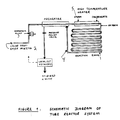
- FIG. 1 A schematic diagram of the tube reactor system is shown in Figure 1.
- the serpentine reaction zone (1) of the tube reactor was approximately 1000 m in length and had an average inside diameter of 22 mm.
- the reaction zone construction material was a titanium alloy (0.2 % PdO2).
- the Bayer process liquor is pumped through the reaction zone (1) under high pressure and at high pressure.
- High pressure steam (5) is used to heat the temperature of the incoming liquor to approximately 270°C. Thereafter, the higher temperatures in the reaction zone were obtained by using the heat of the organics oxidation reaction.
- the Bayer liquor to be oxidized (2) was heated to a temperature of 270-280°C while being pumped, by means of a diaphragm piston pump (3), to the reaction zone (1) under pressure. (At this temperature, the pressure drop across the reactor was 25-30 bar).
- the amount of oxygen introduced into the reaction zone at a partial pressure of at least 30 bar was no more than 50% of the stoichiometric amount necessary to convert the organic carbon content of the liquor to inorganic carbon. This was the largest amount of oxygen which could be used with the existing equipment.
- the higher temperatures (in the range 290-320°C) were obtained, as in the laboratory batch autoclave, by utilizing the exothermic organics oxidation reaction (the heat of reaction was estimated to be about 30 KJ g ⁇ 1 organic carbon converted to inorganic carbon).
- the heat in the reactor outflow was transferred to the incoming liquor within the inner conduit of the double tube preheater.
- the temperature of the liquor leaving the heat recuperation section (4) was of the order of 200°C.
- the oxidized liquor was then flashed directly to atmosphere.
- the tube reactor delivers oxidation efficiencies that are approximately 50% higher than the laboratory batch experiments carried out as far as possible under simulated tube reactor conditions (i.e., turbulent flows non-isothermal conditions).
- simulated tube reactor conditions i.e., turbulent flows non-isothermal conditions.
- 15 bar N2 to the 7.5 bar oxygen introduced to the laboratory batch autoclave an oxidation efficiency of 63.5% was obtained confirming that the higher pressure characteristics of the tube reactor are responsible for the better than expected oxidation efficiencies.
- the initial rapid rise in temperature is related to the organic carbon concentration of the liquor-to-be-oxidized, more particularly the concentration of readily oxidizable low molecular weight organic substances such as sodium acetate.
- the present invention provides an improved method for the catalytic oxidation of Bayer liquor organics whereby no more than the stoichiometric amount of oxygen gas is necessary to obtain low sodium oxalate concentration in oxidized liquor and there is no net build-up of benzene carboxylates.
- transition metals other than copper may be used to accelerate the organics oxidation reaction.
- copper is very likely to be the best catalyst available due its high apparent solubility and redox behavior under the high temperature/high pressure conditions of organics oxidation.
- Copper complexes with soluble organics through the oxygen-containing carboxyl groups of the benzene carboxylates (the hydroxyl groups of phenolics are similarly effective; the phenolics however oxidize much more readily than the benzene carboxylates). It is therefore important not to over-oxidize the organics in Bayer liquor in order to maintain the copper catalyst ions in oxidized liquor prior to their controlled recovery with precipitated aluminum hydroxide.
- An inherent advantage of the present invention is that overshoot of organics oxidation is rendered difficult, even at temperatures of approximately 300°C, because the oxygen gas pressure decreases during organics reaction.
- the organics oxidation process of the invention is largely self controlling provided the stoichiometric amount of oxygen is applied.
- the five percent (5%) of organics which do not oxidize, are in fact the most difficult to oxidize doubly so because the partial pressure of the oxygen gas remaining is too low to oxidize them at the time and temperature involved. If oxidation efficiencies greater than 95% are achieved, then copper begins to crystallize out as black copper (II) oxide, when copper is initially added at the 500 mg/l level.
- the oxidized liquor should contain at least 1 g/l organic carbon.
- the improved method of the present invention has particular relevance to the tube reactor system with its inherent high operating pressures and high temperatures capability.
- air could be used as the oxygen-containing gas if the liquor to be oxidized has an organic carbon content of less than about 20 g/l. Above this organic carbon level pure molecular oxygen gas is necessary at least admixed with air.
- the method of the present invention has large scale industrial benefits.
Landscapes
- Chemical & Material Sciences (AREA)
- Organic Chemistry (AREA)
- Health & Medical Sciences (AREA)
- General Health & Medical Sciences (AREA)
- Life Sciences & Earth Sciences (AREA)
- Geology (AREA)
- Inorganic Chemistry (AREA)
- Organic Low-Molecular-Weight Compounds And Preparation Thereof (AREA)
- Catalysts (AREA)
Applications Claiming Priority (2)
| Application Number | Priority Date | Filing Date | Title |
|---|---|---|---|
| US31507889A | 1989-02-24 | 1989-02-24 | |
| US315078 | 1989-02-24 |
Publications (2)
| Publication Number | Publication Date |
|---|---|
| EP0384272A2 true EP0384272A2 (fr) | 1990-08-29 |
| EP0384272A3 EP0384272A3 (fr) | 1990-12-27 |
Family
ID=23222792
Family Applications (1)
| Application Number | Title | Priority Date | Filing Date |
|---|---|---|---|
| EP19900102840 Withdrawn EP0384272A3 (fr) | 1989-02-24 | 1990-02-14 | Oxydation catalytique de matières organiques présentes dans la liqueur du procédé Bayer |
Country Status (2)
| Country | Link |
|---|---|
| EP (1) | EP0384272A3 (fr) |
| AU (1) | AU5010990A (fr) |
Cited By (1)
| Publication number | Priority date | Publication date | Assignee | Title |
|---|---|---|---|---|
| CN114534662A (zh) * | 2022-03-08 | 2022-05-27 | 昆明理工大学 | 一种超声-非均相催化臭氧氧化脱除铝酸钠溶液中有机物的方法 |
Family Cites Families (3)
| Publication number | Priority date | Publication date | Assignee | Title |
|---|---|---|---|---|
| JPS54110199A (en) * | 1978-02-17 | 1979-08-29 | Sumitomo Aluminium Smelting Co | Method of removing organics from circulating aluminic acid alkali solution |
| HU179404B (en) * | 1978-11-10 | 1982-10-28 | Magyar Aluminium | Process for decomposition of organic materials in aluminate liquor of alum earth-production according to the bayer method,and for separating solide decomposition products |
| US4663133A (en) * | 1985-09-06 | 1987-05-05 | Kaiser Aluminum & Chemical Corporation | Removal of high molecular weight organic compounds from Bayer process caustic liquor |
-
1990
- 1990-02-14 EP EP19900102840 patent/EP0384272A3/fr not_active Withdrawn
- 1990-02-23 AU AU50109/90A patent/AU5010990A/en not_active Abandoned
Cited By (2)
| Publication number | Priority date | Publication date | Assignee | Title |
|---|---|---|---|---|
| CN114534662A (zh) * | 2022-03-08 | 2022-05-27 | 昆明理工大学 | 一种超声-非均相催化臭氧氧化脱除铝酸钠溶液中有机物的方法 |
| CN114534662B (zh) * | 2022-03-08 | 2024-01-30 | 昆明理工大学 | 一种超声-非均相催化臭氧氧化脱除铝酸钠溶液中有机物的方法 |
Also Published As
| Publication number | Publication date |
|---|---|
| EP0384272A3 (fr) | 1990-12-27 |
| AU5010990A (en) | 1990-08-30 |
Similar Documents
| Publication | Publication Date | Title |
|---|---|---|
| US4946666A (en) | Process for the production of fine tabular alumina monohydrate | |
| US4859432A (en) | Novel ceric oxide particulates and process of making | |
| US5198025A (en) | Preparation of metal oxide-doped zinc oxide pigments | |
| US4195189A (en) | Preparation of biphenols by the oxidative coupling of alkylphenols | |
| EP0384272A2 (fr) | Oxydation catalytique de matières organiques présentes dans la liqueur du procédé Bayer | |
| EP0654445A1 (fr) | Méthode de préparation de préparation de poudre de carbonate de cérium | |
| US2204172A (en) | Method of producing chlorine | |
| US4853479A (en) | Process for the manufacture of aromatic dicarboxylic acids and derivatives thereof | |
| EP0180604B1 (fr) | Extraction de substances organiques a partir de courants dans un procede bayer | |
| US3911077A (en) | Tungsten recovery from tungsten ore concentrates by caustic baking | |
| GB2037722A (en) | Removal of organic compounds during the Bayer alumina process | |
| EP0417757A1 (fr) | Procédé pour la préparation de poudre fine de cuivre | |
| CN107597170A (zh) | 利用回收钴锰制备钴锰溴水溶液的方法 | |
| US4564713A (en) | Process for producing 4,4'-dihydroxydiphenyls | |
| AU2008229997A1 (en) | Method of Hydrothermal Treatment of Organic Contaminants of Alkaline Process Solutions | |
| RU2314285C2 (ru) | Способ получения основного ацетата железа (iii) | |
| US3760069A (en) | Process for producing ferrous sulfate | |
| EP0381839B1 (fr) | Procédé de préparation d'un précurseur de catalyseur de synthèse du méthanol | |
| US3963824A (en) | Process for extracting chromium from chromium ores | |
| CN211141541U (zh) | 电子碱生产系统 | |
| JPS5950603B2 (ja) | 亜酸化銅の製造方法 | |
| EP0553251B1 (fr) | Carboxylates de metal | |
| GB2109263A (en) | A catalyst and processes for making and using the catalyst | |
| US2082526A (en) | Production of alumina substantially free from silicic acid from alkaline earth aluminates | |
| CN113620799B (zh) | 2,6-萘二甲酸的制备方法 |
Legal Events
| Date | Code | Title | Description |
|---|---|---|---|
| PUAI | Public reference made under article 153(3) epc to a published international application that has entered the european phase |
Free format text: ORIGINAL CODE: 0009012 |
|
| AK | Designated contracting states |
Kind code of ref document: A2 Designated state(s): AT BE CH DE ES FR GB GR IT LI LU NL SE |
|
| PUAL | Search report despatched |
Free format text: ORIGINAL CODE: 0009013 |
|
| AK | Designated contracting states |
Kind code of ref document: A3 Designated state(s): AT BE CH DE ES FR GB GR IT LI LU NL SE |
|
| 17P | Request for examination filed |
Effective date: 19910606 |
|
| STAA | Information on the status of an ep patent application or granted ep patent |
Free format text: STATUS: THE APPLICATION HAS BEEN WITHDRAWN |
|
| 18W | Application withdrawn |
Withdrawal date: 19911204 |