EP0384277A2 - Procédé et installation de combustion pour la réduction de la formation d'oxyde d'azote pendant la combustion de combustibles fossiles - Google Patents
Procédé et installation de combustion pour la réduction de la formation d'oxyde d'azote pendant la combustion de combustibles fossiles Download PDFInfo
- Publication number
- EP0384277A2 EP0384277A2 EP90102852A EP90102852A EP0384277A2 EP 0384277 A2 EP0384277 A2 EP 0384277A2 EP 90102852 A EP90102852 A EP 90102852A EP 90102852 A EP90102852 A EP 90102852A EP 0384277 A2 EP0384277 A2 EP 0384277A2
- Authority
- EP
- European Patent Office
- Prior art keywords
- combustion chamber
- burner
- combustion
- jacket
- flame tube
- Prior art date
- Legal status (The legal status is an assumption and is not a legal conclusion. Google has not performed a legal analysis and makes no representation as to the accuracy of the status listed.)
- Granted
Links
- 238000002485 combustion reaction Methods 0.000 title claims abstract description 196
- MWUXSHHQAYIFBG-UHFFFAOYSA-N Nitric oxide Chemical compound O=[N] MWUXSHHQAYIFBG-UHFFFAOYSA-N 0.000 title claims abstract description 60
- 230000015572 biosynthetic process Effects 0.000 title claims abstract description 14
- 238000000034 method Methods 0.000 title claims abstract description 11
- 239000002803 fossil fuel Substances 0.000 title claims description 4
- 238000009434 installation Methods 0.000 title 1
- 239000003546 flue gas Substances 0.000 claims abstract description 71
- 239000007789 gas Substances 0.000 claims abstract description 33
- UGFAIRIUMAVXCW-UHFFFAOYSA-N Carbon monoxide Chemical compound [O+]#[C-] UGFAIRIUMAVXCW-UHFFFAOYSA-N 0.000 claims abstract description 28
- 230000000694 effects Effects 0.000 claims abstract description 7
- 238000012546 transfer Methods 0.000 claims abstract description 6
- 238000010438 heat treatment Methods 0.000 claims description 21
- 238000010304 firing Methods 0.000 claims description 11
- 230000003134 recirculating effect Effects 0.000 claims description 8
- XLYOFNOQVPJJNP-UHFFFAOYSA-N water Substances O XLYOFNOQVPJJNP-UHFFFAOYSA-N 0.000 claims description 4
- 239000007788 liquid Substances 0.000 claims description 2
- 239000000779 smoke Substances 0.000 abstract 1
- 238000011161 development Methods 0.000 description 6
- 230000018109 developmental process Effects 0.000 description 6
- 239000000446 fuel Substances 0.000 description 4
- QVGXLLKOCUKJST-UHFFFAOYSA-N atomic oxygen Chemical compound [O] QVGXLLKOCUKJST-UHFFFAOYSA-N 0.000 description 3
- 239000001301 oxygen Substances 0.000 description 3
- 229910052760 oxygen Inorganic materials 0.000 description 3
- IJGRMHOSHXDMSA-UHFFFAOYSA-N Atomic nitrogen Chemical compound N#N IJGRMHOSHXDMSA-UHFFFAOYSA-N 0.000 description 2
- 239000000567 combustion gas Substances 0.000 description 2
- 238000001816 cooling Methods 0.000 description 2
- 238000013461 design Methods 0.000 description 2
- 239000011810 insulating material Substances 0.000 description 2
- VNWKTOKETHGBQD-UHFFFAOYSA-N methane Chemical compound C VNWKTOKETHGBQD-UHFFFAOYSA-N 0.000 description 2
- 239000000203 mixture Substances 0.000 description 2
- 241001156002 Anthonomus pomorum Species 0.000 description 1
- 229910000831 Steel Inorganic materials 0.000 description 1
- 230000004323 axial length Effects 0.000 description 1
- 239000002817 coal dust Substances 0.000 description 1
- 238000010276 construction Methods 0.000 description 1
- 238000011982 device technology Methods 0.000 description 1
- 238000000605 extraction Methods 0.000 description 1
- 238000012986 modification Methods 0.000 description 1
- 230000004048 modification Effects 0.000 description 1
- 239000003345 natural gas Substances 0.000 description 1
- 229910052757 nitrogen Inorganic materials 0.000 description 1
- 230000000149 penetrating effect Effects 0.000 description 1
- 230000001105 regulatory effect Effects 0.000 description 1
- 239000010959 steel Substances 0.000 description 1
- 238000012360 testing method Methods 0.000 description 1
Images

Classifications
-
- F—MECHANICAL ENGINEERING; LIGHTING; HEATING; WEAPONS; BLASTING
- F23—COMBUSTION APPARATUS; COMBUSTION PROCESSES
- F23C—METHODS OR APPARATUS FOR COMBUSTION USING FLUID FUEL OR SOLID FUEL SUSPENDED IN A CARRIER GAS OR AIR
- F23C9/00—Combustion apparatus characterised by arrangements for returning combustion products or flue gases to the combustion chamber
- F23C9/08—Combustion apparatus characterised by arrangements for returning combustion products or flue gases to the combustion chamber for reducing temperature in combustion chamber, e.g. for protecting walls of combustion chamber
-
- F—MECHANICAL ENGINEERING; LIGHTING; HEATING; WEAPONS; BLASTING
- F24—HEATING; RANGES; VENTILATING
- F24H—FLUID HEATERS, e.g. WATER OR AIR HEATERS, HAVING HEAT-GENERATING MEANS, e.g. HEAT PUMPS, IN GENERAL
- F24H1/00—Water heaters, e.g. boilers, continuous-flow heaters or water-storage heaters
- F24H1/22—Water heaters other than continuous-flow or water-storage heaters, e.g. water heaters for central heating
- F24H1/24—Water heaters other than continuous-flow or water-storage heaters, e.g. water heaters for central heating with water mantle surrounding the combustion chamber or chambers
- F24H1/26—Water heaters other than continuous-flow or water-storage heaters, e.g. water heaters for central heating with water mantle surrounding the combustion chamber or chambers the water mantle forming an integral body
- F24H1/263—Water heaters other than continuous-flow or water-storage heaters, e.g. water heaters for central heating with water mantle surrounding the combustion chamber or chambers the water mantle forming an integral body with a dry-wall combustion chamber
Definitions
- the invention relates to a method for reducing nitrogen oxide formation when burning fossil fuels of gaseous, liquid or fine-grained consistency in a combustion chamber equipped with at least one burner, in which at least a partial flow of the flue gases is returned to the burner side and recirculated after releasing at least part of its thermal energy the burner or a flame tube associated therewith is re-inserted into the combustion chamber.
- the invention relates to a firing system used to carry out the method, in particular designed as a boiler for building heating.
- DE-PS 37 38 623 also discloses a boiler with search gas recirculation which, at the burner end of the combustion chamber, has a deflection plate, which closes the combustion chamber at a distance from a boiler door that communicates the burner holder, with an injector channel, and can be recycled into the combustion chamber by a subset of the partially cooled flue gases is.
- This flue gas recirculation is intended to reduce the nitrogen oxide content in the exhaust gas by lowering the oxygen partial pressure.
- this problem is solved, starting from the method specified at the outset, in that the recirculating flue gases, after prior heat removal, in a combustion temperature at a temperature level at most equal to the limit temperature for the formation of nitrogen oxides corresponding subset around the burner in the combustion chamber.
- the flue gases are let into the combustion chamber in a partial quantity which keeps the combustion temperature in the combustion chamber at about 1200 ° C. after prior heat removal.
- the object on which the invention is based is achieved by creating a firing system, in particular a boiler for building heating systems, in which a heat transfer medium, such as water, leading housing, a combustion chamber with at least one burner is accommodated and the combustion chamber has a combustion chamber which is enclosed by a jacket which extends essentially over its entire length and is surrounded with flow paths for returning the flue gases after their directional reversal on the side of the combustion chamber facing away from the burner which extend between the jacket and a wall delimiting the combustion chamber, at least some of these flow paths opening into a burner-side exhaust gas chamber, which in turn is connected to the combustion chamber via an inflow path extending around the burner or a flame tube associated with the latter, that a flame developed by the burner or the flame tube is essentially completely enclosed by the partial flue gas stream returned to the combustion chamber, and the cross section of the inflow path opening into the combustion chamber it is changeable for the recirculating flue gases.
- a heat transfer medium such as water, leading housing
- the furnace according to the invention thus has a "hot" combustion chamber.
- Hot combustion chambers have proven themselves to achieve good combustion efficiency. With sufficient presence of oxygen, a practically complete burnout takes place in such combustion chambers, but undesirably high nitrogen oxide emissions occur because excess quantities of oxygen and nitrogen of the combustion air that are necessary oxidize to nitrogen oxides at the combustion temperatures that occur.
- combustion plant according to the invention also has a "hot" combustion chamber, combustion of the flame at a temperature level below or at most equal to the limit temperature for the formation of nitrogen oxides takes place as a result of cooling the flame by recirculating - cool - flue gases in the combustion chamber, which are recirculated into the combustion chamber.
- the inflow path connecting the exhaust gas chamber to the combustion chamber consists of a gap extending all around the burner or a flame tube, the width of which for sucking in a subset of the - cooled - flue gases into the combustion chamber compared to one of the exhaust gas chamber on that of the combustion chamber wall facing away from the side can be changed by means of a sleeve which can be adjusted in the longitudinal direction of the combustion chamber and which adjoins the jacket on the burner side to the jacket surrounding the combustion chamber.
- the jacket enclosing the combustion chamber essentially over its entire length is pot-shaped and provided with a bottom on the burner side, the burner or a flame tube protruding into the combustion chamber through an opening in the bottom and this opening being excessively large has in relation to the burner or flame tube in such a way that an annular channel for sucking in flue gas from the exhaust gas space extends into the combustion chamber around the burner or flame tube.
- a sleeve which can be displaced in the longitudinal direction of the combustion chamber and which is adjusted by the axial adjustment of the width of an inflow gap between this sleeve and one of the exhaust gas chamber in order to adjust the amount of exhaust gas which can be sucked into the combustion chamber in the opening in the bottom of the jacket surrounding the combustion chamber Combustion chamber side facing the wall to be adjustable.
- the sleeve slidably received in the opening in the bottom of the jacket surrounding the combustion chamber on the ver Combustion chamber-facing side has a funnel-shaped widening section, it is possible in a simple manner to enclose the flame further developed by the burner or the flame tube over a large axial length with flue gas and thereby effectively cool it.
- Another important embodiment provides that when the combustion chamber extends essentially horizontally in the housing, the flue gases recirculated in the upper part between the jacket surrounding the combustion chamber and the combustion chamber are fed directly to a flue gas outlet, whereas the flue gases recirculated in the lower part are introduced into a flue gas-side flue space and from there, in part due to the injector effect of the flame around the burner or a flame tube around the combustion chamber.
- the flue gases recirculated in the upper part between the jacket surrounding the combustion chamber and the combustion chamber have higher temperatures than the flue gases recirculated in the lower half due to thermal buoyancy.
- an approximately semicircular collar extends from the burner-side end thereof and extends to the burner-side insulating plate, which collar extends in the upper part of the combustion chamber - Separates flow paths from the exhaust gas chamber so that a partial quantity can only be sucked into the combustion chamber from the flue gases which are returned in the area of the lower combustion chamber half.
- inflow paths for sucking in cool flue gases are arranged in a bottom which closes the jacket on the burner side around an opening arranged coaxially to the burner or flame tube and into which the burner or flame tube projects, and further if means for at least partially closing these inflow paths are provided, which allow a quantity limitation of the flue gases that can be sucked into the combustion chamber due to the injector effect of the flame.
- Another important embodiment of the invention provides that on the side of the combustion chamber opposite the burner there is a pot-shaped additional heating surface which, in view of the heating surface enlargement caused thereby and its reaching into the combustion chamber, leads to a noticeable improvement in the - firing-related - efficiency contributes.
- the additional heating surface arranged at the end of the combustion chamber opposite the burner can expediently be conical, cylindrical or in the form of a pocket and, in the interest of improved heat transfer, also have ribs on the side in contact with the flue gas.
- the jacket surrounding the combustion chamber extends axially beyond the actual combustion chamber formed by a finned tube.
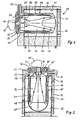
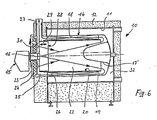
- a water-carrying housing 11 made of sheet steel, which in turn is from one in detail here jacket 12 of interest is surrounded by insulating material, a horizontally extending and essentially cylindrical combustion chamber 14 is accommodated.
- a burner 15 with a flame tube 16 At one end of the combustion chamber 14 there is a burner 15 with a flame tube 16, while the end facing away from the burner is closed off by a heating surface 17 molded into the combustion chamber like a pot.
- the cylindrical part of the combustion chamber 14 consists of a finned tube 18 with fins 19 extending radially inwards, between which flow paths extending parallel to one another extend.
- a cylindrical jacket 20 is received within the combustion chamber 14 at a radial distance from the combustion chamber walls formed by the finned tube, which ends at a distance from the heating surface 17 of the combustion chamber facing away from the burner side and encloses a combustion chamber 22.
- An exhaust gas chamber 25 is arranged between a burner plate 23 carrying the burner 15 with an insulating plate 24 assigned to the combustion chamber, through which the flame tube 16 of the burner extends, and the cylindrical jacket 20 surrounding the combustion chamber 22 the flue gas flow paths 26, which extend at a radial distance therefrom, flow out. Furthermore, a flue gas outlet 27 extends from the exhaust gas chamber 25.
- a sleeve 28 is connected to the cylindrical jacket 20 accommodated in the combustion chamber 14, which sleeve is used for the purpose of adjusting a position between the latter and the flame tube 16 surrounding insulating plate 24 annularly around the flame tube extending gap 30 axially movable according to double arrow 29 and can be determined in the respective setting position.
- the fuel used is burned in a flame which extends from the flame tube 16 into the combustion chamber 22.
- the flue gases flow around the end of the cylindrical jacket 20 arranged in the combustion chamber 14 away from the flame tube and between the latter and the combustion chamber in the flow paths 26 formed by the circumferentially spaced ribs 19 of the finned tube 18 to the burner side, in order there to enter the exhaust gas space 25 and then to be discharged via the flue gas discharge 27.
- the flue gases give off their thermal energy largely via the finned tube 18 of the combustion chamber 14 to the water 32 received as heat transfer medium in the housing 11 and thus enter the exhaust gas chamber 25 in the cooled state.
- the combustion temperature In order to effectively reduce or prevent nitrogen oxide formation during combustion, the combustion temperature must be set to a temperature level which is below the limit temperature which is relevant for the formation of nitrogen oxides. This is achieved in a simple manner by regulating the quantity of the cool flue gases flowing into the combustion chamber 22 through the said annular gap 30 by appropriately adjusting the width of the inflow gap between the burner-side end face of the adjustable sleeve 28 and the insulating plate 24 surrounding the flame tube 16 of the burner.
- Fig. 2 differs in particular from the embodiment of Fig. 1 that within a water-carrying housing 11 ', which is surrounded by a jacket 12' made of insulating material, a cylindrical combustion chamber 14 'extends vertically.
- This combustion chamber which is also closed on one side by a burner plate 23 with an inner insulating plate 24 and on the other end face has a bottom in the manner of a spherical cap 17 ', in its cylindrical part in turn consists of a finned tube 18 with a radially inward direction Ribs 19 which are parallel to each other in the axial direction.
- a cylindrical jacket 20 is also inserted into this combustion chamber, which, as in the embodiment according to FIG. 1, is on the side of the burner opposite side extends to a certain extent beyond the finned tube 18 and is closed on the burner side by a conical bottom 34.
- Coaxial to the flame tube 16 extending through the insulating plate 24 of the burner 15 arranged on the burner plate 23 is within a provided with a collar 35 recess of the conical bottom 34 of the cylindrical shell 20 which surrounds the combustion chamber, in turn a cylindrical sleeve 28 'axially movably received, which has oversize compared to the flame tube 16 of the burner. In view of this excess extends between the flame tube 16 and the sleeve 28 'an annular inflow gap for cooled flue gases which are sucked into the combustion chamber during operation of the boiler by the injector effect emanating from the flame and which largely completely enclose the flame extending from the flame tube.
- the sleeve 28 ' is axially displaceable for the purpose of adjusting the width of the gap 30' between the sleeve 28 'and the exhaust gas chamber 25 on the end facing away from the combustion chamber 22 insulating plate 24. This is a precise adjustment of the amount of flue gas returned to the combustion chamber for cooling the flame possible depending on the requirements of the respective application.
- the boiler illustrated in Fig. 3 has Again, like the embodiment according to FIG. 1, a horizontally arranged combustion chamber 14, but in accordance with the embodiment according to FIG. 2, the jacket 20 surrounding the combustion chamber is provided on the burner side with a conical bottom 34, in which coaxial to the flame tube 16 of the burner 15 a sleeve is axially movable and can be locked in any axial position.
- This sleeve has a section 36 which widens slightly conically towards the combustion chamber 22 and which favors the inclusion of the flame extending from the flame tube with cool exhaust gases which are sucked out of the exhaust gas chamber into the combustion chamber as a result of the injector effect.
- the cylindrical jacket 20 surrounding the combustion chamber 22 is closed on the burner side by a straight bottom 34 '.
- the burner-side termination of the jacket by means of a straight - or also conical - base has proven to be advantageous in that the exhaust gas space becomes larger and the flue gas-side resistance becomes smaller. This favors a rapid flow through the combustion chamber with exhaust gases sucked into it and thus contributes to reduced nitrogen oxide formation.
- FIGS. 1 and 3 is a construction with a horizontally arranged Combustion chamber 14.
- the channels extending in the upper region between the casing 20 surrounding the combustion chamber 22 and the combustion chamber 14 are subjected to a higher thermal load due to the thermal buoyancy of the heating gases than the channels leading to the exhaust gas chamber 25 in the lower region. 4 and 5, by extending between the straight bottom 34 'and the insulating plate 24 penetrated by the flame tube 16 of the burner 15, a semicircular collar 38 which flows back through the flow paths in the upper half of the combustion chamber - Thermally more heavily loaded - introduces flue gas directly into the flue gas outlet 27.
- Fig. 5 illustrates in a representation corresponding to the section VV in Fig. 4 another variant, in which around a straight bottom 34 'of the jacket surrounding the combustion chamber 20 coaxially penetrating the flame tube of the burner recess in the upper half of several holes 40, however larger flow cross in the lower half cuts having elongated holes 41 are arranged around the flame tube.
- means for partially or completely covering the bores or elongated holes can also be provided, which in turn leads to a simple adaptability of a boiler designed in this way to the requirements of the respective application.
- the boiler 10 'illustrated in Fig. 6' differs from the embodiment of Fig. 1 only in that the extending on the side facing away from the burner in the combustion chamber additional heating surface 17 ', which is substantially frustoconical, not symmetrical to the combustion chamber longitudinal axis arranged, but is offset upwards. Accordingly, have in the upper part of the combustion chamber between the jacket 20 and the additional heating surface 17 'extending discharge paths for the combustion gases smaller cross-sections than the discharge paths in the lower part.
Landscapes
- Engineering & Computer Science (AREA)
- Chemical & Material Sciences (AREA)
- Combustion & Propulsion (AREA)
- Mechanical Engineering (AREA)
- General Engineering & Computer Science (AREA)
- Physics & Mathematics (AREA)
- Thermal Sciences (AREA)
- Treating Waste Gases (AREA)
- Catalysts (AREA)
Applications Claiming Priority (2)
| Application Number | Priority Date | Filing Date | Title |
|---|---|---|---|
| DE3905762 | 1989-02-24 | ||
| DE3905762A DE3905762A1 (de) | 1989-02-24 | 1989-02-24 | Verfahren und feuerungsanlage zum reduzieren der stickoxidbildung beim verbrennen fossiler brennstoffe |
Publications (3)
| Publication Number | Publication Date |
|---|---|
| EP0384277A2 true EP0384277A2 (fr) | 1990-08-29 |
| EP0384277A3 EP0384277A3 (fr) | 1991-07-31 |
| EP0384277B1 EP0384277B1 (fr) | 1994-05-25 |
Family
ID=6374855
Family Applications (1)
| Application Number | Title | Priority Date | Filing Date |
|---|---|---|---|
| EP90102852A Revoked EP0384277B1 (fr) | 1989-02-24 | 1990-02-14 | Procédé et installation de combustion pour la réduction de la formation d'oxyde d'azote pendant la combustion de combustibles fossiles |
Country Status (3)
| Country | Link |
|---|---|
| EP (1) | EP0384277B1 (fr) |
| AT (1) | ATE106127T1 (fr) |
| DE (2) | DE3905762A1 (fr) |
Cited By (9)
| Publication number | Priority date | Publication date | Assignee | Title |
|---|---|---|---|---|
| EP0387859A3 (fr) * | 1989-03-14 | 1991-07-24 | Pyropac AG | Chaudière de chauffage |
| AU614467B2 (en) * | 1989-05-04 | 1991-08-29 | Bloom Engineering Company, Inc. | Method and device for controlling nox emissions by vitiation |
| EP0483520A3 (en) * | 1990-10-02 | 1992-10-14 | Vereinigte Aluminium-Werke Aktiengesellschaft | Method and apparatus for the combustion of gaseous and liquid fuels generating a low emission of noxious products |
| WO1999061839A1 (fr) * | 1998-05-25 | 1999-12-02 | Wedab Wave Energy Development Ab | Systeme chaudiere et procede permettant de bruler l'huile |
| EP1046862A1 (fr) * | 1999-04-21 | 2000-10-25 | Klaus Lorenz | Brûleur avec chemin de circulation helicoidal pour les produits de combustion |
| WO2006043869A1 (fr) * | 2004-10-22 | 2006-04-27 | Sandvik Intellectual Property Ab | Procede de combustion a l'aide de bruleurs dans des fours industriels, et bruleur prevu a cet effet |
| EP2741000A3 (fr) * | 2012-12-04 | 2014-08-20 | Ökofen Forschungs- und Entwicklungsges. M.B.H. | Chaudière dotée d'un moteur thermique |
| CN106895399A (zh) * | 2017-04-25 | 2017-06-27 | 武建斌 | 一种醇基燃料锅炉内部用气化燃烧装置 |
| CN120819908A (zh) * | 2025-09-18 | 2025-10-21 | 克拉玛依市独山子区晟通热力有限责任公司 | 一种一体化循环式热水锅炉 |
Families Citing this family (4)
| Publication number | Priority date | Publication date | Assignee | Title |
|---|---|---|---|---|
| DE4308731A1 (de) * | 1993-03-19 | 1994-09-22 | Babcock Omnical Gmbh | Verfahren zur Verminderung der Bildung von NOx und Kessel |
| DE4332258C2 (de) * | 1993-09-22 | 1998-01-15 | Ppv Verwaltungs Ag | Aufsatz für einen Brenner |
| DE102005019509A1 (de) * | 2005-04-27 | 2006-11-02 | Valentin Rosel | Kugel-Brennwert-Öl-Gasheizkessel mit Rundscheibennachschaltheizfläche |
| DE102008022696A1 (de) | 2008-05-07 | 2009-11-12 | Solvis Gmbh & Co. Kg | Feuerungseinrichtung mit einer Reinigungseinrichtung |
Family Cites Families (9)
| Publication number | Priority date | Publication date | Assignee | Title |
|---|---|---|---|---|
| US2585477A (en) * | 1945-12-22 | 1952-02-12 | Stewart Warner Corp | Thermostatic control for hotwater heaters and the like |
| AT231113B (de) * | 1961-05-16 | 1964-01-10 | Rene Gossalter | Mit flüssigem Brennstoff beheizter Kessel |
| DE2927193A1 (de) * | 1979-07-05 | 1981-01-15 | Koerting Hannover Ag | Vorrichtung zum erwaermen von fluessigkeiten |
| DE3140821A1 (de) * | 1981-10-09 | 1983-04-21 | Körting Hannover AG, 3000 Hannover | Vorrichtung zum erwaermen von fluessigkeiten |
| DE3601000A1 (de) * | 1985-07-02 | 1987-06-19 | Vaillant Joh Gmbh & Co | Wasserheizkessel |
| DE3628293A1 (de) * | 1986-08-20 | 1988-02-25 | Wolf Klimatechnik Gmbh | Heizkessel fuer die verbrennung fluessiger und/oder gasfoermiger brennstoffe |
| AT389164B (de) * | 1986-09-11 | 1989-10-25 | Olymp Werk A Schwarz Ges M B H | Heizkessel |
| DE3713408A1 (de) * | 1987-04-21 | 1988-11-03 | Weishaupt Max Gmbh | Verfahren zur reduzierung von no(pfeil abwaerts)x(pfeil abwaerts)-werten bei oel- oder gasbetriebenen feuerungsanlagen |
| DE3738623C2 (de) * | 1987-11-11 | 1995-05-04 | Wolf Klimatechnik Gmbh | Heizkessel mit Rauchgasrezirkulation |
-
1989
- 1989-02-24 DE DE3905762A patent/DE3905762A1/de active Granted
-
1990
- 1990-02-14 EP EP90102852A patent/EP0384277B1/fr not_active Revoked
- 1990-02-14 AT AT90102852T patent/ATE106127T1/de not_active IP Right Cessation
- 1990-02-14 DE DE59005785T patent/DE59005785D1/de not_active Revoked
Cited By (10)
| Publication number | Priority date | Publication date | Assignee | Title |
|---|---|---|---|---|
| EP0387859A3 (fr) * | 1989-03-14 | 1991-07-24 | Pyropac AG | Chaudière de chauffage |
| AU614467B2 (en) * | 1989-05-04 | 1991-08-29 | Bloom Engineering Company, Inc. | Method and device for controlling nox emissions by vitiation |
| EP0483520A3 (en) * | 1990-10-02 | 1992-10-14 | Vereinigte Aluminium-Werke Aktiengesellschaft | Method and apparatus for the combustion of gaseous and liquid fuels generating a low emission of noxious products |
| WO1999061839A1 (fr) * | 1998-05-25 | 1999-12-02 | Wedab Wave Energy Development Ab | Systeme chaudiere et procede permettant de bruler l'huile |
| EP1046862A1 (fr) * | 1999-04-21 | 2000-10-25 | Klaus Lorenz | Brûleur avec chemin de circulation helicoidal pour les produits de combustion |
| WO2006043869A1 (fr) * | 2004-10-22 | 2006-04-27 | Sandvik Intellectual Property Ab | Procede de combustion a l'aide de bruleurs dans des fours industriels, et bruleur prevu a cet effet |
| US7993130B2 (en) | 2004-10-22 | 2011-08-09 | Sandvik Intellectual Property Ab | Method of combustion with the aid of burners in industrial furnaces, and a burner to this end |
| EP2741000A3 (fr) * | 2012-12-04 | 2014-08-20 | Ökofen Forschungs- und Entwicklungsges. M.B.H. | Chaudière dotée d'un moteur thermique |
| CN106895399A (zh) * | 2017-04-25 | 2017-06-27 | 武建斌 | 一种醇基燃料锅炉内部用气化燃烧装置 |
| CN120819908A (zh) * | 2025-09-18 | 2025-10-21 | 克拉玛依市独山子区晟通热力有限责任公司 | 一种一体化循环式热水锅炉 |
Also Published As
| Publication number | Publication date |
|---|---|
| ATE106127T1 (de) | 1994-06-15 |
| DE3905762A1 (de) | 1990-08-30 |
| DE3905762C2 (fr) | 1993-02-18 |
| DE59005785D1 (de) | 1994-06-30 |
| EP0384277B1 (fr) | 1994-05-25 |
| EP0384277A3 (fr) | 1991-07-31 |
Similar Documents
| Publication | Publication Date | Title |
|---|---|---|
| DE68913590T2 (de) | Verbrennungsverfahren eines Ofens. | |
| EP0102507A2 (fr) | Dispositif destiné à l'injection du combustible dans les chambres de combustion des moteurs à combustion interne du type à auto-allumage | |
| EP0384277B1 (fr) | Procédé et installation de combustion pour la réduction de la formation d'oxyde d'azote pendant la combustion de combustibles fossiles | |
| DE3343617C2 (fr) | ||
| DE3738623C2 (de) | Heizkessel mit Rauchgasrezirkulation | |
| DE3628293A1 (de) | Heizkessel fuer die verbrennung fluessiger und/oder gasfoermiger brennstoffe | |
| EP1004833A2 (fr) | Chaudière | |
| DE4238529C2 (de) | Brenner zur Heißgaserzeugung | |
| DE2845588A1 (de) | Brennkammer fuer gasturbinentriebwerke | |
| DE8203062U1 (de) | Brenner zum erhitzen von verbrennungsluft und brennstoff in heizungsanlagen | |
| EP0387859B1 (fr) | Chaudière de chauffage | |
| DE2749089A1 (de) | Ofen | |
| DE3105552A1 (de) | Verbrennungsvorrichtung fuer vergasten fluessigen brennstoff | |
| DE102008019532B3 (de) | Ölvormischbrenner | |
| EP0292580B1 (fr) | Chaudière de chauffage | |
| DE10203116B4 (de) | Heizgerät mit einem becherförmigen Wärmeübertrager | |
| EP0445393B1 (fr) | Brûleur avec récirculation des gaz d'échappement, notamment brûleur à air soufflé | |
| DE2624617C3 (de) | Brenner mit Wärmetauscher | |
| DE2952564C1 (de) | Heizungskessel | |
| DE10014104A1 (de) | Brenner | |
| DE9404317U1 (de) | Einrichtung zum Führen der Brennergase in einem Ofen | |
| EP0007424A1 (fr) | Brûleur pour combustion de carburants liquides | |
| DE8536716U1 (de) | Heizkessel | |
| DE8033855U1 (de) | Flammrohr aus hitzebestaendigem werkstoff fuer brenner, insbesondere oelbrenner | |
| DE2943289A1 (de) | Brenner fuer fluessige und/oder gasfoermige brennstoffe, insbesondere fuer industrielle oefen |
Legal Events
| Date | Code | Title | Description |
|---|---|---|---|
| PUAI | Public reference made under article 153(3) epc to a published international application that has entered the european phase |
Free format text: ORIGINAL CODE: 0009012 |
|
| AK | Designated contracting states |
Kind code of ref document: A2 Designated state(s): AT BE CH DE DK ES FR GB GR IT LI NL SE |
|
| PUAL | Search report despatched |
Free format text: ORIGINAL CODE: 0009013 |
|
| AK | Designated contracting states |
Kind code of ref document: A3 Designated state(s): AT BE CH DE DK ES FR GB GR IT LI NL SE |
|
| 17P | Request for examination filed |
Effective date: 19911121 |
|
| 17Q | First examination report despatched |
Effective date: 19920907 |
|
| GRAA | (expected) grant |
Free format text: ORIGINAL CODE: 0009210 |
|
| AK | Designated contracting states |
Kind code of ref document: B1 Designated state(s): AT BE CH DE DK ES FR GB GR IT LI NL SE |
|
| PG25 | Lapsed in a contracting state [announced via postgrant information from national office to epo] |
Ref country code: GB Effective date: 19940525 Ref country code: IT Free format text: LAPSE BECAUSE OF FAILURE TO SUBMIT A TRANSLATION OF THE DESCRIPTION OR TO PAY THE FEE WITHIN THE PRE;WARNING: LAPSES OF ITALIAN PATENTS WITH EFFECTIVE DATE BEFORE 2007 MAY HAVE OCCURRED AT ANY TIME BEFORE 2007. THE CORRECT EFFECTIVE DATE MAY BE DIFFERENT FROM THE ONE RECORDED.SCRIBED TIME-LIMIT Effective date: 19940525 Ref country code: NL Effective date: 19940525 Ref country code: DK Effective date: 19940525 |
|
| REF | Corresponds to: |
Ref document number: 106127 Country of ref document: AT Date of ref document: 19940615 Kind code of ref document: T |
|
| REF | Corresponds to: |
Ref document number: 59005785 Country of ref document: DE Date of ref document: 19940630 |
|
| ET | Fr: translation filed | ||
| PG25 | Lapsed in a contracting state [announced via postgrant information from national office to epo] |
Ref country code: GR Free format text: LAPSE BECAUSE OF FAILURE TO SUBMIT A TRANSLATION OF THE DESCRIPTION OR TO PAY THE FEE WITHIN THE PRESCRIBED TIME-LIMIT Effective date: 19940826 Ref country code: ES Free format text: LAPSE BECAUSE OF FAILURE TO SUBMIT A TRANSLATION OF THE DESCRIPTION OR TO PAY THE FEE WITHIN THE PRESCRIBED TIME-LIMIT Effective date: 19940826 |
|
| NLV1 | Nl: lapsed or annulled due to failure to fulfill the requirements of art. 29p and 29m of the patents act | ||
| GBV | Gb: ep patent (uk) treated as always having been void in accordance with gb section 77(7)/1977 [no translation filed] |
Effective date: 19940525 |
|
| EAL | Se: european patent in force in sweden |
Ref document number: 90102852.2 |
|
| PLBI | Opposition filed |
Free format text: ORIGINAL CODE: 0009260 |
|
| 26 | Opposition filed |
Opponent name: MAX WEISHAUPT GMBH Effective date: 19950222 |
|
| PGFP | Annual fee paid to national office [announced via postgrant information from national office to epo] |
Ref country code: FR Payment date: 19960125 Year of fee payment: 7 |
|
| PGFP | Annual fee paid to national office [announced via postgrant information from national office to epo] |
Ref country code: AT Payment date: 19960213 Year of fee payment: 7 |
|
| PGFP | Annual fee paid to national office [announced via postgrant information from national office to epo] |
Ref country code: DE Payment date: 19960215 Year of fee payment: 7 Ref country code: SE Payment date: 19960215 Year of fee payment: 7 |
|
| PGFP | Annual fee paid to national office [announced via postgrant information from national office to epo] |
Ref country code: CH Payment date: 19960308 Year of fee payment: 7 |
|
| PGFP | Annual fee paid to national office [announced via postgrant information from national office to epo] |
Ref country code: BE Payment date: 19960412 Year of fee payment: 7 |
|
| RDAH | Patent revoked |
Free format text: ORIGINAL CODE: EPIDOS REVO |
|
| RDAG | Patent revoked |
Free format text: ORIGINAL CODE: 0009271 |
|
| STAA | Information on the status of an ep patent application or granted ep patent |
Free format text: STATUS: PATENT REVOKED |
|
| REG | Reference to a national code |
Ref country code: CH Ref legal event code: PL |
|
| 27W | Patent revoked |
Effective date: 19960801 |