EP0384409A2 - Détecteur infrarouge comportant un vibreur de cristaux liquides - Google Patents
Détecteur infrarouge comportant un vibreur de cristaux liquides Download PDFInfo
- Publication number
- EP0384409A2 EP0384409A2 EP90103261A EP90103261A EP0384409A2 EP 0384409 A2 EP0384409 A2 EP 0384409A2 EP 90103261 A EP90103261 A EP 90103261A EP 90103261 A EP90103261 A EP 90103261A EP 0384409 A2 EP0384409 A2 EP 0384409A2
- Authority
- EP
- European Patent Office
- Prior art keywords
- liquid crystal
- chopper
- electrically conductive
- infrared sensor
- pyroelectric element
- Prior art date
- Legal status (The legal status is an assumption and is not a legal conclusion. Google has not performed a legal analysis and makes no representation as to the accuracy of the status listed.)
- Granted
Links
Images





Classifications
-
- G—PHYSICS
- G01—MEASURING; TESTING
- G01J—MEASUREMENT OF INTENSITY, VELOCITY, SPECTRAL CONTENT, POLARISATION, PHASE OR PULSE CHARACTERISTICS OF INFRARED, VISIBLE OR ULTRAVIOLET LIGHT; COLORIMETRY; RADIATION PYROMETRY
- G01J5/00—Radiation pyrometry, e.g. infrared or optical thermometry
- G01J5/10—Radiation pyrometry, e.g. infrared or optical thermometry using electric radiation detectors
- G01J5/34—Radiation pyrometry, e.g. infrared or optical thermometry using electric radiation detectors using capacitors, e.g. pyroelectric capacitors
-
- G—PHYSICS
- G01—MEASURING; TESTING
- G01J—MEASUREMENT OF INTENSITY, VELOCITY, SPECTRAL CONTENT, POLARISATION, PHASE OR PULSE CHARACTERISTICS OF INFRARED, VISIBLE OR ULTRAVIOLET LIGHT; COLORIMETRY; RADIATION PYROMETRY
- G01J5/00—Radiation pyrometry, e.g. infrared or optical thermometry
- G01J5/02—Constructional details
- G01J5/08—Optical arrangements
- G01J5/0803—Arrangements for time-dependent attenuation of radiation signals
- G01J5/0805—Means for chopping radiation
-
- G—PHYSICS
- G02—OPTICS
- G02F—OPTICAL DEVICES OR ARRANGEMENTS FOR THE CONTROL OF LIGHT BY MODIFICATION OF THE OPTICAL PROPERTIES OF THE MEDIA OF THE ELEMENTS INVOLVED THEREIN; NON-LINEAR OPTICS; FREQUENCY-CHANGING OF LIGHT; OPTICAL LOGIC ELEMENTS; OPTICAL ANALOGUE/DIGITAL CONVERTERS
- G02F1/00—Devices or arrangements for the control of the intensity, colour, phase, polarisation or direction of light arriving from an independent light source, e.g. switching, gating or modulating; Non-linear optics
- G02F1/01—Devices or arrangements for the control of the intensity, colour, phase, polarisation or direction of light arriving from an independent light source, e.g. switching, gating or modulating; Non-linear optics for the control of the intensity, phase, polarisation or colour
- G02F1/13—Devices or arrangements for the control of the intensity, colour, phase, polarisation or direction of light arriving from an independent light source, e.g. switching, gating or modulating; Non-linear optics for the control of the intensity, phase, polarisation or colour based on liquid crystals, e.g. single liquid crystal display cells
- G02F1/137—Devices or arrangements for the control of the intensity, colour, phase, polarisation or direction of light arriving from an independent light source, e.g. switching, gating or modulating; Non-linear optics for the control of the intensity, phase, polarisation or colour based on liquid crystals, e.g. single liquid crystal display cells characterised by the electro-optical or magneto-optical effect, e.g. field-induced phase transition, orientation effect, guest-host interaction or dynamic scattering
- G02F1/13743—Devices or arrangements for the control of the intensity, colour, phase, polarisation or direction of light arriving from an independent light source, e.g. switching, gating or modulating; Non-linear optics for the control of the intensity, phase, polarisation or colour based on liquid crystals, e.g. single liquid crystal display cells characterised by the electro-optical or magneto-optical effect, e.g. field-induced phase transition, orientation effect, guest-host interaction or dynamic scattering based on electrohydrodynamic instabilities or domain formation in liquid crystals
- G02F1/1375—Devices or arrangements for the control of the intensity, colour, phase, polarisation or direction of light arriving from an independent light source, e.g. switching, gating or modulating; Non-linear optics for the control of the intensity, phase, polarisation or colour based on liquid crystals, e.g. single liquid crystal display cells characterised by the electro-optical or magneto-optical effect, e.g. field-induced phase transition, orientation effect, guest-host interaction or dynamic scattering based on electrohydrodynamic instabilities or domain formation in liquid crystals using dynamic scattering
-
- H—ELECTRICITY
- H10—SEMICONDUCTOR DEVICES; ELECTRIC SOLID-STATE DEVICES NOT OTHERWISE PROVIDED FOR
- H10W—GENERIC PACKAGES, INTERCONNECTIONS, CONNECTORS OR OTHER CONSTRUCTIONAL DETAILS OF DEVICES COVERED BY CLASS H10
- H10W90/00—Package configurations
- H10W90/701—Package configurations characterised by the relative positions of pads or connectors relative to package parts
- H10W90/751—Package configurations characterised by the relative positions of pads or connectors relative to package parts of bond wires
- H10W90/753—Package configurations characterised by the relative positions of pads or connectors relative to package parts of bond wires between laterally-adjacent chips
Definitions
- the present invention relates to an infrared sensor designed to detect infrared rays with the use of a pyroelectric element and also to a liquid crystal chopper for use in such infrared sensor or the like.
- a chopper mechanism In an infrared sensor employing a pyroelectric element, a chopper mechanism is required to intermittently cut the infrared rays incident upon the pyroelectric element, so that an output indicative of the detection of infrared rays from the pyroelectric element is continuously obtained.
- a vane-shaped rotary body or vibrating element, etc. has been used for the chopper mechanism mentioned above.
- this kind of chopper mechanism is disadvantageously bulky in structure and high in cost, with consuming a large amount of electric power.
- a liquid crystal shutter has been noted as the chopper mechanism which is stationary and able to be rendered compact in size.
- Japanese Patent Application Laid-Open No. 62-23412 discloses a liquid crystal chopper of TN (twisted nematic) type.
- This liquid crystal chopper of TN type is, when it is utilized as a chopper, not free from such a drawback as a long response time (particularly, a fall time).
- the TN-type liquid crystal chopper needs a deflecting plate for infrared rays (wavelength of approximately 3 ⁇ m - 12 ⁇ m), which plate is considerably expensive.
- a liquid crystal chopper according to the present invention is comprised of a pair of electrically conductive substrates provided opposite to each other, a spacer keeping the pair of electrically conductive substrates at a predetermined distance thereby defining a space, and a liquid crystal of DSM (dynamic scattering mode) type enclosed within the space and having a dielectric anisotropy of -0.5 or more and not exceeding 0.
- the electrically conductive substrates may be made of silicon or germanium and the liquid crystal may be made of para-azoxyanisole.
- an infrared sensor which uses a liquid crystal chopper for intermittently interrupting the infrared rays incident upon a pyroelectric element, wherein the liquid crystal chopper is comprised of a pair of electrically conductive substrates provided opposite to each other, a spacer keeping the electrically conductive sub strates at a predetermined distance thereby defining a space, a liquid crystal enclosed within the space.
- the operating mode of the liquid crystal may either DSM type or TN type.
- the infrared rays can be focused onto the pyroelectric element, whereby the amount of infrared rays incident upon the pyroelectric element is made greatly different between when a voltage is applied to the electrically conductive substrates and when no voltage is applied thereto.
- the application of voltage namely, a cycle of positive voltage, 0 voltage, negative voltage and 0 voltage is repeated by a predetermined number of times in the electrically conductive substrates of the liquid crystal chopper.
- the number of cycles is determined in relation to the sensitivity of the pyroelectric element.
- one of the electrically conductive substrates at the side of the pyroelectric element is grounded.
- the pyroelectric element and liquid crystal chopper are enclosed by a housing which is provided with a window so as to guide infrared rays therethrough via the liquid crystal chopper onto the pyroelectric element.
- the thickness of the housing where the window is formed is made as large as possible so long as the pyroelectric element can perceive the infrared rays, whereby outputs at the pyroelectric element can be improved.
- One object of the present invention is to provide a liquid crystal chopper which realizes a chopper mechanism compact in size and small in power consumption.
- a further object of the present invention is to provide a liquid crystal chopper which has a short response time and requires no deflecting plate and consequently reduces the manufacturing cost.
- a still further object of the present invention is to provide an infrared sensor wherein at least one of a pair of electrically conductive substrates is formed convex, so that a compact structure with large outputs and small power consumption as compared with a conventional sensor can be achieved.
- a yet another object of the present invention is to provide an infrared sensor wherein electrically conductive substrates of a liquid crystal chopper are applied with a voltage by a predetermined pattern described earlier, so that high outputs can be taken out stably at the pyroelectric element.
- a yet further object of the present invention is to provide an infrared sensor wherein an electrically conductive substrate at the side of a pyroelectric element is earthed, so that a high level output with high S/N ratio can be stably obtained, with improving the detecting accuracy.
- a still another object of the present invention is to provide an infrared sensor wherein a window as mentioned above is formed in a housing, so that an output from a pyroelectric element can be large as compared with in a conventional infrared sensor.
- a liquid crystal chopper 4 is comprised of a pair of electrically conductive substrates 4b, 4c which are conductive silicon substrates allowing infrared rays to pass therethrough, a spacer 4d keeping the substrates 4b, 4c at a predetermined distance thereby to define a space therebetween, and a liquid crystal 4a enclosed within the space.
- Reference 40a represents a molecule of the liquid crystal.
- the liquid crystal 4 is operated in DSM (dynamic scattering mode) and made of para-azoxyanisole (NP-4, NP-5; produced by Merk Japan, Co.,Ltd.).
- Fig. 2 shows the construction of an infrared sensor employing the above-described liquid crystal chopper.
- reference 2 represents a pyroelectric element made of pyroelectric material such as LiTaO3 or the like
- reference 7 represents an object to be measured which emits infrared rays.
- the liquid crystal chopper 4 of DSM type is provided in the halfway of the route of infrared rays 13 from the object 7 to the pyroelectric element 2.
- the infrared rays 13 emitted from the object 7 are intermittently radiated onto the pyroelectric element 2.
- An electric charge caused on the surface of the pyroelectric element 2 in accordance with the amount of radiated infrared rays thereto is amplified by an amplifier 15 and then sent to a control unit 16.
- the control unit 16 calculates the amount of radiated infrared rays as well as the temperature of the object 7, etc. from input signals, the result of which is given to a display unit 17.
- Fig. 3 is a diagram of a system for measuring the difference in the amount of infrared rays passing through the liquid crystal chopper with and without application of voltage thereto. This difference will be discussed later.
- a detector 19 is provided to measure the intensity of infrared rays.
- the measured result with the use of the liquid crystal chopper made of 6 different liquid crystal materials is tabulated in Table 1.
- Table 1 Name Operation Type ⁇ *** T on T off * A Tisso LIXON-5018 TN + 5.0 6.8% 500msec 3sec 18V B Tisso SA-9501 TN (unknown) 6.9% 500msec 3sec 18V C Merk Jpn. NP-4 DSM - 0.2 9.5% 200msec 500msec 25V D Merk Jpn.
- ⁇ represents the dielectric anisotropy of the liquid crystal molecules of liquid crystal, and the difference in the amount of passing infrared rays is obtained by dividing the amount of passing infrared rays when the voltage is applied from which is subtracted the amount of passing infrared rays when no voltage is applied, by the amount of incident infrared rays.
- T on designates a rise time, while T off represents a fall time, each of which concretely holds the following value.
- T on is a time required for the amount of passing infrared rays through the liquid crystal chopper 4 without the application of voltage to decline 0.9 ⁇ P after the application of voltage.
- T off is a time spent before the amount of passing infrared rays through the liquid crystal chopper 4 increases 0.9 ⁇ P after the voltage supply to the chopper is cut from the normal stationary state with the application of voltage.
- the DSM-type liquid crystal chopper is formed of material having the dielectric anisotropy ⁇ of -0.2 or so (-0.5 ⁇ 0), it is suitable as the chopper mechanism in an infrared sensor using a pyroelectric element.
- liquid crystal chopper of the present invention is applicable in various usage other than an infrared sensor.
- the liquid crystal chopper of the present invention is applicable in a thermopile, a thermisterholometer, an infrared camera and so like.
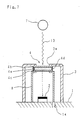
- the pyroelectric element 2 made of pyroelectric material such as LiTaO3 or PZT ceramics, etc. is rigidly fixed onto a base 1. Moreover, a housing 3 is secured onto the base 1 in a manner to accommodate the pyroelectric element 2 thereinside. At the top portion of the housing 3 is formed a window 3a for guiding infrared rays therethrough to the pyroelectric element 2 via the liquid crystal chopper 4. The window 3a is located at a position to be aligned with the pyroelectric element 2 seen from a plane view. Moreover, the window 3a prevents the infrared rays from scattering at the liquid crystal chopper 4.
- the liquid crystal chopper 4 is approximately in the same construction as the liquid crystal chopper shown in Fig. 1, except that although the substrate 4b at the side of the object 7 is a flat plate, the substrate 4c at the side of the pyroelectric element 2 is protruding convexly only towards the pyroelectric element 2. The curvature of the substrate 4c or the distance between the substrate 4c and the pyroelectric element 2 is adjusted such that the focus of the substrate 4c meets on the pyroelectric element 2.
- a processing circuit 5 is mounted on the base 1 inside the housing 3 so as to process the current obtained by the pyroelectric element 2, which is connected to the pyroelectric element 2 via a lead wire.
- the processing circuit 5 includes the amplifier 15 and control unit 16 indicated in Fig. 2.
- an earth or grounding electrode 1a is provided with the base 1.
- a lead wire 6 connects the grounding electrode 1a and the substrate 4c. In consequence to this, noises generated at the liquid crystal chopper 4 can leak out to the grounding electrode 1a via the lead wire 6 from the substrate 4c.
- the infrared sensor having the above-described construction operates in the following manner.
- the window 3a is directed opposite to the object 7 to be measured which emits infrared rays.
- the infrared rays emitted from the object 7 are, through the liquid crystal chopper 4 secured to and inside the window 3a, introduced into the housing 3.
- the emitted infrared rays are intermittently interrupted by the liquid crystal chopper 4, and therefore, the pyroelectric element 2 is given intermittent radiation of the infrared rays.
- an electric charge corresponding to the amount of radiated infrared rays is produced on the pyroelectric element 2.
- the amount of emitted infrared rays from the object 7 is calculated in the processing circuit 5, based on which, for example, the temperature of the object 7 can be detected.
- infrared rays 13 pass through the liquid crystal chopper 4 without being scattered, proceeding to be collected onto the pyroelectric element 2 by the convex substrate 4c.
- an ion current is generated in the liquid crystal 4a, thereby extremely moving the liquid crystal molecules of liquid crystal. Therefore, the infrared rays 13 incident upon the liquid crystal chopper 4 are scattered. Consequently, the infrared rays passing through the liquid crystal chopper 4 are not always collected on the pyroelectric element 2.
- the amount of infrared rays incident upon the pyroelectric element 2 is thus greatly changed depending on the presence or absence of the applied voltage to the substrates 4b and 4c. And the outputs of the detector 19 are also greatly changed, thereby to realize easy detection. Both the substrates 4b and 4c may be convex if only the infrared rays 13 are collected and focused onto the pyroelectric element 2.
- the following description is related to the voltage to be applied to the liquid crystal chopper 4.
- the driving voltage for the liquid crystal chopper 4 should be such that is reversed periodically.
- the driving circuit 18 shown in Fig. 2 (not shown in Fig. 4) produces such driving voltage.
- the inventors of the present invention have measured both the amount of passing infrared rays Q ON with the application of driving voltage and the amount of passing infrared rays Q OFF without the application of the driving voltage, by changing the waveforms of the driving voltage supplied from the driving circuit 18 to the liquid crystal chopper 4 in various manners, and obtained the difference therebetween.
- the liquid crystal of the liquid crystal chopper 4 was para-azoxyanisole, and the object 7 to be measured was a black body at 150°C.
- the amount of the infrared rays was measured by the detector 19 of Fig. 3.
- the driving voltage supplied by the driving circuit 18 repeats an application state (ON state) and a non-application state (OFF state) periodically. Moreover, a period T for one cycle of ON and OFF states is changed 1.0sec., 0.67sec., 0.50sec. and 0.33sec.
- the wave-form of the driving voltage at the ON state is periodically changed in four manners, namely, positive voltage and negative voltage are continuously supplied (Fig. 5(a)); a cycle of positive voltage and negative voltage is repeated (Fig. 5(b)); a cycle of positive voltage and negative voltage is repeated twice (Fig. 5(c)); and a cycle of positive voltage and negative voltage is repeated ten times (Fig. 5(d)).
- the above positive and negative voltages are respectively 25V.
- the liquid crystal chopper 4 When the liquid crystal chopper 4 is driven by the respective driving voltage as mentioned above, the amount of passing infrared rays Q OFF and Q ON are measured.
- the difference (Q OFF - Q ON ) is indicated in a graph of Fig. 6 in which the longitudinal axis indicates the difference by % based on the reference of infrared rays emitted from the black body 7, while the vertical axes (a) - (d) correspond to Figs. 5(a) - respectively. From this graph, it is found that the value (Q OFF - Q ON ) is inclined to increase in accordance with the increase of the period T for every waveform of driving voltage, and it increases on a large scale when the driving voltage of the waveform shown in Fig. 5(a) is supplied with the same period T in comparison with the other cases.
- the infrared sensor according to the present invention is further arranged with a countermeasure against noises, which will be described hereinbelow.
- the grounding electrode 1a and substrate 4c are connected through the lead wire 6, so that the noises generated at the liquid crystal chopper 4 are removed through the lead wire 6 and grounding electrode 1a.
- FIG. 7 According to the embodiment of Fig. 7, there is provided a metallic cylindrical body 8 which is electrically conductive between the peripheral edge of the substrate 4c and the base 1. A portion of the cylindrical body 8 is connected to the grounding electrode 1a. Therefore, also in this embodiment, noises generated at the liquid crystal chopper 4 are removed through the cylindrical body 8 and grounding electrode 1a.
- Table 3 indicates the results of evaluation test against noises of the infrared sensor according the present invention.
- the grounding condition shown in Fig. 7 is employed.
- the field of view of the pyroelectric element 2 through the window 3a is 22.4° and the object 7 to be measured is a black body at the surface temperature of 100°C.
- the liquid crystal of the DSM-type chopper 4 is para-azoxyanisole, which is driven by the driving voltage of rectangular waveforms repeating a cycle of +25V, 0V, -25V and 0V in this order every two seconds as shown in Fig. 8.
- Table 3 Present Infrared Sensor Comparison 1 Comparison 2 Comparison 3 Noise ( ⁇ V) 5 or less 50 50 5 or less Output ( ⁇ V) 710 710 710 500 S/N Ratio (dB) 43 or more 23 23 40 or more
- comparisons 1-3 are infrared sensors subjected to the evaluation test under the same conditions as the infrared sensor of this invention.
- the comparison 1 has substrates 4b and 4c not grounded to the earth.
- the comparison 2 has the substrate 4b, not the substrate 4c at the side of the pyroelectric element 2, grounded to the earth.
- the comparison 3 has the substrates 4b and 4c not grounded, but is provided with a shield box to enclose the pyroelectric element 2 to shut the noises.
- the infrared sensor of the present invention as compared with the comparisons 1 and 2, noises overlapping with the output signals are reduced to a large extent, whereby a high S/N ratio is obtained. Moreover, since the noises of the same level are observed both in the comparisons 1 and 2 wherein the substrate 4b is grounded and, none of the substrates 4b and 4c is grounded, respectively, it is seen that the overlapping noises can be reduced by grounding the substrate 4c at the side of the pyroelectric element 2.
- the level of output signals is lowered in comparison with that of the present invention and comparisons 1 and 2. This is because the shield box partly interrupts the radiated infrared rays onto the pyroelectric element 2.
- An output characteristic of the infrared sensor of this invention provided with the window 3a is compared with that of the conventional infrared sensor without either the housing 3 or the window 3a.
- the object 7 to be measured is a black body at the surface temperature of 100°C, and the liquid crystal chopper 4 is driven by the driving voltage of rectangular waveforms shown in Fig. 8.
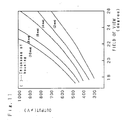
- FIG. 9 shows the relation between the field of view ⁇ (18 - 26° ) and an output ( ⁇ V).
- a solid line A indicates the characteristic of the present invention sensor
- a broken line B indicates the characteristic of the conventional infrared sensor. If the field of view is the same, the output of the infrared sensor of this invention is larger.
- Fig. 10 the relation between the distance d(cm) from the sensor to the object 7, and the output ( ⁇ V) when the field of view is fixed 22.4° is indicated in Fig. 10. It is found out from this Fig. 10 that the output of the infrared sensor of the present invention shown by a solid line a is more stable than that of the conventional infrared sensor shown by a broken line b which is dependent on the distance, and therefore the conventional infrared sensor exerts poor efficiency.
- the thickness of the housing 3 is determined for the reason below.
- the output characteristic of the present infrared sensor after infrared rays enter from the window 3a of the housing 3 before they reach the liquid crystal chopper 4 is shown when the thickness of the housing 3 is changed.
- Fig. 12 indicates lateral sectional views of three kinds of sensors for comparison of an output therefrom.
- Fig. 12(a) shows the conventional infrared sensor
- Fig. 12(b) shows the present infrared sensor with the thickness of the housing 3 reduced
- Fig. 12(c) indicates the present infrared sensor with the thickness of the housing 3 increased.
- the liquid crystal chopper when the application of voltage is started to the DSM-type liquid crystal chopper (the liquid crystal chopper is closed), infrared rays from outside the viewfield are scattered by the chopper to reach the sensor. Therefore, if the housing is rendered thick so as to prevent the infrared rays from scattering at the liquid crystal chopper, the sensor can generate high outputs, with improving the accuracy.
- the liquid crystal chopper according to the present invention can realize a chopper mechanism compact in size and small in electric power consumption. Moreover, the liquid crystal chopper is driven by DSM, and therefore a short response time is achieved. Further, because no deflecting plate is necessary, the liquid crystal chopper becomes simple in structure with low manufacturing cost.
Landscapes
- Physics & Mathematics (AREA)
- General Physics & Mathematics (AREA)
- Spectroscopy & Molecular Physics (AREA)
- Nonlinear Science (AREA)
- Engineering & Computer Science (AREA)
- Power Engineering (AREA)
- Fluid Mechanics (AREA)
- Chemical & Material Sciences (AREA)
- Crystallography & Structural Chemistry (AREA)
- Optics & Photonics (AREA)
- Radiation Pyrometers (AREA)
- Photometry And Measurement Of Optical Pulse Characteristics (AREA)
Applications Claiming Priority (10)
| Application Number | Priority Date | Filing Date | Title |
|---|---|---|---|
| JP1862389U JPH02109328U (fr) | 1989-02-20 | 1989-02-20 | |
| JP18623/89U | 1989-02-20 | ||
| JP187667/89 | 1989-07-19 | ||
| JP1187667A JPH0351722A (ja) | 1989-07-19 | 1989-07-19 | 赤外線センサ |
| JP1190082A JPH0353133A (ja) | 1989-07-20 | 1989-07-20 | 赤外線センサ |
| JP190082/89 | 1989-07-20 | ||
| JP24568989A JPH03107731A (ja) | 1989-09-21 | 1989-09-21 | 赤外線センサ |
| JP245689/89 | 1989-09-21 | ||
| JP123391/89U | 1989-10-20 | ||
| JP12339189U JPH0361535U (fr) | 1989-10-20 | 1989-10-20 |
Publications (3)
| Publication Number | Publication Date |
|---|---|
| EP0384409A2 true EP0384409A2 (fr) | 1990-08-29 |
| EP0384409A3 EP0384409A3 (fr) | 1991-10-09 |
| EP0384409B1 EP0384409B1 (fr) | 1994-10-19 |
Family
ID=27520053
Family Applications (1)
| Application Number | Title | Priority Date | Filing Date |
|---|---|---|---|
| EP90103261A Expired - Lifetime EP0384409B1 (fr) | 1989-02-20 | 1990-02-20 | Détecteur infrarouge comportant un vibreur de cristaux liquides |
Country Status (3)
| Country | Link |
|---|---|
| US (1) | US5036199A (fr) |
| EP (1) | EP0384409B1 (fr) |
| DE (1) | DE69013375T2 (fr) |
Cited By (4)
| Publication number | Priority date | Publication date | Assignee | Title |
|---|---|---|---|---|
| DE4102614A1 (de) * | 1991-01-30 | 1992-08-06 | Messerschmitt Boelkow Blohm | Endoskop |
| CN102374903A (zh) * | 2010-08-13 | 2012-03-14 | 北京广微积电科技有限公司 | 红外透射窗及其制造方法以及气密性盒体、红外线传感装置 |
| CN102853917A (zh) * | 2012-08-30 | 2013-01-02 | 华中科技大学 | 液晶基电调成像波谱面阵红外探测芯片 |
| US12411046B2 (en) | 2017-01-13 | 2025-09-09 | The Research Foundation For The State University Of New York | Chopped passive infrared sensor apparatus and method for stationary and moving occupant detection |
Families Citing this family (5)
| Publication number | Priority date | Publication date | Assignee | Title |
|---|---|---|---|---|
| US5528391A (en) * | 1993-06-04 | 1996-06-18 | Xerox Corporation | Infrared beam steering system using diffused infrared light and liquid crystal apertures |
| CN103542939B (zh) * | 2013-09-29 | 2015-11-11 | 华中科技大学 | 一种可寻址电调成像波谱红外探测芯片 |
| FR3064062B1 (fr) | 2017-03-15 | 2019-04-12 | Commissariat A L'energie Atomique Et Aux Energies Alternatives | Detecteur pyroelectrique |
| FR3066017B1 (fr) | 2017-05-05 | 2019-07-05 | Commissariat A L'energie Atomique Et Aux Energies Alternatives | Dispositif pyroelectrique de detection infrarouge comportant un emetteur infrarouge de modulation |
| CA3143345A1 (fr) | 2019-06-19 | 2020-12-24 | The Texas A&M University System | Procedes et systemes a capteurs infrarouges passifs |
Family Cites Families (9)
| Publication number | Priority date | Publication date | Assignee | Title |
|---|---|---|---|---|
| US3499112A (en) * | 1967-03-31 | 1970-03-03 | Rca Corp | Electro-optical device |
| US4066334A (en) * | 1975-01-06 | 1978-01-03 | National Research Development Corporation | Liquid crystal light deflector |
| DE2503600A1 (de) * | 1975-01-29 | 1976-08-05 | Rothdach Wolf Peter Dr Med | Verfahren zur schnellen und genauen signalverarbeitung in radiometern fuer den infraroten spektralbereich |
| JPS56122885A (en) * | 1980-02-29 | 1981-09-26 | Sharp Corp | Liquid crystal display apparatus |
| GB2164789B (en) * | 1984-09-19 | 1987-11-11 | Philips Electronic Associated | Pyroelectric infra-red detector |
| EP0224595A4 (fr) * | 1985-06-06 | 1989-10-24 | Nippon Ceramic Kk | Capteur infrarouge pyro-electrique. |
| EP0274638B1 (fr) * | 1986-12-12 | 1991-03-13 | Heimann GmbH | Modulateur optique pour pyromètre |
| DE3708923A1 (de) * | 1987-03-19 | 1988-09-29 | Messerschmitt Boelkow Blohm | Modulationsvorrichtung |
| US4882235A (en) * | 1988-03-02 | 1989-11-21 | Raytheon Company | Liquid crystal cell window |
-
1990
- 1990-02-20 US US07/481,277 patent/US5036199A/en not_active Expired - Fee Related
- 1990-02-20 EP EP90103261A patent/EP0384409B1/fr not_active Expired - Lifetime
- 1990-02-20 DE DE69013375T patent/DE69013375T2/de not_active Expired - Fee Related
Cited By (5)
| Publication number | Priority date | Publication date | Assignee | Title |
|---|---|---|---|---|
| DE4102614A1 (de) * | 1991-01-30 | 1992-08-06 | Messerschmitt Boelkow Blohm | Endoskop |
| CN102374903A (zh) * | 2010-08-13 | 2012-03-14 | 北京广微积电科技有限公司 | 红外透射窗及其制造方法以及气密性盒体、红外线传感装置 |
| CN102853917A (zh) * | 2012-08-30 | 2013-01-02 | 华中科技大学 | 液晶基电调成像波谱面阵红外探测芯片 |
| CN102853917B (zh) * | 2012-08-30 | 2013-12-25 | 华中科技大学 | 液晶基电调成像波谱面阵红外探测芯片 |
| US12411046B2 (en) | 2017-01-13 | 2025-09-09 | The Research Foundation For The State University Of New York | Chopped passive infrared sensor apparatus and method for stationary and moving occupant detection |
Also Published As
| Publication number | Publication date |
|---|---|
| DE69013375T2 (de) | 1995-05-24 |
| DE69013375D1 (de) | 1994-11-24 |
| US5036199A (en) | 1991-07-30 |
| EP0384409B1 (fr) | 1994-10-19 |
| EP0384409A3 (fr) | 1991-10-09 |
Similar Documents
| Publication | Publication Date | Title |
|---|---|---|
| EP0384409B1 (fr) | Détecteur infrarouge comportant un vibreur de cristaux liquides | |
| JPH1019768A (ja) | 表面プラズモン共鳴センサ | |
| CN102721468B (zh) | 一种太赫兹波探测器 | |
| US4140902A (en) | Device for measurement of hair-like particulate material | |
| US5056129A (en) | Apparatus for monitoring X-ray beam alignment | |
| US5050969A (en) | Photo-driven switching apparatus | |
| US4631406A (en) | Infrared ray detector | |
| EP0235372B1 (fr) | Détecteur de rayon infrarouge | |
| US4682222A (en) | Stimulated scanning infrared imaging system | |
| EP0557109B1 (fr) | Appareil pyroélectrique | |
| US4195244A (en) | CdS Solid state phase insensitive ultrasonic transducer | |
| EP0117604B1 (fr) | Commutateurs électro-optiques | |
| US3465143A (en) | Switching system for detecting a plurality of physical quantities in a consecutive timing sequence | |
| KR0133244Y1 (ko) | 무방향성 초전형 센서 | |
| US5202790A (en) | Photo-driven light beam deflecting apparatus | |
| KR0133150B1 (ko) | 적외선 온도검출기 | |
| JPS6138448A (ja) | ガス又は液体分析用光度計 | |
| CN1240932A (zh) | 非接触、口腔红外线电子体温计 | |
| US3675017A (en) | Shielded pyroelectric detector apparatus and method | |
| JPH08122253A (ja) | 試料分析装置 | |
| JPH10260212A (ja) | 光電界センサ | |
| US4091279A (en) | Method and means for equalizing the sensitivity of a multi-element sensor array | |
| JP3114235B2 (ja) | 焦電アレイセンサ | |
| JP3175321B2 (ja) | 焦電アレイセンサ | |
| Takeuchi et al. | Modulation-type pyroelectric infrared detector and its application |
Legal Events
| Date | Code | Title | Description |
|---|---|---|---|
| PUAI | Public reference made under article 153(3) epc to a published international application that has entered the european phase |
Free format text: ORIGINAL CODE: 0009012 |
|
| AK | Designated contracting states |
Kind code of ref document: A2 Designated state(s): DE FR GB IT |
|
| PUAL | Search report despatched |
Free format text: ORIGINAL CODE: 0009013 |
|
| RHK1 | Main classification (correction) |
Ipc: G01J 5/34 |
|
| AK | Designated contracting states |
Kind code of ref document: A3 Designated state(s): DE FR GB IT |
|
| 17P | Request for examination filed |
Effective date: 19920409 |
|
| 17Q | First examination report despatched |
Effective date: 19930928 |
|
| GRAA | (expected) grant |
Free format text: ORIGINAL CODE: 0009210 |
|
| AK | Designated contracting states |
Kind code of ref document: B1 Designated state(s): DE FR GB IT |
|
| ITF | It: translation for a ep patent filed | ||
| REF | Corresponds to: |
Ref document number: 69013375 Country of ref document: DE Date of ref document: 19941124 |
|
| ET | Fr: translation filed | ||
| PLBE | No opposition filed within time limit |
Free format text: ORIGINAL CODE: 0009261 |
|
| STAA | Information on the status of an ep patent application or granted ep patent |
Free format text: STATUS: NO OPPOSITION FILED WITHIN TIME LIMIT |
|
| 26N | No opposition filed | ||
| REG | Reference to a national code |
Ref country code: GB Ref legal event code: IF02 |
|
| PGFP | Annual fee paid to national office [announced via postgrant information from national office to epo] |
Ref country code: FR Payment date: 20030210 Year of fee payment: 14 |
|
| PGFP | Annual fee paid to national office [announced via postgrant information from national office to epo] |
Ref country code: GB Payment date: 20030219 Year of fee payment: 14 |
|
| PGFP | Annual fee paid to national office [announced via postgrant information from national office to epo] |
Ref country code: DE Payment date: 20030227 Year of fee payment: 14 |
|
| PG25 | Lapsed in a contracting state [announced via postgrant information from national office to epo] |
Ref country code: GB Free format text: LAPSE BECAUSE OF NON-PAYMENT OF DUE FEES Effective date: 20040220 |
|
| PG25 | Lapsed in a contracting state [announced via postgrant information from national office to epo] |
Ref country code: DE Free format text: LAPSE BECAUSE OF NON-PAYMENT OF DUE FEES Effective date: 20040901 |
|
| GBPC | Gb: european patent ceased through non-payment of renewal fee |
Effective date: 20040220 |
|
| PG25 | Lapsed in a contracting state [announced via postgrant information from national office to epo] |
Ref country code: FR Free format text: LAPSE BECAUSE OF NON-PAYMENT OF DUE FEES Effective date: 20041029 |
|
| REG | Reference to a national code |
Ref country code: FR Ref legal event code: ST |
|
| PG25 | Lapsed in a contracting state [announced via postgrant information from national office to epo] |
Ref country code: IT Free format text: LAPSE BECAUSE OF NON-PAYMENT OF DUE FEES Effective date: 20050220 |