EP0384876B1 - Anticipation d'objets dans un environnement distribué - Google Patents
Anticipation d'objets dans un environnement distribué Download PDFInfo
- Publication number
- EP0384876B1 EP0384876B1 EP90480005A EP90480005A EP0384876B1 EP 0384876 B1 EP0384876 B1 EP 0384876B1 EP 90480005 A EP90480005 A EP 90480005A EP 90480005 A EP90480005 A EP 90480005A EP 0384876 B1 EP0384876 B1 EP 0384876B1
- Authority
- EP
- European Patent Office
- Prior art keywords
- work station
- processing system
- objects
- distributed processing
- data objects
- Prior art date
- Legal status (The legal status is an assumption and is not a legal conclusion. Google has not performed a legal analysis and makes no representation as to the accuracy of the status listed.)
- Expired - Lifetime
Links
Images
Classifications
-
- G—PHYSICS
- G06—COMPUTING OR CALCULATING; COUNTING
- G06F—ELECTRIC DIGITAL DATA PROCESSING
- G06F9/00—Arrangements for program control, e.g. control units
- G06F9/06—Arrangements for program control, e.g. control units using stored programs, i.e. using an internal store of processing equipment to receive or retain programs
- G06F9/46—Multiprogramming arrangements
- G06F9/54—Interprogram communication
Definitions
- the present invention relates to distributed processing and more particularly to interchange of data in a communication system having one or more host processors connected for cooperative interaction with a plurality of intelligent terminals or work stations.
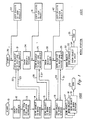
- Cooperative processing is well known in the art, illustrative of which are systems such as those depicted in Fig. 1 hereof, wherein a host processor is operative in a purely reactive mode to requests for objects (data and processing routines) requested by the connected terminal/work stations.
- heuristics are provided within the host processor to screen objects and anticipate the need for such objects at work stations, thereby eliminating the necessity, at least for thus selected objects, for the user or work station to request them from the host.
- anticipatory data (also referred to herein as prestaged data or objects) are transmitted from the host to one or more selected terminals at optimal times, e.g., when the host processor is not otherwise engaged, thereby improving efficiency of utilization.
- several objects may be selected for transmission from the host and transmitted as a group, thereby eliminating the need for a plurality of data/overhead items (e.g. re-starting transmission and identifying user), thereby further improving efficiency of equipment use.
- data/overhead items e.g. re-starting transmission and identifying user
- selected objects are retained in storage (e.g, memory or DASD) at the local terminal/work stations until either: 1. a pre-determined period of time has passed without their being used; or 2. until the available storage at the terminal/work station is full and a higher priority item seeks entry thereto.
- storage e.g, memory or DASD
- Steps progress operatively in descending order from top to bottom and represent, by vertical column, the host processor, terminal/work station and user respectively.
- action begins with starting of the host system and the terminal/work station(s) respectively.
- start symbols 10 and 20 are represented by start symbols 10 and 20.
- object item arrives As represented by the descriptor "object item arrives", symbol 12. This is accomplished in accordance with heretofore generally known techniques in equipment of the prior art. After arrival, the object item is stored at the host for later retrieval when a request is subsequently received from the user for such item.
- the work station When a user elects to view the object, e.g., object 1 as noted by symbol 40, he or she makes an appropriate entry, normally by manipulation of a keyboard or the like; and in response thereto, the work station develops and sends to the host a request for the object as denoted by symbol 21. Upon receiving such an input, the work station circuits transmit a request for the object over communication link 22 to the host processor with a request that the identified object be sent to the work station. This then is accomplished as represented by communication link 23, and the work station equipment accepts the requested object and then displays it to the user as noted by symbol 24. The items may be temporarily retained at the work station until the memory capacity is needed for the next item.
- the system is entirely reactive; that is, the host does not take the initiative to voluntarily or anticipatorily send objects to the work stations but awaits receipt of a request before doing so.
- the object is not stored there but is retained at the host, thereby requiring subsequent individual retrievals of the object from the host for use or display.
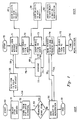
- the inventive system includes a host and one or more work stations. These are presented in a form similar to that of Fig. 1, and are activated by start-up which is indicated by symbols 50 and 70 respectively.
- start-up which is indicated by symbols 50 and 70 respectively.
- objects are received and are represented by "object item arrives", symbol 51.
- the items are then stored in host storage 52.
- the heuristic logic circuits 53 identify the item.
- heuristic logic circuits 53 then either determine that the item is not to be voluntarily sent to a work station as noted by the word “no" at the base of diamond 53, or that it is to be sent as noted by the word “yes” which appears adjacent path 54. If the answer is “no”, then the object simply remains in storage 52 and is available for later retrieval and transmission as noted by rectangle 56; if "yes”, then the object is sent to a work station as noted by link 54, rectangle 55 and link 58. Thus, the system is effective to voluntarily send selected ones of the objects to one or more predetermined work stations as represented by symbol 71, without any request from a work station as represented by symbol 55.
- the host is conditioned to respond to a specific request from a work station and to send the object to the work station as represented by symbol 56.
- Communication between the circuits 53, 55 and 56 and the corresponding work station circuits of 71 and 74 is effected over communication links 58, 59 and 60. Deactivation of the host system is of course, represented by "end" symbol 61.
- link 54 is a logic path rather than a communication path.
- path 54 may also be considered to represent communication of data within the host so that it can be transmitted over communication link 58 to one or more work stations.
- circuits at the work stations are equipped with sufficient storage capacity to store and retain objects ordinarily desired and/or used by the work station operators. Accordingly, after an item has been received by circuits 71 it is stored in storage 77 (which is symbolic of storage at each work station) where it remains until, because of inactivity or need for replacement by an object of higher priority, it is erased therefrom. Paths inter-connecting circuits 71, 72, 73 and 74 with storage 77 are identified by communication paths 68, 69, 78 and 79.
- Fig. 2 displays of requested objects, e.g., mail, to the user are identified by symbols 72, 73 and 75.
- symbols 72, 73 and 75 are representative of a number of different showings of the same or different objects.
- a work station user may select to view an object that is either currently resident within local storage 77 or which must be summoned from the host.
- Symbols 80 and 81 represent selection by the work station user to view one or more objects resident in storage 77
- symbol 82 identifies selection by the user of viewing an object which is currently not in work station storage 77, but which must be summoned from the host processor.
- dual modes of operation are provided whereby the user can select items that are currently either in the local storage and host storage or in the storage of the host and wherein the local storage memory normally contains objects which are most likely to be selected by the user in accordance with the principles hereinafter described.
- Communication link 79 is provided to show that when a user selects to view a given object, he may not know whether it is in local storage 77 or must be summoned from the host. Accordingly, before a request is made to the host, local storage 77 is first checked via link 79. This link 79 is also used to store the object once it has been obtained from the host.
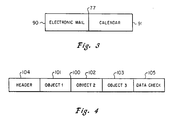
- Fig 3 illustrates two categories of objects which many users would like to maintain. These are electronic mail and calendar. Accordingly, at least a portion of storage 77 is allocated for storing information to these two categories.
- Other objects may also be included as, for example, those which are described in co-pending application filed on even date herewith by the inventors hereof for "Asynchronous Staging of Objects Between Computer System in Cooperative Processing Systems".
- Electronic mail 90 is provided for storage of selected items of mail which are newly arrived, designated by the users for retention, or are being maintained at the work station for a predetermined or indeterminate interval of time.
- Calendar 91 designates information of a chronological nature such as schedules for meetings, appointments, holidays, travel and the like which the user finds necessary or useful in organizing, planning and conducting his activities.
- the electronic mail storage 90 is adapted to store for a predetermined or indeterminate period of time such items as have been selected for storage by the work station.
- a system of priority hierarchies is established within the work station circuits in accordance with known techniques so as to identify items which may be displaced to make room for newly arrived information.
- the item furthest down in the order of priority is bumped in order to make room for storage of the new item, thus insuring at all times that the latest and highest priority items are retained in the electronic mail storage 90.
- the most recently arrived item is accorded first priority, provided that it does not occupy more than a predetermined amount of storage. Should the item exceed a permitted storage limitation an indication may be provided to the user; and, after displaying the item and its use within the memory of the work station, the item is discarded from the work station. On the other hand, if the item meets the storage requirements, it then is stored in electronic mail storage segment 90, without displacing any other information if sufficient unoccupied storage exists. However, if there is insufficient unused storage, then one or more items of the greatest age and lowest retention priority are displaced and erased from memory 90.
- the order of priorities may include the feature by which when an item is used, it is advanced either to the head of the queue or a predetermined high position therein.
- the calendar section 93 is dedicated to the storage of items that are forward looking and time dependant. Because the user is more likely to look at the current week, and another week or two in advance, the calendar is specially adapted for storing and updating information covering the period. Thus, the calendar is adapted for the establishment of a time priority which includes a sliding window of predetermined duration, e.g., two or three weeks (or longer, at the discretion of the user) into which calendar information is introduced and retained, to which new items are added, and from which past items are deleted. It also optionally includes a feature by which selected future items lying outside of the window can be separately stored for capture within the window then the window has advanced to that point chronologically.
- a time priority which includes a sliding window of predetermined duration, e.g., two or three weeks (or longer, at the discretion of the user) into which calendar information is introduced and retained, to which new items are added, and from which past items are deleted. It also optionally includes a feature by which selected future items lying outside of the window can be separately stored for capture within
- FIG. 4 another feature of the invention is illustrated.
- a block of information 100 which, for purposes of illustration includes 3 objects, 101, 102, 103, a header packet 104 and a data check packet 105.
- one of the features hereof is the provision for transmitting more than one object from a host to a terminal storage as part of one incident in order to achieve increased efficiency through the use of but one set of overhead items, (e.g., header 104 and data check 105).
- overhead items e.g., header 104 and data check 105.
- batches of information such as that represented by symbol 100 can be transmitted and thus achieve the efficiencies inherent in such batch communication.
- a pre-staging system which includes a host and plurality of work stations that are substantially improved in efficiency by virtue of the voluntary or anticipatory transmission of objects in accordance with the prediction of the needs or desires of the user, thus substantially increasing speed of operation and efficiency in use of time and equipment.
Landscapes
- Engineering & Computer Science (AREA)
- Software Systems (AREA)
- Theoretical Computer Science (AREA)
- Physics & Mathematics (AREA)
- General Engineering & Computer Science (AREA)
- General Physics & Mathematics (AREA)
- Computer And Data Communications (AREA)
- Multi Processors (AREA)
Claims (14)
- Un système de traitement distribué ayant un processeur hôte, au moins un poste de travail, connecté audit processeur hôte, et des moyens pour introduire des données objet dans ledit processeur hôte, caractérisé par des moyens heuristiques, prévus dans ledit processeur hôte, pour assurer la prédiction de l'utilisation audit poste de travail de différentes données objet, des moyens d'examen comprenant lesdits moyens heuristiques, afin d'examiner chacune desdites données objet et de déterminer si chacune desdites données objet doit éventuellement être utilisée audit poste de travail et des moyens de transmission, sur ledit processeur hôte, réagissant audit moyen d'examen afin de transmettre spontanément audit poste de travail celles desdites données objet que lesdits moyens heuristiques déterminent comme devant éventuellement être utilisées audit poste de travail.
- Un système de traitement distribué selon la revendication 1, comprenant en outre des moyens de stockage sur ledit processeur hôte, pour stocker au moins certaines données objet sélectionnées parmi lesdites objet.
- Un système de traitement distribué selon la revendication 1, comprenant en outre un moyen de stockage pour poste de travail, destiné à stocker audit poste de travail au moins des données objet sélectionnées parmi lesdites données objet, que lesdits moyens heuristiques déterminent comme devant éventuellement être utilisées audit poste de travail.
- Un système de traitement distribué selon la revendication 1, comprenant en outre des moyens de stockage de processeur hôte, destinés à stocker au moins des données objet sélectionnées parmi lesdites données objet, et comprenant en outre des moyens de stockage de poste de travail, pour stocker au moins des données objet sélectionnées parmi lesdites données objet que lesdits moyens heuristiques déterminent comme devant éventuellement être utilisées audit poste de travail.
- Un système de traitement distribué selon la revendication 1, dans lequel ledit moyen de transmission agit pour transmettre des données objet audit poste de travail seulement lorsque ledit processeur hôte n'a pas été appelé en vue d'effectuer d'autres tâches.
- Un système de traitement distribué selon la revendication 1, dans lequel ledit poste de travail comprend des moyens de détermination de priorité, afin de déterminer des priorités de rétention, au niveau dudit poste de travail, d'objets reçus par ledit poste de travail.
- Un système de traitement distribué selon la revendication 1, dans lequel ladite transmission volontaire est effectuée par groupes d'objets.
- Un système de traitement distribué selon la revendication 3, dans lequel ledit poste de travail comprend des moyens de détermination de priorité, pour déterminer des priorités de rétention dans ledit moyen de stockage de poste de travail, concernant des objets y étant stockés.
- Un système de traitement distribué selon la revendication 8, dans lequel lesdites priorités de rétention, dans ledit moyen de stockage de poste de travail, agissent pour accorder une première priorité de rétention à l'objet reçu le plus récemment, sachant que ledit objet reçu le plus récemment ne dépasse pas une quantité de données prédéterminée.
- Un système de traitement distribué selon la revendication 8, dans lequel desdites priorités de rétention, dans ledit moyen de stockage de poste de travail, agissent pour accorder une première priorité de rétention à l'objet ayant été reçu le plus récemment.
- Un système de traitement distribué selon la revendication 8, dans lequel lesdites priorités de rétention, dans ledit moyen de stockage de poste de travail, agissent pour modifier la priorité d'un objet en fonction de l'intensité d'utilisation dudit objet audit poste de travail.
- Un système de traitement distribué selon la revendication 8, dans lequel lesdites priorités de rétention, dans ledit moyen de stockage de poste de travail, réagissent à l'utilisation d'un objet afin de positionner l'objet ayant été reçu le plus récemment à un niveau de priorité élevé prédéterminé.
- Un système de traitement distribué selon la revendication 8, dans lequel lesdites priorités de rétention, dans ledit moyen de stockage de poste de travail, agissent pour supprimer dudit moyen de stockage de poste de travail des objets n'ayant pas été utilisés au cours d'un intervalle de temps prédéterminé.
- Le procédé d'interaction d'un processeur hôte avec un poste de travail connecté, comprenant les étapes consistant à recevoir, audit processeur hôte, une pluralité de données objet, caractérisé par l'examen de chacune desdites données objet, la détermination de celles desdites données objet devant être éventuellement utilisées audit poste de travail, transmission volontaire audit poste de travail, avant requête par ledit poste de travail, des objets ayant été déterminés comme devant éventuellement être utilisés audit poste de travail et stockage, audit poste de travail, d'au moins d'objets sélectionnés parmi les objets reçus audit poste de travail.
Applications Claiming Priority (2)
| Application Number | Priority Date | Filing Date | Title |
|---|---|---|---|
| US312223 | 1989-02-21 | ||
| US07/312,223 US5029104A (en) | 1989-02-21 | 1989-02-21 | Prestaging objects in a distributed environment |
Publications (3)
| Publication Number | Publication Date |
|---|---|
| EP0384876A2 EP0384876A2 (fr) | 1990-08-29 |
| EP0384876A3 EP0384876A3 (fr) | 1992-07-15 |
| EP0384876B1 true EP0384876B1 (fr) | 1996-10-16 |
Family
ID=23210442
Family Applications (1)
| Application Number | Title | Priority Date | Filing Date |
|---|---|---|---|
| EP90480005A Expired - Lifetime EP0384876B1 (fr) | 1989-02-21 | 1990-01-03 | Anticipation d'objets dans un environnement distribué |
Country Status (5)
| Country | Link |
|---|---|
| US (1) | US5029104A (fr) |
| EP (1) | EP0384876B1 (fr) |
| JP (1) | JPH0682347B2 (fr) |
| CA (1) | CA1331654C (fr) |
| DE (1) | DE69028864T2 (fr) |
Families Citing this family (40)
| Publication number | Priority date | Publication date | Assignee | Title |
|---|---|---|---|---|
| DE69032348T2 (de) * | 1990-07-31 | 1998-09-24 | Hewlett Packard Co | Objektbasiertes System |
| EP0837391B1 (fr) * | 1990-08-31 | 2002-05-29 | Texas Instruments Incorporated | Système multiprocesseur |
| US5918214A (en) * | 1996-10-25 | 1999-06-29 | Ipf, Inc. | System and method for finding product and service related information on the internet |
| WO1998019259A1 (fr) * | 1996-10-25 | 1998-05-07 | Ipf, Inc. | Systeme et procede permettant de gerer et de transmettre sur internet des informations relatives a des produits de consommation |
| US6961712B1 (en) | 1996-10-25 | 2005-11-01 | Ipf, Inc. | Consumer product information request (CPIR) enabling servlets and web-based consumer product information catalogs employing the same |
| US6625581B1 (en) | 1994-04-22 | 2003-09-23 | Ipf, Inc. | Method of and system for enabling the access of consumer product related information and the purchase of consumer products at points of consumer presence on the world wide web (www) at which consumer product information request (cpir) enabling servlet tags are embedded within html-encoded documents |
| JP4309480B2 (ja) | 1995-03-07 | 2009-08-05 | 株式会社東芝 | 情報処理装置 |
| US5787285A (en) * | 1995-08-15 | 1998-07-28 | International Business Machines Corporation | Apparatus and method for optimizing applications for multiple operational environments or modes |
| US5884324A (en) * | 1996-07-23 | 1999-03-16 | International Business Machines Corporation | Agent for replicating data based on a client defined replication period |
| US7516094B2 (en) * | 1996-10-25 | 2009-04-07 | Ipf, Inc. | Internet-based system for managing and delivering consumer product information to consumers at web-based retailer store sites on the world wide web (WWW), using consumer product information (CPI) requesting and graphical user interface (GUI) display subsystems, driven by server-side components embodying universal product numbers (UPNs) and driven by UPN/URL links managed by product manufacturer team members and/or their agents |
| US7711598B2 (en) * | 1996-10-25 | 2010-05-04 | Ipf, Inc. | Web-based consumer product marketing communication network for managing and delivering consumer product marketing communications to consumers along e-commerce (EC) enabled web sites on the world wide web (WWW), using multi-mode virtual kiosks (MMVKS) driven by server=side components embodying consumer product identifiers and driven by consumer product information (CPI) links managed by product manufacturer team members and/or their agents |
| US7904333B1 (en) | 1996-10-25 | 2011-03-08 | Ipf, Inc. | Web-based electronic commerce (EC) enabled shopping network configured to allow members of a consumer product management team and authorized parties to communicate directly with consumers shopping at EC-enabled websites along the world wide web (WWW), using multi-mode virtual kiosks (MMVKS) driven by server-side components and managed by product team members |
| US20040210479A1 (en) * | 1996-10-25 | 2004-10-21 | Ipf, Inc. | Internet-based brand marketing communication instrumentation network for deploying, installing and remotely programming brand-building server-side driven multi-mode virtual kiosks on the World Wide Web (WWW), and methods of brand marketing communication between brand marketers and consumers using the same |
| US20050010475A1 (en) * | 1996-10-25 | 2005-01-13 | Ipf, Inc. | Internet-based brand management and marketing communication instrumentation network for deploying, installing and remotely programming brand-building server-side driven multi-mode virtual Kiosks on the World Wide Web (WWW), and methods of brand marketing communication between brand marketers and consumers using the same |
| US7848948B2 (en) * | 1996-10-25 | 2010-12-07 | Ipf, Inc. | Internet-based product brand marketing communication network configured to allow members of a product brand management team to communicate directly with consumers browsing HTML-encoded pages at an electronic commerce (EC) enabled web-site along the fabric of the world wide web (WWW), using programable multi-mode virtual kiosks (MMVKS) driven by server-side components and managed by product brand management team members |
| CA2278709A1 (fr) * | 1997-01-27 | 1998-08-13 | Benjamin Slotznick | Systeme permettant de delivrer et d'afficher simultanement des informations primaires et secondaires, et de n'afficher que les informations secondaires dans l'espace interstitiel |
| AU1391999A (en) | 1997-11-12 | 1999-05-31 | Benjamin Slotznick | Automatically switching a user's interface from a program to another program while the first is processing |
| AU749314B2 (en) | 1998-05-15 | 2002-06-20 | Unicast Communications Corporation | A technique for implementing browser-initiated network-distributed advertising and for interstitially displaying an advertisement |
| US6173313B1 (en) * | 1998-06-24 | 2001-01-09 | Oracle Corporation | Methodology for hosting distributed objects at a predetermined node in a distributed system |
| US6711608B1 (en) | 1998-09-23 | 2004-03-23 | John W. L. Ogilvie | Method for including a self-removing code in a self-removing message |
| US6757713B1 (en) | 1998-09-23 | 2004-06-29 | John W. L. Ogilvie | Method for including a self-removing indicator in a self-removing message |
| US6701347B1 (en) | 1998-09-23 | 2004-03-02 | John W. L. Ogilvie | Method for including a self-removing code in a self-removing email message that contains an advertisement |
| US6324569B1 (en) | 1998-09-23 | 2001-11-27 | John W. L. Ogilvie | Self-removing email verified or designated as such by a message distributor for the convenience of a recipient |
| US20080021778A1 (en) * | 1999-04-21 | 2008-01-24 | Ipf, Inc. | Web-based brand marketing communication network for enabling e-commerce transactions using Multi-Mode Virtual Kiosks (MMVKS) |
| US20020198791A1 (en) * | 1999-04-21 | 2002-12-26 | Perkowski Thomas J. | Internet-based consumer product brand marketing communication system which enables manufacturers, retailers and their respective agents, and consumers to carry out product-related functions along the demand side of the retail chain in an integrated manner |
| US7844492B2 (en) * | 1999-11-17 | 2010-11-30 | Ipf, Inc. | Internet-based E-commerce network for enabling commission-based E-commerce transactions along the fabric of the world wide web (WWW) using server-side driven multi-mode virtual kiosks (MMVKS) and transaction and commission tracking servers |
| WO2001022243A1 (fr) * | 1999-09-18 | 2001-03-29 | Ogilvie, John, W., L. | Message electronique a elimination automatique pour la commodite du destinataire |
| US8554628B1 (en) | 1999-10-26 | 2013-10-08 | Aol Inc. | Advertisement delivery |
| US20110238506A1 (en) * | 2000-01-14 | 2011-09-29 | Perkowski Thomas J | Internet-based brand marketing communication network for enabling commission-based e-commerce transactions along the fabric of the world wide web (www) using server-side driven multi-mode virtual kiosks (mmvks) |
| US7962604B1 (en) * | 2000-10-17 | 2011-06-14 | Aol Inc | Displaying advertisements in a computer network environment |
| US7278153B1 (en) * | 2000-04-12 | 2007-10-02 | Seachange International | Content propagation in interactive television |
| US8086697B2 (en) | 2005-06-28 | 2011-12-27 | Claria Innovations, Llc | Techniques for displaying impressions in documents delivered over a computer network |
| US7475404B2 (en) | 2000-05-18 | 2009-01-06 | Maquis Techtrix Llc | System and method for implementing click-through for browser executed software including ad proxy and proxy cookie caching |
| KR100392879B1 (ko) * | 2000-06-02 | 2003-08-06 | 주식회사 인터넷엑스퍼트시스템 | 전자 메일에 의한 기업비밀 유출 방지 및 바이러스 확산방지 기능을 갖는 전자 메일 보안 시스템 |
| GB2395041A (en) * | 2001-08-14 | 2004-05-12 | Bloomberg Lp | Distribution and mapping of financial records from data stream |
| US7603341B2 (en) | 2002-11-05 | 2009-10-13 | Claria Corporation | Updating the content of a presentation vehicle in a computer network |
| US8255413B2 (en) | 2004-08-19 | 2012-08-28 | Carhamm Ltd., Llc | Method and apparatus for responding to request for information-personalization |
| US8078602B2 (en) | 2004-12-17 | 2011-12-13 | Claria Innovations, Llc | Search engine for a computer network |
| US7693863B2 (en) | 2004-12-20 | 2010-04-06 | Claria Corporation | Method and device for publishing cross-network user behavioral data |
| US8073866B2 (en) | 2005-03-17 | 2011-12-06 | Claria Innovations, Llc | Method for providing content to an internet user based on the user's demonstrated content preferences |
Family Cites Families (7)
| Publication number | Priority date | Publication date | Assignee | Title |
|---|---|---|---|---|
| JPS57169865A (en) * | 1981-04-14 | 1982-10-19 | Fuji Xerox Co Ltd | Picture information storage device |
| US4466059A (en) * | 1981-10-15 | 1984-08-14 | International Business Machines Corporation | Method and apparatus for limiting data occupancy in a cache |
| JPS60235257A (ja) * | 1984-05-07 | 1985-11-21 | Mitsubishi Electric Corp | 問合せデ−タ処理装置 |
| GB8425375D0 (en) * | 1984-10-08 | 1984-11-14 | Gen Electric Co Plc | Data communication systems |
| JPS61163748A (ja) * | 1985-01-14 | 1986-07-24 | Nec Corp | 情報送信装置 |
| US4713780A (en) * | 1985-04-15 | 1987-12-15 | Express Communications, Inc. | Electronic mail |
| US4750135A (en) * | 1986-05-01 | 1988-06-07 | Reuters Limited | Method for dynamically creating a receiver definable local trading instrument displayable record from a remotely transmitted trading instrument common data stream |
-
1989
- 1989-02-21 US US07/312,223 patent/US5029104A/en not_active Expired - Lifetime
- 1989-09-22 CA CA000612648A patent/CA1331654C/fr not_active Expired - Lifetime
-
1990
- 1990-01-03 EP EP90480005A patent/EP0384876B1/fr not_active Expired - Lifetime
- 1990-01-03 DE DE69028864T patent/DE69028864T2/de not_active Expired - Lifetime
- 1990-01-19 JP JP2008538A patent/JPH0682347B2/ja not_active Expired - Lifetime
Also Published As
| Publication number | Publication date |
|---|---|
| DE69028864T2 (de) | 1997-04-03 |
| EP0384876A2 (fr) | 1990-08-29 |
| EP0384876A3 (fr) | 1992-07-15 |
| CA1331654C (fr) | 1994-08-23 |
| US5029104A (en) | 1991-07-02 |
| JPH02247768A (ja) | 1990-10-03 |
| DE69028864D1 (de) | 1996-11-21 |
| JPH0682347B2 (ja) | 1994-10-19 |
Similar Documents
| Publication | Publication Date | Title |
|---|---|---|
| EP0384876B1 (fr) | Anticipation d'objets dans un environnement distribué | |
| EP0384875B1 (fr) | Anticipation asynchrone d'objets entre systèmes ordinateur dans des systèmes de traitement coopératifs | |
| US5724574A (en) | Method and apparatus for transferring data to a remote workstation using communications established as a background function at time workstation | |
| US5537684A (en) | Method for a communication unit to influence communication resource allocation | |
| US5201049A (en) | System for executing applications program concurrently/serially on different virtual machines | |
| US5063500A (en) | System for executing segments of application program concurrently/serially on different/same virtual machine | |
| US5406643A (en) | Method and apparatus for selecting between a plurality of communication paths | |
| US5220653A (en) | Scheduling input/output operations in multitasking systems | |
| US5245532A (en) | Electronic mail follow-up system | |
| US7725344B2 (en) | System and method for computer-aided technician dispatch and communication | |
| US6167379A (en) | System for user to accept or decline updating a calendar remotely with a proposed schedule update that may have schedule confliction | |
| US4530051A (en) | Program process execution in a distributed multiprocessor system | |
| US20060005149A1 (en) | Method and system for displaying categorized information on a user interface | |
| EP0678818A1 (fr) | Système pour la mise-à-jour de l'affichage des allocations de ressources dans un système de traitement de données | |
| JP2001513589A (ja) | 2地点間メッセージ移動のための待ち行列システムおよび方法 | |
| EP0317468A2 (fr) | Système de commande du flux pour bus | |
| Cullum | The transmission subsystem in systems network architecture | |
| JP2010020786A (ja) | リソースの分担管理用装置 | |
| JPH07248751A (ja) | 表示方法及び表示装置 | |
| KR100328440B1 (ko) | 이동통신교환기의통신데이터송신방법 | |
| JP2609640B2 (ja) | 画像表示装置 | |
| JPH05327852A (ja) | 通話履歴の自動更新装置 | |
| JPH05108650A (ja) | レストランシステム | |
| JPH1196093A (ja) | 不特定宛先回覧データの先読み制御方式およびこの方式を用いたシステム | |
| JPH0793126A (ja) | データ表示システム及びデータ表示制御方法 |
Legal Events
| Date | Code | Title | Description |
|---|---|---|---|
| PUAI | Public reference made under article 153(3) epc to a published international application that has entered the european phase |
Free format text: ORIGINAL CODE: 0009012 |
|
| AK | Designated contracting states |
Kind code of ref document: A2 Designated state(s): DE FR GB IT |
|
| 17P | Request for examination filed |
Effective date: 19901210 |
|
| PUAL | Search report despatched |
Free format text: ORIGINAL CODE: 0009013 |
|
| AK | Designated contracting states |
Kind code of ref document: A3 Designated state(s): DE FR GB IT |
|
| ITF | It: translation for a ep patent filed | ||
| GRAG | Despatch of communication of intention to grant |
Free format text: ORIGINAL CODE: EPIDOS AGRA |
|
| GRAH | Despatch of communication of intention to grant a patent |
Free format text: ORIGINAL CODE: EPIDOS IGRA |
|
| 17Q | First examination report despatched |
Effective date: 19960403 |
|
| GRAH | Despatch of communication of intention to grant a patent |
Free format text: ORIGINAL CODE: EPIDOS IGRA |
|
| GRAA | (expected) grant |
Free format text: ORIGINAL CODE: 0009210 |
|
| AK | Designated contracting states |
Kind code of ref document: B1 Designated state(s): DE FR GB IT |
|
| REF | Corresponds to: |
Ref document number: 69028864 Country of ref document: DE Date of ref document: 19961121 |
|
| ITF | It: translation for a ep patent filed | ||
| ET | Fr: translation filed | ||
| PLBE | No opposition filed within time limit |
Free format text: ORIGINAL CODE: 0009261 |
|
| STAA | Information on the status of an ep patent application or granted ep patent |
Free format text: STATUS: NO OPPOSITION FILED WITHIN TIME LIMIT |
|
| 26N | No opposition filed | ||
| REG | Reference to a national code |
Ref country code: GB Ref legal event code: IF02 |
|
| PGFP | Annual fee paid to national office [announced via postgrant information from national office to epo] |
Ref country code: IT Payment date: 20060131 Year of fee payment: 17 |
|
| REG | Reference to a national code |
Ref country code: GB Ref legal event code: 746 Effective date: 20081215 |
|
| PGFP | Annual fee paid to national office [announced via postgrant information from national office to epo] |
Ref country code: DE Payment date: 20090213 Year of fee payment: 20 |
|
| PGFP | Annual fee paid to national office [announced via postgrant information from national office to epo] |
Ref country code: GB Payment date: 20090128 Year of fee payment: 20 |
|
| PG25 | Lapsed in a contracting state [announced via postgrant information from national office to epo] |
Ref country code: IT Free format text: LAPSE BECAUSE OF NON-PAYMENT OF DUE FEES Effective date: 20070103 |
|
| REG | Reference to a national code |
Ref country code: GB Ref legal event code: PE20 Expiry date: 20100102 |
|
| PG25 | Lapsed in a contracting state [announced via postgrant information from national office to epo] |
Ref country code: GB Free format text: LAPSE BECAUSE OF EXPIRATION OF PROTECTION Effective date: 20100102 |
|
| PG25 | Lapsed in a contracting state [announced via postgrant information from national office to epo] |
Ref country code: DE Free format text: LAPSE BECAUSE OF EXPIRATION OF PROTECTION Effective date: 20100103 |
|
| PGFP | Annual fee paid to national office [announced via postgrant information from national office to epo] |
Ref country code: FR Payment date: 20080830 Year of fee payment: 20 |