EP0385174A2 - Adsorptives Verfahren zum Trennen von Vielkomponentengasmischungen - Google Patents
Adsorptives Verfahren zum Trennen von Vielkomponentengasmischungen Download PDFInfo
- Publication number
- EP0385174A2 EP0385174A2 EP90102743A EP90102743A EP0385174A2 EP 0385174 A2 EP0385174 A2 EP 0385174A2 EP 90102743 A EP90102743 A EP 90102743A EP 90102743 A EP90102743 A EP 90102743A EP 0385174 A2 EP0385174 A2 EP 0385174A2
- Authority
- EP
- European Patent Office
- Prior art keywords
- bed
- beds
- alternate
- key component
- depressurization
- Prior art date
- Legal status (The legal status is an assumption and is not a legal conclusion. Google has not performed a legal analysis and makes no representation as to the accuracy of the status listed.)
- Withdrawn
Links
Images


Classifications
-
- B—PERFORMING OPERATIONS; TRANSPORTING
- B01—PHYSICAL OR CHEMICAL PROCESSES OR APPARATUS IN GENERAL
- B01D—SEPARATION
- B01D53/00—Separation of gases or vapours; Recovering vapours of volatile solvents from gases; Chemical or biological purification of waste gases, e.g. engine exhaust gases, smoke, fumes, flue gases, aerosols
- B01D53/02—Separation of gases or vapours; Recovering vapours of volatile solvents from gases; Chemical or biological purification of waste gases, e.g. engine exhaust gases, smoke, fumes, flue gases, aerosols by adsorption, e.g. preparative gas chromatography
- B01D53/04—Separation of gases or vapours; Recovering vapours of volatile solvents from gases; Chemical or biological purification of waste gases, e.g. engine exhaust gases, smoke, fumes, flue gases, aerosols by adsorption, e.g. preparative gas chromatography with stationary adsorbents
- B01D53/047—Pressure swing adsorption
- B01D53/0476—Vacuum pressure swing adsorption
-
- B—PERFORMING OPERATIONS; TRANSPORTING
- B01—PHYSICAL OR CHEMICAL PROCESSES OR APPARATUS IN GENERAL
- B01D—SEPARATION
- B01D2253/00—Adsorbents used in seperation treatment of gases and vapours
- B01D2253/10—Inorganic adsorbents
- B01D2253/106—Silica or silicates
- B01D2253/108—Zeolites
-
- B—PERFORMING OPERATIONS; TRANSPORTING
- B01—PHYSICAL OR CHEMICAL PROCESSES OR APPARATUS IN GENERAL
- B01D—SEPARATION
- B01D2256/00—Main component in the product gas stream after treatment
- B01D2256/16—Hydrogen
-
- B—PERFORMING OPERATIONS; TRANSPORTING
- B01—PHYSICAL OR CHEMICAL PROCESSES OR APPARATUS IN GENERAL
- B01D—SEPARATION
- B01D2256/00—Main component in the product gas stream after treatment
- B01D2256/20—Carbon monoxide
-
- B—PERFORMING OPERATIONS; TRANSPORTING
- B01—PHYSICAL OR CHEMICAL PROCESSES OR APPARATUS IN GENERAL
- B01D—SEPARATION
- B01D2256/00—Main component in the product gas stream after treatment
- B01D2256/22—Carbon dioxide
-
- B—PERFORMING OPERATIONS; TRANSPORTING
- B01—PHYSICAL OR CHEMICAL PROCESSES OR APPARATUS IN GENERAL
- B01D—SEPARATION
- B01D2256/00—Main component in the product gas stream after treatment
- B01D2256/24—Hydrocarbons
-
- B—PERFORMING OPERATIONS; TRANSPORTING
- B01—PHYSICAL OR CHEMICAL PROCESSES OR APPARATUS IN GENERAL
- B01D—SEPARATION
- B01D2257/00—Components to be removed
- B01D2257/10—Single element gases other than halogens
- B01D2257/102—Nitrogen
-
- B—PERFORMING OPERATIONS; TRANSPORTING
- B01—PHYSICAL OR CHEMICAL PROCESSES OR APPARATUS IN GENERAL
- B01D—SEPARATION
- B01D2257/00—Components to be removed
- B01D2257/40—Nitrogen compounds
- B01D2257/406—Ammonia
-
- B—PERFORMING OPERATIONS; TRANSPORTING
- B01—PHYSICAL OR CHEMICAL PROCESSES OR APPARATUS IN GENERAL
- B01D—SEPARATION
- B01D2257/00—Components to be removed
- B01D2257/50—Carbon oxides
- B01D2257/502—Carbon monoxide
-
- B—PERFORMING OPERATIONS; TRANSPORTING
- B01—PHYSICAL OR CHEMICAL PROCESSES OR APPARATUS IN GENERAL
- B01D—SEPARATION
- B01D2257/00—Components to be removed
- B01D2257/50—Carbon oxides
- B01D2257/504—Carbon dioxide
-
- B—PERFORMING OPERATIONS; TRANSPORTING
- B01—PHYSICAL OR CHEMICAL PROCESSES OR APPARATUS IN GENERAL
- B01D—SEPARATION
- B01D2257/00—Components to be removed
- B01D2257/70—Organic compounds not provided for in groups B01D2257/00 - B01D2257/602
- B01D2257/702—Hydrocarbons
- B01D2257/7022—Aliphatic hydrocarbons
- B01D2257/7025—Methane
-
- B—PERFORMING OPERATIONS; TRANSPORTING
- B01—PHYSICAL OR CHEMICAL PROCESSES OR APPARATUS IN GENERAL
- B01D—SEPARATION
- B01D2259/00—Type of treatment
- B01D2259/40—Further details for adsorption processes and devices
- B01D2259/40001—Methods relating to additional, e.g. intermediate, treatment of process gas
-
- B—PERFORMING OPERATIONS; TRANSPORTING
- B01—PHYSICAL OR CHEMICAL PROCESSES OR APPARATUS IN GENERAL
- B01D—SEPARATION
- B01D2259/00—Type of treatment
- B01D2259/40—Further details for adsorption processes and devices
- B01D2259/40011—Methods relating to the process cycle in pressure or temperature swing adsorption
- B01D2259/40013—Pressurization
- B01D2259/40015—Pressurization with two sub-steps
-
- B—PERFORMING OPERATIONS; TRANSPORTING
- B01—PHYSICAL OR CHEMICAL PROCESSES OR APPARATUS IN GENERAL
- B01D—SEPARATION
- B01D2259/00—Type of treatment
- B01D2259/40—Further details for adsorption processes and devices
- B01D2259/40011—Methods relating to the process cycle in pressure or temperature swing adsorption
- B01D2259/40013—Pressurization
- B01D2259/40016—Pressurization with three sub-steps
-
- B—PERFORMING OPERATIONS; TRANSPORTING
- B01—PHYSICAL OR CHEMICAL PROCESSES OR APPARATUS IN GENERAL
- B01D—SEPARATION
- B01D2259/00—Type of treatment
- B01D2259/40—Further details for adsorption processes and devices
- B01D2259/40011—Methods relating to the process cycle in pressure or temperature swing adsorption
- B01D2259/40028—Depressurization
- B01D2259/4003—Depressurization with two sub-steps
-
- B—PERFORMING OPERATIONS; TRANSPORTING
- B01—PHYSICAL OR CHEMICAL PROCESSES OR APPARATUS IN GENERAL
- B01D—SEPARATION
- B01D2259/00—Type of treatment
- B01D2259/40—Further details for adsorption processes and devices
- B01D2259/40011—Methods relating to the process cycle in pressure or temperature swing adsorption
- B01D2259/40028—Depressurization
- B01D2259/40032—Depressurization with three sub-steps
-
- B—PERFORMING OPERATIONS; TRANSPORTING
- B01—PHYSICAL OR CHEMICAL PROCESSES OR APPARATUS IN GENERAL
- B01D—SEPARATION
- B01D2259/00—Type of treatment
- B01D2259/40—Further details for adsorption processes and devices
- B01D2259/40011—Methods relating to the process cycle in pressure or temperature swing adsorption
- B01D2259/40035—Equalization
- B01D2259/40037—Equalization with two sub-steps
-
- B—PERFORMING OPERATIONS; TRANSPORTING
- B01—PHYSICAL OR CHEMICAL PROCESSES OR APPARATUS IN GENERAL
- B01D—SEPARATION
- B01D2259/00—Type of treatment
- B01D2259/40—Further details for adsorption processes and devices
- B01D2259/40011—Methods relating to the process cycle in pressure or temperature swing adsorption
- B01D2259/40035—Equalization
- B01D2259/40041—Equalization with more than three sub-steps
-
- B—PERFORMING OPERATIONS; TRANSPORTING
- B01—PHYSICAL OR CHEMICAL PROCESSES OR APPARATUS IN GENERAL
- B01D—SEPARATION
- B01D2259/00—Type of treatment
- B01D2259/40—Further details for adsorption processes and devices
- B01D2259/40011—Methods relating to the process cycle in pressure or temperature swing adsorption
- B01D2259/40043—Purging
- B01D2259/4005—Nature of purge gas
- B01D2259/40052—Recycled product or process gas
-
- B—PERFORMING OPERATIONS; TRANSPORTING
- B01—PHYSICAL OR CHEMICAL PROCESSES OR APPARATUS IN GENERAL
- B01D—SEPARATION
- B01D2259/00—Type of treatment
- B01D2259/40—Further details for adsorption processes and devices
- B01D2259/40011—Methods relating to the process cycle in pressure or temperature swing adsorption
- B01D2259/40058—Number of sequence steps, including sub-steps, per cycle
- B01D2259/40066—Six
-
- B—PERFORMING OPERATIONS; TRANSPORTING
- B01—PHYSICAL OR CHEMICAL PROCESSES OR APPARATUS IN GENERAL
- B01D—SEPARATION
- B01D2259/00—Type of treatment
- B01D2259/40—Further details for adsorption processes and devices
- B01D2259/40011—Methods relating to the process cycle in pressure or temperature swing adsorption
- B01D2259/40058—Number of sequence steps, including sub-steps, per cycle
- B01D2259/40067—Seven
-
- B—PERFORMING OPERATIONS; TRANSPORTING
- B01—PHYSICAL OR CHEMICAL PROCESSES OR APPARATUS IN GENERAL
- B01D—SEPARATION
- B01D2259/00—Type of treatment
- B01D2259/40—Further details for adsorption processes and devices
- B01D2259/40011—Methods relating to the process cycle in pressure or temperature swing adsorption
- B01D2259/40058—Number of sequence steps, including sub-steps, per cycle
- B01D2259/40069—Eight
-
- B—PERFORMING OPERATIONS; TRANSPORTING
- B01—PHYSICAL OR CHEMICAL PROCESSES OR APPARATUS IN GENERAL
- B01D—SEPARATION
- B01D2259/00—Type of treatment
- B01D2259/40—Further details for adsorption processes and devices
- B01D2259/40011—Methods relating to the process cycle in pressure or temperature swing adsorption
- B01D2259/40058—Number of sequence steps, including sub-steps, per cycle
- B01D2259/40073—Ten
-
- B—PERFORMING OPERATIONS; TRANSPORTING
- B01—PHYSICAL OR CHEMICAL PROCESSES OR APPARATUS IN GENERAL
- B01D—SEPARATION
- B01D2259/00—Type of treatment
- B01D2259/40—Further details for adsorption processes and devices
- B01D2259/40011—Methods relating to the process cycle in pressure or temperature swing adsorption
- B01D2259/40058—Number of sequence steps, including sub-steps, per cycle
- B01D2259/40075—More than ten
-
- B—PERFORMING OPERATIONS; TRANSPORTING
- B01—PHYSICAL OR CHEMICAL PROCESSES OR APPARATUS IN GENERAL
- B01D—SEPARATION
- B01D2259/00—Type of treatment
- B01D2259/40—Further details for adsorption processes and devices
- B01D2259/404—Further details for adsorption processes and devices using four beds
-
- Y—GENERAL TAGGING OF NEW TECHNOLOGICAL DEVELOPMENTS; GENERAL TAGGING OF CROSS-SECTIONAL TECHNOLOGIES SPANNING OVER SEVERAL SECTIONS OF THE IPC; TECHNICAL SUBJECTS COVERED BY FORMER USPC CROSS-REFERENCE ART COLLECTIONS [XRACs] AND DIGESTS
- Y02—TECHNOLOGIES OR APPLICATIONS FOR MITIGATION OR ADAPTATION AGAINST CLIMATE CHANGE
- Y02C—CAPTURE, STORAGE, SEQUESTRATION OR DISPOSAL OF GREENHOUSE GASES [GHG]
- Y02C20/00—Capture or disposal of greenhouse gases
- Y02C20/20—Capture or disposal of greenhouse gases of methane
-
- Y—GENERAL TAGGING OF NEW TECHNOLOGICAL DEVELOPMENTS; GENERAL TAGGING OF CROSS-SECTIONAL TECHNOLOGIES SPANNING OVER SEVERAL SECTIONS OF THE IPC; TECHNICAL SUBJECTS COVERED BY FORMER USPC CROSS-REFERENCE ART COLLECTIONS [XRACs] AND DIGESTS
- Y02—TECHNOLOGIES OR APPLICATIONS FOR MITIGATION OR ADAPTATION AGAINST CLIMATE CHANGE
- Y02C—CAPTURE, STORAGE, SEQUESTRATION OR DISPOSAL OF GREENHOUSE GASES [GHG]
- Y02C20/00—Capture or disposal of greenhouse gases
- Y02C20/40—Capture or disposal of greenhouse gases of CO2
Definitions
- the present invention relates in general to the separation of gas mixtures, with individual recovery of at least two of the components contained therein, by pressure swing adsorption.
- PSA pressure swing adsorption
- a large body of prior art in this field pertains to the recovery of a single component at high purity from a mixture of that component with impurities present at lower concentrations, or the recovery of one product at high purity and a second product at low purity from a gas mixture.
- One example of the former is the recovery of high-purity hydrogen from petroleum refinery gas streams; an example of the latter is the separation of air into a medium- to high-purity nitrogen stream and a low-purity, oxygen-rich stream.
- parallel adsorbent beds are operated sequentially as parallel sets of single-stage adsorbers.
- the first stage adsorbs most of the major contaminants in the feed stream
- the second stage selectively adsorbs at least one impurity component in the effluent from the first stage
- the third stage selectively adsorbs at least one impurity component in the effluent from the second stage.
- An ultra-high purity product is recovered as the effluent from the third stage adsorber
- a moderately pure product is recovered as effluent from the second stage adsorber and as depressurization gas from the third stage adsorber.
- ultra-pure hydrogen at 99.995% purity and moderately-pure hydrogen at 99% purity are recovered from refinery off gases by the disclosed process.
- U.S. Patent No. 4,171,207 discloses a PSA system comprising two groups of adsorbent beds for the recovery of two high-purity products from a gas mixture containing a primary key component, a secondary key component which is more strongly adsorbed than the primary key component, and one or more tertiary components at low concentrations which are more strongly adsorbed than the primary or secondary key components.
- the gas mixture is passed through a first adsorbent bed in which the tertiary components are selectively adsorbed, and then through a second adsorbent bed in which the secondary key component is selectively adsorbed; a product stream of high-purity primary key component is withdrawn as an effluent stream from the second adsorbent bed.
- Flow through the two beds is then discontinued, and the second bed is rinsed at feed pressure with a stream of high-purity secondary key component.
- This rinse step displaces other components present in the bed and saturates the bed with secondary key component.
- High-purity secondary key component then is recovered by desorption from the second adsorbent bed.
- An example of this process is the adsorptive separation of a mixture of hydrogen, methane, and C2+ hydrocarbons to recover high-purity hydrogen as the primary key component and high-purity methane as the secondary key component.
- U.S. Patent Re. 31,014 a reissue of U.S. Patent No. 4,171,206, discloses a PSA system comprising two sets of adsorbent beds for the recovery of two high- purity products from a gas mixture containing a primary key component, a secondary key component which is more strongly adsorbed than the primary key component, and one or more tertiary components at low concentration which are less strongly adsorbed than the secondary key component and more strongly adsorbed than the primary key component.
- the gas mixture is passed through a first adsorbent bed in which the secondary key component is selectively adsorbed, and then through a second adsorbent bed in which the tertiary components are selectively adsorbed; a product stream of high-purity primary key component is withdrawn as an effluent stream from the second adsorbent bed.
- Flow through the two beds is then discontinued, and the first bed is rinsed at feed pressure with a stream of high-purity secondary key component.
- This rinse step displaces other components present in the bed and saturates the bed with secondary key component.
- High-purity secondary key component is then recovered by desorption from the first adsorbent bed.
- An example of this process is the adsorptive separation of a mixture of hydrogen, carbon dioxide, carbon monoxide, methane, and nitrogen to recover high-purity hydrogen as the primary key component and high-purity carbon dioxide as the secondary key component.
- Japanese Patent Application 58-205592 discloses a three-stage PSA process for the recovery of three individual products from a multicomponent gas mixture comprising hydrogen, carbon monoxide, carbon dioxide, and nitrogen. Such a gas mixture is recovered, for example, from a steel converter furnace.
- the process comprises three separate multi-bed PSA systems arranged in series; the feed gas is passed through the first stage PSA in which CO2 is preferentially adsorbed, through the second stage PSA in which CO is preferentially adsorbed, and then through the third stage PSA in which N2 and residual CO are preferentially adsorbed.
- Hydrogen product is recovered as third stage effluent.
- CO2 is recovered by desorption from the first stage and CO is recovered, after a rinse step, by desorption from the second stage.
- U.S. Patent No. 4,539,020 discloses a two-stage PSA process for recovering carbon monoxide from a feed gas comprising carbon monoxide, carbon dioxide, and components less adsorbable than carbon monoxide.
- Feed gas is passed to a first PSA system in which CO2 is selectively adsorbed and recovered by the steps of adsorption, depressurization, evacuation, purging with waste gas from the second stage PSA system, and repressurization with first stage product gas.
- Effluent from the first stage PSA is introduced into the second stage PSA in which carbon monoxide is selectively adsorbed and recovered by the steps of adsorption, partial depressurization, pressure equalization, purge with product CO, evacuation yielding product CO, pressure equalization, and final repressurization to the adsorption pressure with purge effluent from another adsorbent bed in the second stage PSA system.
- a CO2-rich waste gas is produced by the first stage PSA; the CO product from the second stage PSA contains less than 0.5% CO2 and less than 1% N2.
- U.S. Patent No. 4,790,858 discloses an improvement to previously cited U.S. Patent Re. 31,014 wherein additional primary key component is recovered by passing the waste stream from the second set of adsorbent beds to a third set of adsorbent beds in which additional secondary key tertiary components are selectively adsorbed.
- the additional recovered primary key component from the third adsorbent bed is used in part for purging the second adsorbent bed, and for purging and repressurizing another third adsorbent bed.
- a distinguishing feature of the earlier cited U.S. Patent No. 4,171,207 and U.S. Patent Re. 31,014 is the high-pressure rinse step in which high-purity secondary key component is utilized to rinse at the adsorption pressure the adsorbent bed in which the secondary key component has been selectively adsorbed. This step is important in the recovery of secondary key component at high purity.
- the present invention is an improved pressure swing adsorption process for the separation of a multicomponent gas mixture to recover as individual products a primary key component and a secondary key component, wherein the secondary key component is more strongly adsorbed than the primary key component and there is present in the multicomponent gas mixture one or more minor tertiary components at low concentrations which are less strongly adsorbed than the secondary key component, by passing the multicomponent gas mixture in an adsorption step through a first bed of adsorbent selective for retention of the secondary key component, passing the effluent from the first bed through a second bed of adsorbent selective for the retention of the secondary key component and of the one or more minor tertiary components, withdrawing from the second bed a high-purity product stream of the primary key component, and continuing the passing of the multicomponent gas mixture through the first and second beds until the concentration of the secondary key component in the effluent from the first bed or the concentration of at least one of the tertiary components in the high-purity stream of said
- the first bed of adsorbent is one of a first group of multiple parallel beds and the second bed of adsorbent is one of a second group of multiple parallel beds; each bed of the first group is paired with a corresponding bed of the second group, and each pair of beds undergoes in turn the adsorption step, steps (1) through (4) during the mutually extending time period, and the pressurization step (5).
- pressurization and depressurization steps are carried out as follows:
- the adsorption step is carried out in the same manner as described above in the first embodiment.
- the following steps described above for the first embodiment also are utilized in the second embodiment: (1) depressurization of the first bed; (1d) further depressurization of the first bed; (2) evacuation of the first bed; (3) depressurization of the second bed; (4) purge of the second bed; and (5) final pressurization of the first and second beds.
- the additional pressurization and depressurization steps are carried out in the second embodiment:
- the adsorption step is carried out in the same manner as described above in the first and second embodiments.
- the following steps described in the first two embodiments are also utilized in the third embodiment: (1) depressurization of the first bed; (2) evacuation of the first bed; (3) depressurization of the second bed; (4) purge of the second bed; and (5) final pressurization of the first and second beds.
- further depressurization step (1d) as described in the first two embodiments can be carried out after depressurization step (1).
- the additional pressurization and depressurization steps are carried out in the third embodiment:
- the adsorption step is carried out in the same manner as described above in the first three embodiments.
- the following steps described in the first three embodiments are also utilized in the fourth embodiment: (1) depressurization of the first bed; (2) evacuation of the first bed; (3) depressurization of the second bed; (4) purge of the second bed; and (5) final pressurization of the first and second beds.
- further depressurization step (1d) as described in the previous embodiments can be carried out after depressurization step (1).
- the additional pressurization and depressurization steps are carried out in the fourth embodiment:
- a gas mixture containing hydrogen as the primary key component, carbon dioxide as the secondary key component, and carbon monoxide, methane, and nitrogen as tertiary components can be separated into a very high-purity hydrogen product (>99.99 mole% H2) and a high-purity carbon dioxide product (>97 mole% CO2).
- Further recovery of product components is accomplished by recycling at least a portion of the gas from depressurization step (1) of the first bed and combining it with the fresh feed to the first bed. Further recovery of primary key component is optionally accomplished by passing at least a portion of the gas from depressurization step (3) and purge step (4) of the second bed through a third bed of adsorbent, which is one of a group of multiple parallel beds of adsorbent, in which remaining impurities are substantially removed and from which additional primary key component product is withdrawn. At least a portion of this product is used to purge the second beds.
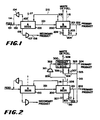
- the general gas flows for four embodiments of the present invention are shown schematically in Figure 1.
- the groups of first (A) beds and second (B) beds each comprise four parallel beds of adsorbent.
- Pressurized feed gas mixture enters the system as stream 101 and is combined with recycle stream 114 and the combined stream 102 passes to the first or A beds 100.
- the secondary key component is selectively adsorbed.
- Desorbed secondary key component is evacuated from the A beds as stream 106 by vacuum blower 107, and is provided in slightly pressurized stream 108 as secondary key component product.
- Depressurization gas from step (1) of the A beds is withdrawn as stream 103, compressed in compressor 104, and recycled to feed as stream 114.
- Additional depressurization or blowdown gas from step (1d) of the A beds is optionally withdrawn as stream 117 and is optionally used as additional secondary product.
- the A bed representative effluent stream 221 passes into the second or B beds 200 in which the tertiary components are adsorbed, and high purity primary key component is withdrawn as stream 201. Secondary and tertiary components are desorbed from the B beds and are discharged as depressurization and purge effluent streams 208 and 116, respectively.
- a portion of stream 201 is taken as stream 204 and passed to the B beds for pressurization through control valve 205 and for purging through pressure reducing valve 206.
- Primary key component product is withdrawn as stream 202. Pressure equalization and pressurization gas flows between the A and B beds are shown as stream 210.
- additional primary key component is recovered as shown in Figure 2. At least a portion of each waste gas stream 208 and 116 from the depressurization and purge steps of the B beds are combined in stream 209 and compressed in compressor 301, and are passed to a gas storage tank (not shown). Gas from the tank as stream 302 passes into product recovery (C) beds 300 in which remaining secondary and tertiary components are selectively adsorbed as described in more detail below. Desorbed secondary and tertiary components in stream 309 are sent to waste or used as fuel. Additional recovered primary key component, stream 303, is used totally or in part as stream 305 for purging and repressurization.
- Stream 306 passes to product recovery or C beds 300 as purge through pressure reduction valve 307 and as repressurization gas through flow control valve 308. Additional primary key component is passed as stream 310 through pressure reduction valve 207 for purging of B beds 200. Any remaining primary key component is taken as additional product as stream 304.
- any given pair of A and B beds (for example, A1 and B1) are in series flow communication during the adsorption step and repressurization step (5) as previously described.
- any pair of A beds, any pair of B beds, or any pair of A and B beds can be isolated and interconnected for pressure equalization as previously discussed.
- each pair of A and B beds (A1 and B1 , A2 and A2, A3 and A3, A4 and B4) are subjected in turn to the process cycle steps summarized earlier and given in Tables 1 and 2. The following detailed process cycle steps will be given only for the first pair of beds, A1 and B1.
- the process cycle steps for the first embodiment of the present invention are given in Table 1. Referring now to Table 1 and Figure 3, the detailed process steps for this embodiment (using step designations previously defined) are as follows.
- the adsorption step for beds A1 and B1 begins with valves 1, 25, and 49 open, and valves 5, 9, 13, 17, 29, 33, 37, 41, 45, 50, 51, and 52 closed; both beds are at or somewhat below the adsorption pressure of between 30 and 500 psia, having been pressurized during the previous step.
- concentration of secondary key component in bed A1 effluent (line 221), or the concentration of at least one tertiary component in bed B1 effluent (line 222) reaches a predetermined level, or after a predetermined time period, the adsorption step is completed and beds A1 and B1 are isolated by closing valves 1, 25, and 49.
- bed A1 is depressurized by opening valve 17 whereby desorbed and void space gas flow from bed A1 and through manifold 103, the gas is compressed by compressor 104, flows through line 105 into gas storage vessel 113, from where it is recycled through line 114 to join feed stream 101.
- This step continues for a predetermined amount of time, or until bed A1 reaches a predetermined pressure, or until the concentration of secondary key component in the bed A1 depressurization gas reaches a predetermined level.
- bed B1 While bed A1 is depressurizing, bed B1 is depressurized to a first intermediate pressure (step (1a)) by opening valve 37 (valves 27, 31, 35, 43, 47, and 51 were closed during previous steps) so that depressurization gas flows from bed B1 through manifold 210 into bed B3 (bed B3 earlier completed its pressurization step (4a)).
- valve 39 is closed to complete bed B1 depressurization step (1a), and valves 7 and 61 are opened (valves 3, 11, 15, 19, and 27 were closed in previous steps) so that gas now flows from bed B1 through manifold 210, line 212, and manifold 117 into bed A3 (which earlier completed its evacuation step (2)) so that the pressure in beds B1 and A3 are equalized at a second intermediate pressure (step (1b)).
- Valves 7 and 61 are closed and then valve 40 is opened (valves 28, 32, 36, 44, 48, and 52 were closed in a previous step) so that gas now flows from bed B1 through manifold 210 into bed B4 (which earlier completed its purge step (4)) so that the pressures in beds B1 and B4 are equalized at a third intermediate pressure (step (1c)).
- Valve 37 is then closed; meanwhile, depressurization step (1) of Bed A1 continues.
- Bed B1 is then further depressurized to near ambient pressure by opening valve 33 so that gas flows from bed B1 through manifold 208 (step (3)).
- Valve 33 is closed to complete bed B1 depressurization step (3), and at approximately the same time valve 17 is closed to complete bed A1 depressurization step (1) at a pressure of between about 30 to 100 psia.
- bed A1 is further depressurized or blown down to near atmospheric pressure by opening valves 5 and 62 whereby gas flows out of bed A1 and through manifold 117 as blowdown gas which optionally can be used as additional secondary key component product (step (1d)).
- bed B1 is purged (step (4)) by opening valves 29 and 41 so that high purity primary key component product flows through manifold 204, control valve 206, manifold 213, valve 41, line 222, bed B1, line 221, valve 29, and manifold 116.
- primary key component product can be provided for purge step (4) through line 310, control valve 207, line 311, and through manifold 213.
- bed B1 purge effluent and depressurization gas flowing through manifolds 116 and 208 can be taken through line 209, compressor 301, and line 302 for further primary component recovery.
- bed A1 depressurization or final blowdown step (1d) is completed by closing valves 5 and 62.
- step (1d) may be omitted; in this option, depressurization step (1) would be continued until bed A1 reached about atmospheric pressure.
- valves 9 and 13 are opened and bed A1 is evacuated by pulling gas from both ends of the bed through valves 9 and 13, manifold 106, and vacuum blower 107 (step (2)). High-purity secondary key component is produced through line 108. While evacuation of bed A1 continues, purge step (4) of bed B1 is completed and valves 29 and 41 are closed; next valves 37 and 38 are opened (valves 26, 30, 34, 42, 46, and 50 were closed in previous steps) and gas flows from bed B2 (which earlier completed its depressurization step (1b) through manifold 210 into bed B1 until the pressures in both beds are equalized at the third intermediate pressure (step (4a)). Valve 38 is then closed.
- valve 39 is opened (valves 27, 31, 35, 43, 47, and 51 were closed in previous steps) and gas flows from bed B3 (which earlier completed its adsorption step) through manifold 210 into bed B1 until the pressures in both beds are equalized at the first intermediate pressure (step (4b)).
- Valve 37 is then closed.
- evacuation of bed A1 is completed at a pressure between about 40 to 400 Torr by closing valves 9 and 13.
- valves 5 and 61 are opened and gas flows from bed B3 (which earlier completed its depressurization step (4b)) through manifold 210, line 212, and manifold 117 into bed A1 until the pressures in both beds are equalized at the second intermediate pressure (step 2a)).
- bed B1 is further pressurized by opening valve 45 whereby high-purity primary key component flows through manifold 204, control valve 205, manifold 214 and into bed B1 (step (4c)).
- pressurization step (2a) of bed A1 is completed by closing valves 5 and 61.
- Valve 25 is then opened, and primary key component flows into and through bed B1 and into bed A1 until both beds are pressurized to a pressure up to the adsorption pressure (step (5)), and another cycle is ready to begin.
- the other sets of beds (A2 and B2, A3 and B3, A4 and B4) in turn undergo the same cycle through control, in a similar manner, of the appropriate valves associated with the beds.
- the relationship of these cycles to the cycle of beds A1 and B1 is given in Table 1.
- valves 5 and 61 are closed and pressurization step (5) of beds A1 and B1 proceeds as described earlier for the first embodiment.
- the other sets of beds (A2 and B2, A3 and B3, A4 and B4) in turn undergo the same cycle through control in a similar manner of the appropriate valves associated with the beds.
- the relationship of these cycles to the cycle of beds A1 and B1 is given in Table 2.
- primary key component product can be provided for purge step (4) through line 310, control valve 207, and line 311 into manifold 213.
- at least a portion of bed B1 purge effluent and depressurization gas flowing through manifolds 116 and 208 can be taken through line 209, compressor 301, and line 302 for further primary component recovery.
- the adsorption step for beds A1 and B1 begins with valves 1, 25, and 49 open, and valves 9, 13, 17, 21, 29, 33, 37, 41, 45, 50, 51, and 52 closed; both beds are at a pressure up to the adsorption pressure of between 30 and 500 psia, having been pressurized during the previous step.
- bed A1 effluent When the concentration of secondary key component in bed A1 effluent (line 221), or the concentration of at least one tertiary component in bed B1 effluent (line 222) reaches a predetermined level, or after a predetermined time period, the adsorption step is completed and beds A1 and B1 are isolated by closing valves 1, 25, and 49.
- bed A1 is depressurized (step (1)) by opening valve 17 whereby desorbed and void space gas flow from bed A1 and through manifold 103, is compressed by compressor 104, flows through line 105 into gas storage vessel 113, from where it is recycled through line 114 to join feed stream 101.
- bed B1 is depressurized to a first intermediate pressure (step (1a)) by opening valves 23 and 37 (valves 3, 11, 15, 19, and 27 were closed in previous steps) so that depressurization gas flows from bed B1 through manifolds 210 and 115 into bed A3 (which earlier completed its evacuation step (2)).
- valve 23 is closed to complete bed B1 depressurization step (1a)
- valve 39 is opened (valves 27, 31, 35, 43, 47, and 51 were closed in previous steps) so that gas now flows from bed B1 through manifold 210 into bed B3 (which earlier completed its purge step (4)) so that the pressure in beds B1 and B3 are equalized at a second intermediate pressure.
- Valves 39 and 37 are closed to complete step (1b). While depressurization step (1) of bed A1 continues, valve 33 is opened and bed B1 is depressurized to about 15 to 75 psia; depressurization gas flows through manifold 116 for use as fuel or for other purposes. Valve 33 is then closed. Meanwhile, depressurization step (1) of bed A1 continues until the bed pressure is about 15 psia. At this point, valve 17 is closed to complete the depressurization and bed A1 is evacuated by opening valves 9 and 13 whereby desorbed and void space gas is pulled through manifold 106, vacuum blower 107, and passes through line 108 as secondary key component product.
- bed B1 is purged at 15 to 75 psia by opening valves 33 and 41 whereby high-purity primary key component flows through manifold 204, control valve 206, manifold 213, bed B1 and manifold 116.
- Purge effluent may be used for fuel or for other purposes.
- primary key component product can be provided for purge step (4) through line 310, control valve 207, line 311, manifold 213.
- at least a portion of bed B1 purge effluent and depressurization gas flowing through manifolds 116 and 208 can be taken through line 209, compressor 301, and line 302 for further primary component recovery.
- evacuation step (2) of bed A1 is completed when the bed pressure reaches between 40 and 400 Torr, and valves 9 and 13 are closed.
- purge step (4) continues, valves 21 and 39 are opened (valves 27, 31, 35, 43, 47, and 51 were closed in previous steps) and gas flows from bed B3 (which has just completed its adsorption step) into bed A1 until the pressures in both beds are equalized at the first intermediate pressure.
- Valve 21 is closed to complete this pressurization step (2a), and at the same time valves 33 and 41 are closed to complete purge step (4) of bed B1.
- valve 37 is opened and gas flows from bed B3 (which has just completed its depressurization step (1a)) into bed B3 until the pressures in both beds are equalized at the second intermediate pressure.
- Valves 37 and 39 are then closed, completing step (4a).
- valves 45 and 25 are opened and high-purity primary key component flows through manifold 204, control valve 205, manifold 214, line 222, bed B1 , line 221, and into bed A1 until both beds A1 and B1 are pressurized to a pressure up to the adsorption pressure.
- the other sets of beds (A2 and B2, A3 and B3, A4 and B4) in turn undergo the same cycle through control in a similar manner of the appropriate valves associated with the beds.
- the relationship of these cycles to the cycle of beds A1 and B1 is given in Table 3.
- the valve operation schedule for this third embodiment in Figure 3 is given in Table 5.
- adsorption step and the other basic process steps of (1) depressurization and (2) evacuation of the first or A1 bed, (3) depressurization and (4) purge of the second or B1 bed, and (5) pressurization of both the A1 and B1 beds are carried out exactly as just described for the third embodiment.
- primary key component product can be provided for purge step (4) through line 310, control valve 207, line 311, manifold 213.
- at least a portion of bed B1 purge effluent and depressurization gas flowing through manifolds 116 and 208 can be taken through line 209, compressor 301, and line 302 for further primary component recovery.
- the other pressurization and depressurization steps for the fourth embodiment are different than those of the third embodiment and are described in detail as follows.
- At least a portion of the gas from depressurization step (3) and purge step (4) of the second or B beds is processed for additional recovery of primary key component in a set of third (C) beds as illustrated in Figure 2 and discussed earlier in brief.
- depressurization gas from beds B1 and through B4 flows through manifold 208 and purge effluent from beds B1 through B4 flows through manifold 116.
- At least a portion of the gas in manifolds 116 and 208 is taken through line 209, is compressed in compressor 301, and flows through line 302 into a gas storage vessel (not shown) which is part of the product recovery or C bed system 300 of Figure 2.
- System 300 is a multiple-bed PSA system in which remaining impurities including secondary and tertiary components are selectively adsorbed and additional high-purity primary key component is recovered. At least a portion of this additional product returns to the second or B beds via line 310 of Figures 3 and 4, where it passes through control valve 207 and line 311 to join manifold 213 which supplies primary component purge gas to beds B1 through B4.
- the duration of the adsorption step depends upon several factors including required primary product purity, feed composition, adsorbent bed pressure and temperature, and bed size. Typically the duration is chosen to yield an impurity level in the primary product which is conservatively less than that of the primary product purity specification. Based on the above mentioned factors, and other design considerations, a typical adsorption step would be four minutes in duration, and the concentration of impurities in the very high purity hydrogen primary product at the end of the step typically would be less than 0.001 mole%.
- final pressurization of the first (A) and second (B) beds is typically completed when the beds reach the pressure of the adsorption step.
- the final pressurization step can be terminated at an intermediate pressure somewhat below the adsorption pressure, in which case the first (A) and second (B) beds would be pressurized from this intermediate pressure to the adsorption pressure by the multicomponent feed gas at the initiation of the adsorption step.
- each step is typically completed when the pressures in each bed become equal.
- it may be desirable to complete one or more of these steps in a given embodiment before the pressures in selected pairs of connected beds become equal.
- the adsorbent used in the first (A) beds should be capable of selectively adsorbing the secondary key component from the feed gas mixture at high selectivity and working capacity, and should possess relatively fast adsorption kinetics and low heat of adsorption for this component.
- the adsorbent used in the second (B) beds and the third (C) beds should be capable of selectively adsorbing the secondary key component as well as the tertiary components, and may include more than one type of adsorbent in multiple layers in each bed. A number of commercially available adsorbents fit these requirements for gas mixtures amenable to adsorptive separation by the process of the present invention.
- NaX zeolite is preferred in the first (A) beds and a combination of NaX and CaA zeolites is preferred in the second (B) beds.
- Other zeolite adsorbents may be used depending on the process pressure and temperature, product purity and recovery requirements, feed gas composition, adsorbent cost relative to product value, and other factors involved in specific applications.
- the present invention is an improvement upon the prior art adsorption process disclosed in U.S. Patent Re. 31,014 previously cited.
- the high-pressure rinse of the first or A beds as utilized in Re. 31,014 is eliminated and instead the depressurization gas is compressed to the adsorption pressure and directly recycled and combined with the fresh feed.
- the gas from depressurization of each first or A beds is compressed and passed through another first bed and the effluent is recycled to feed.
- This rinse step can increase the purity of the secondary key component product and increase product recovery by recycling to feed.
- the selectivity of the secondary key component (2)to the primary key component (1) defined as is greater than about 20
- the first bed of adsorbent after the depressurization step is nearly completely saturated with the secondary key component with typically very small amounts of co-adsorbed primary and tertiary components.
- the prior art rinse step thus may be unnecessary in some cases and product gas purity of the secondary key component in the evacuation gas product will be generally satisfactory.
- the depressurization gas volume of the present invention is about 25% to 50% less than the total amount of depressurization gas compressed for the rinse step in the cited prior art process. This results in reduced compressor size and power requirement.
- the present invention utilizes four first or A beds and four second or B beds, and each first bed operates with a given second bed as a pair throughout the cycle. This contrasts with the cited prior art process in which there are six first or A beds and three second or B beds.
- the equipment configuration and operating cycles of the present invention are thus simplified, and capital and operating costs can be reduced.
- the cycles of the present invention allow a continuous product flow of the primary key component without the use of a product surge tank as required in the prior art process.
- a comparison between operating and equipment parameters for the first embodiment of the present invention and the above-referenced prior art process is given in Table 6.
- the prior art process performance is based upon pilot plant testing and commercial-scale plant operations using the prior art adsorption cycle.
- the predicted process performance of the present invention is based upon the use of the adsorption cycle of emboidment #1 in a commercial-scale plant design using laboratory pilot plant and other commercial-scale plant test data.
- the process performance of the embodiment of the present invention is equivalent to the prior art process in hydrogen purity and nearly equivalent in hydrogen recovery; however, the compressor size, compressor power, and vacuum blower power required are significantly lower for the present invention.
- the process equipment is simplified, requiring one less adsorbent vessel and 18 fewer valves than the prior art process.
- Additional product recovery is realized in the first, second, and fourth embodiments of the present invention by the use of additional pressure equalizations. Also, primary key component recovery can be increased to about 95% or higher by further treating the second bed depressurization and purge gas in a third adsorbent bed, which is one of a group of multiple parallel beds of adsorbent, wherein remaining impurities are selectively adsorbed as described earlier.
- hydrogen was recovered as the primary key component and carbon dioxide as the secondary key component from gas mixture also containing carbon monoxide, methane, and nitrogen as tertiary components at low concentration.
- gas mixture also containing carbon monoxide, methane, and nitrogen as tertiary components at low concentration.
- hydrogen and carbon monoxide can be recovered as primary and secondary key component products from a gas mixture also containing impurity components which adsorb less strongly than CO and more strongly than H2, such as N2 or CH4.
- the present invention also can be utilized to recover hydrogen as the primary key component and C2+ hydrocarbons as the secondary component from a mixture which also contains tertiary components such as methane or other components which adsorb more strongly than hydrogen but less strongly than C2+ hydrocarbons.
- first (A) beds and four second (B) beds were described.
- a greater number of beds may be used for specific cases and economic requirements.
- five first (A) beds and five second (B) beds can be utilized in which the cycle steps of each pair of first (A) and second (B) beds overlap such that at any given time two pairs of A and B beds are always on the adsorption step. This reduces the size of product surge tanks and adsorbent vessels.
- the optimum number of beds will depend upon flow rates, process operating pressures, and the capital costs of pressure vessels, among other factors.
Landscapes
- Chemical & Material Sciences (AREA)
- Engineering & Computer Science (AREA)
- Analytical Chemistry (AREA)
- General Chemical & Material Sciences (AREA)
- Oil, Petroleum & Natural Gas (AREA)
- Chemical Kinetics & Catalysis (AREA)
- Separation Of Gases By Adsorption (AREA)
- Hydrogen, Water And Hydrids (AREA)
Applications Claiming Priority (2)
| Application Number | Priority Date | Filing Date | Title |
|---|---|---|---|
| US313580 | 1989-02-17 | ||
| US07/313,580 US4914218A (en) | 1989-02-17 | 1989-02-17 | Adsorptive process for separating multicomponent gas mixtures |
Publications (2)
| Publication Number | Publication Date |
|---|---|
| EP0385174A2 true EP0385174A2 (de) | 1990-09-05 |
| EP0385174A3 EP0385174A3 (de) | 1991-01-09 |
Family
ID=23216293
Family Applications (1)
| Application Number | Title | Priority Date | Filing Date |
|---|---|---|---|
| EP19900102743 Withdrawn EP0385174A3 (de) | 1989-02-17 | 1990-02-12 | Adsorptives Verfahren zum Trennen von Vielkomponentengasmischungen |
Country Status (3)
| Country | Link |
|---|---|
| US (1) | US4914218A (de) |
| EP (1) | EP0385174A3 (de) |
| CA (1) | CA2009822C (de) |
Cited By (2)
| Publication number | Priority date | Publication date | Assignee | Title |
|---|---|---|---|---|
| EP0501344A1 (de) * | 1991-02-26 | 1992-09-02 | Air Products And Chemicals, Inc. | Verfahren zum Trennen von Vielkomponentengasmischungen durch selektive Adsorption |
| CN113332841A (zh) * | 2021-05-20 | 2021-09-03 | 华北理工大学 | 一种一氧化碳处理工艺 |
Families Citing this family (39)
| Publication number | Priority date | Publication date | Assignee | Title |
|---|---|---|---|---|
| DE3716898A1 (de) * | 1987-05-20 | 1988-12-15 | Bergwerksverband Gmbh | Verfahren und vorrichtung zur heliumanreicherung |
| DE3716899C1 (de) * | 1987-05-20 | 1988-08-04 | Bergwerksverband Gmbh | Verfahren und Vorrichtung zur Heliumgewinnung |
| US5234472A (en) * | 1987-11-16 | 1993-08-10 | The Boc Group Plc | Separation of gas mixtures including hydrogen |
| DE3830506A1 (de) * | 1988-09-08 | 1990-03-15 | Bergwerksverband Gmbh | Verfahren zur gewinnung von stickstoff aus sauerstoff und stickstoff enthaltenden gasgemischen mittels druckwechseladsorption an kohlenstoff-molekularsieben |
| US5137549A (en) * | 1988-10-14 | 1992-08-11 | Vbm Corporation | Two stage super-enriched oxygen concentrator |
| FR2647431B1 (fr) * | 1989-05-24 | 1991-08-16 | Air Liquide | Procede et installation de production d'oxygene gazeux sous haute pression |
| US5042995A (en) * | 1989-12-28 | 1991-08-27 | Uop | Pressure swing adsorption with intermediate product recovery using two adsorption zones |
| US5106396A (en) * | 1989-12-28 | 1992-04-21 | Mitariten Michael J | Adsorption processes with intermediate product recovery using two adsorption zones |
| US5073356A (en) * | 1990-09-20 | 1991-12-17 | Air Products And Chemicals, Inc. | Integrated processes for the production of carbon monoxide |
| US5090973A (en) * | 1990-10-23 | 1992-02-25 | The Boc Group, Inc. | Psa employing high purity purging |
| US5085674A (en) * | 1990-10-25 | 1992-02-04 | Union Carbide Industrial Gases Technology Corporation | Duplex adsorption process |
| US5114441A (en) * | 1990-11-02 | 1992-05-19 | Ryder International Corporation | Oxygen concentrator system and valve structure |
| US5096470A (en) * | 1990-12-05 | 1992-03-17 | The Boc Group, Inc. | Hydrogen and carbon monoxide production by hydrocarbon steam reforming and pressure swing adsorption purification |
| FR2682611B1 (fr) * | 1991-10-17 | 1993-12-03 | Air Liquide | Procede et installation d'epuration d'un gaz par adsorption. |
| US5354346A (en) * | 1992-10-01 | 1994-10-11 | Air Products And Chemicals, Inc. | Purge effluent repressurized adsorption process |
| US5248322A (en) * | 1992-10-01 | 1993-09-28 | Air Products And Chemicals, Inc. | Depressurization effluent repressurized adsorption process |
| KR970008347B1 (ko) * | 1994-04-12 | 1997-05-23 | 한국에너지기술연구소 | 암모니아 퍼지가스에서 아르곤 및 수소를 고농도로 분리하는 흡착분리방법과 그 장치 |
| US5792239A (en) * | 1994-10-21 | 1998-08-11 | Nitrotec Corporation | Separation of gases by pressure swing adsorption |
| US5707425A (en) * | 1994-10-21 | 1998-01-13 | Nitrotec Corporation | Helium recovery from higher helium content streams |
| US5632803A (en) * | 1994-10-21 | 1997-05-27 | Nitrotec Corporation | Enhanced helium recovery |
| US5542966A (en) * | 1994-10-21 | 1996-08-06 | Nitrotec Corporation | Helium recovery |
| US5507857A (en) * | 1995-01-19 | 1996-04-16 | The Boc Group, Inc. | Pressure swing adsorption process for fractionating a multi-component mixture |
| US5669960A (en) * | 1995-11-02 | 1997-09-23 | Praxair Technology, Inc. | Hydrogen generation process |
| US5906673A (en) * | 1997-05-15 | 1999-05-25 | Nitrotec Corporation | Pressure swing system with auxiliary adsorbent bed |
| US5993517A (en) * | 1998-03-17 | 1999-11-30 | The Boc Group, Inc. | Two stage pressure swing adsorption process |
| JP3902416B2 (ja) * | 2001-04-16 | 2007-04-04 | 大陽日酸株式会社 | ガス分離方法 |
| US20060191410A1 (en) * | 2005-02-28 | 2006-08-31 | Dolan William B | NGL trap-method for recovery of heavy hydrocarbon from natural gas |
| US7550030B2 (en) * | 2006-04-03 | 2009-06-23 | Praxair Technology, Inc. | Process and apparatus to recover high purity carbon dioxide |
| EP2103569B1 (de) | 2008-03-17 | 2015-04-15 | Air Products and Chemicals, Inc. | Dampf-Kohlenwasserstoffreformierungsverfahren mit eingeschränktem Dampfexport |
| US8535417B2 (en) * | 2008-07-29 | 2013-09-17 | Praxair Technology, Inc. | Recovery of carbon dioxide from flue gas |
| US7927573B2 (en) * | 2008-09-26 | 2011-04-19 | Praxair Technology, Inc. | Multi-stage process for purifying carbon dioxide and producing acid |
| US8057773B2 (en) * | 2009-12-28 | 2011-11-15 | Institute Francais du Pétrole | Reduction of greenhouse gas emission from petroleum refineries |
| JP2014512259A (ja) | 2011-03-01 | 2014-05-22 | エクソンモービル リサーチ アンド エンジニアリング カンパニー | 制御された吸着フロントを用いたスイング吸着法 |
| US8808425B2 (en) | 2011-08-30 | 2014-08-19 | Air Products And Chemicals, Inc. | Process and apparatus for producing hydrogen and carbon monoxide |
| US8808426B2 (en) | 2012-09-04 | 2014-08-19 | Exxonmobil Research And Engineering Company | Increasing scales, capacities, and/or efficiencies in swing adsorption processes with hydrocarbon gas feeds |
| US9381460B2 (en) | 2014-09-11 | 2016-07-05 | Air Products And Chemicals, Inc. | Pressure swing adsorption process |
| US10449479B2 (en) | 2016-08-04 | 2019-10-22 | Exxonmobil Research And Engineering Company | Increasing scales, capacities, and/or efficiencies in swing adsorption processes with hydrocarbon gas feeds |
| WO2023064977A1 (en) * | 2021-10-18 | 2023-04-27 | Dimer Technologies Pty. Ltd. | A process and plant of vacuum pressure swing adsorption for producing pure carbon dioxide from industrial off-gas containing co2 |
| EP4585294A3 (de) * | 2023-12-22 | 2025-09-24 | Technip Energies France | Druckwechseladsorption mit zwei zugeführten, drei produktströmen |
Family Cites Families (14)
| Publication number | Priority date | Publication date | Assignee | Title |
|---|---|---|---|---|
| US31014A (en) * | 1861-01-01 | Improvement in seeding-machines | ||
| US3252268A (en) * | 1963-04-01 | 1966-05-24 | Exxon Research Engineering Co | Gas separation by adsorption process |
| US4171207A (en) * | 1978-08-21 | 1979-10-16 | Air Products And Chemicals, Inc. | Separation of multicomponent gas mixtures by pressure swing adsorption |
| USRE31014E (en) | 1981-03-30 | 1982-08-17 | Air Products And Chemicals, Inc. | Separation of multicomponent gas mixtures |
| JPS5992907A (ja) * | 1982-11-19 | 1984-05-29 | Seitetsu Kagaku Co Ltd | 高濃度アルゴンの製造方法 |
| EP0129444B2 (de) * | 1983-06-20 | 1995-04-19 | Kawasaki Steel Corporation | Verfahren zur Herstellung von hochreinem Kohlenmonoxid |
| JPS607920A (ja) * | 1983-06-29 | 1985-01-16 | Hitachi Ltd | 非凝縮性混合ガスの分離方法 |
| US4539020A (en) * | 1983-07-10 | 1985-09-03 | Kawasaki Steel Corporation | Methods for obtaining high-purity carbon monoxide |
| JPS60103002A (ja) * | 1983-11-01 | 1985-06-07 | Kawasaki Steel Corp | 吸着法を使用して一酸化炭素、二酸化炭素、水素及び窒素ガスを含む混合ガス中の一酸化炭素及び水素を精製する方法 |
| DE3543468A1 (de) * | 1985-12-09 | 1987-06-11 | Linde Ag | Druckwechseladsorptionsverfahren |
| JPS62250927A (ja) * | 1986-04-23 | 1987-10-31 | Nippon Steel Corp | 圧力スイング吸脱着装置のプレフイルタ−再生方法 |
| US4770676A (en) * | 1986-05-16 | 1988-09-13 | Air Products And Chemicals, Inc. | Recovery of methane from land fill gas |
| US4813980A (en) * | 1987-10-16 | 1989-03-21 | Air Products And Chemicals, Inc. | Recovery of nitrogen, hydrogen and carbon dioxide from hydrocarbon reformate |
| US4790858A (en) * | 1988-01-29 | 1988-12-13 | Air Products And Chemicals, Inc. | Fractionation of multicomponent gas mixtures by pressure swing adsorption |
-
1989
- 1989-02-17 US US07/313,580 patent/US4914218A/en not_active Expired - Lifetime
-
1990
- 1990-02-12 CA CA002009822A patent/CA2009822C/en not_active Expired - Fee Related
- 1990-02-12 EP EP19900102743 patent/EP0385174A3/de not_active Withdrawn
Cited By (2)
| Publication number | Priority date | Publication date | Assignee | Title |
|---|---|---|---|---|
| EP0501344A1 (de) * | 1991-02-26 | 1992-09-02 | Air Products And Chemicals, Inc. | Verfahren zum Trennen von Vielkomponentengasmischungen durch selektive Adsorption |
| CN113332841A (zh) * | 2021-05-20 | 2021-09-03 | 华北理工大学 | 一种一氧化碳处理工艺 |
Also Published As
| Publication number | Publication date |
|---|---|
| EP0385174A3 (de) | 1991-01-09 |
| CA2009822A1 (en) | 1990-08-17 |
| CA2009822C (en) | 1995-11-28 |
| US4914218A (en) | 1990-04-03 |
Similar Documents
| Publication | Publication Date | Title |
|---|---|---|
| US4914218A (en) | Adsorptive process for separating multicomponent gas mixtures | |
| EP0383312B1 (de) | Absorptionsverfahren zur Rückgewinnung von zwei hochreinen Gasprodukten aus zusammengesetzten Gasgemischen | |
| CA2237103C (en) | Pressure swing adsorption process with single adsorbent bed | |
| EP0008512B1 (de) | Trennung von Multikomponent-Gasmischungen | |
| EP0501344B1 (de) | Verfahren zum Trennen von Vielkomponentengasmischungen durch selektive Adsorption | |
| EP0008882B1 (de) | Trennung von Multikomponent-Gasmischungen durch Druckwechsel-Adsorption | |
| US5084075A (en) | Vacuum swing adsorption process for production of 95+% n2 from ambient air | |
| US6641645B1 (en) | Vacuum swing adsorption process with controlled waste gas withdrawal | |
| US5234472A (en) | Separation of gas mixtures including hydrogen | |
| US5112590A (en) | Separation of gas mixtures including hydrogen | |
| US4770676A (en) | Recovery of methane from land fill gas | |
| USRE31014E (en) | Separation of multicomponent gas mixtures | |
| EP0590562A1 (de) | Rückverdichtung von Entspannungsabgasen | |
| EP1004342B1 (de) | Druckwechseladsorptionsverfahren zur Gastrennung und Vorrichtung unter Verwendung eines einzelnen Adsorbers und von Produktrückführung | |
| EP0590615A1 (de) | Adsorptionverfahren mit Rückverdichtung von Spülabgasen | |
| EP1018359A2 (de) | Druckwechseladsorptionsverfahren und -system mit Produktbehälter(n) | |
| US5250088A (en) | Gas separation process | |
| GB2127710A (en) | Separating nitrogen and carbon monoxide | |
| JP2006239692A (ja) | 圧力スゥイング吸着プロセス及び装置 | |
| EP0266884B1 (de) | Verfahren und Einrichtung zur Druckwechseladsorption mit Verwendung von Gasdiffusionsmembranen | |
| EP1179360B1 (de) | Druckwechseladsorptionsverfahren mit Produktgasabgabe bei sinkendem Druck im Adsorptionsbett | |
| US6709486B2 (en) | Pressure swing adsorption process with controlled internal depressurization flow | |
| EP0529513A2 (de) | Druckwechseladsorptionsverfahren für Wasserstoff mit hoher Produktivität |
Legal Events
| Date | Code | Title | Description |
|---|---|---|---|
| PUAI | Public reference made under article 153(3) epc to a published international application that has entered the european phase |
Free format text: ORIGINAL CODE: 0009012 |
|
| AK | Designated contracting states |
Kind code of ref document: A2 Designated state(s): BE DE ES GB NL |
|
| PUAL | Search report despatched |
Free format text: ORIGINAL CODE: 0009013 |
|
| AK | Designated contracting states |
Kind code of ref document: A3 Designated state(s): BE DE ES GB NL |
|
| 17P | Request for examination filed |
Effective date: 19901228 |
|
| 17Q | First examination report despatched |
Effective date: 19930826 |
|
| STAA | Information on the status of an ep patent application or granted ep patent |
Free format text: STATUS: THE APPLICATION HAS BEEN WITHDRAWN |
|
| 18W | Application withdrawn |
Withdrawal date: 19940912 |