EP0385204A1 - Wasserlösliche faserreaktive Azofarbstoffe, deren Bis(carbonsäureamid)-benzol-Vorprodukte, Verfahren zu ihrer Herstellung und ihre Verwendung - Google Patents
Wasserlösliche faserreaktive Azofarbstoffe, deren Bis(carbonsäureamid)-benzol-Vorprodukte, Verfahren zu ihrer Herstellung und ihre Verwendung Download PDFInfo
- Publication number
- EP0385204A1 EP0385204A1 EP90103080A EP90103080A EP0385204A1 EP 0385204 A1 EP0385204 A1 EP 0385204A1 EP 90103080 A EP90103080 A EP 90103080A EP 90103080 A EP90103080 A EP 90103080A EP 0385204 A1 EP0385204 A1 EP 0385204A1
- Authority
- EP
- European Patent Office
- Prior art keywords
- general formula
- group
- radical
- compound
- fiber
- Prior art date
- Legal status (The legal status is an assumption and is not a legal conclusion. Google has not performed a legal analysis and makes no representation as to the accuracy of the status listed.)
- Withdrawn
Links
- 238000000034 method Methods 0.000 title claims description 23
- 238000002360 preparation method Methods 0.000 title claims description 7
- 239000002243 precursor Substances 0.000 title abstract 2
- -1 beta -sulphatoethyl Chemical group 0.000 claims abstract description 154
- UHOVQNZJYSORNB-UHFFFAOYSA-N Benzene Chemical compound C1=CC=CC=C1 UHOVQNZJYSORNB-UHFFFAOYSA-N 0.000 claims abstract description 49
- 238000005859 coupling reaction Methods 0.000 claims abstract description 32
- 239000000975 dye Substances 0.000 claims abstract description 27
- 230000008878 coupling Effects 0.000 claims abstract description 26
- 238000010168 coupling process Methods 0.000 claims abstract description 26
- 229910052801 chlorine Chemical group 0.000 claims abstract description 20
- 125000002887 hydroxy group Chemical group [H]O* 0.000 claims abstract description 17
- 239000000460 chlorine Chemical group 0.000 claims abstract description 16
- ZAMOUSCENKQFHK-UHFFFAOYSA-N Chlorine atom Chemical group [Cl] ZAMOUSCENKQFHK-UHFFFAOYSA-N 0.000 claims abstract description 14
- 230000015572 biosynthetic process Effects 0.000 claims abstract description 14
- 150000002790 naphthalenes Chemical class 0.000 claims abstract description 14
- 125000003277 amino group Chemical group 0.000 claims abstract description 13
- 238000003786 synthesis reaction Methods 0.000 claims abstract description 13
- 125000000751 azo group Chemical group [*]N=N[*] 0.000 claims abstract description 12
- 239000000463 material Substances 0.000 claims abstract description 11
- 229910052731 fluorine Inorganic materials 0.000 claims abstract description 9
- 125000001931 aliphatic group Chemical group 0.000 claims abstract description 8
- 239000011737 fluorine Substances 0.000 claims abstract description 7
- 125000001153 fluoro group Chemical group F* 0.000 claims abstract description 7
- 125000000623 heterocyclic group Chemical group 0.000 claims abstract description 7
- 125000000449 nitro group Chemical group [O-][N+](*)=O 0.000 claims abstract description 7
- 125000000391 vinyl group Chemical group [H]C([*])=C([H])[H] 0.000 claims abstract description 6
- 125000004432 carbon atom Chemical group C* 0.000 claims description 57
- 150000001875 compounds Chemical class 0.000 claims description 51
- 150000003254 radicals Chemical class 0.000 claims description 46
- 125000004435 hydrogen atom Chemical group [H]* 0.000 claims description 28
- 125000002496 methyl group Chemical group [H]C([H])([H])* 0.000 claims description 25
- 125000000217 alkyl group Chemical group 0.000 claims description 24
- 239000000985 reactive dye Substances 0.000 claims description 22
- 125000000956 methoxy group Chemical group [H]C([H])([H])O* 0.000 claims description 19
- 125000001424 substituent group Chemical group 0.000 claims description 19
- 238000004043 dyeing Methods 0.000 claims description 17
- 125000001997 phenyl group Chemical group [H]C1=C([H])C([H])=C(*)C([H])=C1[H] 0.000 claims description 14
- 125000000664 diazo group Chemical group [N-]=[N+]=[*] 0.000 claims description 11
- 125000005236 alkanoylamino group Chemical group 0.000 claims description 10
- 125000003545 alkoxy group Chemical group 0.000 claims description 10
- 239000007858 starting material Substances 0.000 claims description 10
- WKBOTKDWSSQWDR-UHFFFAOYSA-N Bromine atom Chemical compound [Br] WKBOTKDWSSQWDR-UHFFFAOYSA-N 0.000 claims description 9
- GDTBXPJZTBHREO-UHFFFAOYSA-N bromine Substances BrBr GDTBXPJZTBHREO-UHFFFAOYSA-N 0.000 claims description 9
- 229910052794 bromium Inorganic materials 0.000 claims description 9
- 229910052783 alkali metal Inorganic materials 0.000 claims description 8
- 239000012954 diazonium Substances 0.000 claims description 8
- 150000001989 diazonium salts Chemical class 0.000 claims description 8
- 239000002657 fibrous material Substances 0.000 claims description 8
- 239000003795 chemical substances by application Substances 0.000 claims description 7
- 125000001301 ethoxy group Chemical group [H]C([H])([H])C([H])([H])O* 0.000 claims description 7
- 125000002023 trifluoromethyl group Chemical group FC(F)(F)* 0.000 claims description 7
- 150000001412 amines Chemical class 0.000 claims description 6
- 239000000987 azo dye Substances 0.000 claims description 6
- 229910052700 potassium Inorganic materials 0.000 claims description 6
- 229910052736 halogen Inorganic materials 0.000 claims description 5
- 150000002367 halogens Chemical class 0.000 claims description 5
- 150000001340 alkali metals Chemical class 0.000 claims description 4
- 125000001309 chloro group Chemical group Cl* 0.000 claims description 4
- WGYKZJWCGVVSQN-UHFFFAOYSA-N propylamine Chemical compound CCCN WGYKZJWCGVVSQN-UHFFFAOYSA-N 0.000 claims description 4
- PXGOKWXKJXAPGV-UHFFFAOYSA-N Fluorine Chemical compound FF PXGOKWXKJXAPGV-UHFFFAOYSA-N 0.000 claims description 3
- 125000005518 carboxamido group Chemical group 0.000 claims description 3
- 125000000843 phenylene group Chemical group C1(=C(C=CC=C1)*)* 0.000 claims description 3
- 230000001180 sulfating effect Effects 0.000 claims description 3
- CPEONABTMRSIKA-UHFFFAOYSA-N 1,4$l^{2}-oxazinane Chemical compound C1COCC[N]1 CPEONABTMRSIKA-UHFFFAOYSA-N 0.000 claims description 2
- CIUQDSCDWFSTQR-UHFFFAOYSA-N [C]1=CC=CC=C1 Chemical group [C]1=CC=CC=C1 CIUQDSCDWFSTQR-UHFFFAOYSA-N 0.000 claims description 2
- 238000004519 manufacturing process Methods 0.000 claims 1
- 229920003043 Cellulose fiber Polymers 0.000 abstract description 6
- 229920000742 Cotton Polymers 0.000 abstract description 6
- 125000003917 carbamoyl group Chemical class [H]N([H])C(*)=O 0.000 abstract description 4
- 239000004952 Polyamide Substances 0.000 abstract description 2
- 125000004442 acylamino group Chemical group 0.000 abstract description 2
- 229920002647 polyamide Polymers 0.000 abstract description 2
- 210000002268 wool Anatomy 0.000 abstract description 2
- 229920002554 vinyl polymer Polymers 0.000 abstract 2
- FDDDEECHVMSUSB-UHFFFAOYSA-N sulfanilamide Chemical compound NC1=CC=C(S(N)(=O)=O)C=C1 FDDDEECHVMSUSB-UHFFFAOYSA-N 0.000 abstract 1
- 229940124530 sulfonamide Drugs 0.000 abstract 1
- PAYRUJLWNCNPSJ-UHFFFAOYSA-N Aniline Chemical compound NC1=CC=CC=C1 PAYRUJLWNCNPSJ-UHFFFAOYSA-N 0.000 description 23
- HEMHJVSKTPXQMS-UHFFFAOYSA-M Sodium hydroxide Chemical compound [OH-].[Na+] HEMHJVSKTPXQMS-UHFFFAOYSA-M 0.000 description 18
- QAOWNCQODCNURD-UHFFFAOYSA-N sulfuric acid Substances OS(O)(=O)=O QAOWNCQODCNURD-UHFFFAOYSA-N 0.000 description 17
- 239000000243 solution Substances 0.000 description 16
- QTBSBXVTEAMEQO-UHFFFAOYSA-N Acetic acid Chemical compound CC(O)=O QTBSBXVTEAMEQO-UHFFFAOYSA-N 0.000 description 12
- 125000001495 ethyl group Chemical group [H]C([H])([H])C([H])([H])* 0.000 description 12
- 229910052739 hydrogen Inorganic materials 0.000 description 12
- 239000001257 hydrogen Substances 0.000 description 12
- 239000002253 acid Substances 0.000 description 11
- XLYOFNOQVPJJNP-UHFFFAOYSA-N water Substances O XLYOFNOQVPJJNP-UHFFFAOYSA-N 0.000 description 10
- 239000000203 mixture Substances 0.000 description 9
- VEXZGXHMUGYJMC-UHFFFAOYSA-N Hydrochloric acid Chemical compound Cl VEXZGXHMUGYJMC-UHFFFAOYSA-N 0.000 description 8
- 125000000738 acetamido group Chemical group [H]C([H])([H])C(=O)N([H])[*] 0.000 description 8
- 238000006243 chemical reaction Methods 0.000 description 7
- 125000000020 sulfo group Chemical group O=S(=O)([*])O[H] 0.000 description 7
- RUFPHBVGCFYCNW-UHFFFAOYSA-N 1-naphthylamine Chemical compound C1=CC=C2C(N)=CC=CC2=C1 RUFPHBVGCFYCNW-UHFFFAOYSA-N 0.000 description 6
- 229960000583 acetic acid Drugs 0.000 description 5
- 150000003839 salts Chemical group 0.000 description 5
- 0 Cc(c(C)n[n]1CC(*)*)c1O Chemical compound Cc(c(C)n[n]1CC(*)*)c1O 0.000 description 4
- NBIIXXVUZAFLBC-UHFFFAOYSA-N Phosphoric acid Chemical compound OP(O)(O)=O NBIIXXVUZAFLBC-UHFFFAOYSA-N 0.000 description 4
- 239000012736 aqueous medium Substances 0.000 description 4
- OSGAYBCDTDRGGQ-UHFFFAOYSA-L calcium sulfate Chemical compound [Ca+2].[O-]S([O-])(=O)=O OSGAYBCDTDRGGQ-UHFFFAOYSA-L 0.000 description 4
- 239000000835 fiber Substances 0.000 description 4
- LPXPTNMVRIOKMN-UHFFFAOYSA-M sodium nitrite Chemical compound [Na+].[O-]N=O LPXPTNMVRIOKMN-UHFFFAOYSA-M 0.000 description 4
- 159000000000 sodium salts Chemical class 0.000 description 4
- AKEJUJNQAAGONA-UHFFFAOYSA-N sulfur trioxide Chemical compound O=S(=O)=O AKEJUJNQAAGONA-UHFFFAOYSA-N 0.000 description 4
- UFHFLCQGNIYNRP-UHFFFAOYSA-N Hydrogen Chemical compound [H][H] UFHFLCQGNIYNRP-UHFFFAOYSA-N 0.000 description 3
- OKKJLVBELUTLKV-UHFFFAOYSA-N Methanol Chemical compound OC OKKJLVBELUTLKV-UHFFFAOYSA-N 0.000 description 3
- 125000003668 acetyloxy group Chemical group [H]C([H])([H])C(=O)O[*] 0.000 description 3
- 150000007513 acids Chemical class 0.000 description 3
- 125000003178 carboxy group Chemical group [H]OC(*)=O 0.000 description 3
- 150000001732 carboxylic acid derivatives Chemical class 0.000 description 3
- 125000004093 cyano group Chemical group *C#N 0.000 description 3
- 125000003754 ethoxycarbonyl group Chemical group C(=O)(OCC)* 0.000 description 3
- 239000000706 filtrate Substances 0.000 description 3
- 239000012362 glacial acetic acid Substances 0.000 description 3
- 125000003170 phenylsulfonyl group Chemical group C1(=CC=CC=C1)S(=O)(=O)* 0.000 description 3
- VOWZNBNDMFLQGM-UHFFFAOYSA-N 2,5-dimethylaniline Chemical compound CC1=CC=C(C)C(N)=C1 VOWZNBNDMFLQGM-UHFFFAOYSA-N 0.000 description 2
- MKARNSWMMBGSHX-UHFFFAOYSA-N 3,5-dimethylaniline Chemical compound CC1=CC(C)=CC(N)=C1 MKARNSWMMBGSHX-UHFFFAOYSA-N 0.000 description 2
- MCSXGCZMEPXKIW-UHFFFAOYSA-N 3-hydroxy-4-[(4-methyl-2-nitrophenyl)diazenyl]-N-(3-nitrophenyl)naphthalene-2-carboxamide Chemical compound Cc1ccc(N=Nc2c(O)c(cc3ccccc23)C(=O)Nc2cccc(c2)[N+]([O-])=O)c(c1)[N+]([O-])=O MCSXGCZMEPXKIW-UHFFFAOYSA-N 0.000 description 2
- JJYPMNFTHPTTDI-UHFFFAOYSA-N 3-methylaniline Chemical compound CC1=CC=CC(N)=C1 JJYPMNFTHPTTDI-UHFFFAOYSA-N 0.000 description 2
- FOINSAWEWXUXPQ-UHFFFAOYSA-N 4-acetamido-2-aminobenzenesulfonic acid Chemical compound CC(=O)NC1=CC=C(S(O)(=O)=O)C(N)=C1 FOINSAWEWXUXPQ-UHFFFAOYSA-N 0.000 description 2
- JLDYJXZCXHXBTL-UHFFFAOYSA-N 4-acetamido-5-hydroxynaphthalene-1,7-disulfonic acid Chemical compound OS(=O)(=O)C1=CC(O)=C2C(NC(=O)C)=CC=C(S(O)(=O)=O)C2=C1 JLDYJXZCXHXBTL-UHFFFAOYSA-N 0.000 description 2
- DACUJXBUANTBKE-UHFFFAOYSA-N 4-acetamido-5-hydroxynaphthalene-2,7-disulfonic acid Chemical compound OS(=O)(=O)C1=CC(O)=C2C(NC(=O)C)=CC(S(O)(=O)=O)=CC2=C1 DACUJXBUANTBKE-UHFFFAOYSA-N 0.000 description 2
- BUVOCOQOYNGMCO-UHFFFAOYSA-N 4-benzamido-5-hydroxynaphthalene-1,7-disulfonic acid Chemical compound C=12C(O)=CC(S(O)(=O)=O)=CC2=C(S(O)(=O)=O)C=CC=1NC(=O)C1=CC=CC=C1 BUVOCOQOYNGMCO-UHFFFAOYSA-N 0.000 description 2
- RKKZDGOUSIOSIY-UHFFFAOYSA-N 4-benzamido-5-hydroxynaphthalene-2,7-disulfonic acid Chemical compound C=12C(O)=CC(S(O)(=O)=O)=CC2=CC(S(O)(=O)=O)=CC=1NC(=O)C1=CC=CC=C1 RKKZDGOUSIOSIY-UHFFFAOYSA-N 0.000 description 2
- YKVBYISUDGOVDM-UHFFFAOYSA-N 6-acetamido-4-hydroxynaphthalene-2-sulfonic acid Chemical compound C1=C(S(O)(=O)=O)C=C(O)C2=CC(NC(=O)C)=CC=C21 YKVBYISUDGOVDM-UHFFFAOYSA-N 0.000 description 2
- KKAMNIDZQVXDJV-UHFFFAOYSA-N 7-acetamido-4-hydroxynaphthalene-2-sulfonic acid Chemical compound OC1=CC(S(O)(=O)=O)=CC2=CC(NC(=O)C)=CC=C21 KKAMNIDZQVXDJV-UHFFFAOYSA-N 0.000 description 2
- CSCPPACGZOOCGX-UHFFFAOYSA-N Acetone Chemical compound CC(C)=O CSCPPACGZOOCGX-UHFFFAOYSA-N 0.000 description 2
- VTYYLEPIZMXCLO-UHFFFAOYSA-L Calcium carbonate Chemical compound [Ca+2].[O-]C([O-])=O VTYYLEPIZMXCLO-UHFFFAOYSA-L 0.000 description 2
- KZBUYRJDOAKODT-UHFFFAOYSA-N Chlorine Chemical compound ClCl KZBUYRJDOAKODT-UHFFFAOYSA-N 0.000 description 2
- MHAJPDPJQMAIIY-UHFFFAOYSA-N Hydrogen peroxide Chemical compound OO MHAJPDPJQMAIIY-UHFFFAOYSA-N 0.000 description 2
- DGAQECJNVWCQMB-PUAWFVPOSA-M Ilexoside XXIX Chemical compound C[C@@H]1CC[C@@]2(CC[C@@]3(C(=CC[C@H]4[C@]3(CC[C@@H]5[C@@]4(CC[C@@H](C5(C)C)OS(=O)(=O)[O-])C)C)[C@@H]2[C@]1(C)O)C)C(=O)O[C@H]6[C@@H]([C@H]([C@@H]([C@H](O6)CO)O)O)O.[Na+] DGAQECJNVWCQMB-PUAWFVPOSA-M 0.000 description 2
- 239000007868 Raney catalyst Substances 0.000 description 2
- 229910000564 Raney nickel Inorganic materials 0.000 description 2
- NPXOKRUENSOPAO-UHFFFAOYSA-N Raney nickel Chemical compound [Al].[Ni] NPXOKRUENSOPAO-UHFFFAOYSA-N 0.000 description 2
- UIIMBOGNXHQVGW-UHFFFAOYSA-M Sodium bicarbonate Chemical compound [Na+].OC([O-])=O UIIMBOGNXHQVGW-UHFFFAOYSA-M 0.000 description 2
- FAPWRFPIFSIZLT-UHFFFAOYSA-M Sodium chloride Chemical compound [Na+].[Cl-] FAPWRFPIFSIZLT-UHFFFAOYSA-M 0.000 description 2
- 125000002777 acetyl group Chemical group [H]C([H])([H])C(*)=O 0.000 description 2
- 125000004453 alkoxycarbonyl group Chemical group 0.000 description 2
- 125000004390 alkyl sulfonyl group Chemical group 0.000 description 2
- 125000005281 alkyl ureido group Chemical group 0.000 description 2
- 229910000147 aluminium phosphate Inorganic materials 0.000 description 2
- 125000004397 aminosulfonyl group Chemical group NS(=O)(=O)* 0.000 description 2
- 150000004982 aromatic amines Chemical class 0.000 description 2
- 125000003118 aryl group Chemical group 0.000 description 2
- 150000001555 benzenes Chemical class 0.000 description 2
- 125000001797 benzyl group Chemical group [H]C1=C([H])C([H])=C(C([H])=C1[H])C([H])([H])* 0.000 description 2
- 125000001951 carbamoylamino group Chemical group C(N)(=O)N* 0.000 description 2
- 229910052799 carbon Inorganic materials 0.000 description 2
- 238000001816 cooling Methods 0.000 description 2
- 238000006193 diazotization reaction Methods 0.000 description 2
- 239000003792 electrolyte Substances 0.000 description 2
- 239000000543 intermediate Substances 0.000 description 2
- 238000002844 melting Methods 0.000 description 2
- 230000008018 melting Effects 0.000 description 2
- 125000001160 methoxycarbonyl group Chemical group [H]C([H])([H])OC(*)=O 0.000 description 2
- LQNUZADURLCDLV-UHFFFAOYSA-N nitrobenzene Substances [O-][N+](=O)C1=CC=CC=C1 LQNUZADURLCDLV-UHFFFAOYSA-N 0.000 description 2
- RNVCVTLRINQCPJ-UHFFFAOYSA-N o-toluidine Chemical compound CC1=CC=CC=C1N RNVCVTLRINQCPJ-UHFFFAOYSA-N 0.000 description 2
- 239000000843 powder Substances 0.000 description 2
- JEXVQSWXXUJEMA-UHFFFAOYSA-N pyrazol-3-one Chemical compound O=C1C=CN=N1 JEXVQSWXXUJEMA-UHFFFAOYSA-N 0.000 description 2
- 238000006722 reduction reaction Methods 0.000 description 2
- 229910052708 sodium Inorganic materials 0.000 description 2
- 239000011734 sodium Substances 0.000 description 2
- 235000010288 sodium nitrite Nutrition 0.000 description 2
- FYSNRJHAOHDILO-UHFFFAOYSA-N thionyl chloride Chemical compound ClS(Cl)=O FYSNRJHAOHDILO-UHFFFAOYSA-N 0.000 description 2
- ZNXSFVXZQBETRJ-UHFFFAOYSA-N (3-aminophenyl)urea Chemical compound NC(=O)NC1=CC=CC(N)=C1 ZNXSFVXZQBETRJ-UHFFFAOYSA-N 0.000 description 1
- ZOZFMTULOYRWEL-UHFFFAOYSA-N (4-bromo-3,5-dimethylphenyl) n-methylcarbamate Chemical compound CNC(=O)OC1=CC(C)=C(Br)C(C)=C1 ZOZFMTULOYRWEL-UHFFFAOYSA-N 0.000 description 1
- WZCQRUWWHSTZEM-UHFFFAOYSA-N 1,3-phenylenediamine Chemical compound NC1=CC=CC(N)=C1 WZCQRUWWHSTZEM-UHFFFAOYSA-N 0.000 description 1
- CBCKQZAAMUWICA-UHFFFAOYSA-N 1,4-phenylenediamine Chemical compound NC1=CC=C(N)C=C1 CBCKQZAAMUWICA-UHFFFAOYSA-N 0.000 description 1
- OVTVHKNCOHAUQN-UHFFFAOYSA-N 1-(5-amino-2-methoxyphenyl)-5-oxo-4H-pyrazole-3-carboxylic acid Chemical compound COC1=C(C=C(C=C1)N)N1N=C(CC1=O)C(=O)O OVTVHKNCOHAUQN-UHFFFAOYSA-N 0.000 description 1
- KJCVRFUGPWSIIH-UHFFFAOYSA-N 1-naphthol Chemical compound C1=CC=C2C(O)=CC=CC2=C1 KJCVRFUGPWSIIH-UHFFFAOYSA-N 0.000 description 1
- 125000001637 1-naphthyl group Chemical class [H]C1=C([H])C([H])=C2C(*)=C([H])C([H])=C([H])C2=C1[H] 0.000 description 1
- VVAKEQGKZNKUSU-UHFFFAOYSA-N 2,3-dimethylaniline Chemical compound CC1=CC=CC(N)=C1C VVAKEQGKZNKUSU-UHFFFAOYSA-N 0.000 description 1
- BQWFGJYQYFBDFD-UHFFFAOYSA-N 2,4-diamino-5-methoxybenzenesulfonic acid Chemical compound COC1=CC(S(O)(=O)=O)=C(N)C=C1N BQWFGJYQYFBDFD-UHFFFAOYSA-N 0.000 description 1
- XAQCYASNAMYTQA-UHFFFAOYSA-N 2,4-diamino-5-methylbenzenesulfonic acid Chemical compound CC1=CC(S(O)(=O)=O)=C(N)C=C1N XAQCYASNAMYTQA-UHFFFAOYSA-N 0.000 description 1
- JVMSQRAXNZPDHF-UHFFFAOYSA-N 2,4-diaminobenzenesulfonic acid Chemical compound NC1=CC=C(S(O)(=O)=O)C(N)=C1 JVMSQRAXNZPDHF-UHFFFAOYSA-N 0.000 description 1
- VOZKAJLKRJDJLL-UHFFFAOYSA-N 2,4-diaminotoluene Chemical compound CC1=CC=C(N)C=C1N VOZKAJLKRJDJLL-UHFFFAOYSA-N 0.000 description 1
- VOPSFYWMOIKYEM-UHFFFAOYSA-N 2,5-diaminobenzene-1,4-disulfonic acid Chemical compound NC1=CC(S(O)(=O)=O)=C(N)C=C1S(O)(=O)=O VOPSFYWMOIKYEM-UHFFFAOYSA-N 0.000 description 1
- HEAHMJLHQCESBZ-UHFFFAOYSA-N 2,5-diaminobenzenesulfonic acid Chemical compound NC1=CC=C(N)C(S(O)(=O)=O)=C1 HEAHMJLHQCESBZ-UHFFFAOYSA-N 0.000 description 1
- NAZDVUBIEPVUKE-UHFFFAOYSA-N 2,5-dimethoxyaniline Chemical compound COC1=CC=C(OC)C(N)=C1 NAZDVUBIEPVUKE-UHFFFAOYSA-N 0.000 description 1
- YAFMKTJYVTZOCF-UHFFFAOYSA-N 2-(n-ethylanilino)ethanesulfonic acid Chemical compound OS(=O)(=O)CCN(CC)C1=CC=CC=C1 YAFMKTJYVTZOCF-UHFFFAOYSA-N 0.000 description 1
- NGNBDVOYPDDBFK-UHFFFAOYSA-N 2-[2,4-di(pentan-2-yl)phenoxy]acetyl chloride Chemical group CCCC(C)C1=CC=C(OCC(Cl)=O)C(C(C)CCC)=C1 NGNBDVOYPDDBFK-UHFFFAOYSA-N 0.000 description 1
- CRROEVUWXPRFEL-UHFFFAOYSA-N 2-[n-(2-sulfoethyl)anilino]ethanesulfonic acid Chemical compound OS(=O)(=O)CCN(CCS(O)(=O)=O)C1=CC=CC=C1 CRROEVUWXPRFEL-UHFFFAOYSA-N 0.000 description 1
- GOJUJUVQIVIZAV-UHFFFAOYSA-N 2-amino-4,6-dichloropyrimidine-5-carbaldehyde Chemical group NC1=NC(Cl)=C(C=O)C(Cl)=N1 GOJUJUVQIVIZAV-UHFFFAOYSA-N 0.000 description 1
- JYYLQSCZISREGY-UHFFFAOYSA-N 2-amino-4-chlorobenzoic acid Chemical compound NC1=CC(Cl)=CC=C1C(O)=O JYYLQSCZISREGY-UHFFFAOYSA-N 0.000 description 1
- GRGSHONWRKRWGP-UHFFFAOYSA-N 2-amino-4-sulfobenzoic acid Chemical compound NC1=CC(S(O)(=O)=O)=CC=C1C(O)=O GRGSHONWRKRWGP-UHFFFAOYSA-N 0.000 description 1
- KZKGEEGADAWJFS-UHFFFAOYSA-N 2-amino-5-methoxybenzenesulfonic acid Chemical compound COC1=CC=C(N)C(S(O)(=O)=O)=C1 KZKGEEGADAWJFS-UHFFFAOYSA-N 0.000 description 1
- LTPSRQRIPCVMKQ-UHFFFAOYSA-N 2-amino-5-methylbenzenesulfonic acid Chemical compound CC1=CC=C(N)C(S(O)(=O)=O)=C1 LTPSRQRIPCVMKQ-UHFFFAOYSA-N 0.000 description 1
- LDCCBULMAFILCT-UHFFFAOYSA-N 2-aminobenzene-1,4-disulfonic acid Chemical compound NC1=CC(S(O)(=O)=O)=CC=C1S(O)(=O)=O LDCCBULMAFILCT-UHFFFAOYSA-N 0.000 description 1
- YAIKCRUPEVOINQ-UHFFFAOYSA-N 2-aminonaphthalene-1,5-disulfonic acid Chemical compound OS(=O)(=O)C1=CC=CC2=C(S(O)(=O)=O)C(N)=CC=C21 YAIKCRUPEVOINQ-UHFFFAOYSA-N 0.000 description 1
- QEFPDISKVNULGA-UHFFFAOYSA-N 2-aminonaphthalene-1,6-disulfonic acid Chemical compound C1=C(S(O)(=O)=O)C=CC2=C(S(O)(=O)=O)C(N)=CC=C21 QEFPDISKVNULGA-UHFFFAOYSA-N 0.000 description 1
- GWIAAIUASRVOIA-UHFFFAOYSA-N 2-aminonaphthalene-1-sulfonic acid Chemical compound C1=CC=CC2=C(S(O)(=O)=O)C(N)=CC=C21 GWIAAIUASRVOIA-UHFFFAOYSA-N 0.000 description 1
- UPHOPMSGKZNELG-UHFFFAOYSA-N 2-hydroxynaphthalene-1-carboxylic acid Chemical class C1=CC=C2C(C(=O)O)=C(O)C=CC2=C1 UPHOPMSGKZNELG-UHFFFAOYSA-N 0.000 description 1
- HGUYBLVGLMAUFF-UHFFFAOYSA-N 2-methoxybenzene-1,4-diamine Chemical compound COC1=CC(N)=CC=C1N HGUYBLVGLMAUFF-UHFFFAOYSA-N 0.000 description 1
- OBCSAIDCZQSFQH-UHFFFAOYSA-N 2-methyl-1,4-phenylenediamine Chemical compound CC1=CC(N)=CC=C1N OBCSAIDCZQSFQH-UHFFFAOYSA-N 0.000 description 1
- 125000001622 2-naphthyl group Chemical class [H]C1=C([H])C([H])=C2C([H])=C(*)C([H])=C([H])C2=C1[H] 0.000 description 1
- IAVHKMVGTPXJIC-UHFFFAOYSA-N 2-phenylamino-ethanesulfonic acid Chemical compound OS(=O)(=O)CCNC1=CC=CC=C1 IAVHKMVGTPXJIC-UHFFFAOYSA-N 0.000 description 1
- 125000000094 2-phenylethyl group Chemical group [H]C1=C([H])C([H])=C(C([H])=C1[H])C([H])([H])C([H])([H])* 0.000 description 1
- NSWDWUHBMOIGOA-UHFFFAOYSA-N 3,5-diaminobenzenesulfonic acid Chemical compound NC1=CC(N)=CC(S(O)(=O)=O)=C1 NSWDWUHBMOIGOA-UHFFFAOYSA-N 0.000 description 1
- AJHPGXZOIAYYDW-UHFFFAOYSA-N 3-(2-cyanophenyl)-2-[(2-methylpropan-2-yl)oxycarbonylamino]propanoic acid Chemical compound CC(C)(C)OC(=O)NC(C(O)=O)CC1=CC=CC=C1C#N AJHPGXZOIAYYDW-UHFFFAOYSA-N 0.000 description 1
- QKBMSKICTFUJFZ-UHFFFAOYSA-N 3-amino-2,4-dimethylbenzenesulfonic acid Chemical compound CC1=CC=C(S(O)(=O)=O)C(C)=C1N QKBMSKICTFUJFZ-UHFFFAOYSA-N 0.000 description 1
- XJQRCFRVWZHIPN-UHFFFAOYSA-N 3-amino-4-chlorobenzenesulfonic acid Chemical compound NC1=CC(S(O)(=O)=O)=CC=C1Cl XJQRCFRVWZHIPN-UHFFFAOYSA-N 0.000 description 1
- GADKYCGOSLZAKG-UHFFFAOYSA-N 3-amino-4-ethoxybenzenesulfonic acid Chemical compound CCOC1=CC=C(S(O)(=O)=O)C=C1N GADKYCGOSLZAKG-UHFFFAOYSA-N 0.000 description 1
- FLIOATBXVNLPLK-UHFFFAOYSA-N 3-amino-4-methoxybenzenesulfonic acid Chemical compound COC1=CC=C(S(O)(=O)=O)C=C1N FLIOATBXVNLPLK-UHFFFAOYSA-N 0.000 description 1
- DTNODBHGOLWROS-UHFFFAOYSA-N 3-amino-4-methylbenzenesulfonic acid Chemical compound CC1=CC=C(S(O)(=O)=O)C=C1N DTNODBHGOLWROS-UHFFFAOYSA-N 0.000 description 1
- MTJGVAJYTOXFJH-UHFFFAOYSA-N 3-aminonaphthalene-1,5-disulfonic acid Chemical compound C1=CC=C(S(O)(=O)=O)C2=CC(N)=CC(S(O)(=O)=O)=C21 MTJGVAJYTOXFJH-UHFFFAOYSA-N 0.000 description 1
- UCTREIIEJSFTDI-UHFFFAOYSA-N 3-aminonaphthalene-2,7-disulfonic acid Chemical compound C1=C(S(O)(=O)=O)C=C2C=C(S(O)(=O)=O)C(N)=CC2=C1 UCTREIIEJSFTDI-UHFFFAOYSA-N 0.000 description 1
- AQKKRXMVSOXABZ-UHFFFAOYSA-N 3-anilinopropanoic acid Chemical compound OC(=O)CCNC1=CC=CC=C1 AQKKRXMVSOXABZ-UHFFFAOYSA-N 0.000 description 1
- PNPCRKVUWYDDST-UHFFFAOYSA-N 3-chloroaniline Chemical compound NC1=CC=CC(Cl)=C1 PNPCRKVUWYDDST-UHFFFAOYSA-N 0.000 description 1
- USWINTIHFQKJTR-UHFFFAOYSA-N 3-hydroxynaphthalene-2,7-disulfonic acid Chemical compound C1=C(S(O)(=O)=O)C=C2C=C(S(O)(=O)=O)C(O)=CC2=C1 USWINTIHFQKJTR-UHFFFAOYSA-N 0.000 description 1
- KIBNFCSPPOYXPP-UHFFFAOYSA-N 3-methyl-1-phenylthieno[2,3-c]pyrazole-5-carboxylic acid Chemical compound C1=2SC(C(O)=O)=CC=2C(C)=NN1C1=CC=CC=C1 KIBNFCSPPOYXPP-UHFFFAOYSA-N 0.000 description 1
- UCJKAZZVJXOLRP-UHFFFAOYSA-N 3-oxo-2-(4-sulfophenyl)-1h-pyrazole-5-carboxylic acid Chemical compound N1C(C(=O)O)=CC(=O)N1C1=CC=C(S(O)(=O)=O)C=C1 UCJKAZZVJXOLRP-UHFFFAOYSA-N 0.000 description 1
- YADSWTKOIHUSDX-UHFFFAOYSA-N 4,6-diaminobenzene-1,3-disulfonic acid Chemical compound NC1=CC(N)=C(S(O)(=O)=O)C=C1S(O)(=O)=O YADSWTKOIHUSDX-UHFFFAOYSA-N 0.000 description 1
- KRLKXOLFFQWKPZ-UHFFFAOYSA-N 4-(bromomethyl)pyridine Chemical compound BrCC1=CC=NC=C1 KRLKXOLFFQWKPZ-UHFFFAOYSA-N 0.000 description 1
- MICDVUDJBHIFHA-UHFFFAOYSA-N 4-amino-2,5-dimethoxybenzenesulfonic acid Chemical compound COC1=CC(S(O)(=O)=O)=C(OC)C=C1N MICDVUDJBHIFHA-UHFFFAOYSA-N 0.000 description 1
- FOUDIUBFAMPYQA-UHFFFAOYSA-N 4-amino-3,5-dichlorobenzenesulfonic acid Chemical compound NC1=C(Cl)C=C(S(O)(=O)=O)C=C1Cl FOUDIUBFAMPYQA-UHFFFAOYSA-N 0.000 description 1
- ALYNCZNDIQEVRV-PZFLKRBQSA-N 4-amino-3,5-ditritiobenzoic acid Chemical compound [3H]c1cc(cc([3H])c1N)C(O)=O ALYNCZNDIQEVRV-PZFLKRBQSA-N 0.000 description 1
- CVYDAAGFDZATJD-UHFFFAOYSA-N 4-amino-3-bromobenzenesulfonic acid Chemical compound NC1=CC=C(S(O)(=O)=O)C=C1Br CVYDAAGFDZATJD-UHFFFAOYSA-N 0.000 description 1
- NEECEUZBAHTVIN-UHFFFAOYSA-N 4-amino-3-chlorobenzenesulfonic acid Chemical compound NC1=CC=C(S(O)(=O)=O)C=C1Cl NEECEUZBAHTVIN-UHFFFAOYSA-N 0.000 description 1
- BGMUQSQTQVRFMT-UHFFFAOYSA-N 4-amino-3-ethoxybenzenesulfonic acid Chemical compound CCOC1=CC(S(O)(=O)=O)=CC=C1N BGMUQSQTQVRFMT-UHFFFAOYSA-N 0.000 description 1
- DFFMMDIDNCWQIV-UHFFFAOYSA-N 4-amino-3-methoxybenzenesulfonic acid Chemical compound COC1=CC(S(O)(=O)=O)=CC=C1N DFFMMDIDNCWQIV-UHFFFAOYSA-N 0.000 description 1
- APRRQJCCBSJQOQ-UHFFFAOYSA-N 4-amino-5-hydroxynaphthalene-2,7-disulfonic acid Chemical compound OS(=O)(=O)C1=CC(O)=C2C(N)=CC(S(O)(=O)=O)=CC2=C1 APRRQJCCBSJQOQ-UHFFFAOYSA-N 0.000 description 1
- IMUUNYPYNWXUBO-UHFFFAOYSA-N 4-aminobenzene-1,3-disulfonic acid Chemical compound NC1=CC=C(S(O)(=O)=O)C=C1S(O)(=O)=O IMUUNYPYNWXUBO-UHFFFAOYSA-N 0.000 description 1
- XGQWHHCZIMXNHG-UHFFFAOYSA-N 4-aminonaphthalene-2,6-disulfonic acid Chemical compound C1=C(S(O)(=O)=O)C=C2C(N)=CC(S(O)(=O)=O)=CC2=C1 XGQWHHCZIMXNHG-UHFFFAOYSA-N 0.000 description 1
- HXXMONHYPKNZHE-UHFFFAOYSA-N 4-aminonaphthalene-2-sulfonic acid Chemical compound C1=CC=C2C(N)=CC(S(O)(=O)=O)=CC2=C1 HXXMONHYPKNZHE-UHFFFAOYSA-N 0.000 description 1
- HKWPUUYEGGDLJF-UHFFFAOYSA-N 4-hydroxynaphthalene-2-sulfonic acid Chemical compound C1=CC=C2C(O)=CC(S(O)(=O)=O)=CC2=C1 HKWPUUYEGGDLJF-UHFFFAOYSA-N 0.000 description 1
- WLYWVRPVFLHYAE-UHFFFAOYSA-N 5-(3-methyl-5-oxo-4H-pyrazol-1-yl)naphthalene-2-sulfonic acid Chemical compound S(=O)(=O)(O)C=1C=C2C=CC=C(C2=CC=1)N1N=C(CC1=O)C WLYWVRPVFLHYAE-UHFFFAOYSA-N 0.000 description 1
- DQNAQOYOSRJXFZ-UHFFFAOYSA-N 5-Amino-1-naphthalenesulfonic acid Chemical compound C1=CC=C2C(N)=CC=CC2=C1S(O)(=O)=O DQNAQOYOSRJXFZ-UHFFFAOYSA-N 0.000 description 1
- PHRVJZNHPVJYOM-UHFFFAOYSA-N 5-acetamido-2-aminobenzenesulfonic acid Chemical compound CC(=O)NC1=CC=C(N)C(S(O)(=O)=O)=C1 PHRVJZNHPVJYOM-UHFFFAOYSA-N 0.000 description 1
- GSUHCMJUVKKVFG-UHFFFAOYSA-N 5-amino-2,4-dimethoxybenzenesulfonic acid Chemical compound COC1=CC(OC)=C(S(O)(=O)=O)C=C1N GSUHCMJUVKKVFG-UHFFFAOYSA-N 0.000 description 1
- JXZGTFLJFKLVAX-UHFFFAOYSA-N 5-amino-2-methoxybenzenesulfonic acid Chemical compound COC1=CC=C(N)C=C1S(O)(=O)=O JXZGTFLJFKLVAX-UHFFFAOYSA-N 0.000 description 1
- WEIJTHNFFYMUIQ-UHFFFAOYSA-N 5-amino-4-hydroxy-6-methylnaphthalene-2-sulfonic acid Chemical compound C1=C(S(O)(=O)=O)C=C(O)C2=C(N)C(C)=CC=C21 WEIJTHNFFYMUIQ-UHFFFAOYSA-N 0.000 description 1
- GBWNQBBVSVGAAL-UHFFFAOYSA-N 5-aminobenzene-1,3-disulfonic acid Chemical compound NC1=CC(S(O)(=O)=O)=CC(S(O)(=O)=O)=C1 GBWNQBBVSVGAAL-UHFFFAOYSA-N 0.000 description 1
- UWPJYQYRSWYIGZ-UHFFFAOYSA-N 5-aminonaphthalene-2-sulfonic acid Chemical compound OS(=O)(=O)C1=CC=C2C(N)=CC=CC2=C1 UWPJYQYRSWYIGZ-UHFFFAOYSA-N 0.000 description 1
- YLKCHWCYYNKADS-UHFFFAOYSA-N 5-hydroxynaphthalene-1-sulfonic acid Chemical compound C1=CC=C2C(O)=CC=CC2=C1S(O)(=O)=O YLKCHWCYYNKADS-UHFFFAOYSA-N 0.000 description 1
- LVNDUJYMLJDECN-UHFFFAOYSA-N 5-methylbenzene-1,3-diamine Chemical compound CC1=CC(N)=CC(N)=C1 LVNDUJYMLJDECN-UHFFFAOYSA-N 0.000 description 1
- OHIVUAREQFICPK-UHFFFAOYSA-N 5-nitrobenzene-1,3-dicarbonyl chloride Chemical compound [O-][N+](=O)C1=CC(C(Cl)=O)=CC(C(Cl)=O)=C1 OHIVUAREQFICPK-UHFFFAOYSA-N 0.000 description 1
- CTDDCOOOLYSGTG-UHFFFAOYSA-N 5-oxo-1-(3-sulfamoylphenyl)-4H-pyrazole-3-carboxylic acid Chemical compound S(N)(=O)(=O)C=1C=C(C=CC=1)N1N=C(CC1=O)C(=O)O CTDDCOOOLYSGTG-UHFFFAOYSA-N 0.000 description 1
- YUNBHHWDQDGWHC-UHFFFAOYSA-N 6-aminonaphthalene-1-sulfonic acid Chemical compound OS(=O)(=O)C1=CC=CC2=CC(N)=CC=C21 YUNBHHWDQDGWHC-UHFFFAOYSA-N 0.000 description 1
- SCOSSUFXFMVRJQ-UHFFFAOYSA-N 6-hydroxynaphthalene-1-sulfonic acid Chemical compound OS(=O)(=O)C1=CC=CC2=CC(O)=CC=C21 SCOSSUFXFMVRJQ-UHFFFAOYSA-N 0.000 description 1
- VVPHSMHEYVOVLH-UHFFFAOYSA-N 6-hydroxynaphthalene-2-sulfonic acid Chemical compound C1=C(S(O)(=O)=O)C=CC2=CC(O)=CC=C21 VVPHSMHEYVOVLH-UHFFFAOYSA-N 0.000 description 1
- GFPQSWFFPRQEHH-UHFFFAOYSA-N 7-aminonaphthalene-1,3,6-trisulfonic acid Chemical compound C1=C(S(O)(=O)=O)C=C2C=C(S(O)(=O)=O)C(N)=CC2=C1S(O)(=O)=O GFPQSWFFPRQEHH-UHFFFAOYSA-N 0.000 description 1
- CMOLPZZVECHXKN-UHFFFAOYSA-N 7-aminonaphthalene-1,3-disulfonic acid Chemical compound C1=C(S(O)(=O)=O)C=C(S(O)(=O)=O)C2=CC(N)=CC=C21 CMOLPZZVECHXKN-UHFFFAOYSA-N 0.000 description 1
- ANYNWDCUWOSEFH-UHFFFAOYSA-N 7-hydroxynaphthalene-1,3,6-trisulfonic acid Chemical compound C1=C(S(O)(=O)=O)C=C2C=C(S(O)(=O)=O)C(O)=CC2=C1S(O)(=O)=O ANYNWDCUWOSEFH-UHFFFAOYSA-N 0.000 description 1
- DOBIZWYVJFIYOV-UHFFFAOYSA-N 7-hydroxynaphthalene-1,3-disulfonic acid Chemical compound C1=C(S(O)(=O)=O)C=C(S(O)(=O)=O)C2=CC(O)=CC=C21 DOBIZWYVJFIYOV-UHFFFAOYSA-N 0.000 description 1
- HUYJTJXLNBOVFO-UHFFFAOYSA-N 7-hydroxynaphthalene-1-sulfonic acid Chemical compound C1=CC=C(S(O)(=O)=O)C2=CC(O)=CC=C21 HUYJTJXLNBOVFO-UHFFFAOYSA-N 0.000 description 1
- MVEOHWRUBFWKJY-UHFFFAOYSA-N 7-hydroxynaphthalene-2-sulfonic acid Chemical compound C1=CC(S(O)(=O)=O)=CC2=CC(O)=CC=C21 MVEOHWRUBFWKJY-UHFFFAOYSA-N 0.000 description 1
- RQVVDWMOCSOAJS-UHFFFAOYSA-N 8-aminonaphthalene-1,3,5-trisulfonic acid Chemical compound OS(=O)(=O)C1=CC(S(O)(=O)=O)=C2C(N)=CC=C(S(O)(=O)=O)C2=C1 RQVVDWMOCSOAJS-UHFFFAOYSA-N 0.000 description 1
- UBDHSURDYAETAL-UHFFFAOYSA-N 8-aminonaphthalene-1,3,6-trisulfonic acid Chemical compound OS(=O)(=O)C1=CC(S(O)(=O)=O)=C2C(N)=CC(S(O)(=O)=O)=CC2=C1 UBDHSURDYAETAL-UHFFFAOYSA-N 0.000 description 1
- QEZZCWMQXHXAFG-UHFFFAOYSA-N 8-aminonaphthalene-2-sulfonic acid Chemical compound C1=C(S(O)(=O)=O)C=C2C(N)=CC=CC2=C1 QEZZCWMQXHXAFG-UHFFFAOYSA-N 0.000 description 1
- ZPLBZGGKAUXTRT-UHFFFAOYSA-N 8-hydroxynaphthalene-1-sulfonic acid Chemical compound C1=CC(S(O)(=O)=O)=C2C(O)=CC=CC2=C1 ZPLBZGGKAUXTRT-UHFFFAOYSA-N 0.000 description 1
- 241000974482 Aricia saepiolus Species 0.000 description 1
- LLMUSDODMUVULU-UHFFFAOYSA-N Cc1cc([NH+](C)[O-])cc([NH+](C)[O-])c1 Chemical compound Cc1cc([NH+](C)[O-])cc([NH+](C)[O-])c1 LLMUSDODMUVULU-UHFFFAOYSA-N 0.000 description 1
- WHXSMMKQMYFTQS-UHFFFAOYSA-N Lithium Chemical compound [Li] WHXSMMKQMYFTQS-UHFFFAOYSA-N 0.000 description 1
- ZLMJMSJWJFRBEC-UHFFFAOYSA-N Potassium Chemical compound [K] ZLMJMSJWJFRBEC-UHFFFAOYSA-N 0.000 description 1
- WUGQZFFCHPXWKQ-UHFFFAOYSA-N Propanolamine Chemical compound NCCCO WUGQZFFCHPXWKQ-UHFFFAOYSA-N 0.000 description 1
- 229920000297 Rayon Polymers 0.000 description 1
- 238000010521 absorption reaction Methods 0.000 description 1
- 150000001339 alkali metal compounds Chemical class 0.000 description 1
- 229910052784 alkaline earth metal Inorganic materials 0.000 description 1
- 125000002947 alkylene group Chemical group 0.000 description 1
- 229940051880 analgesics and antipyretics pyrazolones Drugs 0.000 description 1
- 150000001448 anilines Chemical class 0.000 description 1
- 239000007864 aqueous solution Substances 0.000 description 1
- 150000005840 aryl radicals Chemical class 0.000 description 1
- 238000006149 azo coupling reaction Methods 0.000 description 1
- 125000000043 benzamido group Chemical group [H]N([*])C(=O)C1=C([H])C([H])=C([H])C([H])=C1[H] 0.000 description 1
- 125000001246 bromo group Chemical group Br* 0.000 description 1
- 229910000019 calcium carbonate Inorganic materials 0.000 description 1
- 125000001589 carboacyl group Chemical group 0.000 description 1
- 239000003054 catalyst Substances 0.000 description 1
- 238000010531 catalytic reduction reaction Methods 0.000 description 1
- JBAVAJIXZVRJHT-UHFFFAOYSA-N cresidinesulfonic acid Chemical compound COC1=CC(S(O)(=O)=O)=C(C)C=C1N JBAVAJIXZVRJHT-UHFFFAOYSA-N 0.000 description 1
- 125000000113 cyclohexyl group Chemical group [H]C1([H])C([H])([H])C([H])([H])C([H])(*)C([H])([H])C1([H])[H] 0.000 description 1
- 150000004985 diamines Chemical class 0.000 description 1
- 150000002148 esters Chemical class 0.000 description 1
- NAWPQGYGWZBSNV-UHFFFAOYSA-N ethyl hypobromite Chemical compound CCOBr NAWPQGYGWZBSNV-UHFFFAOYSA-N 0.000 description 1
- NSHIYIMHYBAIEY-UHFFFAOYSA-N ethyl hypochlorite Chemical compound CCOCl NSHIYIMHYBAIEY-UHFFFAOYSA-N 0.000 description 1
- 238000001704 evaporation Methods 0.000 description 1
- 230000008020 evaporation Effects 0.000 description 1
- 238000001914 filtration Methods 0.000 description 1
- 238000004508 fractional distillation Methods 0.000 description 1
- 125000005843 halogen group Chemical group 0.000 description 1
- IXCSERBJSXMMFS-UHFFFAOYSA-N hydrogen chloride Substances Cl.Cl IXCSERBJSXMMFS-UHFFFAOYSA-N 0.000 description 1
- 229910000041 hydrogen chloride Inorganic materials 0.000 description 1
- 239000007788 liquid Substances 0.000 description 1
- 229910052744 lithium Inorganic materials 0.000 description 1
- NCBZRJODKRCREW-UHFFFAOYSA-N m-anisidine Chemical compound COC1=CC=CC(N)=C1 NCBZRJODKRCREW-UHFFFAOYSA-N 0.000 description 1
- 150000004988 m-phenylenediamines Chemical class 0.000 description 1
- 239000003863 metallic catalyst Substances 0.000 description 1
- LVWZTYCIRDMTEY-UHFFFAOYSA-N metamizole Chemical compound O=C1C(N(CS(O)(=O)=O)C)=C(C)N(C)N1C1=CC=CC=C1 LVWZTYCIRDMTEY-UHFFFAOYSA-N 0.000 description 1
- UCFFGYASXIPWPD-UHFFFAOYSA-N methyl hypochlorite Chemical compound COCl UCFFGYASXIPWPD-UHFFFAOYSA-N 0.000 description 1
- 125000004170 methylsulfonyl group Chemical group [H]C([H])([H])S(*)(=O)=O 0.000 description 1
- SJWQCBCAGCEWCV-UHFFFAOYSA-N n-(3-amino-4-methoxyphenyl)acetamide Chemical compound COC1=CC=C(NC(C)=O)C=C1N SJWQCBCAGCEWCV-UHFFFAOYSA-N 0.000 description 1
- RBQWGHBZCHFUQU-UHFFFAOYSA-N n-(3-amino-4-methylphenyl)acetamide Chemical compound CC(=O)NC1=CC=C(C)C(N)=C1 RBQWGHBZCHFUQU-UHFFFAOYSA-N 0.000 description 1
- PEMGGJDINLGTON-UHFFFAOYSA-N n-(3-aminophenyl)acetamide Chemical compound CC(=O)NC1=CC=CC(N)=C1 PEMGGJDINLGTON-UHFFFAOYSA-N 0.000 description 1
- IRFCTHNJIWUUJZ-UHFFFAOYSA-N n-(3-aminophenyl)benzamide Chemical compound NC1=CC=CC(NC(=O)C=2C=CC=CC=2)=C1 IRFCTHNJIWUUJZ-UHFFFAOYSA-N 0.000 description 1
- NRZRRZAVMCAKEP-UHFFFAOYSA-N naphthionic acid Chemical compound C1=CC=C2C(N)=CC=C(S(O)(=O)=O)C2=C1 NRZRRZAVMCAKEP-UHFFFAOYSA-N 0.000 description 1
- 150000004780 naphthols Chemical class 0.000 description 1
- 125000001624 naphthyl group Chemical group 0.000 description 1
- RWZYAGGXGHYGMB-UHFFFAOYSA-N o-aminobenzenecarboxylic acid Natural products NC1=CC=CC=C1C(O)=O RWZYAGGXGHYGMB-UHFFFAOYSA-N 0.000 description 1
- VMPITZXILSNTON-UHFFFAOYSA-N o-anisidine Chemical compound COC1=CC=CC=C1N VMPITZXILSNTON-UHFFFAOYSA-N 0.000 description 1
- 125000000636 p-nitrophenyl group Chemical group [H]C1=C([H])C(=C([H])C([H])=C1*)[N+]([O-])=O 0.000 description 1
- WXWCDTXEKCVRRO-UHFFFAOYSA-N para-Cresidine Chemical compound COC1=CC=C(C)C=C1N WXWCDTXEKCVRRO-UHFFFAOYSA-N 0.000 description 1
- 125000000951 phenoxy group Chemical group [H]C1=C([H])C([H])=C(O*)C([H])=C1[H] 0.000 description 1
- 229920000137 polyphosphoric acid Polymers 0.000 description 1
- 239000011591 potassium Substances 0.000 description 1
- 159000000001 potassium salts Chemical class 0.000 description 1
- 125000002924 primary amino group Chemical group [H]N([H])* 0.000 description 1
- 239000000047 product Substances 0.000 description 1
- 125000001501 propionyl group Chemical group O=C([*])C([H])([H])C([H])([H])[H] 0.000 description 1
- UBQKCCHYAOITMY-UHFFFAOYSA-N pyridin-2-ol Chemical class OC1=CC=CC=N1 UBQKCCHYAOITMY-UHFFFAOYSA-N 0.000 description 1
- 239000002964 rayon Substances 0.000 description 1
- 239000011541 reaction mixture Substances 0.000 description 1
- 238000004045 reactive dyeing Methods 0.000 description 1
- 238000005185 salting out Methods 0.000 description 1
- 235000017557 sodium bicarbonate Nutrition 0.000 description 1
- 229910000030 sodium bicarbonate Inorganic materials 0.000 description 1
- 239000011780 sodium chloride Substances 0.000 description 1
- 150000003388 sodium compounds Chemical class 0.000 description 1
- AKHNMLFCWUSKQB-UHFFFAOYSA-L sodium thiosulfate Chemical compound [Na+].[Na+].[O-]S([O-])(=O)=S AKHNMLFCWUSKQB-UHFFFAOYSA-L 0.000 description 1
- 235000019345 sodium thiosulphate Nutrition 0.000 description 1
- XMVONEAAOPAGAO-UHFFFAOYSA-N sodium tungstate Chemical compound [Na+].[Na+].[O-][W]([O-])(=O)=O XMVONEAAOPAGAO-UHFFFAOYSA-N 0.000 description 1
- IAAKNVCARVEIFS-UHFFFAOYSA-M sodium;4-hydroxynaphthalene-1-sulfonate Chemical compound [Na+].C1=CC=C2C(O)=CC=C(S([O-])(=O)=O)C2=C1 IAAKNVCARVEIFS-UHFFFAOYSA-M 0.000 description 1
- 239000002904 solvent Substances 0.000 description 1
- 239000007921 spray Substances 0.000 description 1
- 238000001694 spray drying Methods 0.000 description 1
- 230000019635 sulfation Effects 0.000 description 1
- 238000005670 sulfation reaction Methods 0.000 description 1
- 125000004964 sulfoalkyl group Chemical group 0.000 description 1
- 150000003458 sulfonic acid derivatives Chemical class 0.000 description 1
- 150000003467 sulfuric acid derivatives Chemical class 0.000 description 1
- 239000000725 suspension Substances 0.000 description 1
- 238000004809 thin layer chromatography Methods 0.000 description 1
- DGVVWUTYPXICAM-UHFFFAOYSA-N β‐Mercaptoethanol Chemical compound OCCS DGVVWUTYPXICAM-UHFFFAOYSA-N 0.000 description 1
Classifications
-
- C—CHEMISTRY; METALLURGY
- C07—ORGANIC CHEMISTRY
- C07C—ACYCLIC OR CARBOCYCLIC COMPOUNDS
- C07C317/00—Sulfones; Sulfoxides
- C07C317/26—Sulfones; Sulfoxides having sulfone or sulfoxide groups and nitrogen atoms, not being part of nitro or nitroso groups, bound to the same carbon skeleton
- C07C317/28—Sulfones; Sulfoxides having sulfone or sulfoxide groups and nitrogen atoms, not being part of nitro or nitroso groups, bound to the same carbon skeleton with sulfone or sulfoxide groups bound to acyclic carbon atoms of the carbon skeleton
-
- C—CHEMISTRY; METALLURGY
- C09—DYES; PAINTS; POLISHES; NATURAL RESINS; ADHESIVES; COMPOSITIONS NOT OTHERWISE PROVIDED FOR; APPLICATIONS OF MATERIALS NOT OTHERWISE PROVIDED FOR
- C09B—ORGANIC DYES OR CLOSELY-RELATED COMPOUNDS FOR PRODUCING DYES, e.g. PIGMENTS; MORDANTS; LAKES
- C09B62/00—Reactive dyes, i.e. dyes which form covalent bonds with the substrates or which polymerise with themselves
- C09B62/44—Reactive dyes, i.e. dyes which form covalent bonds with the substrates or which polymerise with themselves with the reactive group not directly attached to a heterocyclic ring
- C09B62/4401—Reactive dyes, i.e. dyes which form covalent bonds with the substrates or which polymerise with themselves with the reactive group not directly attached to a heterocyclic ring with two or more reactive groups at least one of them being directly attached to a heterocyclic system and at least one of them being directly attached to a non-heterocyclic system
- C09B62/4403—Reactive dyes, i.e. dyes which form covalent bonds with the substrates or which polymerise with themselves with the reactive group not directly attached to a heterocyclic ring with two or more reactive groups at least one of them being directly attached to a heterocyclic system and at least one of them being directly attached to a non-heterocyclic system the heterocyclic system being a triazine ring
- C09B62/4411—Azo dyes
-
- C—CHEMISTRY; METALLURGY
- C09—DYES; PAINTS; POLISHES; NATURAL RESINS; ADHESIVES; COMPOSITIONS NOT OTHERWISE PROVIDED FOR; APPLICATIONS OF MATERIALS NOT OTHERWISE PROVIDED FOR
- C09B—ORGANIC DYES OR CLOSELY-RELATED COMPOUNDS FOR PRODUCING DYES, e.g. PIGMENTS; MORDANTS; LAKES
- C09B62/00—Reactive dyes, i.e. dyes which form covalent bonds with the substrates or which polymerise with themselves
- C09B62/44—Reactive dyes, i.e. dyes which form covalent bonds with the substrates or which polymerise with themselves with the reactive group not directly attached to a heterocyclic ring
- C09B62/503—Reactive dyes, i.e. dyes which form covalent bonds with the substrates or which polymerise with themselves with the reactive group not directly attached to a heterocyclic ring the reactive group being an esterified or non-esterified hydroxyalkyl sulfonyl or mercaptoalkyl sulfonyl group, a quaternised or non-quaternised aminoalkyl sulfonyl group, a heterylmercapto alkyl sulfonyl group, a vinyl sulfonyl or a substituted vinyl sulfonyl group, or a thiophene-dioxide group
- C09B62/507—Azo dyes
Definitions
- the invention is in the technical field of fiber-reactive dyes.
- the new dyes should be distinguished in particular by a high fiber-dye binding stability and should be particularly suitable for dyeing by the padding process; furthermore, the fractions not fixed on the fiber should be easy to wash out. Furthermore, the available with the new dyes dyeings had good fastness properties, for example, good light and wet fastness properties possess.
- D is a radical of the general formula (2) in which Y is the vinyl group or the ⁇ -sulfatoethyl, ⁇ -acetyloxyethyl, ⁇ -thiosulfatoethyl or ⁇ -phosphatoethyl group, preferably the vinyl group and especially the ⁇ -sulfatoethyl group; M is a hydrogen atom or an alkali metal such as sodium, potassium or lithium; K o is the radical of a coupling component of the benzene or naphthalene series or the heterocyclic series or the acetoacetarylide series or K o is a radical of the general formula (3) - K- G- Q (3) in which K is a bivalent radical of the benzene or naphthalene series, such as a bivalent radical of a coupling component of the benzene
- W is a chlorine or fluorine atom or a hydroxy group.
- the radicals K o and K preferably originate from the radicals of the coupling components of the aniline, naphthylamine, naphthol, pyrazolone, acetoacetylarylide and pyridone series; they may have fiber-reactive groups.
- Coupling components of the formula HK o of the aniline and naphthalene series are, for example, the anilines, N-mono- and N, N-disubstituted anilines, m-phenylenediamines and their derivatives, naphtholsulfonic acids, aminonaphthalenes and their sulfonic acid derivatives, naphthols and derivatives thereof and hydroxynaphthoic acid derivatives and aminonaphtholsulfonic acids.
- sulfo groups are groups corresponding to the general formula -SO3M, carboxy groups groups corresponding to the general formula -COOM, thiosulfato groups corresponding to the general formula -S-SO3M, phosphato groups corresponding to the general formula -OPO3M2 and sulfato groups corresponding to the general formula -OSO3M, each with M of the above Meaning.
- the compounds of the general formula (1) according to the invention can be present both in acid form and in the form of their salts, in particular the abovementioned alkali metal and alkaline earth metal salts. They are used, preferably in the form of the alkali metal salts, for dyeing (including printing) hydroxyl- and / or carboxamido-containing materials, in particular fiber materials.
- Aromatic radicals D1 of the diazo components D1-NH2 of the aniline and aminonaphthalene series are, for example, radicals of the general formulas (6a) and (6b) in which R1 is a hydrogen atom, a sulfo group or a group of the general formula -SO2-Y with Y of the abovementioned meaning, R2 is hydrogen, methyl, ethyl, methoxy, ethoxy, alkanoyl of 2 to 5 carbon atoms, such as acetyl and propionyl, cyano, carboxy, sulfo, alkoxycarbonyl of 2 to 5 carbon atoms, carbamoyl, N- (C1-C4-alkyl ) -carbamoyl, fluorine, chlorine, bromine or trifluoromethyl, R3 is hydrogen, methyl, ethyl, methoxy, ethoxy, cyano, carboxy, sulfo, alkanoyla
- R 2 is preferably hydrogen, methyl, methoxy, bromo, chloro, carboxy and sulfo and R 3 is hydrogen, methyl, methoxy, chlorine, carboxy, sulfo and acetylamino.
- Aromatic amines of the general formula D1-NH2 corresponding to the formulas (6a) and (6b) are, for example: 2-amino or 4-aminobenzoic acid, 3-aminobenzoic acid, 3-chloroaniline-6-carboxylic acid, aniline-2 or 3- or 4-sulfonic acid, 2,5-disulfo-aniline, 2,4-disulfo-aniline, 3,5-disulfoaniline, 2-aminotoluene-4-sulfonic acid, 2-amino-anisole-4-sulfonic acid, 2- Amino-anisole-5-sulfonic acid, 4-amino-anisole-2-sulfonic acid, 2-ethoxy-aniline-5-sulfonic acid, 2-ethoxy-aniline-4-sulfonic acid, 4-sulfo-2-aminobenzoic acid, 2,5- Dimethoxy-aniline-4-sulfonic acid, 2,4-dimethoxyaniline-5-sulf
- Aromatic amines of the diazo component D1-NH2 containing a fiber-reactive acylamino radical Z are, for example, those of the general formula (7a) which are derived from the diamines of the formula (7b): in which Z, R, R2 and R3 have the abovementioned, particularly preferred meanings.
- Examples of amines of the general formula (7b) are: 1,3-diaminobenzene, 1,3-diaminobenzene-4-sulfonic acid, 1,3-diaminobenzene-4,6-disulfonic acid, 1,4-diaminobenzene, 1,4-diaminobenzene-2-sulfonic acid, 1,4-diaminobenzene-2,5-disulfonic acid, 1,4-diamino-2-methyl-benzene, 1,4-diamino-2-methoxybenzene, 1,3-diamino 4-methylbenzene, 1,5-diamino-4-methylbenzene-2-sulfonic acid, 1,5-diamino-4-methoxybenzene-2-sulfonic acid, 1,3-diaminobenzene-5-sulfonic acid and 1,3-diamino 5-methyl benzene.
- Residues K o , K and K * are, for example, those of the general formulas (8a) to (8f) in which R2, R3, p and M have the abovementioned meanings, T is a benzene or naphthalene ring, B alkylene of 1 to 4 carbon atoms or benzyl or phenethyl (where the free bond is on the benzene nucleus) or phenylene whose benzene nuclei may be substituted by fluorine, chlorine, bromine, methyl, methoxy, cyano, sulfo, carboxy, acetyl, nitro, carbamoyl and / or sulfamoyl, R x is a hydrogen atom or an alkyl group of 1 to 4 C atoms, such as the methyl group, or an alkyl group of 1 to 4 C atoms substituted by alkoxy of 1 to 4 C atoms, such as methoxy, or cyan
- Aromatic radicals E of a coupling-capable and diazotizable compound of the aniline and aminonaphthalene series are derived, for example, from amines of the general formulas (9a) and (9b) in which R 2 and M have the meanings given above, R4 represents a hydrogen atom, an alkyl group of 1 to 4 C atoms, such as the methyl or ethyl group, an alkoxy group of 1 to 4 C atoms, such as the methoxy and ethoxy group, a chlorine atom, an alkanoylamino group of 2 to 5 C atoms such as the acetylamino and propionylamino group, the benzoylamino group, the Ureido group, a phenylureido group, an alkylureido group having 1 to 4 carbon atoms in the alkyl radical, a phenylsulfonyl group or an alkylsulfonyl group of 1
- Such compounds are, for example: Aniline, 3-methylaniline, 3-chloroaniline, 2,5-dimethylaniline, 2,5-dimethoxyaniline, 3-methoxyaniline, 3-methyl-6-methoxyaniline, 3-aminophenylurea, 3-acetylamino-6-methylaniline, 2- Amino-4-acetylaminobenzene-1-sulfonic acid, 1-aminonaphthalene, 1-aminonaphthalene-6 or -7- or -8-sulfonic acid, 3-acetylaminoaniline, 2-methylaniline, 2-methoxyaniline, 3-benzoylamino-aniline, 2,3-dimethylaniline, 3,5-dimethylaniline, 1-amino-2-methoxy-5-acetylamino-benzene.
- Coupling components of the formula HK o are, for example, compounds of the general formulas (10a) to (10g) in which R1, R2, R3, R o , R x , R y , p and M have the abovementioned meanings, m is the number zero, 1, 2 or 3 (which group in the case of m equals zero means a hydrogen atom), R5 Alkylureido with alkyl groups of 1 to 6 carbon atoms, phenylureido, in the phenyl by chlorine, methyl, methoxy, nitro, sulfo and / or carboxy substituted phenylureido, alkanoylamino of 2 to 7 carbon atoms, such as acetylamino and propionylamino, cyclohexanoylamino, Benzoylamino or in the benzene radical by chlorine, methyl, methoxy, nitro, sulfo and / or carboxy-
- R7 is hydrogen, alkyl of 1 to 4 C atoms, such as methyl and ethyl, alkoxy of 1 to 4 C atoms, such as methoxy and ethoxy, chlorine or alkanoylamino of 2 to 7 C atoms, such as acetylamino and propionylamino, an ureido or phenylureido group
- R8 is hydrogen or alkyl of 1 to 4 C atoms, which may be substituted by hydroxyl, cyano, carboxy, sulfo, sulfato, methoxycarbonyl, ethoxycarbonyl or acetoxy
- R9 is alkyl of 1 to 4 carbon atoms, which may be substituted by hydroxy, cyano, carboxy, sulfo, sulfato, methoxycarbonyl, ethoxycarbonyl or acetoxy, or benzyl or phenyl or by alkyl of 1 to 4 carbon
- Compounds of the general formulas (10) are, for example: 1-naphthol-3-sulfonic acid, 1-naphthol-4-sulfonic acid, 1-naphthol-5-sulfonic acid, 1-naphthol-8-sulfonic acid, 1-naphthol-3,6-disulfonic acid, 1-naphthol-3,8-disulfonic acid, 2-naphthol-5-sulfonic acid, 2-naphthol-6-sulfonic acid, 2-naphthol-7-sulfonic acid, 2-naphthol-8-sulfonic acid, 2-naphthol-3,6- disulfonic acid, 2-naphthol-6,8-disulfonic acid, 2-naphthol-3,6,8-trisulfonic acid, 1-acetylamino-8-hydroxynaphthalene-3,6-disulfonic acid, 1-benzo
- sulfo-containing, optionally azo groups such as 1 or 2 azo groups, carrying coupling components which couple in the o- or p-position to a hydroxyl and / or amino group, such as 2-acetylamino-5-hydroxy-naphthalene-7 sulfonic acid, 2-acetylamino-8-hydroxynaphthalene-6 sulfonic acid, 1-acetylamino-8-hydroxynaphthalene-3,6-disulfonic acid, 1-benzoylamino-8-hydroxynaphthalene-3,6-disulfonic acid, 1-acetylamino-8-hydroxynaphthalene-4,6-disulfonic acid or 1-benzoylamino-8- hydroxynaphthalene-4,6-disulfonic acid.
- 2-acetylamino-5-hydroxy-naphthalene-7 sulfonic acid 2-acetylamino-8-hydroxynaphthalene-6 sulfonic acid
- coupling components HK o 1-amino-8-hydroxynaphthalene-3,6- and 4,6-disulfonic acid and their aryl azo coupling products of general formula (11) obtained by acid coupling in which D1 and M have the abovementioned meanings.
- Individual radicals D1 are, for example: phenyl, 2-sulfophenyl, 3-sulfophenyl, 4-sulfophenyl, 2,4-disulfophenyl, 2,5-disulfophenyl, 3,5-disulfophenyl, 1,5-disulfonaphth-2-yl, 4,8-disulfonaphth-2-yl, 3,6,8-trisulfonaphth-2-yl, 4,6,8-trisulfonaphth-2-yl yl, 3,6,8-trisulfonaphth-1-yl, 4,6,8-trisulfonaphth-1-yl, 4-sulfonaphth-1-yl, 1-sulfonaphth-2-yl, 3-acetylamino-phenyl, 4-acetylamino-phenyl, 4-acetylamino-2-sulfophenyl,
- Pyrazolone coupling components are, for example, 3-methyl, 3-carboxy and 3- (C2-C5-alkoxycarbonyl) -5-pyrazolones, which in the 1-position hydrogen, optionally by methyl, ethyl, Fluorine, chlorine, bromine, trifluoromethyl, methoxy, ethoxy, cyano, phenoxy, phenylsulfonyl, methylsulfonyl, sulfo, benzoyl, acetyl, acetylamino, nitro, hydroxy, carboxy, carbamoyl or sulfamoyl substituted phenyl or sulfo-substituted 1- or 2-naphthyl, for example : 1- (2'-Methoxy-5'-methylphenyl) -, 1- (2'-chloro-5'-sulfophenyl) -, 1- (2'-methoxy-5'-sulfophenyl)
- Pyridone coupling components are for example: 1-Ethyl-2-hydroxy-4-methyl-carbonamido-pyridone-6,1- (2'-hydroxyethyl) -2-hydroxy-4-methyl-5-carbonamido-pyridone-6, (4'-sulfo-1-phenyl ) -2-hydroxy-4-methyl-5-carbonamido-pyridone-6,1- (2'-sulfoethyl) -2-hydroxy-4-methyl-5-cyano-pyridone-6,1-ethyl-2-hydroxy 4-sulfomethyl-5-carbonamido-pyridone-6,1-ethyl-2-hydroxy-4-methyl-5-sulfomethyl-pyridone-6,1-methyl-2-hydroxy-4-methyl-5-cyano-pyridone -6, 1-methyl-2-hydroxy-5-acetyl-pyridone-6, 1,4-dimethyl-2-hydroxy-5-cyano-pyridone-6, 1,4-dimethyl-2-hydroxy-5-
- Further coupling components HK o with a fiber-reactive group Z are, for example, those of the general formulas (12a) to (12e) in which R, R x , R y , R o , T, R 2 and R 3 have the abovementioned meanings, Z1 is a fiber-reactive acyl radical, such as, for example, a radical of the general formula (4a) with W and X of the abovementioned meaning.
- amino group-containing coupling components of the formula HK * -NRH such as those which correspond to the compounds of the general formulas (12a) to (12e), but here in place of the radical Z1 have a hydrogen atom, and those of the general formulas (13a) and (13b ) R, R2, R3, M and p of the abovementioned meanings which serve for the synthesis of the azo compounds (1) according to the invention can be prepared by reaction with a fiber-reactive acylating agent, in the case of the compounds of the formulas (13a) and (13b) after their coupling, a fiber-reactive radical Z1 are introduced.
- fiber-reactive acylating agents come into consideration, in particular those of the halotriazine series, such as, for example, a radical of the formula (14) in which Hal is a halogen atom, such as chlorine or fluorine atom, and W and X have the abovementioned meaning.
- Coupling components in whose free amino group, for example, after completion of the coupling of the aryl radical Z1 can be introduced, for example: 1- (3'- or 4'-aminophenyl), 1- (2'-sulfo-5'-aminophenyl) and 1- (2'-methoxy-5'-aminophenyl) -3-carboxy-5-pyrazolone , 1- (3 'or 4'-Aminophenyl) -3-methyl-5-pyrazolone and 1- (6'-amino-4', 8'-disulfonaphthyl-2 ') -3-carboxy-5-pyrazolone.
- the present invention further relates to processes for preparing the azo compounds of the general formula (1) according to the invention.
- the compounds (1) can be prepared, for example, according to the invention by reacting a diazonium salt of an amine of the general formula (15) in which Y have the abovementioned meanings, coupling with a coupling component of the general formula HK o with K o of the abovementioned meaning.
- Compounds (5c) according to the invention can also be prepared by coupling reaction in the manner according to the invention by reacting a diazonium salt of an amine of the general formula D1-NH2 with D1 of the abovementioned meaning with a compound of the general formula (16) in which D and M have the meanings mentioned above, couples.
- the diazotization and coupling reactions are carried out in a conventional manner, so the diazotization usually at a temperature between -5 ° C and + 15 ° C and a pH below 2 by means of a strong acid and Alkalinalitrit in preferably aqueous medium and the coupling reaction usually at a pH between 1 and 4.5 in the case of the amino group-containing coupling component and at a pH between 3 and 7.5 in the case of the hydroxyl-containing coupling component and at a temperature between 0 and 25 ° C, also preferably in aqueous medium.
- novel azo compounds of the general formula (1) in which K o or related groups have a fiber-reactive group Z may be prepared according to the invention also in such a way that a compound of the general formula (17) with Y, K * and R of the abovementioned meaning, such as, for example, also a compound of the general formula (18) in which D, R and M have the abovementioned meanings and D2 is a phenylene or naphthylene radical which may be substituted by substituents customary in fiber-reactive dyes, for example by substituents from the alkyl group of 1 to 4 C atoms, such as methyl and ethyl, alkoxy of 1 to 4 carbon atoms, such as methoxy and ethoxy, carboxy, sulfo, halogen, such as chlorine and bromine, trifluoromethyl, nitro, benzoylamino, a group of the general formula -SO2-Y defined above, alkanoylamino of 2 to 5 C atom
- Dyes according to the invention corresponding to the general formula (1) having the abovementioned meaning but in which the two Y are ⁇ -sulfatoethyl groups and / or one of the substituents of K o is a ⁇ -sulfatoethyl radical, can also be prepared according to the invention, by forming a starting compound corresponding to general formula (1) with the meaning given for formula (1), but with the difference that the formula radicals Y are ⁇ -hydroxyethyl groups and / or one of the substituents in K o is a ⁇ -hydroxyethyl Residue contains, analogously known procedures with a sulfating agent, such as concentrated sulfuric acid or sulfur trioxide containing sulfuric acid reacted, the sulfation is usually carried out at a temperature between 10 and 25 ° C.
- a sulfating agent such as concentrated sulfuric acid or sulfur trioxide containing sulfuric acid reacted
- the starting compounds corresponding to the general formula (1), but with the ⁇ -hydroxyethylsulfonyl groups, are synthesized analogously to the above information for the preparation of the dyes of the formula (1) according to the invention, starting from the corresponding starting compounds containing this ⁇ -hydroxyethylsulfonyl group (n).
- Fiber-reactive diazo component residues D1 are, for example, 4- (2-m-sulfophenylamino-4-fluoro-s-triazin-6-yl) -amino-2- sulfo-phenyl, 4- ( ⁇ -sulfatoethylsulfonyl) -phenyl, 3- ( ⁇ -sulfatoethylsulfonyl) -phenyl and 4-vinylsulfonyl-phenyl.
- Halogentriazinylamino compounds of the general formula Hal-Z1 such as that of the general formula (15)
- an amino compound of the general formula (17) or (18) for example, at a temperature between -10 ° C and 60 ° C. , preferably between 0 and 5 ° C, and at a pH between 3 and 10.5, preferably between 4 and 8, wherein it should be ensured that the fiber-reactive groups are not damaged in the weakly alkaline range.
- the present invention furthermore relates to compounds corresponding to the general formula (19) in which Y1 has one of the meanings given for Y or denotes a ⁇ -hydroxyethyl group and G stands for the nitro group or the amino group.
- Y1 has one of the meanings given for Y or denotes a ⁇ -hydroxyethyl group and G stands for the nitro group or the amino group.
- the aniline compound according to formula (19) obtainable by reduction of the nitro group in the nitrobenzene compound according to formula (19), can serve directly as diazo component for the synthesis of fiber-reactive azo dyes; but it can also be introduced as an amino compound itself by reaction with an amino group-reactive group contained in a dye moiety in an existing dye residue, such as by reacting an acid chloride group or a halogen-substituted heterocyclic radical, such as a halotriazine radical of a dye radical, analogously to customary procedures.
- novel compounds according to the general formula (19) can be prepared according to the invention by adding the ⁇ - ( ⁇ '-hydroxyethylsulfonyl) -propylamine in a doubly molar amount with 5-nitro-benzene-1,3-dicarboxylic acid chloride in an aqueous medium at a pH between 7 and 9.5 and at a temperature of 20 to 50 ° C and in the case of the synthesis of the corresponding aniline compound of formula (19), the resulting nitrobenzene compound according to the general formula (19), in which Y1 represents the ⁇ -hydroxyethyl group and G represents the nitro group, according to the usual procedure of reducing an aromatic nitro group to the amino group, such as by catalytic reduction by means of hydrogen on a metallic catalyst, such as Raney nickel, in, for example, aqueous medium Aniline compound (19) reduced.
- the compounds of general formula (19) in which Y1 is the ⁇ -hydroxyethyl group can be converted in a manner known per se into the fiber-reactive compounds with Y1 of the corresponding fiber-reactive grouping of one of the meanings given above, for example in US Pat their ester derivatives with Y1 equal to the sulfato, phosphato or acetyloxy group by reaction with, for example, 100% sulfuric acid or sulfur trioxide containing sulfuric acid or with concentrated phosphoric acid or polyphosphoric acid or by means of glacial acetic acid.
- the present invention accordingly also relates to the use of the intermediates of the general formula (19) according to the invention for the synthesis of fiber-reactive dyes, preferably azo dyes.
- the dyes of the invention are useful as fiber-reactive dyes for dyeing and printing hydroxy-containing fibers, especially cotton, as well as synthetic or natural polyamide fibers, such as wool.
- Suitable dyeing processes are the known dyeing and printing processes for fiber-reactive dyes. Such procedures are numerous described in the general and patent literature, as for example in US Pat. No. 4,775,746.
- the dyes of the invention in the exhaust process at 40 to 80 ° C and cold paddling advantageously applicable.
- the application is possible in a wide temperature range, and the dyes are characterized by a high color depth and a high degree of fixation; their dyeings and prints have high fastness properties.
- Parts by weight refer to parts by volume such as kilograms to liters.
- the compounds described formulaically in the examples are given in the form of the free acids; in general, they are prepared in the form of their sodium or potassium salts and isolated and used in the form of their salts for dyeing.
- the starting compounds and components mentioned in the following examples, in particular table examples, in the form of the free acid and components as such or in the form of their salts, preferably alkali metal salts, can be used in the synthesis.
- the absorption maxima ( ⁇ max ) in the visible range indicated for the compounds according to the invention were determined by means of which alkali metal salts in aqueous solution.
- ⁇ max values in the color specification are given in parentheses; the wavelength specification refers to nm.
- the starting compound of the formula (19A) is made as follows: In 750 parts of 3-amino-propan-1-ol is passed until the formation of the hydrochloride about 365 parts of hydrogen chloride. In the still liquid hydrochloride are slowly added at 70 to 85 ° C 1190 parts of thionyl chloride. The now difficult stirrable reaction mixture is stirred for an hour and then dissolved in 600 parts of water. The solution is added slowly while maintaining a pH of 11 to 11.5 by means of sodium hydroxide solution and a temperature of the highest 60 ° C in a solution of 780 parts of thioglycol and 400 parts of sodium hydroxide in 1500 parts of water.
- the mixture is stirred for some time at about 50 ° C and then the water is distilled off under reduced pressure, the residue digested in 1500 parts by volume of methanol, filtered from undissolved and isolated after removal of the solvent from the residue, the ⁇ - ( ⁇ '-hydroxyethyl -thio) -propylamine by fractional distillation at 132-140 ° C / 3 mbar.
- the resulting mixture of the hydrochloride of ⁇ - ( ⁇ '-hydroxyethylsulfonyl) propylamine is mixed with 200 parts of water. It is adjusted with sodium hydroxide solution to a pH of 9 and gives a solution of 236 parts 5-nitrobenzene-1,3-di- (carboxylic acid chloride) with 240 parts by volume of acetone while maintaining a pH of 7 to 9 by means of sodium hydroxide solution and a temperature of about 30 ° C added.
- the mixture is cooled to 0 to 5 ° C and the resulting formed 5-nitrobenzene-1,3-di- ⁇ carboxylic acid [ ⁇ - ( ⁇ '-hydroxyethylsulfonyl) -propylamid] ⁇ by filtration; it has a melting point of 101-104 ° C.
- the resulting nitrobenzene-dicarboxylic acid amide compound is suspended in 1200 parts of water and catalytically reduced with hydrogen and Raney nickel at 25 to 60 ° C and a hydrogen pressure of about 40 bar to the amino compound of formula (19A). After completion of the reduction, the catalyst is filtered off. Compound (19A) crystallizes on cooling the filtrate to 0 to 5 ° C. It has a melting point of 145 to 147 ° C and is thin-layer chromatography uniform.
- the 5-aminobenzene-1,3-bis [ ⁇ - ( ⁇ '-hydroxyethylsulfonyl) -N-propyl] -carboxamide prepared in Example A can be used in its fiber-reactive derivatives, such as, for example, their bis-sulfato, -phosphato or acetyloxy compound, are converted in the usual manner, for example by reaction in 100% sulfuric acid or 100% phosphoric acid or in glacial acetic acid.
- Both the ⁇ -hydroxyethylsulfonyl and the ⁇ -sulfato, ⁇ -phosphato and ⁇ -acetyloxyethylsulfonyl compounds of this 5-nitro-1,3-dicarboxylic acid amide serve as the diazo component for the synthesis of the dyes of the invention.
- the ⁇ -hydroxyethylsulfonyl compound according to formula (19A) is used as the diazo component in the synthesis of the dyes according to the invention
- the ⁇ -hydroxyethylsulfonyl groups can be prepared either in accordance with known procedures Convert intermediate compounds during the synthesis of the azo dye or in the finished azo dye itself into the corresponding ⁇ -sulfato, ⁇ -phosphato or ⁇ -acetyloxy derivatives.
- the sodium salt according to the invention of the compound of the formula is obtained as a salty red powder.
- the azo compound according to the invention shows very good fiber-reactive dye properties and dyes according to those for fiber-reactive Dyeing customary application and fixing the materials mentioned in the description, especially cotton and rayon, in deep red shades with good fastness properties, of which in particular the good wet fastness, for example, the good perspiration can be highlighted.
- the azo compound according to the invention of Example 1 is dissolved in water and adjusted by means of sodium hydroxide solution to a pH of 10.5, it is held for about 15 minutes by the addition of sodium hydroxide solution. The solution is then adjusted to pH 5 with aqueous hydrochloric acid and the vinylsulfonyl compound according to the invention salted out by means of sodium chloride.
- the sodium salt isolated compound of the invention of the formula likewise shows very good dye properties and, for example, dyes cellulose fiber materials according to the application and fixing methods customary for fiber-reactive dyes in rich red shades with the good fastness properties given in Example 1.
- the aniline compound is diazotized in the usual way by means of sodium nitrite, then to the diazonium salt suspension 36.1 parts of 1-acetylamino-8-naphthol-3,6-disulfonic acid added, the approach to a pH of 5.5, stirred for one hour and the synthesis solution is then evaporated under reduced pressure.
- the azo compound of the formula A is obtained according to the invention as alkali metal salt (sodium salt). It also has good dye properties and, according to the application and fixing methods for fiber-reactive dyes, the materials mentioned in the description, in particular cellulose fiber materials, in rich red shades with the good fastness properties given in Example 1.
- azo compounds according to the invention are given by means of the formula radicals of the general formula (A) described. They can be prepared in the manner according to the invention, for example analogously to the above exemplary embodiments, by coupling reaction of the corresponding diazo component and coupling component which can be seen from the respective table example. They have very good dye properties and provide on the materials mentioned in the description, in particular cellulose fiber materials, by the customary in the art for fiber-reactive dyes application and fixing procedures strong dyeings and prints in the color given for the respective table example for dyeing on cotton.
- the diazonium salt of the sulfate derivative of the starting compound of the formula (19A) is prepared in accordance with the procedure of Example 1 and then filtered off from calcium sulfate.
- the filtrate is made by addition of ice at a temperature of 5 ° C by means of sodium bicarbonate to a pH of 1.8 and then treated with 29 parts of 1-amino-8-naphthol-3,6-disulfonic acid.
- the mixture is stirred for 4 hours and then added at about 10 ° C prepared in a conventional way diazonium salt solution of 29.5 parts of 2-methoxy-5- ( ⁇ -sulfatoethylsulfonyl) -aniline added.
- the pH is adjusted to 6 and stirred until the completion of the coupling reaction while maintaining this pH.
- the resulting synthesis solution is evaporated or spray dried.
- This gives a black, electrolyte-containing powder of the alkali metal compound (sodium compound) of the formula of the invention has the good dye properties and according to the usual in the art for fiber-reactive dyes application of the materials mentioned in the description, especially cellulose fiber materials in greenish-blue shades with high color strength and good fastness properties.
Landscapes
- Chemical & Material Sciences (AREA)
- Organic Chemistry (AREA)
- Coloring (AREA)
Abstract
Azofarbstoffe entsprechend der allgemeinen Formel D-N=N-K<o> , in welcher bedeuten: D ist ein Rest der allgemeinen Formel <IMAGE> in welcher bedeuten: Y ist Vinyl, β-Sulfatoethyl, β-Acetyloxyethyl, β-Phosphatoethyl oder β-Thiosulfatoethyl; K<o> ist der Rest einer Kupplungskomponente der Benzol- oder Naphthalinreihe oder der heterocyclischen Reihe oder Acetoacetarylid-Reihe oder ist ein Rest der allgemeinen Formel -K-G-Q , in welcher K ein bivalenter Rest aus der Benzol- oder Naphthalinreihe ist, G eine Carbonamid- oder Sulfonamid- oder eine Azogruppe und Q einen aliphatischen oder aromatischen Rest, der farbstoffübliche Reste enthält, bedeutet, oder K<o> ist der Rest einer Kupplungskomponente der Benzol- oder Naphthalinreihe oder der heterocyclischen Reihe oder Acetoacetarylid-Reihe, der eine faserreaktive Acylaminogruppe enthält, wie beispielsweise einen s-Triazinylaminorest, der durch Fluor oder Chlor substituiert sein kann und/oder eine aliphatisch- oder aromatisch substituierte Oxy- oder Aminogruppe besitzt, die eine faserreaktive Gruppierung besitzen kann, des weiteren Vorprodukte entsprechend der allgemeinen Formel <IMAGE> die zur Synthese der Azofarbstoffe dienen können, in welcher G eine Nitrogruppe oder die Aminogruppe und Y¹ Vinyl, β-Sulfatoethyl, β-Acetyloxyethyl, β-Thiosulfatoethyl, β-Phosphatoethyl oder β-Hydroxyethyl ist. Die faserreaktiven Azofarbstoffe färben carbonamidgruppen- und/oder hydroxygruppenhaltiges Material, wie synthetische Polyamidfasern und Wolle und insbesonder Cellulosefasermaterialien, wie Baumwolle, in farbstarken, echten Tönen. Sie zeichnen sich insbesondere durch eine hohe Faser-Farbstoff-Bindungsstabilität und gute Farbausbeute aus.
Description
- Die Erfindung liegt auf dem technischen Gebiet der faserreaktiven Farbstoffe.
- Die Praxis des Färbens mit Reaktivfarbstoffen hat in neuerer Zeit zu erhöhten Anforderungen an die Qualität der Färbungen und die Wirtschaftlichkeit des Färbeprozesses geführt. Infolgedessen besteht weiterhin ein Bedarf an neuen Reaktivfarbstoffen, die verbesserte Eigenschaften, insbesondere in Bezug auf die auf der Faser erzielbare Farbausbeute und die Echtheiten, besitzen. Zwar sind aus der Europäischen Patentanmeldungs-Veröffentlichung Nr. 0 221 013 faserreaktive Farbstoffe mit u.a. einer β-(Vinylsulfonyl)-ethylamido- oder β-(β′-Chlorethylsulfonyl)-ethylamido-Gruppe bekannt, gleichwohl lag der vorliegenden Erfindung die Aufgabe zugrunde, neue, verbesserte Reaktivfarbstoffe zu finden, die Baumwolle in allen Farbtönen färben. Die neuen Farbstoffe sollten sich vor allem durch eine hohe Faser-Farbstoff-Bindungsstabilität auszeichnen und sollten besonders für das Färben nach dem Klotzverfahren geeignet sein; desweiteren sollten sich die nicht auf der Faser fixierten Anteile leicht auswaschen lassen. Desweiteren mußten die mit den neuen Farbstoffen erhältlichen Färbungen gute Allgemeinechtheiten, beispielsweise gute Licht- und Naßechtheiten, besitzen.
- Mit der vorliegenden Erfindung wurde diese Aufgabe durch Auffindung der Verbindungen der allgemeinen Formel (1)
D - N = N - Ko (1)
gelöst. In dieser Formel bedeuten:
D ist ein Rest der allgemeinen Formel (2)
Y die Vinylgruppe oder die β-Sulfatoethyl-, β-Acetyloxyethyl-, β-Thiosulfatoethyl- oder β-Phosphatoethyl-Gruppe, bevorzugt die Vinylgruppe und insbesondere die β-Sulfatoethyl-Gruppe, ist;
M ist ein Wasserstoffatom oder ein Alkalimetall, wie Natrium, Kalium oder Lithium;
Ko ist der Rest einer Kupplungskomponente der Benzol- oder Naphthalinreihe oder der heterocyclischen Reihe oder der Acetoacetarylid-Reihe oder
Ko ist ein Rest der allgemeinen Formel (3)
- K- G- Q (3)
in welcher
K ein bivalenter Rest aus der Benzol- oder Naphthalin-Reihe, wie beispielsweise ein bivalenter Rest einer Kupplungskomponente der Benzol- oder Naphthalinreihe, ist,
G für eine Gruppe der Formel
-- CO-
oder -- SO₂ -
steht, in welchen
R ein Wasserstoffatom oder eine Alkylgruppe von 1 bis 4 C-Atomen, wie die Methyl- oder Ethylgruppe, ist, oder
G eine Azogruppe der Formel -N=N- ist und
Q einen aliphatischen oder aromatischen Rest, wie einen Alkylenrest von 1 bis 4 C-Atomen oder Phenylenrest, bedeutet, der seinerseits farbstoffübliche Reste, insbesondere faserreaktive Reste, insbesondere solche der allgemeinen Formel -SO₂-Y mit Y der obigen Bedeutung, enthält, oder
Ko ist ein Rest der allgemeinen Formel -K*-Z ,
in welcher
K* der bivalente Rest einer Kupplungskomponente der Benzol- oder Naphthalin-Reihe oder der heterocyclischen Reihe oder der Acetoacetarylid-Reihe ist und
Z einen faserreaktiven Acylaminorest bedeutet, wie bevorzugt einen Rest der allgemeinen Formel (4)
R eine der obengenannten Bedeutungen hat,
X für ein Fluor- oder Chloratom oder den Morpholinorest oder eine Gruppe der allgemeinen Formel -O-Rα oder eine Aminogruppe der allgemeinen Formel -NRαRβ steht,
in welchen
Rα ein Wasserstoffatom oder ein aliphatischer oder aromatischer Rest ist, der farbstoffübliche Reste, einschließlich faserreaktive Reste, bspw. solche der allgemeinen Formel -SO₂-Y mit Y der obigen Bedeutung, enthält, wie bspw. eine Alkylgruppe von 1 bis 4 C-Atomen, wie die Methyl- und Ethylgruppe, ist, die durch Hydroxy, Sulfato, Sulfo, Carboxy, Phosphato, Phenyl, Methoxy oder Ethoxy substitutiert sein kann, oder ein Phenylrest, der durch Substituenten substituiert sein kann, die aus der Gruppe Alkyl von 1 bis 4 C-Atomen, wie Methyl und Ethyl, Alkoxy von 1 bis 4 C-Atomen, wie Methoxy und Ethoxy, Carboxy, Sulfo, einer Gruppe der Formel -SO₂-Y mit Y einer der obengenannten Bedeutungen, Chlor und Brom ausgewählt sind, und
Rβ ein Wasserstoffatom oder eine Alkylgruppe von 1 bis 4 C-Atomen, wie die Methyl- oder Ethylgruppe ist, die durch Hydroxy, Sulfato, Sulfo, Carboxy, Phosphato, Phenyl, Methoxy oder Ethoxy substituiert sein kann, und
W einen der für X angegebenen Bedeutungen besitzt, wobei X und W zueinander gleich oder voneinander verschieden sein können. - Vorzugsweise ist W ein Chlor- oder Fluoratom oder eine Hydroxygruppe.
- Die Reste Ko und K entstammen vorzugsweise den Resten der Kupplungskomponenten der Anilin-, Naphthylamin-, Naphthol-, Pyrazolon-, Acetoacetylarylid- und Pyridon-Reihe; sie können faserreaktive Gruppen besitzen.
- Kupplungskomponenten der Formel H-Ko der Anilin- und Naphthalinreihe sind beispielsweise die Aniline, N-mono-und N,N-disubstituierten Aniline, m-Phenylendiamine und deren Derivate, Naphtholsulfonsäuren, Aminonaphthaline und deren Sulfonsäurederivate, Naphthole und deren Derivate und Hydroxynaphthoesäurederivate sowie Aminonaphtholsulfonsäuren.
- Bevorzugte erfindungsgemäße Azofarbstoffe der allgemeinen Formel (1a) sind beispielsweise Farbstoffe der allgemeinen Formeln (5a), (5b) und (5c)
D - N = N (̵E - N = N )̵Ko (5a)

Ko, D und M die obengenannten Bedeutungen haben,
D¹ ein Rest einer Diazokomponente der Benzol- oder Naphthalinreihe ist, der durch in faserreaktiven Farbstoffen übliche Substituenten substituiert sein kann, wie beispielsweise durch Substituenten, die aus der folgenden Gruppe vom Substituenten ausgewählt sind: Alkyl von 1 bis 4 C-Atomen, wie Methyl und Ethyl, Alkoxy von 1 bis 4 C-Atomen wie Methoxy und Ethoxy, Carboxy, Sulfo, Halogen, wie Chlor und Brom, Trifluormethyl, Nitro, Benzoylamino, eine Gruppe der oben definierten allgemeinen Formel -SO₂-Y , eine faserreaktive aliphatische oder heterocyclische Acylaminogruppe Z, wie beispielsweise eine Gruppe der oben genannten und definierten allgemeinen Formel (4), Alkanoylamino von 2 bis 5 C-Atomen, wie Acetylamino, und Hydroxy; oder
D¹ ein Rest der allgemeinen Formel (2) ist,
E den bivalenten Rest einer kupplungsfähigen und diazotierbaren Verbindung bedeutet und
v für die Zahl Null oder 1 steht. - Die Gruppen "Sulfo", "Carboxy", "Thiosulfato", "Phosphato" und "Sulfato" schließen sowohl deren Säureform als auch deren Salzform ein. Demgemäß bedeuten Sulfogruppen Gruppen entsprechend der allgemeinen Formel -SO₃M , Carboxygruppen Gruppen entsprechend der allgemeinen Formel -COOM , Thiosulfatogruppen Gruppen entsprechend der allgemeinen Formel -S-SO₃M , Phosphatogruppen Gruppen entsprechend der allgemeinen Formel -OPO₃M₂ und Sulfatogruppen Gruppen entsprechend der allgemeinen Formel -OSO₃M , jeweils mit M der obengenannten Bedeutung.
- Die erfindungsgemäßen Verbindungen der allgemeinen Formel (1) können sowohl in saurer Form als auch in Form ihrer Salze, insbesondere der obengenannten Alkali- und Erdalkalimetallsalze, vorliegen. Sie finden, bevorzugt in Form der Alkalimetallsalze, Verwendung zum Färben (einschließlich des Bedruckens) von hydroxygruppen- und/oder carbonamidgruppen-haltigen Materialien, insbesondere Fasermaterialien.
- Aromatische Reste D¹ der Diazokomponenten D¹-NH₂ der Anilin- und Aminonaphthalinreihe sind beispielsweise Reste der allgemeinen Formeln (6a) und (6b)

R¹ ein Wasserstoffatom, eine Sulfogruppe oder eine Gruppe der allgemeinen Formel -SO₂-Y mit Y der obengenannten Bedeutung ist,
R² Wasserstoff, Methyl, Ethyl, Methoxy, Ethoxy, Alkanoyl von 2 bis 5 C-Atomen, wie Acetyl und Propionyl, Cyano, Carboxy, Sulfo, Alkoxycarbonyl von 2 bis 5 C-Atomen, Carbamoyl, N-(C₁-C₄-Alkyl)-carbamoyl, Fluor, Chlor, Brom oder Trifluormethyl ist,
R³ Wasserstoff, Methyl, Ethyl, Methoxy, Ethoxy, Cyan, Carboxy, Sulfo, Alkanoylamino von 2 bis 5 C-Atomen, wie Acetylamino, Alkoxycarbonyl von 2 bis 5 C-Atomen, Carbamoyl, N-(C₁-C₄-Alkyl)-carbamoyl, Fluor, Chlor, Nitro, Sulfamoyl, N-(C₁-C₄-Alkyl)-sulfamoyl, Alkylsulfonyl von 1 bis 4 C-Atomen, Phenylsulfonyl oder Phenoxy ist,
p die Zahl Null, 1 oder 2 bedeutet (wobei diese Gruppe im Falle von p gleich Null ein Wasserstoffatom bedeutet) und
M die obengenannte Bedeutung hat. - Bevorzugt ist hiervon R² gleich Wasserstoff, Methyl, Methoxy, Brom, Chlor, Carboxy und Sulfo sowie R³ gleich Wasserstoff, Methyl, Methoxy, Chlor, Carboxy, Sulfo und Acetylamino.
- Aromatische Amine der allgemeinen Formel D¹-NH₂ entsprechend den Formeln (6a) und (6b) sind beispielsweise: 2-Amino- oder 4-Aminobenzoesäure, 3-Amino-benzoesäure, 3-Chloranilin-6-carbonsäure, Anilin-2- oder -3- oder -4-sulfonsäure, 2,5-Disulfo-anilin, 2,4-Disulfo-anilin, 3,5-Disulfoanilin, 2-Aminotoluol-4-sulfonsäure, 2-Amino-anisol-4-sulfonsäure, 2-Amino-anisol-5-sulfonsäure, 4-Amino-anisol-2-sulfonsäure, 2-Ethoxy-anilin-5-sulfonsäure, 2-Ethoxy-anilin-4-sulfonsäure, 4-Sulfo-2-aminobenzoesäure, 2,5-Dimethoxy-anilin-4-sulfonsäure, 2,4-Dimethoxyanilin-5-sulfonsäure, 2-Methoxy-5-methyl-anilin-4-sulfonsäure, 4-Amino-anisol-3-sulfonsäure, 4-Amino-toluol-3-sulfonsäure, 2-Amino-toluol-5-sulfonsäure, 2-Chlor-anilin-4-sulfonsäure, 2-Chlor-anilin-5-sulfonsäure, 2-Brom-anilin-4-sulfonsäure, 2,6-Dichloranilin-4-sulfonsäure, 2,6-Dimethylanilin-3-sulfonsäure oder -4-sulfonsäure, 3-Acetylamino-6-sulfoanilin, 4-Acetyl-amino-2-sulfo-anilin, 1-Aminonaphthalin-4-sulfonsäure, 1-Aminonaphthalin-3-sulfonsäure, 1-Aminonaphthalin-5-sulfonsäure, 1-Aminonaphthalin-6-sulfonsäure, 1-Aminonaphthalin-7-sulfonsäure, 1-Aminonaphthalin-3,7-disulfonsäure, 1-Aminonaphthalin-3,6,8-trisulfonsäure, 1-Aminonaphthalin-4,6,8-trisulfonsäure, 2-Naphthylamin-5-sulfonsäure oder -6- oder -8-sulfonsäure, 2-Aminonaphthalin-3,6,8-trisulfonsäure, 2-Aminonaphthalin-6,8-disulfonsäure, 2-Aminonaphthalin-1,6-disulfonsäure, 2-Aminonaphthalin-1-sulfonsäure, 2-Aminonaphthalin-1,5-disulfonsäure, 2-Aminonaphthalin-3,6-disulfonsäure, 2-Aminonaphthalin-4,8-disulfonsäure, 4-(β-Sulfatoethylsulfonyl)-anilin, 3-(β-Sulfatoethylsulfonyl)-anilin, 2-Sulfo-5-(β-sulfatoethylsulfonyl)-anilin, 2-Sulfo-4-(β-sulfatoethylsulfonyl)-anilin, 2-Methoxy-4-(β-sulfatoethylsulfonyl)-anilin, 2-Methoxy-5-methyl-4-(β-sulfatoethylsulfonyl)-anilin, 2,5-Dimethoxy-4-(β-sulfatoethylsulfonyl)-anilin, 2-Amino-5-(β-sulfatoethylsulfonyl)-phenol, 2-Amino-4-(β-sulfatoethylsulfonyl)-phenol, 2-Amino-6-(β-sulfatoethylsulfonyl)-naphthalin-8-sulfonsäure, 2-Amino-8-(β-sulfatoethylsulfonyl)-naphthalin-6-sulfonsäure, 2-Amino-5-(β-sulfatoethylsulfonyl)-naphthalin-7-sulfonsäure und 2-Amino7-(β-sulfatoethylsulfonyl)-naphthalin-5-sulfonsäure sowie 3,5-Bis-|γ-(β′-sulfatoethylsulfonyl)-propylamidocarbonyl]-anilin.
- Aromatische Amine der Diazokomponente D¹-NH₂ , die einen faserreaktiven Acylaminorest Z enthalten, wie beispielsweise den Rest der Formel (4), sind bspw. solche der allgemeinen Formel (7a), die sich von den Diaminen der Formel (7b) ableiten:

- Amine der allgemeinen Formel (7b) sind beispielsweise: 1,3-Diaminobenzol, 1,3-Diaminobenzol-4-sulfonsäure, 1,3-Diaminobenzol-4,6-disulfonsäure, 1,4-Diaminobenzol, 1,4-Diaminobenzol-2-sulfonsäure, 1,4-Diaminobenzol-2,5-disulfonsäure, 1,4-Diamino-2-methyl-benzol, 1,4-Diamino-2-methoxybenzol, 1,3-Diamino-4-methyl-benzol, 1,5-Diamino-4-methylbenzol-2-sulfonsäure, 1,5-Diamino-4-methoxybenzol-2-sulfonsäure, 1,3-Diaminobenzol-5-sulfonsäure und 1,3-Diamino-5-methylbenzol.
- Reste Ko, K und K* sind bspw. solche der allgemeinen Formeln (8a) bis (8f)

R², R³, p und M die obengenannten Bedeutungen haben,
T ein Benzol- oder Naphthalinring ist,
B Alkylen von 1 bis 4 C-Atomen oder Benzyl oder Phenethyl (wobei die freie Bindung am Benzolkern steht) oder Phenylen ist, deren Benzolkerne durch Fluor, Chlor, Brom, Methyl, Methoxy, Cyano, Sulfo, Carboxy, Acetyl, Nitro, Carbamoyl und/oder Sulfamoyl substituiert sein können,
Rx ein Wasserstoffatom oder eine Alkylgruppe von 1 bis 4 C-Atomen, wie die Methylgruppe, oder eine durch Alkoxy von 1 bis 4 C-Atomen, wie Methoxy, oder Cyano substituierte Alkylgruppe von 1 bis 4 C-Atomen ist, bevorzugt Methyl oder Phenyl ist,
Ry ein Wasserstoffatom, eine Sulfogruppe oder eine Sulfoalkylgruppe mit einem Alkylenrest von 1 bis 4 C-Atomen, wie die Sulfomethylgruppe, oder eine Cyano-, Methylsulfonyl-, Phenylsulfonyl- oder Carbamoylgruppe ist und
Ro für Wasserstoff, Alkyl von 1 bis 4 C-Atomen, wie Methyl, Cyano, Carboxy, Carbalkoxy von 2 bis 5 C-Atomen, Carbonamido oder Phenyl steht, bevorzugt Methyl, Carboxy, Carbomethoxy oder Carbethoxy ist. - Aromatische Reste E einer kupplungsfähigen und diazotierbaren Verbindung der Anilin- und Aminonaphthalinreihe leiten sich beispielsweise von Aminen der allgemeinen Formeln (9a) und (9b)

R² und M die oben angegebenen Bedeutungen haben,
R⁴ ein Wasserstoffatom, eine Alkylgruppe von 1 bis 4 C-Atomen, wie die Methyl- oder Ethylgruppe, eine Alkoxygruppe von 1 bis 4 C-Atomen, wie die Methoxy- und Ethoxygruppe, ein Chloratom, eine Alkanoylaminogruppe von 2 bis 5 C-Atomen, wie die Acetylamino- und Propionylaminogruppe, die Benzoylaminogruppe, die Ureidogruppe, eine Phenylureidogruppe, eine Alkylureidogruppe mit 1 bis 4 C-Atomen im Alkylrest, eine Phenylsulfonylgruppe oder eine Alkylsulfonylgruppe von 1 bis 4 C-Atomen ist und
p für die Zahl Null, 1 oder 2 steht (wobei diese Gruppe im Falle von p gleich Null ein Wasserstoffatom bedeutet). - Solche Verbindungen sind beispielsweise:
Anilin, 3-Methylanilin, 3-Chloranilin, 2,5-Dimethylanilin, 2,5-Dimethoxyanilin, 3-Methoxyanilin, 3-Methyl-6-methoxyanilin, 3-Aminophenyl-harnstoff, 3-Acetylamino-6-methylanilin, 2-Amino-4-acetyl-aminobenzol-1-sulfonsäure, 1-Aminonaphthalin, 1-Aminonaphthalin-6- oder -7- oder -8-sulfonsäure, 3-Acetylaminoanilin, 2-Methylanilin, 2-Methoxyanilin, 3-Benzoylamino-anilin, 2,3-Dimethylanilin, 3,5-Dimethylanilin, 1-Amino-2-methoxy-5-acetylamino-benzol. - Kupplungskomponenten der Formel H-Ko sind beispielsweise Verbindungen der allgemeinen Formeln (10a) bis (10g)

R¹, R², R³, Ro, Rx, Ry, p und M die obengenannten Bedeutungen haben,
m für die Zahl Null, 1, 2 oder 3 steht (wobei diese Gruppe im Falle m gleich Null ein Wasserstoffatom bedeutet),
R⁵ Alkylureido mit Alkylgruppen von 1 bis 6 C-Atomen, Phenylureido, im Phenylrest durch Chlor, Methyl, Methoxy, Nitro, Sulfo und/oder Carboxy substituiertes Phenylureido, Alkanoylamino von 2 bis 7 C-Atomen, wie beispielsweise Acetylamino und Propionylamino, Cyclohexanoylamino, Benzoylamino oder im Benzolrest durch Chlor, Methyl, Methoxy, Nitro, Sulfo und/oder Carboxy substituiertes Benzoylamino bedeutet,
R⁶ Wasserstoff, Alkyl von 1 bis 4 C-Atomen, wie Methyl und Ethyl, Alkoxy von 1 bis 4 C-Atomen, wie Methoxy und Ethoxy, Brom, Chlor oder Alkanoylamino von 2 bis 7 C-Atomen, wie Acetylamino und Propionylamino, ist,
R⁷ Wasserstoff, Alkyl von 1 bis 4 C-Atomen, wie Methyl und Ethyl, Alkoxy von 1 bis 4 C-Atomen, wie Methoxy und Ethoxy, Chlor oder Alkanoylamino von 2 bis 7 C-Atomen, wie Acetylamino und Propionylamino, eine Ureido- oder Phenylureidogruppe ist,
R⁸ Wasserstoff oder Alkyl von 1 bis 4 C-Atomen, das durch Hydroxy, Cyan, Carboxy, Sulfo, Sulfato, Methoxycarbonyl, Ethoxycarbonyl oder Acetoxy substituiert sein kann, ist,
R⁹ für Alkyl von 1 bis 4 C-Atomen, das durch Hydroxy, Cyan, Carboxy, Sulfo, Sulfato, Methoxycarbonyl, Ethoxycarbonyl oder Acetoxy substituiert sein kann, steht oder Benzyl oder Phenyl oder durch Alkyl von 1 bis 4 C-Atomen, Alkoxy von 1 bis 4 C-Atomen, Chlor und/oder Sulfo substituiertes Phenyl ist und
Rz ein Wasserstoffatom oder eine Alkylgruppe von 1 bis 6 C-Atomen, bevorzugt von 1 bis 4 C-Atomen ist, die durch Phenyl, Sulfo, Sulfato, Carboxy, Sulfophenyl, Hydroxy, Amino, Methoxy, Ethoxy, Acetylamino, Benzoylamino oder Cyano substituiert sein kann, oder ist Cyclohexyl, Phenyl oder durch Carboxy, Sulfo, Benzoylamino, Acetylamino, Methyl, Methoxy, Cyano und/oder Chlor substituiertes Phenyl. - Verbindungen der allgemeinen Formeln (10) sind beispielsweise: 1-Naphthol3-sulfonsäure, 1-Naphthol-4-sulfonsäure, 1-Naphthol-5-sulfonsäure, 1-Naphthol-8-sulfonsäure, 1-Naphthol-3,6-disulfonsäure, 1-Naphthol-3,8-disulfonsäure, 2-Naphthol-5-sulfonsäure, 2-Naphthol-6-sulfonsäure, 2-Naphthol-7-sulfonsäure, 2-Naphthol-8-sulfonsäure, 2-Naphthol-3,6-disulfonsäure, 2-Naphthol-6,8-disulfonsäure, 2-Naphthol-3,6,8-trisulfonsäure, 1-Acetylamino-8-hydroxynaphthalin-3,6-disulfonsäure, 1-Benzoylamino-8-hydroxynaphthalin-3,6-disulfonsäure, 1-Acetylamino-8-hydroxynaphthalin-4,6-disulfonsäure, 1-Benzoylamino-8-hydroxynaphthalin-4,6-disulfonsäure, 2-Acetylamino-5-hydroxy-naphthalin-7-sulfonsäure, 3-Acetylamino-5-hydroxy-naphthalin-7-sulfonsäure, 2-Methyl-amino-8-hydroxy-naphthalin-6-sulfonsäure oder 2-(3′- und 4′-Sulfophenyl)-amino-8-hydroxynaphthalin-6-sulfonsäure, 3-(3′- und 4′-Sulfophenyl)-amino-8-hydroxy-naphthalin-6-sulfonsäure, N,N-Di-(β-sulfoethyl)-anilin und dessen im Benzolkern durch Methyl, Methoxy und/oder Ethoxy mono- oder disubstituierten Derivate, N-Ethyl-N-(β-sulfoethyl)-anilin, N-(β-Sulfoethyl)anilin, N-(β-Carboxyethyl)-anilin und deren im Benzolkern durch Methyl, Methoxy und/oder Ethoxy mono- oder disubstituierten Derivate, sowie 1-[4′-(β-Sulfatoethyl-sulfonyl)-2′-sulfo]-phenyl-3-methyl-pyrazol-5-on, 1-[4′-(β-Sulfatoethylsulfonyl)]-phenyl-3-carboxy-pyrazol-5-on und 1-(4′-Sulfophenyl)-3-carboxy-pyrazol-5-on.
- Von besonderer Bedeutung sind sulfogruppenhaltige, gegebenenfalls Azogruppen, wie 1 oder 2 Azogruppen, tragende Kupplungskomponenten, die in o- oder p-Stellung zu einer Hydroxy- und/oder Aminogruppe kuppeln, wie beispielsweise 2-Acetylamino-5-hydroxy-naphthalin-7-sulfonsäure, 2-Acetyl-amino-8-hydroxynaphthalin-6- sulfonsäure, 1-Acetylamino-8-hydroxynaphthalin-3,6-disulfonsäure, 1-Benzoylamino-8-hydroxynaphthalin-3,6-disulfonsäure, 1-Acetylamino-8-hydroxynaphthalin-4,6-disulfonsäure oder 1-Benzoylamino-8-hydroxynaphthalin-4,6-disulfonsäure.
- Als Kupplungskomponenten H-Ko sind weiterhin besonders zu nennen: 1-Amino-8-hydroxynaphthalin-3,6- und -4,6-disulfonsäure sowie deren durch saure Kupplung erhaltene Arylazokupplungsprodukte der allgemeinen Formel (11)

- Einzelne Reste D¹ sind beispielsweise: Phenyl, 2-Sulfo-phenyl, 3-Sulfo-phenyl, 4-Sulfo-phenyl, 2,4-Disulfo-phenyl, 2,5-Disulfo-phenyl, 3,5-Disulfo-phenyl, 1,5-Disulfo-naphth-2-yl, 4,8-Disulfo-naphth-2-yl, 3,6,8-Trisulfo-naphth-2-yl, 4,6,8-Trisulfo-naphth-2-yl, 3,6,8-Trisulfo-naphth-1-yl, 4,6,8-Trisulfo-naphth-1-yl, 4-Sulfo-naphth-1-yl, 1-Sulfo-naphth-2-yl, 3-Acetylamino-phenyl, 4-Acetylamino-phenyl, 4-Acetylamino-2-sulfo-phenyl, 5-Acetylamino-2-sulfo-phenyl, 4-Nitro-phenyl, 4-Nitro-2-sulfo-phenyl, 6-Acetylamino-4,8-disulfo-naphth-2-yl, 4-(β-Sulfatoethylsulfonyl)-phenyl, 3-(β-Sulfatoethylsulfonyl)-phenyl, 2-Sulfo-4-(β-sulfatoethylsulfonyl)-phenyl, 2-Methoxy-5-(β-sulfatoethylsulfonyl)-phenyl, 2,5-Dimethoxy-4-(β-sulfatoethylsulfonyl)-phenyl, 1-Sulfo-6-(β-sulfatoethylsulfonyl)-naphth-2-yl.
- Pyrazolon-Kupplungskomponenten sind beispielsweise 3-Methyl-, 3-Carboxy- und 3-(C₂-C₅-Alkoxycarbonyl)-5-pyrazolone, die in 1-Stellung Wasserstoff, gegebenenfalls durch Methyl, Ethyl, Fluor, Chlor, Brom, Trifluormethyl, Methoxy, Ethoxy, Cyano, Phenoxy, Phenylsulfonyl, Methylsulfonyl, Sulfo, Benzoyl, Acetyl, Acetylamino, Nitro, Hydroxy, Carboxy, Carbamoyl oder Sulfamoyl substituiertes Phenyl oder sulfosubstituiertes 1- oder 2-Naphthyl tragen, beispielsweise:
1-(2′-Methoxy-5′-methylphenyl)-, 1-(2′-Chlor-5′-sulfophenyl)-, 1-(2′-Methoxy-5′-sulfophenyl)-, 1-(2′-Methyl-4′-sulfophenyl)-, 1-(2′,5′-Dichlor-4′-sulfophenyl)-, 1-(2′,5′-Disulfophenyl)-, 1-(2′-Carboxyphenyl)-, 1-(3′-Sulfophenyl)-, 1-(4′-Sulfophenyl)-, 1-(3′-Sulfamoylphenyl)-3-carboxy-5-pyrazolon, 1-(3′- oder 4′-Sulfophenyl)-, 1-(2′-Chlor-4′- oder -5′-sulfophenyl)-, 1-(2′-Methyl-4′-sulfophenyl)-, 1-(4′,8′-Disulfo-8-naphthyl)-, 1-(6′-Sulfo-1-naphthyl)-3-methyl-5-pyrazolon, 1-Phenyl-5-pyrazolon-3-carbonsäureethylester, 5-Pyrazolon-3-carbonsäureethylester oder 5-Pyrazolon-3-carbonsäure. - Pyridonkupplungskomponenten sind beispielsweise:
1-Ethyl-2-hydroxy-4-methylscarbonamido-pyridon-6, 1-(2′-Hydroxyethyl)-2-hydroxy-4-methyl-5-carbonamido-pyridon-6, (4′-Sulfo-1-phenyl)-2-hydroxy-4-methyl-5-carbonamido-pyridon-6, 1-(2′-Sulfoethyl)-2-hydroxy-4-methyl-5-cyano-pyridon-6, 1-Ethyl-2-hydroxy-4-sulfomethyl-5-carbonamido-pyridon-6, 1-Ethyl-2-hydroxy-4-methyl-5-sulfomethyl-pyridon-6, 1-Methyl-2-hydroxy-4-methyl-5-cyano-pyridon-6, 1-Methyl-2-hydroxy-5-acetyl-pyridon-6, 1,4-Dimethyl-2-hydroxy-5-cyano-pyridon-6, 1,4-Dimethyl-2-hydroxy-5-carbonamido-pyridon-6, 2,6-Dihydroxy-4-ethyl-5-cyano-pyridin, 2,6-Dihydroxy-4-ethyl-5-carbonamido-pyridin, 1-Ethyl-2-hydroxy-4-methyl-5-sulfomethyl-pyridon-6, 1-Methyl-2-hydroxy-4-methyl-5-methylsulfonyl-pyridon-6, 1-Carboxymethyl-2-hydroxy-4-ethyl-5-phenylsulfonyl-pyridon-6 und 1-(2′-Sulfo-ethyl)-2-hydroxy-4-carboxy-pyridon-6. - Weitere Kupplungskomponenten H-Ko mit einer faserreaktiven Gruppe Z sind bspw. solche der allgemeinen Formeln (12a) bis (12e)

R, Rx, Ry, Ro, T, R² und R³ die obengenannten Bedeutungen haben,
Z¹ für einen faserreaktiven Acylrest steht, wie beispielsweise für einen Rest der allgemeinen Formel (4a)
- In aminogruppenhaltige Kupplungskomponenten der Formel H-K*-NRH , wie solche, die den Verbindungen der allgemeinen Formeln (12a) bis (12e) entsprechen, die hier jedoch anstelle des Restes Z¹ ein Wasserstoffatom besitzen, und solche der allgemeinen Formeln (13a) und (13b)

- Prinzipiell kommen hierfür alle bekannten faserreaktiven Acylierungsmittel in Betracht, insbesondere solche der Halogentriazin-Reihe, wie bspw. ein Rest der Formel (14)

Hal ein Halogenatom, wie Chlor- oder Fluoratom, ist und
W und X die obengenannte Bedeutung haben. - Kupplungskomponenten, in deren freie Aminogruppe bspw. nach beendeter Kupplung der Arylrest Z¹ eingeführt werden kann, sind beispielsweise:
1-(3′- oder 4′-Aminophenyl)-, 1-(2′-Sulfo-5′-aminophenyl)- und 1-(2′-Methoxy-5′-aminophenyl)-3-carboxy-5-pyrazolon, 1-(3′- oder 4′-Aminophenyl)-3-methyl-5-pyrazolon und 1-(6′-Amino-4′,8′-disulfonaphthyl-2′)-3-carboxy-5-pyrazolon. - Die vorliegende Erfindung betrifft weiterhin Verfahren zur Herstellung der erfindungsgemäßen Azoverbindungen der allgemeinen Formel (1). Die Verbindungen (1) können beispielsweise erfindungsgemäß hergestellt werden, indem man ein Diazoniumsalz eines Amins der allgemeinen Formel (15)

- Erfindungsgemäße Verbindungen (5c) können in erfindungsgemäßer Weise ebenfalls durch Kupplungsreaktion hergestellt werden, indem man ein Diazoniumsalz eines Amins der allgemeinen Formel D¹-NH₂ mit D¹ der obengenannten Bedeutung mit einer Verbindung der allgemeinen Formel (16)

- Die Diazotierungs- und Kupplungsreaktionen erfolgen in üblicher Weise, so die Diazotierung in der Regel bei einer Temperatur zwischen -5°C und +15°C und einem pH-Wert unterhalb von 2 mittels einer starken Säure und Alkalinitrit in bevorzugt wäßrigem Medium und die Kupplungsreaktion in der Regel bei einem pH-Wert zwischen 1 und 4,5 im Falle der aminogruppenhaltigen Kupplungskomponente und bei einem pH-Wert zwischen 3 und 7,5 im Falle der hydroxygruppenhaltigen Kupplungskomponente und bei einer Temperatur zwischen 0 und 25°C, ebenso bevorzugt in wäßrigem Medium.
- Die neuen Azoverbindungen der allgemeinen Formel (1), in welcher Ko oder damit verbundene Gruppen eine faserreaktive Gruppe Z besitzen, können erfindungsgemäß auch in der Weise hergestellt werden, daß man eine Verbindung der allgemeinen Formel (17)


D² ein Phenylen- oder Naphthylenrest ist, der durch in faserreaktiven Farbstoffen übliche Substituenten substituiert sein kann, wie beispielsweise durch Substituenten aus der Gruppe Alkyl von 1 bis 4 C-Atomen, wie Methyl und Ethyl, Alkoxy von 1 bis 4 C-Atomen wie Methoxy und Ethoxy, Carboxy, Sulfo, Halogen, wie Chlor und Brom, Trifluormethyl, Nitro, Benzoylamino, eine Gruppe der oben definierten allgemeinen Formel -SO₂-Y , Alkanoylamino von 2 bis 5 C-Atomen, wie Acetylamino, und Hydroxy,
mit einer Verbindung der allgemeinen Formel Hal-Z¹ mit Hal und Z¹ der obengenannten Bedeutung umsetzt. - Erfindungsgemäße Farbstoffe entsprechend der allgemeinen Formel (1) mit der oben angegebenen Bedeutung, in welcher jedoch die beiden Y β-Sulfatoethyl-Gruppen bedeuten und/oder einer der Substituenten von Ko einen β-Sulfatoethyl-Rest enthält, können erfindungsgemäß auch hergestellt werden, indem man eine Ausgangsverbindung entsprechend der allgemeinen Formel (1) mit der für Formel (1) angegebenen Bedeutung, jedoch mit dem Unterschied, daß die Formelreste Y β-Hydroxyethyl-Gruppen darstellen und/oder einer der Substituenten in Ko einen β-Hydroxyethyl-Rest enthält, analog bekannten Verfahrensweisen mit einem Sulfatierungsmittel, wie konzentrierte Schwefelsäure oder Schwefeltrioxyd enthaltende Schwefelsäure, umsetzt, wobei die Sulfatierung in der Regel bei einer Temperatur zwischen 10 und 25°C erfolgt.
- Die Ausgangsverbindungen entsprechend der allgemeinen Formel (1), jedoch mit den β-Hydroxyethylsulfonyl-Gruppen, sind analog den obigen Angaben zur Herstellung der erfindungsgemäßen Farbstoffe der Formel (1) synthetisierbar, indem man von den entsprechenden Ausgangsverbindungen, die diese β-hydroxyethylsulfonyl-Gruppe(n) enthalten, ausgeht.
- Faserreaktive Diazokomponentenreste D¹ sind beispielsweise 4-(2-m-Sulfophenylamino-4-fluor-s-triazin-6-yl)-amino-2- sulfo-phenyl, 4-(β-Sulfatoethylsulfonyl)-phenyl, 3-(β-Sulfatoethylsulfonyl)-phenyl und 4-Vinylsulfonyl-phenyl.
- Die Umsetzung der Halogentriazinylamino-Verbindungen der allgemeinen Formel Hal-Z¹ , wie der der allgemeinen Formel (15), mit einer Aminoverbindung der allgemeinen Formel (17) bzw. (18) erfolgt beispielsweise bei einer Temperatur zwischen -10°C und 60°C, bevorzugt zwischen 0 und 5°C, und bei einem pH-Wert zwischen 3 und 10,5, bevorzugt zwischen 4 und 8, wobei darauf zu achten ist, daß die faserreaktive Gruppierungen im schwach alkalischen Bereich nicht geschädigt werden.
- Die vorliegende Erfindung betrifft weiterhin Verbindungen entsprechend der allgemeinen Formel (19)

- Die neuen Verbindungen entsprechend der allgemeinen Formel (19) lassen sich in erfindungsgemäßer Weise herstellen, indem man das γ-(β′-Hydroxyethylsulfonyl)-propylamin in zweifach molarer Menge mit 5-Nitro-benzol-1,3-dicarbonsäurechlorid in wäßrigem Medium bei einem pH-Wert zwischen 7 und 9,5 und bei einer Temperatur von 20 bis 50°C umsetzt und im Falle der Synthese der entsprechenden Anilinverbindung von Formel (19) die so erhaltene Nitrobenzol-Verbindung entsprechend der allgemeinen Formel (19), in welcher Y¹ für die β-Hydroxyethyl-Gruppe steht und G die Nitrogruppe bedeutet, gemäß üblicher Verfahrensweise der Reduktion einer aromatischen Nitrogruppe zur Aminogruppe, wie beispielsweise durch katalytische Reduktion mittels Wasserstoff an einem metallischen Katalysator, wie beispielsweise Raney-Nickel, in beispielsweise wäßrigem Medium, zur Anilinverbindung (19) reduziert.
- Die Verbindungen der allgemeinen Formel (19), in welchen Y¹ für die β-Hydroxyethyl-Gruppe stehen, können in an und für sich bekannter Verfahrensweise in die faserreaktiven Verbindungen mit Y¹ der entsprechenden faserreaktiven Gruppierung einer der anfangs angegebenen Bedeutungen überführt werden, so beispielsweise in deren Esterderivate mit Y¹ gleich der Sulfato-, Phosphato- oder Acetyloxy- Gruppe durch Umsetzung mit beispielsweise 100%iger Schwefelsäure oder Schwefeltrioxid enthaltender Schwefelsäure bzw. mit konzentrierter Phosphorsäure oder Polyphosphorsäure bzw. mittels Eisessig.
- Die vorliegende Erfindung betrifft demgemäß auch die Verwendung der erfindungsgemäßen Zwischenprodukte der allgemeinen Formel (19) zur Synthese von faserreaktiven Farbstoffen, vorzugsweise Azofarbstoffen.
- Die erfindungsgemäßen Farbstoffe eignen sich als faserreaktive Farbstoffe zum Färben und Bedrucken von hydroxygruppenhaltigen Fasern, insbesondere von Baumwolle, ebenso auch für synthetische oder natürliche Polyamidfasern, wie Wolle. Als Färbeverfahren eignen sich die bekannten Färbe- und Druckverfahren für faserreaktive Farbstoffe. Solche Verfahrensweisen sind zahlreich in der Allgemein- und Patentliteratur beschrieben, so beispielsweise in der US-PS 4 775 746.
- Insbesondere sind die erfindungsgemäßen Farbstoffe im Ausziehverfahren bei 40 bis 80°C und im Kaltverweilverfahren mit Vorteil anwendbar. Die Applikation ist in einem weiten Temperaturbereich möglich, und die Farbstoffe zeichnen sich durch eine hohe Farbtiefe und einen hohen Fixiergrad aus; deren Färbungen und Drucke besitzen hohe Echtheiten.
- Die nachstehenden Beispiele dienen zur Erläuterung der Erfindung. Die darin genannten Teile sind Gewichtsteile, (die Prozentangaben stellen Gewichtsprozente dar, sofern nicht anders vermerkt. Gewichtsteile beziehen sich zu Volumenteilen wie Kilogramm zu Liter.
Die in den Beispielen formelmäßig beschriebenen Verbindungen sind in Form der freien Säuren angegeben; im allgemeinen werden sie in Form ihrer Natrium- oder Kaliumsalze hergestellt und isoliert und in Form ihrer Salze zum Färben verwendet. Ebenso können die in den nachfolgenden Beispielen, insbesondere Tabellenbeispielen, in Form der freien Säure genannten Ausgangsverbindungen und Komponenten als solche oder in Form ihrer Salze, vorzugsweise Alkalisalze, in die Synthese eingesetzt werden. - Die für die erfindungsgemäßen Verbindungen angegebenen Absorptionsmaxima (λmax) im sichtbaren Bereich wurden anhand derer Alkalimetallsalze in wäßriger Lösung ermittelt. In den Tabellenbeispielen sind die λmax-Werte bei der Farbtonangabe in Klammern gesetzt; die Wellenlängenangabe bezieht sich auf nm.
- Die Ausgangsverbindung der Formel (19A)
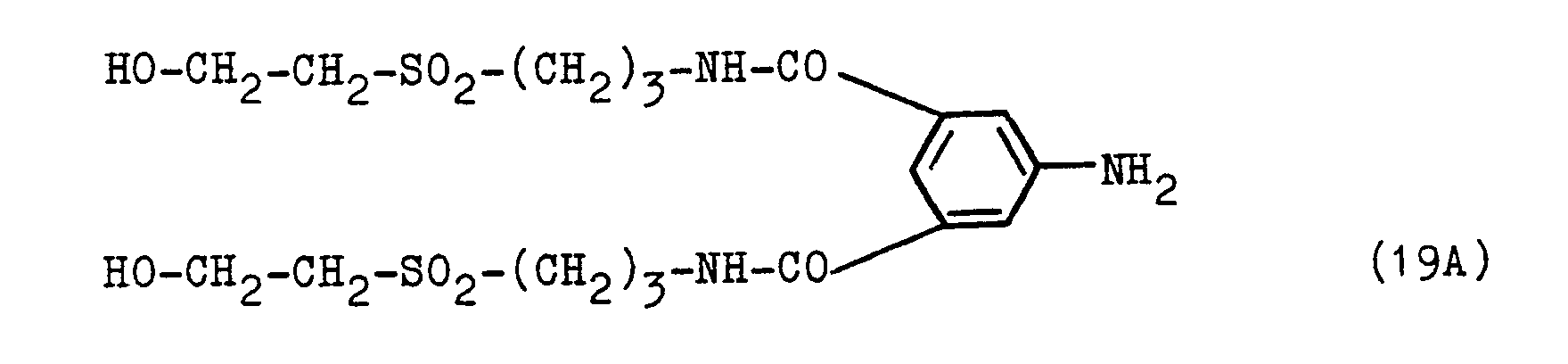
In 750 Teile 3-Amino-propan-1-ol leitet man bis zur Bildung des Hydrochlorids etwa 365 Teile Chlorwasserstoff ein. In das noch flüssige Hydrochlorid werden bei 70 bis 85°C langsam 1190 Teile Thionylchlorid gegeben. Das nunmehr schwer rührbare Reaktionsgemisch wird noch eine Stunde gerührt und danach in 600 Teilen Wasser gelöst. Die Lösung gibt man langsam unter Einhaltung eines pH-Wertes von 11 bis 11,5 mittels Natronlauge und einer Temperatur von höchsten 60°C in eine Lösung von 780 Teilen Thioglykol und 400 Teilen Natriumhydroxid in 1500 Teilen Wasser. Man rührt noch einige Zeit bei etwa 50°C nach und destilliert sodann das Wasser unter reduziertem Druck ab, digeriert den Rückstand in 1500 Volumenteilen Methanol, filtriert von Ungelöstem ab und isoliert nach Entfernen des Lösemittels aus dem Rückstand das γ-(β′-Hydroxyethyl-thio)-propylamin durch fraktionierte Destillation bei 132-140°C/3 mbar. - 270 Teile dieser Verbindung werden in 243 Teilen einer 30%igen Salzsäure gelöst. Man gibt 2 Teile Natriumwolframat hinzu und anschließend langsam 395 Teile 35%iges wäßriges Wasserstoffperoxid, wobei die stark exotherme Reaktion unterhalb 98°C gehalten wird.
- Nach dem Abkühlen wird der erhaltene Ansatz des Hydrochlorids des γ-(β′-Hydroxyethylsulfonyl)-propylamins mit 200 Teilen Wasser versetzt. Man stellt mit Natronlauge einen pH-Wert von 9 ein und gibt eine Lösung von 236 Teilen 5-Nitrobenzol-1,3-di-(carbonsäurechlorid) mit 240 Volumenteilen Aceton unter Einhaltung eines pH-Wertes von 7 bis 9 mittels Natronlauge und einer Temperatur von etwa 30°C hinzu. Nach Beendigung der Reaktion kühlt man den Ansatz auf 0 bis 5°C ab und isoliert das gebildete 5-Nitrobenzol-1,3-di-{carbonsäure-[γ-(β′-hydroxyethylsulfonyl)-propylamid]} durch Filtration; es besitzt einen Schmelzpunkt von 101-104°C.
- Die erhaltene Nitrobenzol-dicarbonsäureamid-Verbindung wird in 1200 Teilen Wasser suspendiert und katalytisch mit Wasserstoff und Raney-Nickel bei 25 bis 60°C und einem Wasserstoffüberdruck von etwa 40 bar zur Aminoverbindung der Formel (19A) reduziert. Nach beendeter Reduktion wird der Katalysator abfiltriert. Die Verbindung (19A) kristallisiert beim Abkühlen des Filtrats auf 0 bis 5°C aus. Es besitzt einen Schmelzpunkt von 145 bis 147°C und ist dünnschichtchromatographisch einheitlich.
- Das unter Beispiel A hergestellte 5-Aminobenzol-1,3-bis-[γ-(β′-hydroxyethylsulfonyl)-N-propyl]-carbonsäureamid kann in dessen faserreaktiven Derivate, wie beispielsweise deren Bis-sulfato-, -phosphato- oder -acetyloxy-Verbindung, auf übliche Weise übergeführt werden, so beispielsweise durch Umsetzung in 100%iger Schwefelsäure oder 100%iger Phosphorsäure oder in Eisessig.
Sowohl die β-Hydroxyethylsulfonyl- als auch die β-Sulfato-, β-Phosphato- und β-Acetyloxyethylsulfonyl-Verbindungen dieses 5-Nitro-1,3-dicarbonsäureamids dienen als Diazokomponente für die Synthese der erfindungsgemäßen Farbstoffe. Wird die β-Hydroxyethylsulfonyl-Verbindung gemäß Formel (19A) als Diazokomponente in die Synthese der erfindungsgemäßen Farbstoffe eingesetzt, so lassen sich analog zu bekannten Verfahrensweisen die β-Hydroxyethylsulfonyl-Gruppen entweder in Zwischenverbindungen während der Synthese des Azofarbstoffes oder im fertiggestellten Azofarbstoff selbst in die entsprechenden β-Sulfato-, β-Phosphato- oder β-Acetyloxy-Derivate überführen. - 47,9 Teile der Verbindung der Formel (19A) von Beispiel A werden in 150 Teile 100%iger Schwefelsäure eingetragen. Man gibt 25 Teile 65%iges Oleum hinzu; hierbei erwärmt sich die Mischung auf 70°C und rührt noch 3 Stunden bei 70 bis 75°C nach. Sodann gießt man die erhaltene Lösung auf ein Gemisch von 1200 Teilen Wasser und 800 Teilen Eis und neutralisiert einen Teil der Schwefelsäure mittels 100 Teilen Calciumcarbonat. Die Anilinverbindung wird sodann in üblicher Weise mittels 21 Volumenteilen einer 5n-Natriumnitritlösung diazotiert. Zu der Diazoniumsalzlösung gibt man 42,3 Teile 1-Benzoylamino-8-naphthol-3,6-disulfonsäure und führt die Kupplungsreaktion bei einem pH-Wert von 5,5 bis 6 durch. Man rührt eine Stunde nach, filtriert vom Calciumsulfat ab und dampft das Filtrat unter reduziertem Druck ein.
- Man erhält das erfindungsgemäße Natriumsalz der Verbindung der Formel

- Man löst die erfindungsgemäße Azoverbindung des Beispieles 1 in Wasser und stellt mittels Natronlauge einen pH-Wert von 10,5 ein, hält ihn noch etwa 15 Minuten durch Zugabe von Natronlauge. Sodann stellt man die Lösung mit wäßriger Salzsäure auf einen pH-Wert von 5 und salzt die hergestellte erfindungsgemäße Vinylsulfonyl-Verbindung mittels Natriumchlorid aus.
- Die als Natriumsalz isolierte erfindungsgemäße Verbindung der Formel

- 8,82 Teile der erfindungsgemäßen Azoverbindung des Beispieles 2 werden in 150 Teilen Wasser bei 70°C gelöst. Man stellt einen pH-Wert von 6,5 ein, gibt 3,2 Teile Natriumthiosulfat hinzu und rührt den Ansatz noch 3 Stunden bei 70°C unter Einhaltung eines pH-Wertes von 6,5 mittels verdünnter wäßriger Essigsäure. Die erfindungsgemäße Thiosulfatoverbindung der Formel

- Man trägt 47,9 Teile der Ausgangsverbindung der Formel (19A) von Beispiel A in 400 Teile Eisessig ein, setzt 1 Teil 96,5%iger Schwefelsäure hinzu und rührt den Ansatz zwei Stunden bei 60 bis 70°C. Überschüssige Essigsäure und Wasser werden unter reduziertem Druck abdestilliert. Die verbleibende Schmelze wird auf ein Gemisch aus Eis und Wasser gegeben und mit 15 Teilen 96,5 %iger Schwefelsäure versetzt. Man diazotiert die Anilinverbindung in üblicher Weise mittels Natriumnitrit, gibt sodann zu der Diazoniumsalzsuspension 36,1 Teile 1-Acetylamino-8-naphthol-3,6-disulfonsäure hinzu, stellt den Ansatz auf einen pH-Wert von 5,5, rührt eine Stunde nach und dampft die Syntheselösung sodann unter reduziertem Druck ein.
- Man erhält die erfindungsgemäße Azoverbindung der Formel

- In den nachfolgenden Tabellenbeispielen sind weitere erfindungsgemäße Azoverbindungen mit Hilfe der Formelreste der allgemeinen Formel (A)
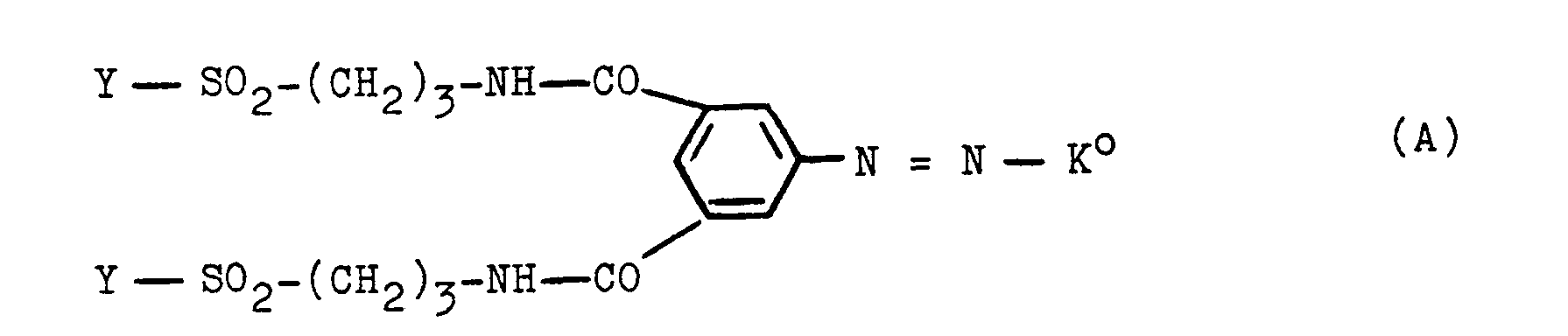

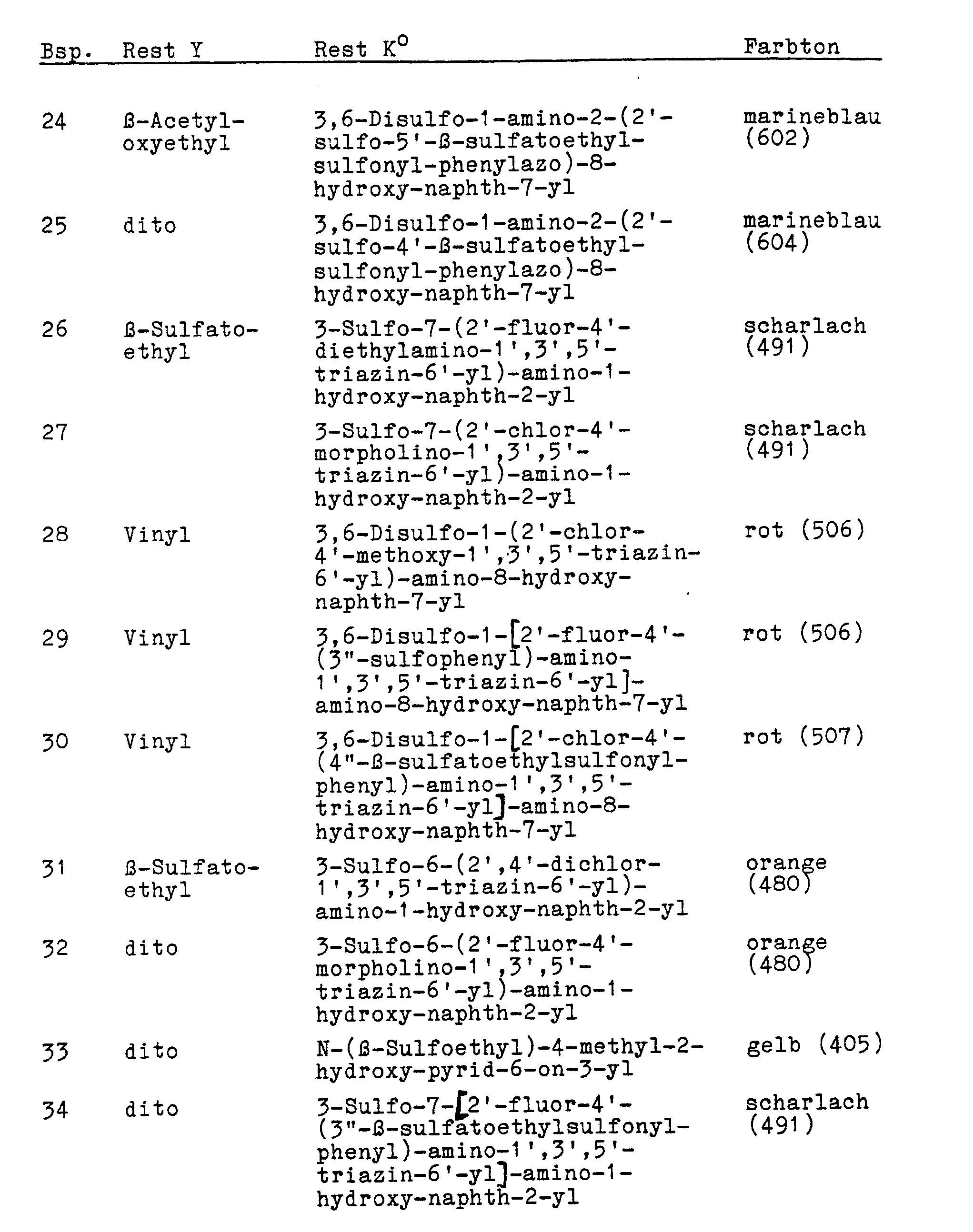
- Man stellt gemäß den Angaben des Beispieles 1 das Diazoniumsalz des Sulfatoderivates der Ausgangsverbindung der Formel (19A) her und filtriert anschließend von Calciumsulfat ab. Das Filtrat wird durch Zugabe von Eis bei einer Temperatur von 5°C mittels Natriumbicarbonat auf einen pH-Wert von 1,8 gestellt und anschließend mit 29 Teilen 1-Amino-8-naphthol-3,6-disulfonsäure versetzt. Man rührt 4 Stunden nach und gibt anschließend bei etwa 10°C eine auf üblichem Wege hergestellte Diazoniumsalzlösung von 29,5 Teilen 2-Methoxy-5-(β-sulfatoethylsulfonyl)-anilin hinzu. Man stellt den pH-Wert auf 6 und rührt bis zur Beendigung der Kupplungsreaktion unter Einhaltung dieses pH-Wertes nach.
- Die erhaltene Syntheselösung wird eingedampft oder sprühgetrocknet. Man erhält ein schwarzes, elektrolythaltiges Pulver der erfindungsgemäßen Alkalimetallverbindung (Natriumverbindung) der Formel
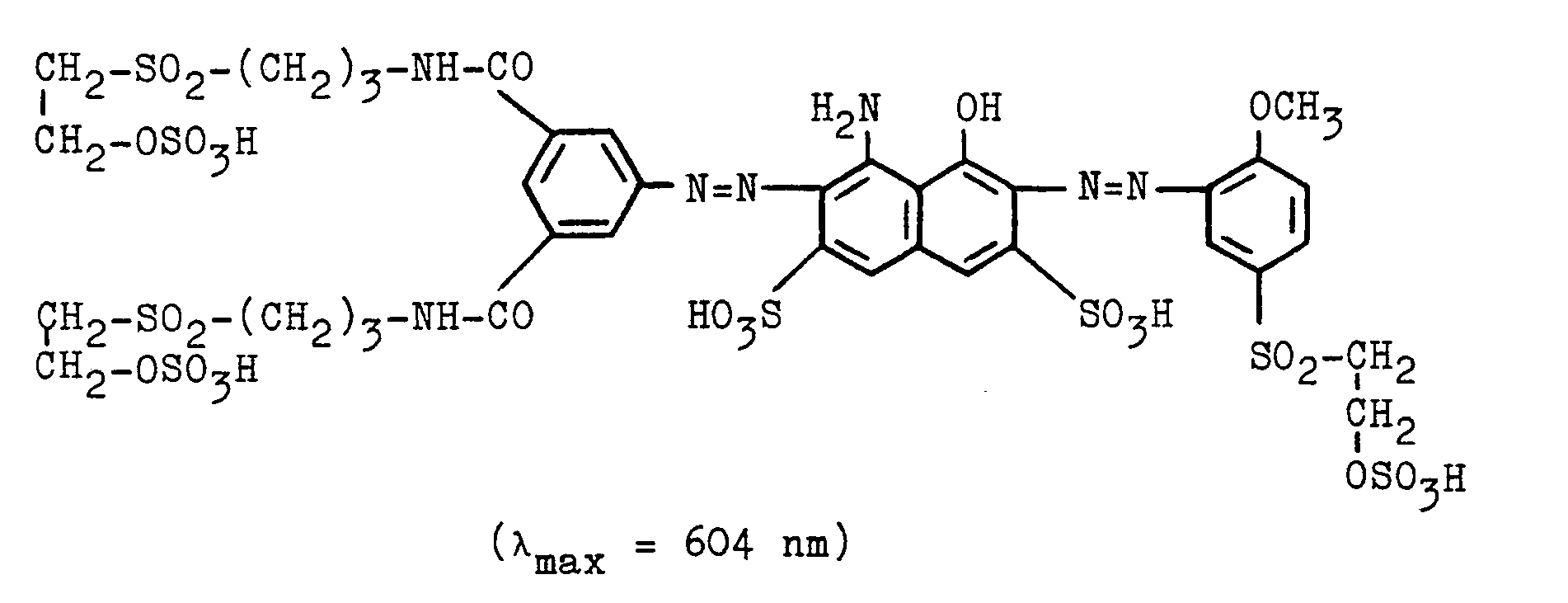
- In den nachfolgenden Tabellenbeispielen sind weitere erfindungsgemäße Disazoverbindungen mit Hilfe der Formelreste der allgemeinen Formel (B)


Claims (15)
1. Eine Verbindung entsprechend der allgemeinen Formel (1)
D - N = N - Ko (1)
in welcher bedeuten:
D ist ein Rest der allgemeinen Formel (2) 
in welcher
Y die Vinylgruppe oder die β-Sulfatoethyl-, β-Acetyloxyethyl-, β-Thiosulfatoethyl oder β-Phosphatoethyl-Gruppe ist;
Ko ist der Rest einer Kupplungskomponente der Benzol- oder Naphthalinreihe oder der heterocyclischen Reihe oder der Acetoacetarylid-Reihe oder
Ko ist ein Rest der allgemeinen Formel (3)
- K - G - Q (3)
in welcher
K ein bivalenter Rest aus der Benzol- oder Naphthalin-Reihe ist,
G für eine Gruppe der Formel
- - CO -
oder - - SO₂ -
steht, in welchen
R ein Wasserstoffatom oder eine Alkylgruppe von 1 bis 4 C-Atomen ist, oder
G eine Azogruppe der Formel -N=N- ist und
Q einen aliphatischen oder aromatischen Rest bedeutet, der seinerseits farbstoffübliche Reste enthält, oder
Ko ist ein Rest der allgemeinen Formel -K*-Z ,
in welcher
K* der bivalente Rest einer Kupplungskomponente der Benzol- oder Naphthalin-Reihe oder der heterocyclischen Reihe oder der Acetoacetarylid-Reihe ist und
Z ein faserreaktiver Acylaminorest, bevorzugt ein Rest der allgemeinen Formel (4) 
ist, in welcher
R eine der obengenannten Bedeutungen hat,
X für ein Fluor- oder Chloratom oder den Morpholinorest oder eine Gruppe der allgemeinen Formel -O-Rα oder eine Aminogruppe der allgemeinen Formel -NRαRβ steht,
in welchen
Rα ein Wasserstoffatom oder ein aliphatischer oder aromatischer Rest ist, der farbstoffübliche Reste enthält, und
Rβ ein Wasserstoffatom oder eine Alkylgruppe von 1 bis 4 C-Atomen ist, die durch Hydroxy, Sulfato, Sulfo, Carboxy, Phosphato, Phenyl, Methoxy oder Ethoxy substituiert sein kann, und
W einen der für X angegebenen Bedeutungen besitzt, wobei X und W zueinander gleich oder voneinander verschieden sein können.
D - N = N - Ko (1)
in welcher bedeuten:
D ist ein Rest der allgemeinen Formel (2)
Y die Vinylgruppe oder die β-Sulfatoethyl-, β-Acetyloxyethyl-, β-Thiosulfatoethyl oder β-Phosphatoethyl-Gruppe ist;
Ko ist der Rest einer Kupplungskomponente der Benzol- oder Naphthalinreihe oder der heterocyclischen Reihe oder der Acetoacetarylid-Reihe oder
Ko ist ein Rest der allgemeinen Formel (3)
- K - G - Q (3)
in welcher
K ein bivalenter Rest aus der Benzol- oder Naphthalin-Reihe ist,
G für eine Gruppe der Formel
-
oder -
steht, in welchen
R ein Wasserstoffatom oder eine Alkylgruppe von 1 bis 4 C-Atomen ist, oder
G eine Azogruppe der Formel -N=N- ist und
Q einen aliphatischen oder aromatischen Rest bedeutet, der seinerseits farbstoffübliche Reste enthält, oder
Ko ist ein Rest der allgemeinen Formel -K*-Z ,
in welcher
K* der bivalente Rest einer Kupplungskomponente der Benzol- oder Naphthalin-Reihe oder der heterocyclischen Reihe oder der Acetoacetarylid-Reihe ist und
Z ein faserreaktiver Acylaminorest, bevorzugt ein Rest der allgemeinen Formel (4)
R eine der obengenannten Bedeutungen hat,
X für ein Fluor- oder Chloratom oder den Morpholinorest oder eine Gruppe der allgemeinen Formel -O-Rα oder eine Aminogruppe der allgemeinen Formel -NRαRβ steht,
in welchen
Rα ein Wasserstoffatom oder ein aliphatischer oder aromatischer Rest ist, der farbstoffübliche Reste enthält, und
Rβ ein Wasserstoffatom oder eine Alkylgruppe von 1 bis 4 C-Atomen ist, die durch Hydroxy, Sulfato, Sulfo, Carboxy, Phosphato, Phenyl, Methoxy oder Ethoxy substituiert sein kann, und
W einen der für X angegebenen Bedeutungen besitzt, wobei X und W zueinander gleich oder voneinander verschieden sein können.
2. Verbindung nach Anspruch 1, dadurch gekennzeichnet, daß in der Gruppe der Formel (4) der Rest X eine Aminogruppe -NRαRβ ist, in welcher Rα ein Wasserstoffatom oder eine Alkylgruppe von 1 bis 4 C-Atomen ist, die durch Hydroxy, Sulfato, Sulfo, Carboxy, Phosphato, Phenyl, Methoxy oder Ethoxy substitutiert sein kann, oder ein Phenylrest ist, der durch Substituenten substituiert sein kann, die aus der Gruppe Alkyl von 1 bis 4 C-Atomen, Alkoxy von 1 bis 4 C-Atomen, Carboxy, Sulfo, einer Gruppe der Formel -SO₂-Y mit Y einer der obengenannten Bedeutungen, Chlor und Brom ausgewählt sind, und Rβ die in Anspruch 1 genannte Bedeutung hat.
3. Verbindung nach Anspruch 1 oder 2 entsprechend der allgemeinen Formel (5a)
D - N = N (̵ E - N = N )̵ - Ko (5a)
in welcher
D und Ko die in Anspruch 1 genannten Bedeutungen haben,
E den bivalenten Rest einer kupplungsfähigen und diazotierbaren Verbindung bedeutet und
v für die Zahl Null oder 1 steht.
D - N = N (̵ E - N = N )̵
in welcher
D und Ko die in Anspruch 1 genannten Bedeutungen haben,
E den bivalenten Rest einer kupplungsfähigen und diazotierbaren Verbindung bedeutet und
v für die Zahl Null oder 1 steht.
4. Verbindung nach Anspruch 1 entsprechend der allgemeinen Formel (5b)

in welcher
M für ein Wasserstoffatom oder ein Alkalimetall steht,
D die in Anspruch 1 genannte Bedeutung besitzt und
D¹ ein Rest einer Diazokomponente der Benzol- oder Naphthalinreihe ist, der durch in faserreaktiven Farbstoffen übliche Substituenten substituiert sein kann, beispielsweise durch Substituenten, die aus der folgenden Gruppe vom Substituenten ausgewählt sind: Alkyl von 1 bis 4 C-Atomen, wie Methyl und Ethyl, Alkoxy von 1 bis 4 C-Atomen wie Methoxy und Ethoxy, Carboxy, Sulfo, Halogen, wie Chlor und Brom, Trifluormethyl, Nitro, Benzoylamino, eine Gruppe der oben definierten allgemeinen Formel -SO₂-Y , eine faserreaktive aliphatische oder heterocyclische Acylaminogruppe Z, beispielsweise eine Gruppe der oben genannten und definierten allgemeinen Formel (4), Alkanoylamino von 2 bis 5 C-Atomen und Hydroxy, oder
D¹ ein Rest der allgemeinen Formel (2) ist.
M für ein Wasserstoffatom oder ein Alkalimetall steht,
D die in Anspruch 1 genannte Bedeutung besitzt und
D¹ ein Rest einer Diazokomponente der Benzol- oder Naphthalinreihe ist, der durch in faserreaktiven Farbstoffen übliche Substituenten substituiert sein kann, beispielsweise durch Substituenten, die aus der folgenden Gruppe vom Substituenten ausgewählt sind: Alkyl von 1 bis 4 C-Atomen, wie Methyl und Ethyl, Alkoxy von 1 bis 4 C-Atomen wie Methoxy und Ethoxy, Carboxy, Sulfo, Halogen, wie Chlor und Brom, Trifluormethyl, Nitro, Benzoylamino, eine Gruppe der oben definierten allgemeinen Formel -SO₂-Y , eine faserreaktive aliphatische oder heterocyclische Acylaminogruppe Z, beispielsweise eine Gruppe der oben genannten und definierten allgemeinen Formel (4), Alkanoylamino von 2 bis 5 C-Atomen und Hydroxy, oder
D¹ ein Rest der allgemeinen Formel (2) ist.
5. Verbindung nach Anspruch 1 entsprechend der allgemeinen Formel (5c)

in welcher
M für ein Wasserstoffatom oder ein Alkalimetall steht,
D die in Anspruch 1 genannte Bedeutung besitzt und
D¹ ein Rest einer Diazokomponente der Benzol- oder Naphthalinreihe ist, der durch in faserreaktiven Farbstoffen übliche Substituenten substituiert sein kann, beispielsweise durch Substituenten, die aus der folgenden Gruppe vom Substituenten ausgewählt sind: Alkyl von 1 bis 4 C-Atomen, wie Methyl und Ethyl, Alkoxy von 1 bis 4 C-Atomen wie Methoxy und Ethoxy, Carboxy, Sulfo, Halogen, wie Chlor und Brom, Trifluormethyl, Nitro, Benzoylamino, eine Gruppe der oben definierten allgemeinen Formel -SO₂-Y , eine faserreaktive aliphatische oder heterocyclische Acylaminogruppe Z, beispielsweise eine Gruppe der oben genannten und definierten allgemeinen Formel (4), Alkanoylamino von 2 bis 5 C-Atomen und Hydroxy, oder
D¹ ein Rest der allgemeinen Formel (2) ist.
M für ein Wasserstoffatom oder ein Alkalimetall steht,
D die in Anspruch 1 genannte Bedeutung besitzt und
D¹ ein Rest einer Diazokomponente der Benzol- oder Naphthalinreihe ist, der durch in faserreaktiven Farbstoffen übliche Substituenten substituiert sein kann, beispielsweise durch Substituenten, die aus der folgenden Gruppe vom Substituenten ausgewählt sind: Alkyl von 1 bis 4 C-Atomen, wie Methyl und Ethyl, Alkoxy von 1 bis 4 C-Atomen wie Methoxy und Ethoxy, Carboxy, Sulfo, Halogen, wie Chlor und Brom, Trifluormethyl, Nitro, Benzoylamino, eine Gruppe der oben definierten allgemeinen Formel -SO₂-Y , eine faserreaktive aliphatische oder heterocyclische Acylaminogruppe Z, beispielsweise eine Gruppe der oben genannten und definierten allgemeinen Formel (4), Alkanoylamino von 2 bis 5 C-Atomen und Hydroxy, oder
D¹ ein Rest der allgemeinen Formel (2) ist.
6. Verbindung nach mindestens einem der Ansprüche 1 bis 3, dadurch gekennzeichnet, daß W ein Fluor- oder Chloratom bedeutet.
7. Verfahren zur Herstellung einer in Anspruch 1 genannten und definierten Verbindung der allgemeinen Formel (1), dadurch gekennzeichnet, daß man ein Diazoniumsalz eines Amins der allgemeinen Formel (15)

in welcher Y die in Anspruch 1 genannten Bedeutungen haben, mit einer Kupplungskomponente der allgemeinen Formel H-Ko mit Ko der in Anspruch 1 genannten Bedeutung kuppelt,
oder daß man eine Verbindung der allgemeinen Formel (17) 
mit Y, K* und R der in Anspruch 1 genannten Bedeutung mit einer Verbindung der allgemeinen Formel Hal-Z¹ mit Hal und Z¹ der obengenannten Bedeutung umsetzt.
oder daß man eine Verbindung der allgemeinen Formel (17)
8. Verfahren nach Anspruch 7, dadurch gekennzeichnet, daß man eine Verbindung der allgemeinen Formel (18)

in welcher D, R und M die in Anspruch 1 und 5 genannten Bedeutungen haben und
D² ein Phenylen- oder Naphthylenrest ist, der durch in faserreaktiven Farbstoffen übliche Substituenten substituiert sein kann, beispielsweise durch Substituenten aus der Gruppe Alkyl von 1 bis 4 C-Atomen, Alkoxy von 1 bis 4 C-Atomen, Carboxy, Sulfo, Halogen, Trifluormethyl, Nitro, Benzoylamino, eine Gruppe der oben definierten allgemeinen Formel -SO₂-Y , Alkanoylamino von 2 bis 5 C-Atomen und Hydroxy,
mit einer Verbindung der allgemeinen Formel Hal-Z¹ mit Hal und Z¹ der obengenannten Bedeutung umsetzt.
D² ein Phenylen- oder Naphthylenrest ist, der durch in faserreaktiven Farbstoffen übliche Substituenten substituiert sein kann, beispielsweise durch Substituenten aus der Gruppe Alkyl von 1 bis 4 C-Atomen, Alkoxy von 1 bis 4 C-Atomen, Carboxy, Sulfo, Halogen, Trifluormethyl, Nitro, Benzoylamino, eine Gruppe der oben definierten allgemeinen Formel -SO₂-Y , Alkanoylamino von 2 bis 5 C-Atomen und Hydroxy,
mit einer Verbindung der allgemeinen Formel Hal-Z¹ mit Hal und Z¹ der obengenannten Bedeutung umsetzt.
9. Verfahren nach Anspruch 6 zur Herstellung einer Verbindung der in Anspruch 1 genannten und definierten allgemeinen Formel (1), in welcher jedoch beide Y β-Sulfatoethyl-Gruppen bedeuten und/oder eine der möglichen Substituenten in Ko einen β-Sulfatoethyl-Rest enthält, dadurch gekennzeichnet, daß man eine Verbindung entsprechend der allgemeinen Formel (1) der in Anspruch 1 angegebenen Bedeutung, in welcher jedoch beide Y β-Hydroxyethyl-Gruppen sind und/oder einer der für Ko angegebenen Substituenten ein β-Hydroxyethyl-Rest enthält, mit einem Sulfatierungsmittel verestert.
10. Verfahren zur Herstellung einer in Anspruch 4 definierten Disazoverbindung der allgemeinen Formel (5c), dadurch gekennzeichnet, daß man ein Diazoniumsalz eines Amins der allgemeinen Formel D¹-NH₂ mit D¹ der in Anspruch 4 angegebenen Bedeutung mit einer Verbindung der allgemeinen Formel (16)

in welcher D und M die in Anspruch 4 genannten Bedeutungen haben, kuppelt und im Falle, daß in den Ausgangsverbindungen der Formeln D¹-NH₂ und (16) die Reste D und D¹ eine oder mehrere β-Hydroxyethylsulfonyl-Gruppen enthalten, in der synthetisierten Disazoverbindung entsprechend der allgemeinen Formel (5c), in welcher jedoch eine oder mehrere β-Hydroxyethylsulfonyl-Gruppen enthalten sind, diese β-Hydroxyethylsulfonyl-Gruppen mittels einem Sulfatierungsmittel in die β-Sulfatoethylsulfonyl-Gruppen überführt.
11. Verwendung eines Farbstoffes von Anspruch 1 zum Färben und Bedrucken von hydroxy- und/oder carbonamidgruppenhaltigem Material, insbesondere Fasermaterial.
12. Verfahren zum Färben und Bedrucken von hydroxy- und/oder carbonamidgruppenhaltigem Material, insbesondere Fasermaterial, bei welchem man einen Farbstoff auf das Material aufbringt und ihn mittels Wärme oder mit Hilfe eines alkalisch wirkenden Mittels oder mittels Wärme und mit Hilfe eines alkalischen Mittels fixiert, dadurch gekennzeichnet, daß man als Farbstoff eine Verbindung entsprechend der allgemeinen Formel (1) von Anspruch 1 verwendet.
13. Eine Verbindung entsprechend der allgemeinen Formel (19)

in welcher Y¹ die Vinylgruppe oder die β-Sulfatoethyl-, β-Acetyloxyethyl-, β-Thiosulfatoethyl-, β-Phosphatoethyl- oder β-Hydroxyethyl-Gruppe ist und G für die Nitrogruppe oder die Aminogruppe steht.
14. Verfahren zur Herstellung einer in Anspruch 13 genannten und definierten Verbindung der allgemeinen Formel (19), dadurch gekennzeichnet, daß man γ-(β′-Hydroxyethylsulfonyl)-propylamin in zweifach molarer Menge mit 5-Nitro-benzol-1,3-di-(carbonsäurechlorid) umsetzt und im Falle der Herstellung einer Verbindung (19) mit G der Aminogruppe die Nitrogruppe reduziert und ggfs. zur Synthese einer Verbindung der allgemeinen Formel (19) mit Y¹ einer anderen der angegebenen Bedeutung als β-Hydroxyethyl die β-Hydroxyethyl-Gruppen analog bekannten Verfahrensweisen in andere solche Gruppen überführt.
15. Verwendung einer Verbindung der allgemeinen Formel (19) von Anspruch 14 zur Synthese von faserreaktiven Farbstoffen, insbesondere Azofarbstoffen.
Applications Claiming Priority (2)
| Application Number | Priority Date | Filing Date | Title |
|---|---|---|---|
| DE19893905270 DE3905270A1 (de) | 1989-02-21 | 1989-02-21 | Wasserloesliche faserreaktive azofarbstoffe, deren bis-(carbonsaeureamid)-benzol-vorprodukte, verfahren zu ihrer herstellung und ihre verwendung |
| DE3905270 | 1989-02-21 |
Publications (1)
| Publication Number | Publication Date |
|---|---|
| EP0385204A1 true EP0385204A1 (de) | 1990-09-05 |
Family
ID=6374574
Family Applications (1)
| Application Number | Title | Priority Date | Filing Date |
|---|---|---|---|
| EP90103080A Withdrawn EP0385204A1 (de) | 1989-02-21 | 1990-02-17 | Wasserlösliche faserreaktive Azofarbstoffe, deren Bis(carbonsäureamid)-benzol-Vorprodukte, Verfahren zu ihrer Herstellung und ihre Verwendung |
Country Status (3)
| Country | Link |
|---|---|
| EP (1) | EP0385204A1 (de) |
| JP (1) | JPH02247258A (de) |
| DE (1) | DE3905270A1 (de) |
Cited By (2)
| Publication number | Priority date | Publication date | Assignee | Title |
|---|---|---|---|---|
| EP0586331A3 (de) * | 1992-07-31 | 1994-05-11 | Ciba-Geigy Ag | Verfahren zum Färben von synthetischen Polyamidfasermaterialien |
| EP1046677A1 (de) * | 1999-04-22 | 2000-10-25 | DyStar Textilfarben GmbH & Co. Deutschland KG | Wasserlösliche Disazoverbindungen mit Arylcarbonamid-Diazokomponenten, Verfahren zu ihrer Herstellung und ihre Verwendung |
Citations (2)
| Publication number | Priority date | Publication date | Assignee | Title |
|---|---|---|---|---|
| EP0221013A1 (de) * | 1985-10-03 | 1987-05-06 | Ciba-Geigy Ag | Reaktivfarbstoffe, deren Herstellung und Verwendung |
| EP0284568A2 (de) * | 1987-03-27 | 1988-09-28 | Ciba-Geigy Ag | Reaktivfarbstoffe, deren Herstellung und Verwendung |
-
1989
- 1989-02-21 DE DE19893905270 patent/DE3905270A1/de not_active Withdrawn
-
1990
- 1990-02-17 EP EP90103080A patent/EP0385204A1/de not_active Withdrawn
- 1990-02-20 JP JP2037541A patent/JPH02247258A/ja active Pending
Patent Citations (2)
| Publication number | Priority date | Publication date | Assignee | Title |
|---|---|---|---|---|
| EP0221013A1 (de) * | 1985-10-03 | 1987-05-06 | Ciba-Geigy Ag | Reaktivfarbstoffe, deren Herstellung und Verwendung |
| EP0284568A2 (de) * | 1987-03-27 | 1988-09-28 | Ciba-Geigy Ag | Reaktivfarbstoffe, deren Herstellung und Verwendung |
Cited By (4)
| Publication number | Priority date | Publication date | Assignee | Title |
|---|---|---|---|---|
| EP0586331A3 (de) * | 1992-07-31 | 1994-05-11 | Ciba-Geigy Ag | Verfahren zum Färben von synthetischen Polyamidfasermaterialien |
| US5356440A (en) * | 1992-07-31 | 1994-10-18 | Ciba-Geigy Corporation | Process for the dyeing of synthetic polyamide fibre materials |
| EP1046677A1 (de) * | 1999-04-22 | 2000-10-25 | DyStar Textilfarben GmbH & Co. Deutschland KG | Wasserlösliche Disazoverbindungen mit Arylcarbonamid-Diazokomponenten, Verfahren zu ihrer Herstellung und ihre Verwendung |
| US6281340B1 (en) | 1999-04-22 | 2001-08-28 | Dystar Textilfarben Gmbh & Co. Deutschland Kg | Water-soluble disazo compound having arylcarboxamide diazo components, preparation thereof and use thereof |
Also Published As
| Publication number | Publication date |
|---|---|
| DE3905270A1 (de) | 1990-08-23 |
| JPH02247258A (ja) | 1990-10-03 |
Similar Documents
| Publication | Publication Date | Title |
|---|---|---|
| EP0221013B1 (de) | Reaktivfarbstoffe, deren Herstellung und Verwendung | |
| EP0471702B1 (de) | Wasserlösliche faserreaktive farbstoffe, verfahren zu ihrer herstellung und ihre verwendung | |
| EP0538785B1 (de) | Wasserlösliche faserreaktive Farbstoffe, Verfahren zu ihrer Herstellung und ihre Verwendung | |
| EP0629667A1 (de) | Wasserlöslichse faserreaktive Farbstoffe, Verfahren zu ihrer Herstellung und ihre Verwendung | |
| EP0675172B1 (de) | Wasserlösliche Azoverbindungen, Verfahren zu ihrer Herstellung und ihre Verwendung als Farbstoffe | |
| EP0271883B1 (de) | Wasserlösliche farbige Verbindungen, Verfahren zu ihrer Herstellung und ihre Verwendung als Farbstoffe | |
| EP0542214B1 (de) | Wasserlösliche faserreaktive Farbstoffe, Verfahren zu ihrer Herstellung und ihre Verwendung | |
| EP0471713B1 (de) | Wasserlösliche azofarbstoffe, verfahren zu ihrer herstellung und ihre verwendung | |
| EP0630946A1 (de) | Wasserlösliche faserreaktive Azofarbstoffe, Verfahren zu ihrer Herstellung und ihre Verwendung | |
| EP0212264B1 (de) | Wasserlösliche farbige Verbindungen, Verfahren zu ihrer Herstellung und ihre Verwendung als Farbstoffe | |
| DE3843014A1 (de) | Wasserloesliche farbstoffe, verfahren zu ihrer herstellung und ihre verwendung | |
| EP0377166A1 (de) | Wasserlösliche faserreaktive Farbstoffe, Verfahren zu ihrer Herstellung und ihre Verwendung | |
| EP0388864B1 (de) | Wasserlösliche faserreaktive Farbstoffe, Verfahren zu ihrer Herstellung und ihre Verwendung | |
| DE3905270A1 (de) | Wasserloesliche faserreaktive azofarbstoffe, deren bis-(carbonsaeureamid)-benzol-vorprodukte, verfahren zu ihrer herstellung und ihre verwendung | |
| DE3825658A1 (de) | Wasserloesliche faserreaktive farbstoffe, verfahren zu ihrer herstellung und ihre verwendung | |
| EP0511246B1 (de) | Wasserlösliche faserreaktive farbstoffe, verfahren zu ihrer herstellung und ihre verwendung | |
| EP0374911A1 (de) | Wasserlösliche faserreaktive Farbstoffe, Verfahren zu ihrer Herstellung und ihre Verwendung | |
| DE3906778A1 (de) | Wasserloesliche faserreaktive farbstoffe, verfahren zu ihrer herstellung und ihre verwendung | |
| EP0838504B1 (de) | Wasserlösliche faserreaktive Farbstoffe, Verfahren zu ihrer Herstellung und ihre Verwendung | |
| EP0624630A1 (de) | Wasserlösliche faserreaktive Farbstoffe, Verfahren zu ihrer Herstellung und ihre Verwendung | |
| DE3930704A1 (de) | Wasserloesliche faserreaktive farbstoffe, verfahren zu ihrer herstellung und ihre verwendung | |
| EP0548792A2 (de) | Wasserlöschliche faserreaktive Farbstoffe, Verfahren zu ihrer Herstellung und ihre Verwendung | |
| EP0361440A1 (de) | Wasserlösliche faserreaktive Farbstoffe, Verfahren zu ihrer Herstellung und ihre Verwendung | |
| DE3934514A1 (de) | Wasserloesliche azofarbstoffe, verfahren zu ihrer herstellung und ihre verwendung | |
| DE4009066A1 (de) | Wasserloesliche faserreaktive farbstoffe, verfahren zu ihrer herstellung und ihre verwendung |
Legal Events
| Date | Code | Title | Description |
|---|---|---|---|
| PUAI | Public reference made under article 153(3) epc to a published international application that has entered the european phase |
Free format text: ORIGINAL CODE: 0009012 |
|
| AK | Designated contracting states |
Kind code of ref document: A1 Designated state(s): BE CH DE FR GB IT LI |
|
| 17P | Request for examination filed |
Effective date: 19901221 |
|
| STAA | Information on the status of an ep patent application or granted ep patent |
Free format text: STATUS: THE APPLICATION HAS BEEN WITHDRAWN |
|
| 18W | Application withdrawn |
Withdrawal date: 19920611 |