EP0385557A1 - Matériau d'amélioration du sol à base de polyuréthane - Google Patents
Matériau d'amélioration du sol à base de polyuréthane Download PDFInfo
- Publication number
- EP0385557A1 EP0385557A1 EP90200501A EP90200501A EP0385557A1 EP 0385557 A1 EP0385557 A1 EP 0385557A1 EP 90200501 A EP90200501 A EP 90200501A EP 90200501 A EP90200501 A EP 90200501A EP 0385557 A1 EP0385557 A1 EP 0385557A1
- Authority
- EP
- European Patent Office
- Prior art keywords
- soil
- polyurethane
- water
- flakes
- draining
- Prior art date
- Legal status (The legal status is an assumption and is not a legal conclusion. Google has not performed a legal analysis and makes no representation as to the accuracy of the status listed.)
- Withdrawn
Links
- 239000000463 material Substances 0.000 title claims abstract description 64
- 239000002689 soil Substances 0.000 title claims abstract description 28
- 229920002635 polyurethane Polymers 0.000 title claims abstract description 17
- 239000004814 polyurethane Substances 0.000 title claims abstract description 17
- XLYOFNOQVPJJNP-UHFFFAOYSA-N water Substances O XLYOFNOQVPJJNP-UHFFFAOYSA-N 0.000 claims abstract description 33
- 229920003023 plastic Polymers 0.000 claims abstract description 8
- 239000004033 plastic Substances 0.000 claims abstract description 8
- 238000011282 treatment Methods 0.000 claims abstract description 5
- 238000004659 sterilization and disinfection Methods 0.000 claims abstract 2
- 229920005830 Polyurethane Foam Polymers 0.000 claims description 15
- 239000011496 polyurethane foam Substances 0.000 claims description 15
- 230000001788 irregular Effects 0.000 claims description 12
- 238000010521 absorption reaction Methods 0.000 claims description 4
- 229920000642 polymer Polymers 0.000 claims description 4
- 229920001187 thermosetting polymer Polymers 0.000 claims description 4
- 238000002360 preparation method Methods 0.000 claims description 2
- 230000001954 sterilising effect Effects 0.000 claims 1
- 238000004519 manufacturing process Methods 0.000 abstract description 3
- 239000006260 foam Substances 0.000 description 16
- 239000000047 product Substances 0.000 description 5
- 239000004743 Polypropylene Substances 0.000 description 4
- 238000005187 foaming Methods 0.000 description 4
- 238000000034 method Methods 0.000 description 4
- -1 polyethylene Polymers 0.000 description 4
- 239000004576 sand Substances 0.000 description 4
- 230000015572 biosynthetic process Effects 0.000 description 3
- 230000000903 blocking effect Effects 0.000 description 3
- 239000004927 clay Substances 0.000 description 3
- 239000002245 particle Substances 0.000 description 3
- 229920001155 polypropylene Polymers 0.000 description 3
- 239000007858 starting material Substances 0.000 description 3
- 238000010025 steaming Methods 0.000 description 3
- 239000000126 substance Substances 0.000 description 3
- 241000233866 Fungi Species 0.000 description 2
- 239000002253 acid Substances 0.000 description 2
- 150000007513 acids Chemical class 0.000 description 2
- 150000001298 alcohols Chemical class 0.000 description 2
- 230000008901 benefit Effects 0.000 description 2
- GZUXJHMPEANEGY-UHFFFAOYSA-N bromomethane Chemical compound BrC GZUXJHMPEANEGY-UHFFFAOYSA-N 0.000 description 2
- 230000002950 deficient Effects 0.000 description 2
- 230000001419 dependent effect Effects 0.000 description 2
- 230000008021 deposition Effects 0.000 description 2
- 230000000694 effects Effects 0.000 description 2
- 230000002349 favourable effect Effects 0.000 description 2
- 239000006261 foam material Substances 0.000 description 2
- 239000007789 gas Substances 0.000 description 2
- 239000011521 glass Substances 0.000 description 2
- 239000012948 isocyanate Substances 0.000 description 2
- 150000002513 isocyanates Chemical class 0.000 description 2
- 231100000989 no adverse effect Toxicity 0.000 description 2
- 239000004698 Polyethylene Substances 0.000 description 1
- 239000004721 Polyphenylene oxide Substances 0.000 description 1
- 239000004793 Polystyrene Substances 0.000 description 1
- 239000000654 additive Substances 0.000 description 1
- 150000001412 amines Chemical class 0.000 description 1
- 238000005452 bending Methods 0.000 description 1
- 230000009286 beneficial effect Effects 0.000 description 1
- 239000011230 binding agent Substances 0.000 description 1
- 238000006243 chemical reaction Methods 0.000 description 1
- 239000007795 chemical reaction product Substances 0.000 description 1
- 238000001514 detection method Methods 0.000 description 1
- 238000010410 dusting Methods 0.000 description 1
- 230000007613 environmental effect Effects 0.000 description 1
- 239000011888 foil Substances 0.000 description 1
- 238000013467 fragmentation Methods 0.000 description 1
- 238000006062 fragmentation reaction Methods 0.000 description 1
- 239000003673 groundwater Substances 0.000 description 1
- 230000007774 longterm Effects 0.000 description 1
- 238000012423 maintenance Methods 0.000 description 1
- 239000002184 metal Substances 0.000 description 1
- 229940102396 methyl bromide Drugs 0.000 description 1
- 244000005700 microbiome Species 0.000 description 1
- 150000007522 mineralic acids Chemical class 0.000 description 1
- 239000000203 mixture Substances 0.000 description 1
- 235000015097 nutrients Nutrition 0.000 description 1
- 238000012856 packing Methods 0.000 description 1
- 230000035699 permeability Effects 0.000 description 1
- 229920000728 polyester Polymers 0.000 description 1
- 229920000570 polyether Polymers 0.000 description 1
- 229920000573 polyethylene Polymers 0.000 description 1
- 229920002223 polystyrene Polymers 0.000 description 1
- 239000011148 porous material Substances 0.000 description 1
- 238000010298 pulverizing process Methods 0.000 description 1
- 239000002994 raw material Substances 0.000 description 1
- 230000002940 repellent Effects 0.000 description 1
- 239000005871 repellent Substances 0.000 description 1
- 238000007789 sealing Methods 0.000 description 1
- 230000035945 sensitivity Effects 0.000 description 1
- 238000005507 spraying Methods 0.000 description 1
- 238000005728 strengthening Methods 0.000 description 1
- 238000009941 weaving Methods 0.000 description 1
Images
Classifications
-
- E—FIXED CONSTRUCTIONS
- E01—CONSTRUCTION OF ROADS, RAILWAYS, OR BRIDGES
- E01C—CONSTRUCTION OF, OR SURFACES FOR, ROADS, SPORTS GROUNDS, OR THE LIKE; MACHINES OR AUXILIARY TOOLS FOR CONSTRUCTION OR REPAIR
- E01C3/00—Foundations for pavings
- E01C3/003—Foundations for pavings characterised by material or composition used, e.g. waste or recycled material
-
- E—FIXED CONSTRUCTIONS
- E02—HYDRAULIC ENGINEERING; FOUNDATIONS; SOIL SHIFTING
- E02B—HYDRAULIC ENGINEERING
- E02B11/00—Drainage of soil, e.g. for agricultural purposes
-
- E—FIXED CONSTRUCTIONS
- E02—HYDRAULIC ENGINEERING; FOUNDATIONS; SOIL SHIFTING
- E02D—FOUNDATIONS; EXCAVATIONS; EMBANKMENTS; UNDERGROUND OR UNDERWATER STRUCTURES
- E02D3/00—Improving or preserving soil or rock, e.g. preserving permafrost soil
- E02D3/02—Improving by compacting
- E02D3/10—Improving by compacting by watering, draining, de-aerating or blasting, e.g. by installing sand or wick drains
Definitions
- the invention relates to soil-improving materials, especially for draining purposes, based on particulate plyurethane foam materials which may be held together by a cover. It is known to keep the soil in warehouses,nursery-gardens etc in condition by means of draining pipes and thus advantageously influence the water management. The materials used thus far all have certain objections.If one uses draining pipes then material has to be put on top of it to prevent deposition, blocking, which often arises in connection with the clay layer etc present. The use of materials, like filted PVS-foam further has the object that they themselves imbibe water and retain it and thus retard continuous flow. Up to now methyl bromide was used to disinfect the soil.This however has environmental disadvantages and thus one returns to steaming of the soil. Therefore still other propertiesare of interest for the present materials, such as resistance against the relatively high temperatures which occur during steaming of the soil.Further of course a relatively low weight is of importance.
- the invention is aimed at a foamed material inparticulate form, which during use as draining materal doen not require maintenance and which indefinitely retains its water repellant capacity.Thus long term use is possible without occurrence of blocking or layer formation.
- the invention is aimed at a foamed material in particuate and possible covered form, which is resistant against the relatively high temperatures which may arise in warehouses when steaming the soil.
- the foamed material especially consists of a famed particulate thermohardable polyurethane polymer which does not melt or is shrinking of changes shape at the temperatures experienced.
- German Offenlegungsschrift 2041192 it is known from German Offenlegungsschrift 2041192 to use polyurethane foam particles mixed with feed materials and bound together by a binder into a carrier product for the roots of plants. This publication does not disclose a specific shape of the polyurethane particles and equally the purpose is different.Furthermore the German Offenlegungsschrift 2213053 describes an apparatus for the detection of draining pipes consisting of an intermediate layer ofhard foam particles loosely laying on top of each other covered by an outer layer of fibrous materiaal.
- a material which is used as a soil improving material, especially as a drain, material or soil strengthening material, which is characterized in that it is built up of a thermo hardend polyurethane foam,which by means of a desintegrating process, as defined, is comminuted to irregular flakes.
- a thermo hardend polyurethane foam which by means of a desintegrating process, as defined, is comminuted to irregular flakes.
- polyurethane consists of polymers obtained by the polyaddition of isocyanate containing molecules to polyvalent alcohols, acids or amines.
- polyurethanes By variation of the staring materials polyurethanes with different properties are obtainable.
- the invention starts from thermohardenable polyurethanes for processing into foam, like polyester and polyether foam,wherein foaming occurs by CO2 or water dosing or by other foaming gases.
- the polyurethane foams can be obtained as blocks by foaming in a mold or as sheets when foaming takes place on a belt.
- the foams may be flexible or rigid dependent on the reactions used.
- rigid polyurethane foams with closed cells are used which are thermo hardable and during higher temperatures, especially above 140 o C do not soften or otherwise loose their favourite properties .
- thermohardend polyurethane foam with dense cells which in a desintegration process is comminuted to irregular flakes, of which in fact none has the same shape, by means of for this purpose known apparatuses, like hammer mills, ball mills, beaters, vibration mills etc.
- a hammer mill provided with a perforated screen with adjustable screen openings with which the flake size can be adjusted.
- the flakes should have an irregular form in such a way that in use always opening remain between the stacked flakes because of their non-fitting shape.These opening are of course necessary for a good draining. In case of a dense packing of the flakes there may arise the danger of layer forming.
- the form most suitable of the irregular flakes is obtained by disintegrating sheet- or block materials, which are the startingmaterials,in a hammer mill of which the screen distance between the screen or grid bars is adjusted to 20 mm to 50 mm (square openings). The material is beaten through the screen openings by the hammers of the mill so that very irregular shapes of the flakes arise, of which the mean dimensions are lying about th4 screen distance. It is of course to be understood that no exact measures can be indicated, such as a mean diameter etc, because the flakes per se possess too great deviations and may have tortuous forms.However, when the indicated screen distances are maintained a material is obtained which satisfies the objects of the invention.
- the revolutions of the axis with hammers is in the range of 500 to 1100 rpm.
- the hammers are fixed to one or more axis, according to the type of mill, which are revolving with the afore mentioned rpm.
- the hammers generally have the shape of straight metal bars, which in numbers of 2-6 are mounted on the axis.
- the flakes may be obtained possibly in another way than by a hammer mill treatment provided they meet the desired criteria of irregularity of the flakes, shape of the flakes and size thereof. According to the invention one starts from material having the shape as obtained by the said hammer mill treatment of plates of blocks thermohardened pol polyurethane foam, with which material the benefits of the invention can be attained.
- the invention is in particular beneficial for the processing of polyurethane foam scrap which is formed during the polyurethane manufacturing process and which normally cannot be used anymore and is disposed off.
- the mixture to be polymerized consisting of the needed mixed chemicals
- the mixture to be polymerized is sprayed on a cover layer, which is passed through a continuous roller band , there also being passed a sealing cover layer through the roller band .
- the foam made is confined and adhered between the cover layers and at the exit of the roller band a continuous foam layer is formed.
- scrap which per se non usable pieces of scrap are suited as starting material for the invention.
- the enclosure of the foam which may comprise several materials, like glass mat, glass mat covered with plastic etc is per se not objective because only a relatively small amount is present.
- This material may be present during the mill processing and be processed; if desired it may be removed.
- foam obtained in another way like foam blocks, in which case mostly no enclosure is present.
- the endproduct has an irregular shape,by which the water permeability is increased. water runs smoothly and easily through the irregular ducts in the material without the material itself taking up water.
- the ducts must be irregular, not align with each other and be of sufficient size, because too small ducts may be easily blocked and the water permeating capacity could become totally lost.
- a satisfactory product is obained by the hammer mill treatment as above described.
- the foam material according to the invention is inserted in a water permeable strong enclosure of inert material, such as plastic so that one obtains mattresses und such forms.
- inert material such as plastic
- These mattresses have dimensions of e.g. 2-3 meter length and 1,5-2 meter width at a height of 20-25 cm. They are lightweight and as such easily conveyable. Their bearing capacity is good and thanks to their water repellent properties no layer forming takes place and the water is faster removed.
- the fragmentation of the foamed blocks or plates has no adverse effect on the draining properties; i.e. the water take-up of the product treated is indeed higher because of the pulverisation of the surface cells, but not that high that as a consequence thereof the draining properties diminish. It has been found that only at the edges where there are cut open cells there occurs water take-up of the product.This amounts to not more than 0,5 vol % at 20 o C. Thus the desintegration has no adverse effect and the water permeating properties are improved.
- the bulk density of the foamed material is about 32-35 kg/m3. Furthermore the material has sufficient strength for use for soil improving purposes (tensile strenght about 2200-2600 kg/m3.
- the flaked polyurethane foam according to the invention is especially suitable for draining purposes.
- the material is porous and of light weight and easily transmits water.Thus it can be used for draining pipes or coils, in which case the flakes are arranged on top of the pipes or coils.
- the material as such can be mixed with the soil, in particular hard soil to improve the draining properties thereof.
- the material is shaped to a mattress, it being enclosed by a strong,inert and porous material, especially woven materials, like woven plastics.
- These mattresses are put in the soil with a soft condition as an underlayer to combat soil settling and deficient water removal, in particular with a view to the weight.
- sand has a weight of about 1300-1600 kg/m3, just as debris. This has to be compared with with the about 30 kg/ 30 m3 of the present materials.
- the material is for instance brought in the soil to a depth of 20 to 50 cm and then covered with soil or sand.
- the condition of the soil appears to be strongly improved owing to the favorable properties of the mattresses described, i.e. there is practically no soil setting and the water transport has been improved.
- the flaked polyurethane foam material has an additional advantage that it is easily transportable in a loose form and it does not stick to the walls of the transporting means in contrast with other plastic materials.
- the flaked polyurethane foam according to the invention is resistant to fungus and moulds and does not form a nutrient for micro-organisms.
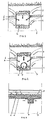
- FIG. 1 denotes the polyurethane flake material according to the invention that is taken up in an enclosure of permeable polypropylene material (e.g. Propex R ), reference number 2.
- a drain pipe (3) is enclosed by the polyurethane flakes (1).
- the arrows 4 indicate the groundwater flow,arrows 5 the flow of polyurethane flakes.
- a clay layer is indicated by 6.
- FIG. 3 3 again denotes the drain pipe, above which a continuous layer of polyurethane flakes as defined is arranged, enclosed by the polypropylene water permeable layer.
- the arrows denote the water flow.
- a sand layer 8 or another layer (tile path) may be placed.
- Tensile strength without cover parallel to the foam direction 35.10 ⁇ 2 N/mm2.
- Water take-up when immersing the foam in water at a temperature of 20 0 C during 24 hours the water absorption is about 0.5 vol %. Especially at the edges where there are open cells which were formed during the processing.Apart form this boundary effect the water absorption is zero.
- the material is resistant against chemicals apart from very concentrated alkaline materials and inorganic acids and it is further resistant against moulds and fungus.
- the material as obtained was processed in a hammer mill of which the screen was adjusted to square openings with a dimension of 3 cm. All flakes passing through the sieve were collected. The flakes obtained after this processing had very irregular ,tortuous shapes and none of them has substantially the same shape.
- the product obtained was processed into mattresses by enclosing it in an inert, water permeable plastic foil.
- polypropylene weave material commercially available as Propex R , which possesses sufficient strenght.
- Propex R polypropylene weave material
- the thickness was about 1 to 2 mm.
- another similar woven material of other plastics within similar properties may be used.
- the material is also applicable in road building or in streets as an under layer. It is to be understood that various types of hard polyurethane foams (thermoset PUR-foam), obtained dependent on the chosen starting materials and additives, are suitable for the present purposes,provided they are subjected to the desintegration step to get irregularly formed angular flakes.
- the properties of the utmost importance for the hardened foam are a low (volume) weight, a good strength, a low water absorption and a high resistance, especially against steam temperatures.
- the enclosed pressure gas,if any, is substantially removed.
- the general dimensions of the flakes can be adjusted by changing the screen distance of the hammer mill.For use as a draining material the screen distance (square) is set at about 40 mm. The rectangular shape of the screen is op importance to give the flakes an angular form.
- HO-(CH2)-OH stepwise polymerisation of alcohols
- the thermosetting polyurethane foams are of interest. Because of the fact that the preparation processes of these foams are generally known a further description is regarded as superfluous.
Landscapes
- Engineering & Computer Science (AREA)
- Structural Engineering (AREA)
- General Engineering & Computer Science (AREA)
- Civil Engineering (AREA)
- Life Sciences & Earth Sciences (AREA)
- Agronomy & Crop Science (AREA)
- Environmental & Geological Engineering (AREA)
- Mechanical Engineering (AREA)
- Architecture (AREA)
- Soil Sciences (AREA)
- General Life Sciences & Earth Sciences (AREA)
- Mining & Mineral Resources (AREA)
- Paleontology (AREA)
- Manufacture Of Porous Articles, And Recovery And Treatment Of Waste Products (AREA)
- Road Paving Structures (AREA)
- Polyurethanes Or Polyureas (AREA)
- Cultivation Of Plants (AREA)
Applications Claiming Priority (2)
| Application Number | Priority Date | Filing Date | Title |
|---|---|---|---|
| NL8900523 | 1989-03-03 | ||
| NL8900523A NL8900523A (nl) | 1989-03-03 | 1989-03-03 | Bodemverbeterende op polyurethaan gebaseerde materialen. |
Publications (1)
| Publication Number | Publication Date |
|---|---|
| EP0385557A1 true EP0385557A1 (fr) | 1990-09-05 |
Family
ID=19854238
Family Applications (1)
| Application Number | Title | Priority Date | Filing Date |
|---|---|---|---|
| EP90200501A Withdrawn EP0385557A1 (fr) | 1989-03-03 | 1990-03-05 | Matériau d'amélioration du sol à base de polyuréthane |
Country Status (2)
| Country | Link |
|---|---|
| EP (1) | EP0385557A1 (fr) |
| NL (1) | NL8900523A (fr) |
Cited By (2)
| Publication number | Priority date | Publication date | Assignee | Title |
|---|---|---|---|---|
| EP0952257A3 (fr) * | 1998-04-23 | 2000-03-22 | Borghi Azio - S.P.A. | Module pour réaliser des canaux de drainage dans le sol |
| EP1530974A1 (fr) * | 2003-08-08 | 2005-05-18 | Basf Aktiengesellschaft | Procédé pour la stérilisation du sol |
Citations (8)
| Publication number | Priority date | Publication date | Assignee | Title |
|---|---|---|---|---|
| DE2041192A1 (de) * | 1969-08-29 | 1971-03-04 | Semperit Gummiwerk Gmbh Deutsc | Traegerkoerper fuer die Wurzeln von Pflanzen |
| FR2204201A5 (en) * | 1972-10-20 | 1974-05-17 | Friedland Jacques | Polyurethane foam compsn - for soil consolidation by spraying |
| WO1981002968A1 (fr) * | 1980-04-16 | 1981-10-29 | Metzeler As | Milieu de croissance inerte et son procede de preparation |
| EP0052526A1 (fr) * | 1980-11-19 | 1982-05-26 | University College Cardiff Consultants Ltd. | Récipient pour la culture de plantes |
| DE3313053A1 (de) * | 1983-04-12 | 1984-11-15 | Eduard Luxemburg Colangelo | Vorrichtung zum schutz von drainagerohren |
| DE8606742U1 (de) * | 1986-03-12 | 1986-05-07 | Technoflor Deutschland GmbH, 5603 Wülfrath | Schaumstoffmatte |
| DE3636207A1 (de) * | 1986-10-24 | 1988-04-28 | Lentia Gmbh | Drainagelaminat |
| EP0280629A1 (fr) * | 1987-02-18 | 1988-08-31 | Jacques Elie Henri Perrin | Procédé pour armer des matériaux naturels ou non et, notamment, le sol |
-
1989
- 1989-03-03 NL NL8900523A patent/NL8900523A/nl not_active Application Discontinuation
-
1990
- 1990-03-05 EP EP90200501A patent/EP0385557A1/fr not_active Withdrawn
Patent Citations (8)
| Publication number | Priority date | Publication date | Assignee | Title |
|---|---|---|---|---|
| DE2041192A1 (de) * | 1969-08-29 | 1971-03-04 | Semperit Gummiwerk Gmbh Deutsc | Traegerkoerper fuer die Wurzeln von Pflanzen |
| FR2204201A5 (en) * | 1972-10-20 | 1974-05-17 | Friedland Jacques | Polyurethane foam compsn - for soil consolidation by spraying |
| WO1981002968A1 (fr) * | 1980-04-16 | 1981-10-29 | Metzeler As | Milieu de croissance inerte et son procede de preparation |
| EP0052526A1 (fr) * | 1980-11-19 | 1982-05-26 | University College Cardiff Consultants Ltd. | Récipient pour la culture de plantes |
| DE3313053A1 (de) * | 1983-04-12 | 1984-11-15 | Eduard Luxemburg Colangelo | Vorrichtung zum schutz von drainagerohren |
| DE8606742U1 (de) * | 1986-03-12 | 1986-05-07 | Technoflor Deutschland GmbH, 5603 Wülfrath | Schaumstoffmatte |
| DE3636207A1 (de) * | 1986-10-24 | 1988-04-28 | Lentia Gmbh | Drainagelaminat |
| EP0280629A1 (fr) * | 1987-02-18 | 1988-08-31 | Jacques Elie Henri Perrin | Procédé pour armer des matériaux naturels ou non et, notamment, le sol |
Cited By (2)
| Publication number | Priority date | Publication date | Assignee | Title |
|---|---|---|---|---|
| EP0952257A3 (fr) * | 1998-04-23 | 2000-03-22 | Borghi Azio - S.P.A. | Module pour réaliser des canaux de drainage dans le sol |
| EP1530974A1 (fr) * | 2003-08-08 | 2005-05-18 | Basf Aktiengesellschaft | Procédé pour la stérilisation du sol |
Also Published As
| Publication number | Publication date |
|---|---|
| NL8900523A (nl) | 1990-10-01 |
Similar Documents
| Publication | Publication Date | Title |
|---|---|---|
| US3877172A (en) | Foamed plastic profile member for hydroponic cultivation and growth of plants | |
| EP2189573B1 (fr) | Structure de gazon artificiel et son procédé de fabrication | |
| US3472644A (en) | Foamed synthetic polymeric plant growth medium containing an inorganic filler and microorganisms | |
| EP3687279B1 (fr) | Procédé de préparation d'un milieu de croissance horticole | |
| EP3190231A1 (fr) | Barrière sonore pour isolation acoustique | |
| JP7498701B2 (ja) | 親水性複合体 | |
| JPH02276513A (ja) | 無土壌栽培用基体 | |
| CZ2000816A3 (cs) | Způsob a zařízení ke zpracování použitých pneumatik | |
| JP5931124B2 (ja) | 立体網状構造体、立体網状構造体製造方法及び立体網状構造体製造装置 | |
| EP1844196B1 (fr) | Systeme de pavage | |
| EP0775047B1 (fr) | Procede de recyclage et de mise au rebut de dechets | |
| EP0377923B1 (fr) | Sol artificiel poreux pour la culture de plantes et procédé pour sa fabrication | |
| US4599269A (en) | Foamable plastics granules and packaging material prepared therefrom | |
| US3300558A (en) | Method of removing the cell walls of a resilient cellular filter material | |
| GB2291419A (en) | A method for recycling waste materials | |
| NL8900523A (nl) | Bodemverbeterende op polyurethaan gebaseerde materialen. | |
| KR102327596B1 (ko) | 구심향 습지를 이용한 빗물정원 | |
| Lubis et al. | Characterization of modified polyurethane foam adsorbents for mercury adsorption applications | |
| JP6067772B2 (ja) | 立体網状構造体製造方法及び立体網状構造体製造装置 | |
| JP2572708B2 (ja) | 植物育成用培地資材の製造方法 | |
| EP1160367A2 (fr) | Matelas fibreux ayant un indice élevé d'espaces vides, à partir de filaments thermoplastiques de faible densité, installation et procédé de fabrication | |
| EP3938200A1 (fr) | Tuiles de rétention d'eau modulaires et structures de toit vert/bleu contenant un ensemble de telles tuiles | |
| GB2035284A (en) | Trickle filter medium for sewage treatment | |
| Darmadi et al. | Characterization of Modified Polyurethane Foam Adsorbents for Mercury Adsorption Applications | |
| US20140166559A1 (en) | Three-dimensional filament matrix as biological filtration medium |
Legal Events
| Date | Code | Title | Description |
|---|---|---|---|
| PUAI | Public reference made under article 153(3) epc to a published international application that has entered the european phase |
Free format text: ORIGINAL CODE: 0009012 |
|
| AK | Designated contracting states |
Kind code of ref document: A1 Designated state(s): BE DE FR GB NL |
|
| STAA | Information on the status of an ep patent application or granted ep patent |
Free format text: STATUS: THE APPLICATION IS DEEMED TO BE WITHDRAWN |
|
| 18D | Application deemed to be withdrawn |
Effective date: 19910306 |