EP0385678A2 - Übergangsmetalle als Spurstoffe für eine chemische Behandlung - Google Patents
Übergangsmetalle als Spurstoffe für eine chemische Behandlung Download PDFInfo
- Publication number
- EP0385678A2 EP0385678A2 EP90301982A EP90301982A EP0385678A2 EP 0385678 A2 EP0385678 A2 EP 0385678A2 EP 90301982 A EP90301982 A EP 90301982A EP 90301982 A EP90301982 A EP 90301982A EP 0385678 A2 EP0385678 A2 EP 0385678A2
- Authority
- EP
- European Patent Office
- Prior art keywords
- transition metal
- liquid system
- metal compound
- vanadium
- treatment
- Prior art date
- Legal status (The legal status is an assumption and is not a legal conclusion. Google has not performed a legal analysis and makes no representation as to the accuracy of the status listed.)
- Granted
Links
Images
Classifications
-
- G—PHYSICS
- G01—MEASURING; TESTING
- G01N—INVESTIGATING OR ANALYSING MATERIALS BY DETERMINING THEIR CHEMICAL OR PHYSICAL PROPERTIES
- G01N33/00—Investigating or analysing materials by specific methods not covered by groups G01N1/00 - G01N31/00
- G01N33/18—Water
- G01N33/1813—Specific cations in water, e.g. heavy metals
-
- G—PHYSICS
- G01—MEASURING; TESTING
- G01N—INVESTIGATING OR ANALYSING MATERIALS BY DETERMINING THEIR CHEMICAL OR PHYSICAL PROPERTIES
- G01N33/00—Investigating or analysing materials by specific methods not covered by groups G01N1/00 - G01N31/00
- G01N33/18—Water
- G01N33/182—Specific anions in water
-
- Y—GENERAL TAGGING OF NEW TECHNOLOGICAL DEVELOPMENTS; GENERAL TAGGING OF CROSS-SECTIONAL TECHNOLOGIES SPANNING OVER SEVERAL SECTIONS OF THE IPC; TECHNICAL SUBJECTS COVERED BY FORMER USPC CROSS-REFERENCE ART COLLECTIONS [XRACs] AND DIGESTS
- Y10—TECHNICAL SUBJECTS COVERED BY FORMER USPC
- Y10T—TECHNICAL SUBJECTS COVERED BY FORMER US CLASSIFICATION
- Y10T436/00—Chemistry: analytical and immunological testing
- Y10T436/13—Tracers or tags
Definitions
- the present invention pertains to the utilization of transition metals as tracers to quantify the change in the level of treatment chemicals under static and changing operating conditions of liquid systems and to control feed rates of treatment chemicals into liquid systems. Further, transition metal concentration can be used to quantify important characteristics of the system such as total volume and amount of a liquid entering and/or leaving the liquid system.
- a treating agent In a system involving a body of liquid to which a treating agent is added, maintaining the proper feed level for the agent is essential for optimal performance.
- An improper feed rate of treating agent can lead to serious problems. For example, severe corrosion and deposit formation can rapidly occur on heat-exchanger surfaces in cooling water systems when incorrect levels of treating agent are used.
- One common method of estimating the concentration of a treating agent focuses on measuring the level of an active component in the treatment formulation (e.g., polymeric scale inhibitor, phosphate, or organophosphate).
- That technique is often unsatisfactory due to one or more of the following problems: - background interferences from the system liquid or materials contained in the liquid; - analytical methods require bulky and costly equipment; - time-consuming, labor-intensive analyses are not compatible with continuous monitoring; and - inaccurate readings result from degradation or deposition of active component within the system.
- An alternative method of determining treatment feed rates is to add tracer compounds to the formulation or system. This method helps circumvent the degradation, deposition, and background interference problems that commonly occur when measuring the level of an active component in a treatment formulation.
- quantitation of low tracer levels commonly magnifies problems associated with expensive equipment and time-consuming test methods. Additional factors which must be considered are cost and environmental acceptability of the tracer. For example, radioactive tracers are detectable at very low levels, but are generally expensive and unacceptable due to environmental and health concerns.
- the tracers must be soluble in the waters to be tested and must be compatible with the treatment chemicals with respect to formation, storage, freeze-thaw recovery, etc. Most importantly, the tracers must show a minimal incorporation into the equipment scale as compared to the treatment chemicals. Incorporation is the transfer of tracer from the treated aqueous system to the surfaces of the system equipment. Last, the tracers should not present any sort of environmental problems in the event of discharge. To avoid costly disposal methods, it is preferable for the tracer to be functional at levels sufficiently low so that discharge does not pose a health concern.
- the tracer is preferably non-toxic at high concentrations.
- the tracer must be sufficiently safe so that its use at the concentrations desired conforms to all governmental regulations.
- Chromium VI (e.g. bichromate, Cr2O7 ⁇ 2) has been used as a tracer in cooling waters in ndustrial cooling water systems.
- Chromium VI e.g. bichromate, Cr2O7 ⁇ 2
- the Environmental Protection Agency and Occupational Safety Hazard Administration have restricted the use of Chromium VI in industry.
- chromium VI is a reactive, oxidizing agent and alternative tracer compounds are needed.
- the present invention is based on the discovery of a new class of tracer compounds that meet the above specified criteria.
- transition metals as a class, will satisfy the criteria for use as tracers if they are soluble in the liquid medium to be tested.
- the transition metals have been found to exhibit minimal incorporation into equipment scale and typically exhibit much lower incorporation than the treatment chemicals used in the liquid systems. Measuring the concentration of the transition metals provides more accurate information as to the volume of liquid and the amount of treatment agent added to the liquid system. As a consequence, this invention provides methods for using transition metals as tracers and compositions containing transition metal tracers therein.
- transition metals have been found to perform better as tracers than some non-transition metals because their rate of incorporation into deposits in the system is much lower.
- the most preferred embodiments of this invention employ transition metals which show lower incorporation into deposits in the system than Chromium VI, such as vanadium.
- Natural sources of makeup waters have been found to have very low concentrations of transition metals as compared to non-transition metals.
- transition metals For example, aluminum and sodium are non-transition metals which have been found to be present at high background levels in many makeup waters.
- Preferred embodiments of this invention are directed to those transition metals identified as having low background levels in the makeup waters of most industrial cooling water system, permitting lower concentrations to be used.
- transition metals Chromium VI and lead are excluded from those used in the present invention because their use is limited by governmental agencies.
- transitional metal is intended to include all of the d-block elements from groups IIIB to IIB of the periodic table. Within this general definition are also included the heavier metallic elements of groups IIIA and IVA.
- transition metal compound as used herein is intended to include transition metal ions, oxyanions, cations and associated complexes which are soluble in water. This phrase is also intended to include those compounds which form these ions, cations, oxyanions and complexes in water.
- the water soluble species are especially suitable for quantitative measure. This measurement allows for the calculated control of the feed rate of water and water treatment chemicals in fluid systems such as industrial process waters.
- aqueous systems which must be treated before being transferred to the environment; recycled to the system or process; or fed to the system or process.
- aqueous systems are contemplated by this invention which include, but are not limited to, domestic wastewater, process wastewater, cooling water systems, boiler water or any other aqueous system that is treated physically or chemically before use in a process, during use in a process or before discharge to the environment where it is necessary to quantify the effects of the physical or the chemical treatment.
- This invention can also be utilized in a broad range of aqueous, mixed aqueous/non- aqueous, or non-aqueous liquid systems where the level of physical or chemical treatment affects performance of the system.
- Cooling systems used in industrial processes typically include multiple water flow pathways through heat-exchangers, multiple sources of "makeup” and “blowdown” water, and control means for maintaining desired process conditions. Desired process conditions may include proper chemical treatment concentrations, temperature, water flow rate, water quality, and pH.
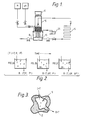
- a simplified version of an industrial cooling water system is a pilot cooling tower (PCT) shown in Figure 1.
- Evaporation (E) of the cooling water leads to concentration of the suspended and dissolved solids in the cooled water (15).
- concentration ratio (CR) is a measure of the increased level of dissolved and suspended matter in a system (eq 1), where CR ⁇ 1.0.
- the heat-exchanger surfaces need to remain clean to maintain efficiency. Deposition of solids and corrosion of heat-exchanger surfaces are problems most generally encountered. Cooling water systems commonly contain highly supersaturated levels of scaling salts. Deposition of solids throughout the system (particularly at metal heat-exchangers) will occur unless one or more chemical treatments (CT) such as scale inhibitors are added from source (25). To prevent corrosion of metal heat-exchangers and water transfer lines, chemical treatments commonly contain corrosion inhibitors. If the feed rate of the chemical treatment is too high or too low, severe scaling and corrosion can occur on the heat-exchangers and throughout the system.
- CT chemical treatments
- concentration ratio water containing a "high” concentration of impurities must be removed from the system, collectively defined as “blowdown” (B), and replaced by water containing a "low” concentration of impurities, collectively defined as “makeup” (M).
- B water containing a "high” concentration of impurities
- M water containing a "low” concentration of impurities
- concentration ratio, evaporation, blowdown and makeup water are variable due to changes in the weather, operating conditions of the industrial plant, and quality of the makeup water. Those factors are all interrelated and a change in any one of those factors must be counterbalanced by corresponding changes in other operating parameters.
- blowdown water can be removed from the cooling system through a variety of ways, some of which tend to be ill-defined in nature.
- the rate at which water is specifically pumped from the cooling water system is defined as "controlled water blowdown".
- Controlled water blowdown is not always accurately known due to practical difficulties in measuring large volumes of water.
- ill-defined amounts of recirculating water are commonly removed from the cooling water system to be used in other areas of the industrial plant, defined as "uncontrolled plant blowdown”. Leakage of recirculating water and drift of liquid droplets from cooling tower also add to unaccounted system losses.
- the total makeup water rate (M) is the combined rate at which makeup water is specifically pumped into the recirculating system and liquid originating from other sources.
- M total makeup water rate
- the feed rate of chemical treatment into the cooling water system is commonly based on estimated values for recirculating water blowdown and makeup water pumped into the recirculating system which means there can be considerable uncertainty regarding the concentration of the chemical treatment.
- the feed rate of the chemical treatment should be adjusted. Those adjustments may or may not be made, depending on how carefully the cooling water system is monitored and controlled. Even when feed rates are adjusted, the concentration of chemical treatment within a cooling water system generally may respond slowly to the change.
- HTI time index
- Transition metal compounds have been found which are soluble in aqueous systems as ions, oxyions, cations or associated complexes. Transition metal compounds have been found to be low in background presence within the makeup waters for substantially all industrial cooling towers, making their use as tracers very economical and efficient.
- a survey of the system waters used in recirculating industrial cooling water systems suggests that the background presence of transition metal compounds within these waters is generally less than 1 ppm.
- the background levels of most transition metal compounds within at least 80% of the system waters tested was found to be below 0.1 ppm. There have been some exceptions, such as zinc and iron; however, as a class, transition metals have been found to have a lower background presence in these waters than other metals such as aluminum, lithium, boron and strontium.
- the preferred class of transition metal compounds include those which are soluble in aqueous liquid systems and show background levels of less than 0.01 ppm within 80% of the waters tested. These preferred transition metal compounds include those of cobalt, vanadium, titanium and yttrium. Compounds of niobium and tantalum are expected to fall into this class and thus also be useful in this invention.
- Other members of the preferred class include those which show background levels of less than 0.1 ppm in 95% of the waters tested. These include those transition metal ions mentioned above, plus tin, nickel, molybdenum (molybdate), and tungsten (tungstates). It is important that the tracer have low background presence within the makeup waters so as to limit the amount necessary to be added to function effectively as a tracer. It is preferable that the background level of a tracer provide no more than 10% of the signal which quantifies the level of transition metal in a sample.
- transition metal compounds evaluated for use as tracers by this invention include those of copper, Chromium III and manganese. Ions of these transition metals are present as background in cooling water systems typically at relatively higher levels than the above mentioned transition metals, requiring higher levels to be added to the aqueous system and making them less cost effective.
- transition metals are well recognized as toxic at low levels and some have raised questions as to whether they pose health hazards to humans, i.e., carcinogens, mutagens, etc.
- lead has long been recognized as toxic at very low levels and its use in gasoline has been restricted.
- Other species which raise health questions include cadmium and mercury.
- Each transition metal chosen (and the amount used) must conform to governmental guidelines.
- the use of Chromium VI has recently been regulated by the EPA and other governmental agencies. Consequently, lead, cadmium, mercury and Chromium VI are not considered suitable for use in this invention.
- transition metal compounds are contemplated for use in the present invention; however, they are not preferred in that they are either present at high background levels in the makeup water for cooling water systems, or show poor solubility in aqueous liquid-systems. Examples of transition metal compounds which are excluded because they are insoluble in aqueous systems, or show very low solubility include those of zirconium and silver.
- transition metal compound chosen for any particular system must be soluble in the system, i.e. it must be ionized or dissociate to soluble ions, cations, etc.
- the transition metal compound tracer should be chosen within those permitted by governmental guidelines. For example, OSHA and the EPA have restricted the use of Chromium VI in industry to the extent that its use as a tracer cannot be tolerated in all instances.
- Vanadium (V+5) also referred to herein as Vanadium V
- Vanadium V is a weak oxidizing agent in cooling water applications and tends to resist reduction to lower oxidation states which would not be detected by the analysis method.
- higher oxidation states beyon Vanadium V are not known so there is no concern with V+5 tracers being converted to higher oxidation states which would not be detected by the analysis method. Since Vanadium V is already in its highest oxidation state there is no concern that it will be oxidized.
- Soluble transition metals compounds are effectively used as cooling water treatment chemical tracers to allow the easy and accurate determination of chemical feed rates. These transition metal tracers may be added to the aqueous system directly but are preferably added to a treatment formulation such as a scale inhibitor or corrosion inhibitor.
- a treatment formulation such as a scale inhibitor or corrosion inhibitor.
- the addition of tracer compounds to liquid systems is very useful as a diagnostic tool for quantifying system characteristics and identifying and quantifying problems within the system.
- the addition of a tracer to treatment formulations is very useful for measuring treatment concentration and efficacy.
- Transition metal compounds offer a number of advantages as tracers. Nearly all transition metal compounds have negligible background levels in makeup waters so that interference is minimal. Many are not health hazards due to their low toxicity at the very low levels needed to function as tracers in most cooling systems. Additionally, most transition metal compounds when in the form of ions, cations, associated complexes, etc. are sufficiently inert, stable and soluble in a cooling water environment. The transition metal compounds are typically more stable than the treating agents which they "trace".
- the transition metal compound concentration measured is used to determine the level of treating agents.
- Other possible methods of detecting transition metal concentration include ion selective electrodes, fluorometric analysis and voltametric analysis, as well as other conventional techniques for detecting ions.
- the preferred method of detecting transition metals is a colorimetric method.
- Colorimetry refers to the determination of a substance from its ability to absorb visible light.
- Visual colorimetric methods are based on a comparison of a blank or known solution with known concentration with that of a sample of unknown concentration.
- spectrophotometric methods the ratio of the intensities of the incident and the transmitted beams of light are measured at a specified wavelength by means of a detector such as a photocell or photomultiplier tube.
- a blank is made that contains all the reagents in solution except the compound of interest. Then, the measuring device is set at 100% for the blank. Thereafter, any reading of an actual sample will be the true absorbance minus any effects due to the holding cell or the reagent solution.
- the intensity of radiation absorbed in a thin layer of material depends on the absorbing substance and on the frequency of the incident radiation, and is proportional to the thickness of the layer. At a given concentration of the absorbing substance, summation over a series of thin layers, or integration over a finite thickness, lead to an exponential relationship between transmitted intensity and thickness.
- the amount of radiation absorbed or transmitted by a solution or medium is an exponential function of the concentration of absorbing substance present and of the length of the path of the radiation through the sample. Therefore, a plot of the absorbance, which is equal -log(%T/100), versus concentration should give a straight line passing through the origin.
- a calibration curve or in this case, a straight line, of the known concentration versus absorbance may be plotted. Finally, the samples with unknown concentration may be compared to the calibration curve to determine its concentration.
- spectrophotometric methods may be used for the quantitative determination of many trace substances, especially inorganic elements.
- the basic principle of quantitative absorption spectroscopy lies in comparing the extent of absorption of a sample solution with that of a set of standards under radiation at a selected wavelength.
- the sample compound does not absorb radiation appreciably in the wavelength regions provided or the absorption is so low that it is desirable to form a light-absorbing tracer or at least better light-absorbing substance by reacting the compound in question with other reagents.
- the reagents should be selective in their reactions and should not form interfering absorbing species with foreign substances likely to be present.
- Some of the factors that should be considered when forming light-absorbing compounds from tracer ions include: pH, reagent concentration, time, temperature, order of mixing reagents, stability, available masking agents, organic solvent, and salt concentration.
- the pH plays a very important role in complex formation. Adjustment of pH or the use of a buffer often eliminates certain interfering reactions. Additionally, some transition metals are insoluble at high pH levels. One such metal is cobalt but it can be resolubilized by lowering the pH.
- the amount of reagent required is dictated by the composition of the absorbing complex formed.
- An optimum concentration of reagents should be determined, since either not enough reagent or too much reagent can cause deviation from Beer's Law.
- Formation of the absorbing complex may be slow or fast with color development times ranging from several seconds to several hours. Therefore, in processes where time is of the essence, a complexing reagent that reacts quickly is important. Additionally, reaction rates are often affected by temperature. Certain reactions require elevated temperature to decrease the time necessary for complete color development.
- masking agents are often necessary to prevent complexing of other reagents.
- ferric ion does not form the colored FeSCN2+ complex with a thiocyanate ion.
- Many organic reagent or complexes are only slightly soluble in water. In such cases, it is necessary to add immiscible organic solvent to avoid precipitation or to aid color development.
- immiscible organic solvent to avoid precipitation or to aid color development.
- Transition metal compound concentrations when added to an aqueous system as tracers can vary from parts per trillion (ppt) to parts per million (ppm). Detection of these compounds can be routinely accomplished on an instant or continuous basis with inexpensive portable equipment. In addition, multiple tracers may be used concurrently by choice of transition metal compounds with proper spectral characteristics or other tracers. As such, various combinations of transition metals and treatment feeds can be quantified within a liquid system. For example, several individual treatments containing different transition metal compounds can be employed within a liquid system. In that case, each transition metal compound and the corresponding individual concentration of each of the treatments can each be quantified. In addition to being able to quantify complex combinations of the treatment feeds, transition metal compounds are available which are environmentally acceptable, are not degraded by or deposited within the liquid systems, and are low in cost.
- the invention can generally be applied in the following ways:
- FIGS 2A-C demonstrate the operation of the water treatment program at the molecular level as a function of time.
- the concentration of chemical treatment contains phosphorus (P′), polymer (P) and tracer (T).
- This chemical treatment is slowly fed via feedline into the recirculating cooling water where the treatment is rapidly diluted and distributed throughout the system. If operating conditions of the cooling water system remained constant, the addition and removal of treatment due to recirculating water blowdown (B) would equilibrate.
- the concentration of the chemical treatment and its components ideally should remain unchanged. However, that situation never occurs.
- Figures 2A-C also indicate how addition of an inert tracer can provide accurate determination of treatment feed rate and treatment efficacy, in spite of deposition of other components in the chemical treatment.
- the formulation feed rate was 100 ppm. If deposition occurred on the heat-exchangers, 40% of the phosphorus-containing species could be lost from the recirculating water, but little or none of the transition metal tracer will be lost. The total phosphorus concentration would suggest only 60 ppm of the product was present. However, the transition metal ion tracer would more closely indicate the formulation feed rate of 100 ppm and a loss of phosphorus-containing components equivalent to that supplied by 40 ppm feed of formulation was being deposited. Determination of loss rates of active component(s) of the treatment is a direct measurement of treatment efficacy.
- One method of evaluating transition metal compounds as tracer compositions is to compare their measured deposit enrichment ratio (DER) (eq 2) against the DER values for the active components.
- DER deposit enrichment ratio
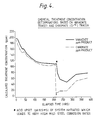
- the DER value of the tracer is lower than that of active and readily analyzed components of the treatment formulation. The lower the DER values under scale forming conditions the better. While low DER values are desired, the tracer compound should also exhibit good stability and not decompose when in use. For example, it is known that vanadium responds to pH changes more favorably than Chromium VI as shown in Figure 4.
- transition metals are used as chemical feed tracers in industrial cooling water systems.
- industrial systems whereby a chemical treatment is added to a moving liquid in a containment structure(s) and associated transfer lines in order to maintain proper operation of the system.
- concentration, feed rate and efficacy of the chemical treatment are imprecisely known and system characteristics (total volume, makeup and blowdown rates, holding time index, etc.) are estimated, variable or unknown.
- the systems can generally be divided into three major classes: closed, open, and once-through. In each case, transition metal can be effectively used to determine and continuously monitor the concentration and efficacy of chemical treatment and a system's operating conditions and unknown characteristics.
- liquid and chemical treatment In a "closed" system, the liquid and chemical treatment generally remain within the system and minimal amounts of liquid are added or discharged.
- closed systems are continuous casting processes in the metallurgical industry, refrigerating and air-conditioning units, radiator units, and recirculating cooling water systems in areas where water use or chemical discharges are severely limited. In those systems, the treatment can be lost through chemical/microbial degradation, deposition/corrosion processes, system leaks and low level discharges.
- open systems variable and significant amounts of liquid (makeup) and chemical treatment are added and discharged (blowdown) from the working fluid.
- the system may or may not be pressurized and subject to evaporative losses of fluid.
- open systems are boilers, gas scrubbers and air washers, municipal sewage treatment, metal working and fabrication processes, paint spray booths, wood pulping and papermaking, and others.
- Chemical treatment can be lost through system discharges and leaks, deposition/corrosion processes, adsorption onto particulate matter, chemical/microbial degradation, etc.
- nce-through systems generally involve a fluid and chemical treatment which are added to a system, pass through the system a single time, and then are discharged as effluent or transferred into another system. Much larger amounts of water are required in those systems than in comparable "closed” or “open” recirculating systems.
- Common examples of once-through systems are clarification and filtration units, mineral washing and benefaction, boilers, and cooling for utilities and industrial process streams.
- the chemical treatment containing a known quantity of transition metal is added to and distributed within the liquid system.
- the liquid can be sampled or continuously monitored at any point of addition, from within the system or its discharge.
- concentration of the chemical treatment within the liquid system may be determined.
- the uniformity of chemical treatment distribution and presence of low fluid flow and stagnant regions within the system can be quantified.
- Stagnant or low fluid flow regions are inherent in some systems, in spite of continued addition and discharge of liquid(s).
- oil field applications (drilling, secondary and tertiary recovery methods, etc.) involve addition of chemical treatment(s) to a liquid which will permeate slowly into some portions of a larger system.
- Figure 3 shows that although the true total volume (Z) of that system cannot be accurately determined, the effective working volume (S) and average concentration of the chemical treatment can be quantified by comparing the tracer concentration in the liquid entering (I+T) and leaving the system (D+T). By comparing the individual concentrations of treatment components and transition metal tracer, the efficiency and degradation of the treatment and its components can be determined.
- transition metal ion tracers described above have been accomplished in several systems.
- the following examples are illustrative of particular embodiments of the invention. It is emphasized that not all embodiments of this invention are illustrated with the particularity given below.
- a typical calibration procedure is given below. To calibrate a spectrophotomer for measurement of Co II concentration, a series of solutions with known quantities of Co II were prepared.
- the samples of cobalt solutions in Table 1 were obtained from a 100 ppm stock solution of Co(NO3)6H2O and diluted with water to the concentrations shown in Table 1. Fifteen ml samples of the stock solution were mixed with a mask mix and a color reagent. The mask mix consisted of an aqueous sodium citrate and sodium sulfite solution.
- the color reagent (PAR) solution consisted of 1-3 drops 0.1 N sodium hydroxide in approximately 50 mls of 0.2% pure pyridyl azo resorcinol in water. To the first sample only, 10 drops of ethylene diamine tetra acetic acid (EDTA) solution was added to simulate 100% dilution at 530 nm.
- EDTA ethylene diamine tetra acetic acid
- the EDTA solution consisted of 5 gm Na2EDTA in 100 mls water with a pH adjustment to 9 with NaOH.
- TABLE 1 Calibration Data for Cobalt II [Co+2] ppm Percent Transmittance Absorbance (A) * 0** 100 0 .01 98 .008 .05 90 .045 .1 81 .092 .2 67 .174 .3 57 .244 .4 49 .310 .5 45 .347 .6 41 .387 .7 38 .420 1.5 31 .509 * (A) -log(%T.100). ** EDTA solution added to simulate 100% dilution.
- Transmittance was measured with a Bausch and Lomb Spectrometer 2000 at a wavelength of 530 nm.
- the data from Table 1 was used to generate a calibration curve.
- the tracer concentration of samples with unknown tracer concentration was determined by comparison with the curve generated from the data above.
- ISU integrated scaling unit
- the ISU contains a seven liter system adapted to receive continuous streams of water, chemical treatment and various tracers. This minimizes variations in concentrations of components during a test run.
- the streams are fed through syringe pumps that pump concentrated feed from a stock solution prepared in sufficient quantity to last an entire test period.
- the ISU is a recirculating water system which contains a metal heat-exchange tube and is used to model cooling water systems.
- the % of expected feed is obtained by dividing the observed amount of tracer by the expected amount of tracer in the system multiplied by 100%.
- the expected amount of tracer is calculated by a mass balance of concentrated chemical feed added, makeup water added and blowdown water lost.
- This example serves to compare Co +2 as a tracer against fluorescent tracers and direct measurement of the active phosphate treating agent.
- the ISU was started wherein two syringe pumps were activated.
- the first pump injected a mixture comprising 57.3 weight percent deionized water, 1.1 weight percent aryl sulfonic acid fluorescent tracer, 36.6 weight percent acrylic acid base terpolymer and 1.0 weight percent Co +2 as Co(NO3)2.6H2O (5 weight percent).
- the second pump injected in overlay of a mixture including deionized water, potassium hydroxide, phosphate compounds, tetrapotassium pyrophosphate and phosphoric acid.
- the mixture injected from the first pump was diluted in the system water to 126.8 ppm.
- the mixture injected from the second pump was diluted in the system water to 170.3 ppm.
- the purpose of the following analysis is to measure the difference between Co+2 readings and fluorescent tracer readings and other active component(s) of the treatment.
- the concentration of Co2 ion was determined by the colorimetric technique described above.
- the fluorescent tracer concentration was determined by comparison of the samples with a calibration curve of tracer concentration versus emission, [refer to J.R. Lakowicz; "Principles of Fluorescence Spectroscopy” (1983)].
- the total phosphorus content was determined by persulfate oxidation of organophosphorus species to orthophosphate and subsequent formation of blue phosphomolybdate complex which was quantified spectrophotometrically, [refer to M.C. Rand; "Standard Methods for the Examination of Water and Wastewater", 14th Ed. (1975)]. All concentrations of tracers and phosphorus containing species are expressed as % of expected chemical feed concentration.
- This analysis shows that a Cobalt compound can function as a tracer and accurately determine the chemical treatment feed rate at pH ⁇ 8.
- the analysis proves that Cobalt compounds can follow the proven fluorescent tracers and are superior in determining treatment feed rates than by direct measurement of the treatment agent (e.g. total phosphorus concentration).
- This analysis shows that the Co+2 may be accurately quantified in the presence of active chemical treatment agents, other tracers and other compounds and complexes commonly found in industrial water.
- the enrichment ratio data shows that the Co+2 ion has less of a tendency to deposit in the above described system than active treatment formulation components and by-products such as ortho phosphate, pyro phosphate, total phosphorus and HEDP Therefore, chemical feed determination using a Co+2 ion is acceptable within the presence of the above-identified active treatment formulation.
- the Co+2 ion enrichment ratio is deceptively high in this analysis because the system pH was brought above pH 8 allowing some precipitation of Co+2 ion to occur.
- ISU integrated scaling unit
- the ISU was started wherein two syringe pumps were activated.
- the first pump injected an aqueous solution comprising 71.50 weight percent deionized water, 0.37 weight percent aqueous sodium hydroxide (50 weight percent aqueous), 14.44 weight percent aqueous potassium hydroxide (45 weight percent aqueous), 5.41 weight percent aqueous tetra potassium pyrophosphate (40 weight percent aqueous), 4.86 weight percent phosphoric acid (25 weight percent aqueous), 2.12 weight percent aqueous sodium tolyl triazole (50 weight percent aqueous), 1.21 weight percent aqueous HEDP (40 weight percent aqueous) and 0.10 weight percent aryl sulfonic acid fluorescent tracer.
- the second pump injected a mixture comprising 94.35 weight percent deionized water; 4.57 weight percent of a terpolymer consisting of an acrylic acid base, acrylamide and acrylamidomethane-sulfonic acid; 0.63 weight percent Co(NO3)2 ⁇ 6H2O (1.0 weight percent Co+2) and 0.45 weight percent LiCl (0.6 weight percent Li+).
- the mixture injected from the first pump was diluted in the system with water to 132.3 ppm.
- the mixture injected from the second pump was diluted in the same system with the same water to 171.3 ppm. Grab samples were analyzed for total phosphorus, fluorescent tracer, lithium tracer and Co+2 tracer. Table 4 shows the results.
- the purpose of the following analysis is to compare Co+2 tracer readings and fluorescent tracer readings and lithium ion tracer readings and other active components of the treatment.
- the concentration of each component was determined as described in Example 1.
- the concentration of lithium ion was determined by conventional atomic absorption spectroscopy. All concentrations of tracers and phosphorus containing species are expressed as % of expected chemical feed.
- This analysis shows that a Co+2 ion can be used to accurately determine the chemical treatment feed rate.
- the analysis proves that Co+2 ions follow the proven fluorescent tracers and perform very effectively as compared to other currently used methods for determining treatment feed rates.
- This analysis shows that the Co+2 ions may be accurately quantified in the presence of active chemical treatment agents, other tracers and other compounds and complexes commonly found in industrial water.
- Co+2 ion increases in solubility below pH 8, it may be desirable to use Cobalt tracers in water treatment systems with pH levels below 8.
- Ions, elements, and compounds commonly encountered in industrial cooling water systems i.e. Ca+2, Mg+2, HCO - 3 /CO32 ⁇ , PO4 ⁇ 3, P2O7 ⁇ 2, polymer and hydroxy ethane diphosphonic acid
- ions that respond to the color reagent i.e. copper ions and iron ions
- the PCT contains a 50 liter capacity adapted to simulate recirculating water, chemical treatment feed, deposit formation and corrosion on heat exchangers, blowdown and makeup, and evaporative cooling from a tower fill.
- the test was conducted to provide data that allows comparison of a vanadate ion (VO3 ⁇ ) as a tracer under various simulated treatment conditions against a conventional chemical feed determination method.
- VO3 ⁇ vanadate ion
- pyridylazo resorcinol (PAR) color reagent may be used successfully as an indicator with cobalt II ions when background ions are masked with a sodium citrate and sodium sulfite solution.
- PAR pyridylazo resorcinol
- H2O2 may be added to a sample solution before the PAR color reagent to form 2:1 diperoxyvanadate, VO(O2)2 ⁇ , which does not react with the PAR solution.
- VO(O2)2 ⁇ 2:1 diperoxyvanadate
- the VO2+ ions are allowed to completely react with the PAR solution. The difference in the transmittance between the two samples provides an indication of the concentration of vanadium ions present within the sample.
- PCT test results are summarized in Table 5.
- the VO3 ⁇ ions were quantified by comparison of transmitted light with samples of known concentration as described above in the alternative sample analysis. Additionally, product feed rate was calculated from syringe pump and blowdown measurements. The active phosphate content was determined by persulfate oxidation of organophosphorus species to orthophosphate and subsequent formation of blue phosphomolybdate complex which was quantified photometrically; [refer to M.C. Rand; "Standard Methods for the Examination of Water and Wastewater", 14th Ed. (1975)].
- Vanadium oxyanions does not tend to precipitate with other solids which are formed between pH 7-9.
- Vanadium oxyanions are resistant to precipitation in the presence of corroding mild steel heat exchange tubes.
- Vanadium (VO3 ⁇ ) and Chromium (Cr+3) exhibit excellent solubility in both systems, whereas other transition metals such as zinc (Zn+2), yttrium (Y+3), nickel (Ni+2) and cobalt (Co+2) are better suited in systems with a pH 7.0 than pH 9.3.
- Solubility at lower pH for these transition metals show an advantage over non-transition metals such as aluminum (Al+3) which are not as soluble at pH 7 as shown in Table 7.
- Table 7 and Table 8 show that silver (Ag+) and zirconium (Zr+4) are not suitable at either pH 7 or pH 9.3.
Landscapes
- Health & Medical Sciences (AREA)
- Life Sciences & Earth Sciences (AREA)
- Chemical & Material Sciences (AREA)
- Biochemistry (AREA)
- General Physics & Mathematics (AREA)
- Medicinal Chemistry (AREA)
- Physics & Mathematics (AREA)
- Analytical Chemistry (AREA)
- Engineering & Computer Science (AREA)
- General Health & Medical Sciences (AREA)
- Food Science & Technology (AREA)
- Immunology (AREA)
- Pathology (AREA)
- Manufacture And Refinement Of Metals (AREA)
- Investigating Or Analyzing Non-Biological Materials By The Use Of Chemical Means (AREA)
- Compounds Of Alkaline-Earth Elements, Aluminum Or Rare-Earth Metals (AREA)
- Extraction Or Liquid Replacement (AREA)
- Removal Of Specific Substances (AREA)
- Sampling And Sample Adjustment (AREA)
Applications Claiming Priority (2)
| Application Number | Priority Date | Filing Date | Title |
|---|---|---|---|
| US07/315,713 US4966711A (en) | 1989-02-27 | 1989-02-27 | Transition metals as treatment chemical tracers |
| US315713 | 1989-02-27 |
Publications (4)
| Publication Number | Publication Date |
|---|---|
| EP0385678A2 true EP0385678A2 (de) | 1990-09-05 |
| EP0385678A3 EP0385678A3 (de) | 1992-08-12 |
| EP0385678B1 EP0385678B1 (de) | 1995-08-30 |
| EP0385678B2 EP0385678B2 (de) | 2003-09-03 |
Family
ID=23225717
Family Applications (1)
| Application Number | Title | Priority Date | Filing Date |
|---|---|---|---|
| EP90301982A Expired - Lifetime EP0385678B2 (de) | 1989-02-27 | 1990-02-23 | Übergangsmetalle als Spurstoffe für eine chemische Behandlung |
Country Status (9)
| Country | Link |
|---|---|
| US (1) | US4966711A (de) |
| EP (1) | EP0385678B2 (de) |
| JP (1) | JP2954964B2 (de) |
| AT (1) | ATE127227T1 (de) |
| AU (2) | AU648426B2 (de) |
| CA (1) | CA2003681C (de) |
| DE (1) | DE69021910T3 (de) |
| ES (1) | ES2079435T5 (de) |
| GR (1) | GR3018236T3 (de) |
Cited By (3)
| Publication number | Priority date | Publication date | Assignee | Title |
|---|---|---|---|---|
| EP0447721A3 (en) * | 1990-03-23 | 1992-04-22 | Nalco Chemical Company | Monitoring performance of a treating agent added to a body of water and analyzer therefor |
| EP0608044A3 (de) * | 1993-01-22 | 1994-11-02 | Nalco Chemical Co | Verfahren zur Bestimmung von Borsäuren in Flüssigkeiten. |
| EP0640747A1 (de) * | 1993-08-20 | 1995-03-01 | Nalco Chemical Company | System zur Regelung eines Kessels nach einem PH/phosphat-Programm |
Families Citing this family (35)
| Publication number | Priority date | Publication date | Assignee | Title |
|---|---|---|---|---|
| US5132096A (en) * | 1990-03-23 | 1992-07-21 | Nalco Chemical Company | Monitoring performance of a water treating agent by measuring and resolving optical voltage analogs |
| US5171450A (en) * | 1991-03-20 | 1992-12-15 | Nalco Chemical Company | Monitoring and dosage control of tagged polymers in cooling water systems |
| US5242602A (en) * | 1992-03-04 | 1993-09-07 | W. R. Grace & Co.-Conn. | Spectrophotometric monitoring of multiple water treatment performance indicators using chemometrics |
| US5271904A (en) * | 1992-09-17 | 1993-12-21 | Electric Power Research Institute, Inc. | Apparatus for sensing a chemical property of a spray |
| US5304800A (en) * | 1992-11-10 | 1994-04-19 | Nalco Chemical Company | Leak detection and responsive treatment in industrial water processes |
| US5320967A (en) * | 1993-04-20 | 1994-06-14 | Nalco Chemical Company | Boiler system leak detection |
| US5411889A (en) * | 1994-02-14 | 1995-05-02 | Nalco Chemical Company | Regulating water treatment agent dosage based on operational system stresses |
| US5435969A (en) * | 1994-03-29 | 1995-07-25 | Nalco Chemical Company | Monitoring water treatment agent in-system concentration and regulating dosage |
| CN1069162C (zh) * | 1994-05-02 | 2001-08-08 | 诺尔科化学公司 | 用作改进的抗微生物剂的荧光杀生物剂组合物 |
| US5663489A (en) * | 1994-11-14 | 1997-09-02 | Betzdearborn Inc. | Methods and apparatus for monitoring water process equipment |
| US5565619A (en) * | 1994-11-14 | 1996-10-15 | Betz Laboratories, Inc. | Methods and apparatus for monitoring water process equipment |
| EP0773298B1 (de) | 1995-11-09 | 2000-01-26 | Nalco Chemical Company | Überwachung der mikrobiologischen Aktivität in einem Flüssigkeitssystem |
| US5658798A (en) * | 1996-02-08 | 1997-08-19 | Nalco Chemical Company | Detection of process components in food process streams by fluorescence |
| US5736405A (en) * | 1996-03-21 | 1998-04-07 | Nalco Chemical Company | Monitoring boiler internal treatment with fluorescent-tagged polymers |
| US6109096A (en) * | 1997-02-13 | 2000-08-29 | Betzdearborn Inc. | Methods and apparatus for monitoring water process equipment |
| US6244098B1 (en) | 1997-02-13 | 2001-06-12 | Betzdearborn Inc. | Methods and apparatus for monitoring water process equipment |
| US5756880A (en) * | 1997-02-13 | 1998-05-26 | Betzdearborn Inc. | Methods and apparatus for monitoring water process equipment |
| US5817927A (en) * | 1997-04-11 | 1998-10-06 | Betzdearborn Inc. | Method and apparatus for monitoring water process equipment |
| US6170319B1 (en) | 1998-03-31 | 2001-01-09 | Betzdearborn Inc. | Methods and apparatus for monitoring water process equipment |
| US6585933B1 (en) | 1999-05-03 | 2003-07-01 | Betzdearborn, Inc. | Method and composition for inhibiting corrosion in aqueous systems |
| US6068012A (en) | 1998-12-29 | 2000-05-30 | Ashland, Inc. | Performance-based control system |
| US6662636B2 (en) | 2001-12-13 | 2003-12-16 | Ondeo Nalco Company | Method of reducing fouling in filters for industrial water system analytical devices |
| US6790664B2 (en) * | 2001-12-28 | 2004-09-14 | Nalco Company | Fluorometric monitoring and control of soluble hardness of water used in industrial water systems |
| US6790666B2 (en) * | 2001-12-28 | 2004-09-14 | Nalco Company | Method to ascertain whether soluble hardness is calcium or magnesium based |
| US20040250841A1 (en) * | 2003-06-10 | 2004-12-16 | Kimbrough Atwood M. | HVAC enviro-clean condensate drain pan and coil cleaning system |
| US20090101587A1 (en) * | 2007-10-22 | 2009-04-23 | Peter Blokker | Method of inhibiting scale formation and deposition in desalination systems |
| US8893784B2 (en) | 2010-06-30 | 2014-11-25 | Schlumberger Technology Corporation | Traced chemicals and method to verify and control formulation composition |
| US9266797B2 (en) | 2013-02-12 | 2016-02-23 | Ecolab Usa Inc. | Online monitoring of polymerization inhibitors for control of undesirable polymerization |
| US9399622B2 (en) | 2013-12-03 | 2016-07-26 | Ecolab Usa Inc. | Nitroxide hydroxylamine and phenylenediamine combinations as polymerization inhibitors for ethylenically unsaturated monomer processes |
| NO343468B1 (en) * | 2016-11-18 | 2019-03-18 | Inst Energiteknik | Tracers |
| WO2018093272A1 (en) * | 2016-11-18 | 2018-05-24 | Institutt For Energiteknikk | Tracers |
| US20190249360A1 (en) | 2018-02-15 | 2019-08-15 | Buckman Laboratories International, Inc. | Method And System For Tagging Leather Or Hides Treated With Biocide And Identifying Same |
| RU2724591C1 (ru) * | 2019-08-20 | 2020-06-25 | Общество с ограниченной ответственностью "Агро Эксперт Груп" | Способ фотометрической идентификации и определения концентрации компонентов баковой смеси |
| CN111749650A (zh) * | 2020-06-09 | 2020-10-09 | 中国石油化工股份有限公司 | 一种油井阻垢剂加药周期确定方法 |
| MX2023004954A (es) | 2020-11-06 | 2023-05-17 | Northern Tech International Corporation | Cuantificacion colorimetrica de compuestos inhibidores de la corrosion en fluidos industriales. |
Family Cites Families (7)
| Publication number | Priority date | Publication date | Assignee | Title |
|---|---|---|---|---|
| DE2643422A1 (de) * | 1976-09-21 | 1978-03-30 | Kurita Water Ind Ltd | Wasserbehandlungsmittel und verfahren zur behandlung von wasser |
| US4264329A (en) * | 1979-04-27 | 1981-04-28 | Cities Service Company | Tracing flow of fluids |
| US4501667A (en) * | 1983-03-03 | 1985-02-26 | Ciba-Geigy Corporation | Process of inhibiting corrosion of metal surfaces and/or deposition of scale thereon |
| AU572825B2 (en) * | 1983-03-03 | 1988-05-19 | Fmc Corporation (Uk) Limited | Inhibition of corrosion and scale formation of metal surfaces |
| US4664884A (en) * | 1985-06-14 | 1987-05-12 | Drew Chemical Corporation | Corrosion inhibitor |
| US4783314A (en) * | 1987-02-26 | 1988-11-08 | Nalco Chemical Company | Fluorescent tracers - chemical treatment monitors |
| US4777140A (en) * | 1987-05-26 | 1988-10-11 | Mobil Oil Corporation | Measurement of vanadium content in a refinery stream by electron spin resonance spectroscopy |
-
1989
- 1989-02-27 US US07/315,713 patent/US4966711A/en not_active Expired - Lifetime
- 1989-11-23 CA CA002003681A patent/CA2003681C/en not_active Expired - Fee Related
-
1990
- 1990-02-23 DE DE69021910T patent/DE69021910T3/de not_active Expired - Fee Related
- 1990-02-23 ES ES90301982T patent/ES2079435T5/es not_active Expired - Lifetime
- 1990-02-23 AT AT90301982T patent/ATE127227T1/de not_active IP Right Cessation
- 1990-02-23 EP EP90301982A patent/EP0385678B2/de not_active Expired - Lifetime
- 1990-02-27 JP JP2044651A patent/JP2954964B2/ja not_active Expired - Fee Related
-
1992
- 1992-07-31 AU AU20733/92A patent/AU648426B2/en not_active Ceased
-
1994
- 1994-07-21 AU AU68638/94A patent/AU6863894A/en not_active Abandoned
-
1995
- 1995-11-29 GR GR950403356T patent/GR3018236T3/el unknown
Cited By (3)
| Publication number | Priority date | Publication date | Assignee | Title |
|---|---|---|---|---|
| EP0447721A3 (en) * | 1990-03-23 | 1992-04-22 | Nalco Chemical Company | Monitoring performance of a treating agent added to a body of water and analyzer therefor |
| EP0608044A3 (de) * | 1993-01-22 | 1994-11-02 | Nalco Chemical Co | Verfahren zur Bestimmung von Borsäuren in Flüssigkeiten. |
| EP0640747A1 (de) * | 1993-08-20 | 1995-03-01 | Nalco Chemical Company | System zur Regelung eines Kessels nach einem PH/phosphat-Programm |
Also Published As
| Publication number | Publication date |
|---|---|
| JPH0315755A (ja) | 1991-01-24 |
| EP0385678B1 (de) | 1995-08-30 |
| DE69021910T2 (de) | 1996-04-25 |
| AU4915190A (en) | 1990-08-30 |
| DE69021910D1 (de) | 1995-10-05 |
| EP0385678B2 (de) | 2003-09-03 |
| CA2003681A1 (en) | 1990-08-27 |
| AU6863894A (en) | 1994-10-06 |
| CA2003681C (en) | 2002-08-20 |
| ES2079435T3 (es) | 1996-01-16 |
| GR3018236T3 (en) | 1996-02-29 |
| EP0385678A3 (de) | 1992-08-12 |
| AU2073392A (en) | 1992-10-15 |
| ATE127227T1 (de) | 1995-09-15 |
| AU624675B2 (en) | 1992-06-18 |
| AU648426B2 (en) | 1994-04-21 |
| DE69021910T3 (de) | 2004-06-03 |
| JP2954964B2 (ja) | 1999-09-27 |
| ES2079435T5 (es) | 2004-05-16 |
| US4966711A (en) | 1990-10-30 |
Similar Documents
| Publication | Publication Date | Title |
|---|---|---|
| US4966711A (en) | Transition metals as treatment chemical tracers | |
| US5200106A (en) | Compositions comprising transition metals for treating and monitoring liquid systems | |
| AU691872B2 (en) | Monitoring water treatment agent in-system concentration and regulating dosage | |
| EP0362435B1 (de) | Vorrichtung zur Überwachung chemischer Behandlungen unter Verwendung fluoreszierender Indikatoren | |
| CA2142415C (en) | Regulating water treatment agent dosage based on operational system stresses | |
| Crumpton et al. | Nitrate and organic N analyses with second‐derivative spectroscopy | |
| US5236845A (en) | On-line iron (II) concentration monitoring to continuously determine corrosion in boiler systems | |
| US5416323A (en) | Leak detection and responsive treatment in industrial water processes | |
| US4992380A (en) | Continuous on-stream monitoring of cooling tower water | |
| EP0675353B1 (de) | Überwachung und Kontrolle der Polyelektrolytkonzentration im System unter Verwendung fluorochromer Farbstoffe | |
| CA1325583C (en) | Visual analytical tracer and method for detection and quantitative analysis for water treatment chemicals | |
| CA2354015C (en) | Rapid colorimetric method for measuring polymers in aqueous systems | |
| US3706532A (en) | Method for determining zinc concentration in aqueous mediums | |
| JPH02115093A (ja) | 工業または都市用水システムを監視する方法 | |
| JPH0894520A (ja) | 蛍光物質による冷却水系水処理剤濃度及び保有水量の測定方法 | |
| Methods Development et al. | Methods for Chemical Analysis of Water and Wastes | |
| Samples | Chapter VII—Analysis of Industrial Water and Industrial Waste Water |
Legal Events
| Date | Code | Title | Description |
|---|---|---|---|
| PUAI | Public reference made under article 153(3) epc to a published international application that has entered the european phase |
Free format text: ORIGINAL CODE: 0009012 |
|
| AK | Designated contracting states |
Kind code of ref document: A2 Designated state(s): AT BE CH DE ES FR GB GR IT LI LU NL SE |
|
| PUAL | Search report despatched |
Free format text: ORIGINAL CODE: 0009013 |
|
| AK | Designated contracting states |
Kind code of ref document: A3 Designated state(s): AT BE CH DE ES FR GB GR IT LI LU NL SE |
|
| 17P | Request for examination filed |
Effective date: 19921027 |
|
| 17Q | First examination report despatched |
Effective date: 19931208 |
|
| GRAA | (expected) grant |
Free format text: ORIGINAL CODE: 0009210 |
|
| AK | Designated contracting states |
Kind code of ref document: B1 Designated state(s): AT BE CH DE ES FR GB GR IT LI LU NL SE |
|
| PG25 | Lapsed in a contracting state [announced via postgrant information from national office to epo] |
Ref country code: LI Effective date: 19950830 Ref country code: CH Effective date: 19950830 |
|
| REF | Corresponds to: |
Ref document number: 127227 Country of ref document: AT Date of ref document: 19950915 Kind code of ref document: T |
|
| REF | Corresponds to: |
Ref document number: 69021910 Country of ref document: DE Date of ref document: 19951005 |
|
| REG | Reference to a national code |
Ref country code: CH Ref legal event code: PL |
|
| ITF | It: translation for a ep patent filed | ||
| ET | Fr: translation filed | ||
| REG | Reference to a national code |
Ref country code: ES Ref legal event code: FG2A Ref document number: 2079435 Country of ref document: ES Kind code of ref document: T3 |
|
| REG | Reference to a national code |
Ref country code: GR Ref legal event code: FG4A Free format text: 3018236 |
|
| PLBQ | Unpublished change to opponent data |
Free format text: ORIGINAL CODE: EPIDOS OPPO |
|
| PLBI | Opposition filed |
Free format text: ORIGINAL CODE: 0009260 |
|
| PLBF | Reply of patent proprietor to notice(s) of opposition |
Free format text: ORIGINAL CODE: EPIDOS OBSO |
|
| 26 | Opposition filed |
Opponent name: W.R. GRACE & CO.-CONN. Effective date: 19960530 |
|
| NLR1 | Nl: opposition has been filed with the epo |
Opponent name: W.R. GRACE & CO.-CONN. |
|
| PLBF | Reply of patent proprietor to notice(s) of opposition |
Free format text: ORIGINAL CODE: EPIDOS OBSO |
|
| PLBF | Reply of patent proprietor to notice(s) of opposition |
Free format text: ORIGINAL CODE: EPIDOS OBSO |
|
| PGFP | Annual fee paid to national office [announced via postgrant information from national office to epo] |
Ref country code: LU Payment date: 19970217 Year of fee payment: 8 |
|
| PLBQ | Unpublished change to opponent data |
Free format text: ORIGINAL CODE: EPIDOS OPPO |
|
| PLAB | Opposition data, opponent's data or that of the opponent's representative modified |
Free format text: ORIGINAL CODE: 0009299OPPO |
|
| R26 | Opposition filed (corrected) |
Opponent name: W.R. GRACE & CO.-CONN. Effective date: 19960530 |
|
| NLR1 | Nl: opposition has been filed with the epo |
Opponent name: W.R. GRACE & CO.-CONN. |
|
| PLAB | Opposition data, opponent's data or that of the opponent's representative modified |
Free format text: ORIGINAL CODE: 0009299OPPO |
|
| PG25 | Lapsed in a contracting state [announced via postgrant information from national office to epo] |
Ref country code: LU Free format text: LAPSE BECAUSE OF NON-PAYMENT OF DUE FEES Effective date: 19980223 |
|
| R26 | Opposition filed (corrected) |
Opponent name: BETZDEARBORN, INC. Effective date: 19960530 |
|
| NLR1 | Nl: opposition has been filed with the epo |
Opponent name: BETZDEARBORN, INC. |
|
| PLAW | Interlocutory decision in opposition |
Free format text: ORIGINAL CODE: EPIDOS IDOP |
|
| APAC | Appeal dossier modified |
Free format text: ORIGINAL CODE: EPIDOS NOAPO |
|
| APAE | Appeal reference modified |
Free format text: ORIGINAL CODE: EPIDOS REFNO |
|
| REG | Reference to a national code |
Ref country code: GB Ref legal event code: IF02 |
|
| PGFP | Annual fee paid to national office [announced via postgrant information from national office to epo] |
Ref country code: GR Payment date: 20020228 Year of fee payment: 13 |
|
| APAC | Appeal dossier modified |
Free format text: ORIGINAL CODE: EPIDOS NOAPO |
|
| PLAW | Interlocutory decision in opposition |
Free format text: ORIGINAL CODE: EPIDOS IDOP |
|
| PUAH | Patent maintained in amended form |
Free format text: ORIGINAL CODE: 0009272 |
|
| STAA | Information on the status of an ep patent application or granted ep patent |
Free format text: STATUS: PATENT MAINTAINED AS AMENDED |
|
| 27A | Patent maintained in amended form |
Effective date: 20030903 |
|
| AK | Designated contracting states |
Kind code of ref document: B2 Designated state(s): AT BE CH DE ES FR GB GR IT LI LU NL SE |
|
| PG25 | Lapsed in a contracting state [announced via postgrant information from national office to epo] |
Ref country code: GR Free format text: LAPSE BECAUSE OF NON-PAYMENT OF DUE FEES Effective date: 20030904 |
|
| NLR2 | Nl: decision of opposition |
Effective date: 20030903 |
|
| REG | Reference to a national code |
Ref country code: SE Ref legal event code: RPEO |
|
| NLR3 | Nl: receipt of modified translations in the netherlands language after an opposition procedure | ||
| REG | Reference to a national code |
Ref country code: ES Ref legal event code: DC2A Date of ref document: 20031128 Kind code of ref document: T5 |
|
| PGFP | Annual fee paid to national office [announced via postgrant information from national office to epo] |
Ref country code: NL Payment date: 20050129 Year of fee payment: 16 |
|
| PGFP | Annual fee paid to national office [announced via postgrant information from national office to epo] |
Ref country code: AT Payment date: 20050202 Year of fee payment: 16 |
|
| PGFP | Annual fee paid to national office [announced via postgrant information from national office to epo] |
Ref country code: GB Payment date: 20050216 Year of fee payment: 16 |
|
| PGFP | Annual fee paid to national office [announced via postgrant information from national office to epo] |
Ref country code: FR Payment date: 20050217 Year of fee payment: 16 |
|
| PGFP | Annual fee paid to national office [announced via postgrant information from national office to epo] |
Ref country code: SE Payment date: 20050222 Year of fee payment: 16 |
|
| PGFP | Annual fee paid to national office [announced via postgrant information from national office to epo] |
Ref country code: ES Payment date: 20050309 Year of fee payment: 16 |
|
| PGFP | Annual fee paid to national office [announced via postgrant information from national office to epo] |
Ref country code: DE Payment date: 20050331 Year of fee payment: 16 |
|
| PGFP | Annual fee paid to national office [announced via postgrant information from national office to epo] |
Ref country code: BE Payment date: 20050414 Year of fee payment: 16 |
|
| APAH | Appeal reference modified |
Free format text: ORIGINAL CODE: EPIDOSCREFNO |
|
| PG25 | Lapsed in a contracting state [announced via postgrant information from national office to epo] |
Ref country code: GB Free format text: LAPSE BECAUSE OF NON-PAYMENT OF DUE FEES Effective date: 20060223 Ref country code: AT Free format text: LAPSE BECAUSE OF NON-PAYMENT OF DUE FEES Effective date: 20060223 |
|
| PG25 | Lapsed in a contracting state [announced via postgrant information from national office to epo] |
Ref country code: SE Free format text: LAPSE BECAUSE OF NON-PAYMENT OF DUE FEES Effective date: 20060224 Ref country code: ES Free format text: LAPSE BECAUSE OF NON-PAYMENT OF DUE FEES Effective date: 20060224 |
|
| PG25 | Lapsed in a contracting state [announced via postgrant information from national office to epo] |
Ref country code: BE Free format text: LAPSE BECAUSE OF NON-PAYMENT OF DUE FEES Effective date: 20060228 |
|
| PGFP | Annual fee paid to national office [announced via postgrant information from national office to epo] |
Ref country code: IT Payment date: 20060228 Year of fee payment: 17 |
|
| PG25 | Lapsed in a contracting state [announced via postgrant information from national office to epo] |
Ref country code: NL Free format text: LAPSE BECAUSE OF NON-PAYMENT OF DUE FEES Effective date: 20060901 Ref country code: DE Free format text: LAPSE BECAUSE OF NON-PAYMENT OF DUE FEES Effective date: 20060901 |
|
| EUG | Se: european patent has lapsed | ||
| GBPC | Gb: european patent ceased through non-payment of renewal fee |
Effective date: 20060223 |
|
| NLV4 | Nl: lapsed or anulled due to non-payment of the annual fee |
Effective date: 20060901 |
|
| REG | Reference to a national code |
Ref country code: FR Ref legal event code: ST Effective date: 20061031 |
|
| REG | Reference to a national code |
Ref country code: ES Ref legal event code: FD2A Effective date: 20060224 |
|
| BERE | Be: lapsed |
Owner name: *NALCO CHEMICAL CY Effective date: 20060228 |
|
| PG25 | Lapsed in a contracting state [announced via postgrant information from national office to epo] |
Ref country code: FR Free format text: LAPSE BECAUSE OF NON-PAYMENT OF DUE FEES Effective date: 20060228 |
|
| PG25 | Lapsed in a contracting state [announced via postgrant information from national office to epo] |
Ref country code: IT Free format text: LAPSE BECAUSE OF NON-PAYMENT OF DUE FEES Effective date: 20070223 |