EP0385680B1 - Heterozyklische Ether als 5-Lipoxygenase-hemmer - Google Patents
Heterozyklische Ether als 5-Lipoxygenase-hemmer Download PDFInfo
- Publication number
- EP0385680B1 EP0385680B1 EP90301988A EP90301988A EP0385680B1 EP 0385680 B1 EP0385680 B1 EP 0385680B1 EP 90301988 A EP90301988 A EP 90301988A EP 90301988 A EP90301988 A EP 90301988A EP 0385680 B1 EP0385680 B1 EP 0385680B1
- Authority
- EP
- European Patent Office
- Prior art keywords
- alkyl
- formula
- amino
- methyl
- group
- Prior art date
- Legal status (The legal status is an assumption and is not a legal conclusion. Google has not performed a legal analysis and makes no representation as to the accuracy of the status listed.)
- Expired - Lifetime
Links
Classifications
-
- C—CHEMISTRY; METALLURGY
- C07—ORGANIC CHEMISTRY
- C07D—HETEROCYCLIC COMPOUNDS
- C07D213/00—Heterocyclic compounds containing six-membered rings, not condensed with other rings, with one nitrogen atom as the only ring hetero atom and three or more double bonds between ring members or between ring members and non-ring members
- C07D213/02—Heterocyclic compounds containing six-membered rings, not condensed with other rings, with one nitrogen atom as the only ring hetero atom and three or more double bonds between ring members or between ring members and non-ring members having three double bonds between ring members or between ring members and non-ring members
- C07D213/04—Heterocyclic compounds containing six-membered rings, not condensed with other rings, with one nitrogen atom as the only ring hetero atom and three or more double bonds between ring members or between ring members and non-ring members having three double bonds between ring members or between ring members and non-ring members having no bond between the ring nitrogen atom and a non-ring member or having only hydrogen or carbon atoms directly attached to the ring nitrogen atom
- C07D213/24—Heterocyclic compounds containing six-membered rings, not condensed with other rings, with one nitrogen atom as the only ring hetero atom and three or more double bonds between ring members or between ring members and non-ring members having three double bonds between ring members or between ring members and non-ring members having no bond between the ring nitrogen atom and a non-ring member or having only hydrogen or carbon atoms directly attached to the ring nitrogen atom with substituted hydrocarbon radicals attached to ring carbon atoms
- C07D213/28—Radicals substituted by singly-bound oxygen or sulphur atoms
- C07D213/30—Oxygen atoms
-
- C—CHEMISTRY; METALLURGY
- C07—ORGANIC CHEMISTRY
- C07D—HETEROCYCLIC COMPOUNDS
- C07D213/00—Heterocyclic compounds containing six-membered rings, not condensed with other rings, with one nitrogen atom as the only ring hetero atom and three or more double bonds between ring members or between ring members and non-ring members
- C07D213/02—Heterocyclic compounds containing six-membered rings, not condensed with other rings, with one nitrogen atom as the only ring hetero atom and three or more double bonds between ring members or between ring members and non-ring members having three double bonds between ring members or between ring members and non-ring members
- C07D213/04—Heterocyclic compounds containing six-membered rings, not condensed with other rings, with one nitrogen atom as the only ring hetero atom and three or more double bonds between ring members or between ring members and non-ring members having three double bonds between ring members or between ring members and non-ring members having no bond between the ring nitrogen atom and a non-ring member or having only hydrogen or carbon atoms directly attached to the ring nitrogen atom
- C07D213/60—Heterocyclic compounds containing six-membered rings, not condensed with other rings, with one nitrogen atom as the only ring hetero atom and three or more double bonds between ring members or between ring members and non-ring members having three double bonds between ring members or between ring members and non-ring members having no bond between the ring nitrogen atom and a non-ring member or having only hydrogen or carbon atoms directly attached to the ring nitrogen atom with hetero atoms or with carbon atoms having three bonds to hetero atoms with at the most one bond to halogen, e.g. ester or nitrile radicals, directly attached to ring carbon atoms
- C07D213/62—Oxygen or sulfur atoms
- C07D213/63—One oxygen atom
- C07D213/65—One oxygen atom attached in position 3 or 5
-
- C—CHEMISTRY; METALLURGY
- C07—ORGANIC CHEMISTRY
- C07D—HETEROCYCLIC COMPOUNDS
- C07D215/00—Heterocyclic compounds containing quinoline or hydrogenated quinoline ring systems
- C07D215/02—Heterocyclic compounds containing quinoline or hydrogenated quinoline ring systems having no bond between the ring nitrogen atom and a non-ring member or having only hydrogen atoms or carbon atoms directly attached to the ring nitrogen atom
- C07D215/12—Heterocyclic compounds containing quinoline or hydrogenated quinoline ring systems having no bond between the ring nitrogen atom and a non-ring member or having only hydrogen atoms or carbon atoms directly attached to the ring nitrogen atom with substituted hydrocarbon radicals attached to ring carbon atoms
- C07D215/14—Radicals substituted by oxygen atoms
-
- C—CHEMISTRY; METALLURGY
- C07—ORGANIC CHEMISTRY
- C07D—HETEROCYCLIC COMPOUNDS
- C07D215/00—Heterocyclic compounds containing quinoline or hydrogenated quinoline ring systems
- C07D215/02—Heterocyclic compounds containing quinoline or hydrogenated quinoline ring systems having no bond between the ring nitrogen atom and a non-ring member or having only hydrogen atoms or carbon atoms directly attached to the ring nitrogen atom
- C07D215/16—Heterocyclic compounds containing quinoline or hydrogenated quinoline ring systems having no bond between the ring nitrogen atom and a non-ring member or having only hydrogen atoms or carbon atoms directly attached to the ring nitrogen atom with hetero atoms or with carbon atoms having three bonds to hetero atoms with at the most one bond to halogen, e.g. ester or nitrile radicals, directly attached to ring carbon atoms
- C07D215/20—Oxygen atoms
-
- C—CHEMISTRY; METALLURGY
- C07—ORGANIC CHEMISTRY
- C07D—HETEROCYCLIC COMPOUNDS
- C07D215/00—Heterocyclic compounds containing quinoline or hydrogenated quinoline ring systems
- C07D215/02—Heterocyclic compounds containing quinoline or hydrogenated quinoline ring systems having no bond between the ring nitrogen atom and a non-ring member or having only hydrogen atoms or carbon atoms directly attached to the ring nitrogen atom
- C07D215/16—Heterocyclic compounds containing quinoline or hydrogenated quinoline ring systems having no bond between the ring nitrogen atom and a non-ring member or having only hydrogen atoms or carbon atoms directly attached to the ring nitrogen atom with hetero atoms or with carbon atoms having three bonds to hetero atoms with at the most one bond to halogen, e.g. ester or nitrile radicals, directly attached to ring carbon atoms
- C07D215/20—Oxygen atoms
- C07D215/22—Oxygen atoms attached in position 2 or 4
- C07D215/227—Oxygen atoms attached in position 2 or 4 only one oxygen atom which is attached in position 2
-
- C—CHEMISTRY; METALLURGY
- C07—ORGANIC CHEMISTRY
- C07D—HETEROCYCLIC COMPOUNDS
- C07D401/00—Heterocyclic compounds containing two or more hetero rings, having nitrogen atoms as the only ring hetero atoms, at least one ring being a six-membered ring with only one nitrogen atom
- C07D401/02—Heterocyclic compounds containing two or more hetero rings, having nitrogen atoms as the only ring hetero atoms, at least one ring being a six-membered ring with only one nitrogen atom containing two hetero rings
- C07D401/12—Heterocyclic compounds containing two or more hetero rings, having nitrogen atoms as the only ring hetero atoms, at least one ring being a six-membered ring with only one nitrogen atom containing two hetero rings linked by a chain containing hetero atoms as chain links
Definitions
- EP-A-181568 discloses lipoxygenase inhibitor compounds possessing anti-inflammatory and anti-allergic activities.
- This invention concerns novel heterocyclic ethers and more particularly novel heterocyclic ethers which are inhibitors of the enzyme 5-lipoxygenase (hereinafter referred to as 5-LO).
- the invention also concerns processes for the manufacture of said heterocyclic ethers and novel pharmaceutical compositions containing said heterocyclic ethers.
- Also included in the invention is the use of said heterocyclic ethers in the treatment of various inflammatory and/or allergic diseases in which the direct or indirect products of 5-LO catalysed oxidation of arachidonic acid are involved, and the production of new medicaments for such use.
- heterocyclic ethers described hereinafter are inhibitors of 5-LO, which enzyme is known to be involved in catalysing the oxidation of arachidonic acid to give rise via a cascade process to the physiologically active leukotrienes such as leukotriene B4 (LTB4) and the peptido-lipid leukotrienes such as leukotriene C4 (LTC4) and leukotriene D4 (LTD4) and various metabolites.
- 5-LO which enzyme is known to be involved in catalysing the oxidation of arachidonic acid to give rise via a cascade process to the physiologically active leukotrienes such as leukotriene B4 (LTB4) and the peptido-lipid leukotrienes such as leukotriene C4 (LTC4) and leukotriene D4 (LTD4) and various metabolites.
- the biosynthetic relationship and physiological properties of the leukotrienes are summarised by G.W. Taylor and S.R. Clarke in Trends in Pharmacological Sciences , 1986, 7 , 100-103.
- the leukotrienes and their metabolites have been implicated in the production and development of various inflammatory and allergic diseases such as arthritic diseases, asthma, allergic rhinitis, atopic dermatitis, psoriasis, cardiovascular and cerebrovascular disorders and inflammatory bowel disease.
- the leukotrienes are mediators of inflammatory diseases by virtue of their ability to modulate lymphocyte and leukocyte function.
- Other physiologically active metabolites of arachidonic acid, such as the prostaglandins and thromboxanes arise via the action of the enzyme cyclooxygenase on arachidonic acid.
- heterocyclic ethers are effective as inhibitors of the enzyme 5-LO and thus of leukotriene biosyntheses.
- such compounds are of value as therapeutic agents in the treatment of, for example, allergic conditions, psoriasis, asthma, cardiovascular and cerebrovascular disorders, and/or inflammatory and arthritic conditions, mediated alone or in part by one or more leukotrienes.
- a heterocyclic ether of the formula I (set out hereinafter) wherein Q is a 6-membered monocyclic or 10-membered bicyclic heterocyclic moiety containing one or two nitrogen atoms which may optionally bear one, two or three substituents selected from halogeno, hydroxy, oxo, carboxy, cyano, amino, (1-4C)alkyl, (1-4C)alkoxy, fluoro-(1-4C)alkyl, (1-4C)alkylamino, di-[(1-4C)alkyl]amino, hydroxy-(1-4C)alkyl, amino-(1-4C)alkyl, (1-4C)alkylamino-(1-4C)alkyl, di-[(1-4C)alkyl]amino-(1-4C)alkyl, amino-(2-4C)alkoxy, (1-4C)alkylamino-(2-4C)alkoxy, di-[(1-4C)alkyl]amino-
- alkyl includes both straight-chain and branched-chain alkyl groups.
- references to individual alkyl groups such as “propyl” are specific for the straight-chain version only and references to individual branched-chain alkyl groups such as “isopropyl”, are specific for the branched-chain version only.
- An analogous convention applies to other generic terms.
- the invention includes in its definition of active ingredient any such optically active or racemic form which possesses the property of inhibiting 5-LO.
- the synthesis of optically active forms may be carried out by standard techniques of organic chemistry well known in the art, for example by synthesis from optically active starting materials or by resolution of a racemic form.
- inhibitory properties against 5-LO may be evaluated using the standard laboratory techniques referred to hereinafter.
- a suitable value for Q when it is a 6-membered monocyclic or 10-membered bicyclic heterocyclic moiety containing one or two nitrogen atoms is, for example, pyridyl, pyridazinyl, pyrimidinyl, pyrazinyl, quinolyl, isoquinolyl, cinnolinyl, quinazolinyl, quinoxalinyl, phthalazinyl or naphthyridinyl, or a hydrogenated derivative thereof such as, for example, 1,2-dihydropyridyl or 1,2-dihydroquinolyl.
- the heterocyclic moiety may be attached through any available nitrogen atom and it may bear a substituent on any available position including on any available nitrogen atom.
- Q is a 10-membered bicyclic heterocyclic moiety containing one or two nitrogen atoms it will be appreciated that Q may be attached to A from either of the two rings of the bicyclic heterocyclic moiety.
- Q is, for example, 2-pyridyl, 3-pyridyl, 4-pyridyl, 3-pyridazinyl, 4-pyridazinyl, 2-pyrimidinyl, 4-pyrimidinyl, 5-pyrimidinyl, 2-pyrazinyl, 2-quinolyl, 3-quinolyl, 5-quinolyl, 6-quinolyl, 7-quinolyl, 1-isoquinolyl, 3-isoquinolyl, 6-isoquinolyl, 7-isoquinolyl, 3-cinnolyl, 6-cinnolyl, 7-cinnolyl, 2-quinazolinyl, 4-quinazolinyl, 6-quinazolinyl, 7-quinazolinyl, 2-quinoxalinyl, 5-quinoxalinyl, 6-quinoxalinyl, 1-phthalazinyl, 6-phthalazinyl, 1,5-naphthyridin-2-yl, 1,5-naphthy
- a suitable value for a halogeno substituent which may be present on Q, Ar or R1 is, for example, fluoro, chloro, bromo or iodo.
- a suitable value for a (1-4C)alkyl substituent which may be present on Q, Ar or R1 is, for example, methyl, ethyl, propyl, isopropyl, butyl, isobutyl or sec -butyl.
- a suitable value for a (1-4C)alkoxy substituent which may be present on Q, Ar or R1 is, for example, methoxy, ethoxy, propoxy, isopropoxy or butoxy.
- a suitable value for a fluoro-(1-4C)alkyl substituent which may be present on Q or Ar is, for example, fluoromethyl, difluoromethyl, trifluoromethyl, 2-fluoroethyl, 2,2,2-trifluoroethyl or pentafluoroethyl.
- a suitable value for A when it is (1-6C)alkylene is, for example, methylene, ethylene, ethylidene, trimethylene, propylidene, tetramethylene or pentamethylene; when it is (3-6C)alkenylene is, for example, 1-propenylene, 2-methylprop-1-enylene, 3-methylprop-1-enylene, 1-butenylene or 2-butenylene; and when it is (3-6C)alkynylene is, for example, 1-propynylene, 3-methylprop-1-ynylene, 1-butynylene or 2-butynylene.
- a suitable value for A when it is cyclo(3-6C)alkylene is, for example, cyclopropylidene, 1,2-cyclopropylene, cyclopentylidene, 1,2-cyclopentylene, cyclohexylidene or 1,4-cyclohexylene.
- a suitable value for Ar when it is phenylene is, for example, 1,3-phenylene or 1,4-phenylene.
- a suitable value for Ar when it is a 6-membered heterocyclene moiety containing up to three nitrogen atoms is, for example, pyridylene, pyrimidinylene, pyridazinylene, pyrazinylene or 1,3,5-triazinylene.
- Ar when it is a 6-membered heterocyclene moiety containing up to three nitrogen atoms is, for example, 2,4-, 2,5-, 3,5- or 2,6-pyridylene, 2,4-, 2,5- or 4,6-pyrimidinylene, 3,5- or 3,6-pyridazinylene or 2,5- or 2,6-pyrazinylene.
- Suitable values for substituents which may be present on Q include, for example:-
- Suitable values for substituents which may be present on Ar include, for example:-
- a suitable value for R1 or R2 when it is (1-6C)alkyl is, for example, methyl, ethyl, propyl, butyl, pentyl or hexyl.
- a suitable value for R1 when it is (3-6C)alkenyl is, for example, allyl, 2-butenyl or 3-butenyl; and when it is (3-6C)alkynyl is, for example, 2-propynyl or 2-butynyl.
- a suitable value for R1 when it is (2-4C)alkanoyl is, for example, acetyl, propionyl or butyryl.
- a suitable value for R2 when it is (2-6C)alkenyl is, for example, vinyl, allyl, 2-butenyl or 3-butenyl; and when it is (2-6C)alkynyl is, for example, ethynyl, 1-propynyl, 2-propynyl, 1-butynyl or 2-butynyl.
- a suitable value for R2 or R3 when it is cyano-(1-4C)alkyl is, for example, cyanomethyl, 2-cyanoethyl or 3-cyanopropyl.
- a suitable value for R2 when it is fluoro-(1-4C)alkyl is, for example, fluoromethyl, difluoromethyl, trifluoromethyl, 2-fluoroethyl, 2,2,2-trifluoroethyl or pentafluoroethyl.
- a suitable value for R2 or R3 when it is hydroxy-(1-4C)alkyl is, for example, hydroxymethyl, 1-hydroxyethyl, 2-hydroxyethyl, 1-hydroxypropyl, 2-hydroxypropyl or 3-hydroxypropyl; when it is (1-4C)alkoxy-(1-4C)alkyl is, for example, methoxymethyl, 1-methoxyethyl, 2-methoxyethyl, 1-methoxypropyl, 2-methoxypropyl, 3-methoxypropyl, ethyoxymethyl, 1-ethoxyethyl, 2-ethoxyethyl, 1-ethoxypropyl, 2-ethoxypropyl or 3-ethoxypropyl; and when it is (2-4C)alkanoyloxy-(1-4C)alkyl is, for example, acetoxymethyl, 2-acetoxyethyl, 3-acetoxypropyl, propionyloxymethyl, 2-propionyloxyethyl or 3-propiony
- a suitable value for R3 when it is mercapto-(1-4C)alkyl is, for example, mercaptomethyl, 1-mercaptoethyl, 2-mercaptoethyl, 1-mercaptopropyl, 2-mercaptopropyl or 3-mercaptopropyl; when it is (1-4C)alkylthio-(1-4C)alkyl is, for example, methylthiomethyl, 1-methylthioethyl, 2-methylthioethyl, 1-methylthiopropyl, 2-methylthiopropyl, 3-methylthiopropyl, ethylthiomethyl, 1-ethylthioethyl, 2-ethylthioethyl, 1-ethylthiopropyl, 2-ethylthiopropyl or 3-ethylthiopropyl; when it is (1-4C)alkylsulphinyl-(1-4C)alkyl is, for example, methylsulphinylmethyl, 1-methylsul
- a suitable pharmaceutically-acceptable salt of a heterocyclic ether of the invention which is sufficiently basic is an acid-addition salt with, for example, an inorganic or organic acid, for example hydrochloric, hydrobromic, sulphuric, phosphoric, trifluoroacetic, citric or maleic acid.
- an inorganic or organic acid for example hydrochloric, hydrobromic, sulphuric, phosphoric, trifluoroacetic, citric or maleic acid.
- a suitable pharmaceutically-acceptable salt of a heterocyclic ether of the invention which is sufficiently acidic is an alkali metal salt, for example a sodium or potassium salt, an alkaline earth metal salt, for example a calcium or magnesium salt, an ammonium salt or a salt with an organic base which affords a physiologically-acceptable cation, for example a salt with methylamine, dimethylamine, trimethylamine, piperidine, morpholine or tris-(2-hydroxyethyl)amine.
- novel compounds of the invention are, for example, heterocyclic ethers of the formula I wherein:-
- a particular compound of the invention comprises a heterocyclic ether of the formula I wherein Q is pyridyl, pyrimidinyl, pyrazinyl, quinolyl, isoquinolyl, quinazolinyl or quinoxalinyl which may optionally bear one, two or three substituents selected from fluoro, chloro, hydroxy, oxo, methyl, ethyl, propyl, trifluoromethyl, 2-fluoroethyl, 2-dimethylaminoethyl and benzyl; wherein A is methylene, 1-propenylene or 1-propynylene; wherein X is oxy; wherein Ar is 1,3-phenylene or 1,4-phenylene which may optionally bear one or two substituents selected from fluoro, chloro, hydroxy, amino, methoxy and trifluoromethyl, or Ar is 3,5-pyridylene; wherein R1 is methyl, ethyl, allyl or 2-
- a further particular compound of the invention comprises a heterocyclic ether of the formula I wherein Q is 2-pyridyl, 3-pyridyl, 2-quinolyl, 3-quinolyl, 6-quinolyl, 7-quinolyl or 6-quinoxalinyl which may optionally bear one or two substituents selected from hydroxy, oxo, methyl, ethyl, propyl, 2-fluoroethyl, 2-dimethylaminoethyl and benzyl; wherein A is methylene, 1-propenylene or 1-propynylene; wherein X is oxy; wherein Ar is 1,3-phenylene or 1,4-phenylene which may optionally bear one or two substituents selected from fluoro, chloro, amino, methoxy and trifluoromethyl, or Ar is 3,5-pyridylene; wherein R1 is methyl, ethyl or allyl; wherein R2 is methyl, ethyl or propyl; and wherein R
- a further particular compound of the invention comprises a heterocyclic ether of the formula I wherein Q is 1,2-dihydro-2-oxoquinolin-3-yl, 1,2-dihydro-2-oxoquinolin-5-yl, 1,2-dihydro-2-oxoquinolin-6-yl or 1,2-dihydro-2-oxoquinolin-7-yl which bears a 1-substituent selected from methyl, ethyl, 2-fluoroethyl, 2-dimethylaminoethyl and benzyl, and which may optionally bear a substituent selected from fluoro and chloro; wherein A is methylene, 1-propenylene or 1-propynylene; wherein X is oxy; wherein Ar is 1,3-phenylene or 1,4-phenylene which may optionally bear one or two substituents selected from fluoro, chloro, amino, methoxy and trifluoromethyl, or Ar is 3,5-pyridylene;
- a preferred compound of the invention comprises a heterocyclic ether the formula I wherein Q is 2-pyridyl, 1,2-dihydro-1-methyl-2-oxoquinolin-3-yl, 2-quinolyl, 3-quinolyl, 1,2-dihydro-2-oxoquinolin-3-yl, 3-isoquinolyl or 6-quinoxalinyl;
- A is methylene or 1-propynylene;
- Ar is 1,3-phenylene or 5-fluoro-1,3-phenylene;
- R1 is methyl;
- R2 is methyl, ethyl or methoxymethyl; and
- R3 is hydroxymethyl, mercaptomethyl, methoxymethyl, 2-methoxyethyl, ethoxymethyl, methylthiomethyl, 1-methylthioethyl, 2-methylthioethyl, acetoxymethyl or cyanomethyl; or a pharmaceutically-acceptable salt thereof.
- a further preferred compound of the invention comprises a heterocyclic ether of the formula I wherein Q is 6-quinoxalinyl, or Q is 1,2-dihydro-2-oxoquinolin-3-yl or 1,2-dihydro-2-oxoquinolin-6-yl which bears a 1-substituent selected from methyl and ethyl; wherein A is methylene; wherein X is oxy; wherein Ar is 1,3-phenylene which may optionally bear one fluoro substituent; wherein R1 is methyl, ethyl or allyl; wherein R2 is methyl or ethyl; and wherein R3 is methoxymethyl, allyloxymethyl or 2-propynyloxymethyl; or a pharmaceutically-acceptable salt thereof.
- heterocyclic ethers of the formula I or pharmaceutically-acceptable salts thereof:- 2-methoxy-2-[3-(3-(2-pyridyl)prop-2-yn-1-yloxy)phenyl]but-1-yl methyl ether, 2-[5-fluoro-3-(1,2-dihydro-1-methyl-2-oxoquinolin-3-ylmethoxy)phenyl]-2-methoxybut-1-yl methyl ether and allyl 2-allyloxy-2-[5-fluoro-3-(1,2-dihydro-1-methyl-2-oxoquinolin-6-ylmethoxy)phenyl]but-1-yl ether.
- a compound of the invention comprising a heterocyclic ether of the formula I, or a pharmaceutically-acceptable salt thereof, may be prepared by any process known to be applicable to the preparation of structurally-related compounds. Such procedures are provided as a further feature of the invention and are illustrated by the following representative examples in which, unless otherwise stated, Q, A, X, Ar, R1, R2 and R3 have any of the meanings defined hereinbefore.
- a pharmaceutically-acceptable salt of a novel compound of the formula I When a pharmaceutically-acceptable salt of a novel compound of the formula I is required, it may be obtained, for example, by reaction of said compound with a suitable acid or base using a conventional procedure.
- an optically active form of a compound of the formula I it may be obtained by carrying out one of the aforesaid procedures using an optically active starting material, as illustrated in the accompanying non-limiting Examples, or by resolution of a racemic form of said compound using a conventional procedure.
- heterocyclic ethers of the formula I are inhibitors of the enzyme 5-LO.
- the effects of this inhibition may be demonstrated using one or more of the standard procedures set out below:-
- the compound 2-methoxy-2-[3-(3-(2-pyridyl)prop-2-yn-1-yloxy)phenyl]but-1-yl methyl ether has an IC50 of 1.0 micromolar against LTB4 and of >40 micromolar against TxB2 in test b), and the compound allyl 2-allyloxy-2-[5-fluoro-3-(1,2-dihydro-1-methyl-2-oxoquinolin-6-ylmethoxy)phenyl]but-1-yl ether has an IC50 of 0.1 micromolar against LTB4 in test b).
- those compounds of the formula I which are particularly preferred have an IC50 of ⁇ 1 micromolar against LTB4 and of >40 micromolar against TxB2 in test b), and an oral ED50 of ⁇ 100 mg/kg against LTB4 in test c).
- heterocyclic ethers of the invention which show selective inhibitory properties for 5-LO as opposed to cyclooxygenase, which selective properties are expected to impart improved therapeutic properties, for example, a reduction in or freedom from the gastrointestinal side-effects frequently associated with cyclooxygenase inhibitors such as indomethacin.
- a pharmaceutical composition which comprises a heterocyclic ether of the formula I, or a pharmaceutically-acceptable salt thereof, in association with a pharmaceutically-acceptable diluent or carrier.
- the composition may be in a form suitable for oral use, for example a tablet, capsule, aqueous or oily solution, suspension or emulsion; for topical use, for example a cream, ointment, gel or aqueous or oily solution or suspension; for nasal use, for example a snuff, nasal spray or nasal drops; for vaginal or rectal use, for example a suppository; for administration by inhalation, for example as a finely divided powder or a liquid aerosol; for sub-lingual or buccal use, for example a tablet or capsule; or for parenteral use (including intravenous, subcutaneous, intramuscular, intravascular or infusion), for example a sterile aqueous or oily solution or suspension.
- the above compositions may be prepared in a conventional manner using conventional excipients.
- the amount of active ingredient (that is a heterocyclic ether of the formula I or a pharmaceutically-acceptable salt thereof) that is combined with one or more excipients to produce a single dosage form will necessarily vary depending upon the host treated and the particular route of administration.
- a formulation intended for oral administration to humans will generally contain, for example, from 0.5 mg to 2g of active agent compounded with an appropriate and convenient amount of excipients which may vary from about 5 to about 98 percent by weight of the total composition.
- Dosage unit forms will generally contain about 1 mg to about 500 mg of an active ingredient.
- a heterocyclic ether of the formula I, or a pharmaceutically-acceptable salt thereof for use in a method of treatment of the human or animal body by therapy.
- the invention also includes a method of treating a disease or medical condition mediated alone or in part by one or more leukotrienes which comprises administering to a warm-blooded animal requiring such treatment an effective amount of an active ingredient as defined above.
- the invention also provides the use of such an active ingredient in the production of a new medicament for use in a leukotriene mediated disease or medical condition.
- an ether of the formula I will naturally vary according to the nature and severity of the conditions, the age and sex of the animal or patient and the route of administration, according to well known principles of medicine.
- heterocyclic ethers of the formula I are useful in treating those allergic and inflammatory conditions which are due alone or in part to the effects of the metabolites of arachidonic acid arising by the linear (5-LO catalysed) pathway and in particular the leukotrienes, the production of which is mediated by 5-LO.
- such conditions include, for example, asthmatic conditions, allergic reactions, allergic rhinitis, allergic shock, psoriasis, atopic dermatitis, cardiovascular and cerebrovascular disorders of an inflammatory nature, arthritic and inflammatory joint disease, and inflammatory bowel diseases.
- a daily dose in the range for example, 0.5mg to 75mg per kg body weight is received, given if required in divided doses.
- a parenteral route is employed.
- a dose in the range for example, 0.5mg to 30 mg per kg body weight will generally be used.
- a dose in the range for example, 0.5 mg to 25 mg per kg body weight will be used.
- the compounds of the formula I are primarily of value as therapeutic agents for use in warm-blooded animals (including man), they are also useful whenever it is required to inhibit the enzyme 5-LO. Thus, they are useful as pharmacological standards for use in the development of new biological tests and in the search for new pharmacological agents.
- the compounds of the formula I have certain cytoprotective effects, for example they are useful in reducing or suppressing certain of the adverse gastrointestinal effects of the cyclooxygenase inhibitory non-steroidal anti-inflammatory agents (NSAIA), such as indomethacin, acetylsalicylic acid, ibuprofen, sulindac, tolmetin and piroxicam.
- NSAIA cyclooxygenase inhibitory non-steroidal anti-inflammatory agents
- co-administration of a 5-LO inhibitor of the formula I with a NSAIA can result in a reduction in the quantity of the latter agent needed to produce a therapeutic effect, thereby reducing the likelihood of adverse side-effects.
- a pharmaceutical composition which comprises a heterocyclic ether of the formula I, or a pharmaceutically-acceptable salt thereof as defined hereinbefore, in conjunction or admixture with a cyclooxygenase inhibitory non-steroidal anti-inflammatory agent (such as mentioned above), and a pharmaceutically-acceptable diluent or carrier.
- cytoprotective effects of the compounds of the formula I may be demonstrated, for example in a standard laboratory model which assesses protection against indomethacin-induced or ethanol-induced ulceration in the gastrointestinal tract of rats.
- compositions of the invention may in addition contain one or more therapeutic or prophylactic agents known to be of value for the disease under treatment.
- a known platelet aggregation inhibitor, hypolipidemic agent, anti-hypertensive agent, beta-adrenergic blocker or a vasodilator may usefully also be present in a pharmaceutical composition of the invention for use in treating a heart or vascular disease or condition.
- an anti-histamine, steroid such as beclomethasone dipropionate
- sodium cromoglycate sodium cromoglycate
- phosphodiesterase inhibitor or a beta-adrenergic stimulant may usefully also be present in a pharmaceutical composition of the invention for use in treating a pulmonary disease or condition.
- the compounds of the formula I may also be used in combination with leukotriene antagonists such as those disclosed in European Patent Specifications Nos. 179619, 199543, 220066, 227241, 242167, 290145, 337765, 337766 and 337767, which are incorporated herein by way of reference.
- 3-Methoxymethoxybenzaldehyde was prepared from 3-hydroxybenzaldehyde and dimethoxymethane using the method described in Synthesis , 1976, 244.
- Ethylmagnesium bromide (161 ml of a 3M solution in diethyl ether) was added to a solution of 3-methoxymethoxybenzaldehyde (73 g) in diethyl ether (150 ml) which had been cooled to 0°C.
- the mixture was allowed to warm to ambient temperature and was stirred for 1 hour.
- the mixture was poured into a mixture of diethyl ether (2 litres) and 1N aqueous hydrochloric acid (500 ml).
- This salt was recrystallised from a mixture of ethanol (20 ml) and diisopropyl ether (500 ml). The precipitate (2.71 g) was filtered off, dissolved in 2N aqueous hydrochloric acid solution and extracted with diethyl ether. The organic phase was washed with a saturated aqueous sodium chloride solution, dried (MgSO4) and evaporated to give (+)-2-(3-benzyloxy-5-fluorophenyl)-2-hydroxybutyric acid (1.86 g).
- Lithium aluminium hydride (0.345 g) was added to a solution of the ester so obtained in diethyl ether (70 ml) and the mixture was stirred at ambient temperature for 1 hour. Water (10 ml) was added dropwise and the mixture was filtered. The organic layer was dried (MgSO4) and evaporated to give optically active 2-(3-benzyloxy-5-fluorophenyl)butane-1,2-diol (2.2 g), as an oil.
- (+)-2-(3-benzyloxy-5-fluorophenyl)-2-hydroxybutyric acid was converted into optically active 2-(5-fluoro-3-hydroxyphenyl)-2-methoxbut-1-yl methyl ether in 90% yield, as an oil.
- Example 8 The following illustrate representative pharmaceutical dosage forms containing the compound of formula I, or a pharmaceutically-acceptable salt salt thereof (hereafter compound X), for therapeutic or prophylactic use in humans: (a) Tablet I mg/tablet Compound X 100 Lactose Ph.Eur 182.75 Croscarmellose sodium 12.0 Maize starch paste (5% w/v paste) 2.25 Magnesium stearate 3.0 (b) Tablet II mg/tablet Compound X 50 Lactose Ph.Eur 223.75 Croscarmellose sodium 6.0 Maize starch 15.0 Polyvinylpyrrolidone (5% w/v paste) 2.25 Magnesium stearate 3.0 (c) Tablet III mg/tablet Compound X 1.0 Lactose Ph.Eur 93.25 Croscarmellose sodium 4.0 Maize starch paste (5% w/v paste) 0.75 Magnesium stearate 1.0 (d) Capsule mg/capsule Compound X 10 mg Lactose Ph
- the above formulations may be obtained by conventional procedures well known in the pharmaceutical art.
- the tablets (a)-(c) may be enteric coated by conventional means, for example to provide a coating of cellulose acetate phthalate.
- the aerosol formulations (h)-(k) may be used in conjunction with standard, metered dose aerosol dispensers, and the suspending agents sorbitan trioleate and soya lecithin may be replaced by an alternative suspending agent such as sorbitan monooleate, sorbitan sesquioleate, polysorbate 80, polyglycerol oleate or oleic acid.
Landscapes
- Chemical & Material Sciences (AREA)
- Organic Chemistry (AREA)
- Pharmaceuticals Containing Other Organic And Inorganic Compounds (AREA)
- Plural Heterocyclic Compounds (AREA)
Claims (10)
- Heterocyclischer Ether mit der folgenden Formel I:
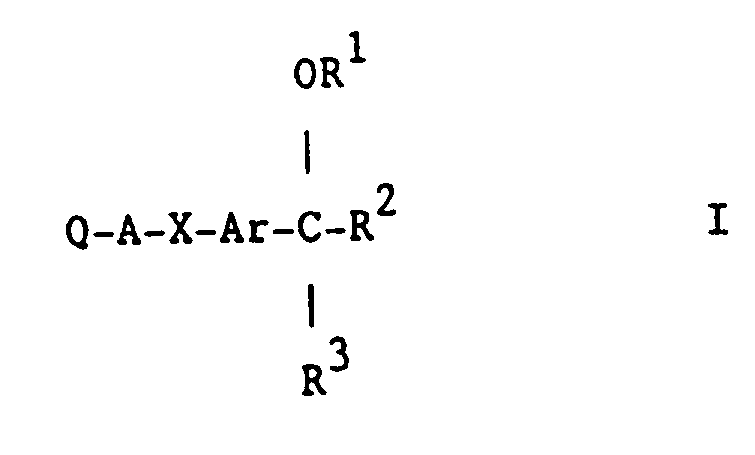
Q für einen 6-gliedrigen monocyclischen oder 10-gliedrigen bicyclischen heterocyclischen Rest steht, der einen oder zwei Stickstoffatome enthält, die gegebenenfalls einen, zwei oder drei Substituenten tragen können, die unter Halogen, Hydroxy, Oxo, Carboxy, Cyano, Amino, (1-4C)Alkyl, (1-4C)Alkoxy, Fluor-(1-4C)alkyl, (1-4C)Alkylamino, Di-[(1-4C)alkyl]amino, Hydroxy-(1-4C)alkyl, Amino-(1-4C)alkyl, (1-4C)Alkylamino-(1-4C)alkyl, Di-[(1-4C)alkyl]amino-(1-4C)alkyl, Amino-(2-4C)alkoxy, (1-4C)Alkylamino-(2-4C)alkoxy, Di-[(1-4C)alkyl]amino-(2-4C)alkoxy und Phenyl-(1-4C)alkyl ausgewählt sind;
A für (1-6C)Alkylen, (3-6C)Alkenylen, (3-6C)Alkinylen oder Cyclo(3-6C)alkylen steht;
X für Oxy, Thio, Sulfinyl, Sulfonyl oder Imino steht;
Ar für Phenylen steht, das gegebenenfalls einen oder zwei Substituenten tragen kann, die unter Halogen, Hydroxy, Amino, Nitro, Cyano, Carbamoyl, (1-4C)Alkyl, (3-4C)Alkenyloxy, (1-4C)Alkoxy, (1-4C)Alkylthio, (1-4C)Alkylsulfinyl, (1-4C)Alkylsulfonyl, (1-4C)Alkylamino, Di-[(1-4C)alkyl]amino, Fluor-(1-4C)alkyl, (1-4C)Alkoxycarbonyl, N-[(1-4C)Alkyl]carbamoyl, N,N-Di-[(1-4C)alkyl]carbamoyl, (2-4C)Alkanoylamino, Cyano-(1-4C)alkoxy, Carbamoyl-(1-4C)alkoxy, Amino-(2-4C)alkoxy, (1-4C)Alkylamino-(2-4C)alkoxy, Di-[(1-4C)-alkyl]amino-(2-4C)alkoxy und (1-4C)Alkoxycarbonyl-(1-4C)alkoxy ausgewählt sind; oder in der
Ar für einen 6-gliedrigen Heterocyclen-Rest steht, der bis zu drei Stickstoffatome enthält, die gegebenenfalls einen oder zwei Substituenten tragen können, die unter Halogen, Hydroxy, Amino, Cyano, (1-4C)Alkyl, (1-4C)Alkoxy, (1-4C)Alkylamino und Di-[(1-4C)alkyl]amino ausgewählt sind;
R¹ für (1-6C)Alkyl, (3-6C)Alkenyl, (3-6C)Alkinyl oder (2-4C)Alkanoyl steht, oder in der
R¹ für Benzoyl steht, das gegebenenfalls einen Substituenten tragen kann, der unter Halogen, (1-4C)Alkyl und (1-4C)Alkoxy ausgewählt ist;
R² für (1-6C)Alkyl, (2-6C)Alkenyl, (2-6C)Alkinyl, Fluor-(1-4C)alkyl, Cyano-(1-4C)alkyl, Hydroxy-(1-4C)alkyl, (1-4C)Alkoxy-(1-4C)alkyl oder (2-4C)Alkanoyloxy-(1-4C)alkyl steht; und
R³ für Hydroxy-(1-4C)alkyl, Mercapto-(1-4C)alkyl, (1-4C)Alkoxy-(1-4C)alkyl, (1-4C)Alkylthio-(1-4C)alkyl, (1-4C)Alkylsulfinyl-(1-4C)alkyl, (1-4C)Alkylsulfonyl-(1-4C)alkyl, (1-4C)Alkoxycarbonyl-(1-4C)alkyl, (2-4C)Alkanoyloxy-(1-4C)alkyl, Cyano-(1-4C)alkyl, (3-4C)Alkenyloxy-(1-4C)alkyl oder (3-4C)Alkinyloxy-(1-4C)alkyl steht;
oder ein pharmazeutisch geeignetes Salz davon. - Heterocyclischer Ether mit der Formel I nach Anspruch 1, in der:
Q für Pyridyl, Pyrimidinyl, Pyrazinyl, Chinolyl, Isochinolyl, Chinazolinyl oder Chinoxalinyl steht, das gegebenenfalls einen, zwei oder drei Substituenten tragen kann, die unter Fluor, Chlor, Hydroxy, Oxo, Methyl, Ethyl, Propyl, Trifluormethyl, 2-Fluorethyl, 2-Dimethylaminoethyl und Benzyl ausgewählt sind;
A für Methylen, 1-Propenylen oder 1-Propinylen steht;
X für Oxy steht;
Ar für 1,3-Phenylen oder 1,4-Phenylen steht, das gegebenenfalls einen oder zwei Substituenten tragen kann, die unter Fluor, Chlor, Hydroxy, Amino, Methoxy und Trifluormethyl ausgewählt sind, oder in der Ar für 3,5-Pyridylen steht;
R¹ für Methyl, Ethyl, Allyl oder 2-Propinyl steht;
R² für Methyl, Ethyl oder Propyl steht; und
R³ für Methoxymethyl, 1-Methoxyethyl, 2-Methoxyethyl, Ethoxymethyl, Allyloxymethyl, 1-(Allyloxy)ethyl, 2-Propinyloxymethyl oder 1-(2-Propinyloxy)ethyl steht; oder ein pharmazeutisch geeignetes Salz davon. - Heterocyclischer Ether mit der Formel I nach Anspruch 1, in der:
Q für 2-Pyridyl, 3-Pyridiyl, 2-Chinolyl, 3-Chinolyl, 6-Chinolyl, 7-Chinolyl oder 6-Chinoxalinyl steht, das gegebenenfalls einen oder zwei Substituenten tragen kann, die unter Hydroxy, Oxo, Methyl, Ethyl, Propyl, 2-Fluorethyl, 2-Dimethylaminoethyl und Benzyl ausgewählt sind;
A für Methylen, 1-Propenylen oder 1-Propinylen steht;
X für Oxy steht;
Ar für 1,3-Phenylen oder 1,4-Phenylen steht, das gegebenenfalls einen oder zwei Substituenten tragen kann, die unter Fluor, Chlor, Amino, Methoxy und Trifluormethyl ausgewählt sind, oder in der Ar für 3,5-Pyridylen steht;
R¹ für Methyl, Ethyl oder Allyl steht;
R² für Methyl, Ethyl oder Propyl steht; und
R³ für Methoxymethyl, 2-Methoxyethyl, Allyloxymethyl oder 2-Propinyloxymethyl steht;
oder ein pharmazeutisch geeignetes Salz davon. - Heterocyclischer Ether mit der Formel I nach Anspruch 1, in der:
Q für 1,2-Dihydro-2-oxochinolin-3-yl, 1,2-Dihydro-2-oxochinolin-5-yl, 1,2-Dihydro-2-oxochinolin-6-yl oder 1,2-Dihydro-2-oxochinolin-7-yl steht, das einen 1-Substituenten trägt, der unter Methyl, Ethyl, 2-Fluorethyl, 2-Dimethylaminoethyl und Benzyl ausgewählt ist, und das gegebenenfalls einen Substituenten tragen kann, der unter Fluor und Chlor ausgewählt ist;
A für Methylen, 1-Propenylen oder 1-Propinylen steht;
X für Oxy steht;
Ar für 1,3-Phenylen oder 1,4-Phenylen steht, das gegebenenfalls einen oder zwei Substituenten tragen kann, die unter Fluor, Chlor, Amino, Methoxy und Trifluormethyl ausgewählt sind, oder in der Ar für 3,5-Pyridylen steht;
R¹ für Methyl, Ethyl oder Allyl steht;
R² für Methyl, Ethyl oder Propyl steht; und
R³ für Methoxymethyl, 2-Methoxyethyl, Allyloxymethyl oder 2-Propinyloxymethyl steht;
oder ein pharmazeutisch geeignetes Salz davon. - Heterocyclischer Ether mit der Formel I nach Anspruch 1, in der:
Q für 2-Pyridyl, 1,2-Dihydro-1-methyl-2-oxochinolin-3-yl, 2-Chinolyl, 3-Chinolyl, 1,2-Dihydro-2-oxochinolin-3-yl, 3-Isochinolyl oder 6-Chinoxalinyl steht;
A für Methylen oder 1-Propinylen steht;
Ar für 1,3-Phenylen oder 5-Fluor-1,3-phenylen steht;
R¹ für Methyl steht;
R² für Methyl, Ethyl oder Methoxymethyl steht; und
R³ für Hydroxymethyl, Mercaptomethyl, Methoxymethyl, 2-Methoxyethyl, Ethoxymethyl, Methylthiomethyl, 1-Methylthioethyl, 2-Methylthioethyl, Acetoxymethyl oder Cyanomethyl steht;
oder ein pharmazeutisch geeignetes Salz davon. - Heterocyclischer Ether mit der Formel I nach Anspruch 1, in der:
Q für 6-Chinoxalinyl steht, oder in der Q für 1,2-Dihydro-2-oxochinolin-3-yl oder 1,2-Dihydro-2-oxochinolin-6-yl steht, das einen 1-Substituenten trägt, der unter Methyl und Ethyl ausgewählt ist;
A für Methylen steht;
X für Oxy steht;
Ar für 1,3-Phenylen steht, das gegebenenfalls einen Fluor-Substituenten tragen kann;
R¹ für Methyl, Ethyl oder Allyl steht;
R² für Methyl oder Ethyl steht; und
R³ für Methoxymethyl, Allyloxymethyl oder 2-Propinyloxymethyl steht;
oder ein pharmazeutisch geeignetes Salz davon. - Heterocyclischer Ether mit der Formel I nach Anspruch 1, der unter folgendem ausgewählt ist:-
2-Methoxy-2-[3-(3-(2-pyridyl)prop-2-in-1-yloxy)phenyl]but-1-ylmethylether,
2-[5-Fluor-3-(1,2-dihydro-1-methyl-2-oxochinolin-3-ylmethoxy)phenyl]-2-methoxybut-1-ylmethylether und
Allyl-2-allyloxy-2-[5-fluor-3-(1,2-dihydro-1-methyl-2-oxochinolin-6-ylmethoxy)phenyl]but-1-ylether. - Verfahren zur Herstellung eines heterocyclischen Ethers mit der Formel I, oder eines pharmazeutisch geeigneten Salzes davon, nach Anspruch 1, bei dem:-(a) eine Verbindung mit der Formel II:
 (b) eine Verbindung mit der Formel V:
 (c) zur Herstellung derjenigen Verbindungen mit der Formel I, bei denen A für eine (3-6C)Alkinylen-Gruppe steht, eine heterocyclische Verbindung mit der Formel Q-Z, in der Q die oben definierte Bedeutung hat und Z für eine Halogen-Gruppe steht, in Gegenwart eines geeigneten organometallischen Katalysators mit einer Ethinyl-Verbindung mit der Formel VI:
 (d) zur Herstellung derjenigen Verbindungen mit der Formel I, bei denen Ar einen Alkylsulfinyl- oder Alkylsulfonyl-Substituenten trägt, bei denen X für eine Sulfinyl- oder Sulfonyl-Gruppe steht, oder bei denen R³ für eine Alkylsulfinylalkyl- oder Alkylsulfonylalkyl-Gruppe steht, eine Verbindung mit der Formel I, bei der Ar einen Alkylthio-Substituenten trägt, bei der X für eine Thio-Gruppe steht, oder bei der R³ für eine Alkylthioalkyl-Gruppe steht, oxidiert wird;(e) zur Herstellung derjenigen Verbindungen mit der Formel I, bei denen Ar einen Alkanoylamino-Substituenten trägt, eine Verbindung mit der Formel I, bei der Ar einen Amino-Substituenten trägt, acyliert wird;(f) zur Herstellung derjenigen Verbindungen mit der Formel I, bei denen R¹ für Alkanoyl oder Benzoyl steht, das gegebenenfalls einen wie oben definierten Substituenten trägt, eine Verbindung mit der Formel I, bei der R¹ für Wasserstoff steht, acyliert wird;(g) zur Herstellung derjenigen Verbindungen mit der Formel I, bei denen A für Alkenylen steht, R¹ oder R² für Alkenyl steht, die entsprechende Verbindung, bei der A für Alkinylen steht oder R¹ oder R² für Alkinyl steht, reduziert wird;(h) zur Herstellung derjenigen Verbindungen mit der Formel I, bei denen Q einen Alkyl- oder substituierten Alkyl-Substituenten an einem verfügbaren Stickstoffatom trägt oder bei denen Ar einen Alkoxy- oder substituierten Alkoxy-Substituenten trägt, eine Verbindung mit der Formel I, bei der Q ein Wasserstoffatom an dem verfügbaren Stickstoffatom trägt, oder bei der Ar einen Hydroxy-Substituenten trägt, alkyliert wird; oder(i) zur Herstellung derjenigen Verbindungen mit der Formel I, bei denen Q oder Ar einen Amino-Substituenten trägt, eine Verbindung mit der Formel I, bei der Q oder Ar einen Nitro-Substituenten trägt, reduziert wird; und
wenn ein pharmazeutisch geeignetes Salz einer neuen Verbindung mit der Formel I benötigt wird, dieses durch die Umsetzung der Verbindung mit einer geeigneten Säure oder Base unter Anwendung eines üblichen Verfahrens erhalten werden kann. - Pharmazeutische Zusammensetzung, die einen heterocyclischen Ether mit der Formel I, oder ein pharmazeutisch geeignetes Salz davon, nach einem der Ansprüche 1 bis 7 in Verbindung mit einem pharmazeutisch geeigneten Verdünnungsmittel oder Trägermittel enthält.
- Verwendung eines heterocyclischen Ethers mit der Formel I, oder eines pharmazeutisch geeigneten Salzes davon, nach einem der Ansprüche 1 bis 7 zur Herstellung eines neuen Arzneimittels zur Verwendung gegen eine durch Leukotrien vermittelte Erkrankung oder medizinischen Zustand.
Applications Claiming Priority (2)
| Application Number | Priority Date | Filing Date | Title |
|---|---|---|---|
| EP89400557 | 1989-02-28 | ||
| EP89400557 | 1989-02-28 |
Publications (3)
| Publication Number | Publication Date |
|---|---|
| EP0385680A2 EP0385680A2 (de) | 1990-09-05 |
| EP0385680A3 EP0385680A3 (de) | 1991-11-21 |
| EP0385680B1 true EP0385680B1 (de) | 1995-06-14 |
Family
ID=8202928
Family Applications (1)
| Application Number | Title | Priority Date | Filing Date |
|---|---|---|---|
| EP90301988A Expired - Lifetime EP0385680B1 (de) | 1989-02-28 | 1990-02-23 | Heterozyklische Ether als 5-Lipoxygenase-hemmer |
Country Status (11)
| Country | Link |
|---|---|
| EP (1) | EP0385680B1 (de) |
| AU (1) | AU625304B2 (de) |
| CA (1) | CA2009900A1 (de) |
| DE (1) | DE69020008T2 (de) |
| FI (1) | FI901011A7 (de) |
| IE (1) | IE66512B1 (de) |
| IL (1) | IL93345A0 (de) |
| NO (1) | NO900919L (de) |
| NZ (1) | NZ232517A (de) |
| PT (1) | PT93290A (de) |
| ZA (1) | ZA901046B (de) |
Families Citing this family (13)
| Publication number | Priority date | Publication date | Assignee | Title |
|---|---|---|---|---|
| IL93343A0 (en) * | 1989-02-28 | 1990-11-29 | Ici Plc | Heterocyclic cycloalkanes |
| US5227399A (en) * | 1991-02-28 | 1993-07-13 | Merck Frosst Canada, Inc. | Pyranylphenyl naphthalene lactones as inhibitors of leukotriene biosynthesis |
| US5281720A (en) * | 1991-02-28 | 1994-01-25 | Merck Frosst Canada, Inc. | Pyranylphenyl hydroxyalkylnaphthoic acids as inhibitors of leukotriene biosynthesis |
| EP0505122A1 (de) * | 1991-03-21 | 1992-09-23 | Zeneca Limited | Alpha, Alpha-Dialkylbenzylderivate |
| DE4219765A1 (de) * | 1992-06-17 | 1993-12-23 | Bayer Ag | Substituierte (Benzothiazolyl- und Chinoxalyl-methoxy)phenylessigsäurederivate |
| US5308852A (en) * | 1992-06-29 | 1994-05-03 | Merck Frosst Canada, Inc. | Heteroarylnaphthalenes as inhibitors of leukotriene biosynthesis |
| US5268379A (en) * | 1992-08-24 | 1993-12-07 | Abbott Laboratories | Ether-containing inhibitors of 5-lipoxygenase |
| US5252599A (en) * | 1992-08-27 | 1993-10-12 | Merck Frosst Canada, Inc. | Heteroarylnaphthalene hydroxy acids as inhibitors of leukotriene biosynthesis |
| US5350744A (en) * | 1992-08-27 | 1994-09-27 | Merck Frosst Canada, Inc. | Phenylnaphthalene lactones as inhibitors of leukotriene biosynthesis |
| US5426109A (en) * | 1992-08-27 | 1995-06-20 | Merck Frosst Canada, Inc. | Phenylnaphthalene hydroxy acids |
| US5428060A (en) * | 1992-08-27 | 1995-06-27 | Merck Frosst Canada, Inc. | Heteroarylnaphthalene lactones as inhibitors of leukotriene biosynthesis |
| AR035087A1 (es) * | 2001-08-09 | 2004-04-14 | Syngenta Participations Ag | Piridil-alquinos y piridil-n-oxido-alquinos herbicidas activos, procedimiento para su preparacion, composicion herbicida y para inhibir el crecimiento de plantas, metodo para el control del crecimiento de plantas indeseables , y metodo para la inhibicion del crecimiento de plantas |
| US6825221B2 (en) | 2001-10-18 | 2004-11-30 | Allergan, Inc. | Arylsulfanyl and heteroarylsulfanyl derivatives for treating pain |
Family Cites Families (6)
| Publication number | Priority date | Publication date | Assignee | Title |
|---|---|---|---|---|
| HU184772B (en) * | 1980-05-23 | 1984-10-29 | Egyt Gyogyszervegyeszeti Gyar | Process for preparing quinoxaline-1,4-dioxide derivatives |
| NO174506B (no) * | 1984-10-30 | 1994-02-07 | Usv Pharma Corp | Analogifremgangsmaate ved fremstilling av terapeutisk aktive forbindelser |
| US4839369A (en) * | 1985-04-16 | 1989-06-13 | Rorer Pharmaceutical Corporation | Aryl and heteroaryl ethers as agents for the treatment of hypersensitive ailments |
| US4835164A (en) * | 1987-02-20 | 1989-05-30 | A. H. Robins Company, Incorporated | Aryloxymethyl derivatives of nitrogenous heterocyclic methanols and ethers thereof |
| GB8711802D0 (en) * | 1987-05-19 | 1987-06-24 | Fujisawa Pharmaceutical Co | Dithioacetal compounds |
| IE81170B1 (en) * | 1988-10-21 | 2000-05-31 | Zeneca Ltd | Pyridine derivatives |
-
1990
- 1990-02-06 IE IE42590A patent/IE66512B1/en not_active IP Right Cessation
- 1990-02-11 IL IL93345A patent/IL93345A0/xx unknown
- 1990-02-12 ZA ZA901046A patent/ZA901046B/xx unknown
- 1990-02-13 CA CA002009900A patent/CA2009900A1/en not_active Abandoned
- 1990-02-13 NZ NZ232517A patent/NZ232517A/en unknown
- 1990-02-14 AU AU49760/90A patent/AU625304B2/en not_active Ceased
- 1990-02-23 DE DE69020008T patent/DE69020008T2/de not_active Expired - Fee Related
- 1990-02-23 EP EP90301988A patent/EP0385680B1/de not_active Expired - Lifetime
- 1990-02-27 NO NO90900919A patent/NO900919L/no unknown
- 1990-02-28 FI FI901011A patent/FI901011A7/fi not_active Application Discontinuation
- 1990-02-28 PT PT93290A patent/PT93290A/pt not_active Application Discontinuation
Also Published As
| Publication number | Publication date |
|---|---|
| DE69020008D1 (de) | 1995-07-20 |
| PT93290A (pt) | 1990-08-31 |
| CA2009900A1 (en) | 1990-08-31 |
| NO900919D0 (no) | 1990-02-27 |
| FI901011A7 (fi) | 1990-08-29 |
| NZ232517A (en) | 1992-04-28 |
| AU4976090A (en) | 1990-09-06 |
| EP0385680A2 (de) | 1990-09-05 |
| IE900425L (en) | 1990-08-28 |
| AU625304B2 (en) | 1992-07-09 |
| ZA901046B (en) | 1990-10-31 |
| NO900919L (no) | 1990-08-29 |
| EP0385680A3 (de) | 1991-11-21 |
| DE69020008T2 (de) | 1995-10-05 |
| IE66512B1 (en) | 1996-01-10 |
| FI901011A0 (fi) | 1990-02-28 |
| IL93345A0 (en) | 1990-11-29 |
Similar Documents
| Publication | Publication Date | Title |
|---|---|---|
| EP0385662B1 (de) | Heterozyklische Verbindungen mit hemmender Wirkung auf 5-Lipoxygenase | |
| EP0420511B1 (de) | Heterozyklische Derative | |
| EP0385679B1 (de) | Heterozyklische zyklische Ether mit hemmender Wirkung auf 5-Lipoxygenase | |
| US5196419A (en) | Heterocyclic cyclic ethers | |
| EP0385663B1 (de) | Heterozyklische Zykloalkane mit hemmender Wirkung auf 5-Lipoxygenase | |
| EP0375452B1 (de) | Cycloalkanderivate | |
| US5134148A (en) | Heterocycles for use as inhibitors of leukotrienes | |
| NZ231665A (en) | Phenyl (and naphthyl) alkyl-, alkenyl- and alkynyl-oxy phenyl (and heterocyclyl) substituted cyclic ethers, thioethers and imines; pharmaceutical compositions | |
| EP0381375B1 (de) | Heterocyclische Derivate | |
| EP0375368B1 (de) | Derivate von Alkoholen und Ethern | |
| EP0385680B1 (de) | Heterozyklische Ether als 5-Lipoxygenase-hemmer | |
| US5446043A (en) | Isoquinolyl, quinoxalinyl and quinazolinyl derivatives as inhibitors of 5-lipoxygenase | |
| US5236919A (en) | Quinoxalinyl derivatives suitable for use in leukotriene mediated disease | |
| US5202326A (en) | Heterocyclic ethers | |
| US5214070A (en) | Diaryl ether cycloalkanes | |
| EP0409414B1 (de) | Diarylcycloalkanether |
Legal Events
| Date | Code | Title | Description |
|---|---|---|---|
| PUAI | Public reference made under article 153(3) epc to a published international application that has entered the european phase |
Free format text: ORIGINAL CODE: 0009012 |
|
| AK | Designated contracting states |
Kind code of ref document: A2 Designated state(s): AT BE CH DE DK ES FR GB GR IT LI LU NL SE |
|
| PUAL | Search report despatched |
Free format text: ORIGINAL CODE: 0009013 |
|
| AK | Designated contracting states |
Kind code of ref document: A3 Designated state(s): AT BE CH DE DK ES FR GB GR IT LI LU NL SE |
|
| 17P | Request for examination filed |
Effective date: 19911130 |
|
| 17Q | First examination report despatched |
Effective date: 19930824 |
|
| RBV | Designated contracting states (corrected) |
Designated state(s): CH DE FR GB IT LI |
|
| RAP1 | Party data changed (applicant data changed or rights of an application transferred) |
Owner name: ZENECA PHARMA S.A. Owner name: ZENECA LIMITED |
|
| GRAA | (expected) grant |
Free format text: ORIGINAL CODE: 0009210 |
|
| AK | Designated contracting states |
Kind code of ref document: B1 Designated state(s): CH DE FR GB IT LI |
|
| ITF | It: translation for a ep patent filed | ||
| REF | Corresponds to: |
Ref document number: 69020008 Country of ref document: DE Date of ref document: 19950720 |
|
| ET | Fr: translation filed | ||
| PGFP | Annual fee paid to national office [announced via postgrant information from national office to epo] |
Ref country code: FR Payment date: 19960125 Year of fee payment: 7 |
|
| PGFP | Annual fee paid to national office [announced via postgrant information from national office to epo] |
Ref country code: GB Payment date: 19960214 Year of fee payment: 7 |
|
| PGFP | Annual fee paid to national office [announced via postgrant information from national office to epo] |
Ref country code: DE Payment date: 19960227 Year of fee payment: 7 |
|
| PGFP | Annual fee paid to national office [announced via postgrant information from national office to epo] |
Ref country code: CH Payment date: 19960315 Year of fee payment: 7 |
|
| PLBE | No opposition filed within time limit |
Free format text: ORIGINAL CODE: 0009261 |
|
| STAA | Information on the status of an ep patent application or granted ep patent |
Free format text: STATUS: NO OPPOSITION FILED WITHIN TIME LIMIT |
|
| 26N | No opposition filed | ||
| PG25 | Lapsed in a contracting state [announced via postgrant information from national office to epo] |
Ref country code: GB Effective date: 19970223 |
|
| PG25 | Lapsed in a contracting state [announced via postgrant information from national office to epo] |
Ref country code: LI Effective date: 19970228 Ref country code: CH Effective date: 19970228 |
|
| GBPC | Gb: european patent ceased through non-payment of renewal fee |
Effective date: 19970223 |
|
| REG | Reference to a national code |
Ref country code: CH Ref legal event code: PL |
|
| PG25 | Lapsed in a contracting state [announced via postgrant information from national office to epo] |
Ref country code: FR Effective date: 19971030 |
|
| PG25 | Lapsed in a contracting state [announced via postgrant information from national office to epo] |
Ref country code: DE Effective date: 19971101 |
|
| REG | Reference to a national code |
Ref country code: FR Ref legal event code: ST |
|
| PG25 | Lapsed in a contracting state [announced via postgrant information from national office to epo] |
Ref country code: IT Free format text: LAPSE BECAUSE OF NON-PAYMENT OF DUE FEES;WARNING: LAPSES OF ITALIAN PATENTS WITH EFFECTIVE DATE BEFORE 2007 MAY HAVE OCCURRED AT ANY TIME BEFORE 2007. THE CORRECT EFFECTIVE DATE MAY BE DIFFERENT FROM THE ONE RECORDED. Effective date: 20050223 |