EP0387902A2 - Method for manufacturing laminated panels, especially for floors - Google Patents
Method for manufacturing laminated panels, especially for floors Download PDFInfo
- Publication number
- EP0387902A2 EP0387902A2 EP90105031A EP90105031A EP0387902A2 EP 0387902 A2 EP0387902 A2 EP 0387902A2 EP 90105031 A EP90105031 A EP 90105031A EP 90105031 A EP90105031 A EP 90105031A EP 0387902 A2 EP0387902 A2 EP 0387902A2
- Authority
- EP
- European Patent Office
- Prior art keywords
- layer
- panel
- boards
- tread
- barrier layer
- Prior art date
- Legal status (The legal status is an assumption and is not a legal conclusion. Google has not performed a legal analysis and makes no representation as to the accuracy of the status listed.)
- Withdrawn
Links
- 238000000034 method Methods 0.000 title claims description 34
- 238000004519 manufacturing process Methods 0.000 title claims description 13
- 239000002131 composite material Substances 0.000 claims abstract description 31
- 239000003292 glue Substances 0.000 claims abstract description 13
- 230000004888 barrier function Effects 0.000 claims description 26
- 239000000835 fiber Substances 0.000 claims description 25
- 238000004026 adhesive bonding Methods 0.000 claims description 16
- 239000000463 material Substances 0.000 claims description 10
- 238000001035 drying Methods 0.000 claims description 4
- 239000002023 wood Substances 0.000 claims description 4
- 238000003801 milling Methods 0.000 claims description 3
- 238000005253 cladding Methods 0.000 claims 1
- 230000008021 deposition Effects 0.000 claims 1
- 210000002105 tongue Anatomy 0.000 abstract description 6
- 239000010410 layer Substances 0.000 description 76
- 238000012805 post-processing Methods 0.000 description 5
- 238000010438 heat treatment Methods 0.000 description 4
- 238000003754 machining Methods 0.000 description 3
- 239000004831 Hot glue Substances 0.000 description 2
- 230000000903 blocking effect Effects 0.000 description 2
- 238000005520 cutting process Methods 0.000 description 2
- 238000009408 flooring Methods 0.000 description 2
- 239000011120 plywood Substances 0.000 description 2
- 238000009418 renovation Methods 0.000 description 2
- 238000001816 cooling Methods 0.000 description 1
- 230000000694 effects Effects 0.000 description 1
- 238000000227 grinding Methods 0.000 description 1
- 230000001771 impaired effect Effects 0.000 description 1
- 238000009434 installation Methods 0.000 description 1
- 238000009413 insulation Methods 0.000 description 1
- 238000012545 processing Methods 0.000 description 1
- 239000002356 single layer Substances 0.000 description 1
- XLYOFNOQVPJJNP-UHFFFAOYSA-N water Substances O XLYOFNOQVPJJNP-UHFFFAOYSA-N 0.000 description 1
Images

Classifications
-
- B—PERFORMING OPERATIONS; TRANSPORTING
- B32—LAYERED PRODUCTS
- B32B—LAYERED PRODUCTS, i.e. PRODUCTS BUILT-UP OF STRATA OF FLAT OR NON-FLAT, e.g. CELLULAR OR HONEYCOMB, FORM
- B32B21/00—Layered products comprising a layer of wood, e.g. wood board, veneer, wood particle board
- B32B21/10—Next to a fibrous or filamentary layer
-
- B—PERFORMING OPERATIONS; TRANSPORTING
- B27—WORKING OR PRESERVING WOOD OR SIMILAR MATERIAL; NAILING OR STAPLING MACHINES IN GENERAL
- B27M—WORKING OF WOOD NOT PROVIDED FOR IN SUBCLASSES B27B - B27L; MANUFACTURE OF SPECIFIC WOODEN ARTICLES
- B27M1/00—Working of wood not provided for in subclasses B27B - B27L, e.g. by stretching
- B27M1/08—Working of wood not provided for in subclasses B27B - B27L, e.g. by stretching by multi-step processes
-
- B—PERFORMING OPERATIONS; TRANSPORTING
- B27—WORKING OR PRESERVING WOOD OR SIMILAR MATERIAL; NAILING OR STAPLING MACHINES IN GENERAL
- B27M—WORKING OF WOOD NOT PROVIDED FOR IN SUBCLASSES B27B - B27L; MANUFACTURE OF SPECIFIC WOODEN ARTICLES
- B27M3/00—Manufacture or reconditioning of specific semi-finished or finished articles
-
- B—PERFORMING OPERATIONS; TRANSPORTING
- B27—WORKING OR PRESERVING WOOD OR SIMILAR MATERIAL; NAILING OR STAPLING MACHINES IN GENERAL
- B27M—WORKING OF WOOD NOT PROVIDED FOR IN SUBCLASSES B27B - B27L; MANUFACTURE OF SPECIFIC WOODEN ARTICLES
- B27M3/00—Manufacture or reconditioning of specific semi-finished or finished articles
- B27M3/04—Manufacture or reconditioning of specific semi-finished or finished articles of flooring elements, e.g. parqueting blocks
-
- B—PERFORMING OPERATIONS; TRANSPORTING
- B32—LAYERED PRODUCTS
- B32B—LAYERED PRODUCTS, i.e. PRODUCTS BUILT-UP OF STRATA OF FLAT OR NON-FLAT, e.g. CELLULAR OR HONEYCOMB, FORM
- B32B21/00—Layered products comprising a layer of wood, e.g. wood board, veneer, wood particle board
- B32B21/13—Layered products comprising a layer of wood, e.g. wood board, veneer, wood particle board all layers being exclusively wood
-
- B—PERFORMING OPERATIONS; TRANSPORTING
- B32—LAYERED PRODUCTS
- B32B—LAYERED PRODUCTS, i.e. PRODUCTS BUILT-UP OF STRATA OF FLAT OR NON-FLAT, e.g. CELLULAR OR HONEYCOMB, FORM
- B32B3/00—Layered products comprising a layer with external or internal discontinuities or unevennesses, or a layer of non-planar shape; Layered products comprising a layer having particular features of form
- B32B3/26—Layered products comprising a layer with external or internal discontinuities or unevennesses, or a layer of non-planar shape; Layered products comprising a layer having particular features of form characterised by a particular shape of the outline of the cross-section of a continuous layer; characterised by a layer with cavities or internal voids ; characterised by an apertured layer
- B32B3/30—Layered products comprising a layer with external or internal discontinuities or unevennesses, or a layer of non-planar shape; Layered products comprising a layer having particular features of form characterised by a particular shape of the outline of the cross-section of a continuous layer; characterised by a layer with cavities or internal voids ; characterised by an apertured layer characterised by a layer formed with recesses or projections, e.g. hollows, grooves, protuberances, ribs
-
- E—FIXED CONSTRUCTIONS
- E04—BUILDING
- E04F—FINISHING WORK ON BUILDINGS, e.g. STAIRS, FLOORS
- E04F15/00—Flooring
- E04F15/02—Flooring or floor layers composed of a number of similar elements
- E04F15/04—Flooring or floor layers composed of a number of similar elements only of wood or with a top layer of wood, e.g. with wooden or metal connecting members
-
- B—PERFORMING OPERATIONS; TRANSPORTING
- B32—LAYERED PRODUCTS
- B32B—LAYERED PRODUCTS, i.e. PRODUCTS BUILT-UP OF STRATA OF FLAT OR NON-FLAT, e.g. CELLULAR OR HONEYCOMB, FORM
- B32B2607/00—Walls, panels
-
- E—FIXED CONSTRUCTIONS
- E04—BUILDING
- E04F—FINISHING WORK ON BUILDINGS, e.g. STAIRS, FLOORS
- E04F2201/00—Joining sheets or plates or panels
- E04F2201/02—Non-undercut connections, e.g. tongue and groove connections
- E04F2201/025—Non-undercut connections, e.g. tongue and groove connections with tongue and grooves alternating transversally in the direction of the thickness of the panel, e.g. multiple tongue and grooves oriented parallel to each other
-
- Y—GENERAL TAGGING OF NEW TECHNOLOGICAL DEVELOPMENTS; GENERAL TAGGING OF CROSS-SECTIONAL TECHNOLOGIES SPANNING OVER SEVERAL SECTIONS OF THE IPC; TECHNICAL SUBJECTS COVERED BY FORMER USPC CROSS-REFERENCE ART COLLECTIONS [XRACs] AND DIGESTS
- Y10—TECHNICAL SUBJECTS COVERED BY FORMER USPC
- Y10T—TECHNICAL SUBJECTS COVERED BY FORMER US CLASSIFICATION
- Y10T156/00—Adhesive bonding and miscellaneous chemical manufacture
- Y10T156/10—Methods of surface bonding and/or assembly therefor
- Y10T156/1052—Methods of surface bonding and/or assembly therefor with cutting, punching, tearing or severing
- Y10T156/1059—Splitting sheet lamina in plane intermediate of faces
-
- Y—GENERAL TAGGING OF NEW TECHNOLOGICAL DEVELOPMENTS; GENERAL TAGGING OF CROSS-SECTIONAL TECHNOLOGIES SPANNING OVER SEVERAL SECTIONS OF THE IPC; TECHNICAL SUBJECTS COVERED BY FORMER USPC CROSS-REFERENCE ART COLLECTIONS [XRACs] AND DIGESTS
- Y10—TECHNICAL SUBJECTS COVERED BY FORMER USPC
- Y10T—TECHNICAL SUBJECTS COVERED BY FORMER US CLASSIFICATION
- Y10T156/00—Adhesive bonding and miscellaneous chemical manufacture
- Y10T156/10—Methods of surface bonding and/or assembly therefor
- Y10T156/1052—Methods of surface bonding and/or assembly therefor with cutting, punching, tearing or severing
- Y10T156/1062—Prior to assembly
- Y10T156/1075—Prior to assembly of plural laminae from single stock and assembling to each other or to additional lamina
- Y10T156/1077—Applying plural cut laminae to single face of additional lamina
-
- Y—GENERAL TAGGING OF NEW TECHNOLOGICAL DEVELOPMENTS; GENERAL TAGGING OF CROSS-SECTIONAL TECHNOLOGIES SPANNING OVER SEVERAL SECTIONS OF THE IPC; TECHNICAL SUBJECTS COVERED BY FORMER USPC CROSS-REFERENCE ART COLLECTIONS [XRACs] AND DIGESTS
- Y10—TECHNICAL SUBJECTS COVERED BY FORMER USPC
- Y10T—TECHNICAL SUBJECTS COVERED BY FORMER US CLASSIFICATION
- Y10T156/00—Adhesive bonding and miscellaneous chemical manufacture
- Y10T156/10—Methods of surface bonding and/or assembly therefor
- Y10T156/1089—Methods of surface bonding and/or assembly therefor of discrete laminae to single face of additional lamina
- Y10T156/1092—All laminae planar and face to face
- Y10T156/1093—All laminae planar and face to face with covering of discrete laminae with additional lamina
Definitions
- the invention relates to a method for producing plywood panel boards, preferably for floors, according to the preamble of claims 1 and 4.
- Blocked boards are designed for flooring to prevent excessive distortion caused by moisture and heat after installation.
- the known panel boards referred to in the preamble of claim 1 have, in addition to the tread layer forming the actual tread surface, a barrier layer glued to this, which is formed from wooden boards or rods and the fiber course of which extends transversely to that of the tread layer.
- the barrier layer is severed in the longitudinal direction of its fiber course by cuts running transversely to the tread surface, which are intended to prevent working of the barrier layer transversely to its fiber direction leading to bulging of the panel board.
- a plate is first produced, for example by means of a heatable press, from a tread and barrier layer, into which parallel grooves are then sawn from the surface facing away from the tread layer, which grooves have to penetrate the barrier layer entirely, but not if possible should penetrate into the pedal position.
- This machining requires a high degree of accuracy and is therefore complex.
- This machining is carried out by a multi-blade circular saw, in which several circular saw blades are mounted side by side on a rotating tool shaft.
- the plate processed in this way is then sawn into individual panel boards, which may also be subjected to post-processing, for example grinding the tread surface, milling grooves and tongues into the side edges and the like.
- the saw cuts are made in the grain direction of the tread position, that is to say transversely to the cuts mentioned, so that the length of the panel boards produced in this way corresponds at most to the working width of the multi-blade circular saw mentioned.
- the delay can practically only be compensated for by post-processing; since the amount of warpage increases with the dimensions of the panel board, but on the other hand only a thin layer of the step surface can be removed by post-processing, the length of the panel board is also very limited for this reason.
- the panel board produced by this known method has the advantage of being relatively thin, so that when it is laid on a poured screed it clings to any slight imperfections that are present and does not cantileverly span it like a thicker panel board, so that the known panel board does not yield under local loads.
- the method described in the preamble of claim 4 is also known, in which, as in the known method mentioned above, the tread layer is glued to a barrier layer made of wooden boards or rods, the fiber course of which is transverse to that of the tread layer extends.
- a further layer is now glued onto the surface of the barrier layer facing away from the tread layer, the fiber course of which coincides with that of the tread layer and which is intended to absorb tensile stresses, thereby counteracting the "bowls" described above and the distortion occurring during gluing described above should.
- the invention is based on gave the basis to further develop the two known methods for the production of panel boards in such a way that the respective manufacturing process for panel boards of the type described is simplified, so that distortion-free, possibly reworked panel boards can be produced with less effort than was previously required.
- the first-mentioned method is to be developed in such a way that panel boards of up to a few meters in length can be produced.
- a board is formed from the boards or rods of the tread layer, the barrier layer and possibly the further layer by gluing.
- a single panel is now glued, but a double arrangement of the individual layers, the surface of a panel facing away from the tread surface being applied with the surface of a second panel facing away from the tread surface, which is of the same type in terms of material, dimensions and fiber orientation, thereby producing a composite panel , each of which has a tread on its two surfaces, to which a plane of symmetry runs parallel and in the middle.
- the two layers adjoining the plane of symmetry match in the direction of the fibers and the material and can therefore also be formed by a single layer, the thickness of which corresponds to that of the two layers mentioned.
- this composite panel is sawn into double-board blanks, the surface of which corresponds approximately to that of the panel boards to be produced, if necessary plus a machining allowance.
- the double board blanks are halved along the symmetry plane described above, whereby the dimensioning of the position that lies in the symmetry plane or those layers that adjoin the symmetry plane , the cutting width of the halving cut must be taken into account.
- the panel boards obtained by the method according to the invention can finally be processed on their longitudinal edges and provided with a tongue and groove arrangement.
- this processing already takes place in the double-board blanks which have not yet been halved, since in these the two panel boards still connected to one another in the plane of symmetry can be provided with their required grooves and tongues in a single operation, thereby further simplifying the process Manufacturing process is achieved.
- the basic method according to the invention described above is modified in the following manner for the production of panel boards, the barrier layer of which is severed by grooves:
- an intermediate layer is created by gluing boards or rods made of wood together on their longitudinal edges.
- the thickness of this intermediate layer is twice the barrier layer provided on the panel board plus the width of that cut in half required to halve the double board blanks.
- a tread layer is now glued onto both sides of this pre-milled intermediate plate, the fiber orientation, material and dimensioning of the two tread layers being the same.
- each double board blank is halved in the manner described above, the depth of the incisions in the intermediate plate being dimensioned such that the incisions at least reach the bisection cut, but do not extend or do not extend far beyond it .
- the incisions in the two surfaces of the intermediate plate are offset from one another, the incision in one surface preferably being arranged centrally between two incisions on the opposite surface in order to distribute the stress as evenly as possible to achieve composite panel to be achieved.
- the incisions are preferably made with a multi-blade circular saw managed, the working width, as already mentioned at the beginning, is limited.
- the width of the intermediate layer is now dimensioned such that it does not exceed the working width mentioned.
- the elements of one tread layer, then those of the associated barrier layer, then those of an intermediate layer, again that of the second barrier layer and that of the second tread layer are applied and glued to one another .
- the directions of the fiber course in each of the adjacent layers are perpendicular to one another, except for the case in which the intermediate layer is formed by two individual layers each adjoining the plane of symmetry; their fiber course is the same.
- the middle layer lying between the two blocking layers has a thickness which corresponds to twice that of the lower layer of the panel board to be produced and the width of the cut in half.
- the middle layer can also consist of two individual layers glued together.
- the bottom layer is generally formed by a peeled veneer
- the bottom layer is a little thicker and also additionally hardened by the glue which has penetrated into it and is undrained consolidated.
- a panel which is still quite thin but is free from distortion, is thus formed, in which the lower layer is able to effectively counteract the distortion later in use.
- the thickness of the panel board is not important, it is possible to replace the middle layer with a number of several layers; What is essential in any case is the symmetrical arrangement in terms of the fiber orientation, material and dimensioning with respect to the above-mentioned plane of symmetry. Tighter panel boards that do not bend under normal load are preferably laid on upholstery.
- the invention thus enables the production of distortion-free and relatively thin plywood panel boards, as can preferably be used as flooring.
- Such floor panel boards can be used not only for new buildings, but especially for the renovation of old buildings, because there the panels must be as thin as possible due to the floor heights already specified; in addition, the renovation of old buildings can often be influenced by moisture, where distortion-free panel boards are particularly important.
- Another preferred area of application for the panel boards produced by the method according to the invention is the covering of underfloor heating systems: because of the height required by such a heating system, a thin panel is particularly important; furthermore, this thin panel has a relatively low heat insulation effect, so that the response of the underfloor heating is not significantly impaired and in particular the build-up of heat is avoided.
- the panels produced by the method according to the invention can be used not only as floor panels, but also as wall and ceiling panels and as panels for lining water and land vehicles, particularly where they are exposed to changing temperatures and moisture.
- the method according to the invention enables the use and full utilization of the largest size presses, the composite panels produced having a length and width of several meters.
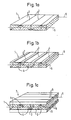
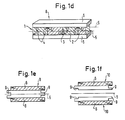
- FIGS. 1a to 1d as well as 2a and 2b are representations of an intermediate plate (Fig. 1a and 1b), a composite plate (Fig. 1c and 2a) or a double board blank (Fig. 1d and 2b) in the oblique view and each broken off while the remaining figures are end views of a double board blank (FIGS. 1e and 2c) or a panel board (FIGS. 1f and 2d).
- FIG. 1a an intermediate plate 1 is shown, which is formed by mutually gluing together wooden boards or rods 2 on their longitudinal narrow sides; the glue spots are labeled 3.
- incisions 4 are milled into the intermediate plate, starting from both surfaces, which extend parallel to the longitudinal course of the wooden boards or rods 2 and perpendicular to the surfaces.
- the incisions 4, starting from the respective surface of the intermediate plate 1, extend to the central plane 5 and a little beyond it.
- the grooves 4 of the top and bottom of the intermediate plate are each offset by half a pitch (distance between adjacent grooves of a surface).
- the incisions 4 are made by means of a multi-blade circular saw in the intermediate plate, which can be run under this saw once on each side.
- Such an intermediate plate has only a limited width; if necessary, several such intermediate plates are therefore glued together with their longitudinal side edges, so as to create the intermediate layer of a composite plate which, in the direction transverse to the incisions 4, has at least the length of the panel boards to be produced.
- a three-layer composite panel 7 is thus obtained, which has a tread layer 6 on its top and bottom.
- This composite panel is then cut into double-board blanks, with each cutting line extending perpendicular to the surfaces and parallel to the grain in the tread layers 6 (FIG. 1d).
- the double board blanks 8 obtained in this way are, as shown in FIG. 1e, provided with a tongue and groove arrangement 9 on the longitudinal edges; in addition, the respective free surface of the tread layers 6 (tread surface) can be ground. It may also be advantageous to glaze, stain and / or let in the two treads of the double board blank, the moisture being introduced into the wood symmetrically as a result of this treatment and thus not leading to any distortion.
- the finished, hardened and dried double board blanks are cut in half along the central plane 5 by a cut, as a result of which two multilayer panel boards 10 are formed.
- the intermediate layer 1 shown in FIG. 1 a preferably has a thickness of 20 mm, a length of 5 m and a width of 1.5 m.
- the thickness of the tread layer 6 (Fig. 1c) is 7.8 mm.
- the width of the halving cut is approximately 3.5 to 4 mm.
- a panel board of this type is particularly suitable for laying on screed that is not completely level and above floor heating.
- a composite plate 7 ' is shown, which match from five other layers is formed, namely a bottom step 6 ⁇ in the figure, an overlying barrier layer 2 ⁇ , an overlying middle layer 11, an in turn overlying barrier layer 2 'and an overhead step layer 6'.
- the fiber course of two adjacent layers is perpendicular to each other.
- the composite panel formed from individual wooden boards or rods 2 ', 2 ⁇ , 6', 6 ⁇ and 11 is glued in the form shown in Fig. 2a and then cut into double board blanks 8 '; one of these double board blanks 8 'is shown in Fig. 2b.
- the cut is made perpendicular to the surfaces and parallel to the grain of the two treads 6 'and 6 ⁇ .
- tongue and groove arrangements 9 ' are milled into the two longitudinal edges of section 8' (Fig. 2c); subsequently, after curing the glue and cooling and drying the composite panel, the double board blank 8 'along its central plane 5', as shown in Fig. 2d, separated into two panel boards 10 'by a cut in half.
- the composite panel shown in FIG. 2a has five layers, each with a thickness of 7.8 mm; the width of the halving cut is 2.8 mm, so that the support shown in FIG. 2d has a thickness of 2.5 mm.
- a panel board of the type shown in Fig. 2d is particularly suitable for laying on upholstery.
- each other with respect to the plane of symmetry of the respective composite plate or the respective double board blank opposite, corresponding layers each have the same fiber direction and such a thickness and material that the distortion caused by each of these two layers is exactly the same and is thus compensated by that of the other plate;
- the layers which correspond symmetrically to one another are preferably formed from the same material and each have the same dimensions and the same structure.
- the invention also expressly relates to composite panels, double board blanks and panel boards produced by the method according to the invention.
Landscapes
- Engineering & Computer Science (AREA)
- Life Sciences & Earth Sciences (AREA)
- Wood Science & Technology (AREA)
- Forests & Forestry (AREA)
- Architecture (AREA)
- Manufacturing & Machinery (AREA)
- Mechanical Engineering (AREA)
- Civil Engineering (AREA)
- Structural Engineering (AREA)
- Floor Finish (AREA)
Abstract
Mehrlagige Fußbodenpaneelbretter werden von einer aus einzelnen, verleimten Lagen zusammengesetzten Platte abgeschnitten.Multi-layer floor panel boards are cut from a panel composed of individual, glued layers.
Erfindungsgemäß werden nun die Lagen zweier solcher Platten Unterseite an Unterseite zusammengelegt und miteinander verleimt, dann werden Doppelbrettrohlinge in Größe der herzustellenden Paneelbretter von der so gebildeten Verbundplatte (7) abgeschnitten, und nach Erhärten des Leims werden diese Doppelbrettrohlinge längs ihrer Mittelebene (5) halbiert, so daß zwei völlig verzugsfreie Paneelbretter gebildet werden.According to the invention, the layers of two such boards are now put together on the underside and on the underside and glued together, then double board blanks the size of the panel boards to be produced are cut off from the composite board (7) thus formed, and after the glue has hardened, these double board blanks are halved along their central plane (5), so that two completely distortion-free panel boards are formed.
Die an die Mittelebene (5) der Verbundplatte (7) angrenzenden Lagen bilden bevorzugt eine durchgehende Mittellage (1). Diese kann beidseitig mit bis zur Mittelebene (5) reichenden Einschnitten (4) versehen werden, so daß nach der Halbierung der Doppelbrettrohlinge jedes Paneelbrett eine unterste Lage aufweist, die durchgehende Trennschnitte aufweist.The layers adjacent to the central plane (5) of the composite panel (7) preferably form a continuous central layer (1). This can be provided on both sides with cuts (4) reaching to the central plane (5), so that after halving the double board blanks, each panel board has a lowermost layer which has continuous separating cuts.
Die an den Kanten der Paneelbretter ggf. erforderlichen Nuten und Federn werden bereits in die Kanten der Doppelbrettrohlinge in einem Arbeitsgang für jeweils zwei Paneelbretter eingebracht.
Description
Die Erfindung betrifft ein Verfahren zur Herstellung von Sperrholz-Paneelbrettern bevorzugt für Fußböden, gemäß dem Oberbegriff der Ansprüche 1 und 4.The invention relates to a method for producing plywood panel boards, preferably for floors, according to the preamble of claims 1 and 4.
Paneelbretter für Fußböden werden abgesperrte Bretter ausgebildet, um allzu groben Verwerfungen durch Feuchtigkeits- und Wärmeeinflüsse nach dem Verlegen vorzubeugen.Blocked boards are designed for flooring to prevent excessive distortion caused by moisture and heat after installation.
Hierbei weisen die bekannten, im Oberbegriff des Anspruchs 1 bezeichneten Paneelbretter neben der die eigentliche Trittfläche bildenden Trittlage eine mit dieser verleimte Sperrlage auf, die aus Holzbrettern oder -stäben gebildet ist und deren Faserverlauf sich jeweils quer zu jenem der Trittlage erstreckt.Here, the known panel boards referred to in the preamble of claim 1 have, in addition to the tread layer forming the actual tread surface, a barrier layer glued to this, which is formed from wooden boards or rods and the fiber course of which extends transversely to that of the tread layer.
Um das sogenannte "Schüsseln" solcher Paneelbretter zu vermeiden, ist die Sperrlage in Längsrichtung ihres Faserverlaufes durch quer zur Trittfläche verlaufende Einschnitte durchtrennt, die verhindern sollen, daß ein Arbeiten der Sperrlage quer zu ihrer Faserrichtung zum Aufwölben des Paneelbretts führt.In order to avoid the so-called "bowls" of such panel boards, the barrier layer is severed in the longitudinal direction of its fiber course by cuts running transversely to the tread surface, which are intended to prevent working of the barrier layer transversely to its fiber direction leading to bulging of the panel board.
Bei der Herstellung solcher Paneelbretter wird zunächst etwa mittels einer beheizbaren Presse aus Tritt- und Sperrlage eine Platte hergestellt, in welche dann von der von der Trittlage abgewandten Oberfläche her zueinander parallele Nuten eingesägt werden, welche einerseits die Sperrlage ganz durchsetzen müssen, andererseits aber möglichst nicht in die Trittlage eindringen sollen.In the manufacture of such panel boards, a plate is first produced, for example by means of a heatable press, from a tread and barrier layer, into which parallel grooves are then sawn from the surface facing away from the tread layer, which grooves have to penetrate the barrier layer entirely, but not if possible should penetrate into the pedal position.
Diese Bearbeitung erfordert ein hohes Maß an Genauigkeit und ist daher aufwendig.This machining requires a high degree of accuracy and is therefore complex.
Diese Bearbeitung erfolgt durch eine Vielblatt-Kreissäge, bei welcher auf einer rotierenden Werkzeugwelle mehrere Kreissägeblätter nebeneinanderliegend angebracht sind.This machining is carried out by a multi-blade circular saw, in which several circular saw blades are mounted side by side on a rotating tool shaft.
Da die Arbeitsbreite einer solchen Vielblatt-Kreissäge beschränkt ist, kann die hiermit bearbeitete Platte ebenfalls nur diese beschränkte Breite aufweisen.Since the working width of such a multi-blade circular saw is limited, the plate processed with it can also only have this limited width.
Die so bearbeitete Platte wird dann zu einzelnen Paneelbrettern zersägt, die gegebenenfalls noch einer Nachbearbeitung unterzogen werden, etwa dem Überschleifen der Trittfläche, dem Einfräsen von Nuten und Federn in die Seitenkanten und dergleichen.The plate processed in this way is then sawn into individual panel boards, which may also be subjected to post-processing, for example grinding the tread surface, milling grooves and tongues into the side edges and the like.
Die Sägeschnitte werden in der Faserrichtung der Trittlage vorgenommen, also quer zu den genannten Einschnitten, so daß die Länge der auf diese Weise hergestellten Paneelbretter höchstenfalls mit der Arbeitsbreite der genannten Vielblatt-Kreissäge übereinstimmt.The saw cuts are made in the grain direction of the tread position, that is to say transversely to the cuts mentioned, so that the length of the panel boards produced in this way corresponds at most to the working width of the multi-blade circular saw mentioned.
Die Herstellung längerer Paneelbretter ist aber auch aus einem anderen Grund nicht möglich:The production of longer panel boards is also not possible for another reason:
Beim Verleimen werden die einzelnen Holzbestandteile der Feuchtigkeit des Leimes und gegebenenfalls auch der Wärme ausgesetzt, so daß sich die durch Verleimen hergestellte Platte verziehen kann, bevor der Leim voll ausgehärtet ist. Infolge der Feuchtigkeit des Leimes tritt in der Regel auch noch nach der Aushärtung des Leimes ein nachträglicher Verzug ein.When gluing, the individual wooden components are exposed to the moisture of the glue and possibly also to the heat, so that the plate produced by gluing can warp before the glue has fully hardened. Due to the moisture of the glue, there is usually a subsequent delay even after the glue has hardened.
Der Verzug kann praktisch nur noch durch spanende Nachbearbeitung ausgeglichen werden; da nun das Ausmaß des Verzuges mit der Abmessung des Paneelbrettes zunimmt, andererseits aber nur eine dünne Schicht der Trittfläche durch Nachbearbeitung abgetragen werden darf, ist auch aus diesem Grund die Länge des Paneelbrettes sehr begrenzt.The delay can practically only be compensated for by post-processing; since the amount of warpage increases with the dimensions of the panel board, but on the other hand only a thin layer of the step surface can be removed by post-processing, the length of the panel board is also very limited for this reason.
Ferner ist ersichtlich, daß der eintretende Verzug das präzise Einfräsen der Nuten in die Sperrlage erschwert.It can also be seen that the delay that occurs makes it difficult to precisely mill the grooves into the locked position.
Das nach diesem bekannten Verfahren hergestellte Paneelbrett hat den Vorteil, verhältnismäßig dünn zu sein, so daß es beim Verlegen auf einem gegossenen Estrich sich an etwa vorhandene, geringfügige Unebenheiten anschmiegt und diese nicht, wie ein dickeres Paneelbrett, freitragend überspannt, so daß das bekannte Paneelbrett bei örtlicher Belastung nicht nachgibt.The panel board produced by this known method has the advantage of being relatively thin, so that when it is laid on a poured screed it clings to any slight imperfections that are present and does not cantileverly span it like a thicker panel board, so that the known panel board does not yield under local loads.
Um die aufwendige Herstellung mehrlagiger Paneelbretter zu vereinfachen, ist auch das im Oberbegriff des Anspruchs 4 beschriebene Verfahren bekannt, bei welchem wie beim obengenannten, bekannten Verfahren die Trittlage mit einer Sperrlage aus Holzbrettern oder -stäben verleimt wird, deren Faserverlauf sich quer zu jenem der Trittlage erstreckt.In order to simplify the complex production of multi-layer panel boards, the method described in the preamble of claim 4 is also known, in which, as in the known method mentioned above, the tread layer is glued to a barrier layer made of wooden boards or rods, the fiber course of which is transverse to that of the tread layer extends.
Auf die von der Trittlage abgewandte Oberfläche der Sperrlage wird nun eine weitere Lage aufgeleimt, deren Faserverlauf mit jenem der Trittlage übereinstimmt und die zur Aufnahme von Zugspannungen dienen soll, wodurch dem oben beschriebenen "Schüsseln" sowie dem oben beschriebenen, beim Verleimen auftretenden Verzug entgegengewirkt werden soll.A further layer is now glued onto the surface of the barrier layer facing away from the tread layer, the fiber course of which coincides with that of the tread layer and which is intended to absorb tensile stresses, thereby counteracting the "bowls" described above and the distortion occurring during gluing described above should.
Um aber aus den oben genannten Gründen zu verhindern, daß das Paneelbrett zu dick wird, wird in der Praxis als weitere Lage ein Schälfurnier verwendet, dessen Querschnitt viel zu klein ist, um tatsächlich so hohe Kräfte aufzunehmen, wie sie erforderlich sind, um dem Verzug wirksam entgegenzuwirken.However, in order to prevent the panel board from becoming too thick for the reasons mentioned above, a peeled veneer is used in practice as a further layer, the cross section of which is much too small to actually absorb the forces required to withstand the distortion counteract effectively.
Es ist daher auch bei diesem, bekannten Paneelbrett dann, wenn beim Verleimen ein Verzug eingetreten ist, eine aufwendige, spanende Nachbearbeitung erforderlich.It is therefore also necessary with this known panel board, if a delay has occurred during the gluing, an elaborate, post-processing.
Ausgehend von diesem Stand der Technik liegt der Erfindung die Auf gabe zugrunde, die beiden bekannten Verfahren zur Herstellung von Paneelbrettern dahingehend weiterzubilden, daß das jeweilige Herstellungsverfahren für Paneelbretter der beschriebenen Art vereinfacht wird, so daß mit geringerem Aufwand, als er bisher erforderlich war, verzugsfreie, gegebenenfalls nachbearbeitete Paneelbretter hergestellt werden können.Starting from this prior art, the invention is based on gave the basis to further develop the two known methods for the production of panel boards in such a way that the respective manufacturing process for panel boards of the type described is simplified, so that distortion-free, possibly reworked panel boards can be produced with less effort than was previously required.
Ferner soll das erstgenannte Verfahren so weitergebildet werden, daß Paneelbretter von bis zu einigen Metern Länge hergestellt werden können.Furthermore, the first-mentioned method is to be developed in such a way that panel boards of up to a few meters in length can be produced.
Diese Aufgabe wird durch die kennzeichnenden Merkmale der Ansprüche 1 und 4 gelöst, wobei diesen der folgende, gemeinsame Lösungsgedanke zugrundeliegt:This object is achieved by the characterizing features of claims 1 and 4, which are based on the following common solution:
Bei den bekannten Verfahren wird aus den Brettern bzw. Stäben der Trittlage, der Sperrlage und gegebenenfalls der weiteren Lage durch Verleimen eine Platte gebildet. Erfindungsgemäß wird nun nicht eine einzige Platte verleimt, sondern eine Doppelanordnung der einzelnen Lagen, wobei auf die von der Trittfläche abgewandte Oberfläche einer Platte die von der Trittfläche abgewandte Oberfläche einer zweiten, nach Material, Abmessung und Faserverlauf gleichartigen Platte aufgebracht wird, wodurch eine Verbundplatte entsteht, die an ihren beiden Oberflächen jeweils eine Trittfläche aufweist, zu denen parallel und mittig eine Symmetrieebene verläuft.In the known methods, a board is formed from the boards or rods of the tread layer, the barrier layer and possibly the further layer by gluing. According to the invention, not a single panel is now glued, but a double arrangement of the individual layers, the surface of a panel facing away from the tread surface being applied with the surface of a second panel facing away from the tread surface, which is of the same type in terms of material, dimensions and fiber orientation, thereby producing a composite panel , each of which has a tread on its two surfaces, to which a plane of symmetry runs parallel and in the middle.
Die beiden an die Symmetrieebene angrenzenden Lagen stimmen in Faserrichtung und Material überein und können daher auch von einer einzigen Lage gebildet sein, deren Dicke jener der beiden genannten Lagen entspricht.The two layers adjoining the plane of symmetry match in the direction of the fibers and the material and can therefore also be formed by a single layer, the thickness of which corresponds to that of the two layers mentioned.
Diese Verbundplatte wird nach dem Verleimen in Doppelbrettrohlinge zersägt, deren Oberfläche jeweils etwa jener der herzustellenden Paneelbretter entspricht, gegebenenfalls zuzüglich einer Bearbeitungszugabe.After gluing, this composite panel is sawn into double-board blanks, the surface of which corresponds approximately to that of the panel boards to be produced, if necessary plus a machining allowance.
Da die Anordnung im Querschnitt völlig symmetrisch aufgebaut ist, tritt beiderseits der Symmetrieebene jeweils ein nach Richtung und Größe gleichartiger Verzug auf, so daß sich der Verzug beider Hälften dieser Verbundplatte voll kompensiert. Die entstandene Verbundplatte ist ebenso wie die von ihr abgeschnittenen Doppelbrettroh linge völlig verzugsfrei.Since the arrangement is completely symmetrical in cross-section, a distortion of the same type in terms of direction and size occurs on both sides of the plane of symmetry, so that the distortion of both halves of this composite panel is fully compensated for. The resulting composite board, like the double board blanks cut from it, is completely free of distortion.
Nach Abkühlen des Verbundes, Aushärten des Leimes und weitgehender Trocknung der vom Leim angefeuchteten Holzteile werden nun die Doppelbrettrohlinge längs der oben beschriebenen Symmetrieebene halbiert, wobei bei der Bemessung jener Lage, die in der Symmetrieebene liegt, bzw. jener Lagen, die an die Symmetrieebene angrenzen, jeweils die Schnittbreite des Halbierungsschnittes berücksichtigt werden muß.After the composite has cooled, the glue has hardened and the wooden parts moistened with the glue have largely dried, the double board blanks are halved along the symmetry plane described above, whereby the dimensioning of the position that lies in the symmetry plane or those layers that adjoin the symmetry plane , the cutting width of the halving cut must be taken into account.
Die so gewonnenen Paneelbretter benötigen, da sie verzugsfrei sind, keinerlei den Verzug ausgleichende Nachbearbeitung.The panel boards obtained in this way, since they are free from distortion, do not require any post-processing to compensate for the distortion.
Es ist grundsätzlich möglich, etwa bei Verwendung eines Schmelzklebers zur Herstellung der Verbundplatte die Doppelbrettrohlinge sofort nach ihrer Entstehung zu halbieren, da zu diesem Zeitpunkt der Schmelzkleber bereits ausreichend abgekühlt und hiermit ausgehärtet ist.It is fundamentally possible, for example when using a hot melt adhesive to produce the composite panel, to halve the double board blanks immediately after they are formed, since at this point the hot melt adhesive has already cooled sufficiently and has thus hardened.
Bei der Verwendung eines Leimes, der die von ihm kontaktierten Holzteile befeuchtet, ist dagegen dann mit einem Verzug der fertigen Paneelbretter zu rechnen, wenn die Halbierung bereits vorgenommen wird, bevor die Doppelbrettrohlinge trocken sind.When using a glue that moistens the wooden parts in contact with it, on the other hand, a distortion of the finished panel boards is to be expected if the halving is already done before the double board blanks are dry.
Gemäß einer bevorzugten Ausgestaltung der Erfindung ist es sogar von Vorteil, die Doppelbrettrohlinge zur völligen Austrocknung einige Tage bevorzugt in einer Trocknungskammer abzulagern, und zwar bevorzugt für etwa zwei Tage, um völlig sicher zu sein, daß nach dem Halbieren der Doppelbrettrohlinge sich nicht noch ein wenn auch nur geringer Verzug einstellt.According to a preferred embodiment of the invention, it is even advantageous to preferably store the double-board blanks in a drying chamber for a few days to completely dry them out, preferably for about two days, in order to be completely certain that if the double-board blanks are halved, there will not be any even minimal delay.
Die durch das erfindungsgemäße Verfahren gewonnenen Paneelbretter können abschließend an ihren Längskanten bearbeitet und mit einer Nut- und Federanordnung versehen werden.The panel boards obtained by the method according to the invention can finally be processed on their longitudinal edges and provided with a tongue and groove arrangement.
Gemäß einer bevorzugten Ausgestaltung der Erfindung erfolgt diese Bearbeitung jedoch bereits bei den noch nicht halbierten Doppelbrettrohlingen, da bei diesen die zwei noch in der Symmetrieebene miteinander verbundenen Paneelbretter in einem einzigen Arbeitsgang mit ihren erforderlichen Nuten und Federn versehen werden können, wodurch eine noch weitere Vereinfachung des Herstellungsverfahrens erzielt wird.According to a preferred embodiment of the invention, however, this processing already takes place in the double-board blanks which have not yet been halved, since in these the two panel boards still connected to one another in the plane of symmetry can be provided with their required grooves and tongues in a single operation, thereby further simplifying the process Manufacturing process is achieved.
Gemäß Anspruch 1 wird zur Herstellung von Paneelbrettern, deren Sperrlage von Nuten durchtrennt ist, das oben beschriebene, erfindungsgemäße Grundverfahren auf die folgende Weise modifiziert:According to claim 1, the basic method according to the invention described above is modified in the following manner for the production of panel boards, the barrier layer of which is severed by grooves:
Zunächst wird eine Zwischenlage dadurch geschaffen, daß Bretter oder Stäbe aus Holz an ihren Längskanten miteinander verleimt werden. Die Dicke dieser Zwischenlage beträgt das Doppelte der am Paneelbrett vorgesehenen Sperrschicht zuzüglich der Breite jenes Halbierungsschnittes, der zum Halbieren der Doppelbrettrohlinge erforderlich ist.First, an intermediate layer is created by gluing boards or rods made of wood together on their longitudinal edges. The thickness of this intermediate layer is twice the barrier layer provided on the panel board plus the width of that cut in half required to halve the double board blanks.
In die so gewonnene und dimensionierte Zwischenlage werden nun von beiden Seiten her Einschnitte eingebracht, die nach Verlauf und Abstand den Nuten in der Unterseite der Sperrschicht des herzustellenden Paneelbrettes entsprechen, aber nur etwa bis zur Mitte der Dicke der Zwischenplatte reichen.In the intermediate layer thus obtained and dimensioned, incisions are now made from both sides, which correspond to the grooves in the underside of the barrier layer of the panel board to be produced, but only extend approximately to the middle of the thickness of the intermediate plate.
Auf diese vorgefräste Zwischenplatte wird nun beiderseits jeweils eine Trittlage aufgeleimt, wobei Faserverlauf, Material und Dimensionierung der beiden Trittlagen gleich ist.A tread layer is now glued onto both sides of this pre-milled intermediate plate, the fiber orientation, material and dimensioning of the two tread layers being the same.
Nach dem Verleimen, dem Aushärten des Leimes, der Trocknung der so gewonnenen Verbundplatte und dem Zerteilen in Doppelbrettrohlinge wird nun jeder Doppelbrettrohling auf die oben beschriebene Weise halbiert, wobei die Tiefe der Einschnitte in die Zwischenplatte so bemessen ist, daß die Einschnitte mindestens bis an den Halbierungsschnitt heranreichen, sich aber nicht oder nicht weit über diesen hinaus erstrecken.After gluing, curing the glue, drying the so obtained composite board and the division into double board blanks, each double board blank is halved in the manner described above, the depth of the incisions in the intermediate plate being dimensioned such that the incisions at least reach the bisection cut, but do not extend or do not extend far beyond it .
Während beim bekannten Verfahren größte Genauigkeit beim Einbringen der Einschnitte angezeigt war, um einerseits sicherzustellen, daß die Sperrlage voll durchtrennt wird, andererseits aber zu verhindern, daß in die Trittlage eingeschnitten wird, ist beim erfindungsgemäßen Verfahren die genaue Tiefe der Einschnitte unwesentlich, vorausgesetzt, die Einschnitte reichen jeweils bis zum Halbierungsschnitt.While the known method showed the greatest accuracy when making the incisions, on the one hand to ensure that the blocking position is completely severed, but on the other hand to prevent incisions from being made in the tread position, the exact depth of the incisions is insignificant in the method according to the invention, provided Incisions reach up to the halving cut.
Es ist grundsätzlich möglich und zum Erzielen einer besonders symmetrisch aufgebauten Platte auch vorteilhaft, wenn man die Einschnitte in die beiden Oberflächen der Zwischenplatte genau einander gegenüberliegend einbringt. Hierbei muß jedoch wieder die Tiefe der Einschnitte mit verhältnismäßig hoher Genauigkeit ausgeführt werden, um sicherzustellen, daß nicht versehentlich die Zwischenplatte ganz durchschnitten wird oder beim Einlegen in die Leimpresse zerbricht.It is fundamentally possible and, in order to achieve a particularly symmetrical plate, also advantageous if the cuts are made in the two surfaces of the intermediate plate exactly opposite one another. Here, however, the depth of the incisions must be made with a relatively high degree of accuracy in order to ensure that the intermediate plate is not accidentally cut through completely or breaks when inserted into the size press.
Es ist daher gemäß einer bevorzugten Ausgestaltung der Erfindung von Vorteil, wenn die Einschnitte in die beiden Oberflächen der Zwischenplatte zueinander versetzt sind, wobei der Einschnitt in der einen Oberfläche bevorzugt mittig zwischen zwei Einschnitten der gegenüberliegenden Oberfläche angeordnet ist, um eine möglichst gleichmäßige Spannungsverteilung in der herzustellenden Verbundplatte zu erreichen.It is therefore advantageous according to a preferred embodiment of the invention if the incisions in the two surfaces of the intermediate plate are offset from one another, the incision in one surface preferably being arranged centrally between two incisions on the opposite surface in order to distribute the stress as evenly as possible to achieve composite panel to be achieved.
Die Einschnitte werden bevorzugt mit einer Vielblatt-Kreissäge aus geführt, deren Arbeitsbreite , wie bereits eingangs erwähnt, beschränkt ist. Erfindungsgemäß wird nun die Breite der Zwischenlage so bemessen, daß sie die genannte Arbeitsbreite nicht übertrifft. Mehrere dieser Zwischenlagen werden nach der Vornahme der Einschnitte jedoch an ihren Längskanten stumpf miteinander verleimt, so daß nach dem Aufleimen der beiden Trittlagen auf die Oberflächen der so gewonnenen Anordnung eine Verbundplatte gebildet wird, deren Länge in Richtung des Faserverlaufes der Trittlagen 3,5 m bis 6 m, bevorzugt 4 m bis 5 m beträgt, so daß es durch das erfindungsgemäße Verfahren möglich wird, Paneelbretter entsprechender Länge herzustellen.The incisions are preferably made with a multi-blade circular saw managed, the working width, as already mentioned at the beginning, is limited. According to the invention, the width of the intermediate layer is now dimensioned such that it does not exceed the working width mentioned. Several of these intermediate layers are butt-glued together at their longitudinal edges after making the incisions, so that after the gluing of the two tread layers to the surfaces of the arrangement thus obtained, a composite panel is formed, the length of which in the direction of the grain of the tread layers is 3.5 m to 6 m, preferably 4 m to 5 m, so that the method according to the invention makes it possible to produce panel boards of corresponding length.
Beim Einbringen der Einschnitte in die Zwischenlage können bevorzugt im gleichen Arbeitsgang auch noch weitere Einfräsungen vorgenommen werden, soweit dies erforderlich ist.When the incisions are made in the intermediate layer, further milled cuts can preferably be carried out in the same operation, insofar as this is necessary.
Zur Weiterbildung des zweiten, eingangs genannten Verfahrens zur Herstellung dreilagiger Paneelbretter werden gemäß Anspruch 4 zunächst die Elemente der einen Trittlage, dann jene der zugehörigen Sperrlage, dann jene einer Zwischenlage, wiederum jene der zweiten Sperrlage und auf diese jene der zweiten Trittlage aufgebracht und miteinander verleimt. Hierbei stehen die Richtungen des Faserverlaufs in jeweils benachbarten Lagen senkrecht aufeinander, ausgenommen jener Fall, in welchem die Zwischenlage von zwei jeweils an die Symmetrieebene angrenzenden Einzellagen gebildet wird; deren Faserverlauf ist gleich.To further develop the second method mentioned at the outset for producing three-layer panel boards, the elements of one tread layer, then those of the associated barrier layer, then those of an intermediate layer, again that of the second barrier layer and that of the second tread layer are applied and glued to one another . In this case, the directions of the fiber course in each of the adjacent layers are perpendicular to one another, except for the case in which the intermediate layer is formed by two individual layers each adjoining the plane of symmetry; their fiber course is the same.
Die zwischen den beiden Sperrlagen liegende Mittellage weist eine Dicke auf, die dem zweifachen jener der unteren Lage des herzustellenden Paneelbretts sowie der Breite des Halbierungsschnitts entspricht.The middle layer lying between the two blocking layers has a thickness which corresponds to twice that of the lower layer of the panel board to be produced and the width of the cut in half.
Die mittlere Lage kann aber, wie oben beschrieben, auch aus zwei miteinander verleimten Einzellagen bestehen.However, as described above, the middle layer can also consist of two individual layers glued together.
Während bei dem durch das bekannte Verfahren hergestellten Paneelbrett die unterste Lage in der Regel durch ein Schälfurnier gebildet wird, ist bei dem durch das erfindungsgemäße Verfahren hergestellten Paneelbrett die untere Lage ein wenig dicker und außerdem durch den in diese eingedrungenen und in unverzogenem Zustand ausgehärteten Leim zusätzlich gefestigt. Es ist somit ein noch immer recht dünnes, aber verzugsfreies Paneelbrett gebildet, bei welchem die untere Lage imstande ist, später im Gebrauch wirksam dem Verzug entgegenzuwirken.While in the panel board produced by the known method the bottom layer is generally formed by a peeled veneer, in the panel board produced by the method according to the invention the bottom layer is a little thicker and also additionally hardened by the glue which has penetrated into it and is undrained consolidated. A panel, which is still quite thin but is free from distortion, is thus formed, in which the lower layer is able to effectively counteract the distortion later in use.
Wo es auf die Dicke des Paneelbrettes nicht ankommt, ist es möglich, die mittlere Lage auch durch eine Anzahl mehrerer Lagen zu ersetzen; wesentlich ist in jedem Fall die nach Faserverlauf, Material und Dimensionierung symmetrische Anordnung in Bezug auf die oben genannte Symmetrieebene. Dichere Paneelbretter, die sich bei üblicher Belastung nicht durchbegen, werden bevorzugt auf Polsterhölzer verlegt.Where the thickness of the panel board is not important, it is possible to replace the middle layer with a number of several layers; What is essential in any case is the symmetrical arrangement in terms of the fiber orientation, material and dimensioning with respect to the above-mentioned plane of symmetry. Tighter panel boards that do not bend under normal load are preferably laid on upholstery.
Insgesamt ermöglicht die Erfindung somit die Herstellung verzugsfreier und verhältnismäßig dünner Sperrholz-Paneelbretter, wie sie bevorzugt als Fußbodenbelag Verwendung finden können.Overall, the invention thus enables the production of distortion-free and relatively thin plywood panel boards, as can preferably be used as flooring.
Solche Fußboden-Paneelbretter sind nicht nur für Neubauten, sondern ganz besonders für die Altbausanierung anwendbar, denn dort müssen doe Paneele wegen der bereits vorgegebenen Stockwerkhöhen möglichst dünn sein; außerdem ist bei der Altbausanierung öfter mit Feuchtigkeitseinflüssen zu rechnen, wo es auf verzugsfreie Paneelbretter besonders ankommt.Such floor panel boards can be used not only for new buildings, but especially for the renovation of old buildings, because there the panels must be as thin as possible due to the floor heights already specified; in addition, the renovation of old buildings can often be influenced by moisture, where distortion-free panel boards are particularly important.
Ein weiteres, bevorzugtes Anwendungsgebiet für die durch die erfindungsgemäßen Verfahren hergestellten Paneelbretter ist die Abdekkung von Fußbodenheizungen: wegen der von einer solchen Heizung beanspruchten Bauhöhe kommt es besonders auf ein dünnes Paneel an; ferner hat dieses dünne Paneel eine verhältnismäßig geringe Wärme dämmwirkung, so daß das Ansprechverhalten der Fußbodenheizung nicht wesentlich beeinträchtigt wird und besonders der Wärmestau vermieden wird.Another preferred area of application for the panel boards produced by the method according to the invention is the covering of underfloor heating systems: because of the height required by such a heating system, a thin panel is particularly important; furthermore, this thin panel has a relatively low heat insulation effect, so that the response of the underfloor heating is not significantly impaired and in particular the build-up of heat is avoided.
Die durch das erfindungsgemäße Verfahren hergestellten Paneele können nicht nur als Fußbodenpaneele, sondern auch als Wand- und Deckenpaneele sowie Als Paneele zum Auskleiden von Wasser- und Landfahrzeugen verwendet werden, und zwar besonders dort, wo sie wechselnden Temperaturen und der Feuchtigkeit ausgesetzt sind.The panels produced by the method according to the invention can be used not only as floor panels, but also as wall and ceiling panels and as panels for lining water and land vehicles, particularly where they are exposed to changing temperatures and moisture.
Das erfindungsgemäße Verfahren ermöglicht den Einsatz und die volle Ausnutzung der größten Leimpressen, wobei die hergestellten Verbundplatten eine Länge und Breite von mehreren Metern aufweisen können.The method according to the invention enables the use and full utilization of the largest size presses, the composite panels produced having a length and width of several meters.
Der Gegenstand der Erfindung wird anhand der beigefügten, schematischen Zeichnung beispielsweise noch näher erläutert.The object of the invention is explained in more detail, for example, with the aid of the attached schematic drawing.
Hierbei zeigen:
- die Fig. 1a bis 1f die einzelnen Verfahrensschritte eines Verfahrens gemäß einer ersten Ausführungsform der Erfindung, und
- die Fig. 2a bis 2d die Verfahrensschritte einer weiteren Ausführungsform des erfindungsgemäßen Verfahrens.
- 1a to 1f the individual process steps of a method according to a first embodiment of the invention, and
- 2a to 2d the process steps of a further embodiment of the method according to the invention.
Die Fig. 1a bis 1d sowie 2a und 2b sind jeweils Darstellungen einer Zwischenplatte (Fig. 1a und 1b), einer Verbundplatte (Fig. 1c und 2a) bzw. eines Doppelbrettrohlings (Fig. 1d und 2b) im Schrägbild und jeweils abgebrochen, während die übrigen Figuren Endansichten eines Doppelbrettrohlings (Fig. 1e und 2c) bzw. eines Paneelbretts (Fig. 1f und 2d) sind.1a to 1d as well as 2a and 2b are representations of an intermediate plate (Fig. 1a and 1b), a composite plate (Fig. 1c and 2a) or a double board blank (Fig. 1d and 2b) in the oblique view and each broken off while the remaining figures are end views of a double board blank (FIGS. 1e and 2c) or a panel board (FIGS. 1f and 2d).
In Fig. 1a ist eine Zwischenplatte 1 gezeigt, die durch gegenseitiges Aneinanderleimen von Holzbrettern oder -stäben 2 an deren Längs-Schmalseiten gebildet ist; die Leimstellen sind mit 3 bezeichnet.In Fig. 1a, an intermediate plate 1 is shown, which is formed by mutually gluing together wooden boards or
Mit 5 ist die Mittelebene der so gebildeten Zwischenplatte bezeichnet.5 denotes the center plane of the intermediate plate thus formed.
Wie in Fig. 1b gezeigt, werden von beiden Oberflächen ausgehend Einschnitte 4 in die Zwischenplatte eingefräst, die sich parallel zum Längsverlauf der Holzbretter bzw. -stäbe 2 sowie senkrecht zu den Oberflächen erstrecken.As shown in FIG. 1b, incisions 4 are milled into the intermediate plate, starting from both surfaces, which extend parallel to the longitudinal course of the wooden boards or
Wie aus der Zeichnung ersichtlich, erstrecken sich die Einschnitte 4, von der jeweiligen Oberfläche der Zwischenplatte 1 ausgehend, bis zur Mittelebene 5 und ein wenig über diese hinaus.As can be seen from the drawing, the incisions 4, starting from the respective surface of the intermediate plate 1, extend to the
Ferner ist aus der Zeichnung ersichtlich, daß die Nuten 4 der Ober-und Unterseite der Zwischenplatte zueinander jeweils um eine halbe Teilung (Abstand zwischen benachbarten Nuten einer Oberfläche) versetzt sind.Furthermore, it can be seen from the drawing that the grooves 4 of the top and bottom of the intermediate plate are each offset by half a pitch (distance between adjacent grooves of a surface).
Die Einschnitte 4 werden mittels einer Vielblatt-Kreissäge in die Zwischenplatte eingebracht, die man mit jeder Seite einmal unter dieser Säge hindurchlaufen läßt.The incisions 4 are made by means of a multi-blade circular saw in the intermediate plate, which can be run under this saw once on each side.
Eine solche Zwischenplatte hat nur eine begrenzte Breite; falls erforderlich, werden daher mehrere solcher Zwischenplatten mit ihren Längs-Seitenkanten aneinandergeleimt, um so die Zwischenlage einer Verbundplatte zu schaffen, die in Richtung quer zu den Einschnitten 4 mindestens die Länge der herzustellenden Paneelbretter aufweist.Such an intermediate plate has only a limited width; if necessary, several such intermediate plates are therefore glued together with their longitudinal side edges, so as to create the intermediate layer of a composite plate which, in the direction transverse to the incisions 4, has at least the length of the panel boards to be produced.
Mit der Ober- und Unterseite der Zwischenplatte 1 bzw. der aus mehreren Zwischenplatten gebildeten Zwischenlage werden dann, wie aus Fig. 1c ersichtlich, jeweils aneinander angrenzende Bretter 6 verleimt, die jeweils eine obere und untere Trittlage bilden und deren Fasern sich quer zu jenen der Zwischenplatte bzw. Zwischenplatten 1 erstrecken.With the top and bottom of the intermediate plate 1 or the intermediate layer formed from several intermediate plates are then how 1c, glued to each other
Nach der Verleimung ergibt sich somit eine dreilagige Verbundplatte 7, die an ihrer Ober- und Unterseite eine Trittlage 6 aufweist.After gluing, a three-layer composite panel 7 is thus obtained, which has a
Diese Verbundplatte wird dann in Doppelbrettrohlinge zerschnitten, wobei sich jede Schnittlinie senkrecht zu den Oberflächen und parallel zum Faserverlauf in den Trittlagen 6 erstreckt (Fig. 1d).This composite panel is then cut into double-board blanks, with each cutting line extending perpendicular to the surfaces and parallel to the grain in the tread layers 6 (FIG. 1d).
Die so gewonnenen Doppelbrettrohlinge 8 werden, wie in Fig. 1e gezeigt, an den Längskanten mit einer Nut-Feder-Anordnung 9 versehen; zusätzlich kann die jeweils freie Oberfläche der Trittlagen 6 (Trittfläche) geschliffen werden. Es ist gegebenenfalls auch vorteilhaft, die beiden Trittflächen des Doppelbrettrohlings zu lasieren, zu beizen und/oder einzulassen, wobei der Feuchtigkeitseintrag in das Holz infolge dieser Behandlung symmetrisch erfolgt und somit zu keinerlei Verzug führt.The
Abschließend werden, wie in Fig. 1f gezeigt, die fertig zugerichteten, ausgehärteten und getrockneten Doppelbrettrohlinge längs der Mittelebene 5 durch einen Schnitt halbiert, wodurch zwei mehrlagige Paneelbretter 10 gebildet werden.Finally, as shown in FIG. 1f, the finished, hardened and dried double board blanks are cut in half along the
Die in Fig. 1a gezeigte Zwischenlage 1 weist bevorzugt eine Dicke von 20 mm, eine Länge von 5m und eine Breite von 1,5 m auf. Die Dicke der Trittlage 6 (Fig. 1c) beträgt 7,8 mm. Die Breite des Halbierungsschnittes beträgt etwa 3,5 bis 4 mm. Ein Paneelbrett dieser Art ist besonders zum Verlegen auf nicht völlig ebenem Estrich und über Fußbodenheizungen geeignet.The intermediate layer 1 shown in FIG. 1 a preferably has a thickness of 20 mm, a length of 5 m and a width of 1.5 m. The thickness of the tread layer 6 (Fig. 1c) is 7.8 mm. The width of the halving cut is approximately 3.5 to 4 mm. A panel board of this type is particularly suitable for laying on screed that is not completely level and above floor heating.
In Fig. 2a ist eine Verbundplatte 7′ gezeigt, die aus fünf überein anderliegenden Lagen gebildet ist, und zwar einer in der Abbildung untenliegenden Trittlage 6˝, einer darüberliegenden Sperrlage 2˝, einer darüberliegenden Mittellage 11 , einer wiederum darüberliegenden Sperrlage 2′ und einer obenliegenden Trittlage 6′ .In Fig. 2a, a composite plate 7 'is shown, which match from five other layers is formed, namely a
Die Abmessungen, das Material und der Faserverlauf in der unteren und oberen Trittlage 6′ sind jeweils gleich; das gleiche gilt für die beiden Sperrlagen 2′, 2˝.The dimensions, the material and the grain in the lower and upper tread 6 'are each the same; the same applies to the two
Außerdem ist der Faserverlauf jeweils zweier benachbarter Lagen jeweils zueinander senkrecht.In addition, the fiber course of two adjacent layers is perpendicular to each other.
Die aus einzelnen Holzbrettern oder -stäben 2′, 2˝, 6′, 6˝ und 11 gebildete Verbundplatte wird in der in Fig. 2a gezeigten Form verleimt und anschließend in Doppelbrettrohlinge 8′ zerschnitten; einer dieser Doppelbrettrohlinge 8′ ist in Fig. 2b gezeigt.The composite panel formed from individual wooden boards or
Der Schnitt erfolgt hierbei jeweils senkrecht zu den Oberflächen und parallel zum Faserverlauf der beiden Trittlagen 6′ und 6˝.The cut is made perpendicular to the surfaces and parallel to the grain of the two
Anschließend werden Nut- und Federanordnungen 9′ in die beiden Längskanten des Abschnitts 8′ eingefräst (Fig. 2c); nachfolgend wird nach dem Aushärten des Leimes sowie dem Abkühlen und Trocknen der Verbundplatte der Doppelbrettrohling 8′ längs seiner Mittelebene 5′, wie in Fig. 2d gezeigt, in zwei Paneelbretter 10′ durch einen Halbierungsschnitt aufgetrennt.Then tongue and groove arrangements 9 'are milled into the two longitudinal edges of section 8' (Fig. 2c); subsequently, after curing the glue and cooling and drying the composite panel, the double board blank 8 'along its central plane 5', as shown in Fig. 2d, separated into two panel boards 10 'by a cut in half.
Die in Fig. 2a gezeigte Verbundplatte weist fünf Lagen mit jeweils einer Dicke von 7,8 mm auf; die Breite des Halbierungsschnittes beträgt 2,8 mm, so daß der in Fig. 2d gezeigte Unterzug eine Dicke von 2,5 mm aufweist. Ein Paneelbrett der in Fig. 2d gezeigten Art ist besonders zum Verlegen auf Polsterhölzern geeignet.The composite panel shown in FIG. 2a has five layers, each with a thickness of 7.8 mm; the width of the halving cut is 2.8 mm, so that the support shown in FIG. 2d has a thickness of 2.5 mm. A panel board of the type shown in Fig. 2d is particularly suitable for laying on upholstery.
Die einander bezüglich der Symmetrieebene der jeweiligen Verbund platte bzw. des jeweiligen Doppenbrettrohlings gegenüberliegenden, einander entsprechenden Lagen weisen jeweils die gleiche Faserrichtung sowie eine solche Dicke und ein solches Material auf, daß der durch jede dieser beiden Lagen herbeigeführte Verzug genau gleich ist und somit durch jenen der anderen Platte kompensiert wird; obwohl nicht in jedem Fall erforderlich, sind bevorzugt die einander symmetrisch entsprechenden Lagen jeweils aus dem gleichen Material gebildet und weisen jeweils die gleichen Abmessungen und den gleichen Aufbau auf.The each other with respect to the plane of symmetry of the respective composite plate or the respective double board blank opposite, corresponding layers each have the same fiber direction and such a thickness and material that the distortion caused by each of these two layers is exactly the same and is thus compensated by that of the other plate; Although not required in every case, the layers which correspond symmetrically to one another are preferably formed from the same material and each have the same dimensions and the same structure.
Die Erfindung betrifft neben dem Verfahren ausdrücklich auch nach dem erfindungsgemäßen Verfahren hergestellte Verbundplatten, Doppelbrettrohlinge und Paneelbretter.In addition to the method, the invention also expressly relates to composite panels, double board blanks and panel boards produced by the method according to the invention.
Claims (12)
dadurch gekennzeichnet, daß
- durch Verleimen von Holzbrettern oder -stäben, deren Dicke mindestens das Doppelte jener der Sperrschicht beträgt, eine Zwischenplatte gebildet wird,
- in die beiden Oberflächen der Zwischenplatte jeweils eine Anzahl von Einschnitten senkrecht zu den Oberflächen und parallel zum Faserverlauf eingebracht werden, die mindestens bis kurz vor die Mittelebene der Zwischenplatte reichen,
- auf jede der beiden Oberflächen der Zwischenplatte jeweils eine Trittlage geleimt wird,
- die so gewonnene Verbundplatte in Doppelbrettrohlinge zersägt wird, deren Größe in der jeweiligen Trittfläche etwa jener der herzustellenden Paneelbretter entspricht, und
- die Doppelbrettrohlinge durch einen Trennschnitt längs der Mittelebene zwischen den beiden Trittflächen halbiert werden, der die Einschnitte schneidet oder tangiert.1.Procedure for the production of multilayer panel boards, preferably for floors, by gluing a step layer forming a visible or tread surface from several adjacent wooden boards, the fibers of which run lengthwise, with a barrier layer of adjacent wooden boards or bars, the fibers of which are parallel to the step surface and perpendicular to those of the tread layer are arranged, the barrier layer being cut several times parallel to its grain and perpendicular to the tread surface, the panel thus obtained is sawn into panel boards parallel to the grain in the tread pattern and the longitudinal edges of which are possibly finished by milling,
characterized in that
an intermediate plate is formed by gluing wooden boards or rods, the thickness of which is at least twice that of the barrier layer,
a number of incisions are made in the two surfaces of the intermediate plate, perpendicular to the surfaces and parallel to the grain, which extend at least to just before the median plane of the intermediate plate,
- a step layer is glued onto each of the two surfaces of the intermediate plate,
- The composite panel obtained in this way is sawn into double board blanks, the size of which corresponds approximately to that of the panel boards to be produced, and
- The double board blanks are halved by a separating cut along the median plane between the two treads, which cuts or touches the incisions.
dadurch gekennzeichnet, daß
- auf die weitere Lage eine zusätzliche, nach Material und Faserverlauf mit dieser übereinstimmende Lage oder statt der weiteren Lage eine solche mit mindestens doppelter Dicke auf die Sperrlage aufgeleimt wird,
- auf die freie Oberfläche dieser zusätzlichen bzw. weiteren Lage eine zweite, nach Material und Faserverlauf mit der ersten übereinstimmende Sperrlage aufgeleimt wird,
- auf diese eine zweite, nach Material und Faserverlauf mit der ersten übereinstimmende Trittlage aufgeleimt wird,
- die so gewonnene Verbundplatte in Doppelbrettrohlinge zersägt wird, deren Größe in der jeweiligen Trittfläche etwa jener der Paneelbretter entspricht, und
- die Doppelbrettrohlinge durch einen in der Mittelebene zwischen den beiden Trittflächen geführten Trennschnitt zur Bildung der Paneelbretter halbiert werden.6.Procedure for the production of multi-layer panel boards, preferably for floors, by gluing a step layer that forms a visible or tread surface from several adjacent wooden boards, each with longitudinal fibers, with a barrier layer from adjacent wooden boards or bars, the fibers of which are parallel to the step surface and perpendicular to that in the tread layer are arranged, and by gluing a further layer onto the surface of the barrier layer facing away from the tread layer, the further layer itself may have several layers, the plate thus obtained is sawn into panel boards parallel to the grain in the tread layer, and the longitudinal edges thereof, if necessary can be finished by milling,
characterized in that
- On the further layer, an additional layer that corresponds to this in terms of material and fiber orientation or instead of the further layer Layer is glued onto the barrier layer with at least twice the thickness,
a second barrier layer is glued to the free surface of this additional or further layer, which corresponds to the material and fiber course with the first,
- a second tread layer is glued onto this, according to the material and the grain of the fibers,
- The composite panel obtained in this way is sawn into double board blanks, the size of which corresponds approximately to that of the panel boards in the respective step surface, and
- The double board blanks are halved by a cut made in the middle plane between the two treads to form the panel boards.
Applications Claiming Priority (2)
| Application Number | Priority Date | Filing Date | Title |
|---|---|---|---|
| DE3908851 | 1989-03-17 | ||
| DE3908851A DE3908851A1 (en) | 1989-03-17 | 1989-03-17 | METHOD FOR PRODUCING MULTI-LAYER PANEL BOARDS PREFERRED FOR FLOORS |
Publications (2)
| Publication Number | Publication Date |
|---|---|
| EP0387902A2 true EP0387902A2 (en) | 1990-09-19 |
| EP0387902A3 EP0387902A3 (en) | 1991-08-21 |
Family
ID=6376621
Family Applications (1)
| Application Number | Title | Priority Date | Filing Date |
|---|---|---|---|
| EP19900105031 Withdrawn EP0387902A3 (en) | 1989-03-17 | 1990-03-16 | Method for manufacturing laminated panels, especially for floors |
Country Status (3)
| Country | Link |
|---|---|
| US (1) | US5109898A (en) |
| EP (1) | EP0387902A3 (en) |
| DE (1) | DE3908851A1 (en) |
Cited By (11)
| Publication number | Priority date | Publication date | Assignee | Title |
|---|---|---|---|---|
| FR2698036A1 (en) * | 1992-11-19 | 1994-05-20 | Artbois Ahmerkamp | Method of producing solid or self adhesive parquet flooring - includes using edge to edge equal thickness sections to form strips in layers glued or tongued and grooved for splitting into strips |
| EP0690185A1 (en) * | 1994-06-29 | 1996-01-03 | Geroclair | Parqueting lath |
| EP0726373A1 (en) * | 1994-12-19 | 1996-08-14 | Hans Krönig | Massive wooden element |
| FR2913631A1 (en) * | 2007-03-12 | 2008-09-19 | Henrick Merle | MACHINE WOOD BLOCK FOR THE CONSTITUTION OF A TOOLING, METHOD FOR MANUFACTURING THE SAME AND TOOLS OBTAINED |
| EP1930523A3 (en) * | 2006-11-22 | 2010-03-03 | Olavi Räsänen Oy | Method of fabricating a parquet slab base |
| CN102605929A (en) * | 2012-03-14 | 2012-07-25 | 广州厚邦木业制造有限公司 | Manual multi-layer solid wood floor and production process thereof |
| USD665211S1 (en) | 2009-08-06 | 2012-08-14 | Bender James J | Flexible sample of replica wood flooring |
| US8241039B2 (en) | 2009-08-21 | 2012-08-14 | Bender James J | Kit of pre-construction samples for replicating construction products |
| WO2014037286A1 (en) * | 2012-09-07 | 2014-03-13 | Ed. Züblin Ag | Multi-layered timber panel |
| USD716086S1 (en) | 2010-06-10 | 2014-10-28 | James J. Bender | Flexible sample of a cabinet replica |
| US8961182B2 (en) | 2009-08-21 | 2015-02-24 | James J. Bender | Kit of pre-construction samples for replicating construction products |
Families Citing this family (60)
| Publication number | Priority date | Publication date | Assignee | Title |
|---|---|---|---|---|
| FI87632C (en) * | 1991-08-13 | 1993-02-10 | Honkarakenne Oy | STOCKELEMENT OCH FOERFARANDE FOER FRAMSTAELLNING AV ETT STOCKELEMENT |
| US5283102A (en) * | 1992-10-28 | 1994-02-01 | Premier Wood Floors | Laminated wood flooring product and wood floor |
| DE9313274U1 (en) * | 1993-09-03 | 1993-11-21 | Hufer, Hans-Peter, Dipl.-Ing. (FH), 47506 Neukirchen-Vluyn | Multi-layer glued solid wood installation board |
| DE4439279C1 (en) * | 1994-11-07 | 1996-06-13 | Hans Kroenig | Wooden support for parquet floor section |
| AT401747B (en) * | 1994-11-14 | 1996-11-25 | Fendt Hermann | Panel element of solid wood and process for its production |
| US5985398A (en) * | 1994-12-27 | 1999-11-16 | Manufacture De Lambton Ltee | Stairtread made of a combination of higher quality wood and lower quality material |
| SE507235C2 (en) * | 1995-03-28 | 1998-04-27 | Tarkett Ab | Ways to prepare a building element for the manufacture of a laminated wooden floor |
| US5830549A (en) * | 1995-11-03 | 1998-11-03 | Triangle Pacific Corporation | Glue-down prefinished flooring product |
| BE1010487A6 (en) | 1996-06-11 | 1998-10-06 | Unilin Beheer Bv | FLOOR COATING CONSISTING OF HARD FLOOR PANELS AND METHOD FOR MANUFACTURING SUCH FLOOR PANELS. |
| US5725929A (en) * | 1996-08-20 | 1998-03-10 | Fiber Technologies, Inc. | Reinforced wood |
| US5804019A (en) * | 1997-01-31 | 1998-09-08 | Triangle Pacific Corporation | Apparatus and method for applying adhesive and release paper to wooden flooring strips |
| CA2207633A1 (en) * | 1997-06-26 | 1998-12-26 | Gilles Grenier | Wood resistant to humidity variations |
| US5935668A (en) * | 1997-08-04 | 1999-08-10 | Triangle Pacific Corporation | Wooden flooring strip with enhanced flexibility and straightness |
| US5894700A (en) * | 1997-08-04 | 1999-04-20 | Triangle Pacific Corporation | Glue-down prefinished wood flooring product |
| US5816304A (en) * | 1997-08-04 | 1998-10-06 | Triangle Pacific Corporation | Apparatus and method for increasing the flexibility of and straightening flooring strips |
| US5968625A (en) * | 1997-12-15 | 1999-10-19 | Hudson; Dewey V. | Laminated wood products |
| US6173548B1 (en) * | 1998-05-20 | 2001-01-16 | Douglas J. Hamar | Portable multi-section activity floor and method of manufacture and installation |
| SE514645C2 (en) | 1998-10-06 | 2001-03-26 | Perstorp Flooring Ab | Floor covering material comprising disc-shaped floor elements intended to be joined by separate joint profiles |
| US6058991A (en) | 1999-03-22 | 2000-05-09 | Hill; David A. | Method for making a wood product |
| TW455705B (en) * | 1999-07-05 | 2001-09-21 | Seiko Epson Corp | Manufacturing method of polarization transformation element |
| US6533005B2 (en) * | 2000-02-02 | 2003-03-18 | David A. Hill | Method of making a hybrid wood product |
| SE518184C2 (en) | 2000-03-31 | 2002-09-03 | Perstorp Flooring Ab | Floor covering material comprising disc-shaped floor elements which are joined together by means of interconnecting means |
| US6519912B1 (en) | 2000-04-11 | 2003-02-18 | Temple-Inland Forest Products Corporation | Composite wood products |
| BE1013569A3 (en) | 2000-06-20 | 2002-04-02 | Unilin Beheer Bv | Floor covering. |
| DE10036034C2 (en) * | 2000-07-24 | 2003-12-18 | Ihd Inst Fuer Holztechnologie | Three or multi-layer composite panel |
| CA2322364C (en) * | 2000-10-05 | 2004-03-09 | Romaro 2000 Limitee | A structural wooden joist |
| DE10061516A1 (en) * | 2000-12-08 | 2002-06-20 | Buerkle Gmbh Robert | Method and device for producing a central layer of a parquet board |
| US20020148192A1 (en) * | 2001-02-13 | 2002-10-17 | Romaro 2000 Limitee | Structural wooden joist |
| WO2002064910A1 (en) * | 2001-02-15 | 2002-08-22 | Schroeder Peter | A wall cladding board and a method for making the same |
| DE10214882B4 (en) * | 2002-04-04 | 2004-02-05 | Matthias Junginger | Wooden component, window or door jacket and manufacturing method |
| SE525657C2 (en) | 2002-04-08 | 2005-03-29 | Vaelinge Innovation Ab | Flooring boards for floating floors made of at least two different layers of material and semi-finished products for the manufacture of floorboards |
| AU2002315687A1 (en) * | 2002-05-15 | 2003-12-02 | Hamberger Industriewerke Gmbh | Floor element and method for producing the same |
| US20040222609A1 (en) * | 2003-05-07 | 2004-11-11 | Schmitt Paul G. | Waffled wood core skateboard |
| US20050247000A1 (en) * | 2004-05-04 | 2005-11-10 | Zhu Sai Y | Interlocking self-aligning cladding panel for floors, walls, ceilings, or the like |
| BE1016938A6 (en) | 2005-03-31 | 2007-10-02 | Flooring Ind Ltd | Floor panel manufacturing method, involves providing panels at lower side with guiding groove and providing two opposite sides with profiled edge regions that comprise coupling parts |
| US20130139478A1 (en) * | 2005-03-31 | 2013-06-06 | Flooring Industries Limited, Sarl | Methods for packaging floor panels, as well as packed set of floor panels |
| DE102005038975B3 (en) * | 2005-08-16 | 2006-12-14 | Johannes Schulte | Panel production process for floor, wall or ceiling panels has initial board with parallel grooves in upper and lower surfaces |
| US7603824B1 (en) * | 2006-02-14 | 2009-10-20 | Pamasia, Inc. | Flooring construction |
| BE1017157A3 (en) | 2006-06-02 | 2008-03-04 | Flooring Ind Ltd | FLOOR COVERING, FLOOR ELEMENT AND METHOD FOR MANUFACTURING FLOOR ELEMENTS. |
| US7665263B2 (en) * | 2007-02-05 | 2010-02-23 | Paul Yau | Hardwood flooring system |
| CA2643180C (en) * | 2008-11-05 | 2011-08-16 | Boa-Franc S.E.N.C. | Composite engineered wood material piece |
| US8316594B2 (en) * | 2009-10-07 | 2012-11-27 | Moulure Alexandria Moulding Inc. | Stair tread assembly and method |
| DE102010004717A1 (en) | 2010-01-15 | 2011-07-21 | Pergo (Europe) Ab | Set of panels comprising retaining profiles with a separate clip and method for introducing the clip |
| CN104831904B (en) | 2010-05-10 | 2017-05-24 | 佩尔戈(欧洲)股份公司 | Set of panels |
| CN102971468A (en) * | 2010-05-28 | 2013-03-13 | P·R·欧特佳 | Improvement of composite wood flooring, production method of composite wood flooring and its correction and maintenance |
| US9010067B2 (en) * | 2011-04-14 | 2015-04-21 | Geoffrey Alan Baker | Fabricating the locking steps in the groove element of spring-loaded split-tongue locking connector system |
| JP6105587B2 (en) | 2011-08-29 | 2017-04-05 | セラロック、イノベーション、アクチボラグ | Mechanical locking system for floor panels |
| US8935899B2 (en) * | 2012-02-02 | 2015-01-20 | Valinge Innovation Ab | Lamella core and a method for producing it |
| DE102012008771A1 (en) * | 2012-05-07 | 2013-11-07 | Stephan Brückner | Glued solid wood slat rod assembly used in manufacture of e.g. bureau, has horizontal solid wood slat layers that are arranged at orientation angle with one another such that stable structure is formed at outer sides of assembly |
| KR102238758B1 (en) | 2012-07-02 | 2021-04-08 | 세라록 이노베이션 에이비 | A building panels, a method to produce of floor panels and a wooden based floor panel, with reduced weight and material content |
| US9140010B2 (en) | 2012-07-02 | 2015-09-22 | Valinge Flooring Technology Ab | Panel forming |
| US9340984B2 (en) * | 2013-07-28 | 2016-05-17 | Alan Lun Chou | Micro lock mortise riveted joint frame two ply solid wood hybrid engineered flooring |
| BR112016003022B1 (en) | 2013-08-27 | 2021-08-17 | Vãlinge Innovation Ab | METHOD FOR PRODUCING A SEMI-PRODUCT FOR A BUILDING PANEL |
| CN104972524A (en) * | 2015-07-07 | 2015-10-14 | 南充市嘉陵区森利木业加工厂 | Recycled solid wood finger-jointed multilayer composite plate |
| US11084245B2 (en) | 2019-01-09 | 2021-08-10 | Six Minutes LLC | Cross-laminated timber having a conduit therein |
| US11712816B2 (en) | 2019-03-05 | 2023-08-01 | Ceraloc Innovation Ab | Method and system for forming grooves in a board element and an associated panel |
| EP3947849B1 (en) | 2019-03-25 | 2025-10-15 | Ceraloc Innovation AB | A mineral-based panel comprising grooves |
| DE102019125608A1 (en) | 2019-09-24 | 2021-03-25 | PaTim UG (haftungsbeschränkt) | Process for the production of a wooden construction element and a wooden construction element |
| CN114829126B (en) | 2019-12-27 | 2024-10-29 | 塞拉洛克创新股份有限公司 | Thermoplastic-based building panels including a balancing layer |
| PL442049A1 (en) * | 2022-08-19 | 2024-02-26 | Palettenwerk Kozik Spółka Z Ograniczoną Odpowiedzialnością | Ceiling panel and method for producing the ceiling panel |
Family Cites Families (10)
| Publication number | Priority date | Publication date | Assignee | Title |
|---|---|---|---|---|
| DE130233C (en) * | ||||
| US1102036A (en) * | 1910-04-05 | 1914-06-30 | Francis X Ganter | Parquet flooring or paneling and method of making the same. |
| US1594889A (en) * | 1925-10-31 | 1926-08-03 | Emil C Loetscher | Method of making veneered wood products |
| US1840974A (en) * | 1929-12-04 | 1932-01-12 | Byrd C Rockwell | Inlay flooring and method of manufacturing same |
| DK70586C (en) * | 1943-06-30 | 1950-02-06 | Gustaf Kaehr | Floor covering and slatted boards for the same as well as method for manufacturing the floor covering. |
| US3878017A (en) * | 1972-01-03 | 1975-04-15 | Roland Etzold | Method of making a decorative building panel of lumber planks and laminated veneer plies |
| CH587400A5 (en) * | 1975-05-12 | 1977-04-29 | Schaer Oskar | Timber wall or ceiling cover plates - has three adhesive bonded layers with decorative surfaces resembling sawn timber |
| DE2851582A1 (en) * | 1978-11-29 | 1980-06-12 | Gerbl Karl Heinz | Ornamental timber surface on cheap wood backing - used in wall or ceiling cladding board and has glue line in plane between groove base and tongue (OE 15.3.79) |
| CH664185A5 (en) * | 1983-10-12 | 1988-02-15 | Naegeli Geb | Block board production method - by sawing through middle after gluing lengthwise and transverse panels either side of board |
| SE8703354L (en) * | 1987-08-31 | 1989-03-01 | Olav Hoel | SEAT FOR PREPARATION OF FLOOR BREADS AND ACCORDING TO SATISFACTION |
-
1989
- 1989-03-17 DE DE3908851A patent/DE3908851A1/en not_active Withdrawn
-
1990
- 1990-03-14 US US07/493,258 patent/US5109898A/en not_active Expired - Fee Related
- 1990-03-16 EP EP19900105031 patent/EP0387902A3/en not_active Withdrawn
Cited By (16)
| Publication number | Priority date | Publication date | Assignee | Title |
|---|---|---|---|---|
| FR2698036A1 (en) * | 1992-11-19 | 1994-05-20 | Artbois Ahmerkamp | Method of producing solid or self adhesive parquet flooring - includes using edge to edge equal thickness sections to form strips in layers glued or tongued and grooved for splitting into strips |
| EP0690185A1 (en) * | 1994-06-29 | 1996-01-03 | Geroclair | Parqueting lath |
| FR2721957A1 (en) * | 1994-06-29 | 1996-01-05 | Geraud Pierre | WOOD LATCH |
| EP0726373A1 (en) * | 1994-12-19 | 1996-08-14 | Hans Krönig | Massive wooden element |
| EP1930523A3 (en) * | 2006-11-22 | 2010-03-03 | Olavi Räsänen Oy | Method of fabricating a parquet slab base |
| FR2913631A1 (en) * | 2007-03-12 | 2008-09-19 | Henrick Merle | MACHINE WOOD BLOCK FOR THE CONSTITUTION OF A TOOLING, METHOD FOR MANUFACTURING THE SAME AND TOOLS OBTAINED |
| EP1982828A1 (en) * | 2007-03-12 | 2008-10-22 | Henrick Merle | Machinable block of wood for forming a tool, its manufacturing method and tool obtained |
| USD665211S1 (en) | 2009-08-06 | 2012-08-14 | Bender James J | Flexible sample of replica wood flooring |
| USD697738S1 (en) | 2009-08-06 | 2014-01-21 | James J. Bender | Flexible sample of replica wood flooring |
| US8241039B2 (en) | 2009-08-21 | 2012-08-14 | Bender James J | Kit of pre-construction samples for replicating construction products |
| US8961182B2 (en) | 2009-08-21 | 2015-02-24 | James J. Bender | Kit of pre-construction samples for replicating construction products |
| US9293066B2 (en) | 2009-08-21 | 2016-03-22 | James J. Bender | Kit of pre-construction samples for replicating construction products |
| US10201238B2 (en) | 2009-08-21 | 2019-02-12 | James J. Bender | Kit of pre-construction samples for replicating construction products |
| USD716086S1 (en) | 2010-06-10 | 2014-10-28 | James J. Bender | Flexible sample of a cabinet replica |
| CN102605929A (en) * | 2012-03-14 | 2012-07-25 | 广州厚邦木业制造有限公司 | Manual multi-layer solid wood floor and production process thereof |
| WO2014037286A1 (en) * | 2012-09-07 | 2014-03-13 | Ed. Züblin Ag | Multi-layered timber panel |
Also Published As
| Publication number | Publication date |
|---|---|
| EP0387902A3 (en) | 1991-08-21 |
| DE3908851A1 (en) | 1990-09-20 |
| US5109898A (en) | 1992-05-05 |
Similar Documents
| Publication | Publication Date | Title |
|---|---|---|
| EP0387902A2 (en) | Method for manufacturing laminated panels, especially for floors | |
| EP0881965B1 (en) | Vacuum-bonded laminated wood panel | |
| EP0249592B1 (en) | Polymer pressure laminate and building element made therefrom having a bended part | |
| EP2821191B1 (en) | Wooden panel element | |
| AT515171B1 (en) | Sawn board from side board ware and process for its production | |
| DE3130190A1 (en) | "FLOOR PLATE" | |
| EP2404012B1 (en) | Panel for forming a covering and method for producing said covering | |
| DE4133416A1 (en) | Procedure for production of insulation board - Involves compounding of several layers of fibre where each layer is arranged or manufactured differently for increasing weight to strength ratio of board | |
| EP0864020B1 (en) | Method for manufacturing structural members containing bamboo, in particular bamboo bonded plates used for furniture and internal structures, and structural members made of bamboo | |
| DE202005014132U1 (en) | Panel for forming e.g. wall surface, has locking unit with locking surfaces on groove and tongue profiles, where height of locking surfaces amounts to be no more than twenty percentage of maximum height of long groove side wall | |
| EP0388507B1 (en) | Wooden beam and method for manufacturing the same | |
| DE1453351C3 (en) | Process for the production of prefabricated square parquet elements | |
| EP1754582A1 (en) | Method for manufacturing planks | |
| DE3623235C2 (en) | ||
| DE10054978B4 (en) | Gypsum plaster board with a randseitingen extending over the entire length of a side edge recess, method for producing and using the same | |
| DE20003804U1 (en) | Thermal insulation element made of a foamed plastic material | |
| EP1538276A1 (en) | Floor panel | |
| WO1996014971A1 (en) | Process for producing coated panel units | |
| AT412794B (en) | INSULATION DEVICE, METHOD FOR FITTING PROFILE SIDES WITH FILLING BODIES, DEVICE FOR EXECUTING THE METHOD, AND METHOD FOR PRODUCING AN INSULATION DEVICE | |
| DE102004037802A1 (en) | Component, cover with at least two components and manufacturing process of a component | |
| DE102017113368A1 (en) | Multilayer plate and method for its production | |
| DE4439279C1 (en) | Wooden support for parquet floor section | |
| DE2725008A1 (en) | Wall lining panel with soft wood core - has outer layer of harder wood and is made of vertical strips with chamfered edges stuck onto central core | |
| DE3913160A1 (en) | Method of producing wood panels - by using basic board tongued or grooved and cut into lengths at angle to its long sides | |
| AT397489B (en) | Glued laminated board with a lamella thickness of 45 mm |
Legal Events
| Date | Code | Title | Description |
|---|---|---|---|
| PUAI | Public reference made under article 153(3) epc to a published international application that has entered the european phase |
Free format text: ORIGINAL CODE: 0009012 |
|
| AK | Designated contracting states |
Kind code of ref document: A2 Designated state(s): AT BE CH DE FR GB IT LI LU NL SE |
|
| PUAL | Search report despatched |
Free format text: ORIGINAL CODE: 0009013 |
|
| AK | Designated contracting states |
Kind code of ref document: A3 Designated state(s): AT BE CH DE FR GB IT LI LU NL SE |
|
| 17P | Request for examination filed |
Effective date: 19920221 |
|
| 17Q | First examination report despatched |
Effective date: 19930506 |
|
| STAA | Information on the status of an ep patent application or granted ep patent |
Free format text: STATUS: THE APPLICATION IS DEEMED TO BE WITHDRAWN |
|
| 18D | Application deemed to be withdrawn |
Effective date: 19940930 |