EP0388002A2 - Systeme zum Zählen von Gegenständen - Google Patents
Systeme zum Zählen von Gegenständen Download PDFInfo
- Publication number
- EP0388002A2 EP0388002A2 EP90301388A EP90301388A EP0388002A2 EP 0388002 A2 EP0388002 A2 EP 0388002A2 EP 90301388 A EP90301388 A EP 90301388A EP 90301388 A EP90301388 A EP 90301388A EP 0388002 A2 EP0388002 A2 EP 0388002A2
- Authority
- EP
- European Patent Office
- Prior art keywords
- articles
- article
- sensor
- magnitude
- counter
- Prior art date
- Legal status (The legal status is an assumption and is not a legal conclusion. Google has not performed a legal analysis and makes no representation as to the accuracy of the status listed.)
- Withdrawn
Links
Images

Classifications
-
- G—PHYSICS
- G06—COMPUTING OR CALCULATING; COUNTING
- G06M—COUNTING MECHANISMS; COUNTING OF OBJECTS NOT OTHERWISE PROVIDED FOR
- G06M7/00—Counting of objects carried by a conveyor
- G06M7/02—Counting of objects carried by a conveyor wherein objects ahead of the sensing element are separated to produce a distinct gap between successive objects
- G06M7/04—Counting of piece goods, e.g. of boxes
-
- G—PHYSICS
- G06—COMPUTING OR CALCULATING; COUNTING
- G06M—COUNTING MECHANISMS; COUNTING OF OBJECTS NOT OTHERWISE PROVIDED FOR
- G06M1/00—Design features of general application
- G06M1/08—Design features of general application for actuating the drive
- G06M1/10—Design features of general application for actuating the drive by electric or magnetic means
Definitions
- This invention relates to article counting systems, and more particularly but not exclusively to the counting of articles which are moving in a stream or cascade.
- a conventional counting system sensor downstream of the container and which switches state in dependence on the presence or absence of an article is liable to cause a mis-count by responding only once if two or more articles pass together or in very close succession.
- Such a conventional sensor is also liable to cause a mis-count by responding at least twice if a single article bounces on the sensor.
- article counting apparatus having a sensor signal input connected in use to a sensor which transduces impact to a proportionate electrical signal, said apparatus further including detector means connected to said input to detect said proportionate electrical signal in use and to produce a characteristic output signal when the magnitude of said proportionate electrical signal lies within a predetermined magnitude range.
- Said apparatus preferably includes a counter actuator circuit coupled to receive the output signals of the detector means, said counter actuator circuit functioning in use to produce successively incrementing counter actuations when an output signal is received.
- Said detector means may be a level detector circuit such as to produce a respective characteristic output signal when the magnitude of said proportionate electrical signal lies within one of a plurality of predetermined ranges of magnitudes, said respective characteristic output signals being mutually distinct whereby to identify the respective range.
- Said plurality of ranges are preferably contiguous and increase in magnitude from a minimum threshold magnitude (which threshold may be zero or non-zero) up to a peak magnitude (which peak may be determinate or indeterminate).
- the counter actuator circuit coupled to receive the output signals of the detector means in use produces successively incrementing counter actuations as the proportionate electrical signal traverses ranges of successive increasing magnitudes, such that the incrementation of counter actuations serves to identify respective ranges of increasing magnitudes.
- Said apparatus preferably includes means for conjointly or independently varying the lower and upper limits of the or each said range of magnitude to allow selective variation of the predetermination of the range or ranges of magnitude.
- the counting system can be adjusted to discriminate between the impact of a single article, and the respective simultaneous impacts of two articles, three articles, etc.
- an article counting system comprising a sensor functioning in use to transduce impact to a proportionate electrical signal, and article counting apparatus according to the first aspect of the invention having its sensor signal input coupled to receive said signals from said sensor and including a counter actuator circuit as aforesaid, said system further including an incrementing counter coupled to said counter actuator circuit to be actuated thereby, said sensor being arranged to produce transient response to the passage of an article whereby said counter is incremented upon each such passage.
- the sensor is preferably either arranged to be directly impacted by a cascade or stream of the articles or alternatively the sensor is coupled or connected to a surface which is directly impacted by a cascade or stream of the articles.
- the sensor may be mechanically, acoustically, optically or otherwise coupled to the surface which may be rigidly or non-rigidly mounted.
- the impact of one or more articles results in a proportionate electrical signal. If the articles are identical or not excessively dissimilar in mass, the impact of a single article will produce a signal lying within a certain relatively narrow range of magnitudes. Conversely, the simultaneous impact of two articles will produce a signal lying within a range of magnitudes which is significantly higher than the range of magnitudes for the impact of a single article. Similarly, the simultaneous impact of three articles produces a signal whose magnitude is higher again than the signal for two articles. On the other hand, if an article bounces and re-impacts on the sensor or the surface to which the sensor is connected, the result will be a signal whose magnitude is significantly lower than the magnitude of the signal produced by the first impact of a single article.
- the detector means preferably operates to respond only to sensor signals above a threshold below which the low magnitude of sensor signal can reasonably be ascribed to bounce rather than a direct impact. Above this threshold the detector means is preferably arranged to discriminate between signals representing the simultaneous impact of one, two, three (and possibly more) articles with the counter actuation circuit respectively causing the counter to increment by one, two, three, etc. Thereby the counting system is relatively immune to mis-counts caused by bouncing and by simultaneous multiple impacts.
- a method of counting articles utilising the article counting system of the second aspect of the invention, said method comprising the steps of decanting or, discharging the articles from a container or a transport device to drop or otherwise impact upon the sensor or the surface to which the sensor is coupled or connected, the rate of decanting or discharging being passively or actively controlled to limit the short-term frequency of impacts to a relatively small value (preferably such that impacts are usually of single articles, and rarely, if ever, of more than two or three articles simultaneously), and operating the apparatus to count the number of impacts such that the count is a substantially accurate count of the total number of articles decanted or discharged.
- the sensor or the surface to which the sensor is coupled, is preferably arranged such that articles leave the sensor or the surface substantially immediately after first impact thereon, thereby to obviate obstruction of impacts of subsequent articles. This may be simply achieved by arranging that the sensor or surface upon which the articles impact has a substantial slope such that the articles promptly fall off or roll off under gravity.
- the method preferably further includes a preliminary step of sorting the articles into groups wherein the masses of articles in each group lie within a relatively narrow range. This preliminary step will minimise potential difficulties of discrimination between a single heavy article and two light articles.
- the present invention is particularly but not exclusively intended for use in a fish farm to count fish as they are decanted from a tank (for example in the course of transfer to another tank, to open water, or into a purchaser's container).
- the invention may also be applied to counting live or dead fish transported by conveyor belt, and is particularly applicable to counting live fish removed from a breeding tank onto a conveyor system of the type which discharges the fish at different outlets according to their size; a counting system pre-adjusted to cope with the expected narrow range of fish sizes will be installed under each conveyor outlet to produce a count of fish of a given size (the range settings will be different from one counting system to the next according to whether the respective counting system is to deal with small fish or large fish).
- the invention would also be applicable to count fish in fishing vessels, fish markets, and fish processing factories.
- This invention is also applicable to counting quite different articles in quite different contexts; for example the invention may be applied to counting harvested fruits and vegetables, and to counting mass-produced components in industry.
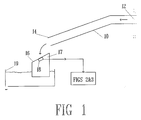
- a feed pipe 10 has its inlet end 12 fed from a tank or hopper containing the articles to be counted.
- the feed pipe 10 is generally down-sloping such that the articles (not shown) roll, slide, or tumble down to cascade out of the lower outlet end 14 of the feed pipe 10 more or less individually. Generally, one article at a time will leave the outlet 14, but sometimes two, or even three articles will come out together.
- a sloping plate 16 forms the top plate of a closed box 17 which floats in a receiving tank 19.
- the box 17 is arranged to float in the tank 19 a short distance below and just beyond the feed pipe outlet 14.
- a sensor 18 in the form of a microphone is fastened to the underside of the sloping top plate 16 to respond to the impact of articles falling onto the plate 16 from the outlet 14.
- the output of the sensor 18 is a transient oscillatory electric signal whose peak amplitude is proportional to the magnitude of the impact caused by the falling article or articles, and hence to the mass of the article or articles since they fall through a nominally constant height.
- the slope of the plate 16 causes the articles to fall off the plate 16 without delay, leaving the plate 16 unobstructed to impact by subsequently falling articles.
- the sensor 18 may alternatively be fastened to the bottom of the box 17 or may be otherwise positioned within the box 17 to maximise detection of the impact.
- the sloping plate 16 may be a free plate, not forming part of any other structure and non rigidly mounted a short distance below and just beyond the feed pipe outlet 14.
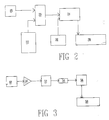
- the electrical output signal from the sensor 18 is fed to the circuit arrangements of Fig. 2 or Fig. 3 which will now be described in detail.
- the electrical output signal from the sensor 18 is fed into a level detector circuit 20.
- the circuit 20 detects which one of several contiguous magnitude ranges the peak sensor signal falls into, and produces a characteristic output signal accordingly. These magnitude ranges are predetermined by a calibration and level control circuit 22 connected to the level detector circuit 20. Controls forming part of the circuit 22 provide switchable settings for overall input from the sensor 18, and adjustable settings to increase or decrease the levels defining the magnitude ranges over which the detector circuit 20 operates.
- the resultant characteristic output signals from the level detector circuit 20 operate a counter actuator circuit 24 to produce a requisite number of counter actuation signals ultimately dependent on the number of articles sensed by the sensor 18 in conjunction with the level detector circuit 20.
- Control inputs 26 connected to the counter actuator circuit 24 include an on/off control, a re-set control, a count inhibit control, a count start/stop control, a print control for printing unit (not shown), a battery back-up monitor, and an on/off control for a totalisator.
- the output from the counter actuation circuit 24 operates a conventional up/down event counter 28.
- Each single counter actuation signal from the circuit 24 increments the count in the counter 28 by one.
- the detection of two or more articles simultaneously hitting the plate 16 will result in a corresponding number of suitably spaced counter actuation signals from the circuit 24 to increment the counter 28 by the requisite number.
- the counter 28 can be employed to count down (ie to increment negatively) from a pre-set total such that the reaching of zero indicates completion of delivery of a batch of pre-selected size.
- controls 26 and the counter 28 being in the form of hardware, they could be replaced by a suitable microprocessor-based system for sophisticated monitoring and control.
- the controls 26 would then be functionally replaced by a keyboard, while the article count would be displayed on an VDU along with other system parameters.
- the electrical output signal from the sensor 18 is passed to an amplifier 50 and then passed to a level detector means in the form of a Schmitt trigger 52 which produces an output pulse when the output voltage received from the amplifier 50 is above a certain threshold.
- the output pulse from the Schmitt trigger 52 is passed to a controllable monostable multivibrator 54.
- the output pulse from the the multivibrator 54 is controllable to give an optimum pulse length.
- the length of the pulse is determined by the size of the fish or article being counted. In practice, the length of the pulse must be sufficiently long to obviate double counting, but must be short enough to minimise the dead time of the instrument.
- the dead time is the duration of the pulse length since during this time no further pulses may be counted.
- the output pulses from the multivibrator 54 are passed to a counter 58 through the counter firing circuit 56.
- FIG. 4 this schematically illustrates system for grading and counting cultured fish.
- a conveyor belt system 30 is fed at its leading end 32 with artificially cultured live fish which are of a single species but have grown to a range of sizes.
- a known arrangement grades the fish into several narrow ranges of size as they pass along the conveyor system 30.
- Fish in predetermined size ranges are discharged from the conveyor system 30 at various points 34A, 34B, 34C, 34D, etc, each particular discharge point being for one of the size ranges.
- Beneath each discharge point 34A, etc, is a respective non-rigidly mounted sloping plate or box 36A, 36B, 36C, 36D, etc.
- Each of these plates has a respective impact sensor 38A, 38B, 38C, 38D, etc, attached thereto or within the box.
- the Fig. 4 system so far described is therefore functionally equivalent to Fig. 1 system replicated as many times as there are fish size ranges.
- Each of the sensors 38A, etc in Fig. 4 is connected to a respective counting circuit arrangement as shown in Fig. 2 or Fig. 3, or more preferably to a modification thereof in which the multiple counting circuits function under the control of a single supervisory microprocessor control system.
- the system of Fig. 4 can be employed, for example, to audit the products of a fish breeding tank when the tank is emptied after initial breeding and prior to sale or continued cultivation of the fish.
- Analogous uses of the article counting systems of the invention may be made in any context involving articles (whether animate or inanimate) which are capable of being manipulated (whether by being dropped or otherwise) to impact upon a sensor (or a surface to which a sensor is attached) to produce a characteristic signal.
Landscapes
- Physics & Mathematics (AREA)
- General Physics & Mathematics (AREA)
- Engineering & Computer Science (AREA)
- Theoretical Computer Science (AREA)
- Sorting Of Articles (AREA)
- Other Investigation Or Analysis Of Materials By Electrical Means (AREA)
- Control Of Conveyors (AREA)
Applications Claiming Priority (2)
| Application Number | Priority Date | Filing Date | Title |
|---|---|---|---|
| GB898903066A GB8903066D0 (en) | 1989-02-10 | 1989-02-10 | Article counting system |
| GB8903066 | 1989-02-10 |
Publications (2)
| Publication Number | Publication Date |
|---|---|
| EP0388002A2 true EP0388002A2 (de) | 1990-09-19 |
| EP0388002A3 EP0388002A3 (de) | 1992-09-30 |
Family
ID=10651504
Family Applications (1)
| Application Number | Title | Priority Date | Filing Date |
|---|---|---|---|
| EP19900301388 Withdrawn EP0388002A3 (de) | 1989-02-10 | 1990-02-09 | Systeme zum Zählen von Gegenständen |
Country Status (6)
| Country | Link |
|---|---|
| EP (1) | EP0388002A3 (de) |
| CA (1) | CA2009647A1 (de) |
| FI (1) | FI900664A7 (de) |
| GB (1) | GB8903066D0 (de) |
| IS (1) | IS3544A7 (de) |
| NO (1) | NO900649L (de) |
Cited By (2)
| Publication number | Priority date | Publication date | Assignee | Title |
|---|---|---|---|---|
| ES2081774A1 (es) * | 1994-08-23 | 1996-03-01 | Cultivos Marinos Del Sur S A | Maquina para contar peces de pequeño tamaño. |
| CN113902085A (zh) * | 2021-09-16 | 2022-01-07 | 国网浙江省电力有限公司湖州供电公司 | 一种无人值守仓库物资出入库清点装置及方法 |
Families Citing this family (1)
| Publication number | Priority date | Publication date | Assignee | Title |
|---|---|---|---|---|
| CA2057833C (en) * | 1991-12-17 | 1997-11-11 | John H. C. Pippy | Apparatus for monitoring moving aquatic organisms |
Family Cites Families (4)
| Publication number | Priority date | Publication date | Assignee | Title |
|---|---|---|---|---|
| GB876885A (en) * | 1958-06-24 | 1961-09-06 | Ass Elect Ind | Improvements relating to counting apparatus |
| US3552053A (en) * | 1969-02-24 | 1971-01-05 | Gen Time Corp | Means for counting shots fired from a gun |
| FR2339916A2 (fr) * | 1976-01-29 | 1977-08-26 | Marcel Richard | Dispositif de triage et de comptage |
| DE3711538A1 (de) * | 1987-04-08 | 1988-10-27 | Norbert Kraemer | Verfahren zum elektrischen zaehlen von gegenstaenden und vorrichtung hierzu |
-
1989
- 1989-02-10 GB GB898903066A patent/GB8903066D0/en active Pending
-
1990
- 1990-02-08 IS IS3544A patent/IS3544A7/is unknown
- 1990-02-08 CA CA002009647A patent/CA2009647A1/en not_active Abandoned
- 1990-02-09 FI FI900664A patent/FI900664A7/fi not_active IP Right Cessation
- 1990-02-09 NO NO90900649A patent/NO900649L/no unknown
- 1990-02-09 EP EP19900301388 patent/EP0388002A3/de not_active Withdrawn
Cited By (3)
| Publication number | Priority date | Publication date | Assignee | Title |
|---|---|---|---|---|
| ES2081774A1 (es) * | 1994-08-23 | 1996-03-01 | Cultivos Marinos Del Sur S A | Maquina para contar peces de pequeño tamaño. |
| CN113902085A (zh) * | 2021-09-16 | 2022-01-07 | 国网浙江省电力有限公司湖州供电公司 | 一种无人值守仓库物资出入库清点装置及方法 |
| CN113902085B (zh) * | 2021-09-16 | 2023-10-10 | 国网浙江省电力有限公司湖州供电公司 | 一种无人值守仓库物资出入库清点装置及方法 |
Also Published As
| Publication number | Publication date |
|---|---|
| GB8903066D0 (en) | 1989-03-30 |
| FI900664A0 (fi) | 1990-02-09 |
| NO900649L (no) | 1990-08-13 |
| CA2009647A1 (en) | 1990-08-10 |
| NO900649D0 (no) | 1990-02-09 |
| EP0388002A3 (de) | 1992-09-30 |
| IS3544A7 (is) | 1990-08-11 |
| FI900664A7 (fi) | 1990-08-11 |
Similar Documents
| Publication | Publication Date | Title |
|---|---|---|
| US5602485A (en) | Apparatus for screening capsules using velocity measurements | |
| US4223751A (en) | High speed capacitance apparatus for classifying pharmaceutical capsules | |
| US8417375B2 (en) | Counting machine for discrete items | |
| JP6207831B2 (ja) | 品目を分配するための方法および装置 | |
| US3618819A (en) | Electronic counting apparatus | |
| US4120403A (en) | Photoelectric apparatus for sorting variegated articles according to size | |
| US6799684B2 (en) | Multi-head portioning system | |
| DE102008027624A1 (de) | Verfahren und Vorrichtung zum Kontrollieren und Sortieren von Kleinteilen | |
| CN107683183A (zh) | 具有轨迹跟踪传感器网络的新型智能分级机及其方法 | |
| US20210381878A1 (en) | Combination weighing device | |
| US4625872A (en) | Method and apparatus for particle sorting by vibration analysis | |
| KR102454626B1 (ko) | 견과 선별장치 | |
| US3744299A (en) | Crack detector | |
| EP1536895B1 (de) | Qualitätsbewertung von schüttgut | |
| EP0388002A2 (de) | Systeme zum Zählen von Gegenständen | |
| US6408223B1 (en) | Weighing system of the dynamic type | |
| EP0396290A2 (de) | Verfahren und Gerät zum Sortieren von diskretem Material und hergestellte Produkte | |
| WO2019175678A1 (en) | Statically weighed grading apparatus and method | |
| WO2008004895A1 (en) | Sorting by softness: method and apparatus | |
| US3701418A (en) | Grading machine | |
| CN112871729A (zh) | 铜螺丝不良品筛选装置 | |
| US6563901B2 (en) | Multi-head counting system with size discrimination | |
| JP5723196B2 (ja) | 組合せ秤 | |
| JP7342747B2 (ja) | ノズルメンテナンス装置および色彩選別機のノズルメンテナンス方法 | |
| CN214015547U (zh) | 一种基于多通道的对虾分选装置 |
Legal Events
| Date | Code | Title | Description |
|---|---|---|---|
| PUAI | Public reference made under article 153(3) epc to a published international application that has entered the european phase |
Free format text: ORIGINAL CODE: 0009012 |
|
| AK | Designated contracting states |
Kind code of ref document: A2 Designated state(s): AT BE CH DE DK ES FR GB GR IT LI NL SE |
|
| PUAL | Search report despatched |
Free format text: ORIGINAL CODE: 0009013 |
|
| AK | Designated contracting states |
Kind code of ref document: A3 Designated state(s): AT BE CH DE DK ES FR GB GR IT LI NL SE |
|
| 17P | Request for examination filed |
Effective date: 19930326 |
|
| 17Q | First examination report despatched |
Effective date: 19931122 |
|
| STAA | Information on the status of an ep patent application or granted ep patent |
Free format text: STATUS: THE APPLICATION IS DEEMED TO BE WITHDRAWN |
|
| 18D | Application deemed to be withdrawn |
Effective date: 19950901 |