EP0388071A1 - Vorrichtung und Verfahren zum Reinigen von Eiern - Google Patents
Vorrichtung und Verfahren zum Reinigen von Eiern Download PDFInfo
- Publication number
- EP0388071A1 EP0388071A1 EP90302427A EP90302427A EP0388071A1 EP 0388071 A1 EP0388071 A1 EP 0388071A1 EP 90302427 A EP90302427 A EP 90302427A EP 90302427 A EP90302427 A EP 90302427A EP 0388071 A1 EP0388071 A1 EP 0388071A1
- Authority
- EP
- European Patent Office
- Prior art keywords
- cleaning
- solution
- water
- egg
- station
- Prior art date
- Legal status (The legal status is an assumption and is not a legal conclusion. Google has not performed a legal analysis and makes no representation as to the accuracy of the status listed.)
- Withdrawn
Links
- 238000004140 cleaning Methods 0.000 title claims abstract description 67
- 238000000034 method Methods 0.000 title claims description 10
- XLYOFNOQVPJJNP-UHFFFAOYSA-N water Substances O XLYOFNOQVPJJNP-UHFFFAOYSA-N 0.000 claims abstract description 48
- 235000013601 eggs Nutrition 0.000 claims abstract description 37
- 239000012459 cleaning agent Substances 0.000 claims abstract description 22
- 238000009472 formulation Methods 0.000 claims abstract description 13
- 239000000203 mixture Substances 0.000 claims abstract description 13
- 238000012544 monitoring process Methods 0.000 claims description 13
- 238000010438 heat treatment Methods 0.000 claims description 6
- 230000001419 dependent effect Effects 0.000 claims description 2
- 241000894006 Bacteria Species 0.000 description 5
- 239000003599 detergent Substances 0.000 description 4
- 230000001105 regulatory effect Effects 0.000 description 4
- 230000000844 anti-bacterial effect Effects 0.000 description 3
- 238000010586 diagram Methods 0.000 description 3
- 239000007921 spray Substances 0.000 description 3
- 238000004458 analytical method Methods 0.000 description 2
- 239000003899 bactericide agent Substances 0.000 description 2
- 238000011109 contamination Methods 0.000 description 2
- 230000004044 response Effects 0.000 description 2
- 239000002699 waste material Substances 0.000 description 2
- ZAMOUSCENKQFHK-UHFFFAOYSA-N Chlorine atom Chemical compound [Cl] ZAMOUSCENKQFHK-UHFFFAOYSA-N 0.000 description 1
- 229910052801 chlorine Inorganic materials 0.000 description 1
- 239000000460 chlorine Substances 0.000 description 1
- 230000001276 controlling effect Effects 0.000 description 1
- 238000001704 evaporation Methods 0.000 description 1
- 230000008020 evaporation Effects 0.000 description 1
- 238000000605 extraction Methods 0.000 description 1
- 239000003517 fume Substances 0.000 description 1
- 238000005259 measurement Methods 0.000 description 1
- 244000005700 microbiome Species 0.000 description 1
- 230000004048 modification Effects 0.000 description 1
- 238000012986 modification Methods 0.000 description 1
- 239000002245 particle Substances 0.000 description 1
- 230000002085 persistent effect Effects 0.000 description 1
- 239000008213 purified water Substances 0.000 description 1
- 239000007787 solid Substances 0.000 description 1
- 238000011144 upstream manufacturing Methods 0.000 description 1
Images
Classifications
-
- A—HUMAN NECESSITIES
- A01—AGRICULTURE; FORESTRY; ANIMAL HUSBANDRY; HUNTING; TRAPPING; FISHING
- A01K—ANIMAL HUSBANDRY; AVICULTURE; APICULTURE; PISCICULTURE; FISHING; REARING OR BREEDING ANIMALS, NOT OTHERWISE PROVIDED FOR; NEW BREEDS OF ANIMALS
- A01K43/00—Testing, sorting or cleaning eggs ; Conveying devices ; Pick-up devices
- A01K43/005—Cleaning, washing of eggs
Definitions
- This invention relates to egg-cleaning apparatus in which eggs travelling on conveyor means are cleaned at a cleaning station by a solution of water and cleaning agent, and to a method of cleaning eggs.
- the idea cleaning the eggs is not only to remove the visible dirt from them, but also to destroy bacteria and other micro-organisms which are always present on the shell, and which, if not destroyed, can multiply and penetrate the shell, resulting in internal contamination of the egg.
- the cleaning agent is a combination of detergent and bactericide, and the solution is sprayed onto the eggs to clean them.
- the used solution is filtered to remove solid particles, and is then re-circulated through the apparatus. If a fresh supply of the solution is not provided at the appropriate time, the solution will be overused, so that it becomes contaminated with bacteria. As a result, the eggs cleaned in an overused solution may actually have more bacteria after cleaning than they had before cleaning. To try to avoid this problem, the solution may be overenriched with the cleaning agent to start with, which can be wasteful.
- a further problem is that the used solutions have high levels of cleaning agent and/or bacteria and so require careful treatment and disposal if pollution is to be avoided.
- egg-cleaning apparatus in which eggs travelling on conveyor means are cleaned at a cleaning station by a solution of water and cleaning agent, includes a treatment station for treating used solution to recover the water, and all the solution passing from the cleaning station is supplied to the treatment station, with the recovered water only being re-circulated in the apparatus.
- the solution can also have the appropriate formulation for efficient cleaning of the eggs, so that waste is avoided. Further, the used solution is easier to treat, as the levels of cleaning agent and bacteria will not be excessive, so disposal is easier.
- the formulation of the solution, the flow rate through the cleaning station and the speed of the conveyor means may all be varied, in accordance with the number and condition of the eggs to be cleaned, in order to provide efficient cleaning. Any or all of these variables may be controlled by an operator, or automatically.
- the apparatus includes means for analysing the number and condition of the eggs coming into the apparatus on the conveyor means, and for calculating the appropriate formulation for the solution, the flow rate and the conveyor speed.
- the apparatus includes a water reservoir, means for heating the water and means for adding the cleaning agent and supply pipe means for supplying the solution to outlets in the cleaning station.
- the outlets may comprise spray or knife cleaning nozzles, as appropriate.
- Heaters are provided in the supply pipe means to ensure that the correct temperature is attained.
- the means for adding the cleaning agent may comprise dosage pumps in the supply pipe means, to add a predetermined amount of cleaning agent to the water.
- the cleaning agent preferably includes detergents and bactericides.
- the flow rate of the solution through the cleaning station is controlled by pressure pumps provided in the supply pipe means, and by regulator valve means downstream of the nozzles.
- the dosage pumps, pressure pumps and valve means are set in accordance with the values obtained from the analysing means and calculating means.
- the used solution is collected and pumped to the treatment means, from where the recovered water is returned to the reservoir at an output rate dependent on the flow rate of the solution.
- the apparatus may also include monitoring means for monitoring the conveyor speed, the formulation and temperature of the solution, and the flow and output rates. Signals from the monitoring means may be used as feedback controls to ensure that these variables remain at the correct values. This enables the apparatus to operate wholly automatically.
- the calculating means comprises a microprocessor, responsive to signals from the analysing and monitoring means, and able to control the variables in accordance with the conditions and the feedback signals.
- a method of cleaning eggs travelling on conveyor means comprises the steps of making a cleaning solution of water and cleaning agent, cleaning the eggs with the solution, collecting the used solution, treating the used solution to recover the water, and re-circulating the recovered water into the cleaning solution.
- the method has the advantage of providing efficient cleaning of the eggs as well as re-using the water, and making disposal of the waste part of the used solution easier.
- the step of making the cleaning solution preferably includes taking water from a reservoir, heating it and adding the cleaning agent, while the step of cleaning the eggs includes supplying the solution to outlets of a cleaning station.
- the step of re-circulating the recovered water comprises returning it to the reservoir.
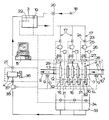
- eggs travelling on conveyor means 1 are cleaned at a cleaning station 2 by a solution of cleaning agent in water from a reservoir 3, the water being recovered from the used solution at a treatment station 4 and returned to the reservoir 3 for re-circulation through the apparatus.
- a microprocessor 5 is provided to set and control the speed of the conveyor means 1, the formulation of the solution and the flow rates to and from the reservoir 3, in accordance with the number of eggs to be cleaned and their condition, and feedback signals from monitoring means which monitor the various parts of the apparatus.
- the dotted lines in the diagram show the control and/or monitoring connections between the various parts and the microprocessor 5.
- the conveyor means 1 comprises an input conveyor belt 6 onto which eggs taken from laying batteries or nesting-boxes are marshalled.
- the eggs are transferred to a cleaning conveyor belt 7 which takes them through the cleaning station 2, and they are then transferred to an output conveyor belt 8 to be taken to a further stage in the process. This avoids any contamination of the output belt 8.
- Each belt is driven by a variable speed electric motor (not shown) which is controlled by the microprocessor.
- the speed of each conveyor belt is monitored by a tachometer 9, which measures the actual speed of the belt, and an encoder 10 which measures its position.
- Each tachometer 9 and encoder 10 sends feedback signals to the microprocessor 5.
- the input conveyor belt 6 also has an input analyser 11, which scans the belt to analyse the number and condition of the eggs travelling towards the cleaning station 2. This information is fed to the microprocessor 5, which uses it to control the apparatus. A similar output analyser 12 is provided on the output conveyor belt 8.
- the cleaning station 2 is divided into three chambers, in each of which the solution is sprayed onto the eggs through outlet nozzles 13.
- the solution is different for each chamber.
- the first chamber 14 provides an axial and tangential spray to soak the eggs, softening adhered debris.
- the second chamber 15 has three sets of nozzles 13, which spray a detergent solution. The first set cleans by a swirl pattern, the second set comprises knife nozzles which cleave away persistent debris, and the third set again cleans by a swirl pattern.
- the eggs are sprayed with a bactericidal solution.
- the nozzles 13 for each chamber are supplied from the reservoir 3 through their own supply pipe means 17.
- the reservoir 3 itself is fed from a mains water supply 18 and from the treatment station 4, through solenoid-operated valves (not shown) controlled by a water level detector 19.
- the pressure and flow of the mains supply 18 is monitored by a transducer 20, and that of the output from the treatment station 4 by a transducer 21.
- the reservoir 3 also includes a pH analyser 22 to measure the acidity or alkalinity of the water, enabling the microprocessor to control the formulation of the solutions, in particular the detergent solutions, accordingly.
- the water from the reservoir 3 is supplied to the supply pipe means 17.
- Each has a pressure regulator 23, which can be controlled by the microprocessor 5 to supply the required amount of water to each supply pipe means 17, and includes a pressure/flow measuring transducer 24 which provides monitoring signals to the microprocessor 5.
- the water passes from the pressure regulator 23 to a pressure pump 25, which again is controlled by the microprocessor 5.
- a dosage pump 26 then meters the appropriate amount of cleaning agent into the water, again under the control of the microprocessor 5.
- the water then passes through a heater 27, the output of which is set by the microprocessor.
- the solution passes through a formulation analyser 28, which takes conductivity and/or resistivity measurements to monitor the solution and provide feedback signals to the microprocessor 5, and over a thermal transducer 29 which measures the temperature and provides a feedback signal to the heater 27 itself.
- a regulating valve 30, controlled by the microprocessor 5 is located downstream of the nozzles 13 and regulates the flow through them by controlling the amount of solution that flows out through a downstream outlet 31.
- a pressure/flow transducer 32 is included to monitor the flow. This arrangement is known as metering-out, and has the advantage that it provides a substantially constant pressure upstream of the nozzles 13, and a substantially constant flow rate through the supply pipe means 17.
- the cleaning station 2 also includes fume extraction equipment (not shown), to cope with the chlorine vapours which will usually be generated in the cleaning process.
- Solution passing through the nozzles 13 and outlets 31 is collected in a tank 33, which includes water level detectors 34. It is then pumped, by a pump 35 controlled by the microprocessor 5, to the treatment station 4 where the water is recovered.
- the effluent is placed in an effluent tank 36 for disposal.
- the input flow and pressure to the treatment station 4 are monitored by a transducer 37. The rates of flow into and out of the treatment station 4 are controlled in dependence on the flow rate through the cleaning station 2.
- the microprocessor 5 holds in its memory the optimum conveyor speeds, solution formulations and temperatures, and solution flow rates for cleaning a given number of eggs in a given condition.
- the input analyser 11 analyses the incoming eggs, and from this information the microprocessor 5 chooses the correct rates, and sets the appropriate conveyor speeds, formulations, temperatures and flow rates by setting the electric motors, pressure regulators 23, pumps 25 and 26, heaters 27 and regulating valves 30.
- the treatment station flow rates are also set in accordance with the total flow rate through the cleaning station 2.
- the apparatus is then started, so that the water from the reservoir 3 is pressurised, the cleaning agents are added, and the solution is then heated and sprayed onto the eggs to clean them.
- Used solution is supplied to the treatment station 4, with purified water returning to the reservoir 3 for recirculation. Any shortfall in the returning water, due to spillage, evaporation and the like is made up by water from the mains supply 18.
- the correct rates chosen by the microprocessor 5 are maintained by it in accordance with the monitoring signals from the monitoring means to provide feedback control.
- the signals from the formulation analysers 28 are used to control the dosage pumps 26, and these may also be controlled by any flow or pressure variations detected by the transducers 24.
- the flow rate to the nozzles 13 is controlled by regulating valves 30 in response to signals from the regulating transducers 31.
- the temperature of the solutions is controlled by the heaters 27, using feedback from the thermal transducers 29.
- the conveyor speeds are controlled by the electric motors in response to the encoder and tachometer signals. Further feedbacks operate as necessary to keep the apparatus in balance. However, if a situation arises where the apparatus is unable to compensate, the microprocessor 5 will shut down altogether.
- the microprocessor 5 is also able to control the apparatus to adapt to changes in the number or condition of the incoming eggs, by changing the rates which were set initially. Thus, if fewer eggs arrive the conveyor belts may be speeded up, or if an empty section is detected by the input analyser 11 the cleaning process may be stopped until more eggs arrive. If the incoming eggs are themselves dirtier, or cleaner, the solutions and flow rates may be altered accordingly.
- the microprocessor 5 can also of course provide information on the process to the operator.
- the apparatus is therefore efficient, as it produces clean eggs, using a minimum amount of cleaning agent and water, but enabling easy disposal of the effluent, which will never be heavily contaminated. It is particularly efficient because it operates automatically. If required some or even all of its operations could be performed manually, although the efficiency would then suffer.
- the reservoir 3 may include a heater, an agitator and a thermostat. These are used on initial operation of the apparatus to pre-heat the water, so that the heaters 27 then need to provide only a small amount of heat to maintain the temperature of the solution.
Landscapes
- Life Sciences & Earth Sciences (AREA)
- Environmental Sciences (AREA)
- Animal Husbandry (AREA)
- Biodiversity & Conservation Biology (AREA)
- Cleaning By Liquid Or Steam (AREA)
Applications Claiming Priority (2)
| Application Number | Priority Date | Filing Date | Title |
|---|---|---|---|
| GB898905616A GB8905616D0 (en) | 1989-03-11 | 1989-03-11 | Egg-cleaning apparatus |
| GB8905616 | 1989-03-11 |
Publications (1)
| Publication Number | Publication Date |
|---|---|
| EP0388071A1 true EP0388071A1 (de) | 1990-09-19 |
Family
ID=10653162
Family Applications (1)
| Application Number | Title | Priority Date | Filing Date |
|---|---|---|---|
| EP90302427A Withdrawn EP0388071A1 (de) | 1989-03-11 | 1990-03-07 | Vorrichtung und Verfahren zum Reinigen von Eiern |
Country Status (2)
| Country | Link |
|---|---|
| EP (1) | EP0388071A1 (de) |
| GB (1) | GB8905616D0 (de) |
Cited By (5)
| Publication number | Priority date | Publication date | Assignee | Title |
|---|---|---|---|---|
| US6883528B2 (en) | 2002-07-23 | 2005-04-26 | Jeffrey B. Kuhl | Apparatus for cleaning eggs by conveying thereof upon multiple conveyors through washers which are vertically tiered |
| US8616156B2 (en) * | 2006-01-31 | 2013-12-31 | Robert L. Krouse | Water treatment system for egg processing facility |
| CN103931520A (zh) * | 2013-01-22 | 2014-07-23 | 惠州市鹏昌农业科技有限公司 | 自动禽蛋清洗机及其禽蛋清洗方法 |
| KR101995412B1 (ko) * | 2019-02-19 | 2019-07-02 | 김수진 | 계란 세척 장치 |
| US20200329679A1 (en) * | 2019-04-19 | 2020-10-22 | Moba Group B.V. | Filtration system for use with an egg washer operation for extending both efficiency and life cycle of a volume of wash water including clean-in-place cleaning of the washer and water disposal/refill options |
Citations (6)
| Publication number | Priority date | Publication date | Assignee | Title |
|---|---|---|---|---|
| US3360817A (en) * | 1966-01-20 | 1968-01-02 | James E. Halverson | Egg cleaning machine |
| GB1126312A (en) * | 1966-03-21 | 1968-09-05 | John Clyde Cathcart | Egg cleaning apparatus |
| DE2044860A1 (de) * | 1969-09-12 | 1971-03-18 | Henningsen Foods | Einrichtung und Verfahren zum Waschen von Eiern |
| US3882769A (en) * | 1971-12-07 | 1975-05-13 | John R Weber | Egg handling system |
| US4125914A (en) * | 1977-05-25 | 1978-11-21 | Warren William H | Egg washing machine |
| US4724854A (en) * | 1986-04-07 | 1988-02-16 | Kuhl Henry Y | Apparatus for pre-washing and accumulating eggs |
-
1989
- 1989-03-11 GB GB898905616A patent/GB8905616D0/en active Pending
-
1990
- 1990-03-07 EP EP90302427A patent/EP0388071A1/de not_active Withdrawn
Patent Citations (6)
| Publication number | Priority date | Publication date | Assignee | Title |
|---|---|---|---|---|
| US3360817A (en) * | 1966-01-20 | 1968-01-02 | James E. Halverson | Egg cleaning machine |
| GB1126312A (en) * | 1966-03-21 | 1968-09-05 | John Clyde Cathcart | Egg cleaning apparatus |
| DE2044860A1 (de) * | 1969-09-12 | 1971-03-18 | Henningsen Foods | Einrichtung und Verfahren zum Waschen von Eiern |
| US3882769A (en) * | 1971-12-07 | 1975-05-13 | John R Weber | Egg handling system |
| US4125914A (en) * | 1977-05-25 | 1978-11-21 | Warren William H | Egg washing machine |
| US4724854A (en) * | 1986-04-07 | 1988-02-16 | Kuhl Henry Y | Apparatus for pre-washing and accumulating eggs |
Cited By (8)
| Publication number | Priority date | Publication date | Assignee | Title |
|---|---|---|---|---|
| US6883528B2 (en) | 2002-07-23 | 2005-04-26 | Jeffrey B. Kuhl | Apparatus for cleaning eggs by conveying thereof upon multiple conveyors through washers which are vertically tiered |
| US8616156B2 (en) * | 2006-01-31 | 2013-12-31 | Robert L. Krouse | Water treatment system for egg processing facility |
| US20140083457A1 (en) * | 2006-01-31 | 2014-03-27 | Robert L. Krouse | Water treatment system for egg processing facility |
| US10492474B2 (en) | 2006-01-31 | 2019-12-03 | Midwest Poultry Services, L.P. | Water treatment system for egg processing facility |
| CN103931520A (zh) * | 2013-01-22 | 2014-07-23 | 惠州市鹏昌农业科技有限公司 | 自动禽蛋清洗机及其禽蛋清洗方法 |
| CN103931520B (zh) * | 2013-01-22 | 2015-12-02 | 惠州市鹏昌农业科技有限公司 | 自动禽蛋清洗机 |
| KR101995412B1 (ko) * | 2019-02-19 | 2019-07-02 | 김수진 | 계란 세척 장치 |
| US20200329679A1 (en) * | 2019-04-19 | 2020-10-22 | Moba Group B.V. | Filtration system for use with an egg washer operation for extending both efficiency and life cycle of a volume of wash water including clean-in-place cleaning of the washer and water disposal/refill options |
Also Published As
| Publication number | Publication date |
|---|---|
| GB8905616D0 (en) | 1989-04-26 |
Similar Documents
| Publication | Publication Date | Title |
|---|---|---|
| CA2214139C (en) | Self-optimizing detergent controller | |
| DE19961835C2 (de) | Verfahren sowie Vorrichtung zum automatischen Gargerätereinigen | |
| US4546511A (en) | Continuous flow laundry system and method | |
| EP0222264A2 (de) | Waschmaschine | |
| GB2364629A (en) | A device for cleaning a cooking appliance interior | |
| EP0388071A1 (de) | Vorrichtung und Verfahren zum Reinigen von Eiern | |
| US5326308A (en) | Vertical scalding apparatus | |
| GB2235782A (en) | Streaming current detector and fluid treatment system using same | |
| US4731908A (en) | Apparatus for the scalding of carcasses | |
| EP3152511B1 (de) | Vorrichtung zur rückgewinnung von wärme aus einem flüssigkeitsstrom aus einer industrieanlage | |
| US6257254B1 (en) | Cleaning system for a washer | |
| CN104661576A (zh) | 具有除垢/除钙系统的器皿洗涤机以及方法 | |
| NL1032823C2 (nl) | Werkwijze en inrichting voor het bevochtigen van lucht met waterdamp, | |
| CN119259613A (zh) | 一种桶装水空桶预清洗消毒工艺 | |
| US5913984A (en) | Arrangement designed to be a part of an equipment for cleaning different objects in a food processing plant | |
| WO2002082893A1 (en) | Aquaculture system | |
| US5531905A (en) | System and method to control laundry waste water treatment | |
| CN219174349U (zh) | 锅炉组件及烹饪设备 | |
| KR20190080831A (ko) | 분리막 세정회복율 제어장치 | |
| CN210036418U (zh) | 一种具有免拆洗功能的在线自清洗换热装置 | |
| EP0530081A1 (de) | Luftbehandlungsverfahren in einer Lüftungs- oder Klima-Anlage und Mittel zur Durchführung des Verfahrens | |
| EP4344600B1 (de) | Transportspülmaschine sowie verfahren zum betreiben einer transportspülmaschine | |
| JP3516476B2 (ja) | 洗浄装置 | |
| WO2022113141A1 (en) | Machine and method for the treatment of objects, in particular washing and sanitising | |
| WO2020222163A1 (en) | Multistation apparatus for cleaning inner and outside surfaces of cylinder halves |
Legal Events
| Date | Code | Title | Description |
|---|---|---|---|
| PUAI | Public reference made under article 153(3) epc to a published international application that has entered the european phase |
Free format text: ORIGINAL CODE: 0009012 |
|
| AK | Designated contracting states |
Kind code of ref document: A1 Designated state(s): BE DE DK ES FR GB GR IT NL SE |
|
| 17P | Request for examination filed |
Effective date: 19910319 |
|
| STAA | Information on the status of an ep patent application or granted ep patent |
Free format text: STATUS: THE APPLICATION HAS BEEN WITHDRAWN |
|
| 18W | Application withdrawn |
Withdrawal date: 19910607 |
|
| R18W | Application withdrawn (corrected) |
Effective date: 19910603 |