EP0388760B1 - Laserdiode und optischer Kopf mit mehreren Strahlen, welcher die Laserdiode verwendet - Google Patents
Laserdiode und optischer Kopf mit mehreren Strahlen, welcher die Laserdiode verwendet Download PDFInfo
- Publication number
- EP0388760B1 EP0388760B1 EP90104710A EP90104710A EP0388760B1 EP 0388760 B1 EP0388760 B1 EP 0388760B1 EP 90104710 A EP90104710 A EP 90104710A EP 90104710 A EP90104710 A EP 90104710A EP 0388760 B1 EP0388760 B1 EP 0388760B1
- Authority
- EP
- European Patent Office
- Prior art keywords
- optical
- information system
- laser diode
- optical information
- laser beams
- Prior art date
- Legal status (The legal status is an assumption and is not a legal conclusion. Google has not performed a legal analysis and makes no representation as to the accuracy of the status listed.)
- Expired - Lifetime
Links
- 230000003287 optical effect Effects 0.000 title claims description 129
- 230000003321 amplification Effects 0.000 claims description 2
- 238000003199 nucleic acid amplification method Methods 0.000 claims description 2
- 230000015572 biosynthetic process Effects 0.000 description 9
- 229910001218 Gallium arsenide Inorganic materials 0.000 description 8
- 238000010276 construction Methods 0.000 description 6
- 238000000034 method Methods 0.000 description 6
- 239000000758 substrate Substances 0.000 description 4
- 238000001514 detection method Methods 0.000 description 3
- 230000001678 irradiating effect Effects 0.000 description 3
- 108091008695 photoreceptors Proteins 0.000 description 3
- 238000010586 diagram Methods 0.000 description 2
- 238000004519 manufacturing process Methods 0.000 description 2
- 238000007493 shaping process Methods 0.000 description 2
- 238000005530 etching Methods 0.000 description 1
- 230000010365 information processing Effects 0.000 description 1
- 230000010355 oscillation Effects 0.000 description 1
- 230000000750 progressive effect Effects 0.000 description 1
Images









Classifications
-
- G—PHYSICS
- G11—INFORMATION STORAGE
- G11B—INFORMATION STORAGE BASED ON RELATIVE MOVEMENT BETWEEN RECORD CARRIER AND TRANSDUCER
- G11B7/00—Recording or reproducing by optical means, e.g. recording using a thermal beam of optical radiation by modifying optical properties or the physical structure, reproducing using an optical beam at lower power by sensing optical properties; Record carriers therefor
- G11B7/12—Heads, e.g. forming of the optical beam spot or modulation of the optical beam
- G11B7/125—Optical beam sources therefor, e.g. laser control circuitry specially adapted for optical storage devices; Modulators, e.g. means for controlling the size or intensity of optical spots or optical traces
- G11B7/127—Lasers; Multiple laser arrays
-
- C—CHEMISTRY; METALLURGY
- C07—ORGANIC CHEMISTRY
- C07K—PEPTIDES
- C07K1/00—General methods for the preparation of peptides, i.e. processes for the organic chemical preparation of peptides or proteins of any length
- C07K1/14—Extraction; Separation; Purification
-
- G—PHYSICS
- G11—INFORMATION STORAGE
- G11B—INFORMATION STORAGE BASED ON RELATIVE MOVEMENT BETWEEN RECORD CARRIER AND TRANSDUCER
- G11B7/00—Recording or reproducing by optical means, e.g. recording using a thermal beam of optical radiation by modifying optical properties or the physical structure, reproducing using an optical beam at lower power by sensing optical properties; Record carriers therefor
- G11B7/12—Heads, e.g. forming of the optical beam spot or modulation of the optical beam
- G11B7/14—Heads, e.g. forming of the optical beam spot or modulation of the optical beam specially adapted to record on, or to reproduce from, more than one track simultaneously
-
- H—ELECTRICITY
- H01—ELECTRIC ELEMENTS
- H01S—DEVICES USING THE PROCESS OF LIGHT AMPLIFICATION BY STIMULATED EMISSION OF RADIATION [LASER] TO AMPLIFY OR GENERATE LIGHT; DEVICES USING STIMULATED EMISSION OF ELECTROMAGNETIC RADIATION IN WAVE RANGES OTHER THAN OPTICAL
- H01S5/00—Semiconductor lasers
- H01S5/40—Arrangement of two or more semiconductor lasers, not provided for in groups H01S5/02 - H01S5/30
- H01S5/4025—Array arrangements, e.g. constituted by discrete laser diodes or laser bar
- H01S5/4031—Edge-emitting structures
Definitions
- the present invention relates to a laser diode and a multibeam optical head using the the laser diode as used in an optical writing and reading system which optically performs writing, reading, erasure, and so forth of information by irradiating the convergent rays from a light source onto optical writing media.
- the optical head is so constructed as to include a laser diode array 100, in which many laser diodes independently controllable for their light emission are arranged linearly and at equal intervals to form a unified structure, a condenser lens 101, which converts the rays output from the laser diode array 100 into parallel collimated rays, an object lens 102, which converges the parallel rays mentioned above into minute spots, a polarizing beam splitter 103, which separates the incident rays and the reflected rays, and a plurality of beam splitting and detecting means 104, which detects signals by splitting the reflected rays from a plurality of beam spots, a photo-detector 105, which detects the position of one track, and a pair of focusing error detecting systems 106.
- a laser diode array 100 in which many laser diodes independently controllable for their light emission are arranged linearly and at equal intervals to form a unified structure
- a plurality of beam spots 112 through 120 arranged in a straight line are set at a slant by a prescribed angle ⁇ in relation to the radial direction A of the optical disk 110, so that the intervals of the plurality of laser diodes arranged in the laser diode array 100 may thereby be set at a value feasible to the actual manufacture of the array.
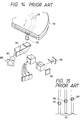
- the multibeam optical head described above is designed to arrange a plurality of beam spots 112 through 120 linearly at equal intervals, as shown Fig. 17. Therefore, if the many beam spots 112 through 120 were arranged in such a way as to be set at a slant at the angle ⁇ in relation to the radial direction A of the optical disk 110, as shown in Fig. 17, it would not be possible to position all of the plurality of beam spots 112 through 120 over the tracks 111 corresponding to these since the tracks 111 of the optical disk 110 are formed in a circular arc having a prescribed radius of curvature, with the result that the beam spots on both ends would be positioned off the tracks 111.
- US-A-4,298,974 describes according to the preamble of claim 1 an optical head, which is suited for use with an optical disk for optically recording information.
- the optical head which is optically coupled to the disk and is movable along a movement axis in the radial direction of the disk, comprises a laser diode array with a plurality of independently drivable lasing means which are nonuniformally spaced for generating a plurality of spaced laser beams.
- the resulting beam spots of the laser beams on the surface of the disk are arranged in a straight line set in a slant in relation to the radial direction of the disk.
- the prior art shows the disadvantage that it is not possible to position the plurality of the generated beam spots over the tracks corresponding to these because the curvature of the tracks is not taken into consideration. Consequently, it would not be possible to have all the beam spots perform the tracking of their respective tracks at the same time and with accuracy. Therefore the reading and writing of information could not be performed on a plurality of tracks at the same time.
- An object of this invention is to provide a laser diode capable of tracking all the laser beams on all the individual tracks and performing the writing or reading of information on a plurality of tracks at the same time and a multibeam optical head using the laser diode, which performs writing or reading or the like at the same time, using a plurality of laser beams.
- the optical information system comprises an optical recording means having a plurality of circular tracks uniformely spaced one from another in a radial direction of said optical recording means for recording information thereon; and a multibeam optical head means optically coupled to said optical recording means and movable along a movement axis in said radial direction, said multibeam optical head means comprising: a laser diode means having a plurality of lasing means nonuniformely spaced one from another for generating a plurality of spaced laser beams, and image forming optical means, coupled to said laser diode means, for directing each of said plurality of laser beams as a beam spot onto a respective one of said plurality of tracks of the optical recording means with a common amplification, so that said beam spots are arranged in a straight line set at a slant in relation to said radial direction, wherein said plurality of lasing means is nonuniformely spaced one from another such that the spacing between adjacent ones of
- one spot is positioned on the axis for the transit of the optical head in the radial direction of the optical writing media while the remaining spots are positioned in equal numbers on both sides of the transit axis, for the formation of images, in case the number of the beam spots is an odd number, for example.
- the images are formed by positioning the beam spots in equal numbers on both sides of the transit axis, for example, in relation to the axis of the transit of the optical head in the radial direction of the optical writing media.
- the manner of image formation with the beam spots mentioned above is not limited to the image forming manners just described, but it is, of course, feasible to have the image formed with one beam spot positioned on the axis of transit for the optical head in the radial direction of the optical writing media and with the other beam spots being positioned on either one side of the axis of transit for the optical head.
- the error detection for tracking servo it is desirable to obtain a basis therefor, for example, from the reflected rays of the spot positioned on the axis for the transit of the optical head in the radial direction of the optical writing media, in case the number of beam spots is an odd number, but from the reflected rays of the spot nearest to the axis for the transit of the optical head in the radial direction of the optical writing media in case the number of the beam spots is an even number.
- a pin hole for example, is used.
- a plurality of light emitting elements are arranged in a straight line with their intervals varied, and it is therefore possible to irradiate all the laser beams emitted from a plurality of light emitting elements on the tracks of all the optical writing media by arranging a plurality of light emitting elements with a variation by the prescribed amount, depending on the curvature of the tracks, even in case it is designed to irradiate the laser beams emitted from a plurality of light emitting elements over the tracks at the same time.
- the multibeam optical head according to this invention is constructed in such a way as to be provided with a laser diode wherein a plurality of independently drivable light emitting elements are arranged at varying intervals in a straight line and with an image forming optical system which forms images by directing a plurality of beams from the laser diode mentioned above to the optical writing media in such a way as to arrange a plurality of beam spots linearly at a prescribed angle to the radial direction of the optical writing media and to vary the intervals therebetween, and the multibeam optical head is therefore capable of forming the images by focusing all of the plurality of laser beams emitted from the laser diode on the tracks on the optical writing media at the same time even in case all of the plurality of laser beams are irradiated at the same time to form the images arranged linearly at a prescribed angle to the radial direction of the optical writing media.
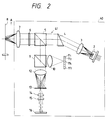
- Fig. 2 and Fig. 3 illustrate an optical writing and reading system to which a laser diode and a multibeam optical head both according to the present invention are applied.
- This optical writing and reading system 1 is comprised of a laser diode 2, which is composed of a plurality of independently drivable light emitting elements arranged in a straight line, a collimator lens 3, which converts into parallel rays a plurality of the laser beams LB1 through LB7 (seven pieces in the Figures) having an elliptical sectional shape as emitted from the laser diode 2, a beam shaping prism 4, which conditions into circular sectional shape the laser beams LB1 through LB7 as thus converted into parallel rays by the collimator lens 3, a polarizing beam splitter 5, which separates these shaped laser beams LB1 through LB7 between the rays irradiated to an optical disk 8 to be mentioned later and the rays reflected from the optical disk 8, a one-quarter wavelength plate 6, which converts the linear deflected rays and the circular deflected rays reciprocally from one into the other, an object lens 7, which converges and irradiates the
- the optical disk 8 mentioned above has the tracks 17 and 17 ... for their writing of information with a prescribed radius of curvature and a prescribed pitch p in the form of concentric circles, as shown in Fig. 3.
- a plurality of laser beams LB1 through LB7 which are emitted in an elliptical shape from the laser diode 2 are converted into parallel rays with the collimator lens 3 and thereafter shaped into circular beams by means of the beam shaping prism 4, as shown in Fig. 2.
- these laser beams LB1 through LB7 pass through the polarizing beam splitter 5 and the one-quarter wavelength plate 6, narrowed down with the object lens 7 and irradiated on the tracks 17, and 17 ... on the optical disk 8.
- the rays reflected from the tracks 17 and 17 ... of the optical disk 8 mentioned above are fed back by the same route as what is mentioned above, and the rays are reflected by the polarizing beam splitter 5 and at the same time split by the beam splitter 9 for their transit in two directions.
- the laser beams LB1 through LB7 in one stream are applied by means of the condenser lens 10 onto the seven photo-detector elements 111 through 117 to form images, and the image information recorded in a plurality of tracks 17 and 17 ... is read at the same time by the photo-detector elements 111 through 117.
- the individual photo-detector elements 111 through 117 are connected with differential amplifiers, and image information is obtained as output signals 501 through 507 from the individual differential amplifiers.
- the laser beams LB1 through LB7 forming the other stream as split by the beam splitter 9 mentioned above are condensed with a condenser lens 12, and thereafter only the middle laser beam LB4 passes through the pinhole 13 and is applied to form its image onto the photo-detector element 16 by way of the condenser lens 14 and the cylindrical lens 15.
- a tracking error signal is obtained, and also a focusing error signal is obtained by the astigmatic process.
- the tracking error signal mentioned above is obtained in the manner described below.
- the photo-detector element 16 is composed of mutually adjacent photo-detector elements 16a and 16b and adjacent photo receptor elements 16c and 16d, which are connected respectively with the adding amplifiers 54 and 55, and these adding amplifiers 54 and 55 are connected with the differential amplifier 56, and a tracking error signal is obtained from this differential amplifier 56.
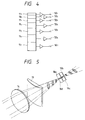
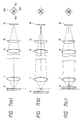
- the astigmatic process mentioned above is constructed so as to obtain a focusing error signal through utilization of the feature that a circular beam is obtained in an approximately midway position in the in-focus state, as shown in Fig. 5, by varying the focus in the x-axis direction and that in the y-axis direction of the laser beam by means of the cylindrical lens 15.
- the quadrant photo receptor element 16 is provided with the photo-detector elements 16a and 16c and the photo-detector elements 16b and 16d positioned on diagonal lines, and these photo receptor elements are connected respectively with the adding amplifiers 51 and 52, which in its turn are connected to the differential amplifier 53, as shown in Fig. 6.
- the laser diode in accordance with the embodiment is constructed with a plurality of light emitting elements mentioned above being arranged in a straight line at varying intervals. That is to say, the laser diode 2 is provided, as shown in Fig. 1, with a plurality of laser diode elements 181 through 187 arranged in one block in a straight line in such a way that the intervals X1 through X6 of the individual laser diode elements increase progressively (i.e. x1 ⁇ X2 ... ⁇ X6).
- the principal part of the laser diode 2 mentioned above, as shown in Fig. 8, is composed of a p-GaAs substrate 19, an n-GaAs layer 20 formed on the substrate 19 and forming a current constricting layer, a p-Ga 1-x Al x As layer 21 formed on the n-GaAs layer 20 and forming a clad layer, a p-Ga 1-y Al y As layer 22 forming an active layer formed on the p-Ga 1-x Al x As layer 21, a p-Ga 1-x Al x As layer 23 forming a clad layer formed on the p-Ga 1-y Al y As layer 22, and an n-GaAs layer 24 forming a gap layer formed on the p-Ga 1-x Al x As layer 23.
- a p-side electrode 25 is formed over the entire area on the back side of the p-GaAs substrate, and, on the other hand, a plurality of n-side electrodes 26 through 32 are formed on the n-GaAs layer 24 mentioned above. Also, on the n-GaAs layer 20, which forms the current constricting layer mentioned above, are provided V-shaped grooves 33 through 39 formed by the mesa-etching process or the like, and laser diode elements 181 through 187 are formed with the individual V-shaped grooves 33 through 39.
- an electric current is injected from the direction indicated by the arrow into the inside region of the current constricting layer, n-GaAs layer 20, which has a polarity reverse to that of the substrate 19, through the V-shaped grooves 33 through 39 by applying a driving voltage independently between the p-side electrode 25 and the n-side electrode 26 through 32 mentioned above.
- laser oscillation takes place in the p- Ga 1-y Al y As layer 22, which is the active layer, and a plurality of laser beams LB1 through LB7 each having an elliptical shape are obtained from the individual laser diode elements 181 through 187.
- These laser beams LB1 through LB7 are emitted at intervals equal to the intervals X1 through X6 of the laser diode elements 181 through 187.
- the multibeam optical head according to this embodiment is provided with a laser diode constructed as described above and an image forming optical system which directs the plural number of beams from the above-mentioned laser diode onto the optical writing media in such a way that a plurality of beam spots are arranged linearly at a prescribed angle in relation to the radial direction of the writing media and also the intervals therebetween vary.
- the multibeam optical head 40 is provided with an image forming optical system 41, which is composed mainly of the component parts of the optical writing and reading system except for the optical disk 8, in addition to the laser diode 2, and this optical head 40, as shown in Fig. 2, is so constructed as to be capable of moving along the line in the radial direction A of the optical disk 8 by the action of the driving means not shown in the Figure.
- a plurality of laser beams LB1 through LB7 emitted from the laser diode 2 mentioned above are converged with the object lens 7 through the collimator lens 3, the anamorphic prism 4, the polarizing beam splitter 5, and the one-quarter wavelength plate 6, as shown in Fig. 2, and directed in the form of a plurality of beam spots BS1 through BS7 onto the optical disk 8 to form images thereon in a straight line with an angle ⁇ in relation to the radial direction A of the optical disk 8, as shown in Fig. 9.
- the plural number of beam spots BS1 through BS7 irradiated in a straight line onto the optical disk 8 mentioned above are, as shown in Fig. 1, are designed to perform their image formation with progressive increases of their intervals (i.e., l1 ⁇ l2 ... ⁇ l6), so that all the beam spots will be positioned on the tracks 17 and 17 ... on the optical disk 8.
- the number of the beam spots BS1 through BS7 is seven, which is an odd number, and, among these beam spots BS1 through BS7, the middle beam spot BS4 is so arranged as to move in the direction agreeing with the direction of movement of the optical head 40, as shown in Fig. 9.
- the intervals of these beam spots LB1 through LB7 are set as mentioned in the following part.
- the middle beam spot BS4 among the beam spots BS1 through BS7 mentioned above, is arranged in such a way as to move along the line in the radial direction A of the optical disk 8 and also to be positioned on the track 17 of the optical disk 8, the beam spots are considered with being divided between inner side beam spots and outer side beam spots with respect to the beam spot BS4.
- the condition for the positioning of the beam spot BS m which is in the m-th position on the inner side of the middle beam spot BS4 mentioned above, on the track 17 m in the m-th position on the inner side of the track on which the middle beam spot BS4 is positioned, is that the coordinates (x and y) of the beam spot BS m in the m-th position on the inner side should satisfy the equation for a circle expressive of the track 17 m in the m-th position of the inner side as counted from the track where the middle beam spot BS4 is positioned.
- x2 + y2 R i 2
- R i represents the radius of the track 17 m in the m-th position on the inner side.
- the distance D m from the middle beam spot BS4 to the beam spot BS m in the m-th position either on the inner side or the outer side of the middle beam spot BS4, with the equation (5) or the equation (6) given above being used therefor, and the intervals l1 through l6 of the individual beam spots BS1 through BS7 are obtained from this value as shown below.
- the radius of curvature R i is set at 30 mm
- the angle ⁇ is set at 87 degrees
- the pitch p is set at 1.6 »m.
- the intervals l1 through l6 of the beam spots BS1 through BS7 can be set at the value mentioned above in order to position all of the beam spots BS1 through BS7 on the tracks 17 and 17 ... on the optical disk 8.
- the laser diode 2 which emits the laser beam LB1 through LB7 mentioned above, has a plurality of laser diode elements 181 through 187 arranged at the intervals x1 through x6, which reflects consideration given to the image forming magnification of the image forming optical system 41, as shown in Fig. 1, so that the beam spots BS1 through BS7 are formed at the intervals l1 through l6 mentioned above.
- the multibeam head of the embodiment according to this invention performs, for example, the reproduction of information in the following manner. That is to say, in order to perform the reproduction of information, the laser diode 2 emits a plurality of laser beams LB1 through LB7, as shown in Fig. 2, and these laser beams LB1 through LB7 are directed onto the tracks 17 and 17 ... of the optical disk via the image forming optical system 41 along a straight line set with a slant at the angle ⁇ in relation to the radial direction A of the optical disk 8 for their image formation as the beam spots BS1 through BS7.
- the beam spots BS1 through BS7 formed on the optical disk 8 mentioned above have their intervals l1 through l6 increasing gradually, so that all the beam spots BS1 through BS7 are positioned on the tracks 17 and 17 ... of the optical disk 8.
- the servo signal and particularly the tracking error signal for performing the tracking servo are a plurality of laser beams, and it is best to detect the servo signal and particularly the tracking error signal for performing the tracking servo through the middle spot, in view of the fact that the difference in the radius of curvature between the tracks 17 and 17 ... at the inner circumference and the outer circumference grows larger as given beams deviate from the axis of movement of the optical head, in case the number of the beams is an odd number.
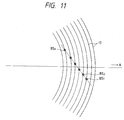
- Fig. 11 shows another embodiment of this invention, and a description will now be made of this embodiment, with the same reference numbers being placed on the same parts as in the above described embodiment.
- the system is set in such a way that the number of the laser beams is an even number, and, additionally, the spots of the individual laser beams are so arranged on the optical disk that the same numbers of the spots are positioned on both sides in relation to the axis of movement of the optical head.
- the laser diode 2 is provided with an even number of pieces of the laser diode elements 181 through 186 (six pieces in the Figure), as shown in Fig. 12, and the laser beams LB1 through LB6 emitted from the laser diode 2 are applied onto the optical disk 8 at the intervals l1 through l5 corresponding to the magnification of the image forming optical system 41 to form the beam spots BS1 through BS6, as shown in Fig. 11.
- the middle position of the two beam spots BS3 and BS4 in the middle is set to move in the radial direction A of the optical disk 8.
- the intervals of the individual beam spots BS1 through BS6 are set as shown below on the basis of Fig. 13. That is to say, the distance D m of the individual beam spots BS1 through BS6 is obtained by finding the crossing point of the equation for a circle expressing the tracks 17 and 17 ... and the equation for a straight line expressing the arrangement of the beam spots BS1 through BS6.
- the distance D m from the middle beam spot BS4 to the beam spot BS m in the m-th position either on the inner side or the outer side from the middle beam spot BS4 is calculated, and the intervals l1 through l5 of the individual beam spots BS1 through BS6 are obtained from this value as shown below.
- the radius of curvature R i is set at 30 mm
- the angle ⁇ is set at 87 degrees
- the pitch p is set at 1.6 »m.
- the tracking error signal for the performance of the tracking servo can be taken from either one of the two middle beams closest to the axis of movement of the optical head 40 or from the mean value of these.
- This invention consists in the construction and working described above, and, since the laser diode according to this invention is provided with a plurality of light emitting elements arranged at varying intervals, the laser diode is capable of irradiating all of the laser beams emitted from the plurality of light emitting elements onto the tracks on the optical writing media at the same time.
- the multibeam optical head according to this invention is so constructed as to be provided with a laser diode in which a plurality of independently drivable light emitting elements are arranged in a straight line with their intervals varied and an image forming optical system which forms images in such a manner that a plurality of beams from the laser diode mentioned above are applied onto the optical writing media to form images arranged linearly at a prescribed angle in relation to the radial direction of the optical writing media and additionally that the intervals of the plural number of beam spots are varied.
- the multibeam optical head according to this invention is capable of directing all the plural number of laser beams emitted from the laser diode onto the tracks of the optical writing media via the image forming optical system to form the images at the same time even when it is designed to form the images arranged linearly at a prescribed angle to the radial direction of the optical writing media at the same time by applying the laser beams.
Landscapes
- Physics & Mathematics (AREA)
- Optics & Photonics (AREA)
- Chemical & Material Sciences (AREA)
- Organic Chemistry (AREA)
- Biochemistry (AREA)
- Life Sciences & Earth Sciences (AREA)
- Health & Medical Sciences (AREA)
- Biophysics (AREA)
- General Health & Medical Sciences (AREA)
- Genetics & Genomics (AREA)
- Medicinal Chemistry (AREA)
- Molecular Biology (AREA)
- Proteomics, Peptides & Aminoacids (AREA)
- Analytical Chemistry (AREA)
- Optical Head (AREA)
Claims (12)
- Optisches Informationssystem (1), das aufweist:
ein optisches Aufzeichnungsmittel (8) mit einer Vielzahl von kreisförmigen Spuren (17), die gleichmäßig voneinander in einer radialen Richtung des optischen Aufzeichnungsmittels (8) zum darauf Aufzeichnen von Information beabstandet sind; und
ein optisches Mehrstrahlkopfmittel (40), das optisch mit dem optischen Aufzeichnungsmittel (8) gekoppelt und entlang einer Bewegungsachse in der radialen Richtung beweglich ist, wobei das optische Mehrstrahlkopfmittel (40) aufweist:
ein Laserdiodenmittel (2), das eine Vielzahl von ungleichmäßig voneinander beabstandeten Lasermitteln (18₁, 18₂,...18₇) aufweist, um eine Vielzahl von beabstandeten Laserstrahlen (LB₁, LB₂, ...LB₇) zu erzeugen, und
ein bilderzeugendes optisches Mittel (41), das mit dem Laserdiodenmittel (2) verbunden ist, um jeden aus der Vielzahl der Laserstrahlen (LB₁, LB₂, ...LB₇) als einen Strahlpunkt (BS₁, BS₂, ...BS₇) auf eine entsprechende Spur aus der Vielzahl der Spuren (17) des optischen Aufzeichnungsmittels (8) mit einer gemeinsamen Verstärkung zu lenken, so daß die Strahlpunkte in einer geraden Linie ausgerichtet sind, die unter einem Winkel bezüglich der radialen Richtung eingestellt ist,
dadurch gekennzeichnet, daß
die Vielzahl der Lasermittel (18₁, 18₂, ...18₇) ungleichmäßig voneinander beabstandet ist, so daß der Abstand zwischen benachbarten Strahlpunkten (BS₁, BS₂, ...BS₇) dem Abstand zwischen benachbarten Lasermitteln (18₁, 18₂, ..18₇) entspricht. - Optisches Informationssystem nach Anspruch 1, worin der Abstand zwischen benachbarten Lasermitteln (18₁, 18₂, ...18₇) monoton in der Reihenfolge der Position der Lasermittel (18₁, 18₂, ...18₇) zunimmt.
- Optisches Informationssystem nach Anspruch 1, worin die Anzahl der Vielzahl der Laserstrahlen (LB₁, LB₂, ...LB₇) eine gerade Zahl ist.
- Optisches Informationssystem nach Anspruch 1, worin die Anzahl der Vielzahl der Laserstrahlen (LB₁, LB₂, ...LB₆) eine ungerade Zahl ist.
- Optisches Informationssystem nach Anspruch 1, worin das Laserdiodenmittel (2) eine ungerade Anzahl der Lasermittel (18₁, 18₂, ...18₆) umfaßt.
- Optisches Informationssystem nach Anspruch 1, worin das Laserdiodenmittel (2) eine gerade Anzahl der Lasermittel (18₁, 18₂, ...18₇) umfaßt.
- Optisches Informationssystem nach Anspruch 1, worin das optische Mehrstrahlkopfmittel (40) weiterhin aufweist:
ein Mittel (5) zum Reflektieren der auf die Spuren (17) gerichteten Vielzahl der Laserstrahlen (LB₁, LB₂, ...LB₇);
ein mit dem reflektierenden Mittel (5) verbundenes Mittel (16) zum Detektieren von mindestens einem Referenzlaserstrahl (LB₄) aus einer Vielzahl von reflektierten Laserstrahlen (LB₁, LB₂, ...LB₇); und
ein mit dem detektierenden Mittel (16) verbundenes Mittel (51, 52, 53; 54, 55, 56) zum Erzeugen eines Signals, das einem detektierten Referenzlaserstrahl (LB₄) entspricht. - Optisches Informationssystem nach Anspruch 1, worin eine gleiche Anzahl der Strahlpunkte (BS₁, BS₂, ...BS₇) sich auf jeder Seite der Bewegungsachse befindet.
- Optisches Informationssystem nach Anspruch 4, worin einer der Strahlpunkte (BS₄) sich auf der Bewegungsachse befindet.
- Optisches Informationssystem nach Anspruch 7, worin das Detektionsmittel (16) eine Vielzahl von Fotodetektoren (16a, ...16d) umfaßt.
- Optisches Informationssystem nach Anspruch 7, worin das Detektionsmittel (16) ein kleines Loch (133) in dem Zentrum des detektierenden Mittels aufweist.
- Optisches Informationssystem nach Anspruch 7, worin das Erzeugungsmittel (51, 52, 53; 54, 55, 56) eine Vielzahl von Verstärkern umfaßt.
Applications Claiming Priority (2)
| Application Number | Priority Date | Filing Date | Title |
|---|---|---|---|
| JP1059564A JPH081705B2 (ja) | 1989-03-14 | 1989-03-14 | 半導体レーザー及びこれを用いたマルチビーム光ヘッド |
| JP59564/89 | 1989-03-14 |
Publications (2)
| Publication Number | Publication Date |
|---|---|
| EP0388760A1 EP0388760A1 (de) | 1990-09-26 |
| EP0388760B1 true EP0388760B1 (de) | 1995-08-02 |
Family
ID=13116861
Family Applications (1)
| Application Number | Title | Priority Date | Filing Date |
|---|---|---|---|
| EP90104710A Expired - Lifetime EP0388760B1 (de) | 1989-03-14 | 1990-03-13 | Laserdiode und optischer Kopf mit mehreren Strahlen, welcher die Laserdiode verwendet |
Country Status (4)
| Country | Link |
|---|---|
| US (1) | US5144616A (de) |
| EP (1) | EP0388760B1 (de) |
| JP (1) | JPH081705B2 (de) |
| DE (1) | DE69021237T2 (de) |
Families Citing this family (35)
| Publication number | Priority date | Publication date | Assignee | Title |
|---|---|---|---|---|
| JP3066118B2 (ja) * | 1991-07-19 | 2000-07-17 | パイオニア株式会社 | 光検出装置 |
| US5619488A (en) * | 1991-09-07 | 1997-04-08 | Fuji Xerox Co., Ltd. | Information recording device |
| JPH05114159A (ja) * | 1991-10-22 | 1993-05-07 | Canon Inc | 複数ビーム光ヘツド |
| JPH0696468A (ja) * | 1992-09-14 | 1994-04-08 | Canon Inc | 光記録再生装置及び半導体レーザアレイ |
| US5483511A (en) * | 1993-02-17 | 1996-01-09 | Vixel Corporation | Multiple beam optical memory system with solid-state lasers |
| US5526182A (en) * | 1993-02-17 | 1996-06-11 | Vixel Corporation | Multiple beam optical memory system |
| JPH07129966A (ja) * | 1993-11-05 | 1995-05-19 | Matsushita Electric Ind Co Ltd | マルチビーム光ヘッド |
| JPH07147020A (ja) * | 1993-11-24 | 1995-06-06 | Canon Inc | 複数ビーム光ヘッド |
| EP0663662A2 (de) * | 1994-01-13 | 1995-07-19 | Toshinobu Futagawa | Optische Kopfeinheit |
| US5523995A (en) * | 1994-04-01 | 1996-06-04 | Lichtenberg; Heinz D. | Optical information read/write system with a spread plane beam |
| GB2300749A (en) * | 1995-05-06 | 1996-11-13 | Thomson Multimedia Sa | A multiple beam optical disk system |
| JP3800653B2 (ja) * | 1995-12-26 | 2006-07-26 | ソニー株式会社 | クロストーク除去装置 |
| US5815482A (en) * | 1996-01-22 | 1998-09-29 | T Squared G, Inc. | Multibyte random access mass storage/memory system |
| US6038089A (en) | 1996-05-14 | 2000-03-14 | Asahi Kogaku Kogyo Kabushiki Kaisha | Beam shaping optical system |
| US6430125B1 (en) * | 1996-07-03 | 2002-08-06 | Zen Research (Ireland), Ltd. | Methods and apparatus for detecting and correcting magnification error in a multi-beam optical disk drive |
| US5959953A (en) * | 1996-07-03 | 1999-09-28 | Zen Research Nv | Methods and apparatus for performing cross-talk correction in a multi-track optical disk reader based on magnification error |
| US5870227A (en) * | 1997-03-13 | 1999-02-09 | T Squared G Systems, Inc. | Scanning head lens assembly |
| US6252715B1 (en) | 1997-03-13 | 2001-06-26 | T. Squared G, Inc. | Beam pattern contractor and focus element, method and apparatus |
| US20010050892A1 (en) * | 1997-07-11 | 2001-12-13 | Yoshitaka Takahashi | Optical disk apparatus compatible with different types of mediums |
| US5917797A (en) * | 1997-08-15 | 1999-06-29 | Zen Research Nv | Multi-beam optical pickup assembly and methods using a compact two-dimensional arrangement of beams |
| US6314071B1 (en) | 1998-02-20 | 2001-11-06 | Zen Research (Ireland), Ltd. | Method and apparatus for reading multiple tracks and writing at least one track of an optical disk |
| US6411573B1 (en) | 1998-02-20 | 2002-06-25 | Zen Research (Ireland), Ltd. | Multi-beam optical pickup |
| US6166756A (en) * | 1998-06-02 | 2000-12-26 | Science Applications International Corporation | Multiple channel data writing device |
| US6091067A (en) * | 1998-06-02 | 2000-07-18 | Science Applications International Corporation | Scanning device using fiber optic bimorph |
| US6584052B1 (en) | 1998-06-02 | 2003-06-24 | Science Applications International Corporation | Method and apparatus for controlling the focus of a read/write head for an optical scanner |
| US6246658B1 (en) | 1998-06-02 | 2001-06-12 | Science Applications International Corporation | Multiple channel scanning device using optoelectronic switching |
| US6137105A (en) * | 1998-06-02 | 2000-10-24 | Science Applications International Corporation | Multiple parallel source scanning device |
| US6341118B1 (en) | 1998-06-02 | 2002-01-22 | Science Applications International Corporation | Multiple channel scanning device using oversampling and image processing to increase throughput |
| US6137763A (en) * | 1998-09-24 | 2000-10-24 | Zen Research N.V. | Method and apparatus for buffering data in a multi-beam optical disk reader |
| US6229771B1 (en) * | 1998-10-09 | 2001-05-08 | Zen Research (Ireland), Ltd. | Method and apparatus for generating focus error signals in a multi-beam optical disk drive |
| WO2002065461A2 (en) | 2001-01-08 | 2002-08-22 | Zen Research (Ireland), Ltd. | Method and apparatus for writing multiple tracks of an optical disk |
| US6700096B2 (en) * | 2001-10-30 | 2004-03-02 | Semiconductor Energy Laboratory Co., Ltd. | Laser apparatus, laser irradiation method, manufacturing method for semiconductor device, semiconductor device, production system for semiconductor device using the laser apparatus, and electronic equipment |
| US7105048B2 (en) * | 2001-11-30 | 2006-09-12 | Semiconductor Energy Laboratory Co., Ltd. | Laser irradiation apparatus |
| WO2007105137A2 (en) * | 2006-03-10 | 2007-09-20 | Koninklijke Philips Electronics N.V. | Method and apparatus for writing/reading an information carrier and such an information carrier |
| CN113064136A (zh) | 2020-01-02 | 2021-07-02 | 隆达电子股份有限公司 | 发光元件与发光模块 |
Family Cites Families (5)
| Publication number | Priority date | Publication date | Assignee | Title |
|---|---|---|---|---|
| JPS54146613A (en) * | 1978-05-10 | 1979-11-16 | Hitachi Ltd | Optical head |
| EP0092420A1 (de) * | 1982-04-19 | 1983-10-26 | Xerox Corporation | Vorrichtungen zur Informationsspeicherung |
| US4594719A (en) * | 1984-01-19 | 1986-06-10 | Rca Corporation | Phase-locked laser array having a non-uniform spacing between lasing regions |
| JPS6311726U (de) * | 1986-07-09 | 1988-01-26 | ||
| JP2661098B2 (ja) * | 1988-02-09 | 1997-10-08 | 日本電気株式会社 | 半導体レーザおよび光ディスク装置 |
-
1989
- 1989-03-14 JP JP1059564A patent/JPH081705B2/ja not_active Expired - Fee Related
-
1990
- 1990-03-13 EP EP90104710A patent/EP0388760B1/de not_active Expired - Lifetime
- 1990-03-13 US US07/492,453 patent/US5144616A/en not_active Expired - Lifetime
- 1990-03-13 DE DE69021237T patent/DE69021237T2/de not_active Expired - Lifetime
Also Published As
| Publication number | Publication date |
|---|---|
| DE69021237D1 (de) | 1995-09-07 |
| JPH081705B2 (ja) | 1996-01-10 |
| JPH02239436A (ja) | 1990-09-21 |
| EP0388760A1 (de) | 1990-09-26 |
| DE69021237T2 (de) | 1996-05-02 |
| US5144616A (en) | 1992-09-01 |
Similar Documents
| Publication | Publication Date | Title |
|---|---|---|
| EP0388760B1 (de) | Laserdiode und optischer Kopf mit mehreren Strahlen, welcher die Laserdiode verwendet | |
| US4817074A (en) | Method and apparatus for detecting the focusing state and positioning accuracy of a light beam directed onto an optical disk tracking guide in an optical recording system | |
| US4775968A (en) | Tracking error detecting system for optical head | |
| US4520472A (en) | Beam expansion and relay optics for laser diode array | |
| US6185167B1 (en) | Optical head and information recording and reproduction apparatus | |
| KR900008380B1 (ko) | 광학식 헤드장치 | |
| EP0383237B1 (de) | Aufnahme-/Wiedergabegerät für optische Karte | |
| US4520471A (en) | Multi-channel recording/playback optics for laser diode arrays | |
| EP0426053B1 (de) | Optischer Kopf für optisches Informationsaufzeichnungsmedium | |
| US5579298A (en) | Optical scanner having symmetry about an oblique divider | |
| US5113378A (en) | Optical tracking system for an optical recording arrangement with plurality of beams | |
| EP0583036A2 (de) | Einrichtung zur optischen Abtastung einer Oberfläche | |
| US20020071360A1 (en) | Optical pickup device | |
| JP3019181B2 (ja) | 光ヘッドのサーボ信号検出装置 | |
| US5216562A (en) | Multi-beam optical recording system and method | |
| US4888755A (en) | Optical head for recording informations into a record medium and reproducing the same therefrom | |
| US6567353B1 (en) | Optical head with light receiving element surfaces divided into at least three light receiving areas | |
| US5107102A (en) | Arrangement for detecting a signal for effecting a focus control of an optical head | |
| US5526330A (en) | Optical head assembly for optical information player | |
| JPH0721869B2 (ja) | 光ピックアップ装置 | |
| CN1208223A (zh) | 激光头装置 | |
| EP0195192B1 (de) | Ovale Lichtstrahlen verwendende optische Systeme | |
| EP0192433A1 (de) | Optischer Kopf zur Aufzeichnung und Wiedergabe optischer Daten | |
| EP0416283B1 (de) | Optischer Kopf mit einer Vorrichtung zur Ermittlung eines Spurfolgenfehlers | |
| US5317557A (en) | Optical head for recording and reproducing information on and/or from optical record medium |
Legal Events
| Date | Code | Title | Description |
|---|---|---|---|
| PUAI | Public reference made under article 153(3) epc to a published international application that has entered the european phase |
Free format text: ORIGINAL CODE: 0009012 |
|
| AK | Designated contracting states |
Kind code of ref document: A1 Designated state(s): DE FR GB NL |
|
| 17P | Request for examination filed |
Effective date: 19901129 |
|
| 17Q | First examination report despatched |
Effective date: 19930625 |
|
| GRAA | (expected) grant |
Free format text: ORIGINAL CODE: 0009210 |
|
| AK | Designated contracting states |
Kind code of ref document: B1 Designated state(s): DE FR GB NL |
|
| REF | Corresponds to: |
Ref document number: 69021237 Country of ref document: DE Date of ref document: 19950907 |
|
| ET | Fr: translation filed | ||
| PLBE | No opposition filed within time limit |
Free format text: ORIGINAL CODE: 0009261 |
|
| STAA | Information on the status of an ep patent application or granted ep patent |
Free format text: STATUS: NO OPPOSITION FILED WITHIN TIME LIMIT |
|
| 26N | No opposition filed | ||
| REG | Reference to a national code |
Ref country code: GB Ref legal event code: IF02 |
|
| PGFP | Annual fee paid to national office [announced via postgrant information from national office to epo] |
Ref country code: NL Payment date: 20090315 Year of fee payment: 20 |
|
| PGFP | Annual fee paid to national office [announced via postgrant information from national office to epo] |
Ref country code: GB Payment date: 20090311 Year of fee payment: 20 |
|
| PGFP | Annual fee paid to national office [announced via postgrant information from national office to epo] |
Ref country code: DE Payment date: 20090219 Year of fee payment: 20 |
|
| PGFP | Annual fee paid to national office [announced via postgrant information from national office to epo] |
Ref country code: FR Payment date: 20090101 Year of fee payment: 20 |
|
| REG | Reference to a national code |
Ref country code: NL Ref legal event code: V4 Effective date: 20100313 |
|
| REG | Reference to a national code |
Ref country code: GB Ref legal event code: PE20 Expiry date: 20100312 |
|
| PG25 | Lapsed in a contracting state [announced via postgrant information from national office to epo] |
Ref country code: GB Free format text: LAPSE BECAUSE OF EXPIRATION OF PROTECTION Effective date: 20100312 |
|
| PG25 | Lapsed in a contracting state [announced via postgrant information from national office to epo] |
Ref country code: NL Free format text: LAPSE BECAUSE OF EXPIRATION OF PROTECTION Effective date: 20100313 |
|
| PG25 | Lapsed in a contracting state [announced via postgrant information from national office to epo] |
Ref country code: DE Free format text: LAPSE BECAUSE OF EXPIRATION OF PROTECTION Effective date: 20100313 |