EP0389097A2 - Photonisches Nahbereich/Metropolitan-Netzwerk - Google Patents
Photonisches Nahbereich/Metropolitan-Netzwerk Download PDFInfo
- Publication number
- EP0389097A2 EP0389097A2 EP90301571A EP90301571A EP0389097A2 EP 0389097 A2 EP0389097 A2 EP 0389097A2 EP 90301571 A EP90301571 A EP 90301571A EP 90301571 A EP90301571 A EP 90301571A EP 0389097 A2 EP0389097 A2 EP 0389097A2
- Authority
- EP
- European Patent Office
- Prior art keywords
- packet
- optical
- path
- network
- loop
- Prior art date
- Legal status (The legal status is an assumption and is not a legal conclusion. Google has not performed a legal analysis and makes no representation as to the accuracy of the status listed.)
- Granted
Links
- 230000003287 optical effect Effects 0.000 claims abstract description 57
- 239000013307 optical fiber Substances 0.000 claims abstract description 29
- 230000005540 biological transmission Effects 0.000 abstract description 9
- 239000000835 fiber Substances 0.000 abstract description 4
- 230000008878 coupling Effects 0.000 abstract description 2
- 238000010168 coupling process Methods 0.000 abstract description 2
- 238000005859 coupling reaction Methods 0.000 abstract description 2
- 238000004891 communication Methods 0.000 description 8
- 230000003139 buffering effect Effects 0.000 description 5
- 238000000034 method Methods 0.000 description 5
- 230000000903 blocking effect Effects 0.000 description 3
- 238000005516 engineering process Methods 0.000 description 3
- 230000015654 memory Effects 0.000 description 3
- 244000061456 Solanum tuberosum Species 0.000 description 2
- 235000002595 Solanum tuberosum Nutrition 0.000 description 2
- 238000001514 detection method Methods 0.000 description 2
- 240000003537 Ficus benghalensis Species 0.000 description 1
- 239000000872 buffer Substances 0.000 description 1
- 238000006243 chemical reaction Methods 0.000 description 1
- 239000013078 crystal Substances 0.000 description 1
- 230000007423 decrease Effects 0.000 description 1
- 230000001934 delay Effects 0.000 description 1
- 230000002939 deleterious effect Effects 0.000 description 1
- 230000006870 function Effects 0.000 description 1
- 239000012464 large buffer Substances 0.000 description 1
- 239000011159 matrix material Substances 0.000 description 1
- 230000002093 peripheral effect Effects 0.000 description 1
- 230000003134 recirculating effect Effects 0.000 description 1
- 230000001960 triggered effect Effects 0.000 description 1
Images


Classifications
-
- H—ELECTRICITY
- H04—ELECTRIC COMMUNICATION TECHNIQUE
- H04L—TRANSMISSION OF DIGITAL INFORMATION, e.g. TELEGRAPHIC COMMUNICATION
- H04L12/00—Data switching networks
- H04L12/28—Data switching networks characterised by path configuration, e.g. LAN [Local Area Networks] or WAN [Wide Area Networks]
-
- H—ELECTRICITY
- H04—ELECTRIC COMMUNICATION TECHNIQUE
- H04L—TRANSMISSION OF DIGITAL INFORMATION, e.g. TELEGRAPHIC COMMUNICATION
- H04L12/00—Data switching networks
- H04L12/28—Data switching networks characterised by path configuration, e.g. LAN [Local Area Networks] or WAN [Wide Area Networks]
- H04L12/2852—Metropolitan area networks
Definitions
- This invention relates generally to packet-switched optical communication systems for use in local and/or metropolitan area networks (LAN's or MAN's) and, more particularly, to such networks which are adapted to resolve collisions between advancing packets without buffering the colliding packets within the switching nodes.
- LAN local and/or metropolitan area networks
- MAN's metropolitan area networks
- Packet-switching technology has been advantageously applied to optical communication systems.
- packet-switched networks operating at low transmission speeds, the collisions between advancing packets are resolved by buffering the colliding packets until the output link becomes available.
- Such a scheme is commonly referred to as store-and-forward routing. Since large optical memories are expensive, today's solution for networks that use optical communication is to convert the optical signal to an electrical signal for appropriate buffering and queuing.
- the switching node of "hot-potato” topologies must have the same number of input and output links.
- a network commonly referred to as The Manhattan Street Network (MSN) utilizes the "hot potato” scheme.
- MSN The Manhattan Street Network
- the proposed invention also uses the "hot potato" routing.
- the proposed invention can be built on totally uncontained topologies.
- each path contains a reverse channel, the number of input and output paths to a switching node need not, necessarily, be equal.
- This invention refers to a packet-switched local or metropolitan area optical communications network in which collisions between two or more packets are resolved without local buffering in the switching node.
- a (logical) uni-directional link within a network is replaced by two optical links.
- One optical link which is referred to as the forward link, is capable of transmitting an optical signal in the direction of the original optical uni-directional link.
- the other link which can be referred to as the reverse link, is capable of transmitting an optical signal in the opposite direction.
- These links can be selectively configured to form either a direct path between the nodes (in which case only the forward link is used), or a "loop-back" path between the nodes (in which case both the forward and reverse are used to form a closed optical loop between the two nodes).
- the invention introduces a novel network architecture that is based on switching nodes which do not have local memory.
- the inventive network involves the use of optical fiber media to store packets in transit when a collision between two or more packets at a switching node is imminent.
- each uni-directional link in a conventional network is replaced by a fiber path composed of two links that carry packets in opposite directions. These two opposite-directed links can serve as a forward path or as a "loop-back" path.
- the two opposite-directed links are configured to form a loop on which a blocked packet will circulate until the required output loop at the arriving switching node becomes available.
- This invention avoids the need of large buffers within a switching node that needs to operate at high speeds. This becomes a serious problem as the transmission of the optical media increases.
- the invention is directed toward high performance communication systems, for example, distributed processing systems.
- Such high performance communication systems require the "low delay”, “multi-point”, “on-demand” delivery of large amounts of data.
- the "low-delay" characteristic of high performance communication systems refers to the rapidity with which data can be transmitted from one user of the system to another.
- certain operations - called atomic operations - must be performed without interruption if the integrity of the procedure is to be maintained.
- Exemplary of such operations is the withdrawal of funds from an account and the immediate debiting of said account to reflect such withdrawal.
- any interruption between such withdrawal and such debiting can endanger the integrity of the associated data bases.
- Low delay networks minimize the occurrence of such deleterious delays.
- the term "local area network” refers to a general-purpose network that can serve a wide variety of devices. Local area networks support minicomputers, mainframes, terminals, and other peripheral devices. In many cases, local area networks can carry not only data, but voice, video and graphics.
- One of the common types of a local area network topology which uses optical fiber is the star type of topology.
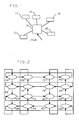
- a central switching element 10 is coupled to all of the nodes 12, 14, 16, 18, 20 of the network via, for example, optical fibers.
- a station wishing to transmit data sends its transmission to the central switching node 10 which forwards the transmission to the specified nodes by addressing data provided to node 10 by the source node.
- the Manhattan Street Network is based on a grid of alternatingly-directed paths of rows and columns normally referred to as streets and avenues.
- Various nodes 60, 62, 64, 66, 68, 70, 72, 74, 76, 78, 80, 82, 84, 86, 88, 90 exist on the corners of the streets and avenues.
- routing from a particular street and avenue to a destination is straightforward.
- any destination street and avenue destination can be found without asking directions, even when some roads are blocked.
- a Manhattan Street Network does not store-and-forward the data at intermediate nodes, and does require that the packets be immediately forwarded.
- Switching node 100 is coupled to switching nodes 102, 104, 106 via optical fiber paths 108, 110, 112.
- Appropriate hosts 101, 103, 105, 107, 109, 111, 113, 115, 117 are associated with each node.
- Optical fiber paths 108, 110 and 112 can be used to transmit a packet from node 100 directly to nodes 102, 104 and 106 respectively.
- the optical fiber paths can store the optical packet being transmitted by causing it to circulate around the optical path 108, 110, and/or 112. The number of times a packet circulates can be limited by a loop-count field in the header portion of the packet.
- a second optical fiber path is required from node 100 to each of the other nodes 102, 104 and 106.
- double-sided arrows are assigned to the optical fiber paths to indicate that there are two separate paths for serving traffic in opposite directions.
- Each optical fiber path, or loop 108, 110, 112 is a bi-directional channel which serves unidirectional network traffic.
- two loops are required. In a different configuration, a single loop can serve traffic in both directions.
- FIG. 4 there is illustrated a format of a packet which can be used to specify the source route as a series of hop-selects.
- Each hop-select field indicates the output link on which the packet is to be forwarded for that hop.
- the first non-zero hop-select field in the packet is examined to determine the next output link for the packet. If that output path is available for transmission of a new packet, the hop-select field is zeroed and the packet is immediately routed to the available output link.
- the packet When a packet is blocked because the output path that was selected is unavailable at the packet's arrival time, the packet is routed back to the previous switching node on the return portion of the path that the packet arrived on. Upon its arrival at the previous switching node, the return packet is again sent to arrive at the blocking switching node one round-trip time after it first arrives at the node.
- the optical fiber path effectively provides short-term storage of the optical packet and causes the packet to reappear at the blocking switching node a short time later.
- the loopcount field of a packet header is decremented and examined each time a packet is returned. If the loopcount reaches zero, the packet is removed from the network to prevent a packet from indefinitely looping within the network because of a failure or load condition.
- This invention does not require memory in the switching node of the size and speed which is required to store all blocked packets, such as would be required for a conventional store-and-forward design. Additionally, the loop-back technique here disclosed exerts back pressure on the link over which the packet was received because each return packet reduces the availability of the path for receiving and forwarding new packets. In an extreme case, the back pressure can extend back from the point of contention to one or more of the packet sources. Besides alerting the packet sources of congestion, the back pressure provides fast feedback to the source routing mechanism to enable it to react more quickly to network load and topological changes.
- Each optical fiber path 108, 110, 112 comprises two optical links which, when joined end to end forms a loop and together has a total length which is equal to or larger than the length of the packet being transmitted, or to the maximum packet size if variable length packets are used.
- Switches that are used to reconfigure the optical paths are commercial products of, for example, BT&D Technologies, having offices in the United States and in England, and Crystal Technology, Inc., having offices in Palo Alto, California.
- two or more loops can be physically concatenated by a simple switching node with two input and two output loops. If the internodel distance is less than the size of the loop, the excessive length of the loop can be compactly stored. For example, an optical fiber loop located between nodes 100 meters apart can store a packet of 300 bits when the link operates at 1Gbps with a single color transmission.
- each optical path is comprised of two optical links which can be selectively configured to form a straight-through transmission path for an optical packet or a loop-back path for the optical packet to controllably selectively delay its advance.
- Each input path includes a packet detector circuit 120 and a switching delay 122.
- the packet detector circuit scans the input path for syncs. Upon detection of a sync, the packet detector generates a new-packet signal and reports a packet arrival to a Control circuit 121.
- Switching delay 122 which is coupled to report header information to Control circuits 121, can comprise a length of fiber which is long enough to contain the packet header and the number of bits which correspond to the time the control logic requires to do the actual switching.
- Each output path 118 includes a packet detector circuit 124 that scans the output path for a returned packet and is coupled to report this information to Control circuits 121. Upon detection of a returned packet, a returned-packet signal is generated. A loop is considered to be free if it does not contain a packet or any part of a packet.
- the Control circuit can uniquely determine the status of a loop using the returned-packet signal and a timer that can be set for a packet length. (other implementations are also possible.)
- the switching nodes that switch a packet from an input loop 116 to an output loop 118 can be implemented in a switching matrix configuration. However, in those instances where there are a large number of inputs/outputs, an alternate switch architecture, such as a variation of Banyan network, can be used.
- the availability of the output loop is checked.
- An output loop is available if no active connection of any other loop to this loop currently exists and the loop is not occupied by a returned packet.
- the condition that a loop is not occupied by a returned packet can be determined by the timer that is triggered by the sync of every transmitted and/or returned packet. If the output loop is available, the packet is clocked from its input loop onto the output loop by closing switches 126, 128 as illustrated. If, on the other hand, the output loop is busy, the packet is blocked, and it is returned by being clocked out on the same input loop it came in on. This is accomplished by positioning switch 126 as shown by the dotted arrow.
- the successful packet will be the one with the higher priority (if the priority field is implemented in the packet structure) or the one that is chosen randomly in the case of equal priorities.
- Each other packet or packets are clocked out on their loops.
- the input loop terminates at another node and at this other node the loop is referred to as the output loop.
- a blocked packet upon arriving at the other node, sets the timer to indicate that the loop is busy and is clocked out to arrive at the blocking node one round trip later.
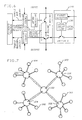
- the switching node of FIG. 5 can be implemented as an interconnection of a number of photonic components.
- local I/O packets can be handled in a manner similar to the way that the forwarded packets are handled.
- the local delay line 130 of a local fiber optical loop having two optical links can have a length that is equal to that of the packet size. on the same principle as an insert register in LAN's.
- a new message from the local host can be input to the local loop and circulate in the local loop until it is inserted into the network.
- the schematic of FIG. 6 is similar to that of FIG. 5 with the addition of a local loop and the necessary switches.
- a collision between two packets can be resolved in optical network topologies by replacing each of the various logical links with an optical loop having two substantially parallel optical links which can be selectively configured to form either a direct straight throughput or loop-back path.
- FIG. 7 illustrates a Star-of-Star type of network topology having central switching elements 150, 152, 154, 156, 158 interconnected via optical fiber paths, and nodes 160, 162, 164, 166 of each cluster coupled to an associated central switching element via an optical fiber path having two optical links which can be selectively configured to form either a direct straight through path or a loop-back path.
- collisions of optical packets in network topologies are resolved by using selectively configurable optical fiber paths to couple together the various nodes.
- An optical fiber path when configured to form a loop-back, resolves collisions by delaying the advance of an optical packet.
- the loop-back path effectively functions as a storage medium for the packet.
- a colliding packet can be recirculated around a loop until a preceding packet has been cleared.
Landscapes
- Engineering & Computer Science (AREA)
- Computer Networks & Wireless Communication (AREA)
- Signal Processing (AREA)
- Optical Communication System (AREA)
- Small-Scale Networks (AREA)
- Data Exchanges In Wide-Area Networks (AREA)
Applications Claiming Priority (2)
| Application Number | Priority Date | Filing Date | Title |
|---|---|---|---|
| US07/314,724 US4970717A (en) | 1989-02-23 | 1989-02-23 | Photonic local/metropolitan area network |
| US314724 | 1989-02-23 |
Publications (3)
| Publication Number | Publication Date |
|---|---|
| EP0389097A2 true EP0389097A2 (de) | 1990-09-26 |
| EP0389097A3 EP0389097A3 (de) | 1991-12-04 |
| EP0389097B1 EP0389097B1 (de) | 1995-10-04 |
Family
ID=23221168
Family Applications (1)
| Application Number | Title | Priority Date | Filing Date |
|---|---|---|---|
| EP90301571A Expired - Lifetime EP0389097B1 (de) | 1989-02-23 | 1990-02-14 | Photonisches Nahbereich/Metropolitan-Netzwerk |
Country Status (8)
| Country | Link |
|---|---|
| US (1) | US4970717A (de) |
| EP (1) | EP0389097B1 (de) |
| JP (1) | JP2523201B2 (de) |
| KR (1) | KR900013738A (de) |
| CA (1) | CA2005997C (de) |
| DE (1) | DE69022758T2 (de) |
| ES (1) | ES2078940T3 (de) |
| HK (1) | HK33596A (de) |
Cited By (1)
| Publication number | Priority date | Publication date | Assignee | Title |
|---|---|---|---|---|
| GB2321563A (en) * | 1997-01-24 | 1998-07-29 | Plessey Telecomm | Burst mode wavelength controller |
Families Citing this family (13)
| Publication number | Priority date | Publication date | Assignee | Title |
|---|---|---|---|---|
| US5138615A (en) * | 1989-06-22 | 1992-08-11 | Digital Equipment Corporation | Reconfiguration system and method for high-speed mesh connected local area network |
| US5421030A (en) * | 1991-09-17 | 1995-05-30 | Com21, Inc. | Communications system and method for bi-directional communications between an upstream control facility and downstream user terminals |
| US5341415A (en) * | 1992-09-22 | 1994-08-23 | Paul Baran | Method and apparatus for sharing of common in-house wiring to permit multiple telephone carriers to serve the same customer |
| EP0686332A4 (de) * | 1992-09-29 | 1996-05-01 | Com 21 Inc | Zellenbasiertes weitbereichstelefon- und datensystem mit alternativem zugang |
| US5425027A (en) * | 1993-01-04 | 1995-06-13 | Com21, Inc. | Wide area fiber and TV cable fast packet cell network |
| WO1999014915A2 (en) * | 1997-09-17 | 1999-03-25 | British Telecommunications Public Limited Company | Process scheduling in computer network |
| US6128113A (en) * | 1998-03-04 | 2000-10-03 | Dynamics Research Corporation | Transparent optical communications switch |
| US6748451B2 (en) | 1998-05-26 | 2004-06-08 | Dow Global Technologies Inc. | Distributed computing environment using real-time scheduling logic and time deterministic architecture |
| US6567429B1 (en) | 1998-06-02 | 2003-05-20 | Dynamics Research Corporation | Wide area multi-service broadband network |
| DE19940565C1 (de) * | 1999-08-26 | 2001-02-01 | Siemens Ag | Verfahren zur Leitweglenkung von Datenpaketen eines optischen Datenpaketstromes |
| US7145704B1 (en) | 2003-11-25 | 2006-12-05 | Cheetah Omni, Llc | Optical logic gate based optical router |
| US7308002B2 (en) * | 2003-11-24 | 2007-12-11 | Intergrated System Solution Corp. | Packet type arbitrator in WLAN and corresponding arbitrating method |
| US7245831B2 (en) * | 2004-10-04 | 2007-07-17 | Board Of Supervisors Of Louisiana State University And Agricultural And Mechanical College | Optical packet switching |
Family Cites Families (8)
| Publication number | Priority date | Publication date | Assignee | Title |
|---|---|---|---|---|
| US4674085A (en) * | 1985-03-21 | 1987-06-16 | American Telephone And Telegraph Co. | Local area network |
| FR2586874B1 (fr) * | 1985-08-29 | 1988-08-05 | Comp Generale Electricite | Dispositif de telecommunication par fibres optiques. |
| GB8530087D0 (en) * | 1985-12-06 | 1986-02-12 | British Telecomm | Operating multi access optical network |
| US4701907C1 (en) * | 1986-02-03 | 2002-08-27 | Collins Mary | Dynamically reconfigurable time-space-time digital switch and network |
| US4829512A (en) * | 1986-08-26 | 1989-05-09 | Nec Corporation | Loop-back control apparatus for a loop network having duplicate optical fiber transmission lines |
| US4847837A (en) * | 1986-11-07 | 1989-07-11 | The United States Of America As Represented By The Administrator Of The National Aeronautics And Space Administration | Local area network with fault-checking, priorities and redundant backup |
| US4766530A (en) * | 1986-11-24 | 1988-08-23 | Westinghouse Electric Corp. | Token passing scheme for a predetermined configuration local area network |
| US4835763A (en) * | 1988-02-04 | 1989-05-30 | Bell Communications Research, Inc. | Survivable ring network |
-
1989
- 1989-02-23 US US07/314,724 patent/US4970717A/en not_active Expired - Lifetime
- 1989-12-19 CA CA002005997A patent/CA2005997C/en not_active Expired - Fee Related
-
1990
- 1990-02-14 EP EP90301571A patent/EP0389097B1/de not_active Expired - Lifetime
- 1990-02-14 ES ES90301571T patent/ES2078940T3/es not_active Expired - Lifetime
- 1990-02-14 DE DE69022758T patent/DE69022758T2/de not_active Expired - Lifetime
- 1990-02-20 KR KR1019900002030A patent/KR900013738A/ko not_active Ceased
- 1990-02-22 JP JP2039902A patent/JP2523201B2/ja not_active Expired - Lifetime
-
1996
- 1996-02-29 HK HK33596A patent/HK33596A/en not_active IP Right Cessation
Cited By (3)
| Publication number | Priority date | Publication date | Assignee | Title |
|---|---|---|---|---|
| GB2321563A (en) * | 1997-01-24 | 1998-07-29 | Plessey Telecomm | Burst mode wavelength controller |
| GB2321563B (en) * | 1997-01-24 | 1999-04-21 | Plessey Telecomm | Burst mode wavelength manager |
| AU727021B2 (en) * | 1997-01-24 | 2000-11-30 | Marconi Communications Limited | Burst mode wavelength manager |
Also Published As
| Publication number | Publication date |
|---|---|
| CA2005997C (en) | 1995-02-14 |
| HK33596A (en) | 1996-03-08 |
| US4970717A (en) | 1990-11-13 |
| ES2078940T3 (es) | 1996-01-01 |
| JPH02248133A (ja) | 1990-10-03 |
| DE69022758D1 (de) | 1995-11-09 |
| KR900013738A (ko) | 1990-09-06 |
| CA2005997A1 (en) | 1990-08-23 |
| DE69022758T2 (de) | 1996-03-14 |
| EP0389097A3 (de) | 1991-12-04 |
| JP2523201B2 (ja) | 1996-08-07 |
| EP0389097B1 (de) | 1995-10-04 |
Similar Documents
| Publication | Publication Date | Title |
|---|---|---|
| EP0724798B1 (de) | Selektive überlastungsregelung für informationsnetze | |
| US5901140A (en) | Selective congestion control mechanism for information networks | |
| US6967926B1 (en) | Method and apparatus for using barrier phases to limit packet disorder in a packet switching system | |
| US4970717A (en) | Photonic local/metropolitan area network | |
| US6907041B1 (en) | Communications interconnection network with distributed resequencing | |
| EP1317825B1 (de) | System und verfahren zur steuerung des mehrfachdatenverkehrs einer datenvermittlungsstelle | |
| JP2963316B2 (ja) | パケット分配ネットワーク | |
| EP0658027A2 (de) | Gemeinsame Benutzung des Kanals und des Speichers in einem Paketvermittlungssystem | |
| KR19990036054A (ko) | 패킷 루팅 방법 및 장치 | |
| JP4146080B2 (ja) | 通信ネットワーク | |
| JP2918772B2 (ja) | パケット交換配置 | |
| KR19980064825A (ko) | 에이.티.엠 스위치의 분산 버퍼링 시스템 | |
| EP0590865B1 (de) | Mehrstufige erweiterbare optische Paketverteilanordnung mit Überbrückungsschalter | |
| US5285449A (en) | Protocol for hybrid local area networks | |
| AU719413B2 (en) | Logical multicast from a switch configured for spatial multicast | |
| CA2371037C (en) | A node and method for the removal of expired packets from a communication network | |
| WO2000004741A1 (en) | A reliable and robust atm-switch | |
| Chlamtac et al. | Scalable WDM network architecture based on photonic slot routing and switched delay lines | |
| Haas et al. | Blazenet: A packet-switched wide-area network with photonic data path | |
| Wong et al. | Pipeline banyan-a parallel fast packet switch architecture | |
| US7321558B2 (en) | Method and apparatus in a computer network | |
| Haas | Loop concatenation and loop replication to improve Blazelan performance | |
| Haas et al. | Blazenet: A Phototonic Implementable Wide-area Network | |
| Decina et al. | Two simple techniques for broadcasting in deflection routing multichannel MANs | |
| Laskaridis et al. | Grid-based switch fabrics: a new approach in designing fault-tolerant ATM switches |
Legal Events
| Date | Code | Title | Description |
|---|---|---|---|
| PUAI | Public reference made under article 153(3) epc to a published international application that has entered the european phase |
Free format text: ORIGINAL CODE: 0009012 |
|
| AK | Designated contracting states |
Kind code of ref document: A2 Designated state(s): DE ES FR GB IT NL |
|
| PUAL | Search report despatched |
Free format text: ORIGINAL CODE: 0009013 |
|
| AK | Designated contracting states |
Kind code of ref document: A3 Designated state(s): DE ES FR GB IT NL |
|
| 17P | Request for examination filed |
Effective date: 19911105 |
|
| 17Q | First examination report despatched |
Effective date: 19931018 |
|
| RAP3 | Party data changed (applicant data changed or rights of an application transferred) |
Owner name: AT&T CORP. |
|
| GRAA | (expected) grant |
Free format text: ORIGINAL CODE: 0009210 |
|
| AK | Designated contracting states |
Kind code of ref document: B1 Designated state(s): DE ES FR GB IT NL |
|
| ET | Fr: translation filed | ||
| REF | Corresponds to: |
Ref document number: 69022758 Country of ref document: DE Date of ref document: 19951109 |
|
| ITF | It: translation for a ep patent filed | ||
| REG | Reference to a national code |
Ref country code: ES Ref legal event code: FG2A Ref document number: 2078940 Country of ref document: ES Kind code of ref document: T3 |
|
| RIN2 | Information on inventor provided after grant (corrected) |
Free format text: HAAS, ZYGMUNT |
|
| PLBE | No opposition filed within time limit |
Free format text: ORIGINAL CODE: 0009261 |
|
| STAA | Information on the status of an ep patent application or granted ep patent |
Free format text: STATUS: NO OPPOSITION FILED WITHIN TIME LIMIT |
|
| 26N | No opposition filed | ||
| REG | Reference to a national code |
Ref country code: GB Ref legal event code: IF02 |
|
| PGFP | Annual fee paid to national office [announced via postgrant information from national office to epo] |
Ref country code: NL Payment date: 20020207 Year of fee payment: 13 |
|
| PG25 | Lapsed in a contracting state [announced via postgrant information from national office to epo] |
Ref country code: NL Free format text: LAPSE BECAUSE OF NON-PAYMENT OF DUE FEES Effective date: 20030901 |
|
| NLV4 | Nl: lapsed or anulled due to non-payment of the annual fee |
Effective date: 20030901 |
|
| PG25 | Lapsed in a contracting state [announced via postgrant information from national office to epo] |
Ref country code: IT Free format text: LAPSE BECAUSE OF NON-PAYMENT OF DUE FEES Effective date: 20050214 |
|
| PGFP | Annual fee paid to national office [announced via postgrant information from national office to epo] |
Ref country code: ES Payment date: 20090219 Year of fee payment: 20 |
|
| PGFP | Annual fee paid to national office [announced via postgrant information from national office to epo] |
Ref country code: DE Payment date: 20090219 Year of fee payment: 20 |
|
| PGFP | Annual fee paid to national office [announced via postgrant information from national office to epo] |
Ref country code: GB Payment date: 20090219 Year of fee payment: 20 |
|
| PGFP | Annual fee paid to national office [announced via postgrant information from national office to epo] |
Ref country code: FR Payment date: 20090213 Year of fee payment: 20 |
|
| REG | Reference to a national code |
Ref country code: GB Ref legal event code: PE20 Expiry date: 20100213 |
|
| REG | Reference to a national code |
Ref country code: ES Ref legal event code: FD2A Effective date: 20100215 |
|
| PG25 | Lapsed in a contracting state [announced via postgrant information from national office to epo] |
Ref country code: GB Free format text: LAPSE BECAUSE OF EXPIRATION OF PROTECTION Effective date: 20100213 |
|
| PG25 | Lapsed in a contracting state [announced via postgrant information from national office to epo] |
Ref country code: ES Free format text: LAPSE BECAUSE OF EXPIRATION OF PROTECTION Effective date: 20100215 |
|
| PG25 | Lapsed in a contracting state [announced via postgrant information from national office to epo] |
Ref country code: DE Free format text: LAPSE BECAUSE OF EXPIRATION OF PROTECTION Effective date: 20100214 |