EP0389128A2 - Verfahren zur Herstellung von sehr reinem, geschmolzenem Quarzpulver - Google Patents
Verfahren zur Herstellung von sehr reinem, geschmolzenem Quarzpulver Download PDFInfo
- Publication number
- EP0389128A2 EP0389128A2 EP90302149A EP90302149A EP0389128A2 EP 0389128 A2 EP0389128 A2 EP 0389128A2 EP 90302149 A EP90302149 A EP 90302149A EP 90302149 A EP90302149 A EP 90302149A EP 0389128 A2 EP0389128 A2 EP 0389128A2
- Authority
- EP
- European Patent Office
- Prior art keywords
- particles
- fused silica
- aggregates
- silica
- silica particles
- Prior art date
- Legal status (The legal status is an assumption and is not a legal conclusion. Google has not performed a legal analysis and makes no representation as to the accuracy of the status listed.)
- Withdrawn
Links
Images

Classifications
-
- C—CHEMISTRY; METALLURGY
- C03—GLASS; MINERAL OR SLAG WOOL
- C03C—CHEMICAL COMPOSITION OF GLASSES, GLAZES OR VITREOUS ENAMELS; SURFACE TREATMENT OF GLASS; SURFACE TREATMENT OF FIBRES OR FILAMENTS MADE FROM GLASS, MINERALS OR SLAGS; JOINING GLASS TO GLASS OR OTHER MATERIALS
- C03C12/00—Powdered glass; Bead compositions
-
- C—CHEMISTRY; METALLURGY
- C03—GLASS; MINERAL OR SLAG WOOL
- C03B—MANUFACTURE, SHAPING, OR SUPPLEMENTARY PROCESSES
- C03B19/00—Other methods of shaping glass
- C03B19/10—Forming beads
- C03B19/1005—Forming solid beads
- C03B19/102—Forming solid beads by blowing a gas onto a stream of molten glass or onto particulate materials, e.g. pulverising
-
- C—CHEMISTRY; METALLURGY
- C03—GLASS; MINERAL OR SLAG WOOL
- C03C—CHEMICAL COMPOSITION OF GLASSES, GLAZES OR VITREOUS ENAMELS; SURFACE TREATMENT OF GLASS; SURFACE TREATMENT OF FIBRES OR FILAMENTS MADE FROM GLASS, MINERALS OR SLAGS; JOINING GLASS TO GLASS OR OTHER MATERIALS
- C03C3/00—Glass compositions
- C03C3/04—Glass compositions containing silica
- C03C3/06—Glass compositions containing silica with more than 90% silica by weight, e.g. quartz
-
- C—CHEMISTRY; METALLURGY
- C03—GLASS; MINERAL OR SLAG WOOL
- C03C—CHEMICAL COMPOSITION OF GLASSES, GLAZES OR VITREOUS ENAMELS; SURFACE TREATMENT OF GLASS; SURFACE TREATMENT OF FIBRES OR FILAMENTS MADE FROM GLASS, MINERALS OR SLAGS; JOINING GLASS TO GLASS OR OTHER MATERIALS
- C03C2201/00—Glass compositions
- C03C2201/02—Pure silica glass, e.g. pure fused quartz
-
- C—CHEMISTRY; METALLURGY
- C03—GLASS; MINERAL OR SLAG WOOL
- C03C—CHEMICAL COMPOSITION OF GLASSES, GLAZES OR VITREOUS ENAMELS; SURFACE TREATMENT OF GLASS; SURFACE TREATMENT OF FIBRES OR FILAMENTS MADE FROM GLASS, MINERALS OR SLAGS; JOINING GLASS TO GLASS OR OTHER MATERIALS
- C03C2203/00—Production processes
- C03C2203/50—After-treatment
Definitions
- the invention relates to a product from and a process for the production of high purity fused silica powder from relatively low density silica particles.
- the fusion of the silica particles occurs in a flame fusion furnace.
- the temperature of the flame and feed rate of the silica particles are controlled to produce an aggregate of fused glass particles which are bonded on the surface in such a manner that subsequent grinding thereof is made easier than if the particles had been allowed to completely coalesce during fusion.
- fused quartz or silica crucibles are used for growing silicon crystals which find use in electronic circuits. Necessarily, these crucibles must be of a high purity to ensure pure crystal growth.
- Silica or quartz that is currently used in the manufacture of fused silica crucibles is a natural quartz of very high purity and is available in only very limited number of places in the world. Its particle size is critical and is controlled between 50 to 150 mesh. From a purity viewpoint, natural quartz has some inherent limitations and ever increasing purity requirements of the electronics and optical industries demand that crucibles be made from purer and purer starting material. Synthetic silica can fill this purity gap. However, commercially available synthetic silica powder is very light, fluffy, fine and generally not suitable for making crucible or other fused quartz products.
- Optical elements also must be free of bubbles, color centers and elements which can absorb radiation in undesired regions of the wavelength spectrum.
- the requirements for each of the above applications demand that the silica particles to be fused have a relatively high density. If the density is too low, air trapped within the pore structure forms bubbles upon heating the silica particles. These bubbles do not escape due to the high viscosity of the molten glass. Since high density silica feeds reduce bubble formation, there is a need to make dense, high purity, synthetic silica particles of the desired size which can be used for crucible manufacture as well as for other applications in the optical industry. To the knowledge of inventors, there is no known commercial method of making coarse and dense silica powders of purity suitable for above applications.
- silica gel material may be formed directly into fused silica without an intermediate washing or spray drying.
- silicon tetrachloride is hydrolized in a flame and deposited directly on a mandrel or "bait".
- a similar technique can also be applied to a plurality of different types of metal chloride gases. See, U.S. Patent No. 3,801,294.
- Silica particles known as silica flour, generally have has a particle size of up to about 70 microns. Silica flour particles are amorphous and have a bulk density of only about 0.2 to 0.4 g/cc.
- completely fused silica particles provide a glass product having a bulk density of about 2.2 g/cc.
- One method for producing such completely fused glass from a silica flour uses an electric arc through which the silica flour is dropped. See, U.S. Patent No. 3,151,964 and U.S. Patent No. 3,553,756.
- This glass product is very hard and is almost impossible to break by thermal shock. These properties make the glass difficult to grind into powder because the particles abrade the grinding elements thereby introducing impurities into the resultant product.
- a process for producing a fused silica particle aggregate in accordance with the invention comprises: feeding silica flour particles to a heating zone; heating said silica flour particles in a flame to a temperature sufficient to form fused silica particles from said silica particles, said fused silica particles having a relatively higher bulk density than said silica flour particles; collecting aggregates of said fused silica particles, said aggregates exhibiting a honeycomb-shaped structure of surface-bonded fused silica particles; and grinding said aggregates into ground silica particles having a desired size.
- honeycomb structure produced by this invention is not very hard, can be readily handled during processing and, thereafter, can be easily ground to the desired particle size without introducing impurities or substantial amount of fines.
- the unfused silica particles used as feed for the process of this invention are presented in the form of a high purity silica flour.
- Flour useful for the present invention may be made by any conventional method with appropriate attention to the presence of metallic impurities.
- the flour may be entrained in a first stream of oxygen and transported to a flame fusion furnace. Within the furnace, this entrained stream of silica particles contacts a flame made with hydrogen and a second stream of oxygen.
- the flame temperature is, normally within a range from about 1600° to about 1900°C. Hydrogen pressure can be used to control the flame temperature as appropriate.
- the silica flour particles will have a residence time in the fusion area on the order of a few milliseconds, but this time can be adjusted to control the size and density of the resulting fused silica aggregates.
- Silica flour particles are so small that heat transfer across the diameter is substantially instantaneous.
- the particles soften and contract as the void structures collapse. This fusion causes the particle density to increase and the gases within the pores to be expelled as the particle volume decreases.
- the heated particles then collide with one another and begin to aggregate into larger particles.
- the flame temperature and residence times are controlled to produce an aggregate having a form that is best described as a honeycomb-shaped structure of particles that are less than about 25% coalesced, preferably less than about 10% coalesced by volume.
- the honey-shaped structure according to the invention comprises fused silica particles which are surface bonded to each other in a porous, aggregated structure.
- the honeycomb-shaped aggregates will generally have dimensions within a range from about 500 microns to about inches. This aggregate is easier to grind than a mass formed from completely coalesced fused silica particles.
- a collection zone Downstream from the fusion zone is a collection zone.
- This collection zone is at a temperature much lower than the flame temperature.
- the collection zone temperature is within a range from about 1000° to about 1200°C depending on the temperature of the flame, the collection point distance from the flame, and the structure of the furnace.
- One furnace structure constituting an embodiment of the invention uses a collection zone having a larger diameter than the fusion furnace.
- the furnace and the collection zone are located coaxially so as to form an annular distance between at least the lower portion of the furnace wall and the upper portion of the collection zone wall.
- this annular zone is open to a source of cooling air.
- This cooling air can be ambient air.
- Such an arrangement will generate a venturi suction across the annular zone as the gases and heated glass particles pass from the relatively narrow furnace into the relatively larger cooling zone.
- Ambient air is drawn into the collection zone by the suction forces. This ambient air will act as a cooling stream and cool the hot silica particles thereby terminating the coalescence. Cooled air or other gases may be used in place of ambient air or pressurized if desired.
- the aggregates are collected in the collection zone for later removal and processing.
- This collection may be as simple as permitting the aggregates to collect on the collection zone wall or on a moveable mandrel which is inserted into the collection zone.
- a mandrel is within a group of collection devices known as "baits". See, U.S. Patent No. 3,806,570.
- Mandrels may be of any material (metal, ceramic, graphite, etc.) but are preferably completely fused quartz.
- Aggregates collected on a fused quartz mandrel need not be removed from the mandrel prior to grinding.
- the mandrel containing the attached aggregates is inserted, for example, into an autogenous grinder without intermediate processing. Because the fused quartz mandrel is harder than the aggregates, the mandrels will pass through the grinder generally intact and may be reused. Particles broken from the mandrels have substantially the same composition as the fused silica particles so these fragments do not constitute impurities.
- the aggregates must be removed from the mandrel prior to processing if metal mandrels are used. Otherwise, impurities from the mandrel will become mixed with the ground fused silica particles. These impurity particles are very difficult to separate and will decrease the overall purity.
- the preferred grinder is an autogenous grinder having an abrasion-resistant inner liner.
- Autogenous grinders use the material to be ground as the grinding media and do not use external grinding materials and, therefore, avoid introducing possible sources of impurity.
- the abrasion surface of an autogenous grinder may be the feed material itself. See, U.S. Patent No. 3,497,142.
- One exemplary autogenous grinder structure is a lined, rotating cylinder.
- the cylinder rotates continually with periodic or continuous material removal. Continuous removal can be achieved by entraining the desired particles into a gas stream or gravity discharge.
- the liner can be polyurethane, plastic, quartz or some other abrasion resistant material.
- the liner is a potential source of impurities. If an organic liner is used, the ground material discharged from the grinder can be calcined in an oxygen-containing atmosphere within a range from about 500° to about 1000°C. This calcination will remove the organic impurities.
- Other liner materials should be chosen with considerations for separating and removing the resulting impurities.
- the fused silica particles are classified to recover particles within a desired size range.
- this size is within the range 100-300 microns.
- the bulk density of ground particles according to the invention will be within a range from about 0.7 to about 1.2 g/cc.
- the purity of the final product will depend on the purity of the feed silica and whether impurities were introduced during processing.
- An autogenous grinder can be operated to avoid the introduction of any contaminants.
- copending application Serial No. 07/221.025 is cited which is expressly incorporated herein by reference.
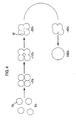
- silica flour particles 1 in the form of a dry flour are entrained in a first stream of oxygen 2 and transported to furnace 4 for heating into fused silica particles.
- a second stream of oxygen 2 and a stream of hydrogen 3 are introduced into furnace 4 and reacted to form a high temperature flame in a fusion zone.
- the entrained stream of silica flour particles 1 is introduced to the center of this high temperature flame.
- Silica flour particles 1 heat up almost instantaneously, soften, and form discrete fused silica particles of a higher density. These discrete particles will collide with one another and form surface-bonded aggregates of particles that are less than 25%, preferably less than about 10% coalesced by volume (see Figure 4).
- Fused silica particle aggregates exit furnace 4 and are collected in aggregate collection stage 5.
- the aggregates are collected and passed to grinding stage 6 for size reduction.
- Autogenous grinding in a lined grinder is preferred to maintain the purity of the fused silica particles.
- An organic liner assures that any materials introduced into the ground material can be removed such as by calcining.
- Optional calciner 7 at 500°-1000°C will burn off organic contaminants that may be present in the final material.
- Size classifier 8 separates the particles of desired size 9 from oversized and undersized particles. Large particles and aggregates may be returned via recycle line 10 to grinding stage 6 for further size reduction.
- Figure 2 illustrates a concentric feed arrangement for fusion furnace 4.
- Silica flour particles entrained in first stream of oxygen 2 are introduced into center 11 of a concentrically fed flame.
- Hydrogen 3 is presented to the flame from first annular passage 12. Because the hydrogen is completely converted in the flame, its flow rate can be used to control the flame temperature.
- the second stream of oxygen 2 is fed to the flame in outermost annular passage 13.
- FIG 3 shows a side view of a fusion zone burner 14 coaxially disposed above collection zone 16.
- both burner 14 and collection zone 16 are cylindrical with different diameters.
- This difference will form annular area 15 between the stages.
- This annular area will be subjected to a venturi suction as the gases and glass particles pass through the flame and into the collection zone.
- annular area 15 is open to the relatively cooler ambient air. The air taken in will cool the heated and aggregating particles quickly and without the need for a pressurized cooling gas line.
- a line may be used instead of or in addition to a venturi intake, though.
- Appropriate cooling means will be determined by the particular apparatus used, the flame temperature, and the silica flour feed rate.
- the flame temperature should be within a range from about 1600 to about 1900°C with a cooling stage temperature within a range from about 1000 to about 1200°C.
- the cooling stage may be used at a lower temperature so long as the aggregates according to the invention are produced.
- Mandrel 17 may be moved into collection zone 16 as needed for collection.
- Silica flour with the analysis shown in Table 1 was flame fused in an apparatus sketched in Figures 2 and 3. Silica flour was fed at 6.5 grams/min in a O2 carrier gas flow of 1.5 liters/min. Hydrogen and oxygen were fed as shown in Figure 2 at 26 and 15 liters/min, respectively.
- the fused silica particle aggregates were allowed to form on the walls of the collection zone (16 in Fig. 3) without the benefit of a mandrel.
- the fused, unaggregated silica was collected in a crucible below the aggregate collection zone. When aggregates became large enough to interfere with the flame in the collection zone, they were broken with a quartz rod and allowed to fall into the powder collection crucible.
- the fused silica aggregates were ground in an autogenous mill to produce 50 x 150 mesh size fused silica powder. Specifically, 261 grams of aggregated fused quartz were placed in a 9" O.D. x 12" height polyurethane-lined mill (Manufacturer: Paul O. Abbe, Inc., Little Falls, NJ) and tumbled for approximately 3 hours at 85% of its critical speed. Mill contents were then manually screened using plastic screens to collect -50, 50 x 150 and -150 mesh fractions. The following size distribution was obtained. 50 50 x 150 -150 Handling Loss Wt. % 28.7 45.1 23.3 3
Landscapes
- Chemical & Material Sciences (AREA)
- Engineering & Computer Science (AREA)
- Materials Engineering (AREA)
- Organic Chemistry (AREA)
- Life Sciences & Earth Sciences (AREA)
- Chemical Kinetics & Catalysis (AREA)
- General Chemical & Material Sciences (AREA)
- Geochemistry & Mineralogy (AREA)
- Manufacturing & Machinery (AREA)
- Silicon Compounds (AREA)
- Glass Melting And Manufacturing (AREA)
Applications Claiming Priority (2)
| Application Number | Priority Date | Filing Date | Title |
|---|---|---|---|
| US331692 | 1989-03-20 | ||
| US07/331,692 US5004488A (en) | 1989-03-20 | 1989-03-20 | Process for producing high purity fused quartz powder |
Publications (2)
| Publication Number | Publication Date |
|---|---|
| EP0389128A2 true EP0389128A2 (de) | 1990-09-26 |
| EP0389128A3 EP0389128A3 (de) | 1992-03-04 |
Family
ID=23294968
Family Applications (1)
| Application Number | Title | Priority Date | Filing Date |
|---|---|---|---|
| EP19900302149 Withdrawn EP0389128A3 (de) | 1989-03-20 | 1990-02-28 | Verfahren zur Herstellung von sehr reinem, geschmolzenem Quarzpulver |
Country Status (3)
| Country | Link |
|---|---|
| US (1) | US5004488A (de) |
| EP (1) | EP0389128A3 (de) |
| JP (1) | JPH0316925A (de) |
Cited By (1)
| Publication number | Priority date | Publication date | Assignee | Title |
|---|---|---|---|---|
| EP1076043A3 (de) * | 1999-08-13 | 2001-10-24 | Heraeus Quarzglas GmbH & Co. KG | Verfahren für die Herstellung dichter Quarzglas-Körnung |
Families Citing this family (10)
| Publication number | Priority date | Publication date | Assignee | Title |
|---|---|---|---|---|
| US5679315A (en) * | 1995-09-25 | 1997-10-21 | Nu-West Industries, Inc. | Method of production of high purity silica |
| FR2762836B1 (fr) | 1997-05-02 | 1999-07-23 | Alsthom Cge Alcatel | Procede et appareil de fabrication de preformes de fibre de verre |
| US6094940A (en) * | 1997-10-09 | 2000-08-01 | Nikon Corporation | Manufacturing method of synthetic silica glass |
| JP4112125B2 (ja) * | 1999-08-13 | 2008-07-02 | 電気化学工業株式会社 | 微細球状シリカ粉末の製造方法 |
| US8551457B2 (en) | 2008-11-25 | 2013-10-08 | The Procter & Gamble Company | Oral care compositions comprising spherical fused silica |
| MX2011005567A (es) | 2008-11-25 | 2012-01-25 | Procter & Gamble | Composiciones para el cuidado bucal con estetica mejorada y silicio fundido. |
| TWI539969B (zh) * | 2009-10-14 | 2016-07-01 | Sunstar Inc | Composition for oral use |
| AU2013337356B2 (en) | 2012-11-05 | 2016-12-08 | The Procter & Gamble Company | Heat treated precipitated silica |
| JP7232024B2 (ja) * | 2018-11-28 | 2023-03-02 | 太平洋セメント株式会社 | 無機酸化物中空粒子の製造方法 |
| JP7720849B2 (ja) * | 2020-01-24 | 2025-08-08 | オムヤ インターナショナル アクチェンゲゼルシャフト | 中空球状ガラス粒子の製造方法 |
Family Cites Families (32)
| Publication number | Priority date | Publication date | Assignee | Title |
|---|---|---|---|---|
| US1843792A (en) * | 1930-01-29 | 1932-02-02 | Gen Electric | Composite silica article |
| US1930340A (en) * | 1932-05-10 | 1933-10-10 | Gen Electric | Composite silica article and method of fabricating same |
| US2272342A (en) * | 1934-08-27 | 1942-02-10 | Corning Glass Works | Method of making a transparent article of silica |
| US2714227A (en) * | 1950-09-11 | 1955-08-02 | Corning Glass Works | Method of making fritted glass tubes |
| US2726487A (en) * | 1952-11-21 | 1955-12-13 | Gen Electric | Method for making fused vitreous quartz |
| US2859560A (en) * | 1956-10-02 | 1958-11-11 | Wald Ind Inc | Manufacture of spherical particles |
| US3181800A (en) * | 1957-07-26 | 1965-05-04 | Bolidens Gruv Ab | Method of comminuting materials by autogenous grinding in a continuous grinding mill |
| US3151964A (en) * | 1958-06-10 | 1964-10-06 | Glasrock Products | Process of manufacturing fused silica |
| NL284077A (de) * | 1961-10-20 | |||
| US3447962A (en) * | 1965-12-13 | 1969-06-03 | William John Megowen | Method of agglomerating |
| DE1596654A1 (de) * | 1966-07-29 | 1971-03-11 | Siemens Ag | Verfahren zur thermischen Oberflaechenbehandlung von Teilchen aus kristallisiertem Material und Vorrichtung hierfuer |
| US3533756A (en) * | 1966-11-15 | 1970-10-13 | Hercules Inc | Solids arc reactor method |
| GB1156066A (en) * | 1967-03-23 | 1969-06-25 | Pilkington Brothers Ltd | Improvements in or relating to the Production of Powdered Cristobalite. |
| US3762936A (en) * | 1967-07-31 | 1973-10-02 | Du Pont | Manufacture of borosilicate glass powder essentially free of alkali and alkaline earth metals |
| US3535890A (en) * | 1967-10-26 | 1970-10-27 | Corning Glass Works | Method of making fused silica |
| US3497142A (en) * | 1968-10-10 | 1970-02-24 | Dominion Eng Works Ltd | Autogenous grinding process and mill systems |
| US3838998A (en) * | 1971-01-07 | 1974-10-01 | R Carson | Process for forming hollow glass micro-spheres from admixed high and low temperature glass formers |
| US3801294A (en) * | 1971-12-15 | 1974-04-02 | Corning Glass Works | Method of producing glass |
| US3806570A (en) * | 1972-03-30 | 1974-04-23 | Corning Glass Works | Method for producing high quality fused silica |
| US4010242A (en) * | 1972-04-07 | 1977-03-01 | E. I. Dupont De Nemours And Company | Uniform oxide microspheres and a process for their manufacture |
| US3859073A (en) * | 1973-10-19 | 1975-01-07 | Corning Glass Works | Method of producing glass by flame hydrolysis |
| US3864113A (en) * | 1973-10-19 | 1975-02-04 | Corning Glass Works | Method of Producing Glass by Flame Hydrolysis |
| DD108724A1 (de) * | 1973-12-27 | 1974-10-05 | ||
| GB1568817A (en) * | 1975-11-13 | 1980-06-04 | Sovitec Sa | Glass-former comp |
| JPS542654A (en) * | 1977-06-08 | 1979-01-10 | Toshiba Corp | Forming method for florescent screen of color picture tube |
| JPS5471650A (en) * | 1977-11-18 | 1979-06-08 | Komatsu Denshi Kinzoku Kk | Method of fabricating high purity transparent quartz glass tube |
| SU914513A1 (ru) * | 1980-05-19 | 1982-03-23 | Samostoyatelnoe Kt B Proekt Pr | Способ изготовления стеклянных шариков1 |
| US4465656A (en) * | 1981-08-19 | 1984-08-14 | Hughes Aircraft Company | Process for preparation of water-free oxide material |
| EP0151490B1 (de) * | 1984-02-09 | 1991-01-16 | Toyota Jidosha Kabushiki Kaisha | Verfahren zur Herstellung von ultrafeinen Keramikpartikeln |
| NL8502133A (nl) * | 1985-07-26 | 1987-02-16 | Unie Van Kunstmestfab Bv | Werkwijze voor het bereiden van granules en granules verkregen met deze werkwijze. |
| US4755368A (en) * | 1986-06-26 | 1988-07-05 | Ulrich Research & Consulting, Inc. | Silica fillers from silicon powder |
| EP0259844A3 (de) * | 1986-09-08 | 1988-09-21 | GTE Products Corporation | Feine sphärische Pulverteilchen und Verfahren zu ihrer Herstellung |
-
1989
- 1989-03-20 US US07/331,692 patent/US5004488A/en not_active Expired - Lifetime
-
1990
- 1990-02-28 EP EP19900302149 patent/EP0389128A3/de not_active Withdrawn
- 1990-03-20 JP JP2071789A patent/JPH0316925A/ja active Pending
Cited By (2)
| Publication number | Priority date | Publication date | Assignee | Title |
|---|---|---|---|---|
| EP1076043A3 (de) * | 1999-08-13 | 2001-10-24 | Heraeus Quarzglas GmbH & Co. KG | Verfahren für die Herstellung dichter Quarzglas-Körnung |
| US6360563B1 (en) | 1999-08-13 | 2002-03-26 | Heraeus Quarzglas Gmbh & Co. Kg | Process for the manufacture of quartz glass granulate |
Also Published As
| Publication number | Publication date |
|---|---|
| US5004488A (en) | 1991-04-02 |
| JPH0316925A (ja) | 1991-01-24 |
| EP0389128A3 (de) | 1992-03-04 |
Similar Documents
| Publication | Publication Date | Title |
|---|---|---|
| EP0734362B1 (de) | Brennen von feinkoernigen teilchen | |
| EP0389128A2 (de) | Verfahren zur Herstellung von sehr reinem, geschmolzenem Quarzpulver | |
| EP0352027B1 (de) | Verfahren zur Herstellung von reinen, dichten, amorphen synthetischen Kieselsäureteilchen | |
| EP0335875B1 (de) | Kieselglas | |
| CN102383194A (zh) | 多晶硅及其制造方法 | |
| EP0423490A1 (de) | Zerreibbarer Katalysator und Verfahren zu seiner Herstellung | |
| WO2018229151A1 (en) | Preparation of a quartz glass body | |
| CN104471013A (zh) | 喷砂用研磨材料及其制造方法 | |
| TW201736289A (zh) | 合成石英玻璃晶粒的製備 | |
| KR20110093804A (ko) | 실리콘 테트라할라이드와 실리콘을 수소화 처리하여 트리할로실란을 제조하는 장치 및 방법 | |
| CA2355862A1 (en) | Agglomeration of silicon powders | |
| EP1414601A2 (de) | Produkte zur herstellung von formen und kernen, die beim metallgiessen verwendet werden, verfahren zu deren herstellung und aufbereitung aus zerkleinertem gestein | |
| JP5077848B2 (ja) | 高強度ガラス質軽量フィラー材料 | |
| US4880541A (en) | Hot filter media | |
| US7255815B2 (en) | Titanium dioxide scouring media and method of production | |
| CN112844760B (zh) | 一种铸造镁砂回收再生系统 | |
| CN112262113A (zh) | 在制造高纯度氧化铝时高岭土的干式制备 | |
| JP3115162B2 (ja) | 石英ガラス粉の製造方法 | |
| TW202304811A (zh) | 二氧化矽粉末及其製造方法 | |
| US2347685A (en) | Bauxite process and product | |
| JPH02286B2 (de) | ||
| JPH0647479A (ja) | 人工鋳物砂およびその製造方法 | |
| JP4061902B2 (ja) | 多孔質炭酸カリウムの製造方法 | |
| KR950011832B1 (ko) | 무색소 이산화 티타늄 분말 제조 방법 | |
| JP2820865B2 (ja) | 石英ガラス発泡体の製造方法 |
Legal Events
| Date | Code | Title | Description |
|---|---|---|---|
| PUAI | Public reference made under article 153(3) epc to a published international application that has entered the european phase |
Free format text: ORIGINAL CODE: 0009012 |
|
| AK | Designated contracting states |
Kind code of ref document: A2 Designated state(s): AT BE CH DE DK ES FR GB GR IT LI LU NL SE |
|
| PUAL | Search report despatched |
Free format text: ORIGINAL CODE: 0009013 |
|
| AK | Designated contracting states |
Kind code of ref document: A3 Designated state(s): AT BE CH DE DK ES FR GB GR IT LI LU NL SE |
|
| 17P | Request for examination filed |
Effective date: 19920620 |
|
| 17Q | First examination report despatched |
Effective date: 19930112 |
|
| STAA | Information on the status of an ep patent application or granted ep patent |
Free format text: STATUS: THE APPLICATION IS DEEMED TO BE WITHDRAWN |
|
| 18D | Application deemed to be withdrawn |
Effective date: 19940125 |