EP0389992A2 - Dispositif pour l'analyse automatique de validité des donées d'examen médical - Google Patents
Dispositif pour l'analyse automatique de validité des donées d'examen médical Download PDFInfo
- Publication number
- EP0389992A2 EP0389992A2 EP90105598A EP90105598A EP0389992A2 EP 0389992 A2 EP0389992 A2 EP 0389992A2 EP 90105598 A EP90105598 A EP 90105598A EP 90105598 A EP90105598 A EP 90105598A EP 0389992 A2 EP0389992 A2 EP 0389992A2
- Authority
- EP
- European Patent Office
- Prior art keywords
- medical examination
- data
- examination data
- neural network
- necessity
- Prior art date
- Legal status (The legal status is an assumption and is not a legal conclusion. Google has not performed a legal analysis and makes no representation as to the accuracy of the status listed.)
- Granted
Links
Images

Classifications
-
- G—PHYSICS
- G06—COMPUTING OR CALCULATING; COUNTING
- G06N—COMPUTING ARRANGEMENTS BASED ON SPECIFIC COMPUTATIONAL MODELS
- G06N3/00—Computing arrangements based on biological models
- G06N3/02—Neural networks
- G06N3/04—Architecture, e.g. interconnection topology
-
- G—PHYSICS
- G06—COMPUTING OR CALCULATING; COUNTING
- G06N—COMPUTING ARRANGEMENTS BASED ON SPECIFIC COMPUTATIONAL MODELS
- G06N3/00—Computing arrangements based on biological models
- G06N3/02—Neural networks
- G06N3/04—Architecture, e.g. interconnection topology
- G06N3/0499—Feedforward networks
-
- G—PHYSICS
- G06—COMPUTING OR CALCULATING; COUNTING
- G06N—COMPUTING ARRANGEMENTS BASED ON SPECIFIC COMPUTATIONAL MODELS
- G06N3/00—Computing arrangements based on biological models
- G06N3/02—Neural networks
- G06N3/08—Learning methods
- G06N3/09—Supervised learning
-
- G—PHYSICS
- G16—INFORMATION AND COMMUNICATION TECHNOLOGY [ICT] SPECIALLY ADAPTED FOR SPECIFIC APPLICATION FIELDS
- G16H—HEALTHCARE INFORMATICS, i.e. INFORMATION AND COMMUNICATION TECHNOLOGY [ICT] SPECIALLY ADAPTED FOR THE HANDLING OR PROCESSING OF MEDICAL OR HEALTHCARE DATA
- G16H15/00—ICT specially adapted for medical reports, e.g. generation or transmission thereof
-
- G—PHYSICS
- G16—INFORMATION AND COMMUNICATION TECHNOLOGY [ICT] SPECIALLY ADAPTED FOR SPECIFIC APPLICATION FIELDS
- G16H—HEALTHCARE INFORMATICS, i.e. INFORMATION AND COMMUNICATION TECHNOLOGY [ICT] SPECIALLY ADAPTED FOR THE HANDLING OR PROCESSING OF MEDICAL OR HEALTHCARE DATA
- G16H50/00—ICT specially adapted for medical diagnosis, medical simulation or medical data mining; ICT specially adapted for detecting, monitoring or modelling epidemics or pandemics
- G16H50/20—ICT specially adapted for medical diagnosis, medical simulation or medical data mining; ICT specially adapted for detecting, monitoring or modelling epidemics or pandemics for computer-aided diagnosis, e.g. based on medical expert systems
Definitions
- the present invention relates to an apparatus for automatically analyzing validity of medical examination data obtained by an examination of an object to be examined, which determines whether re-examination is necessary or not, automatically.
- whether there is any error in the medical examination data is determined by observing a pattern of the medical examination data values for a particular medical examination and comparing this pattern with patterns of the medical examination data values previously obtained for the same particular medical examination, in which the medical examination data are considered erroneous when the pattern of the medical examination data values is infrequently encountered one.
- the medical examination data having an infrequently encountered pattern are not necessarily erroneous.
- the medical examination data having a frequently encountered pattern are not always without an error.
- the accuracy of the decision of the validity has been rather low in a conventional apparatus, and a conventional apparatus has been practically too unreliable.
- an apparatus for automatically analyzing validity of medical examination data by making an assessment of a necessity of re-examination comprising: means for collecting the medical examination data; neural network for learning human judgements for the necessity of re-examination from previously collected sets of medical examination data accompanied with corresponding teacher data indicating whether re-examination was performed for each set of medical examination data, and for making an assessment of the necessity of re-examination for each set of the medical examination data collected by the collecting means, in accordance with the human judgements for the necessity of re-examination learned.
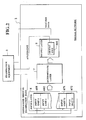
- FIG. 1 there is shown one embodiment of an apparatus for automatically analyzing validity of medical examination data according to the present invention.
- the apparatus comprises an medical examination equipment 1 for medically examining an object to be examined, processing data obtained from the object to be examined, and producing a result of a medical examination in terms of medical examination data, a neural network 2 for making an assessment for a necessity of re-examination by analyzing validity of the medical examination data and learning previous analyses in order to improve an accuracy of the assessment, a memory device 3 for memorizing the medical examination data and teacher data to accompany the medical examination data, both of which are to be utilized in a process of learning by the neural network 2, a CRT 4 for displaying the assessment made by the neural network 2 for the sake of inspection by an operator P, and a keyboard 5 for allowing the operator P to indicate his judgement for the necessity of the re-examination.
- an medical examination equipment 1 for medically examining an object to be examined, processing data obtained from the object to be examined, and producing a result of a medical examination in terms of medical examination data
- a neural network 2 for making an assessment for a necessity of re-examination by analyzing
- each set of the medical examination data comprises 36 items.
- the neural network 2 in this apparatus has a triple layer structure comprising an input layer 6, an intermediate layer 7, and an output layer 8, and in this case the input layer 6 is equipped with 72 input units 601-672, while the output layer 8 is equipped with only one output unit 801.
- the intermediate layer 7 may be equipped with much greater number of units such as 200 units for example.
- the input units 601-672 are assumed to be those capable of inputting continuously varying values between 0 and 1, while the output units 801 is assumed to be that capable of outputting continuously varying value between 0 and 1.
- an initial learning must be carried out on the neural network 2 using an appropriate number of the medical examination data and accompanying teacher data which indicates whether the re-examination is performed or not for these particular medical examination data. This initial learning will be described in detail below.
- the apparatus operates as follows.
- the medical examination equipment 1 normalizes the collected medical examination data to obtain normalized medical examination data within a range between 0 and 1, and supply these normalized medical examination data to the neural network 2.
- the normalized medical examination data to be given to the neural network 2 are obtained by the medical examination equipment 1 as follows.
- the normalization is carried out independently for each item of a set of the medical examination data.
- any monotonously increasing function may be utilized for the normalization, but it is generally more preferable to have as wide a dynamic range for the normalization as possible.
- the medical examination data may differ for a normal person and for a sick person by an order of several hundred. In such a case, it is desirable to use logarithmic function for the normalization.
- a case using a linear function for the normalization will be elaborated.
- the normalization is achieved by using the following linear function: where X is a value before the normalization, C is a normalized value, A is an expectation value for the maximum, B is an expectation value for the minimum, and d is a coefficient specifying a lower bound.
- the upper bound is set equal to 1 in this embodiment.
- the coefficient d is set equal to 0.2, all the normalized values fall within a range between 0.2 and 1.
- the medical examination equipment 1 In addition to calculating the normalized medical examination data as described above, the medical examination equipment 1 also generates additional data indicating the presence or absence of each item of a set of the medical examination data. Namely, certain items of a set of the medical examination data may be missing because they were not collected as being unnecessary for that particular examination. Thus, for 36 items of a set of the medical examination data in this embodiment, the medical examination equipment 1 generates 36 additional data, each of which is given a value of either 1 indicating the presence of the medical examination data for a particular item, or 0 indicating the absence of the medical examination data for a particular item. Such additional data provide information required by the neural network 2 in arriving at correct assessment, as the assessment to be made relies on which items of a set of the medical examination data have been measured.
- the input units 601-672 of the neural network 2 are provided in correspondence with these 36 items of the medical examination data and 36 additional data, such that the first 36 input units 601-636 receive 36 medical examination data of 36 different items, while the second 36 input units 637-372 receive 36 additional data for 36 different items.
- the neural network 2 When these medical examination data and the additional data are supplied to the input units 601-672 of the neural network 2 as input data, the neural network 2 operates on these input data, makes the assessment for the necessity of re-examination in accordance with human judgements learned at the initial learning, and returns the assessment to the examination equipment 1.
- the assessment is given in a form of a number between 0 and 1, where 0 indicates that the re-examination is absolutely not necessary, while 1 indicates that the re-examination is absolutely necessary.
- This assessment is either shown directly to the operator P through the CRT 4 for his inspection, or else further final judgement is derived from this assessment at the medical examination equipment 1 in such a manner for example that the re-examination is judged necessary when the assessment from the neural network 2 falls within a range of 0.7 to 1, whereas the re-examination is judged unnecessary when the assessment from the neural network 2 falls within a range of 0 to 0.3, and the judgement is indeterminate when the assessment from the neural network 2 falls within a range of 0.3 to 0.7 in which case the judgement is entrusted to the discretion of the operator P.
- the operator P operates the apparatus to perform the re-examination.
- the learning is performed by the backward error propagation algorithm of Rumelhart, and the learning process is iterated until an error becomes lower than a prescribed level.
- 100,000 sets of the medical examination data and the corresponding teacher data may be collected and compiled in the memory device 3, memorized in an order of acquisition of these medical examination data.
- the normalized medical examination data and the corresponding additional data are calculated for each set of the medical examination data by the medical examination equipment 1 as described above, and are given to the input units 601-672 of the neural network 2, while the accompanying teacher data for this set of the medical examination data are given to the output unit 801 of the neural network 2.
- the learning according to the backward error propagation algorithm is carried out. This process is repeated for all of 100,000 sets of the medical examination data and accompanying teacher data, and is iterated until an error become lower than a prescribed level.
- the neural network 2 utilizes only a single set of weights.
- the memory device 3 can be utilized for the purpose of re-learning as follows.
- the teacher data accompanying these medical examination data are modified in accordance with the final judgement given by the operator P, and the medical examination data and the modified teacher data for the neural network 2 are memorized in the memory device 3.
- such a memorization of the medical examination data and the teacher data may be carried out selectively for only a predetermined number of the medical examination data and the teacher data.
- the memory device 3 as many of the medical examination data and the corresponding teacher data as a full storage capacity of the memory device 3 are initially compiled, as the learning data for the initial learning of the neural network 2, which are arranged in an order of acquisition of these medical examination data.
- the assessment made by the neural network 2 is corrected at the keyboard 5 by the operator P, the oldest of the medical examination data and the corresponding teacher data memorized in the memory device 3 are released from the memory device 3 and the medical examination data and the corresponding teacher data with respect to which the assessment made by the neural network 2 has been corrected are newly memorized in the memory device 3.
- a re-learning of the neural network 2 When a number of newly memorized medical examination data and corresponding teacher data reaches a predetermined number, a re-learning of the neural network 2 will be carried out.
- the re-learning of the neural network 2 may also be carried out when the previous learning is considered insufficient, when the learning data at the previous learning are considered biased, when the configuration of the medical examination equipment 1 is modified, or when the examination to be performed is modified.
- an apparatus for automatically analyzing validity of medical examination data capable of making accurate assessment for the necessity of the re-examination, reflecting the characteristics of each examination apparatus, examination itself, and operator.
- the accuracy of the assessment for the necessity of the re-examination can further be improved through the learning of the neural network, even when the operational circumstances are changed.
- each group can be devised very freely by simply combining as many as necessary number of items.
- the same item may belong to more than one group, and one group may entirely overlap with a part of another group. All the combination not to be utilized may be considered as forming one group.
- the medical examination data and the learning data are classified into groups, and the groups are memorized separately in the memory device 3.
- this particular item is considered missing.
- this particular item of the medical examination data belonging to more than one group is collected, this particular item may be considered as a member of one group to which it belongs and which has fewest missing members.
- the learning as well as assessment making by the neural network 2 are also carried out for each group separately.
- the neural network 2 utilizes different sets of weights for different groups.
- a number of newly memorized medical examination data and corresponding teacher data reaches a predetermined number within a particular group, a re-learning of the neural network 2 will be carried out for such a particular group.
- a plurality of independent neural networks may be provided for each distinctive group.
- the input units 601-672 of the neural network 2 may be modified as follows, when a very wide dynamic range for the normalization is required.
- a compression of the medical examination data into values within a range between 0 and 1 may cause a poor accuracy for the medical examination data.
- more than one input units of the neural network 2 may be assigned to a single item of a set of the medical examination data.
- a range for values of a particular item of a set of the medical examination data may be divided into the following three sections: B ⁇ X ⁇ A1 normal A1 ⁇ X ⁇ A2 large A2 ⁇ X ⁇ A very large and three input units R, S, and T may be assigned for each of these sections, respectively.
- the normalization may be carried out as follows.
- the normalization can be achieved by using the following linear function: where X is a value before the normalization, Cr is a normalized value for the input unit R, A1 is a border between the normal and large sections, B is an expectation value for the minimum, and d is a coefficient specifying a lower bound. The upper bound is set equal to 1 as before. When the data is in this range, the input units S and T are given a value of 0.
- the normalization can be achieved by using the following linear function: where X is a value before the normalization, Cs is a normalized value for the input unit S, A1 is a border between the normal and large sections, A2 is a border between the large and very large sections, and d is a coefficient specifying a lower bound.
- the upper bound is set equal to 1 as before.
- the normalization can be achieved by using the following linear function: where X is a value before the normalization, Ct is a normalized value for the input unit T, A is an expectation value for the maximum, A2 is a border between the large and very large sections, and d is a coefficient specifying a lower bound.
- the upper bound is set equal to 1 as before.
- a number of input units to be assigned to an item may vary from one item to another.
- a formula for the normalization may be different for different input units assigned to the same item.
- the normal values can be treated by the linear function as described above, while the very large values are treated by a logarithmic function. It is to be also noted that even when the number of input units for the medical examination data is increased as above, a single input unit is sufficient for each additional data to be generated in conjunction with each item of a set of the medical examination data.
- each one of the input units 601-672 which are assumed to be those capable of inputting continuously varying values between 0 and 1, and the output units 801 which is assumed to be that capable of outputting continuously varying value between 0 and 1 may be replaced by a plurality of units capable of dealing only with discrete values which are assigned to different ranges of data values for each medical examination data.
- a data value for each medical examination data may be divided into five ranges, such as 0 to 0.2, 0.2 to 0.4, 0.4 to 0.6, 0.6 to 0.8, 0.8 to 1, and five units may be assigned to each of such a range to indicate which one of these ranges does the data value fall.
- a type of the neural network and a learning algorithm described above may be replaced by other known type of the neural network and the learning algorithm so long as the substantially the same effect as described above is realizable by them.
Landscapes
- Engineering & Computer Science (AREA)
- Health & Medical Sciences (AREA)
- Theoretical Computer Science (AREA)
- Physics & Mathematics (AREA)
- Biomedical Technology (AREA)
- General Health & Medical Sciences (AREA)
- Data Mining & Analysis (AREA)
- General Physics & Mathematics (AREA)
- Public Health (AREA)
- Evolutionary Computation (AREA)
- Biophysics (AREA)
- Molecular Biology (AREA)
- Computing Systems (AREA)
- General Engineering & Computer Science (AREA)
- Artificial Intelligence (AREA)
- Mathematical Physics (AREA)
- Software Systems (AREA)
- Life Sciences & Earth Sciences (AREA)
- Computational Linguistics (AREA)
- Medical Informatics (AREA)
- Epidemiology (AREA)
- Primary Health Care (AREA)
- Databases & Information Systems (AREA)
- Pathology (AREA)
- Medical Treatment And Welfare Office Work (AREA)
- Measuring And Recording Apparatus For Diagnosis (AREA)
- Testing Or Calibration Of Command Recording Devices (AREA)
- Automatic Analysis And Handling Materials Therefor (AREA)
Applications Claiming Priority (2)
| Application Number | Priority Date | Filing Date | Title |
|---|---|---|---|
| JP1078610A JPH02259421A (ja) | 1989-03-31 | 1989-03-31 | 自動分析装置 |
| JP78610/89 | 1989-03-31 |
Publications (3)
| Publication Number | Publication Date |
|---|---|
| EP0389992A2 true EP0389992A2 (fr) | 1990-10-03 |
| EP0389992A3 EP0389992A3 (fr) | 1991-07-17 |
| EP0389992B1 EP0389992B1 (fr) | 1994-08-31 |
Family
ID=13666651
Family Applications (1)
| Application Number | Title | Priority Date | Filing Date |
|---|---|---|---|
| EP90105598A Expired - Lifetime EP0389992B1 (fr) | 1989-03-31 | 1990-03-23 | Dispositif pour l'analyse automatique de validité des donées d'examen médical |
Country Status (3)
| Country | Link |
|---|---|
| EP (1) | EP0389992B1 (fr) |
| JP (1) | JPH02259421A (fr) |
| DE (1) | DE69011917T2 (fr) |
Cited By (3)
| Publication number | Priority date | Publication date | Assignee | Title |
|---|---|---|---|---|
| EP0555591A1 (fr) * | 1991-12-27 | 1993-08-18 | Toa Medical Electronics Company, Limited | Appareil de diagnose pour infarction cérébrale |
| EP0778537A3 (fr) * | 1995-12-06 | 1997-07-02 | TOA MEDICAL ELECTRONICS CO., Ltd. | Appareil de vérification des déterminations des analyses cliniques |
| US8676510B2 (en) * | 2003-07-18 | 2014-03-18 | A&T Corporation | Clinical-result confirming device, clinical-result confirming method, and computer program therefor |
Families Citing this family (3)
| Publication number | Priority date | Publication date | Assignee | Title |
|---|---|---|---|---|
| JP7371906B2 (ja) * | 2019-12-20 | 2023-10-31 | 東海電子株式会社 | ガス分析システムおよびプログラム |
| JP7443815B2 (ja) * | 2020-02-25 | 2024-03-06 | 東ソー株式会社 | 統計的手法によるクロマトグラムの分類方法 |
| JP7431709B2 (ja) * | 2020-09-28 | 2024-02-15 | 株式会社日立ハイテク | 自動分析装置 |
Family Cites Families (1)
| Publication number | Priority date | Publication date | Assignee | Title |
|---|---|---|---|---|
| US4202033A (en) * | 1977-12-27 | 1980-05-06 | Royco Instruments, Inc. | Apparatus and method utilizing calculator for quality control of hematology sample analysis |
-
1989
- 1989-03-31 JP JP1078610A patent/JPH02259421A/ja active Pending
-
1990
- 1990-03-23 DE DE69011917T patent/DE69011917T2/de not_active Expired - Fee Related
- 1990-03-23 EP EP90105598A patent/EP0389992B1/fr not_active Expired - Lifetime
Cited By (4)
| Publication number | Priority date | Publication date | Assignee | Title |
|---|---|---|---|---|
| EP0555591A1 (fr) * | 1991-12-27 | 1993-08-18 | Toa Medical Electronics Company, Limited | Appareil de diagnose pour infarction cérébrale |
| EP0778537A3 (fr) * | 1995-12-06 | 1997-07-02 | TOA MEDICAL ELECTRONICS CO., Ltd. | Appareil de vérification des déterminations des analyses cliniques |
| US5851487A (en) * | 1995-12-06 | 1998-12-22 | Toa Medical Electronics Co., Ltd. | Data checking apparatus |
| US8676510B2 (en) * | 2003-07-18 | 2014-03-18 | A&T Corporation | Clinical-result confirming device, clinical-result confirming method, and computer program therefor |
Also Published As
| Publication number | Publication date |
|---|---|
| DE69011917T2 (de) | 1995-05-18 |
| EP0389992B1 (fr) | 1994-08-31 |
| DE69011917D1 (de) | 1994-10-06 |
| EP0389992A3 (fr) | 1991-07-17 |
| JPH02259421A (ja) | 1990-10-22 |
Similar Documents
| Publication | Publication Date | Title |
|---|---|---|
| Cowley et al. | Methodological standards for the development and evaluation of clinical prediction rules: a review of the literature | |
| Lippmann et al. | Coronary artery bypass risk prediction using neural networks | |
| Kukar et al. | Analysing and improving the diagnosis of ischaemic heart disease with machine learning | |
| US5619990A (en) | Apparatus and method for making a medical diagnosis by discriminating attribution degrees | |
| Prorok | The theory of periodic screening I: Lead time and proportion detected | |
| Potchen | Measuring observer performance in chest radiology: some experiences | |
| Jonsdottir et al. | The feasibility of constructing a predictive outcome model for breast cancer using the tools of data mining | |
| EP0389992A2 (fr) | Dispositif pour l'analyse automatique de validité des donées d'examen médical | |
| US20260102122A1 (en) | Diagnostic tool | |
| Echevarria et al. | Learning human-understandable models for the health assessment of Li-ion batteries via Multi-Objective Genetic Programming | |
| KR102033484B1 (ko) | 적대적 인공지능 생성망 (gan)을 활용한 반려동물 검사의 정상범위 기준치 설정 방법 및 장치 | |
| Morise et al. | The effect of disease-prevalence adjustments on the accuracy of a logistic prediction model | |
| Kvalseth | A coefficient of agreement for nominal scales: An asymmetric version of Kappa | |
| KR950004454B1 (ko) | 근사 추론 장치 | |
| Raza et al. | Classifier fusion using dempster-shafer theory of evidence to predict breast cancer tumors | |
| CN116189909B (zh) | 基于推举算法的临床医学判别方法及系统 | |
| WO1997009678A1 (fr) | Systeme de diagnostic d'organes biologiques par utilisation d'un reseau neuronal reconnaissant une erreur aleatoire d'entree | |
| CN107122598B (zh) | 基于低差异度数列交叉检验的数据分类优化方法及系统 | |
| Forsström et al. | DIAGAID: a connectionist approach to determine the diagnostic value of clinical data | |
| CN116975297A (zh) | 一种用于评估临床试验风险的方法 | |
| Wanichsan et al. | A majority-density approach to developing testing and diagnostic systems with the cooperation of multiple experts based on an enhanced concept–effect relationship model | |
| CN113035364A (zh) | 一种小儿骨科患者体格评估的方法及系统 | |
| Taskforce | How I read an article that uses machine learning methods | |
| Afzal et al. | Type 2 Diabetes Mellitus Early Detection with Machine Learning-Based Prediction | |
| Voss et al. | A multinomial model for the quality control of colony counting procedures |
Legal Events
| Date | Code | Title | Description |
|---|---|---|---|
| PUAI | Public reference made under article 153(3) epc to a published international application that has entered the european phase |
Free format text: ORIGINAL CODE: 0009012 |
|
| 17P | Request for examination filed |
Effective date: 19900323 |
|
| AK | Designated contracting states |
Kind code of ref document: A2 Designated state(s): DE NL |
|
| PUAL | Search report despatched |
Free format text: ORIGINAL CODE: 0009013 |
|
| AK | Designated contracting states |
Kind code of ref document: A3 Designated state(s): DE NL |
|
| 17Q | First examination report despatched |
Effective date: 19930216 |
|
| GRAA | (expected) grant |
Free format text: ORIGINAL CODE: 0009210 |
|
| AK | Designated contracting states |
Kind code of ref document: B1 Designated state(s): DE NL |
|
| REF | Corresponds to: |
Ref document number: 69011917 Country of ref document: DE Date of ref document: 19941006 |
|
| PLBE | No opposition filed within time limit |
Free format text: ORIGINAL CODE: 0009261 |
|
| STAA | Information on the status of an ep patent application or granted ep patent |
Free format text: STATUS: NO OPPOSITION FILED WITHIN TIME LIMIT |
|
| 26N | No opposition filed | ||
| PGFP | Annual fee paid to national office [announced via postgrant information from national office to epo] |
Ref country code: NL Payment date: 20030327 Year of fee payment: 14 |
|
| PGFP | Annual fee paid to national office [announced via postgrant information from national office to epo] |
Ref country code: DE Payment date: 20030403 Year of fee payment: 14 |
|
| PG25 | Lapsed in a contracting state [announced via postgrant information from national office to epo] |
Ref country code: NL Free format text: LAPSE BECAUSE OF NON-PAYMENT OF DUE FEES Effective date: 20041001 Ref country code: DE Free format text: LAPSE BECAUSE OF NON-PAYMENT OF DUE FEES Effective date: 20041001 |
|
| NLV4 | Nl: lapsed or anulled due to non-payment of the annual fee |
Effective date: 20041001 |