EP0390512A2 - Méthode pour texturer un substrat en verre - Google Patents
Méthode pour texturer un substrat en verre Download PDFInfo
- Publication number
- EP0390512A2 EP0390512A2 EP90303274A EP90303274A EP0390512A2 EP 0390512 A2 EP0390512 A2 EP 0390512A2 EP 90303274 A EP90303274 A EP 90303274A EP 90303274 A EP90303274 A EP 90303274A EP 0390512 A2 EP0390512 A2 EP 0390512A2
- Authority
- EP
- European Patent Office
- Prior art keywords
- substrate
- polishing step
- texturing
- chemical
- glass
- Prior art date
- Legal status (The legal status is an assumption and is not a legal conclusion. Google has not performed a legal analysis and makes no representation as to the accuracy of the status listed.)
- Ceased
Links
Images


Classifications
-
- G—PHYSICS
- G11—INFORMATION STORAGE
- G11B—INFORMATION STORAGE BASED ON RELATIVE MOVEMENT BETWEEN RECORD CARRIER AND TRANSDUCER
- G11B5/00—Recording by magnetisation or demagnetisation of a record carrier; Reproducing by magnetic means; Record carriers therefor
- G11B5/84—Processes or apparatus specially adapted for manufacturing record carriers
- G11B5/8404—Processes or apparatus specially adapted for manufacturing record carriers manufacturing base layers
Definitions
- This invention relates to a method of texturing a glass substrate for use in manufacture of a magnetic disk.
- One method of manufacturing a magnetic disk comprises the steps of texturing a glass substrate, depositing a magnetic film on the glass substrate depositing a protective layer on the magnetic film, and applying a lubricant to the protective layer.
- One reason for texturing the substrate is to reduce the friction between the magnetic disk and a read/write head used in conjunction with the disk.
- U.S. Patent Application 07/105,612 incorporated herein by reference, discloses a method of texturing a glass substrate using chemical etching. During chemical etching, the glass substrate is subjected to either a gaseous or an aqueous etching medium comprising HF.
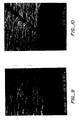
- Figure 9 of the accompanying drawings is a SEM photograph of a portion of a glass surface etched by a gaseous etching medium. Porous reaction products are shown having a thickness almost equal to the etching depth, which consist of fluorides and contain very little silicon, form on the surface. It is believed that the major component of the glass (silicon atoms) reacts with the etchant and forms gaseous SiF4, which is released from blowholes which dot the etched glass surface.
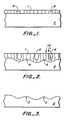
- FIGS 1-3 of the accompanying drawings illustrate a glass substrate during the etching process described in U.S. Patent Application 07/105,612.
- a porous chemical compound barrier 1 consisting of a skeletal or sponge-like compound, and blowholes 6 form on the surface of glass substrate 2.
- the barrier material 1 acts as a permeable mask during chemical etching.
- mountains 3 are formed beneath material 1 as shown in Fig. 2 and valleys form below blowholes 6.
- Material 1 is removed after etching by rinsing substrate 2 with water, thereby leaving the profile illustrated in Fig. 3.
- mountains 3 generally have a height less than or equal to about 700 ⁇ at a reference length of 250 ⁇ m and greater than or equal to about 50 ⁇ at a reference length of 50 ⁇ m.
- reference length is also known as a "standard length”, which is defined in Japanese Industrial Standard B 0601-1982 “Definitions and Designations of Surface Roughness", incorporated herein by reference, and in the '612 patent application.
- the mountain pitches are between 0.1 and 50 ⁇ m.
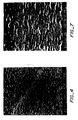
- the disk surface will include excessively high mountains around the microcrack or scratch such as the mountains illustrated in the SEM photograph of Fig. 4, which is observed with a 75° tilt angle.
- These mountains (hereinafter referred to as "linkage bumps”) have a height greater than the height of the other mountains on the substrate surface and can cause the resulting magnetic disk to fail a glide height test.
- linkage bumps have a height greater than the height of the other mountains on the substrate surface and can cause the resulting magnetic disk to fail a glide height test.
- ⁇ s static friction coefficient
- Figure 10 is a SEM photograph of the section of a glass surface with a scratch which was etched by a gaseous etching medium. Thick reaction products (e.g. masking material 1) are not formed over the scratch.
- masking material 5 (which is different in characteristics from that of masking material 1) tends to accumulate in the vicinity of microcracks such as microcrack 4 (see Fig. 5a).
- Masking material 5 masks the glass from the etchant more efficiently than masking material 1 elsewhere on the disk surface, thereby forming linkage bump 7.
- the glass substrate prior to chemically texturing a glass substrate, is subjected to an extra step of a gentle, mechanical polishing process or a pre-etch chemical polishing process or a combination of both to eliminate microcracks or change the morphology of microcracks in the substrate surface and to thereby eliminate or reduce the problem of linkage bumps.
- a glass substrate is polished and textured.
- the glass substrate can have a composition such as discussed in U.S. Patent Application 07/105,612 or a composition as discussed in U.S. Patent Application 07/230,210, also incorporated herein by reference.
- a magnetic alloy e.g., a cobalt alloy or an iron alloy
- a non-magnetic underlayer such as chromium or a nickel-phosphorus alloy underlayer, which is deposited on the glass substrate prior to the deposition of the magnetic alloy.
- a hard protective layer such as a hard carbon layer is formed on the magnetic alloy.
- the outer edge of the substrate Prior to chemical etching, the outer edge of the substrate is washed carefully. If this washing step is not performed, glass chips come off the substrate edges during a mechanical polishing step, described below, thereby forming microcracks or scratches and then forming linkage bumps. Thereafter, the substrate is subjected to mechanical polishing, e.g., using a soft polyurethane polish pad such as DOMY, manufactured by Dai-Ichi Lace Mfg. Co., Ltd. of Kyoto, Japan, used in conjunction with CeO2 particles having an average diameter of 1.0 microns or less, under a pressure of 30 to 70 grams/cm2.
- a soft polyurethane polish pad such as DOMY, manufactured by Dai-Ichi Lace Mfg. Co., Ltd. of Kyoto, Japan
- the polishing apparatus used for this step can be machine model number MDS-13015P4 or SFPL-168-5P, each manufactured by Speedfam Co., Ltd. Alternatively, device number DSPM-1200M manufactured by Toshiba Machine Co. can also be used.
- the disk can be subjected to a pre-etch chemical polishing step in which the glass substrate is placed in a pre-etching solution comprising 0.01 to 1 wt % H2SO4 and 0.01 to 0.2 wt % HF. The disks are typically placed in this solution for 2 to 10 minutes at room temperature.
- the substrate can be subjected to a mechanical polishing step, and then to a pre-etch chemical polishing step as described above.
- Figures 6a and 6b illustrate a glass substrate 11 including a microcrack 12 before and after being placed in a pre-etch chemical polishing solution.
- a pre-etch chemical polishing solution approximately 60 to 500 ⁇ of the glass are removed.
- Figure 7 illustrates a SEM photograph, with a 75° tilting angle, of a textured glass disk after the chemical texturing process. Because of the pre-texturing chemical or mechanical polishing step, the substrate of Fig. 7 includes no high linkage bumps.
- Figure 8 illustrates the relation between the height of linkage bumps and the amount of glass removed during the pre-etch chemical polishing step.
- the glass substrates used for these experiments were polished with coarse CeO2 powder (mean particle diameter of 2 microns) without above-described gentle mechanical polishing process.
- linkage bumps of 100 to 800 ⁇ height and an average height of 390 ⁇ were found on the substrate surface (see the Comparison Test in Table 1 below).
- another substrate was subjected to a pre-etch chemical polishing step (after mechanical polishing with coarse CeO2) during which the substrate was etched to a depth of 80 ⁇ by soaking the substrate in a solution comprising 0.05 wt % HF and 0.05 wt 1 % H2SO4 for 6 minutes at 35°C. After chemical texturing, no linkage bumps exceeding a height of 400 ⁇ were found, and the average height of the linkage bumps was about 200 ⁇ .
- Table 1 contains data concerning the heights of linkage bumps formed on glass substrates after chemical texturing.
- the tests in Table 1 were performed by using glass substrates made of sodium borosilicate glass containing about 72% by weight of SiO2. The outer diameter and thickness of the disks were 130 mm and 1.9 mm, respectively.
- the disks were processed as described above. Chemical texturing was accomplished by blowing nitrogen gas including 0.2% by volume SF and 0.2% by volume H2O for two minutes against the dry glass substrate heated to approximately 40°C. The substrate was then washed and dried, and data concerning linkage bumps was taken.
- Test 2 was subjected to the coarse mechanical polishing described above, then a gentle mechanical polishing step as described above, cleaned, dried thoroughly and then chemically textured.
- the substrate in Test 3 was polished in the same way as in Test 2 and was subjected to an additional chemical polishing step during which the substrate was pre-etched to a 280 ⁇ depth. Thereafter, the substrate was cleaned, dried and then chemically textured.
- an H2SO4 concentration between 0.01 and 10 wt.%, and an HF concentration between 0.01 and 1 wt. % can be used.
- the etching time may be between 30 seconds and 10 minutes, and the temperature of the solution may be between 10 and 40°C.
- a NaOH aqueous solution, an HN4F aqueous solution, an HF aqueous solution, an H2SiF6 aqueous solution, or other glass etchant solution can be used in place of a HF-H2SO4 solution. Accordingly, all such changes come within the present invention.
Landscapes
- Engineering & Computer Science (AREA)
- Manufacturing & Machinery (AREA)
- Manufacturing Of Magnetic Record Carriers (AREA)
Applications Claiming Priority (2)
| Application Number | Priority Date | Filing Date | Title |
|---|---|---|---|
| US329993 | 1989-03-29 | ||
| US07/329,993 US5087481A (en) | 1986-10-09 | 1989-03-29 | Method for texturing a magnetic disk silicate glass substrate |
Publications (2)
| Publication Number | Publication Date |
|---|---|
| EP0390512A2 true EP0390512A2 (fr) | 1990-10-03 |
| EP0390512A3 EP0390512A3 (fr) | 1991-10-02 |
Family
ID=23287879
Family Applications (1)
| Application Number | Title | Priority Date | Filing Date |
|---|---|---|---|
| EP19900303274 Ceased EP0390512A3 (fr) | 1989-03-29 | 1990-03-28 | Méthode pour texturer un substrat en verre |
Country Status (2)
| Country | Link |
|---|---|
| EP (1) | EP0390512A3 (fr) |
| JP (1) | JPH03245322A (fr) |
Cited By (2)
| Publication number | Priority date | Publication date | Assignee | Title |
|---|---|---|---|---|
| GB2303811A (en) * | 1995-03-30 | 1997-03-05 | Ag Technology Corp | Method of manufacturing glass substrate for magnetic disk |
| WO2002076902A1 (fr) * | 2001-03-27 | 2002-10-03 | Showa Denko K.K. | Composition pour procede de texturation |
Families Citing this family (3)
| Publication number | Priority date | Publication date | Assignee | Title |
|---|---|---|---|---|
| JP3669457B2 (ja) | 1996-03-19 | 2005-07-06 | 富士通株式会社 | 磁気記録媒体及びその製造方法 |
| US6530258B2 (en) * | 2001-07-23 | 2003-03-11 | International Business Machines Corporation | Disk drive laser melt bump disk for accurate glide calibration and certification processing |
| JP2012056828A (ja) * | 2010-09-13 | 2012-03-22 | Asahi Glass Co Ltd | ガラスの製造方法 |
Family Cites Families (2)
| Publication number | Priority date | Publication date | Assignee | Title |
|---|---|---|---|---|
| JPS6243819A (ja) * | 1985-08-22 | 1987-02-25 | Tdk Corp | 磁気記録媒体 |
| DE3789932T2 (de) * | 1986-10-09 | 1995-02-09 | Asahi Glass Co Ltd | Glassubstrat für eine Magnetplatte und Verfahren zu seiner Herstellung. |
-
1990
- 1990-03-22 JP JP6967090A patent/JPH03245322A/ja active Pending
- 1990-03-28 EP EP19900303274 patent/EP0390512A3/fr not_active Ceased
Cited By (3)
| Publication number | Priority date | Publication date | Assignee | Title |
|---|---|---|---|---|
| GB2303811A (en) * | 1995-03-30 | 1997-03-05 | Ag Technology Corp | Method of manufacturing glass substrate for magnetic disk |
| GB2303811B (en) * | 1995-03-30 | 1998-10-21 | Ag Technology Corp | Method for producing a glass substrate for a magnetic disk |
| WO2002076902A1 (fr) * | 2001-03-27 | 2002-10-03 | Showa Denko K.K. | Composition pour procede de texturation |
Also Published As
| Publication number | Publication date |
|---|---|
| EP0390512A3 (fr) | 1991-10-02 |
| JPH03245322A (ja) | 1991-10-31 |
Similar Documents
| Publication | Publication Date | Title |
|---|---|---|
| US5087481A (en) | Method for texturing a magnetic disk silicate glass substrate | |
| JP4432199B2 (ja) | 磁気媒体用のガラス基体の製造方法 | |
| JPH04216377A (ja) | 固定磁気ディスク装置用ヘッドコアスライダ | |
| JP4185266B2 (ja) | 情報記録媒体用基板の製造方法 | |
| KR920001150B1 (ko) | 자기헤드의 제조방법 | |
| US5162073A (en) | Textured air bearing surface | |
| US20060062129A1 (en) | Glass substrate for information recording medium and method for manufacturing same | |
| US20020142707A1 (en) | Glass substrate for magnetic recording medium, production method thereof, and magnetic recording medium using the substrate | |
| JP2003272336A (ja) | 磁気ディスク用ガラス製取付け部材およびその製造方法 | |
| EP0390512A2 (fr) | Méthode pour texturer un substrat en verre | |
| US6690544B2 (en) | Magnetic head and magnetic head manufacturing method | |
| US6521286B2 (en) | Method for manufacturing a magnetic recording medium | |
| JP3472687B2 (ja) | 磁気ディスク基板の製造方法 | |
| WO2004042709A1 (fr) | Substrat de verre pour support d'enregistrement et son procede de fabrication | |
| US6623652B1 (en) | Reactive ion etching of the lapped trailing edge surface of a slider | |
| US20060128154A1 (en) | Glass substrate for magnetic disk and its production process | |
| JP3912575B2 (ja) | 磁気記録媒体用ガラス基板の製造方法、及び磁気記録媒体の製造方法 | |
| JP2737901B2 (ja) | 磁気ディスク用ガラス基板の製造方法 | |
| JP2000348344A (ja) | 磁気記録媒体用ガラス基板の製造方法、及び磁気記録媒体の製造方法 | |
| KR20010107669A (ko) | 자기 기록 매체용 글라스 기판의 제조 방법 | |
| JPH11268932A (ja) | 磁気記録媒体用ガラス基板およびその製造方法 | |
| JP4723341B2 (ja) | 磁気記録媒体用ガラス基板および磁気ディスクの製造方法 | |
| WO2007037441A1 (fr) | Processus de fabrication de substrat de verre pour disque magnétique et processus de fabrication de disque magnétique | |
| JP3310563B2 (ja) | 磁気記録媒体及びその製造方法 | |
| US20010024932A1 (en) | Substrate for magnetic recording media, manufacturing method for the same, and magnetic recording media |
Legal Events
| Date | Code | Title | Description |
|---|---|---|---|
| PUAI | Public reference made under article 153(3) epc to a published international application that has entered the european phase |
Free format text: ORIGINAL CODE: 0009012 |
|
| AK | Designated contracting states |
Kind code of ref document: A2 Designated state(s): BE DE FR GB IT |
|
| PUAL | Search report despatched |
Free format text: ORIGINAL CODE: 0009013 |
|
| AK | Designated contracting states |
Kind code of ref document: A3 Designated state(s): BE DE FR GB IT |
|
| 17P | Request for examination filed |
Effective date: 19920120 |
|
| 17Q | First examination report despatched |
Effective date: 19930907 |
|
| STAA | Information on the status of an ep patent application or granted ep patent |
Free format text: STATUS: THE APPLICATION HAS BEEN REFUSED |
|
| 18R | Application refused |
Effective date: 19950907 |