EP0391871A2 - Verfahren zur Verwaltung eines prioritisierten Cache-Speichers - Google Patents
Verfahren zur Verwaltung eines prioritisierten Cache-Speichers Download PDFInfo
- Publication number
- EP0391871A2 EP0391871A2 EP90850122A EP90850122A EP0391871A2 EP 0391871 A2 EP0391871 A2 EP 0391871A2 EP 90850122 A EP90850122 A EP 90850122A EP 90850122 A EP90850122 A EP 90850122A EP 0391871 A2 EP0391871 A2 EP 0391871A2
- Authority
- EP
- European Patent Office
- Prior art keywords
- cache
- priority
- data
- partition
- size
- Prior art date
- Legal status (The legal status is an assumption and is not a legal conclusion. Google has not performed a legal analysis and makes no representation as to the accuracy of the status listed.)
- Withdrawn
Links
Images

Classifications
-
- G—PHYSICS
- G06—COMPUTING OR CALCULATING; COUNTING
- G06F—ELECTRIC DIGITAL DATA PROCESSING
- G06F12/00—Accessing, addressing or allocating within memory systems or architectures
- G06F12/02—Addressing or allocation; Relocation
- G06F12/08—Addressing or allocation; Relocation in hierarchically structured memory systems, e.g. virtual memory systems
- G06F12/12—Replacement control
- G06F12/121—Replacement control using replacement algorithms
- G06F12/126—Replacement control using replacement algorithms with special data handling, e.g. priority of data or instructions, handling errors or pinning
-
- G—PHYSICS
- G06—COMPUTING OR CALCULATING; COUNTING
- G06F—ELECTRIC DIGITAL DATA PROCESSING
- G06F12/00—Accessing, addressing or allocating within memory systems or architectures
- G06F12/02—Addressing or allocation; Relocation
- G06F12/08—Addressing or allocation; Relocation in hierarchically structured memory systems, e.g. virtual memory systems
- G06F12/0802—Addressing of a memory level in which the access to the desired data or data block requires associative addressing means, e.g. caches
- G06F12/0866—Addressing of a memory level in which the access to the desired data or data block requires associative addressing means, e.g. caches for peripheral storage systems, e.g. disk cache
-
- G—PHYSICS
- G06—COMPUTING OR CALCULATING; COUNTING
- G06F—ELECTRIC DIGITAL DATA PROCESSING
- G06F12/00—Accessing, addressing or allocating within memory systems or architectures
- G06F12/02—Addressing or allocation; Relocation
- G06F12/08—Addressing or allocation; Relocation in hierarchically structured memory systems, e.g. virtual memory systems
- G06F12/0802—Addressing of a memory level in which the access to the desired data or data block requires associative addressing means, e.g. caches
- G06F12/0888—Addressing of a memory level in which the access to the desired data or data block requires associative addressing means, e.g. caches using selective caching, e.g. bypass
-
- G—PHYSICS
- G06—COMPUTING OR CALCULATING; COUNTING
- G06F—ELECTRIC DIGITAL DATA PROCESSING
- G06F12/00—Accessing, addressing or allocating within memory systems or architectures
- G06F12/02—Addressing or allocation; Relocation
- G06F12/08—Addressing or allocation; Relocation in hierarchically structured memory systems, e.g. virtual memory systems
- G06F12/12—Replacement control
- G06F12/121—Replacement control using replacement algorithms
- G06F12/122—Replacement control using replacement algorithms of the least frequently used [LFU] type, e.g. with individual count value
Definitions
- This invention relates to computer storage of information and, more particularly, to a method for managing an LRU (least recently used) cache in a staged storage system with reference to prioritized data sets or data by address.
- LRU least recently used
- a computer system typically includes an information processor coupling a staged storage unit.
- speed, capacity, and cost have been among the factors influencing the type of storage and its staging location relative to the processor.
- processes continually reference storage over their executing lifetimes.
- These references include self-referencing as well as references being made to every manner of other process, overlay, or data.
- information can be switched, stored, and accessed in electronic media orders of magnitude faster than that of magnetic media.
- Electronic storage typically relies upon charge and capacitive properties of electric fields, while magnetic storage still relies on mechanical measures such as rotational position of disks with respect to read/write heads in order to establish a path to magnetically readable or writable data. This has mandated the use of DASD for bulk storage, and electronic RAM for processor internal memory and caching.
- a cache is typically placed between a processor and a larger memory source. Caches are found between a processor and main memory, and between main memory and DASD. Cache use is based upon the observation that processes frequently cluster their references to a small subset of all the data stored. If 80 percent of the references are to 5 percent of the data, then storing the 5 percent of the data in cache would significantly decrease average reference time. The problem is that the cache itself becomes a data flow choke-point as among concurrent processes. This requires a regime for the space and time allocation of cache to processes or the information they are referencing.
- the LRU cache discipline is one in which every reference made by a process is first satisfied by an access to cache and, if the data is not available, then access is made typically to a bulk magnetic storage such as DASD. Less frequent access is made to magnetic tape. The referenced data is then copied from DASD to internal memory and cache. If the cache is full, then the least recently used data presently stored in cache is written back to DASD, if modified while resident in cache. If not modified, it can be overwritten and replaced by the new data.
- cache flushing The efficacy of cache breaks down where long strings of single references are made, such as to consecutive addresses defining a table. As a result, the advantage of clustering disappears. That is, the data not being in cache must be staged up from DASD. Since it is not referenced again, it is continually being replaced by newer data staged from DASD. This is termed "cache flushing".
- Mattson disclosed dynamically adjusting LRU cache partition size among concurrent processes in a CPU as a direct function of a hit ratio as approximated from sampled reference traces. Mattson sought in part to minimize the effects of flushing in addition to using hit and miss ratio dynamic strictlyally to control cache allocation.
- hit ratio means the ratio of read hits to the total number of references (hits + misses).
- the method implementing this observation involves initi severelyally partitioning the cache and assigning a target hit ratio arbitrarily.
- the actual hit ratio associated with each partition is periodically monitored and the size of each cache partition is altered as a function of the signed difference between the actual and target hit ratios. The alteration is such that a positive difference causes a reduction in partition size, while a negative difference causes an increase in partition size.
- the priority class of data referenced by the host to the staged storage system is ascertained.
- a reference is either made to the partition 1...N correlated with the ascertained priority class 1...N, or the reference is made to the staged storage system.
- the hit ratio performance of a class of data cannot be degraded beyond a predetermined level (target) by a class of data having lower priority (assigned importance).
- the method of this invention is executable upon a computing system of the type including one or more CPUs, each CPU having a main store, input/output channel, control unit, direct access storage devices, and other I/O devices coupled thereto.
- a computing system of the type including one or more CPUs, each CPU having a main store, input/output channel, control unit, direct access storage devices, and other I/O devices coupled thereto.
- Typical resources include a main store, I/O devices, the CPU, data sets, and control or processing programs. Futhermore, said systems are capable of "multiprogramming".
- This invention is intended to be utilized in an operating system environment that contains a conventional data management facility, manages auxiliary storage, and provides traditional program compiler and assembly capabilities.
- the method of this invention is described in a pseudo-code flow of control conforming to the PASCAL language system syntax and convention.
- Such syntax and conventions may be found in any standard reference work such as Jensen and Wirth, "PASCAL User's Manual and Report", 2nd Edition, copyright 1974 by Springer- Verlag.
- the method steps are illustrated in both the tables and the figures in PASCAL notation and syntax.
- a CPU's relationship with a DASD begins when a CPU invokes a START I/O instruction.
- This instruction serves to establish a connection between the CPU and the addressed device, and the execution of a channel program with the device.
- the invocation of the START I/O instruction causes control to be relinquished to a series of channel commands.
- This series or chain of channel commands (CCWs) is, in turn, sent over a channel to a control unit for the purpose of selecting and accessing the device, and effectuating data movement across interfaces.
- Each channel program consists of a sequential list of operations resident in the CPU internal or main memory.
- the transmission to and the execution at the control unit of the CCWs takes place only after interconnection between the CPU and the control unit takes place.
- CCW operation
- the first active connection is that of an initial selection sequence. This sequence is invoked with a START I/O operation in which an initial path is set up both electrically and logically in terms of device address (virtual/real) and device status (available/busy).
- the next active connection relates to that of the CCW transfer and execution.
- a control CCW such as SEEK, requires physical positioning or activity at the device.
- a control unit in response to receipt of the control CCW, can execute the CCW in disconnected mode.
- CCWs involving the movement of data between the channel and devices require the control unit to remain connected to the channel in order to effectuate the data transfer.
- a typical configuration including multiple CPUs accessing shared devices over logically independent paths, is described in Luiz et al., U.S. Patent 4,207,609, "Method and Means for Path Independent Device Reservation and Reconnection in a Multi-CPU and Shared Device Access System", issued June 10, 1980.
- priority #0 is special in that data in that priority group is never allowed to utilize the cache (i.e., bypass cache); thus, there is no reason to establish a target hit ratio for priority #0.
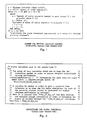
- Fig. 1 distributes cache among the partitions according to their priority order as a function of a WHILE.. DO loop.
- the prioritized cache is really a p-way set associative cache (where p is the number of cached priority classes).
- p is the number of cached priority classes.
- the value of partitioning the cache for each priority class is that each priority class is thus able to enjoy the full benefits of an LRU caching scheme and yet do so with no danger of affecting the cache performance of a higher priority class.
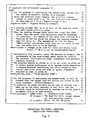
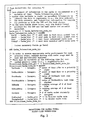
- Figs. 2-4 there is set out a counter-part list of global constants, types, and variables. Associated with each constant, type, or variable is a comment field defining the element and the method of its value selection or structure.
- the present implementation requires that the variables and cache memory be initialized according to the procedure set out in Table 1. Once the global variables have been created and initialized, the prioritized cache can begin to ensure prioritized cache performance.
- the cache nodes are allocated as well as initialized. In the case where the cache nodes already exist, rather than allocating memory for each of the nodes, one would transfer them from the existing cache memory instead.
- each call to this procedure should be thought of as some information which is relayed to the control unit to reallocate logical cache partition sizes.
- the actual information to be relayed to the control unit could be transmitted as part of a CCW, for example.
- the parameters used are necessary information elements to be used by the cache control unit or resource manager; namely, identifiers to designate the two logical partitions to exchange cache memory, and the amount of cache memory to be transferred.
- Nreads is a variable for keeping track of the running average number of cached read I/Os for each of the priority classes. Note that this is comparable to using the cached read I/O rates since all priority classes begin at the same time.
- the variable “Residue” keeps a running sum of the recommended signed changes in the cache memory sizes of each of the priority classes. If the final result of "Residue” is less than zero, then there is more demand for cache memory than supply (by the amount: -Residue). If the final result of "Residue” is greater than or equal to zero, then there is more supply of cache memory than demand (by the amount: Residue). Note, “Residue” is the negative of the sum of the signed changes in the cache sizes for each of the priority classes.
- the procedure supports the proposition that for every I/O of a given cache priority class to be issued to the control unit, "PriorityNo" representing the cache priority class number, should be executed.
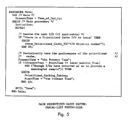
- Fig. 5 the main procedure comprising a pair of IF-THEN-ELSE routines is built within a REPEAT..UNTIL loop.
- the major structures support assigning priorities and targets to data sets, and then tuning performance after a periord of referencing experience.
- Fig. 6 there is shown a single physical cache in which each cached priority class makes use of its own LRU cache partition. For instance, a priority class #2 I/O request will take advantage of the middle cache partition (in the figure). A priority class #0 I/O request will go straight to the storage medium, not taking advantage of any cache partition, and so on.
- the method of this invention has been described with reference to a procedural model of control. That is, the CPU and storage resource management expressing the method steps have been in the form of a PASCAL-based pseudo-code flow of control and data pathing.
- the method steps can also be implemented with reference to a pattern-sensitive, rule-based, inferencing model without undue experimentation. That is, the method steps of:
- Rule-based systems are cyclic and inference in either a forward- or backward-chaining manner.
- the implementation of interest is data or pattern driven in a forward-chaining manner.
- forward-chained systems use data or data changes to select out the rules having pattern parts matching the data (form a conflict set) and then select and execute one of the rules according to a predetermined criterion (recency).
- Execution of a rule means that action specified is taken whether it involves subroutine execution or invoking another rule.
- the system data state is altered in some manner after which the cycle repeats.
- control data includes the data set names, priorities, target and actual hit ratios, etc., in addition to rules whose action parts can modify the control data and perform the other called-for steps.
- the cycle of processing includes (a) identifying that subset of rules having a condition or pattern part matching the data; (b) selecting at least one rule from the identified subset of rules according to an extrinsic protocol; and (c) executing (firing) the action prescribed by the action part of the selected rule, including modification to the data base.
Landscapes
- Engineering & Computer Science (AREA)
- Theoretical Computer Science (AREA)
- Physics & Mathematics (AREA)
- General Engineering & Computer Science (AREA)
- General Physics & Mathematics (AREA)
- Memory System Of A Hierarchy Structure (AREA)
Applications Claiming Priority (2)
| Application Number | Priority Date | Filing Date | Title |
|---|---|---|---|
| US33287089A | 1989-04-03 | 1989-04-03 | |
| US332870 | 1989-04-03 |
Publications (2)
| Publication Number | Publication Date |
|---|---|
| EP0391871A2 true EP0391871A2 (de) | 1990-10-10 |
| EP0391871A3 EP0391871A3 (de) | 1992-05-27 |
Family
ID=23300216
Family Applications (1)
| Application Number | Title | Priority Date | Filing Date |
|---|---|---|---|
| EP19900850122 Withdrawn EP0391871A3 (de) | 1989-04-03 | 1990-04-02 | Verfahren zur Verwaltung eines prioritisierten Cache-Speichers |
Country Status (2)
| Country | Link |
|---|---|
| EP (1) | EP0391871A3 (de) |
| JP (1) | JPH02287648A (de) |
Cited By (10)
| Publication number | Priority date | Publication date | Assignee | Title |
|---|---|---|---|---|
| EP0509231A1 (de) * | 1991-04-19 | 1992-10-21 | International Business Machines Corporation | Verfahren zur Datenersetzung in einem Cachespeicher |
| EP0543614A1 (de) * | 1991-11-18 | 1993-05-26 | International Business Machines Corporation | Dynamische Speicherzuordnung in einem prioritisierten Cache-Speicher |
| GB2276962A (en) * | 1993-04-08 | 1994-10-12 | Int Computers Ltd | User-defined priority for cache replacement mechanism. |
| US5737752A (en) * | 1993-04-08 | 1998-04-07 | International Computers Limited | Cache replacement mechanism |
| EP0834882A3 (de) * | 1996-09-30 | 1999-08-04 | Nokia Mobile Phones Ltd. | Speicheranordnung |
| US7328309B2 (en) | 2004-10-14 | 2008-02-05 | International Business Machines Corporation | On-demand cache memory for storage subsystems |
| US8769201B2 (en) | 2008-12-02 | 2014-07-01 | Intel Corporation | Technique for controlling computing resources |
| WO2017128641A1 (zh) * | 2016-01-29 | 2017-08-03 | 华为技术有限公司 | 一种面向多租户的缓冲区管理方法及服务器 |
| CN110399316A (zh) * | 2019-06-28 | 2019-11-01 | 苏州浪潮智能科技有限公司 | 一种用于业务系统性能优化的方法和装置 |
| CN120216410A (zh) * | 2025-05-28 | 2025-06-27 | 北京科杰科技有限公司 | 一种基于用户需求的智能缓存管理方法及系统 |
Families Citing this family (1)
| Publication number | Priority date | Publication date | Assignee | Title |
|---|---|---|---|---|
| JP5199165B2 (ja) * | 2009-03-31 | 2013-05-15 | 株式会社エヌ・ティ・ティ・ドコモ | 通信端末および通信制御方法 |
Family Cites Families (2)
| Publication number | Priority date | Publication date | Assignee | Title |
|---|---|---|---|---|
| JPS54128634A (en) * | 1978-03-30 | 1979-10-05 | Toshiba Corp | Cash memory control system |
| US4463424A (en) * | 1981-02-19 | 1984-07-31 | International Business Machines Corporation | Method for dynamically allocating LRU/MRU managed memory among concurrent sequential processes |
-
1990
- 1990-04-02 EP EP19900850122 patent/EP0391871A3/de not_active Withdrawn
- 1990-04-03 JP JP2087641A patent/JPH02287648A/ja active Pending
Cited By (17)
| Publication number | Priority date | Publication date | Assignee | Title |
|---|---|---|---|---|
| US5394531A (en) * | 1989-04-03 | 1995-02-28 | International Business Machines Corporation | Dynamic storage allocation system for a prioritized cache |
| EP0509231A1 (de) * | 1991-04-19 | 1992-10-21 | International Business Machines Corporation | Verfahren zur Datenersetzung in einem Cachespeicher |
| US5293609A (en) * | 1991-04-19 | 1994-03-08 | International Business Machines Corporation | Hit-density-based replacement for data cache with prefetching |
| EP0543614A1 (de) * | 1991-11-18 | 1993-05-26 | International Business Machines Corporation | Dynamische Speicherzuordnung in einem prioritisierten Cache-Speicher |
| GB2276962A (en) * | 1993-04-08 | 1994-10-12 | Int Computers Ltd | User-defined priority for cache replacement mechanism. |
| GB2276962B (en) * | 1993-04-08 | 1997-05-28 | Int Computers Ltd | Cache replacement mechanism |
| US5737752A (en) * | 1993-04-08 | 1998-04-07 | International Computers Limited | Cache replacement mechanism |
| US6301635B2 (en) | 1996-09-30 | 2001-10-09 | Nokia Mobile Phones Limited | Memory device |
| EP0834882A3 (de) * | 1996-09-30 | 1999-08-04 | Nokia Mobile Phones Ltd. | Speicheranordnung |
| US7328309B2 (en) | 2004-10-14 | 2008-02-05 | International Business Machines Corporation | On-demand cache memory for storage subsystems |
| US7519773B2 (en) * | 2004-10-14 | 2009-04-14 | International Business Machines Corporation | On-demand cache memory for storage subsystems |
| US8769201B2 (en) | 2008-12-02 | 2014-07-01 | Intel Corporation | Technique for controlling computing resources |
| WO2017128641A1 (zh) * | 2016-01-29 | 2017-08-03 | 华为技术有限公司 | 一种面向多租户的缓冲区管理方法及服务器 |
| CN110399316A (zh) * | 2019-06-28 | 2019-11-01 | 苏州浪潮智能科技有限公司 | 一种用于业务系统性能优化的方法和装置 |
| CN110399316B (zh) * | 2019-06-28 | 2021-10-01 | 苏州浪潮智能科技有限公司 | 一种用于业务系统性能优化的方法和装置 |
| CN120216410A (zh) * | 2025-05-28 | 2025-06-27 | 北京科杰科技有限公司 | 一种基于用户需求的智能缓存管理方法及系统 |
| CN120216410B (zh) * | 2025-05-28 | 2025-09-16 | 北京科杰科技有限公司 | 一种基于用户需求的智能缓存管理方法及系统 |
Also Published As
| Publication number | Publication date |
|---|---|
| EP0391871A3 (de) | 1992-05-27 |
| JPH02287648A (ja) | 1990-11-27 |
Similar Documents
| Publication | Publication Date | Title |
|---|---|---|
| US5394531A (en) | Dynamic storage allocation system for a prioritized cache | |
| US4463424A (en) | Method for dynamically allocating LRU/MRU managed memory among concurrent sequential processes | |
| US5317728A (en) | Storage management of a first file system using a second file system containing surrogate files and catalog management information | |
| EP0130349B1 (de) | Verfahren zum Ersetzen von Informationsblöcken und dessen Anwendung in einer Datenverarbeitungsanordnung | |
| US6948033B2 (en) | Control method of the cache hierarchy | |
| US9448733B2 (en) | Data management method in storage pool and virtual volume in DKC | |
| JP2675967B2 (ja) | キヤツシユの動的分割方法及びその手段 | |
| US4875155A (en) | Peripheral subsystem having read/write cache with record access | |
| US5666114A (en) | Method and means for managing linear mapped address spaces storing compressed data at the storage subsystem control unit or device level | |
| US5237673A (en) | Memory management method for coupled memory multiprocessor systems | |
| US6574720B1 (en) | System for maintaining a buffer pool | |
| US4779189A (en) | Peripheral subsystem initialization method and apparatus | |
| US5664148A (en) | Cache arrangement including coalescing buffer queue for non-cacheable data | |
| EP0474395A2 (de) | Datenspeicherhierarchie mit einer Ebene für gemeinsamen Speicher | |
| US4812981A (en) | Memory management system improving the efficiency of fork operations | |
| EP1755042A2 (de) | Speichersystem zur Steuerung eines Plattencachespeichers | |
| US9262332B2 (en) | Memory management with priority-based memory reclamation | |
| US20110161608A1 (en) | Method to customize function behavior based on cache and scheduling parameters of a memory argument | |
| US7389506B1 (en) | Selecting processor configuration based on thread usage in a multiprocessor system | |
| JPS61112255A (ja) | コンピユ−タ装置 | |
| GB2265734A (en) | Free memory cell management system | |
| US7107400B2 (en) | System, apparatus, and process for evaluating projected cache sizes | |
| EP0391871A2 (de) | Verfahren zur Verwaltung eines prioritisierten Cache-Speichers | |
| Mattson | Evaluation of multilevel memories | |
| EP0156179B1 (de) | Schutzverfahren für einen flüchtigen Primärspeicher in einem gestuften Speichersystem |
Legal Events
| Date | Code | Title | Description |
|---|---|---|---|
| PUAI | Public reference made under article 153(3) epc to a published international application that has entered the european phase |
Free format text: ORIGINAL CODE: 0009012 |
|
| AK | Designated contracting states |
Kind code of ref document: A2 Designated state(s): DE FR GB |
|
| 17P | Request for examination filed |
Effective date: 19901213 |
|
| PUAL | Search report despatched |
Free format text: ORIGINAL CODE: 0009013 |
|
| AK | Designated contracting states |
Kind code of ref document: A3 Designated state(s): DE FR GB |
|
| STAA | Information on the status of an ep patent application or granted ep patent |
Free format text: STATUS: THE APPLICATION HAS BEEN WITHDRAWN |
|
| 18W | Application withdrawn |
Withdrawal date: 19930504 |