EP0394552A2 - Strippage de résidus - Google Patents
Strippage de résidus Download PDFInfo
- Publication number
- EP0394552A2 EP0394552A2 EP89119676A EP89119676A EP0394552A2 EP 0394552 A2 EP0394552 A2 EP 0394552A2 EP 89119676 A EP89119676 A EP 89119676A EP 89119676 A EP89119676 A EP 89119676A EP 0394552 A2 EP0394552 A2 EP 0394552A2
- Authority
- EP
- European Patent Office
- Prior art keywords
- gas
- stripping
- temperature
- vacuum
- bar
- Prior art date
- Legal status (The legal status is an assumption and is not a legal conclusion. Google has not performed a legal analysis and makes no representation as to the accuracy of the status listed.)
- Withdrawn
Links
Images


Classifications
-
- C—CHEMISTRY; METALLURGY
- C10—PETROLEUM, GAS OR COKE INDUSTRIES; TECHNICAL GASES CONTAINING CARBON MONOXIDE; FUELS; LUBRICANTS; PEAT
- C10G—CRACKING HYDROCARBON OILS; PRODUCTION OF LIQUID HYDROCARBON MIXTURES, e.g. BY DESTRUCTIVE HYDROGENATION, OLIGOMERISATION, POLYMERISATION; RECOVERY OF HYDROCARBON OILS FROM OIL-SHALE, OIL-SAND, OR GASES; REFINING MIXTURES MAINLY CONSISTING OF HYDROCARBONS; REFORMING OF NAPHTHA; MINERAL WAXES
- C10G1/00—Production of liquid hydrocarbon mixtures from oil-shale, oil-sand, or non-melting solid carbonaceous or similar materials, e.g. wood, coal
Definitions
- the invention relates to a process for the hydrogenation of coal, heavy oil, bitumen or the like.
- temperatures between 250 and 350 o C, preferably between 380 and 480 o C and pressures between 50 and 700 bar, preferably between 100 and 325 bar separation of the hot blowdown, in particular at temperatures below the hydrogenation temperature, the hot blowdown being stripped with gas.
- Liquid hydrocarbons are converted into products with different boiling ranges, e.g. B. gas, liquefied petroleum gas, petrol, medium oil, heavy oil and residue in atm. Distilled worked up. The bottom products of the stills, see G. Residues are either converted to light products and separated into products and residues as described above, or used as fuel (heating oil-S) and processed into bitumen.
- the residues are distilled in vacuum systems at approx. 400 - 450 ° C and 20 - 10 mbar.
- This method is e.g. B. common in every refinery.
- Another option for the separation of hydrocarbons is extraction.
- the properties of the different solubility of liquids are used.
- the extractant dissolves the extract from a mixture of substances.
- the extractant is regenerated by separating the extract and used in the cycle.
- the separation can also be done by extraction or by distillation.
- Supercritical extraction is known as a special feature for the separation of paraffinic and aromatic hydrocarbons and hydrocarbon groups from asphaltenes. Components in the supercritical state are predominantly used as the extracting agent, ie the partial pressures in mixtures must exceed the critical data.
- the disadvantages of using vacuum distillation systems are that - the generation of the vacuum requires a considerable amount of steam and wastewater problems, - The vacuum creates safety problems in the event of leaks in the system (O2 break-in, risk of explosion), - The high temperature causes coking problems due to unsaturated hydrocarbons, which on the one hand influence the product quality and on the other hand lead to malfunctions. As a rule, a max. Temperature of 450 ° C must not be exceeded. - due to the high-viscosity sump products generated, discharge problems arise due to the lack of a required NPSH value on the discharge pump, - the high speeds at the inlet (approx.
- the disadvantage of the extraction process is that - Characteristic material properties are addressed in these processes and a special extracting agent must therefore be found for each extract, ie there are no universally applicable extracting agents, -
- the regeneration of the extract agent is substance-dependent and apparatus-intensive. It can be done by extraction, distillation and pressure change combined with temperature changes, - due to the regeneration effort, a considerable amount of equipment is required combined with high investment costs, - Due to the solubility equilibrium, there is always a loss of extractant, which can lead to high operating costs.
- DE-OS 31 23 535 describes that the desired component can be separated off by stripping with gas.
- the required partial pressure change of the vapors takes place to separate the products through the vacuum created.
- the known method does not work optimally.
- the invention is therefore based on the object of improving methods known from DE-OS 31 23 535. According to the invention this is achieved in that the required partial pressure change of the vapors for separating the products is generated by the gas used.
- the heat of vaporization can be provided with the inlet temperature of the liquid and / or preferably with the inlet temperature of the gas.
- the separation takes place while lowering the temperature at constant pressure (condensation).
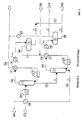
- the preheated streams 6 in the furnace 4 and 5 as liquid and 7 as gas are mixed and the components to be separated are stripped off as product. These then pass overhead with the gas as stream 8 and are condensed out in the condenser 2.
- the separation container 3 the feed gas is separated from the product.
- the product leaves the separation container as stream 9, the gases leave the separation container as stream 10 overhead.
- the process works in - Temperature range between 250 ° C - 600 ° C and in - Pressure range between 1.2 bar - 150 bar.
- Any refinery gas, natural gas or town gas can be used as the gas, preferably H2-containing gas between 20-100 vol .-% H2 which are obtained as waste gases in refineries and petrochemical plants.
- the advantage of the method is that compared to vacuum systems - there are no wastewater problems, since the radiator steam is eliminated, - there are no security problems due to O2 burglary, since the process works with overpressure, the temperature limit of approx. 450 ° C. is removed and there are no coking problems because hydrogen is present in excess to saturate the unsaturated components, -
- the sump discharge does not pose any problems, since there is enough pressure in the tank to regulate the flow to easily regulate even viscosities up to approx. 3,000 m Pa s. With a vacuum column, discharge fails at approx.
- the hydrogenation residue 11 (approx. 420 ° C.) (a solid asphalt mixture with approx. 40% oil boiling ⁇ 500 ° C.) is relaxed in tank 1 from 40 bar to 10 bar.
- an H2-rich expansion gas 14 is obtained in the upstream process, which is heated to 450 ° C. in the furnace 5 and driven into the bottom of the expansion tank 1.
- the expansion gas passes with the stripped oil at the top of the container as stream 15 and is cooled to 30 ° C. in the cooler 9.
- the stripped oil condenses.
- this oil 17 is separated from the expansion gas 16.
- the residue 12 is discharged from the container 1 in a level-controlled manner.
- the residue quality is adjusted by increasing or decreasing the expansion gas temperature after the furnace.
- a residue stripping system for a production process would be carried out in one or more stages with heat recovery.
- a two-stage stripping system is described as an example (see Fig. 3).
- the residue 11 to be worked up passes through a heat exchanger in countercurrent to the worked-up residue 26 and an oven 24 into the first stripping container 1.
- the stripping gas 14 heated in the heat exchanger 7 and furnace 5 is passed in the sump.
- the stripping gas 15 enriched with oil leaves the first stripping tank 1 overhead and is cooled in the heat exchanger 7 and the cooler 9 to such an extent that the oil in the tank 3 condenses.
- the condensate 17 is shut down in a level-controlled manner.
- the remaining stripping gas 16 is pressure-controlled in the second stage.
- the now partially deoiled residue 12 reaches the second stripping tank 2 via a level control valve.
- the stripping gas from the first stage 19 is again passed through a heat exchanger 8 and a furnace 6 into the bottom of the stripping container 2. Possibly. other process gases 18 can be introduced here.
- the oil-containing stripping gas 20 leaves the tank 2 overhead and is cooled in the heat exchanger 8 and in the cooler 10 to such an extent that the oil in the tank 4 condenses.
- This condensate 22 is admixed to the oil from the first stage 17 in a level-controlled manner and leaves the system as product 23.
- the deoiled residue 13 is cooled in the heat exchanger 25.
- the stripping gas is discharged from the condensate container 4 under pressure control 21 for gas processing. Otherwise, a compressor 27 would transport the gas back to the first stripping stage. The plant would thus be operated as a cycle. As a result, only the stripping gas losses in 14 are to be covered.
- Table 1 Comparison of the boiling point of the product oils Vol .-% Vacuum flash Stripping condensate temperature 0 212 193 10th 242 261 20th 256 285 30th 270 302 40 289 316 50 291 333 60 299 350 70 314 365 80 333 385 90 356 417 100 435 504 Density (kg / m3) 968 1,009 Solids content (% by weight) 0.03 0.02
- Table 2 Comparison of the residue qualities Vacuum column Stripping Viscosity (Pa s) 0.62 0.522 Yield point (Pa) 16 27th Ash (% by weight) 13 21st Softening point (° C) 159 160 Solids (% by weight) 44 43 Solids and Asphaltenes (% by weight) 56 55
Landscapes
- Chemical & Material Sciences (AREA)
- Engineering & Computer Science (AREA)
- Oil, Petroleum & Natural Gas (AREA)
- Life Sciences & Earth Sciences (AREA)
- Wood Science & Technology (AREA)
- Chemical Kinetics & Catalysis (AREA)
- General Chemical & Material Sciences (AREA)
- Organic Chemistry (AREA)
- Production Of Liquid Hydrocarbon Mixture For Refining Petroleum (AREA)
- Processing Of Solid Wastes (AREA)
Applications Claiming Priority (2)
| Application Number | Priority Date | Filing Date | Title |
|---|---|---|---|
| DE3914057 | 1989-04-28 | ||
| DE3914057A DE3914057A1 (de) | 1989-04-28 | 1989-04-28 | Strippung von rueckstaenden |
Publications (2)
| Publication Number | Publication Date |
|---|---|
| EP0394552A2 true EP0394552A2 (fr) | 1990-10-31 |
| EP0394552A3 EP0394552A3 (fr) | 1990-12-05 |
Family
ID=6379677
Family Applications (1)
| Application Number | Title | Priority Date | Filing Date |
|---|---|---|---|
| EP19890119676 Withdrawn EP0394552A3 (fr) | 1989-04-28 | 1989-10-24 | Strippage de résidus |
Country Status (5)
| Country | Link |
|---|---|
| US (1) | US5100536A (fr) |
| EP (1) | EP0394552A3 (fr) |
| CA (1) | CA2015005A1 (fr) |
| DE (1) | DE3914057A1 (fr) |
| NO (1) | NO894733L (fr) |
Families Citing this family (4)
| Publication number | Priority date | Publication date | Assignee | Title |
|---|---|---|---|---|
| US6319395B1 (en) * | 1995-10-31 | 2001-11-20 | Chattanooga Corporation | Process and apparatus for converting oil shale or tar sands to oil |
| EP1050570A3 (fr) * | 1999-05-05 | 2002-12-18 | Bechtel Corporation | Procédé de séparation d' une huile lubrifiante en produits légers et en produits lourds |
| US20050252833A1 (en) * | 2004-05-14 | 2005-11-17 | Doyle James A | Process and apparatus for converting oil shale or oil sand (tar sand) to oil |
| US8877040B2 (en) * | 2012-08-20 | 2014-11-04 | Uop Llc | Hydrotreating process and apparatus relating thereto |
Family Cites Families (12)
| Publication number | Priority date | Publication date | Assignee | Title |
|---|---|---|---|---|
| NL29952C (fr) * | 1929-01-22 | |||
| DE2718950C2 (de) * | 1977-04-28 | 1983-11-17 | Saarbergwerke AG, 6600 Saarbrücken | Verfahren zur Anlagerung von Wasserstoff an Kohle |
| FR2396794A1 (fr) * | 1977-07-05 | 1979-02-02 | Ceca Sa | Procede de craquage sous pression d'hydrogene pour la production d'olefine |
| DE2803985C2 (de) * | 1978-01-30 | 1984-04-05 | Saarbergwerke AG, 6600 Saarbrücken | Verfahren zum Verflüssigen von Kohle |
| DE2803916C2 (de) * | 1978-01-30 | 1983-11-17 | Saarbergwerke AG, 6600 Saarbrücken | Verfahren zum Verflüssigen von Kohle |
| US4158948A (en) * | 1978-08-16 | 1979-06-26 | Texaco Inc. | Conversion of solid fuels into fluid fuels |
| DE3022158C2 (de) * | 1980-06-13 | 1989-11-02 | Bergwerksverband Gmbh, 4300 Essen | Verfahren zur hydrierenden Kohleverflüssigung |
| US4301114A (en) * | 1980-06-30 | 1981-11-17 | Thermo Electron Corporation | Molecular sieve trap for nitrogen compound detection |
| DE3037052A1 (de) * | 1980-10-01 | 1982-07-15 | Rheinische Braunkohlenwerke AG, 5000 Köln | Verfahren zur gewinnung von wasserstoff fuer die hydrierung von kohle |
| DE3123535A1 (de) * | 1981-06-13 | 1982-12-30 | Veba Oel Entwicklungsgesellschaft mbH, 4660 Gelsenkirchen-Buer | Verfahren zur hydrierung von kohle, schweroel, bitumen und dergl. |
| US4465584A (en) * | 1983-03-14 | 1984-08-14 | Exxon Research & Engineering Co. | Use of hydrogen sulfide to reduce the viscosity of bottoms streams produced in hydroconversion processes |
| US4822480A (en) * | 1987-12-22 | 1989-04-18 | Mobil Oil Corporation | Hydrocarbon product stripping |
-
1989
- 1989-04-28 DE DE3914057A patent/DE3914057A1/de not_active Withdrawn
- 1989-10-24 EP EP19890119676 patent/EP0394552A3/fr not_active Withdrawn
- 1989-11-28 NO NO89894733A patent/NO894733L/no unknown
-
1990
- 1990-04-20 CA CA002015005A patent/CA2015005A1/fr not_active Abandoned
- 1990-04-30 US US07/516,613 patent/US5100536A/en not_active Expired - Fee Related
Also Published As
| Publication number | Publication date |
|---|---|
| NO894733L (no) | 1990-10-29 |
| NO894733D0 (no) | 1989-11-28 |
| CA2015005A1 (fr) | 1990-10-28 |
| DE3914057A1 (de) | 1990-10-31 |
| US5100536A (en) | 1992-03-31 |
| EP0394552A3 (fr) | 1990-12-05 |
Similar Documents
| Publication | Publication Date | Title |
|---|---|---|
| US4747936A (en) | Deasphalting and demetallizing heavy oils | |
| CN1019584B (zh) | 溶剂萃取方法 | |
| DE2851358C2 (fr) | ||
| EP0600203B1 (fr) | Procédé de traitement ultérieur d'un résidu de distillation tous vide dans une raffinerie | |
| EP0138213A2 (fr) | Procédé de pyrolyse de résidus d'hydrogénation du charbon | |
| EP0394552A2 (fr) | Strippage de résidus | |
| DE3602586A1 (de) | Verfahren zur aufarbeitung von altoel | |
| EP0186955A2 (fr) | Procédé pour la distillation d'huile lourde | |
| CA1187023A (fr) | Recuperation des solvants de tranformation des hydrocarbures | |
| DE10259450B4 (de) | Verfahren zur Hochtemperatur-Kurzzeit-Destillation von Rückstandsöl | |
| CA1249543A (fr) | Accroissement de la production de petrole desasphalte | |
| CA1144504A (fr) | Procede de recuperation de solvants a partir des phases hydrocarbures-solvants dans des systemes de raffinage des hydrocarbures | |
| DE60016755T2 (de) | Verfahren zur behandlung von rohöl | |
| EP0084319B1 (fr) | Procédé de séchage et d'élimination d'hydrocarbures des gaz | |
| DD249916A1 (de) | Verfahren zur erzeugung heller produkte und konventionell verwertbaren heizoeles aus schweren metall- und schwefelreichen erdoelrueckstaenden | |
| RU2036221C1 (ru) | Способ экстракции тяжелого углеводородного сырья | |
| US4555310A (en) | Method of utilizing energy of high pressure condensate | |
| US1970796A (en) | Process of treating oil | |
| EP0187947B1 (fr) | Procédé pour le raffinage par solvant d'huiles résiduelles | |
| CN1176287A (zh) | 一种多产柴油的延迟焦化工艺 | |
| DE2803985A1 (de) | Verfahren zum verfluessigen von kohle | |
| DD219640A3 (de) | Verfahren zur aufbereitung hochviskoser und/oder feststoffhaltiger kohlenwasserstoffe | |
| DE3124934C2 (de) | Verfahren zur Aufarbeitung von bei der Kohlehydrierung anfallenden Rückständen | |
| DD289772A5 (de) | Verfahren zur aufarbeitung von bei der vakuumdestillation entstehenden hydrier- und/oder strippfaehigen vakuumrueckstaenden | |
| DE3122650A1 (de) | Verfahren und vorrichtung zur erdoel-destillation |
Legal Events
| Date | Code | Title | Description |
|---|---|---|---|
| PUAI | Public reference made under article 153(3) epc to a published international application that has entered the european phase |
Free format text: ORIGINAL CODE: 0009012 |
|
| PUAL | Search report despatched |
Free format text: ORIGINAL CODE: 0009013 |
|
| AK | Designated contracting states |
Kind code of ref document: A2 Designated state(s): BE DE FR GB IT NL SE |
|
| AK | Designated contracting states |
Kind code of ref document: A3 Designated state(s): BE DE FR GB IT NL SE |
|
| 17P | Request for examination filed |
Effective date: 19910306 |
|
| 17Q | First examination report despatched |
Effective date: 19910902 |
|
| STAA | Information on the status of an ep patent application or granted ep patent |
Free format text: STATUS: THE APPLICATION IS DEEMED TO BE WITHDRAWN |
|
| 18D | Application deemed to be withdrawn |
Effective date: 19920113 |