EP0394754A2 - Procédé et dispositif pour le traitement thermique sélectif de la zone d'un cordon de soudure d'un tube soudé longitudinalement - Google Patents
Procédé et dispositif pour le traitement thermique sélectif de la zone d'un cordon de soudure d'un tube soudé longitudinalement Download PDFInfo
- Publication number
- EP0394754A2 EP0394754A2 EP90106913A EP90106913A EP0394754A2 EP 0394754 A2 EP0394754 A2 EP 0394754A2 EP 90106913 A EP90106913 A EP 90106913A EP 90106913 A EP90106913 A EP 90106913A EP 0394754 A2 EP0394754 A2 EP 0394754A2
- Authority
- EP
- European Patent Office
- Prior art keywords
- weld seam
- area
- tube
- temperature
- heating means
- Prior art date
- Legal status (The legal status is an assumption and is not a legal conclusion. Google has not performed a legal analysis and makes no representation as to the accuracy of the status listed.)
- Granted
Links
- 238000010438 heat treatment Methods 0.000 title claims abstract description 60
- 238000000034 method Methods 0.000 title claims abstract description 15
- 238000002844 melting Methods 0.000 claims abstract description 18
- 230000008018 melting Effects 0.000 claims abstract description 18
- 238000000137 annealing Methods 0.000 claims abstract description 17
- 230000001681 protective effect Effects 0.000 claims abstract description 17
- 229910052751 metal Inorganic materials 0.000 claims abstract description 13
- 239000002184 metal Substances 0.000 claims abstract description 13
- 239000000463 material Substances 0.000 claims abstract description 8
- 230000006698 induction Effects 0.000 claims abstract description 7
- 238000001816 cooling Methods 0.000 claims description 5
- ZOKXTWBITQBERF-UHFFFAOYSA-N Molybdenum Chemical compound [Mo] ZOKXTWBITQBERF-UHFFFAOYSA-N 0.000 claims description 4
- 229910052750 molybdenum Inorganic materials 0.000 claims description 4
- 239000011733 molybdenum Substances 0.000 claims description 4
- 239000007787 solid Substances 0.000 claims description 2
- 239000010935 stainless steel Substances 0.000 claims description 2
- 229910001220 stainless steel Inorganic materials 0.000 claims description 2
- 229910045601 alloy Inorganic materials 0.000 claims 1
- 239000000956 alloy Substances 0.000 claims 1
- 230000000694 effects Effects 0.000 claims 1
- 238000005260 corrosion Methods 0.000 abstract description 6
- 230000007797 corrosion Effects 0.000 abstract description 6
- 238000004519 manufacturing process Methods 0.000 description 7
- 238000010586 diagram Methods 0.000 description 4
- VYZAMTAEIAYCRO-UHFFFAOYSA-N Chromium Chemical compound [Cr] VYZAMTAEIAYCRO-UHFFFAOYSA-N 0.000 description 2
- PXHVJJICTQNCMI-UHFFFAOYSA-N Nickel Chemical compound [Ni] PXHVJJICTQNCMI-UHFFFAOYSA-N 0.000 description 2
- 229910052804 chromium Inorganic materials 0.000 description 2
- 239000011651 chromium Substances 0.000 description 2
- 238000012423 maintenance Methods 0.000 description 2
- 238000005204 segregation Methods 0.000 description 2
- OKTJSMMVPCPJKN-UHFFFAOYSA-N Carbon Chemical compound [C] OKTJSMMVPCPJKN-UHFFFAOYSA-N 0.000 description 1
- VYPSYNLAJGMNEJ-UHFFFAOYSA-N Silicium dioxide Chemical compound O=[Si]=O VYPSYNLAJGMNEJ-UHFFFAOYSA-N 0.000 description 1
- 229910000831 Steel Inorganic materials 0.000 description 1
- 238000010521 absorption reaction Methods 0.000 description 1
- 229910052799 carbon Inorganic materials 0.000 description 1
- 238000006243 chemical reaction Methods 0.000 description 1
- 238000010276 construction Methods 0.000 description 1
- 230000001419 dependent effect Effects 0.000 description 1
- 230000002349 favourable effect Effects 0.000 description 1
- 229910052759 nickel Inorganic materials 0.000 description 1
- 230000000737 periodic effect Effects 0.000 description 1
- 230000005855 radiation Effects 0.000 description 1
- 239000010959 steel Substances 0.000 description 1
- 230000002123 temporal effect Effects 0.000 description 1
- 230000007704 transition Effects 0.000 description 1
- 230000007723 transport mechanism Effects 0.000 description 1
- 238000003466 welding Methods 0.000 description 1
Images

Classifications
-
- C—CHEMISTRY; METALLURGY
- C21—METALLURGY OF IRON
- C21D—MODIFYING THE PHYSICAL STRUCTURE OF FERROUS METALS; GENERAL DEVICES FOR HEAT TREATMENT OF FERROUS OR NON-FERROUS METALS OR ALLOYS; MAKING METAL MALLEABLE, e.g. BY DECARBURISATION OR TEMPERING
- C21D9/00—Heat treatment, e.g. annealing, hardening, quenching or tempering, adapted for particular articles; Furnaces therefor
- C21D9/50—Heat treatment, e.g. annealing, hardening, quenching or tempering, adapted for particular articles; Furnaces therefor for welded joints
Definitions
- the present invention relates to a method for the selective heat treatment of the weld region of a longitudinally welded metal tube and a device suitable therefor.
- the method is particularly applicable to pipes with a diameter of less than 100 mm and a wall thickness of less than 2.5 mm. It is particularly suitable for pipes of even smaller dimensions, such as those used in heat exchangers and steam condensers, with pipe diameters of, for example, 10 to 50 mm and wall thicknesses of between about 0.3 and 1 mm.
- the invention is of particular importance for pipes made of stainless steel with proportions of chromium and optional components such as nickel and / or molybdenum with a simultaneously low carbon content.
- the heat treatment is intended to improve the corrosion properties, particularly with regard to pitting corrosion.
- the object of the present invention is to provide a method which enables the weld seam to be heated quickly over a short distance and keeps the amount of heating means low.
- a device suitable for this purpose is to be specified.
- a method for selective solution annealing of the weld seam in particular including its heat affected zone, of a longitudinally welded metal tube, the tube in particular having a diameter of less than 100 mm and a wall thickness of less than 2.5 mm, and wherein a heat treatment device and the The pipe is moved relative to one another with the following features:
- the weld seam is heated, preferably by means of at least one arc generated with at least one non-melting electrode, under protective gas to such an extent that its outer region is melted; the weld seam is then selectively held by further heating means, for example further arcs, infrared radiators or induction coils, for a predefinable period under protective gas at least at a temperature required for the solution annealing of the tube material, but at least in the interior area below the melting temperature and then cooled under protective gas.
- the invention is based on the knowledge that, for most applications of the pipes considered here, only the corrosion resistance of the weld seam is important for attacks from the inside, ie the quality of the weld seam must above all Things inside can be improved by heat treatment, whereby a small loss of quality in a relatively small outside area is not decisive. It is therefore entirely permissible to melt the outer area of the weld seam when the weld seam area is heated, which enables rapid heat input in a small space.
- phase transition from the solid to the molten state causes a high heat absorption of the outer area of the weld seam, this amount of heat being partly passed on to the inner area of the weld seam by heat conduction when the outer area solidifies, so that this inner area also heats up very quickly, but not up to there unwanted melting. Subsequently, it is only necessary to keep the temperature of the weld seam in the desired temperature range necessary for solution annealing, which is possible by means of further heating means, in particular by induction coils or by illuminating the weld seam in a linear or punctiform manner. Of course, it should be noted that both when heating z. B.
- a preferred field of application of the invention is heat exchanger tubes made of stainless, in particular molybdenum-containing steels, in which solution annealing of the weld seam region can be carried out above 1200 ° C. or even above 1300 ° C.
- the rest of the pipe naturally heats up during heat treatment, but at a significantly lower temperature than that of the weld area. Such heating of the entire pipe is quite desirable and necessary.
- the pipe does not become so warm outside the weld seam area that it could be deformed by the transport mechanism inadmissibly, so that a high quality of the pipes is guaranteed, which reduces the rejects and facilitates the quality checks that may be necessary later.
- This plays an important role in particular for particularly thin-walled pipes with a wall thickness of approximately 0.3 to 0.5 mm.
- the proposed combination of an electrode with other heating means enables a very compact construction of the heat treatment section and combines the advantages of rapid heating by an arc with the favorable properties of other heating means, in particular infrared heaters and induction coils with regard to maintaining an existing temperature.
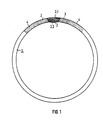
- FIG. 1 the basic structure of a longitudinally welded metal tube is shown in cross-section in FIG. 1, and in FIG. 2 a basic illustration of the device is shown with a diagram of the temperature curves arranged below it in spatial association with the heat treatment device shown.
- the cross section shown in FIG. 1 through a longitudinally welded tube 1 illustrates the areas of the tube which are essential for the invention.
- the individual zones are not shown to scale in order to better illustrate basic things.
- the weld seam and the heat affected zone are smaller.
- the weld seam 2 is generally located on the top of the tube 1 during manufacture. It is surrounded by a heat-affected zone 3, in which the welding process has left changes and inhomogeneities.
- the rest of the tube consists of unchanged base material, although it may be advisable, for safety reasons, to include an area 4 outside the heat affected zone 3 in a heat treatment, since the exact extent of the heat affected zone 3 is not always known.
- the weld seam 2 itself has an outer region 2.1, the corrosion properties of which play no role in pipes which are only subjected to corrosive stress on the inside, and Interior area 2.2 whose properties can be decisive for the corrosion resistance of the entire pipe.
- Fig. 2 shows schematically a heat treatment line, which can be part of a complete production device for longitudinally welded metal pipes or can be arranged separately.
- the tube 1 passes through this distance by being carried and moved by transport rollers 11 or similar means.
- the weld seam 2 or the entire weld seam region are heated by an arc 7 at the beginning of the heat treatment. For this first heating, other means with high energy density, such as.
- a conventional current source 5.1 which is connected on the one hand via a supply line 5.2 to the tube 1 and on the other hand to a non-melting electrode 5, feeds the arc 7.
- the surrounding area of the arc 7 can be kept under protective gas 1 by means of a conventional device 6.
- further heating means 8 in the present exemplary embodiment infrared radiators, which keep the temperature of the weld seam area above the minimum temperature Tmin necessary for solution annealing.
- the distance between the arc 7 and the first infrared radiator 8 is selected such that the outer region 2.1 of the weld seam 2.2 melted by the arc 7 can solidify again on the way by dissipating heat to the inner region 2.2, so that the entire weld region increases approximately same temperature is above Tmin.
- a protective gas atmosphere (indicated by arrows) around the entire tube 1 can be maintained by a quartz glass tube 9.
- a cooling section 10 which is also under protective gas, is connected to the heat treatment section. Under the heat treatment device and with spatial association with it, a diagram is shown in FIG. 2 to illustrate the temperature profiles.
- the temperature is plotted on the abscissa, two temperatures being given by way of example to illustrate the material-dependent region in question.
- the distance is plotted on the ordinate according to the length of the heat treatment device, whereby (assuming a constant throughput speed of the tube this is equivalent to the time.
- the diagram therefore represents the temporal or spatial course of the temperatures during the heat treatment.
- the dashed line Tmir indicates the temperature that is at least necessary for solution annealing of the pipe material
- line Ts indicates the melting temperature of the pipe material
- line Ta illustrates the temperature in the outer region 2.1 of the weld seam 2
- line Ti illustrates the temperature profile in the inner region 2.2 of the weld seam during It can be seen from the diagram that in the area of the arc 7 the outer area is heated to a temperature above the melting point Ts, but the inner area remains significantly below this temperature
- Infrared emitters 8 equalize the temperatures of the outside area 2.1 and the inside area 2.2.
- the outer region 2.1 is brought to higher temperatures than the inner region 2.2 during the further heat treatment, whereby it must be ensured in any case that the temperature Ti must lie between Trin and Ts, while it is permissible for the outer region 2.1 that this in between, as indicated by the dotted lines Ta ', exceeds the melting point Ts.
- the temperature of the weld seam area is finally reduced under protective gas until protective gas is no longer necessary to avoid reactions with the surrounding atmosphere.
- the present invention is particularly suitable for the heat treatment directly downstream of a pipe production plant.
Landscapes
- Chemical & Material Sciences (AREA)
- Engineering & Computer Science (AREA)
- Physics & Mathematics (AREA)
- Thermal Sciences (AREA)
- Crystallography & Structural Chemistry (AREA)
- Mechanical Engineering (AREA)
- Materials Engineering (AREA)
- Metallurgy (AREA)
- Organic Chemistry (AREA)
- Heat Treatment Of Articles (AREA)
Applications Claiming Priority (2)
| Application Number | Priority Date | Filing Date | Title |
|---|---|---|---|
| DE3913973A DE3913973A1 (de) | 1989-04-27 | 1989-04-27 | Verfahren und vorrichtung zur selektiven waermebehandlung des schweissnahtbereiches eines laengsnahtgeschweissten rohres |
| DE3913973 | 1989-04-27 |
Publications (3)
| Publication Number | Publication Date |
|---|---|
| EP0394754A2 true EP0394754A2 (fr) | 1990-10-31 |
| EP0394754A3 EP0394754A3 (fr) | 1992-10-14 |
| EP0394754B1 EP0394754B1 (fr) | 1994-08-17 |
Family
ID=6379624
Family Applications (1)
| Application Number | Title | Priority Date | Filing Date |
|---|---|---|---|
| EP90106913A Expired - Lifetime EP0394754B1 (fr) | 1989-04-27 | 1990-04-11 | Procédé et dispositif pour le traitement thermique sélectif de la zone d'un cordon de soudure d'un tube soudé longitudinalement |
Country Status (4)
| Country | Link |
|---|---|
| EP (1) | EP0394754B1 (fr) |
| AT (1) | ATE110116T1 (fr) |
| DE (2) | DE3913973A1 (fr) |
| ES (1) | ES2057241T3 (fr) |
Cited By (3)
| Publication number | Priority date | Publication date | Assignee | Title |
|---|---|---|---|---|
| DE102010044799A1 (de) * | 2010-09-09 | 2012-04-26 | Benteler Automobiltechnik Gmbh | Stabilisator und Verfahren zum Herstellen eines Stabilisators |
| EP2357099B1 (fr) * | 2010-02-16 | 2017-07-12 | Benteler Automobiltechnik GmbH | Stabilisateur et procédé destiné à la fabrication d'un stabilisateur |
| CN116689963A (zh) * | 2023-06-25 | 2023-09-05 | 浙江摩多巴克斯科技股份有限公司 | 一种高强度钢管的激光焊接工艺 |
Families Citing this family (1)
| Publication number | Priority date | Publication date | Assignee | Title |
|---|---|---|---|---|
| DE102008060205A1 (de) * | 2008-12-04 | 2010-06-10 | Rolls-Royce Deutschland Ltd & Co Kg | Verfahren zur Herstellung eines geschweißten Rotors für ein Gasturbinentriebwerk |
Family Cites Families (6)
| Publication number | Priority date | Publication date | Assignee | Title |
|---|---|---|---|---|
| US2673276A (en) * | 1951-02-01 | 1954-03-23 | Babcock & Wilcox Co | Post heating of electrically welded tubes in line of production |
| DE1558004C2 (de) * | 1967-06-14 | 1974-07-11 | Mannesmannroehren-Werke As, 4000 Duesseldorf | Verfahren zur Wärmebehandlung von Schweißnähten |
| AT297449B (de) * | 1970-07-14 | 1972-03-27 | Simmering Graz Pauker Ag | Verfahren zur Herstellung von Schweißnähten in einer Schutzgasatmosphäre mit vorzugsweise nicht abschmelzender Elektrode |
| BE793529A (nl) * | 1971-12-30 | 1973-06-29 | Rotterdamsche Droogdok Mij N V | Werkwijze voor het rekristalliseren van een onder een opgelastelaag gelegen basismateriaal |
| DE3766507D1 (de) * | 1986-01-21 | 1991-01-17 | Siemens Ag | Verfahren und vorrichtungen zur waermebehandlung von laengsnahtgeschweissten rohren. |
| DE3744044A1 (de) * | 1987-12-24 | 1989-07-06 | Schoeller Gmbh & Co Kg | Verfahren zur waermebehandlung der schweissnaht an laengsgeschweissten metallrohren und vorrichtung zur durchfuehrung des verfahrens |
-
1989
- 1989-04-27 DE DE3913973A patent/DE3913973A1/de not_active Withdrawn
-
1990
- 1990-04-11 AT AT90106913T patent/ATE110116T1/de not_active IP Right Cessation
- 1990-04-11 ES ES90106913T patent/ES2057241T3/es not_active Expired - Lifetime
- 1990-04-11 DE DE59006808T patent/DE59006808D1/de not_active Expired - Fee Related
- 1990-04-11 EP EP90106913A patent/EP0394754B1/fr not_active Expired - Lifetime
Cited By (4)
| Publication number | Priority date | Publication date | Assignee | Title |
|---|---|---|---|---|
| EP2357099B1 (fr) * | 2010-02-16 | 2017-07-12 | Benteler Automobiltechnik GmbH | Stabilisateur et procédé destiné à la fabrication d'un stabilisateur |
| DE102010044799A1 (de) * | 2010-09-09 | 2012-04-26 | Benteler Automobiltechnik Gmbh | Stabilisator und Verfahren zum Herstellen eines Stabilisators |
| CN116689963A (zh) * | 2023-06-25 | 2023-09-05 | 浙江摩多巴克斯科技股份有限公司 | 一种高强度钢管的激光焊接工艺 |
| CN116689963B (zh) * | 2023-06-25 | 2023-12-01 | 浙江摩多巴克斯科技股份有限公司 | 一种高强度钢管的激光焊接工艺 |
Also Published As
| Publication number | Publication date |
|---|---|
| ATE110116T1 (de) | 1994-09-15 |
| EP0394754B1 (fr) | 1994-08-17 |
| DE59006808D1 (de) | 1994-09-22 |
| EP0394754A3 (fr) | 1992-10-14 |
| ES2057241T3 (es) | 1994-10-16 |
| DE3913973A1 (de) | 1990-10-31 |
Similar Documents
| Publication | Publication Date | Title |
|---|---|---|
| DE2834282C3 (de) | Verfahren zur Verbindung von aus austenitischen Manganhartstahlguß bestehenden Herzstücken mit aus Kohlenstoffstahl bestehenden Schienen | |
| DE102013008396A1 (de) | Verfahren und Vorrichtung zum Umschmelzen und/oder Umschmelzlegieren metallischer Werkstoffe, insbesondere von Nitinol | |
| DE3427639A1 (de) | Verfahren und vorrichtung zum biegen laenglicher werkstuecke, insbesondere rohre | |
| DE2648877C3 (de) | Verfahren zum Herstellen von Rohren | |
| EP0234200A1 (fr) | Procédé et dispositif pour le traitement thermique de tubes sondés longitudinalement | |
| DE2757457A1 (de) | Verfahren zum flussmittellosen hartloeten von aluminiumstrukturen | |
| EP2551050B1 (fr) | Procédé de soudage de tuyaux à paroi mince par soudage à haute température | |
| EP2489459A1 (fr) | Procédé et dispositif de soudage de composants à l'aide d'un rayon laser | |
| DE3728498C2 (de) | Vorrichtung zur Wärmebehandlung von Schienen | |
| EP0394754B1 (fr) | Procédé et dispositif pour le traitement thermique sélectif de la zone d'un cordon de soudure d'un tube soudé longitudinalement | |
| DE3914862A1 (de) | Verfahren zum verschweissen von teilen besonders mit unterschiedlichen ausdehnungen | |
| EP0472546B1 (fr) | Procede pour fabriquer des lingots creux plaques | |
| DE112018002646T5 (de) | Proportionalsolenoid, Verfahren zur Herstellung desselben und Verfahren zum Steuern von Eigenschaften des Proportionalsolenoids | |
| EP0322758A1 (fr) | Procédé et dispositif pour le traitement thermique du joint soudé de tubes métalliques soudés longitudinalement | |
| WO2021175790A1 (fr) | Procédé de fabrication additive d'un composant tridimensionnel et système de réparation | |
| DE2228268A1 (de) | Verfahren und vorrichtung zur herstellung von bimetallstreifen | |
| DE102019130644A1 (de) | Verwendung eines Lichtbogenschweißgeräts umfassend eine Richtapparatur | |
| DE2003858C3 (de) | Hartlötverfahren | |
| DE4017634A1 (de) | Verfahren und vorrichtung zur kontinuierlichen herstellung von geschweisstem metallrohr | |
| DE2300528A1 (de) | Verbundmetall-rohr, insbesondere -rohrrohling, und verfahren zu seiner herstellung | |
| DE4113408A1 (de) | Verfahren zum verschweissen zweier hohlkoerper | |
| DE102021208697A1 (de) | Schweißverfahren und Schweißvorrichtung zum Schweißen von Bauteilen | |
| EP1631393B1 (fr) | Procede d'enduction par frittage | |
| DE3247134A1 (de) | Verfahren und vorrichtung zum beschichten der innenflaeche von rotationssymmetrischen hohlkoerpern mit einer verschleissfesten beschichtung | |
| DE2601625C3 (de) | Verfahren und Vorrichtung zum Vergüten dünnwandiger Großrohre aus Stahl |
Legal Events
| Date | Code | Title | Description |
|---|---|---|---|
| PUAI | Public reference made under article 153(3) epc to a published international application that has entered the european phase |
Free format text: ORIGINAL CODE: 0009012 |
|
| AK | Designated contracting states |
Kind code of ref document: A2 Designated state(s): AT CH DE ES FR GB IT LI NL SE |
|
| 17P | Request for examination filed |
Effective date: 19901205 |
|
| PUAL | Search report despatched |
Free format text: ORIGINAL CODE: 0009013 |
|
| AK | Designated contracting states |
Kind code of ref document: A3 Designated state(s): AT CH DE ES FR GB IT LI NL SE |
|
| 17Q | First examination report despatched |
Effective date: 19931026 |
|
| GRAA | (expected) grant |
Free format text: ORIGINAL CODE: 0009210 |
|
| AK | Designated contracting states |
Kind code of ref document: B1 Designated state(s): AT CH DE ES FR GB IT LI NL SE |
|
| REF | Corresponds to: |
Ref document number: 110116 Country of ref document: AT Date of ref document: 19940915 Kind code of ref document: T |
|
| REF | Corresponds to: |
Ref document number: 59006808 Country of ref document: DE Date of ref document: 19940922 |
|
| REG | Reference to a national code |
Ref country code: ES Ref legal event code: FG2A Ref document number: 2057241 Country of ref document: ES Kind code of ref document: T3 |
|
| ITF | It: translation for a ep patent filed | ||
| GBT | Gb: translation of ep patent filed (gb section 77(6)(a)/1977) |
Effective date: 19941014 |
|
| ET | Fr: translation filed | ||
| EAL | Se: european patent in force in sweden |
Ref document number: 90106913.8 |
|
| PLBE | No opposition filed within time limit |
Free format text: ORIGINAL CODE: 0009261 |
|
| STAA | Information on the status of an ep patent application or granted ep patent |
Free format text: STATUS: NO OPPOSITION FILED WITHIN TIME LIMIT |
|
| PGFP | Annual fee paid to national office [announced via postgrant information from national office to epo] |
Ref country code: CH Payment date: 19950718 Year of fee payment: 6 |
|
| 26N | No opposition filed | ||
| PGFP | Annual fee paid to national office [announced via postgrant information from national office to epo] |
Ref country code: GB Payment date: 19960322 Year of fee payment: 7 |
|
| PGFP | Annual fee paid to national office [announced via postgrant information from national office to epo] |
Ref country code: AT Payment date: 19960327 Year of fee payment: 7 |
|
| PGFP | Annual fee paid to national office [announced via postgrant information from national office to epo] |
Ref country code: ES Payment date: 19960409 Year of fee payment: 7 |
|
| PGFP | Annual fee paid to national office [announced via postgrant information from national office to epo] |
Ref country code: SE Payment date: 19960410 Year of fee payment: 7 |
|
| PGFP | Annual fee paid to national office [announced via postgrant information from national office to epo] |
Ref country code: FR Payment date: 19960422 Year of fee payment: 7 |
|
| PG25 | Lapsed in a contracting state [announced via postgrant information from national office to epo] |
Ref country code: LI Effective date: 19960430 Ref country code: CH Effective date: 19960430 |
|
| PGFP | Annual fee paid to national office [announced via postgrant information from national office to epo] |
Ref country code: NL Payment date: 19960430 Year of fee payment: 7 |
|
| PGFP | Annual fee paid to national office [announced via postgrant information from national office to epo] |
Ref country code: DE Payment date: 19960620 Year of fee payment: 7 |
|
| REG | Reference to a national code |
Ref country code: CH Ref legal event code: PL |
|
| PG25 | Lapsed in a contracting state [announced via postgrant information from national office to epo] |
Ref country code: GB Effective date: 19970411 Ref country code: AT Effective date: 19970411 |
|
| PG25 | Lapsed in a contracting state [announced via postgrant information from national office to epo] |
Ref country code: SE Effective date: 19970412 Ref country code: ES Free format text: LAPSE BECAUSE OF NON-PAYMENT OF DUE FEES Effective date: 19970412 |
|
| PG25 | Lapsed in a contracting state [announced via postgrant information from national office to epo] |
Ref country code: NL Effective date: 19971101 |
|
| GBPC | Gb: european patent ceased through non-payment of renewal fee |
Effective date: 19970411 |
|
| PG25 | Lapsed in a contracting state [announced via postgrant information from national office to epo] |
Ref country code: FR Free format text: LAPSE BECAUSE OF NON-PAYMENT OF DUE FEES Effective date: 19971231 |
|
| PG25 | Lapsed in a contracting state [announced via postgrant information from national office to epo] |
Ref country code: DE Free format text: LAPSE BECAUSE OF NON-PAYMENT OF DUE FEES Effective date: 19980101 |
|
| NLV4 | Nl: lapsed or anulled due to non-payment of the annual fee |
Effective date: 19971101 |
|
| EUG | Se: european patent has lapsed |
Ref document number: 90106913.8 |
|
| REG | Reference to a national code |
Ref country code: FR Ref legal event code: ST |
|
| REG | Reference to a national code |
Ref country code: ES Ref legal event code: FD2A Effective date: 19990405 |
|
| PG25 | Lapsed in a contracting state [announced via postgrant information from national office to epo] |
Ref country code: IT Free format text: LAPSE BECAUSE OF NON-PAYMENT OF DUE FEES;WARNING: LAPSES OF ITALIAN PATENTS WITH EFFECTIVE DATE BEFORE 2007 MAY HAVE OCCURRED AT ANY TIME BEFORE 2007. THE CORRECT EFFECTIVE DATE MAY BE DIFFERENT FROM THE ONE RECORDED. Effective date: 20050411 |