EP0396321A2 - Methode d'actualisation des paramètres d'un modèle de coeur de rèacteur nucleaire - Google Patents
Methode d'actualisation des paramètres d'un modèle de coeur de rèacteur nucleaire Download PDFInfo
- Publication number
- EP0396321A2 EP0396321A2 EP90304493A EP90304493A EP0396321A2 EP 0396321 A2 EP0396321 A2 EP 0396321A2 EP 90304493 A EP90304493 A EP 90304493A EP 90304493 A EP90304493 A EP 90304493A EP 0396321 A2 EP0396321 A2 EP 0396321A2
- Authority
- EP
- European Patent Office
- Prior art keywords
- model
- values
- core
- axial
- measured
- Prior art date
- Legal status (The legal status is an assumption and is not a legal conclusion. Google has not performed a legal analysis and makes no representation as to the accuracy of the status listed.)
- Withdrawn
Links
Images


Classifications
-
- G—PHYSICS
- G21—NUCLEAR PHYSICS; NUCLEAR ENGINEERING
- G21D—NUCLEAR POWER PLANT
- G21D3/00—Control of nuclear power plant
- G21D3/001—Computer implemented control
-
- G—PHYSICS
- G21—NUCLEAR PHYSICS; NUCLEAR ENGINEERING
- G21C—NUCLEAR REACTORS
- G21C17/00—Monitoring; Testing ; Maintaining
-
- Y—GENERAL TAGGING OF NEW TECHNOLOGICAL DEVELOPMENTS; GENERAL TAGGING OF CROSS-SECTIONAL TECHNOLOGIES SPANNING OVER SEVERAL SECTIONS OF THE IPC; TECHNICAL SUBJECTS COVERED BY FORMER USPC CROSS-REFERENCE ART COLLECTIONS [XRACs] AND DIGESTS
- Y02—TECHNOLOGIES OR APPLICATIONS FOR MITIGATION OR ADAPTATION AGAINST CLIMATE CHANGE
- Y02E—REDUCTION OF GREENHOUSE GAS [GHG] EMISSIONS, RELATED TO ENERGY GENERATION, TRANSMISSION OR DISTRIBUTION
- Y02E30/00—Energy generation of nuclear origin
-
- Y—GENERAL TAGGING OF NEW TECHNOLOGICAL DEVELOPMENTS; GENERAL TAGGING OF CROSS-SECTIONAL TECHNOLOGIES SPANNING OVER SEVERAL SECTIONS OF THE IPC; TECHNICAL SUBJECTS COVERED BY FORMER USPC CROSS-REFERENCE ART COLLECTIONS [XRACs] AND DIGESTS
- Y02—TECHNOLOGIES OR APPLICATIONS FOR MITIGATION OR ADAPTATION AGAINST CLIMATE CHANGE
- Y02E—REDUCTION OF GREENHOUSE GAS [GHG] EMISSIONS, RELATED TO ENERGY GENERATION, TRANSMISSION OR DISTRIBUTION
- Y02E30/00—Energy generation of nuclear origin
- Y02E30/30—Nuclear fission reactors
Definitions
- the present invention is a system for automatic strictlyally and periodically updating and adjusting an on-line pressurized water reactor core analytical model, which consists of a data file of parameters that describe the reactor core, to insure that at all times the model (data file) closely matches the then current characteristics of the modeled and monitored core, so that real-time and anticipating graphics displays representative of the operating characteristics of the actual core can be generated for a plant operator's use and an attached core parameter predictor can be reliably initialized by a user at any time, even though only minimal core monitoring and analytical capabilities are available.
- an on-line pressurized water reactor core analytical model which consists of a data file of parameters that describe the reactor core, to insure that at all times the model (data file) closely matches the then current characteristics of the modeled and monitored core, so that real-time and anticipating graphics displays representative of the operating characteristics of the actual core can be generated for a plant operator's use and an attached core parameter predictor can be reliably initialized by a user at any time, even though only minimal core monitoring and analytical capabilities are
- An analytical core model has, in the context of the present invention, three essential components.
- the first of these is the broad collection of facts that encompasses the physical description of the core and the nuclear cross section data sets that describe the relative rates at which various nuclear reactions will occur in the core.
- the second of these several components is the current set of spatial distributions of time varying concentrations of certain transient nuclear isotopes that significantly affect local neutron balances throughout the core.
- Typical isotopes of concern are xenon-135 and samarium-149 precursors, iodine-135 and promethium-149, and, on a longer time scale, long term burn-up.
- the last essential component of the model is that small set of coefficients that, coupled with certain algorithms embedded in neutronics calculation sequences, allows complex nuclear phenomenon that are known to be operative in the reactor core to be replicated with a sufficient degree of accuracy by very simple approximation.
- the concept of updating the analytical core model relates to the tracking in time of the changes that occur in the local concentrations of the several nuclides that are of primary consideration in satisfying the second component of the analytical core model.
- the concept of adjusting the analytical core model relates to modifying one or more of the co-efficients that make up the third component of the analytical core model, so that the simple approximations used to replicate the effects of complex nuclear processes in the core provide the best available replication.
- the first problem relates to obtaining, on-line, sufficient information regarding the current distributions of nuclear power, iodine-135 and xenon-135 to be able to supply the reactor operator with reliable, concise indicators both of actual current core conditions and of trends in current core conditions, so that the operator can effectively and efficiently exercise control functions using xenon distribution displays as described in U.S. Patent 4,642,213.
- the reactor operator can well include dedicated automatic control systems that carry out nominally human control functions.
- the second problem relates to insuring that the analytical core model be sufficiently well matched to the operating characteristics of the corresponding reactor core, so that the predictions of core behavior remain stable and realistic over periods of tens of hours in the future, granted a valid initialization of a core predictor.
- Attempts have been made in the past using conventional core models to track certain operating parameters (power level, control bank position, etc.) in pressurized water reactors as plant operations proceed and to periodically update the analytical core models by, in affect, making projections of core response as the core actually responds. In none of these cases was an attempt made to adjust online any of the set of coefficients in the third component of the core model to force the model to match the actual nuclear characteristics of the core.
- the close match of the core model to the actual reactor obtained by utilizing monitored reactor instrumentation responses both to continuously update the axial power, iodine, xenon, promethium, samarium and long term burn-up distributions in the core model and to concurrently adjust the nuclear characteristics of the model to match the nuclear characteristics of the core then provides a relatively inexpensive, readily implemented method for solving both of the problems identified above.
- U.S. Patent 4,711,753 describes a scheme for utilizing the results obtained from an equilibrium full core flux map to calibrate or adjust certain elements of the analytical model (or data file) to be used by a core response predictor.
- the axial distribution of the transverse buckling values, B2 xy (z) is adjusted, so that the calculated axial power distribution in the core model closely approximates the core average axial power distribution derived from the flux map.
- the constraint that the flux map be taken under stable equilibrium core conditions is imposed because no information regarding transient iodine, xenon promethium or samarium distributions can be derived from a single flux map.
- the calibration or adjustment process consists in determining the values of the set of expansion coefficients, A n , that results in the best matching of a series of integral parameters characterizing the calculated axial power distributions to the corresponding parameters characterizing the core average axial power distribution derived from the flux map.
- the particular parameters include the well known axial offset parameter (AO) and other progressively higher order terms involving integrals over thirds, quarters and fifths of the core height.
- AO axial offset parameter
- the values of the expansion coefficients must be found by a guided trial and error search process involving several nested levels of search, details of which are given in the referenced patent.
- the whole procedure is feasible only because the particular set of expansion functions used, the F n (z) functions, has the unique property of effectively decoupling the searches for the successive expansion coefficient values.
- the A1 coefficient influences the reactivity balance, but does not significantly affect any aspect of power distribution.
- the A2 coefficient controls the axial offset aspect of the power distribution but does not materially affect axial pinch (AP), etc. aspects, and so on.
- a system updates and adjusts an analytical core model periodically with the use of measured values available for normal core instrumentation.
- An initial reference calibration of the core model is made using results from an equilibrium flux map and a concurrently measured reactor coolant system boron concentration value.
- the analytical model is updated and adjusted on-line to replicate actual core operations as they progress.
- changes are made in the model to track measured changes in the core power level, control bank position, core inlet temperature and so forth, and the model is depleted over progressive, short time steps to update the calculated values of axial power distribution and axial iodine, xenon, promethium, samarium and long term burn-up distribution at each update.
- values of the axial offset and axial pinch parameters are extracted from the calculated axial power distribution and are compared with estimates of the actual core average axial offset and axial pinch parameters, derived directly from conventional core instrumentation responses without intermediate core average axial power distribution synthesis, to determine whether an adjustment of certain of the analytical core model coefficients is needed. If either the calculated axial offset or calculated axial pinch parameter differs from the measured value of the axial offset or axial pinch by more than a preset tolerance, the adjustment process, operating on the second and third coefficients of the analytical transverse buckling expansion is set in motion.
- the present invention when used on-line on a nominally continuous basis, will provide both frequent periodic updates of certain of the contents of a one dimensional (axial) analytical model and as - required adjustments of certain other contents of the model, so that the analytical core model can serve the dual functions of supplying to a graphic system the necessary data that permits the generation of graphic displays regarding current core conditions and trends of immediate use to the reactor operator and of providing a reliable basis for intializing sequences of analytical predictions of expected core response to anticipated plant maneuvers when requested by plant personnel or by dedicated automatic control systems.
- the present invention will defeat the tendency mentioned earlier of the analytically updated axial power distributions generated by a core response predictor to progressively deviate from the true core average axial power distribution. Constraining the analytically calculated axial power distribution to closely approximate the true core average axial power distribution insures that the calculated axial distributions of iodine, xenon, (promethium and samarium, if explicitly represented) and long term burn-up will also closely approximate the corresponding existing core average distributions.
- the present invention determines a "measured" value of incore axial offset synthesized from conventional plant instrumentation response signals as a basis for adjusting the A2 coefficient in the analytical representation of the axial distribution of transverse buckling values in the analytical core model to force a match between the axial offset of the calculated axial power distribution and the measured incore axial offset value.
- the present invention also synthesizes a measured value of incore axial pinch from plant instrumentation response signals and the measured axial pinch value is used in like manner to adjust the A3 coefficient in the representation of the axial distribution of transverse buckling values in the analytical core model to force a match between the axial pinch of the calculated axial power distribution and the measured incore axial pinch value.
- the present invention in addition to measuring the core power level, control bank position and cold leg temperature signals that are currently supplied to existing core predictors, measures also at a minimum, the signals from the top and bottom detectors of at least one conventional excore power range neutron detector channel.
- the signal from at least one specified core exit thermocouple is also added to this input signal set.
- the selection of the thermocouple is described in U.S. Patent 4,774,050 and a second thermocouple can also be selected and used for verification.
- the signals from the individual excore detector sections or fixed incore detectors are appropriate substitutes for the combination of two section incore detector signals and the core exit thermocouple signal.
- the two detector signals, together with the control bank position signal, along with the other variables supplied to the model, are used to synthesize the measured axial offset value (AO) directly using the equation below: where B1-B3 are axial offset expansion coefficients that are obtainable by a person of ordinary skill in the art by using a least squares fit calibration against a set of transient flux maps, DR t and DR b are the signals from the top and bottom sections of the incore detector, Q is core thermal power level conventionally provided to prediction models and bp is controlling bank position.
- the axial pinch is synthesized by adding a term representative of local coolant enthalpy rise in the peripheral region of the core seen by the incore detectors and using a correlation of the form: where C1-C4 are axial pinch expansion coefficients obtainable by a least squares fit calibration against a series of transient flux maps as mentioned above and ⁇ h is the local enthalpy rise derived from the core exit thermocouple signal and from a cold leg temperature signal as set forth in U.S. Patent 4,774,050.
- the present invention on a prespecified periodic basis (every five minutes, for example) determines the values of time, power level, control bank position, cold leg temperature, RCS pressure (optionally), axial offset and axial pinch.
- the time, power level, control bank position, cold leg temperature and pressure (if provided) are used to update the model data file that contains the description of the current core model parameters.
- calculated core axial power distribution values of axial offset and axial pinch are extracted.
- the calculated values of axial offset and axial pinch are compared to the "measured" values of axial offset and axial pinch.
- the updated model core description is stored and the updating process is suspended until the next scheduled update time. If the value of either calculated axial offset or calculated axial pinch fails to match the corresponding measured value within the specified tolerable error, adjustments, in a manner as described in U.S. Patent 4,711,753, of the values of the A2 and A3 expansion coefficients in the analytical representation of the axial distribution of transverse buckling values are made to obtain acceptable agreement between the calculated and measured values of axial offset and axial pinch. When satisfactory agreement is obtained, the resulting analytical core description is stored and the updating process is suspended until the next scheduled update time.
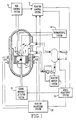
- the model adjustment system 10 obtains the core thermal power from a reactor control system 12 and control bank position information from a rod control system 14.
- the thermocouple system 16 connected to thermocouples 18, positioned at core fuel assembly exits, along with cold leg temperature obtained from the reactor control system 12 allow determination of the enthalpy rise while neutron detector signals are provided by a reactor protection system 20 connected to incore detectors 22 or from an incore fixed detector system 24 connected to incore detector strings 26.
- the systems 10, 12, 14, 16, 20 and 24 are normally provided as software modules in the plant computer.
- Fig. 2 The relationship of the model adjustment system 10 to other software modules is illustrated in Fig. 2.
- Monthly a full scope calibrator 40 obtains the equilibrium power, axial iodine, xenon, promethium, samarium and longterm burn up distributions from the model file 42 along with an input boron concentration and iteratively, performs a conventional 1-D diffusion theory calculation of axial power shape with an equilibrium xenon distribution, compares the AO, AP, AQ, AR components of the calculated power distribution with the corresponding components of the average axial power distribution derived from a conventional equilibrium flux map and adjusts the A1-A5 expansion coefficients of equation (2) until the calculated critical power shape of the model 42 closely matches the measured power shape in a manner as described in U.S. Patent 4,711,753.
- a conventional front end data processor 44 obtains the plant instrumentation data previously discussed and supplies such to the adjuster module 10.
- This module or tracker model adjuster system 10 of the present invention substantially continuously, automatically and online adjusts the analytical core model 42 concurrently with an update of the model 42 by a model update system 46.
- a conventional core response predictor 48 can predict the response of the nuclear reactor to contemplated changes entered by the user 50 by using the axial iodine, xenon, promethium, samarium, long term burn-up and transverse buckling distributions stored in the file as a starting point for a prediction in response to a user specified maneuver.
- the model can be used by a conventional graphics display generator 52 such as described in U.S. Patent 4,642,213 to produce a display for the user 50 on a graphics monitor 54.
- FIG. 3 An example of a possible sequence of execution of the steps necessary in the present invention to automatically, without user intervention, continuously update the analytical core model initiation parameters is illustrated in Fig. 3.
- a flux map is conventionally obtained, boron concentration in the reactor cooling system is determined and the calibration as described in U.S. Patent 4,711,753 is executed to calibrate 62 the model or data file to particularly adjust the A1-A5 coefficients. It is also possible to obtain the A1-A5 coefficients periodically from reactor design calculations as a much less desirable alternative. If the model has been calibrated or after a determination that the monthly calibration is not necessary is made the current state of the core is progressively read 64 as core operations proceed.
- the core model 42 is then read in from its storage location and the core model is updated 66 using a conventional depletion calculation using the time, power level, rod positions inlet temperature and pressure.
- the current analytical axial offset and axial pinch values are calculated using conventional neutronics equations such as the one dimensional diffusion theory algorithms, the one dimensional nodal algorithms or the one dimensional neutron transport algorithms, such as is found in the full scope calibrator 40 or core response predictor 48, by performing a conventional criticality search.
- the current actual axial offset and pinch values 70 are estimated using equations 3 and 4 using the detector readings, thermocouple reading, rod positions, inlet temperature and power level where enthalpy rise ⁇ h is calculated as set forth in U.S. patent 4,774,050.
- the actual values determined using equations 3 and 4 are compared 72 to the analytical values.
- the absolute value of the difference between the calculated analytical axial offset and measured actual axial offset is less than or equal to a predetermined value n, for example 0.5%, and the absolute value of the difference between calculated analytical axial pinch and measured actual axial pinch is less than or equal to a predetermined value m which could be the same 0.5%, the differences are acceptable and the model need not be adjusted.
- n for example 0.5%
- m which could be the same 0.5%
- the system stores 74 the model or data file and waits 76 for a predetermined period of time, that is, waits until it is time for another periodic update cycle. As indicated by the dashed box 75, the system could also display the adjusted and updated model by providing the model to the display generator 52. If deviation is significant, that is, not acceptable, the values of the A2 and A3 coefficients in the buckling equations are adjusted 78. With these adjusted coefficient values the neutronic equations are again used to determine 80 new calculated analytical values for axial offset and axial pinch.
- the cycle of comparing 72, adjusting 78 and calculating 80 are cyclically executed until the A2 and A3 coefficients are compensated for the drift using a standard method, called over-compensation in control theory, to produce non-zero opposite sign deviation values.
- This type of compensation requires that the magnitude of the deviation be offset by a deviation in the opposite direction of somewhat less than the magnitude of the deviation. For example, if the deviation is calculated as 0.5% in the positive direction, the compensation criteria require that the compensated result deviate in the negative direction for a value of for example 0.25%.
- the reason for overcompensating is that the errors that accumulate in the iodine and xenon axial distributions are, in affect, time integrals of axial power distribution errors; and, hence, by over compensating the system is, in effect, burning out the iodine and xenon errors.
- the time constants of promethium and samarium are relatively large compared to those of iodine and xenon and so their errors are relatively insensitive to the variation in power distribution errors.
- a calculated value of the critical reactor coolant system boron concentration is available as a byproduct of the criticality search because boron concentration is recalculated as the update and adjustment proceeds and this allows the A1 coefficient to also be adjusted when reliable values of reactor core coolant system boron concentration are obtained. Since the core model is routinely adjusted to match the calculated boron concentration value to the measured value secured during monthly flux mapping operations and since the model can be refined to match the calculated boron concentration value to a measured value whenever suitable measured values are obtained, a reliable, frequently updated estimate of current boron concentration can be displayed for the operator's use. Further, systematic deviations of calculated boron concentration from measured values can point to analytical core model deficiencies.
- the present invention can be modified to do estimated critical condition and shutdown margin estimates with minimum interaction, except for output of results, with the user.
Landscapes
- Engineering & Computer Science (AREA)
- Physics & Mathematics (AREA)
- General Engineering & Computer Science (AREA)
- Plasma & Fusion (AREA)
- High Energy & Nuclear Physics (AREA)
- Monitoring And Testing Of Nuclear Reactors (AREA)
Applications Claiming Priority (2)
| Application Number | Priority Date | Filing Date | Title |
|---|---|---|---|
| US345872 | 1989-05-01 | ||
| US07/345,872 US5024801A (en) | 1989-05-01 | 1989-05-01 | Reactor core model update system |
Publications (2)
| Publication Number | Publication Date |
|---|---|
| EP0396321A2 true EP0396321A2 (fr) | 1990-11-07 |
| EP0396321A3 EP0396321A3 (fr) | 1991-04-03 |
Family
ID=23356864
Family Applications (1)
| Application Number | Title | Priority Date | Filing Date |
|---|---|---|---|
| EP19900304493 Withdrawn EP0396321A3 (fr) | 1989-05-01 | 1990-04-26 | Methode d'actualisation des paramètres d'un modèle de coeur de rèacteur nucleaire |
Country Status (3)
| Country | Link |
|---|---|
| US (1) | US5024801A (fr) |
| EP (1) | EP0396321A3 (fr) |
| JP (1) | JPH02302695A (fr) |
Cited By (6)
| Publication number | Priority date | Publication date | Assignee | Title |
|---|---|---|---|---|
| FR2796197A1 (fr) * | 1999-07-05 | 2001-01-12 | Framatome Sa | Procede et dispositif de surveillance d'au moins un parametre de fonctionnement du coeur d'un reacteur nucleaire |
| FR2796196A1 (fr) * | 1999-07-05 | 2001-01-12 | Framatome Sa | Procede et dispositif de surveillance d'au moins un parametre de fonctionnement du coeur d'un reacteur nucleaire |
| FR2922351A1 (fr) * | 2007-10-12 | 2009-04-17 | Areva Np Sas | Procede d'etablissement de cartographies incore mixtes et application au calibrage de l'instrumentation fixe |
| EP2884496A4 (fr) * | 2012-08-13 | 2016-03-16 | Mitsubishi Heavy Ind Ltd | Dispositif de surveillance de réacteur nucléaire, dispositif de commande de réacteur nucléaire et installation de génération d'énergie nucléaire |
| CN113409895A (zh) * | 2021-06-23 | 2021-09-17 | 中国核动力研究设计院 | 一种用于硼表化学滴定的人机交互方法及装置 |
| WO2024148894A1 (fr) * | 2023-01-13 | 2024-07-18 | 中广核研究院有限公司 | Procédé et appareil pour surveiller un champ physique d'un réacteur nucléaire, et dispositif et support de stockage |
Families Citing this family (33)
| Publication number | Priority date | Publication date | Assignee | Title |
|---|---|---|---|---|
| US5091139A (en) * | 1989-06-26 | 1992-02-25 | General Electric Company | Automated thermal limit monitor |
| JP2647573B2 (ja) * | 1990-06-12 | 1997-08-27 | ウエスチングハウス・エレクトリック・コーポレイション | 炉心出力分布監視装置、原子炉防護装置、原子炉炉心検出器装置及び原子炉炉心監視方法 |
| US5410492A (en) * | 1992-01-29 | 1995-04-25 | Arch Development Corporation | Processing data base information having nonwhite noise |
| US5459675A (en) * | 1992-01-29 | 1995-10-17 | Arch Development Corporation | System for monitoring an industrial process and determining sensor status |
| JPH06201884A (ja) * | 1992-09-22 | 1994-07-22 | Toshiba Corp | 原子炉出力監視装置 |
| US5740033A (en) * | 1992-10-13 | 1998-04-14 | The Dow Chemical Company | Model predictive controller |
| US5490184A (en) * | 1994-07-21 | 1996-02-06 | Westinghouse Electric Corporation | Method and a system for accurately calculating PWR power from excore detector currents corrected for changes in 3-D power distribution and coolant density |
| US5555279A (en) * | 1994-11-16 | 1996-09-10 | Nir; Israel | System for monitoring and controlling nuclear reactors |
| US5761090A (en) * | 1995-10-10 | 1998-06-02 | The University Of Chicago | Expert system for testing industrial processes and determining sensor status |
| US5866899A (en) * | 1996-09-12 | 1999-02-02 | Advanced Micro Devices, Inc. | Concentration measurement apparatus calibration method |
| US5841016A (en) * | 1996-09-12 | 1998-11-24 | Advanced Micro Devices, Inc. | Ultra-low level standard for concentration measurements |
| FR2769402B1 (fr) * | 1997-10-07 | 1999-12-17 | Framatome Sa | Technique de pilotage de reacteur nucleaire |
| US6353650B1 (en) * | 1997-12-22 | 2002-03-05 | Westinghouse Electric Company Llc | Reduced in-core instrument patterns for pressurized water reactors |
| US6139180A (en) * | 1998-03-27 | 2000-10-31 | Vesuvius Crucible Company | Method and system for testing the accuracy of a thermocouple probe used to measure the temperature of molten steel |
| US6493412B1 (en) * | 2000-10-11 | 2002-12-10 | Westinghouse Electric Company Llc | Method of calibrating exit thermocouples in a nuclear reactor |
| US8873698B2 (en) * | 2002-12-18 | 2014-10-28 | Global Nuclear Fuel—Americas, LLC | Computer-implemented method and system for designing a nuclear reactor core which satisfies licensing criteria |
| US7136779B2 (en) * | 2004-05-28 | 2006-11-14 | Daimlerchrysler Ag | Method for simplified real-time diagnoses using adaptive modeling |
| US7676015B2 (en) * | 2006-04-06 | 2010-03-09 | Georgia Tech Research Corporation | Boundary condition adjustment methods and systems |
| WO2007130003A1 (fr) * | 2006-04-06 | 2007-11-15 | Georgia Tech Research Corporation | Procédés et systèmes d'ajustement des conditions limites |
| FR2914103B1 (fr) * | 2007-03-19 | 2009-12-18 | Areva Np | Procede de determination de la distribution de puissance volumique du coeur d'un reacteur nucleaire |
| KR100991441B1 (ko) * | 2008-10-29 | 2010-11-03 | 한국전력공사 | 원자력발전소 노외계측기의 재규격화 교정방법 |
| US20110002432A1 (en) * | 2009-07-01 | 2011-01-06 | Westinghouse Electric Company Llc | Incore instrument core performance verification method |
| FR2950466B1 (fr) * | 2009-09-22 | 2012-01-13 | Areva Np | Procede d'aide a l'exploitation d'un reacteur nucleaire. |
| US9424376B2 (en) * | 2011-11-18 | 2016-08-23 | Terrapower, Llc | Enhanced neutronics systems |
| US9008807B2 (en) * | 2012-05-25 | 2015-04-14 | Statistics & Control, Inc. | Method of large scale process optimization and optimal planning based on real time dynamic simulation |
| JP6132521B2 (ja) * | 2012-11-27 | 2017-05-24 | 三菱重工業株式会社 | 未臨界度測定方法及び装置 |
| US10310457B2 (en) | 2014-11-24 | 2019-06-04 | Aspen Technology, Inc. | Runtime modeling approach to updating refinery planning models |
| KR101653155B1 (ko) * | 2015-03-06 | 2016-09-02 | 한국원자력연구원 | 고속로의 노물리 시험을 위한 시험 장치 및 방법 |
| KR20240159022A (ko) * | 2018-06-21 | 2024-11-05 | 비더블유엑스티 뉴클리어 에너지, 인크. | 범용 역전형 원자로 및 범용 역전형 원자로의 설계 및 제조 방법 |
| EP3966837B1 (fr) * | 2019-05-07 | 2023-03-15 | Framatome Gmbh | Procédé de commande d'un réacteur nucléaire à eau sous pression et système de gouvernance |
| CN114242275A (zh) * | 2021-11-18 | 2022-03-25 | 中广核研究院有限公司 | 一种保护系统 |
| CN114242274A (zh) * | 2021-11-18 | 2022-03-25 | 中广核研究院有限公司 | 一种保护系统 |
| CN114741376B (zh) * | 2022-03-21 | 2024-11-05 | 哈尔滨工程大学 | 基于反应堆堆芯精细化计算数据在线分析的数据瘦身方法 |
Family Cites Families (11)
| Publication number | Priority date | Publication date | Assignee | Title |
|---|---|---|---|---|
| US4330367A (en) * | 1973-05-22 | 1982-05-18 | Combustion Engineering, Inc. | System and process for the control of a nuclear power system |
| JPS5322639B2 (fr) * | 1973-10-22 | 1978-07-10 | ||
| US4552718A (en) * | 1982-07-01 | 1985-11-12 | Westinghouse Electric Corp. | Method and apparatus for on-line monitoring of the operation of a complex non-linear process control system |
| US4637910A (en) * | 1984-01-20 | 1987-01-20 | Westinghouse Electric Corp. | Method and apparatus for continuous on-line synthesis of power distribution in a nuclear reactor core |
| US4637911A (en) * | 1984-07-24 | 1987-01-20 | Massachusetts Institute Of Technology | Apparatus and method for closed-loop control of reactor power |
| US4642213A (en) * | 1984-07-27 | 1987-02-10 | Westinghouse Electric Corp. | Anticipatory control of xenon in a pressurized water reactor |
| US4803039A (en) * | 1986-02-03 | 1989-02-07 | Westinghouse Electric Corp. | On line interactive monitoring of the execution of process operating procedures |
| US4711753A (en) * | 1986-03-19 | 1987-12-08 | Westinghouse Electric Corp. | Calibration of a nuclear reactor core parameter predictor |
| US4774050A (en) * | 1986-04-10 | 1988-09-27 | Westinghouse Electric Corp. | Axial power distribution monitor and display using outputs from ex-core detectors and thermocouples |
| US4839134A (en) * | 1987-12-31 | 1989-06-13 | Westinghouse Electric Corp. | Continuous, online nuclear power distribution synthesis system and method |
| US4927594A (en) * | 1988-08-10 | 1990-05-22 | Westinghouse Electric Corp. | Thermocouple based control rod position indication system |
-
1989
- 1989-05-01 US US07/345,872 patent/US5024801A/en not_active Expired - Lifetime
-
1990
- 1990-04-26 EP EP19900304493 patent/EP0396321A3/fr not_active Withdrawn
- 1990-05-01 JP JP2115682A patent/JPH02302695A/ja active Pending
Cited By (13)
| Publication number | Priority date | Publication date | Assignee | Title |
|---|---|---|---|---|
| FR2796197A1 (fr) * | 1999-07-05 | 2001-01-12 | Framatome Sa | Procede et dispositif de surveillance d'au moins un parametre de fonctionnement du coeur d'un reacteur nucleaire |
| FR2796196A1 (fr) * | 1999-07-05 | 2001-01-12 | Framatome Sa | Procede et dispositif de surveillance d'au moins un parametre de fonctionnement du coeur d'un reacteur nucleaire |
| US6400786B1 (en) | 1999-07-05 | 2002-06-04 | Framatome | Process and device for monitoring at least one operating parameter of the core of a nuclear reactor |
| US6430247B1 (en) | 1999-07-05 | 2002-08-06 | Framatome | Method and system for monitoring at least one operating parameter of the core of a nuclear reactor |
| FR2922351A1 (fr) * | 2007-10-12 | 2009-04-17 | Areva Np Sas | Procede d'etablissement de cartographies incore mixtes et application au calibrage de l'instrumentation fixe |
| WO2009053624A3 (fr) * | 2007-10-12 | 2009-08-06 | Areva Np | Procede d' etablissement de cartographies incore mixtes et application au calibrage de l' instrumentation fixe |
| CN101868835A (zh) * | 2007-10-12 | 2010-10-20 | 阿海珐核能公司 | 用于建立混合内芯映射的方法以及固定仪表校准的应用 |
| RU2479053C2 (ru) * | 2007-10-12 | 2013-04-10 | Арева Нп | Способ создания смешанных карт активной зоны ядерного реактора и его применение к калибровке стационарных контрольно-измерительных приборов |
| CN101868835B (zh) * | 2007-10-12 | 2013-09-25 | 阿海珐核能公司 | 用于建立混合内芯映射的方法以及固定仪表校准的应用 |
| US8804894B2 (en) | 2007-10-12 | 2014-08-12 | Areva Np | Method of producing mixed in-core maps and application to the calibration of fixed instrumentation |
| EP2884496A4 (fr) * | 2012-08-13 | 2016-03-16 | Mitsubishi Heavy Ind Ltd | Dispositif de surveillance de réacteur nucléaire, dispositif de commande de réacteur nucléaire et installation de génération d'énergie nucléaire |
| CN113409895A (zh) * | 2021-06-23 | 2021-09-17 | 中国核动力研究设计院 | 一种用于硼表化学滴定的人机交互方法及装置 |
| WO2024148894A1 (fr) * | 2023-01-13 | 2024-07-18 | 中广核研究院有限公司 | Procédé et appareil pour surveiller un champ physique d'un réacteur nucléaire, et dispositif et support de stockage |
Also Published As
| Publication number | Publication date |
|---|---|
| JPH02302695A (ja) | 1990-12-14 |
| EP0396321A3 (fr) | 1991-04-03 |
| US5024801A (en) | 1991-06-18 |
Similar Documents
| Publication | Publication Date | Title |
|---|---|---|
| US5024801A (en) | Reactor core model update system | |
| EP0238299B1 (fr) | Etalonnage d'un appareil pour les calculs prévisionnels des paramètres d'un coeur d'un réacteur nucléaire | |
| US20110268239A1 (en) | Method of calibrating excore detectors in a nuclear reactor | |
| JP3087766B2 (ja) | 炉心における三次元出力分布及び冷却材密度の変化について補正した炉外検出器出力電流から加圧水型原子炉の出力を正確に算出する方法及び装置 | |
| KR101158459B1 (ko) | 원자로 노심 모니터링 방법 및 장치 | |
| US4774049A (en) | Two and three dimensional core power distribution monitor and display | |
| US9997263B2 (en) | Method of determining the value of a parameter representative of the operability of a nuclear reactor, determining system, computer and corresponding medium | |
| US6493412B1 (en) | Method of calibrating exit thermocouples in a nuclear reactor | |
| US4927594A (en) | Thermocouple based control rod position indication system | |
| KR100201029B1 (ko) | 원자로 코어 내부 원자력 분포 결정 방법 및 원자로 코어 주위의 중성자 검출기 교정 방법 | |
| JPS59799B2 (ja) | 原子力発電所の炉出力予測装置 | |
| Han et al. | A methodology for benefit assessment of using in-core neutron detector signals in core protection calculator system (CPCS) for Korea standard nuclear power plants (KSNPP) | |
| JPH04232497A (ja) | 炉心出力分布監視装置、原子炉防護装置、原子炉炉心検出器装置及び原子炉炉心監視方法 | |
| JPH04265899A (ja) | 原子炉シミュレータ | |
| Lundberg et al. | Core supervision methods and future improvements of the core master/presto system at KKB | |
| Knutson et al. | Reactivity anomaly surveillance in the Fast Flux Test Facility through cycle 3 | |
| Zalesky et al. | SCORPIO-VVER core surveillance system | |
| Knutson et al. | Reactivity Anomalies in the Fast Flux Test Facility—An Evaluation of Data from Cycles 1 Through 8 | |
| Knutson et al. | Fast Flux Test Facility passive safety reactivity feedback measurements | |
| Hyndman et al. | EBR-II: DIGITAL DATA ACQUISITION SYSTEM STUDY. | |
| JPH0219918B2 (fr) | ||
| Christman | Summary of calculational and experimental physics results for Shippingport PWR-1 Seed 1 | |
| Coiner et al. | Nuclear application software package | |
| Papadatos et al. | Power Measurements in CANDU Reactors | |
| JPS60174986A (ja) | 核計装較正のためのデ−タ取得方法 |
Legal Events
| Date | Code | Title | Description |
|---|---|---|---|
| PUAI | Public reference made under article 153(3) epc to a published international application that has entered the european phase |
Free format text: ORIGINAL CODE: 0009012 |
|
| AK | Designated contracting states |
Kind code of ref document: A2 Designated state(s): BE CH ES FR GB IT LI |
|
| PUAL | Search report despatched |
Free format text: ORIGINAL CODE: 0009013 |
|
| AK | Designated contracting states |
Kind code of ref document: A3 Designated state(s): BE CH ES FR GB IT LI |
|
| 17P | Request for examination filed |
Effective date: 19910927 |
|
| 17Q | First examination report despatched |
Effective date: 19931130 |
|
| STAA | Information on the status of an ep patent application or granted ep patent |
Free format text: STATUS: THE APPLICATION HAS BEEN WITHDRAWN |
|
| 18W | Application withdrawn |
Withdrawal date: 19940711 |