EP0396831A2 - Verfahren und Apparat zur Bestimmung der akustischen Parameter eines Hörgerätes unter Verwendung eines Software-Modells - Google Patents
Verfahren und Apparat zur Bestimmung der akustischen Parameter eines Hörgerätes unter Verwendung eines Software-Modells Download PDFInfo
- Publication number
- EP0396831A2 EP0396831A2 EP89304711A EP89304711A EP0396831A2 EP 0396831 A2 EP0396831 A2 EP 0396831A2 EP 89304711 A EP89304711 A EP 89304711A EP 89304711 A EP89304711 A EP 89304711A EP 0396831 A2 EP0396831 A2 EP 0396831A2
- Authority
- EP
- European Patent Office
- Prior art keywords
- auditory
- auditory prosthesis
- acoustic
- acoustic parameters
- prosthesis
- Prior art date
- Legal status (The legal status is an assumption and is not a legal conclusion. Google has not performed a legal analysis and makes no representation as to the accuracy of the status listed.)
- Granted
Links
Images


Classifications
-
- H—ELECTRICITY
- H04—ELECTRIC COMMUNICATION TECHNIQUE
- H04R—LOUDSPEAKERS, MICROPHONES, GRAMOPHONE PICK-UPS OR LIKE ACOUSTIC ELECTROMECHANICAL TRANSDUCERS; ELECTRIC HEARING AIDS; PUBLIC ADDRESS SYSTEMS
- H04R25/00—Electric hearing aids
- H04R25/70—Adaptation of deaf aid to hearing loss, e.g. initial electronic fitting
-
- H—ELECTRICITY
- H04—ELECTRIC COMMUNICATION TECHNIQUE
- H04R—LOUDSPEAKERS, MICROPHONES, GRAMOPHONE PICK-UPS OR LIKE ACOUSTIC ELECTROMECHANICAL TRANSDUCERS; ELECTRIC HEARING AIDS; PUBLIC ADDRESS SYSTEMS
- H04R25/00—Electric hearing aids
- H04R25/50—Customised settings for obtaining desired overall acoustical characteristics
-
- H—ELECTRICITY
- H04—ELECTRIC COMMUNICATION TECHNIQUE
- H04R—LOUDSPEAKERS, MICROPHONES, GRAMOPHONE PICK-UPS OR LIKE ACOUSTIC ELECTROMECHANICAL TRANSDUCERS; ELECTRIC HEARING AIDS; PUBLIC ADDRESS SYSTEMS
- H04R2225/00—Details of deaf aids covered by H04R25/00, not provided for in any of its subgroups
- H04R2225/39—Aspects relating to automatic logging of sound environment parameters and the performance of the hearing aid during use, e.g. histogram logging, or of user selected programs or settings in the hearing aid, e.g. usage logging
-
- H—ELECTRICITY
- H04—ELECTRIC COMMUNICATION TECHNIQUE
- H04R—LOUDSPEAKERS, MICROPHONES, GRAMOPHONE PICK-UPS OR LIKE ACOUSTIC ELECTROMECHANICAL TRANSDUCERS; ELECTRIC HEARING AIDS; PUBLIC ADDRESS SYSTEMS
- H04R2225/00—Details of deaf aids covered by H04R25/00, not provided for in any of its subgroups
- H04R2225/43—Signal processing in hearing aids to enhance the speech intelligibility
-
- H—ELECTRICITY
- H04—ELECTRIC COMMUNICATION TECHNIQUE
- H04R—LOUDSPEAKERS, MICROPHONES, GRAMOPHONE PICK-UPS OR LIKE ACOUSTIC ELECTROMECHANICAL TRANSDUCERS; ELECTRIC HEARING AIDS; PUBLIC ADDRESS SYSTEMS
- H04R2225/00—Details of deaf aids covered by H04R25/00, not provided for in any of its subgroups
- H04R2225/61—Aspects relating to mechanical or electronic switches or control elements, e.g. functioning
Definitions
- the present invention relates generally to auditory prostheses and more particularly to auditory prostheses having adjustable acoustic parameters.
- Auditory prostheses have been utilized to modify the auditory characteristics of sound received by a user or wearer of that auditory prosthesis.
- the intent of the prosthesis is, at least partially, to compensate for a hearing impairment of the user or wearer.
- Hearing aids which provide an acoustic signal in the audible range to a wearer have been well known and are in example of an auditory prosthesis.
- cochlear implants which stimulate the auditory nerve with an electrical stimulus signal have been used to compensate for the hearing impairment of a wearer.
- Other examples of auditory prostheses are implanted hearing aids which stimulate the auditory response of the wearer by a mechanical stimulation of the middle ear and prostheses which otherwise electromechanically stimulate the user.
- Hearing impairments are quite variable from one individual to another individual.
- An auditory prosthesis which properly compensates for the hearing impairment of one individual may not be beneficial or may be disruptive to another individual.
- auditory prostheses must be adjustable to serve the needs of an individual user or patient.
- the process by which an individual auditory prosthesis is adjusted to be of optimum benefit to the user of patient is typically called “fitting". Stated another way, the auditory prosthesis must be “fit” to the individual user of that auditory prosthesis in order to provide a maximum benefit to that user, or patient.
- the "fitting" of the auditory prosthesis provides the auditory prosthesis with the appropriate auditory characteristics to be of benefit to the user.
- This fitting process involves measuring the auditory characteristics of the individual's hearing, calculating the nature of the acoustic characteristics, e. g., acoustic amplification in specified frequency bands, needed to compensate for the particular auditory deficiency measured, adjusting the auditory characteristics of the auditory prosthesis to enable the prosthesis to deliver the appropriate acoustic characteristic, e. g., acoustic amplification is specified frequency bands, and verifying that this particular auditory characteristic does compensate for the hearing deficiency found by operating the auditory prosthesis in conjunction with the individual.
- the adjustment of the auditory characteristics is accomplished by selection of components during the manufacturing process, so called “custom" hearing aids, or by adjusting potentiometers available to the fitter, typically an audiologist, hearing aid dispenser, otologist, otolaryngologist or other doctor or medical specialist.
- Some hearing aids are programmable in addition to being adjustable.
- Programmable hearing aids have some memory device which store the acoustic parameters which the hearing aid can utilize to provide a particular auditory characteristic.
- the memory device may be changed or modified to provide a new or modified auditory parameter or set of auditory parameters which in turn will provide the hearing aid with a modified auditory characteristic.
- the memory device will be an electronic memory, such as a register or randomly addressable memory, but may also be other types of memory devices such as programmed cards, switch settings or other alterable mechanism having retention capability.
- An example of a programmable hearing aid which utilizes electronic memory is described in U. S. Patent No. 4,425,481, Mangold et al.
- a new auditory characteristic, or a new set of acoustic parameters may be provided to the hearing aid by a host computer or other programming device which includes a mechanism for communication with the hearing aid being programmed.
- acoustic parameters may need to be made, either initially to achieve an initial setting or value for the acoustic parameters or to revise such settings or valuations after the hearing aid has been used by the user.
- Known mechanisms for providing settings or valuations for the acoustic parameters usually involve measuring the hearing impairment of an individual and determining the setting or value necessary for an individual acoustic parameter in order to compensate for the hearing impairment so measured.
- a persistent problem in such fitting procedures is that the measuring and the adjustments in the acoustic parameters during fitting must be made using the auditory prosthesis itself which provides some practical difficulties. If the fitting procedure is automated, as is sometime the case, the automatic features of the fitting process must be stopped and a physical, usually mechanical, adjustment of the acoustic parameters must be made while the auditory prosthesis is operated or utilized in conjunction with the user. Such manual, physical processes not only consume a lot of time but also involve the user, patient, of the auditory prosthesis and, thus, makes the fitting process long and arduous for the patient.
- the present invention provides a method and apparatus for determining the acoustic parameters for an auditory prosthesis without the manual, arduous, time consuming steps required in the past.
- the present invention utilizes a software model of the auditory prosthesis which may be stored independently of the actual auditory prosthesis being fitted to determine the acoustic parameters to be utilized.
- a transfer function of the auditory characteristics of the individual auditory prosthesis to be fitted, or of an exemplary model of such an auditory prosthesis, is created, transformed into a table, or other usable form, and stored in software usable by an automated fitting program.
- the automated fitting program may then "test" or try be iterative process, the various settings for the acoustic parameters of the auditory prosthesis and accurately determine the results without actual resort to the physical auditory prosthesis itself. Since the transfer function of the auditory prosthesis is stored in software, it is no longer necessary to halt the automated fitting process to physically adjust the auditory prosthesis.
- the automated fitting process thus, remains automated and the fitting process is greatly accelerated and enhanced. Further, since less time is required for each step in the fitting process, a greater accuracy may be obtained in the same amount of fitting time. Alternatively, since less time is required for each step, the fitting process may be accelerated and more patients may be treated by the technician in the same amount of time.
- the present invention is designed for use with an auditory prosthesis having acoustic parameters which at least in part determine the acoustic fitting function of the auditory prosthesis, the acoustic parameters being adjustable, and provides a method of determining the acoustic parameters of the auditory prosthesis which will provide a user of the auditory prosthesis with a target auditory response, by following the steps of determining the target auditory response of the user, determining the acoustic fitting function of the auditory prosthesis operating in conjunction with the user, storing a software model of the acoustic fitting function, and optimizing the acoustic parameters of auditory prosthesis by comparing the auditory response of the software model with the target auditory response and by adjusting the acoustic parameters to minimize the error of the comparison.
- the present invention is also designed for use with an auditory prosthesis having acoustic parameters which at least in part determine the acoustic fitting function of the auditory prosthesis, the acoustic parameters being adjustable, and provides an apparatus for determining the acoustic parameters of the auditory prosthesis which will provide a user of the auditory prosthesis with a target auditory response.
- a first mechanism determines the target auditory response of the user.
- a second mechanism is adapted to be operably coupled to the user and determines the acoustic fitting function of the auditory prosthesis operating in conjunction with the user.
- a storage mechanism is operably coupled to the second mechanism and stores a software model of the acoustic fitting function.
- An optimization mechanism is operably coupled to the first mechanism and the second mechanism and optimizes the acoustic parameters of auditory prosthesis by comparing the auditory response of the software model with the target auditory response and for adjusting the acoustic parameters to minimize the error of the comparison.
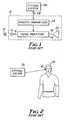
- FIG 1 illustrates a prior art auditory prosthesis 10, which in this description is described as being a hearing aid.
- the auditory prosthesis has a microphone 12 for receiving an acoustic signal 14 and converting the acoustic signal 14 into an electrical signal 16 for transmission to a signal processor 18.
- the signal processor 18 operates on the electrical input signal 16 provides a processed electrical signal 20 which is transmitted to a receiver 22 to be transformed into a signal which is perceptible to the user of the auditory prosthesis 10.
- the auditory prosthesis 10 illustrated in Figure 1 is adjustable in its auditory characteristics.
- the auditory characteristic of the auditory prosthesis 10 is determined by a set of acoustic parameters 24 stored within the auditory prosthesis 10, preferably, or in any other convenient retrievable location.
- the signal processor 18 modifies the electrical input signal 16 in accordance with a set of acoustic parameters 24 to provide the processed electrical signal 20.
- the set of acoustic parameters 24 define the auditory characteristic of the auditory prosthesis 10.
- An example of such an auditory prosthesis includes a signal processor such as is described in United States Patent No. 4,425,481, Mangold et al. Receiver 22, which in hearing aid parlance is a miniature speaker, which produce a signal which is adapted to be perceptible to the user of the auditory prosthesis 10 as sound.
- the auditory characteristic of a particular auditory prosthesis 10 is adjustable and is determined, at least in part, by the set of acoustic parameters 24.
- the auditory prosthesis 10 In order to provide the user of the auditory prosthesis 10 with an appropriate auditory characteristic, as specified by the set of acoustic parameters 24, the auditory prosthesis 10 must be "fit" to the individual's hearing impairment.
- the fitting process involves measuring the auditory characteristic of the individual's hearing, calculating the nature of the amplification or other signal processing characteristics needed to compensate for a particular hearing impairment, determining the individual acoustic parameters 24 which are to be utilized by the auditory prosthesis 10 and verifying that these acoustic parameters do operate in conjunction with the individual's hearing to obtain the compensation desired.
- fitting apparatus 26 is a host computer which may be programmed to provide an initial "fitting", i.e., to determine the initial values for the set of acoustic parameters 24 in order to compensate for a particular hearing impairment for a particular individual with which the auditory prosthesis 10 is intended to be utilized.
- initial “fitting” process is well known in the art.
- Figure 2 illustrates such a prior art fitting system 26 being operated in conjunction with a programmable auditory prosthesis 10 which is being fit to an individual or patient 30.
- the fitting system 26 is used in conjunction with the auditory prosthesis 10 coupled to the individual 30 in order to determine and adjust the auditory prosthesis 10 to properly compensate for the individual's 30 hearing impairment.
- an audiogram 110 is made of the individual's 30 hearing impairment by standard well known techniques, such as is described Green, David S., "Pure Tone Air Conduction Testing", Chapter 9, in Katz, Jack, editor, Handbook of Clinical Audiology , Williams & Wilkins, Baltimore, Maryland (1978).
- the audiogram 110 represents the actual auditory ability of the individual 30 and, hence, illustrates or represents the hearing impairment of the individual 30.
- the prescriptive method, or compensation of the hearing impairment, 112 can be developed, also by well known techniques. From the prescriptive method 112 an insertion gain 114 is determined.
- the settings of the acoustic parameters 24 of the auditory prosthesis 10 can be determined at step 114.
- a particular auditory prosthesis is selected 116 and adjusted 118 according to that insertion gain 114.
- the actual response of the individual 30 is measured 120. From the the measured response 120, it can be determined whether the auditory prosthesis 10 is adjusted properly (step 122). If the auditory prosthesis, at this point, is adjusted properly, the process ends (step 124).
- step 122 If, however, the auditory prosthesis is not adjusted properly (step 122), the process must revert back to step 118 where the auditory prosthesis 10 is readjusted to a new or better approximation of an auditory characteristic and the response is again measured at block 120. Again, it is determined whether or not the auditory prosthesis is adjusted properly at step 122. Thus, an iterative adjustment and measurement of the response of the individual 30 occurs.
- This well known adjustment/fitting technique is represented in the prior art fitting system as illustrated by block 26 in Figures 1 and 2. It can be seen that the entire process for fitting system 26, as illustrated in Figure 3 must be done with the auditory prosthesis 10 operating in conjunction with the individual 30.
- the individual 30 is subjected to a long and arduous fitting process with the auditory prosthesis being utilized in conjunction with the individual's 30 ear. Since much time is spent for each fitting step, a fewer number of iterative processes can be performed in the same amount of time, resulting in potentially high in accuracy in the fitting process.
- FIG 4 illustrates a fitting system 32 of the present invention operating in conjunction with an auditory prosthesis 10, again being fitted to individual 30.
- Fitting system 32 contains an automated fitting program 34 which may operate either in conjunction with the auditory prosthesis 10 or with a software model 36 of the auditory prosthesis 10 which is stored in, or retrievable by, fitting system 32.
- fitting system 32 The procedures involved in the fitting system 32 are illustrated in Figure 5. As in the prior art fitting systems 26, fitting system 32 starts with an audiogram 110 of the individual's 30 hearing. This technique is well known and exactly the same as it is performed in the prior art fitting system 26 illustrated in Figure 3.
- the procedure in Figure 5 develops a prescriptive method 112 from the audiogram 110. From the prescriptive method 112 an insertion gain that is the desired auditory characteristic of the auditory prosthesis 10 is determined. The determination of the prescriptive method 112 and the development of the insertion gain are exactly the same as they occur in the prior art fitting system 26 illustrated in Figure 3. With fitting system 32, a real ear measurement 126 of the auditory prosthesis 10 operating in conjunction with the individual 30 is obtained by the automated fitting program 34. The technique used to perform the real ear measure 126 will be described later. From the real ear measure 126 and the insertion gain 116 determined previously, a target response of the auditory response is computed 128.
- the computed target response 128 simply takes the insertion gain as determined by 116 and it modifies that insertion gain according to the real ear measured 126 corrections. Thus, the computed target response 128 simply represents a combination of the insertion gain 116 and the real ear measure corrections 126.
- the fitting system 32 then "adjusts" 130 the acoustic parameters which would determine the auditory characteristics of the auditory prosthesis. This "adjustment” is performed utilizing a software model 36 of the auditory prosthesis contained in the fitting system 32. Thus, the adjustment 130 need not be performed with the fitting system 32 coupled to the auditory prosthesis 10. The adjustment 130 can be performed independently and separately from any connection to the auditory prosthesis 10 and, hence, the individual 30 is not encumbered at this point.
- Step 134 determines whether the presumably properly "adjusted" auditory prosthesis 10 has the proper values of acoustic parameters 24 to provide the auditory characteristic as determined by the computed target response 128.
- the process reverts to the "adjustment" 130 step and the acoustic parameters of the auditory prosthesis 10 are readjusted, based upon known techniques, to new values where a new computed response 132 may be obtained and a new determination as to the proper adjustment of the presumed auditory prosthesis 10 may be performed (step 134). If the adjustment, however, is proper, then the process optionally ends or (as shown) the auditory prosthesis is adjusted 118 with that set of acoustic parameters 24 and the actual response of the auditory prosthesis 10 is measured 120.
- step 122 If this adjustment of the auditory prosthesis 10 is proper (step 122), then the process is ended (step 124). If at step 122, after actually measuring the auditory prosthesis 10 in conjunction with the individual 30, it is determined that the adjustment is not proper, the process returns to recompute the target response at step 128 or to readjust the control settings at step 130 in order to revise and obtain a new computed response 132 and the process is again accomplished from that point forward.
- step 110 determining the audiogram
- steps 118-124 actually measuring the output
- steps 128-134 may be performed by the fitting system 32 with the automated fitting program 34 operating in the direct conjunction with the software model 36 and without utilization, of or connection with, the actual auditory prosthesis 10 or any encumberance of the individual 30.
- individual 30 avoids the long, arduous, iterative adjustment techniques involved in processing the fitting system 32.
- the use of the software model 36 can be also illustrated with reference to the block diagram shown in Figure 6.
- the individual's 30 target auditory characteristic is determined at block 210 (embodying blocks 110, 112 & 114 in Figure 5). This target auditory response can be developed by known techniques.
- the acoustic characterstics of the individual's 30 ear i.e., a real ear measurement, is accomplished at block 212. This real ear measurement is similar to block 126 illustrated in Figure 5.
- the electrical response of the actual auditory prosthesis 10 is determined in block 214. This can be accomplished by measuring the auditory characteristics of an auditory prosthesis 10, i.e., its acoustic input to output characteristics, with the auditory prosthesis 10 being operated separately from the individual 30.
- block 210 determines the target auditory characteristic of the individual, e.g., by the performance of an audiogram and subsequent calculation, and the acoustic real ear measurement 212 of the auditory prosthesis 10 on individual 30 is determined.
- actual measurements are taken of the electro-acoustic response to 14 of the auditory prosthesis 10 but this need ot be done in conjunction with the individual 30 nor at the same time.
- a software model 36 of the auditory prosthesis 10 may be constructed.
- the target auditory characteristics from block 212 can be compared with the characteristics of the software model of the auditory prosthesis 10 from block 36 to adjust the values of the software model's parameters so as to minimize any error between the target auditory response from block 212 and the response of the software model 36.
- the best fit for the auditory prosthesis 10 can be obtained at block 218.
- the technique to obtain the real ear measurements as discussed in block 126 of Figure 5 and block 212 of Figure 6, may be had by reference to Figure 7.
- the purpose of the real ear measurement is to obtain the acoustic characteristics of the auditory prosthesis 10 in combination with the individual's 30 external ear canal and any associated "plumbing", e.g., the ear mold, tubing, etc. These real ear measurements are commonly taken and utilized in conjunction with individuals.
- the usual technique is to insert a functioning auditory prosthesis 10 into the external ear canal or near the external ear canal of the individual 30 with the auditory prosthesis 10 "programmed" to provide the prescribed auditory characteristic to correct the individual's hearing impairment.
- the "real ear measurement” then obtains the actual response of the prescribed auditory characteristics correcting the hearing impairment of the individual.
- the real ear measurement technique illustrated in Figure 7 utilizes the same real ear measurement technique except that first the unoccluded ear canal response is measured at block 310 across the entire frequency range with which the auditory prosthesis 10 is designed to be operated. Next, the auditory prosthesis 10, or in a less preferred embodiment a replica thereof dedicated to the fitting system 32, is set to a known standard configuration, which is not dependent upon the individual hearing impairment of the individual 30, and is operated in conjunction with the individual 30 and his external ear canal. This is illustrated by block 312.
- the sound level is measured with a real ear measurement with the auditory prosthesis in the ear and operating as illustrated at block 314.
- An auditory stimulus is the presented to the auditory prosthesis 10, at block 316, and the real ear response is measured.
- the optimization technique illustrated in block 216 of Figure 6, while being applied to the software model and the present invention, may be one of the many well known techniques for determining the proper values with a set of unknowns which can not be solved analytically.
- a preferred optimization technique involves a "constrained modified method of steepest descent” (sometimes referred to as a "gradient method"), using Newton accelerators.
- the constraints are the values of the set of acoustic parameters 24, e.g., a center frequency of between 500 and 4,000 Hertz and maximum power output which is not greater than the uncomfortable loudness level.
- the optimization criteria include centering, i.e., the center frequency being as close as possible to 1500 Hertz; the inband average error in both the high pass and low pass frequency bands and the absolute error of the entire amplitude over the entire frequency response of the auditory prosthesis 10, i.e., the dB difference between the model and the target auditory response.
- Successful optimization depends upon a good initial estimate of the values of the acoustic parameters which can be done with known auditory techniques.
- Minimizing the error resulting from specific values of acoustic parameters 24 involve trying a new value for the acoustic parameters and comparing the target insertion gain with the predicted response from the model. Through appropriate optimization techniques, this comparison can be made to find the minimum of the error function by moving in the proper direction "down" the error surface. Reference on how to obtain this optimization can be found in Adby, P.R. and Dempster, M.A.H. Introduction to Optimization Methods , Chapman and Hall, London (1974).
- Figure 8 schematically illustrates the general optimization problem with more than one variable.
- the two parameters, 1 and 2 may be set to particular values arbitrarily.
- the error computed as just described, describes a parabola as a function of parameters 1 and 2.
- the error surface exists in a space of dimension (N + 1).
- the goal is to find the minimum error.
- the initial choice of (P1, P2) results in a non-minimum error, as shown by point A on the error surface.
- the optimization algorithm must find the minimum point, point B, by search through the error space. Note that in general the error surface or function described analytically is not known. However, there are many methods developed to cope with this problem which involve, in general, evaluating equations.
- the programmable parameters are: 1. Microphone attenuation, 2. Crossover frequency between low pass and high pass channels, 3. Attenuation in the low pass automatic gain control circuitry, 4. Attenuation in the low pass channel following the automatic gain control circuitry, 5. Attenuation in the high pass automatic gain control circuitry and 6. Attenuation in the high pass channel following the automatic gain control circuitry.
- the following equations utilizing these programmable acoustic parameters 24 provide for the software model 36.
- the estimated IG(f) [in dB] the acoustic correction (f) + microphone response (f) + + internal amplifiers (f) + receiver response (f) + microphone attenuation (f) + 20 x log 10 [LP (f c -f) x 10 (AGC L + ATT L )/20 + HP (f-fc) x 10 (AGC H + ATT H /20 ] + constant.
- X(f) is intended to indicate that the value of x is as function of frequency f.
Landscapes
- Health & Medical Sciences (AREA)
- General Health & Medical Sciences (AREA)
- Neurosurgery (AREA)
- Otolaryngology (AREA)
- Physics & Mathematics (AREA)
- Engineering & Computer Science (AREA)
- Acoustics & Sound (AREA)
- Signal Processing (AREA)
- Measurement Of The Respiration, Hearing Ability, Form, And Blood Characteristics Of Living Organisms (AREA)
- Prostheses (AREA)
- Measurement Of Mechanical Vibrations Or Ultrasonic Waves (AREA)
Applications Claiming Priority (2)
| Application Number | Priority Date | Filing Date | Title |
|---|---|---|---|
| US07/192,214 US4953112A (en) | 1988-05-10 | 1988-05-10 | Method and apparatus for determining acoustic parameters of an auditory prosthesis using software model |
| US192214 | 1988-05-10 |
Publications (3)
| Publication Number | Publication Date |
|---|---|
| EP0396831A2 true EP0396831A2 (de) | 1990-11-14 |
| EP0396831A3 EP0396831A3 (de) | 1991-08-14 |
| EP0396831B1 EP0396831B1 (de) | 1994-11-09 |
Family
ID=22708721
Family Applications (1)
| Application Number | Title | Priority Date | Filing Date |
|---|---|---|---|
| EP89304711A Expired - Lifetime EP0396831B1 (de) | 1988-05-10 | 1989-05-10 | Verfahren und Apparat zur Bestimmung der akustischen Parameter eines Hörgerätes unter Verwendung eines Software-Modells |
Country Status (11)
| Country | Link |
|---|---|
| US (2) | US4953112A (de) |
| EP (1) | EP0396831B1 (de) |
| JP (1) | JPH01319397A (de) |
| KR (1) | KR960009002B1 (de) |
| AT (1) | ATE114103T1 (de) |
| AU (1) | AU619275B2 (de) |
| BR (1) | BR8902172A (de) |
| CA (1) | CA1321635C (de) |
| DE (2) | DE396831T1 (de) |
| DK (1) | DK175521B1 (de) |
| MY (1) | MY104085A (de) |
Cited By (17)
| Publication number | Priority date | Publication date | Assignee | Title |
|---|---|---|---|---|
| WO1997023117A1 (en) | 1995-12-20 | 1997-06-26 | Decibel Instruments, Inc. | Virtual electroacoustic audiometry for unaided, simulated aided, and aided hearing evaluation |
| GB2375915A (en) * | 2001-05-21 | 2002-11-27 | Seiko Epson Corp | IC chip for recalibration of a hearing aid by user |
| EP1835784A1 (de) * | 2006-03-14 | 2007-09-19 | Starkey Laboratories, Inc. | System zur Beurteilung von Hörgeräteinstellungen mittels erfasster Geräuschumgebung |
| US7313241B2 (en) | 2002-10-23 | 2007-12-25 | Siemens Audiologische Technik Gmbh | Hearing aid device, and operating and adjustment methods therefor, with microphone disposed outside of the auditory canal |
| US7650004B2 (en) | 2001-11-15 | 2010-01-19 | Starkey Laboratories, Inc. | Hearing aids and methods and apparatus for audio fitting thereof |
| US8068627B2 (en) | 2006-03-14 | 2011-11-29 | Starkey Laboratories, Inc. | System for automatic reception enhancement of hearing assistance devices |
| EP1916871A3 (de) * | 2006-10-24 | 2012-02-29 | Korea Advanced Institute of Science and Technology | Digitales Hörgerät, das sich an die Strukturen des menschlichen, äußeren Hörkanals anpasst |
| WO2012041904A1 (de) | 2010-09-30 | 2012-04-05 | Siemens Medical Instruments Pte. Ltd. | Verfahren zum anpassen einer hörvorrichtung mit perzentilanalyse und anpassvorrichtung |
| US8359283B2 (en) | 2009-08-31 | 2013-01-22 | Starkey Laboratories, Inc. | Genetic algorithms with robust rank estimation for hearing assistance devices |
| US8494193B2 (en) | 2006-03-14 | 2013-07-23 | Starkey Laboratories, Inc. | Environment detection and adaptation in hearing assistance devices |
| US8571244B2 (en) | 2008-03-25 | 2013-10-29 | Starkey Laboratories, Inc. | Apparatus and method for dynamic detection and attenuation of periodic acoustic feedback |
| US8681999B2 (en) | 2006-10-23 | 2014-03-25 | Starkey Laboratories, Inc. | Entrainment avoidance with an auto regressive filter |
| US8718288B2 (en) | 2007-12-14 | 2014-05-06 | Starkey Laboratories, Inc. | System for customizing hearing assistance devices |
| US8737654B2 (en) | 2010-04-12 | 2014-05-27 | Starkey Laboratories, Inc. | Methods and apparatus for improved noise reduction for hearing assistance devices |
| US8958586B2 (en) | 2012-12-21 | 2015-02-17 | Starkey Laboratories, Inc. | Sound environment classification by coordinated sensing using hearing assistance devices |
| US9654885B2 (en) | 2010-04-13 | 2017-05-16 | Starkey Laboratories, Inc. | Methods and apparatus for allocating feedback cancellation resources for hearing assistance devices |
| US9729976B2 (en) | 2009-12-22 | 2017-08-08 | Starkey Laboratories, Inc. | Acoustic feedback event monitoring system for hearing assistance devices |
Families Citing this family (85)
| Publication number | Priority date | Publication date | Assignee | Title |
|---|---|---|---|---|
| US4901353A (en) * | 1988-05-10 | 1990-02-13 | Minnesota Mining And Manufacturing Company | Auditory prosthesis fitting using vectors |
| US5303306A (en) * | 1989-06-06 | 1994-04-12 | Audioscience, Inc. | Hearing aid with programmable remote and method of deriving settings for configuring the hearing aid |
| US5197332A (en) * | 1992-02-19 | 1993-03-30 | Calmed Technology, Inc. | Headset hearing tester and hearing aid programmer |
| US5386475A (en) * | 1992-11-24 | 1995-01-31 | Virtual Corporation | Real-time hearing aid simulation |
| DE4418203C2 (de) * | 1994-05-25 | 1997-09-11 | Siemens Audiologische Technik | Verfahren zum Anpassen der Übertragungscharakteristik eines Hörgerätes |
| US5811681A (en) * | 1996-04-29 | 1998-09-22 | Finnigan Corporation | Multimedia feature for diagnostic instrumentation |
| US5999856A (en) * | 1997-02-21 | 1999-12-07 | St. Croix Medical, Inc. | Implantable hearing assistance system with calibration and auditory response testing |
| US6134329A (en) * | 1997-09-05 | 2000-10-17 | House Ear Institute | Method of measuring and preventing unstable feedback in hearing aids |
| US6674867B2 (en) * | 1997-10-15 | 2004-01-06 | Belltone Electronics Corporation | Neurofuzzy based device for programmable hearing aids |
| US6201875B1 (en) | 1998-03-17 | 2001-03-13 | Sonic Innovations, Inc. | Hearing aid fitting system |
| US6240193B1 (en) | 1998-09-17 | 2001-05-29 | Sonic Innovations, Inc. | Two line variable word length serial interface |
| WO2001087147A2 (en) | 2000-05-19 | 2001-11-22 | Michael Sasha John | System and method for objective evaluation of hearing using auditory steady-state responses |
| US7399282B2 (en) * | 2000-05-19 | 2008-07-15 | Baycrest Center For Geriatric Care | System and method for objective evaluation of hearing using auditory steady-state responses |
| JP2003535528A (ja) * | 2000-06-01 | 2003-11-25 | オートロジックス エルエルシー | 埋込型中耳補聴器の性能を測定するための方法及び装置 |
| KR100347595B1 (ko) * | 2000-11-02 | 2002-08-07 | 심윤주 | 보청기 자동 피팅방법 |
| WO2001049068A2 (de) * | 2001-04-10 | 2001-07-05 | Phonak Ag | Verfahren zur anpassung eines hörgerätes an ein individuum |
| DE10152197B4 (de) * | 2001-10-23 | 2009-07-09 | Siemens Audiologische Technik Gmbh | Verfahren zum Programmieren eines Hörgerätes, Programmiergerät sowie Fernbedienung für das Hörgerät |
| WO2004071280A2 (en) * | 2003-02-07 | 2004-08-26 | Michael Sasha John | Rapid screening, threshold, and diagnostic tests for evaluation of hearing |
| US7889879B2 (en) * | 2002-05-21 | 2011-02-15 | Cochlear Limited | Programmable auditory prosthesis with trainable automatic adaptation to acoustic conditions |
| US7020581B2 (en) | 2002-10-18 | 2006-03-28 | Medacoustics Research & Technology | Medical hearing aid analysis system |
| US8355794B2 (en) * | 2003-03-11 | 2013-01-15 | Cochlear Limited | Using a genetic algorithm in mixed mode device |
| US6879860B2 (en) * | 2003-03-11 | 2005-04-12 | Gregory Howard Wakefield | Cochlear implant MAP optimization with use of a genetic algorithm |
| US8255059B2 (en) * | 2003-03-11 | 2012-08-28 | Cochlear Limited | Using a genetic algorithm to fit a medical implant system to a patient |
| ATE371246T1 (de) | 2003-05-28 | 2007-09-15 | Dolby Lab Licensing Corp | Verfahren, vorrichtung und computerprogramm zur berechung und einstellung der wahrgenommenen lautstärke eines audiosignals |
| US20050090372A1 (en) * | 2003-06-24 | 2005-04-28 | Mark Burrows | Method and system for using a database containing rehabilitation plans indexed across multiple dimensions |
| WO2005002431A1 (en) * | 2003-06-24 | 2005-01-13 | Johnson & Johnson Consumer Companies Inc. | Method and system for rehabilitating a medical condition across multiple dimensions |
| US9553984B2 (en) * | 2003-08-01 | 2017-01-24 | University Of Florida Research Foundation, Inc. | Systems and methods for remotely tuning hearing devices |
| US9844326B2 (en) * | 2008-08-29 | 2017-12-19 | University Of Florida Research Foundation, Inc. | System and methods for creating reduced test sets used in assessing subject response to stimuli |
| US9319812B2 (en) * | 2008-08-29 | 2016-04-19 | University Of Florida Research Foundation, Inc. | System and methods of subject classification based on assessed hearing capabilities |
| US20070286350A1 (en) * | 2006-06-02 | 2007-12-13 | University Of Florida Research Foundation, Inc. | Speech-based optimization of digital hearing devices |
| ES2832803T3 (es) * | 2003-12-05 | 2021-06-11 | 3M Innovative Properties Co | Método y aparato para la evaluación objetiva del rendimiento acústico de un dispositivo intrauricular |
| US20080187145A1 (en) * | 2004-06-14 | 2008-08-07 | Johnson & Johnson Consumer Companies, Inc. | System For and Method of Increasing Convenience to Users to Drive the Purchase Process For Hearing Health That Results in Purchase of a Hearing Aid |
| WO2005125278A2 (en) * | 2004-06-14 | 2005-12-29 | Johnson & Johnson Consumer Companies, Inc. | At-home hearing aid training system and method |
| EP1767059A4 (de) * | 2004-06-14 | 2009-07-01 | Johnson & Johnson Consumer | System und verfahren zur optimierung des hörgeräts einer person |
| US20080298614A1 (en) * | 2004-06-14 | 2008-12-04 | Johnson & Johnson Consumer Companies, Inc. | System for and Method of Offering an Optimized Sound Service to Individuals within a Place of Business |
| WO2005125277A2 (en) * | 2004-06-14 | 2005-12-29 | Johnson & Johnson Consumer Companies, Inc. | A sytem for and method of conveniently and automatically testing the hearing of a person |
| WO2005125279A1 (en) * | 2004-06-14 | 2005-12-29 | Johnson & Johnson Consumer Companies, Inc. | Hearing device sound simulation system and method of using the system |
| EP1767055A4 (de) * | 2004-06-14 | 2009-07-08 | Johnson & Johnson Consumer | System zum prüfen und reinigen von hörgeräten zu hause |
| EP1769412A4 (de) * | 2004-06-14 | 2010-03-31 | Johnson & Johnson Consumer | Audiologen-geräteschnittstellen-benutzerdatenbank zur bereitstellung auraler rehabilitierung von hörverlust über mehrere hördimensionen hinweg |
| WO2006002035A2 (en) * | 2004-06-15 | 2006-01-05 | Johnson & Johnson Consumer Companies, Inc. | Low-cost, programmable, time-limited hearing health aid apparatus, method of use, and system for programming same |
| AU2004324310B2 (en) * | 2004-10-19 | 2008-10-02 | Widex A/S | System and method for adaptive microphone matching in a hearing aid |
| US7672468B2 (en) * | 2004-10-20 | 2010-03-02 | Siemens Audiologische Technik Gmbh | Method for adjusting the transmission characteristic of a hearing aid |
| DE102004051325B3 (de) * | 2004-10-20 | 2006-06-01 | Siemens Audiologische Technik Gmbh | Verfahren zum Anpassen der Übertragungscharakteristik eines Hörgerätes |
| BRPI0518278B1 (pt) | 2004-10-26 | 2018-04-24 | Dolby Laboratories Licensing Corporation | Método e aparelho para controlar uma característica de sonoridade particular de um sinal de áudio |
| US8199933B2 (en) * | 2004-10-26 | 2012-06-12 | Dolby Laboratories Licensing Corporation | Calculating and adjusting the perceived loudness and/or the perceived spectral balance of an audio signal |
| US7949145B2 (en) * | 2005-04-13 | 2011-05-24 | Phonak Ag | Method of manufacturing an individually shaped hearing device or hearing aid |
| TWI397903B (zh) * | 2005-04-13 | 2013-06-01 | 杜比實驗室特許公司 | 編碼音訊之節約音量測量技術 |
| TW200638335A (en) * | 2005-04-13 | 2006-11-01 | Dolby Lab Licensing Corp | Audio metadata verification |
| US7582052B2 (en) * | 2005-04-27 | 2009-09-01 | Otologics, Llc | Implantable hearing aid actuator positioning |
| EP1941782B1 (de) * | 2005-10-18 | 2018-07-18 | Widex A/S | Geräte zum programmieren eines hörgeräts und hörgerät |
| US8069022B2 (en) * | 2005-12-07 | 2011-11-29 | Siemens Corporation | Method and apparatus for the classification of surface features of an ear impression |
| DE102005061569B3 (de) * | 2005-12-22 | 2007-05-24 | Siemens Audiologische Technik Gmbh | Verfahren zum Konstruieren einer Otoplastik und zum Einstellen eines Hörgeräts |
| US20070147642A1 (en) * | 2005-12-22 | 2007-06-28 | Siemens Audiologische Technik Gmbh | Method for constructing an otoplastic and calibrating a hearing device |
| TWI517562B (zh) | 2006-04-04 | 2016-01-11 | 杜比實驗室特許公司 | 用於將多聲道音訊信號之全面感知響度縮放一期望量的方法、裝置及電腦程式 |
| DE602007002291D1 (de) | 2006-04-04 | 2009-10-15 | Dolby Lab Licensing Corp | Lautstärkemessung von tonsignalen und änderung im mdct-bereich |
| MX2008013753A (es) | 2006-04-27 | 2009-03-06 | Dolby Lab Licensing Corp | Control de ganancia de audio que utiliza deteccion de evento auditivo basado en intensidad acustica especifica. |
| DE102006020833B3 (de) * | 2006-05-04 | 2007-06-28 | Siemens Audiologische Technik Gmbh | Verfahren und Vorrichtung zum Ermitteln einer Zielverstärkungskurve für ein Hörgerät |
| US7672823B2 (en) * | 2006-09-05 | 2010-03-02 | Siemens Aktiengesellschaft | Computerized method for adherence to physical restriction in the construction of an ITE hearing aid |
| MX2009004175A (es) * | 2006-10-20 | 2009-04-30 | Dolby Lab Licensing Corp | Procesamiento de dinamica de audio que utiliza una reposicion. |
| US8521314B2 (en) | 2006-11-01 | 2013-08-27 | Dolby Laboratories Licensing Corporation | Hierarchical control path with constraints for audio dynamics processing |
| JP4938862B2 (ja) * | 2007-01-03 | 2012-05-23 | ドルビー ラボラトリーズ ライセンシング コーポレイション | ハイブリッドデジタル/アナログラウドネス補償音量調節 |
| US8712067B2 (en) | 2007-03-14 | 2014-04-29 | Able Planet Incorporated | System and method of improving audio signals for the hearing impaired |
| RU2434310C2 (ru) * | 2007-06-19 | 2011-11-20 | Долби Лэборетериз Лайсенсинг Корпорейшн | Измерение громкости со спектральными модификациями |
| WO2008154706A1 (en) * | 2007-06-20 | 2008-12-24 | Cochlear Limited | A method and apparatus for optimising the control of operation of a hearing prosthesis |
| DE102007035171A1 (de) * | 2007-07-27 | 2009-02-05 | Siemens Medical Instruments Pte. Ltd. | Verfahren zum Anpassen eines Hörgeräts mit Hilfe eines perzeptiven Modells |
| US7793545B2 (en) * | 2007-10-04 | 2010-09-14 | Benson Medical Instruments Company | Audiometer with interchangeable transducer |
| EP2082779A3 (de) * | 2008-01-22 | 2014-02-19 | Cochlear Limited | Vom Träger gesteuerte Anpassung einer Hörprothese |
| US8401199B1 (en) * | 2008-08-04 | 2013-03-19 | Cochlear Limited | Automatic performance optimization for perceptual devices |
| EP2368374A2 (de) * | 2008-12-19 | 2011-09-28 | Phonak AG | Verfahren zur herstellung von hörgeräten |
| WO2010117711A1 (en) * | 2009-03-29 | 2010-10-14 | University Of Florida Research Foundation, Inc. | Systems and methods for tuning automatic speech recognition systems |
| US20110060384A1 (en) * | 2009-09-10 | 2011-03-10 | Cochlear Limited | Determining stimulation level parameters in implant fitting |
| US8825168B2 (en) * | 2009-09-10 | 2014-09-02 | Cochlear Limited | Using a genetic algorithm employing dynamic mutation |
| US20110060385A1 (en) * | 2009-09-10 | 2011-03-10 | Lineaweaver Sean K | Determining stimulation level parameters in implant fitting |
| US8401978B2 (en) * | 2009-09-10 | 2013-03-19 | Cochlear Limited | Using a genetic algorithm employing an expedited convergence mechanism to at least partially fit a medical implant to a patient using patient feedback |
| JP4525856B1 (ja) * | 2009-12-01 | 2010-08-18 | パナソニック株式会社 | 補聴器フィッティング装置 |
| KR100974153B1 (ko) * | 2010-02-10 | 2010-08-04 | 심윤주 | 보청기 자동 피팅방법 |
| US8625828B2 (en) * | 2010-04-30 | 2014-01-07 | Cochlear Limited | Hearing prosthesis having an on-board fitting system |
| US8657759B2 (en) | 2010-11-08 | 2014-02-25 | Cochlear Limited | Compartmentalized implant fitting software |
| US20130177188A1 (en) * | 2012-01-06 | 2013-07-11 | Audiotoniq, Inc. | System and method for remote hearing aid adjustment and hearing testing by a hearing health professional |
| KR102059341B1 (ko) | 2013-04-02 | 2019-12-27 | 삼성전자주식회사 | 난청인의 청각 모델을 이용한 파라미터 결정 장치 및 방법 |
| US9148734B2 (en) | 2013-06-05 | 2015-09-29 | Cochlear Limited | Feedback path evaluation implemented with limited signal processing |
| US10105539B2 (en) | 2014-12-17 | 2018-10-23 | Cochlear Limited | Configuring a stimulation unit of a hearing device |
| US10271149B2 (en) * | 2016-11-03 | 2019-04-23 | Starkey Laboratories, Inc. | Configurable hearing device for use with an assistive listening system |
| US10986432B2 (en) * | 2017-06-30 | 2021-04-20 | Bose Corporation | Customized ear tips |
| WO2021198438A1 (en) * | 2020-04-01 | 2021-10-07 | Universiteit Gent | A closed-loop method to individualize neural-network-based audio signal processing |
Family Cites Families (18)
| Publication number | Priority date | Publication date | Assignee | Title |
|---|---|---|---|---|
| US3989904A (en) * | 1974-12-30 | 1976-11-02 | John L. Holmes | Method and apparatus for setting an aural prosthesis to provide specific auditory deficiency corrections |
| IT1117554B (it) * | 1979-01-12 | 1986-02-17 | Cselt Centro Studi Lab Telecom | Sistema di misura dell impedenza acustica dell orecchio |
| US4637402A (en) * | 1980-04-28 | 1987-01-20 | Adelman Roger A | Method for quantitatively measuring a hearing defect |
| SE428167B (sv) * | 1981-04-16 | 1983-06-06 | Mangold Stephan | Programmerbar signalbehandlingsanordning, huvudsakligen avsedd for personer med nedsatt horsel |
| DE3205685A1 (de) * | 1982-02-17 | 1983-08-25 | Robert Bosch Gmbh, 7000 Stuttgart | Hoergeraet |
| JPS59165598A (ja) * | 1983-03-09 | 1984-09-18 | Hitachi Ltd | イヤホン特性測定装置 |
| JPS59182003A (ja) * | 1983-03-31 | 1984-10-16 | Res Dev Corp Of Japan | 異形形状形成装置 |
| US4577641A (en) * | 1983-06-29 | 1986-03-25 | Hochmair Ingeborg | Method of fitting hearing prosthesis to a patient having impaired hearing |
| EP0145997B2 (de) * | 1983-11-28 | 1996-01-10 | Peter Michael Dipl.-Ing. Pfleiderer | Einrichtung zur Kompensation von Wiedergabefehlern eines elektroakustischen Wandlers |
| US4489610A (en) * | 1984-04-11 | 1984-12-25 | Intech Systems Corp. | Computerized audiometer |
| US4622440A (en) * | 1984-04-11 | 1986-11-11 | In Tech Systems Corp. | Differential hearing aid with programmable frequency response |
| US4713782A (en) * | 1984-08-23 | 1987-12-15 | Hewlett-Packard Company | Method and apparatus for measuring a transfer function |
| US4548082A (en) * | 1984-08-28 | 1985-10-22 | Central Institute For The Deaf | Hearing aids, signal supplying apparatus, systems for compensating hearing deficiencies, and methods |
| DE3529704A1 (de) * | 1985-08-20 | 1987-03-05 | Bosch Gmbh Robert | Verfahren zum kalibrieren elektroakustischer messgeraete |
| ATE53735T1 (de) * | 1985-10-16 | 1990-06-15 | Siemens Ag | Hoergeraet. |
| GB2184629B (en) * | 1985-12-10 | 1989-11-08 | Colin David Rickson | Compensation of hearing |
| US4972487A (en) * | 1988-03-30 | 1990-11-20 | Diphon Development Ab | Auditory prosthesis with datalogging capability |
| US4901353A (en) * | 1988-05-10 | 1990-02-13 | Minnesota Mining And Manufacturing Company | Auditory prosthesis fitting using vectors |
-
1988
- 1988-05-10 US US07/192,214 patent/US4953112A/en not_active Ceased
-
1989
- 1989-04-12 DK DK198901766A patent/DK175521B1/da not_active IP Right Cessation
- 1989-04-14 AU AU33033/89A patent/AU619275B2/en not_active Expired
- 1989-04-14 CA CA000596743A patent/CA1321635C/en not_active Expired - Lifetime
- 1989-04-26 MY MYPI89000543A patent/MY104085A/en unknown
- 1989-05-08 JP JP1114895A patent/JPH01319397A/ja active Pending
- 1989-05-09 BR BR898902172A patent/BR8902172A/pt not_active IP Right Cessation
- 1989-05-09 KR KR1019890006181A patent/KR960009002B1/ko not_active Expired - Fee Related
- 1989-05-10 EP EP89304711A patent/EP0396831B1/de not_active Expired - Lifetime
- 1989-05-10 DE DE89304711T patent/DE396831T1/de active Pending
- 1989-05-10 DE DE68919349T patent/DE68919349T2/de not_active Expired - Lifetime
- 1989-05-10 AT AT89304711T patent/ATE114103T1/de not_active IP Right Cessation
-
1992
- 1992-05-26 US US07/888,148 patent/USRE34961E/en not_active Expired - Lifetime
Cited By (25)
| Publication number | Priority date | Publication date | Assignee | Title |
|---|---|---|---|---|
| WO1997023117A1 (en) | 1995-12-20 | 1997-06-26 | Decibel Instruments, Inc. | Virtual electroacoustic audiometry for unaided, simulated aided, and aided hearing evaluation |
| EP0868830A4 (de) * | 1995-12-20 | 2006-03-22 | K S Himpp | Virtuelle elektroakustische audiometrie ohne prothese, mit simulation von prothese und mit prothese |
| GB2375915A (en) * | 2001-05-21 | 2002-11-27 | Seiko Epson Corp | IC chip for recalibration of a hearing aid by user |
| US9049529B2 (en) | 2001-11-15 | 2015-06-02 | Starkey Laboratories, Inc. | Hearing aids and methods and apparatus for audio fitting thereof |
| US7650004B2 (en) | 2001-11-15 | 2010-01-19 | Starkey Laboratories, Inc. | Hearing aids and methods and apparatus for audio fitting thereof |
| US7313241B2 (en) | 2002-10-23 | 2007-12-25 | Siemens Audiologische Technik Gmbh | Hearing aid device, and operating and adjustment methods therefor, with microphone disposed outside of the auditory canal |
| US7986790B2 (en) | 2006-03-14 | 2011-07-26 | Starkey Laboratories, Inc. | System for evaluating hearing assistance device settings using detected sound environment |
| US9264822B2 (en) | 2006-03-14 | 2016-02-16 | Starkey Laboratories, Inc. | System for automatic reception enhancement of hearing assistance devices |
| US8068627B2 (en) | 2006-03-14 | 2011-11-29 | Starkey Laboratories, Inc. | System for automatic reception enhancement of hearing assistance devices |
| EP1835784A1 (de) * | 2006-03-14 | 2007-09-19 | Starkey Laboratories, Inc. | System zur Beurteilung von Hörgeräteinstellungen mittels erfasster Geräuschumgebung |
| US8494193B2 (en) | 2006-03-14 | 2013-07-23 | Starkey Laboratories, Inc. | Environment detection and adaptation in hearing assistance devices |
| US8681999B2 (en) | 2006-10-23 | 2014-03-25 | Starkey Laboratories, Inc. | Entrainment avoidance with an auto regressive filter |
| EP1916871A3 (de) * | 2006-10-24 | 2012-02-29 | Korea Advanced Institute of Science and Technology | Digitales Hörgerät, das sich an die Strukturen des menschlichen, äußeren Hörkanals anpasst |
| US8718288B2 (en) | 2007-12-14 | 2014-05-06 | Starkey Laboratories, Inc. | System for customizing hearing assistance devices |
| US8571244B2 (en) | 2008-03-25 | 2013-10-29 | Starkey Laboratories, Inc. | Apparatus and method for dynamic detection and attenuation of periodic acoustic feedback |
| US8359283B2 (en) | 2009-08-31 | 2013-01-22 | Starkey Laboratories, Inc. | Genetic algorithms with robust rank estimation for hearing assistance devices |
| US10924870B2 (en) | 2009-12-22 | 2021-02-16 | Starkey Laboratories, Inc. | Acoustic feedback event monitoring system for hearing assistance devices |
| US11818544B2 (en) | 2009-12-22 | 2023-11-14 | Starkey Laboratories, Inc. | Acoustic feedback event monitoring system for hearing assistance devices |
| US9729976B2 (en) | 2009-12-22 | 2017-08-08 | Starkey Laboratories, Inc. | Acoustic feedback event monitoring system for hearing assistance devices |
| US8737654B2 (en) | 2010-04-12 | 2014-05-27 | Starkey Laboratories, Inc. | Methods and apparatus for improved noise reduction for hearing assistance devices |
| US9654885B2 (en) | 2010-04-13 | 2017-05-16 | Starkey Laboratories, Inc. | Methods and apparatus for allocating feedback cancellation resources for hearing assistance devices |
| US8929576B2 (en) | 2010-09-30 | 2015-01-06 | Siemens Medical Instruments Pte. Ltd. | Method for tuning a hearing device using a percentile analysis, and tuning device |
| WO2012041904A1 (de) | 2010-09-30 | 2012-04-05 | Siemens Medical Instruments Pte. Ltd. | Verfahren zum anpassen einer hörvorrichtung mit perzentilanalyse und anpassvorrichtung |
| US8958586B2 (en) | 2012-12-21 | 2015-02-17 | Starkey Laboratories, Inc. | Sound environment classification by coordinated sensing using hearing assistance devices |
| US9584930B2 (en) | 2012-12-21 | 2017-02-28 | Starkey Laboratories, Inc. | Sound environment classification by coordinated sensing using hearing assistance devices |
Also Published As
| Publication number | Publication date |
|---|---|
| KR960009002B1 (ko) | 1996-07-10 |
| KR890017997A (ko) | 1989-12-18 |
| JPH01319397A (ja) | 1989-12-25 |
| MY104085A (en) | 1993-11-30 |
| DE68919349T2 (de) | 1995-05-18 |
| US4953112A (en) | 1990-08-28 |
| BR8902172A (pt) | 1990-01-02 |
| DK176689A (da) | 1989-11-11 |
| EP0396831A3 (de) | 1991-08-14 |
| DK176689D0 (da) | 1989-04-12 |
| DK175521B1 (da) | 2004-11-22 |
| ATE114103T1 (de) | 1994-11-15 |
| AU3303389A (en) | 1989-11-16 |
| EP0396831B1 (de) | 1994-11-09 |
| CA1321635C (en) | 1993-08-24 |
| DE396831T1 (de) | 1993-12-16 |
| DE68919349D1 (de) | 1994-12-15 |
| AU619275B2 (en) | 1992-01-23 |
| USRE34961E (en) | 1995-06-06 |
Similar Documents
| Publication | Publication Date | Title |
|---|---|---|
| EP0396831B1 (de) | Verfahren und Apparat zur Bestimmung der akustischen Parameter eines Hörgerätes unter Verwendung eines Software-Modells | |
| KR0127307B1 (ko) | 교정 정보를 구비한 교정 장치 및 인공 청각 기관 | |
| EP0341997B1 (de) | Anmessung von Hörgeräten mit Hilfe von Vektoren | |
| AU2008229850B2 (en) | Method for fitting a bone anchored hearing aid to a user and bone anchored bone conduction hearing aid system | |
| US3989904A (en) | Method and apparatus for setting an aural prosthesis to provide specific auditory deficiency corrections | |
| US7068793B2 (en) | Method of automatically fitting hearing aid | |
| AU2001268142B2 (en) | Method and apparatus for measuring the performance of an implantable middle ear hearing aid, and the response of patient wearing such a hearing aid | |
| US8045737B2 (en) | Method of obtaining settings of a hearing instrument, and a hearing instrument | |
| AU2007229057B2 (en) | Method for individually fitting a hearing instrument | |
| AU2001268142A1 (en) | Method and apparatus for measuring the performance of an implantable middle ear hearing aid, and the response of patient wearing such a hearing aid | |
| Humes | An evaluation of several rationales for selecting hearing aid gain | |
| US7715571B2 (en) | Method for individually fitting a hearing instrument | |
| US7024000B1 (en) | Adjustment of a hearing aid using a phone | |
| EP1830602B1 (de) | Methode zur Erwerbung von Einstellungsparameter eines Hörgerätes, und ein Hörgerät |
Legal Events
| Date | Code | Title | Description |
|---|---|---|---|
| PUAI | Public reference made under article 153(3) epc to a published international application that has entered the european phase |
Free format text: ORIGINAL CODE: 0009012 |
|
| AK | Designated contracting states |
Kind code of ref document: A2 Designated state(s): AT CH DE FR GB LI NL SE |
|
| 17P | Request for examination filed |
Effective date: 19910102 |
|
| PUAL | Search report despatched |
Free format text: ORIGINAL CODE: 0009013 |
|
| AK | Designated contracting states |
Kind code of ref document: A3 Designated state(s): AT CH DE FR GB LI NL SE |
|
| 17Q | First examination report despatched |
Effective date: 19930420 |
|
| TCAT | At: translation of patent claims filed | ||
| TCNL | Nl: translation of patent claims filed | ||
| EL | Fr: translation of claims filed | ||
| DET | De: translation of patent claims | ||
| GRAA | (expected) grant |
Free format text: ORIGINAL CODE: 0009210 |
|
| AK | Designated contracting states |
Kind code of ref document: B1 Designated state(s): AT CH DE FR GB LI NL SE |
|
| REF | Corresponds to: |
Ref document number: 114103 Country of ref document: AT Date of ref document: 19941115 Kind code of ref document: T |
|
| REF | Corresponds to: |
Ref document number: 68919349 Country of ref document: DE Date of ref document: 19941215 |
|
| EAL | Se: european patent in force in sweden |
Ref document number: 89304711.8 |
|
| ET | Fr: translation filed | ||
| PLBI | Opposition filed |
Free format text: ORIGINAL CODE: 0009260 |
|
| 26 | Opposition filed |
Opponent name: TOPHOLM & WESTERMANN APS Effective date: 19950628 |
|
| NLR1 | Nl: opposition has been filed with the epo |
Opponent name: TOPHOLM & WESTERMANN APS |
|
| PLBF | Reply of patent proprietor to notice(s) of opposition |
Free format text: ORIGINAL CODE: EPIDOS OBSO |
|
| PLBF | Reply of patent proprietor to notice(s) of opposition |
Free format text: ORIGINAL CODE: EPIDOS OBSO |
|
| PLBL | Opposition procedure terminated |
Free format text: ORIGINAL CODE: EPIDOS OPPC |
|
| PLBM | Termination of opposition procedure: date of legal effect published |
Free format text: ORIGINAL CODE: 0009276 |
|
| STAA | Information on the status of an ep patent application or granted ep patent |
Free format text: STATUS: OPPOSITION PROCEDURE CLOSED |
|
| 27C | Opposition proceedings terminated |
Effective date: 19961107 |
|
| PGFP | Annual fee paid to national office [announced via postgrant information from national office to epo] |
Ref country code: SE Payment date: 19970520 Year of fee payment: 9 |
|
| NLR2 | Nl: decision of opposition | ||
| NLS | Nl: assignments of ep-patents |
Owner name: K/S HIMPP;RESOUND CORPORATION |
|
| REG | Reference to a national code |
Ref country code: CH Ref legal event code: PUE Owner name: MINNESOTA MINING AND MANUFACTURING COMPANY -DANN A |
|
| REG | Reference to a national code |
Ref country code: FR Ref legal event code: TP |
|
| PG25 | Lapsed in a contracting state [announced via postgrant information from national office to epo] |
Ref country code: SE Free format text: LAPSE BECAUSE OF NON-PAYMENT OF DUE FEES Effective date: 19980511 |
|
| REG | Reference to a national code |
Ref country code: GB Ref legal event code: 732E |
|
| EUG | Se: european patent has lapsed |
Ref document number: 89304711.8 |
|
| REG | Reference to a national code |
Ref country code: FR Ref legal event code: CL |
|
| REG | Reference to a national code |
Ref country code: GB Ref legal event code: IF02 |
|
| PGFP | Annual fee paid to national office [announced via postgrant information from national office to epo] |
Ref country code: AT Payment date: 20050420 Year of fee payment: 17 |
|
| PG25 | Lapsed in a contracting state [announced via postgrant information from national office to epo] |
Ref country code: AT Free format text: LAPSE BECAUSE OF NON-PAYMENT OF DUE FEES Effective date: 20060510 |
|
| REG | Reference to a national code |
Ref country code: CH Ref legal event code: PFA Owner name: K/S HIMPP Free format text: K/S HIMPP#NY VESTERGAARDSVEJ 25#3500 VAERLOESE (DK) -TRANSFER TO- K/S HIMPP#NY VESTERGAARDSVEJ 25#3500 VAERLOESE (DK) |
|
| PGFP | Annual fee paid to national office [announced via postgrant information from national office to epo] |
Ref country code: CH Payment date: 20080530 Year of fee payment: 20 |
|
| PGFP | Annual fee paid to national office [announced via postgrant information from national office to epo] |
Ref country code: DE Payment date: 20080630 Year of fee payment: 20 Ref country code: NL Payment date: 20080524 Year of fee payment: 20 |
|
| PGFP | Annual fee paid to national office [announced via postgrant information from national office to epo] |
Ref country code: GB Payment date: 20080529 Year of fee payment: 20 |
|
| REG | Reference to a national code |
Ref country code: CH Ref legal event code: PL |
|
| REG | Reference to a national code |
Ref country code: GB Ref legal event code: PE20 Expiry date: 20090509 |
|
| NLV7 | Nl: ceased due to reaching the maximum lifetime of a patent |
Effective date: 20090510 |
|
| PG25 | Lapsed in a contracting state [announced via postgrant information from national office to epo] |
Ref country code: NL Free format text: LAPSE BECAUSE OF EXPIRATION OF PROTECTION Effective date: 20090510 |
|
| PG25 | Lapsed in a contracting state [announced via postgrant information from national office to epo] |
Ref country code: GB Free format text: LAPSE BECAUSE OF EXPIRATION OF PROTECTION Effective date: 20090509 |
|
| PGFP | Annual fee paid to national office [announced via postgrant information from national office to epo] |
Ref country code: FR Payment date: 20080519 Year of fee payment: 20 |