EP0398052A2 - Masses de moulage de sulfure de polyarylène fluide à l'état fondu - Google Patents
Masses de moulage de sulfure de polyarylène fluide à l'état fondu Download PDFInfo
- Publication number
- EP0398052A2 EP0398052A2 EP90107971A EP90107971A EP0398052A2 EP 0398052 A2 EP0398052 A2 EP 0398052A2 EP 90107971 A EP90107971 A EP 90107971A EP 90107971 A EP90107971 A EP 90107971A EP 0398052 A2 EP0398052 A2 EP 0398052A2
- Authority
- EP
- European Patent Office
- Prior art keywords
- acid
- formula
- amino
- radical
- zero
- Prior art date
- Legal status (The legal status is an assumption and is not a legal conclusion. Google has not performed a legal analysis and makes no representation as to the accuracy of the status listed.)
- Withdrawn
Links
- 0 C[N+]([O-])Oc1cc(*)ccc1 Chemical compound C[N+]([O-])Oc1cc(*)ccc1 0.000 description 5
Images


Classifications
-
- C—CHEMISTRY; METALLURGY
- C08—ORGANIC MACROMOLECULAR COMPOUNDS; THEIR PREPARATION OR CHEMICAL WORKING-UP; COMPOSITIONS BASED THEREON
- C08L—COMPOSITIONS OF MACROMOLECULAR COMPOUNDS
- C08L81/00—Compositions of macromolecular compounds obtained by reactions forming in the main chain of the macromolecule a linkage containing sulfur with or without nitrogen, oxygen or carbon only; Compositions of polysulfones; Compositions of derivatives of such polymers
- C08L81/02—Polythioethers; Polythioether-ethers
-
- C—CHEMISTRY; METALLURGY
- C08—ORGANIC MACROMOLECULAR COMPOUNDS; THEIR PREPARATION OR CHEMICAL WORKING-UP; COMPOSITIONS BASED THEREON
- C08K—Use of inorganic or non-macromolecular organic substances as compounding ingredients
- C08K5/00—Use of organic ingredients
- C08K5/04—Oxygen-containing compounds
- C08K5/10—Esters; Ether-esters
- C08K5/101—Esters; Ether-esters of monocarboxylic acids
-
- C—CHEMISTRY; METALLURGY
- C08—ORGANIC MACROMOLECULAR COMPOUNDS; THEIR PREPARATION OR CHEMICAL WORKING-UP; COMPOSITIONS BASED THEREON
- C08K—Use of inorganic or non-macromolecular organic substances as compounding ingredients
- C08K5/00—Use of organic ingredients
- C08K5/16—Nitrogen-containing compounds
-
- C—CHEMISTRY; METALLURGY
- C09—DYES; PAINTS; POLISHES; NATURAL RESINS; ADHESIVES; COMPOSITIONS NOT OTHERWISE PROVIDED FOR; APPLICATIONS OF MATERIALS NOT OTHERWISE PROVIDED FOR
- C09K—MATERIALS FOR MISCELLANEOUS APPLICATIONS, NOT PROVIDED FOR ELSEWHERE
- C09K19/00—Liquid crystal materials
- C09K19/04—Liquid crystal materials characterised by the chemical structure of the liquid crystal components, e.g. by a specific unit
- C09K19/06—Non-steroidal liquid crystal compounds
- C09K19/08—Non-steroidal liquid crystal compounds containing at least two non-condensed rings
- C09K19/10—Non-steroidal liquid crystal compounds containing at least two non-condensed rings containing at least two benzene rings
- C09K19/20—Non-steroidal liquid crystal compounds containing at least two non-condensed rings containing at least two benzene rings linked by a chain containing carbon and oxygen atoms as chain links, e.g. esters or ethers
- C09K19/2007—Non-steroidal liquid crystal compounds containing at least two non-condensed rings containing at least two benzene rings linked by a chain containing carbon and oxygen atoms as chain links, e.g. esters or ethers the chain containing -COO- or -OCO- groups
-
- C—CHEMISTRY; METALLURGY
- C08—ORGANIC MACROMOLECULAR COMPOUNDS; THEIR PREPARATION OR CHEMICAL WORKING-UP; COMPOSITIONS BASED THEREON
- C08L—COMPOSITIONS OF MACROMOLECULAR COMPOUNDS
- C08L67/00—Compositions of polyesters obtained by reactions forming a carboxylic ester link in the main chain; Compositions of derivatives of such polymers
-
- C—CHEMISTRY; METALLURGY
- C08—ORGANIC MACROMOLECULAR COMPOUNDS; THEIR PREPARATION OR CHEMICAL WORKING-UP; COMPOSITIONS BASED THEREON
- C08L—COMPOSITIONS OF MACROMOLECULAR COMPOUNDS
- C08L77/00—Compositions of polyamides obtained by reactions forming a carboxylic amide link in the main chain; Compositions of derivatives of such polymers
- C08L77/12—Polyester-amides
Definitions
- the invention relates to new easy-flowing polyarylene sulfide (PAS) molding compositions, preferably polyphenylene sulfide (PPS) molding compositions, which contain low molecular weight, liquid-crystalline esters (amides).
- PAS polyarylene sulfide
- PPS polyphenylene sulfide
- Arylene sulfide polymers are becoming increasingly interesting for the electrical industry and other industrial sectors as inert, high-temperature-resistant thermoplastics, which also allow a high degree of filling with glass fibers and / or other materials.
- polyparaphenylene sulfide PPS
- PPS polyparaphenylene sulfide
- Injection-moldable polyarylene sulfide molding compositions which may contain glass fibers and / or mineral fillers in high concentrations, are generally distinguished by low melt viscosities.
- Difficulties may arise in the production of thin-walled molded parts if the flow paths of the melts in the mold are very long. This can be the case in particular if, for reasons of freedom from distortion, the gates are placed in such a way that the glass fibers are oriented in a preferred manner. In the manufacture of such molded parts, it can be difficult to completely fill the molds despite the low viscosities of the melts. The reason for this may be that PPS melts solidify extremely quickly on cooling.
- the high crystallization temperature of e.g. PPS i.e. the temperature at which crystallization begins when the polymer melts cool.
- This crystallization temperature is, as follows from DSC measurements, around 230 to 250 ⁇ .
- the molds should be filled quickly for complete filling. In many cases this is only possible with sufficiently low melt viscosities.
- melt viscosity of polyarylene sulfides can be significantly reduced by adding selected, low molecular weight, liquid-crystalline esters and / or ester amides without the degree of crystallinity of the polymer being adversely affected and without the molecular weight of the polyarylene sulfide being reduced.
- the invention also relates to a process for the preparation of the arylene sulfide polymer molding compositions according to the invention.
- the invention also relates to the use of the molding compositions according to the invention for the production of moldings, e.g. by the processes of injection molding and extrusion, of foils, e.g. by extrusion, from fibers, filaments, monofilaments, fabrics, e.g. by melt spinning and, if necessary, further processing, as well as from other objects, e.g. Composites.
- the molded articles, foils, fibers, composite materials etc. produced from the molding compositions according to the invention are also the subject of the invention.
- radicals -Ar- of the formula (I) and the radicals Ar a and Ar in formula (11) are the radicals (Ar1) to (Ar4) (Ar1) - (Ar4), according to their order.
- Preferred radicals R 'and R 2 are H, CH 3 , OCH 3 , cyclohexyl, phenyl, CF 3 , OCF 3 , fluorinated cyclohexyl and fluorinated phenyl (in each case at least 1 and at most all H atoms being replaced by fluorine in comparison to the non-fluorinated group are).
- Preferred radicals -M- are those of the formulas (1.1), (1.2), (1.5), (1.8), (1.9) and (1.11).
- the compounds of the formula (I) are distinguished by the fact that they pass through a liquid-crystalline phase during melting (see, for example, for liquid-crystalline compounds or phases: D. Demus, L. Richter, Textures of Liquid Crystals, Verlag Chemie, Weinheim - New York 1978 or H. Kelker, R. Hatz, Handbook of Liquid Crystals, Verlag Chemie, Weinheim, Deerfield 1980).
- Preferred compounds of the formula (I) are those which contain 3 to 25 aromatic substructures, the radical -Ar- being chosen as a substructure, regardless of whether it is mononuclear or polynuclear.
- Particularly preferred compounds of the formula (I) are those which contain 4 to 15 aromatic substructures, the radical -Ar- again being chosen as an aromatic substructure, regardless of whether it is mononuclear or polynuclear.
- Very particularly preferred compounds of the formula (I) are those which have 4 to 10 aromatic partial structures in the sense defined above.
- the compounds of the formula (I) are added to the arylene sulfide polymers in an amount of 0.1 to 30, preferably 1-20 and particularly preferably 2-15% by weight.
- aromatic radicals of the formulas (V) and (VI) are preferred as R 3 wherein R is hydrogen, halogen such as fluorine, chlorine, Ci-C 4 alkyl, C 3 -C 6 cycloalkyl, OC 1 -C 4 alkyl, OC 3 -C 6 cycloalkyl, fluorinated Ci-C 4 alkyl or fluorinated C 3 -C 6 cycloalkyl (where the term "fluorinated” is defined as described above).
- Preferred monocarboxylic acids include benzoic acid, 4-methylbenzoic acid, 4-methoxybenzoic acid and 4-biphenylcarboxylic acid.
- benzoic acid, 4-methylbenzoic acid and 4-biphenylcarboxylic acid are particularly preferred.
- Suitable divalent aromatic radicals (Ar a ) in the formula (11) are those which contain the aromatic hydroxycarboxylic acids of the formulas on which R 6 to R 9 are C 1 -C 4 alkyl (preferably methyl, ethyl), C 1 -C 4 alkoxy (preferably methoxy, ethoxy), C 6 -C 10 aryl or aryloxy (preferably phenyl, Phenyloxy, naphthyl, naphthyloxy, biphenyl, biphenyloxy, tolyl, tolyloxy), C 7 -C 12 alkylaryl (preferably benzyl), halogen (preferably chlorine and bromine) or hydrogen, and the valences between the nucleus and the hydroxyl group, and between the nucleus and Carboxyl group form an angle of 45 to 180 °.
- R 6 to R 9 are C 1 -C 4 alkyl (preferably methyl, ethyl), C 1 -C 4 alkoxy (preferably me
- Preferred aromatic hydroxycarboxylic acids are 4-hydroxy-3-methylbenzoic acid, 4-hydroxy-3-methoxybenzoic acid, 4-hydroxybenzoic acid, 3-hydroxybenzoic acid, 6-hydroxy-2-naphthoic acid. 4-Hydroxybenzoic acid, 3-hydroxybenzoic acid and 6-hydroxy-2-naphthoic acid are particularly preferred.
- the aromatic hydroxycarboxylic acids preferably have the OH group symmetrical (1,4-phenylene or 2,6-naphthylene or 4,4'-diphenyl positions) to the carboxyl group.
- Possible divalent aromatic radicals (Ar b ) of the formula (11) are those on which the diphenols of the formula (IX) HO-Z-OH (IX) are based, in which Z is a divalent, mono- or polynuclear aromatic radical with 6 to 30 carbon atoms means that Z is built such that the two OH groups are bonded directly to one carbon atom of an aromatic system and the two valences form an angle of 45 to 180 °.
- Preferred diphenols are e.g. Hydroquinone, 4,4'-dihydroxydiphenyl, 4,4'-dihydroxydiphenyl ether, 4,4'-dihydroxydiphenylethane, 4,4-dihydroxydiphenoxyethane, 3,5'-dihydroxydiphenyl, 3,5'-dihydroxydiphenyl ether, 1,5-dihydroxynaphthalene, 2 , 6-dihydroxynaphthalene, 1,4-dihydroxynaphthalene, methylhydroquinone, phenylhydroquinone, ethylhydroquinone, 2,2'-dimethyl-4,4'-dihydroxydiphenyl, 3,3 ', 5,5'-tetramethyl-4,4'-dihydroxydiphenyl, 1,2- (2-chloro-4-hydroxyphenoxy) ethane, 4-methoxy-2,6-dihydroxynaphthalene, resorcinol, 3,4'-dihydroxydip
- Particularly preferred diphenols are hydroquinone and 4,4'-dihydroxydiphenyl.
- aliphatic dicarboxylic acids are preferred: oxalic acid, succinic acid, adipic acid, suberic acid, azelaic acid, trimethyladipic acid, sebacic acid, dodecanedioic acid and dimer fatty acids.
- Oxalic acid, adipic acid, sebacic acid and dimer fatty acids are particularly preferably used.
- Preferred aromatic dicarboxylic acids are those which are based on the following divalent radicals: 1,4-phenylene, 1,4-naphthylene or 4,4-biphenylene, in which the two bonds extend coaxially in opposite directions, or 1,5-naphthylene Residues, 2,6-naphthylene residues or 3,5'-biphenylene residues, in which the two bonds pointing in opposite directions are shifted parallel to one another, and 1,3-phenylene residues, 1,3-, 1,6 -, 1,7- or 2,7-naphthylene residues or 3,4'-biphenylene residues, in which the two bonds are not located on adjacent atoms and do not extend coaxially or parallel shifted in opposite directions.
- Preferred aromatic dicarboxylic acids are 1,4-naphthalenedicarboxylic acid, 1,5-naphthalenedicarboxylic acid, 2,6-naphthalenedicarboxylic acid, biphenyl-4,4'-dicarboxylic acid, bipenyl-3,3'-dicarboxylic acid, diphenoxyethane-4,4'-dicarboxylic acid, diphenyl ether -4,4'-dicarboxylic acid, methyl terephthalic acid, methoxy terephthalic acid, chloroterephthalic acid, 4-chloronaphthalene-2,7-dicarboxylic acid, 2,6- or 2,7-naphthalenedicarboxylic acid, biphenyl-3,4'-dicarboxylic acid, 4-methylisophthalic acid, 5- Methyl isophthalic acid, diphenyl ether-4,4'-dichloro-3,3'-dicarboxylic acid, iso- and terephthal
- Isophthalic acid and terephthalic acid are particularly preferred.
- aliphatic or aromatic dicarboxylic acids as well as mixtures of both can be used. At least partially aromatic and particularly preferably only aromatic dicarboxylic acids are preferably used.
- lactams e.g. Caprolactam instead of e-aminocaproic acid.
- Preferred (cyclo) aliphatic aminocarboxylic acids are ⁇ -aminocaproic acid or caprolactam, ⁇ -aminoundecanoic acid, ⁇ -aminododecanoic acid or laurolactam and 4-aminocyclohexylcarboxylic acid; preferred aromatic amino carboxylic acids are 4-aminobenzoic acid and 6-amino-2-naphthoic acid.
- ⁇ -Aminocaproic acid or caprolactam, 4-aminobenzoic acid and 6-amino-2-naphthoic acid are particularly preferred.
- Preferred oligomers of the formula (11) are those which contain on average 3 to 25, particularly preferably 4 to 20, aromatic partial structures, an aromatic partial structure as defined under formula (I).
- esters of formula (I) can e.g. according to the teaching of the unpublished German patent application P 3 824 365.2, namely by reacting corresponding phenolic compounds or their alkali metal salts with corresponding reactive derivatives of aromatic carboxylic acids by known esterification processes.
- thermotropic LC polymers direct esterification process [EP-A 00 88 546], acetate process [EP-A 01 02 719, 134 204], melt transesterification of carboxylic acid phenyl esters with diphenols (diphenyl ester process) [EP-A 072 540, 070 539, 024 499, 45 499, DE-OS 20 25 971, EP 070 539 and EP 132 637]).
- the compounds of the formula (11) are particularly preferably prepared by the acetate and / or by the diphenyl ester process.
- They are added to the polyarylene sulfides in the amounts specified for (I) as additives, the liquid-crystalline oligomeric compounds of the formula (11) which are free from aliphatic building blocks being preferred.
- liquid-crystalline additives (I) and / or (11) can be used individually or in any mixture. Preferably 1-20% by weight and particularly preferably 2-15% by weight are used.
- the polyarylene sulfide molding compositions according to the invention are preferably produced in the melt; all processes common in thermoplastic processing for blending, e.g. Kneading or extruding are suitable for the production of the arylene sulfide polymers according to the invention.
- the polyarylene sulfide molding compositions according to the invention may contain further additives according to C), e.g. Reinforcing materials (e.g. glass fibers or mineral fillers), UV stabilizers, antioxidants, plasticizers, other flow aids, nucleating agents, polymeric alloy partners (e.g. impact modifiers), flame retardants and other additives in the amount of 0.001 to about 300% by weight, based on the sum of Weights of arylene sulfide polymers and additives B) to be used according to the invention.
- Reinforcing materials e.g. glass fibers or mineral fillers
- UV stabilizers e.g. glass fibers or mineral fillers
- antioxidants e.g. antioxidants, plasticizers
- other flow aids e.g. glass fibers or mineral fillers
- nucleating agents e.g. impact modifiers
- polymeric alloy partners e.g. impact modifiers
- flame retardants e.g. flame retardants
- the modified polyarylene sulfide molding compositions are distinguished by a reduced melt viscosity with a high degree of crystallization. You can e.g. can be processed into moldings, foils and other objects.
- the arylene sulfide polymers modified according to the invention can advantageously e.g. for the production of fibers, monofilaments and filaments.
- the finishing of arylene sulfide polymers with the liquid-crystalline additives to be used according to the invention is also particularly advantageous for melt spinning processing. Separately compounded material can be used for this; however, it is also possible to add the additives to the arylene sulfide polymer only at any point in front of the nozzles during spinning, e.g. the granulate before melting or melting. It is often desirable to reduce the pressure build-up in the spinning apparatus - especially in the nozzle area - at a given temperature in order to increase processing reliability. This is possible when using the arylene sulfide polymers modified according to the invention.
- the spinning temperature which is often already adjusted in a critical range, can be reduced. Degrading and side reactions which reduce quality and are detrimental to processing behavior can thus be suppressed.
- lowering the temperature you can e.g. Reduce the deposition of low molecular weight components in the outer nozzle area (e.g. at the nozzle openings) during PPS spinning. As a result, a lower number of filament bonds and a lower rate of thick / thin spots in monofilaments and fibers are observed in the spun material.
- the processing reliability in the downstream process stages e.g. Stretch, curl, fix
- This is expressed in particular by a lower lint formation rate when the threads are stretched.
- this also means that the overall post-treatment speed can be increased.
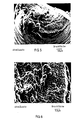
- the spun fibers from the polyarylene sulfide molding compositions according to the invention are also characterized by a more uniform and closed surface structure. This is especially for monofilaments and Continuous filament yarns an advantage.
- melt viscosity measurements were carried out using a Contravis RM 300 plate-cone viscometer, and the DSC measurements were carried out using a Perkin-Elmer DSC System 7 device.
- AH K enthalpy of crystallization during cooling
- a liquid crystalline phase can be determined under the polarizing microscope.
- a polyphenylene sulfide with a melt viscosity of 140 Pas (320 ° C / 10 3 sec- 1 ) was melted in an extruder spinning apparatus and spun with multiple threads.
- the spinning material thus obtained was subjected to a 2-stage aftertreatment process (comparative example 1).
- Example 6 the compound used in Example 6 could be post-treated more quickly and without problems than the comparison.
- capillary cracks occurred frequently in the aftertreatment of the comparison sample.
- the fluff formation was noticeably increased. This is reflected in the poorer mechanical properties of the filament yarns in the comparative example (strengths, modulus of elasticity!).
- the statistically constructed substance of type II shows a liquid-crystalline phase under the polarizing microscope in the range from 190 to 350 ° C.
- the molding composition according to the invention has a much lower melt viscosity.
Landscapes
- Chemical & Material Sciences (AREA)
- Organic Chemistry (AREA)
- Health & Medical Sciences (AREA)
- Chemical Kinetics & Catalysis (AREA)
- Medicinal Chemistry (AREA)
- Polymers & Plastics (AREA)
- Crystallography & Structural Chemistry (AREA)
- Engineering & Computer Science (AREA)
- Materials Engineering (AREA)
- Compositions Of Macromolecular Compounds (AREA)
- Organic Low-Molecular-Weight Compounds And Preparation Thereof (AREA)
- Artificial Filaments (AREA)
- Liquid Crystal Substances (AREA)
Applications Claiming Priority (2)
| Application Number | Priority Date | Filing Date | Title |
|---|---|---|---|
| DE3915067A DE3915067A1 (de) | 1989-05-09 | 1989-05-09 | Leichtfliessende polyarylensulfid-formmassen |
| DE3915067 | 1989-05-09 |
Publications (2)
| Publication Number | Publication Date |
|---|---|
| EP0398052A2 true EP0398052A2 (fr) | 1990-11-22 |
| EP0398052A3 EP0398052A3 (fr) | 1991-09-04 |
Family
ID=6380281
Family Applications (1)
| Application Number | Title | Priority Date | Filing Date |
|---|---|---|---|
| EP19900107971 Withdrawn EP0398052A3 (fr) | 1989-05-09 | 1990-04-26 | Masses de moulage de sulfure de polyarylène fluide à l'état fondu |
Country Status (4)
| Country | Link |
|---|---|
| US (1) | US5151458A (fr) |
| EP (1) | EP0398052A3 (fr) |
| JP (1) | JPH03137162A (fr) |
| DE (1) | DE3915067A1 (fr) |
Cited By (2)
| Publication number | Priority date | Publication date | Assignee | Title |
|---|---|---|---|---|
| EP0546185A4 (fr) * | 1991-05-31 | 1993-03-26 | Idemitsu Petrochemical Co | Composition resineuse de sulfure de polyarylene. |
| EP0608980A1 (fr) * | 1993-01-13 | 1994-08-03 | Hoechst Celanese Corporation | Mélanges de polymères formant des cristaux liquides et de polysulfures d'arylène, ayant une viscosité réduite |
Families Citing this family (14)
| Publication number | Priority date | Publication date | Assignee | Title |
|---|---|---|---|---|
| JP3016494B2 (ja) * | 1992-02-17 | 2000-03-06 | 株式会社クラレ | 高強力高弾性率繊維の製造方法 |
| DE4325287A1 (de) * | 1993-07-28 | 1995-02-02 | Leybold Ag | Kunststoff für die Verwendung im Vacuum |
| CN102939340B (zh) * | 2010-04-23 | 2014-10-08 | 宝理塑料株式会社 | 聚亚芳基硫醚树脂组合物 |
| CN102140233B (zh) * | 2011-02-18 | 2012-12-26 | 金发科技股份有限公司 | 低翘曲液晶聚合物组合物及其制备方法 |
| JP6276692B2 (ja) | 2011-09-20 | 2018-02-07 | ティコナ・エルエルシー | ポータブル電子機器用のハウジング |
| WO2013043565A1 (fr) | 2011-09-20 | 2013-03-28 | Ticona Llc | Alliage polysulfure d'arylène/polymère cristal liquide et compositions le contenant |
| JP2015504014A (ja) | 2011-09-20 | 2015-02-05 | ティコナ・エルエルシー | 電子デバイス用のオーバーモールドコンポジット構造体 |
| WO2013101315A1 (fr) | 2011-09-20 | 2013-07-04 | Ticona Llc | Poly(sulfure d'arylène) lavé par disulfure à faible teneur en halogène |
| EP2758463A2 (fr) | 2011-09-20 | 2014-07-30 | Ticona LLC | Composition de polysulfure d'arylène traitée par fusion chargée et à faible teneur en chlore |
| US8852487B2 (en) | 2011-12-16 | 2014-10-07 | Ticona Llc | Injection molding of polyarylene sulfide compositions |
| EP2791232A1 (fr) | 2011-12-16 | 2014-10-22 | Ticona LLC | Système de nucléation pour compositions de polysulfure d'arylène |
| KR102064024B1 (ko) | 2011-12-16 | 2020-01-08 | 티코나 엘엘씨 | 폴리페닐렌 설파이드용 붕소-함유 핵 형성제 |
| WO2013090172A1 (fr) | 2011-12-16 | 2013-06-20 | Ticona Llc | Procédé de moulage par injection à basse température de compositions de sulfure de polyarylène et pièce moulée par injection ainsi obtenue |
| US9394430B2 (en) | 2012-04-13 | 2016-07-19 | Ticona Llc | Continuous fiber reinforced polyarylene sulfide |
Family Cites Families (6)
| Publication number | Priority date | Publication date | Assignee | Title |
|---|---|---|---|---|
| JPS5582150A (en) * | 1978-12-19 | 1980-06-20 | Toray Ind Inc | Polyester composition |
| US4276397A (en) * | 1980-07-07 | 1981-06-30 | Celanese Corporation | Blend of polyarylene sulfide and wholly aromatic polyester |
| DE3529838A1 (de) * | 1985-08-21 | 1987-02-26 | Bayer Ag | Schnellkristallisierende polyphenylensulfidmassen |
| DE3607712A1 (de) * | 1986-03-08 | 1987-09-10 | Bayer Ag | Schnellkristallisierende polyphenylensulfidmassen |
| JPH01225660A (ja) * | 1988-03-04 | 1989-09-08 | Polyplastics Co | ポリアリーレンサルファイド樹脂組成物 |
| DE3813919A1 (de) * | 1988-04-25 | 1989-11-02 | Siemens Ag | Bauteil zur anwendung fuer elektrotechnische zwecke |
-
1989
- 1989-05-09 DE DE3915067A patent/DE3915067A1/de not_active Withdrawn
-
1990
- 1990-04-26 EP EP19900107971 patent/EP0398052A3/fr not_active Withdrawn
- 1990-04-27 US US07/515,705 patent/US5151458A/en not_active Expired - Fee Related
- 1990-05-02 JP JP2115337A patent/JPH03137162A/ja active Pending
Cited By (2)
| Publication number | Priority date | Publication date | Assignee | Title |
|---|---|---|---|---|
| EP0546185A4 (fr) * | 1991-05-31 | 1993-03-26 | Idemitsu Petrochemical Co | Composition resineuse de sulfure de polyarylene. |
| EP0608980A1 (fr) * | 1993-01-13 | 1994-08-03 | Hoechst Celanese Corporation | Mélanges de polymères formant des cristaux liquides et de polysulfures d'arylène, ayant une viscosité réduite |
Also Published As
| Publication number | Publication date |
|---|---|
| DE3915067A1 (de) | 1990-11-15 |
| JPH03137162A (ja) | 1991-06-11 |
| US5151458A (en) | 1992-09-29 |
| EP0398052A3 (fr) | 1991-09-04 |
Similar Documents
| Publication | Publication Date | Title |
|---|---|---|
| EP0359037A2 (fr) | Alliages et masses à mouler en polyamide à faible viscosité | |
| DE69133099T2 (de) | Zusammensetzung thermotroper, flüssigkristalliner Polyester | |
| EP0225537B1 (fr) | Polyesterimides totalement aromatiques mésomorphes, leur fabrication ainsi que leur utilisation | |
| DE3915067A1 (de) | Leichtfliessende polyarylensulfid-formmassen | |
| EP0251113B1 (fr) | Polyesters totalement aromatiques mésomorphes, leur fabrication et utilisation | |
| EP1242538B1 (fr) | Matieres moulables thermoplastiques a comportement au traitement ameliore a base de polyarylene-ether-sulfones et de polyamides | |
| EP0325739A2 (fr) | Matières à mouler à partir de polyesterimide aromatique et thermoplastique | |
| EP0230546B1 (fr) | Polyesteramides aromatiques mésomorphes, leur préparation et leur utilisation | |
| DE2834536A1 (de) | Copolyester | |
| EP0444292A2 (fr) | Compositions de moulage en polyamide à écoulement aisé | |
| EP0259670B1 (fr) | Polyesters et polyesteramides thermotropes totalement aromatiques | |
| DE2834535A1 (de) | Copolyester | |
| DE69706277T2 (de) | Flüssigkristalline polymer zusammensetzungen | |
| EP0327984A2 (fr) | Poly(aryléthercétones) ayant une aptitude modifiée à se laisser transformer | |
| EP0226080B1 (fr) | Polyesteramides totalement aromatiques mésomorphes, leur fabrication et leur utilisation | |
| DE3629208A1 (de) | Vollaromatische thermotrope polyester | |
| DE3529838A1 (de) | Schnellkristallisierende polyphenylensulfidmassen | |
| DE4017685A1 (de) | Leichtfliessende polycarbonat-, polyestercarbonat und polyesterformmassen | |
| EP0444295A1 (fr) | Masses à mouler de polyamide à faible viscositÀ© | |
| DE2932178C2 (de) | Polyester | |
| DE69021255T2 (de) | Zusammensetzung von kristallinem Polyphtalamid mit verbesserter Wärmebeständigkeit. | |
| EP0374657A2 (fr) | Polyesters thermotropiques, procédé pour leur préparation et leur utilisation dans la préparation d'articles moulés, de filaments, de fibres et de feuilles | |
| DE3629209A1 (de) | Vollaromatische thermotrope polyester | |
| DE3856042T2 (de) | Optisch anisotrope schmelzenbildende aromatische Copolyester auf der Basis von t-Butyl-4-hydroxy-benzoesäure | |
| EP0341397A2 (fr) | Masses à mouler à la base de polyesterimide thermoplastique et aromatique |
Legal Events
| Date | Code | Title | Description |
|---|---|---|---|
| PUAI | Public reference made under article 153(3) epc to a published international application that has entered the european phase |
Free format text: ORIGINAL CODE: 0009012 |
|
| 17P | Request for examination filed |
Effective date: 19900426 |
|
| AK | Designated contracting states |
Kind code of ref document: A2 Designated state(s): BE DE FR GB IT |
|
| PUAL | Search report despatched |
Free format text: ORIGINAL CODE: 0009013 |
|
| AK | Designated contracting states |
Kind code of ref document: A3 Designated state(s): BE DE FR GB IT |
|
| STAA | Information on the status of an ep patent application or granted ep patent |
Free format text: STATUS: THE APPLICATION HAS BEEN WITHDRAWN |
|
| 18W | Application withdrawn |
Withdrawal date: 19920714 |