EP0398286A2 - Capteur d'ammoniac - Google Patents
Capteur d'ammoniac Download PDFInfo
- Publication number
- EP0398286A2 EP0398286A2 EP90109233A EP90109233A EP0398286A2 EP 0398286 A2 EP0398286 A2 EP 0398286A2 EP 90109233 A EP90109233 A EP 90109233A EP 90109233 A EP90109233 A EP 90109233A EP 0398286 A2 EP0398286 A2 EP 0398286A2
- Authority
- EP
- European Patent Office
- Prior art keywords
- ammonia
- ammonia sensor
- polyaniline
- electrodes
- high polymer
- Prior art date
- Legal status (The legal status is an assumption and is not a legal conclusion. Google has not performed a legal analysis and makes no representation as to the accuracy of the status listed.)
- Withdrawn
Links
Images


Classifications
-
- G—PHYSICS
- G01—MEASURING; TESTING
- G01N—INVESTIGATING OR ANALYSING MATERIALS BY DETERMINING THEIR CHEMICAL OR PHYSICAL PROPERTIES
- G01N27/00—Investigating or analysing materials by the use of electric, electrochemical, or magnetic means
- G01N27/02—Investigating or analysing materials by the use of electric, electrochemical, or magnetic means by investigating impedance
- G01N27/04—Investigating or analysing materials by the use of electric, electrochemical, or magnetic means by investigating impedance by investigating resistance
- G01N27/12—Investigating or analysing materials by the use of electric, electrochemical, or magnetic means by investigating impedance by investigating resistance of a solid body in dependence upon absorption of a fluid; of a solid body in dependence upon reaction with a fluid, for detecting components in the fluid
- G01N27/125—Composition of the body, e.g. the composition of its sensitive layer
- G01N27/126—Composition of the body, e.g. the composition of its sensitive layer comprising organic polymers
-
- G—PHYSICS
- G01—MEASURING; TESTING
- G01N—INVESTIGATING OR ANALYSING MATERIALS BY DETERMINING THEIR CHEMICAL OR PHYSICAL PROPERTIES
- G01N33/00—Investigating or analysing materials by specific methods not covered by groups G01N1/00 - G01N31/00
- G01N33/0004—Gaseous mixtures, e.g. polluted air
- G01N33/0009—General constructional details of gas analysers, e.g. portable test equipment
- G01N33/0027—General constructional details of gas analysers, e.g. portable test equipment concerning the detector
- G01N33/0036—General constructional details of gas analysers, e.g. portable test equipment concerning the detector specially adapted to detect a particular component
- G01N33/0054—Ammonia
-
- Y—GENERAL TAGGING OF NEW TECHNOLOGICAL DEVELOPMENTS; GENERAL TAGGING OF CROSS-SECTIONAL TECHNOLOGIES SPANNING OVER SEVERAL SECTIONS OF THE IPC; TECHNICAL SUBJECTS COVERED BY FORMER USPC CROSS-REFERENCE ART COLLECTIONS [XRACs] AND DIGESTS
- Y02—TECHNOLOGIES OR APPLICATIONS FOR MITIGATION OR ADAPTATION AGAINST CLIMATE CHANGE
- Y02A—TECHNOLOGIES FOR ADAPTATION TO CLIMATE CHANGE
- Y02A50/00—TECHNOLOGIES FOR ADAPTATION TO CLIMATE CHANGE in human health protection, e.g. against extreme weather
- Y02A50/20—Air quality improvement or preservation, e.g. vehicle emission control or emission reduction by using catalytic converters
-
- Y—GENERAL TAGGING OF NEW TECHNOLOGICAL DEVELOPMENTS; GENERAL TAGGING OF CROSS-SECTIONAL TECHNOLOGIES SPANNING OVER SEVERAL SECTIONS OF THE IPC; TECHNICAL SUBJECTS COVERED BY FORMER USPC CROSS-REFERENCE ART COLLECTIONS [XRACs] AND DIGESTS
- Y10—TECHNICAL SUBJECTS COVERED BY FORMER USPC
- Y10T—TECHNICAL SUBJECTS COVERED BY FORMER US CLASSIFICATION
- Y10T436/00—Chemistry: analytical and immunological testing
- Y10T436/17—Nitrogen containing
- Y10T436/173845—Amine and quaternary ammonium
-
- Y—GENERAL TAGGING OF NEW TECHNOLOGICAL DEVELOPMENTS; GENERAL TAGGING OF CROSS-SECTIONAL TECHNOLOGIES SPANNING OVER SEVERAL SECTIONS OF THE IPC; TECHNICAL SUBJECTS COVERED BY FORMER USPC CROSS-REFERENCE ART COLLECTIONS [XRACs] AND DIGESTS
- Y10—TECHNICAL SUBJECTS COVERED BY FORMER USPC
- Y10T—TECHNICAL SUBJECTS COVERED BY FORMER US CLASSIFICATION
- Y10T436/00—Chemistry: analytical and immunological testing
- Y10T436/17—Nitrogen containing
- Y10T436/173845—Amine and quaternary ammonium
- Y10T436/175383—Ammonia
Definitions
- the present invention relates to an ammonia sensor and particularly to an ammonia sensor comprising a polyaniline as an ammonia-sensing portion.
- an ammonia gas electrode using an ammonia-permeable membrane As the sensor for ammonia gas detection, there were proposed, for example, (1) an ammonia gas electrode using an ammonia-permeable membrane, (2) a semiconductor sensor utilizing the change of resistance of an inorganic oxide semiconductor and (3) an ammonia detector using conductive polypyrrole.
- the ammonia gas electrode (1) is big in size, inconvenient to handle, impossible to use in a small space and troublesome in maintenance works such as make-up or exchange of electrolytic solution;
- the semiconductor sensor (2) generally has low selectivity for ammonia gas and must be used in a heated condition, and accordingly may cause explosion when used in an atmosphere wherein a flammable gas or a dust is present;
- the detector (3) using polypyrrole gives large property change with the lapse of a time.
- the conventional ammonia sensors have drawbacks.
- ammonia sensor consisting of at least one pair of electrodes and an ammonia-sensing material comprising a polyaniline filling the space between the electrodes.
- the polyaniline used as an ammonia-sensing component in the ammonia-sensing material of the sensor of the present invention is a conductive organic polymer and can be produced by, for example, chemical or electrochemical polymerization of aniline [reference is made to, for example, A. G. MacDiarmid, J. C. Chiang and M. Halpern, Polym. Prepr. (1984) 248; B. Wang, J. Tang and F. Wang, J. Tang and F. Wang, Synthetic Metals, 13 (1986) 329-334].
- the polyaniline can be produced by electrolytic polymerization of aniline wherein a polymerization solution containing aniline and an appropriate electrolyte is subjected to electrolysis in an ordinary electrolytic cell, using platinum as an anode and palladium as a cathode.
- the electrolytic voltage can be ordinarily 0.3-2V (relative to a standard calomel-alumel electrode), and the current density is suitably 1-100 mA/cm2.
- the electrolyte usable in the polymerization solution there can be mentioned, for example, mineral acids such as hydrochloric acid, sulfuric cid and the like; perchloric acids and their salts such as HClO4, NaClO4, KClO4 and the like; phosphoric acid buffer solution; tetraethylammonium fluoroborate; and organic sulforic acids such as toluenesulfonic acid, naphthalenesulfonic acid and the like.
- the electrolyte can be used generally in a concentration of 0.01-5 M, preferably 0.03-4 M in the polymerization solution.
- Aniline can be used in the polymerization solution generally in a concentration of 0.01-5 M, preferively 0.03-4 M.
- the solvent usable in the polymerization solution there can be mentioned, for example, water, ethanol, acetonitrile, propylene carbonate, nitrobenzene and their mixture.
- the polyaniline formed by electrolysis can be separated from the polymerization solution, washed with water thoroughly until the washings become almost neutral, and dried until the residual water in polyaniline becomes 5 % by weight or less, preferably 2 % by weight or less.
- the thus formed polyaniline is preferably soluble in ordinary polar organic solvents such as N,N′-dimethylformamide, N,N′-dimethylacetamide, dimethylsulfoxide, N-methylpyrrolidone, acetonitrile and the like.
- the present inventors found that the polyaniline obtained by electrolytic polymerization as above changes its electric resistance in proportion to the ammonia concentration in an atmosphere such as air or other gas and accordingly the measurement of the electric resistance enables the detection of the ammonia concentration at a very high sensitivity and that the polyaniline is very effective as an element for ammonia sensor.
- the polyaniline can be dissolved in a polar organic solvent such as N,N′-dimethylformamide, N,N′-dimethylacetamide, dimethyl sulfoxide, N-methylpyrrolidone or the like, and the resulting solution can be coated on an insulating substrate having at least one pair of electrodes thereon, so as to fill the space between the electrodes.
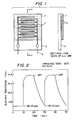
- the polyaniline solution can be coated on an insulating substrate having a pair of interdegitated electrodes thereon as shown in Fig. 1, so as to fill the space between the electrodes and further cover the electrodes.
- the shape of electrodes has no particular restriction and can be not only a interdegitated-type shape but also various other shapes such as whirl shape and sandwich shape in which a rectangular sensor membrane is sandwiched betwen electrode.
- a polymer having film formability such as polyacrylonitrile, poly(vinyl chloride), poly(vinylidene chloride) or polystyrene, or a cellulose derivative, in such an amount as to give substantially no adverse effect on the ammonia-sensing ability of polyaniline.
- the concentration of polyaniline in the polymerization solution is not particularly restricted but can be ordinarily 1-30 %, preferably 3-20 %.
- the electrodes is preferably made of a conductive metal with excellent corrosion resistance, such as platinum, gold, palladium or the like.
- As the insulating substrate there is ordinarily used a ceramic such as glass, alumina or the like.
- the method for coating the polyaniline solution there can be mentioned, for example, ordinary coating methods such as spin coating, dipping and the like. After the coating, the solvent is removed, whereby an ammonia sensor of the present invention can be obtained.
- the suitable film thickness after the solvent removal is generally 0.01-100 microns, preferably 0.1-10 microns.
- a thin film of a conductive high-molecular substance is formed on an insulating substrate having at least one pair of electrodes thereon, and then electrolytic polymerization of aniline is effected in the thin film with the thin film used as an anode, whereby an ammonia sensor comprising a polyaniline as an ammonia-sensing element can be produced very easily.
- an ammonia sensor comprising at least one pair of electrodes and an ammonia-sensing material comprising a matrix of a conductive high polymer filling the space between the electrodes and a polyaniline dispersed in the matrix.
- the conductive high polymer constituting the matrix of the ammonia-sensing material of the ammonia sensor can be any as long as it is a film-formable high polymer showing a conductivity of certain degree or higher (e.g. 10 ⁇ 5 mho or higher) when exposed to an electric field.
- the substance can have conductivity by itself, or can be a mixture with an electrolyte. Specific examples of such a conductive high polymer are as follows.
- conductive high polymers there are preferably used in the present invention a high polymer having a sulfonic group or a carboxylic acid group as a side chain, its crosslinked product, a mixture of a poly(alkylene oxide) with an alkali metal salt, a mixture of an acrylonitrile type high polymer with a rhodanate and zinc chloride, and the like.
- the ammonia sensor of the present invention can be formed, for example, by dissolving a conductive high polymer as mentioned above and a polyaniline produced as above, in a solvent capable of dissolving both of them and then coating the resulting solution on an insulating substrate having at least one pair of electrodes thereon, so as to fill at least the space between the electrodes.
- the ammonia sensor of the present invention can preferably be produced by forming a thin film of a conductive high polymer as mentioned above, on an insulating substrate having at least one pair of electrodes thereon, so as to cover at least the portion of the insulating substrate not covered by the electrodes and then effecting electrolysis of a polymerization solution containing aniline and an appropriate supporting electrolyte, in an electrolytic cell using the above-formed thin film of a conductive high polymer as an anode and platinum, palladium or the like as a cathode.
- the insulating substance having at least one pair of electrodes thereon there can be illustrated those mentioned above.
- a thin film of a conductive high polymer on an insulating substrate having at least one pair of electrodes thereon can be effected by a per se known method, for example, a method wherein a solution of a conductive high polymer is prepared and then coated by, for example, spin coating, dipping, knife coating, roll coating or the like, a vapor deposition method (e.g. vacuum deposition), a plasma polymerization method or the like.
- a per se known method for example, a method wherein a solution of a conductive high polymer is prepared and then coated by, for example, spin coating, dipping, knife coating, roll coating or the like, a vapor deposition method (e.g. vacuum deposition), a plasma polymerization method or the like.
- the suitable thickness of thin film of conductive high polymer can differ depending upon the type of the substance, etc. but is generally 0.1-100 microns, preferably 1-20 microns.
- the solution of the conductive high polymer can contain, as necessary, a film-formable polymer, etc.
- the insulating substrate on which a thin film of a conductive high polymer has been formed is placed in an electrolytic cell filled with a polymerization solution containing aniline and an appropriate supporting electrolyte; electrolytic polymerization of aniline is effected in the thin film of a conductive high polymer, using the thin film as an anode and palladium or the like as a cathode, in the same manner as mentioned above; thereby, an ammonia sensor of the present invention can be obtained.
- the ratio of the conductive high polymer matrix and the polyaniline in the ammonia-sensor material is not strictly restricted and can vary over a wide range depending upon the requirements for the ammonia sensor, its application, etc.
- the weight ratio of the polyaniline/the conducivelytive high polymer can be generally 10/90 to 90/10, preferably 20/80 to 85/15, more preferably 30/70 to 80/20.
- the electric resistance of the polyaniline in the ammonia-sensing material changes in proportion of the concentration of ammonia gas, and the change is sharp even at room temperature and accordingly the sensing portion can function at room temperature.
- the ammonia sensor of the present invention can be easily produced simply by, for example, coating an ammonia-sensing material on a substrate having electrodes thereon, as shown in Fig. 1, can be made small, thin and lightweight, causes no trouble such as separation from electrodes, and is easy to handle and maintain.
- the ammonia sensor of the present invention shows excellent linear change of electric resistance to the change of ammonia gas concentration, has a high sensitivity, and allows easy designing of electronic circuit containing it.
- ammonia sensor of the present invention can be used effectively for automation of ammonia concentration control, leakage detection, warning signal, and operation stop in various plants; detection of protein and amino acid by using in combination with an enzyme or microbe producing ammonia gas in the form of metabolism of protein or amino acid; and detection of ammonia gas generated in various reactions, or control of reaction based on the detection.
- Fig. 1 is a shematic illustration of an example of the ammonia sensor of the present invention, wherein the numeral 1 is a polyaniline membrane, the numeral 2 is an insulating substrate, the numeral 3 is interdegitated electrodes, and the numeral 4 is lead wires; Figs. 2 to 7 are graphs each showing the relationship between the electric resistance of the ammonia sensor of the present invention and ammonia concentration.
- the resulting dry polyaniline was dissolved in N,N′-dimethylformamide to prepare a 10 weight % solution.
- the resulting ammonia sensor was set in a glass tube of 24 mm in diameter. Air was passed through the glass tube from its one end at a rate of 1 /min; a given amount of ammonia was intermittently injected into the air current; and the electric resistance of the sensor was measured. The results of the measurement are shown in Fig. 2.
- An ammonia sensor was produced according to the same procedure as in EXAMPLE 1 except that the propylene carbonate (30 g) used in EXAMPLE 1 was replaced by 10 g of water.
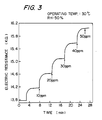
- the ammonia sensor was set in a closed vessel; 10 ppm of ammonia gas was injected to the vessel at intervals of 4 minutes; and the electric resistance of the sensor was measured. The results of the measurement are shown in Fig. 3.
- An ammonia sensor was produced in the same procedure as in EXAMPLE 1 except that the pechloric acid (12 g) was replaced by 15 g of tetraethylammonium fluoroborate, was propylene carbonate (30 g) was replaced by 10 g of water and the platinum cathode was replaced by a palladium cathode.
- the ammonia sensor was set in a closed vessel; the vessel was filled with air alone or air containing 10,000 ppm of H2, CO, NO or O2; 10 ppm of ammonia was injected into the vessel at intervals of 4 minutes; the electric resistance of the sensor was measured; and there was prepared a graph showing the relationship between ammonia concentration (ppm) and electric resistance difference (R - R.).
- R is the measured value of electric resistance when ammonia was injected into air alone or air containing H2, CO, NO or O2; and R. is the measured value of electric resistance when only air was used and no ammonia was present.
- the results are shown in Fig. 4. As is clear from Fig. 4, the electric resistance of the ammonia sensor of the present invention is not affected by the co-presence of gas other than ammonia.
- composition of polymerization solution 1.8 moles of acetonitrile, 1 mole of propylene carbonate, 0.5 mole of HClO4 and 0.25 mole of aniline.
- Voltage 0.8 V (relative to a standard calomel- alumel electrode)
- Current density Constant current electrolysis at 20 mA/cm2 Time: 10 minutes
- the anode was taken out, washed with water until the pH of the washings became about 7, and dried at 50 °C.
- the resulting ammonia sensor was set in a glass tube having a diameter of 24 mm; air was passed through the tube from its one end at a rate of 1 /min; a given amount of ammonia was intermittently injected into the air current; and the electric resistance of the sensor was measured.
- the results are shown in Fig. 5.
- the properties of the sensor were measured in the same manner as in EXAMPLE 4. The results are shown in Fig. 6.
- ammonia sensor was produced in the same procedure as in EXAMPLE 5 except that the acetonitrile (1.8 moles) used in the polymerization solution was changed to 2.0 moles of water. This ammonia sensor had about the same properties as the ammonia sensor produced in EXAMPLE 5.
- a solution consisting of 6 parts by weight of an acrylamide-methylpropanesulfonic acid copolymer, 2 parts by weight of a poly(vinyl alcohol) and 92 parts by weight of water was dip coated on the same alumina sub strate having a pair of electrodes thereon, as used in EXAMPLE 4, followed by drying at 130 °C to form a think film of a conductive high polymer having a thickness of 10 m.
Landscapes
- Chemical & Material Sciences (AREA)
- Health & Medical Sciences (AREA)
- Life Sciences & Earth Sciences (AREA)
- General Health & Medical Sciences (AREA)
- Immunology (AREA)
- Engineering & Computer Science (AREA)
- Analytical Chemistry (AREA)
- Biochemistry (AREA)
- Pathology (AREA)
- General Physics & Mathematics (AREA)
- Physics & Mathematics (AREA)
- Chemical Kinetics & Catalysis (AREA)
- Electrochemistry (AREA)
- Combustion & Propulsion (AREA)
- Food Science & Technology (AREA)
- Medicinal Chemistry (AREA)
- Investigating Or Analyzing Materials By The Use Of Fluid Adsorption Or Reactions (AREA)
Applications Claiming Priority (4)
| Application Number | Priority Date | Filing Date | Title |
|---|---|---|---|
| JP122943/89 | 1989-05-18 | ||
| JP12294389A JPH02304340A (ja) | 1989-05-18 | 1989-05-18 | アンモニアセンサー |
| JP17116889A JPH0337559A (ja) | 1989-07-04 | 1989-07-04 | アンモニアセンサー |
| JP171168/89 | 1989-07-04 |
Publications (2)
| Publication Number | Publication Date |
|---|---|
| EP0398286A2 true EP0398286A2 (fr) | 1990-11-22 |
| EP0398286A3 EP0398286A3 (fr) | 1991-09-25 |
Family
ID=26459979
Family Applications (1)
| Application Number | Title | Priority Date | Filing Date |
|---|---|---|---|
| EP19900109233 Withdrawn EP0398286A3 (fr) | 1989-05-18 | 1990-05-16 | Capteur d'ammoniac |
Country Status (2)
| Country | Link |
|---|---|
| US (1) | US5252292A (fr) |
| EP (1) | EP0398286A3 (fr) |
Cited By (16)
| Publication number | Priority date | Publication date | Assignee | Title |
|---|---|---|---|---|
| DE4241438A1 (de) * | 1992-06-27 | 1994-01-05 | Draegerwerk Ag | Sensor zum Nachweis von Analyten in einem fluiden Medium |
| GB2274336A (en) * | 1993-01-13 | 1994-07-20 | British Gas Plc | Gas sensor incorporating non-protonated polyaniline |
| US5334351A (en) * | 1992-06-27 | 1994-08-02 | Dragerwerk Aktiengesellschaft | Sensor for detecting analytes in a fluid medium |
| EP0726459A1 (fr) * | 1993-03-10 | 1996-08-14 | Hughes Aircraft Company | Capteur pour émissions fugitives |
| US5607573A (en) * | 1993-03-10 | 1997-03-04 | Hughes Aircraft Company | Method for detecting fugitive emissions |
| RU2123685C1 (ru) * | 1998-02-17 | 1998-12-20 | Институт геохимии и аналитической химии им.В.И.Вернадского РАН | Сенсор паров аммиака |
| RU2133029C1 (ru) * | 1998-05-08 | 1999-07-10 | Акционерное общество открытого типа "Практик - НЦ" | Датчик концентрации аммиака |
| WO2001020313A1 (fr) * | 1999-09-16 | 2001-03-22 | Osmetech Plc | Dispositif de mesure du flux d'une composante d'atmosphere gazeuse |
| RU2168718C1 (ru) * | 1999-12-30 | 2001-06-10 | Российский Федеральный Ядерный Центр - Всероссийский Научно-Исследовательский Институт Экспериментальной Физики | Датчик концентрации аммиака |
| RU2209424C1 (ru) * | 2001-12-04 | 2003-07-27 | Открытое акционерное общество "Инфотэк Груп" | Чувствительный элемент концентрации газов |
| EP2469272A1 (fr) * | 2010-12-22 | 2012-06-27 | Nederlandse Organisatie voor toegepast -natuurwetenschappelijk onderzoek TNO | Capteur d'acide/base |
| WO2013028061A1 (fr) * | 2011-08-22 | 2013-02-28 | Mimos Berhad | Électrode composite de polyaniline et procédé permettant de préparer l'électrode composite de polyaniline |
| WO2013109135A1 (fr) * | 2012-01-16 | 2013-07-25 | Mimos Berhad | Détecteur pour l'ammoniac dissous et son procédé de préparation |
| CN105651844A (zh) * | 2014-11-12 | 2016-06-08 | 长沙理工大学 | 一种Bi2S3基氨气传感器及其制备方法 |
| IT201600072363A1 (it) * | 2016-07-12 | 2018-01-12 | Fondazione St Italiano Tecnologia | Sensore per rilevare la presenza di un gas e/o vapore di ammoniaca. |
| CN110907502A (zh) * | 2018-09-17 | 2020-03-24 | 中国科学院大连化学物理研究所 | 一种以三维泡沫状石墨烯材料为传感膜的苯胺传感器 |
Families Citing this family (49)
| Publication number | Priority date | Publication date | Assignee | Title |
|---|---|---|---|---|
| US6709635B1 (en) * | 1996-03-21 | 2004-03-23 | California Institute Of Technology | Gas sensor test chip |
| US5945069A (en) * | 1996-03-21 | 1999-08-31 | California Institute Of Technology | Gas sensor test chip |
| US5764150A (en) * | 1996-04-10 | 1998-06-09 | Fleury; Byron | Gas alarm |
| US5879631A (en) * | 1996-04-30 | 1999-03-09 | Manning System, Inc. | Gas detection system and method |
| US5869007A (en) * | 1996-08-22 | 1999-02-09 | Gumbs Associates, Inc. | Conducting polymer based acid/base sensors |
| US5989840A (en) * | 1997-05-29 | 1999-11-23 | Americare International Diagnostics, Inc. | Estimation of active infection by heliobacter pylori |
| WO1998054563A1 (fr) * | 1997-05-29 | 1998-12-03 | Angelo Joseph P D | Estimation d'une infection evolutive a helicobacter pylori |
| AU3001199A (en) * | 1998-03-06 | 1999-12-13 | Joseph P. D'angelo | Estimation of active infection by helicobacter pylori |
| DE19828093C2 (de) * | 1998-06-24 | 2003-09-11 | Univ Dresden Tech | Einrichtung zum Messen physikalischer Größen von ein- oder mehrkomponentigen Flüssigkeiten |
| US6248224B1 (en) | 1999-05-12 | 2001-06-19 | Mst Analytics Inc. | Toxic sensor and method of manufacture |
| JP4773019B2 (ja) * | 1999-11-08 | 2011-09-14 | ユニバーシティ オブ フロリダ リサーチ ファンデーション インコーポレーティッド | 薬物の服薬遵守を監視するためのマーカー検出の方法および器具 |
| RU2174677C1 (ru) * | 2000-06-02 | 2001-10-10 | Радин Сергей Алексеевич | Газовый сенсор для обнаружения химически вредных веществ |
| US7104963B2 (en) | 2002-01-22 | 2006-09-12 | University Of Florida Research Foundation, Inc. | Method and apparatus for monitoring intravenous (IV) drug concentration using exhaled breath |
| US20050054942A1 (en) | 2002-01-22 | 2005-03-10 | Melker Richard J. | System and method for therapeutic drug monitoring |
| US6981947B2 (en) | 2002-01-22 | 2006-01-03 | University Of Florida Research Foundation, Inc. | Method and apparatus for monitoring respiratory gases during anesthesia |
| US6406669B1 (en) | 2001-01-12 | 2002-06-18 | The Regents Of The University Of California | Polyaniline-based optical ammonia detector |
| CN1325907C (zh) * | 2001-02-21 | 2007-07-11 | 巴西农业研究公司 | 通过总体选择性分析混合物的传感器及其在传感器系统中的应用 |
| US7052854B2 (en) | 2001-05-23 | 2006-05-30 | University Of Florida Research Foundation, Inc. | Application of nanotechnology and sensor technologies for ex-vivo diagnostics |
| EP1393069A1 (fr) | 2001-05-24 | 2004-03-03 | The University Of Florida | Procede et appareil de detection de l'exposition a un environnement de fumee |
| US6768063B2 (en) * | 2001-08-31 | 2004-07-27 | International Business Machines Corporation | Structure and method for shadow mask electrode |
| US20070167853A1 (en) | 2002-01-22 | 2007-07-19 | Melker Richard J | System and method for monitoring health using exhaled breath |
| DE10208648A1 (de) * | 2002-02-28 | 2003-09-11 | Bosch Gmbh Robert | Sensor zur Bestimmung von Gasen und Verfahren zur Herstellung desselben |
| WO2004066839A1 (fr) | 2003-01-23 | 2004-08-12 | University Of Florida Research Foundation, Inc. | Procede et dispositif de controle de la concentration intraveineuse (iv) en medicaments au moyen de l'air expire |
| US8485983B2 (en) * | 2003-04-21 | 2013-07-16 | The Research Foundation Of State University Of New York | Selective nanoprobe for olfactory medicine |
| US20080077037A1 (en) * | 2003-04-21 | 2008-03-27 | Pelagia-Irene Gouma | Selective point of care nanoprobe breath analyzer |
| DE10356935A1 (de) * | 2003-12-05 | 2005-06-30 | Robert Bosch Gmbh | Sensor zur Bestimmung von Gasen und Verfahren zur Herstellung desselben |
| US7069770B2 (en) * | 2004-08-02 | 2006-07-04 | Delphi Technologies, Inc. | Ammonia sensor element, heater, and method for making the same |
| US7442555B2 (en) * | 2004-12-28 | 2008-10-28 | Nair Balakrishnan G | Ammonia gas sensor method and device |
| US20090065370A1 (en) * | 2004-12-28 | 2009-03-12 | Nair Balakrishnan G | Ammonia gas sensor method and device |
| US20060211123A1 (en) * | 2005-03-18 | 2006-09-21 | Ker Eric L | Sensing element and method of making |
| CN100350239C (zh) * | 2005-03-31 | 2007-11-21 | 浙江大学 | 聚吡咯气敏传感器 |
| AU2007237821A1 (en) * | 2006-04-13 | 2007-10-25 | Dublin City University | Sensor comprising conducting polymer materials |
| EP2035824A2 (fr) * | 2006-06-14 | 2009-03-18 | Ceramatec, Inc. | Capteur d'ammoniac gazeux à électrodes dissimilaires |
| US7914460B2 (en) | 2006-08-15 | 2011-03-29 | University Of Florida Research Foundation, Inc. | Condensate glucose analyzer |
| CN101221142B (zh) * | 2007-01-12 | 2012-01-11 | 仁宝电脑工业股份有限公司 | 气体感测单元及其制造方法 |
| WO2009039152A1 (fr) | 2007-09-17 | 2009-03-26 | The Research Foundation Of State University Of New York | Détection de h. pylori au moyen d'urée non marquée |
| US8279063B2 (en) * | 2008-11-12 | 2012-10-02 | Xhale, Inc. | Personnel location and monitoring system and method for enclosed facilities |
| AT507467B1 (de) | 2008-11-14 | 2012-01-15 | Univ Graz Tech | Bifunktionaler gassensor für basische gase |
| US9678058B2 (en) | 2010-09-03 | 2017-06-13 | Anastasia Rigas | Diagnostic method and breath testing device |
| US10451598B2 (en) * | 2010-09-10 | 2019-10-22 | The Trustees Of Dartmouth College | Devices for detecting airborne contaminants, and associated methods |
| US11366077B2 (en) * | 2010-09-10 | 2022-06-21 | The Trustees Of Dartmouth College | Systems, sensing devices and methods for detection of airborne contaminants |
| US9429536B2 (en) * | 2010-09-10 | 2016-08-30 | Trustees Of Dartmouth College | Airborne contaminant sensor device and method for using the same |
| CN102654480A (zh) * | 2011-03-02 | 2012-09-05 | 中国科学院微电子研究所 | 一种制作声表面波传感器敏感膜的方法 |
| US9228988B2 (en) | 2011-08-31 | 2016-01-05 | The Trustees Of Dartmouth College | Molecularly imprinted polymers for detection of contaminants |
| EP3145403A4 (fr) | 2012-03-14 | 2018-01-24 | Anastasia Rigas | Analyseur d'haleine et procédés de test d'haleine |
| AR090886A1 (es) * | 2012-05-03 | 2014-12-10 | Stamicarbon | Metodo de fabricacion de un conjunto de placa de tubo e intercambiador de calor para un reactor o condensador |
| CN105954540A (zh) * | 2016-06-15 | 2016-09-21 | 吉林大学 | 平面叉指电极结构的电化学惯性传感器 |
| US12150752B2 (en) | 2018-12-10 | 2024-11-26 | Anastasia Rigas | Hydrogen breath analyzer and breath test method |
| EP4011290A1 (fr) | 2018-12-10 | 2022-06-15 | Anastasia Rigas | Dispositifs analyseurs de gaz respiratoires et procédés de test de gaz respiratoires |
Family Cites Families (15)
| Publication number | Priority date | Publication date | Assignee | Title |
|---|---|---|---|---|
| FR2460480A1 (fr) * | 1979-06-29 | 1981-01-23 | Sicli Cie Cle | Procede de detection et d'analyse de gaz, notamment pour la prevention des incendies |
| US4297173A (en) * | 1980-05-22 | 1981-10-27 | Ajinomoto Company, Incorporated | Method for determining ammonia and sensor therefor |
| GB2077437A (en) * | 1980-06-07 | 1981-12-16 | Emi Ltd | Ammonia gas sensors |
| SE446776B (sv) * | 1983-08-17 | 1986-10-06 | Claes Nylander | Forfarande for kvantitativ metning av nh?713 i ett prov samt anordning for utforande av forfarandet |
| GB8421188D0 (en) * | 1984-08-21 | 1984-09-26 | Persaud K C | Gas/odorant sensor |
| GB8515511D0 (en) * | 1985-06-19 | 1985-07-24 | Atomic Energy Authority Uk | Sensor |
| US4662996A (en) * | 1985-12-20 | 1987-05-05 | Honeywell Inc. | Method and electrochemical sensor for sensing chemical agents using a sensing elctrode coated with electrically conductive polymers |
| JPS62277547A (ja) * | 1986-05-26 | 1987-12-02 | Terumo Corp | ガスセンサ− |
| GB2192459B (en) * | 1986-07-07 | 1990-12-19 | English Electric Valve Co Ltd | Hydrogen sulphide sensor |
| US4904553A (en) * | 1987-04-16 | 1990-02-27 | Bridgestone Corporation | Polyaniline |
| US4886625A (en) * | 1987-10-29 | 1989-12-12 | Miles Inc. | Functionalized conducting polymers and their use in diagnostic devices |
| FR2624526B1 (fr) * | 1987-12-14 | 1992-04-30 | Ricoh Kk | Electrode composite comprenant un corps en aluminium lie a un polymere electroconducteur et cellule electrique utilisant une telle electrode composite |
| JPH01299452A (ja) * | 1988-05-27 | 1989-12-04 | Ricoh Co Ltd | 4端子検出型ガス検出装置 |
| DE3841623A1 (de) * | 1988-12-10 | 1990-06-13 | Draegerwerk Ag | Dosimeter mit wiederverwendbarer elektrochemischer messzelle |
| US5057436A (en) * | 1989-10-02 | 1991-10-15 | Agmaster, Inc. | Method and apparatus for detecting toxic gases |
-
1990
- 1990-05-16 EP EP19900109233 patent/EP0398286A3/fr not_active Withdrawn
- 1990-05-17 US US07/524,562 patent/US5252292A/en not_active Expired - Fee Related
Cited By (21)
| Publication number | Priority date | Publication date | Assignee | Title |
|---|---|---|---|---|
| DE4241438A1 (de) * | 1992-06-27 | 1994-01-05 | Draegerwerk Ag | Sensor zum Nachweis von Analyten in einem fluiden Medium |
| US5334351A (en) * | 1992-06-27 | 1994-08-02 | Dragerwerk Aktiengesellschaft | Sensor for detecting analytes in a fluid medium |
| GB2274336A (en) * | 1993-01-13 | 1994-07-20 | British Gas Plc | Gas sensor incorporating non-protonated polyaniline |
| WO1994016316A1 (fr) * | 1993-01-13 | 1994-07-21 | British Gas Plc | Detecteurs de gaz |
| GB2274336B (en) * | 1993-01-13 | 1997-04-30 | British Gas Plc | Gas sensors |
| EP0726459A1 (fr) * | 1993-03-10 | 1996-08-14 | Hughes Aircraft Company | Capteur pour émissions fugitives |
| US5607573A (en) * | 1993-03-10 | 1997-03-04 | Hughes Aircraft Company | Method for detecting fugitive emissions |
| RU2123685C1 (ru) * | 1998-02-17 | 1998-12-20 | Институт геохимии и аналитической химии им.В.И.Вернадского РАН | Сенсор паров аммиака |
| RU2133029C1 (ru) * | 1998-05-08 | 1999-07-10 | Акционерное общество открытого типа "Практик - НЦ" | Датчик концентрации аммиака |
| WO2001020313A1 (fr) * | 1999-09-16 | 2001-03-22 | Osmetech Plc | Dispositif de mesure du flux d'une composante d'atmosphere gazeuse |
| RU2168718C1 (ru) * | 1999-12-30 | 2001-06-10 | Российский Федеральный Ядерный Центр - Всероссийский Научно-Исследовательский Институт Экспериментальной Физики | Датчик концентрации аммиака |
| RU2209424C1 (ru) * | 2001-12-04 | 2003-07-27 | Открытое акционерное общество "Инфотэк Груп" | Чувствительный элемент концентрации газов |
| EP2469272A1 (fr) * | 2010-12-22 | 2012-06-27 | Nederlandse Organisatie voor toegepast -natuurwetenschappelijk onderzoek TNO | Capteur d'acide/base |
| WO2012087128A1 (fr) * | 2010-12-22 | 2012-06-28 | Nederlandse Organisatie Voor Toegepast-Natuurwetenschappelijk Onderzoek Tno | Détecteur d'acide/base |
| WO2013028061A1 (fr) * | 2011-08-22 | 2013-02-28 | Mimos Berhad | Électrode composite de polyaniline et procédé permettant de préparer l'électrode composite de polyaniline |
| WO2013109135A1 (fr) * | 2012-01-16 | 2013-07-25 | Mimos Berhad | Détecteur pour l'ammoniac dissous et son procédé de préparation |
| CN105651844A (zh) * | 2014-11-12 | 2016-06-08 | 长沙理工大学 | 一种Bi2S3基氨气传感器及其制备方法 |
| CN105651844B (zh) * | 2014-11-12 | 2018-08-03 | 长沙理工大学 | 一种Bi2S3基氨气传感器及其制备方法 |
| IT201600072363A1 (it) * | 2016-07-12 | 2018-01-12 | Fondazione St Italiano Tecnologia | Sensore per rilevare la presenza di un gas e/o vapore di ammoniaca. |
| WO2018011694A1 (fr) * | 2016-07-12 | 2018-01-18 | Fondazione Istituto Italiano Di Tecnologia | Capteur de détection de gaz d'ammoniac ou de vapeur d'ammoniac, procédé de fabrication dudit capteur et son utilisation |
| CN110907502A (zh) * | 2018-09-17 | 2020-03-24 | 中国科学院大连化学物理研究所 | 一种以三维泡沫状石墨烯材料为传感膜的苯胺传感器 |
Also Published As
| Publication number | Publication date |
|---|---|
| EP0398286A3 (fr) | 1991-09-25 |
| US5252292A (en) | 1993-10-12 |
Similar Documents
| Publication | Publication Date | Title |
|---|---|---|
| EP0398286A2 (fr) | Capteur d'ammoniac | |
| US4401545A (en) | Electrically conductive polypyrrole derivatives | |
| US5556700A (en) | Conductive polyaniline laminates | |
| Ivaska | Analytical applications of conducting polymers | |
| Syed et al. | Polyaniline—A novel polymeric material | |
| KR900004691B1 (ko) | 이온 선택성 fet 센서 | |
| Ogura et al. | A Conductive and Humidity‐Sensitive Composite Film Derived from Poly (o‐phenylenediamine) and Polyvinyl Alcohol | |
| US4521290A (en) | Thin layer electrochemical cell for rapid detection of toxic chemicals | |
| US5869007A (en) | Conducting polymer based acid/base sensors | |
| EP0236440B1 (fr) | Capteur electrochimique sensible aux ions et procede de determination de concentrations ioniques | |
| US3730868A (en) | Carbon dioxide sensor | |
| US4911801A (en) | Electrically conductive polyparaphenylene polymers, and methods for their preparation and use | |
| Przyłuski et al. | Proton polymeric electrolytes—a review | |
| Karakişla et al. | Conductive polyaniline/poly (methyl methacrylate) films obtained by electropolymerization | |
| US5131990A (en) | Fluoropolymer humidity sensors | |
| US5139626A (en) | Ion concentration measurement method | |
| EP0024192B1 (fr) | Electrodes en argent/halogénure d'argent et procédé pour leur fabrication | |
| Hotta et al. | Electrochemically prepared poly (3-methylthienylene) films doped with iodine | |
| US5045828A (en) | Fluoropolymer humidity sensors | |
| JPS61251764A (ja) | ↓pHセンサ− | |
| Kuwano | Silver ion conducting glasses and some applications | |
| Carmack et al. | Electrical charge conduction mechanism in polymer membrane ion selective electrodes | |
| Pampallona et al. | A study of some charge transfer complexes as electrodes in solid-state cells | |
| WO1989010554A1 (fr) | Couche mince sensible aux ions, son procede de production, et capteur d'ions | |
| JPH0337559A (ja) | アンモニアセンサー |
Legal Events
| Date | Code | Title | Description |
|---|---|---|---|
| PUAI | Public reference made under article 153(3) epc to a published international application that has entered the european phase |
Free format text: ORIGINAL CODE: 0009012 |
|
| AK | Designated contracting states |
Kind code of ref document: A2 Designated state(s): DE FR GB |
|
| PUAL | Search report despatched |
Free format text: ORIGINAL CODE: 0009013 |
|
| AK | Designated contracting states |
Kind code of ref document: A3 Designated state(s): DE FR GB |
|
| 17P | Request for examination filed |
Effective date: 19920204 |
|
| STAA | Information on the status of an ep patent application or granted ep patent |
Free format text: STATUS: THE APPLICATION HAS BEEN WITHDRAWN |
|
| 18W | Application withdrawn |
Withdrawal date: 19950308 |
|
| R18W | Application withdrawn (corrected) |
Effective date: 19950308 |