EP0398706A2 - Détermination en ligne des propriétés des polymères obtenus dans un réacteur continu de polymérisation - Google Patents
Détermination en ligne des propriétés des polymères obtenus dans un réacteur continu de polymérisation Download PDFInfo
- Publication number
- EP0398706A2 EP0398706A2 EP90305324A EP90305324A EP0398706A2 EP 0398706 A2 EP0398706 A2 EP 0398706A2 EP 90305324 A EP90305324 A EP 90305324A EP 90305324 A EP90305324 A EP 90305324A EP 0398706 A2 EP0398706 A2 EP 0398706A2
- Authority
- EP
- European Patent Office
- Prior art keywords
- polymer
- reactor
- molecular weight
- monomer
- model
- Prior art date
- Legal status (The legal status is an assumption and is not a legal conclusion. Google has not performed a legal analysis and makes no representation as to the accuracy of the status listed.)
- Granted
Links
Images






Classifications
-
- C—CHEMISTRY; METALLURGY
- C08—ORGANIC MACROMOLECULAR COMPOUNDS; THEIR PREPARATION OR CHEMICAL WORKING-UP; COMPOSITIONS BASED THEREON
- C08F—MACROMOLECULAR COMPOUNDS OBTAINED BY REACTIONS ONLY INVOLVING CARBON-TO-CARBON UNSATURATED BONDS
- C08F2/00—Processes of polymerisation
-
- B—PERFORMING OPERATIONS; TRANSPORTING
- B01—PHYSICAL OR CHEMICAL PROCESSES OR APPARATUS IN GENERAL
- B01J—CHEMICAL OR PHYSICAL PROCESSES, e.g. CATALYSIS OR COLLOID CHEMISTRY; THEIR RELEVANT APPARATUS
- B01J19/00—Chemical, physical or physico-chemical processes in general; Their relevant apparatus
- B01J19/0006—Controlling or regulating processes
-
- C—CHEMISTRY; METALLURGY
- C08—ORGANIC MACROMOLECULAR COMPOUNDS; THEIR PREPARATION OR CHEMICAL WORKING-UP; COMPOSITIONS BASED THEREON
- C08F—MACROMOLECULAR COMPOUNDS OBTAINED BY REACTIONS ONLY INVOLVING CARBON-TO-CARBON UNSATURATED BONDS
- C08F10/00—Homopolymers and copolymers of unsaturated aliphatic hydrocarbons having only one carbon-to-carbon double bond
-
- C—CHEMISTRY; METALLURGY
- C08—ORGANIC MACROMOLECULAR COMPOUNDS; THEIR PREPARATION OR CHEMICAL WORKING-UP; COMPOSITIONS BASED THEREON
- C08F—MACROMOLECULAR COMPOUNDS OBTAINED BY REACTIONS ONLY INVOLVING CARBON-TO-CARBON UNSATURATED BONDS
- C08F2400/00—Characteristics for processes of polymerization
- C08F2400/02—Control or adjustment of polymerization parameters
Definitions
- a major problem constantly faced by engineers in the polymer reaction engineering field is to accurately predict the performance of continuous polymerization reactors. Due to the critical commercial application of polymers, the polymerization reaction should be very carefully controlled in order to insure uniform properties. However, most commercial installations lack proper on-line techniques to predict the product behavior as it is made in the reactor. A number of parameters such as hold-up time, pressure and temperature profile in the reactor are key factors affecting reactor and product performance. Also, product properties are affected by reactor start-up, shut-down and rate changes. There is indeed the need for a quick, continuous on-line measurement of polymer properties.
- This invention provides on-line real time polymer product properties as the polymer is being made in the reactor without making use of the chemistry of the reacting system.
- to follow the kinetics of the reaction for making polymer properties prediction has proven to be a approach without recognizeable value, mostly for the reason that energies of activation and reaction rate constants for the reaction system are hard to measure accurately and, therefore, the numerical solution of the set of differential equations is inaccurate.
- the polymerization chemistry might not be well understood, in particular, the kinetics of cyclic dimer and oligomer formation.
- the present invention deals with the application of fundamental principles of fluid mechanics and polymer processing that were used in the on-line prediction of molecular weight weight average (Mw), molecular weight number average (Mn) and polydispersity (Mw/Mn) in a continuous tubular polymerization reactor.
- Mw molecular weight weight average
- Mn molecular weight number average
- Mw/Mn polydispersity
- the main objective of the present invention is to provide a method for monitoring and controlling the molecular weight build-up of a polymer inside a continuous polymerization reactor.
- the number average and weight average molecular weights are predicted on-line from fluid dynamic principles and a slow influx analysis of multiple side streams incorporation into the main bulk of the fluid flow.
- Process sensors placed along the length of the reactor provide continuous on-line measurement of the input variables required to perform the model calculations.
- the determination of the molecular weight number average Mn can proceed by first calculating an external stoichiometric ratio from values of the monomer's flow rates. Subsequently, the first and second moments of the molecular weights of the individual monomers are obtained. Then, a guess on the apparent stoichiometric ratio is made on the basis of the external stoichiometric ratio. Next, the calculation of the first and second moments of the molecular weight distribution of the polymer can proceed from knowledge of the apparent stoichiometric ratio and the first and second moments of the individual monomers. At this point, the molecular weight weight average Mw is calculated as the ratio of the second moment to the first moment of the molecular weight distribution of the polymer.
- the value of Mw calculated in this fashion is the same as the value of Mw calculated in the paragraph above, then the solution has converged and we have at hand the right numerical values of the moments of the molecular weight distribution of the polymer. Therefore, the value of molecular weight number average Mn is obtained from the first moment of the molecular weight distribution of the polymer and the apparent stoichiometric ratio. In the event that convergence was not achieved, a Newton-Raphson solution guesses a "new value" of the apparent stoichiometric ratio and repeats the logic explained in this paragraph until convergence is achieved.
- the determination of the polydispersity of the polymer can proceed in a straightforward fashion by using the converged values of the first and second moments of the molecular weight distribution of the polymer.
- the polydispersity of the polymer in a given section of the reactor is equal to the ratio of the second moment of the molecular weight distribution to the square of the first moment of the molecular weight distribution.
- the present invention provides real time information on the reactor performance and makes it possible to implement a closed loop control of molecular weight number average Mn and polydispersity. Since the reactor control via an on-line viscometer provides means only to somewhat control molecular weight weight average Mw (see Fig. 4), the approach developed in this invention would without a doubt provide means for improved control of a continuous polymerization reactor. In fact, viscosity might not be a suitable control variable. In certain systems, viscosity may remain essentially unchanged while the molecular weight number average Mn varies out of control (see Fig. 5). This invention becomes an on-line real time "analytical measurement" tool of polymer characteristics.
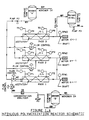
- Fig. 1 depicts the flowsheet regarding the present invention.
- a monomer "B” dissolved in a solvent contained in storage tank T1 is pumped by means of a pump P1 through a flow-metering system M1 into the inlet port of a continuous polymerization reactor R1.
- pure monomer "A” contained in storage tank T2 is pumped by means of pump P2 through a series of flowmetering systems "mi” that are located at different axial locations in the reactor.
- the individual flowmetering systems "mi” allows the addition of varying amounts of monomer "A” into the reactor to optimize temperature profile and facilitate thermal management of the exothermic or endothermic reactions.
- monomer "B” flows inside the reactor, it reacts with side-streams that inject monomer "A”.
- the polymer and byproducts are stored in storage tank T3 and pump when necessary for further chemical processing using pump P3.
- a coolant stream S9 is fed to the reactor and exits at S10 for coolant or heating purposes in either a cocurrent or countercurrent fashion.
- the flowrates of monomers and coolant are controlled appropriately by means of flowmeters to provide desired stoichiometric ratios or to control the reactor within a given temperature profile.
- Fig. 1A illustrates schematically a three pais reactor R2 utilizing the same general flow system as described above.
- the coolant flow has been deleted.
- the invention may be operable without a cooling jacket depending on the polymer.
- the pressure and temperature sensors designated T1-T6 and P1-P6, respectively, are shown at the inlet and outlet ends of each reactor pass, i.e. pass 1, pass 2 and pass 3.
- the analyzer CB-1 for monomer B concentration is located near the outlet end of pump P1.
- the tachometer sensors RPM-1, RPM-2 and RPM-3 are associated with motors EM-1, EM-2 and EM-3, respectively.
- the motors drive the agitators positioned in the respective passes of the reactor.
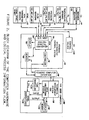
- Fig. 2 shows the block diagram of the computer hardware and logical process information flow.
- Each process sensor 10 Tempoture TS, Pressure PS, Flow FS, Tachometer RPMS and Monomer Concenration CM
- I/O input/output
- the UCM unit control module 30
- DCS distributed control system 40
- the UCM must be configured to read the digital values 20 into its memory 60 and convert them to the desired range for calculation and display 50 at the DCS video spec operator's console.
- the live process input data required by the model must next be transferred to the VAX 8000 computer 100.
- a VAX procedure runs the model subroutines 130 at a specified frequency set-up by the time scheduler 120. The time scheduler also hibernates the model subroutines.
- the input data required by the model subroutines is provided by the Data Acquisition System 110.
- the model subroutines return the calculated values of polymer properties in a reactor section back into the Data Acquisition System where loops are assigned in the Data Acquisition System for display 140 or to be kept in memory 150.
- the calculated results can be loaded down from the Data Acquisition System 110 through the FOXBORO computer interface 80 back into the memory 60 or directly into a controller card 70 in the UCM for further download into the control valves 160.
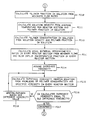
- Fig. 3 presents the flowchart explaining the logical software calculation steps in the execution of the model subroutine.
- the model subroutine obtains the input parameters FC2 (pressure, temperature and flow of monomers) in a given reactor section and checks for non-zero values of input parameters FC3. If there are indeed zero values, an alarm FC4 is displayed and the subroutine goes back to FC2 and stops calculations. If the input parameters are fine, then an average temperature, pressure drop and residence time in the reactor section are calculated FC5. The procedure continues on to determine the mixing times required in the fractional incorporation of a side stream of monomer "A" into the main bulk of fluid FC6.
- the solution viscosity in the reactor can be calculated from fundamental principles of Non-Newtonian fluid mechanics FC8.
- the key determination lies in a good prediction of the shear stress for flow inside a pipe reactor which can contain or not a shearing causing device like an agitator. This invention will cover either since the modification to the shear stress equation can be readily accomplished.
- the solution viscosity is obtained by setting equation (5) equal to equation (4) and then solving for the unknown u.
- the shear viscosity in equation (5) can be made a function of the type of agitator and the rotational speed of it.
- the shear rate could be a function of the flow rate only, such as flow inside a pipe without an agitator.
- FC10 The calculation of polymer fraction in solution from monomers' flow rates is performed in FC10. Then, the calculation of solution density FC11 from average temperature in a reactor section and polymer fraction in solution is done.
- FC11 solution density
- the following step is to calculate the polymer concentration in solution FC12 from solution density and polymer fraction in solution.
- the next step is to determine the first and second moments of the molecular weight distribution of the individual monomers FC21. If the monomers are pure (monodisperse), then the first and second moments of the molecular weight distribution of the monomers become equal to the actual molecular weight (based on summation of individual atomic weights of the atoms composing the molecule) of the monomer.
- the molecular weight weight average Mw is calculated as the ratio of the second moment to the first moment of the molecular weight distribution FC23 of the polymer.
- the model subroutine After final calculation of polydispersity, the model subroutine returns control to the scheduler FC29 subroutine and can either go back and do the same calculations for another reactor section or stop altogether and activate the hibernation subroutine FC30. Finally, the whole process will be repeated after the hibernation time limit is reached and then the model subroutine is called again and the calculation procedure is repeated all over.
- the continuous polymerization reactor system similar to that shown in Fig. 1A, except that five rather than three passes are used, is controlled by means of a closed loop system that senses the polymer viscosity at the exit of the fifth reactor pass and corrects the specified viscosity value by adjusting the flow of monomer "A" to the middle of the third pass.
- inlet and outlet pressure, temperature, monomer flows and rpm of the agitator device in the fifth pass were used to calculate the actual molecular weight weight average of the polymer for a three day period.
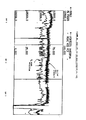
- the calculated Mw results appear in Fig. 9 in addition to the bulk viscosity (curve A) measured by the on-line viscometer at the end of the fifth pass.
- the Mw is the average for the fifth pass as predicted by the model. It is worthwhile to notice that the general trend of the model Mw predictions follow the bulk viscosity because of their close relationship. A good example of this is the rightmost part of Fig. 9, just after a reactor start-up.
- This example deals with the evaluation of the polymer made during a two hour period in the continuous polymerization reaction shown in Fig. 9.
- Off-line verification of model predictions by analyzing polymer samples taken from the exit of the fifth reactor pass was accomplished with a liquid chromatograph. Polymer samples were collected every three minutes, analyzed and compared to the on-line real time model predictions.
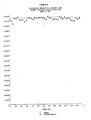
- Figs. 6, 7 and 8 show the molecular weight weight average, molecular weight number average and polydispersity, respectively.
- Table 2 shows the individual values of the polymer properties as well as the percent error of the model predictions versus the measured values. The data suggests good agreement between model predictions and measured values.
- this method allows the on-line monitoring of product quality in the continuous reactor while avoiding time-consuming laboratory analysis.
- the calculated results can then be used to alert the operator of unusual reactor problems, to optimize reactor operation during shutdown and startup or rate changes as well as determine when to segregate product which is off-spec. Since all of the results are stored in the data acquisition system, this patent allows for the future correlation of product performance in downstrean processes to the polymer characteristics.
Landscapes
- Chemical & Material Sciences (AREA)
- Chemical Kinetics & Catalysis (AREA)
- Organic Chemistry (AREA)
- Health & Medical Sciences (AREA)
- Medicinal Chemistry (AREA)
- Polymers & Plastics (AREA)
- Polymerisation Methods In General (AREA)
- Physical Or Chemical Processes And Apparatus (AREA)
- Other Resins Obtained By Reactions Not Involving Carbon-To-Carbon Unsaturated Bonds (AREA)
Applications Claiming Priority (2)
| Application Number | Priority Date | Filing Date | Title |
|---|---|---|---|
| US353690 | 1989-05-18 | ||
| US07/353,690 US5065336A (en) | 1989-05-18 | 1989-05-18 | On-line determination of polymer properties in a continuous polymerization reactor |
Publications (3)
| Publication Number | Publication Date |
|---|---|
| EP0398706A2 true EP0398706A2 (fr) | 1990-11-22 |
| EP0398706A3 EP0398706A3 (fr) | 1991-01-23 |
| EP0398706B1 EP0398706B1 (fr) | 1992-09-09 |
Family
ID=23390137
Family Applications (1)
| Application Number | Title | Priority Date | Filing Date |
|---|---|---|---|
| EP90305324A Expired EP0398706B1 (fr) | 1989-05-18 | 1990-05-17 | Détermination en ligne des propriétés des polymères obtenus dans un réacteur continu de polymérisation |
Country Status (5)
| Country | Link |
|---|---|
| US (1) | US5065336A (fr) |
| EP (1) | EP0398706B1 (fr) |
| JP (1) | JP2967099B2 (fr) |
| DE (1) | DE69000299T2 (fr) |
| ES (1) | ES2035708T3 (fr) |
Cited By (13)
| Publication number | Priority date | Publication date | Assignee | Title |
|---|---|---|---|---|
| WO1993024533A1 (fr) * | 1992-05-29 | 1993-12-09 | Amoco Corporation | Polymerisation d'alpha-olefines |
| WO1996014930A3 (fr) * | 1994-11-16 | 1996-08-08 | Highbright Holdings Ltd | Reacteur et systemes de commande associes |
| WO1996041822A1 (fr) * | 1995-06-09 | 1996-12-27 | Solvay Polyolefines Europe-Belgium (Societe Anonyme) | Methode de regulation de procedes de synthese de produits chimiques |
| WO1999053387A1 (fr) * | 1998-04-09 | 1999-10-21 | Aspen Technology, Inc. | Methodologie et simulation des fonctions de distribution des proprietes de polymeres |
| FR2790760A1 (fr) * | 1999-03-12 | 2000-09-15 | Bp Chemicals Snc | Procede de polymerisation de l'isobutene |
| FR2794757A1 (fr) * | 1999-06-11 | 2000-12-15 | Bp Chemicals Snc | Procede de polymerisation de l'isobutene |
| WO2001096426A1 (fr) * | 2000-06-16 | 2001-12-20 | Bp Chemicals Limited | Procede servant a la polymerisation d'isobutene |
| GB2372506A (en) * | 1999-11-17 | 2002-08-28 | Millennium Pharmaceuticals Ltd | Examining chemical reactions |
| EP0720110A3 (fr) * | 1994-12-26 | 2003-10-29 | Mitsui Chemicals, Inc. | Procédé et appareil pour diriger une installation de production pour une résine polyoléfinique |
| WO2004040283A3 (fr) * | 2002-10-28 | 2004-07-15 | Bp Corp North America Inc | Processus et procede de production chimique reposant sur la transformation de donnees produites par des instruments en ligne |
| WO2005121914A1 (fr) * | 2004-06-07 | 2005-12-22 | Bp Chemicals Limited | Procede de controle et de regulation d'un processus |
| EP1325325A4 (fr) * | 2000-08-24 | 2006-03-22 | Samsung General Chemicals Co | Procede d'estimation des proprietes d'un produit polymere |
| CN111918716A (zh) * | 2018-03-28 | 2020-11-10 | 陶氏环球技术有限责任公司 | 监测和控制聚合物的聚合的方法 |
Families Citing this family (13)
| Publication number | Priority date | Publication date | Assignee | Title |
|---|---|---|---|---|
| US5260882A (en) * | 1991-01-02 | 1993-11-09 | Rohm And Haas Company | Process for the estimation of physical and chemical properties of a proposed polymeric or copolymeric substance or material |
| DE19629814A1 (de) * | 1996-07-24 | 1998-01-29 | Hoechst Trevira Gmbh & Co Kg | Statistisches Verfahren zur Dosierung von Monomeren in Batch-Polykondensationsreaktoren |
| WO1998053909A1 (fr) | 1997-05-29 | 1998-12-03 | E.I. Du Pont De Nemours And Company | Procede de commande de processus pour dispositif de polymerisation avec mise a l'air libre |
| US6153149A (en) * | 1997-08-06 | 2000-11-28 | The Trustees Of Princeton University | Adaptive feedback control flow reactor |
| US6635224B1 (en) * | 1998-10-30 | 2003-10-21 | General Electric Company | Online monitor for polymer processes |
| KR20020060778A (ko) * | 1999-12-06 | 2002-07-18 | 홀던 데이비드 | 프로세스에서 적어도 하나의 유체 흐름 변수를 예측하는온라인 장치 |
| AU2001255551A1 (en) * | 2000-04-27 | 2001-11-07 | Bp Corporation North America Inc. | Method for control of a chemical manufacturing process |
| US7010474B1 (en) * | 2000-11-03 | 2006-03-07 | General Electric Company | Performance predictor for fabricated parts |
| US6745132B1 (en) | 2001-08-16 | 2004-06-01 | University Of Maine System Board Of Trustees | Method for determining the molecular weight of a substance contained in a solution |
| US20070250214A1 (en) * | 2006-04-20 | 2007-10-25 | Shu-Yee Lee | Method and apparatus for fuzzy logic control enhancing advanced process control performance |
| US20090060783A1 (en) * | 2007-09-04 | 2009-03-05 | Kenneth Charles Barrett | Polymer concentration monitoring system and use thereof |
| JP2019507879A (ja) * | 2016-03-07 | 2019-03-22 | アドヴァンスド ポリマー モニタリング テクノロジーズ インコーポレイテッドAdvanced Polymer Monitoring Technologies, Inc. | ポリマーの固有粘度及び非ニュートン挙動を同時特定する装置及び方法 |
| JPWO2020008806A1 (ja) * | 2018-07-05 | 2021-08-02 | 株式会社カネカ | センサシステム |
Family Cites Families (6)
| Publication number | Priority date | Publication date | Assignee | Title |
|---|---|---|---|---|
| US3257363A (en) * | 1961-05-22 | 1966-06-21 | Phillips Petroleum Co | Control of the composition of a reaction mixture |
| DE1942994C3 (de) * | 1969-08-23 | 1980-05-22 | Basf Ag, 6700 Ludwigshafen | Verfahren zur Regelung des Reaktionsablaufes bei der Herstellung von Hochdruck-Polyäthylen |
| JPS5018517B1 (fr) * | 1969-10-01 | 1975-06-30 | ||
| US4448943A (en) * | 1982-05-03 | 1984-05-15 | General Electric Company | Method for measuring polymerization process variables |
| US4775943A (en) * | 1985-10-16 | 1988-10-04 | The Dow Chemical Company | Method and apparatus for determining polymer molecular weight distribution parameters |
| US4825380A (en) * | 1987-05-19 | 1989-04-25 | Phillips Petroleum Company | Molecular weight determination for constraint control of a compressor |
-
1989
- 1989-05-18 US US07/353,690 patent/US5065336A/en not_active Expired - Lifetime
-
1990
- 1990-05-17 ES ES199090305324T patent/ES2035708T3/es not_active Expired - Lifetime
- 1990-05-17 EP EP90305324A patent/EP0398706B1/fr not_active Expired
- 1990-05-17 DE DE9090305324T patent/DE69000299T2/de not_active Expired - Fee Related
- 1990-05-18 JP JP2127047A patent/JP2967099B2/ja not_active Expired - Fee Related
Cited By (26)
| Publication number | Priority date | Publication date | Assignee | Title |
|---|---|---|---|---|
| TR27889A (tr) * | 1992-05-29 | 1995-10-11 | Amoco Corp | Alfa-olefinlerin polimerlestirilmesi. |
| US5504166A (en) * | 1992-05-29 | 1996-04-02 | Amoco Corporation | Polymerization of alpha-olefins |
| WO1993024533A1 (fr) * | 1992-05-29 | 1993-12-09 | Amoco Corporation | Polymerisation d'alpha-olefines |
| WO1996014930A3 (fr) * | 1994-11-16 | 1996-08-08 | Highbright Holdings Ltd | Reacteur et systemes de commande associes |
| EP0720110A3 (fr) * | 1994-12-26 | 2003-10-29 | Mitsui Chemicals, Inc. | Procédé et appareil pour diriger une installation de production pour une résine polyoléfinique |
| US6144897A (en) * | 1995-06-09 | 2000-11-07 | Solvay Polyolefins Europe-Belgium (Societe Anonyme) | Control method for processes of synthesis of chemical products |
| WO1996041822A1 (fr) * | 1995-06-09 | 1996-12-27 | Solvay Polyolefines Europe-Belgium (Societe Anonyme) | Methode de regulation de procedes de synthese de produits chimiques |
| BE1009406A3 (fr) * | 1995-06-09 | 1997-03-04 | Solvay | Methode de regulation de procedes de synthese de produits chimiques. |
| WO1999053387A1 (fr) * | 1998-04-09 | 1999-10-21 | Aspen Technology, Inc. | Methodologie et simulation des fonctions de distribution des proprietes de polymeres |
| US6093211A (en) * | 1998-04-09 | 2000-07-25 | Aspen Technology, Inc. | Polymer property distribution functions methodology and simulators |
| US6576719B2 (en) | 1999-03-12 | 2003-06-10 | Bp Chemicals Limited | Isobutene polymerization process |
| FR2790760A1 (fr) * | 1999-03-12 | 2000-09-15 | Bp Chemicals Snc | Procede de polymerisation de l'isobutene |
| WO2000055217A1 (fr) * | 1999-03-12 | 2000-09-21 | Bp Chemicals Limited | Procede de polymerisation de l'isobutene |
| FR2794757A1 (fr) * | 1999-06-11 | 2000-12-15 | Bp Chemicals Snc | Procede de polymerisation de l'isobutene |
| WO2000077056A1 (fr) * | 1999-06-11 | 2000-12-21 | Bp Chemicals Limited | Procede de polymerisation d'isobutene |
| US6521805B2 (en) | 1999-06-11 | 2003-02-18 | Bp Chemicals Limited | Isobutene polymerization process |
| GB2372506A (en) * | 1999-11-17 | 2002-08-28 | Millennium Pharmaceuticals Ltd | Examining chemical reactions |
| WO2001096426A1 (fr) * | 2000-06-16 | 2001-12-20 | Bp Chemicals Limited | Procede servant a la polymerisation d'isobutene |
| FR2810325A1 (fr) * | 2000-06-16 | 2001-12-21 | Bp Chemicals Snc | Procede de polymerisation de l'isobutene |
| US7176032B2 (en) | 2000-06-16 | 2007-02-13 | Bp Chemicals Limited | Process for the polymerisation of isobutene |
| EP1325325A4 (fr) * | 2000-08-24 | 2006-03-22 | Samsung General Chemicals Co | Procede d'estimation des proprietes d'un produit polymere |
| WO2004040283A3 (fr) * | 2002-10-28 | 2004-07-15 | Bp Corp North America Inc | Processus et procede de production chimique reposant sur la transformation de donnees produites par des instruments en ligne |
| US7133784B2 (en) | 2002-10-28 | 2006-11-07 | Bp Corporation North America, Inc. | Process and method for chemical manufacturing using transformation of on-line instrumentation data |
| WO2005121914A1 (fr) * | 2004-06-07 | 2005-12-22 | Bp Chemicals Limited | Procede de controle et de regulation d'un processus |
| EA012765B1 (ru) * | 2004-06-07 | 2009-12-30 | Бп Кемикэлз Лимитед | Способ контроля процесса и управления им |
| CN111918716A (zh) * | 2018-03-28 | 2020-11-10 | 陶氏环球技术有限责任公司 | 监测和控制聚合物的聚合的方法 |
Also Published As
| Publication number | Publication date |
|---|---|
| US5065336A (en) | 1991-11-12 |
| DE69000299T2 (de) | 1993-04-08 |
| ES2035708T3 (es) | 1993-04-16 |
| JP2967099B2 (ja) | 1999-10-25 |
| DE69000299D1 (de) | 1992-10-15 |
| EP0398706A3 (fr) | 1991-01-23 |
| JPH03115302A (ja) | 1991-05-16 |
| EP0398706B1 (fr) | 1992-09-09 |
Similar Documents
| Publication | Publication Date | Title |
|---|---|---|
| EP0398706A2 (fr) | Détermination en ligne des propriétés des polymères obtenus dans un réacteur continu de polymérisation | |
| Dimitratos et al. | Control of emulsion polymerization reactors | |
| Johnson et al. | Chemical processing and micromixing in confined impinging jets | |
| EP1070281B1 (fr) | Methodologie et simulation des fonctions de distribution des proprietes de polymeres | |
| Schuler et al. | Real-time estimation of the chain length distribution in a polymerization reactor | |
| US6727096B1 (en) | Analysis and control of parallel chemical reactions | |
| Richards et al. | Measurement and control of polymerization reactors | |
| Nauman | Residence time distributions | |
| EP4389275A2 (fr) | Systèmes et procédés de commande de réactions et de traitement de polymères à l'aide d'une surveillance en ligne continue automatique | |
| Chella et al. | Fluid mechanics of mixing in a single-screw extruder | |
| EA009717B1 (ru) | Измерение и регулирование характеристик полимера в оперативном режиме с помощью спектроскопии комбинационного рассеяния света | |
| Canegallo et al. | Densimetry for on‐line conversion monitoring in emulsion homo‐and copolymerization | |
| Collins et al. | Determination of mass transfer coefficients for bubble‐free devolatilization of polymeric solutions in twin‐screw extruders | |
| Kandelhard et al. | Model‐Assisted Optimization of RAFT Polymerization in Micro‐Scale Reactors—A Fast Screening Approach | |
| KR100586728B1 (ko) | 고분자 제품의 물성예측방법 | |
| Tosun | A mathematical model of mixing and polymerization in a semibatch stirred‐tank reactor | |
| Zogg et al. | A new small-scale reaction calorimeter that combines the principles of power compensation and heat balance | |
| Cherfi et al. | On‐line conversion monitoring of the solution polymerization of methyl methacrylate using near‐infrared spectroscopy | |
| Dewey | Fractal analysis of proton exchange kinetics in lysozyme. | |
| Nordhus et al. | Prediction of molecular weight distribution and long-chain branching distribution of low-density polyethylene from a kinetic model | |
| Siadat et al. | Some performance aspects of the extruder as a reactor | |
| Keairns et al. | Model simulation of adiabatic continuous flow stirred tank reactors | |
| KR100827744B1 (ko) | 고분자 제품의 물성 예측 방법 | |
| Yang et al. | Effect of die temperature on the flow of polymer melts. Part I: Flow inside the die | |
| Pandit et al. | Population balance‐enabled model for batch and continuous crystallization processes |
Legal Events
| Date | Code | Title | Description |
|---|---|---|---|
| PUAI | Public reference made under article 153(3) epc to a published international application that has entered the european phase |
Free format text: ORIGINAL CODE: 0009012 |
|
| AK | Designated contracting states |
Kind code of ref document: A2 Designated state(s): DE ES GB NL |
|
| PUAL | Search report despatched |
Free format text: ORIGINAL CODE: 0009013 |
|
| AK | Designated contracting states |
Kind code of ref document: A3 Designated state(s): DE ES GB NL |
|
| 17P | Request for examination filed |
Effective date: 19901220 |
|
| 17Q | First examination report despatched |
Effective date: 19911031 |
|
| GRAA | (expected) grant |
Free format text: ORIGINAL CODE: 0009210 |
|
| AK | Designated contracting states |
Kind code of ref document: B1 Designated state(s): DE ES GB NL |
|
| REF | Corresponds to: |
Ref document number: 69000299 Country of ref document: DE Date of ref document: 19921015 |
|
| REG | Reference to a national code |
Ref country code: ES Ref legal event code: FG2A Ref document number: 2035708 Country of ref document: ES Kind code of ref document: T3 |
|
| PGFP | Annual fee paid to national office [announced via postgrant information from national office to epo] |
Ref country code: ES Payment date: 19930507 Year of fee payment: 4 |
|
| PLBE | No opposition filed within time limit |
Free format text: ORIGINAL CODE: 0009261 |
|
| STAA | Information on the status of an ep patent application or granted ep patent |
Free format text: STATUS: NO OPPOSITION FILED WITHIN TIME LIMIT |
|
| 26N | No opposition filed | ||
| PG25 | Lapsed in a contracting state [announced via postgrant information from national office to epo] |
Ref country code: ES Free format text: LAPSE BECAUSE OF NON-PAYMENT OF DUE FEES Effective date: 19940518 |
|
| REG | Reference to a national code |
Ref country code: ES Ref legal event code: FD2A Effective date: 19990503 |
|
| REG | Reference to a national code |
Ref country code: GB Ref legal event code: IF02 |
|
| PGFP | Annual fee paid to national office [announced via postgrant information from national office to epo] |
Ref country code: DE Payment date: 20080522 Year of fee payment: 19 |
|
| PGFP | Annual fee paid to national office [announced via postgrant information from national office to epo] |
Ref country code: NL Payment date: 20080403 Year of fee payment: 19 |
|
| PGFP | Annual fee paid to national office [announced via postgrant information from national office to epo] |
Ref country code: GB Payment date: 20080521 Year of fee payment: 19 |
|
| GBPC | Gb: european patent ceased through non-payment of renewal fee |
Effective date: 20090517 |
|
| NLV4 | Nl: lapsed or anulled due to non-payment of the annual fee |
Effective date: 20091201 |
|
| PG25 | Lapsed in a contracting state [announced via postgrant information from national office to epo] |
Ref country code: NL Free format text: LAPSE BECAUSE OF NON-PAYMENT OF DUE FEES Effective date: 20091201 |
|
| PG25 | Lapsed in a contracting state [announced via postgrant information from national office to epo] |
Ref country code: GB Free format text: LAPSE BECAUSE OF NON-PAYMENT OF DUE FEES Effective date: 20090517 |
|
| PG25 | Lapsed in a contracting state [announced via postgrant information from national office to epo] |
Ref country code: DE Free format text: LAPSE BECAUSE OF NON-PAYMENT OF DUE FEES Effective date: 20091201 |