EP0399285A1 - Verfahren zur Herstellung von 3-Amino-5-aminocarbonyl-1,2,4-triazol-Derivaten - Google Patents
Verfahren zur Herstellung von 3-Amino-5-aminocarbonyl-1,2,4-triazol-Derivaten Download PDFInfo
- Publication number
- EP0399285A1 EP0399285A1 EP90108629A EP90108629A EP0399285A1 EP 0399285 A1 EP0399285 A1 EP 0399285A1 EP 90108629 A EP90108629 A EP 90108629A EP 90108629 A EP90108629 A EP 90108629A EP 0399285 A1 EP0399285 A1 EP 0399285A1
- Authority
- EP
- European Patent Office
- Prior art keywords
- carbon atoms
- optionally
- chain
- straight
- substituents
- Prior art date
- Legal status (The legal status is an assumption and is not a legal conclusion. Google has not performed a legal analysis and makes no representation as to the accuracy of the status listed.)
- Granted
Links
Classifications
-
- C—CHEMISTRY; METALLURGY
- C07—ORGANIC CHEMISTRY
- C07D—HETEROCYCLIC COMPOUNDS
- C07D401/00—Heterocyclic compounds containing two or more hetero rings, having nitrogen atoms as the only ring hetero atoms, at least one ring being a six-membered ring with only one nitrogen atom
- C07D401/02—Heterocyclic compounds containing two or more hetero rings, having nitrogen atoms as the only ring hetero atoms, at least one ring being a six-membered ring with only one nitrogen atom containing two hetero rings
- C07D401/04—Heterocyclic compounds containing two or more hetero rings, having nitrogen atoms as the only ring hetero atoms, at least one ring being a six-membered ring with only one nitrogen atom containing two hetero rings directly linked by a ring-member-to-ring-member bond
-
- A—HUMAN NECESSITIES
- A01—AGRICULTURE; FORESTRY; ANIMAL HUSBANDRY; HUNTING; TRAPPING; FISHING
- A01N—PRESERVATION OF BODIES OF HUMANS OR ANIMALS OR PLANTS OR PARTS THEREOF; BIOCIDES, e.g. AS DISINFECTANTS, AS PESTICIDES OR AS HERBICIDES; PEST REPELLANTS OR ATTRACTANTS; PLANT GROWTH REGULATORS
- A01N43/00—Biocides, pest repellants or attractants, or plant growth regulators containing heterocyclic compounds
- A01N43/64—Biocides, pest repellants or attractants, or plant growth regulators containing heterocyclic compounds having rings with three nitrogen atoms as the only ring hetero atoms
- A01N43/647—Triazoles; Hydrogenated triazoles
- A01N43/653—1,2,4-Triazoles; Hydrogenated 1,2,4-triazoles
-
- C—CHEMISTRY; METALLURGY
- C07—ORGANIC CHEMISTRY
- C07D—HETEROCYCLIC COMPOUNDS
- C07D249/00—Heterocyclic compounds containing five-membered rings having three nitrogen atoms as the only ring hetero atoms
- C07D249/02—Heterocyclic compounds containing five-membered rings having three nitrogen atoms as the only ring hetero atoms not condensed with other rings
- C07D249/08—1,2,4-Triazoles; Hydrogenated 1,2,4-triazoles
- C07D249/10—1,2,4-Triazoles; Hydrogenated 1,2,4-triazoles with hetero atoms or with carbon atoms having three bonds to hetero atoms with at the most one bond to halogen, e.g. ester or nitrile radicals, directly attached to ring carbon atoms
- C07D249/14—Nitrogen atoms
-
- C—CHEMISTRY; METALLURGY
- C07—ORGANIC CHEMISTRY
- C07D—HETEROCYCLIC COMPOUNDS
- C07D401/00—Heterocyclic compounds containing two or more hetero rings, having nitrogen atoms as the only ring hetero atoms, at least one ring being a six-membered ring with only one nitrogen atom
- C07D401/02—Heterocyclic compounds containing two or more hetero rings, having nitrogen atoms as the only ring hetero atoms, at least one ring being a six-membered ring with only one nitrogen atom containing two hetero rings
- C07D401/12—Heterocyclic compounds containing two or more hetero rings, having nitrogen atoms as the only ring hetero atoms, at least one ring being a six-membered ring with only one nitrogen atom containing two hetero rings linked by a chain containing hetero atoms as chain links
-
- C—CHEMISTRY; METALLURGY
- C07—ORGANIC CHEMISTRY
- C07D—HETEROCYCLIC COMPOUNDS
- C07D403/00—Heterocyclic compounds containing two or more hetero rings, having nitrogen atoms as the only ring hetero atoms, not provided for by group C07D401/00
- C07D403/02—Heterocyclic compounds containing two or more hetero rings, having nitrogen atoms as the only ring hetero atoms, not provided for by group C07D401/00 containing two hetero rings
- C07D403/04—Heterocyclic compounds containing two or more hetero rings, having nitrogen atoms as the only ring hetero atoms, not provided for by group C07D401/00 containing two hetero rings directly linked by a ring-member-to-ring-member bond
-
- C—CHEMISTRY; METALLURGY
- C07—ORGANIC CHEMISTRY
- C07D—HETEROCYCLIC COMPOUNDS
- C07D405/00—Heterocyclic compounds containing both one or more hetero rings having oxygen atoms as the only ring hetero atoms, and one or more rings having nitrogen as the only ring hetero atom
- C07D405/02—Heterocyclic compounds containing both one or more hetero rings having oxygen atoms as the only ring hetero atoms, and one or more rings having nitrogen as the only ring hetero atom containing two hetero rings
- C07D405/12—Heterocyclic compounds containing both one or more hetero rings having oxygen atoms as the only ring hetero atoms, and one or more rings having nitrogen as the only ring hetero atom containing two hetero rings linked by a chain containing hetero atoms as chain links
-
- C—CHEMISTRY; METALLURGY
- C07—ORGANIC CHEMISTRY
- C07D—HETEROCYCLIC COMPOUNDS
- C07D409/00—Heterocyclic compounds containing two or more hetero rings, at least one ring having sulfur atoms as the only ring hetero atoms
- C07D409/02—Heterocyclic compounds containing two or more hetero rings, at least one ring having sulfur atoms as the only ring hetero atoms containing two hetero rings
- C07D409/12—Heterocyclic compounds containing two or more hetero rings, at least one ring having sulfur atoms as the only ring hetero atoms containing two hetero rings linked by a chain containing hetero atoms as chain links
Definitions
- the invention relates to a new process for the preparation of 3-amino-5-aminocarbonyl-1,2,4-triazole derivatives which, as new, herbicidally active substances, are the subject of an older, unpublished patent application (cf. DE-P 3809053 of March 18, 1988).
- 3-amino-5-aminocarbonyl-1,2,4-triazole derivatives are obtained if (a) suitable aminoguanidines are reacted with oxalesteramides or (b) suitable triazolylcarboxylic acid esters with amines. According to both methods, the 3-amino-5-aminocarbonyl-1,2,4-triazole derivatives are obtained in many cases only in unsatisfactory yields.
- R1 and R2 are each independently hydrogen, alkyl, alkenyl, alkynyl, haloalkyl, haloalkenyl, haloalkynyl, alkoxyalkyl, cycloalkyl, cycloalkylalkyl, each optionally substituted aryl, aralkyl or heteroaryl or together with the nitrogen atom to which they are attached for are an optionally substituted heterocycle
- R3 stands for alkyl, alkenyl, alkynyl, haloalkyl, haloalkenyl, haloalkynyl, alkoxyalkyl, cycloalkylalkyl, cycloalkyl or for optionally substituted aralkyl or aryl
- R4 and R5 are each independently of one another hydrogen, alkyl, alkenyl,
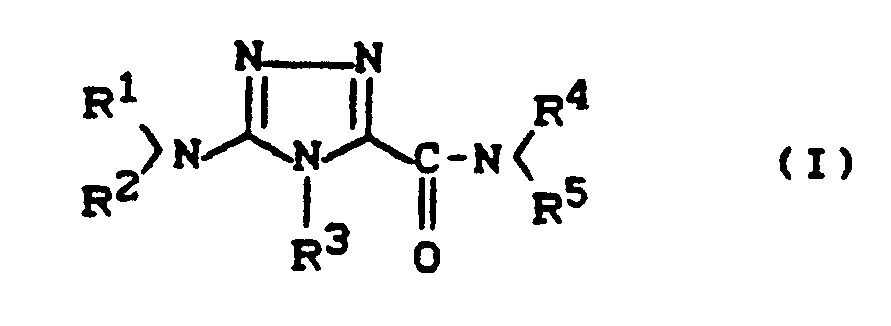
- Formula (I) provides a general definition of the substituted triazoles to be prepared by the process according to the invention.
- R1 and R2 are each independently hydrogen, methyl, ethyl, n- or i-propyl, n-, i-, s- or t-butyl, n- or i-pentyl, allyl, propargyl, each straight-chain or branched Haloalkyl with 1 to 4 carbon atoms, haloalkenyl with 3 to 6 carbon atoms or haloalkynyl with 3 to 6 carbon atoms and each with 1 to 9 identical or different halogen atoms, for methoxymethyl, methoxyethyl, for cyclopropyl, cyclopropylmethyl, cyclopentyl, cyclohexyl, cyclohexylmethyl, cyclohexylethyl, cyclopentylmethyl or are in each case optionally mono- to trisubstituted, identical or differently substituted benzyl, phenylethyl or phenyl, the following
- R1 represents hydrogen, methyl or ethyl
- R2 represents methyl or ethyl
- R3 represents methyl or ethyl
- R4 represents hydrogen or methyl
- R5 for hydrogen, methyl, ethyl, n- or i-propyl, n-, i-, s- or t-butyl, n- or i-pentyl, n - or i-hexyl, n- or i-heptyl, n - or i-octyl, n- or i-nonyl, n- or i-decyl, n- or i-dodecyl, for allyl, n- or i-butenyl, n- or i-pentenyl, n- or i-hexenyl , Propargyl, n- or
- R1, R2, R3 and R4 have the meaning given above as being particularly preferred and R5 is hydrogen, methyl, ethyl, n- or i-propyl, n-, i-, s- or t-butyl, n- or i-pentyl, n- or i-hexyl, allyl, n- or i-butenyl, n- or i-pentenyl, propargyl, n- or i-butinyl, n- or i-pentinyl, halogen-C1-C6-alkyl with 1 to 6 identical or different halogen atoms, especially fluorine and chlorine, halogen-C3-C5- alkenyl or halo gene-C3-C5-alkynyl each having 1 to 3 halogen atoms, in particular fluorine and / or chlorine, each
- Formula (II) provides a general definition of the chloroformamide hydrochlorides to be used as starting materials in the process according to the invention for the preparation of compounds of the formula (I).
- R1, R2 and R3 preferably or in particular have those meanings which have already been given above in connection with the description of the compounds of the formula (I) according to the invention preferably or as particularly preferred for R1, R2 and R3.
- the starting materials of the formula (II) are known and / or can be prepared by processes known per se (cf. DE-OS 3709574; Chem. Ber. 97 (1964), 1232-1245).
- Formula (III) provides a general definition of the oxalic acid amide hydrazides to be used as starting materials in the process according to the invention.
- R4 and R5 preferably or in particular have those meanings which have already been mentioned above in connection with the description of the compounds of the formula (I) according to the invention preferably or as particularly preferred for R4 and R5.
- Examples of the starting materials of the formula (III) are: Oxalic acid hydrazide-methylamide, -ethylamide, -propylamide, -isopropylamide, -butylamide, -isobutylamide, -sec-butylamide, -tert-butylamide, -pentylamide, -isopentylamide, -sec-pentylamide, -tert-pentylamide, -hexylamide, -isohexylamide, -octylamide, -2-fluoro-ethylamide, -2-chloro-ethylamide, -2,2,2-trifluoro-ethylamide, - (1,1-bis-fluoromethyl) -ethylamide, -1,1-dimethyl -2,2,2-trifluoro-ethylamide, -1-cyano-2,2-dimethyl-propylamide,
- the starting materials of the formula (III) are known and / or can be prepared by processes known per se (cf. EP-A 126326).
- the process according to the invention is carried out in the presence of a diluent.
- Polar organic solvents and / or water are preferably used as diluents.
- Preferred organic solvents are alcohols such as methanol, ethanol, propanol, isopropanol and butanol, ethers such as ethylene glycol dimethyl ether, diethylene glycol dimethyl ether, tetrahyne drofuran and dioxane, ether alcohols such as ethylene glycol monomethyl ether and monoethyl ether, amides such as formamide and dimethylformamide, nitriles such as acetonitrile, propionitrile or benzonitrile, and pyridine.
- Methanol is particularly preferred as a diluent.
- Acid acceptors which can be used in the process according to the invention are all acid binders which can customarily be used for such reactions.
- Alkali metal hydroxides such as, for. B. sodium and potassium hydroxide, alkaline earth metal hydroxides such. B.
- alkali carbonates and alcoholates such as sodium and potassium carbonate, sodium and potassium tert-butoxide, also aliphatic, aromatic or heterocyclic amines, for example triethylamine, trimethylamine, dimethylaniline, dimethylbenzylamine, pyridine, 1,5-diazabicyclo- [4 , 3,0] non-5-ene (DBN), 1,8-diazabicyclo- [5,4,0] -undec-7-ene (DBU) and 1,4-diazabicyclo- [2,2,2 ] octane (DABCO).
- DBN 1,5-diazabicyclo- [4 , 3,0] non-5-ene
- DBU 1,8-diazabicyclo- [5,4,0] -undec-7-ene
- DABCO 1,4-diazabicyclo- [2,2,2 ] octane
- reaction temperatures can be varied within a wide range in the process according to the invention. In general, temperatures between 0 ° C and 150 ° C, preferably at temperatures between 10 ° C and 100 ° C.
- the process according to the invention is generally carried out under normal pressure. However, it is also possible to work under increased or reduced pressure.
- 1 mole of chloroformamide hydrochloride of the formula (II) is generally between 0.5 and 1.5 moles, preferably between 0.8 and 1.2 moles, of oxalic acid amide hydrazide of the formula (III) and between 1 and 5 molar equivalents, preferably between 2 and 3 molar equivalents, of an acid acceptor.
- reaction components of the formulas (II) and (III) are generally mixed with the diluent at room temperature and, after the addition of an acid acceptor - if appropriate at elevated temperature - stirred until the end of the reaction.
- the reaction mixture is concentrated after the end of the reaction and the residue is shaken with water and an organic solvent which is practically immiscible with water, such as methylene chloride.
- the organic phase is separated off, dried with a drying agent, such as, for example, magnesium sulfate, and filtered.
- the solvent is carefully distilled off from the filtrate in a water jet vacuum.
- the remaining residue essentially contains the product of the formula (I), which can be purified further in the customary manner, for example by recrystallization.
Landscapes
- Chemical & Material Sciences (AREA)
- Organic Chemistry (AREA)
- Life Sciences & Earth Sciences (AREA)
- Dentistry (AREA)
- Wood Science & Technology (AREA)
- Plant Pathology (AREA)
- Health & Medical Sciences (AREA)
- Engineering & Computer Science (AREA)
- Agronomy & Crop Science (AREA)
- General Health & Medical Sciences (AREA)
- Pest Control & Pesticides (AREA)
- Zoology (AREA)
- Environmental Sciences (AREA)
- Plural Heterocyclic Compounds (AREA)
- Pharmaceuticals Containing Other Organic And Inorganic Compounds (AREA)
- Organic Low-Molecular-Weight Compounds And Preparation Thereof (AREA)
- Agricultural Chemicals And Associated Chemicals (AREA)
Abstract
Description
- Die Erfindung betrifft ein neues Verfahren zur Herstellung von 3-Amino-5-aminocarbonyl-1,2,4-triazol-Derivaten, welche als neue, herbizid wirksame Stoffe Gegenstand einer älteren, nicht vorveröffentlichten Patentanmeldung sind (vgl. DE-P 3809053 vom 18. März 1988).
- Der genannten Patentanmeldung ist zu entnehmen, daß man 3-Amino-5-aminocarbonyl-1,2,4-triazol-Derivate erhält, wenn man (a) geeignete Aminoguanidine mit Oxalesteramiden oder (b) geeignete Triazolylcarbonsäureester mit Aminen umsetzt. Nach beiden Methoden erhält man die 3-Amino-5-aminocarbonyl-1,2,4-triazol-Derivate in vielen Fällen nur in unbefriedigenden Ausbeuten.
- Es wurde nun gefunden, daß man 3-Amino-5-aminocarbonyl-1,2,4-triazol-Derivate der allgemeinen Formel (I)

R¹ und R² unabhängig voneinander jeweils für Wasserstoff, Alkyl, Alkenyl, Alkinyl, Halogenalkyl, Halogenalkenyl, Halogenalkinyl, Alkoxyalkyl, Cycloalkyl, Cycloalkylalkyl, für jeweils gegebenenfalls substituiertes Aryl, Aralkyl oder Heteroaryl stehen oder gemeinsam mit dem Stickstoffatom, an welches sie gebunden sind, für einen gegebenenfalls substituierten Heterocyclus stehen,
R³ für Alkyl, Alkenyl, Alkinyl, Halogenalkyl, Halogenalkenyl, Halogenalkinyl, Alkoxyalkyl, Cycloalkylalkyl, Cycloalkyl oder für jeweils gegebenenfalls substituiertes Aralkyl oder Aryl steht, und
R⁴ und R⁵ unabhängig voneinander jeweils für Wasserstoff, Alkyl, Alkenyl, Alkinyl, Halogenalkyl, Halogenalkenyl, Halogenalkinyl, Cyanalkyl, Hydroxyalkyl, Alkoxyalkyl, Alkylaminoalkyl, Dialkylaminoalkyl, Alkoximinoalkyl, Alkoxycarbonylalkyl, Alkoxycarbonylalkenyl, für jeweils gegebenenfalls sub stituiertes Cycloalkyl, Cycloalkylalkyl, Cycloalkenyl oder Cycloalkenylalkyl, für gegebenenfalls substituiertes Heterocyclylalkyl, für jeweils gegebenenfalls substituiertes Aralkyl, Aroyl oder Aryl oder gemeinsam mit dem Stickstoffatom, an welches sie gebunden sind, für einen gegebenenfalls substituierten Heterocyclus stehen,
in guten Ausbeuten und in hoher Reinheit erhält, wenn man Chlor-formamidin-Hydrochloride der allgemeinen Formel (II)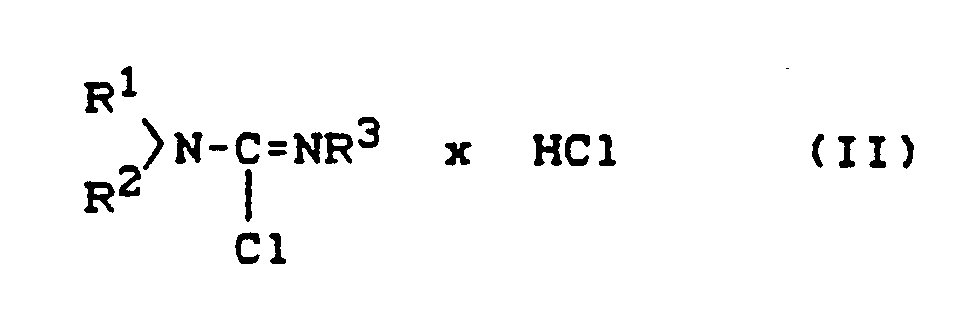
R¹, R² und R³ die oben angegebenen Bedeutungen haben,
mit Oxalsäure-amid-hydraziden der allgemeinen Formel (III)
R⁴ und R⁵ die oben angegebenen Bedeutungen haben,
in Gegenwart eines Säureakzeptors und in Gegenwart eines Verdünnungsmittels bei Temperaturen zwischen 0°C und 150°C umsetzt. - Die nach dem erfindungsgemäßen Verfahren herzustellenden substituierten Triazole sind durch die Formel (I) allgemein definiert. Bevorzugt sind Verbindungen der Formel (I), bei welchen
R¹ und R² unabhängig voneinander jeweils für Wasserstoff, für jeweils geradkettiges oder verzweigtes Alkyl mit 1 bis 8 Kohlenstoffatomen, Alkenyl mit 2 bis 8 Kohlenstoffatomen, Alkinyl mit 2 bis 8 Kohlenstoffatomen, Halogenalkyl mit 1 bis 8 Kohlenstoffatomen und 1 bis 17 gleichen oder verschiedenen Halogenatomen, Halogenalkenyl oder Halogenalkinyl mit jeweils 2 bis 8 Kohlenstoffatomen und 1 bis 15 bzw. 13 gleichen oder verschiedenen Halogenatomen, Alkoxyalkyl mit 1 bis 6 Kohlenstoffatomen in den einzelnen Alkylteilen, für Cycloalkyl mit 3 bis 7 Kohlenstoffatomen, für Cycloalkylalkyl mit 3 bis 7 Kohlenstoffatomen im Cycloalkylteil und 1 bis 6 Kohlenstoffatomen im geradkettigen oder verzweigten Alkylteil oder für jeweils gegebenenfalls einfach oder mehrfach, gleich oder verschieden substituiertes Aralkyl mit 6 bis 10 Kohlenstoffatomen im Arylteil und 1 bis 6 Kohlenstoffatomen im geradkettigen oder verzweigten Alkylteil, Aryl mit 6 bis 10 Kohlenstoffatomen oder Heteroaryl mit 2 bis 9 Kohlenstoffatomen und 1 bis 3 Heteroatomen, insbesondere Stickstoff, Sauerstoff und/ oder Schwefel stehen, wobei als Substituenten jeweils infrage kommen: Halogen, Cyano, Nitro sowie jeweils geradkettiges oder verzweigtes Alkyl, Alkoxy, Alkylthio, Halogenalkyl, Halogenalkoxy oder Halogenalkylthio mit jeweils 1 bis 4 Kohlenstoffatomen und gegebenenfalls 1 bis 9 gleichen oder verschiedenen Halogenatomen oder
R¹ und R² gemeinsam mit dem Stickstoffatom, an welches sie gebunden sind, für einen gegebenenfalls einfach oder mehrfach gleich oder verschieden substituierten fünf- bis zehngliedrigen Heterocyclus stehen, der gegebenenfalls 1 bis 2 weitere Heteroatome, insbesondere Stickstoff, Sauerstoff und/oder Schwefel enthalten kann, wobei als Substituenten infrage kommen: Halogen sowie jeweils geradkettiges oder verzweigtes Alkyl oder Halogenalkyl mit jeweils 1 bis 4 Kohlenstoffatomen und gegebenenfalls 1 bis 9 gleichen oder verschiedenen Halogenatomen sowie 1 bis 2 Oxo- oder Thionogruppen,
R³ für jeweils geradkettiges oder verzweigtes Alkyl mit 1 bis 8 Kohlenstoffatomen, Alkenyl mit 2 bis 8 Kohlenstoffatomen, Alkinyl mit 2 bis 8 Kohlenstoffatomen, Halogenalkyl mit 1 bis 8 Kohlenstoffatomen und 1 bis 17 gleichen oder verschiedenen Halogenatomen, Halogenalkenyl mit 2 bis 8 Kohlenstoffatomen und 1 bis 15 gleichen oder verschiedenen Halogenatomen, Halogenalkinyl mit 2 bis 8 Kohlenstoffatomen und 1 bis 13 gleichen oder verschiedenen Halogenatomen, Alkoxyalkyl mit jeweils 1 bis 6 Kohlenstoffatomen in den einzelnen Alkylteilen, für Cycloalkylalkyl oder Cycloalkyl mit jeweils 3 bis 7 Kohlenstoffatomen im Cycloalkylteil und gegebenenfalls 1 bis 6 Kohlenstoffatomen im geradkettigen oder verzweigten Alkylteil oder für jeweils gegebenenfalls einfach oder mehrfach, gleich oder verschieden substituiertes Aralkyl oder Aryl mit jeweils 6 bis 10 Kohlenstoffatomen im Arylteil und gegebenenfalls 1 bis 6 Kohlenstoffatomen im geradkettigen oder verzweigten Alkylteil steht, wobei als Arylsubstituenten jeweils infrage kommen: Halogen, Cyano, Nitro sowie jeweils geradkettiges oder verzweigtes Alkyl, Alkoxy, Alkylthio, Halogenalkyl, Halogenalkoxy oder Halogenalkylthio mit jeweils 1 bis 4 Kohlenstoffatomen und gegebenenfalls 1 bis 9 gleichen oder verschiedenen Halogenatomen,
R⁴ und R⁵ unabhängig voneinander jeweils für Wasserstoff, für jeweils geradkettiges oder verzweigtes Alkyl mit 1 bis 18 Kohlenstoffatomen, Alkenyl mit 2 bis 8 Kohlenstoffatomen, Alkinyl mit 2 bis 8 Kohlenstoffatomen, Halogenalkyl mit 1 bis 8 Kohlenstoffatomen und 1 bis 17 gleichen oder verschiedenen Halogenatomen, Halogenalkenyl oder Halogenalkinyl mit jeweils 2 bis 8 Kohlenstoffatomen und 1 bis 15 bzw. 13 gleichen oder verschiedenen Halogenatomen, Cyanalkyl mit 1 bis 8 Kohlenstoffatomen, Hydroxyalkyl mit 1 bis 8 Kohlenstoffatomen und 1 bis 6 Hydroxygruppen, Alkoxyalkyl, Alkoximinoalkyl, Alkoxycarbonylalkyl oder Alkoxycarbonylalkenyl mit jeweils bis zu 6 Kohlenstoffatomen in den einzelnen Alkyl- bzw. Alkenylteilen, Alkylaminoalkyl oder Dialkylaminoalkyl mit jeweils 1 bis 6 Kohlenstoffatomen in den einzelnen Alkylteilen oder für jeweils gegebenenfalls einfach oder mehrfach gleich oder verschieden substituiertes Cycloalkyl, Cycloalkylalkyl, Cycloalkenyl oder Cycloalkenylalkyl mit jeweils 3 bis 8 Kohlenstoffatomen im Cycloalkyl- bzw. Cycloalkenylteil und gegebenenfalls 1 bis 6 Kohlenstoffatomen im geradkettigen oder verzweigten Alkylteil stehen, wobei als Substituenten jeweils infrage kommen: Halogen, Cyano sowie jeweils geradkettiges oder verzweigtes Alkyl oder Halogenalkyl mit jeweils 1 bis 4 Kohlenstoffatomen und gegebenenfalls 1 bis 9 gleichen oder verschiedenen Halogenatomen oder jeweils zweifach verknüpftes Alkandiyl bzw. Alkendiyl mit jeweils bis zu 4 Kohlenstoffatomen; R⁴ und R⁵ unabhängig voneinander außerdem für im Heterocyclylteil gegebenenfalls einfach oder mehrfach, gleich oder verschieden substituiertes Heterocyclylalkyl mit 1 bis 6 Kohlenstoffatomen im geradkettigen oder verzweigten Alkylteil und 1 bis 9 Kohlenstoffatomen sowie 1 bis 3 Heteroatomen - insbesondere Stickstoff, Sauerstoff und/oder Schwefel - im Heterocyclylteil stehen, wobei als Substituenten infrage kommen: Halogen, Cyano, Nitro, sowie jeweils geradkettiges oder verzweigtes Alkyl, Alkoxy, Alkylthio, Halogenalkyl, Halogenalkoxy, Halogenalkylthio oder Alkoxycarbonyl mit jeweils 1 bis 5 Kohlenstoff atomen und gegebenenfalls 1 bis 9 gleichen oder verschiedenen Halogenatomen, R⁴ und R⁵ unabhängig voneinander außerdem für jeweils gegebenenfalls einfach oder mehrfach, gleich oder verschieden substituiertes Aralkyl, Aroyl oder Aryl mit jeweils 6 bis 10 Kohlenstoffatomen im Arylteil und gegebenenfalls 1 bis 8 Kohlenstoffatomen im geradkettigen oder verzweigten Alkylteil stehen, wobei als Arylsubstituenten jeweils infrage kommen: Halogen, Cyano, Nitro, Hydroxy, jeweils geradkettiges oder verzweigtes Alkyl, Alkoxy, Alkylthio, Halogenalkyl, Halogenalkoxy, Halogenalkylthio, Alkylsulfinyl, Alkylsulfonyl, Halogenalkylsulfinyl, Halogenalkylsulfonyl, Alkanoyl oder Alkoxycarbonyl mit jeweils 1 bis 6 Kohlenstoffatomen und gegebenenfalls 1 bis 9 gleichen oder verschiedenen Halogenatomen, Cycloalkyl mit 3 bis 6 Kohlenstoffatomen oder Phenoxy und wobei als Alkylsubstituenten gegebenenfalls infrage kommen: Halogen oder Cyano, oder
R⁴ und R⁵ gemeinsam mit dem Stickstoffatom, an welches sie gebunden sind, für einen gegebenenfalls einfach oder mehrfach, gleich oder verschieden substituierten fünf- bis zehngliedrigen Heterocyclus stehen, der gegebenenfalls 1 bis 2 weitere Heteroatome, insbesondere Stickstoff, Sauerstoff und/oder Schwefel, enthalten kann, wobei als Substituenten infrage kommen: Halogen sowie jeweils geradkettiges oder verzweigtes Alkyl oder Halogenalkyl mit jeweils 1 bis 4 Kohlenstoffatomen und gegebenenfalls 1 bis 9 gleichen oder verschiedenen Halogenatomen sowie 1 bis 2 Oxo- oder Thionogruppen. - Besonders bevorzugt werden nach dem erfindungsgemäßen Verfahren Verbindungen der Formel (I) hergestellt, bei welchen
- R¹ und R² unabhängig voneinander jeweils für Wasserstoff, für Methyl, Ethyl, n- oder i-Propyl, n-, i-, s- oder t-Butyl, n- oder i-Pentyl, Allyl, Propargyl, für jeweils geradkettiges oder verzweigtes Halogenalkyl mit 1 bis 4 Kohlenstoffatomen, Halogenalkenyl mit 3 bis 6 Kohlenstoffatomen oder Halogenalkinyl mit 3 bis 6 Kohlenstoffatomen und jeweils 1 bis 9 gleichen oder verschiedenen Halogenatomen, für Methoxymethyl, Methoxyethyl, für Cyclopropyl, Cyclopropylmethyl, Cyclopentyl, Cyclohexyl, Cyclohexylmethyl, Cyclohexylethyl, Cyclopentylmethyl oder für jeweils gegebenenfalls ein- bis dreifach, gleich oder verschieden substituiertes Benzyl, Phenylethyl oder Phenyl stehen, wobei als Substituenten infrage kommen: Fluor, Chlor, Brom, Cyano, Nitro, Methyl, Ethyl, n- oder i-Propyl, n-, i-, s- oder t-Butyl, Methoxy, Ethoxy, Methylthio, Trifluormethyl, Trifluormethoxy oder Trifluormethylthio oder
R¹ und R² gemeinsam mit dem Stickstoffatom, an welches sie gebunden sind, für einen gegebenenfalls ein- bis dreifach, gleich oder verschieden substituierten Heterocyclus der Formel
R³ für Methyl, Ethyl, n- oder i-Propyl, n-, i-, s- oder t-Butyl, n- oder i-Pentyl, n- oder i-Hexyl, für Allyl, Propargyl, für Methoxymethyl, für geradkettiges oder verzweigtes Halogenalkyl mit 1 bis 4 Kohlenstoffatomen und 1 bis 9 gleichen oder verschiedenen Halogenatomen, insbesondere Fluor, Chlor oder Brom, für Cyclopentyl, Cyclohexyl, Cyclopropyl, Cyclopropylmethyl, Cyclohexylmethyl, Cyclohexylethyl oder für jeweils gegebenenfalls ein- bis dreifach gleich oder verschieden substituiertes Benzyl oder Phenyl steht, wobei als Substituenten jeweils infrage kommen: Fluor, Chlor, Brom, Cyano, Nitro, Methyl, Ethyl, n- oder i-Propyl, n-, i-, s- oder t-Butyl, Methoxy, Ethoxy, Methylthio, Trifluormethyl, Trifluormethoxy oder Trifluormethylthio,
R⁴ und R⁵ unabhängig voneinander jeweils für Wasserstoff, Methyl, Ethyl, n- oder i-Propyl, n-, i-, s- oder t-Butyl, n- oder i-Pentyl, n- oder i-Hexyl, n- oder i-Heptyl, n- oder i-Octyl, n- oder i-Nonyl, n- oder i-Decyl, n- oder i-Dodecyl, für Allyl, n- oder i-Butenyl, n- oder i-Pentenyl, n- oder i-Hexenyl, Propargyl, n- oder i-Butinyl, n- oder i-Pentinyl, n- oder i-Hexinyl, für geradkettiges oder verzweigtes Halogenalkyl mit 1 bis 6 Kohlenstoffatomen und 1 bis 9 gleichen oder verschiedenen Halogenatomen, insbesondere Fluor, Chlor oder Brom, für jeweils geradkettiges oder verzweigtes Halogenalkenyl oder Halogenalkinyl mit jeweils 3 bis 5 Kohlenstoffatomen und 1 bis 3 Halogenatomen, insbesondere Fluor oder Chlor, für jeweils geradkettiges oder verzweigtes Cyanalkyl mit 1 bis 6 Kohlenstoffatomen im Alkylteil, Hydroxyalkyl mit 1 bis 6 Kohlenstoffatomen und 1 bis 3 Hydroxygruppen, Alkoxyalkyl, Alkoximinoalkyl, Alkoxycarbonylalkyl oder Alkoxycarbonylalkenyl, Alkylaminoalkyl oder Dialkylaminoalkyl mit jeweils bis zu 4 Kohlenstoffatomen in den einzelnen Alkyl- bzw. Alkenylteilen oder für jeweils gegebenenfalls ein- bis dreifach, gleich oder verschieden substituiertes Cyclopropyl, Cyclopropylmethyl, Cyclopropylethyl, Cyclopentyl, Cyclohexyl, Cycloheptyl, Cyclooctyl, Cyclohexylmethyl, Cyclohexylethyl, Cyclohexenyl, Cyclohexenylmethyl oder Cyclohexenylethyl stehen, wobei als Substituenten jeweils infrage kommen: Fluor, Chlor, Brom, Methyl, Ethyl, n- oder i-Propyl, n-, i-, s-oder t-Butyl, Cyano, Methandiyl, Ethandiyl, Butandiyl oder Butadiendiyl;
R⁴ und R⁵ unabhängig voneinander außerdem für im Heterocyclylteil gegebenenfalls ein- bis dreifach, gleich oder verschieden substituiertes Heterocyclylmethyl, Heterocyclylpropyl oder Heterocyclylethyl stehen, wobei als Heterocyclen jeweils infrage kommen:
Fluor, Chlor, Brom, Cyano, Nitro, Methyl, Ethyl, n- oder i-Propyl, n-, i-, s- oder t-Butyl, Methoxy, Ethoxy, Methylthio, Trifluormethyl, Trifluormethoxy oder Trifluormethylthio; R⁴ und R⁵ unabhängig voneinander außerdem für jeweils gegebenenfalls ein- bis dreifach, gleich oder verschieden substituiertes, gegebenenfalls geradkettiges oder verzweigtes Benzyl, Phenylethyl, Phenylpropyl, Phenylbutyl, Phenylpentyl, Phenylhexyl, Phenylheptyl, Phenylcyanmethyl, Phenylcyanethyl, Phenylcyanpropyl, Benzoyl, Phenyl oder Naphthyl stehen, wobei als Phenylsubstituenten jeweils infrage kommen: Fluor, Chlor, Brom, Hydroxy, Cyano, Nitro, Methyl, Ethyl, n- oder i-Propyl, n-, i-, s-oder t-Butyl, Methoxy, Ethoxy, Methylthio, Trifluormethyl, Trifluormethoxy, Trifluormethylthio, Trifluormethylsulfinyl, Trifluormethylsulfonyl, Methylsulfinyl, Methylsulfonyl, Acetyl, Propionyl, Methoxycarbonyl, Ethoxycarbonyl, Cyclohexyl oder Phenoxy oder
R⁴ und R⁵ gemeinsam mit dem Stickstoffatom, an welches sie gebunden sind, für einen gegebenenfalls ein- bis dreifach, gleich oder verschieden substituierten Heterocyclus der Formel
- Ganz besonders bevorzugt werden nach dem erfindungsgemäßen Verfahren Verbindungen der Formel (I) hergestellt, bei welchen
R¹ für Wasserstoff, Methyl oder Ethyl steht,
R² für Methyl oder Ethyl steht,
R³ für Methyl oder Ethyl steht,
R⁴ für Wasserstoff oder Methyl steht,
R⁵ für Wasserstoff, Methyl, Ethyl, n- oder i-Propyl, n-, i-, s- oder t-Butyl, n- oder i-Pentyl, n - oder i-Hexyl, n- oder i-Heptyl, n- oder i-Octyl, n- oder i-Nonyl, n- oder i-Decyl, n- oder i-Dodecyl, für Allyl, n- oder i-Butenyl, n- oder i-Pentenyl, n- oder i-Hexenyl, Propargyl, n- oder i-Butinyl, n- oder i-Pentinyl, n- oder i-Hexinyl, für geradkettiges oder verzweigtes Halogenalkyl mit 1 bis 6 Kohlenstoffatomen und 1 bis 9 gleichen oder verschiedenen Halogenatomen, insbesondere Fluor, Chlor oder Brom, für jeweils geradkettiges oder verzweigtes Halogenalkenyl oder Halogenalkinyl mit jeweils 3 bis 5 Kohlenstoffatomen und 1 bis 3 Halogenatomen, insbesondere Fluor und/oder Chlor, für jeweils geradkettiges oder verzweigtes Cyanalkyl mit 1 bis 6 Kohlenstoffatomen im Alkylteil, Hydroxyalkyl mit 1 bis 6 Kohlenstoffatomen und 1 bis 3 Hydroxygruppen, Alkoxyalkyl Alkoximinoalkyl, Alkoxycarbonylalkyl oder Alkoxycarbonylalkenyl, Alkylaminoalkyl oder Dialkylaminoalkyl mit jeweils bis zu 4 Kohlenstoffatomen in den einzelnen Alkyl- bzw. Alkenylteilen oder für jeweils gegebenenfalls ein- bis dreifach, gleich oder verschieden durch Fluor, Chlor, Brom, Methyl, Ethyl, n- oder i-Propyl, n-, i-, s- oder t-Butyl, Cyano, Methandiyl, Ethandiyl, Butandiyl oder Butadiendiyl substituiertes Cyclopropyl, Cyclopropylmethyl, Cyclopropylethyl, Cyclopentyl, Cyclohexyl, Cycloheptyl, Cyclooctyl, Cyclohexylmethyl, Cyclohexylethyl, Cyclohexenyl, Cyclohexenylmethyl oder Cyclohexenylethyl steht;
R⁵ außerdem für im Heterocyclylteil gegebenenfalls ein- bis dreifach, gleich oder verschieden durch Fluor, Chlor, Brom, Cyano, Nitro, Methyl, Ethyl, n- oder i-Propyl, n-, i-, s- oder t-Butyl, Methoxy, Ethoxy, Methylthio, Trifluormethyl, Trifluormethoxy oder Trifluormethylthio substituiertes Heterocyclylmethyl, Heterocyclylpropyl oder Heterocyclylethyl steht, wobei als Heterocyclen jeweils infrage kommen:
R⁵ außerdem für jeweils gegebenenfalls im Phenylteil ein- bis dreifach, gleich oder verschieden durch Fluor, Chlor, Brom, Hydroxy, Cyano, Nitro, Methyl, Ethyl, n- oder i-Propyl, n-, i-, s- oder t-Butyl, Methoxy, Ethoxy, Methylthio, Trifluormethyl, Trifluormethoxy, Trifluormethylthio, Trifluormethylsulfinyl, Trifluormethylsulfonyl, Methylsulfinyl, Methylsulfonyl, Acetyl, Propionyl, Methoxycarbonyl, Ethoxycarbonyl, Cyclohexyl oder Phenoxy substituiertes, gegebenenfalls geradkettiges oder verzweigtes Benzyl, Phenylethyl, Phenylpropyl, Phenylbutyl, Phenylpentyl, Phenylhexyl, Phenylheptyl, Phenylcyanmethyl, Phenylcyanethyl, Phenylcyanpropyl, Benzoyl, Phenyl oder Naphthyl steht. - Insbesondere werden nach dem erfindungsgemäßen Verfahren Verbindungen der Formel (I) hergestellt, bei welchen R¹, R², R³ und R⁴ die oben als ganz besonders bevorzugt angegebene Bedeutung haben und
R⁵ Wasserstoff, Methyl, Ethyl, n- oder i- Propyl, n-, i-, s- oder t-Butyl, n- oder i-Pentyl, n- oder i-Hexyl, Allyl, n- oder i-Butenyl, n- oder i-Pentenyl, Propargyl, n- oder i-Butinyl, n- oder i-Pentinyl, Halogen-C₁-C₆-alkyl mit 1 bis 6 gleichen oder verschiedenen Halogenatomen, insbesondere Fluor und Chlor, Halogen-C₃-C₅-alkenyl oder Halo gen-C₃-C₅-alkinyl mit jeweils 1 bis 3 Halogenatomen, insbesondere Fluor und/oder Chlor, jeweils gegebenenfalls einfach bis dreifach gleich oder verschieden substituiertes Cyclopropyl, Cyclopentyl, Cyclohexyl, Cyclopropylmethyl, Cyclopentylmethyl oder Cyclohexylmethyl bedeutet, wobei als Substituenten Fluor, Chlor, Brom, Methyl und Ethyl ausgewählt sind. - Im einzelnen seien außer den bei den Herstellungsbeispielen genannten Verbindungen die folgenden Verbindungen der allgemeinen Formel (I) genannt:


- Verwendet man beispielsweise Chlortrimethylformamidin-Hydrochlorid und Oxalsäure-hydrazidmethylamid als Ausgangsstoffe, so kann der Reaktionsablauf beim erfindungsgemäßen Verfahren durch das folgende Formelschema wiedergegeben werden:

- Die beim erfindungsgemäßen Verfahren zur Herstellung von Verbindungen der Formel (I) als Ausgangsstoffe zu verwendenden Chlor-formamidin-Hydrochloride sind durch die Formel (II) allgemein definiert.
- In Formel (II) haben R¹, R² und R³ vorzugsweise bzw. insbesondere diejenigen Bedeutungen, die bereits oben im Zusammenhang mit der Beschreibung der erfindungsgemäßen Verbindungen der Formel (I) vorzugsweise bzw. als insbesondere bevorzugt für R¹, R² und R³ angegeben wurden.
- Als Beispiele für die Ausgangsstoffe der Formel (II) seien genannt:
Chlor-N,N′-dimethyl-formamidin-Hydrochlorid, Chlor-N,N,N′-trimethyl-formamidin-Hydrochlorid, Chlor-N,N,N′-triethyl-formamidin-Hydrochlorid, Chlor-N,N,N′-tripropyl-formamidin-Hydrochlorid, Chlor-N,N,N′-triisopropyl-formamidin-Hydrochlorid, Chlor-N,N,N′-tributyl-formamidin-Hydrochlorid, Chlor-N,N-dimethyl-N′-ethyl-formamidin-Hydrochlorid, Chlor-N,N-dimethyl-N′-propyl-formamidin-Hydrochlorid, Chlor-N,N-dimethyl-N′-isopropyl-formamidin-Hydrochlorid, Chlor-N,N-dimethyl-N′-butyl-formamidin-Hydrochlorid, Chlor-N,N-dimethyl-N′-isobutyl-formamidin-Hydrochlorid, Chlor-N,N-dimethyl-N′-sec-butyl-formamidin-Hydrochlorid, Chlor-N,N-dimethyl-N′-tert-butyl-formamidin-Hydrochlorid, Chlor-N,N-diethyl-N′-methyl-formamidin-Hydrochlorid, Chlor-N,N-diethyl-N′-propyl-formamidin-Hydrochlorid, Chlor-N,N-diethyl-N′-butyl-formamidin-Hydrochlorid, Chlor-N,N-dipropyl-N′-methyl-formamidin-Hydrochlorid und Chlor-N,N-dipropyl-N′-ethyl-formamidin-Hydrochlorid. - Die Ausgangsstoffe der Formel (II) sind bekannt und/oder können nach an sich bekannten Verfahren hergestellt werden (vgl. DE-OS 3709574; Chem. Ber. 97 (1964), 1232-1245).
- Die beim erfindungsgemäßen Verfahren weiter als Ausgangsstoffe zu verwendenden Oxalsäure-amid-hydrazide sind durch die Formel (III) allgemein definiert.
- In Formel (III) haben R⁴ und R⁵ vorzugsweise bzw. insbesondere diejenigen Bedeutungen, die bereits oben im Zusammenhang mit der Beschreibung der erfindungsgemäßen Verbindungen der Formel (I) vorzugsweise bzw. als insbesondere bevorzugt für R⁴ und R⁵ angegeben wurden.
- Als Beispiele für die Ausgangsstoffe der Formel (III) seien genannt:
Oxalsäure-hydrazid-methylamid, -ethylamid, -propylamid, -isopropylamid, -butylamid, -isobutylamid, -sec-butylamid, -tert-butylamid, -pentylamid, -isopentylamid, -sec-pentylamid, -tert-pentylamid, -hexylamid, -isohexylamid, -octylamid, -2-fluor-ethylamid, -2-chlor-ethylamid, -2,2,2-trifluor-ethylamid, -(1,1-bis-fluormethyl)-ethylamid, -1,1-dimethyl-2,2,2-trifluor-ethylamid, -1-cyano-2,2-dimethyl-propylamid, -2-cyano-ethylamid, -allylamid, -crotylamid, -propargylamid, -1-methyl-propargylamid, -1,1-dimethyl-propargylamid, -cyclopropylamid, -1-methyl-cyclopropylamid, -cyclobutylamid, -1-methyl-cyclobutylamid, -cyclopentylamid, -1-methyl-cyclopentylamid, -cyclohexylamid, -1-methyl-cyclohexylamid, -2-methyl-cyclohexylamid, -3-methyl-cyclohexylamid, -4-methyl-cyclohexylamid, -benzylamid, -4-methyl-benzylamid, -1-phenyl-ethylamid, -2-phenyl-ethylamid und -1-cyano-1-methyl-propylamid. - Die Ausgangsstoffe der Formel (III) sind bekannt und/oder können nach an sich bekannten Verfahren hergestellt werden (vgl. EP-A 126326).
- Das erfindungsgemäße Verfahren wird in Gegenwart eines Verdünnungsmittels durchgeführt. Als Verdünnungsmittel werden vorzugsweise polare organische Lösungsmittel und/oder Wasser eingesetzt. Bevorzugte organische Lösungsmittel sind Alkohole wie Methanol, Ethanol, Propanol, Isopropanol und Butanol, Ether wie Ethylenglycol-dimethylether, Diethylenglycol-dimethylether, Tetrahy drofuran und Dioxan, Etheralkohole wie Ethylenglycol-monomethylether und -monoethylether, Amide wie Formamid und Dimethylformamid, Nitrile wie Acetonitril, Propionitril oder Benzonitril, sowie Pyridin. Methanol wird als Verdünnungsmittel besonders bevorzugt.
- Als Säureakzeptoren können bei dem erfindungsgemäßen Verfahren alle üblicherweise für derartige Umsetzungen verwendbaren Säurebindemittel eingesetzt werden. Vorzugsweise in Frage kommen Alkalimetallhydroxide wie z. B. Natrium- und Kaliumhydroxid, Erdalkalihydroxide wie z. B. Calciumhydroxid, Alkalicarbonate und -alkoholate wie Natrium- und Kaliumcarbonat, Natrium- und Kalium-tert-butylat, ferner aliphatische, aromatische oder heterocyclische Amine, beispielsweise Triethylamin, Trimethylamin, Dimethylanilin, Dimethylbenzylamin, Pyridin, 1,5-Diazabicyclo-[4,3,0]-non-5-en (DBN), 1,8-Diazabicyclo-[5,4,0]-undec-7-en (DBU) und 1,4-Diazabicyclo-[2,2,2]-octan (DABCO).
- Die Reaktionstemperaturen können bei dem erfindungsgemäßen Verfahren in einem größeren Bereich variiert werden. Im allgemeinen arbeitet man bei Temperaturen zwischen 0 °C und 150 °C, vorzugsweise bei Temperaturen zwischen 10 °C und 100 °C.
- Das erfindungsgemäße Verfahren wird im allgemeinen unter Normaldruck durchgeführt. Es ist jedoch auch möglich, unter erhöhtem oder vermindertem Druck zu arbeiten.
- Zur Durchführung des erfindungsgemäßen Verfahrens setzt man auf 1 Mol Chlor-formamidin-hydrochlorid der Formel (II) im allgemeinen zwischen 0,5 und 1,5 Mol, vorzugsweise zwischen 0,8 und 1,2 Mol, Oxalsäure-amid-hydrazid der Formel (III) und zwischen 1 und 5 Moläquivalenten, vorzugsweise zwischen 2 und 3 Moläquivalenten, eines Säureakzeptors ein.
- Die Reaktionskomponenten der Formel (II) und (III) werden im allgemeinen bei Raumtemperatur mit dem Verdünnungsmittel vermischt und nach Zugabe eines Säureakzeptors - gegebenenfalls bei erhöhter Temperatur - bis zum Ende der Umsetzung gerührt.
- Die Aufarbeitung kann nach üblichen Methoden durchgeführt werden.
- Im allgemeinen wird das Reaktionsgemisch nach Ende der Umsetzung eingeengt und der Rückstand mit Wasser und einem mit Wasser praktisch nicht mischbaren organischen Lösungsmittel, wie z.B. Methylenchlorid, ausgeschüttelt. Die organische Phase wird abgetrennt, mit einem Trockenmittel, wie z.B. Magnesiumsulfat, getrocknet und filtriert. Vom Filtrat wird das Lösungsmittel im Wasserstrahlvakuum sorgfältig abdestilliert. Der verbleibende Rückstand enthält im wesentlichen das Produkt der Formel (I), welches auf übliche Weise, beispielsweise durch Umkristallisation, weiter gereinigt werden kann.
-

- 13,1 g (0,1 Mol, Oxalsäure-hydrazid-ethylamid werden bei 20°C zu einer Mischung aus 18,8 g (0,12 Mol, Chlortrimethylformamidin-hydrochlorid und 300 ml Methanol gegeben. Nach Zugabe von 30,3 g (0,3 Mol) Triethylamin steigt die Innentemperatur auf 44°C an. Das Reaktionsgemisch wird eine Stunde unter Rückfluß zum Sieden erhitzt und anschließend im Wasserstrahlvakuum eingeengt. Der Rückstand wird mit Methylenchlorid/Wasser ausgeschüttelt, die organische Phase abgetrennt, mit Natriumsulfat getrocknet und filtriert. Vom Filtrat wird das Lösungsmittel im Wasserstrahlvakuum sorgfältig abdestilliert.
- Man erhält 12,8 g (65% der Theorie) 5-Dimethylamino-4-methyl-4H-1,2,4-triazol-3-yl-carbonsäureethylamid als kristallinen Rückstand vom Schmelzpunkt 73°C-75°C.
-

- 16,65 g (0,1 Mol) Oxalsäure-hydrazid-(2-chlor-ethyl)-amid werden bei 20°C zu einer Mischung aus 18,8 g (0,12 Mol) Chlortrimethylformamidin-hydrochlorid und 300 ml Methanol gegeben. Nach Zugabe von 16,2 g (0,3 Mol) Natriummethylat steigt die Innentemperatur auf 62°C an. Das Reaktionsgemisch wird eine Stunde ohne weiteres Erwärmen gerührt und anschließend im Wasserstrahlvakuum eingeengt. Der Rückstand wird mit Methylenchlorid/Wasser ausgeschüttelt, die organische Phase abgetrennt, mit Magnesiumsulfat getrocknet und filtriert. Vom Filtrat wird das Lösungsmittel im Wasserstrahlvakuum sorgfältig abdestilliert.
- Man erhält 18,5 g (80% der Theorie) 5-Dimethylamino-4-methyl-4H-1,2,4-triazol-3-yl-carbonsäure-(2-chlor-ethyl)-amid als kristallinen Rückstand vom Schmelzpunkt 153°C-155°C.
-

- Analog zu Beispiel 2 erhält man aus 19,5 g (0,1 Mol) Oxalsäure-hydrazid-(1,1-bis-fluormethyl)-ethylamid und 18,8 g (0,12 Mol) Chlortrimethylformamidin-hydrochlorid 19,7 g (75,5% der Theorie) 5-Dimethylamino-4-methyl-4H-1,2,4-triazol-3-yl-carbonsäure-(1,1-bis-fluormethyl)-ethylamid.
¹H-NMR (CDCl₃, δ, ppm): 1,55; 2,9; 4,5-4,8. -

- Analog zu Beispiel 2 erhält man aus 11,0 g (0,067 Mol) Oxalsäure-hydrazid-sec-butylamid und 10,8 g (0,069 Mol) Chlortrimethylformamidin-hydrochlorid 12,0 g (80% der Theorie) 5-Dimethylamino-4-methyl-4H-1,2,4-triazol-3-yl-carbonsäure-sec-butylamid vom Siedepunkt 149°C-152°C (bei 0,1 mbar).
¹H-NMR (CDCl₃, δ, ppm): 1,20-1,25; 2,85; 3,95-4,07. -
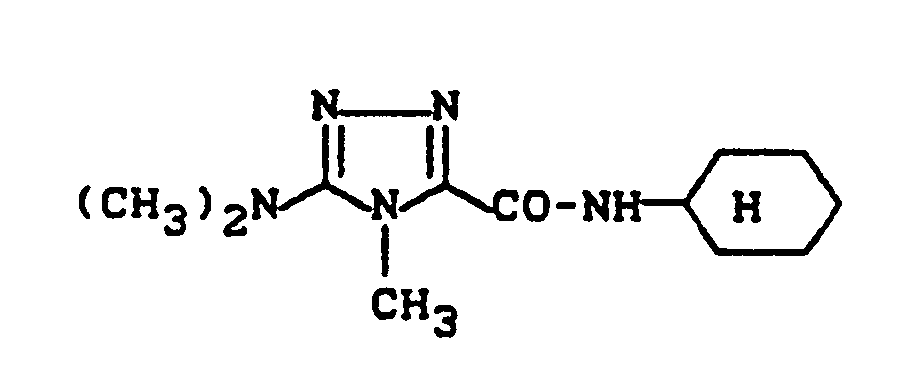
- Analog zu Beispiel 2 erhält man aus 13,8 g (0,074 Mol) Oxalsäure-hydrazid-cyclohexylamid und 14,1 g (0,09 Mol) Chlortrimethylformamidin-hydrochlorid 16,0 g (86% der Theorie) 5-Dimethylamino-4-methyl-4H-1,2,4-triazol-3-yl-carbonsäure-cyclohexylamid vom Schmelzpunkt 60°C-62°C.
-

- Analog zu Beispiel 2 erhält man aus 10,0 g (0,05 Mol) Oxalsäure-hydrazid-(2-methyl-cyclohexyl)-amid und 9,42 g (0,06 Mol) Chlortrimethylformamidin-hydrochlorid 11,2 g (84,5% der Theorie) 5-Dimethylamino-4-methyl-4H-1,2,4-triazol-3-yl-carbonsäure-(2-methyl-cyclohexyl)-amid.
¹H-NMR (CDCl₃, δ, ppm): 0,90-0,95; 2,85. -

- 16,2 g (0,3 Mol) Natrium-methylat werden unter Rühren zu einer Mischung aus 18,8 g (0,12 Mol) Chlortrimethyl-formamidin-hydrochlorid, 14,5 g (0,10 Mol) Oxalsäure-hydrazid-isopropylamid und 200 ml Methanol gegeben und das Reaktionsgemisch wird 2 Stunden unter Rückfluß zum Sieden erhitzt. Nach dem Abkühlen wird abgesaugt, das Filtrat eingeengt und der Rückstand mit Methylenchlorid/Wasser ausgeschüttelt. Die organische Phase wird abgetrennt, mit Natriumsulfat getrocknet und filtriert. Das Filtrat wird durch Vakuumdestillation aufgearbeitet.
- Man erhält 16,0 g (76% der Theorie) 5-Dimethylamino-4-methyl-4H-1,2,4-triazol-3-yl-carbonsäure-isopropylamid vom Siedepunkt 133-135°C (bei 0,1 mbar).
¹H-NMR (CDCl₃, δ, ppm): 1,25; 4,2; 7,3.
Claims (8)
R¹ und R² unabhängig voneinander jeweils für Wasserstoff, Alkyl, Alkenyl, Alkinyl, Halogenalkyl, Halogenalkenyl, Halogenalkinyl, Alkoxyalkyl, Cycloalkyl, Cycloalkylalkyl, für jeweils gegebenenfalls substituiertes Aryl, Aralkyl oder Heteroaryl stehen oder gemeinsam mit dem Stickstoffatom, an welches sie gebunden sind, für einen gegebenenfalls substituierten Heterocyclus stehen,
R³ für Alkyl, Alkenyl, Alkinyl, Halogenalkyl, Halogenalkenyl, Halogenalkinyl, Alkoxyalkyl, Cycloalkylalkyl, Cycloalkyl oder für jeweils gegebenenfalls substituiertes Aralkyl oder Aryl steht, und
R⁴ und R⁵ unabhängig voneinander jeweils für Wasserstoff, Alkyl, Alkenyl, Alkinyl, Halogenalkyl, Halogenalkenyl, Halogenalkinyl, Cyanalkyl, Hydroxyalkyl, Alkoxyalkyl, Alkylaminoalkyl, Dialkylaminoalkyl, Alkoximinoalkyl, Alkoxycarbonylalkyl, Alkoxycarbonylalkenyl, für jeweils gegebenenfalls substituiertes Cycloalkyl, Cycloalkylalkyl, Cycloalkenyl oder Cycloalkenylalkyl, für gegebenenfalls substituiertes Heterocyclylalkyl, für jeweils gegebenenfalls substituiertes Aralkyl, Aroyl oder Aryl oder gemeinsam mit dem Stickstoffatom, an welches sie gebunden sind, für einen gegebenenfalls substituierten Heterocyclus stehen,
dadurch gekennzeichnet, daß man Chlor-formamidin-Hydrochloride der allgemeinen Formel (II)

R¹, R² und R³ die oben angegebenen Bedeutungen haben,
mit Oxalsäure-amid-hydraziden der allgemeinen Formel (III)

R⁴ und R⁵ die oben angegebenen Bedeutungen haben,
umsetzt.
R¹ und R² unabhängig voneinander jeweils für Wasserstoff, für jeweils geradkettiges oder verzweigtes Alkyl mit 1 bis 8 Kohlenstoffatomen, Alkenyl mit 2 bis 8 Kohlenstoffatomen, Alkinyl mit 2 bis 8 Kohlenstoffatomen, Halogenalkyl mit 1 bis 8 Kohlenstoffatomen und 1 bis 17 gleichen oder verschiedenen Halogenatomen, Halogenalkenyl oder Halogenalkinyl mit jeweils 2 bis 8 Kohlenstoffatomen und 1 bis 15 bzw. 13 gleichen oder verschiedenen Halogenatomen, Alkoxyalkyl mit 1 bis 6 Kohlenstoffatomen in den einzelnen Alkylteilen, für Cycloalkyl mit 3 bis 7 Kohlenstoffatomen, für Cycloalkylalkyl mit 3 bis 7 Kohlenstoffatomen im Cycloalkylteil und 1 bis 6 Kohlenstoffatomen im geradkettigen oder verzweigten Alkylteil oder für jeweils gegebenenfalls einfach oder mehrfach, gleich oder verschieden substituiertes Aralkyl mit 6 bis 10 Kohlenstoffatomen im Arylteil und 1 bis 6 Kohlenstoffatomen im geradkettigen oder verzweigten Alkylteil, Aryl mit 6 bis 10 Kohlenstoffatomen oder Heteroaryl mit 2 bis 9 Kohlenstoffatomen und 1 bis 3 Heteroatomen, insbesondere Stickstoff, Sauerstoff und/ oder Schwefel stehen, wobei als Substituenten jeweils infrage kommen: Halogen, Cyano, Nitro sowie jeweils geradkettiges oder verzweigtes Alkyl, Alkoxy, Alkylthio, Halogenalkyl, Halogenalkoxy oder Halogenalkylthio mit jeweils 1 bis 4 Kohlenstoffatomen und gegebenenfalls 1 bis 9 gleichen oder verschiedenen Halogenatomen oder
R¹ und R² gemeinsam mit dem Stickstoffatom, an welches sie gebunden sind, für einen gegebenenfalls einfach oder mehrfach gleich oder verschieden substituierten fünf- bis zehngliedrigen Heterocyclus stehen, der gegebenenfalls 1 bis 2 weitere Heteroatome, insbesondere Stickstoff, Sauerstoff und/oder Schwefel enthalten kann, wobei als Substituenten infrage kommen: Halogen sowie jeweils geradkettiges oder verzweigtes Alkyl oder Halogenalkyl mit jeweils 1 bis 4 Kohlenstoffatomen und gegebenenfalls 1 bis 9 gleichen oder verschiedenen Halogenatomen sowie 1 bis 2 Oxo- oder Thionogruppen,
R³ für jeweils geradkettiges oder verzweigtes Alkyl mit 1 bis 8 Kohlenstoffatomen, Alkenyl mit 2 bis 8 Kohlenstoffatomen, Alkinyl mit 2 bis 8 Kohlenstoffatomen, Halogenalkyl mit 1 bis 8 Kohlenstoffatomen und 1 bis 17 gleichen oder verschiedenen Halogenatomen, Halogenalkenyl mit 2 bis 8 Kohlenstoffatomen und 1 bis 15 gleichen oder verschiedenen Halogenatomen, Halogenalkinyl mit 2 bis 8 Kohlenstoffatomen und 1 bis 13 gleichen oder verschiedenen Halogenatomen, Alkoxyalkyl mit jeweils 1 bis 6 Kohlenstoffatomen in den einzelnen Alkylteilen, für Cycloalkylalkyl oder Cycloalkyl mit jeweils 3 bis 7 Kohlenstoffatomen im Cycloalkylteil und gegebenenfalls 1 bis 6 Kohlenstoffatomen im geradkettigen oder verzweigten Alkylteil oder für jeweils gegebenenfalls einfach oder mehrfach, gleich oder verschieden substituiertes Aralkyl oder Aryl mit jeweils 6 bis 10 Kohlenstoffatomen im Arylteil und gegebenenfalls 1 bis 6 Kohlenstoffatomen im geradkettigen oder verzweigten Alkylteil steht, wobei als Arylsubstituenten jeweils infrage kommen: Halogen, Cyano, Nitro sowie jeweils geradkettiges oder verzweigtes Alkyl, Alkoxy, Alkylthio, Halogenalkyl, Halogenalkoxy oder Halogenalkylthio mit jeweils 1 bis 4 Kohlenstoffatomen und gegebenenfalls 1 bis 9 gleichen oder verschiedenen Halogenatomen,
R⁴ und R⁵ unabhängig voneinander jeweils für Wasserstoff, für jeweils geradkettiges oder verzweigtes Alkyl mit 1 bis 18 Kohlenstoffatomen, Alkenyl mit 2 bis 8 Kohlenstoffatomen, Alkinyl mit 2 bis 8 Kohlenstoffatomen, Halogenalkyl mit 1 bis 8 Kohlenstoffatomen und 1 bis 17 gleichen oder verschiedenen Halogenatomen, Halogenalkenyl oder Halogenalkinyl mit jeweils 2 bis 8 Kohlenstoffatomen und 1 bis 15 bzw. 13 gleichen oder verschiedenen Halogenatomen, Cyanalkyl mit 1 bis 8 Kohlenstoffatomen, Hydroxyalkyl mit 1 bis 8 Kohlenstoffatomen und 1 bis 6 Hydroxygruppen, Alkoxyalkyl, Alkoximinoalkyl, Alkoxycarbonylalkyl oder Alkoxycarbonylalkenyl mit jeweils bis zu 6 Kohlenstoffatomen in den einzelnen Alkyl- bzw. Alkenylteilen, Alkylaminoalkyl oder Dialkylaminoalkyl mit jeweils 1 bis 6 Kohlenstoffatomen in den einzelnen Alkylteilen oder für jeweils gegebenenfalls einfach oder mehrfach gleich oder verschieden substituiertes Cycloalkyl, Cycloalkylalkyl, Cycloalkenyl oder Cycloalkenylalkyl mit jeweils 3 bis 8 Kohlenstoffatomen im Cycloalkyl- bzw. Cycloalkenylteil und gegebenenfalls 1 bis 6 Kohlenstoffatomen im geradkettigen oder verzweigten Alkylteil stehen, wobei als Substituenten jeweils infrage kommen: Halogen, Cyano sowie jeweils geradkettiges oder verzweigtes Alkyl oder Halogenalkyl mit jeweils 1 bis 4 Kohlenstoffatomen und gegebenenfalls 1 bis 9 gleichen oder verschiedenen Halogenatomen oder jeweils zweifach verknüpftes Alkandiyl bzw. Alkendiyl mit jeweils bis zu 4 Kohlenstoffatomen; R⁵ und R⁵ unabhängig voneinander außerdem für im Heterocyclylteil gegebenenfalls einfach oder mehrfach, gleich oder verschieden substituiertes Heterocyclylalkyl mit 1 bis 6 Kohlenstoffatomen im geradkettigen oder verzweigten Alkylteil und 1 bis 9 Kohlenstoffatomen sowie 1 bis 3 Heteroatomen -insbesondere Stickstoff, Sauerstoff und/oder Schwefel - im Heterocyclylteil stehen, wobei als Substituenten infrage kommen: Halogen, Cyano, Nitro, sowie jeweils geradkettiges oder verzweigtes Alkyl, Alkoxy, Alkylthio, Halogenalkyl, Halogenalkoxy, Halogenalkylthio oder Alkoxycarbonyl mit jeweils 1 bis 5 Kohlenstoffatomen und gegebenenfalls 1 bis 9 gleichen oder verschiedenen Halogenatomen, R⁴ und R⁵ unabhängig voneinander, außerdem für jeweils gegebenenfalls einfach oder mehrfach, gleich oder verschieden substituiertes Aralkyl, Aroyl oder Aryl mit jeweils 6 bis 10 Kohlenstoffatomen im Arylteil und gegebenenfalls 1 bis 8 Kohlenstoffatomen im geradkettigen oder verzweigten Alkylteil stehen, wobei als Arylsubstituenten jeweils infrage kommen: Halogen, Cyano, Nitro, Hydroxy, jeweils geradkettiges oder verzweigtes Alkyl, Alkoxy, Alkylthio, Halogenalkyl, Halogenalkoxy, Halogenalkylthio, Alkylsulfinyl, Alkylsulfonyl, Halogenalkylsulfinyl, Halogenalkylsulfonyl, Alkanoyl oder Alkoxycarbonyl mit jeweils 1 bis 6 Kohlenstoffatomen und gegebenenfalls 1 bis 9 gleichen oder verschiedenen Halogenatomen, Cycloalkyl mit 3 bis 6 Kohlenstoffatomen oder Phenoxy und wobei als Alkylsubstituenten gegebenenfalls infrage kommen: Halogen oder Cyano, oder
R⁴ und R⁵ gemeinsam mit dem Stickstoffatom, an welches sie gebunden sind, für einen gegebenenfalls einfach oder mehrfach, gleich oder verschieden substituierten fünf- bis zehngliedrigen Heterocyclus stehen, der gegebenenfalls 1 bis 2 weitere Heteroatome, insbesondere Stickstoff, Sauerstoff und/oder Schwefel, enthalten kann, wobei als Substituenten infrage kommen: Halogen sowie jeweils geradkettiges oder verzweigtes Alkyl oder Halogenalkyl mit jeweils 1 bis 4 Kohlenstoffatomen und gegebenenfalls 1 bis 9 gleichen oder verschiedenen Halogenatomen sowie 1 bis 2 Oxo- oder Thionogruppen.
R¹ und R² unabhängig voneinander jeweils für Wasserstoff, für Methyl, Ethyl, n- oder i-Propyl, n-, i-, s- oder t-Butyl, n- oder i-Pentyl, Allyl, Propargyl, für jeweils geradkettiges oder verzweigtes Halogenalkyl mit 1 bis 4 Kohlenstoffatomen, Halogenalkenyl mit 3 bis 6 Kohlenstoffatomen oder Halogenalkinyl mit 3 bis 6 Kohlenstoffatomen und jeweils 1 bis 9 gleichen oder verschiedenen Halogenatomen, für Methoxymethyl, Methoxyethyl, für Cyclopropyl, Cyclopropylmethyl, Cyclopentyl, Cyclohexyl, Cyclohexylmethyl, Cyclohexylethyl, Cyclopentylmethyl oder für jeweils gegebenenfalls ein-bis dreifach, gleich oder verschieden substituiertes Benzyl, Phenylethyl oder Phenyl stehen, wobei als Substituenten infrage kommen: Fluor, Chlor, Brom, Cyano, Nitro, Methyl, Ethyl, n- oder i-Propyl, n-, i-, s- oder t-Butyl, Methoxy, Ethoxy, Methylthio, Trifluormethyl, Trifluormethoxy oder Trifluormethylthio oder
R¹ und R² gemeinsam mit dem Stickstoffatom, an welches sie gebunden sind, für einen gegebenenfalls ein-bis dreifach, gleich oder verschieden substituierten Heterocyclus der Formel

R³ für Methyl, Ethyl, n- oder i-Propyl, n-, i-, s-oder t-Butyl, n- oder i-Pentyl, n- oder i-Hexyl, für Allyl, Propargyl, für Methoxymethyl, für geradkettiges oder verzweigtes Halogenalkyl mit 1 bis 4 Kohlenstoffatomen und 1 bis 9 gleichen oder verschiedenen Halogenatomen, für Cyclopentyl, Cyclohexyl, Cyclopropyl, Cyclopropylmethyl, Cyclohexylmethyl, Cyclohexylethyl oder für jeweils gegebenenfalls ein- bis dreifach gleich oder verschieden substituiertes Benzyl oder Phenyl steht, wobei als Substituenten jeweils infrage kommen: Fluor, Chlor, Brom, Cyano, Nitro, Methyl, Ethyl, n- oder i-Propyl, n-, i-, s- oder t-Butyl, Methoxy, Ethoxy, Methylthio, Trifluormethyl, Trifluormethoxy oder Trifluormethylthio,
R⁴ und R⁵ unabhängig voneinander jeweils für Wasserstoff, Methyl, Ethyl, n- oder i-Propyl, n-, i-, s- oder t-Butyl, n- oder i-Pentyl, n- oder i-Hexyl, n- oder i-Heptyl, n- oder i-Octyl, n- oder i-Nonyl, n- oder i-Decyl, n- oder i-Dodecyl, für Allyl, n- oder i-Butenyl, n- oder i-Pentenyl, n- oder i-Hexenyl, Propargyl, n- oder i-Butinyl, n-oder i-Pentinyl, n- oder i-Hexinyl, für geradkettiges oder verzweigtes Halogenalkyl mit 1 bis 6 Kohlenstoffatomen und 1 bis 9 gleichen oder verschiedenen Halogenatomen, jeweils geradkettiges oder verzweigtes Halogenalkenyl oder Halogenalkinyl mit jeweils 3 bis 5 Kohlenstoffatomen und 1 bis 3 Halogenatomen, für jeweils geradkettiges oder verzweigtes Cyanalkyl mit 1 bis 6 Kohlenstoffatomen im Alkylteil, Hydroxyalkyl mit 1 bis 6 Kohlenstoffatomen und 1 bis 3 Hydroxygruppen, Alkoxyalkyl, Alkoximinoalkyl, Alkoxycarbonylalkyl oder Alkoxycarbonylalkenyl, Alkylaminoalkyl oder Dialkylaminoalkyl mit jeweils bis zu 4 Kohlenstoffatomen in den einzelnen Alkyl-bzw. Alkenylteilen oder für jeweils gegebenenfalls ein- bis dreifach, gleich oder verschieden substituiertes Cyclopropyl, Cyclopropylmethyl, Cyclopropylethyl, Cyclopentyl, Cyclohexyl, Cycloheptyl, Cyclooctyl, Cyclohexylmethyl, Cyclohexylethyl, Cyclohexenyl, Cyclohexenylmethyl oder Cyclohexenylethyl stehen, wobei als Substituenten jeweils infrage kommen: Fluor, Chlor, Brom, Methyl, Ethyl, n-oder i-Propyl, n-, i-, s-oder t-Butyl, Cyano, Methandiyl, Ethandiyl, Butandiyl oder Butadiendiyl;
R⁴ und R⁵ unabhängig voneinander außerdem für im Heterocyclylteil gegebenenfalls ein- bis dreifach, gleich oder verschieden substituiertes Heterocyclylmethyl, Heterocyclylpropyl oder Heterocyclylethyl stehen, wobei als Heterocyclen jeweils infrage kommen:

Fluor, Chlor, Brom, Cyano, Nitro, Methyl, Ethyl, n- oder i-Propyl, n-, i-, s- oder t-Butyl, Methoxy, Ethoxy, Methylthio, Trifluormethyl, Trifluormethoxy oder Trifluormethylthio; R⁴ und R⁵ unabhängig voneinander außerdem für jeweils gegebenenfalls ein- bis dreifach, gleich oder verschieden substituiertes, gegebenenfalls geradkettiges oder verzweigtes Benzyl, Phenylethyl, Phenylpropyl, Phenylbutyl, Phenylpentyl, Phenylhexyl, Phenylheptyl, Phenylcyanmethyl, Phenylcyanethyl, Phenylcyanpropyl, Benzoyl, Phenyl oder Naphthyl stehen, wobei als Phenylsubstituenten jeweils infrage kommen: Fluor, Chlor, Brom, Hydroxy, Cyano, Nitro, Methyl, Ethyl, n- oder i-Propyl, n-, i-, s-oder t-Butyl, Methoxy, Ethoxy, Methylthio, Trifluormethyl, Trifluormethoxy, Trifluormethylthio, Trifluormethylsulfinyl, Trifluormethylsulfonyl, Methylsulfinyl, Methylsulfonyl, Acetyl, Propionyl, Methoxycarbonyl, Ethoxycarbonyl, Cyclohexyl oder Phenoxy oder
R⁴ und R⁵ gemeinsam mit dem Stickstoffatom, an welches sie gebunden sind, für einen gegebenenfalls ein- bis dreifach, gleich oder verschieden substituierten Heterocyclus der Formel

Applications Claiming Priority (2)
| Application Number | Priority Date | Filing Date | Title |
|---|---|---|---|
| DE3916430A DE3916430A1 (de) | 1989-05-20 | 1989-05-20 | Verfahren zur herstellung von 3-amino-5-aminocarbonyl-1,2,4-triazol-derivaten |
| DE3916430 | 1989-05-20 |
Publications (2)
| Publication Number | Publication Date |
|---|---|
| EP0399285A1 true EP0399285A1 (de) | 1990-11-28 |
| EP0399285B1 EP0399285B1 (de) | 1992-09-30 |
Family
ID=6381027
Family Applications (1)
| Application Number | Title | Priority Date | Filing Date |
|---|---|---|---|
| EP90108629A Expired - Lifetime EP0399285B1 (de) | 1989-05-20 | 1990-05-08 | Verfahren zur Herstellung von 3-Amino-5-aminocarbonyl-1,2,4-triazol-Derivaten |
Country Status (4)
| Country | Link |
|---|---|
| US (1) | US5051517A (de) |
| EP (1) | EP0399285B1 (de) |
| JP (1) | JPH0317071A (de) |
| DE (2) | DE3916430A1 (de) |
Cited By (39)
| Publication number | Priority date | Publication date | Assignee | Title |
|---|---|---|---|---|
| WO2006000354A1 (de) | 2004-06-24 | 2006-01-05 | Boehringer Ingelheim International Gmbh | Neue imidazole und triazole, deren herstellung und verwendung als arzneimittel |
| US7393847B2 (en) | 2004-03-13 | 2008-07-01 | Boehringer Ingleheim International Gmbh | Imidazopyridazinediones, their preparation and their use as pharmaceutical compositions |
| US7407955B2 (en) | 2002-08-21 | 2008-08-05 | Boehringer Ingelheim Pharma Gmbh & Co., Kg | 8-[3-amino-piperidin-1-yl]-xanthines, the preparation thereof and their use as pharmaceutical compositions |
| US7439370B2 (en) | 2004-05-10 | 2008-10-21 | Boehringer Ingelheim International Gmbh | Imidazole derivatives, their preparation and their use as intermediates for the preparation of pharmaceutical compositions and pesticides |
| US7482337B2 (en) | 2002-11-08 | 2009-01-27 | Boehringer Ingelheim Pharma Gmbh & Co. Kg | Xanthine derivatives, the preparation thereof and their use as pharmaceutical compositions |
| US7495005B2 (en) | 2002-08-22 | 2009-02-24 | Boehringer Ingelheim Pharma Gmbh & Co. Kg | Xanthine derivatives, their preparation and their use in pharmaceutical compositions |
| US7495002B2 (en) | 2004-09-14 | 2009-02-24 | Boehringer Ingelheim International Gmbh | 3-methyl-7-butinyl-xanthines, the preparation thereof and their use as pharmaceutical compositions |
| US7495003B2 (en) | 2004-09-11 | 2009-02-24 | Boehringer Ingelheim International Gmbh | 8-(3-amino-piperidin-1-yl)-7-(but-2-ynyl)-xanthines, the preparation thereof and their use as pharmaceutical compositions |
| US7501426B2 (en) | 2004-02-18 | 2009-03-10 | Boehringer Ingelheim International Gmbh | 8-[3-amino-piperidin-1-yl]-xanthines, their preparation and their use as pharmaceutical compositions |
| US7550455B2 (en) | 2003-11-27 | 2009-06-23 | Boehringer Ingelheim International Gmbh | 8-(piperazin-1yl)- and 8-([1,4]diazepan-1yl)-xanthines, the preparation thereof and their use as pharmaceutical composition |
| US7560450B2 (en) | 2002-11-21 | 2009-07-14 | Boehringer Ingelheim Pharma Gmbh & Co., Kg | Xanthine derivatives, the preparation thereof and their use as pharmaceutical compositions |
| US7566707B2 (en) | 2003-06-18 | 2009-07-28 | Boehringer Ingelheim International Gmbh | Imidazopyridazinone and imidazopyridone derivatives, the preparation thereof and their use as pharmaceutical compositions |
| US7569574B2 (en) | 2002-08-22 | 2009-08-04 | Boehringer Ingelheim Pharma Gmbh & Co. Kg | Purine derivatives, the preparation thereof and their use as pharmaceutical compositions |
| US7645763B2 (en) | 2004-02-23 | 2010-01-12 | Boehringer Ingelheim Pharma Gmbh & Co. Kg | 8-[3-amino-piperidin-1-yl]-xanthines, their preparation and their use as pharmaceutical composition |
| US7820815B2 (en) | 2004-11-05 | 2010-10-26 | Boehringer Ingelheim International Gmbh | Process for the preparation of chiral 8-(-3-aminopiperidin-1-yl) xanthines |
| US8071583B2 (en) | 2006-08-08 | 2011-12-06 | Boehringer Ingelheim International Gmbh | Pyrrolo[3,2-D] pyrimidines as DPP-IV inhibitors for the treatment of diabetes mellitus |
| US8106060B2 (en) | 2005-07-30 | 2012-01-31 | Boehringer Ingelheim International Gmbh | 8-(3-amino-piperidin-1-yl)-xanthines, their preparation, and their use as pharmaceuticals |
| US8232281B2 (en) | 2006-05-04 | 2012-07-31 | Boehringer Ingelheim International Gmbh | Uses of DPP-IV inhibitors |
| US8513264B2 (en) | 2008-09-10 | 2013-08-20 | Boehringer Ingelheim International Gmbh | Combination therapy for the treatment of diabetes and related conditions |
| US8846695B2 (en) | 2009-01-07 | 2014-09-30 | Boehringer Ingelheim International Gmbh | Treatment for diabetes in patients with inadequate glycemic control despite metformin therapy comprising a DPP-IV inhibitor |
| US8853156B2 (en) | 2008-08-06 | 2014-10-07 | Boehringer Ingelheim International Gmbh | Treatment for diabetes in patients inappropriate for metformin therapy |
| US8865729B2 (en) | 2008-12-23 | 2014-10-21 | Boehringer Ingelheim International Gmbh | Salt forms of a xanthine compound |
| US8883800B2 (en) | 2011-07-15 | 2014-11-11 | Boehringer Ingelheim International Gmbh | Substituted quinazolines, the preparation thereof and the use thereof in pharmaceutical compositions |
| US9034883B2 (en) | 2010-11-15 | 2015-05-19 | Boehringer Ingelheim International Gmbh | Vasoprotective and cardioprotective antidiabetic therapy |
| US9149478B2 (en) | 2010-06-24 | 2015-10-06 | Boehringer Ingelheim International Gmbh | Diabetes therapy |
| US9155705B2 (en) | 2008-04-03 | 2015-10-13 | Boehringer Ingelheim International Gmbh | DPP-IV inhibitor combined with a further antidiabetic agent, tablets comprising such formulations, their use and process for their preparation |
| US9186392B2 (en) | 2010-05-05 | 2015-11-17 | Boehringer Ingelheim International Gmbh | Combination therapy |
| US9266888B2 (en) | 2006-05-04 | 2016-02-23 | Boehringer Ingelheim International Gmbh | Polymorphs |
| US9457029B2 (en) | 2009-11-27 | 2016-10-04 | Boehringer Ingelheim International Gmbh | Treatment of genotyped diabetic patients with DPP-IV inhibitors such as linagliptin |
| US9486526B2 (en) | 2008-08-06 | 2016-11-08 | Boehringer Ingelheim International Gmbh | Treatment for diabetes in patients inappropriate for metformin therapy |
| US9526728B2 (en) | 2014-02-28 | 2016-12-27 | Boehringer Ingelheim International Gmbh | Medical use of a DPP-4 inhibitor |
| US9526730B2 (en) | 2012-05-14 | 2016-12-27 | Boehringer Ingelheim International Gmbh | Use of a DPP-4 inhibitor in podocytes related disorders and/or nephrotic syndrome |
| US9555001B2 (en) | 2012-03-07 | 2017-01-31 | Boehringer Ingelheim International Gmbh | Pharmaceutical composition and uses thereof |
| US9713618B2 (en) | 2012-05-24 | 2017-07-25 | Boehringer Ingelheim International Gmbh | Method for modifying food intake and regulating food preference with a DPP-4 inhibitor |
| US10060909B2 (en) | 2003-08-06 | 2018-08-28 | Senomyx, Inc. | Flavors, flavor modifiers, tastants, taste enhancers, umami or sweet tastants, and/or enhancers and use thereof |
| US10155000B2 (en) | 2016-06-10 | 2018-12-18 | Boehringer Ingelheim International Gmbh | Medical use of pharmaceutical combination or composition |
| US11033552B2 (en) | 2006-05-04 | 2021-06-15 | Boehringer Ingelheim International Gmbh | DPP IV inhibitor formulations |
| US11911388B2 (en) | 2008-10-16 | 2024-02-27 | Boehringer Ingelheim International Gmbh | Treatment for diabetes in patients with insufficient glycemic control despite therapy with an oral or non-oral antidiabetic drug |
| US12312352B2 (en) | 2012-05-14 | 2025-05-27 | Boehringer Ingelheim International Gmbh | Use of a DPP-4 inhibitor in SIRS and/or sepsis |
Families Citing this family (8)
| Publication number | Priority date | Publication date | Assignee | Title |
|---|---|---|---|---|
| KR100345852B1 (ko) * | 1997-01-06 | 2002-11-29 | 주식회사 엘지씨아이 | 1-벤질-4,5-디카르보닐-1,2,3-트리아졸 유도체 및 그의 제조방법 |
| KR100345850B1 (ko) * | 1997-01-06 | 2002-11-29 | 주식회사 엘지씨아이 | 1-벤질-4,5-디카르보닐-1,2,3-트리아졸 유도체 및 그의 제조방법 |
| SI1953162T1 (sl) * | 2001-02-24 | 2012-09-28 | Boehringer Ingelheim Pharma | Ksantinski derivati, njihova priprava in njihova uporaba kot zdravila |
| US20030105279A1 (en) * | 2001-08-30 | 2003-06-05 | Pharmacia Corporation | Aromatic and heteroaromatic acid halides for synthesizing polyamides |
| US7179809B2 (en) * | 2004-04-10 | 2007-02-20 | Boehringer Ingelheim International Gmbh | 2-Amino-imidazo[4,5-d]pyridazin-4-ones, their preparation and their use as pharmaceutical compositions |
| NZ600126A (en) * | 2007-08-17 | 2013-12-20 | Boehringer Ingelheim Int | Purine derivatives for use in the treatment of fap-related diseases |
| PE20100156A1 (es) * | 2008-06-03 | 2010-02-23 | Boehringer Ingelheim Int | Tratamiento de nafld |
| KR101657960B1 (ko) * | 2008-08-15 | 2016-09-20 | 베링거 인겔하임 인터내셔날 게엠베하 | Fab-관련 질환의 치료에 사용하기 위한 푸린 유도체 |
Citations (1)
| Publication number | Priority date | Publication date | Assignee | Title |
|---|---|---|---|---|
| EP0126326A1 (de) * | 1983-04-26 | 1984-11-28 | Ube Industries, Ltd. | Verfahren zur Herstellung von 1,2,4-Triazol-3-carboxamiden |
Family Cites Families (2)
| Publication number | Priority date | Publication date | Assignee | Title |
|---|---|---|---|---|
| DE3709574A1 (de) * | 1987-03-24 | 1988-10-06 | Bayer Ag | Substituierte triazolinone |
| DE3809053A1 (de) * | 1988-03-18 | 1989-09-28 | Bayer Ag | Substituierte 5-amino-4h-1,2,4-triazol-3-yl-carbonsaeureamide, verfahren zu ihrer herstellung und ihre verwendung als herbizide |
-
1989
- 1989-05-20 DE DE3916430A patent/DE3916430A1/de not_active Withdrawn
-
1990
- 1990-05-07 US US07/520,338 patent/US5051517A/en not_active Expired - Fee Related
- 1990-05-08 DE DE9090108629T patent/DE59000326D1/de not_active Expired - Lifetime
- 1990-05-08 EP EP90108629A patent/EP0399285B1/de not_active Expired - Lifetime
- 1990-05-15 JP JP2123207A patent/JPH0317071A/ja active Pending
Patent Citations (1)
| Publication number | Priority date | Publication date | Assignee | Title |
|---|---|---|---|---|
| EP0126326A1 (de) * | 1983-04-26 | 1984-11-28 | Ube Industries, Ltd. | Verfahren zur Herstellung von 1,2,4-Triazol-3-carboxamiden |
Non-Patent Citations (2)
| Title |
|---|
| BULLETIN DE LA SOCIETE CHIMIQUE DE FRANCE, Nr. 4, April 1970, Seiten 1590-1599, Paris, FR; M. PESSON et al.: "Recherches sur les dérivés du triazole-1,2,4. V. - Amides N-dialkylés d'acides triazol-1,2,4 yl-5 carboxyliques" * |
| CHEMICAL ABSTRACTS, Band 63, Nr. 10, 8. November 1965, Zusammenfassung 13243f - 13244b, Columbus, Ohio, US; G.E. CIPENS et al.: "Derivatives of 1,2,4-triazole-5-carboxylic acid", & LATVIJAS PSR ZINATNU AKAD. VESTIS, KIM. SER. 1965(2), 204-8 * |
Cited By (86)
| Publication number | Priority date | Publication date | Assignee | Title |
|---|---|---|---|---|
| US9108964B2 (en) | 2002-08-21 | 2015-08-18 | Boehringer Ingelheim International Gmbh | 8-[3-amino-piperidin-1-yl]-xanthines, the preparation thereof and their use as pharmaceutical compositions |
| US7407955B2 (en) | 2002-08-21 | 2008-08-05 | Boehringer Ingelheim Pharma Gmbh & Co., Kg | 8-[3-amino-piperidin-1-yl]-xanthines, the preparation thereof and their use as pharmaceutical compositions |
| US8119648B2 (en) | 2002-08-21 | 2012-02-21 | Boehringer Ingelheim Pharma Gmbh & Co. Kg | 8-[3-amino-piperidin-1-yl]-xanthines, the preparation thereof and their use as pharmaceutical compositions |
| US10202383B2 (en) | 2002-08-21 | 2019-02-12 | Boehringer Ingelheim International Gmbh | 8-[3-amino-piperidin-1-yl]-xanthines, the preparation thereof and their use as pharmaceutical compositions |
| US9321791B2 (en) | 2002-08-21 | 2016-04-26 | Boehringer Ingelheim International Gmbh | 8-[3-amino-piperidin-1-yl]-xanthines, the preparation thereof and their use as pharmaceutical compositions |
| US8178541B2 (en) | 2002-08-21 | 2012-05-15 | Boehringer Ingelheim Pharma Gmbh & Co. Kg | 8-[3-amino-piperidin-1-yl]-xanthines, the preparation thereof and their use as pharmaceutical compositions |
| US10023574B2 (en) | 2002-08-21 | 2018-07-17 | Boehringer Ingelheim International Gmbh | 8-[3-amino-piperidin-1-yl]-xanthines, the preparation thereof and their use as pharmaceutical compositions |
| US9556175B2 (en) | 2002-08-21 | 2017-01-31 | Boehringer Ingelheim International Gmbh | 8-[3-amino-piperidin-1-yl]-xanthines, the preparation thereof and thier use as pharmaceutical compositions |
| US8664232B2 (en) | 2002-08-21 | 2014-03-04 | Boehringer Ingelheim Pharma Gmbh & Co. Kg | 8-[3-amino-piperidin-1-yl]-xanthines, the preparation thereof and their use as pharmaceutical compositions |
| US7569574B2 (en) | 2002-08-22 | 2009-08-04 | Boehringer Ingelheim Pharma Gmbh & Co. Kg | Purine derivatives, the preparation thereof and their use as pharmaceutical compositions |
| US7838529B2 (en) | 2002-08-22 | 2010-11-23 | Boehringer Ingelheim International Gmbh | Xanthine derivates, their preparation and their use in pharmaceutical compositions |
| US7495005B2 (en) | 2002-08-22 | 2009-02-24 | Boehringer Ingelheim Pharma Gmbh & Co. Kg | Xanthine derivatives, their preparation and their use in pharmaceutical compositions |
| US7482337B2 (en) | 2002-11-08 | 2009-01-27 | Boehringer Ingelheim Pharma Gmbh & Co. Kg | Xanthine derivatives, the preparation thereof and their use as pharmaceutical compositions |
| US7696212B2 (en) | 2002-11-08 | 2010-04-13 | Boehringer Ingelheim Pharma Gmbh And Co. Kg | Xanthine derivatives, the preparation thereof and their use as pharmaceutical compositions |
| US7560450B2 (en) | 2002-11-21 | 2009-07-14 | Boehringer Ingelheim Pharma Gmbh & Co., Kg | Xanthine derivatives, the preparation thereof and their use as pharmaceutical compositions |
| US7566707B2 (en) | 2003-06-18 | 2009-07-28 | Boehringer Ingelheim International Gmbh | Imidazopyridazinone and imidazopyridone derivatives, the preparation thereof and their use as pharmaceutical compositions |
| US8034941B2 (en) | 2003-06-18 | 2011-10-11 | Boehringer Ingelheim International Gmbh | Imidazopyridazinone and imidazopyridone derivatives, the preparation thereof and their use as pharmaceutical compositions |
| US10557845B2 (en) | 2003-08-06 | 2020-02-11 | Firmenich Incorporated | Flavors, flavor modifiers, tastants, taste enhancers, umami or sweet tastants, and/or enhancers and use thereof |
| US10060909B2 (en) | 2003-08-06 | 2018-08-28 | Senomyx, Inc. | Flavors, flavor modifiers, tastants, taste enhancers, umami or sweet tastants, and/or enhancers and use thereof |
| US11268952B2 (en) | 2003-08-06 | 2022-03-08 | Firmenich Incorporated | Flavors, flavor modifiers, tastants, taste enhancers, umami or sweet tastants, and/or enhancers and use thereof |
| US7550455B2 (en) | 2003-11-27 | 2009-06-23 | Boehringer Ingelheim International Gmbh | 8-(piperazin-1yl)- and 8-([1,4]diazepan-1yl)-xanthines, the preparation thereof and their use as pharmaceutical composition |
| US7501426B2 (en) | 2004-02-18 | 2009-03-10 | Boehringer Ingelheim International Gmbh | 8-[3-amino-piperidin-1-yl]-xanthines, their preparation and their use as pharmaceutical compositions |
| US8697868B2 (en) | 2004-02-18 | 2014-04-15 | Boehringer Ingelheim International Gmbh | 8-[3-amino-piperidin-1-yl]-xanthines, their preparation and their use as pharmaceutical compositions |
| US7645763B2 (en) | 2004-02-23 | 2010-01-12 | Boehringer Ingelheim Pharma Gmbh & Co. Kg | 8-[3-amino-piperidin-1-yl]-xanthines, their preparation and their use as pharmaceutical composition |
| US7393847B2 (en) | 2004-03-13 | 2008-07-01 | Boehringer Ingleheim International Gmbh | Imidazopyridazinediones, their preparation and their use as pharmaceutical compositions |
| US7432262B2 (en) | 2004-03-13 | 2008-10-07 | Boehringer Ingelheim International Gmbh | Imidazopyridazinediones, their preparation and their use as pharmaceutical compositions |
| US7667035B2 (en) | 2004-05-10 | 2010-02-23 | Boehringer Ingelheim International Gmbh | Imidazole derivatives, their preparation and their use as intermediates for the preparation of pharmaceutical compositions and pesticides |
| US7439370B2 (en) | 2004-05-10 | 2008-10-21 | Boehringer Ingelheim International Gmbh | Imidazole derivatives, their preparation and their use as intermediates for the preparation of pharmaceutical compositions and pesticides |
| US7470716B2 (en) | 2004-06-24 | 2008-12-30 | Boehringer Ingelheim International Gmbh | Imidazoles and triazoles, their preparation, and their use as pharmaceutical compositions |
| WO2006000354A1 (de) | 2004-06-24 | 2006-01-05 | Boehringer Ingelheim International Gmbh | Neue imidazole und triazole, deren herstellung und verwendung als arzneimittel |
| US7906539B2 (en) | 2004-06-24 | 2011-03-15 | Boehringer Ingelheim International Gmbh | Imidazoles and triazoles, their preparation, and their use as pharmaceutical compositions |
| US7495003B2 (en) | 2004-09-11 | 2009-02-24 | Boehringer Ingelheim International Gmbh | 8-(3-amino-piperidin-1-yl)-7-(but-2-ynyl)-xanthines, the preparation thereof and their use as pharmaceutical compositions |
| US7495002B2 (en) | 2004-09-14 | 2009-02-24 | Boehringer Ingelheim International Gmbh | 3-methyl-7-butinyl-xanthines, the preparation thereof and their use as pharmaceutical compositions |
| US9499546B2 (en) | 2004-11-05 | 2016-11-22 | Boehringer Ingelheim International Gmbh | Process for the preparation of chiral 8-(3-aminopiperidin-1-yl)-xanthines |
| US7820815B2 (en) | 2004-11-05 | 2010-10-26 | Boehringer Ingelheim International Gmbh | Process for the preparation of chiral 8-(-3-aminopiperidin-1-yl) xanthines |
| US9751855B2 (en) | 2004-11-05 | 2017-09-05 | Boehringer Ingelheim International Gmbh | Process for the preparation of chiral 8-(3-aminopiperidin-1-yl)-xanthines |
| US8883805B2 (en) | 2004-11-05 | 2014-11-11 | Boehringer Ingelheim International Gmbh | Process for the preparation of chiral 8-(3-aminopiperidin-1-yl)-xanthines |
| US8541450B2 (en) | 2004-11-05 | 2013-09-24 | Boehringer Ingelheim International Gmbh | Process for the preparation of chiral 8-(3-aminopiperidin-1yl)-xanthines |
| US8637530B2 (en) | 2005-07-30 | 2014-01-28 | Boehringer Ingelheim International Gmbh | 8-(3-amino-piperidin-1-yl)-xanthines, their preparation, and their use as pharmaceuticals |
| US8106060B2 (en) | 2005-07-30 | 2012-01-31 | Boehringer Ingelheim International Gmbh | 8-(3-amino-piperidin-1-yl)-xanthines, their preparation, and their use as pharmaceuticals |
| US8232281B2 (en) | 2006-05-04 | 2012-07-31 | Boehringer Ingelheim International Gmbh | Uses of DPP-IV inhibitors |
| US11033552B2 (en) | 2006-05-04 | 2021-06-15 | Boehringer Ingelheim International Gmbh | DPP IV inhibitor formulations |
| US11084819B2 (en) | 2006-05-04 | 2021-08-10 | Boehringer Ingelheim International Gmbh | Polymorphs |
| US9173859B2 (en) | 2006-05-04 | 2015-11-03 | Boehringer Ingelheim International Gmbh | Uses of DPP IV inhibitors |
| US10301313B2 (en) | 2006-05-04 | 2019-05-28 | Boehringer Ingelheim International Gmbh | Polymorphs |
| US11291668B2 (en) | 2006-05-04 | 2022-04-05 | Boehringer Ingelheim International Gmbh | Uses of DPP IV inhibitors |
| US10080754B2 (en) | 2006-05-04 | 2018-09-25 | Boehringer Ingelheim International Gmbh | Uses of DPP IV inhibitors |
| US9266888B2 (en) | 2006-05-04 | 2016-02-23 | Boehringer Ingelheim International Gmbh | Polymorphs |
| US11919903B2 (en) | 2006-05-04 | 2024-03-05 | Boehringer Ingelheim International Gmbh | Polymorphs |
| US12171767B2 (en) | 2006-05-04 | 2024-12-24 | Boehringer Ingelheim International Gmbh | Uses of DPP IV inhibitors |
| US8673927B2 (en) | 2006-05-04 | 2014-03-18 | Boehringer Ingelheim International Gmbh | Uses of DPP-IV inhibitors |
| US9815837B2 (en) | 2006-05-04 | 2017-11-14 | Boehringer Ingelheim International Gmbh | Polymorphs |
| US9493462B2 (en) | 2006-05-04 | 2016-11-15 | Boehringer Ingelheim International Gmbh | Polymorphs |
| US12178819B2 (en) | 2006-05-04 | 2024-12-31 | Boehringer Ingelheim International Gmbh | DPP IV inhibitor formulations |
| US8071583B2 (en) | 2006-08-08 | 2011-12-06 | Boehringer Ingelheim International Gmbh | Pyrrolo[3,2-D] pyrimidines as DPP-IV inhibitors for the treatment of diabetes mellitus |
| US9155705B2 (en) | 2008-04-03 | 2015-10-13 | Boehringer Ingelheim International Gmbh | DPP-IV inhibitor combined with a further antidiabetic agent, tablets comprising such formulations, their use and process for their preparation |
| US10022379B2 (en) | 2008-04-03 | 2018-07-17 | Boehringer Ingelheim International Gmbh | DPP-IV inhibitor combined with a further antidiabetic agent, tablets comprising such formulations, their use and process for their preparation |
| US10973827B2 (en) | 2008-04-03 | 2021-04-13 | Boehringer Ingelheim International Gmbh | DPP-IV inhibitor combined with a further antidiabetic agent, tablets comprising such formulations, their use and process for their preparation |
| US9415016B2 (en) | 2008-04-03 | 2016-08-16 | Boehringer Ingelheim International Gmbh | DPP-IV inhibitor combined with a further antidiabetic agent, tablets comprising such formulations, their use and process for their preparation |
| US8853156B2 (en) | 2008-08-06 | 2014-10-07 | Boehringer Ingelheim International Gmbh | Treatment for diabetes in patients inappropriate for metformin therapy |
| US9486526B2 (en) | 2008-08-06 | 2016-11-08 | Boehringer Ingelheim International Gmbh | Treatment for diabetes in patients inappropriate for metformin therapy |
| US10034877B2 (en) | 2008-08-06 | 2018-07-31 | Boehringer Ingelheim International Gmbh | Treatment for diabetes in patients inappropriate for metformin therapy |
| US8513264B2 (en) | 2008-09-10 | 2013-08-20 | Boehringer Ingelheim International Gmbh | Combination therapy for the treatment of diabetes and related conditions |
| US11911388B2 (en) | 2008-10-16 | 2024-02-27 | Boehringer Ingelheim International Gmbh | Treatment for diabetes in patients with insufficient glycemic control despite therapy with an oral or non-oral antidiabetic drug |
| US9212183B2 (en) | 2008-12-23 | 2015-12-15 | Boehringer Ingelheim International Gmbh | Salt forms of 1-[(4-methyl-quinazolin-2-yl)methyl]-3-methyl-7-(2-butyn-1-yl)-8-(3-(R)-amino-piperidin-1-yl)-xanthine |
| US8865729B2 (en) | 2008-12-23 | 2014-10-21 | Boehringer Ingelheim International Gmbh | Salt forms of a xanthine compound |
| US8846695B2 (en) | 2009-01-07 | 2014-09-30 | Boehringer Ingelheim International Gmbh | Treatment for diabetes in patients with inadequate glycemic control despite metformin therapy comprising a DPP-IV inhibitor |
| US9457029B2 (en) | 2009-11-27 | 2016-10-04 | Boehringer Ingelheim International Gmbh | Treatment of genotyped diabetic patients with DPP-IV inhibitors such as linagliptin |
| US10092571B2 (en) | 2009-11-27 | 2018-10-09 | Boehringer Ingelheim International Gmbh | Treatment of genotyped diabetic patients with DPP-IV inhibitors such as linagliptin |
| US9603851B2 (en) | 2010-05-05 | 2017-03-28 | Boehringer Ingelheim International Gmbh | Combination therapy |
| US9186392B2 (en) | 2010-05-05 | 2015-11-17 | Boehringer Ingelheim International Gmbh | Combination therapy |
| US10004747B2 (en) | 2010-05-05 | 2018-06-26 | Boehringer Ingelheim International Gmbh | Combination therapy |
| US9149478B2 (en) | 2010-06-24 | 2015-10-06 | Boehringer Ingelheim International Gmbh | Diabetes therapy |
| US11911387B2 (en) | 2010-11-15 | 2024-02-27 | Boehringer Ingelheim International Gmbh | Vasoprotective and cardioprotective antidiabetic therapy |
| US9034883B2 (en) | 2010-11-15 | 2015-05-19 | Boehringer Ingelheim International Gmbh | Vasoprotective and cardioprotective antidiabetic therapy |
| US8883800B2 (en) | 2011-07-15 | 2014-11-11 | Boehringer Ingelheim International Gmbh | Substituted quinazolines, the preparation thereof and the use thereof in pharmaceutical compositions |
| US8962636B2 (en) | 2011-07-15 | 2015-02-24 | Boehringer Ingelheim International Gmbh | Substituted quinazolines, the preparation thereof and the use thereof in pharmaceutical compositions |
| US9199998B2 (en) | 2011-07-15 | 2015-12-01 | Boehringer Ingelheim Internatioal Gmbh | Substituted quinazolines, the preparation thereof and the use thereof in pharmaceutical compositions |
| US9555001B2 (en) | 2012-03-07 | 2017-01-31 | Boehringer Ingelheim International Gmbh | Pharmaceutical composition and uses thereof |
| US9526730B2 (en) | 2012-05-14 | 2016-12-27 | Boehringer Ingelheim International Gmbh | Use of a DPP-4 inhibitor in podocytes related disorders and/or nephrotic syndrome |
| US10195203B2 (en) | 2012-05-14 | 2019-02-05 | Boehringr Ingelheim International GmbH | Use of a DPP-4 inhibitor in podocytes related disorders and/or nephrotic syndrome |
| US12312352B2 (en) | 2012-05-14 | 2025-05-27 | Boehringer Ingelheim International Gmbh | Use of a DPP-4 inhibitor in SIRS and/or sepsis |
| US9713618B2 (en) | 2012-05-24 | 2017-07-25 | Boehringer Ingelheim International Gmbh | Method for modifying food intake and regulating food preference with a DPP-4 inhibitor |
| US9526728B2 (en) | 2014-02-28 | 2016-12-27 | Boehringer Ingelheim International Gmbh | Medical use of a DPP-4 inhibitor |
| US10155000B2 (en) | 2016-06-10 | 2018-12-18 | Boehringer Ingelheim International Gmbh | Medical use of pharmaceutical combination or composition |
| US12364700B2 (en) | 2016-06-10 | 2025-07-22 | Boehringer Ingelheim International Gmbh | Medical use of pharmaceutical combination or composition |
Also Published As
| Publication number | Publication date |
|---|---|
| DE59000326D1 (de) | 1992-11-05 |
| EP0399285B1 (de) | 1992-09-30 |
| US5051517A (en) | 1991-09-24 |
| DE3916430A1 (de) | 1990-11-22 |
| JPH0317071A (ja) | 1991-01-25 |
Similar Documents
| Publication | Publication Date | Title |
|---|---|---|
| EP0399285B1 (de) | Verfahren zur Herstellung von 3-Amino-5-aminocarbonyl-1,2,4-triazol-Derivaten | |
| EP0595130B1 (de) | N-Phenylacetaminonitrile und ihre Verwendung als Zwischenprodukte zur Synthese von Insektiziden und Herbiziden 3-Aryl-pyrrolidin-2,4-dionen | |
| EP1030847B1 (de) | Verfahren zur herstellung von triazolinthion-derivaten | |
| DE3315681A1 (de) | Verfahren zur herstellung von oxiranen | |
| EP0143384A2 (de) | Verfahren zur Herstellung von Beta-Hydroxyethyl-(1,2,4-triazol)-Derivaten | |
| DE2321330A1 (de) | Azolyl-amidine, verfahren zu ihrer herstellung sowie ihre verwendung als herbizide | |
| EP1030848A1 (de) | Verfahren zur herstellung von triazolinthion-derivaten | |
| WO1999019307A1 (de) | Verfahren zur herstellung von triazolinthion-derivaten | |
| DE3516632A1 (de) | Verfahren zur herstellung von 1,3,5-triazintrionen | |
| EP0192055A2 (de) | Hydroxyalkinyl-azolyl-Derivate, Verfahren zu ihrer Herstellung sowie ihre Verwendung als Fungizide | |
| EP0008057B1 (de) | Verfahren zur Herstellung von N-substituierten alpha-Halogen-acetaniliden | |
| EP0124013B1 (de) | Verfahren zur Herstellung von Oxiranen | |
| EP0659746B1 (de) | Verfahren zur Herstellung von Sulfonylaminocarbonyltriazolinonen | |
| EP0015456B1 (de) | Omega-Halogen-acetophenon-oximether, Verfahren zu ihrer Herstellung sowie ihre Verwendung als Zwischenprodukte zur Herstellung von omega-Azolyl-acetophenon-oximethern | |
| EP0398097B1 (de) | Verfahren und neue Zwischenprodukte zur Herstellung von Triazolon-Derivaten | |
| EP0757041A1 (de) | Verfahren zur Herstellung von substituierten Aminocarbonyltriazolinonen | |
| EP1257542B1 (de) | Verfahren zur herstellung von 2-(1,2,4-triazol-1-yl)-ethanolen | |
| WO2011020579A1 (de) | Verfahren zur herstellung von 1-phenyl-1,2,4-triazolen | |
| EP0075167B1 (de) | N-(1-Alkenyl)-carbonsäureanilide, Verfahren zu ihrer Herstellung sowie ihre Verwendung als Fungizide | |
| DE19839688A1 (de) | Verfahren zur Herstellung von Triazolinthion-Derivaten | |
| DE3431923A1 (de) | Verfahren zur herstellung von sulvonyliso(thio)harnstoffen | |
| EP0703226B1 (de) | Verfahren zur Herstellung von Alkoxytriazolinonen | |
| EP1399437B1 (de) | Vefahren zur herstellung vin triazolylmethyl-oxiranen | |
| DE19522715A1 (de) | Verfahren zur Herstellung von 1,2,4-Triazoliumsalzen und 1,2,4-Triazolinen | |
| DE19610785A1 (de) | Verfahren zur Herstellung von substituierten aromatischen Thiocarbonsäureamiden |
Legal Events
| Date | Code | Title | Description |
|---|---|---|---|
| PUAI | Public reference made under article 153(3) epc to a published international application that has entered the european phase |
Free format text: ORIGINAL CODE: 0009012 |
|
| 17P | Request for examination filed |
Effective date: 19900508 |
|
| AK | Designated contracting states |
Kind code of ref document: A1 Designated state(s): BE CH DE FR GB IT LI NL |
|
| 17Q | First examination report despatched |
Effective date: 19910827 |
|
| GRAA | (expected) grant |
Free format text: ORIGINAL CODE: 0009210 |
|
| AK | Designated contracting states |
Kind code of ref document: B1 Designated state(s): BE CH DE FR GB IT LI NL |
|
| ITF | It: translation for a ep patent filed | ||
| REF | Corresponds to: |
Ref document number: 59000326 Country of ref document: DE Date of ref document: 19921105 |
|
| ET | Fr: translation filed | ||
| GBT | Gb: translation of ep patent filed (gb section 77(6)(a)/1977) | ||
| PLBE | No opposition filed within time limit |
Free format text: ORIGINAL CODE: 0009261 |
|
| STAA | Information on the status of an ep patent application or granted ep patent |
Free format text: STATUS: NO OPPOSITION FILED WITHIN TIME LIMIT |
|
| 26N | No opposition filed | ||
| PGFP | Annual fee paid to national office [announced via postgrant information from national office to epo] |
Ref country code: DE Payment date: 19950413 Year of fee payment: 6 |
|
| PGFP | Annual fee paid to national office [announced via postgrant information from national office to epo] |
Ref country code: FR Payment date: 19950426 Year of fee payment: 6 |
|
| PGFP | Annual fee paid to national office [announced via postgrant information from national office to epo] |
Ref country code: GB Payment date: 19950427 Year of fee payment: 6 |
|
| PGFP | Annual fee paid to national office [announced via postgrant information from national office to epo] |
Ref country code: CH Payment date: 19950512 Year of fee payment: 6 |
|
| PGFP | Annual fee paid to national office [announced via postgrant information from national office to epo] |
Ref country code: BE Payment date: 19950517 Year of fee payment: 6 |
|
| PGFP | Annual fee paid to national office [announced via postgrant information from national office to epo] |
Ref country code: NL Payment date: 19950531 Year of fee payment: 6 |
|
| PG25 | Lapsed in a contracting state [announced via postgrant information from national office to epo] |
Ref country code: GB Effective date: 19960508 |
|
| PG25 | Lapsed in a contracting state [announced via postgrant information from national office to epo] |
Ref country code: LI Effective date: 19960531 Ref country code: CH Effective date: 19960531 Ref country code: BE Effective date: 19960531 |
|
| BERE | Be: lapsed |
Owner name: BAYER A.G. Effective date: 19960531 |
|
| PG25 | Lapsed in a contracting state [announced via postgrant information from national office to epo] |
Ref country code: NL Effective date: 19961201 |
|
| GBPC | Gb: european patent ceased through non-payment of renewal fee |
Effective date: 19960508 |
|
| REG | Reference to a national code |
Ref country code: CH Ref legal event code: PL |
|
| PG25 | Lapsed in a contracting state [announced via postgrant information from national office to epo] |
Ref country code: FR Effective date: 19970131 |
|
| PG25 | Lapsed in a contracting state [announced via postgrant information from national office to epo] |
Ref country code: DE Effective date: 19970201 |
|
| NLV4 | Nl: lapsed or anulled due to non-payment of the annual fee |
Effective date: 19961201 |
|
| REG | Reference to a national code |
Ref country code: FR Ref legal event code: ST |
|
| PG25 | Lapsed in a contracting state [announced via postgrant information from national office to epo] |
Ref country code: IT Free format text: LAPSE BECAUSE OF NON-PAYMENT OF DUE FEES;WARNING: LAPSES OF ITALIAN PATENTS WITH EFFECTIVE DATE BEFORE 2007 MAY HAVE OCCURRED AT ANY TIME BEFORE 2007. THE CORRECT EFFECTIVE DATE MAY BE DIFFERENT FROM THE ONE RECORDED. Effective date: 20050508 |