EP0399392A2 - Gemischtes synthetisches Kurzfasergarn, das sich anfühlt wie ein hochwertiges Baumwollgarn und Verfahren zu seiner Herstellung - Google Patents
Gemischtes synthetisches Kurzfasergarn, das sich anfühlt wie ein hochwertiges Baumwollgarn und Verfahren zu seiner Herstellung Download PDFInfo
- Publication number
- EP0399392A2 EP0399392A2 EP90109434A EP90109434A EP0399392A2 EP 0399392 A2 EP0399392 A2 EP 0399392A2 EP 90109434 A EP90109434 A EP 90109434A EP 90109434 A EP90109434 A EP 90109434A EP 0399392 A2 EP0399392 A2 EP 0399392A2
- Authority
- EP
- European Patent Office
- Prior art keywords
- blended
- yarn
- short fiber
- short fibers
- fibers
- Prior art date
- Legal status (The legal status is an assumption and is not a legal conclusion. Google has not performed a legal analysis and makes no representation as to the accuracy of the status listed.)
- Granted
Links
Images


Classifications
-
- D—TEXTILES; PAPER
- D02—YARNS; MECHANICAL FINISHING OF YARNS OR ROPES; WARPING OR BEAMING
- D02G—CRIMPING OR CURLING FIBRES, FILAMENTS, THREADS, OR YARNS; YARNS OR THREADS
- D02G1/00—Producing crimped or curled fibres, filaments, yarns, or threads, giving them latent characteristics
- D02G1/16—Producing crimped or curled fibres, filaments, yarns, or threads, giving them latent characteristics using jets or streams of turbulent gases, e.g. air, steam
-
- D—TEXTILES; PAPER
- D02—YARNS; MECHANICAL FINISHING OF YARNS OR ROPES; WARPING OR BEAMING
- D02G—CRIMPING OR CURLING FIBRES, FILAMENTS, THREADS, OR YARNS; YARNS OR THREADS
- D02G3/00—Yarns or threads, e.g. fancy yarns; Processes or apparatus for the production thereof, not otherwise provided for
- D02G3/02—Yarns or threads characterised by the material or by the materials from which they are made
- D02G3/04—Blended or other yarns or threads containing components made from different materials
- D02G3/045—Blended or other yarns or threads containing components made from different materials all components being made from artificial or synthetic material
-
- D—TEXTILES; PAPER
- D10—INDEXING SCHEME ASSOCIATED WITH SUBLASSES OF SECTION D, RELATING TO TEXTILES
- D10B—INDEXING SCHEME ASSOCIATED WITH SUBLASSES OF SECTION D, RELATING TO TEXTILES
- D10B2331/00—Fibres made from polymers obtained otherwise than by reactions only involving carbon-to-carbon unsaturated bonds, e.g. polycondensation products
- D10B2331/02—Fibres made from polymers obtained otherwise than by reactions only involving carbon-to-carbon unsaturated bonds, e.g. polycondensation products polyamides
- D10B2331/021—Fibres made from polymers obtained otherwise than by reactions only involving carbon-to-carbon unsaturated bonds, e.g. polycondensation products polyamides aromatic polyamides, e.g. aramides
-
- D—TEXTILES; PAPER
- D10—INDEXING SCHEME ASSOCIATED WITH SUBLASSES OF SECTION D, RELATING TO TEXTILES
- D10B—INDEXING SCHEME ASSOCIATED WITH SUBLASSES OF SECTION D, RELATING TO TEXTILES
- D10B2331/00—Fibres made from polymers obtained otherwise than by reactions only involving carbon-to-carbon unsaturated bonds, e.g. polycondensation products
- D10B2331/04—Fibres made from polymers obtained otherwise than by reactions only involving carbon-to-carbon unsaturated bonds, e.g. polycondensation products polyesters, e.g. polyethylene terephthalate [PET]
Definitions
- the present invention relates to a blended synthetic short fiber yarn having a high grade cotton yarn-like touch, and a process for producing same.
- An object of the present invention is to provide a blended synthetic short fiber yarn having a high grade cotton yarn-like touch, for example, a sea island cotton yarn-like touch, hand and appearance not obtainable from the prior arts.
- the blended synthetic short fiber yarn of the present invention which comprises a blend of at least one type of extremely fine polyester short fibers having a thickness of 0.9 denier or less and at least one type of super high modulus short fibers having a Young's modulus of 4000 kg/mm2 or more, in a blend ratio of from 30:70 to 80:20 by weight.
- the above-mentioned specific blended synthetic short fiber yarn can be produced by the process of the present invention, which comprises the steps of: doubling at least one type of extremely fine polyester multifilament yarn composed of individual filaments having a thickness of 0.9 denier or less with at least one type of super high modulus multifilament yarn composed of a plurality of individual filaments having a Young's modulus of 4000 kg/mm2 or more in a blend ratio of from 30:70 to 80:20 by weight, to provide a blended multifilament tow; subjecting the blended multifilament tow to a draft zone system spinning process in which the individual filaments in the blended multifilament tow are drawn-cut between a pair of feed nip rollers and a pair of draw-cutting nip rollers, and the resultant short fibers are blended with each other to provide a blended short fiber bundle; and passing the blended short fiber bundle through an air nozzle device to cohere the individual short fibers in the bundle to each other and to provide a blended short
- the blended synthetic short fiber yarn of the present invention comprises a blend of at least one type of extremely fine polyester short fibers having a thickness of 0.9 denier (1.0 d tex) or less and at least one type of short fibers having a super high Young's modulus of 4000 kg/mm2, in a blend ratio of from 30:70 to 80:20 by weight.
- the super high modulus synthetic fibers usually have a Young's modulus of from 100 to 800 kg/mm2, and compared with those fibers, the super high modulus synthetic fibers have a very high Young's modulus of 400 to 15,000 kg/mm2, a poor elongation, and a low weight or specific gravity. Therefore, the super high modulus fibers are usable for various industrial materials, for example, aircraft, high pressure containers, reinforcing materials for cement, abrasion-resistant materials, packing (gasket) materials, belts, cables, tires, and hoses.
- polyester short fibers usable for the present invention have an extremely small denier of 0.9 (1.0 d tex) or less, for example, from 0.08 to 0.9 (about 0.09 to 1.0 d tex), whereas the popular synthetic fibers have denier of 5 to 1.2.
- the extremely fine polyester short fibers have a unique and novel touch and hand, and an attractive appearance, for example, a very soft touch and hand and a fine grandrelle yarn-like appearance, and therefore, are useful for high grade clothes, for example, silky woven fabrics, suede-like artificial fabrics, peach skin-like woven fabrics, and downy skin-like fabrics.
- the resultant blended short fiber yarn exhibits a unique high grade cotton yarn-like touch, hand and appearance not to be expected from two such different types of short fiber yarns.
- the reasons for this effect are not absolutely clear at the present stage, but it is assumed that the high rigidity and low elongation of the super high modulus fibers and the high softness or flexibility of the extremely fine fibers cooperate to create a unique resiliency and a high soft touch similar to those of a high grade cotton yarn, for example, a sea island cotton yarn, on the resultant blended short fiber yarn.
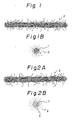
- the individual high grade cotton fibers for example, the individual sea island cotton fibers, are characterized by a very small thickness of 0.7 to 1.0 denier, a relatively high Young's modulus of 1000 to 1300 kg/mm2, and a relatively low ultimate elongation of 3 to 7%, and when the cotton fibers are formed to a fiber bundle while twisting, the resultant spun yarn has a side view as shown in Fig. 1A and a cross-sectional distribution of the short fibers as indicated in Fig. 1B.
- a core portion 1 of the spun yarn serves to create a high resiliency and the fluffs 2 located around the core portion serve to produce a high softness on the cotton spun yarn. Accordingly, it is assumed that the combination of the high resiliency and high softness generate the unique touch and hand of the high grade cotton yarn.
- the resultant spun yarn when formed only from the extremely fine synthetic short fibers, the resultant spun yarn exhibits only a high softness but does not have a satisfactory resiliency, and thus can be easily distinguished in touch and hand from the high grade cotton yarn.
- the resultant spun yarn when produced from only the super high modulus synthetic short fibers, the resultant spun yarn exhibits an excessively high resiliency and stiffness and an undesirably stiff touch or hand, which are quite different from those of the high grade cotton yarn.
- the blend ratio of the extremely fine polyester short fibers to the super high modulus short fibers must be in the range of from 30:70 to 80:20, preferably from 40:60 to 70:30, by weight.
- the blend ratio is less than 30:70 by weight, the resultant blended short fiber yarn has an excessively high resilience and a stiff touch or hand, due to the excessively high content of the super high modulus synthetic short fibers, and often the extremely fine polyester short fibers and the super high modulus short fibers cannot be satisfactorily evenly blended.
- the resultant blended short fiber yarn exhibits an excessively poor resiliency and an excessively high soft touch or hand, due to the excessively high content of the extremely fine polyester short fibers, and the two different types of short fibers are often not evenly blended.
- the resultant blended short fiber yarn exhibits an uneven color and is unevenly dyed.
- the blending evenness depends on the blend ratio and the difference in the modulus of the two different types of short fibers. Therefore, the blend ratio must be controlled in consideration of the difference in modulus of the two different types of short fibers, to provide a uniformly blended short fiber yarn.
- the resiliency, stiffness, touch and blending evenness of the two different types of short fibers, and the uniformity of the thickness of the blended short fiber yarn are greatly influenced by the thickness (fineness, denier) of the extremely fine polyester short fibers, as shown in Table 2.
- Table 2 shows that, when the denier of the extremely fine polyester short fibers is more than 0.9, the resultant blended short fiber yarn exhibits an excessively stiff touch and cannot provide a high grade cotton yarn-like touch. Namely, the larger the denier of the extremely fine polyester short fibers, the higher the resiliency and stiffness of the resultant blended short fiber yarn, and further, the greater the difference in the touch of the resultant blended short fiber yarn from the touch of a high grade cotton yarn.
- the above-mentioned tendency becomes increased with a decrease in the blend ratio to less than 30:70 or an increase in the blend ratio to more than 80:20, or with a decrease in the thickness of the resultant blended short fiber yarn from a denier of 200 to the denier of 140 or less usual in high grade cotton yarns.
- the blend ratio of the extremely fine polyester short fibers to the super high modulus short fibers should be in the range of from 30:70 to 80:20 by weight.
- the thickness of the blended short fiber yarn of the present invention is preferably 200 denier or less.
- the extremely fine short fibers usable for the present invention are selected from polyester short fibers preferably comprising at least one member selected from polyethylene terephthalate, polybutylene terephthalate and polynaphthalene terephthalate, which have a satisfactory extremely fine fiber-forming property, spinning property, and draw-cutting property, an adequate level of modulus and surface frictional property and a high dyeability, which are necessary for obtaining a blended synthetic short fiber yarn having a high grade cotton yarn-like touch, hand and appearance.
- nylon fibers, acrylic fibers and the like are not suitable as the extremely fine fibers usable for the present invention.
- the super high modulus short fibers usable for the present invention should have a Young's modulus of 4000 kg/mm2 or more, and therefore, are not selected from other popular synthetic fibers having a Young's modulus of 100 to 800 kg/mm2.
- the super high modulus short fibers are preferably selected from para-type aromatic polyamide fibers high strength polyethylene fibers, glass fibers, carbon fibers, and steel fibers.
- the super high modulus fibers are preferably selected from organic synthetic super high modulus fibers, more preferably from the para-type aromatic polyamide fibers.
- the thickness of the super high modulus fibers is not critical and can be varied in accordance with the content thereof in the resultant blended yarn, but preferably is as small as possible, most preferably 1.0 denier or less.
- the blended synthetic short fiber yarn of the present invention comprises a blend of 30 to 80 parts by weight of at least one type of extremely fine polyester short fibers having a denier of 0.9 or less with 20 to 70 parts by weight of at least one type of super high modulus short fibers having a Young's modulus of 4000 kg/mm2 .
- the method of blending and spinning the two different types of short fibers can be selected from conventional blending and spinning methods.
- the blended synthetic short fiber yarn of the present invention can be produced by a usual spinning process comprising the steps of sclutching, carding drawing, roving and fine spinning, or a tow spinning method comprising the steps of draw-cutting, gilling, roving and fine spinning.
- the resultant blended short fiber yarn is a twisted yarn as shown, for example, in Figs. 2A and 2B.
- a core portion 1 of the yarn is mainly composed of the super high modulus short fibers having a high modulus and a low elongation and the peripheral portion 3 and fluffs 2 of the yarn are mainly composed of the extremely fine polyester short fibers.
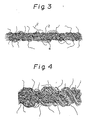
- the blended short fiber yarn can be produced by the process of the present invention, in which at least one type of extremely fine polyester multifilament yarn composed of a plurality of individual filaments having a denier of 0.9 or less is doubled with at least one type of super high modulus multifilament yarn composed of a plurality of individual filaments having a Young's modulus of 4,000 kg/mm2 or more, in a blend ratio of from 30:70 to 80:20 by weight; the resultant blended multifilament tow is subjected to a draft zone system spinning process in which the individual filaments in the tow are drawn cut between a pair of feed nip rollers and a pair of draw-cutting rollers and the resultant short fibers are blended with each other; and the resultant blended short fiber bundle is passed through an air nozzle device in which the short fibers are interlaced with each other and the fluffs are wound around the short fiber bundle, to provide a non-twisted yarn, as shown in Fig. 3.
- the super high modulus short fibers which have a very poor stretching property, causes the yarn to be twist-shrunk and to be locally compressed, and therefore, the extremely fine polyester short fibers having a higher stretching property than that of the super high modulus short fibers are moved to the peripheral portions of the yarn. Accordingly, in the resultant twisted yarn shown in Fig. 4, the core portion of the yarn is mainly composed of the super high modulus short fibers and the peripheral portion of the yarn is mainly composed of the extremely fine polyester short fibers, and thus the resultant blended short fiber yarn of the present invention exhibits a high grade cotton yarn-like touch, hand and appearance.
- the process of the present invention can be carried out by using the draft zone system spinning apparatus as shown in Fig. 5.
- an extremely fine polyester multifilament yarn 11 having a yarn count of 1296 deniers/2880 filaments and a denier of individual filaments of 0.45 was withdrawn from a bobbin 11a and doubled with a super high modulus papa-type aromatic polyamide multifilament yarn having a yarn count of 1000 deniers/1000 filaments.
- the individual filaments had a Young's modulus of 7100 kg/mm2 and a denier of 1, and it was taken from the bobbin 12a, through doubling rollers 13.
- the resultant doubled multifilament tow 14 was drawn-cut between a pair of feed nip rollers 15 and a pair of draw-cutting nip rollers 17, through a shooter 16, at a draw cutting ratio of 17.5, to blend the two types of short fibers with each other.
- the resultant blended short fiber bundle was passed through an air nozzle device 18 composed of a sucking nozzle 18a and a cohering nozzle 19, to cause the two types of short fibers to cohere to each other.
- the resultant blended short fiber yarn 20 was delivered from the air nozzle device 18 through a pair of delivery rollers 21, and wound around a bobbin 22.
- the extremely fine polyester short fibers had a decreased denier of 0.4 and the blend ratio of the extremely fine polyester short fibers to the super high modulus short fibers was 56:44. Also, the blended short fiber yarn had a total denier of 133.
- this can be applied to the blended short fiber yarn produced not only by the process of the present invention but also by the usual spinning process or the tow spinning process. Namely, when the average length of the short fibers is 70 mm or more, the resultant blended short fiber yarn exhibits the above-mentioned preferable properties.
- the blended short fiber yarn described in the above-mentioned example was twisted at a twist number of 600 turns/m, and the twisted yarn was converted to a one side matt woven fabric having a warp density of 124 yarns/25.4 mm, a weft density of 84 yarns/25.4 mm, and a basis weight of 138 g/m2.
- the resultant blended short fiber yarn woven fabric had a satisfactory resilience, stiffness and soft touch, comparable to those of the high grade cotton yarn woven fabric.
- the core portion of the blended short fiber yarn was mainly composed of the super high modulus short fibers, for example, the para-type aromatic polyamide short fibers, the resultant woven fabric had the enhanced mechanical properties as shown in Fig. 3.
- the various properties of the blended short fiber yarn of the present invention and of the woven fabric made therefrom are compared with those of a cotton yarn and a woven fabric made therefrom.
- the resistance (*)6 to frictional melting was determined by pressing a specimen onto a disc while the disc was revolving, and the number of revolutions of the disc at which the specimen was frictionally melted so as to form a perforation in the specimen was counted.
- the surface of the disc was formed by a kraft paper sheet, and an area of the specimen of 0.6 cm2 was pressed onto the disc at a point 60 mm from the revolving center of the disc, at a pressure of 7 kg.
- the resistance (*)7 to frame perforation was determined by positioning a specimen fixed to a frame horizontally, bringing a flame into contact with the lower face of the horizontal specimen at a flame temperature of about 780°C, and measuring the time (sec) required to form a perforation in the specimen.
- the seam strength (*)8 was determined by sewing two rectangular specimens each having long sides of 10 cm and short sides of 5 cm together at the short sides thereof, by a sewing machine, holding the joined piece at the free short sides thereof and drawing same in the longitudinal direction thereof by a tensile test machine, and measuring the load required to break the sewn seam.
- a #14 sewing needle was used, the seam pitch was 16 stitches/3 cm, and the seam margin was 3 mm.
- the resistance (*)9 to scratching was determined by fixing a specimen to a circular metal frame having a diameter of 45 mm, causing an edge of a matt cutter (available from Olfer Co.) having an angle of 45 degrees to penetrate the specimen, and measuring the force required to push the cutter through the specimen.
- the specimen was merely scorched and was not burnt into flame or was not perforated, despite the large content of the combustible extremely fine polyester short fibers of 56% by weight in the blended short fiber yarn fabric.
- the blended synthetic short fiber yarn of the present invention has a high grade cotton yarn-like touch, hand and appearance, and superior mechanical strength, abrasion resistance, heat and flame resistance, and scratch resistance, in comparison with those of the high grade cotton yarn.
- a blended short fiber yarn was produced by using the draw-cut direct spinning apparatus shown in Fig. 5, from an extremely fine polyester multifilament yarn having a yarn count of 1296 denier/2880 filaments and composed of individual filaments having a denier of 0.45 (0.5 d tex) and a super high modulus multifilament yarn having a total denier of 1000 and composed of 667 para-type aromatic polyamide individual filaments having a denier of 1.5 and colored black with 5% by weight of carbon black.
- the polyester multifilament yarn 11 and the aromatic polyamide multifilament yarn 12 were taken up from the bobbins 11a and 12a, respectively, and doubled through a doubling device 13.
- the doubled multifilament tow 14 was drawn-cut between a pair of feed nip rollers 15 and a pair of draw-cut nip rollers 16, through a shooter 17, at a draw-cut ratio of 17.5 while evenly blending the cut fibers with each other, and the resultant thin blended short fiber bundle was passed through an air nozzle device 18 composed of a sucking air nozzle 18a and a cohering air nozzle 19 in which the air flow was circulated, and individual short fibers were cohered to each other by the action of the circulating air flow.
- the resultant blended short fiber yarn 20 was delivered through a pair of delivery rollers 21 and wound around a bobbin 22.
- the peripheral speed ratio of the draw cut nip rollers 16 to the delivery rollers 21 was controlled to 100:99, to cause the short fiber fluffs located in the peripheral portion of the yarn to be wound around the yarn at random.
- the resultant blended short fiber yarn had a total denier of 133 and a blend ratio of the polyester short fibers to the aromatic polyamide short fibers of 56:44.
- the polyester short fibers had an average length of 32 cm and the aromatic polyamide short fibers had an average length of 28 cm.
- the twisted yarn After twisting the blended short fiber yarn at a twist number of 600 turns/m, the twisted yarn had a tensile strength of 8.2 g/denier, an ultimate elongation of 4.5%, and a shrinkage of 5.7% in boiling water.
- the twisted blended short fiber yarn was converted to a woven fabric having a 3/1 twill weaving structure, the resultant fabric was heat-set, the polyester short fibers were dyed a gray color, and then the fabric was calender-finished.
- the resultant finished fabric had a warp density of 192 yarns/25.4 mm, a weft density of 143 yarns/25.4 cm, and a basis weight of 143 g/m2, and exhibited a high grade cotton yarn fabric-like touch, hand and appearance.
- the fabric had a tensile strength of 96 kg/3 cm in the warp direction and 78 kg/3 cm in the weft direction, a tear strength of 10.6 kg in the warp direction and 8.4 kg in the weft direction, a scratch strength of 200 g, an abrasion strength of 88 times measured by JIS L1018, and a satisfactory resistance to flame perforation and a Mecemamine method flame resistance.
- An extremely fine polyester fiber bundle having a total denier of 150,000 and composed of a multiplicity of individual filaments having a denier of 0.45 was drawn-cut in four steps at a total draft ratio of 8.8 by using the tow spinning apparatus shown in Fig. 6, to provide an extremely fine polyester short fiber sliver (A) having a total denier of 17,000 and an average length of 100 mm.
- a para-type aromatic polyamide filament bundle having a total denier of 86,000 and composed of a multiplicity of individual filaments having a denier of 1.0 was drawn-cut by using the apparatus shown in Fig. 6, in four steps at a total draft ratio of 7.1, to provide an aromatic polyamide short fiber sliver (B) having a total denier of 12,000, an average length of 89 mm, and a Young's modulus of individual short fibers of 7100 kg/mm2.
- a filament bundle 31 was first drawn between a feed roller 32 and a preliminary drawing roller 33 and then heat set by a draw-heat setting heater 34.
- the heat-set filament bundle 31 was drawn cut in four steps, among the first, second, third, fourth and fifth draw-cutting rollers 35, 36, 37, 38 and 39.
- the resultant short fiber sliver was crimped in a crimper 40, and the crimped short fiber sliver delivered from the crimper 40 into a container 41.
- the polyester short fiber sliver A was doubled with the aromatic polyamide short fiber sliver (B) and the doubled sliver was successively treated by a gilling step, a roving step, and then a fine spinning step, to provide a blended short fiber single yarn having a blend ratio of the polyester short fibers to the aromatic polyamide short fibers of 59:41 and a yarn count of 50s/1.
- the single yarn was converted to a two-folded yarn having a yarn count of 50s/2, and the two-folded yarn was used as warp and weft yarns and converted to a one side matt woven fabric having a warp density of 132 yarns/25.4 mm, a weft density of 107 yarns/25.4 mm, and a basis weight of 145 g/m2.
- the resultant woven fabric exhibited a high grade cotton yarn fabric-like touch, hand and appearance, and a greater bulkiness than that of the fabric of Example 1. Also, the woven fabric had a tensile strength of 121 kg/3 cm in the warp direction and 57 kg/3 cm in the weft direction, a tear strength of 14.0 kg in the warp direction and 4.8 kg in the weft direction, an abrasion resistance of 97 times measured by JIS LI018, and a satisfactory flame perforation resistance and Mecemamine method flame resistance.
- the resultant doubled filament tow was drawn-cut by the apparatus of Fig. 6 and the resultant blended short fiber sliver then subjected to the same spinning process as described above.
- the resultant blended short fiber yarn and fabric exhibited properties similar to those mentioned above.
- a short fiber blend was prepared from 50 parts by weight of extremely fine polyester short fibers having a denier of 0.45 and a length of 77 mm and 50 parts by weight of para-type aromatic polyamide short fibers having a denier of 1.5, a length of 77 mm, and a Young's modulus of 7100 kg/mm2, in a scratching procedure. Then the blend was subjected successively to a usual carding procedure, drawing procedure, roving procedure and fine spinning procedure, to provide a blended short fiber yarn having a single yarn count of 40s/1.
- the single yarn was converted to a two-folded yarn having a yarn count of 40s/2, and the two folded yarn was used as a warp and weft and converted to a woven fabric having a two folded yarn tussah structure, a warp density of 119 yarns/25.4 mm, a weft density of 73 yarns/25.4 mm, and a basis weight of 172 g/m2.
- the resultant finished fabric exhibited a high grade cotton yarn fabric-like touch, hand and appearance, and had a tensile strength of 73 kg/3 cm in the warp direction and 46 kg/3 cm in the weft direction, a tear strength of 7 kg in the warp direction and 6.5 kg in the weft direction, an abrasion resistance of 88 times measured by JIS L1018, and a satisfactory flame perforation resistance and Mecemamine method flame resistance.
- the blended short fibers exhibit an improved spinning property and can be converted to a spun yarn without difficulty.
- the resultant blended short fiber yarn often has a relatively low degree of orientation of the short fibers, and thus a relatively high bulkiness and a slightly lower mechanical strength, in comparison with the blended short fiber yarns produced by the draw cut-direct spinning process and by the tow spinning process.
- the specific blended short fiber yarn of the present invention exhibits a high grade cotton yarn-like touch, hand and appearance, and a superior mechanical strength, abrasion resistance, heat and flame resistance and scratch resistance, in comparison with those of the high grade cotton yarn.
- the blended short fiber yarn of the present invention can be widely used for sport clothes and articles and for industrial materials.
Landscapes
- Engineering & Computer Science (AREA)
- Mechanical Engineering (AREA)
- Textile Engineering (AREA)
- Physics & Mathematics (AREA)
- Fluid Mechanics (AREA)
- Yarns And Mechanical Finishing Of Yarns Or Ropes (AREA)
- Woven Fabrics (AREA)
Applications Claiming Priority (2)
| Application Number | Priority Date | Filing Date | Title |
|---|---|---|---|
| JP1128624A JP2801264B2 (ja) | 1989-05-24 | 1989-05-24 | 高級綿様風合を有する合成繊維糸条およびその製造方法 |
| JP128624/89 | 1989-05-24 |
Publications (3)
| Publication Number | Publication Date |
|---|---|
| EP0399392A2 true EP0399392A2 (de) | 1990-11-28 |
| EP0399392A3 EP0399392A3 (de) | 1991-03-27 |
| EP0399392B1 EP0399392B1 (de) | 1995-04-19 |
Family
ID=14989401
Family Applications (1)
| Application Number | Title | Priority Date | Filing Date |
|---|---|---|---|
| EP90109434A Expired - Lifetime EP0399392B1 (de) | 1989-05-24 | 1990-05-18 | Gemischtes synthetisches Kurzfasergarn, das sich anfühlt wie ein hochwertiges Baumwollgarn und Verfahren zu seiner Herstellung |
Country Status (5)
| Country | Link |
|---|---|
| US (1) | US5313774A (de) |
| EP (1) | EP0399392B1 (de) |
| JP (1) | JP2801264B2 (de) |
| KR (1) | KR950004079B1 (de) |
| DE (1) | DE69018698T2 (de) |
Cited By (2)
| Publication number | Priority date | Publication date | Assignee | Title |
|---|---|---|---|---|
| CN102677244A (zh) * | 2012-05-29 | 2012-09-19 | 山东来利来毛纺有限公司 | 一种高支高寒动物纤维混纺纱线的生产工艺 |
| CN110106592A (zh) * | 2019-03-25 | 2019-08-09 | 合肥岸鲁意科技有限公司 | 一种涤/棉混纺色织纱的生产方法 |
Families Citing this family (11)
| Publication number | Priority date | Publication date | Assignee | Title |
|---|---|---|---|---|
| JP2715190B2 (ja) * | 1991-04-12 | 1998-02-18 | 帝人株式会社 | 長短複合糸の製造方法 |
| US5427156A (en) * | 1993-03-26 | 1995-06-27 | Toyo Boseki Kabushiki Kaisha | Cotton fabric made from spun yarns of high fiber length and fineness |
| DE60028092T2 (de) * | 1999-09-30 | 2006-12-21 | Asahi Kasei Kabushiki Kaisha | Schuss-strickware |
| US7168232B2 (en) * | 2001-02-21 | 2007-01-30 | Forta Corporation | Fiber reinforcement material, products made thereform, and method for making the same |
| CN1443885A (zh) * | 2002-03-13 | 2003-09-24 | 三菱化学株式会社 | 导电碳纤维织造布和固体聚合物型燃料电池 |
| ITFI20020092A1 (it) * | 2002-06-04 | 2003-12-04 | Eos S R L | Filati e tessuti adatti alla schermatura, per riflettanza, delle ondeelettromagnetiche |
| JP4446721B2 (ja) * | 2003-12-01 | 2010-04-07 | 株式会社クレハ | 炭素繊維紡績糸およびその織物 |
| CN102704105B (zh) * | 2012-05-29 | 2014-08-27 | 山东来利来毛纺有限公司 | 一种高支高寒动物纤维混纺纱线纺织品 |
| KR101289440B1 (ko) | 2013-03-06 | 2013-07-24 | 송종복 | 파라 아라미드 방적용 크림프의 형성방법 및 이에 따른 파라 아라미드 방적용 크림프 |
| KR101439150B1 (ko) * | 2013-05-06 | 2014-09-11 | 현대자동차주식회사 | 탄소연속섬유/열가소성수지섬유 복합사 및 이의 제조방법 |
| US20190233982A1 (en) * | 2018-01-31 | 2019-08-01 | Parkdale Incorporated | Multi-length, multi-denier, multi-cross section fiber blend yarn |
Family Cites Families (15)
| Publication number | Priority date | Publication date | Assignee | Title |
|---|---|---|---|---|
| US3046724A (en) * | 1958-04-23 | 1962-07-31 | Du Pont | Yarn for novel fabrics |
| BE634087A (de) * | 1963-06-26 | 1963-11-04 | ||
| GB1381937A (en) * | 1972-06-27 | 1975-01-29 | Ici Ltd | Composite yarns and methods for their manufacture |
| US3874155A (en) * | 1973-01-30 | 1975-04-01 | Fmc Corp | Flame-retardant fiber blend |
| JPS53139849A (en) * | 1977-05-10 | 1978-12-06 | Toray Industries | Falseetwisted yarn and method of manufacture thereof |
| US4226079A (en) * | 1978-05-04 | 1980-10-07 | Du Pont Canada Inc. | Heather yarn made by combining polyester and polyamide yarns |
| JPS5927410B2 (ja) * | 1978-12-15 | 1984-07-05 | 帝人株式会社 | 多層構造嵩高紡績糸およびその製造方法 |
| JPS57205532A (en) * | 1981-06-15 | 1982-12-16 | Teijin Ltd | Hemp like spun yarn |
| DE3142535A1 (de) * | 1981-10-27 | 1983-05-05 | Pfaudler-Werke Ag, 6830 Schwetzingen | Verfahren zur herstellung einer unterfuetterten dichtung oder dichtungseinlage |
| DE3145267A1 (de) * | 1981-11-14 | 1983-05-19 | Hasso von 4000 Düsseldorf Blücher | Aktivkohle-stapelfasern enthaltendes mischgarn und daraus hergestelltes gewebe |
| ATA103182A (de) * | 1982-03-15 | 1987-05-15 | Zimmer Kg Taunus Textildruck | Flammenhemmendes textiles flaechengebilde |
| US4712366A (en) * | 1985-12-28 | 1987-12-15 | Nippon Ester Co., Ltd. | Denier-mixed composite yarn, denier-mixed special thick and thin yarn, false twist yarn and denier-mixed shrinkage-mixed composite yarn |
| JPH0460Y2 (de) * | 1986-07-15 | 1992-01-06 | ||
| JP2565700B2 (ja) * | 1986-12-26 | 1996-12-18 | 鐘紡 株式会社 | 空気仮撚による羊毛/ポリエステル混紡精紡糸 |
| JPS63309641A (ja) * | 1987-06-11 | 1988-12-16 | 株式会社クラレ | 高温における形態安定性に優れた混紡糸 |
-
1989
- 1989-05-24 JP JP1128624A patent/JP2801264B2/ja not_active Expired - Lifetime
-
1990
- 1990-05-18 DE DE69018698T patent/DE69018698T2/de not_active Expired - Fee Related
- 1990-05-18 EP EP90109434A patent/EP0399392B1/de not_active Expired - Lifetime
- 1990-05-24 KR KR1019900007549A patent/KR950004079B1/ko not_active Expired - Fee Related
-
1992
- 1992-07-23 US US07/919,627 patent/US5313774A/en not_active Expired - Fee Related
Cited By (2)
| Publication number | Priority date | Publication date | Assignee | Title |
|---|---|---|---|---|
| CN102677244A (zh) * | 2012-05-29 | 2012-09-19 | 山东来利来毛纺有限公司 | 一种高支高寒动物纤维混纺纱线的生产工艺 |
| CN110106592A (zh) * | 2019-03-25 | 2019-08-09 | 合肥岸鲁意科技有限公司 | 一种涤/棉混纺色织纱的生产方法 |
Also Published As
| Publication number | Publication date |
|---|---|
| KR950004079B1 (ko) | 1995-04-25 |
| JP2801264B2 (ja) | 1998-09-21 |
| US5313774A (en) | 1994-05-24 |
| JPH02307925A (ja) | 1990-12-21 |
| KR900018435A (ko) | 1990-12-21 |
| DE69018698T2 (de) | 1996-01-18 |
| EP0399392A3 (de) | 1991-03-27 |
| EP0399392B1 (de) | 1995-04-19 |
| DE69018698D1 (de) | 1995-05-24 |
Similar Documents
| Publication | Publication Date | Title |
|---|---|---|
| US5497608A (en) | Short fiber and continuous filament containing spun yarn-like composite yarn | |
| US6803000B2 (en) | Process of making yarn from two types of polyester | |
| US5568719A (en) | Composite yarn including a staple fiber covering a filament yarn component and confining the filament yarn component to a second thickness that is less than a first thickness of the filament in a relaxed state and a process for producing the same | |
| US4100725A (en) | Yarn having alternating entangled and unentangled lengths | |
| KR100313730B1 (ko) | 폴리에스테르중공섬유및당해섬유로이루어진섬유제품 | |
| EP0399392B1 (de) | Gemischtes synthetisches Kurzfasergarn, das sich anfühlt wie ein hochwertiges Baumwollgarn und Verfahren zu seiner Herstellung | |
| AU700155B2 (en) | False twisted yarn | |
| US5534336A (en) | Fabric superior in anti-drape stiffness, stiffness and soft handle, and manufacture thereof | |
| US6715276B2 (en) | False twist yarns and production method and production device therefor | |
| EP0505641B1 (de) | Verbundgarn aus kurzen und langen Fasern und Verfahren und Vorrichtung zu dessen Herstellung | |
| JP2000290846A (ja) | 異収縮複合混繊糸およびその織物、編物 | |
| JP3733696B2 (ja) | 仮撚加工糸およびその製造方法 | |
| JPH08337937A (ja) | スパン糸のような毛羽を有するフィラメント加工糸およびその製造方法 | |
| JP2895490B2 (ja) | 絹紡糸調嵩高加工糸の製造方法 | |
| JPH1077535A (ja) | ドライな風合いを呈する複合繊維糸条 | |
| RU2283906C2 (ru) | Текстурированная нить с различной усадкой и превосходной имитацией свойств замши и способ ее изготовления, ткань, кругловязаный трикотаж и основовязаное трикотажное полотно из такой текстурированной нити | |
| JPH06248527A (ja) | ストレッチ紡績糸及びその製造法 | |
| JP3035895B2 (ja) | ポリエステルスパンミシン糸 | |
| JPS63190039A (ja) | 空気仮撚による精紡糸を用いた織布 | |
| JPS6183370A (ja) | スパンライク高密度布帛の製造方法 | |
| CA1083800A (en) | Zero twist yarn of organic fibers | |
| JPH01213425A (ja) | 空気仮撚法によるレーヨン/ポリエステル混紡糸 | |
| BAGNALL et al. | Textured Filament Yarns | |
| JPH02216234A (ja) | スパンライクポリエステル縫糸およびその製造法 | |
| GB1590126A (en) | Method of bulking yarns |
Legal Events
| Date | Code | Title | Description |
|---|---|---|---|
| PUAI | Public reference made under article 153(3) epc to a published international application that has entered the european phase |
Free format text: ORIGINAL CODE: 0009012 |
|
| AK | Designated contracting states |
Kind code of ref document: A2 Designated state(s): DE FR GB IT NL |
|
| PUAL | Search report despatched |
Free format text: ORIGINAL CODE: 0009013 |
|
| AK | Designated contracting states |
Kind code of ref document: A3 Designated state(s): DE FR GB IT NL |
|
| 17P | Request for examination filed |
Effective date: 19901231 |
|
| 17Q | First examination report despatched |
Effective date: 19930723 |
|
| GRAA | (expected) grant |
Free format text: ORIGINAL CODE: 0009210 |
|
| AK | Designated contracting states |
Kind code of ref document: B1 Designated state(s): DE FR GB IT NL |
|
| REF | Corresponds to: |
Ref document number: 69018698 Country of ref document: DE Date of ref document: 19950524 |
|
| ITF | It: translation for a ep patent filed | ||
| ET | Fr: translation filed | ||
| PLBE | No opposition filed within time limit |
Free format text: ORIGINAL CODE: 0009261 |
|
| STAA | Information on the status of an ep patent application or granted ep patent |
Free format text: STATUS: NO OPPOSITION FILED WITHIN TIME LIMIT |
|
| 26N | No opposition filed | ||
| PGFP | Annual fee paid to national office [announced via postgrant information from national office to epo] |
Ref country code: FR Payment date: 19980320 Year of fee payment: 9 |
|
| PGFP | Annual fee paid to national office [announced via postgrant information from national office to epo] |
Ref country code: NL Payment date: 19980326 Year of fee payment: 9 |
|
| PGFP | Annual fee paid to national office [announced via postgrant information from national office to epo] |
Ref country code: GB Payment date: 19980414 Year of fee payment: 9 |
|
| PGFP | Annual fee paid to national office [announced via postgrant information from national office to epo] |
Ref country code: DE Payment date: 19980630 Year of fee payment: 9 |
|
| PG25 | Lapsed in a contracting state [announced via postgrant information from national office to epo] |
Ref country code: GB Free format text: LAPSE BECAUSE OF NON-PAYMENT OF DUE FEES Effective date: 19990518 |
|
| PG25 | Lapsed in a contracting state [announced via postgrant information from national office to epo] |
Ref country code: NL Free format text: LAPSE BECAUSE OF NON-PAYMENT OF DUE FEES Effective date: 19991201 |
|
| GBPC | Gb: european patent ceased through non-payment of renewal fee |
Effective date: 19990518 |
|
| PG25 | Lapsed in a contracting state [announced via postgrant information from national office to epo] |
Ref country code: FR Free format text: LAPSE BECAUSE OF NON-PAYMENT OF DUE FEES Effective date: 20000131 |
|
| NLV4 | Nl: lapsed or anulled due to non-payment of the annual fee |
Effective date: 19991201 |
|
| PG25 | Lapsed in a contracting state [announced via postgrant information from national office to epo] |
Ref country code: DE Free format text: LAPSE BECAUSE OF NON-PAYMENT OF DUE FEES Effective date: 20000301 |
|
| REG | Reference to a national code |
Ref country code: FR Ref legal event code: ST |
|
| PG25 | Lapsed in a contracting state [announced via postgrant information from national office to epo] |
Ref country code: IT Free format text: LAPSE BECAUSE OF NON-PAYMENT OF DUE FEES;WARNING: LAPSES OF ITALIAN PATENTS WITH EFFECTIVE DATE BEFORE 2007 MAY HAVE OCCURRED AT ANY TIME BEFORE 2007. THE CORRECT EFFECTIVE DATE MAY BE DIFFERENT FROM THE ONE RECORDED. Effective date: 20050518 |