EP0399396A2 - Schmelzklebelacklösung für hitzebeständige Beschichtungen - Google Patents
Schmelzklebelacklösung für hitzebeständige Beschichtungen Download PDFInfo
- Publication number
- EP0399396A2 EP0399396A2 EP90109443A EP90109443A EP0399396A2 EP 0399396 A2 EP0399396 A2 EP 0399396A2 EP 90109443 A EP90109443 A EP 90109443A EP 90109443 A EP90109443 A EP 90109443A EP 0399396 A2 EP0399396 A2 EP 0399396A2
- Authority
- EP
- European Patent Office
- Prior art keywords
- bis
- mol
- diisocyanate
- hot melt
- melt adhesive
- Prior art date
- Legal status (The legal status is an assumption and is not a legal conclusion. Google has not performed a legal analysis and makes no representation as to the accuracy of the status listed.)
- Granted
Links
- 0 CC1CC(*)C(C)CC1 Chemical compound CC1CC(*)C(C)CC1 0.000 description 3
Classifications
-
- C—CHEMISTRY; METALLURGY
- C09—DYES; PAINTS; POLISHES; NATURAL RESINS; ADHESIVES; COMPOSITIONS NOT OTHERWISE PROVIDED FOR; APPLICATIONS OF MATERIALS NOT OTHERWISE PROVIDED FOR
- C09D—COATING COMPOSITIONS, e.g. PAINTS, VARNISHES OR LACQUERS; FILLING PASTES; CHEMICAL PAINT OR INK REMOVERS; INKS; CORRECTING FLUIDS; WOODSTAINS; PASTES OR SOLIDS FOR COLOURING OR PRINTING; USE OF MATERIALS THEREFOR
- C09D175/00—Coating compositions based on polyureas or polyurethanes; Coating compositions based on derivatives of such polymers
-
- H—ELECTRICITY
- H01—ELECTRIC ELEMENTS
- H01B—CABLES; CONDUCTORS; INSULATORS; SELECTION OF MATERIALS FOR THEIR CONDUCTIVE, INSULATING OR DIELECTRIC PROPERTIES
- H01B3/00—Insulators or insulating bodies characterised by the insulating materials; Selection of materials for their insulating or dielectric properties
- H01B3/18—Insulators or insulating bodies characterised by the insulating materials; Selection of materials for their insulating or dielectric properties mainly consisting of organic substances
- H01B3/30—Insulators or insulating bodies characterised by the insulating materials; Selection of materials for their insulating or dielectric properties mainly consisting of organic substances plastics; resins; waxes
- H01B3/302—Polyurethanes or polythiourethanes; Polyurea or polythiourea
-
- C—CHEMISTRY; METALLURGY
- C08—ORGANIC MACROMOLECULAR COMPOUNDS; THEIR PREPARATION OR CHEMICAL WORKING-UP; COMPOSITIONS BASED THEREON
- C08G—MACROMOLECULAR COMPOUNDS OBTAINED OTHERWISE THAN BY REACTIONS ONLY INVOLVING UNSATURATED CARBON-TO-CARBON BONDS
- C08G18/00—Polymeric products of isocyanates or isothiocyanates
- C08G18/06—Polymeric products of isocyanates or isothiocyanates with compounds having active hydrogen
- C08G18/28—Polymeric products of isocyanates or isothiocyanates with compounds having active hydrogen characterised by the compounds used containing active hydrogen
- C08G18/30—Low-molecular-weight compounds
- C08G18/34—Carboxylic acids; Esters thereof with monohydroxyl compounds
- C08G18/341—Dicarboxylic acids, esters of polycarboxylic acids containing two carboxylic acid groups
-
- C—CHEMISTRY; METALLURGY
- C08—ORGANIC MACROMOLECULAR COMPOUNDS; THEIR PREPARATION OR CHEMICAL WORKING-UP; COMPOSITIONS BASED THEREON
- C08G—MACROMOLECULAR COMPOUNDS OBTAINED OTHERWISE THAN BY REACTIONS ONLY INVOLVING UNSATURATED CARBON-TO-CARBON BONDS
- C08G18/00—Polymeric products of isocyanates or isothiocyanates
- C08G18/06—Polymeric products of isocyanates or isothiocyanates with compounds having active hydrogen
- C08G18/28—Polymeric products of isocyanates or isothiocyanates with compounds having active hydrogen characterised by the compounds used containing active hydrogen
- C08G18/40—High-molecular-weight compounds
- C08G18/60—Polyamides or polyester-amides
- C08G18/603—Polyamides
-
- C—CHEMISTRY; METALLURGY
- C08—ORGANIC MACROMOLECULAR COMPOUNDS; THEIR PREPARATION OR CHEMICAL WORKING-UP; COMPOSITIONS BASED THEREON
- C08G—MACROMOLECULAR COMPOUNDS OBTAINED OTHERWISE THAN BY REACTIONS ONLY INVOLVING UNSATURATED CARBON-TO-CARBON BONDS
- C08G18/00—Polymeric products of isocyanates or isothiocyanates
- C08G18/06—Polymeric products of isocyanates or isothiocyanates with compounds having active hydrogen
- C08G18/70—Polymeric products of isocyanates or isothiocyanates with compounds having active hydrogen characterised by the isocyanates or isothiocyanates used
- C08G18/72—Polyisocyanates or polyisothiocyanates
-
- C—CHEMISTRY; METALLURGY
- C08—ORGANIC MACROMOLECULAR COMPOUNDS; THEIR PREPARATION OR CHEMICAL WORKING-UP; COMPOSITIONS BASED THEREON
- C08G—MACROMOLECULAR COMPOUNDS OBTAINED OTHERWISE THAN BY REACTIONS ONLY INVOLVING UNSATURATED CARBON-TO-CARBON BONDS
- C08G18/00—Polymeric products of isocyanates or isothiocyanates
- C08G18/06—Polymeric products of isocyanates or isothiocyanates with compounds having active hydrogen
- C08G18/70—Polymeric products of isocyanates or isothiocyanates with compounds having active hydrogen characterised by the isocyanates or isothiocyanates used
- C08G18/72—Polyisocyanates or polyisothiocyanates
- C08G18/721—Two or more polyisocyanates not provided for in one single group C08G18/73 - C08G18/80
- C08G18/724—Combination of aromatic polyisocyanates with (cyclo)aliphatic polyisocyanates
-
- C—CHEMISTRY; METALLURGY
- C08—ORGANIC MACROMOLECULAR COMPOUNDS; THEIR PREPARATION OR CHEMICAL WORKING-UP; COMPOSITIONS BASED THEREON
- C08G—MACROMOLECULAR COMPOUNDS OBTAINED OTHERWISE THAN BY REACTIONS ONLY INVOLVING UNSATURATED CARBON-TO-CARBON BONDS
- C08G18/00—Polymeric products of isocyanates or isothiocyanates
- C08G18/06—Polymeric products of isocyanates or isothiocyanates with compounds having active hydrogen
- C08G18/70—Polymeric products of isocyanates or isothiocyanates with compounds having active hydrogen characterised by the isocyanates or isothiocyanates used
- C08G18/72—Polyisocyanates or polyisothiocyanates
- C08G18/80—Masked polyisocyanates
- C08G18/8061—Masked polyisocyanates masked with compounds having only one group containing active hydrogen
- C08G18/807—Masked polyisocyanates masked with compounds having only one group containing active hydrogen with nitrogen containing compounds
- C08G18/8074—Lactams
-
- H—ELECTRICITY
- H01—ELECTRIC ELEMENTS
- H01B—CABLES; CONDUCTORS; INSULATORS; SELECTION OF MATERIALS FOR THEIR CONDUCTIVE, INSULATING OR DIELECTRIC PROPERTIES
- H01B3/00—Insulators or insulating bodies characterised by the insulating materials; Selection of materials for their insulating or dielectric properties
- H01B3/18—Insulators or insulating bodies characterised by the insulating materials; Selection of materials for their insulating or dielectric properties mainly consisting of organic substances
- H01B3/30—Insulators or insulating bodies characterised by the insulating materials; Selection of materials for their insulating or dielectric properties mainly consisting of organic substances plastics; resins; waxes
- H01B3/303—Macromolecular compounds obtained by reactions forming a linkage containing nitrogen with or without oxygen or carbon in the main chain of the macromolecule, not provided for in groups H01B3/38 or H01B3/302
- H01B3/305—Polyamides or polyesteramides
Definitions
- thermoplastic and thermoset systems Two different basic types can be used as baking varnishes, namely thermoplastic and thermoset systems.
- Thermoplastic systems made from partially aromatic polyamides are known from US Pat. No. 4,505,978.
- Thermoplastic systems generally have the disadvantage that the re-softening temperature is almost identical to the baking temperature.
- a high re-softening temperature desired for heat-resistant applications also requires a high baking temperature; at low baking temperatures the re-softening temperatures are in turn undesirably low.
- Semi-aromatic polyamide solutions are also known from DE-A 36 12 372.
- the re-softening temperatures of the hot-melt adhesive varnishes obtained from the solutions are given as 180 to 200 ° C.
- aliphatic polyamide solutions Compared to partially aromatic polyamide solutions, aliphatic polyamide solutions have the disadvantage that toxic solvents, especially cresol, must be used.
- Duromeric, thermosetting baking varnishes change from a thermoplastic state to the cured final state when baked by a crosslinking reaction.
- thermosetting, thermosetting baking varnishes both the type of crosslinking agent and the combination of the base resin and the crosslinking agent must be fine-tuned so that the thermoplastic state and the caking ability are retained during the painting process and at the same time a temperature-resistant, hardened final state after baking is achieved.
- DE-A 35 17 753 discloses a polyamide solution in which a cured, thermosetting hot-melt adhesive varnish is obtained by adding blocked di- or polyisocyanate as the crosslinking agent.
- the re-softening temperature of 193 C after a baking temperature of 180 C (30 min) is not yet sufficient for high demands.
- the storage stability of hotmelt adhesive varnish solutions should not be impaired by the addition of blocked polyisocyanate crosslinking agents.
- Crosslinking reactions already taking place in the hotmelt adhesive varnish solution recognizable by an increase in viscosity, increase the necessary baking temperature and generally impair the ability to bake.
- the object of the present invention was therefore to provide hotmelt adhesive lacquer solutions for heat-resistant coatings.
- the hotmelt adhesive varnishes obtained from the solutions should be distinguished by high re-reaching temperatures at low caking temperatures, while the solutions should be as stable as possible in storage and largely free of toxic solvents.
- Linear aliphatic dicarboxylic acids are preferred for the aliphatic dicarboxylic acids in which x represents an integer in the range from 1 to 16, linear aliphatic are particularly preferred Dicarboxylic acids in which x has a value in the range from 3 to 12, very particularly preferred are azelaic and sebacic acids and mixtures thereof.
- Aromatic dicarboxylic acids which can be used are cyclopentadienyl, phenyl, naphthyl and diphenylcarboxylic acids and mixtures of these acids, in which the aromatic ring systems are optionally substituted.
- Substituents can be, for example, alkyl or alkoxy groups, preferably C 1 -C 4 alkyl or alkoxy groups.
- the aromatic ring systems can be condensed or bridged via heteroatoms or carbon atoms or chains.
- dicarboxylic acids examples include diphenylmethane, diphenylsulfonic or diphenyloxide dicarboxylic acids. Mixtures of aromatic dicarboxylic acids can also be used.
- Optionally substituted phenyl, naphthyl or diphenyimethane diisocarboxylic acids are preferably used.
- Isophthalic acid, terephthalic acid and naphthalenedicarboxylic acids are particularly preferred.
- a mixture of aliphatic and aromatic dicarboxylic acids is particularly preferably used, the molar ratio of aliphatic to aromatic dicarboxylic acids being 6: 1 to 1: 2, particularly preferably 4: 1 to 1: 1.
- Suitable diisocyanates a 21 are, for example, cyclopentadienyl, phenyl. Naphthyl or diphenyl diisocyanates in which the aromatic ring groups are optionally substituted.
- Substituents can be, for example, alkyl or alkoxy groups, preferably C 1 to C 4 alkyl or alkoxy groups.
- the aromatic ring systems can be condensed or bridged via heteroatoms or carbon atoms or chains.
- Examples are 2,4'-diphenyimethane diisocyanate, 4,4'-diphenyimethane diisocyanate, 4,4'-diphenyloxide diisocyanate, diphenylsulfone diisocyanate, 1,3-phenylene diisocyanate, 1,4-phenylene diisocyanate, 2,4-tolylene diisocyanate.
- phenyl, naphthyl or diphenylmethane diisocyanates are preferably used.
- 2,4-Toluene diisocyanate and 4,4'-oiphenylmethane diisocyanate are particularly preferably used.
- a single aromatic diiocyanate or a mixture of aromatic diisocyanates can be used as component a 21 .
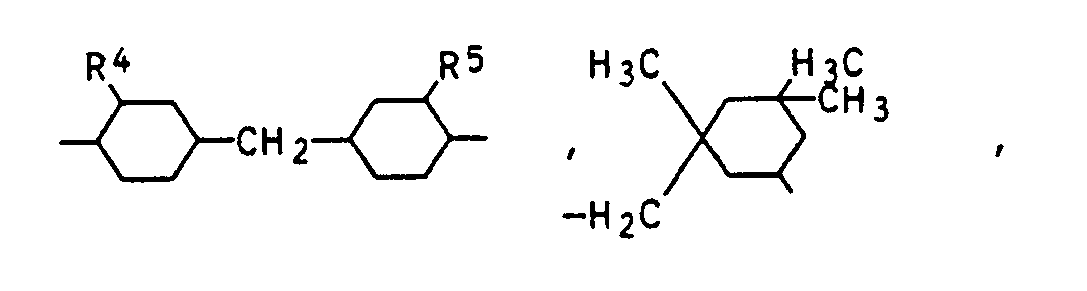
- the diisocyanates a 22 are diisocyanates of the general formula where R 3 for the rest or a linear aliphatic radical substituted by 1 to 3 C 1 -C 4 alkyl groups and having 3 to 30 preferably 5 to 20 carbon atoms and R 4 and R 5 each represent a C to C 4 alkyl group or a hydrogen atom.
- R 4 and R 5 are methyl or ethyl groups.
- diisocyanates a 22 are 3,3-dimethyl4,4'-dicyclohexylmethane diisocyanate, isophorone diisocyanate and trimethylhexamethylene diisocyanate. Mixtures of the compounds listed as diisocyanates a 22 can also be used.
- the diisocyanates a 23 according to claim 1 are linear aliphatic diisocyanates of the general formula where y represents an integer in the range from 1 to 20, which are used individually or in a mixture. Y is preferably 4 to 15, particularly preferably 6 to 12.
- the molar ratio of the sum of the dicarboxylic acids used to the sum of the diisocyanates used is preferably 1: 1 to 1: 0.8, in particular 1: 0.99 to 1: 0.95.
- Lactams of the general formula are preferred as blocking agents for the di- or polyisocyanates of component B.
- z is an integer in the range from 3 to 22, in order to avoid the release of toxic gases which occur, for example, during the evaporation of phenols in the subsequent baking.
- Caprolactome is particularly preferably used as a blocking agent.
- polyisocyanates e.g. Diphenylmethane diisocyanate, phenylene diisocyanate, tolylene diisocyanate, lupranate @ MS (BASF AG) and Desmodur® L (BAYER AG) in question.
- Lupranat @ MS is a mixture of 4,4'-, 2,4'-diphenylmethane diisocyanate and oligomers of diphenylmethane diisocyanates.
- Desmodur® L is preferably used as the polyisoocyanate, which is a reaction product of a toluyien diisocyanate and a polyalcohol mixture.
- the leveling agents and other auxiliaries such as rosin, benzotriazole, etc., customary in the paint industry, can be added to the solutions in customary amounts, e.g. up to 1 wt .-% are added.
- the above-mentioned starting compounds can preferably be introduced in amidic solvents with boiling points from 60 to 250 ° C., preferably in N-methylpyrrolidone, and the mixture can be heated to 180 to 200 ° C. with stirring within 1 to 20 hours.
- a 5 to 80% solution of the reaction products is initially prepared, from which, after the reaction with N-methylpyrrolidone has been completed, optionally also by adding other solvents such as xylene, toluene, 10 to 50% solutions with viscosities of 100 to 5000, preferably 200 to 3000 mPas (23 ° C) can be set.
- ⁇ 0.5 to 30% by weight of a blocked polyisocyanate B) are added before, during or after the dilution with solvent. based on the solution at a temperature of 20 to 120 C with continuous mixing.
- the hotmelt adhesive coating solutions obtained show no appreciable increase in viscosity over a period of 6 months, and are therefore distinguished by their good storage stability.
- the baking lacquer solutions according to the invention are generally applied to wires made of copper or aluminum, which are coated with an insulating layer made of high-temperature-resistant resins, such as polyesterimides, polyesters or polyamideimides, which is common in the electrical industry.
- These insulated wires are coated to dry the individual layers of baked enamel at stoving temperatures, for example from 200 to 600 ° C., preferably from 300 to 400 ° C., and coating speeds, for example from 10 to 60 m min, preferably 25 to 35 m / min.
- the hotmelt adhesive varnish solutions according to the invention preferably those which contain polyisocyanates blocked with lactams, can be applied without problems. With the described coating of the wires and drying of the lacquer layer, there is still no sufficient crosslinking for curing.
- the bobbins obtained from the wires can therefore be caked at relatively low temperatures of approx. 180 ° C and show a high level of properties after caking with high re-softening temperatures and high caking strength.
- the viscosity of the 20% solution was 210 mPas at 23 ° C. This solution was stable in storage over a period of 6 months in the temperature range between -10 and 45 ° C.
- the viscosity was 7900 mPas at a solids content of 35%.
- the solids content was adjusted to 20% with xylene.
- the viscosity of the 20% solution was 250 mPas at 23 ° C. This solution was stable in storage over a period of 6 months in the temperature range between -10 and 45 ° C.
- the viscosity was 7620 mPas at a solids content of 35.
- the solids content was adjusted to 20% with xylene.
- the viscosity of the 20% solution was 190 mPas at 23 C. This solution was stable in storage over a period of 6 months in the temperature range between -10 and 45 ° C.
- the test on the so-called drill rod showed the following caking strengths: 23 C: 200; 130 ° C: 45; 155 ° C: 16 Newtons.
Landscapes
- Chemical & Material Sciences (AREA)
- Chemical Kinetics & Catalysis (AREA)
- Organic Chemistry (AREA)
- Health & Medical Sciences (AREA)
- Medicinal Chemistry (AREA)
- Polymers & Plastics (AREA)
- Physics & Mathematics (AREA)
- Spectroscopy & Molecular Physics (AREA)
- Life Sciences & Earth Sciences (AREA)
- Engineering & Computer Science (AREA)
- Materials Engineering (AREA)
- Wood Science & Technology (AREA)
- Polyurethanes Or Polyureas (AREA)
- Paints Or Removers (AREA)
- Adhesives Or Adhesive Processes (AREA)
- Organic Insulating Materials (AREA)
Abstract
- A) 5 bis 80 Gew.-% eines Copolyamids, aufgebaut aus Einheiten, die sich ableiten von
- A1) organischen Dicarbonsäuren

- A2) einer Mischung von Diisocyanaten aus
- a21) 20 bis 95 mol.% eines Diisocyanats der allgemeinen Formel

- a22) 5 bis 70 mol% eines Diisocyanats der allgemeinen Formel

- a23) 0 bis 20 mol% eines Diisocyanats der allgemeinen Formel

- a21) 20 bis 95 mol.% eines Diisocyanats der allgemeinen Formel
- B) <0,5 bis 30 Gew.-% eines blockierten Di- oder Polyisocyanats in einem organischen Lösungsmittel oder Lösungsmittelgemisch.
- A1) organischen Dicarbonsäuren
Description
- Die vorliegende Erfindung betrifft eine Schmelzklebelacklösung, enthaltend
- A) 5 bis 80 Gew.-% eines Copolyamids, aufgebaut aus Einheiten, die sich ableiten von
- A1) organischen Dicarbonsäuren

- A2) einer Mischung von Diisocyanaten aus
- a21) 20 bis 95 mol.% eines Diisocyanats der allgemeinen Formel

- a22) 5 bis 70 mol% eines Diisocyanats der allgemeinen Formel


- a23) 0 bis 20 mol% eines Diisocyanats der allgemeinen Formel

- a21) 20 bis 95 mol.% eines Diisocyanats der allgemeinen Formel
- A1) organischen Dicarbonsäuren
- B) <0,5 bis 30 Gew.-% eines blockierten Di- oder Polyisocyanats in einem organischen Lösungsmittel oder Lösungsmittelgemisch. Hitzehärtbare Schmelzklebelacke, sog. Backlacke, werden für die Herstellung mechanisch und thermisch beanspruchter Wickelkörper aus mit Lack isolierten Drähten verwendet, deren Windungen mit Hilfe von äußerer Wärmezufuhr oder durch Stromwärme durch Schmelzen und nachfolgendes Verfestigen einer solchen Backlackschicht miteinander verklebt (verbacken) werden.
- Als Backlacke können prinzipiell zwei verschiedene Grundtypen eingesetzt werden, nämlich thermoplastische und duromere Systeme.
- Aus der US-A 4 505 978 sind thermoplastische Systeme aus teilaromatischen Polyamiden bekannt.
- Thermoplastische Systeme weisen generell den Nachteil auf, daß die Wiedererweichungstemperatur nahezu identisch mit der Verbackungstemperatur ist. Eine für hitzebeständige Anwendungen gewünschte hohe Wiedererweichungstemperatur macht eine ebenfalls hohe Verbackungstemperatur erforderlich, bei niedrigen Verbackungstemperaturen sind wiederum die Wiedererweichungstemperaturen unerwünscht niedrig.
- Teilaromatische Polyamidlösungen sind auch aus der DE-A 36 12 372 bekannt. Die Wiedererweichungstemperaturen der aus den Lösungen erhaltenen Schmelzklebelacke werden mit 180 bis 200 C angegeben.
- Auch die aus der US-A 4 420 535 bekannten teilaromatischen Systeme können in ihren Eigenschaften nicht voll befriedigen.
- Aliphatische Polyamidlösungen weisen gegenüber teilaromatischen Polyamidlösungen den Nachteil auf, daß toxische Lösungsmittel, vor allem Kresol verwendet werden müssen.
- Duromere, hitzehärtbare Backlacke gehen beim Verbacken durch eine Vernetzungsreaktion aus einem thermoplastischen Zustand in den ausgehärteten Endzustand über.
- Das Problem bei derartigen duromeren, hitzehärtbaren Backlacken besteht darin, daß sowohl die Art des vernetzers als auch die Kombination des Basisharzes mit dem Vernetzer fein abgestimmt sein muß, damit beim Lackierungsvorgang der thermoplastische zustand und die Verbackungsfähigkeit erhalten bleibt und gleichzeitig ein möglichst temperaturbeständiger, ausgehärteter Endzustand nach erfolgter Verbackung erreicht wird.
- Aus der DE-A 35 17 753 ist eine Polyamidlösung bekannt, bei der durch Zugabe von blockiertem Di-oder Polyisocyanat als Vernetzer ein ausgehärteter duromerer Schmelzklebelack erhalten wird. Die erreichte Wiedererweichungstemperatur ist mit 193 C nach einer Verbackungstemperatur von 180 C (30 min) für hohe Anforderungen noch nicht ausreichend.
- Durch die Zugabe von blockierten Polyisocyanatvernetzern sollte die Lagerstabilität von Schmelzklebelacklösungen nicht beeinträchtigt werden. Bereits in der Schmelzklebelacklösung ablaufende Vernetzungsreaktionen, erkennbar an einem Viskositätsanstieg, erhöhen die notwendige Verbackungstemperatur und beeinträchtigen generell die Verbackungsfähigkeit.
- Aufgabe der vorliegenden Erfindung war es daher, Schmelzklebelacklösungen für hitzebeständige Beschichtungen zur Verfügung zu stellen. Die aus den Lösungen erhaltenen Schmelzklebelacke sollten sich durch hohe Wiederereichungstemperaturen bei geringen Verbackungstemperaturen auszeichnen, während die Lösungen möglichst lagerstabil und weitgehend frei von toxischen Lösungsmitteln sein sollen.
- Erfindungsgemäß wird diese Aufgabe gelöst durch Schmelzklebelacklösungen, enthaltend
- A) 5 bis 80 Gew.-% eines Copolyamids, aufgebaut aus Einheiten, die sich ableiten von
- A1) organischen Dicarbonsäuren

- A2) einer Mischung von Diisocyanaten aus
- a2) 20 bis 95 mol.% eines Diisocyanats der allgemeinen Formel

- a22) 5 bis 70 mol% eines Diisocyanats der allgemeinen Formel


- a23) 0 bis 20 mol% eines Diisocyanats der allgemeinen Formel

- a2) 20 bis 95 mol.% eines Diisocyanats der allgemeinen Formel
- A1) organischen Dicarbonsäuren
- B) <0.5 bis 30 Gew.-% eines blockierten Di- oder Polyisocyanats in einem organischen Lösungsmittel oder Lösungsmittelgemisch. In den Dicarbonsäuren A·

- Bevorzugt bei den aliphatischen Dicarbonsäuren sind lineare aliphatische Dicarbonsäuren

- Als aromatische Dicarbonsäuren können Cyclopentadienyl, Phenyl-, Naphthyl-, und Diphenylcarbonsäuren sowie Mischungen dieser Säuren, bei denen die aromatischer Ringsysteme gegebenfalls substituiert sind, eingesetzt werden. Substituenten können z.B. Alkyl- oder Alkoxygruppen, bevorzugt C1-C4-Alkyl- oder Alkoxygruppen sein. Die aromatischen Ringsysteme können sowohl kondensiert, als auch über Heteroatome oder Kohlenstoffatome bzw. -ketten verbrückt sein.
- Beispiele für die zuletzt genannten Dicarbonsäuren sind Diphenylmethan-, Diphenylsulfon- oder Diphenyloxiddicarbonsauren. Es können auch Gemische von aromatischen Dicarbonsäuren eingesetzt werden.
- Bevorzugt werden gegebenenfalls substituierte Phenyl-, Naphthyl- oder Diphenyimethandiisocarbonsäuren eingesetzt.
- Besonders bevorzugt sind Isophthalsäure, Terephthalsäure und Naphthalindicarbonsäuren.
- Besonders bevorzugt verwendet man ein Gemisch aus aliphatischen und aromatischen Dicarbonsäuren, wobei das Molverhältnis von aliphatischen zu aromatischen Dicarbonsäuren 6:1 bis 1:2, besonders bevorzugt 4:1 bis 1:1 beträgt.
- Ganz besonders bevorzugt ist die Verwendung einer Mischung aus aliphatischen und aromatischen Dicarbonsäuren im Molverhältnis 2,5 bis 1,5:1, insbesondere etwa 2:1.
- Bei den eingesetzten Diisocyanaten A2 handelt es sich um eine Mischung von Diisocyanaten aus
- a21) 20 bis 95 mol.% eines Diisocyanats der allgemeinen Formel

- a22) 5 bis 70 mol% eines Diisocyanats der allgemeinen Formel


- a23) 0 bis 20 mol% eines Diisocyanats der allgemeinen Formel

- Geeignete Diisocyanate a21 sind z.B. Cyclopentadienyl-, Phenyl-. Naphthyl-oder Diphenyldiisocyanate, bei denen die aromatischen Ringgruppen gegebenenfalls substituiert sind. Substituenten können z.B. Alkyl-oder Alkoxyruppen, bevorzugt C, bis C4 Alkyl- oder Alkoxygruppen sein. Die aromatischen Ringsysteme können sowohl kondensiert als auch über Heteroatome oder Kohlenstoffatome bzw. -ketten verbrückt sein. Beispiele sind 2,4'-Diphenyimethandiisocyanat, 4,4'-Diphenyimethandiisocyanat, 4,4'-Diphenyloxiddiisocyanat, Diphenylsulfondiisocyanat, 1,3-Phenylendiisocyanat, 1,4-Phenylendiisocyanat, 2,4-Toluylendiisocyanat.
- Bevorzugt werden gegebenenfalls substituierte Phenyl-, Naphthyl- oder Diphenylmethandiisocyanate eingesetzt.
- Besonders bevorzugt finden 2,4-Toluylendiisocyanat und 4,4'-oiphenylmethandiisocyanat Verwendung.
- Als Komponente a21 kann ein einziges aromatisches Diiocyanat oder ein Gemisch von aromatischen Diisocyanaten eingesetzt werden.
- Bei den Diisocyanten a22 handelt es sich um Diisocyanate der allgemeinen Formel


- Besonders bevorzugt verwendet man als Diisocyanate a22 3,3-Dimethyl4,4'-dicyclohexylmethandiisocyanat, Isophorondiisocyanat und Trimethyl-hexamethylendiisocyanat. Es können auch Gemische der als Diisocyanate a22 angeführten Verbindungen eingesetzt werden.
- Bei den Diisocyanaten a23 gemäß Anspruch 1 handelt es sich um lineare aliphatische Diisocyanate der allgemeinen Formel

- Die Gemische von Diisocyanaten a21 bis a23 werden in folgenden molaren Verhältnissen eingesetzt:
- 20 bis 95 mol.%, bevorzugt 30 bis 90 mol.% der Diisocyanate a2'),
- 5 bis 70 mol.%, bevorzugt 10 bis 60 mol.% der Diisocyanate a22) und
- 0 bis 20 mol.%, bevorzugt 0 bis 10 mol.% der Diisocyanate a23)
- Besonders bevorzugt sind
- 40 bis 80 mol.% der Diisocyanate a21)
- 20 bis 60 mol.% der Diisocyanate a22)
- Ganz besonders bevorzugt ist ein etwa äquimolares Gemisch aus 2.4-Toluylsndiisocyanat, 4,4'-Diphenylmethandiisocyanat und einem Isomerengemisch aus 2,2.4- und 2,4,4-Trimethylhexamethylendiisoxyanat (HÜLS AG).
- Das molare Verhältnis der Summe der eingesetzten Dicarbonsäuren zur Summe der eingesetzten Diisocyanate beträgt vorzugsweise 1:1 bis 1:0,8, insbesondere 1:0,99 bis 1:0.95.
- Als Blockierungsmittel für die Di- oder Polyisocyanate der Komponente B werden bevorzugt Lactame der allgemeinen Formel

- Besonders bevorzugt wird Caprolactom als Blockierungsmittel eingesetzt. Als Polyisocyanate kommen z.B. Diphenylmethandiisocyanat, Phenylendiisocyanat, Toluylendiisocyanat, Lupranat@ MS (BASF AG) und Desmodur® L (BAYER AG) in Frage. Bei Lupranat@ MS handelt es sich um ein Gemisch aus 4,4'-, 2,4'-Diphenylmethandiisocyanat und Oligomeren von Diphenylmethandiisocyanaten.
- Bevorzugt wird Desmodur® L als Polyisoocyanat verwendet, wobei es sich um ein Reaktionsprodukt aus einem Toluyiendiisocyanat und einem Polyalkoholgemisch handelt.
- Den Lösungen können in der Lackindustrie übliche Verlaufsmittel und sonstige Hilfsmittel wie Kollophonium, Benztriazol usw. in üblichen Mengen z.B. bis 1 Gew.-% zugesetzt werden.
- Zur Herstellung des Copolyamid A können die oben genannten Ausgangsverbindungen bevorzugt in amidischen Lösungsmitteln mit Siedepunkten von 60 bis 250°C, vorzugsweise in N-Methylpyrrolidon vorgelegt und das Gemisch innerhalb von 1 bis 20 Stunden auf 180 bis 200°C unter Rühren aufgeheizt werden. Vorzugsweise wird zunächst eine 5 bis 80 %ige Lösung der Umsetzungsprodukte dargestellt, aus welcher nach Abschluß der Reaktion mit N-Methylpyrrolidon, gegebenenfalls auch durch Zusatz anderer Lösungsmittel wie Xylol, Toluol 10 bis 50 %ige Lösungen mit Viskositäten von 100 bis 5000 vorzugsweise 200 bis 3000 mPas (23°C) eingestellt werden können.
- Nach der Reaktion der Dicarbonsäuren mit den Diisocyanaten werden vor, während oder nach der Verdünnung mit Lösungsmitttel <0.5 bis 30 Gew.-% eines blockierten Polyisocyanates B). bezogen auf die Lösung bei einer Temperatur von 20 bis 120 C unter fortwährender Durchmischung zugesetzt.
- Die erhaltenen Schmelzklebelacklösungen zeigen über einen Zeitraum von 6 Monaten keinen merklichen Viskositätsanstieg, sie zeichnen sich daher durch ihre gute Lagerstabilität aus.
- Die Applikation der erfindungsgemäßen Backlacklösungen erfolgt im allgemeinen auf Drähte aus Kupfer oder aus Aluminium, welche mit einer für die Elektroindustrie üblichen Isolierschicht aus hochtemperaturbeständigen Harzen, wie Polyesterimiden, Polyestern oder Polyamidimiden überzogen sind. Diese isolierten Drähte werden zur Trocknung der einzelnen Backlackschichten bei Einbrenntemperaturen z.B. von 200 bis 600°C, bevorzugt 300 bis 400°C und Lackiergeschwindigkeiten z.B. von 10 bis 60 m min, bevorzugt 25 bis 35 m/min lackiert.
- Auf diese Weise erhält man lagerstabile und wickelfeste Backlackdrähte, welche in Form der entsprechenden Spulenkörper durch Heißluft oder durch Stromwärme verbacken werden können.
- Die erfindungsgemäßen Schmelzklebelacklösungen, bevorzugt solche, welche mit Lactamen blockierte Polyisocyanate enthalten, sind problemlos applizierbar. Bei der beschriebenen Beschichtung der Drähte und Trocknung der Lackschicht findet noch keine zur Aushärtung ausreichende Vernetzung statt. Die aus den Drähten erhaltenen Spulenkörper sind daher bei relativ niedrigen Temperarturen von ca. 180°C verbackbar und zeigen nach Verbackung ein hohes Eigenschaftsniveau mit hohen Wiedererweichungstemperaturen und hoher Verbackungsfestigkeit.
- 202,0 g (1,000 mol) Sebacinsäure und 83,0 g (0,500 mol) Terephthalsäure wurden in 870,0 g N-Methylpyrrolidon vorgelegt. Sofort nach der Zugabe von 86,2 g (0,495 mol) 2,4-Toluylendiisocyanat, 123,8 g (0,495 mol) 4,4-Diphenylmethandiisocyanat und 104,0 g (0,495 mol) Trimethylhexamethylendiisocyanat (Gemisch aus den 2,2,4- und 2,4,4-lsomeren; HÜLS AG) wurde das Gemisch auf 80°C aufgeheizt, mit 10°C/Stunde auf 180°C eingestellt und diese Temperatur für eine Stunde gehalten. Nach dem Abkühlen auf 23 C betrug die Viskosität 7620 mPas bei 35 Festgehalt. Nach der zugabe von 92,6 g einer 50 %igen Lösung von mit Caprolactam blockiertem Desmodur L@ (BAYER AG) in N-Methylpyrrolidon wurde der Feststoffgehalt mit Xylol auf 20 % eingestellt.
- Die Viskosität der 20 %igen Lösung betrug 210 mPas bei 23°C. Diese Lösung war über einen Zeitraum von 6 Monaten im Temperaturbereich zwischen -10 und 45°C lagerstabil.
- Mit diesem Lack wurde ein mit einem handelsüblichen Polyesterimid-Grundlack beschichteter 0,315 mm Kupferdraht auf einer üblichen Drahtlackiermachine lackiert. Eine verbackene Wickellocke zeigte folgende nach DIN 46 435 bestimmte Eigenschaften:
- Lackierofen-Temperatur: vorne 320°C; hinten 340°C; (Ofenlänge 2,50 m)
- Verbackungsbedingungen: 30 Minuten bei 180 C;
- Wiedererweichungstemperatur: 255°C.
- Lackierofen-Temperatur: vorne 340°C; hinten 360°C;
- Verbackungsbedingungen: 30 Minuten bei 180°C;
- Wiedererweichungstemperatur: 268°C.
- Lackierofen-Temperatur: vorne 360°C; hinten 380°C;
- Verbackungsbedingungen: 30 Minuten bei 180°C;
- Wiedererweichungstemperatur: 250°C.
- Die Prüfung am sog. Drillstab (R. Steinhaus, Proc. of the 15th Electronic/Electrical Insulation Conference, Chicago 1981, IEEE Publ. Nr. 81/CH 1717 - 8/81; S. 56 (1981), und R. Steinhaus, Proc. of the 18th Electronic/Electrical Insulation Conference, Chicago 1987, IEEE Publ. Nr. 87/CH 2451-. 1, S. 152 (1987)), zeigte folgende Verbackungsfestigkeiten:
- 23 C: 280; 130 C: 170; 155 C: 40; 165°C: 25; 175 C: 18 Newton.
- 146,1 g (1,000 mol) Adipinsäure und 83,0 g (0,500 mol) Terephthalsäure wurden in 870,0 g N-Methylpyrrolidon vorgelegt. Sofort nach der zugabe von 86,2 g (0,495 mol) 2,4-Toluylendiisocyanat, 123,8 g (0,495 mol) 4,4-Diphenylmethandiisocyanat und 104,0 g (0,495 mol) Trimethylhexamethylendiisocyanat (Gemisch aus den 2,2,4- und 2,4,4-lsomeren; HÜLS AG) wurde das Gemisch auf 80° C aufgeheizt, mit 10 C/Stunde auf 180 C eingestellt und diese Temperatur für eine Stunde gehalten. Nach dem Abkühlen auf 23°C betrug die Viskosität 7900 mPas bei 35 % Festgehalt. Nach der Zugabe von 92,6 g einer 50 %igen Lösung von mit Caprolactam blockiertem Desmodur L@ (BAYER AG) in N-Methylpyrrolidon wurde der Feststoffgehalt mit Xylol auf 20% eingestellt.
- Die Viskosität der 20 %igen Lösung betrug 250 mPas bei 23°C. Diese Lösung war über einen Zeitraum von 6 Monaten im Temperaturbereich zwischen -10 und 45°C lagerstabil.
- Mit diesem Lack wurde ein mit einem handelsüblichen Polyesterimid-Grundlack beschichteter 0,315 mm Kupferdraht auf einer üblichen Drahtlackiermachine lackiert. Eine verbackene Wickellocke zeigte folgende nach DIN 46 435 bestimmte Eigenschaften:
- Lackierofen-Temperatur: vorne 320°C; hinten 340°C; (Ofenlänge 2,50 m)
- Verbackungsbedingungen: 30 Minuten bei 180°C;
- Wiedererweichungstemperatur: 260°C.
- Lackierofen-Temperatur: vorne 340°C; hinten 360°C;
- Verbackungsbedingungen: 30 Minuten bei 180°C;
- Wiedererweichungstemperatur: 277°C.
- Lackierofen-Temperatur: vorne 360°C; hinten 380°C;
- Verbackungsbedingungen: 30 Minuten bei 180°C;
- Wiedererweichungstemperatur: 255°C.
- Die Prüfung am sog. Drillstab (R. Steinhaus, Proc. of the 15th Electronic Electrical Insulation Conference, Chicago 1981, IEEE Publ. Nr. 81 CH 1717 - 8/81; S. 56 (1981), und R. Steinhaus. Proc. of the 18th Electronic/Electrical Insulation Conference. Chicago 1987, IEEE Publ. Nr. 87 CH 2451-1, S 152 (1987)), zeigte folgende Verbackungsfestigkeiten:
- 23°C: 280; 130 °C: 180; 155°C: 50 Newton.
- 202.0 g (1.000 mol) Sebacinsäure und 83,0 g (0,500 mol) Terephthalsäure wurden in 870.0 g N-Methylpyrrolidon vorgelegt. Sofort nach der Zugabe von 86.2 g (0,495 mol) 2,4-Toluylendiisocyanat, 123.8 g (0,495 mol) 4,4-Diphenylmethandiisocyanat und 110,0 g (0,495 mol) Isophorondiisocyanat (HÜLS AG) wurde das Gemisch auf 80 C aufgeheizt, mit 10°C Stunde auf 180°C eingestellt und diese Temperatur für eine Stunde gehalten. Nach dem Abkühlen auf 23°C betrug die Viskosität 7620 mPas bei 35 Festgehalt. Nach der zugabe von 92.6 g einer 50 %igen Lösung von mit Caprolactam blockiertem Desmodur L® (BAYER AG) in N-Methylpyrrolidon wurde der Feststoffgehalt mit Xylol auf 20 % eingestellt.
- Die Viskosität der 20 %igen Lösung betrug 190 mPas bei 23 C. Diese Lösung war über einen Zeitraum von 6 Monaten im Temperaturbereich zwischen -10 und 45°C lagerstabil.
- Mit diesem Lack wurde ein mit einem handelsüblichen Polyesterimid-Grundlack beschichteter 0.315 mm Kupferdraht auf einer üblichen Drahtlackiermachine lackiert. Eine verbackene Wickellocke zeigte folgende nach DIN 46 435 bestimmte Eigenschaften:
- Lackierofen-Temperatur: vorne 320°C; hinten 340°C; (Ofenlänge 2,50 m)
- Verbackungsbedingungen: 30 Minuten bei 180°C;
- Wiedererweichungstemperatur: 255°C.
- Lackierofen-Temperatur: vorne 340 C; hinten 360 C;
- Verbackungsbedingungen: 30 Minuten bei 180°C;
- Wiedererweichungstemperatur: 263°C.
- Lackierofen-Temperatur: vorne 360°C; hinten 380°C;
- Verbackungsbedingungen: 30 Minuten bei 180°C;
- Wiedererweichungstemperatur: 255°C.
- Die Prüfung am sog. Drillstab (R. Steinhaus, Proc. of the 15th Electronic Electrical Insulation Conference, Chicago 1981, IEEE Publ. Nr. 81 CH 1717 - 8,81; S. 56 (1981). und R. Steinhaus. Proc. of the 18th Electronic,Electrical Insulation Conference, Chicago 1987, IEEE Publ. Nr. 87 CH 2451-. 1. S. 152 (1987)). zeigte folgende Verbackungsfestigkeiten:
- 23°C: 280; 130°C: 160; 155°C: 40 Newton.
- Zum Vergleich wurde ein handelsüblicher Backlack (XWE-1539, Schenectady) auf Polyamidbasis geprüft:
- Der Festgehalt betrug 17 % bei einer Viskosität von 20 mPas.
- Lackierofen-Temperatur: vorne 320°C; hinten 340°C;
- Verbackungsbedingungen: 30 Minuten bei 180°C;
- Wiedererweichungstemperatur: 194°C.
- Lackierofen-Temperatur: vorne 340°C; hinten 360°C;
- Verbackungsbedingungen: 30 Minuten bei 180°C;
- Wiedererweichungstemperatur: 196°C.
- Lackierofen-Temperatur: vorne 360°C; hinten 380°C;
- Verbackungsbedingungen: 30 Minuten bei 180°C;
- Wiedererweichungstemperatur: 188°C.
- Die Prüfung am sog. Drillstab zeigte folgende Verbackungsfestigkeiten: 23 C: 200; 130°C: 45; 155°C: 16 Newton.
Claims (11)


Priority Applications (1)
| Application Number | Priority Date | Filing Date | Title |
|---|---|---|---|
| AT90109443T ATE95528T1 (de) | 1989-05-26 | 1990-05-18 | Schmelzklebelackloesung fuer hitzebestaendige beschichtungen. |
Applications Claiming Priority (2)
| Application Number | Priority Date | Filing Date | Title |
|---|---|---|---|
| DE3917197A DE3917197A1 (de) | 1989-05-26 | 1989-05-26 | Schmelzklebelackloesung fuer hitzebestaendige beschichtungen |
| DE3917197 | 1989-05-26 |
Publications (3)
| Publication Number | Publication Date |
|---|---|
| EP0399396A2 true EP0399396A2 (de) | 1990-11-28 |
| EP0399396A3 EP0399396A3 (de) | 1991-03-27 |
| EP0399396B1 EP0399396B1 (de) | 1993-10-06 |
Family
ID=6381461
Family Applications (1)
| Application Number | Title | Priority Date | Filing Date |
|---|---|---|---|
| EP90109443A Expired - Lifetime EP0399396B1 (de) | 1989-05-26 | 1990-05-18 | Schmelzklebelacklösung für hitzebeständige Beschichtungen |
Country Status (8)
| Country | Link |
|---|---|
| US (1) | US5059660A (de) |
| EP (1) | EP0399396B1 (de) |
| JP (1) | JP2834279B2 (de) |
| KR (1) | KR0138647B1 (de) |
| AT (1) | ATE95528T1 (de) |
| BR (1) | BR9002453A (de) |
| DE (2) | DE3917197A1 (de) |
| ES (1) | ES2059877T3 (de) |
Cited By (2)
| Publication number | Priority date | Publication date | Assignee | Title |
|---|---|---|---|---|
| EP0461389A1 (de) * | 1990-05-16 | 1991-12-18 | BASF Lacke + Farben AG | In amidischen Lösungsmitteln gelöste Schmelzklebelacke für hochtemperaturbeständige Beschichtungen |
| US6680120B1 (en) | 1999-01-27 | 2004-01-20 | Nexans | Baked enamel |
Families Citing this family (3)
| Publication number | Priority date | Publication date | Assignee | Title |
|---|---|---|---|---|
| DE4201376C1 (de) * | 1992-01-20 | 1993-01-28 | Herberts Gmbh, 5600 Wuppertal, De | |
| CN1331961C (zh) * | 2003-11-25 | 2007-08-15 | 中国化工建设总公司常州涂料化工研究院 | 耐热漆包线漆用芳香族聚酰胺助剂 |
| US9006350B2 (en) | 2006-12-22 | 2015-04-14 | Axalta Coating Systems Ip Co., Llc | Selfbonding enamels based on new polyester amide imides and polyester amides |
Family Cites Families (6)
| Publication number | Priority date | Publication date | Assignee | Title |
|---|---|---|---|---|
| DE2545912A1 (de) * | 1975-10-14 | 1977-04-28 | Wiedeking Chem Fab | Loetbarer drahtlack |
| US4505978A (en) * | 1982-09-28 | 1985-03-19 | Schenectady Chemicals, Inc. | Bondable polyamide |
| US4420535A (en) * | 1981-10-14 | 1983-12-13 | Schenectady Chemicals, Inc. | Bondable polyamide |
| AU8923682A (en) * | 1981-10-14 | 1983-04-21 | Schenectady Chemicals Inc. | Aromatic-aliphatic-polyamide |
| DE3517753A1 (de) * | 1985-05-17 | 1986-11-20 | Dr. Beck & Co Ag, 2000 Hamburg | Hitzehaertbarer schmelzklebelack und seine verwendung |
| DE3612372A1 (de) * | 1986-04-12 | 1987-10-15 | Chem Fab Dr Wiedeking Gmbh & C | Waermebestaendiger, haertbarer klebelack |
-
1989
- 1989-05-26 DE DE3917197A patent/DE3917197A1/de not_active Withdrawn
-
1990
- 1990-05-09 US US07/521,030 patent/US5059660A/en not_active Expired - Lifetime
- 1990-05-18 EP EP90109443A patent/EP0399396B1/de not_active Expired - Lifetime
- 1990-05-18 DE DE90109443T patent/DE59002973D1/de not_active Expired - Lifetime
- 1990-05-18 AT AT90109443T patent/ATE95528T1/de not_active IP Right Cessation
- 1990-05-18 ES ES90109443T patent/ES2059877T3/es not_active Expired - Lifetime
- 1990-05-24 BR BR909002453A patent/BR9002453A/pt not_active IP Right Cessation
- 1990-05-25 JP JP2134230A patent/JP2834279B2/ja not_active Expired - Lifetime
- 1990-05-25 KR KR1019900007595A patent/KR0138647B1/ko not_active Expired - Lifetime
Cited By (2)
| Publication number | Priority date | Publication date | Assignee | Title |
|---|---|---|---|---|
| EP0461389A1 (de) * | 1990-05-16 | 1991-12-18 | BASF Lacke + Farben AG | In amidischen Lösungsmitteln gelöste Schmelzklebelacke für hochtemperaturbeständige Beschichtungen |
| US6680120B1 (en) | 1999-01-27 | 2004-01-20 | Nexans | Baked enamel |
Also Published As
| Publication number | Publication date |
|---|---|
| BR9002453A (pt) | 1991-08-13 |
| US5059660A (en) | 1991-10-22 |
| JP2834279B2 (ja) | 1998-12-09 |
| ES2059877T3 (es) | 1994-11-16 |
| DE59002973D1 (de) | 1993-11-11 |
| EP0399396A3 (de) | 1991-03-27 |
| JPH0312466A (ja) | 1991-01-21 |
| KR900018306A (ko) | 1990-12-21 |
| DE3917197A1 (de) | 1990-11-29 |
| KR0138647B1 (ko) | 1998-04-28 |
| EP0399396B1 (de) | 1993-10-06 |
| ATE95528T1 (de) | 1993-10-15 |
Similar Documents
| Publication | Publication Date | Title |
|---|---|---|
| DE1494443C3 (de) | Lackmischungen enthaltend Hydantoin bzw. Thiohydantoinringe enthaltende Polykondensate | |
| EP1311588B1 (de) | Polyamidimidharzlösung und ihre verwendung zur herstellung von drahtlacken | |
| DE4416750A1 (de) | Mischblockierte Polyisocyanate | |
| EP0813580A1 (de) | Drahtbeschichtungsmittel sowie verfahren zu dessen herstellung | |
| EP0291699B1 (de) | Lackbindemittel, ihre Verwendung in Beschichtungsmitteln und ein Verfahren zur Herstellung von Drahtlackierungen | |
| EP0399396B1 (de) | Schmelzklebelacklösung für hitzebeständige Beschichtungen | |
| EP0133223B1 (de) | Verfahren zur Herstellung von organischen Polyisocyanaten mit zumindest teilweise blockierten Isocyanatgruppen, die nach dem Verfahren erhältlichen Verbindungen und ihre Verwendung zur Herstellung von Polyurethanen, Einbrennlacken oder wässrigen Polyisocyanatlösungen bzw. -dispersionen | |
| EP0226968B1 (de) | Verfahren zur Herstellung lagerstabiler Polyamidimidlacke und deren Verwendung | |
| EP0461389B1 (de) | In amidischen Lösungsmitteln gelöste Schmelzklebelacke für hochtemperaturbeständige Beschichtungen | |
| EP0008811B1 (de) | Thermohärtbarer Schmelzklebelack, dessen Herstellung und dessen Verwendung | |
| DE3240934C2 (de) | ||
| DE1644794B2 (de) | Lackmischung fuer einbrennlacke | |
| DE3905287A1 (de) | Verfahren zum kontinuierlichen beschichten von draehten sowie die verwendung der so hergestellten draehte | |
| DE2311599A1 (de) | Urethanueberzugsgemisch auf der grundlage eines substituierten isocyanuratlacton-additionsproduktes | |
| EP0075239B1 (de) | Verfahren zur Herstellung wässriger hitzehärtbarer Elektroisolierlacke und deren Verwendung | |
| EP0688460B1 (de) | Verzinnbare drahtbeschichtungsmittel sowie verfahren zum kontinuierlichen beschichten von drähten | |
| EP0104417A2 (de) | Verfahren zur Herstellung von Polyamidimiden | |
| EP0205858A2 (de) | Hitzehärtbarer Schmelzklebelack, dessen Herstellung und Verwendung | |
| DE3909483A1 (de) | Verfahren zur herstellung hitzehaertbarer schmelzklebelackloesungen mit hoher verbackungsfestigkeit und deren verwendung | |
| DE1967171B1 (de) | Verwendung eines erhitzten Loetbades zum teilweisen Entfernen des Lackueberzugs von Lackdraehten | |
| EP0424548A1 (de) | Lagerstabile Schmelzklebelacklösungen | |
| EP0287947A2 (de) | Verfahren zur Herstellung von Überzügen mit Hydantoin-Strukturen durch Umsetzung Carbodiimidgruppen enthaltender Verbindungen mit ungesättigten Carbonsäuren | |
| US4264485A (en) | Insulating coating composition for wire | |
| DE1794337C3 (de) | Stabile Überzugsmasse. Ausscheidung aus: 1520767 | |
| DE1520803A1 (de) | UEberzugsmassen |
Legal Events
| Date | Code | Title | Description |
|---|---|---|---|
| PUAI | Public reference made under article 153(3) epc to a published international application that has entered the european phase |
Free format text: ORIGINAL CODE: 0009012 |
|
| AK | Designated contracting states |
Kind code of ref document: A2 Designated state(s): AT BE CH DE DK ES FR GB GR IT LI NL SE |
|
| PUAL | Search report despatched |
Free format text: ORIGINAL CODE: 0009013 |
|
| 17P | Request for examination filed |
Effective date: 19901227 |
|
| AK | Designated contracting states |
Kind code of ref document: A3 Designated state(s): AT BE CH DE DK ES FR GB GR IT LI NL SE |
|
| 17Q | First examination report despatched |
Effective date: 19920916 |
|
| GRAA | (expected) grant |
Free format text: ORIGINAL CODE: 0009210 |
|
| AK | Designated contracting states |
Kind code of ref document: B1 Designated state(s): AT BE CH DE DK ES FR GB GR IT LI NL SE |
|
| PG25 | Lapsed in a contracting state [announced via postgrant information from national office to epo] |
Ref country code: DK Effective date: 19931006 Ref country code: GR Free format text: LAPSE BECAUSE OF FAILURE TO SUBMIT A TRANSLATION OF THE DESCRIPTION OR TO PAY THE FEE WITHIN THE PRESCRIBED TIME-LIMIT Effective date: 19931006 Ref country code: NL Effective date: 19931006 Ref country code: SE Effective date: 19931006 Ref country code: BE Effective date: 19931006 |
|
| REF | Corresponds to: |
Ref document number: 95528 Country of ref document: AT Date of ref document: 19931015 Kind code of ref document: T |
|
| REF | Corresponds to: |
Ref document number: 59002973 Country of ref document: DE Date of ref document: 19931111 |
|
| ITF | It: translation for a ep patent filed | ||
| GBT | Gb: translation of ep patent filed (gb section 77(6)(a)/1977) |
Effective date: 19931028 |
|
| ET | Fr: translation filed | ||
| NLV1 | Nl: lapsed or annulled due to failure to fulfill the requirements of art. 29p and 29m of the patents act | ||
| PLBE | No opposition filed within time limit |
Free format text: ORIGINAL CODE: 0009261 |
|
| STAA | Information on the status of an ep patent application or granted ep patent |
Free format text: STATUS: NO OPPOSITION FILED WITHIN TIME LIMIT |
|
| 26N | No opposition filed | ||
| REG | Reference to a national code |
Ref country code: ES Ref legal event code: FG2A Ref document number: 2059877 Country of ref document: ES Kind code of ref document: T3 |
|
| REG | Reference to a national code |
Ref country code: CH Ref legal event code: PUE Owner name: BASF AKTIENGESELLSCHAFT TRANSFER- SCHENECTADY INTE Ref country code: CH Ref legal event code: NV Representative=s name: SCHMAUDER & PARTNER AG PATENTANWALTSBUERO |
|
| REG | Reference to a national code |
Ref country code: FR Ref legal event code: TP |
|
| REG | Reference to a national code |
Ref country code: ES Ref legal event code: PC2A |
|
| REG | Reference to a national code |
Ref country code: GB Ref legal event code: IF02 |
|
| REG | Reference to a national code |
Ref country code: CH Ref legal event code: PUE Owner name: ALTANA ELECTRICAL INSULATION GMBH Free format text: SCHENECTADY INTERNATIONAL INC.#2750 BALLTOWN ROAD#SCHENECTADY NEW YORK 12309 (US) -TRANSFER TO- ALTANA ELECTRICAL INSULATION GMBH#ABELSTRASSE 45#46483 WESEL (DE) |
|
| REG | Reference to a national code |
Ref country code: ES Ref legal event code: PC2A |
|
| REG | Reference to a national code |
Ref country code: FR Ref legal event code: TP |
|
| PGFP | Annual fee paid to national office [announced via postgrant information from national office to epo] |
Ref country code: CH Payment date: 20080530 Year of fee payment: 19 |
|
| PGFP | Annual fee paid to national office [announced via postgrant information from national office to epo] |
Ref country code: AT Payment date: 20080515 Year of fee payment: 19 |
|
| PGFP | Annual fee paid to national office [announced via postgrant information from national office to epo] |
Ref country code: ES Payment date: 20090525 Year of fee payment: 20 |
|
| REG | Reference to a national code |
Ref country code: CH Ref legal event code: PCAR Free format text: SCHMAUDER & PARTNER AG PATENT- UND MARKENANWAELTE VSP;ZWAENGIWEG 7;8038 ZUERICH (CH) |
|
| PGFP | Annual fee paid to national office [announced via postgrant information from national office to epo] |
Ref country code: FR Payment date: 20090529 Year of fee payment: 20 Ref country code: IT Payment date: 20090529 Year of fee payment: 20 Ref country code: DE Payment date: 20090531 Year of fee payment: 20 |
|
| PGFP | Annual fee paid to national office [announced via postgrant information from national office to epo] |
Ref country code: GB Payment date: 20090529 Year of fee payment: 20 |
|
| REG | Reference to a national code |
Ref country code: CH Ref legal event code: PL |
|
| PG25 | Lapsed in a contracting state [announced via postgrant information from national office to epo] |
Ref country code: LI Free format text: LAPSE BECAUSE OF NON-PAYMENT OF DUE FEES Effective date: 20090531 Ref country code: CH Free format text: LAPSE BECAUSE OF NON-PAYMENT OF DUE FEES Effective date: 20090531 Ref country code: AT Free format text: LAPSE BECAUSE OF NON-PAYMENT OF DUE FEES Effective date: 20090518 |
|
| REG | Reference to a national code |
Ref country code: ES Ref legal event code: FD2A Effective date: 20100519 |
|
| PG25 | Lapsed in a contracting state [announced via postgrant information from national office to epo] |
Ref country code: ES Free format text: LAPSE BECAUSE OF EXPIRATION OF PROTECTION Effective date: 20100519 |
|
| PG25 | Lapsed in a contracting state [announced via postgrant information from national office to epo] |
Ref country code: GB Free format text: LAPSE BECAUSE OF EXPIRATION OF PROTECTION Effective date: 20100517 |
|
| PG25 | Lapsed in a contracting state [announced via postgrant information from national office to epo] |
Ref country code: DE Free format text: LAPSE BECAUSE OF EXPIRATION OF PROTECTION Effective date: 20100518 |