EP0399552A2 - Flüssigkristall-Anzeigevorrichtung - Google Patents
Flüssigkristall-Anzeigevorrichtung Download PDFInfo
- Publication number
- EP0399552A2 EP0399552A2 EP90109984A EP90109984A EP0399552A2 EP 0399552 A2 EP0399552 A2 EP 0399552A2 EP 90109984 A EP90109984 A EP 90109984A EP 90109984 A EP90109984 A EP 90109984A EP 0399552 A2 EP0399552 A2 EP 0399552A2
- Authority
- EP
- European Patent Office
- Prior art keywords
- substrates
- display device
- liquid crystal
- orientation film
- crystal display
- Prior art date
- Legal status (The legal status is an assumption and is not a legal conclusion. Google has not performed a legal analysis and makes no representation as to the accuracy of the status listed.)
- Withdrawn
Links
- 239000004973 liquid crystal related substance Substances 0.000 title claims abstract description 35
- 239000000758 substrate Substances 0.000 claims abstract description 21
- 239000005262 ferroelectric liquid crystals (FLCs) Substances 0.000 claims abstract description 15
- 229920001721 polyimide Polymers 0.000 claims abstract description 14
- 239000004990 Smectic liquid crystal Substances 0.000 claims abstract description 12
- 239000002253 acid Substances 0.000 claims abstract description 12
- -1 aromatic tetracarboxylic acid Chemical class 0.000 claims abstract description 10
- 125000001997 phenyl group Chemical group [H]C1=C([H])C([H])=C(*)C([H])=C1[H] 0.000 claims abstract description 10
- 230000001747 exhibiting effect Effects 0.000 claims abstract description 6
- 239000009719 polyimide resin Substances 0.000 claims abstract description 4
- 150000001875 compounds Chemical class 0.000 claims description 2
- 230000001681 protective effect Effects 0.000 claims description 2
- ANSXAPJVJOKRDJ-UHFFFAOYSA-N furo[3,4-f][2]benzofuran-1,3,5,7-tetrone Chemical compound C1=C2C(=O)OC(=O)C2=CC2=C1C(=O)OC2=O ANSXAPJVJOKRDJ-UHFFFAOYSA-N 0.000 claims 1
- 239000000306 component Substances 0.000 description 15
- GTDPSWPPOUPBNX-UHFFFAOYSA-N ac1mqpva Chemical compound CC12C(=O)OC(=O)C1(C)C1(C)C2(C)C(=O)OC1=O GTDPSWPPOUPBNX-UHFFFAOYSA-N 0.000 description 6
- 230000003287 optical effect Effects 0.000 description 5
- 239000004642 Polyimide Substances 0.000 description 4
- 238000010276 construction Methods 0.000 description 4
- 230000005684 electric field Effects 0.000 description 4
- CYIDZMCFTVVTJO-UHFFFAOYSA-N pyromellitic acid Chemical compound OC(=O)C1=CC(C(O)=O)=C(C(O)=O)C=C1C(O)=O CYIDZMCFTVVTJO-UHFFFAOYSA-N 0.000 description 4
- 238000005259 measurement Methods 0.000 description 3
- YEJRWHAVMIAJKC-UHFFFAOYSA-N 4-Butyrolactone Chemical compound O=C1CCCO1 YEJRWHAVMIAJKC-UHFFFAOYSA-N 0.000 description 2
- FXHOOIRPVKKKFG-UHFFFAOYSA-N N,N-Dimethylacetamide Chemical compound CN(C)C(C)=O FXHOOIRPVKKKFG-UHFFFAOYSA-N 0.000 description 2
- SECXISVLQFMRJM-UHFFFAOYSA-N N-Methylpyrrolidone Chemical compound CN1CCCC1=O SECXISVLQFMRJM-UHFFFAOYSA-N 0.000 description 2
- UFWIBTONFRDIAS-UHFFFAOYSA-N Naphthalene Chemical group C1=CC=CC2=CC=CC=C21 UFWIBTONFRDIAS-UHFFFAOYSA-N 0.000 description 2
- 239000004988 Nematic liquid crystal Substances 0.000 description 2
- VYPSYNLAJGMNEJ-UHFFFAOYSA-N Silicium dioxide Chemical compound O=[Si]=O VYPSYNLAJGMNEJ-UHFFFAOYSA-N 0.000 description 2
- 125000002947 alkylene group Chemical group 0.000 description 2
- 210000004027 cell Anatomy 0.000 description 2
- 239000011248 coating agent Substances 0.000 description 2
- 238000000576 coating method Methods 0.000 description 2
- 230000000052 comparative effect Effects 0.000 description 2
- 238000002347 injection Methods 0.000 description 2
- 239000007924 injection Substances 0.000 description 2
- 230000003446 memory effect Effects 0.000 description 2
- 229920000642 polymer Polymers 0.000 description 2
- 239000000243 solution Substances 0.000 description 2
- 239000002904 solvent Substances 0.000 description 2
- 238000004528 spin coating Methods 0.000 description 2
- 0 Cc(ccc(*=I*c(cc1)cc(C(O2)=C)c1C2=O)c1)c1C(OC=O)=O Chemical compound Cc(ccc(*=I*c(cc1)cc(C(O2)=C)c1C2=O)c1)c1C(OC=O)=O 0.000 description 1
- ZSAVMBQKUJXJCS-UHFFFAOYSA-N N=C1C(c(cc2C(O3)=O)c4cc2C3=O)=CC1OC4=O Chemical compound N=C1C(c(cc2C(O3)=O)c4cc2C3=O)=CC1OC4=O ZSAVMBQKUJXJCS-UHFFFAOYSA-N 0.000 description 1
- QQGYZOYWNCKGEK-UHFFFAOYSA-N O=C(c(c1c2)ccc2Oc(cc2)cc(C(O3)=O)c2C3=O)OC1=O Chemical compound O=C(c(c1c2)ccc2Oc(cc2)cc(C(O3)=O)c2C3=O)OC1=O QQGYZOYWNCKGEK-UHFFFAOYSA-N 0.000 description 1
- VQVIHDPBMFABCQ-UHFFFAOYSA-N O=C(c(cc1C(O2)=O)ccc1C2=O)c(cc1)cc(C(O2)=O)c1C2=O Chemical compound O=C(c(cc1C(O2)=O)ccc1C2=O)c(cc1)cc(C(O2)=O)c1C2=O VQVIHDPBMFABCQ-UHFFFAOYSA-N 0.000 description 1
- SJSUPYDDWTUNCL-UHFFFAOYSA-N O=Cc(cc1)c(C=O)cc1C(CCC1C(O2)=O)=CC1C2=O Chemical compound O=Cc(cc1)c(C=O)cc1C(CCC1C(O2)=O)=CC1C2=O SJSUPYDDWTUNCL-UHFFFAOYSA-N 0.000 description 1
- 125000003118 aryl group Chemical group 0.000 description 1
- 125000004432 carbon atom Chemical group C* 0.000 description 1
- 125000002915 carbonyl group Chemical group [*:2]C([*:1])=O 0.000 description 1
- 150000001732 carboxylic acid derivatives Chemical class 0.000 description 1
- 229910052681 coesite Inorganic materials 0.000 description 1
- 229910052906 cristobalite Inorganic materials 0.000 description 1
- 210000002858 crystal cell Anatomy 0.000 description 1
- 230000001419 dependent effect Effects 0.000 description 1
- 150000004985 diamines Chemical class 0.000 description 1
- 238000007598 dipping method Methods 0.000 description 1
- 230000000694 effects Effects 0.000 description 1
- 239000003822 epoxy resin Substances 0.000 description 1
- 125000001033 ether group Chemical group 0.000 description 1
- 239000004744 fabric Substances 0.000 description 1
- 239000005329 float glass Substances 0.000 description 1
- 230000002401 inhibitory effect Effects 0.000 description 1
- 239000007788 liquid Substances 0.000 description 1
- 238000004519 manufacturing process Methods 0.000 description 1
- 239000000463 material Substances 0.000 description 1
- 239000011159 matrix material Substances 0.000 description 1
- 238000000034 method Methods 0.000 description 1
- 239000000203 mixture Substances 0.000 description 1
- 239000004033 plastic Substances 0.000 description 1
- 229920003023 plastic Polymers 0.000 description 1
- 239000002798 polar solvent Substances 0.000 description 1
- 230000010287 polarization Effects 0.000 description 1
- 229920005575 poly(amic acid) Polymers 0.000 description 1
- 229920003229 poly(methyl methacrylate) Polymers 0.000 description 1
- 238000006068 polycondensation reaction Methods 0.000 description 1
- 229920000647 polyepoxide Polymers 0.000 description 1
- 239000004926 polymethyl methacrylate Substances 0.000 description 1
- 239000002243 precursor Substances 0.000 description 1
- 239000011347 resin Substances 0.000 description 1
- 229920005989 resin Polymers 0.000 description 1
- 230000004044 response Effects 0.000 description 1
- 239000000377 silicon dioxide Substances 0.000 description 1
- 235000012239 silicon dioxide Nutrition 0.000 description 1
- 125000006850 spacer group Chemical group 0.000 description 1
- 230000002269 spontaneous effect Effects 0.000 description 1
- 229910052682 stishovite Inorganic materials 0.000 description 1
- 239000000126 substance Substances 0.000 description 1
- 229910052905 tridymite Inorganic materials 0.000 description 1
Images
Classifications
-
- C—CHEMISTRY; METALLURGY
- C08—ORGANIC MACROMOLECULAR COMPOUNDS; THEIR PREPARATION OR CHEMICAL WORKING-UP; COMPOSITIONS BASED THEREON
- C08G—MACROMOLECULAR COMPOUNDS OBTAINED OTHERWISE THAN BY REACTIONS ONLY INVOLVING UNSATURATED CARBON-TO-CARBON BONDS
- C08G73/00—Macromolecular compounds obtained by reactions forming a linkage containing nitrogen with or without oxygen or carbon in the main chain of the macromolecule, not provided for in groups C08G12/00 - C08G71/00
- C08G73/06—Polycondensates having nitrogen-containing heterocyclic rings in the main chain of the macromolecule
- C08G73/10—Polyimides; Polyester-imides; Polyamide-imides; Polyamide acids or similar polyimide precursors
- C08G73/1042—Copolyimides derived from at least two different tetracarboxylic compounds or two different diamino compounds
-
- C—CHEMISTRY; METALLURGY
- C08—ORGANIC MACROMOLECULAR COMPOUNDS; THEIR PREPARATION OR CHEMICAL WORKING-UP; COMPOSITIONS BASED THEREON
- C08G—MACROMOLECULAR COMPOUNDS OBTAINED OTHERWISE THAN BY REACTIONS ONLY INVOLVING UNSATURATED CARBON-TO-CARBON BONDS
- C08G73/00—Macromolecular compounds obtained by reactions forming a linkage containing nitrogen with or without oxygen or carbon in the main chain of the macromolecule, not provided for in groups C08G12/00 - C08G71/00
- C08G73/06—Polycondensates having nitrogen-containing heterocyclic rings in the main chain of the macromolecule
- C08G73/10—Polyimides; Polyester-imides; Polyamide-imides; Polyamide acids or similar polyimide precursors
- C08G73/1046—Polyimides containing oxygen in the form of ether bonds in the main chain
- C08G73/1053—Polyimides containing oxygen in the form of ether bonds in the main chain with oxygen only in the tetracarboxylic moiety
-
- G—PHYSICS
- G02—OPTICS
- G02F—OPTICAL DEVICES OR ARRANGEMENTS FOR THE CONTROL OF LIGHT BY MODIFICATION OF THE OPTICAL PROPERTIES OF THE MEDIA OF THE ELEMENTS INVOLVED THEREIN; NON-LINEAR OPTICS; FREQUENCY-CHANGING OF LIGHT; OPTICAL LOGIC ELEMENTS; OPTICAL ANALOGUE/DIGITAL CONVERTERS
- G02F1/00—Devices or arrangements for the control of the intensity, colour, phase, polarisation or direction of light arriving from an independent light source, e.g. switching, gating or modulating; Non-linear optics
- G02F1/01—Devices or arrangements for the control of the intensity, colour, phase, polarisation or direction of light arriving from an independent light source, e.g. switching, gating or modulating; Non-linear optics for the control of the intensity, phase, polarisation or colour
- G02F1/13—Devices or arrangements for the control of the intensity, colour, phase, polarisation or direction of light arriving from an independent light source, e.g. switching, gating or modulating; Non-linear optics for the control of the intensity, phase, polarisation or colour based on liquid crystals, e.g. single liquid crystal display cells
- G02F1/133—Constructional arrangements; Operation of liquid crystal cells; Circuit arrangements
- G02F1/1333—Constructional arrangements; Manufacturing methods
- G02F1/1337—Surface-induced orientation of the liquid crystal molecules, e.g. by alignment layers
- G02F1/133711—Surface-induced orientation of the liquid crystal molecules, e.g. by alignment layers by organic films, e.g. polymeric films
- G02F1/133723—Polyimide, polyamide-imide
-
- C—CHEMISTRY; METALLURGY
- C09—DYES; PAINTS; POLISHES; NATURAL RESINS; ADHESIVES; COMPOSITIONS NOT OTHERWISE PROVIDED FOR; APPLICATIONS OF MATERIALS NOT OTHERWISE PROVIDED FOR
- C09K—MATERIALS FOR MISCELLANEOUS APPLICATIONS, NOT PROVIDED FOR ELSEWHERE
- C09K2323/00—Functional layers of liquid crystal optical display excluding electroactive liquid crystal layer characterised by chemical composition
- C09K2323/02—Alignment layer characterised by chemical composition
- C09K2323/027—Polyimide
Definitions
- the present invention relates to a liquid crystal display device and, more particularly to an improved liquid crystal display device using chiral smectic C (SmC*) liquid crystals.
- SmC* chiral smectic C
- a twisted nematic (TN) liquid crystal display device has been generally used as a display device utilizing liquid crystals.
- a pair of electrode substrates each of which is formed with an orientation film thereon are disposed opposite to each other so as to render the orientation directions thereof crossing each other with a predetermined angle, whereby liquid crystals interposed between the electrode substrates are aligned twisted.
- SBE Supertwisted Birefrengence Effect
- liquid crystal display element has developed as an improved type of the above display device. Although the contrast is improved, this improved display device still has disadvantages such as a limited viewing angle, a low response speed, and the like.
- Clark and Lagerwall proposed a display device using ferroelectric liquid crystals so as to solve the above problems involved in such conventional liquid crystal display devices using nematic liquid crystals [Appl. Phys. Lett., 36, 899 (1980)].
- This liquid crystal display device is adapted to realize optical switching by changing the orientation direction of a liquid crystal molecule having optical anisotropy with a help of rotation caused when polarity of spontaneous polarization of a ferroelectric liquid crystal is to align with polarity of an electric field.
- One feature of this display device is bistability by virtue of which one optically stable state can be switched to the other or vice versa by applying a positive or negative electric field.
- bistability memory effect
- Another feature of the display device is that its switching speed is more than 1000 times as high as that of a TN liquid crystal display device. Utilizing this high switching speed characteristic and the above noted “memory effect" material severelyizes high capacity display using matrix electrodes.
- liquid crystal molecules are required to be oriented in substantially parallel with the substrates and in one direction.
- a polyimide film is typically used as an orientation film for the molecules which has been subjected to rubbing with cloth in one direction.
- Orientation of the molecules is assumed to be mainly dependent on the nature of an orientation film contacting liquid crystals. Especially, such an orientation film as to attract strong or repel strong spontaneously polarized liquid crystal molecules tends to cause such a twisted alignment of the molecules. Therefore, to improve the liquid crystal display device in its contrast, it is important to select an orientation film such as not to seriously affect the orientation of the spontaneously polarized liquid crystal molecules.
- the inventor of this invention has conducted intensive research on a number of combinations of diamine and anhydrous carboxylic acid which are precursors of the polyimide of the orientation film.
- the inventor has found the fact that using a polyimide resin formed from a specific alicyclic diamine as a base component and a specific aromatic tetracarboxylic acid anhydride as an acid component for an orientation film make it possible to improve a display device in its contrast.
- a liquid crystal display device comprising a pair of opposite transparent substrates, an orientation film provided on the facing side of each of said substrates via a transparent electrode, and ferroelectric liquid crystals capable of exhibiting a smectic phase sandwiched between said pair of substrates, said orientation film being made of a polyimide resin formed from di-4-aminocyclohexylmethane as a base component and an aromatic tetracarboxylic acid anhydride having one or two benzene rings as an acid component.
- the present invention utilizes ferroelectric liquid crystals capable of exhibiting a smectic phase.
- Various ferroelectric liquid crystals (liquid crystal composition) which are known in the art and can exhibit smectic C phase are suitably used in the liquid crystal device of this invention.
- preferable are those exhibiting smectic C phase at a temperature from -40 °C to 80 °C.
- the polyimide film used as an orientation film in a display device of the invention is formed from di-4-aminocyclohexylmethane as a base component and an aromatic tetracarboxylic acid anhydride having one or two benzene rings as an acid component.
- aromatic tetracarboxylic acid used is that of intramolecular dianhydride.
- dianhydride having one benzene ring are that of benzene-1,2,4,5-tetracarboxylic acid (pyromellitic acid) and the like.
- the two benzene rings may be directly bonded together or indirectly bonded via a predetermined group.
- the predetermined group may be a lower alkylene group, an ether group, a carbonyl group, or the like.
- the lower alkylene group is meant here by that having approximately 1-6 carbon atoms.
- the two benzene rings may be combined to form another condensed ring (for example, naphthalene ring).
- dianhydride having two benzene rings may be selected from compounds having the following chemical structures.
- single or appropriately mixed aromatic anhydride recited above may be used as the above acid component.
- the above orientation film is obtained by polycondensing the above base component and acid component to form a polyimide film and subsequently rubbing the surface thereof.
- the above polyimide film may be formed by applying a lower polycondensed product, e.g., a polyamic acid dissolved in a polar solvent such as dimethylacetamide (DMAC), ⁇ -butyrolactone, N-methylpyrolidone, or the like to a transparent electrode-formed side of a predetermined transparent substrate by spin-coating, dipping, or the like, followed by baking.
- a temperature of baking is suitably approximately 200-300 °C, preferably 250 °C ⁇ 50 °C.
- the final film thickness is suitably approximately 50-2000 ⁇ , which can be adjusted by varying the amount of the polymer to be applied. If the film thickness is less than 50 ⁇ , the stability of molecules' orientation is lowered, and if it is more than 2000 ⁇ , uniform contrast cannot be obtained.
- the use of a polyimide film formed from di-4-aminocyclohexylmethane as a base component and an aromatic tetracarboxylic acid anhydride having one or two benzene rings as an acid component for an orientation film of a liquid crystal display device sandwiching ferroelectric liquid crystals of a smectic phase improves this display device in contrast.
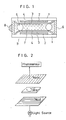
- Fig. 1 is an explanatory view of a construction of one example of a liquid display device according to the invention.
- a transparent substrate 1 made of, for example, a float glass or a transparent plastic material (PMMA, PC etc.)
- a transparent electrode 2 consisting of an ITO film.
- an electrode protective film 3 of SiO2 or the like Laminated sequentially thereon are an electrode protective film 3 of SiO2 or the like and an orientation film 4.
- Two transparent substrates thus obtained are disposed opposite to each other with their orientation films 4 faced each other, and bonded together via spacers 5 by means of epoxy resin to form a liquid crystal cell of, for example, 1.8 to 2 ⁇ m thick.
- Ferroelectric liquid crystals 7 of a smectic phase are injected into this cell with vacuum injection, thereafter an injection hole of the cell is sealed with a UV setting resin 8 to form a liquid crystal display device 9.
- Ferroelectric liquid crystals exhibiting chiral smectic C (SmC*) phase are preferably used as the ferroelectric liquid crystals 7 of a smectic phase.
- used was CS1014 (a product of CHISSO CORPORATION).
- each electrode-formed side of the pair of substrates was coated with the above coating solution by spin-coating method, followed by baking at 250 °C for one hour to form a polyimide film of 50-1000 ⁇ thick. Thereafter, the polyimide film thus obtained was rubbed in one direction to obtain the orientation film 4. The pair of substrates were disposed so that one rubbing (orientating) direction was antiparallel to the other.
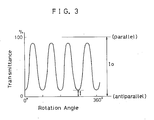
- LC panel 9 liquid crystal display device 9 having each of orientation films thus obtained.
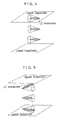
- the LC panel was interposed between orthogonally disposed Nicols, and rotated in the direction designated by the arrow. As the LC panel rotated, intensity of transmitting light varied, and the lowest intensity was measured. A ratio I/I0 of the lowest intensity I of transmitting light to the intensity I0 of projecting light (I and I0 are indicated in Fig. 3) was then found.
- ratios (I/I0) of transmitting light are all 1% or less, while it is 13 % with respect to the display device using a conventional orientation film. This proves that the display device of the present invention has a significant light-transmitting inhibitive feature offering a higher contrast of display.
- the present invention can provide a liquid crystal display device using ferroelectric liquid crystals of a smectic phase which is significantly improved in its contrast.
Landscapes
- Physics & Mathematics (AREA)
- Chemical & Material Sciences (AREA)
- Medicinal Chemistry (AREA)
- Health & Medical Sciences (AREA)
- Polymers & Plastics (AREA)
- Organic Chemistry (AREA)
- Chemical Kinetics & Catalysis (AREA)
- Nonlinear Science (AREA)
- Spectroscopy & Molecular Physics (AREA)
- Mathematical Physics (AREA)
- Crystallography & Structural Chemistry (AREA)
- General Physics & Mathematics (AREA)
- Optics & Photonics (AREA)
- Liquid Crystal (AREA)
Applications Claiming Priority (2)
| Application Number | Priority Date | Filing Date | Title |
|---|---|---|---|
| JP1133740A JPH02310524A (ja) | 1989-05-26 | 1989-05-26 | 液晶表示装置 |
| JP133740/89 | 1989-05-26 |
Publications (2)
| Publication Number | Publication Date |
|---|---|
| EP0399552A2 true EP0399552A2 (de) | 1990-11-28 |
| EP0399552A3 EP0399552A3 (de) | 1991-01-16 |
Family
ID=15111814
Family Applications (1)
| Application Number | Title | Priority Date | Filing Date |
|---|---|---|---|
| EP19900109984 Withdrawn EP0399552A3 (de) | 1989-05-26 | 1990-05-25 | Flüssigkristall-Anzeigevorrichtung |
Country Status (3)
| Country | Link |
|---|---|
| US (1) | US5202779A (de) |
| EP (1) | EP0399552A3 (de) |
| JP (1) | JPH02310524A (de) |
Families Citing this family (9)
| Publication number | Priority date | Publication date | Assignee | Title |
|---|---|---|---|---|
| JP2775527B2 (ja) * | 1991-02-01 | 1998-07-16 | キヤノン株式会社 | カイラルスメクチック液晶素子 |
| US6693696B1 (en) * | 1992-06-30 | 2004-02-17 | Semiconductor Energy Laboratory Co., Ltd. | Electro-optical device |
| US5611941A (en) * | 1995-07-17 | 1997-03-18 | Rainbow Display Serivices | Method for forming a ferroelectric liquid crystal spatial light modulator utilizing a planarization process |
| JP3510509B2 (ja) * | 1998-12-01 | 2004-03-29 | 株式会社 日立ディスプレイズ | 液晶表示装置 |
| TWI335455B (en) * | 2005-09-22 | 2011-01-01 | Ind Tech Res Inst | Liquid crystal display device |
| JP2007173758A (ja) * | 2005-11-24 | 2007-07-05 | Jfe Chemical Corp | ポリイミドを含有する青色発光素子 |
| TWI365888B (en) * | 2007-11-27 | 2012-06-11 | Ind Tech Res Inst | Polyimide optical compensation films |
| RU2010154405A (ru) * | 2008-06-11 | 2012-07-20 | Конинклейке Филипс Электроникс Н.В. (Nl) | Рирпроекционная система и рирпроекционный экран |
| TW201720855A (zh) * | 2015-12-01 | 2017-06-16 | 台虹科技股份有限公司 | 聚醯亞胺聚合物、聚醯亞胺膜以及聚醯亞胺膜的製造方法 |
Family Cites Families (7)
| Publication number | Priority date | Publication date | Assignee | Title |
|---|---|---|---|---|
| JPS56111833A (en) * | 1980-02-08 | 1981-09-03 | Sharp Corp | Liquid-crystal display element |
| GB2109123B (en) * | 1981-09-14 | 1986-03-19 | Sharp Kk | Colour liquid crystal display devices |
| JPS5893915U (ja) * | 1981-12-18 | 1983-06-25 | シャープ株式会社 | 液晶表示装置 |
| US4634228A (en) * | 1984-05-01 | 1987-01-06 | Hitachi, Ltd. | Ferroelectric liquid crystal cell with rubbed polyimide alignment layer |
| EP0208293B1 (de) * | 1985-07-10 | 1990-02-21 | Hitachi, Ltd. | Ferroelektrisches Flüssigkristallelement und Verfahren zu dessen Herstellung |
| US4879059A (en) * | 1986-09-02 | 1989-11-07 | Canon Kabushiki Kaisha | Liquid crystal device |
| JPH0766125B2 (ja) * | 1986-09-02 | 1995-07-19 | キヤノン株式会社 | カイラルスメクチック液晶素子 |
-
1989
- 1989-05-26 JP JP1133740A patent/JPH02310524A/ja active Pending
-
1990
- 1990-05-24 US US07/527,960 patent/US5202779A/en not_active Expired - Fee Related
- 1990-05-25 EP EP19900109984 patent/EP0399552A3/de not_active Withdrawn
Also Published As
| Publication number | Publication date |
|---|---|
| JPH02310524A (ja) | 1990-12-26 |
| EP0399552A3 (de) | 1991-01-16 |
| US5202779A (en) | 1993-04-13 |
Similar Documents
| Publication | Publication Date | Title |
|---|---|---|
| EP0160302B1 (de) | Ferroelektrische Flüssigkristall-Zelle | |
| EP0415447B1 (de) | Flüssigkristallanzeigevorrichtung | |
| EP0400635B1 (de) | Flüssigkristall-Vorrichtung | |
| DE3909704A1 (de) | Fluessigkristallanzeigezelle und verfahren zu ihrer herstellung | |
| EP0345064B1 (de) | Flüssigkristall-Anzeigevorrichtung | |
| KR102237291B1 (ko) | 조성물, 중합체, 액정 배향제, 액정 배향막, 위상차판, 편광판, 액정 배향막의 제조 방법 및 액정 소자 | |
| US5268780A (en) | Liquid crystal device having a polyimide alignment film substituted with fluorine or a fluorine-containing group | |
| EP0539992A1 (de) | Flüssigkristall-Anzeigevorrichtung | |
| US5202779A (en) | Ferroelectric liquid crystal display device with polyimide orientation film of bis(4-aminocyclohexyl) methane and aromatic tetracarboxylic acid anhydride | |
| JPH02287324A (ja) | 液晶セル用配向処理剤 | |
| US5330803A (en) | Liquid crystal device | |
| EP0538841B1 (de) | Flüssigkristallvorrichtung | |
| KR20020032922A (ko) | 광배향성 물질 및 이를 이용한 액정표시소자 | |
| EP0323231B1 (de) | Verschluss mit einem ferroelektrischen Flüssigkristall | |
| US5576864A (en) | Chiral smectic liquid crystal device having fluorine-containing polymeric alignment film with predetermined refractive index anisotropy after rubbing | |
| US5400159A (en) | Liquid crystal device having alignment film with particular surface energy difference before and after rubbing | |
| KR100412080B1 (ko) | 액정표시소자의배향막형성용조성물 | |
| EP0645662A1 (de) | Flüssigkristall-Anzeigevorrichtung | |
| US5436037A (en) | Liquid crystal orientation controlling membranes and liquid crystal elements using the same | |
| EP0397153B1 (de) | Chiralsmektische Flüssigkristallvorrichtung | |
| KR19980048480A (ko) | 광배향성 조성물, 이로부터 형성된 배향막 및 이 배향막을 구비한 액정표시소자 | |
| JPH01242631A (ja) | ポリイミド前駆体膜の製造方法 | |
| KR0148406B1 (ko) | 액정표시소자 | |
| JP2942577B2 (ja) | 強誘電性液晶素子 | |
| US5422148A (en) | Liquid crystal display device |
Legal Events
| Date | Code | Title | Description |
|---|---|---|---|
| PUAI | Public reference made under article 153(3) epc to a published international application that has entered the european phase |
Free format text: ORIGINAL CODE: 0009012 |
|
| PUAL | Search report despatched |
Free format text: ORIGINAL CODE: 0009013 |
|
| 17P | Request for examination filed |
Effective date: 19900525 |
|
| AK | Designated contracting states |
Kind code of ref document: A2 Designated state(s): DE FR GB |
|
| AK | Designated contracting states |
Kind code of ref document: A3 Designated state(s): DE FR GB |
|
| 17Q | First examination report despatched |
Effective date: 19930726 |
|
| STAA | Information on the status of an ep patent application or granted ep patent |
Free format text: STATUS: THE APPLICATION IS DEEMED TO BE WITHDRAWN |
|
| 18D | Application deemed to be withdrawn |
Effective date: 19941028 |