EP0399772B1 - Joindre par diffusion et déformer superplastiquement - Google Patents
Joindre par diffusion et déformer superplastiquement Download PDFInfo
- Publication number
- EP0399772B1 EP0399772B1 EP90305514A EP90305514A EP0399772B1 EP 0399772 B1 EP0399772 B1 EP 0399772B1 EP 90305514 A EP90305514 A EP 90305514A EP 90305514 A EP90305514 A EP 90305514A EP 0399772 B1 EP0399772 B1 EP 0399772B1
- Authority
- EP
- European Patent Office
- Prior art keywords
- sheets
- stop
- aluminium
- stack
- lamella
- Prior art date
- Legal status (The legal status is an assumption and is not a legal conclusion. Google has not performed a legal analysis and makes no representation as to the accuracy of the status listed.)
- Expired - Lifetime
Links
Images



Classifications
-
- B—PERFORMING OPERATIONS; TRANSPORTING
- B23—MACHINE TOOLS; METAL-WORKING NOT OTHERWISE PROVIDED FOR
- B23K—SOLDERING OR UNSOLDERING; WELDING; CLADDING OR PLATING BY SOLDERING OR WELDING; CUTTING BY APPLYING HEAT LOCALLY, e.g. FLAME CUTTING; WORKING BY LASER BEAM
- B23K20/00—Non-electric welding by applying impact or other pressure, with or without the application of heat, e.g. cladding or plating
- B23K20/22—Non-electric welding by applying impact or other pressure, with or without the application of heat, e.g. cladding or plating taking account of the properties of the materials to be welded
- B23K20/233—Non-electric welding by applying impact or other pressure, with or without the application of heat, e.g. cladding or plating taking account of the properties of the materials to be welded without ferrous layer
- B23K20/2333—Non-electric welding by applying impact or other pressure, with or without the application of heat, e.g. cladding or plating taking account of the properties of the materials to be welded without ferrous layer one layer being aluminium, magnesium or beryllium
-
- B—PERFORMING OPERATIONS; TRANSPORTING
- B23—MACHINE TOOLS; METAL-WORKING NOT OTHERWISE PROVIDED FOR
- B23K—SOLDERING OR UNSOLDERING; WELDING; CLADDING OR PLATING BY SOLDERING OR WELDING; CUTTING BY APPLYING HEAT LOCALLY, e.g. FLAME CUTTING; WORKING BY LASER BEAM
- B23K20/00—Non-electric welding by applying impact or other pressure, with or without the application of heat, e.g. cladding or plating
Definitions
- This invention relates to diffusion bonding and in particular to a stop-off material for use in the production of combined diffusion bonded and superplastically formed structures which are preferably made of aluminium or an aluminium alloy
- DB/SPF Combined diffusion bonding and superplastic forming
- a suitable stop-off material is fine particles of yttria in an organic resin binder, which may be applied to the sheets by conventional silk-screen printing techniques (see for example GB 2 095 137 and 1 495 655).
- DB step which is carried out at a temperature greater than 900°C for titanium, evaporation of the binder can contaminate the surfaces of the alloy sheets; similar problems occur in the diffusion bonding of aluminium aloys.
- DB/SPF techniques In order to produce structures, particularly those made of an aluminium base alloy, by DB/SPF techniques satisfactorily, there remains the need for a suitable stop-off material.
- DE-A-37 10 680 describes a process of explosion bonding foils in a packet; paper or fibre sheets can be interposed between the sheets to prevent bonding in the areas covered by the sheets.
- EP-A-0 350 220 describes a process of diffusion bonding aluminium components together after a surface treatment to improve diffusion bonding. There is an example of using a glass cloth as a stop-off material.
- a method of forming a structure which method comprises arranging a plurality of sheets of a superplastic metal (e.g. aluminium or an aluminium alloy) in a stack, interposing a lamella of inert porous material between adjacent sheets in a predetermined pattern to prevent bonding between said adjacent sheets in selected regions, diffusion bonding said stack of sheets together and then subjecting the thus bonded stack to superplastic forming.
- a superplastic metal e.g. aluminium or an aluminium alloy
- the interposed lamella must meet certain requirements to act as a successful stop-off material.
- the material must be inert at the elevated temperatures concerned, typically in the region of 500 to 600°C depending on the alloy.
- the material must be porous to permit gas to flow between the alloy sheets during the SPF step. Examples of suitable materials are glass cloth and vermiculite paper.
- the lamella(e) prior to said diffusion bonding to drive off any possible contaminants and preferably this is achieved at a temperature above the temperature used in the diffusion bonding step. It is also preferred that prior to the diffusion bonding step, the stack of alloy sheets and interposed lamella(e) is sealed under vacuum.
- Suitable aluminium alloys are any that exhibit superplastic properties, and in particular aluminium-lithium alloys such as 8090 aluminium-lithium.
- the present invention achieves the stopping-off of the superplastic sheets by the simple expedient of placing a self-supporting lamella of inert porous stop-off material between adjacent sheets prior to the diffusion bonding step and so does away with the necessarity of applying stop-off material in a liquid vehicle, e.g. by silk screen printing, and so avoids the consequent problems of contamination by the liquid vehicle used in such printing.
- FIG. 1(b) is a section along line A-A of Figure 1(a), there is shown a diffusion bonding pack.
- the pack comprises a stack of two outer or face sheets 1 of 8090 aluminium-lithium alloy, a core sheet 1′ also made of 8090 aluminium-lithium alloy, the core sheet 1′ being separated from the face sheets 1 by two thin masks 2 formed of glass cloth.
- the stack of alloy sheets is sandwiched between spacer elements 3, and is located in the cavity 15 in the base 16 of a press 17 between a base element 4 and an upper diaphragm 5, which is made of a superplastic material.
- the alloy sheets 1,1′ and the glass cloth masks 2 are pretreated.
- the sheets are chemically cleaned and the surfaces to be bonded are grit blasted using aluminium oxide.
- the glass masks are pre-baked at 590°C for one hour to drive off any organic binders or other possible contaminants.
- the outer two alloy sheets 1 are uninterrupted squares or rectangles, but the inner or core sheet 1′, as shown in Figure 2(a), has two cut-away portions 6 which are partly complementary in shape to the two masks 2 that are shown in Figures 2(b) and 2(c).
- Figure 2(b) shows the upper of the two masks (as viewed in in Figure 1(b)), and Figure 2(c) the lower of the pair. It will be appreciated that when the alloy sheets and masks are superimposed in the bonding pack, the masks will prevent bonding of the alloy sheets in selected locations by stopping the sheets from contacting one another.
- the shapes of the masks 2 and the core sheet 1′ are shown by broken lines in Figure 1(a).
- the prepared sheets are formed into the bonding pack along with the glass cloth masks as shown in Figure 1(b).
- the bonding pack is then loaded into the cavity 15 of the press which is preheated to 560°C, the membrane is placed over the pack and the press is sealed by clamping the top 18 of the press against the base 16 thereby copmpressing the edges of the membrane 5 and sealing the cavity 15. Whilst heating up to the required bonding temperature, the cavity 15 is evacuated for 10 minutes to achieve a vacuum of 10 ⁇ 6 mbar or better. This evacuation is carried out via a vacuum pipe 7 passing through the wall of the base 16 and connected to a pump (not shown).
- a bonding pressure of 1000 psi (7 MPa) is applied to the pack by supplying pressurised gas through inlet 8 to the space 14 above the diaphragm 5.
- the bonding pressure and temperature are maintained for as long as is necessary to achieve diffusion bonding; typically a period of 3 hours. After diffusion bonding has taken place, the pack is removed from the press and allowed to cool.
- a gas-supply hole 19 (see Figure 4) is drilled in the pack of bonded sheets (the shapes of the masks 2 and of the core sheet 1′ are shown by broken lines in Figure 4); the hole 19 passes through a tail part 6′ in the cut-out section 6 of the core sheet 1′ (see also Figure 2(a)) and through a tail part 2′ in the stop-off masks 2 (see also Figure 2(b) and (c)) to allow gas to be injected into the interior of the pack, as described in more detail below; the hole 19 does not, however, extend all the way through the stack of sheets and does not pass through the lower face sheet 1.
- the pack is then loaded into the superplastic forming (SPF) tooling shown in Figures 3(a) and (b).
- SPPF superplastic forming
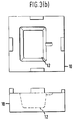
- the SPF tooling includes an upper tool part 9, shown in Figure 3(a), and a lower tool part 10 shown in Figure 3(b).
- the upper tool part 9 is provided with a supply line 11 for the supply of an inert gas, such as argon or compressed air, to the diffusion bonded pack during the SPF step; the outlet 11′ of the gas supply line 11 is located in register with the above-described gas-supply hole 19 that has been drilled in the pack.
- the lower tool part 10 is formed with an internal surface 12 corresponding to the outer surface of the structure to be formed.
- the tool After the bonded stack has been loaded into the SPF tool, the tool is placed in a preheated press (530°C) and the temperature allowed to stabilise (which takes approximately 20 minutes). Compressed air is then injected into the interior of the pack via supply line 11 and the gas-supply hole 19 drilled in the pack, the gas pressure being controlled to produce an optimum pressure-time cycle which may be calculated in advance using computer modelling techniques.
- a preheated press 530°C
- stabilise which takes approximately 20 minutes
- Compressed air is then injected into the interior of the pack via supply line 11 and the gas-supply hole 19 drilled in the pack, the gas pressure being controlled to produce an optimum pressure-time cycle which may be calculated in advance using computer modelling techniques.
- FIG. 5 shows in section the structure obtained with the sheets and masks of Figures 1 and 2.
Landscapes
- Engineering & Computer Science (AREA)
- Mechanical Engineering (AREA)
- Pressure Welding/Diffusion-Bonding (AREA)
- Laminated Bodies (AREA)
- Ceramic Products (AREA)
Claims (10)
- Procédé de formation d'une structure comprenant l'agencement d'une pluralité de feuilles (1, 1') en un matériau superplastique en une pile, l'interposition d'un matériau inerte d'arrêt entre des feuilles adjacentes selon une configuration prédéterminée pour empêcher le soudage entre lesdites feuilles adjacentes dans des zones choisies, le soudage par diffusion de ladite pile de feuilles puis la soumission de la pile ainsi soudée à un formage superplastique,
procédé caractérisé en ce que le matériau inerte d'arrêt interposé est une lamelle (3) d'un matériau poreux à l'exception du fait que le matériau d'arrêt n'est pas un tissu de verre lorsque :1- au moins une des feuilles est en aluminium ou en alliage d'aluminium et peut former un revêtement de surface d'oxyde d'aluminium; et2- avant l'agencement des feuilles en une pile, les feuilles en aluminium ou en alliage d'aluminium subissent un grenaillage angulaire sur des zones liées à d'autres feuilles; et3- avant l'agencement des feuilles en une pile, les feuilles grenaillées sont chimiquement traitées pour enlever l'oxyde d'aluminium de surface; et4- les feuilles sont soudées par diffusion en les chauffant et en les pressant sans déformation plastique notable des feuilles. - Procédé selon la revendication 1, caractérisé en ce que ladite lamelle (3) comprend des mailles, du papier ou du tissu.
- Procédé selon la revendication 1 ou 2, caractérisé en ce que ladite lamelle de matériau d'arrêt (3) comprend un matériau à filaments.
- Procédé selon la revendication 3, caractérisé en ce que la lamelle (3) du matériau d'arrêt comprend un tissu de verre.
- Procédé selon la revendication 1 ou 2, caractérisé en ce que ladite lamelle du matériau d'arrêt (3) comprend un papier de vermiculite.
- Procédé selon l'une quelconque des revendications précédentes, caractérisé en ce que ladite lamelle du matériau d'arrêt (3) est préchauffée avant ledit soudage par diffusion pour éliminer tout polluant.
- Procédé selon la revendication 6, caractérisé en ce que ladite lamelle du matériau d'arrêt (3) est préchauffée avant ledit soudage par diffusion à une température dépassant celle de l'étape de soudage par diffusion.
- Procédé selon l'une quelconque des revendications précédentes, caractérisé en ce que ladite pile, avant ledit soudage par diffusion, est placée sous vide, par ex. au moyen de soudage par faisceau électronique, autour des zones latérales des feuilles.
- Procédé selon l'une quelconque des revendications précédentes, caractérisé en ce que le métal est de l'aluminium ou un alliage d'aluminium.
- Procédé selon la revendication 9, caractérisé en ce que ledit alliage d'aluminium est un alliage d'aluminium/lithium.
Applications Claiming Priority (2)
| Application Number | Priority Date | Filing Date | Title |
|---|---|---|---|
| GB898912025A GB8912025D0 (en) | 1989-05-25 | 1989-05-25 | Diffusion bonding |
| GB8912025 | 1989-05-25 |
Publications (3)
| Publication Number | Publication Date |
|---|---|
| EP0399772A2 EP0399772A2 (fr) | 1990-11-28 |
| EP0399772A3 EP0399772A3 (fr) | 1991-01-30 |
| EP0399772B1 true EP0399772B1 (fr) | 1993-12-15 |
Family
ID=10657325
Family Applications (1)
| Application Number | Title | Priority Date | Filing Date |
|---|---|---|---|
| EP90305514A Expired - Lifetime EP0399772B1 (fr) | 1989-05-25 | 1990-05-22 | Joindre par diffusion et déformer superplastiquement |
Country Status (5)
| Country | Link |
|---|---|
| US (1) | US5069383A (fr) |
| EP (1) | EP0399772B1 (fr) |
| DE (1) | DE69005192T2 (fr) |
| ES (1) | ES2047263T3 (fr) |
| GB (1) | GB8912025D0 (fr) |
Families Citing this family (20)
| Publication number | Priority date | Publication date | Assignee | Title |
|---|---|---|---|---|
| GB9026134D0 (en) * | 1990-11-30 | 1991-01-16 | British Aerospace | Explosive bonding |
| US5263638A (en) * | 1991-06-04 | 1993-11-23 | Rolls-Royce Plc | Method of manufacturing an article by superplastic forming and diffusion bonding and a vacuum chamber for use in processing workpieces for superplastic forming and diffusion bonding |
| GB9122874D0 (en) * | 1991-10-29 | 1991-12-11 | Rolls Royce Plc | A method of manufacturing an article,a method of diffusion bonding and a vacuum chamber |
| US5273202A (en) * | 1991-10-29 | 1993-12-28 | Rolls-Royce Plc | Method of manufacturing an article, a method of diffusion bonding and a vacuum chamber |
| GB9205034D0 (en) * | 1992-03-07 | 1992-04-22 | British Aerospace | Manufacture of components by superplastic forming |
| US5715644A (en) * | 1996-08-13 | 1998-02-10 | Mcdonnell Douglas Corporation | Superplastically formed, diffusion bonded panels with diagonal reinforcing webs and method of manufacture |
| US5723225A (en) * | 1996-08-26 | 1998-03-03 | Mcdonnell Douglas Corporation | Superplastically formed, diffusion bonded multiple sheet panels with web doublers and method of manufacture |
| US5904992A (en) * | 1996-09-26 | 1999-05-18 | Mcdonnell Douglas Corporation | Floating superplastic forming/diffusion bonding die, product and process |
| US5737954A (en) * | 1996-11-15 | 1998-04-14 | Mcdonnell Douglas Corporation | Superplastic forming with direct electrical heating |
| US6321541B1 (en) | 1999-04-01 | 2001-11-27 | Parker-Hannifin Corporation | Multi-circuit multi-injection point atomizer |
| US6711898B2 (en) | 1999-04-01 | 2004-03-30 | Parker-Hannifin Corporation | Fuel manifold block and ring with macrolaminate layers |
| US6202277B1 (en) | 1999-10-28 | 2001-03-20 | General Electric Company | Reusable hard tooling for article consolidation and consolidation method |
| FR2852537B1 (fr) * | 2003-03-21 | 2005-06-17 | Snecma Moteurs | Ensemble permettant la fabrication d'une piece mecanique creuse par soudage-diffusion et formage superplastique, utilisation d'un tel ensemble et procede de fabrication d'une telle piece mecanique |
| US7451907B2 (en) * | 2004-08-06 | 2008-11-18 | General Motors Corporation | Roll bonding of bipolar plates |
| CN100462196C (zh) * | 2006-02-27 | 2009-02-18 | 北京亚太空间钛业有限公司 | 一种多层钛合金薄板组合连接方法 |
| US8727203B2 (en) | 2010-09-16 | 2014-05-20 | Howmedica Osteonics Corp. | Methods for manufacturing porous orthopaedic implants |
| FR2997645B1 (fr) * | 2012-11-06 | 2015-05-15 | Technicatome | Procede et dispositif de soudage par diffusion a compression uni-axiale, utilisation pour des plaques portant des canaux |
| US20140335368A1 (en) * | 2013-05-13 | 2014-11-13 | Ford Global Technologies, Llc | Method Of Fabricating Roll-Bonded Expanded Load-Bearing Aluminum Laminate Structural Elements For Vehicle |
| DE102014111634A1 (de) * | 2014-08-14 | 2016-02-18 | Atv Technologie Gmbh | Vorrichtung zum insbesondere thermischen Verbinden mikro-elektromechanischer Bauteile |
| DE102020215873A1 (de) | 2020-12-15 | 2022-06-15 | Forschungszentrum Jülich GmbH | Verfahren zur Herstellung von Baugruppen und Verwendung eines Trennmittels |
Family Cites Families (11)
| Publication number | Priority date | Publication date | Assignee | Title |
|---|---|---|---|---|
| GB820033A (en) * | 1955-10-03 | 1959-09-16 | Olin Mathieson | A method of applying weld-preventing material to a metal sheet and a metal sheet treated with weld-preventing material |
| GB883359A (en) * | 1958-06-24 | 1961-11-29 | Phoenix Rheinrohr Ag | Improvements in or relating to the cladding of metals |
| GB1495655A (en) * | 1975-03-20 | 1977-12-21 | Rockwell International Corp | Method for making metallic structures from two or more selectively bonded sheets |
| US4197977A (en) * | 1978-04-20 | 1980-04-15 | The Boeing Company | Method of making an actively-cooled titanium structure |
| US4406393A (en) * | 1981-03-23 | 1983-09-27 | Rockwell International Corporation | Method of making filamentary reinforced metallic structures |
| US4426032A (en) * | 1981-09-10 | 1984-01-17 | The United States Of America As Represented By The Secretary Of The Air Force | Tool sealing arrangement and method |
| GB8623719D0 (en) * | 1986-10-02 | 1986-11-05 | British Aerospace | Stop-off compound |
| US4732312A (en) * | 1986-11-10 | 1988-03-22 | Grumman Aerospace Corporation | Method for diffusion bonding of alloys having low solubility oxides |
| DE3710680C1 (en) * | 1987-03-31 | 1988-10-06 | Surtec Patent Holding | Method of producing multi-foils |
| US4942999A (en) * | 1987-08-31 | 1990-07-24 | Ngk Insulators, Inc. | Metal-ceramic joined composite bodies and joining process therefor |
| US4811766A (en) * | 1987-10-08 | 1989-03-14 | Mcdonnell Douglas Corporation | Explosively bonded expanded structure |
-
1989
- 1989-05-25 GB GB898912025A patent/GB8912025D0/en active Pending
-
1990
- 1990-05-22 ES ES90305514T patent/ES2047263T3/es not_active Expired - Lifetime
- 1990-05-22 EP EP90305514A patent/EP0399772B1/fr not_active Expired - Lifetime
- 1990-05-22 DE DE90305514T patent/DE69005192T2/de not_active Expired - Fee Related
-
1991
- 1991-04-30 US US07/693,036 patent/US5069383A/en not_active Expired - Fee Related
Also Published As
| Publication number | Publication date |
|---|---|
| GB8912025D0 (en) | 1989-07-12 |
| DE69005192D1 (de) | 1994-01-27 |
| EP0399772A3 (fr) | 1991-01-30 |
| EP0399772A2 (fr) | 1990-11-28 |
| DE69005192T2 (de) | 1994-03-31 |
| US5069383A (en) | 1991-12-03 |
| ES2047263T3 (es) | 1994-02-16 |
Similar Documents
| Publication | Publication Date | Title |
|---|---|---|
| EP0399772B1 (fr) | Joindre par diffusion et déformer superplastiquement | |
| US5147086A (en) | Preparation of capsule for use in isostatic pressing treatment | |
| US5024368A (en) | Stopping-off method for use with diffusion bonding | |
| US4406393A (en) | Method of making filamentary reinforced metallic structures | |
| US4426032A (en) | Tool sealing arrangement and method | |
| DE4005674C2 (de) | Verfahren und Vorrichtung zum Einkapseln eines mittels des isostatischen Heiß- oder Warmpressens zu bearbeitenden Materials | |
| US5611944A (en) | Hollow component manufacture | |
| US5188281A (en) | Brazing procedure in inert atmosphere | |
| US6129261A (en) | Diffusion bonding of metals | |
| US4691857A (en) | Method of shaping a workpiece | |
| US5344063A (en) | Method of making diffusion bonded/superplastically formed cellular structures with a metal matrix composite | |
| US4483478A (en) | Method for fabricating superplastically formed/diffusion bonded aluminum or aluminum alloy structures | |
| EP0398760B1 (fr) | Soudage par diffusion d'aluminium et d'alliages d'aluminium | |
| GB2269555A (en) | A method of manufacturing an article by superplastic forming and diffusion bonding | |
| GB2269556A (en) | A method of manufacturing an article by diffusion bonding | |
| US5399215A (en) | Method of manufacturing assemblies composed of two bonded parts | |
| EP0488592B1 (fr) | Méthode de fixation par explosion | |
| JP2008179152A (ja) | 真空工具装置 | |
| CN100509249C (zh) | 使用可活动嵌入模块的扩散结合和超塑成形设备 | |
| JP2803927B2 (ja) | 板状拡散接合部材の製造方法 | |
| JPH0736928B2 (ja) | 金属箔の超塑性成形方法 | |
| JPH0597530A (ja) | セラミツクス焼結体の接合方法 | |
| GB2280867A (en) | A method of diffusion bonding and a vacuum chamber | |
| JP2823411B2 (ja) | 拡散接合部材の製造方法 | |
| US5403423A (en) | Method for forming details and adhesive bonding of sheet metal and composite assemblies |
Legal Events
| Date | Code | Title | Description |
|---|---|---|---|
| PUAI | Public reference made under article 153(3) epc to a published international application that has entered the european phase |
Free format text: ORIGINAL CODE: 0009012 |
|
| AK | Designated contracting states |
Kind code of ref document: A2 Designated state(s): DE ES FR GB IT SE |
|
| PUAL | Search report despatched |
Free format text: ORIGINAL CODE: 0009013 |
|
| AK | Designated contracting states |
Kind code of ref document: A3 Designated state(s): DE ES FR GB IT SE |
|
| 17P | Request for examination filed |
Effective date: 19901221 |
|
| 17Q | First examination report despatched |
Effective date: 19920804 |
|
| RAP3 | Party data changed (applicant data changed or rights of an application transferred) |
Owner name: BRITISH AEROSPACE PUBLIC LIMITED COMPANY |
|
| ITF | It: translation for a ep patent filed | ||
| GRAA | (expected) grant |
Free format text: ORIGINAL CODE: 0009210 |
|
| AK | Designated contracting states |
Kind code of ref document: B1 Designated state(s): DE ES FR GB IT SE |
|
| ET | Fr: translation filed | ||
| REF | Corresponds to: |
Ref document number: 69005192 Country of ref document: DE Date of ref document: 19940127 |
|
| REG | Reference to a national code |
Ref country code: ES Ref legal event code: FG2A Ref document number: 2047263 Country of ref document: ES Kind code of ref document: T3 |
|
| PGFP | Annual fee paid to national office [announced via postgrant information from national office to epo] |
Ref country code: FR Payment date: 19940413 Year of fee payment: 5 |
|
| PGFP | Annual fee paid to national office [announced via postgrant information from national office to epo] |
Ref country code: SE Payment date: 19940419 Year of fee payment: 5 Ref country code: GB Payment date: 19940419 Year of fee payment: 5 |
|
| PGFP | Annual fee paid to national office [announced via postgrant information from national office to epo] |
Ref country code: DE Payment date: 19940425 Year of fee payment: 5 |
|
| PGFP | Annual fee paid to national office [announced via postgrant information from national office to epo] |
Ref country code: ES Payment date: 19940506 Year of fee payment: 5 |
|
| PLBE | No opposition filed within time limit |
Free format text: ORIGINAL CODE: 0009261 |
|
| STAA | Information on the status of an ep patent application or granted ep patent |
Free format text: STATUS: NO OPPOSITION FILED WITHIN TIME LIMIT |
|
| 26N | No opposition filed | ||
| EAL | Se: european patent in force in sweden |
Ref document number: 90305514.3 |
|
| PG25 | Lapsed in a contracting state [announced via postgrant information from national office to epo] |
Ref country code: GB Effective date: 19950522 |
|
| PG25 | Lapsed in a contracting state [announced via postgrant information from national office to epo] |
Ref country code: SE Effective date: 19950523 Ref country code: ES Free format text: LAPSE BECAUSE OF NON-PAYMENT OF DUE FEES Effective date: 19950523 |
|
| GBPC | Gb: european patent ceased through non-payment of renewal fee |
Effective date: 19950522 |
|
| PG25 | Lapsed in a contracting state [announced via postgrant information from national office to epo] |
Ref country code: DE Effective date: 19960201 |
|
| EUG | Se: european patent has lapsed |
Ref document number: 90305514.3 |
|
| PG25 | Lapsed in a contracting state [announced via postgrant information from national office to epo] |
Ref country code: FR Effective date: 19960229 |
|
| REG | Reference to a national code |
Ref country code: FR Ref legal event code: ST |
|
| REG | Reference to a national code |
Ref country code: FR Ref legal event code: ST |
|
| REG | Reference to a national code |
Ref country code: ES Ref legal event code: FD2A Effective date: 19990301 |
|
| PG25 | Lapsed in a contracting state [announced via postgrant information from national office to epo] |
Ref country code: IT Free format text: LAPSE BECAUSE OF NON-PAYMENT OF DUE FEES;WARNING: LAPSES OF ITALIAN PATENTS WITH EFFECTIVE DATE BEFORE 2007 MAY HAVE OCCURRED AT ANY TIME BEFORE 2007. THE CORRECT EFFECTIVE DATE MAY BE DIFFERENT FROM THE ONE RECORDED. Effective date: 20050522 |