EP0399897B1 - System zur individuellen Teilnahme an einem Fernseh-Rundfunkprogramm - Google Patents
System zur individuellen Teilnahme an einem Fernseh-Rundfunkprogramm Download PDFInfo
- Publication number
- EP0399897B1 EP0399897B1 EP90401362A EP90401362A EP0399897B1 EP 0399897 B1 EP0399897 B1 EP 0399897B1 EP 90401362 A EP90401362 A EP 90401362A EP 90401362 A EP90401362 A EP 90401362A EP 0399897 B1 EP0399897 B1 EP 0399897B1
- Authority
- EP
- European Patent Office
- Prior art keywords
- server
- participation
- certification
- code
- result
- Prior art date
- Legal status (The legal status is an assumption and is not a legal conclusion. Google has not performed a legal analysis and makes no representation as to the accuracy of the status listed.)
- Expired - Lifetime
Links
- 238000010200 validation analysis Methods 0.000 claims description 41
- 230000003287 optical effect Effects 0.000 claims description 27
- 230000004044 response Effects 0.000 claims description 25
- 239000002131 composite material Substances 0.000 claims description 20
- 238000012545 processing Methods 0.000 claims description 13
- 238000004422 calculation algorithm Methods 0.000 claims description 11
- 238000003860 storage Methods 0.000 claims description 11
- 230000002596 correlated effect Effects 0.000 claims description 6
- 230000003213 activating effect Effects 0.000 claims 1
- 238000000034 method Methods 0.000 description 29
- 230000006870 function Effects 0.000 description 24
- 230000008569 process Effects 0.000 description 17
- 230000005540 biological transmission Effects 0.000 description 13
- 238000010586 diagram Methods 0.000 description 13
- 238000003825 pressing Methods 0.000 description 10
- 238000004364 calculation method Methods 0.000 description 8
- 238000004519 manufacturing process Methods 0.000 description 8
- 238000012360 testing method Methods 0.000 description 7
- 210000000056 organ Anatomy 0.000 description 5
- 230000001960 triggered effect Effects 0.000 description 5
- 230000009471 action Effects 0.000 description 4
- 238000004891 communication Methods 0.000 description 4
- 230000000694 effects Effects 0.000 description 4
- 238000005259 measurement Methods 0.000 description 4
- 230000001427 coherent effect Effects 0.000 description 3
- 239000004973 liquid crystal related substance Substances 0.000 description 3
- 238000012795 verification Methods 0.000 description 3
- 101150034459 Parpbp gene Proteins 0.000 description 2
- 241000287107 Passer Species 0.000 description 2
- 238000012550 audit Methods 0.000 description 2
- 230000000875 corresponding effect Effects 0.000 description 2
- 238000013479 data entry Methods 0.000 description 2
- 238000001514 detection method Methods 0.000 description 2
- 238000009792 diffusion process Methods 0.000 description 2
- 235000021183 entrée Nutrition 0.000 description 2
- 241001415961 Gaviidae Species 0.000 description 1
- 230000008901 benefit Effects 0.000 description 1
- 230000002457 bidirectional effect Effects 0.000 description 1
- 230000000903 blocking effect Effects 0.000 description 1
- 239000004020 conductor Substances 0.000 description 1
- 230000001186 cumulative effect Effects 0.000 description 1
- 230000001934 delay Effects 0.000 description 1
- 238000011161 development Methods 0.000 description 1
- 238000005516 engineering process Methods 0.000 description 1
- 239000000284 extract Substances 0.000 description 1
- 238000000605 extraction Methods 0.000 description 1
- 238000001914 filtration Methods 0.000 description 1
- 230000010365 information processing Effects 0.000 description 1
- 230000002452 interceptive effect Effects 0.000 description 1
- 238000007726 management method Methods 0.000 description 1
- 239000010453 quartz Substances 0.000 description 1
- 230000007420 reactivation Effects 0.000 description 1
- 230000009467 reduction Effects 0.000 description 1
- 238000007493 shaping process Methods 0.000 description 1
- VYPSYNLAJGMNEJ-UHFFFAOYSA-N silicon dioxide Inorganic materials O=[Si]=O VYPSYNLAJGMNEJ-UHFFFAOYSA-N 0.000 description 1
- 238000006467 substitution reaction Methods 0.000 description 1
- 230000001360 synchronised effect Effects 0.000 description 1
- 238000013518 transcription Methods 0.000 description 1
- 230000035897 transcription Effects 0.000 description 1
- 238000012546 transfer Methods 0.000 description 1
Images


Classifications
-
- A63F13/12—
-
- A—HUMAN NECESSITIES
- A63—SPORTS; GAMES; AMUSEMENTS
- A63F—CARD, BOARD, OR ROULETTE GAMES; INDOOR GAMES USING SMALL MOVING PLAYING BODIES; VIDEO GAMES; GAMES NOT OTHERWISE PROVIDED FOR
- A63F13/00—Video games, i.e. games using an electronically generated display having two or more dimensions
- A63F13/70—Game security or game management aspects
- A63F13/71—Game security or game management aspects using secure communication between game devices and game servers, e.g. by encrypting game data or authenticating players
-
- A—HUMAN NECESSITIES
- A63—SPORTS; GAMES; AMUSEMENTS
- A63F—CARD, BOARD, OR ROULETTE GAMES; INDOOR GAMES USING SMALL MOVING PLAYING BODIES; VIDEO GAMES; GAMES NOT OTHERWISE PROVIDED FOR
- A63F13/00—Video games, i.e. games using an electronically generated display having two or more dimensions
- A63F13/30—Interconnection arrangements between game servers and game devices; Interconnection arrangements between game devices; Interconnection arrangements between game servers
-
- A—HUMAN NECESSITIES
- A63—SPORTS; GAMES; AMUSEMENTS
- A63F—CARD, BOARD, OR ROULETTE GAMES; INDOOR GAMES USING SMALL MOVING PLAYING BODIES; VIDEO GAMES; GAMES NOT OTHERWISE PROVIDED FOR
- A63F13/00—Video games, i.e. games using an electronically generated display having two or more dimensions
- A63F13/30—Interconnection arrangements between game servers and game devices; Interconnection arrangements between game devices; Interconnection arrangements between game servers
- A63F13/33—Interconnection arrangements between game servers and game devices; Interconnection arrangements between game devices; Interconnection arrangements between game servers using wide area network [WAN] connections
- A63F13/338—Interconnection arrangements between game servers and game devices; Interconnection arrangements between game devices; Interconnection arrangements between game servers using wide area network [WAN] connections using television networks
-
- A—HUMAN NECESSITIES
- A63—SPORTS; GAMES; AMUSEMENTS
- A63F—CARD, BOARD, OR ROULETTE GAMES; INDOOR GAMES USING SMALL MOVING PLAYING BODIES; VIDEO GAMES; GAMES NOT OTHERWISE PROVIDED FOR
- A63F13/00—Video games, i.e. games using an electronically generated display having two or more dimensions
- A63F13/30—Interconnection arrangements between game servers and game devices; Interconnection arrangements between game devices; Interconnection arrangements between game servers
- A63F13/35—Details of game servers
-
- G—PHYSICS
- G04—HOROLOGY
- G04G—ELECTRONIC TIME-PIECES
- G04G15/00—Time-pieces comprising means to be operated at preselected times or after preselected time intervals
- G04G15/006—Time-pieces comprising means to be operated at preselected times or after preselected time intervals for operating at a number of different times
-
- G—PHYSICS
- G09—EDUCATION; CRYPTOGRAPHY; DISPLAY; ADVERTISING; SEALS
- G09B—EDUCATIONAL OR DEMONSTRATION APPLIANCES; APPLIANCES FOR TEACHING, OR COMMUNICATING WITH, THE BLIND, DEAF OR MUTE; MODELS; PLANETARIA; GLOBES; MAPS; DIAGRAMS
- G09B7/00—Electrically-operated teaching apparatus or devices working with questions and answers
- G09B7/06—Electrically-operated teaching apparatus or devices working with questions and answers of the multiple-choice answer-type, i.e. where a given question is provided with a series of answers and a choice has to be made from the answers
- G09B7/07—Electrically-operated teaching apparatus or devices working with questions and answers of the multiple-choice answer-type, i.e. where a given question is provided with a series of answers and a choice has to be made from the answers providing for individual presentation of questions to a plurality of student stations
- G09B7/073—Electrically-operated teaching apparatus or devices working with questions and answers of the multiple-choice answer-type, i.e. where a given question is provided with a series of answers and a choice has to be made from the answers providing for individual presentation of questions to a plurality of student stations all student stations being capable of presenting the same questions simultaneously
-
- H—ELECTRICITY
- H03—ELECTRONIC CIRCUITRY
- H03J—TUNING RESONANT CIRCUITS; SELECTING RESONANT CIRCUITS
- H03J9/00—Remote-control of tuned circuits; Combined remote-control of tuning and other functions, e.g. brightness, amplification
- H03J9/06—Remote-control of tuned circuits; Combined remote-control of tuning and other functions, e.g. brightness, amplification using electromagnetic waves other than radio waves, e.g. light
-
- H—ELECTRICITY
- H04—ELECTRIC COMMUNICATION TECHNIQUE
- H04H—BROADCAST COMMUNICATION
- H04H20/00—Arrangements for broadcast or for distribution combined with broadcast
- H04H20/38—Arrangements for distribution where lower stations, e.g. receivers, interact with the broadcast
-
- H—ELECTRICITY
- H04—ELECTRIC COMMUNICATION TECHNIQUE
- H04H—BROADCAST COMMUNICATION
- H04H60/00—Arrangements for broadcast applications with a direct linking to broadcast information or broadcast space-time; Broadcast-related systems
- H04H60/09—Arrangements for device control with a direct linkage to broadcast information or to broadcast space-time; Arrangements for control of broadcast-related services
- H04H60/14—Arrangements for conditional access to broadcast information or to broadcast-related services
- H04H60/21—Billing for the use of broadcast information or broadcast-related information
- H04H60/22—Billing for the use of broadcast information or broadcast-related information per use
-
- H—ELECTRICITY
- H04—ELECTRIC COMMUNICATION TECHNIQUE
- H04N—PICTORIAL COMMUNICATION, e.g. TELEVISION
- H04N7/00—Television systems
- H04N7/002—Special television systems not provided for by H04N7/007 - H04N7/18
-
- H—ELECTRICITY
- H04—ELECTRIC COMMUNICATION TECHNIQUE
- H04N—PICTORIAL COMMUNICATION, e.g. TELEVISION
- H04N7/00—Television systems
- H04N7/16—Analogue secrecy systems; Analogue subscription systems
-
- A—HUMAN NECESSITIES
- A63—SPORTS; GAMES; AMUSEMENTS
- A63F—CARD, BOARD, OR ROULETTE GAMES; INDOOR GAMES USING SMALL MOVING PLAYING BODIES; VIDEO GAMES; GAMES NOT OTHERWISE PROVIDED FOR
- A63F2250/00—Miscellaneous game characteristics
- A63F2250/64—Miscellaneous game characteristics used for radio or television, e.g. television shows; used in front of an audience
-
- A—HUMAN NECESSITIES
- A63—SPORTS; GAMES; AMUSEMENTS
- A63F—CARD, BOARD, OR ROULETTE GAMES; INDOOR GAMES USING SMALL MOVING PLAYING BODIES; VIDEO GAMES; GAMES NOT OTHERWISE PROVIDED FOR
- A63F2300/00—Features of games using an electronically generated display having two or more dimensions, e.g. on a television screen, showing representations related to the game
- A63F2300/40—Features of games using an electronically generated display having two or more dimensions, e.g. on a television screen, showing representations related to the game characterised by details of platform network
- A63F2300/401—Secure communication, e.g. using encryption or authentication
-
- A—HUMAN NECESSITIES
- A63—SPORTS; GAMES; AMUSEMENTS
- A63F—CARD, BOARD, OR ROULETTE GAMES; INDOOR GAMES USING SMALL MOVING PLAYING BODIES; VIDEO GAMES; GAMES NOT OTHERWISE PROVIDED FOR
- A63F2300/00—Features of games using an electronically generated display having two or more dimensions, e.g. on a television screen, showing representations related to the game
- A63F2300/40—Features of games using an electronically generated display having two or more dimensions, e.g. on a television screen, showing representations related to the game characterised by details of platform network
- A63F2300/403—Connection between platform and handheld device
-
- A—HUMAN NECESSITIES
- A63—SPORTS; GAMES; AMUSEMENTS
- A63F—CARD, BOARD, OR ROULETTE GAMES; INDOOR GAMES USING SMALL MOVING PLAYING BODIES; VIDEO GAMES; GAMES NOT OTHERWISE PROVIDED FOR
- A63F2300/00—Features of games using an electronically generated display having two or more dimensions, e.g. on a television screen, showing representations related to the game
- A63F2300/40—Features of games using an electronically generated display having two or more dimensions, e.g. on a television screen, showing representations related to the game characterised by details of platform network
- A63F2300/409—Data transfer via television network
-
- A—HUMAN NECESSITIES
- A63—SPORTS; GAMES; AMUSEMENTS
- A63F—CARD, BOARD, OR ROULETTE GAMES; INDOOR GAMES USING SMALL MOVING PLAYING BODIES; VIDEO GAMES; GAMES NOT OTHERWISE PROVIDED FOR
- A63F2300/00—Features of games using an electronically generated display having two or more dimensions, e.g. on a television screen, showing representations related to the game
- A63F2300/50—Features of games using an electronically generated display having two or more dimensions, e.g. on a television screen, showing representations related to the game characterized by details of game servers
- A63F2300/53—Features of games using an electronically generated display having two or more dimensions, e.g. on a television screen, showing representations related to the game characterized by details of game servers details of basic data processing
- A63F2300/532—Features of games using an electronically generated display having two or more dimensions, e.g. on a television screen, showing representations related to the game characterized by details of game servers details of basic data processing using secure communication, e.g. by encryption, authentication
-
- A—HUMAN NECESSITIES
- A63—SPORTS; GAMES; AMUSEMENTS
- A63F—CARD, BOARD, OR ROULETTE GAMES; INDOOR GAMES USING SMALL MOVING PLAYING BODIES; VIDEO GAMES; GAMES NOT OTHERWISE PROVIDED FOR
- A63F2300/00—Features of games using an electronically generated display having two or more dimensions, e.g. on a television screen, showing representations related to the game
- A63F2300/60—Methods for processing data by generating or executing the game program
- A63F2300/63—Methods for processing data by generating or executing the game program for controlling the execution of the game in time
Definitions
- the invention relates to a system comprising an electronic device intended to allow at least one individual, on the one hand, to participate from a reception station in a broadcast program, and, on the other hand, to certify said participation by connection with a server.
- US-A-4,745,468 describes a system for evaluating the answers given by listeners or viewers to questions asked during a radio or television program.
- the station broadcasting the program transmits concurrently on another broadcast channel an instruction signal containing data representing the question to be answered, the time available for formulating an answer and the content and form of the answer correct.
- These data are downloaded into consoles with which individuals wishing to participate in the broadcast program are equipped.
- the consoles include a specific means of receiving the instruction signal.
- Each console includes timing means which require the participant to formulate his response within the time limit, which response is entered into the console via a keyboard.
- processing means compare the participant's response with the correct response downloaded, calculate the result, gain or score obtained by the participant, and cumulate it with the score previously accumulated.
- the cumulative score can then be transferred, possibly in encrypted form, to a recording medium with magnetic reading (magnetic stripe card) or optical (printed or perforated sheet).
- This recording medium thus allows the user of the console to prove his participation in the broadcast program and, in connection with a server, to validate the result obtained.
- the participant may possibly be awarded a prize in the form of money, a lot, a reduction on goods or services, etc.
- U.S. Patent 4,592,546 describes a similar system allowing viewers to wager on the outcome of an event, such as a soccer game, before it is broadcast by a television station.
- viewers have a console provided with a receiver enabling it to receive radio signals transmitted by a central station.
- the console is equipped with a real-time clock set on an absolute time scale to determine, in the console, the precise date on which the viewer makes his bet.
- the bet deadline (kick-off date for a football match for example) is transmitted from the central station to the consoles by radio and the console does not take into account the bet performed by the viewer only if the latter intervened before the deadline.
- the console is also provided with ten counters which are triggered on random dates by signals transmitted from the central station.
- a player wants to have his winnings validated he puts his console in communication with the central station via a telephone line and his result is only validated if the state of the console counters is at this instant. identical to that of counter counter of the central station, the counting of which started when the above-mentioned signals were transmitted.
- the verification procedure aims to avoid fraud which would consist in preventing the reception by a console of the real deadline and in allowing a deferred bet thanks to a falsification of this deadline.
- the verification procedure is not really satisfactory because it also relies on the transmission to the consoles, during the course of the program, of external signals: such a transmission always presents random sources of difficulty techniques and disputes in the event of faulty operation.
- the invention aims to provide a system comprising an electronic device allowing an individual to participate in a televised program received on a television or radio receiver, a telematic or computer terminal, or any other station for receiving a program, by introducing in its device at least one participation datum which can be, for example, an answer to a question asked within the framework of the broadcast program, a bet on an upcoming event, a random or pseudo-random code within the framework of a lottery game or similar, etc.
- this device While being of a low cost allowing its diffusion on a large scale, that is to say without requiring a real time clock of precision calibrated on an absolute time scale , this device must be able, in connection with a server, to certify that the participation data has been entered into the device before a given absolute deadline.
- Another object of the invention is to provide a device which is autonomous, that is to say having its own source of electrical power and therefore having low electrical consumption, and which does not require a permanent connection with a server when its user participates in a broadcast program.
- a scenario includes all of the parameters which, depending on the broadcast program, determine in the device the conditions for participation in this program.
- Another object of the invention is that such a device offers a high degree of protection against fraud.
- the dating of participation in a program does not require the transmission to the device of external signals during the course of the program.
- the time measurement in the device is in effect triggered by an event of the scenario which takes place in the latter.
- the dating occurs a posteriori, that is to say when the user establishes a certification link with the server. It is therefore possible to participate in the program in real time, but also offline. However, in the latter case, the participation will not be certified because the time ⁇ T int measured in the device will not be consistent with the reference time ⁇ T ref measured by the server.
- the participation system does not require a very precise clock because its drift will only be accumulated over the period of time which separates a given instant from the progress of the program for the establishment of the certification link. It suffices to require users to have their participation certified within a relatively short period (a few hours to a few days), which in practice does not pose any particular difficulty, to easily get rid of these problems of drift.
- the participation system therefore does not use expensive components while ensuring very reliable certification conditions.
- said first event is constituted by said introduction of participation data into the device and the second event by the absolute deadline for the introduction of this participation data, deadline which is known to the server.
- the certification process is particularly reliable because it is based on a time measurement triggered by the user when he enters participation data into the device, whose electronic circuits can easily be made inaccessible to any outside intervention like this. will be described below.
- the scenario includes parameters representative of the chronological progress of said program and the device comprises time-delay means for setting work of said scenario according to said chronology.
- these parameters are downloaded into the device but, as a variant, they can be programmed therein at the time of its personalization in the event that the chronological sequence of the programs subject to participation is standardized.
- the device comprises data processing means for producing a result which is a function of said participation data and the comparison means are suitable for certifying or not certifying said result.
- the certified result can be credited to its beneficiary in storage means arranged in the server and / or in its device.
- the comparison means can be part of the server and / or of the device.
- the device and the server preferably include additional authentication means aimed at verifying the admissibility of a certification request.
- the certified result is credited in the device and the comparison means are arranged in the server.
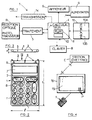
- Figure 1 is a simplified block diagram of an electronic portable device according to an embodiment of the invention.
- Figure 2 is a plan view of the device.
- FIG. 3 is a view along arrow III, FIG. 2.
- Figure 4 is a diagram illustrating the use of the device in conjunction with a television receiver.
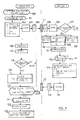
- FIG. 5 is a functional diagram illustrating the steps of a certification and authentication process by means of a first embodiment of the device of the invention.
- Figure 6 is a diagram illustrating the certification function performed by the process of Figure 5.
- FIG. 7 is a diagram illustrating the implementation of the certification and authentication process of FIG. 5.
- FIG. 8 is a diagram illustrating the implementation of the certification and authentication process of FIG. 5 by means of a screen and keyboard terminal connected to a server.
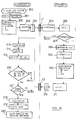
- Figure 9 is a diagram similar to that of Figure 7 illustrating the implementation of the certification and authentication process with a device according to a second preferred embodiment of the invention.
- Figure 10 is a diagram similar to that of Figure 9 illustrating the implementation of the certification and authentication process with a device according to a third embodiment of the invention.
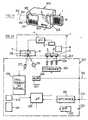
- FIG. 11 is a schematic perspective view of a terminal usable in connection with the device of FIG. 1, and
- FIG. 12 is a functional diagram illustrating data exchanges between the terminal of FIG. 11 and the device of FIG. 1.
- This device comprises an outer box 2 of rectangular parallelepiped shape, preferably made of plastic, and whose thickness e (FIG. 3) is small, compared to its width l and its length L.
- the size of the box is adapted so that it can be held in one hand.
- the device comprises optical reception means R advantageously constituted by phototransistors 3 ( Figures 2 and 3) arranged on the edge of a small side of the housing 2, and in particular aligned. In the example considered, there are three phototransistors.
- the reception means R are connected to a microcomputer 4, by means of processing means 5 suitable for converting the light signals received into electrical signals of format adapted to the microcomputer 4.
- the device 1 comprises a display 6, preferably liquid crystal (LCD), forming a rectangular screen 7 (Figure 2) on the housing.
- this screen 7 is designed to display eight alphanumeric characters, aligned.
- the display 6 makes it possible to display information coming from the microcomputer.
- This battery is preferably embedded in the housing 2 during the manufacture of the device so as to be made inaccessible and to prohibit its replacement as well as any access to the supply conductors of the various electronic circuits of the device, also embedded in the housing 2.
- this inaccessible battery can be reserved for supplying the clock and RAM memory circuits and the other circuits can be supplied by an interchangeable battery.
- the microcomputer 4 is a masked microcomputer, in CMOS technology. It can be of the MC68HC ⁇ 5B6 type, from Motorola, for a self-programming microcomputer version, or of the NEC 753 ⁇ 8 type for a version with RAM storage memory, or else of the specific circuit type (ASIC) for a version with protected RAM.
- the specific circuit will be developed from a standard microcomputer of the previous types in which the memory protection means will be included. These protection means could be constituted by a blown fuse after writing the memory.
- the microcomputer has a read only memory (ROM) 11 and a storage memory 12.
- the storage memory 12 can be a PROM or an EEPROM, or advantageously a RAM saved by the power source.
- the RAM memory is inaccessible from outside the device and any attempt causes the erasing of the information written therein and makes the device unusable.
- Personalization data is stored there once and for all, operating data can be modified. The protection of personalization data in RAM memory 12 results from the simple structured programming of the microcomputer 4.
- the data bus and the address bus (not shown in the drawings) of the microcomputer 4 are not accessible from the outside, so as to make it impossible to read or fraudulently modify, from the outside, the information contained in the read only memory 11 and the storage memory 12 of the device 1.
- the device can only be made active after pressing the ID key and entering, on the keyboard 8, a confidential identification code PIN of the user of the device. This confidential code is known only to the holder of the device 1.
- the program stored in the memory 11 can also be provided to block the device 1 after consecutive entry of a certain number of incorrect confidential codes on the keyboard 8, for example four codes.
- the device 1 then becomes unusable, and the reactivation of the device can only be ensured by a special procedure, for example on a server center.
- the device 1 can be provided with specific means 14 for transmitting data to the outside, in particular to a server, for the implementation of procedures which will be described below.
- These transmission means can be optical, electric, radioelectric, acoustic or other and take any suitable form known to those skilled in the art.
- the device 1 is also equipped with a clock 10.
- This clock can for example consist of a time base 10A and a counter 10B supplied with permanently by the power source 9.
- the counter 10B emits a wake-up pulse from the microcomputer 4.
- the latter increments the time elapsed since the customization of the device and then returns to the standby state until the appearance of the next pulse from the counter 10B.
- the microcomputer 4 is programmed to automatically inhibit the operation of the device 1, for example by erasing the content of the personalization information in memory 12.
- the clock 10 also has the role, with the microcomputer 4, of ensuring the certification of the results or gains obtained after participating in a television program or the like.
- the possible game scenarios are extremely numerous and are not the subject of the present invention.
- This generally aims to allow an individual, on the one hand, to participate in a program or broadcast broadcast by entering by the keyboard of his device one or more data representative of his participation, whether '' one or more answers to one or more questions asked, at the start, during or at the end of the broadcast, of one or more random numbers chosen by the individual as part of a lottery, the setting of a certain amount (money, points), etc ..., and, on the other hand, to validate the result of this participation in connection with a server.
- the invention will be more particularly described below in its application to games using sequences of questions and answers.
- the emissions or programs can be diffused on television receivers by a cable or hertzian network, on telematic terminals (for example of the MINITEL type), on computer terminals, or even on radio receivers if the device is equipped with appropriate means, as described for example in US Pat. No. 4,745,468, for downloading the script.
- the device 1 is provided with optical reception means R and the data or parameters defining the scenario which will allow the spectators to participate in a program, hereinafter also called a game, are transmitted by a transmitting station E (FIG. 4) at the start of the latter in the form of a variable light image such as a test pattern p which is displayed in overlay on the screen 15 of a television receiver 16.
- a transmitting station E FIG. 4
- CCC coherence control
- CRC error detection
- the chronology of the downloaded scenario is such that, in the devices, the game takes place in synchronism with the program broadcast by the transmitting station.
- the player To participate in the game or broadcast program, the player must first download to his device the aforementioned scenario data transmitted by the transmitting station E ( Figure 4). Depending on the amount of data to be transmitted, it may take a fraction of a second to several seconds to download it to a device. This time is very short, it is necessary to repeat the download sequences on the screen for a sufficient period of time, for example from a few tens of seconds to more than a minute, to ensure that viewers have been able to download in their device the scenario of the upcoming game.
- Pressing the "TELE” key has the effect of generating an interrupt selecting the program for receiving optical data from the microcomputer 4. If the device is equipped with an identification function, the individual must first make it active by pressing the "ID” key then entering the confidential identification code (NID) using the keyboard 8. As a variant, the abovementioned interruption can be generated by a particular optical frame preceding the transmission of the data to be downloaded.
- the optical reception means R convert the variations in brightness of the screen 15 into electrical signals which are converted into binary signals of the desired format by the processing means 5.
- the data received is decoded (decryption) by the microcomputer 4 which, when 'it has received all the desired data, displays on the screen 7 of the display 6 a message, such as "READY", indicating that the device is ready for operation.
- the time allowed for responding can be displayed on the screen in the form of a countdown in seconds, and at the same time the microcomputer 4 can invite the user to respond by displaying information on the screen, for example the sign "?".
- the user then enters his response on the keyboard and confirms it by pressing the "ENT" key and, from this moment, the microcomputer 4 counts the time which elapses, clocked by the clock 10, with a view to subsequent certification of the result or score obtained by the user at the end of the game.
- the microcomputer 4 compares each response entered on the keyboard 8 with the correct response downloaded and stored in the memory 12 and updates the score of the player as a function of parameters which either have been downloaded or are part of the program of the microcomputer relating to the game in question.
- the microcomputer can be programmed to display on the screen 7 a message indicating whether or not the player has given the correct answer ("BRAVO", "DESOLE"), whether or not this correct answer is given on the screen during or at the end of the show.
- the microcomputer 4 can also be programmed to display on the screen 7 the score achieved by the player at the end of the game, either in number of correct answers, in number of points or in any other appropriate form. Pressing the "CL" key also makes it possible, depending on the programming of the microcomputer 4, to display the score obtained on the last game or on several accumulated games.
- the microcomputer 4 automatically goes into standby mode in order to reduce the consumption of electrical energy.
- the microcomputer is periodically reactivated by the clock 10, which makes it possible to count the time elapsed since the introduction of the first response to the game.
- This server is for example a computer which has in memory the absolute deadlines of reference events of programs or emissions for which players are likely to have their result validated.
- This server is also equipped with a clock synchronous with the clock 10 of the device 1 and making it possible to calculate the time elapsed between the absolute date of one of these events and the absolute date on which it is entered by a player of a request for certification and authentication of its result for the game in question.
- the gains made by the user are credited to the server S.
- the server call can be made in different ways, for example, by telephone communication with an operator of the server or by means of a conventional computer or telematics terminal or of a specific terminal connected to the server.
- the certification and authentication request can be transmitted to the microcomputer 4 via the keyboard 8 or optical reception means R.
- the server is likely, at a given moment, to validate the results obtained in several different games, provision may be made for the player to indicate to the server a code, for example a number, identifying the game for which he wishes to have his result validated. .
- its device 1 must, after having possibly been made active by the identification procedure, be put in a state to receive the certification and authentication request, either by pressing the "ID” key if the request is transmitted under form of a digital code via the keyboard, either by pressing the "TELE” key or by receiving a specific optical frame if the request is transmitted to reception means R in optical form: this state is decoded by the microcomputer 4 (step 50, FIG. 5).
- This code is transmitted to the microcomputer 4 (reception means R or keyboard 8) which ensures decryption 51 thereof using an algorithm installed in the ROM memory 11.
- the microcomputer 4 compares the value ⁇ T ref received from the server with the value ⁇ T int representing the time measured between the time of introduction of the answer to the first question of the game considered and the time of reception by the microcomputer of the certification request and the authentication (step 52).
- the gain or result of the game is certified and the microcomputer 4 emits a composite code (step 53) by coding, according to a given algorithm, as a function of the random number transmitted. by the server, of the certified result or gain and of an internal identification code (NII) loaded in the storage memory 12 during the personalization of the device.
- a composite code by coding, according to a given algorithm, as a function of the random number transmitted.
- This composite code is displayed on the display 6 (step 54) in alphanumeric form in order to be transmitted to the server (by telephone, introduction to the keyboard of a terminal or reading by a specific terminal or terminal as described for example in the request French patent FR-A- 2 650 416 with a view to continuing the authentication procedure which will be described in more detail below.
- this composite code can be transmitted to the server by the transmission means 14 if the device is equipped with it. Its display on screen 7 can then be omitted.
- step 52 If, in step 52, the difference between ⁇ T int and ⁇ T ref is not correct, the microcomputer emits a composite code with the zero gain or result information (step 55) and displays this code (step 54).
- the microcomputer emits a non-coherent composite code (random data) to protect against fraud (step 56) and displays this code not consistent (step 54).
- the total number of composite codes per day can be limited: beyond a defined number, the device emits a non-coherent composite code in order to protect against fraud (successive tests).
- the time difference between the end of a game and the request for certification and authentication must preferably be limited, for example to half a day, in order to take into account the possible drifts of the clocks of the various devices in service.
- a duration of this order is sufficiently short for the differences between the different clocks to remain within an acceptable range.
- date means the position of an event on an absolute time scale of defined origin, for example the usual calendar. We will assume that the times, and therefore the "dates", are measured to the nearest tenth of a second.
- T2 T5 - ⁇ T int
- the device 1 only measures relative times, thanks to the absolute time T5 supplied by the server, it is possible to know the absolute time T2 of the player's response to the first question (that is to say -date to date this event) and to check if this response has been made before the absolute time T3 at which the correct response was given on the screen.
- the starting point of ⁇ T int is not necessarily that of the answer to the first question: it may be the answer to the nth question since the chronology of the scenario of the game's progress is frozen by the downloaded data.
- the starting point of ⁇ T ref will be the end of the response time to the n th question.
- ⁇ T int can be measured or calculated from a predetermined event in the scenario, for example T0, T1, T1 etc ...
- the server calculates ⁇ T ref , transmits it to the device as indicated above and the microcomputer 4 compares ⁇ T int and ⁇ T ref .
- the value ⁇ T int and the result calculated by the microcomputer 4 can be transmitted from the device 1 to the server which performs the comparison between ⁇ T int and ⁇ T ref and certifies or not the result.
- the certification of the result results from the measurement, by the microcomputer 4 and the clock 10, of the "certificate" which constitutes the time .T int .
- the result is certified if the difference between ⁇ T ref and ⁇ T int is less than a defined tolerance ⁇ .
- This tolerance ⁇ is fixed as a function of the maximum foreseeable drift of the clocks of the devices over the maximum time allowed for validating a result (half a day for example), of the precision on the measurement of the times and of the maximum time allowed between the date T5 of data supply by the server (game code, ⁇ T ref , random number) and date T'5 of entry of the composite code in the server.
- the admissible delay must be significant, of the order of several tens of seconds, in order to give the users time to carry out the necessary operations.
- the microcomputer 4 stops its calculation of the time ⁇ T int on the date T'5 after the date T5.
- a maximum delay T6-T5 will be given to the server to accept the composite code associated with the data supplied to the device.
- the overall tolerance ⁇ must take account of the aforementioned parameters while being less than T4 - T3, that is to say at the time separating the deadline for providing a response by the players from the date for providing the correct response on the screen.
- FIG. 7 is a functional diagram illustrating the optical implementation of the certification and authentication process of FIG. 5.
- the left part of this figure corresponds to the communication automaton of the server S.
- the part located on the right the dashed line (which shows a terminal 13 of the server S) corresponds to the device 1.
- Block 17 corresponds to the generation of a random number a and to the calculation of time ⁇ T ref by the server S.
- Block 18 corresponds to the coding and the display of this data on the screen 13e of the terminal.
- Block 19 corresponds to the optical reception of the data by the phototransistors 3 of the device 1.
- Block 20 corresponds to the decoding, by the microcomputer 4, of the received data.
- Block 21a corresponds to the reading by the microcomputer 4 of the NII code and block 21b to the certification of the result G (comparison ⁇ T int , ⁇ T ref ).
- Block 25 corresponds to the calculation by the microcomputer 4 of a composite code x from the code NII, the result G, the time ⁇ T ref and the random number received a , according to an algorithm A.
- Block 22 corresponds to the display on screen 7 of device 1 of the composite code x calculated at 25.
- the user shown diagrammatically by a circle 23, after reading on the screen 7, enters the code displayed x on the screen 7 on the keyboard 13c of the terminal 13.
- Block 24 corresponds, in the server S, to a calculation carried out, by means of the random number a according to an algorithm B correlated to algorithm A, on the composite code x to decode the result G and calculate an external identification code NIE, the result G being validated when there is consistency of the external NIE identification code with control information known to the server. If algorithm B is symmetrical with algorithm A, the NIE and NII codes are equal in case of consistency.
- the result or gain G thus validated is stored in memory by the server and assigned to the owner of the device, which is identified, for example, by the NIE code (block 26). If there is no consistency, the result is not affected.
- Consistency can be established, for example, by processing on the NIE code, according to predetermined coding rules, and / or by correlation of the NIE code with external information entered by the user in the server, for example the number of card series, user name, password, etc.
- FIG. 8 is a diagram illustrating the progress of the certification and authentication process using the device 1 of the invention, in connection with a server S provided with a terminal 13 with screen and keyboard. This figure 8 explains some of the functions described in connection with figure 7.
- Block 30 corresponds to the establishment of the connection with the server S which generates a pattern (block 31), that is to say, appears on the screen 13e of the terminal of the blocks luminous p which, in the example shown, consist of three aligned rectangles.
- the device 1 is in place for receiving information by optical means.
- the server S in response to pressing the key on the keyboard 13c, generates and transmits, to the terminal 13, in coded form, the random number, the game number and the time ⁇ T ref , as indicated by block 32.
- the corresponding information is expressed on the screen 13e by variations in the brightness levels of the blocks p , information which is received by the device 1.
- the latter certifies or not the result G and shows on the screen 8 an alphabetical composite code and / or numeric that the user enters on the keyboard 13c, which corresponds to the block 33 of input by the server S.
- Block 34 corresponds to the calculation, by the server S, of a code identifying the device, from the random number generated at 32 and from the composite code entered on the keyboard 13c.
- the server then requests the operator to type on the keyboard 13c the serial number appearing on the device in his possession (step 35).
- the server S checks in a file F, as indicated by block 36, the concordance between the serial number and the number or NIE code calculated by block 34.
- the gain G is validated and it is assigned to the user in a memory of the server, for example by asking the latter to identify himself on the terminal 13c.
- the results or gains obtained by the participants are managed centrally at the server level.
- This solution offers the advantage, when the device is portable, that its holder can easily use the credit available to him, either to participate in new games, or anywhere (point of sale for example) equipped with a terminal or terminal capable of authenticating the device and of reading and debiting the protected credit memory.
- This terminal or terminal is not necessarily connected to the server if the gain credited to the device has been previously validated.
- the gain may then be preferable for the gain to be credited, inside the device, in a part of its memory 12 constituted by a conventional protected memory of the type encountered, for example, in the microcircuit cards.
- a conventional protected memory of the type encountered, for example, in the microcircuit cards.
- Such protected memory cards are described, for example, in the work entitled "The microcircuit cards” by F. Guez and C. Robert published in 1988 by MASSON (France).
- FIG. 9 illustrates a certification and authentication process of result credited in the device 1.
- the part situated to the right of the dashed line corresponds to a communication automaton of the server S.
- the part situated to the left of the dashed line (which diagrams the interface or interfaces between the device and the server S) illustrates the functions implemented work by device 1, which is assumed to be portable.
- the holder of device 1 hereinafter also called the player, is assumed to have participated in a program (betting, lottery, interactive game %) as described previously and obtained a certain gain which he wants to have validated in his device.
- the validation procedure must be triggered in the device 1 by actuation of a key or a combination of keys of the keyboard 8 (step 100).
- the device includes a "validation” key (not shown), replacing for example the "ID” key described above.
- the triggering of the certification and authentication process may or may not be subject, after pressing the "validation" key, to the entry by the user of a confidential identification code.
- the microcomputer determines the relative time ⁇ T int which has elapsed between the absolute date of the event characteristic of the player's participation in the program (bet, answer to a question, etc.) and the absolute date on which the certification and authentication process was initiated as described above.
- the certificate can also include other information such as the internal identification code NII of the device in order to perfect its authentication. by the server, the gain G contained in the device, etc ...
- the certificate is then encrypted in step 103 by means of a variable key known to the server S, a key which can be calculated for example from the current date and / or from variable information forming part of the data downloaded in the system for participation in the program.
- a CRC error control code is then associated with the certificate encrypted in step 104.
- the encrypted certificate is transmitted to the server S by appropriate means symbolized in the form of an interface I1. If the length of the certificate allows, the encrypted certificate will be displayed in alphanumeric form on screen 7 of the device and entered into the server, either by the player on the keyboard of a terminal, or by an operator in telephone contact with the player, or by any other appropriate means.
- the encrypted certificate can be transmitted to the server by a digital link between the device and the server terminal, for example of the acoustic modem type, the device then comprising a conventional acoustic transducer.
- step 105 the server S checks the certificate received by means of the error control code CRC that this certificate contains.
- the next step 106 consists in decrypting the certificate and the step 107 is a test performed on the certificate in order to check the consistency as a function of the consistency check code CCC that it contains.
- the server S extracts from the certificate the secret information a (step 108) and the time ⁇ T int (step 109) and calculates the time ⁇ T ref (step 110).
- the next step 111 is a comparison between the times ⁇ T int and ⁇ T ref . Depending on whether the difference between ⁇ T ref and ⁇ T int is less than or greater than a defined tolerance, the validation procedure in progress is continued or rejected (step 112).
- the latter can carry out other operations such as checking the internal identification number NII or saving the gain if the certificate contains such information.
- the server proceeds at 113 to the development of a validation code containing a validation key intended to be recognized by the device.
- This validation key can be fixed but it is preferably variable: for example, it can be a function of data supplied to the device when downloading the program which generated the gain during validation, it can be a function of the date instant, etc ...
- the validation code can also contain other information related to the operation of the device, for example the amount of the gain that will be allocated in the device to the user, a rule for calculating this gain in the device, etc. ..
- the validation key is associated with a coherence control code CCC and the set is encrypted in step 114 by means of secret information a , which can also be part of the validation code.
- a CRC error control code is associated with the encrypted validation code.
- This code is transmitted to the device 1 by means symbolized by an interface I2 which may consist, either in the display or the transmission by an operator of this code in the form of alphanumeric characters which the user only has to enter in its device by means of the keyboard 8, either in a digital connection of acoustic, light or other type.
- the validation code encrypted can for example be transmitted from the server S to the device 1 by generation of a light sequence capable of being read by the phototransistors 3 with which the device is provided.
- the microcomputer of the device carries out a check of the received message according to the CRC error check code attached thereto and then proceeds to decrypt the validation code based on the secret information only the microcomputer knows since it was generated and memorized by it.
- the encryption and decryption operations implemented in steps 103, 106, 114 and 117 use conventional software well known to specialists in this technique.
- the consistency of the validation code is tested in step 118 as a function of the associated CCC consistency control code and, in the event of a lack of consistency, the validation procedure in progress is rejected.
- the microcomputer proceeds in 119 to the calculation of the validation key from the same parameter (for example instantaneous date, information supplied to the device when the program is downloaded, etc.) as that which served the server. to calculate the validation key transmitted to the device.
- the same parameter for example instantaneous date, information supplied to the device when the program is downloaded, etc.
- the microcomputer of the device proceeds in 120 to a test to determine whether the validation keys calculated on the one hand by the server, on the other hand by the device, are equal or consistent. If not, the validation procedure in progress is rejected, otherwise, participation in the game is validated in 121, the gain which results from it is calculated in 122 and the amount of this gain is credited in 123 in the memory protected with which the device is equipped.
- the gain is credited directly to the device by which it was obtained, but the certification that this gain has been achieved by playing with the device before an authorized time limit is performed in the server.
- the certification can be carried out and the gain can be credited directly in the device 1 as shown in FIG. 10 to which reference will be made.
- the validation process is triggered by the actuation of a "validation" key or of a combination of several keys (step 200).
- This action has the effect of triggering a timer (step 201) to measure the time that elapses between the start of the validation procedure and the reception by the device of a certificate issued by the server as will be described below. .
- step 202 the microcomputer generates a message similar to that of step 102 in FIG. 9, except that this message does not contain the time ⁇ T int .
- the message developed in step 202 is encrypted in 203 as described with respect to step 103, then assigned a CRC error control code at 204.
- This message is then transmitted to the server S via the interface I1 as described with reference to FIG. 9.
- an error check is carried out in 205 using the CRC code and the message is decrypted in 206.
- the consistency of the decrypted message is tested in step 207 using the consistency check code CCC contained in the message. If the message does not appear consistent, the current validation procedure is aborted.
- the server S determines in step 208 the time ⁇ T ref which has elapsed between the deadline for participation in the program (date which is naturally known to the server) and the instantaneous date, that is to say -tell the date on which the server is seized of a coherent message representative of a validation request.
- the server proceeds in 209 to the extraction of the secret information a from the received message and in 210 produces a certificate containing the time ⁇ T ref obtained in step 208.
- the certificate of step 210 in addition to a consistency check code CCC, may contain other information (amount of gain, calculation rule gain, etc.) linked to the operation of the system.
- the server can also proceed to an authentication of the device on the basis, for example, of the internal identification number NII thereof, if it is contained in the message transmitted from the device to the server.
- the gain cannot, at this stage, be stored in the server for statistical or control purposes as in the case of FIG. 9, because certification does not take place in the server but, in a second stage, in the device.
- the certificate produced in step 210 is encrypted at 211 by means of secret information a (information which may or may not be part of the certificate), then the encrypted certificate is endowed at 212 with an error control code CRC .
- the encrypted certificate is transmitted to the device 1 by the interface means I2 which have been described with reference to FIG. 9.
- the microcomputer 213 of the device proceeds in the control of the certificate by means of the CRC code, in decryption 214 using the secret information is developed at step 202 and stored by the microcomputer, and determines 215 the time .DELTA.t int .
- the next step 216 is a test making it possible to determine whether there is consistency between the time ⁇ T int measured in the device and the time ⁇ T ref produced by the server. If not, the current validation procedure is rejected.
- the microcomputer examines in 217 whether the time which has elapsed since the triggering of the timer in step 201 is greater than or not greater than a predetermined duration stored in the microcomputer.
- the purpose of this time delay and this test is to prevent fraud which could consist, after step 212, in delaying the introduction into the device of the certificate produced by the server and thus artificially increasing the time ⁇ T int . If the time elapsed since the start of the timer in 201 is greater than the aforementioned predetermined duration, the validation procedure is aborted.
- the microcomputer validates in 218 the participation in the program, calculates the gain obtained in 219 and credits it in the protected memory reserved for this purpose in 220.
- This terminal can be a conventional screen and keyboard terminal or, for example, a specific terminal such as the terminal described with reference to FIGS. 11 and 12.
- Such a terminal is the subject of French patent application FR-A-2 650 416 to which reference may be made.
- This terminal 302 comprises, in a housing 310, in addition to a reception station 303 of the portable device 1, a keyboard 311 and a screen 312 of any known type, which are organs conventionally arranged on any computer terminal for input and data display.
- a line 313 possibly connects the terminal 302 to the server S.
- Another line 314 ensures the electrical supply of the terminal by the sector.
- the reception station 303 comprises optical reading means constituted by a light source 315 for illuminating a range 316 of the screen 7 of the device 1 (a light-emitting diode or LED, for example) and a photosensitive sensor 317 (a phototransistor for example ), preferably directional, oriented towards this range in a chosen direction.
- the light source can be supplied electrically from the mains by the line 314, through a supply circuit 326 which also produces supply voltages for the other organs and circuits of the terminal, voltages supplied on the output lines 327.
- the quantity of light reflected by range 316 is modulated on the axis of the optical sensor 317, which then produces an electric signal modulated as the reflectance of the range 316.
- filtering and shaping in a signal processing block 318, of this signal, there is a digital signal which enters information processing means 320, a microprocessor for example, arranged in the terminal 302.
- the digital information thus received by the microprocessor 320 is then con form to that emitted by the portable device 1 and transmitted by the liquid crystal screen 7, normally used for other purposes.
- the terminal 302 also comprises means for the optical transmission of information 325 cooperating with the optical reception means R of the device 1.
- These optical transmission means 325 are preferably constituted by several photoemitting organs, such as light-emitting diodes, arranged in the reception station 303 so as to be aligned each with a phototransistor 3 of the device 1 when the latter is engaged in the reception station 303.
- the organs Photoemitters 325 are controlled by the microprocessor 320 via a control circuit 324.
- the information that the microprocessor 320 transmits to the device 1 can relate, for example, to the type of information that the microcomputer 4 of the device 1 must transfer to the terminal 302.
- the microprocessor 320 supplied with the information thus received, relating to the gain of a player, can trigger actions such as the issue in 323 of a ticket by a printer 322 incorporated in the reader, the ticket carrying information allowing the player to assert these gains, and the emission by the photoemitting organs 325 of an acknowledgment in response to which the microcomputer 4 decrements from the memory of the device 1 the amount of the gain which has been credited to the player.
- the exchanges of information between the device 1 and the terminal 302 are preferably encrypted in a similar manner to that described previously with regard to the certification and authentication processes.
- the digital information received by the microprocessor 320 can also be formatted and conformed in an interface 321 before being injected on the line 313 to be transmitted to the server.
- This terminal 302 can therefore advantageously be used as a server terminal for the implementation of the certification and authentication processes described above.
- This terminal allows an automatic bidirectional exchange of information, therefore free of the errors and delays involved in the manual transcription of information on a keyboard by a user (which contributes to improving the reliability of the certification and authentication process. when the terminal is used for this purpose), without this additional possibility increasing the manufacturing cost of the portable device 1, which must be as low as possible.
- the microcomputer 4 present in the portable object must be duly programmed according to a specialized protocol ensuring the control of the reflectance of the range 316 in accordance with the information to be transmitted.
Landscapes
- Engineering & Computer Science (AREA)
- Multimedia (AREA)
- Signal Processing (AREA)
- Physics & Mathematics (AREA)
- Theoretical Computer Science (AREA)
- General Physics & Mathematics (AREA)
- Business, Economics & Management (AREA)
- Electromagnetism (AREA)
- Computer Hardware Design (AREA)
- Microelectronics & Electronic Packaging (AREA)
- Educational Administration (AREA)
- Educational Technology (AREA)
- Computer Security & Cryptography (AREA)
- General Business, Economics & Management (AREA)
- Storage Device Security (AREA)
- Two-Way Televisions, Distribution Of Moving Picture Or The Like (AREA)
Claims (27)
- System zur Teilnahme mindestens einer Person an einem fernübertragenen Programm gemäß eines Programmablaufs (Szenario), der in einer individuellen und autonomen elektronischen Vorrichtung zur Teilnahme und zur Bestätigung dieser Teilnahme in Verbindung mit einem Server gespeichert ist, welches folgendes aufweist:- Schnittstellenmittel zur Eingabe von mindestens einem für die Programmteilnahme repräsentativen Datensatz durch einen Teilnehmer und zum Aufbau einer Verbindung zur Bestätigung mit dem Server,- Mittel zur Speicherung des Teilnahmedatensatzes und des Programmablaufs, und- eine Uhr,dadurch gekennzeichnet, daß:- die Vorrichtung (1) Mittel (4, 10) zur Messung der relativen Zeit (δTint) aufweist, die zwischen zumindest einem ersten Ereignis des Programmablaufs, welcher chronologisch in Beziehung mit der Eingabe eines Teilnahmedatensatzes in die Vorrichtung steht, und dem Aufbau der Verbindung zur Bestätigung mit dem Server (S) vergangen ist,- der Server (S) Mittel (110, 208) zur Messung der relativen Zeit (δTint) aufweist, die zwischen zumindest einem zweiten Ereignis des Programms, welches chronologisch in Beziehung mit einem absoluten Grenzzeitpunkt zur Eingabe des Teilnahmedatensatzes steht, und dem Aufbau der Verbindung zur Bestätigung vergangen ist, und- die Vorrichtung und/oder der Server Mittel (111, 216) aufweisen zum Vergleich der in der Vorrichtung und dem Server gemessenen Relativzeiten und zur Bestätigung oder Nicht-Bestätigung der Teilnahme in Abhängigkeit vom Ergebnis des Vergleichs.
- System nach Anspruch 1, dadurch gekennzeichnet, daß das erste Ereignis aus der Eingabe eines Teilnahmedatensatzes in die Vorrichtung besteht.
- System nach einem der Ansprüche 1 und 2, dadurch gekennzeichnet, daß das zweite Ereignis aus dem absoluten Grenzzeitpunkt zur Eingabe eines Teilnahmedatensatzes in die Vorrichtung besteht.
- System nach einem der Ansprüche 1 bis 3, dadurch gekennzeichnet, daß der Programmablauf repräsentative Parameter des chronologischen Ablaufs des Programms enthält, und dadurch, daß die Vorrichtung Zeitgebermittel zur Durchführung des Programmablaufs nach dieser Chronologie aufweist.
- System nach einem der Ansprüche 1 bis 4, dadurch gekennzeichnet, daß die Vergleichsmittel (111, 216) geeignet sind, die Teilnahme zu bestätigen, falls innerhalb eines gegebenen engen Toleranzrahmens (τ) zwischen den in der Vorrichtung (δTint) und dem Server (δTref) gemessenen Relativzeiten Gleichheit besteht.
- System nach einem der Ansprüche 1 bis 5, dadurch gekennzeichnet, daß die Vorrichtung Mittel zur Datenverarbeitung (4) umfaßt zur Lieferung eines Ergebnisses, das von dem Teilnahmedatensatz abhängt, und daß die Vergleichsmittel (111, 216) geeignet sind zur Bestätigung oder Nicht-Bestätigung des Ergebnisses.
- System nach Anspruch 6, dadurch gekennzeichnet, daß der Server (S) Speichermittel aufweist, in denen das Ergebnis nach erfolgter Bestätigung abgelegt wird.
- System nach Anspruch 7, dadurch gekennzeichnet, daß die Vorrichtung Mittel zur Authentifikation (4) aufweist, die geeignet sind, einen durch Codierung zusammengesetzten Code auszugeben, wobei die Codierung gemäß eines ersten gegebenen Algorithmus (A), welcher abhängig ist von externen, vom Server (S) stammenden Befehlsinformationen, die chiffriert sein können und eine Zufallszahl (a) enthalten, des Ergebnisses und des der Vorrichtung eigenen, in den Speichermitteln gespeicherten Identifikationscodes (NII) erfolgt, und wobei der Server (S) mittels der Zufallszahl (a) und gemäß eines mit dem Algorithmus (A) korrelierten Algorithmus (B) in der Lage ist, aus diesem Code das decodierte Ergebnis und einen externen Identifikationscode (NIE) zu berechnen, und das Ergebnis in Speichermitteln abgelegt wird, falls der externe Identifikationscode (NIE) mit dem Server bekannten Kontrolldaten kohärent ist.
- System nach Anspruch 8, dadurch gekennzeichnet, daß sich die Vergleichsmittel im Server (S) befinden, und die Mittel zur Authentifikation (4) geeignet sind zur Erzeugung eines zusammengesetzten Codes, welcher auch die in der Vorrichtung gemessene Zeit (δTint), im Hinblick auf ihre Verwendung mit den Vergleichsmitteln im Server (S), enthält.
- System nach Anspruch 6, dadurch gekennzeichnet, daß die Speichermittel geeignet sind, das Ergebnis nach erfolgter Bestätigung zu speichern.
- System nach Anspruch 10, dadurch gekennzeichnet, daß sich die Vergleichsmittel (111) im Server (S) befinden, und dadurch, daß die Vorrichtung Mittel zur Authentifikation enthält, welche folgendes aufweisen:- Mittel (4) zur Ausarbeitung einer Bestätigung, welche die in der Vorrichtung gemessene Relativzeit (δTint) beinhaltet,- Mittel (4) zur Chiffrierung der Bestätigung,- Mittel (I₁) zur Übertragung der chiffrierten Bestätigung zum Server,- Mittel (I₂), um nach erfolgter Bestätigung des Ergebnisses durch die Vergleichsmittel einen chiffrierten Freigabecode vom Server zu empfangen, der einen ersten Freigabeschlüssel aufweist, welcher durch den Server in Abhängigkeit von Daten, die den Verarbeitungsmitteln bekannt sind, berechnet wird,- Mittel (4) zur Dechiffrierung des Freigabecodes,- Mittel (4) zur Berechnung eines zweiten Freigabeschlüssels, abhängig von Daten, die den Verarbeitungsmitteln bekannt sind.- Mittel zum Vergleich des ersten und des zweiten Freigabeschlüssels, und- Mittel (4), um das Ergebnis in den Speichermitteln abzulegen, falls der erste und zweite Freigabeschlüssel miteinander kohärent sind.
- System nach Anspruch 10, dadurch gekennzeichnet, daß die Vergleichsmittel (216) in der Vorrichtung (1) angeordnet sind, und dadurch, daß letztere Mittel zur Authentifikation enthält, welche folgendes aufweisen:- Zeitgebermittel (4), die bei Vorliegen einer Anfrage zur Freigabe eines Ergebnisses initialisiert werden,- Mittel (4) zur Ausarbeitung einer charakteristischen Nachricht für eine Freigabeanfrage,- Mittel zur Chiffrierung der Nachricht,- Mittel (I₁) zur Übertragung der chiffrierten Nachricht zum Server,- und Mittel (I₂), um vom Server (S) eine chiffrierte Bestätigung zu empfangen, welche die vom Server gemessene Bezugsrelativzeit (δTref) enthält,- Mittel (4), um die Bestätigung zu dechiffrieren, und um die Bezugsrelativzeit (δTref) auf die Vergleichsmittel (216) anzuwenden, und- Mittel (4), um das Ergebnis nach der durch die Vergleichsmittel erfolgten Bestätigung in den Speichermitteln abzulegen, falls die durch die Verzögerungsmittel (201) gemessene Zeit geringer ist als eine vorher bestimmte begrenzte Zeitspanne.
- System nach einem der Ansprüche 11 und 12, dadurch gekennzeichnet, daß die von der Vorrichtung (1) zum Server (S) übertragene Bestätigung oder Nachricht geheime, den Verarbeitungsmitteln bekannte Information (a) enthält, und dadurch, daß die vom Server (S) zur Vorrichtung (1) übertragene Freigabe oder Bestätigung abhängig von der geheimen Information verschlüsselt ist.
- System nach einem der Ansprüche 11 bis 13, dadurch gekennzeichnet, daß die von der Vorrichtung zum Server übertragene Bestätigung oder Nachricht abhängig von dem Server bekannter Information verschlüsselt ist.
- System nach einem der Ansprüche 1 bis 14, dadurch gekennzeichnet, daß die Schnittstellenmittel eine Tastatur (8) mit alphabetischen und/oder numerischen (t) Tasten zur Eingabe der Daten in die Vorrichtung umfassen.
- System nach Anspruch 15, dadurch gekennzeichnet, daß die Vorrichtung Mittel (4) zur Identifikation besitzt, die geeignet sind, einen mittels der Tastatur eingegebenen Code mit einem vertraulichen Identifikations- code (NID), welcher in den Speichermitteln (11, 12) abgelegt ist, zu vergleichen und die Vorrichtung im Fall von Übereinstimmung der Codes zu aktivieren.
- System nach einem der Ansprüche 1 bis 16, dadurch gekennzeichnet, daß die Schnittstellenmittel über Empfangsmittel für fernübertragene, codierte Daten verfügen, welche repräsentativ für den zu dem Programm gehörenden Programmablauf einer Teilnahme sind.
- System nach Anspruch 17, dadurch gekennzeichnet, daß die Daten zum Programmablauf chiffriert sind und die Vorrichtung (1) über Mittel zur Dechiffrierung der Daten verfügt.
- System nach einem der Ansprüche 17 und 18, dadurch gekennzeichnet, daß die Empfangsmittel (R) durch optische Mittel (3) zum Lesen der in Lichtform übertragenen Daten gebildet werden.
- System nach einem der Ansprüche 1 bis 19, dadurch gekennzeichnet, daß die Schnittstellenmittel über Mittel (7) zum Anzeigen von in der Vorrichtung gespeicherten und/oder verarbeiteten Daten verfügen.
- System nach einem der Ansprüche 1 bis 20, dadurch gekennzeichnet, daß die Mittel zur Entschlüsselung, zur Datenverarbeitung, zur Bestätigung, zur Authentifikation, zur Zeitgabe und zur Identifikation durch einen programmierten Rechnerchip (4) gebildet werden, der mit den Speichermitteln (11, 12) und den Schnittstellenmitteln (7, 8, R) verschaltet ist.
- System nach Anspruch 21, dadurch gekennzeichnet, daß die Uhr über eine Zeitbasis (10) verfügt, welche dauernd von einer elektrischen Stromquelle versorgt wird und mit dem Rechnerchip (4) verschaltet ist, wobei der Rechnerchip darauf programmiert ist, die seit der Speicherung eines für die autorisierte Lebensdauer der Vorrichtung repräsentativen Datensatzes vergangene Zeit zu messen, und das Funktionieren der Vorrichtung nach Ablauf der vorbestimmten Lebensdauer zu verhindern.
- System nach einem der Ansprüche 1 bis 22, dadurch gekennzeichnet, daß folgendes vorgesehen ist:- Teilnahmevorrichtungen (1), die jeweils zu einer an dem Programm teilnehmenden Person gehören,- Mittel (E) zur Programmabstrahlung an Empfangseinheiten (16),- Terminals (13) zum Aufbau der Verbindung zur Bestätigung zwischen den Teilnahmevorrichtungen (1) und dem Server (S).
- System nach Anspruch 23, dadurch gekennzeichnet, daß es über Terminals zur Ausgabe des oder der in den Speichermitteln der Vorrichtungen abgelegten Ergebnisse(s) verfügt.
- System nach einem der Ansprüche 23 und 24, dadurch gekennzeichnet, daß die Empfangseinheiten (16) über einen Bildschirm (15) zur Visualisierung oder Sichtbarmachung des Programmes verfügen, und dadurch, daß die Abstrahlungsmittel (E) geeignet sind, an die optischen Empfangsmittel (R) der Teilnahmevorrichtungen (1) Programmablaufsdaten zu übertragen, die in Lichtform auf den Bildschirmen angezeigt werden.
- System nach einem der Ansprüche 24 und 25, dadurch gekennzeichnet, daß die Terminals (13, 302) Mittel zur Übertragung der Daten in Lichtform an die optischen Empfangsmittel (R) der Teilnahmevorrichtungen (1) besitzen.
- System nach einem der Ansprüche 23 bis 26, dadurch gekennzeichnet, daß die Terminals (302) Mittel (317) zum Lesen von Informationen besitzen, die in codierter Form auf einem Anzeigebildschirm (7) der Teilnahmevorrichtungen (1) dargestellt sind.
Priority Applications (1)
| Application Number | Priority Date | Filing Date | Title |
|---|---|---|---|
| AT90401362T ATE103439T1 (de) | 1989-05-25 | 1990-05-22 | System zur individuellen teilnahme an einem fernseh-rundfunkprogramm. |
Applications Claiming Priority (4)
| Application Number | Priority Date | Filing Date | Title |
|---|---|---|---|
| FR8906848A FR2647619B1 (fr) | 1989-05-25 | 1989-05-25 | Dispositif electronique destine a permettre la participation d'un individu a un programme telediffuse |
| FR8906848 | 1989-05-25 | ||
| FR9001512 | 1990-02-09 | ||
| FR9001512A FR2658375B2 (fr) | 1989-05-25 | 1990-02-09 | Dispositif electronique destine a permettre la participation d'un individu a un programme telediffuse. |
Publications (2)
| Publication Number | Publication Date |
|---|---|
| EP0399897A1 EP0399897A1 (de) | 1990-11-28 |
| EP0399897B1 true EP0399897B1 (de) | 1994-03-23 |
Family
ID=26227348
Family Applications (1)
| Application Number | Title | Priority Date | Filing Date |
|---|---|---|---|
| EP90401362A Expired - Lifetime EP0399897B1 (de) | 1989-05-25 | 1990-05-22 | System zur individuellen Teilnahme an einem Fernseh-Rundfunkprogramm |
Country Status (7)
| Country | Link |
|---|---|
| US (1) | US5073931A (de) |
| EP (1) | EP0399897B1 (de) |
| CA (1) | CA2017131C (de) |
| DE (1) | DE69007540T2 (de) |
| ES (1) | ES2054288T3 (de) |
| FR (1) | FR2658375B2 (de) |
| HK (1) | HK27497A (de) |
Cited By (1)
| Publication number | Priority date | Publication date | Assignee | Title |
|---|---|---|---|---|
| US7167562B2 (en) | 2000-07-07 | 2007-01-23 | Dhva, Inc. | Security method using information transmission by optical means, and an optical disk for implementing the method |
Families Citing this family (123)
| Publication number | Priority date | Publication date | Assignee | Title |
|---|---|---|---|---|
| US4926255A (en) * | 1986-03-10 | 1990-05-15 | Kohorn H Von | System for evaluation of response to broadcast transmissions |
| KR100191811B1 (ko) * | 1989-10-24 | 1999-06-15 | 이브 오드베르 | 매체 또는 이와 유사한 것에 대하여 대중의 관심을 유발시키기 위한 휴대용 전자장치 |
| US7373587B1 (en) | 1990-06-25 | 2008-05-13 | Barstow David R | Representing sub-events with physical exertion actions |
| WO1992000654A1 (en) | 1990-06-25 | 1992-01-09 | Barstow David R | A method for encoding and broadcasting information about live events using computer simulation and pattern matching techniques |
| FR2675289B1 (fr) * | 1991-04-12 | 1993-07-02 | Info Telecom | Procede perfectionne pour materialiser une interactivite virtuelle entre un support d'informations et un individu. |
| US5134719A (en) | 1991-02-19 | 1992-07-28 | Mankovitz Roy J | Apparatus and methods for identifying broadcast audio program selections in an FM stereo broadcast system |
| US5734413A (en) * | 1991-11-20 | 1998-03-31 | Thomson Multimedia S.A. | Transaction based interactive television system |
| US5343239A (en) * | 1991-11-20 | 1994-08-30 | Zing Systems, L.P. | Transaction based interactive television system |
| US5519433A (en) * | 1991-11-20 | 1996-05-21 | Zing Systems, L.P. | Interactive television security through transaction time stamping |
| US8352400B2 (en) | 1991-12-23 | 2013-01-08 | Hoffberg Steven M | Adaptive pattern recognition based controller apparatus and method and human-factored interface therefore |
| US5703795A (en) * | 1992-06-22 | 1997-12-30 | Mankovitz; Roy J. | Apparatus and methods for accessing information relating to radio and television programs |
| US6253069B1 (en) | 1992-06-22 | 2001-06-26 | Roy J. Mankovitz | Methods and apparatus for providing information in response to telephonic requests |
| USRE38600E1 (en) | 1992-06-22 | 2004-09-28 | Mankovitz Roy J | Apparatus and methods for accessing information relating to radio television programs |
| US5489095A (en) * | 1992-07-01 | 1996-02-06 | U.S. Philips Corporation | Device for protecting the validity of time sensitive information |
| FR2693296B1 (fr) * | 1992-07-01 | 1994-09-23 | Trt Telecom Radio Electr | Circuit d'horloge pour dispositif de jeu. |
| FR2693295B1 (fr) * | 1992-07-01 | 1994-11-18 | Trt Telecom Radio Electr | Circuit d'horloge pour dispositif de jeu. |
| FR2693120B1 (fr) * | 1992-07-01 | 1994-11-18 | Trt Telecom Radio Electr | Système de participation à un jeu télévisé notamment et boîtier individuel convenant à ce système. |
| GB2271899A (en) * | 1992-10-22 | 1994-04-27 | Aaronix Ind Inc | Television game remote control |
| WO1994022113A1 (de) * | 1993-03-25 | 1994-09-29 | Schneider Philipp J | Elektronisches kleingerät |
| EP0617386A1 (de) * | 1993-03-25 | 1994-09-28 | Philipp J. Schneider | Elektronisches Kleingerät |
| US5523794A (en) * | 1993-04-16 | 1996-06-04 | Mankovitz; Roy J. | Method and apparatus for portable storage and use of data transmitted by television signal |
| US6193520B1 (en) * | 1993-05-10 | 2001-02-27 | Yugengaisha Adachi International | Interactive communication system for communicating video game and karaoke software |
| FR2708768B1 (fr) * | 1993-08-05 | 1995-09-01 | Gemplus Card Int | Système sécurisé de participation à des jeux interactifs à distance avec vérification de la chronologie d'événements. |
| IL106746A (en) * | 1993-08-19 | 1997-02-18 | News Datacom Ltd | CATV systems |
| GB9321312D0 (en) * | 1993-10-15 | 1993-12-08 | Interactive Network Ltd | Game playing system |
| AU1195395A (en) * | 1993-12-08 | 1995-06-27 | Michael Jeremy Kew | A communications system and associated apparatus |
| AU755544B2 (en) * | 1994-01-19 | 2002-12-12 | Gamut Interactive, Inc. | Television signal activated interactive smart card system |
| US5594493A (en) * | 1994-01-19 | 1997-01-14 | Nemirofsky; Frank R. | Television signal activated interactive smart card system |
| US5880769A (en) * | 1994-01-19 | 1999-03-09 | Smarttv Co. | Interactive smart card system for integrating the provision of remote and local services |
| US5573244A (en) * | 1994-02-28 | 1996-11-12 | International Sports Wagering, Inc. | System and method for wagering at fixed handicaps and/or odds on a sports event |
| FR2721724B1 (fr) * | 1994-06-23 | 1996-08-23 | Ali Ayache | Circuit électronique pour appel à la prière annuel. |
| US5624265A (en) * | 1994-07-01 | 1997-04-29 | Tv Interactive Data Corporation | Printed publication remote contol for accessing interactive media |
| US5647795A (en) * | 1994-10-11 | 1997-07-15 | Stanton; Robert P. | Portable computerized pari-mutuel sports entertainment system |
| JPH08263438A (ja) | 1994-11-23 | 1996-10-11 | Xerox Corp | ディジタルワークの配給及び使用制御システム並びにディジタルワークへのアクセス制御方法 |
| US7690043B2 (en) * | 1994-12-19 | 2010-03-30 | Legal Igaming, Inc. | System and method for connecting gaming devices to a network for remote play |
| FR2728984A1 (fr) * | 1995-01-02 | 1996-07-05 | Etim Electronique Sa | Systeme de collecte des reponses donnees par les candidats a un examen collectif |
| US5643088A (en) * | 1995-05-31 | 1997-07-01 | Interactive Network, Inc. | Game of skill or chance playable by remote participants in conjunction with a common game event including inserted interactive advertising |
| DE19523515C2 (de) * | 1995-06-30 | 1998-01-29 | Bci Rundfunkberatung Gmbh & Co | Verfahren und Anlage zur senderbezogenen Erfassung von zuhörerseitigen Daten |
| US5768382A (en) * | 1995-11-22 | 1998-06-16 | Walker Asset Management Limited Partnership | Remote-auditing of computer generated outcomes and authenticated biling and access control system using cryptographic and other protocols |
| US5830068A (en) * | 1995-09-08 | 1998-11-03 | Ods Technologies, L.P. | Interactive wagering systems and processes |
| US5800268A (en) * | 1995-10-20 | 1998-09-01 | Molnick; Melvin | Method of participating in a live casino game from a remote location |
| US5905865A (en) | 1995-10-30 | 1999-05-18 | Web Pager, Inc. | Apparatus and method of automatically accessing on-line services in response to broadcast of on-line addresses |
| WO1997019537A1 (en) * | 1995-11-22 | 1997-05-29 | Walker Asset Management L.P. | Remote-auditing of computer generated outcomes using cryptographic and other protocols |
| US8092224B2 (en) | 1995-11-22 | 2012-01-10 | James A. Jorasch | Systems and methods for improved health care compliance |
| US20030177347A1 (en) * | 1995-11-22 | 2003-09-18 | Bruce Schneier | Methods and apparatus for awarding prizes based on authentication of computer generated outcomes using coupons |
| US7553234B2 (en) * | 1995-11-22 | 2009-06-30 | Walker Digital, Llc | Method and apparatus for outputting a result of a game via a container |
| AU4635696A (en) * | 1995-11-30 | 1997-06-19 | Garri Kimovich Kasparov | Method of playing a lottery game and suitable system |
| DE19547902B4 (de) * | 1995-12-21 | 2007-10-18 | Institut für Rundfunktechnik GmbH | Verfahren zum Durchführen eines elektronischen Spiels |
| FR2743244B1 (fr) * | 1995-12-29 | 1998-04-03 | Parment Philippe | Procede de transmission d'informations |
| US6264560B1 (en) | 1996-01-19 | 2001-07-24 | Sheldon F. Goldberg | Method and system for playing games on a network |
| US5823879A (en) | 1996-01-19 | 1998-10-20 | Sheldon F. Goldberg | Network gaming system |
| US9530150B2 (en) | 1996-01-19 | 2016-12-27 | Adcension, Llc | Compensation model for network services |
| US7192352B2 (en) * | 1996-04-22 | 2007-03-20 | Walker Digital, Llc | System and method for facilitating play of a video game via a web site |
| CA2267895A1 (en) * | 1996-10-08 | 1998-04-16 | Allen Chang | Talking remote control with display |
| US20040168187A1 (en) * | 1996-10-08 | 2004-08-26 | Allen Chang | Talking remote control with display |
| FR2756961A1 (fr) * | 1996-12-09 | 1998-06-12 | Saunier Christian | Dispositif permettant de repondre et de verifier les reponses d'un questionnaire a choix multiple |
| US5986623A (en) * | 1997-02-03 | 1999-11-16 | Microsoft Corporation | System and method for interlaced display device data transmission |
| WO1998040863A1 (en) * | 1997-03-14 | 1998-09-17 | Tv Interactive Data Corporation | A method of detachably attaching an insert to a remote control base and the resulting remote control |
| US6327459B2 (en) * | 1997-03-14 | 2001-12-04 | Tv Interactive Data Corporation | Remote control with a detachable insert |
| GB9708061D0 (en) * | 1997-04-22 | 1997-06-11 | Two Way Tv Ltd | Interactive, predictive game control system |
| CA2228331C (en) * | 1998-01-30 | 2002-01-15 | Ibm Canada Limited-Ibm Canada Limitee | A token-based deadline enforcement system for electronic document submission |
| US6196920B1 (en) | 1998-03-31 | 2001-03-06 | Masque Publishing, Inc. | On-line game playing with advertising |
| WO1999052284A1 (en) * | 1998-04-07 | 1999-10-14 | Scientific-Atlanta, Inc. | Method and apparatus for providing elapsed time indicators in electronic devices |
| NL1009210C2 (nl) * | 1998-05-19 | 1999-11-22 | Tolin V O F Pulsar Interactive | Spelsysteem. |
| CA2352147A1 (en) | 1998-09-08 | 2000-03-16 | Valery Filippovich Ivanov | A method for holding lotteries and a system for realising the same |
| JP2000134591A (ja) * | 1998-10-28 | 2000-05-12 | Sony Computer Entertainment Inc | データ生成装置及びデータ生成方法、データ受信装置及びデータ受信方法、並びにデータ通信システム及びデータ通信方法 |
| US7904187B2 (en) | 1999-02-01 | 2011-03-08 | Hoffberg Steven M | Internet appliance system and method |
| AR029163A1 (es) | 1999-06-11 | 2003-06-18 | Ods Properties Inc | Sistema para realizar apuestas de forma interactiva |
| ZA200110153B (en) * | 1999-06-11 | 2003-03-10 | Ods Properties Inc | Methods and systems for interactive wagering using multiple types of user interfaces. |
| US6394899B1 (en) * | 1999-10-29 | 2002-05-28 | Stephen Tobin Walker | Method of playing a knowledge based wagering game |
| JP2001244902A (ja) * | 2000-02-29 | 2001-09-07 | Sony Corp | 送信装置および方法、受信装置および方法、並びに記録媒体 |
| US8055509B1 (en) | 2000-03-10 | 2011-11-08 | Walker Digital, Llc | Methods and apparatus for increasing and/or for monitoring a party's compliance with a schedule for taking medicines |
| JP3833868B2 (ja) * | 2000-03-31 | 2006-10-18 | パイオニア株式会社 | 放送用受信機 |
| JP2001276438A (ja) * | 2000-03-31 | 2001-10-09 | Konami Computer Entertainment Osaka:Kk | ネットゲームシステム、ネットゲーム装置、ネットゲーム方法及びネットゲームプログラムを記録した可読記録媒体 |
| US7409700B1 (en) | 2000-11-03 | 2008-08-05 | The Walt Disney Company | System and method for enhanced broadcasting and interactive |
| IL141441A0 (en) * | 2001-02-15 | 2002-03-10 | Aharonson Dov | Smart card having an optical communication circuit and a method for use thereof |
| JP2002245198A (ja) * | 2001-02-20 | 2002-08-30 | Sony Corp | 放送送信装置および方法、放送受信装置および方法、放送システム、記録媒体、並びにプログラム |
| WO2002089935A1 (en) * | 2001-04-11 | 2002-11-14 | Walker Digital, Llc | Method and apparatus for remotely customizing a gaming device |
| DE10205934A1 (de) * | 2002-02-12 | 2003-08-21 | Idea Tv Ges Fuer Kommunikative | Verfahren und Vorrichtung zum Ermitteln der absoluten Zeit der Vornahme von wenigstens einer Handlung |
| WO2002094401A1 (de) * | 2001-05-21 | 2002-11-28 | Idea Tv Gesellschaft Für Kommunikative Unternehmensbetreuung Mbh | Vorrichtung und verfahren zum nachträglichen ermitteln von zeitdaten einer in der vergangenheit vorgenommenen handlung |
| NL1018339C2 (nl) * | 2001-06-20 | 2002-12-30 | Cysens Technology B V | Spelsysteem, werkwijze voor het spelen van een spel en bedieningspaneel voor gebruik in een spelsysteem. |
| US20070117619A1 (en) * | 2001-12-03 | 2007-05-24 | Walker Jay S | System and method for facilitating play of a video game via a web site |
| US7477954B2 (en) * | 2001-12-27 | 2009-01-13 | Scientific Games International, Inc. | Wagering interface system and method |
| US20030196206A1 (en) | 2002-04-15 | 2003-10-16 | Shusman Chad W. | Method and apparatus for internet-based interactive programming |
| US20040032486A1 (en) | 2002-08-16 | 2004-02-19 | Shusman Chad W. | Method and apparatus for interactive programming using captioning |
| US20040210947A1 (en) | 2003-04-15 | 2004-10-21 | Shusman Chad W. | Method and apparatus for interactive video on demand |
| AU2003252901A1 (en) | 2002-04-18 | 2003-12-11 | Walker Digital, Llc | Method and Apparatus for Authenticating Data Relating to Usage of a Gaming Device |
| AU2003230946A1 (en) * | 2002-04-19 | 2003-11-03 | Walker Digital, Llc | Method and apparatus for linked play gaming with combined outcomes and shared indicia |
| US20040059659A1 (en) * | 2002-09-13 | 2004-03-25 | Aman Safaei | Map based lottery ticket sales and marketing analysis system and method |
| US9865126B2 (en) | 2002-10-09 | 2018-01-09 | Zynga Inc. | System and method for connecting gaming devices to a network for remote play |
| FR2851069A1 (fr) * | 2003-02-06 | 2004-08-13 | Christophe Bouvier | Dispositif electronique de jeu de rapidite a multi-joueurs |
| US7574604B2 (en) * | 2003-03-04 | 2009-08-11 | Sony Corporation | Network device registration |
| KR100574511B1 (ko) * | 2004-05-14 | 2006-04-26 | 주식회사 오성전자 | 원격제어유닛 및 원격제어방법 |
| US8376855B2 (en) | 2004-06-28 | 2013-02-19 | Winview, Inc. | Methods and apparatus for distributed gaming over a mobile device |
| US8870639B2 (en) | 2004-06-28 | 2014-10-28 | Winview, Inc. | Methods and apparatus for distributed gaming over a mobile device |
| US10226698B1 (en) | 2004-07-14 | 2019-03-12 | Winview, Inc. | Game of skill played by remote participants utilizing wireless devices in connection with a common game event |
| JP4213659B2 (ja) * | 2004-12-20 | 2009-01-21 | 株式会社東芝 | 非水電解質電池および正極活物質 |
| EA010454B1 (ru) * | 2005-06-14 | 2008-08-29 | Валерий Филиппович ИВАНОВ | Способ проведения интерактивных игр и система для его реализации |
| US10721543B2 (en) | 2005-06-20 | 2020-07-21 | Winview, Inc. | Method of and system for managing client resources and assets for activities on computing devices |
| JP2008547122A (ja) | 2005-06-20 | 2008-12-25 | エアプレイ ネットワーク インコーポレイテッド | サービス提供方法、データ受信方法、データ提供システム、クライアント装置及びサーバ装置 |
| US12014328B2 (en) | 2005-07-13 | 2024-06-18 | Vccb Holdings, Inc. | Medicine bottle cap with electronic embedded curved display |
| WO2007016575A2 (en) * | 2005-08-01 | 2007-02-08 | Airplay Network, Inc. | A live television show utilizing real-time input from a viewing audience |
| US8705195B2 (en) | 2006-04-12 | 2014-04-22 | Winview, Inc. | Synchronized gaming and programming |
| US9919210B2 (en) | 2005-10-03 | 2018-03-20 | Winview, Inc. | Synchronized gaming and programming |
| US9511287B2 (en) * | 2005-10-03 | 2016-12-06 | Winview, Inc. | Cellular phone games based upon television archives |
| US8149530B1 (en) | 2006-04-12 | 2012-04-03 | Winview, Inc. | Methodology for equalizing systemic latencies in television reception in connection with games of skill played in connection with live television programming |
| EP1802155A1 (de) | 2005-12-21 | 2007-06-27 | Cronto Limited | System und Verfahren zur dynamischen mehrfaktorfähigen Authentifizierung |
| US8002618B1 (en) | 2006-01-10 | 2011-08-23 | Winview, Inc. | Method of and system for conducting multiple contests of skill with a single performance |
| US9056251B2 (en) | 2006-01-10 | 2015-06-16 | Winview, Inc. | Method of and system for conducting multiple contests of skill with a single performance |
| US10556183B2 (en) | 2006-01-10 | 2020-02-11 | Winview, Inc. | Method of and system for conducting multiple contest of skill with a single performance |
| US11082746B2 (en) | 2006-04-12 | 2021-08-03 | Winview, Inc. | Synchronized gaming and programming |
| US8147322B2 (en) * | 2007-06-12 | 2012-04-03 | Walker Digital, Llc | Multiplayer gaming device and methods |
| US8813112B1 (en) | 2007-10-23 | 2014-08-19 | Winview, Inc. | Method of and apparatus for utilizing SMS while running an application on a mobile device controlling a viewer's participation with a broadcast |
| IL193504A (en) * | 2008-08-17 | 2013-02-28 | Michael Braiman | RF coded communication system |
| US9716918B1 (en) | 2008-11-10 | 2017-07-25 | Winview, Inc. | Interactive advertising system |
| US9405710B2 (en) * | 2009-06-30 | 2016-08-02 | Rovi Guides, Inc. | Systems and methods for providing interactive media guidance on a wireless communications device |
| US8769578B2 (en) * | 2009-06-30 | 2014-07-01 | United Video Properties, Inc. | Systems and methods for providing interactive media guidance on a wireless communications device |
| US20100333136A1 (en) * | 2009-06-30 | 2010-12-30 | Rovi Technologies Corporation | Systems and methods for providing interactive media guidance on a wireless communications device |
| US20110086330A1 (en) * | 2009-10-14 | 2011-04-14 | Mounia D Anna Cherie | Ethnic awareness education game system and method |
| RU2417812C1 (ru) * | 2010-06-21 | 2011-05-10 | Валерий Филиппович Иванов | Способ и система для проведения интерактивных игр |
| US11551529B2 (en) | 2016-07-20 | 2023-01-10 | Winview, Inc. | Method of generating separate contests of skill or chance from two independent events |
| US11308765B2 (en) | 2018-10-08 | 2022-04-19 | Winview, Inc. | Method and systems for reducing risk in setting odds for single fixed in-play propositions utilizing real time input |
| RU2770655C1 (ru) * | 2021-06-30 | 2022-04-20 | Валерий Филиппович Иванов | Система для проведения интерактивных игр |
Family Cites Families (11)
| Publication number | Priority date | Publication date | Assignee | Title |
|---|---|---|---|---|
| US4359220A (en) * | 1980-02-08 | 1982-11-16 | Marvin Glass & Associates | Microcomputer controlled game |
| GB2146815A (en) * | 1983-09-17 | 1985-04-24 | Ibm | Electronic fund transfer systems |
| US4592546A (en) * | 1984-04-26 | 1986-06-03 | David B. Lockton | Game of skill playable by remote participants in conjunction with a live event |
| US4885778A (en) * | 1984-11-30 | 1989-12-05 | Weiss Kenneth P | Method and apparatus for synchronizing generation of separate, free running, time dependent equipment |
| GB2187014B (en) * | 1985-06-13 | 1989-08-23 | Malcolm John Drummond | Event adjudication and interface |
| US4799061A (en) * | 1985-11-18 | 1989-01-17 | International Business Machines Corporation | Secure component authentication system |
| US4745468B1 (en) * | 1986-03-10 | 1991-06-11 | System for evaluation and recording of responses to broadcast transmissions | |
| US4750036A (en) * | 1986-05-14 | 1988-06-07 | Radio Telcom & Technology, Inc. | Interactive television and data transmission system |
| GB2194416B (en) * | 1986-08-19 | 1990-05-09 | Plessey Co Plc | A method of authenticating stream ciphers |
| US4944008A (en) * | 1988-02-18 | 1990-07-24 | Motorola, Inc. | Electronic keying scheme for locking data |
| FR2630561B1 (fr) * | 1988-04-21 | 1992-11-27 | Audebert Yves | Dispositif portable electronique destine a etre utilise en liaison avec un ecran |
-
1990
- 1990-02-09 FR FR9001512A patent/FR2658375B2/fr not_active Expired - Lifetime
- 1990-05-18 US US07/524,890 patent/US5073931A/en not_active Expired - Lifetime
- 1990-05-18 CA CA002017131A patent/CA2017131C/fr not_active Expired - Fee Related
- 1990-05-22 DE DE69007540T patent/DE69007540T2/de not_active Expired - Fee Related
- 1990-05-22 EP EP90401362A patent/EP0399897B1/de not_active Expired - Lifetime
- 1990-05-22 ES ES90401362T patent/ES2054288T3/es not_active Expired - Lifetime
-
1997
- 1997-03-06 HK HK27497A patent/HK27497A/xx not_active IP Right Cessation
Cited By (1)
| Publication number | Priority date | Publication date | Assignee | Title |
|---|---|---|---|---|
| US7167562B2 (en) | 2000-07-07 | 2007-01-23 | Dhva, Inc. | Security method using information transmission by optical means, and an optical disk for implementing the method |
Also Published As
| Publication number | Publication date |
|---|---|
| FR2658375A2 (fr) | 1991-08-16 |
| FR2658375B2 (fr) | 1994-04-22 |
| CA2017131C (fr) | 1999-09-28 |
| HK27497A (en) | 1997-03-06 |
| DE69007540D1 (de) | 1994-04-28 |
| EP0399897A1 (de) | 1990-11-28 |
| US5073931A (en) | 1991-12-17 |
| ES2054288T3 (es) | 1994-08-01 |
| CA2017131A1 (fr) | 1990-11-25 |
| DE69007540T2 (de) | 1994-10-13 |
Similar Documents
| Publication | Publication Date | Title |
|---|---|---|
| EP0399897B1 (de) | System zur individuellen Teilnahme an einem Fernseh-Rundfunkprogramm | |
| EP0338936B1 (de) | Tragbares elektronisches Gerät zur Benutzung in Verbindung mit einem Bildschirm | |
| EP0425347B1 (de) | Tragbares elektronisches Gerät um die Öffentlichkeit an Medien oder ähnliches zu binden | |
| EP0638344B1 (de) | Sicheres Teilnahmesystem für interaktive Spiele mit Überprüfung der zeitlichen Ereignisfolge | |
| US7543152B2 (en) | Methods and arrangements for realising betting with off-line terminals | |
| FR2719730A1 (fr) | Système pour transactions sécurisées par téléphone. | |
| FR2717283A1 (fr) | Système amélioré de jeux à distance. | |
| FR2514593A1 (fr) | Procede et dispositif pour authentifier la signature d'un message signe | |
| FR2680263A1 (fr) | Appareil de parcmetre individuel. | |
| EP0704832B1 (de) | Verfahren zur Durchführung einer virtuellen Interaktivität zwischen einer Person und einem Datenträger | |
| EP1451783A1 (de) | Verfahren, system und vorrichtung zur authentifierung von durch einen benutzer übertragener und/oder empfangener daten | |
| FR2647619A1 (fr) | Dispositif electronique destine a permettre la participation d'un individu a un programme telediffuse | |
| FR2693120A1 (fr) | Système de participation à un jeu télévisé notamment et boîtier individuel convenant à ce système. | |
| EP1007170B1 (de) | Verfahren und vorrichtung zur teilnahmeberechtigung an einem wettbewerbsspiel mit hilfe eines autonomen elektronischen gehäuses | |
| WO2020128203A1 (fr) | Procédé et système de sécurisation d'opérations, et poste utilisateur associé | |
| EP1308909B1 (de) | Verfahren zum Erzeugen von Pseudo-Zufallsdaten in einer Chipkarte und dazugehöriges Authentifizierungsverfahren und -system | |
| FR2830353A1 (fr) | Procede et dispositif de mise en oeuvre securisee de jeux du type loterie utilisant un telephone mobile | |
| FR2747526A1 (fr) | Dispositif interactif de jeu comportant un recepteur d'informations radiodiffusees, en particulier un poste radiophonique | |
| FR2865060A1 (fr) | Procede pour modifier de maniere sure le contenu de la memoire non volatile d'une carte a microcircuit a l'aide d'un terminal portable et d'un serveur distant. | |
| BE899285A (fr) | Dispositif portatif pour la memorisation et le transfert de donnees. |
Legal Events
| Date | Code | Title | Description |
|---|---|---|---|
| PUAI | Public reference made under article 153(3) epc to a published international application that has entered the european phase |
Free format text: ORIGINAL CODE: 0009012 |
|
| AK | Designated contracting states |
Kind code of ref document: A1 Designated state(s): AT BE CH DE DK ES FR GB GR IT LI LU NL SE |
|
| 17P | Request for examination filed |
Effective date: 19910319 |
|
| 17Q | First examination report despatched |
Effective date: 19930301 |
|
| RAP1 | Party data changed (applicant data changed or rights of an application transferred) |
Owner name: ADVENTURE |
|
| GRAA | (expected) grant |
Free format text: ORIGINAL CODE: 0009210 |
|
| AK | Designated contracting states |
Kind code of ref document: B1 Designated state(s): AT BE CH DE DK ES FR GB GR IT LI LU NL SE |
|
| PG25 | Lapsed in a contracting state [announced via postgrant information from national office to epo] |
Ref country code: SE Free format text: THE PATENT HAS BEEN ANNULLED BY A DECISION OF A NATIONAL AUTHORITY Effective date: 19940323 Ref country code: GR Free format text: LAPSE BECAUSE OF FAILURE TO SUBMIT A TRANSLATION OF THE DESCRIPTION OR TO PAY THE FEE WITHIN THE PRESCRIBED TIME-LIMIT Effective date: 19940323 Ref country code: DK Effective date: 19940323 |
|
| REF | Corresponds to: |
Ref document number: 103439 Country of ref document: AT Date of ref document: 19940415 Kind code of ref document: T |
|
| REF | Corresponds to: |
Ref document number: 69007540 Country of ref document: DE Date of ref document: 19940428 |
|
| GBT | Gb: translation of ep patent filed (gb section 77(6)(a)/1977) |
Effective date: 19940412 |
|
| ITF | It: translation for a ep patent filed | ||
| REG | Reference to a national code |
Ref country code: ES Ref legal event code: FG2A Ref document number: 2054288 Country of ref document: ES Kind code of ref document: T3 |
|
| PLBE | No opposition filed within time limit |
Free format text: ORIGINAL CODE: 0009261 |
|
| STAA | Information on the status of an ep patent application or granted ep patent |
Free format text: STATUS: NO OPPOSITION FILED WITHIN TIME LIMIT |
|
| 26N | No opposition filed | ||
| REG | Reference to a national code |
Ref country code: FR Ref legal event code: CD Ref country code: FR Ref legal event code: CA |
|
| REG | Reference to a national code |
Ref country code: GB Ref legal event code: IF02 |
|
| PGFP | Annual fee paid to national office [announced via postgrant information from national office to epo] |
Ref country code: FR Payment date: 20020328 Year of fee payment: 13 |
|
| PGFP | Annual fee paid to national office [announced via postgrant information from national office to epo] |
Ref country code: LU Payment date: 20020514 Year of fee payment: 13 Ref country code: GB Payment date: 20020514 Year of fee payment: 13 |
|
| PGFP | Annual fee paid to national office [announced via postgrant information from national office to epo] |
Ref country code: AT Payment date: 20020529 Year of fee payment: 13 |
|
| PGFP | Annual fee paid to national office [announced via postgrant information from national office to epo] |
Ref country code: ES Payment date: 20020530 Year of fee payment: 13 |
|
| PGFP | Annual fee paid to national office [announced via postgrant information from national office to epo] |
Ref country code: NL Payment date: 20020531 Year of fee payment: 13 Ref country code: DE Payment date: 20020531 Year of fee payment: 13 |
|
| PGFP | Annual fee paid to national office [announced via postgrant information from national office to epo] |
Ref country code: BE Payment date: 20020603 Year of fee payment: 13 |
|
| PGFP | Annual fee paid to national office [announced via postgrant information from national office to epo] |
Ref country code: CH Payment date: 20020730 Year of fee payment: 13 |
|
| PG25 | Lapsed in a contracting state [announced via postgrant information from national office to epo] |
Ref country code: LU Free format text: LAPSE BECAUSE OF NON-PAYMENT OF DUE FEES Effective date: 20030522 Ref country code: GB Free format text: LAPSE BECAUSE OF NON-PAYMENT OF DUE FEES Effective date: 20030522 Ref country code: AT Free format text: LAPSE BECAUSE OF NON-PAYMENT OF DUE FEES Effective date: 20030522 |
|
| PG25 | Lapsed in a contracting state [announced via postgrant information from national office to epo] |
Ref country code: ES Free format text: LAPSE BECAUSE OF NON-PAYMENT OF DUE FEES Effective date: 20030523 |
|
| PG25 | Lapsed in a contracting state [announced via postgrant information from national office to epo] |
Ref country code: LI Free format text: LAPSE BECAUSE OF NON-PAYMENT OF DUE FEES Effective date: 20030531 Ref country code: CH Free format text: LAPSE BECAUSE OF NON-PAYMENT OF DUE FEES Effective date: 20030531 Ref country code: BE Free format text: LAPSE BECAUSE OF NON-PAYMENT OF DUE FEES Effective date: 20030531 |
|
| BERE | Be: lapsed |
Owner name: *ADVENTURE Effective date: 20030531 |
|
| PG25 | Lapsed in a contracting state [announced via postgrant information from national office to epo] |
Ref country code: NL Free format text: LAPSE BECAUSE OF NON-PAYMENT OF DUE FEES Effective date: 20031201 |
|
| PG25 | Lapsed in a contracting state [announced via postgrant information from national office to epo] |
Ref country code: DE Free format text: LAPSE BECAUSE OF NON-PAYMENT OF DUE FEES Effective date: 20031202 |
|
| GBPC | Gb: european patent ceased through non-payment of renewal fee |
Effective date: 20030522 |
|
| REG | Reference to a national code |
Ref country code: CH Ref legal event code: PL |
|
| PG25 | Lapsed in a contracting state [announced via postgrant information from national office to epo] |
Ref country code: FR Free format text: LAPSE BECAUSE OF NON-PAYMENT OF DUE FEES Effective date: 20040130 |
|
| NLV4 | Nl: lapsed or anulled due to non-payment of the annual fee |
Effective date: 20031201 |
|
| REG | Reference to a national code |
Ref country code: FR Ref legal event code: ST |
|
| REG | Reference to a national code |
Ref country code: ES Ref legal event code: FD2A Effective date: 20030523 |
|
| PG25 | Lapsed in a contracting state [announced via postgrant information from national office to epo] |
Ref country code: IT Free format text: LAPSE BECAUSE OF NON-PAYMENT OF DUE FEES;WARNING: LAPSES OF ITALIAN PATENTS WITH EFFECTIVE DATE BEFORE 2007 MAY HAVE OCCURRED AT ANY TIME BEFORE 2007. THE CORRECT EFFECTIVE DATE MAY BE DIFFERENT FROM THE ONE RECORDED. Effective date: 20050522 |