EP0400735A1 - Verfahren zur Reinigung von Vinylchlorid - Google Patents
Verfahren zur Reinigung von Vinylchlorid Download PDFInfo
- Publication number
- EP0400735A1 EP0400735A1 EP90201321A EP90201321A EP0400735A1 EP 0400735 A1 EP0400735 A1 EP 0400735A1 EP 90201321 A EP90201321 A EP 90201321A EP 90201321 A EP90201321 A EP 90201321A EP 0400735 A1 EP0400735 A1 EP 0400735A1
- Authority
- EP
- European Patent Office
- Prior art keywords
- vinyl chloride
- carried out
- treatment
- bisulfite
- alkaline washing
- Prior art date
- Legal status (The legal status is an assumption and is not a legal conclusion. Google has not performed a legal analysis and makes no representation as to the accuracy of the status listed.)
- Granted
Links
- BZHJMEDXRYGGRV-UHFFFAOYSA-N Vinyl chloride Chemical compound ClC=C BZHJMEDXRYGGRV-UHFFFAOYSA-N 0.000 title claims abstract description 32
- 238000000034 method Methods 0.000 title claims abstract description 20
- 238000000746 purification Methods 0.000 title description 5
- 150000001875 compounds Chemical class 0.000 claims abstract description 15
- LSNNMFCWUKXFEE-UHFFFAOYSA-M Bisulfite Chemical compound OS([O-])=O LSNNMFCWUKXFEE-UHFFFAOYSA-M 0.000 claims abstract description 14
- 238000005406 washing Methods 0.000 claims abstract description 11
- 150000002148 esters Chemical class 0.000 claims abstract description 9
- XTXRWKRVRITETP-UHFFFAOYSA-N Vinyl acetate Chemical group CC(=O)OC=C XTXRWKRVRITETP-UHFFFAOYSA-N 0.000 claims description 12
- DWAQJAXMDSEUJJ-UHFFFAOYSA-M Sodium bisulfite Chemical compound [Na+].OS([O-])=O DWAQJAXMDSEUJJ-UHFFFAOYSA-M 0.000 claims description 11
- 235000010267 sodium hydrogen sulphite Nutrition 0.000 claims description 11
- 239000007864 aqueous solution Substances 0.000 claims description 9
- 229910052784 alkaline earth metal Inorganic materials 0.000 claims description 4
- 239000003513 alkali Substances 0.000 claims description 2
- 150000001342 alkaline earth metals Chemical class 0.000 claims description 2
- 239000002585 base Substances 0.000 claims description 2
- HEMHJVSKTPXQMS-UHFFFAOYSA-M Sodium hydroxide Chemical compound [OH-].[Na+] HEMHJVSKTPXQMS-UHFFFAOYSA-M 0.000 description 18
- IKHGUXGNUITLKF-UHFFFAOYSA-N Acetaldehyde Chemical compound CC=O IKHGUXGNUITLKF-UHFFFAOYSA-N 0.000 description 8
- -1 ester compounds Chemical class 0.000 description 8
- 238000009434 installation Methods 0.000 description 8
- 238000004519 manufacturing process Methods 0.000 description 6
- 150000001299 aldehydes Chemical class 0.000 description 4
- 238000007334 copolymerization reaction Methods 0.000 description 4
- 238000001035 drying Methods 0.000 description 4
- 239000007789 gas Substances 0.000 description 4
- 230000015572 biosynthetic process Effects 0.000 description 3
- 239000007788 liquid Substances 0.000 description 3
- 239000000178 monomer Substances 0.000 description 3
- FAPWRFPIFSIZLT-UHFFFAOYSA-M Sodium chloride Chemical compound [Na+].[Cl-] FAPWRFPIFSIZLT-UHFFFAOYSA-M 0.000 description 2
- LSNNMFCWUKXFEE-UHFFFAOYSA-N Sulfurous acid Chemical class OS(O)=O LSNNMFCWUKXFEE-UHFFFAOYSA-N 0.000 description 2
- 238000001816 cooling Methods 0.000 description 2
- 230000008030 elimination Effects 0.000 description 2
- 238000003379 elimination reaction Methods 0.000 description 2
- 238000002474 experimental method Methods 0.000 description 2
- 239000000463 material Substances 0.000 description 2
- 239000000203 mixture Substances 0.000 description 2
- 238000004064 recycling Methods 0.000 description 2
- 238000005057 refrigeration Methods 0.000 description 2
- 238000000926 separation method Methods 0.000 description 2
- GEHJYWRUCIMESM-UHFFFAOYSA-L sodium sulfite Chemical compound [Na+].[Na+].[O-]S([O-])=O GEHJYWRUCIMESM-UHFFFAOYSA-L 0.000 description 2
- XLYOFNOQVPJJNP-UHFFFAOYSA-N water Substances O XLYOFNOQVPJJNP-UHFFFAOYSA-N 0.000 description 2
- BQCIDUSAKPWEOX-UHFFFAOYSA-N 1,1-Difluoroethene Chemical compound FC(F)=C BQCIDUSAKPWEOX-UHFFFAOYSA-N 0.000 description 1
- OEPOKWHJYJXUGD-UHFFFAOYSA-N 2-(3-phenylmethoxyphenyl)-1,3-thiazole-4-carbaldehyde Chemical compound O=CC1=CSC(C=2C=C(OCC=3C=CC=CC=3)C=CC=2)=N1 OEPOKWHJYJXUGD-UHFFFAOYSA-N 0.000 description 1
- CSCPPACGZOOCGX-UHFFFAOYSA-N Acetone Chemical class CC(C)=O CSCPPACGZOOCGX-UHFFFAOYSA-N 0.000 description 1
- VEXZGXHMUGYJMC-UHFFFAOYSA-M Chloride anion Chemical compound [Cl-] VEXZGXHMUGYJMC-UHFFFAOYSA-M 0.000 description 1
- VMHLLURERBWHNL-UHFFFAOYSA-M Sodium acetate Chemical compound [Na+].CC([O-])=O VMHLLURERBWHNL-UHFFFAOYSA-M 0.000 description 1
- IKHGUXGNUITLKF-XPULMUKRSA-N acetaldehyde Chemical compound [14CH]([14CH3])=O IKHGUXGNUITLKF-XPULMUKRSA-N 0.000 description 1
- 239000002253 acid Substances 0.000 description 1
- 229910052783 alkali metal Inorganic materials 0.000 description 1
- 230000005587 bubbling Effects 0.000 description 1
- 238000006243 chemical reaction Methods 0.000 description 1
- 239000003153 chemical reaction reagent Substances 0.000 description 1
- 239000003795 chemical substances by application Substances 0.000 description 1
- 150000003997 cyclic ketones Chemical class 0.000 description 1
- 230000006378 damage Effects 0.000 description 1
- 238000010586 diagram Methods 0.000 description 1
- WBZKQQHYRPRKNJ-UHFFFAOYSA-L disulfite Chemical compound [O-]S(=O)S([O-])(=O)=O WBZKQQHYRPRKNJ-UHFFFAOYSA-L 0.000 description 1
- 230000000694 effects Effects 0.000 description 1
- 230000007613 environmental effect Effects 0.000 description 1
- XUCNUKMRBVNAPB-UHFFFAOYSA-N fluoroethene Chemical compound FC=C XUCNUKMRBVNAPB-UHFFFAOYSA-N 0.000 description 1
- 238000007710 freezing Methods 0.000 description 1
- 230000008014 freezing Effects 0.000 description 1
- 229920001519 homopolymer Polymers 0.000 description 1
- 230000007062 hydrolysis Effects 0.000 description 1
- 238000006460 hydrolysis reaction Methods 0.000 description 1
- XLYOFNOQVPJJNP-UHFFFAOYSA-M hydroxide Chemical compound [OH-] XLYOFNOQVPJJNP-UHFFFAOYSA-M 0.000 description 1
- 239000012535 impurity Substances 0.000 description 1
- 239000012263 liquid product Substances 0.000 description 1
- 229910052751 metal Inorganic materials 0.000 description 1
- 239000002184 metal Substances 0.000 description 1
- 150000002739 metals Chemical class 0.000 description 1
- 238000012986 modification Methods 0.000 description 1
- 230000004048 modification Effects 0.000 description 1
- 229920000642 polymer Polymers 0.000 description 1
- 238000010926 purge Methods 0.000 description 1
- 239000012429 reaction media Substances 0.000 description 1
- 230000000717 retained effect Effects 0.000 description 1
- 150000003839 salts Chemical class 0.000 description 1
- 239000001632 sodium acetate Substances 0.000 description 1
- 235000017281 sodium acetate Nutrition 0.000 description 1
- 239000011780 sodium chloride Substances 0.000 description 1
- 235000010265 sodium sulphite Nutrition 0.000 description 1
- 239000000243 solution Substances 0.000 description 1
- 229910001220 stainless steel Inorganic materials 0.000 description 1
- 239000010935 stainless steel Substances 0.000 description 1
- 238000003860 storage Methods 0.000 description 1
- LSNNMFCWUKXFEE-UHFFFAOYSA-L sulfite Chemical class [O-]S([O-])=O LSNNMFCWUKXFEE-UHFFFAOYSA-L 0.000 description 1
- 125000000391 vinyl group Chemical group [H]C([*])=C([H])[H] 0.000 description 1
- 229920002554 vinyl polymer Polymers 0.000 description 1
Images
Classifications
-
- C—CHEMISTRY; METALLURGY
- C07—ORGANIC CHEMISTRY
- C07C—ACYCLIC OR CARBOCYCLIC COMPOUNDS
- C07C17/00—Preparation of halogenated hydrocarbons
- C07C17/38—Separation; Purification; Stabilisation; Use of additives
Definitions
- the present invention relates to a process for purifying vinyl chloride from ester-type compounds and more particularly from ester compounds such as vinyl acetate having unsaturation in the molecule.
- vinyl chloride used in industry is a compound which can be obtained according to various manufacturing methods which have been optimized so as to produce a compound whose purity is high and in any case sufficient for the uses to which it compound is usually intended and especially for its homopolymerization.
- the present invention relates for this purpose to a process for purifying vinyl chloride into ester-type compounds having a structure of enol esters, characterized in that the vinyl chloride undergoes a treatment comprising an alkaline washing step followed by a treatment step with a bisulfite.
- ester type compounds having a structure of enol esters, generally present in vinyl chloride are compounds capable of radical copolymerization with vinyl chloride. These compounds of the enol ester type give, by hydrolysis, ketonic or aldehyde carbonyl derivatives capable of forming addition compounds with a bisulfite, either aldehydes in general, or methyl ketones and cyclic ketones. A compound of this type which has led to good results is vinyl acetate. It is however obvious that the process of the invention is easily applicable to any type of unsaturated ester having an enol ester structure which can be found for some reason in vinyl chloride.
- the alkaline washing step of the impure vinyl chloride can in principle be carried out with any known basic agent, but is usually carried out with an aqueous solution of a base derived from alkali or alkaline earth metals. Preferably, this treatment is carried out with a hydroxide of these metals. Finally, good results have been obtained with sodium hydroxide.
- the present invention is in no way intended to be limited or to depend on any scientific explanation or theory, it is very likely that the alkaline treatment converts the entire ester compound to a salt and an aldehyde. Thus, more particularly in the case of vinyl acetate, sodium acetate and acetaldehyde would form at this stage when the process is carried out using sodium hydroxide.
- the concentration of NaOH is generally between 0.01 and 10 M / l and preferably between 0.1 M / l and 2 M / l.
- the alkaline washing step is followed by a step of treating vinyl chloride with a bisulfite, which has the consequence of purifying the vinyl chloride, probably by elimination of aldehydes, such as residual acetaldehyde, present in the medium.
- a bisulfite which has the consequence of purifying the vinyl chloride, probably by elimination of aldehydes, such as residual acetaldehyde, present in the medium.
- the operation is generally carried out with alkali metal bisulfites; good results have been observed with sodium bisulfite.
- the bisulfites of the invention can be obtained by any known process such as the addition of water to metabisulfite or the addition of acid to sulfites.
- the operation is advantageously carried out under controlled pH and, in all cases, between values of 5 and 9 in order to avoid the formation of excessively high amounts of SO2 in the reaction medium.
- the pH of the medium will be maintained between values between 6.5 and 8.5.
- Control of the pH can be ensured by any means enabling this effect to be achieved.
- One method which has given good results consists in adding sodium sulfite in sufficient quantities to reach the desired pH.
- the concentration of NaHSO3 is generally between 0.01 M / l and the limit of solubility in water, under the conditions of temperature and pressure considered, of this compound.
- the concentration is however between 0.05 and 1 M / l.
- the bisulfite treatment can be carried out with an aqueous solution containing only the bisulfite or can be carried out in the presence of other components which do not affect the smooth running of the reaction.
- an execution which has given good results consists in combining the operation of drying the vinyl chloride with that of the bisulfite treatment.
- it is preferably carried out with mixtures of NaCl and NaHSO3 whose freezing point is sufficiently low to simultaneously ensure the elimination of acetaldehyde and the drying of vinyl chloride.
- the treatment is advantageously carried out in a drying scrubber maintained at around -10 ° C.
- the process of the invention can provide for other stages according to the particular conditions which have led to such vinyl chloride.
- the process of the invention when carried out using sodium bisulfite on vinyl chloride resulting from a manufacture of copolymerization of vinyl chloride and vinyl acetate, can be carried out under conditions of temperature usually between -20 ° C and 50 ° C and preferably between 0 ° and 10 ° C for the alkaline washing step and between -15 ° and 40 ° C and preferably between - 10 ° and 35 ° C for the bisulfite step.
- the two stages are carried out at atmospheric pressure.
- the method of the invention can be carried out in any installation making it possible to carry out the steps described above and comprising flooded, sprinkled or packed columns capable of operating either in batch or in continuous.
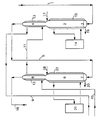
- a diagram of an installation which has given good results is shown in Figure 1 and includes: a pipe 1 through which gaseous vinyl chloride containing the ester to be eliminated is introduced into the system, - A first reactor 2, equipped with a double jacket 15, into which the impure vinyl chloride is introduced via line 1.
- This reactor 2 is advantageously equipped with a device for distributing the gases in the liquid 3 and with a condenser 4 making it possible respectively to carry out a good bubbling of the gases and to retain the liquid products at the alkaline washing temperature, a pipe 5 connecting the condenser 4 of the reactor 2 to a second reactor 6 intended to carry out the bisulfite treatment, -
- This reactor 6 is again advantageously equipped with a device for distributing the gases in the liquid 7 and with a condenser 8 whose functions are identical to those of the device 3 and of the condenser 4, the pure vinyl chloride is then sent via line 16 to drying followed by recompression and liquefaction in order to allow storage of the pure vinyl chloride, - finally, the installation is completed by a refrigeration circuit allowing respectively via the pipes 10 and 11 to cool by the double jackets 12 and 13 the condensers 4 and 8, and by independent refrigeration circuits 14 and 21 making it possible to ensure the cooling of the double jacket 15 of the alkaline washing reactor 2 and of the double jacket 22
- Reactors 2 and 6 can also be equipped to operate continuously or discontinuously.
- pipes 17 and 18 are provided to supply them respectively with aqueous solutions of NaOH and bisulfite.
- these also include "purge" lines 19 and 20 which make it possible to eliminate the partially exhausted aqueous solutions.
- the installation can be carried out entirely or partially in any suitable material, whether or not covered with polymeric compounds making it possible to improve the resistance of the materials to some of the reagents used.
- the entire installation is made of stainless steel.
- the vinyl chloride recovered at the outlet of the second reactor can be used in any production and more particularly for the manufacture of high purity homopolymers.
- the invention relates to the purification of vinyl chloride into ester type compounds having an enol ester structure, it is obvious that it can also be suitable without other fundamental modification for the purification of other monomers of the same type such as vinylidene chloride, vinyl fluoride and vinylidene fluoride as well as the purification of these compounds into certain ketonic impurities or aldehydes capable of reacting with bisulfite and whose origin is not the enol ester.
- column 2 and column 6 have a diameter of 65 mm, a height of 550 mm and a volume in liquid of 400 cm3.
- the operation is carried out under conditions identical to those of Example 1, but controlling the pH by introducing NaSO3 in an amount such that the pH is located throughout the experiment at a value of 5.5.
- Example 1 The operation is carried out under the conditions of Example 1 but by introducing enough NaSO3 to be able to work throughout the experiment at a pH of 8 and it is observed that, under these conditions, any other result being retained, the quantity of SO2 formed is less than 0.1 ppm vol.
Landscapes
- Chemical & Material Sciences (AREA)
- Organic Chemistry (AREA)
- Organic Low-Molecular-Weight Compounds And Preparation Thereof (AREA)
- Addition Polymer Or Copolymer, Post-Treatments, Or Chemical Modifications (AREA)
Priority Applications (1)
| Application Number | Priority Date | Filing Date | Title |
|---|---|---|---|
| AT90201321T ATE98950T1 (de) | 1989-06-02 | 1990-05-25 | Verfahren zur reinigung von vinylchlorid. |
Applications Claiming Priority (2)
| Application Number | Priority Date | Filing Date | Title |
|---|---|---|---|
| FR8908234A FR2647782B1 (fr) | 1989-06-02 | 1989-06-02 | Procede d'epuration de chlorure de vinyle |
| FR8908234 | 1989-06-02 |
Publications (2)
| Publication Number | Publication Date |
|---|---|
| EP0400735A1 true EP0400735A1 (de) | 1990-12-05 |
| EP0400735B1 EP0400735B1 (de) | 1993-12-22 |
Family
ID=9382964
Family Applications (1)
| Application Number | Title | Priority Date | Filing Date |
|---|---|---|---|
| EP90201321A Expired - Lifetime EP0400735B1 (de) | 1989-06-02 | 1990-05-25 | Verfahren zur Reinigung von Vinylchlorid |
Country Status (7)
| Country | Link |
|---|---|
| US (1) | US5059730A (de) |
| EP (1) | EP0400735B1 (de) |
| JP (1) | JP2703389B2 (de) |
| AT (1) | ATE98950T1 (de) |
| BR (1) | BR9002608A (de) |
| DE (1) | DE69005360T2 (de) |
| FR (1) | FR2647782B1 (de) |
Cited By (1)
| Publication number | Priority date | Publication date | Assignee | Title |
|---|---|---|---|---|
| EP0534094A3 (en) * | 1991-09-23 | 1994-12-28 | Occidental Chem Co | A process for removing aldehydes and/or vinyl esters from gaseous or liquid process streams |
Families Citing this family (4)
| Publication number | Priority date | Publication date | Assignee | Title |
|---|---|---|---|---|
| DE4425918C2 (de) * | 1994-07-21 | 1996-10-02 | Wacker Chemie Gmbh | Verfahren zur Rückgewinnung von nicht umgesetzten Vinylacetat-Monomer nach Polymerisationsreaktionen |
| US6037516A (en) * | 1997-11-20 | 2000-03-14 | Huntsman Ici Chemicals Llc | Method for removal of oxygenate impurities from organic chemical streams |
| US7903088B2 (en) * | 2004-10-20 | 2011-03-08 | Kodama Robert R | Computer keyboard with pointer control |
| KR102236922B1 (ko) * | 2017-09-27 | 2021-04-07 | 주식회사 엘지화학 | 염화비닐계 중합체, 이의 제조방법 및 이를 포함하는 내장재 |
Citations (2)
| Publication number | Priority date | Publication date | Assignee | Title |
|---|---|---|---|---|
| US2356562A (en) * | 1937-04-28 | 1944-08-22 | Berg Herbert | Preparation of synthetic resins |
| GB1406502A (en) * | 1972-07-19 | 1975-09-17 | Ici Ltd | Removal of bromine from chlorinated hydrocarbons |
Family Cites Families (1)
| Publication number | Priority date | Publication date | Assignee | Title |
|---|---|---|---|---|
| US2816148A (en) * | 1955-04-27 | 1957-12-10 | Allied Chem & Dye Corp | Production of substantially pure vinyl chloride |
-
1989
- 1989-06-02 FR FR8908234A patent/FR2647782B1/fr not_active Expired - Fee Related
-
1990
- 1990-05-25 EP EP90201321A patent/EP0400735B1/de not_active Expired - Lifetime
- 1990-05-25 DE DE69005360T patent/DE69005360T2/de not_active Expired - Fee Related
- 1990-05-25 AT AT90201321T patent/ATE98950T1/de not_active IP Right Cessation
- 1990-05-31 US US07/531,343 patent/US5059730A/en not_active Expired - Fee Related
- 1990-06-01 BR BR909002608A patent/BR9002608A/pt not_active IP Right Cessation
- 1990-06-02 JP JP2145237A patent/JP2703389B2/ja not_active Expired - Fee Related
Patent Citations (2)
| Publication number | Priority date | Publication date | Assignee | Title |
|---|---|---|---|---|
| US2356562A (en) * | 1937-04-28 | 1944-08-22 | Berg Herbert | Preparation of synthetic resins |
| GB1406502A (en) * | 1972-07-19 | 1975-09-17 | Ici Ltd | Removal of bromine from chlorinated hydrocarbons |
Cited By (1)
| Publication number | Priority date | Publication date | Assignee | Title |
|---|---|---|---|---|
| EP0534094A3 (en) * | 1991-09-23 | 1994-12-28 | Occidental Chem Co | A process for removing aldehydes and/or vinyl esters from gaseous or liquid process streams |
Also Published As
| Publication number | Publication date |
|---|---|
| EP0400735B1 (de) | 1993-12-22 |
| US5059730A (en) | 1991-10-22 |
| DE69005360T2 (de) | 1994-06-16 |
| JPH0363235A (ja) | 1991-03-19 |
| BR9002608A (pt) | 1991-08-20 |
| FR2647782A1 (fr) | 1990-12-07 |
| ATE98950T1 (de) | 1994-01-15 |
| FR2647782B1 (fr) | 1991-07-26 |
| JP2703389B2 (ja) | 1998-01-26 |
| DE69005360D1 (de) | 1994-02-03 |
Similar Documents
| Publication | Publication Date | Title |
|---|---|---|
| EP0400735B1 (de) | Verfahren zur Reinigung von Vinylchlorid | |
| FR2637581A1 (fr) | Procede de fabrication de peroxyde d'hydrogene | |
| EP0400736B1 (de) | Verfahren zur Reinigung von Vinylchlorid | |
| EP1474374B1 (de) | Verfahren zur reinigung von acrolein | |
| FR2726556A1 (fr) | Procede de preparation d'acides carboxyliques par carbonylation en presence d'iridium | |
| JPH05213817A (ja) | ガス又は液体プロセスストリームからアルデヒド及び/又はビニルエステルを除去する方法 | |
| EP0789681B1 (de) | Verfahren zur herstellung von carbonsäuren durch carbonylierung in gegenwart des rhodiums | |
| EP1194238A1 (de) | Selektive trennung von eisen mit einem diphosphonsäuregruppen enthaltenden ionenaustauscherharz | |
| CA2133613C (fr) | Procede de purification du 1,1,1,2-tetrafluoroethane | |
| CA2232457C (fr) | Procede de purification d'hydrocarbures aromatiques chlores | |
| EP0922672A1 (de) | Herstellung von Bortrifluorid und Schwefelsäure aus Bortrifluoridhydrat | |
| FR3124503A1 (fr) | Procédé de traitement d’effluents liquides contenant des ions chlorures | |
| FR2750984A1 (fr) | Preparation d'acide acetique et/ou d'acetate de methyle par une reaction de carbonylation | |
| EP0732314A1 (de) | Verfahren zur Herstellung von Difluormethan | |
| EP0644170B1 (de) | Herstellung von festen Perfluoralkylbromiden | |
| EP0051524B1 (de) | Verfahren zum Behandeln inerter, Äthylen enthaltender Residugase | |
| RU2146665C1 (ru) | Способ регенерации высокофторированных карбоновых кислот из потоков отходящего газа и устройство для его осуществления | |
| WO1999005102A1 (fr) | Solution organique de peroxydicarbonate de dialkyle, procede pourl'obtenir, et preparation de polymeres halogenes a l'intervention de celle-ci | |
| FR2750985A1 (fr) | Procede de preparation d'acide acetique et/ou d'acetate de methyle par carbonylation en presence d'iridium et de rhodium | |
| EP0795531A1 (de) | Verfahren zur Transformation der leichtsiedenden Nebenprodukten gebildet bei der thermischen Spaltung von 1,2-Dichlorethan | |
| FR2495138A1 (fr) | Procede de preparation de l'acide gloxylique | |
| FR2967668A1 (fr) | Procede de preparation de solutions concentrees d'hypochlorite de metal alcalin | |
| BE725249A (de) | ||
| FR2868330A1 (fr) | Procede et installation pour la production d'un gaz | |
| JPH11309363A (ja) | 充填塔用充填物の洗浄方法 |
Legal Events
| Date | Code | Title | Description |
|---|---|---|---|
| PUAI | Public reference made under article 153(3) epc to a published international application that has entered the european phase |
Free format text: ORIGINAL CODE: 0009012 |
|
| AK | Designated contracting states |
Kind code of ref document: A1 Designated state(s): AT BE CH DE DK ES FR GB GR IT LI LU NL SE |
|
| 17P | Request for examination filed |
Effective date: 19901219 |
|
| 17Q | First examination report despatched |
Effective date: 19920604 |
|
| RAP1 | Party data changed (applicant data changed or rights of an application transferred) |
Owner name: SOLVAY |
|
| RAP1 | Party data changed (applicant data changed or rights of an application transferred) |
Owner name: SOLVAY (SOCIETE ANONYME) |
|
| GRAA | (expected) grant |
Free format text: ORIGINAL CODE: 0009210 |
|
| AK | Designated contracting states |
Kind code of ref document: B1 Designated state(s): AT BE CH DE DK ES FR GB GR IT LI LU NL SE |
|
| PG25 | Lapsed in a contracting state [announced via postgrant information from national office to epo] |
Ref country code: SE Effective date: 19931222 Ref country code: NL Effective date: 19931222 Ref country code: GR Free format text: LAPSE BECAUSE OF FAILURE TO SUBMIT A TRANSLATION OF THE DESCRIPTION OR TO PAY THE FEE WITHIN THE PRESCRIBED TIME-LIMIT Effective date: 19931222 Ref country code: GB Effective date: 19931222 Ref country code: ES Free format text: THE PATENT HAS BEEN ANNULLED BY A DECISION OF A NATIONAL AUTHORITY Effective date: 19931222 Ref country code: DK Effective date: 19931222 Ref country code: AT Effective date: 19931222 |
|
| REF | Corresponds to: |
Ref document number: 98950 Country of ref document: AT Date of ref document: 19940115 Kind code of ref document: T |
|
| REF | Corresponds to: |
Ref document number: 69005360 Country of ref document: DE Date of ref document: 19940203 |
|
| ITF | It: translation for a ep patent filed | ||
| NLV1 | Nl: lapsed or annulled due to failure to fulfill the requirements of art. 29p and 29m of the patents act | ||
| PG25 | Lapsed in a contracting state [announced via postgrant information from national office to epo] |
Ref country code: LU Free format text: LAPSE BECAUSE OF NON-PAYMENT OF DUE FEES Effective date: 19940531 Ref country code: LI Effective date: 19940531 Ref country code: CH Effective date: 19940531 Ref country code: BE Effective date: 19940531 |
|
| GBV | Gb: ep patent (uk) treated as always having been void in accordance with gb section 77(7)/1977 [no translation filed] |
Effective date: 19931222 |
|
| PLBE | No opposition filed within time limit |
Free format text: ORIGINAL CODE: 0009261 |
|
| STAA | Information on the status of an ep patent application or granted ep patent |
Free format text: STATUS: NO OPPOSITION FILED WITHIN TIME LIMIT |
|
| BERE | Be: lapsed |
Owner name: S.A. SOLVAY Effective date: 19940531 |
|
| 26N | No opposition filed | ||
| REG | Reference to a national code |
Ref country code: CH Ref legal event code: PL |
|
| PGFP | Annual fee paid to national office [announced via postgrant information from national office to epo] |
Ref country code: FR Payment date: 20020508 Year of fee payment: 13 |
|
| PGFP | Annual fee paid to national office [announced via postgrant information from national office to epo] |
Ref country code: DE Payment date: 20020529 Year of fee payment: 13 |
|
| PG25 | Lapsed in a contracting state [announced via postgrant information from national office to epo] |
Ref country code: DE Free format text: LAPSE BECAUSE OF NON-PAYMENT OF DUE FEES Effective date: 20031202 |
|
| PG25 | Lapsed in a contracting state [announced via postgrant information from national office to epo] |
Ref country code: FR Free format text: LAPSE BECAUSE OF NON-PAYMENT OF DUE FEES Effective date: 20040130 |
|
| REG | Reference to a national code |
Ref country code: FR Ref legal event code: ST |
|
| PG25 | Lapsed in a contracting state [announced via postgrant information from national office to epo] |
Ref country code: IT Free format text: LAPSE BECAUSE OF NON-PAYMENT OF DUE FEES;WARNING: LAPSES OF ITALIAN PATENTS WITH EFFECTIVE DATE BEFORE 2007 MAY HAVE OCCURRED AT ANY TIME BEFORE 2007. THE CORRECT EFFECTIVE DATE MAY BE DIFFERENT FROM THE ONE RECORDED. Effective date: 20050525 |