EP0401258B1 - Markierungssystem für dokumente - Google Patents
Markierungssystem für dokumente Download PDFInfo
- Publication number
- EP0401258B1 EP0401258B1 EP89902625A EP89902625A EP0401258B1 EP 0401258 B1 EP0401258 B1 EP 0401258B1 EP 89902625 A EP89902625 A EP 89902625A EP 89902625 A EP89902625 A EP 89902625A EP 0401258 B1 EP0401258 B1 EP 0401258B1
- Authority
- EP
- European Patent Office
- Prior art keywords
- document
- marked
- marking
- data
- text file
- Prior art date
- Legal status (The legal status is an assumption and is not a legal conclusion. Google has not performed a legal analysis and makes no representation as to the accuracy of the status listed.)
- Expired - Lifetime
Links
- 238000000034 method Methods 0.000 claims description 37
- 230000006870 function Effects 0.000 claims description 9
- 241000269627 Amphiuma means Species 0.000 claims 5
- 108010076504 Protein Sorting Signals Proteins 0.000 claims 3
- 230000001172 regenerating effect Effects 0.000 claims 1
- 230000004044 response Effects 0.000 claims 1
- 230000000007 visual effect Effects 0.000 description 4
- 230000004075 alteration Effects 0.000 description 2
- 238000010586 diagram Methods 0.000 description 2
- 238000009826 distribution Methods 0.000 description 2
- 230000001154 acute effect Effects 0.000 description 1
- 230000006978 adaptation Effects 0.000 description 1
- 230000002411 adverse Effects 0.000 description 1
- 230000003466 anti-cipated effect Effects 0.000 description 1
- 230000001174 ascending effect Effects 0.000 description 1
- 230000009286 beneficial effect Effects 0.000 description 1
- 230000015556 catabolic process Effects 0.000 description 1
- 238000006731 degradation reaction Methods 0.000 description 1
- 230000000694 effects Effects 0.000 description 1
- 239000012634 fragment Substances 0.000 description 1
- 238000004519 manufacturing process Methods 0.000 description 1
- 238000002360 preparation method Methods 0.000 description 1
- 230000002265 prevention Effects 0.000 description 1
- 238000011084 recovery Methods 0.000 description 1
- 238000003860 storage Methods 0.000 description 1
Images


Classifications
-
- G—PHYSICS
- G03—PHOTOGRAPHY; CINEMATOGRAPHY; ANALOGOUS TECHNIQUES USING WAVES OTHER THAN OPTICAL WAVES; ELECTROGRAPHY; HOLOGRAPHY
- G03C—PHOTOSENSITIVE MATERIALS FOR PHOTOGRAPHIC PURPOSES; PHOTOGRAPHIC PROCESSES, e.g. CINE, X-RAY, COLOUR, STEREO-PHOTOGRAPHIC PROCESSES; AUXILIARY PROCESSES IN PHOTOGRAPHY
- G03C5/00—Photographic processes or agents therefor; Regeneration of such processing agents
- G03C5/08—Photoprinting; Processes and means for preventing photoprinting
-
- B—PERFORMING OPERATIONS; TRANSPORTING
- B41—PRINTING; LINING MACHINES; TYPEWRITERS; STAMPS
- B41M—PRINTING, DUPLICATING, MARKING, OR COPYING PROCESSES; COLOUR PRINTING
- B41M3/00—Printing processes to produce particular kinds of printed work, e.g. patterns
- B41M3/14—Security printing
-
- G—PHYSICS
- G09—EDUCATION; CRYPTOGRAPHY; DISPLAY; ADVERTISING; SEALS
- G09C—CIPHERING OR DECIPHERING APPARATUS FOR CRYPTOGRAPHIC OR OTHER PURPOSES INVOLVING THE NEED FOR SECRECY
- G09C5/00—Ciphering apparatus or methods not provided for in the preceding groups, e.g. involving the concealment or deformation of graphic data such as designs, written or printed messages
Definitions
- the present invention relates to methods of, and apparatus for, generating documents which, as well as presenting the usual alpha-numeric text information, contain a distinctive marking. More particularly, the marking scheme of the invention can convey identifying information which, in the event of a document coming into the possession of an unauthorised person, allows a particular copy of a document to be traced to its source.
- Such techniques have little effect and efforts have been made to mark documents in such a way that each copy bears a distinctive feature so that in the event of "leaking" the source of the leak can be identified.
- One such technique involves subtly changing the text of each copy distributed and recording the details of changes made in the case of each recipient. This technique is cumbersome, requires undesirable alteration of the text, and relies on recovery of the whole or a large part of the text to be effective as a means of identifying the source.
- Other marking schemes utilise a pattern of special markings which must cover the whole page area if the possibility of erasure is to be avoided.
- the present invention is directed to providing an improved document marking scheme which uniquely identifies each of a potentially large number of copies of a document and cannot be removed from the text of the document.
- a further novel and useful feature of the invention is the ability to convey within the marking textual information, such as the name of the intended recipient of each copy.
- the marking scheme of the invention does not significantly detract from the visual quality of the document, and the marking is maintained in spite of photocopying, enlarging or reducing.
- the invention can be realised by a suitable arrangement of conventional digital data processing components.
- a document marking method comprising the steps of inputting a file representing a document, altering certain elements of the contents of said file in such a way as to mark the document by altering the format or visual presentation of the document, said alteration being performed according to an algorithm accepting as an input identifying data to be encoded into the marking of the document, and outputting the processed file.
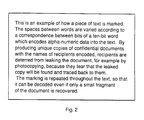
- the marking method is achieved by varying the spacing between words of the text of the document in such a way that the sequence of variations corresponds to predetermined sequences representing alphanumeric characters.
- the invention also consists in a method of decoding the marking encoded into a document using the above methods, comprising the steps of examining the spacing between successive words of a document, classifying said spaces as long or short, and matching the resulting sequence of long and short spaces with predetermined sequences representing alpha-numeric characters.
- the invention also consists in data processing apparatus arranged to perform the marking methods described herein.
- a text processing system for practice of the invention will now be described, by way of example only, in which a programmed digital computer is used to perform word-processing functions as well as the document marking function of the invention.
- This embodiment is useful for producing multiple copies of a document, each carrying a distinctive marking within the formatting of the text.
- the marking codes correspond to alpha-numeric strings, such as persons' names, although this is not an essential characteristic of the invention.
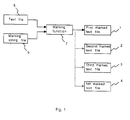
- Text file 5 is a digital representation of the document to be marked.
- Marking string file 6 is a set of data representing a table of alpha-numeric strings, each designating a recipient of the document.
- Marking function 7 is a set of programme instructions which when executed by the computer causes the text file to be processed as follows:
- This process is repeated for each marking string in marking string file 6, generating a set of files equal to the number of such strings.
- each marking string can consist of the name of a recipient of a copy of the document, with the result that when each marked file is printed, a set of documents each uniquely marked with the name of the intended recipient is available for distribution.
- marking function 7 it is of course possible to direct the output of marking function 7 directly to a printer, so that the marked text files are not required, or the files can be stored temporarily prior to printing, or permanently on disk or other medium.
- Marking function 7 in this embodiment of the invention uses a 10 bit marking code, where each bit defines the length of a corresponding space in the marked document.
- the codes corresponding to each alpha-numeric character have been selected to minimise the occurrence of long series of long or short spaces, so that the undesirable degradation of the appearance of the marked document is minimised.
- the marking code corresponding to each character is shown in the following table (table 1), in which S represents a Short space, L represents a Long space.
- marking codes for most characters have been chosen to ensure a maximum of two consecutive long or short spaces, except that the characters 0-9, # and space begin with three long spaces or three short spaces.
- This scheme allows the beginning of the characters starting with three long spaces or three short spaces to be located unambiguously even if the starting position of the coding is not known, for example when only a fragment of the document has been recovered. For this reason it is desirable that marking strings include at least one space or numeric character.
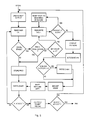
- the process begins with the creation of the first output file.
- the first character is then read from the input file, and a test performed to determine whether the character read (CHAR) is the space character. If not, CHAR is written to the output file, CHAR is stored in a temporary location PREV, and a test is performed to see if the input file is at end of text. If not, the next character is read from the input file, and this process is repeated until a space character is encountered.
- PREV is tested to see whether the previous character was a punctuation character. If it was, the space is ignored. If not, a test is performed to see if BIT COUNT has reached zero, indicating that the end of the 10 bit marking code pattern has been reached.
- the long space is generated by using two consecutive space characters. This is achieved by writing the space (CHAR) to the output before returning to the main loop which writes it a second time. If the M.S.B. of PATTERN is not set, this extra write is not performed.
- the marking string file is at the end of a record, the file is reset to the beginning of the same record, so that the marking string will be repeated throughout the pass of the input file. If it is not at the end of the record, the byte read from the marking string file is used to obtain a 10 bit marking pattern using a lookup table containing the data of Table 1, and BITCOUNT is reset to 10.
- the M.S.F. is set to the beginning of the next record, so that the next marking string will be used to mark the next file generated.
- a test is then performed to see if the M.S.F. is at E.O.T. A true result indicates that all required marked copies have been generated, in which case the process ends. If M.S.F. is not at E.O.T., another output is created, and the process repeats, generating an output file with the markings dictated by the next marking string of the M.S.F.
- the marking of a particular document can be decoded manually, by observing the pattern of long and short spaces in the document and looking up the corresponding character codes as per Table 1.
- the source of a marked document can be identified by optically comparing the document with a set of copies made prior to circulating the document and identifying the one which matches. For identification, the copies should be labelled with the name of the recipient. For better security, it may be desired not to keep copies of the circulated documents, but to generate a new marked set for comparison purposes should the need for identification arise. Visual comparison can be aided by producing a transparency of the document which can be used to overlay the copy to be compared.
- the decoding process can be automated, using a document scanner to input the document to be decoded to a computer which can then decode the marking, for example by ascertaining the spacing between words.
- certain additional features are provided for the purpose of streamlining the production of multiple marked documents.
- One such feature is additional software which provides the ability to command the computer to automatically use a recipient list (marking string file of the above-described embodiment) as a source of names to be inserted into a prescribed merge field of a document. This is useful for automatically annotating each marked copy with an identifying message. For example, it may be desired to print the message "THIS DOCUMENT IS MARKED AND UNIQUE TO J. SMITH" at the head of each version. In this case, the name (J. SMITH) would take the form of a merge field in the original document, the name being automatically inserted in the output text as part of the marking process of the invention.
- the basic marking scheme of the invention is used to encode a sub-text of arbitrary length within the spaces between words of a document.
- a marking function 63 as described in the context of the embodiment above, is applied to a text file 61 to produce a marked document 64, except that in this case the marking corresponds to the characters of sub-text file 62.
- Sub-text file 62 contains a message of arbitrary length which is encoded into the marked document, instead of individual short strings used in the marking string file 6 of Fig. 1.
- the invention can be used to convey information within the spaces between words, at a density of approximately one character per ten words.
- Another useful extension of the invention is its application to word-processing systems in which a plurality of users may have access to a document.
- a multi-terminal word-processing system incorporating electronic mail facilities whereby a document can be circulated to a number of people in electronic form, that is, without printing on paper.
- a computer to which a number of users have access.
- the invention can be used to deter those with access to the document from printing a copy and disclosing it to unauthorised persons.
- the invention can be adapted so that text files used by the word-processing system carry within them an indicator that the document which they represent is to be marked when printed, this indicator being accessible only to the author of the document.
- the printing software of the data processing system is arranged so that if any person instructs that the document be printed, the document will be marked, for example with the name of the person requesting the print.
- the name can for convenience be automatically retrieved from a file containing a correspondence between the password of a user of the system and that user's name.
- the marking can be determined by a marking string designated by the original author of the document at the time it is electronically mailed to each person, the string and the indicator that the document is to be marked when printed being linked to the file when mailed.
- the marking process of the invention is independent of the nature of the document originating means and document printing means and it is anticipated that the invention can be realised in many ways other than those specifically mentioned herein.
- the invention can be realised as an integral part of a word-processing system, by adding suitable software to the word-processing software, or it can be realised as a stand-alone device interposed between a source of text data, such as a word processor, and a printer, or it can be realised as a printer adapted to carry out marking according to the invention.
- the spacing between words is the most suitable characteristic of a document to modify for the conveyance of the marking of the invention
- other characteristics of the formatting or visual presentation can be varied in like fashion.
- the spacing between letters can be varied as well as the spacing between words.
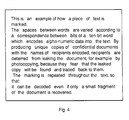
- one or more printing characters can be used as well as variations of spacing between words. For example, in the case of the embodiment described above in which two consecutive spaces are used to generate a long space, a space followed by an asterisk can be used, yielding a marked document similar in appearance to the example of Fig. 3.
- marking information provided by an operator
- other adaptations of the invention can be provided whereby the marking codes can be automatically generated by the invention, for example by forming an ascending number sequence, or a sequence of random numbers, thereby assuring that each copy of a document is distinctively marked, without requiring the operator to provide specific marking information.
- the marking information is taken from a data field already serving another purpose within the memory of the data processing apparatus.
- the invention can be made to use the time and date information commonly resident in memory as the marking information, with the result that each copy of a marked document generated will be marked with the time and date at which the document was generated.
- Other fields such as the name of the author of the document, operator's password, or addressee's name can also be used in like manner.
- the invention is particularly beneficial when used as part of a word-processing system, in which case the operator can request a number of copies of a confidential document to be printed, each being uniquely marked so as to identify the recipient.
- the invention provides a means for reducing the incidence of unauthorised distribution of confidential documents.
- the invention can also be used to provide marking of any computer-printed information, such as business reports.
- the invention also finds application in marking of documents to deter breach of copyright.
- the invention is also useful for encoding messages within the formatting of a document.
- a book could be produced which conveys within the formatting of the words a sub-text which is only readable by those possessing the knowledge of the method of decoding the marking, while not detracting from the readability of the text.
Landscapes
- Physics & Mathematics (AREA)
- General Physics & Mathematics (AREA)
- Engineering & Computer Science (AREA)
- Theoretical Computer Science (AREA)
- Document Processing Apparatus (AREA)
- Heat Sensitive Colour Forming Recording (AREA)
- Road Signs Or Road Markings (AREA)
- Details Or Accessories Of Spraying Plant Or Apparatus (AREA)
- Storage Device Security (AREA)
Claims (13)
- Verfahren der Dokumentenmarkierung in einem Datenverarbeitungssystem zur Dokumentenerzeugung,
wobei das Verfahren dadurch gekennzeichnet ist, daß es die folgenden Stufen umfaßt:a. Eingabe einer ersten ein Dokument darstellenden Textdatei,b. Eingabe eines auf dem genannten Dokument anzubringenden Markierungscode,c. aufeinanderfolgende Definition der Größe für jeden Wortabstand der ersten Textdatei, Änderung jeder Größe gemäß einer Funktion des genannten Markierungscode, wobei die genannte Funktion eine Signalfolge erzeugt, die feststellt, ob jede genannte Größe in eine Größe verändert wird, die beim Druck des Dokuments zu einem längeren Wortabstand oder einem kürzeren Wortabstand führt, oder ob der Wortabstand unverändert ist, undd. Ausgabe einer zweiten, eine markierte Form des genannten Dokuments darstellenden Textdatei. - Verfahren der Erzeugung mehrfach einmalig markierter Dokumente, bei dem man das Verfahren nach Anspruch 1 wiederholt und bei jeder Wiederholung an der genannten ersten Textdatei unterschiedliche Markierungscode anbringt, wobei die unterschiedlichen Markierungscode durch ein Datenverarbeitungssystem automatisch erzeugt werden.
- Verfahren der Dokumentenmarkierung nach Anspruch 1, bei dem die genannte Markierung in Antwort auf die Identität eines Benutzers variiert wird, der auf eine ein Dokument darstellende Datei zugreift.
- Verfahren der Erzeugung mehrfach einmalig markierter Dokumente, bei dem man das Verfahren nach Anspruch 1 wiederholt und bei jeder Wiederholung an der genannten ersten Textdatei unterschiedliche Markierungscode anbringt, wobei die unterschiedlichen Markierungscode automatisch von bestimmten Speicherstellen in einem Datenverarbeitungssystem abgerufen werden und wobei die genannten Speicherstellen alphanumerische Datenfolgen darstellende Daten enthalten.
- Verfahren der Erzeugung mehrfach einmalig markierter Dokumente, bei dem man das Verfahren nach Anspruch 1 wiederholt und bei jeder Wiederholung an der genannten ersten Textdatei unterschiedliche Markierungscode anbringt, wobei die unterschiedlichen Markierungscode als alphanumerische Datenketten eingegeben werden.
- Datenverarbeitungssystem für Textmaterial mit Mitteln zur Einführung einer ein Dokument darstellenden ersten Textdatei, Datenverarbeitungsmitteln für die Verarbeitung der Daten der genannten ersten Textdatei und für die Befehlsausführung, mit den genannten Datenverarbeitungsmitteln gekoppelte Speichermittel für die Speicherung von Daten und Befehlen und Ausgabemitteln für die Darstellung des Dokuments, wobei das Datenverarbeitungssystem ferner aufweista. Mittel (6) für die Eingabe eines an dem genannten Dokument anzubringenden Markierungscode,b. Mittel zum Lesen der genannten ersten Textdatei (5),c. Mittel (7) für die Erzeugung einer Signalfolge beim Ansprechen auf den genannten Markierungscode,d. Mittel für die aufeinanderfolgende Bestimmung, für jeden Wortabstand der genannten Datei und entsprechend der genannten Signalfolge, ob jede genannte Größe in eine Größe verändert ist, die beim Drucken des Dokuments zu einem längeren oder einem kürzeren Abstand führt oder ob der Abstand unverändert ist, unde. Mittel für die Ausgabe einer zweiten Textdatei, die eine markierte Form des genannten Dokuments darstellt.
- Vorrichtung zur Erzeugung mehrfach einmalig gekennzeichneter Dokumente mit einem Datenverarbeitungssystem nach Anspruch 6, die ferner aufweista. Mittel für die automatische Erzeugung einer Folge unterschiedlicher Markierungscode undb. Mittel für die Erzeugung dritter und folgender markierter Textdateien, wobei jede solche markierte Textdatei unter Benutzung einer anderen der genannten unterschiedlichen Markierungscode markiert wird.
- Vorrichtung zur Erzeugung mehrfach einmalig markierter Dokumente mit einem Datenverarbeitungssystem nach Anspruch 6, die ferner umfaßta. Mittel für die Erzeugung eines ersten Markierungscode, der auf auf bestimmten Speicherstellen in dem genannten Datenverarbeitungssystem gespeicherte Daten anspricht, wobei die genannten Speicherstellen alphanumerische Datenketten darstellende Daten enthalten und die genannten Datenketten wenigstens einen der Punkte darstellen:i. einen Namen eines Verfassers eine Dokuments,ii. eine Revisionsnummer eines Dokuments,iii. ein aktuelles Datum und die Zeit,iv. den Namen der Datei, in der die das Dokument darstellenden Daten gespeichert sind,v. einen Namen eines geplanten Empfängers eines Dokuments,b. Mittel für die Regenerierung des genannten Markierungscode jedes Mal, wenn sich die Inhalte der genannten Speicherstellen ändern, undc. Mittel für die Erzeugung dritter und folgender markierter Textdateien, von denen jede unter Benutzung eines anderen der genannten Markierungscode markiert wird.
- Vorrichtung zur Erzeugung mehrfach einmalig markierter Dokumente mit einem Datenverarbeitungssystem nach Anspruch 6 und ferner mita. Mitteln für die Eingabe einer Folge alphanumerischer Datenketten,b. Mitteln für die Bildung eines Markierungscode entsprechend jedem der genannten alphanumerischen Datenketten undc. Mitteln für die Erzeugung dritter und folgender markierter Textdateien, von denen jede unter Benutzung eines anderen der genannten Markierungscode markiert wird.
- Vorrichtung nach Anspruch 6 und ferner mita. Mitteln für die Assoziierung mit den genannten ersten Textdateidaten, die anzeigen, daß die genannte Datei zu markieren ist, wenn sie gedruckt wird,b. Mitteln für die Feststellung der Anwesenheit der genannten anzeigenden Daten, undc. Mitteln für die Veranlassung der Dokumentenmarkierung, wenn die genannten anzeigenden Daten vorliegen, wobei die genannte Markierung auf mit einer besonderen Kopie der genannten ersten Textdatei assoziierte Daten anspricht.
- Vorrichtung nach einem der Ansprüche 7 bis 10, die ferner einen Drucker für die Hersteilung eines dauerhaften Bildes der ausgegebenen Textdaten aufweist.
- Verfahren zur Identifizierung eines unter Benutzung des Verfahrens einer der Ansprüche 1 bis 5 markierten Belegs mit den Stufen dera. Prüfung des Abstands zwischen aufeinanderfolgenden Wörtern eines Dokuments,b. Klassifizierung der genannten Abstände als lang oder kurz, undc. Vergleichung der resultierenden Folge langer und kurzer Abstände mit der bestimmten, alphanumerische Zeichen darstellenden Folge.
- Vorrichtung für die Identifizierung eines unter Benutzung des Verfahrens eines der Ansprüche 1 bis 5 gekennzeichneten Dokuments mita. Mitteln zur Dokumentabtastung,b. Recheneinrichtungen mit der Eignungi. Daten von den genannten Abtastmitteln zu empfangen,ii. den relativen Abstand zwischen aufeinanderfolgenden Wörtern eines Dokuments zu messen,iii.die genannten Abstände als lang oder kurz zu klassifizieren,iv. die resultierende Folge langer und kurzer Abstände mit bestimmten, alphanumerische Zeichen darstellenden Folgen zu vergleichen, undc. Mitteln für die Ausgabe von die genannten alphanumerischen Zeichen darstellenden Signalen.
Applications Claiming Priority (3)
| Application Number | Priority Date | Filing Date | Title |
|---|---|---|---|
| AUPI670588 | 1988-02-11 | ||
| AU6705/88 | 1988-02-11 | ||
| PCT/AU1989/000050 WO1989007819A1 (en) | 1988-02-11 | 1989-02-08 | Document marking system |
Publications (3)
| Publication Number | Publication Date |
|---|---|
| EP0401258A1 EP0401258A1 (de) | 1990-12-12 |
| EP0401258A4 EP0401258A4 (en) | 1992-10-28 |
| EP0401258B1 true EP0401258B1 (de) | 1994-11-30 |
Family
ID=3772808
Family Applications (1)
| Application Number | Title | Priority Date | Filing Date |
|---|---|---|---|
| EP89902625A Expired - Lifetime EP0401258B1 (de) | 1988-02-11 | 1989-02-08 | Markierungssystem für dokumente |
Country Status (6)
| Country | Link |
|---|---|
| US (1) | US5388194A (de) |
| EP (1) | EP0401258B1 (de) |
| JP (1) | JP2754062B2 (de) |
| AT (1) | ATE114850T1 (de) |
| DE (1) | DE68919685T2 (de) |
| WO (1) | WO1989007819A1 (de) |
Families Citing this family (26)
| Publication number | Priority date | Publication date | Assignee | Title |
|---|---|---|---|---|
| DE3810652A1 (de) * | 1988-03-29 | 1989-10-12 | Bernard M Jordan | Verfahren zum schutze von auf einen traeger aufgebrachter information und informationstraeger |
| EP0629972A3 (de) * | 1993-04-23 | 1995-05-24 | Hewlett Packard Co | Verfahren und Vorrichtung zum Einbetten von Identifizierungskoden in gedruckten Dokumenten. |
| US6086706A (en) * | 1993-12-20 | 2000-07-11 | Lucent Technologies Inc. | Document copying deterrent method |
| US5664076A (en) * | 1994-12-27 | 1997-09-02 | Karen A. Pluta | Apparatus and method for making a scannable form on a blank sheet |
| US9630443B2 (en) * | 1995-07-27 | 2017-04-25 | Digimarc Corporation | Printer driver separately applying watermark and information |
| US5787441A (en) * | 1996-01-11 | 1998-07-28 | International Business Machines Corporation | Method of replicating data at a field level |
| FI103543B (fi) | 1996-09-30 | 1999-07-15 | Nokia Telecommunications Oy | Elektronisten dokumenttien merkitseminen |
| IE980959A1 (en) * | 1998-03-31 | 1999-10-20 | Datapage Ireland Ltd | Document Production |
| US6965697B1 (en) * | 1998-07-15 | 2005-11-15 | Sony Corporation | Coding apparatus and method, decoding apparatus and method, data processing system, storage medium, and signal |
| JP3991249B2 (ja) * | 1998-07-15 | 2007-10-17 | ソニー株式会社 | 符号化装置および符号化方法、復号装置および復号方法、情報処理装置および情報処理方法、並びに記録媒体 |
| US7337387B1 (en) * | 1998-11-23 | 2008-02-26 | Tradepaq Corporation | Intercepting document data from a spooler and using the data to retrieve related information from a data base to modify the document |
| US6547830B1 (en) * | 1999-08-13 | 2003-04-15 | Pixo, Inc. | Methods and apparatuses for display and traversing of links in page character array |
| BG63520B1 (bg) * | 1999-10-15 | 2002-03-29 | Живко ЖЕЛЕВ | Мултимедийно едно и многостепенно шифрирана маркировка-бандерол върху продукти |
| EP1136903B1 (de) * | 2000-03-20 | 2007-04-11 | International Business Machines Corporation | Verfahren und System zur reversiblen Markierung eines Textdokuments mit einem Muster der zusätzlichen Leerzeichen für Beglaubigung |
| US6899475B2 (en) * | 2002-01-30 | 2005-05-31 | Digimarc Corporation | Watermarking a page description language file |
| US20040001606A1 (en) * | 2002-06-28 | 2004-01-01 | Levy Kenneth L. | Watermark fonts |
| US8014557B2 (en) | 2003-06-23 | 2011-09-06 | Digimarc Corporation | Watermarking electronic text documents |
| US7418656B1 (en) | 2003-10-03 | 2008-08-26 | Adobe Systems Incorporated | Dynamic annotations for electronics documents |
| JP5031472B2 (ja) * | 2007-07-23 | 2012-09-19 | キヤノン株式会社 | 画像処理装置、画像処理方法、コンピュータプログラム |
| JP2009141700A (ja) * | 2007-12-06 | 2009-06-25 | Ricoh Co Ltd | 画像処理装置、画像処理方法、画像処理プログラムおよび記録媒体 |
| US9898451B2 (en) | 2013-11-26 | 2018-02-20 | Adobe Systems Incorporated | Content adaptation based on selected reviewer comment |
| GB2524724B (en) * | 2014-03-19 | 2021-07-07 | Omarco Network Solutions Ltd | Steganographic document alteration |
| US9230355B1 (en) | 2014-08-21 | 2016-01-05 | Glu Mobile Inc. | Methods and systems for images with interactive filters |
| US9306881B1 (en) | 2014-09-25 | 2016-04-05 | Glu Mobile Inc. | Methods and systems for obscuring text in a conversation |
| US10194015B2 (en) * | 2014-09-25 | 2019-01-29 | Glu Mobile Inc. | Systems and methods for facilitating conversations |
| WO2023018356A1 (ru) | 2021-08-11 | 2023-02-16 | Александр Олегович ХЕГАЙ | Идентификация пользователя, запросившего электронный документ |
Family Cites Families (11)
| Publication number | Priority date | Publication date | Assignee | Title |
|---|---|---|---|---|
| US3654611A (en) * | 1970-03-02 | 1972-04-04 | Ibm | Visual editing system incorporating controls for justifying and dejustifying displayed text |
| US3852088A (en) * | 1972-03-20 | 1974-12-03 | Ibm | Security document system and method |
| SE436939B (sv) * | 1981-09-30 | 1985-01-28 | Esselte Nordia Ab | Anordning for att kodera och/eller dekodera ett dokument |
| US4434487A (en) * | 1981-10-05 | 1984-02-28 | Digital Equipment Corporation | Disk format for secondary storage system |
| FR2542472B1 (fr) * | 1983-03-11 | 1985-06-21 | Thomson Brandt | Carte a lecture optique portant des informations numeriques et systeme de controle d'acces a des informations diffusees utilisant une telle carte |
| US4685141A (en) * | 1983-12-19 | 1987-08-04 | Ncr Canada Ltd - Ncr Canada Ltee | Method and system for finding image data associated with the monetary amount on financial documents |
| US4577289A (en) * | 1983-12-30 | 1986-03-18 | International Business Machines Corporation | Hardware key-on-disk system for copy-protecting magnetic storage media |
| GB8410918D0 (en) * | 1984-04-27 | 1984-06-06 | De La Rue Thomas & Co Ltd | Numbered documents |
| FR2565383B1 (fr) * | 1984-05-29 | 1986-08-14 | Imaje Sa | Procede d'identification d'un produit destine a empecher toute fraude et dispositif mettant en oeuvre ce procede |
| US4608618A (en) * | 1984-10-25 | 1986-08-26 | Verbatim Corporation | Digital alignment diagnostic disk |
| EP0246823A3 (en) * | 1986-05-22 | 1989-10-04 | Racal-Guardata Limited | Data communication systems and methods |
-
1989
- 1989-02-08 DE DE68919685T patent/DE68919685T2/de not_active Expired - Fee Related
- 1989-02-08 WO PCT/AU1989/000050 patent/WO1989007819A1/en not_active Ceased
- 1989-02-08 EP EP89902625A patent/EP0401258B1/de not_active Expired - Lifetime
- 1989-02-08 AT AT89902625T patent/ATE114850T1/de not_active IP Right Cessation
- 1989-02-08 JP JP1502430A patent/JP2754062B2/ja not_active Expired - Fee Related
-
1990
- 1990-07-24 US US07/548,904 patent/US5388194A/en not_active Expired - Fee Related
Also Published As
| Publication number | Publication date |
|---|---|
| US5388194A (en) | 1995-02-07 |
| ATE114850T1 (de) | 1994-12-15 |
| WO1989007819A1 (en) | 1989-08-24 |
| EP0401258A4 (en) | 1992-10-28 |
| EP0401258A1 (de) | 1990-12-12 |
| DE68919685D1 (de) | 1995-01-12 |
| DE68919685T2 (de) | 1995-04-13 |
| JP2754062B2 (ja) | 1998-05-20 |
| JPH03502505A (ja) | 1991-06-06 |
Similar Documents
| Publication | Publication Date | Title |
|---|---|---|
| US5388194A (en) | System for altering elements of a text file to mark documents | |
| US5467447A (en) | Document marking system employing context-sensitive embedded marking codes | |
| US6351815B1 (en) | Media-independent document security method and apparatus | |
| US5436974A (en) | Method of encoding confidentiality markings | |
| US5568550A (en) | Method and system for identifying documents generated by an unauthorized software copy | |
| EP0629972A2 (de) | Verfahren und Vorrichtung zum Einbetten von Identifizierungskoden in gedruckten Dokumenten | |
| US6072871A (en) | Method and system for identifying the source of documents generated by software and documents generated thereby | |
| US5859935A (en) | Source verification using images | |
| US5761686A (en) | Embedding encoded information in an iconic version of a text image | |
| US5699427A (en) | Method to deter document and intellectual property piracy through individualization | |
| KR100311338B1 (ko) | 보증가능한광학문자인식방법 | |
| JP3643196B2 (ja) | 印刷媒体に印刷する情報をエンコードする方法、印刷媒体に印刷された情報をデコードする方法、および2次元データバーコード | |
| US5861619A (en) | Method of and apparatus for embedding data into an electronic document by modulating spaces between words | |
| Hecht | Embedded data glyph technology for hardcopy digital documents | |
| WO2003065226A1 (en) | Document authentication and verification | |
| Memon et al. | EVALUATION OF STEGANOGRAPHY FOR URDU/ARABIC TEXT. | |
| US20060147082A1 (en) | Method for robust asymmetric modulation spatial marking with spatial sub-sampling | |
| EP0895691B1 (de) | Verfahren und system zur erkennung von dokumenten, die von einer unerlaubten softwarekopie erzeugt werden | |
| CN100353279C (zh) | 一种文件加密方法 | |
| US20070003341A1 (en) | Image processing device, image processing method, program, and recording medium | |
| AU623895B2 (en) | Document marking system | |
| GB2411330A (en) | A means for document security tracking | |
| US7987494B1 (en) | Method and apparatus providing end to end protection for a document | |
| Brassil et al. | Marking text features of document images to deter illicit dissemination | |
| AU650876B2 (en) | Document marking system |
Legal Events
| Date | Code | Title | Description |
|---|---|---|---|
| PUAI | Public reference made under article 153(3) epc to a published international application that has entered the european phase |
Free format text: ORIGINAL CODE: 0009012 |
|
| 17P | Request for examination filed |
Effective date: 19900801 |
|
| AK | Designated contracting states |
Kind code of ref document: A1 Designated state(s): AT BE CH DE FR GB IT LI LU NL SE |
|
| A4 | Supplementary search report drawn up and despatched |
Effective date: 19920910 |
|
| AK | Designated contracting states |
Kind code of ref document: A4 Designated state(s): AT BE CH DE FR GB IT LI LU NL SE |
|
| 17Q | First examination report despatched |
Effective date: 19930615 |
|
| GRAA | (expected) grant |
Free format text: ORIGINAL CODE: 0009210 |
|
| AK | Designated contracting states |
Kind code of ref document: B1 Designated state(s): AT BE CH DE FR GB IT LI LU NL SE |
|
| PG25 | Lapsed in a contracting state [announced via postgrant information from national office to epo] |
Ref country code: NL Effective date: 19941130 Ref country code: LI Effective date: 19941130 Ref country code: CH Effective date: 19941130 Ref country code: BE Effective date: 19941130 Ref country code: AT Effective date: 19941130 |
|
| REF | Corresponds to: |
Ref document number: 114850 Country of ref document: AT Date of ref document: 19941215 Kind code of ref document: T |
|
| ET | Fr: translation filed | ||
| REF | Corresponds to: |
Ref document number: 68919685 Country of ref document: DE Date of ref document: 19950112 |
|
| ITF | It: translation for a ep patent filed | ||
| PG25 | Lapsed in a contracting state [announced via postgrant information from national office to epo] |
Ref country code: SE Effective date: 19950228 Ref country code: LU Free format text: LAPSE BECAUSE OF NON-PAYMENT OF DUE FEES Effective date: 19950228 |
|
| REG | Reference to a national code |
Ref country code: CH Ref legal event code: PL |
|
| NLV1 | Nl: lapsed or annulled due to failure to fulfill the requirements of art. 29p and 29m of the patents act | ||
| PLBE | No opposition filed within time limit |
Free format text: ORIGINAL CODE: 0009261 |
|
| STAA | Information on the status of an ep patent application or granted ep patent |
Free format text: STATUS: NO OPPOSITION FILED WITHIN TIME LIMIT |
|
| 26N | No opposition filed | ||
| REG | Reference to a national code |
Ref country code: GB Ref legal event code: IF02 |
|
| PGFP | Annual fee paid to national office [announced via postgrant information from national office to epo] |
Ref country code: GB Payment date: 20020205 Year of fee payment: 14 |
|
| PGFP | Annual fee paid to national office [announced via postgrant information from national office to epo] |
Ref country code: FR Payment date: 20020227 Year of fee payment: 14 |
|
| PG25 | Lapsed in a contracting state [announced via postgrant information from national office to epo] |
Ref country code: GB Free format text: LAPSE BECAUSE OF NON-PAYMENT OF DUE FEES Effective date: 20030208 |
|
| PGFP | Annual fee paid to national office [announced via postgrant information from national office to epo] |
Ref country code: DE Payment date: 20030228 Year of fee payment: 15 |
|
| GBPC | Gb: european patent ceased through non-payment of renewal fee | ||
| PG25 | Lapsed in a contracting state [announced via postgrant information from national office to epo] |
Ref country code: FR Free format text: LAPSE BECAUSE OF NON-PAYMENT OF DUE FEES Effective date: 20031031 |
|
| REG | Reference to a national code |
Ref country code: FR Ref legal event code: ST |
|
| PG25 | Lapsed in a contracting state [announced via postgrant information from national office to epo] |
Ref country code: DE Free format text: LAPSE BECAUSE OF NON-PAYMENT OF DUE FEES Effective date: 20040901 |
|
| PG25 | Lapsed in a contracting state [announced via postgrant information from national office to epo] |
Ref country code: IT Free format text: LAPSE BECAUSE OF NON-PAYMENT OF DUE FEES Effective date: 20050208 |