EP0401428B1 - Procédé et appareil à utiliser pour promouvoir la croissance de plantes et le developpement de fleurs - Google Patents
Procédé et appareil à utiliser pour promouvoir la croissance de plantes et le developpement de fleurs Download PDFInfo
- Publication number
- EP0401428B1 EP0401428B1 EP89201455A EP89201455A EP0401428B1 EP 0401428 B1 EP0401428 B1 EP 0401428B1 EP 89201455 A EP89201455 A EP 89201455A EP 89201455 A EP89201455 A EP 89201455A EP 0401428 B1 EP0401428 B1 EP 0401428B1
- Authority
- EP
- European Patent Office
- Prior art keywords
- radiation
- sunscreening
- screen
- screen means
- range
- Prior art date
- Legal status (The legal status is an assumption and is not a legal conclusion. Google has not performed a legal analysis and makes no representation as to the accuracy of the status listed.)
- Expired - Lifetime
Links
- 238000000034 method Methods 0.000 title claims abstract description 10
- 230000008635 plant growth Effects 0.000 title abstract description 10
- 230000008124 floral development Effects 0.000 title description 2
- 230000005855 radiation Effects 0.000 claims abstract description 40
- 230000012010 growth Effects 0.000 claims abstract description 26
- 239000000463 material Substances 0.000 claims abstract description 14
- 239000003795 chemical substances by application Substances 0.000 claims description 15
- 239000000049 pigment Substances 0.000 claims description 12
- 241001464837 Viridiplantae Species 0.000 claims description 7
- 239000004033 plastic Substances 0.000 claims description 4
- 229920003023 plastic Polymers 0.000 claims description 4
- 229920000178 Acrylic resin Polymers 0.000 claims description 3
- 239000004925 Acrylic resin Substances 0.000 claims description 3
- 230000009471 action Effects 0.000 claims description 3
- 230000001737 promoting effect Effects 0.000 claims description 3
- 229920000728 polyester Polymers 0.000 claims description 2
- 229920000098 polyolefin Polymers 0.000 claims description 2
- 239000004800 polyvinyl chloride Substances 0.000 claims description 2
- 229920000915 polyvinyl chloride Polymers 0.000 claims description 2
- 238000010521 absorption reaction Methods 0.000 abstract description 13
- 230000029553 photosynthesis Effects 0.000 abstract description 12
- 238000010672 photosynthesis Methods 0.000 abstract description 12
- 238000011161 development Methods 0.000 abstract description 7
- 230000018109 developmental process Effects 0.000 abstract description 5
- 230000004936 stimulating effect Effects 0.000 abstract description 3
- 230000004069 differentiation Effects 0.000 abstract description 2
- 230000004060 metabolic process Effects 0.000 abstract description 2
- 239000011343 solid material Substances 0.000 abstract description 2
- 241000196324 Embryophyta Species 0.000 description 30
- 239000010408 film Substances 0.000 description 8
- 230000017260 vegetative to reproductive phase transition of meristem Effects 0.000 description 8
- 229930192334 Auxin Natural products 0.000 description 6
- 239000002363 auxin Substances 0.000 description 6
- 230000008901 benefit Effects 0.000 description 6
- 230000000694 effects Effects 0.000 description 6
- 239000006096 absorbing agent Substances 0.000 description 5
- -1 polyethylene Polymers 0.000 description 4
- 239000000126 substance Substances 0.000 description 4
- 239000004698 Polyethylene Substances 0.000 description 3
- 239000000654 additive Substances 0.000 description 3
- 230000000996 additive effect Effects 0.000 description 3
- 239000007952 growth promoter Substances 0.000 description 3
- SEOVTRFCIGRIMH-UHFFFAOYSA-N indole-3-acetic acid Chemical compound C1=CC=C2C(CC(=O)O)=CNC2=C1 SEOVTRFCIGRIMH-UHFFFAOYSA-N 0.000 description 3
- 238000013021 overheating Methods 0.000 description 3
- 238000006303 photolysis reaction Methods 0.000 description 3
- 230000015843 photosynthesis, light reaction Effects 0.000 description 3
- 230000000243 photosynthetic effect Effects 0.000 description 3
- 229920000573 polyethylene Polymers 0.000 description 3
- 239000011347 resin Substances 0.000 description 3
- 229920005989 resin Polymers 0.000 description 3
- 230000003595 spectral effect Effects 0.000 description 3
- KWOLFJPFCHCOCG-UHFFFAOYSA-N Acetophenone Chemical compound CC(=O)C1=CC=CC=C1 KWOLFJPFCHCOCG-UHFFFAOYSA-N 0.000 description 2
- KAKZBPTYRLMSJV-UHFFFAOYSA-N Butadiene Chemical compound C=CC=C KAKZBPTYRLMSJV-UHFFFAOYSA-N 0.000 description 2
- CURLTUGMZLYLDI-UHFFFAOYSA-N Carbon dioxide Chemical compound O=C=O CURLTUGMZLYLDI-UHFFFAOYSA-N 0.000 description 2
- PPBRXRYQALVLMV-UHFFFAOYSA-N Styrene Chemical compound C=CC1=CC=CC=C1 PPBRXRYQALVLMV-UHFFFAOYSA-N 0.000 description 2
- 229930002875 chlorophyll Natural products 0.000 description 2
- 235000019804 chlorophyll Nutrition 0.000 description 2
- ATNHDLDRLWWWCB-AENOIHSZSA-M chlorophyll a Chemical compound C1([C@@H](C(=O)OC)C(=O)C2=C3C)=C2N2C3=CC(C(CC)=C3C)=[N+]4C3=CC3=C(C=C)C(C)=C5N3[Mg-2]42[N+]2=C1[C@@H](CCC(=O)OC\C=C(/C)CCC[C@H](C)CCC[C@H](C)CCCC(C)C)[C@H](C)C2=C5 ATNHDLDRLWWWCB-AENOIHSZSA-M 0.000 description 2
- 244000038559 crop plants Species 0.000 description 2
- 230000036425 denaturation Effects 0.000 description 2
- 238000004925 denaturation Methods 0.000 description 2
- 235000013305 food Nutrition 0.000 description 2
- 238000009472 formulation Methods 0.000 description 2
- 239000003630 growth substance Substances 0.000 description 2
- 239000000203 mixture Substances 0.000 description 2
- 230000035772 mutation Effects 0.000 description 2
- 230000008121 plant development Effects 0.000 description 2
- 230000000638 stimulation Effects 0.000 description 2
- XLYOFNOQVPJJNP-UHFFFAOYSA-N water Substances O XLYOFNOQVPJJNP-UHFFFAOYSA-N 0.000 description 2
- ANHAEBWRQNIPEV-UHFFFAOYSA-N 2-chloroethyl dihydrogen phosphate Chemical group OP(O)(=O)OCCCl ANHAEBWRQNIPEV-UHFFFAOYSA-N 0.000 description 1
- MBSOHMUBMHZCGE-UHFFFAOYSA-N 9h-carbazole;dioxazine Chemical compound O1ON=CC=C1.C1=CC=C2C3=CC=CC=C3NC2=C1 MBSOHMUBMHZCGE-UHFFFAOYSA-N 0.000 description 1
- 230000005778 DNA damage Effects 0.000 description 1
- 231100000277 DNA damage Toxicity 0.000 description 1
- 229910052693 Europium Inorganic materials 0.000 description 1
- 241000218922 Magnoliophyta Species 0.000 description 1
- 239000004677 Nylon Substances 0.000 description 1
- 239000004743 Polypropylene Substances 0.000 description 1
- 241000219061 Rheum Species 0.000 description 1
- 235000009411 Rheum rhabarbarum Nutrition 0.000 description 1
- 229910052772 Samarium Inorganic materials 0.000 description 1
- 229910052771 Terbium Inorganic materials 0.000 description 1
- XTXRWKRVRITETP-UHFFFAOYSA-N Vinyl acetate Chemical compound CC(=O)OC=C XTXRWKRVRITETP-UHFFFAOYSA-N 0.000 description 1
- 210000004102 animal cell Anatomy 0.000 description 1
- 238000005452 bending Methods 0.000 description 1
- 230000015572 biosynthetic process Effects 0.000 description 1
- 238000000071 blow moulding Methods 0.000 description 1
- 229910002092 carbon dioxide Inorganic materials 0.000 description 1
- 239000001569 carbon dioxide Substances 0.000 description 1
- 210000004027 cell Anatomy 0.000 description 1
- 230000030833 cell death Effects 0.000 description 1
- 150000001875 compounds Chemical class 0.000 description 1
- 238000010276 construction Methods 0.000 description 1
- 229920001577 copolymer Polymers 0.000 description 1
- 230000006378 damage Effects 0.000 description 1
- 230000018044 dehydration Effects 0.000 description 1
- 238000006297 dehydration reaction Methods 0.000 description 1
- 230000003111 delayed effect Effects 0.000 description 1
- 238000009792 diffusion process Methods 0.000 description 1
- 238000009826 distribution Methods 0.000 description 1
- MCPKSFINULVDNX-UHFFFAOYSA-N drometrizole Chemical group CC1=CC=C(O)C(N2N=C3C=CC=CC3=N2)=C1 MCPKSFINULVDNX-UHFFFAOYSA-N 0.000 description 1
- 230000008030 elimination Effects 0.000 description 1
- 238000003379 elimination reaction Methods 0.000 description 1
- 230000007613 environmental effect Effects 0.000 description 1
- 150000002148 esters Chemical class 0.000 description 1
- OGPBJKLSAFTDLK-UHFFFAOYSA-N europium atom Chemical compound [Eu] OGPBJKLSAFTDLK-UHFFFAOYSA-N 0.000 description 1
- 230000001747 exhibiting effect Effects 0.000 description 1
- 238000001125 extrusion Methods 0.000 description 1
- 230000004883 flower formation Effects 0.000 description 1
- 231100000024 genotoxic Toxicity 0.000 description 1
- 230000001738 genotoxic effect Effects 0.000 description 1
- 238000010438 heat treatment Methods 0.000 description 1
- 239000005556 hormone Substances 0.000 description 1
- 229940088597 hormone Drugs 0.000 description 1
- 238000003898 horticulture Methods 0.000 description 1
- 235000019239 indanthrene blue RS Nutrition 0.000 description 1
- UHOKSCJSTAHBSO-UHFFFAOYSA-N indanthrone blue Chemical compound C1=CC=C2C(=O)C3=CC=C4NC5=C6C(=O)C7=CC=CC=C7C(=O)C6=CC=C5NC4=C3C(=O)C2=C1 UHOKSCJSTAHBSO-UHFFFAOYSA-N 0.000 description 1
- 230000006698 induction Effects 0.000 description 1
- 230000001939 inductive effect Effects 0.000 description 1
- 239000002648 laminated material Substances 0.000 description 1
- 238000004020 luminiscence type Methods 0.000 description 1
- 238000004519 manufacturing process Methods 0.000 description 1
- 230000007246 mechanism Effects 0.000 description 1
- 229920001778 nylon Polymers 0.000 description 1
- 230000027874 photomorphogenesis Effects 0.000 description 1
- 239000003375 plant hormone Substances 0.000 description 1
- 239000004014 plasticizer Substances 0.000 description 1
- 229920003229 poly(methyl methacrylate) Polymers 0.000 description 1
- 229920000642 polymer Polymers 0.000 description 1
- 239000004926 polymethyl methacrylate Substances 0.000 description 1
- 229920001155 polypropylene Polymers 0.000 description 1
- 230000002265 prevention Effects 0.000 description 1
- 230000003014 reinforcing effect Effects 0.000 description 1
- 230000000979 retarding effect Effects 0.000 description 1
- 238000012552 review Methods 0.000 description 1
- 238000005096 rolling process Methods 0.000 description 1
- KZUNJOHGWZRPMI-UHFFFAOYSA-N samarium atom Chemical compound [Sm] KZUNJOHGWZRPMI-UHFFFAOYSA-N 0.000 description 1
- 238000012216 screening Methods 0.000 description 1
- 239000002689 soil Substances 0.000 description 1
- 238000001228 spectrum Methods 0.000 description 1
- 238000003786 synthesis reaction Methods 0.000 description 1
- GZCRRIHWUXGPOV-UHFFFAOYSA-N terbium atom Chemical compound [Tb] GZCRRIHWUXGPOV-UHFFFAOYSA-N 0.000 description 1
- 239000004753 textile Substances 0.000 description 1
- 229920001169 thermoplastic Polymers 0.000 description 1
- 239000012815 thermoplastic material Substances 0.000 description 1
- 239000004416 thermosoftening plastic Substances 0.000 description 1
- 239000010409 thin film Substances 0.000 description 1
Images

Classifications
-
- A—HUMAN NECESSITIES
- A01—AGRICULTURE; FORESTRY; ANIMAL HUSBANDRY; HUNTING; TRAPPING; FISHING
- A01G—HORTICULTURE; CULTIVATION OF VEGETABLES, FLOWERS, RICE, FRUIT, VINES, HOPS OR SEAWEED; FORESTRY; WATERING
- A01G9/00—Cultivation in receptacles, forcing-frames or greenhouses; Edging for beds, lawn or the like
- A01G9/14—Greenhouses
- A01G9/1438—Covering materials therefor; Materials for protective coverings used for soil and plants, e.g. films, canopies, tunnels or cloches
-
- Y—GENERAL TAGGING OF NEW TECHNOLOGICAL DEVELOPMENTS; GENERAL TAGGING OF CROSS-SECTIONAL TECHNOLOGIES SPANNING OVER SEVERAL SECTIONS OF THE IPC; TECHNICAL SUBJECTS COVERED BY FORMER USPC CROSS-REFERENCE ART COLLECTIONS [XRACs] AND DIGESTS
- Y02—TECHNOLOGIES OR APPLICATIONS FOR MITIGATION OR ADAPTATION AGAINST CLIMATE CHANGE
- Y02A—TECHNOLOGIES FOR ADAPTATION TO CLIMATE CHANGE
- Y02A40/00—Adaptation technologies in agriculture, forestry, livestock or agroalimentary production
- Y02A40/10—Adaptation technologies in agriculture, forestry, livestock or agroalimentary production in agriculture
- Y02A40/25—Greenhouse technology, e.g. cooling systems therefor
Definitions
- the current invention relates to green plant growth promoting apparatus for use in maximizing the production of food crop and flowering plants comprising a plurality of individual plastic screen means as well as control means for selectively imposing - in an independent way from each other - the radiation absorbing action of said individual screen means.
- the invention involves the provision of several specially constituted thermoplastic screens which offer singley or in combination shade from the auxin-destroying UV-radiation, the growth retarding photosynthesis-unusable green and infra-red light of the sun, but the same time, will optimize the photosynthesis rate of the plant and encourage rapid growth.
- growth control and flowering may be managed by those skilled in the art of horticulture.
- GB-A-2 158 833 refers to a polymeric material for covering greenhouses comprising a light-transparant polymer and an additive.
- This additive absorbs the ultraviolet component of natural light (200-450 nm) and transforms it through luminescence into the light component in the orange-red spectral range (580-750 nm) considered the most effective range for plant growth and development.
- the additive present in the polymeric material is at least one compound of a f-element capable of absorbing the UV component of daylight and of fluorescenting within the orange-red spectral range. Examples of such elements are europium, terbium and samarium.
- a greenhouse screen which is made of a film, textile, non-woven material or a combination thereof with high light resistance and good weathering characteristics.
- this screen material absorbs a significant part of the light in the range of 575-800 nm whereas it transmits the photosynthesis light in the range of 400-575 nm.
- Terrestrial sunlight has been considered to consist of short-wave ultraviolet light (UV-B, 290-320 nm), long-wave ultraviolet light (UV-A, 320-400 nm), visible light (400-700 nm) and infra-red light (700-2500 nm).
- UV-B short-wave ultraviolet light
- UV-A long-wave ultraviolet light
- UV-A visible light
- infra-red light 700-2500 nm
- UV-B radiation is dangerous to all living cells leading to various genotoxic disorders by mutation and will cause, at high enough exposure levels, plant and animal cell death.
- UV-A on the other hand is apparently harmless to animal tissues at natural radiation levels, but green plants have utilized the hormone-destroying effect of UV-A light to control or regulate their growth, while protecting themselves as best they can from the dangerous UV-B rays with the pigment chlorophyll. It has been known since Darwin's time that plants produce a growth stimulating substance (hormone or auxin) near their growth tips which diffuses downwards promoting further growth and that if completely shaded, plants will grow, for a limited period, at about three times their illuminated rate (e.g. "forcing" of hyacynthe or rhubarb shoots) and that the bending of plants towards light is caused by the protection of the auxin from light denaturation on the darkside of plants grown on say a window sill.
- hormone or auxin a growth stimulating substance
- the present invention provides method and apparatus for encouraging maximal plant growth
- method and apparatus comprise a light filter which prevents the natural decay of plant growth stimulating materials by absorption of UV-radiation while permitting photosynthesis to occur with blue light in the absence of attendant heat generating and dehydrating radiations caused by green, yellow and infra-red light.
- the objective is made possible according to the preferred embodiment of the invention by interposing a combination of filters made of solid material between the sun and the growing plants which block out radiation in those wavelengths which are either physiologically harmful or which retard growth, but do not inhibit those wavelengths which are necessary for photosynthesis, metabolism, differentiation and development.
- the invention relates to a sunscreening apparatus (10) for the growth promotion of green plants
- a sunscreening apparatus (10) for the growth promotion of green plants comprising a plurality of individual plastic first screen means (12) for absorbing UV-radiation in the range of 290-340 nm and second screen means (14) for absorbing IR-radiation in the range of 800-2500 nm as well as control means for selectively imposing - in an independent way from each other - the radiation absorbing action of said individual screen means, characterized in that the second screen means (14) comprises an agent means for absorbing radiation in the range of 510-610 nm.
- the apparatus of the preferred embodiment of the present invention comprises at least three filters, i.e. also a third screen means (16) for absorbing radiation in the range of 610-710 nm employed either together, separately, continuously, or discontinuously, as a canopy above growing plants.
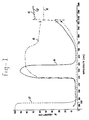
- Fig.1 is a graph representing the selective absorption of wavelength of sunlight, in accordance with a preferred embodiment of the present invention.
- Fig.2 is a cross-sectional, side view of an apparatus in accordance with the present invention, depicting a preferred embodiment thereof.
- a filter assembly 10 displays selective and variable radiation absorption features.
- the filter assembly 10 comprises three screens 12, 14, 16 (or three sets of screens 12, 14, 16).
- the outer screen 12 of the three screens provides a mechanism by which the plants may be protected from harmful UV radiation.
- the outer screen 12 is constituted so as to exclude from the growing plants, by absorption, that portion of UV-light known to cause DNA-damage and denaturation of the naturally occuring plant growth promoters and auxins, but at the same time to transmit as much white light and infra-red as practical.
- the wavelengths to be absorbed by this outer filter screen 12 lie, therefore, in the range 290-340 nm (see Fig. 1).
- a suitable material for the outer screen 12 is any thermoplastic material or acrylic resin in the form of either a thin film or woven or laminated material but exhibiting the property of being transparent to solar energy wavelengths above 340 nm which are those associated with heat and photosynthesis.
- Suitable materials for the outer screen 12 when in film form are resins of polyvinyl chloride, polyolefins such as polyethylene and polypropylene, or acrylic resins such as polymethylmethacrylate. Copolymers such as polyethylene/vinyl acetate and butadiene/styrene would also suffice. Such resins may also include plasticisers such as phthallate esters.
- the outer screen 12 includes UV absorbers of various chemical types at such concentration to provide both longevity to the material and selective absorption of UV below 340 nm. It is preferable that the outer screen 12 shall not have significant absorption, i.e. greater than 20%, of the natural wavelengths of light above 340 nm.
- the UV absorbers constitute between 0.01 and 0.5 % by weight of the screen material.
- An example of a suitable UV absorber is (2-chloroethyl) phosphate or acetophenone at a concentration of 0.1 w/w.
- Another example of a suitable absorber is 2-[2-hydroxy-5methylphenyl]benzotriazole at a concentration of 0.05 % w/w.
- a preferred material for the outer screen is polyethylene film of thickness between 100 and 300 microns, for example 200 microns, and this may be a single film or a laminate form with a reinforcing nylon or polyester net to give greater physical strength.
- the resin should also be light stable and non-volatile at the relatively high temperatures used in blow forming, extrusion or callendering of lay-flat film (i.e. about 1500°C). It is also essential according to the invention that the outer film be not polished, and preferably, it should be finished as a matte or taffeta surface to provide a light diffusion effect. The growth of plants is enhanced by diffused rather than direct light.
- the second screen 14 which is, preferably, arranged between the outer screen 12 and the growing plants, provides, in the preferred embodiment, protection from the unnecessary heating effect of light within the spectral wavelength ranges 510-610 nm and 800-2500 nm (see Fig. 1).
- the second screen 14 is comprised of a set of two screening films. These two films making up the second set of screens are ideally identical to each other although not necessarily so. The objective of this set is to provide the plants, at the discretion of the nurseryman, with an optional single or double degree of shade from heat (800-2500 nm) and intense green and yellow light (510-610 nm) but permitting maximum photosynthesis, synthesis of chlorophyll and photomorphogenesis, to occur.
- These screens should absorb maximally within the wavelength range 510-610 nm and consequently appear purple or violet in colour. Suitable materials for these screens are as described for the outer screen 12 but there is no necessity to include UV absorbers and a suitable thickness is between 100-300 microns. However, included in these screens according to the present invention and to achieve the objective of absorbing light in the range 510-610 nm, a pigment such as CI pigment Violet 37 (carbazole dioxazine) must be included in the formulation of the said screens at a concentration of, for example, 0.05 % w/w. This same pigment accomplishes the desired absorption of infra-red radiation of wavelengths between 800 nm and 2500 nm.
- CI pigment Violet 37 carbazo pigment Violet 37
- the pigment or dye used is heat and light stable. Care must be taken however when selecting a suitable pigment that little, if any, absorption occurs in the photosynthesis-essential ranges of 340-510 nm (blue) and 610-710 nm (red).
- a combination of the previously described, UV absorbing, outer screen 12 and this second screen 14 (or set of screens 14) absorbing green, yellow and infrared light, provide the plants with selected solar protection.
- growth rates to be enhanced by up to three times the unprotected rate. This combination of screens has been shown to encourage growth and development, especially of young plants.
- a third screen 16 comprising a set of at least one additional or alternative filter which will absorb those wavelengths of light known to be effective in inducing flowering, i.e. red light in the range 610-710 nm. Provision of this third screen filter 16, either in combination with the outer screen 12 and the second set of screens 14 previously described, or in combination with just the outer screen 12, will permit synchronisation of plant growth and flowering. When flowering is required, the nurseryman has simply to remove this third screen filter 16 which absorbs light in the range 510-710 nm and replace it by the second screen 14 which transmits red light in the range 610-710 nm.
- This third screen 16 also absorbs infra-red radiation (800-2500 nm).
- the objective of the third screen filter 16 is achieved by constructing a filter material as that previously described for the second set 14 but including in the formulation a pigment which will absorb substantially only red, green and yellow light in the range 510-710 nm, but which will transmit light in the blue region of the spectrum, i.e. between 340 and 500 nm (see Fig. 1).
- a filter will appear blue and suitable pigment would be, for example, CI pigment blue 60 (Cromophtal Blue A3R, Indanthone blue).
- This same pigment accomplishes desired absorption of infra-red radiation of wavelengths in the range 800 nm and 2500 nm.
- the pigment or dye utilized is heat and light stable.
- the filter assembly 10 of the present invention functions as a growth regulator and promoter and that each of the three screens 12, 14, 16 individually contributes to the ideal photosynthetic and development needs of green plants. Because any one green plant does not use the same wavelengths of solar radiation at different times during its growth and development, the present invention provides a means whereby the nurseryman can choose which filtered light environment he thinks fit for his crop. This choice of environment is accomplished, in accordance with the preferred embodiment, by selectively interposing one or more of the filter screens 12, 14, 16 between the growing plants and sun.
- the present invention provides environmental control by eliminating those wave-lengths of light which cause overheating, dehydration and wilting. These energy-rich wavelengths of light do their damage without contributing to the photosynthetic capacity of the plant, and, therefore, are of little benefit to the plant during the growth period in the natural environment. Elimination of these rays permit unhindered growth during daylight hours. In order to capitalize on such growth stimulation, the plants so stimulated need to operate their photosynthesis machinery to maximum advantage.
- the apparatus in addition to protecting the plant from mutation and auxin photolysis, the apparatus is capable of controlling photo-synthetic rate by preventing overheating and, therefore, excess water loss, and providing the plant with only those wavelengths of light usable in photosynthesis, i.e. red and blue light, thus preventing the growth and photosynthesis retardation effect of high light intensity known as solarization.
- the apparatus brings maximum advantage to crops grown in hot, arid, high light intensity regions, e.g. mediterranean and tropical climates, but considerable advantage should be accrued in temperate zones.
- One example of a filter assembly 10, in accordance with the present invention, includes an outer screen 12 containing an agent or agents which absorbs at least 80% of the UV radiation within the stated ranges of wavelengths, 290-340 nm; and the second and third sets of screens 14, 16 contain agents which absorbs at least 50 % of the respective green/yellow, red and infra-red radiation within the stated ranges of wavelengths (510-610 nm and 800-2500 nm) and (610-710 nm and 800-2500 nm) respectively.
- a filter assembly 10 in the form of a greenhouse 20 of conventional construction exemplifies a form in which the growth promotors may be supported and varied (see Fig. 2).
- the outer screen 12 of the filter assembly 10 forms the semi-permanent weather structure (i.e. roof and sides) of the greenhouse.
- the second screen 14 and third screen 16 are mounted on rollers 22, 23 inside the greenhouse, between the outer screen 12 and the growing plants 30.
- Hoisting ropes 25, 26 are connected to the ends of the second screen 14 and third screen 16 and extended over pulleys 27, 28 at the peak 29 of the greenhouse 20.
- the second screen 14 and third screen 16 function as blinds or curtains which the nurseryman selectively interposes, alternately or together, between the outer screen 12 and the plants 30 by unrolling and rolling the screens 14, 16 using the ropes 25, 26 and rollers 22, 23.
- the scope of the present invention is not to be limited to the physical structure of a canopy or greenhouse.
- the filter assembly 10 comprises only two screens or sets of screens which are employed either together, separately, continuously or discontinuously between the radiation source and the plants.
- one screen i.e. the stationary screen
- the other screen 16 i.e. the retractable screen
Landscapes
- Life Sciences & Earth Sciences (AREA)
- Chemical & Material Sciences (AREA)
- Engineering & Computer Science (AREA)
- Materials Engineering (AREA)
- Soil Sciences (AREA)
- Environmental Sciences (AREA)
- Cultivation Of Plants (AREA)
- Hydroponics (AREA)
- Fertilizers (AREA)
- Protection Of Plants (AREA)
- Greenhouses (AREA)
Claims (16)
- Dispositif pare-soleil (10) destiné à favoriser la croissance des plantes vertes, comprenant une pluralité de premiers écrans plastiques individuels (12) destinés à absorber le rayonnement UV dans la plage de 290-340 nm et des seconds écrans (14) destinés à absorber le rayonnement IR dans la plage de 800-2500 nm ainsi que des moyens de contrôle pour imposer sélectivement - d'une manière indépendante - l'action d'absorption du rayonnement des différents écrans individuels, dispositif caractérisé en ce que les seconds écrans (14) comprennent un agent absorbant la radiation dans la plage de 510-610 nm.
- Dispositif pare-soleil selon la revendication 1, caractérisé en ce que les premiers écrans (12) comprennent un agent absorbant au moins 80 % du rayonnement UV dans la plage de 290-340 nm.
- Dispositif pare-soleil selon la revendication 1 ou 2, caractérisé en ce que les seconds écrans (14) comprennent un agent absorbant au moins 50 % du rayonnement dans les plages d'ou moins 510-610 nm et 800-2500 nm respectivement.
- Dispositif pare-soleil selon l'une quelconque des revendications 1-3, caractérisé en ce que les moyens (12, 14) sont constitués de feuilles souples ou de pellicules ayant une épaisseur de 100-300 microns et réalisés en un matériau plastique choisi dans le groupe du chlorure de polyvinyle, de polyoléfine, du polyester et de résine acrylique.
- Dispositif pare-soleil selon l'une quelconque des revendications 1-4, caractérisé en ce que l'agent dans le premier écran (12) est présent dans une quantité de 0,01-5 % en poids du premier écran.
- Dispositif pare-soleil selon l'une quelconque des revendications 1-4, caractérisé en ce que l'agent dans le second écran (14) est un colorant ou pigment stable à la lumière et à la chaleur.
- Dispositif pare-soleil selon l'une quelconque des revendications 1-6, caractérisé en ce que l'appareil comprend un troisième écran (16) comprenant un agent pour absorber le rayonnement dans la plage de 610-710 nm.
- Dispositif pare-soleil selon la revendication 7, caractérisé en ce que le troisième écran comprend un agent destiné à absorber au moins 50 % du rayonnement dans la plage de 610-710 nm.
- Dispositif pare-soleil selon la revendication 7 ou 8, caractérisé en ce que l'agent dans le troisième écran (16) est présent dans une quantité inférieure à 1 % en poids du troisième écran.
- Dispositif pare-soleil selon l'une quelconque des revendications 7-9, caractérisé en ce que l'agent du troisième écran (16) est un colorant ou pigment stable à la lumière et à la chaleur.
- Dispositif pare-soleil selon l'une quelconque des revendications 1-5, caractérisé en ce que le second écran (14) a été remplacé par un écran (16) comprenant un agent destiné à absorber le rayonnement dans la plage de 610-710 nm.
- Dispositif pare-soleil selon la revendication 11, caractérisé en ce que le second écran (14) a été remplacé par un écran (16) comprenant un agent destiné à absorber au moins 50 % du rayonnement dans la plage de 610-710 nm.
- Procécé destiné à favoriser la croissance de plantes vertes, caractérisé par l'utilisation d'un dispositif pare-soleil défini dans l'une quelconque des revendications 1-12.
- Procédé selon la revendication 13, caractérisé par l'application d'étapes de création sélective à différentes périodes du cycle de croissance de la plante d'au moins deux environnements de rayonnement solaire différente.
- Procédé selon la revendication 14, caractérisé en ce que les environnements de rayonnement solaire différente se distinguent par des quantités différentes de radiations dans la plage de 610-710 nm.
- Procédé selon les revendications 14 ou 15, caractérisé en ce que les environnements de rayonnement solaire différents se distinguent par des quantités différentes de rayonnement de longueurs d'onde dans la plage de 510-710 nm.
Priority Applications (4)
| Application Number | Priority Date | Filing Date | Title |
|---|---|---|---|
| AT89201455T ATE100665T1 (de) | 1989-06-06 | 1989-06-06 | Verfahren und vorrichtung zum verwenden bei planzenwachstumsfoerderung und blumenentwicklung. |
| ES89201455T ES2050782T3 (es) | 1989-06-06 | 1989-06-06 | Metodo y aparato para uso en la promocion del crecimiento de las plantas y el desarrollo de las flores. |
| DE68912768T DE68912768T2 (de) | 1989-06-06 | 1989-06-06 | Verfahren und Vorrichtung zum Verwenden bei Planzenwachstumsförderung und Blumenentwicklung. |
| EP89201455A EP0401428B1 (fr) | 1989-06-06 | 1989-06-06 | Procédé et appareil à utiliser pour promouvoir la croissance de plantes et le developpement de fleurs |
Applications Claiming Priority (1)
| Application Number | Priority Date | Filing Date | Title |
|---|---|---|---|
| EP89201455A EP0401428B1 (fr) | 1989-06-06 | 1989-06-06 | Procédé et appareil à utiliser pour promouvoir la croissance de plantes et le developpement de fleurs |
Publications (2)
| Publication Number | Publication Date |
|---|---|
| EP0401428A1 EP0401428A1 (fr) | 1990-12-12 |
| EP0401428B1 true EP0401428B1 (fr) | 1994-01-26 |
Family
ID=8202403
Family Applications (1)
| Application Number | Title | Priority Date | Filing Date |
|---|---|---|---|
| EP89201455A Expired - Lifetime EP0401428B1 (fr) | 1989-06-06 | 1989-06-06 | Procédé et appareil à utiliser pour promouvoir la croissance de plantes et le developpement de fleurs |
Country Status (4)
| Country | Link |
|---|---|
| EP (1) | EP0401428B1 (fr) |
| AT (1) | ATE100665T1 (fr) |
| DE (1) | DE68912768T2 (fr) |
| ES (1) | ES2050782T3 (fr) |
Family Cites Families (5)
| Publication number | Priority date | Publication date | Assignee | Title |
|---|---|---|---|---|
| US2639550A (en) * | 1947-09-20 | 1953-05-26 | Arthur G Mckee | Apparatus for growing tender plants |
| GB1247066A (en) * | 1968-02-14 | 1971-09-22 | Montedison Spa | Improvements in synthetic polymer materials for use in the agricultural field |
| FR2417252A1 (fr) * | 1978-02-20 | 1979-09-14 | Cellophane Sa | Materiau composite thermoplastique transparent pour la realisation de serres agricoles |
| NL189794C (nl) * | 1983-10-31 | 1993-08-02 | Inst Obschei I Neoorganichesko | Polymeermateriaal voor het bedekken van broeikassen en werkwijze voor het stimuleren van de groei van planten. |
| SE8403986L (sv) * | 1984-08-06 | 1986-02-07 | Svensson Ludvig Int | Vexthusgardin |
-
1989
- 1989-06-06 AT AT89201455T patent/ATE100665T1/de not_active IP Right Cessation
- 1989-06-06 EP EP89201455A patent/EP0401428B1/fr not_active Expired - Lifetime
- 1989-06-06 DE DE68912768T patent/DE68912768T2/de not_active Expired - Fee Related
- 1989-06-06 ES ES89201455T patent/ES2050782T3/es not_active Expired - Lifetime
Also Published As
| Publication number | Publication date |
|---|---|
| ES2050782T3 (es) | 1994-06-01 |
| ATE100665T1 (de) | 1994-02-15 |
| DE68912768D1 (de) | 1994-03-10 |
| DE68912768T2 (de) | 1994-08-11 |
| EP0401428A1 (fr) | 1990-12-12 |
Similar Documents
| Publication | Publication Date | Title |
|---|---|---|
| US5022181A (en) | Method and apparatus for use in plant growth promotion and flower development | |
| DE69737205T2 (de) | Pflanzenbehandlungsstoff und verwendungsverfahren | |
| AU600275B2 (en) | Sunbathing filter with incomplete uv-b absorption | |
| DE2107346A1 (de) | Schichtfolie für landwirtschaftliche Zwecke | |
| US20160174474A1 (en) | Woven ground cover materials | |
| EP3013139B1 (fr) | Toit de la serre avec une transparence dépendant de la température et procédé de culture des plantes | |
| ES2550535T3 (es) | Cobertura protectora de plantas | |
| EP0172151B1 (fr) | Ecran de serre | |
| DE1247738B (de) | Kunststoffolie und Verfahren zu ihrer Herstellung | |
| WO2016151520A1 (fr) | Matériaux d'ombrage rafraîchissants | |
| Castellano et al. | Design and use criteria of netting systems for agricultural production in Italy | |
| JPH0646685A (ja) | 農業用光質変換資材 | |
| AU639202B2 (en) | Apparatus for use in plant growth promotion and flower development | |
| JPH07170865A (ja) | 波長変換資材 | |
| JP2002247919A (ja) | 植物の栽培方法 | |
| JPH0638635A (ja) | 波長変換資材 | |
| KR101859916B1 (ko) | 태양광 차폐 시설 구조를 갖는 농업용 재배 하우스 | |
| CN104542100B (zh) | 智慧型光栅式植物培植装置、其制法及培植方法 | |
| KR102254578B1 (ko) | 냉방 및 보온 효율이 증진된 시설원예용 하이브리드형 장기성 코팅 필름 | |
| EP0401428A1 (fr) | Procédé et appareil à utiliser pour promouvoir la croissance de plantes et le developpement de fleurs | |
| JPH08252882A (ja) | 波長変換資材 | |
| Puglisi | Applied research and experimental development of a new generation of plastic nets for crop protection | |
| CN110381730A (zh) | 用于柑橘类水果生产的光谱修改网 | |
| TWI494054B (zh) | 智慧型光柵式植物培植裝置、其製法及培植方法 | |
| JP2001258403A (ja) | 通気性を有する光選択透過性被覆材料およびそれを用いる植物の栽培方法 |
Legal Events
| Date | Code | Title | Description |
|---|---|---|---|
| PUAI | Public reference made under article 153(3) epc to a published international application that has entered the european phase |
Free format text: ORIGINAL CODE: 0009012 |
|
| AK | Designated contracting states |
Kind code of ref document: A1 Designated state(s): AT BE CH DE ES FR GB GR IT LI LU NL SE |
|
| 17P | Request for examination filed |
Effective date: 19901220 |
|
| 17Q | First examination report despatched |
Effective date: 19911220 |
|
| RAP3 | Party data changed (applicant data changed or rights of an application transferred) |
Owner name: LONGSTAFF, ERIC |
|
| GRAA | (expected) grant |
Free format text: ORIGINAL CODE: 0009210 |
|
| AK | Designated contracting states |
Kind code of ref document: B1 Designated state(s): AT BE CH DE ES FR GB GR IT LI LU NL SE |
|
| PG25 | Lapsed in a contracting state [announced via postgrant information from national office to epo] |
Ref country code: SE Effective date: 19940126 |
|
| REF | Corresponds to: |
Ref document number: 100665 Country of ref document: AT Date of ref document: 19940215 Kind code of ref document: T |
|
| REF | Corresponds to: |
Ref document number: 68912768 Country of ref document: DE Date of ref document: 19940310 |
|
| ITF | It: translation for a ep patent filed | ||
| REG | Reference to a national code |
Ref country code: ES Ref legal event code: FG2A Ref document number: 2050782 Country of ref document: ES Kind code of ref document: T3 |
|
| ET | Fr: translation filed | ||
| REG | Reference to a national code |
Ref country code: GR Ref legal event code: FG4A Free format text: 3011640 |
|
| EPTA | Lu: last paid annual fee | ||
| PLBE | No opposition filed within time limit |
Free format text: ORIGINAL CODE: 0009261 |
|
| STAA | Information on the status of an ep patent application or granted ep patent |
Free format text: STATUS: NO OPPOSITION FILED WITHIN TIME LIMIT |
|
| 26N | No opposition filed | ||
| PGFP | Annual fee paid to national office [announced via postgrant information from national office to epo] |
Ref country code: GB Payment date: 19990408 Year of fee payment: 11 |
|
| PGFP | Annual fee paid to national office [announced via postgrant information from national office to epo] |
Ref country code: FR Payment date: 19990506 Year of fee payment: 11 |
|
| PGFP | Annual fee paid to national office [announced via postgrant information from national office to epo] |
Ref country code: AT Payment date: 19990512 Year of fee payment: 11 |
|
| PGFP | Annual fee paid to national office [announced via postgrant information from national office to epo] |
Ref country code: CH Payment date: 19990519 Year of fee payment: 11 |
|
| PGFP | Annual fee paid to national office [announced via postgrant information from national office to epo] |
Ref country code: DE Payment date: 19990526 Year of fee payment: 11 |
|
| PGFP | Annual fee paid to national office [announced via postgrant information from national office to epo] |
Ref country code: NL Payment date: 19990531 Year of fee payment: 11 |
|
| PGFP | Annual fee paid to national office [announced via postgrant information from national office to epo] |
Ref country code: ES Payment date: 19990604 Year of fee payment: 11 |
|
| PGFP | Annual fee paid to national office [announced via postgrant information from national office to epo] |
Ref country code: BE Payment date: 19990607 Year of fee payment: 11 |
|
| PGFP | Annual fee paid to national office [announced via postgrant information from national office to epo] |
Ref country code: LU Payment date: 19990617 Year of fee payment: 11 |
|
| PGFP | Annual fee paid to national office [announced via postgrant information from national office to epo] |
Ref country code: GR Payment date: 19990621 Year of fee payment: 11 |
|
| PG25 | Lapsed in a contracting state [announced via postgrant information from national office to epo] |
Ref country code: LU Free format text: LAPSE BECAUSE OF NON-PAYMENT OF DUE FEES Effective date: 20000606 Ref country code: GB Free format text: LAPSE BECAUSE OF NON-PAYMENT OF DUE FEES Effective date: 20000606 Ref country code: AT Free format text: LAPSE BECAUSE OF NON-PAYMENT OF DUE FEES Effective date: 20000606 |
|
| PG25 | Lapsed in a contracting state [announced via postgrant information from national office to epo] |
Ref country code: ES Free format text: THE PATENT HAS BEEN ANNULLED BY A DECISION OF A NATIONAL AUTHORITY Effective date: 20000607 |
|
| PG25 | Lapsed in a contracting state [announced via postgrant information from national office to epo] |
Ref country code: LI Free format text: LAPSE BECAUSE OF NON-PAYMENT OF DUE FEES Effective date: 20000630 Ref country code: GR Free format text: LAPSE BECAUSE OF NON-PAYMENT OF DUE FEES Effective date: 20000630 Ref country code: CH Free format text: LAPSE BECAUSE OF NON-PAYMENT OF DUE FEES Effective date: 20000630 Ref country code: BE Free format text: LAPSE BECAUSE OF NON-PAYMENT OF DUE FEES Effective date: 20000630 |
|
| BERE | Be: lapsed |
Owner name: LONGSTAFF ERIC Effective date: 20000630 |
|
| PG25 | Lapsed in a contracting state [announced via postgrant information from national office to epo] |
Ref country code: NL Free format text: LAPSE BECAUSE OF NON-PAYMENT OF DUE FEES Effective date: 20010101 |
|
| GBPC | Gb: european patent ceased through non-payment of renewal fee |
Effective date: 20000606 |
|
| REG | Reference to a national code |
Ref country code: CH Ref legal event code: PL |
|
| PG25 | Lapsed in a contracting state [announced via postgrant information from national office to epo] |
Ref country code: FR Free format text: LAPSE BECAUSE OF NON-PAYMENT OF DUE FEES Effective date: 20010228 |
|
| NLV4 | Nl: lapsed or anulled due to non-payment of the annual fee |
Effective date: 20010101 |
|
| REG | Reference to a national code |
Ref country code: FR Ref legal event code: ST |
|
| PG25 | Lapsed in a contracting state [announced via postgrant information from national office to epo] |
Ref country code: DE Free format text: LAPSE BECAUSE OF NON-PAYMENT OF DUE FEES Effective date: 20010403 |
|
| REG | Reference to a national code |
Ref country code: ES Ref legal event code: FD2A Effective date: 20020204 |
|
| PG25 | Lapsed in a contracting state [announced via postgrant information from national office to epo] |
Ref country code: IT Free format text: LAPSE BECAUSE OF NON-PAYMENT OF DUE FEES;WARNING: LAPSES OF ITALIAN PATENTS WITH EFFECTIVE DATE BEFORE 2007 MAY HAVE OCCURRED AT ANY TIME BEFORE 2007. THE CORRECT EFFECTIVE DATE MAY BE DIFFERENT FROM THE ONE RECORDED. Effective date: 20050606 |