EP0401489A2 - Anziehende elektrostatische Schicht - Google Patents
Anziehende elektrostatische Schicht Download PDFInfo
- Publication number
- EP0401489A2 EP0401489A2 EP90106781A EP90106781A EP0401489A2 EP 0401489 A2 EP0401489 A2 EP 0401489A2 EP 90106781 A EP90106781 A EP 90106781A EP 90106781 A EP90106781 A EP 90106781A EP 0401489 A2 EP0401489 A2 EP 0401489A2
- Authority
- EP
- European Patent Office
- Prior art keywords
- sheet
- whiskers
- attracting
- attracting sheet
- electrostatic
- Prior art date
- Legal status (The legal status is an assumption and is not a legal conclusion. Google has not performed a legal analysis and makes no representation as to the accuracy of the status listed.)
- Granted
Links
Images


Classifications
-
- H—ELECTRICITY
- H01—ELECTRIC ELEMENTS
- H01B—CABLES; CONDUCTORS; INSULATORS; SELECTION OF MATERIALS FOR THEIR CONDUCTIVE, INSULATING OR DIELECTRIC PROPERTIES
- H01B1/00—Conductors or conductive bodies characterised by the conductive materials; Selection of materials as conductors
- H01B1/20—Conductive material dispersed in non-conductive organic material
- H01B1/22—Conductive material dispersed in non-conductive organic material the conductive material comprising metals or alloys
-
- C—CHEMISTRY; METALLURGY
- C08—ORGANIC MACROMOLECULAR COMPOUNDS; THEIR PREPARATION OR CHEMICAL WORKING-UP; COMPOSITIONS BASED THEREON
- C08K—Use of inorganic or non-macromolecular organic substances as compounding ingredients
- C08K9/00—Use of pretreated ingredients
- C08K9/02—Ingredients treated with inorganic substances
-
- H—ELECTRICITY
- H01—ELECTRIC ELEMENTS
- H01B—CABLES; CONDUCTORS; INSULATORS; SELECTION OF MATERIALS FOR THEIR CONDUCTIVE, INSULATING OR DIELECTRIC PROPERTIES
- H01B1/00—Conductors or conductive bodies characterised by the conductive materials; Selection of materials as conductors
- H01B1/20—Conductive material dispersed in non-conductive organic material
-
- H—ELECTRICITY
- H02—GENERATION; CONVERSION OR DISTRIBUTION OF ELECTRIC POWER
- H02N—ELECTRIC MACHINES NOT OTHERWISE PROVIDED FOR
- H02N13/00—Clutches or holding devices using electrostatic attraction, e.g. using Johnson-Rahbek effect
-
- Y—GENERAL TAGGING OF NEW TECHNOLOGICAL DEVELOPMENTS; GENERAL TAGGING OF CROSS-SECTIONAL TECHNOLOGIES SPANNING OVER SEVERAL SECTIONS OF THE IPC; TECHNICAL SUBJECTS COVERED BY FORMER USPC CROSS-REFERENCE ART COLLECTIONS [XRACs] AND DIGESTS
- Y10—TECHNICAL SUBJECTS COVERED BY FORMER USPC
- Y10S—TECHNICAL SUBJECTS COVERED BY FORMER USPC CROSS-REFERENCE ART COLLECTIONS [XRACs] AND DIGESTS
- Y10S428/00—Stock material or miscellaneous articles
- Y10S428/913—Material designed to be responsive to temperature, light, moisture
-
- Y—GENERAL TAGGING OF NEW TECHNOLOGICAL DEVELOPMENTS; GENERAL TAGGING OF CROSS-SECTIONAL TECHNOLOGIES SPANNING OVER SEVERAL SECTIONS OF THE IPC; TECHNICAL SUBJECTS COVERED BY FORMER USPC CROSS-REFERENCE ART COLLECTIONS [XRACs] AND DIGESTS
- Y10—TECHNICAL SUBJECTS COVERED BY FORMER USPC
- Y10T—TECHNICAL SUBJECTS COVERED BY FORMER US CLASSIFICATION
- Y10T428/00—Stock material or miscellaneous articles
- Y10T428/25—Web or sheet containing structurally defined element or component and including a second component containing structurally defined particles
-
- Y—GENERAL TAGGING OF NEW TECHNOLOGICAL DEVELOPMENTS; GENERAL TAGGING OF CROSS-SECTIONAL TECHNOLOGIES SPANNING OVER SEVERAL SECTIONS OF THE IPC; TECHNICAL SUBJECTS COVERED BY FORMER USPC CROSS-REFERENCE ART COLLECTIONS [XRACs] AND DIGESTS
- Y10—TECHNICAL SUBJECTS COVERED BY FORMER USPC
- Y10T—TECHNICAL SUBJECTS COVERED BY FORMER US CLASSIFICATION
- Y10T428/00—Stock material or miscellaneous articles
- Y10T428/25—Web or sheet containing structurally defined element or component and including a second component containing structurally defined particles
- Y10T428/258—Alkali metal or alkaline earth metal or compound thereof
-
- Y—GENERAL TAGGING OF NEW TECHNOLOGICAL DEVELOPMENTS; GENERAL TAGGING OF CROSS-SECTIONAL TECHNOLOGIES SPANNING OVER SEVERAL SECTIONS OF THE IPC; TECHNICAL SUBJECTS COVERED BY FORMER USPC CROSS-REFERENCE ART COLLECTIONS [XRACs] AND DIGESTS
- Y10—TECHNICAL SUBJECTS COVERED BY FORMER USPC
- Y10T—TECHNICAL SUBJECTS COVERED BY FORMER US CLASSIFICATION
- Y10T428/00—Stock material or miscellaneous articles
- Y10T428/29—Coated or structually defined flake, particle, cell, strand, strand portion, rod, filament, macroscopic fiber or mass thereof
- Y10T428/2982—Particulate matter [e.g., sphere, flake, etc.]
-
- Y—GENERAL TAGGING OF NEW TECHNOLOGICAL DEVELOPMENTS; GENERAL TAGGING OF CROSS-SECTIONAL TECHNOLOGIES SPANNING OVER SEVERAL SECTIONS OF THE IPC; TECHNICAL SUBJECTS COVERED BY FORMER USPC CROSS-REFERENCE ART COLLECTIONS [XRACs] AND DIGESTS
- Y10—TECHNICAL SUBJECTS COVERED BY FORMER USPC
- Y10T—TECHNICAL SUBJECTS COVERED BY FORMER US CLASSIFICATION
- Y10T428/00—Stock material or miscellaneous articles
- Y10T428/29—Coated or structually defined flake, particle, cell, strand, strand portion, rod, filament, macroscopic fiber or mass thereof
- Y10T428/2982—Particulate matter [e.g., sphere, flake, etc.]
- Y10T428/2991—Coated
-
- Y—GENERAL TAGGING OF NEW TECHNOLOGICAL DEVELOPMENTS; GENERAL TAGGING OF CROSS-SECTIONAL TECHNOLOGIES SPANNING OVER SEVERAL SECTIONS OF THE IPC; TECHNICAL SUBJECTS COVERED BY FORMER USPC CROSS-REFERENCE ART COLLECTIONS [XRACs] AND DIGESTS
- Y10—TECHNICAL SUBJECTS COVERED BY FORMER USPC
- Y10T—TECHNICAL SUBJECTS COVERED BY FORMER US CLASSIFICATION
- Y10T428/00—Stock material or miscellaneous articles
- Y10T428/31504—Composite [nonstructural laminate]
-
- Y—GENERAL TAGGING OF NEW TECHNOLOGICAL DEVELOPMENTS; GENERAL TAGGING OF CROSS-SECTIONAL TECHNOLOGIES SPANNING OVER SEVERAL SECTIONS OF THE IPC; TECHNICAL SUBJECTS COVERED BY FORMER USPC CROSS-REFERENCE ART COLLECTIONS [XRACs] AND DIGESTS
- Y10—TECHNICAL SUBJECTS COVERED BY FORMER USPC
- Y10T—TECHNICAL SUBJECTS COVERED BY FORMER US CLASSIFICATION
- Y10T428/00—Stock material or miscellaneous articles
- Y10T428/31504—Composite [nonstructural laminate]
- Y10T428/31551—Of polyamidoester [polyurethane, polyisocyanate, polycarbamate, etc.]
- Y10T428/31616—Next to polyester [e.g., alkyd]
Definitions
- This invention relates to an electrostatic attracting sheet which is used in electrostatic holding apparatuses adapted to hold and transport paper sheets in the so-called X-Y plotters, copying machines or the like.
- Known electrostatic holding apparatuses utilize the electrostatic coulomb force in order to attract a paper sheet or other object to be held on the holding apparatus.
- Said electrostatic holding apparatuses each comprises an insulating base layer, a pair of electrodes formed thereon and an electrostatic attracting sheet, laminated on and covering the base layer and electrodes.
- the attracting sheet is of a predetermined conductivity or of a limited electrical resistance.
- positive and negative electrostatic charges are imparted to the electrodes, respectively, to induce electrostatic charges in the attracting sheet.
- the electrostatic attracting sheets in said known devices have a structure such that carbon black or other powder of electrically conducting materials is dispersed and embedded in a sheet of plastics or synthetic rubber. Rolling technique or extrusion method is used to form the sheets.
- the attracting sheets made by those method are disadvantageous because their conductivity is not well controlled but is likely to be influenced by ambient temperature or humidity. Thus, they cannot exert their attracting force in a stable manner.
- the inventions disclosed in the Japanese Patent Publications are directed to an improvement to diminish such disadvantages in the known art, the improvement residing in the adding of a stabilizing agent, a plasticizer, anti-aging agent, a lubricant and/or other special additives.
- a stabilizing agent e.g., a plasticizer, anti-aging agent, a lubricant and/or other special additives.
- Such additives added to the electrically conducting material are intended to eliminate the bad influences of ambient temperature or humidity in order to stabilize the attracting force.
- an object of the invention is to provide an electrostatic sheet which has a well controlled electric conductivity, a stable attracting force free from bad influences of ambient temperature and humidity, and can be manufactured at a lower cost.
- characteristic of said sheets in the invention is scarcely affected by ambient humidity conditions. Said sheets are more resistant to higher temperatures so that electrodes which constitute an attracting device may be printed, if necessary, on one surface of the sheets within a wider range of temperatures.
- white conductive substances such as some compounds of tinc or antimony may be coated on the surface of whiskers, thereby giving white attracting sheets.
- white sheets may be colored with any desirable colors which will give an aesthetic value to said sheets.
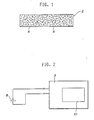
- Fig. 1 shows an electrostatic attracting sheet 2 made of a high polymer substance 4 and conductive crystal whiskers 6 dispersed therein.
- a direct current is fed to the attracting sheet 2 by means of a power source 8. Consequently, electrostatic charges are induced in said sheet 2 to thereby attract an object sheet 10 thereto.
- the electrostatic attracting sheet 2 which contains the whiskers 6 dispersed in the polymer 4 is formed to be 0.2 to 0.8 mm in thickness.
- the whiskers 6 are caused in general to scatter homogeneously throughout the polymer 4 so that uniform conductivity is imparted thereto. However, concentration or content of said whiskers in respective areas or zones of one sheet 2 may be made different, if occasions demand. In other words , the attracting force of a portion of any desirable pattern on the sheet 2 may be higher than the other portions.
- high polymer substance examples include polyurethane, acrylic resins, polyamide, polyacetal, polyvinylidene fluoride, polybutylene terephthalate and the likes. They may be crystalline or non-crystalline.
- Potassium titanate is one of such compounds that can produce the whiskers 6 as used in the embodiment. Diameter thereof may be about 0.1 to 0,3 ⁇ m with length of about 10 to 30 ⁇ m.
- reduction method or CVD chemical Vapor Deposition
- CVD chemical Vapor Deposition
- Table 1 indicates a fact that the added amount of the whiskers 2 varying within a range from 0 to 4 wt.% brings about a greater variation of the volume resistivity of sheet 2 ranging from 5.5 x 10¹⁴ ⁇ cm to 2.0 x 10¹⁴ ⁇ cm.
- the added amount of whishers varying within another range from 5 to 15 wt. % does not cause such a sharp change in the resistivity but rather stabilized same within a smaller range from 6.8 x 10¹³ to 4.5 x 10¹³ ⁇ cm.
- volume resistivity in the order of 1013 ⁇ cm is the most preferable to provide the electrostatic attracting sheet having a sufficient attracting force.
- the result of the above described experiments in the first embodiment suggests a better and more uniform dispersion of the whiskers compared with the case of carbon black which is of a poor dispersibility in the high polymer.
- a three-dimensional network in which the whiskers entangle with each other as shown in Fig. 1 is formed by the dispersed whiskers 6 in the embodiment, throughout the sheet 2.
- Such a network cannot be built with a conductive powder such as carbon black as used in prior art, because it tends to aggregate one another. This difference in dispersion makes it possible to reduce the amount of whiskers to a half of added amount of carbon black.
- Fine spherical particles of carbon black will form bead chains of a kind which is called "structure". It is assumed that electrons flows through the chains or repeatedly jump from the aggregate particles of carbon black to the surrounding high polymer phases. This mechanism of electron current makes it difficult to obtain an attracting sheet comprising carbon black and being uniform in its volume resistivity over its entire surface.
- the high polymer 4 containing the whiskers 6 uniformly dispersed therein can be easily formed into the sheet 2 by the method of injection molding extrusion or other suitable methods.
- a desirable level of conductivity is realized in a stable and well-controlled manner in such formation of sheets.
- an electrostatic attracting device 10 comprises a plate 20 comprising an electrostatic attracting sheet 12.
- a positive electrode 14 and a negative electrode 16 are of a comb-like shape and electrically connected to a power source 18. The electrodes are formed on a back surface of said attracting sheet 12.
- a drawing sheet of paper "P" is attracted to an upper surface of the sheet 12.
- the plate 28 comprises an insulating base 22 on which the electrodes 14 and 16 are formed.
- Each of comb-teeth portions of one electrode is disposed between and spaced apart from every two comb-teeth portions of the other electrode.
- the electrostatic attracting sheet 12 bonds the electrodes and the base.
- the electrostatic attracting sheet 12 which is formed by the melt-extrusion method is about 0.3 mm in thickness and has a fine internal structure as shown in Fig. 4. Dispersed in a matrix of an insulating polyacetal resin 26 are crystal whiskers 24 made of potassium titanate and coated with white conductive substance.
- the white and electrically conductive substance mentioned above is tinc, in the second embodiment, which is coated at a ratio of about 1 part by weight to 2 parts by weight of the whiskers.
- the CVD (Chemical Vapor Deposition) method was utilized in the second embodiment to coat the whiskers with tinc.
- the thus coated whiskers are about 0.2 to 0.5 ⁇ m in diameter, and about 10 to 20 ⁇ m in length.
- Table 2 shows characteristics of electrostatic attracting sheets which were prepared in the second embodiment by varying the content (%) by weight of white coated whiskers 24 in the sheets 12 within a range from 0% to 20%. Thickness of said sheets was set at about 0.3 mm. Table 2 Examples of Attracting Sheets Added amount of whiskers(wt.%) Volume resistivity ( ⁇ cm) Bending modulus (kgf/cm2) Thermal deformation temp.(°C) (18.6 kgf/cm2) 0 5.5 x 10¹⁴ 2.7 x 10⁴ 110 2 4.1 x 10¹⁴ 2.6 x 10⁴ 110 3 2.5 x 10¹⁴ -- -- 4 1.3 x 10¹⁴ -- -- 5 2.8 x 10¹⁴ 2.9 x 10⁴ -- 8 8.2 x 10¹⁴ 3.1 x 10⁴ 120 15 6.7 x 10¹¹ 3.3 x 10⁴ 120 20 4.8 x 10¹⁰ -- -- Test method (ASTM) D-257 D-790 D-648
- volume resistivity of an order from 1012 ⁇ cm to 1014 ⁇ cm was imparted to the attracting sheets with 2 (two) to 8 (eight) % by weight of the whiskers added in said sheets.
- a content higher than 8% by weight of whiskers is not desirable because electric conductivity sharply decreases giving poor attracting force to the sheets.
- the attracting sheets in the second embodiment proved to be much stronger in paper-attracting force than said known sheets.
- whiskers which are coated with white conductive substances such as antimony, nickel or aluminum, in place of tinc. Such coated whiskers make white the attracting sheet so that any desirable color can be given to it. Colored attracting sheets made in this way will be of a higher aesthetic value and practical value in use compared with the known conventional black sheets which have been real black caused by the carbon black contained therein. With white or light-colored attracting sheets, fine lines which are being drawn on a paper sheet attracted on the attracting sheet in X-Y plotter can be seen clearly by an operator thereof.
- Relaxation time for the sheet in the invention also was observed to be longer than that for the known sheets. This may have a relationship to the higher attracting force, but requires the charged voltage to be reversed when attraction of paper sheets are to be released.
- the thickness of attracting sheet could be made smaller in the invention which probably resulted from the use of whiskers and which in turn caused the whiskers to be arranged in parallel with the surface of attracting sheet.
Landscapes
- Chemical & Material Sciences (AREA)
- Physics & Mathematics (AREA)
- Dispersion Chemistry (AREA)
- Spectroscopy & Molecular Physics (AREA)
- Organic Chemistry (AREA)
- Chemical Kinetics & Catalysis (AREA)
- Medicinal Chemistry (AREA)
- Polymers & Plastics (AREA)
- Health & Medical Sciences (AREA)
- Laminated Bodies (AREA)
- Compositions Of Macromolecular Compounds (AREA)
- Manufacture Of Porous Articles, And Recovery And Treatment Of Waste Products (AREA)
- Delivering By Means Of Belts And Rollers (AREA)
- Paper (AREA)
- Electrostatic Separation (AREA)
- Manufacture Of Macromolecular Shaped Articles (AREA)
Applications Claiming Priority (2)
| Application Number | Priority Date | Filing Date | Title |
|---|---|---|---|
| JP1127392A JPH02307551A (ja) | 1989-05-20 | 1989-05-20 | 静電吸着シート |
| JP127392/89 | 1989-05-20 |
Publications (3)
| Publication Number | Publication Date |
|---|---|
| EP0401489A2 true EP0401489A2 (de) | 1990-12-12 |
| EP0401489A3 EP0401489A3 (de) | 1992-02-12 |
| EP0401489B1 EP0401489B1 (de) | 1994-11-30 |
Family
ID=14958858
Family Applications (1)
| Application Number | Title | Priority Date | Filing Date |
|---|---|---|---|
| EP90106781A Expired - Lifetime EP0401489B1 (de) | 1989-05-20 | 1990-04-09 | Anziehende elektrostatische Schicht |
Country Status (4)
| Country | Link |
|---|---|
| US (1) | US5202179A (de) |
| EP (1) | EP0401489B1 (de) |
| JP (1) | JPH02307551A (de) |
| DE (1) | DE69014417T2 (de) |
Cited By (6)
| Publication number | Priority date | Publication date | Assignee | Title |
|---|---|---|---|---|
| DE4323812A1 (de) * | 1992-07-29 | 1994-03-10 | Abisare Kk | Elektrostatisches Notiztafelsystem |
| DE4326375A1 (de) * | 1992-12-03 | 1994-06-09 | Abisare Kk | Elektrostatisches Anziehungs-Notiztafelsystem |
| GB2294468A (en) * | 1994-10-27 | 1996-05-01 | Btr Plc | Electrically conductive composite polymeric material |
| WO2011116357A3 (en) * | 2010-03-19 | 2011-11-24 | Sri International | Electroadhesive device, method of adhering a device and electrolaminate system |
| WO2012129541A3 (en) * | 2011-03-23 | 2013-01-03 | Sri International | Active electroadhesive cleaning |
| US9358590B2 (en) | 2011-03-23 | 2016-06-07 | Sri International | Electroadhesive surface cleaner |
Families Citing this family (15)
| Publication number | Priority date | Publication date | Assignee | Title |
|---|---|---|---|---|
| US5939243A (en) * | 1998-05-04 | 1999-08-17 | Eastman Kodak Company | Imaging element comprising an electrically-conductive layer containing mixed acicular and granular metal-containing particles and a transparent magnetic recording layer |
| US6074807A (en) * | 1998-10-15 | 2000-06-13 | Eastman Kodak Company | Imaging element containing an electrically-conductive layer containing acicular metal-containing particles and a transparent magnetic recording layer |
| JP2002284384A (ja) * | 2001-03-28 | 2002-10-03 | Canon Inc | 搬送ベルト、該搬送ベルトの製造方法、および前記搬送ベルトを備えた画像形成装置 |
| EP1403083B1 (de) * | 2002-09-26 | 2008-11-19 | Canon Kabushiki Kaisha | Förderband, welches in der Lage ist Gegenstände anzuziehen, Bilderzeugungsvorrichtung mit solch einem Förderband und Methode zu Herstellung solch eines Förderbandes |
| CN100366655C (zh) * | 2005-02-23 | 2008-02-06 | 沈阳化工学院 | 高耐磨、抗静电型聚氨酯材料 |
| US8404160B2 (en) * | 2007-05-18 | 2013-03-26 | Applied Nanotech Holdings, Inc. | Metallic ink |
| US10231344B2 (en) * | 2007-05-18 | 2019-03-12 | Applied Nanotech Holdings, Inc. | Metallic ink |
| US8506849B2 (en) | 2008-03-05 | 2013-08-13 | Applied Nanotech Holdings, Inc. | Additives and modifiers for solvent- and water-based metallic conductive inks |
| US20090286383A1 (en) * | 2008-05-15 | 2009-11-19 | Applied Nanotech Holdings, Inc. | Treatment of whiskers |
| US9730333B2 (en) * | 2008-05-15 | 2017-08-08 | Applied Nanotech Holdings, Inc. | Photo-curing process for metallic inks |
| US20100000762A1 (en) * | 2008-07-02 | 2010-01-07 | Applied Nanotech Holdings, Inc. | Metallic pastes and inks |
| CN102365713B (zh) | 2009-03-27 | 2015-11-25 | 应用纳米技术控股股份有限公司 | 增强光和/或激光烧结的缓冲层 |
| US8422197B2 (en) * | 2009-07-15 | 2013-04-16 | Applied Nanotech Holdings, Inc. | Applying optical energy to nanoparticles to produce a specified nanostructure |
| US9598776B2 (en) | 2012-07-09 | 2017-03-21 | Pen Inc. | Photosintering of micron-sized copper particles |
| SE542576C2 (sv) * | 2018-04-18 | 2020-06-09 | Eurus Airtech Ab | Högresistiva elektrodelement för tvåstegselektrofilter |
Family Cites Families (17)
| Publication number | Priority date | Publication date | Assignee | Title |
|---|---|---|---|---|
| US3634740A (en) * | 1970-04-20 | 1972-01-11 | Addressograph Multigraph | Electrostatic holddown |
| US3916270A (en) * | 1974-05-02 | 1975-10-28 | Tektronix Inc | Electrostatic holddown apparatus |
| JPS5313389A (en) * | 1976-07-06 | 1978-02-06 | Mitsubishi Electric Corp | Radar system |
| JPS5441892A (en) * | 1977-09-08 | 1979-04-03 | Hokuriku Pharmaceutical | Quaternary salt derivative |
| JPS5441892U (de) * | 1977-08-25 | 1979-03-20 | ||
| JPS5520830A (en) * | 1978-07-31 | 1980-02-14 | Tomoma Tani | Lockkup device |
| JPS5758872A (en) * | 1980-09-25 | 1982-04-08 | Nozaki Kamaboko Kk | Preparation of corn beef paste |
| DE3447391A1 (de) * | 1984-12-27 | 1986-07-03 | Otsuka Kagaku K.K., Osaka | Elektrisch leitfaehige alkalimetalltitanatzusammensetzung und daraus geformte formteile |
| JPH064789B2 (ja) * | 1985-09-12 | 1994-01-19 | セイコ−化成株式会社 | 薄膜状導電性材料の製造方法 |
| US4933109A (en) * | 1985-10-14 | 1990-06-12 | Sumitomo Chemical Company, Limited | Fibrous white electrically conductive material and a white electrically conductive coating composition containing the same |
| US4752525A (en) * | 1985-11-22 | 1988-06-21 | Bridgestone Corporation | Wave absorber and method for making same |
| JPH0643195B2 (ja) * | 1986-06-28 | 1994-06-08 | オ−ツタイヤ株式会社 | 履帯装置 |
| US4864461A (en) * | 1987-04-14 | 1989-09-05 | Kabushiki Kaisha Abisare | Machine unit having retaining device using static electricity |
| JPS63257481A (ja) * | 1987-04-14 | 1988-10-25 | Abisare:Kk | 静電保持装置 |
| DE3716116A1 (de) * | 1987-05-14 | 1988-12-01 | Battelle Institut E V | Verfahren zur einlagerung von whiskern in metallische ueberzuege |
| JPS63318568A (ja) * | 1987-06-22 | 1988-12-27 | Tomoegawa Paper Co Ltd | 導電性支持体 |
| JP2525593Y2 (ja) * | 1988-02-05 | 1997-02-12 | 株式会社 アビサレ | 静電吸着シート |
-
1989
- 1989-05-20 JP JP1127392A patent/JPH02307551A/ja active Pending
-
1990
- 1990-04-09 DE DE69014417T patent/DE69014417T2/de not_active Expired - Fee Related
- 1990-04-09 EP EP90106781A patent/EP0401489B1/de not_active Expired - Lifetime
- 1990-04-10 US US07/507,130 patent/US5202179A/en not_active Expired - Fee Related
Cited By (10)
| Publication number | Priority date | Publication date | Assignee | Title |
|---|---|---|---|---|
| DE4323812A1 (de) * | 1992-07-29 | 1994-03-10 | Abisare Kk | Elektrostatisches Notiztafelsystem |
| DE4326375A1 (de) * | 1992-12-03 | 1994-06-09 | Abisare Kk | Elektrostatisches Anziehungs-Notiztafelsystem |
| GB2294468A (en) * | 1994-10-27 | 1996-05-01 | Btr Plc | Electrically conductive composite polymeric material |
| GB2294468B (en) * | 1994-10-27 | 1997-04-16 | Btr Plc | Electrically conductive filter element |
| WO2011116357A3 (en) * | 2010-03-19 | 2011-11-24 | Sri International | Electroadhesive device, method of adhering a device and electrolaminate system |
| US9401668B2 (en) | 2010-03-19 | 2016-07-26 | Sri International | Materials for electroadhesion and electrolaminates |
| WO2012129541A3 (en) * | 2011-03-23 | 2013-01-03 | Sri International | Active electroadhesive cleaning |
| US9186709B2 (en) | 2011-03-23 | 2015-11-17 | Sri International | Active electroadhesive cleaning |
| US9302299B2 (en) | 2011-03-23 | 2016-04-05 | Sri International | Active electroadhesive cleaning |
| US9358590B2 (en) | 2011-03-23 | 2016-06-07 | Sri International | Electroadhesive surface cleaner |
Also Published As
| Publication number | Publication date |
|---|---|
| JPH02307551A (ja) | 1990-12-20 |
| DE69014417T2 (de) | 1995-04-20 |
| EP0401489B1 (de) | 1994-11-30 |
| US5202179A (en) | 1993-04-13 |
| DE69014417D1 (de) | 1995-01-12 |
| EP0401489A3 (de) | 1992-02-12 |
Similar Documents
| Publication | Publication Date | Title |
|---|---|---|
| EP0401489A2 (de) | Anziehende elektrostatische Schicht | |
| EP1137702B1 (de) | Kunstharzzusammensetzung | |
| DE69817887T2 (de) | Zwischenübertragungselemente | |
| KR101346416B1 (ko) | 도전막, 및 그것을 사용한 트랜스듀서, 플렉시블 배선판 | |
| DE3886933T2 (de) | Rakel für elektrophotographische vorrichtungen. | |
| US20090121196A1 (en) | Use of carbon nanotubes for the production of a conductive organic composition and applications of one such composition | |
| Chekanov et al. | Electrical properties of epoxy resin filled with carbon fibers | |
| US5260849A (en) | Electrostatic attracting sheet | |
| US8158240B2 (en) | Stock shape for machining | |
| KR910006733A (ko) | 이방 도전성 시트를 사용한 전기적 검사 장치 및 이방 도전성 시트의 제조방법 | |
| EP2924406B1 (de) | Lastsensor | |
| EP0609038A2 (de) | Halbleitende Walze | |
| CN1230944C (zh) | 各向异性导电板 | |
| CN117120939B (zh) | 电子照相设备用带电辊以及电子照相设备用带电辊的制造方法 | |
| DE60112218T2 (de) | Zwischenübertragungselement aus mit Polyanalin und Russ gefülltem Polyimid | |
| DE60003376T2 (de) | Verbindungselement aus Gummi | |
| DE19703187A1 (de) | Elektrostatisches Druckverfahren und Vorrichtung mit einem Kontaktborsten enthaltenden Bebilderungskopf | |
| KR20220093168A (ko) | 도전 입자의 분산 방법, 및 정전 흡착 장치 | |
| JP3638008B2 (ja) | 半導電性シリコーンゴムロール | |
| EP0446405B1 (de) | Elektrostatisch anziehende Folie | |
| JP3593402B2 (ja) | 半導電性ゴム | |
| KR20090130114A (ko) | 정착용 히터와 그 제조 방법 | |
| CN1679139A (zh) | 电荷控制部件 | |
| JPH0788971A (ja) | 半導電性シート | |
| EP0747909A1 (de) | Polymerisches Halbleiterverbundmaterial |
Legal Events
| Date | Code | Title | Description |
|---|---|---|---|
| PUAI | Public reference made under article 153(3) epc to a published international application that has entered the european phase |
Free format text: ORIGINAL CODE: 0009012 |
|
| AK | Designated contracting states |
Kind code of ref document: A2 Designated state(s): DE FR GB |
|
| 17P | Request for examination filed |
Effective date: 19901231 |
|
| PUAL | Search report despatched |
Free format text: ORIGINAL CODE: 0009013 |
|
| AK | Designated contracting states |
Kind code of ref document: A3 Designated state(s): DE FR GB |
|
| 17Q | First examination report despatched |
Effective date: 19930126 |
|
| GRAA | (expected) grant |
Free format text: ORIGINAL CODE: 0009210 |
|
| AK | Designated contracting states |
Kind code of ref document: B1 Designated state(s): DE FR GB |
|
| ET | Fr: translation filed | ||
| REF | Corresponds to: |
Ref document number: 69014417 Country of ref document: DE Date of ref document: 19950112 |
|
| PLBE | No opposition filed within time limit |
Free format text: ORIGINAL CODE: 0009261 |
|
| STAA | Information on the status of an ep patent application or granted ep patent |
Free format text: STATUS: NO OPPOSITION FILED WITHIN TIME LIMIT |
|
| 26N | No opposition filed | ||
| PGFP | Annual fee paid to national office [announced via postgrant information from national office to epo] |
Ref country code: FR Payment date: 19960229 Year of fee payment: 7 |
|
| PGFP | Annual fee paid to national office [announced via postgrant information from national office to epo] |
Ref country code: GB Payment date: 19960301 Year of fee payment: 7 |
|
| PG25 | Lapsed in a contracting state [announced via postgrant information from national office to epo] |
Ref country code: GB Effective date: 19970409 |
|
| GBPC | Gb: european patent ceased through non-payment of renewal fee |
Effective date: 19970409 |
|
| PG25 | Lapsed in a contracting state [announced via postgrant information from national office to epo] |
Ref country code: FR Free format text: LAPSE BECAUSE OF NON-PAYMENT OF DUE FEES Effective date: 19971231 |
|
| REG | Reference to a national code |
Ref country code: FR Ref legal event code: ST |
|
| PGFP | Annual fee paid to national office [announced via postgrant information from national office to epo] |
Ref country code: DE Payment date: 19980630 Year of fee payment: 9 |
|
| PG25 | Lapsed in a contracting state [announced via postgrant information from national office to epo] |
Ref country code: DE Free format text: LAPSE BECAUSE OF NON-PAYMENT OF DUE FEES Effective date: 20000201 |