EP0401812A1 - Procédé et dispositif pour la préparation de tubercules - Google Patents
Procédé et dispositif pour la préparation de tubercules Download PDFInfo
- Publication number
- EP0401812A1 EP0401812A1 EP90110757A EP90110757A EP0401812A1 EP 0401812 A1 EP0401812 A1 EP 0401812A1 EP 90110757 A EP90110757 A EP 90110757A EP 90110757 A EP90110757 A EP 90110757A EP 0401812 A1 EP0401812 A1 EP 0401812A1
- Authority
- EP
- European Patent Office
- Prior art keywords
- drum
- water
- solids
- washing
- wash
- Prior art date
- Legal status (The legal status is an assumption and is not a legal conclusion. Google has not performed a legal analysis and makes no representation as to the accuracy of the status listed.)
- Withdrawn
Links
Images



Classifications
-
- B—PERFORMING OPERATIONS; TRANSPORTING
- B03—SEPARATION OF SOLID MATERIALS USING LIQUIDS OR USING PNEUMATIC TABLES OR JIGS; MAGNETIC OR ELECTROSTATIC SEPARATION OF SOLID MATERIALS FROM SOLID MATERIALS OR FLUIDS; SEPARATION BY HIGH-VOLTAGE ELECTRIC FIELDS
- B03B—SEPARATING SOLID MATERIALS USING LIQUIDS OR USING PNEUMATIC TABLES OR JIGS
- B03B5/00—Washing granular, powdered or lumpy materials; Wet separating
- B03B5/48—Washing granular, powdered or lumpy materials; Wet separating by mechanical classifiers
- B03B5/56—Drum classifiers
-
- A—HUMAN NECESSITIES
- A23—FOODS OR FOODSTUFFS; TREATMENT THEREOF, NOT COVERED BY OTHER CLASSES
- A23N—MACHINES OR APPARATUS FOR TREATING HARVESTED FRUIT, VEGETABLES OR FLOWER BULBS IN BULK, NOT OTHERWISE PROVIDED FOR; PEELING VEGETABLES OR FRUIT IN BULK; APPARATUS FOR PREPARING ANIMAL FEEDING- STUFFS
- A23N12/00—Machines for cleaning, blanching, drying or roasting fruits or vegetables, e.g. coffee, cocoa, nuts
- A23N12/02—Machines for cleaning, blanching, drying or roasting fruits or vegetables, e.g. coffee, cocoa, nuts for washing or blanching
- A23N12/023—Machines for cleaning, blanching, drying or roasting fruits or vegetables, e.g. coffee, cocoa, nuts for washing or blanching for washing potatoes, apples or similarly shaped vegetables or fruit
Definitions
- the invention relates to a method for processing root crops according to the preamble of claim 1 and a corresponding device according to the preamble of claim 7.
- the first step is to separate the by-products delivered by the field with the root crops, namely solids such as stones, sand, herbs or the like, from the root crops and then to close them to wash.
- the separation process i.e. the solids separation, is carried out using floating water as the conveying medium for the root crops and the solids.
- the water that is usually circulated must be dosed accordingly for the individual treatment steps.
- the main wash is preferably carried out without the presence of alluvial water, so that when the root crops are sprinkled with pure water, fine components (sand etc.) carried in the alluvial water cannot impair the washing effect.
- the invention has for its object to provide a gentle method for processing root crops and a corresponding compact device.
- the method according to the invention has the features of claim 1.
- the main wash is no longer influenced by the wash water in that it is carried out above the wash water level. It is therefore no longer important whether the alluvial water in the main wash area has already been completely or partially separated, since the level of the wash current - however high it may be in the main wash area - has no influence on the items to be washed Root crops can take more. It is therefore possible to carry out the main wash immediately after the solids separation.
- the flood water level is determined as a function of the level of the main wash in such a way that a flood water discharge height corresponding to the flood water level is set at least at a drain or overflow through a weir or the like.
- the flushing current level can be kept in a simple manner at a level that optimally enables both the solids separation and the main wash.
- the amount of sticky water discharged from the main wash with the root crops must be added. This happens because the amount of water supplied to the main wash corresponds at least to the amount of detergent water. Usually, the amount of irrigation water supplied is greater than the amount of detergent water discharged, so that the excess amount of water, namely a quantity of differential water, must be removed separately, irrespective of the flood water circuit, so that the intended flood water level remains almost constant. This also happens through the overflow or the weir.
- the device used to achieve the object has the features of claim 7. Due to the fact that, compared to the separating element, the main washing element emerges from the wash water, an effective main wash can be carried out without changing the wash water level, whereby in the area of the main wash device there are essentially only the root crops to be washed, that is to say, the wash current carrying fine components, for example sand particles that would negatively affect the cleaning effect.
- the separating element and the main washing element are combined in terms of apparatus.
- they expediently have a common preparation drum, which is composed of a solids drum and a washing drum adjoining it in the direction of flow of the floating water.
- the resultant connection of the solids drum to the washing drum creates an extremely compact device in which there are no significant conveying sections between the separating element and the main washing element.
- the solids drum and the washing drum connected to it are expediently located on a common, preferably horizontal, axis of rotation, the washing drum having a smaller diameter than the solids collecting drum.
- a frustoconical transition is provided between the solids drum and the washing drum, which is smaller in diameter.
- This expediently has transport blades through which the root crops of the washing drum, which is smaller in diameter compared to the solids drum, can be fed.
- This is necessary because the washing drum dips out of the alluvial water, that is to say towards the washing drum, at least in the end region of the truncated cone-tapering transition nozzle, there is no longer any hydraulic conveyance of the root crops by the alluvial water.
- the new push the washing drum root crops the root crops that are already in the same gradually out to the end opening of the washing drum.
- further conveying elements for example screws arranged on the inner jacket of the washing drum, can be arranged within the washing drum to support this conveyance. It is also conceivable to let the washing drum run obliquely towards its opening at the end, be it through a slightly inclined axis of rotation or through a conically shaped jacket of the washing drum.
- the entire preparation drum that is to say both the solids drum and the washing drum, are rotatably mounted in a common, open-top trough.
- This trough is expediently divided into a washing trough assigned to it and a solid trough in the area of the solid tundish drum by preferably adapting the size to the smaller washing drum.
- the washing tub is expediently offset from the solid tub and / or provided with a partition facing the solid tub, as a result of which fine solids, for example sand, collecting in the area of the solid tub cannot get into the washing tub.
- the washing tub is assigned at least one drain opening for the alluvial water to be circulated.
- This drain opening is preferably provided with an adjustable weir for fixing the level of the suspended matter.
- the cross-section of the discharge opening can be varied by means of a throttle valve, so that only a certain amount of wash water per unit of time can be discharged through it.
- the washing tub is assigned a second outlet, namely an overflow opening.
- an overflow opening This is used in particular in the case of a discharge opening provided with a flow restrictor to remove an excess amount of differential water supplied by the sprinkling water in the area of the washing drum, so that the intended water level in the device remains almost unchanged.
- at least the overflow opening is provided with an adjustable weir. so that a corresponding amount of differential water is withdrawn from the flood water circuit only when the water level rises above the target level through the overflow opening.
- This quantity of differential water can be supplied to the solid constituents separated in the area of the solid material drum, but alternatively can also be used again as sprinkling water after a fine particle separation, if necessary in between.
- the devices shown here are plants for the preparation of potatoes, in which they come from the field or an intermediate storage of adhering Solids, such as stones, herbs, sand, etc. are separated and then (finally) washed.
- the devices shown here are arranged in the depot of a potato-processing factory.
- a solid separating element in the form of a stone catcher 10 and a main washing element, namely a drum scrubber 11, are combined.
- a flow of washing water leads through the device. This is brought through a flood channel 12 to the device, namely an inlet side 13 of the stone catcher 10.
- the sweeping current then continues to flow in the direction of arrow 14 through the stone catcher 10 into the area of the drum washer 11 (FIG. 1).
- the potatoes with adhering solids can also be used in another way.
- the processed potatoes leaving the drum washer 11 on the outlet side 17 of the device reach a conveyor belt 19, which is only indicated here, for appropriate further processing (FIG. 1).
- the device is formed from a processing drum 20 which is mounted in a stationary trough 22 and is partially immersed and rotatable about an approximately horizontal longitudinal central axis 21.
- the tub 22 is completely open at its top layer and ends somewhat above the processing drum 20. The latter therefore partially protrudes from the tub 22.
- Opposing ends of the processing drum 20 are supported on the upper edge 23 of the tub 22 attached bearing blocks 24 and 25, respectively.
- the bearing block 24 arranged on the inlet side 13 of the stone catcher 10 is assigned a motor / gear unit 26 for rotating the processing drum 20.
- the processing drum 20 comprises a solids drum 27 and a washing drum 28 which is arranged coaxially behind it in the flow direction 14.
- the solids drum 27 has a stone catch ring 29 assigned to the inlet side 13, with a plurality of scooping pockets 30 arranged uniformly distributed over the circumference thereof for generating a buoyancy flow in the stone catch ring 29. Furthermore, wipers 31 extending on the outer circumference of the stone catch ring 27 are evenly distributed over the entire length of the solids drum . Finally, the solids drum 27 has a cylindrical sieve drum 32 with a perforated jacket, which adjoins the stone trap ring 29 in the flow direction 14.
- the stone catcher 10, in particular the solids drum 27 corresponds to the device known from German patent application P 38 20 044.9.
- the stone catcher 10 and the solids drum 27 can be formed in the manner known from DE-PS 33 41 931 and DE-GM 85 13 947, to which reference is made in this respect.
- the washing drum 28 is also cylindrical and provided with a perforated outer surface. However, the diameter of the washing drum 48 is significantly smaller than the diameter of the sieve drum 32 of the stone catcher 10. Between the sieve drum 32 on the stone catching ring 29 and the washing drum 28, a truncated cone-shaped transition section 33 is arranged here, which may also have a perforated outer surface. This transition section 33 creates a continuous transition from the sieve drum 32 to the washing drum 28, which has a smaller diameter.
- the Processing drum 20 composed of four sections which lie one behind the other in the flow direction 14, namely the stone catching ring 29, the sieve drum 32, the transition section 33 and the washing drum 28.
- inclined, projecting blades 34 are arranged inside the transition section 33, through which the processing crops 20 can transport the root crops from the screening drum 32 into the washing drum 28.
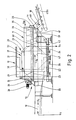
- the washing drum 28 also has inwardly projecting conveying members, namely a screw conveyor 35 (FIG. 2). This conveys the root crops through the washing drum 28 to the outlet side 17 of the processing drum 20.
- the tub 22 is also subdivided analogously to the processing drum 20. It has two trough sections, namely a solid trough 36 and a washing trough 37 behind it in the flow direction 14.
- the solid trough 36 is semi-cylindrical and is dimensioned in such a diameter that the outer surfaces of the wipers 31 move along the inside of the curved bottom of the solid trough 36 for conveying away in the solid trough 36 collecting fine solids, in particular sand or the like.
- These components are discharged from the wipers 31 at the edge 23 of the solid trough 36 into a discharge chute 38, from which the excreted fine components can be removed, for example to a decanter (not shown) (FIG. 3).
- the solid trough 36 is assigned a discharge chute 39 in the area of the stone catch ring 29 for separate removal of the stones or the like collecting in the stone catch ring 29 (FIG. 2).
- the washing tub 37 separated by the partition 40 from the solid tub 36 is smaller in cross section than the solid tub 36.
- a part rises here as just trained bottom 41 of the washing tub 37 to the outlet side 17 of the drum washer 11 slightly (Fig. 2).
- the alluvial water collecting in the washing tub 37 and the remaining portion of the clean irrigation water supplied to the drum washer 11 in the washing tub 28 accumulate in the area of the partition 40.
- One side of the washing tub 37 is assigned a drain opening 43 opening into a drain shaft 42 here.
- the cross section of the drain opening 43 can be changed by a movable throttle slide 44 such that only a predetermined amount of wash water Q s can get into the drain shaft 42 through the drain opening 43 per time unit (FIG. 2).
- the alluvial water withdrawn from the wash basin 37 passes through a return line (not shown) with a circulation pump (also not shown) in the area of the potato bunker 15 back into the alluvial channel 12. In this way, a closed alluvial water circuit is created.
- the wash tub 37 is assigned an overflow opening 45, which is approximately opposite the drain opening 43 in the exemplary embodiment shown.
- the height of the lower edge of the overflow opening 45 can be changed in a weir-like manner by means of a slide 46 to set a certain zs water level 47 to the overflow opening 45, a connection channel 48 connects to the discharge chute 38.
- the height of the flooding water level 47 is adapted to the diameter of the washing drum 28 via corresponding positions of the slide 46 at the overflow opening 45 and, if appropriate, the throttle slide 44 of the drain opening 43, namely that the flooding water level 47 lies at a level below the lower apex line 48 of the washing drum 28.
- the potatoes and the solids to be separated are in the area of the stone catcher 10 in the floating water for carrying out a buoyancy separation, while in contrast through the washing drum 28 of the drum washer 11 the card to be washed potatoes are passed through alone, i.e. without floating water.
- the washing tub 37 is provided with an end panel 49. which ends above the water level 47 but below the jacket of the washing drum 28 (FIG. 2).
- the device according to the second exemplary embodiment of the invention differs from the above-described first embodiment of the device by the transition between the larger diameter solid drum 27 and the smaller diameter washing drum 28.
- This transition is here step-shaped, namely consists of a transition wall 50 lying in a vertical plane.
- the transition wall 50 is designed in the form of a ring and thus connects the solids drum 27 to the washing drum 28.
- the step-shaped transition between the solids drum 27 and the washing drum 28 is associated here with a plurality of blades 51 arranged uniformly on the circumference of the solids drum 27. Starting from the solids drum 27, these protrude in some areas into the front end of the washing drum 28 connected thereto.
- the blades 51 are provided with a spiral, not shown in the figures. Through this, the potatoes collecting in front of the blades 51 can be conveyed to the washing drum 28.
- the potatoes are fed to the floating channel 12 via the discharge belt 16.
- Flood water flows in the flood channel towards the inlet side 13 of the stone catcher 10 of the device.
- the alluvial water serves as a conveying medium for the mixture of potatoes and solids such as stones, sand, cabbage, etc.
- the amount of alluvial water Q s is selected such that an alluvial water level 47 is set in the alluvial channel 12 and in the device, which is approximately below the lower apex line 48 the washing drum 28 is located, but the solids drum 27 is partially immersed.
- the drum washer 11 In the drum washer 11, the main washing of the potatoes which are essentially only contained therein is carried out without the floating water and solids by sprinkling with fresh water.
- the drum washer 11 from the Exit side 17 ago supplied a sprinkling water quantity Q B via appropriate spray pipes.
- the amount of alluvial water Q s is guided in the circuit along the alluvial channel 12 and the device by removing a certain amount of alluvial water Q s , namely an amount of circulating water, through the drain opening 43 in the washing tub 37 and through a pipe to the beginning of the alluvial channel 12 in the area of the potato bunker 15 is pumped. Since an amount of wash water Q s which is approximately the same size is discharged through the discharge opening 43 as it is fed back at the start of the wash channel 12, the wash water level 47 remains constant.
- the irrigation water amount Q B affects. Although this is dimensioned such that it corresponds approximately to the amount of detergent water Q H removed from the drum washer 11 with the washed potatoes, a larger amount of irrigation water Q B is required, for example, for heavily soiled potatoes than the amount of detergent water Q H. In this way, a quantity of differential water Q D is added to the amount of floating water Q s circulated. So that this does not lead to any noteworthy increase in the flood water level 47, due to which, for example, the lower part of the washing drum 28 could still be immersed in the flood water, the quantity of differential water Q D is discharged through the overflow opening 45 Height set so that it specifies the intended flood water level 47.
- the differential water quantity Q D that ends through the overflow opening 45 reaches the discharge shaft 38 on the stone trap 10 in the exemplary embodiment shown, where it mixes with the fine solids (sand etc.) that have separated out there and the removal of these fine solids (sand etc.) into a collecting container or decanter supported.
- the differential water quantity Q D can be processed and returned to the drum washer 11 for washing the potatoes as part of the sprinkling water quantity Q B.
- the method according to the invention takes place in the device according to the second exemplary embodiment of the invention (FIGS. 4 and 5) essentially in the manner described above.
- the only difference from the method described above is that at the end of the solids drum 27 designed as a sieve drum 32, the potatoes are lifted out of the water by the coiled blades 51 via the step-shaped heel between the solids drum 27 and the washing drum 28 and conveyed into the washing drum 28 will.
Landscapes
- Life Sciences & Earth Sciences (AREA)
- Chemical & Material Sciences (AREA)
- Engineering & Computer Science (AREA)
- Food Science & Technology (AREA)
- Polymers & Plastics (AREA)
- Apparatuses For Bulk Treatment Of Fruits And Vegetables And Apparatuses For Preparing Feeds (AREA)
Applications Claiming Priority (2)
| Application Number | Priority Date | Filing Date | Title |
|---|---|---|---|
| DE19893918671 DE3918671A1 (de) | 1989-06-08 | 1989-06-08 | Verfahren und vorrichtung zur aufbereitung von hackfruechten |
| DE3918671 | 1989-06-08 |
Publications (1)
| Publication Number | Publication Date |
|---|---|
| EP0401812A1 true EP0401812A1 (fr) | 1990-12-12 |
Family
ID=6382324
Family Applications (1)
| Application Number | Title | Priority Date | Filing Date |
|---|---|---|---|
| EP90110757A Withdrawn EP0401812A1 (fr) | 1989-06-08 | 1990-06-07 | Procédé et dispositif pour la préparation de tubercules |
Country Status (2)
| Country | Link |
|---|---|
| EP (1) | EP0401812A1 (fr) |
| DE (1) | DE3918671A1 (fr) |
Cited By (5)
| Publication number | Priority date | Publication date | Assignee | Title |
|---|---|---|---|---|
| WO2012123424A1 (fr) * | 2011-03-11 | 2012-09-20 | Simon Cross | Dispositif de lavage de culture racine |
| GB2516639A (en) * | 2013-07-26 | 2015-02-04 | Tickhill Eng Co Ltd | A combined cleaning apparatus for cleaning vegetables or other items and an associated method |
| CN109757220A (zh) * | 2019-01-14 | 2019-05-17 | 青海大学 | 一种流动沙丘采挖菊芋的方法 |
| CN109820211A (zh) * | 2019-03-13 | 2019-05-31 | 青岛日辰食品股份有限公司 | 一种水过滤式菌菇处理设备 |
| EP3834631A1 (fr) * | 2019-12-12 | 2021-06-16 | Institutul National de Cercetare Dezvoltare pentru Masini si Instalatii destinate Agriculturii si Industriei Alimentare-INMA | Installation industrielle pour lavage de topinambour |
Citations (8)
| Publication number | Priority date | Publication date | Assignee | Title |
|---|---|---|---|---|
| GB181227A (en) * | 1921-05-24 | 1922-06-15 | Cornelis Maters | Process and device for the cleaning of fruit, vegetables and the like |
| GB414809A (en) * | 1933-03-11 | 1934-08-16 | James Peebles | Improvements in and connected with machines for washing sand, gravel, and other likematerials |
| US2091675A (en) * | 1934-07-18 | 1937-08-31 | Joseph D Ferry | Material treating apparatus |
| FR1127850A (fr) * | 1955-07-22 | 1956-12-26 | Machine à laver les pommes de terre et autres tubercules ou autres racines | |
| FR2014810A1 (en) * | 1969-04-16 | 1970-04-24 | Barre Marcel | Stone removing washer for mechanically - cut sugar cane |
| FR2080172A6 (en) * | 1970-02-25 | 1971-11-12 | Sucriere Atlantique Eng | Stone-removing washer - for sugar canes |
| DE3322915A1 (de) * | 1983-03-09 | 1984-09-13 | Guenter Gerlach | Vorrichtung zum trennen von steinen und kraut einerseits sowie (zucker-)rueben andererseits eines gemisches derselben |
| DE3717170A1 (de) * | 1987-05-22 | 1988-12-01 | Alfred Schneider | Vorrichtung zur unterwasserwaesche von knollenfruechten |
-
1989
- 1989-06-08 DE DE19893918671 patent/DE3918671A1/de not_active Withdrawn
-
1990
- 1990-06-07 EP EP90110757A patent/EP0401812A1/fr not_active Withdrawn
Patent Citations (8)
| Publication number | Priority date | Publication date | Assignee | Title |
|---|---|---|---|---|
| GB181227A (en) * | 1921-05-24 | 1922-06-15 | Cornelis Maters | Process and device for the cleaning of fruit, vegetables and the like |
| GB414809A (en) * | 1933-03-11 | 1934-08-16 | James Peebles | Improvements in and connected with machines for washing sand, gravel, and other likematerials |
| US2091675A (en) * | 1934-07-18 | 1937-08-31 | Joseph D Ferry | Material treating apparatus |
| FR1127850A (fr) * | 1955-07-22 | 1956-12-26 | Machine à laver les pommes de terre et autres tubercules ou autres racines | |
| FR2014810A1 (en) * | 1969-04-16 | 1970-04-24 | Barre Marcel | Stone removing washer for mechanically - cut sugar cane |
| FR2080172A6 (en) * | 1970-02-25 | 1971-11-12 | Sucriere Atlantique Eng | Stone-removing washer - for sugar canes |
| DE3322915A1 (de) * | 1983-03-09 | 1984-09-13 | Guenter Gerlach | Vorrichtung zum trennen von steinen und kraut einerseits sowie (zucker-)rueben andererseits eines gemisches derselben |
| DE3717170A1 (de) * | 1987-05-22 | 1988-12-01 | Alfred Schneider | Vorrichtung zur unterwasserwaesche von knollenfruechten |
Cited By (8)
| Publication number | Priority date | Publication date | Assignee | Title |
|---|---|---|---|---|
| US10244784B2 (en) | 2001-03-11 | 2019-04-02 | Simon Cross | Root crop washer |
| WO2012123424A1 (fr) * | 2011-03-11 | 2012-09-20 | Simon Cross | Dispositif de lavage de culture racine |
| GB2516639A (en) * | 2013-07-26 | 2015-02-04 | Tickhill Eng Co Ltd | A combined cleaning apparatus for cleaning vegetables or other items and an associated method |
| GB2516639B (en) * | 2013-07-26 | 2018-05-09 | Tickhill Engineering Company Ltd | A combined cleaning apparatus for cleaning vegetables or other items and an associated method |
| CN109757220A (zh) * | 2019-01-14 | 2019-05-17 | 青海大学 | 一种流动沙丘采挖菊芋的方法 |
| CN109820211A (zh) * | 2019-03-13 | 2019-05-31 | 青岛日辰食品股份有限公司 | 一种水过滤式菌菇处理设备 |
| CN109820211B (zh) * | 2019-03-13 | 2024-02-27 | 青岛日辰食品股份有限公司 | 一种水过滤式菌菇处理设备 |
| EP3834631A1 (fr) * | 2019-12-12 | 2021-06-16 | Institutul National de Cercetare Dezvoltare pentru Masini si Instalatii destinate Agriculturii si Industriei Alimentare-INMA | Installation industrielle pour lavage de topinambour |
Also Published As
| Publication number | Publication date |
|---|---|
| DE3918671A1 (de) | 1990-12-13 |
Similar Documents
| Publication | Publication Date | Title |
|---|---|---|
| EP0026855A1 (fr) | Procédé et dispositif pour le nettoyage au champ de plantes à racine | |
| DE3941673A1 (de) | Vorrichtung zum entfernen von sieb- und grobstoffen aus abwasser | |
| DE2843800C2 (de) | Verfahren und Vorrichtung zum Waschen und Kühlen des Bruchkornes von Cottage- Käse, Quark o.dgl. | |
| EP0401812A1 (fr) | Procédé et dispositif pour la préparation de tubercules | |
| DE4023434A1 (de) | Verfahren zur separierung von kunststoffmaterialien | |
| DE3920196C2 (fr) | ||
| DE3441528A1 (de) | Verfahren und vorrichtung zur beseitigung von aus fett, organischen substanzen und wasser bestehenden gemischen | |
| EP0129638B1 (fr) | Dispositif pour séparer les pierres et les herbes mélangées à des betteraves sucrières | |
| DE3715019A1 (de) | Vorrichtung zur trennung von feststoffen aus fluessigkeiten | |
| AT389488B (de) | Verfahren und anordnung zur reinigung von vorzugsweise zerkleinerte kunststofffolien und bzw. oder kunststoffstuecke und bzw. oder hartkunststoffe od.dgl. enthaltenden substraten | |
| DE2635045A1 (de) | Anlage zur reinigung von feldfruechten, insbesondere zuckerrueben | |
| EP0594167A1 (fr) | Dispositif pour extraire des matériaux séparables d'un liquide coulant dans une rigole | |
| DE19721629C1 (de) | Aufstromsortierer | |
| DE10012379A1 (de) | Sandfanganlage | |
| DE19600372C1 (de) | Vorrichtung zum Austragen von festen Verunreinigungen aus Abwasser | |
| DE4014676A1 (de) | Verfahren und vorrichtung zur aufbereitung von hackfruechten | |
| DE2845383A1 (de) | Einrichtung zum abscheiden von fremdkoerpern von fruechten, insbesondere obst | |
| DE2651942C2 (de) | Waschtrog zur Reinigung von Feldfrüchten | |
| EP0349710B1 (fr) | Roue d'égouttage à godets pour installations de traitement du sable | |
| DE4428878C1 (de) | Gemüsewaschanlage | |
| DE6604382U (de) | Eindicker fuer feststoffhaltige fluessigkeiten | |
| DE3423981A1 (de) | Vorrichtung zur aufbereitung von naturbims | |
| DE3108332A1 (de) | Ausruestung zur stoffabscheidung | |
| DE3300602A1 (de) | Verfahren und vorrichtung zur abtrennung von spezifisch leichten teilen aus bauschutt | |
| DE963771C (de) | Verfahren und Vorrichtung zur Schwimm- und Sinkaufbereitung von festen Stoffen |
Legal Events
| Date | Code | Title | Description |
|---|---|---|---|
| PUAI | Public reference made under article 153(3) epc to a published international application that has entered the european phase |
Free format text: ORIGINAL CODE: 0009012 |
|
| AK | Designated contracting states |
Kind code of ref document: A1 Designated state(s): DE FR IT NL SE |
|
| 17P | Request for examination filed |
Effective date: 19901217 |
|
| 17Q | First examination report despatched |
Effective date: 19910517 |
|
| STAA | Information on the status of an ep patent application or granted ep patent |
Free format text: STATUS: THE APPLICATION IS DEEMED TO BE WITHDRAWN |
|
| 18D | Application deemed to be withdrawn |
Effective date: 19920728 |