EP0401875A2 - Improvements in or relating to antiprotozoal agents - Google Patents
Improvements in or relating to antiprotozoal agents Download PDFInfo
- Publication number
- EP0401875A2 EP0401875A2 EP90114375A EP90114375A EP0401875A2 EP 0401875 A2 EP0401875 A2 EP 0401875A2 EP 90114375 A EP90114375 A EP 90114375A EP 90114375 A EP90114375 A EP 90114375A EP 0401875 A2 EP0401875 A2 EP 0401875A2
- Authority
- EP
- European Patent Office
- Prior art keywords
- naphthoquinone
- combination
- pyridinol
- hydroxy
- combinations
- Prior art date
- Legal status (The legal status is an assumption and is not a legal conclusion. Google has not performed a legal analysis and makes no representation as to the accuracy of the status listed.)
- Granted
Links
- 239000003904 antiprotozoal agent Substances 0.000 title abstract description 7
- GCNTZFIIOFTKIY-UHFFFAOYSA-N 4-hydroxypyridine Chemical compound OC1=CC=NC=C1 GCNTZFIIOFTKIY-UHFFFAOYSA-N 0.000 claims abstract description 23
- 150000001875 compounds Chemical class 0.000 claims abstract description 18
- 150000002148 esters Chemical class 0.000 claims abstract description 11
- 238000011282 treatment Methods 0.000 claims abstract description 10
- 201000004792 malaria Diseases 0.000 claims abstract description 8
- 238000011321 prophylaxis Methods 0.000 claims abstract description 6
- 229930192627 Naphthoquinone Natural products 0.000 claims description 37
- 150000002791 naphthoquinones Chemical class 0.000 claims description 37
- 239000000203 mixture Substances 0.000 claims description 20
- 238000009472 formulation Methods 0.000 claims description 19
- 239000003814 drug Substances 0.000 claims description 15
- 230000001225 therapeutic effect Effects 0.000 claims description 14
- 230000003389 potentiating effect Effects 0.000 claims description 6
- 201000010099 disease Diseases 0.000 claims description 3
- 208000037265 diseases, disorders, signs and symptoms Diseases 0.000 claims description 3
- 229910052736 halogen Inorganic materials 0.000 claims description 3
- 150000002367 halogens Chemical class 0.000 claims description 3
- 125000004178 (C1-C4) alkyl group Chemical group 0.000 claims description 2
- 239000003937 drug carrier Substances 0.000 claims description 2
- 229940124597 therapeutic agent Drugs 0.000 claims description 2
- 230000000842 anti-protozoal effect Effects 0.000 abstract description 12
- 230000000875 corresponding effect Effects 0.000 abstract 1
- ZDPIZLCVJAAHHR-UHFFFAOYSA-N Clopidol Chemical compound CC1=NC(C)=C(Cl)C(O)=C1Cl ZDPIZLCVJAAHHR-UHFFFAOYSA-N 0.000 description 17
- 230000000694 effects Effects 0.000 description 17
- 229960000731 clopidol Drugs 0.000 description 13
- 229940079593 drug Drugs 0.000 description 13
- UBQKCCHYAOITMY-UHFFFAOYSA-N pyridin-2-ol Chemical class OC1=CC=CC=N1 UBQKCCHYAOITMY-UHFFFAOYSA-N 0.000 description 11
- XLYOFNOQVPJJNP-UHFFFAOYSA-N water Substances O XLYOFNOQVPJJNP-UHFFFAOYSA-N 0.000 description 8
- -1 2-substituted-3-hydroxy-1, 4-naphthoquinones Chemical class 0.000 description 7
- 230000000078 anti-malarial effect Effects 0.000 description 7
- 230000005764 inhibitory process Effects 0.000 description 7
- 238000000034 method Methods 0.000 description 7
- 206010035500 Plasmodium falciparum infection Diseases 0.000 description 6
- 239000004615 ingredient Substances 0.000 description 6
- 239000007788 liquid Substances 0.000 description 6
- 241000223960 Plasmodium falciparum Species 0.000 description 5
- 239000002775 capsule Substances 0.000 description 5
- 239000000843 powder Substances 0.000 description 5
- 239000000725 suspension Substances 0.000 description 5
- LFQSCWFLJHTTHZ-UHFFFAOYSA-N Ethanol Chemical compound CCO LFQSCWFLJHTTHZ-UHFFFAOYSA-N 0.000 description 4
- 239000003430 antimalarial agent Substances 0.000 description 4
- 230000037396 body weight Effects 0.000 description 4
- 208000015181 infectious disease Diseases 0.000 description 4
- HQKMJHAJHXVSDF-UHFFFAOYSA-L magnesium stearate Chemical compound [Mg+2].CCCCCCCCCCCCCCCCCC([O-])=O.CCCCCCCCCCCCCCCCCC([O-])=O HQKMJHAJHXVSDF-UHFFFAOYSA-L 0.000 description 4
- 239000003826 tablet Substances 0.000 description 4
- PZQFWEVFWWOGCO-UHFFFAOYSA-N 3-(4-tert-butylcyclohexyl)-4-hydroxynaphthalene-1,2-dione Chemical compound C1CC(C(C)(C)C)CCC1C1=C(O)C2=CC=CC=C2C(=O)C1=O PZQFWEVFWWOGCO-UHFFFAOYSA-N 0.000 description 3
- 208000003495 Coccidiosis Diseases 0.000 description 3
- PEDCQBHIVMGVHV-UHFFFAOYSA-N Glycerine Chemical compound OCC(O)CO PEDCQBHIVMGVHV-UHFFFAOYSA-N 0.000 description 3
- 206010023076 Isosporiasis Diseases 0.000 description 3
- 241000124008 Mammalia Species 0.000 description 3
- 241001465754 Metazoa Species 0.000 description 3
- 241000699670 Mus sp. Species 0.000 description 3
- 241000223830 Plasmodium yoelii Species 0.000 description 3
- DNIAPMSPPWPWGF-UHFFFAOYSA-N Propylene glycol Chemical compound CC(O)CO DNIAPMSPPWPWGF-UHFFFAOYSA-N 0.000 description 3
- 229940124536 anticoccidial agent Drugs 0.000 description 3
- 239000000969 carrier Substances 0.000 description 3
- MGDIRAXSDLCQGC-UHFFFAOYSA-N chembl1999063 Chemical compound O=C1C2=CC=CC=C2C(=O)C(O)=C1CCCCCCCCC1CCCCC1 MGDIRAXSDLCQGC-UHFFFAOYSA-N 0.000 description 3
- 239000003795 chemical substances by application Substances 0.000 description 3
- 239000003224 coccidiostatic agent Substances 0.000 description 3
- 235000020188 drinking water Nutrition 0.000 description 3
- 239000003651 drinking water Substances 0.000 description 3
- 238000000338 in vitro Methods 0.000 description 3
- 238000001727 in vivo Methods 0.000 description 3
- 238000010348 incorporation Methods 0.000 description 3
- 235000014666 liquid concentrate Nutrition 0.000 description 3
- 239000000314 lubricant Substances 0.000 description 3
- 229950008312 menoctone Drugs 0.000 description 3
- 239000007787 solid Substances 0.000 description 3
- 125000004191 (C1-C6) alkoxy group Chemical group 0.000 description 2
- MXRFJVFBVXHALN-UHFFFAOYSA-N C1CC(C(C)(C)CC)CCC1C1=C(O)C(=O)C2=CC=CC=C2C1=O Chemical compound C1CC(C(C)(C)CC)CCC1C1=C(O)C(=O)C2=CC=CC=C2C1=O MXRFJVFBVXHALN-UHFFFAOYSA-N 0.000 description 2
- 239000012980 RPMI-1640 medium Substances 0.000 description 2
- 230000000996 additive effect Effects 0.000 description 2
- 230000001165 anti-coccidial effect Effects 0.000 description 2
- 239000011230 binding agent Substances 0.000 description 2
- 239000008280 blood Substances 0.000 description 2
- GZECHRFOLYSZIQ-UHFFFAOYSA-N chembl2448600 Chemical compound O=C1C2=CC=CC=C2C(=O)C(O)=C1C(CC1)CCC1C1CCCCC1 GZECHRFOLYSZIQ-UHFFFAOYSA-N 0.000 description 2
- 230000002596 correlated effect Effects 0.000 description 2
- 239000003085 diluting agent Substances 0.000 description 2
- 210000003743 erythrocyte Anatomy 0.000 description 2
- 238000002474 experimental method Methods 0.000 description 2
- 125000002887 hydroxy group Chemical group [H]O* 0.000 description 2
- 235000019359 magnesium stearate Nutrition 0.000 description 2
- LXCFILQKKLGQFO-UHFFFAOYSA-N methylparaben Chemical compound COC(=O)C1=CC=C(O)C=C1 LXCFILQKKLGQFO-UHFFFAOYSA-N 0.000 description 2
- 238000000465 moulding Methods 0.000 description 2
- 239000000546 pharmaceutical excipient Substances 0.000 description 2
- 239000000244 polyoxyethylene sorbitan monooleate Substances 0.000 description 2
- 235000010482 polyoxyethylene sorbitan monooleate Nutrition 0.000 description 2
- 229920000136 polysorbate Polymers 0.000 description 2
- 229940068968 polysorbate 80 Drugs 0.000 description 2
- 229920000053 polysorbate 80 Polymers 0.000 description 2
- 229920006316 polyvinylpyrrolidine Polymers 0.000 description 2
- 244000144977 poultry Species 0.000 description 2
- 150000003222 pyridines Chemical class 0.000 description 2
- 238000007493 shaping process Methods 0.000 description 2
- 239000000243 solution Substances 0.000 description 2
- 239000002904 solvent Substances 0.000 description 2
- 239000000126 substance Substances 0.000 description 2
- 239000000829 suppository Substances 0.000 description 2
- 239000004094 surface-active agent Substances 0.000 description 2
- PORJBGKAHIJVRR-UHFFFAOYSA-N (3-cyclohexyl-1,4-dioxonaphthalen-2-yl) acetate Chemical compound O=C1C2=CC=CC=C2C(=O)C(OC(=O)C)=C1C1CCCCC1 PORJBGKAHIJVRR-UHFFFAOYSA-N 0.000 description 1
- 125000002861 (C1-C4) alkanoyl group Chemical group 0.000 description 1
- 125000004169 (C1-C6) alkyl group Chemical group 0.000 description 1
- 125000006552 (C3-C8) cycloalkyl group Chemical group 0.000 description 1
- XOZPAKAYGQIDBT-UHFFFAOYSA-N 3,5-dibromo-2,6-dimethyl-1h-pyridin-4-one Chemical compound CC=1NC(C)=C(Br)C(=O)C=1Br XOZPAKAYGQIDBT-UHFFFAOYSA-N 0.000 description 1
- TZHBEIFWUZMVRN-UHFFFAOYSA-N 3,5-dibromo-2,6-dipropyl-1h-pyridin-4-one Chemical compound CCCC1=NC(CCC)=C(Br)C(O)=C1Br TZHBEIFWUZMVRN-UHFFFAOYSA-N 0.000 description 1
- OTLPOHOMIPXFPF-UHFFFAOYSA-N 3,5-dichloro-2,6-dipropyl-1h-pyridin-4-one Chemical compound CCCC1=NC(CCC)=C(Cl)C(O)=C1Cl OTLPOHOMIPXFPF-UHFFFAOYSA-N 0.000 description 1
- JJMFNXJCDGGBEV-UHFFFAOYSA-N 3-(8-cyclohexyloctyl)-4-hydroxynaphthalene-1,2-dione Chemical compound O=C1C(=O)C2=CC=CC=C2C(O)=C1CCCCCCCCC1CCCCC1 JJMFNXJCDGGBEV-UHFFFAOYSA-N 0.000 description 1
- XBGHCDVBZZNDBY-UHFFFAOYSA-N 3-cyclohexyl-4-hydroxynaphthalene-1,2-dione Chemical compound O=C1C(=O)C2=CC=CC=C2C(O)=C1C1CCCCC1 XBGHCDVBZZNDBY-UHFFFAOYSA-N 0.000 description 1
- GUBGYTABKSRVRQ-XLOQQCSPSA-N Alpha-Lactose Chemical compound O[C@@H]1[C@@H](O)[C@@H](O)[C@@H](CO)O[C@H]1O[C@@H]1[C@@H](CO)O[C@H](O)[C@H](O)[C@H]1O GUBGYTABKSRVRQ-XLOQQCSPSA-N 0.000 description 1
- 241000894006 Bacteria Species 0.000 description 1
- RHKIMKWSENPPGS-UHFFFAOYSA-N C1C(C(C)(C)C)CCCC1C1=C(O)C(=O)C2=CC=CC=C2C1=O Chemical compound C1C(C(C)(C)C)CCCC1C1=C(O)C(=O)C2=CC=CC=C2C1=O RHKIMKWSENPPGS-UHFFFAOYSA-N 0.000 description 1
- NWCVRXADYNRXCT-UHFFFAOYSA-N C1CC(C(C)(C)C)CCC1C1=C(O)C(=O)C2=CC=CC=C2C1=O Chemical class C1CC(C(C)(C)C)CCC1C1=C(O)C(=O)C2=CC=CC=C2C1=O NWCVRXADYNRXCT-UHFFFAOYSA-N 0.000 description 1
- DUQKNNFNHGXYEM-UHFFFAOYSA-N C1CC(C)(C)CCC1C1=C(O)C(=O)C2=CC=CC=C2C1=O Chemical compound C1CC(C)(C)CCC1C1=C(O)C(=O)C2=CC=CC=C2C1=O DUQKNNFNHGXYEM-UHFFFAOYSA-N 0.000 description 1
- AYCQYUMSMQJKDC-UHFFFAOYSA-N C1CC(OC(C)(C)C)CCC1C1=C(O)C(=O)C2=CC=CC=C2C1=O Chemical compound C1CC(OC(C)(C)C)CCC1C1=C(O)C(=O)C2=CC=CC=C2C1=O AYCQYUMSMQJKDC-UHFFFAOYSA-N 0.000 description 1
- LGFDNUSAWCHVJN-UHFFFAOYSA-N CC(C(c1c2cccc1)=O)=C(C)C2=O Chemical compound CC(C(c1c2cccc1)=O)=C(C)C2=O LGFDNUSAWCHVJN-UHFFFAOYSA-N 0.000 description 1
- 229920002261 Corn starch Polymers 0.000 description 1
- GUBGYTABKSRVRQ-QKKXKWKRSA-N Lactose Natural products OC[C@H]1O[C@@H](O[C@H]2[C@H](O)[C@@H](O)C(O)O[C@@H]2CO)[C@H](O)[C@@H](O)[C@H]1O GUBGYTABKSRVRQ-QKKXKWKRSA-N 0.000 description 1
- 235000019759 Maize starch Nutrition 0.000 description 1
- 229920000168 Microcrystalline cellulose Polymers 0.000 description 1
- CIEUSZBTKKXKPA-UHFFFAOYSA-N O=C1C2=CC=CC=C2C(=O)C(O)=C1C(CC1)CCC1C1=CC=CC=C1 Chemical compound O=C1C2=CC=CC=C2C(=O)C(O)=C1C(CC1)CCC1C1=CC=CC=C1 CIEUSZBTKKXKPA-UHFFFAOYSA-N 0.000 description 1
- AJZYYDODZUXKPL-UHFFFAOYSA-N O=C1C2=CC=CC=C2C(=O)C(O)=C1C1CCCC1 Chemical compound O=C1C2=CC=CC=C2C(=O)C(O)=C1C1CCCC1 AJZYYDODZUXKPL-UHFFFAOYSA-N 0.000 description 1
- 240000007594 Oryza sativa Species 0.000 description 1
- 235000007164 Oryza sativa Nutrition 0.000 description 1
- 239000002202 Polyethylene glycol Substances 0.000 description 1
- 241000700159 Rattus Species 0.000 description 1
- 229920002472 Starch Polymers 0.000 description 1
- CZMRCDWAGMRECN-UGDNZRGBSA-N Sucrose Chemical compound O[C@H]1[C@H](O)[C@@H](CO)O[C@@]1(CO)O[C@@H]1[C@H](O)[C@@H](O)[C@H](O)[C@@H](CO)O1 CZMRCDWAGMRECN-UGDNZRGBSA-N 0.000 description 1
- 229930006000 Sucrose Natural products 0.000 description 1
- RAHZWNYVWXNFOC-UHFFFAOYSA-N Sulphur dioxide Chemical group O=S=O RAHZWNYVWXNFOC-UHFFFAOYSA-N 0.000 description 1
- SJSUIRCSEISWNH-UHFFFAOYSA-N [3-(4,4-dimethylcyclohexyl)-1,4-dioxonaphthalen-2-yl] acetate Chemical compound O=C1C2=CC=CC=C2C(=O)C(OC(=O)C)=C1C1CCC(C)(C)CC1 SJSUIRCSEISWNH-UHFFFAOYSA-N 0.000 description 1
- 230000000895 acaricidal effect Effects 0.000 description 1
- 239000002253 acid Substances 0.000 description 1
- 239000004480 active ingredient Substances 0.000 description 1
- 230000001154 acute effect Effects 0.000 description 1
- OIRDTQYFTABQOQ-KQYNXXCUSA-N adenosine Chemical compound C1=NC=2C(N)=NC=NC=2N1[C@@H]1O[C@H](CO)[C@@H](O)[C@H]1O OIRDTQYFTABQOQ-KQYNXXCUSA-N 0.000 description 1
- 125000000217 alkyl group Chemical group 0.000 description 1
- 230000003428 anti-theilerial effect Effects 0.000 description 1
- 239000004599 antimicrobial Substances 0.000 description 1
- 239000003963 antioxidant agent Substances 0.000 description 1
- 235000006708 antioxidants Nutrition 0.000 description 1
- 230000002824 aphicidal effect Effects 0.000 description 1
- 210000004369 blood Anatomy 0.000 description 1
- 210000000601 blood cell Anatomy 0.000 description 1
- 239000000872 buffer Substances 0.000 description 1
- QTPSDCFAVWZIJU-UHFFFAOYSA-N chembl3092109 Chemical compound O=C1C2=CC=CC=C2C(=O)C(O)=C1CCCC1CCCCC1 QTPSDCFAVWZIJU-UHFFFAOYSA-N 0.000 description 1
- KLLIVCPQDTYMLC-UHFFFAOYSA-N chembl3182074 Chemical compound C1CC(C(C)(C)C)CCC1CC1=C(O)C(=O)C2=CC=CC=C2C1=O KLLIVCPQDTYMLC-UHFFFAOYSA-N 0.000 description 1
- VBQSIHLAJQLOQW-UHFFFAOYSA-N chembl408346 Chemical compound C1=CC=C2C(=O)C(CCCCCCCCC)=C(O)C(=O)C2=C1 VBQSIHLAJQLOQW-UHFFFAOYSA-N 0.000 description 1
- 238000002512 chemotherapy Methods 0.000 description 1
- 239000007958 cherry flavor Substances 0.000 description 1
- 229940110456 cocoa butter Drugs 0.000 description 1
- 235000019868 cocoa butter Nutrition 0.000 description 1
- 239000007891 compressed tablet Substances 0.000 description 1
- 238000007906 compression Methods 0.000 description 1
- 230000006835 compression Effects 0.000 description 1
- 125000000753 cycloalkyl group Chemical group 0.000 description 1
- 125000000113 cyclohexyl group Chemical group [H]C1([H])C([H])([H])C([H])([H])C([H])(*)C([H])([H])C1([H])[H] 0.000 description 1
- 235000005911 diet Nutrition 0.000 description 1
- 230000037213 diet Effects 0.000 description 1
- 239000012895 dilution Substances 0.000 description 1
- 238000010790 dilution Methods 0.000 description 1
- LOKCTEFSRHRXRJ-UHFFFAOYSA-I dipotassium trisodium dihydrogen phosphate hydrogen phosphate dichloride Chemical compound P(=O)(O)(O)[O-].[K+].P(=O)(O)([O-])[O-].[Na+].[Na+].[Cl-].[K+].[Cl-].[Na+] LOKCTEFSRHRXRJ-UHFFFAOYSA-I 0.000 description 1
- 239000002270 dispersing agent Substances 0.000 description 1
- 239000002552 dosage form Substances 0.000 description 1
- 239000000839 emulsion Substances 0.000 description 1
- 239000000796 flavoring agent Substances 0.000 description 1
- 235000013355 food flavoring agent Nutrition 0.000 description 1
- 239000007903 gelatin capsule Substances 0.000 description 1
- 239000003365 glass fiber Substances 0.000 description 1
- 229940074076 glycerol formal Drugs 0.000 description 1
- 239000008187 granular material Substances 0.000 description 1
- 229910052739 hydrogen Inorganic materials 0.000 description 1
- 239000001257 hydrogen Chemical group 0.000 description 1
- 125000004435 hydrogen atom Chemical group [H]* 0.000 description 1
- CSFWPUWCSPOLJW-UHFFFAOYSA-N hydroxynaphthoquinone Natural products C1=CC=C2C(=O)C(O)=CC(=O)C2=C1 CSFWPUWCSPOLJW-UHFFFAOYSA-N 0.000 description 1
- 150000004340 hydroxynaphthoquinones Chemical class 0.000 description 1
- 229920003088 hydroxypropyl methyl cellulose Polymers 0.000 description 1
- FDGQSTZJBFJUBT-UHFFFAOYSA-N hypoxanthine Chemical compound O=C1NC=NC2=C1NC=N2 FDGQSTZJBFJUBT-UHFFFAOYSA-N 0.000 description 1
- 239000003701 inert diluent Substances 0.000 description 1
- 229940102213 injectable suspension Drugs 0.000 description 1
- 238000007918 intramuscular administration Methods 0.000 description 1
- 238000001990 intravenous administration Methods 0.000 description 1
- 239000008101 lactose Substances 0.000 description 1
- 229940041476 lactose 100 mg Drugs 0.000 description 1
- 238000012417 linear regression Methods 0.000 description 1
- 230000001050 lubricating effect Effects 0.000 description 1
- 239000000463 material Substances 0.000 description 1
- 229940016286 microcrystalline cellulose Drugs 0.000 description 1
- 235000019813 microcrystalline cellulose Nutrition 0.000 description 1
- 239000008108 microcrystalline cellulose Substances 0.000 description 1
- 238000005497 microtitration Methods 0.000 description 1
- 238000003801 milling Methods 0.000 description 1
- 238000012986 modification Methods 0.000 description 1
- 230000004048 modification Effects 0.000 description 1
- 229940100692 oral suspension Drugs 0.000 description 1
- 244000045947 parasite Species 0.000 description 1
- 238000007911 parenteral administration Methods 0.000 description 1
- 239000008194 pharmaceutical composition Substances 0.000 description 1
- 125000001997 phenyl group Chemical group [H]C1=C([H])C([H])=C(*)C([H])=C1[H] 0.000 description 1
- 239000002953 phosphate buffered saline Substances 0.000 description 1
- 230000000704 physical effect Effects 0.000 description 1
- 229920001223 polyethylene glycol Polymers 0.000 description 1
- 235000014483 powder concentrate Nutrition 0.000 description 1
- 238000002360 preparation method Methods 0.000 description 1
- 239000003755 preservative agent Substances 0.000 description 1
- 230000000069 prophylactic effect Effects 0.000 description 1
- 238000009877 rendering Methods 0.000 description 1
- 238000012552 review Methods 0.000 description 1
- 235000009566 rice Nutrition 0.000 description 1
- 238000007789 sealing Methods 0.000 description 1
- 238000010561 standard procedure Methods 0.000 description 1
- 239000008107 starch Substances 0.000 description 1
- 235000019698 starch Nutrition 0.000 description 1
- 239000008174 sterile solution Substances 0.000 description 1
- 125000001424 substituent group Chemical group 0.000 description 1
- 239000005720 sucrose Substances 0.000 description 1
- 229960004793 sucrose Drugs 0.000 description 1
- 229960004016 sucrose syrup Drugs 0.000 description 1
- 125000001273 sulfonato group Chemical class [O-]S(*)(=O)=O 0.000 description 1
- 239000007916 tablet composition Substances 0.000 description 1
- 239000002562 thickening agent Substances 0.000 description 1
- 230000001988 toxicity Effects 0.000 description 1
- 231100000419 toxicity Toxicity 0.000 description 1
- 239000003981 vehicle Substances 0.000 description 1
- 210000003462 vein Anatomy 0.000 description 1
- 239000008215 water for injection Substances 0.000 description 1
Classifications
-
- A—HUMAN NECESSITIES
- A61—MEDICAL OR VETERINARY SCIENCE; HYGIENE
- A61K—PREPARATIONS FOR MEDICAL, DENTAL OR TOILETRY PURPOSES
- A61K31/00—Medicinal preparations containing organic active ingredients
- A61K31/33—Heterocyclic compounds
- A61K31/395—Heterocyclic compounds having nitrogen as a ring hetero atom, e.g. guanethidine or rifamycins
- A61K31/435—Heterocyclic compounds having nitrogen as a ring hetero atom, e.g. guanethidine or rifamycins having six-membered rings with one nitrogen as the only ring hetero atom
- A61K31/44—Non condensed pyridines; Hydrogenated derivatives thereof
-
- A—HUMAN NECESSITIES
- A61—MEDICAL OR VETERINARY SCIENCE; HYGIENE
- A61P—SPECIFIC THERAPEUTIC ACTIVITY OF CHEMICAL COMPOUNDS OR MEDICINAL PREPARATIONS
- A61P33/00—Antiparasitic agents
- A61P33/02—Antiprotozoals, e.g. for leishmaniasis, trichomoniasis, toxoplasmosis
-
- Y—GENERAL TAGGING OF NEW TECHNOLOGICAL DEVELOPMENTS; GENERAL TAGGING OF CROSS-SECTIONAL TECHNOLOGIES SPANNING OVER SEVERAL SECTIONS OF THE IPC; TECHNICAL SUBJECTS COVERED BY FORMER USPC CROSS-REFERENCE ART COLLECTIONS [XRACs] AND DIGESTS
- Y02—TECHNOLOGIES OR APPLICATIONS FOR MITIGATION OR ADAPTATION AGAINST CLIMATE CHANGE
- Y02A—TECHNOLOGIES FOR ADAPTATION TO CLIMATE CHANGE
- Y02A50/00—TECHNOLOGIES FOR ADAPTATION TO CLIMATE CHANGE in human health protection, e.g. against extreme weather
- Y02A50/30—Against vector-borne diseases, e.g. mosquito-borne, fly-borne, tick-borne or waterborne diseases whose impact is exacerbated by climate change
Definitions
- the present invention relates to combinations of naphthoquinones and pyridine derivatives. More specifically it is concerned with potentiating combinations of anti-protozoal naphthoquinones and 4-pyridinol derivatives.
- Naphthoquinones of diverse structures have been described as possessing useful antiprotozoal activity, for example antimalarial, anticoccidial and antiheilerial activity. Some of these compounds have also been described as possessing activity against external parasites.
- U.S. Patent No. 3,367 830 describes a series of 2-substituted-3-hydroxy-1, 4-naphthoquinones as anticoccidial agents.
- U.S. Patent No. 3347 742 describes the use of 2-(4′-cyclohexylcyclohexyl)-3-hydroxy-1,4-naphthoquinone as an anticoccidial agent.
- U.K. Patent Specification No. 1553424 describes the use of 2-cyclohexyl- and 2-cyclohexylalkyl-3-hydroxy-1,4-naphthoquinones as antitheilerial agents.
- European Patent Specification No. 0 002 228 describes a number of 2-cycloalkyl-3-hydroxy-1,4-naphthoquinones as antiheilerial agents.
- European Patent Specification 77551 describes a series of 2-(4-substituted cyclohexyl)-3-hydroxy-1,4-naphthoquinones as antimalarial and anticoccidial agents.
- European Patent Specification 77550 describes a series of 2-(4-substituted cyclohexylmethyl)-3-hydroxy-1,4-naphthoquinones as antiheilerial agents.
- German Offenlegungsschrift 2,641,343 describes a series of 2-higher alkyl-3-hydroxy-1,4-naphthoquinones having acaricidal and aphicidal activity.
- the Bulletin of the World Health Organization 1974, 50 , 203-212 reviews potential antimalarial agents from a variety of chemical classes including the naphthoquinone menoctone. Clopidol, classified as a pyridine derivative, is also included. Annals of Tropical Medicine and Parasitology vol.72, No 6, 1978, 501-511 describes studies with the hydroxynaphthoquinone menoctone. J.Med. Chem 1977 Vol 20 No.2 237-243 compares the activity of 40 potential anti-malarial compounds against folate-requiring bacteria with activity against experimental malaria infections in mice, and human malaria. The compounds tested include clopidol and menoctone which are indicated respectively to have negligible or no activity against human malaria.
- the invention therefore provides, in a first aspect, a combination of an antiprotozoal naphthoquinone and a 4-pyridinol, or an alkanoic ester thereof, wherein the naphthoquinone and 4-pyridinol, or alkanoic ester thereof, are present in a potentiating ratio.
- the term 'potentiating ratio' is used herein to indicate that the naphthoquinone and 4-pyridinol, or alkanoic esters thereof, are present in a ratio such that the antiprotozoal activity of the combination is greater than that of either the naphthoquinone or the 4-pyridinol, or alkanoic ester thereof, alone or of the merely additive activity of the combination based upon the activities of the individual components.
- the naphthoquinone may comprise any naphthoquinone known to possess anti-protozoal activity, having the formula wherein R1 is a straight or branched chain C1 ⁇ 14 alkyl group, a C3 ⁇ 8 cycloalkyl or a C3 ⁇ 8 cycloalkyl-C1 ⁇ 8 alkyl group, such groups being optionally substituted by one or more substituents selected from C1 ⁇ 6 alkyl or cycloalkyl, C1 ⁇ 6 alkoxy, phenyl and hydroxy groups; and R2 is hydroxy, C1 ⁇ 4 acyl, C1 ⁇ 6 alkoxy, hydrogen, or halogen.
- R1 is a straight or branched chain C1 ⁇ 14 alkyl group, a C3 ⁇ 8 cycloalkyl or a C3 ⁇ 8 cycloalkyl-C1 ⁇ 8 alkyl group, such groups being optionally substituted by one or more substituents selected from C1 ⁇ 6 alkyl or cycloalkyl
- Preferred compounds of formula (I) include those wherein the group R1 comprises or contains a cyclohexyl moiety, particularly those wherein R1 is a 4-substituted cyclohexyl group, especially a 4- t -butylcyclohexyl group.
- Specific compounds of formula (I) include for example:- 2-(4- t -butylcyclohexyl)-3-hydroxy-1,4-naphthoquinone, 2-(4- t -pentylcyclohexyl)-3-hydroxy-1,4-naphthoquinone, 2-(4- t -butylcyclohexylmethyl)-3-hydroxy-1,4-naphthoquinone, 2-cyclohexyl-3-hydroxy-1,4-naphthoquinone, 2-(4-phenylcyclohexyl)-3-hydroxy-1,4-naphthoquinone, 2-(8-cyclohexyloctyl)-3-hydroxy-1,4-naphthoquinone, 2-(4-cyclohexylcyclohexyl)-3-hydroxy-1,4-naphthoquinone, 2-(3-cyclohexylpropyl)-3
- pyridinols which may be employed in the combinations of the invention include those described in U.S. Patent No. 3,206,358.
- Preferred pyridinols include those of formula (II) wherein each R3 is the same or different and is a C1 ⁇ 4 alkyl group and each X is the same or different and is halogen or a C1 ⁇ 6 alkanoic acid esters thereof.
- Particularly preferred compounds of formula (II) include 3,5-dichloro-2,6-dimethyl-4-pyridinol; 3,5-dibromo-2,6-dimethyl-4-pyridinol; 3,5-dichloro-2,6-dipropyl-4-pyridinol and 3,5-dibromo-2,6-dipropyl-4-pyridinol.
- naphthoquinones and 4-pyridinols and alkanoic esters thereof employed in the combinations according to the invention may be prepared in conventional manner, for example, using analogous techniques to those described in the above-mentioned references.
- the two active ingredients of the combinations of the invention may be present in any convenient potentiating ratio.
- the actual ratio will vary depending primarily upon the inherent antiprotozoal activity of the naphthoquinone. Thus the more active the naphthoquinone the greater will be the ratio of pyridinol to naphthoquinone. However, in general, the ratio of naphthoquinone to pyridinol (w/w) will be in the range of 1:500 to 1:1.
- the ratio of more active naphthoquinones to pyridinol is advantageously about 1:50 to 1:500 or even greater; for less active naphthoquinones the ratio will be lower, for example in the ranges of about 1:10 to 1:100 or 1:1 to 1:25 depending upon the activity of the naphthoquinone.
- protozoal diseases which may be treated in accordance with the invention include coccidiosis and malarial infections, in hosts, including mammals (such as man in the case of malaria) and birds (such as poultry in the case of coccidiosis).
- a suitable daily dose for a mammal (including man) for the treatment of malaria will lie in the range of 0.1mg to 200mg/kg bodyweight, for example 1mg to 100 mg/kg such as 10mg to 40mg/kg.
- the amount of pyridinol present in the combination will be that necessary to provide the appropriate potentiating ratio of naphthoquinone to pyridinol as hereinbefore defined.
- the amount of pyridinol will vary according to the particular naphthoquinone employed but will be apparent to someone skilled in the art.
- a suitable dose for a mammal (including man) for treatment, for example of malaria will lie in the range of 0.1 mg to 200 mg per kilogram bodyweight per day, with a preferred range of 1 mg to 100 mg, particularly 10 to 40 mg.
- the compound will normally be administered ad lib in drinking water or diet and suitable levels of drug will be in the range of 1 to 500ppm, preferably 10-400ppm ideally about 200ppm.
- the combinations of the invention are preferably employed as antiprotozoal agents in the form of therapeutic (pharmaceutical or veterinary) formulations.
- a therapeutic formulation comprising a combination, according to the invention, together with one or more pharmaceutically acceptable carriers therefore and/or optionally one or more further therapeutic and/or prophylactic ingredients.
- the combination according to the invention is present in the therapeutic formulations in an effective antiprotozoal amount.
- a convenient unit dose formulation contains the combination in an amount of from 10 mg to 1 g.
- Therapeutic formulations include those suitable for oral, rectal or parenteral (including intramuscular and intravenous) administration, although the oral route is preferred.
- the formulations may, where appropriate, be conveniently presented in discrete dosage units and may be prepared by any of the methods well known in the art of pharmacy. All methods include the step of bringing into association the active compound with liquid carriers or finely divided solid carriers of both and then, if necessary, shaping the product into the desired formulation.
- Therapeutic formulations suitable for oral administration wherein the carrier is a solid are most preferably presented as unit dose formulations such as boluses, capsules, cachets or tablets each containing a predetermined amount of the combination.
- a tablet may be made by compression or moulding, optionally with one or more accessory ingredients.
- Compressed tablets may be prepared by compressing in a suitable machine the active compound in a free-flowing form such as a powder or granules optionally mixed with a binder, lubricant, inert diluent, lubricating, surface active or dispersing agent.
- Moulded tablets may be made by moulding an inert liquid diluent. Tablets may be optionally coated and, if uncoated, may be optionally scored.
- Capsules may be prepared by filling the combination, either alone or in admixture with one or more accessory ingredients, into the capsule cases and then sealing them in the usual manner. Cachets are analogous to capsules wherein the combination together with any accessory ingredient(s) is sealed in a rice paper envelope.
- Therapeutic formulations suitable for oral administration wherein the carrier is a liquid may be presented as a solution or a suspension in an aqueous liquid or a non-aqueous liquid, or as an oil-in-water or water-in-oil liquid emulsion.
- Therapeutic formulations suitable for rectal administration wherein the carrier is a solid are most preferably presented as unit dose suppositories.
- Suitable carriers include cocoa butter and other materials commonly used in the art, and the suppositories may be conveniently formed by admixture of the combination with the softened or melted carrier(s) followed by chilling and shaping moulds.
- Therapeutic formulations suitable for parenteral administration include sterile solutions or suspensions of the combination in aqueous or oleaginous vehicles. Such preparations are conveniently presented in unit dose or multi-dose containers which are sealed after introduction of the formulation until required for use.
- the pharmaceutical formulations described above may include, as appropriate, one or more additional carrier ingredients such as diluents, buffers, flavouring agents, binders, surface-active agents, thickeners, lubricants, preservatives (including anti-oxidants) and the like, and substances included for the purpose of rendering the formulation isotonic with the blood of the intended recipient.
- additional carrier ingredients such as diluents, buffers, flavouring agents, binders, surface-active agents, thickeners, lubricants, preservatives (including anti-oxidants) and the like, and substances included for the purpose of rendering the formulation isotonic with the blood of the intended recipient.
- the therapeutic formulations for veterinary use may conveniently be in either powder or liquid concentrate form.
- conventional water soluble excipients such as lactose or sucrose, may be incorporated in the powders to improve their physical properties.
- suitable powders of this invention comprise 50 to 100% w/w, and preferably 60 to 80% w/w of the combination and 0 to 50% w/w and preferably 20 to 40% w/w of conventional veterinary excipients.
- These powders may either be added to animal feedstuffs, for example by way of an intermediate premix, or diluted in animal drinking water.
- Liquid concentrates of this invention suitably contain a water-soluble compound combination and may optionally include a veterinarily acceptable water miscible solvent, for example polyethylene glycol, propylene glycol, glycerol, glycerol formal or such a solvent mixed with up to 30% v/v of ethanol.
- a veterinarily acceptable water miscible solvent for example polyethylene glycol, propylene glycol, glycerol, glycerol formal or such a solvent mixed with up to 30% v/v of ethanol.
- the liquid concentrates may be administered to the drinking water of animals, particularly poultry.
- Each of the two compounds to be tested were dissolved in ethanol at a concentration of 10 mg/L and serially diluted with RPMI 1640 medium and 10% (v/v) human plasma in microtitration plates.
- P.falciparum -parasitised and fresh blood cells were added together with 3H-adenosine or 3H-hypoxanthine in RPMI 1640 medium and 10% human plasma.
- the cultures were then incubated at 37 o C for 43 hours, harvested and the particulate contents connected on glass fibre filter papers which were washed copiously with water using a Cooke Microtiter System (Dynatech Labs. Europe); the filter papers were dried and the radioactivity measured using a scintillation counter.
- Infected, untreated and uninfected cultures were included as controls. Percent inhibition was correlated with dose to provide an IC50 for each drug alone.
- the naphthoquinone and the pyridinol were each suspended in 025% (w/v) celacol®(hydroxypropylmethylcellulose) in water by milling for 16-24 hours at 26 o C.
- the suspensions were subsequently serially diluted with 0.25% (w/v) celacol® in water.
- 0.1 ml of a suspension of 107 P.yoelii -parasitised red blood cells/ml of phosphate-buffered saline were injected intravenously into 15-20 g mice through a tail vein.
- Groups of 5 mice per treatment were dosed orally at times 6, 22, 30, 46, 54, 70 and 78 hours with 0.2ml of the drug suspension.
- Tail-blood smears were taken at 96 hours, stained with Giemsa and the percentage of red blood cells infected determined and compared to untreated, infected controls. Percent inhibition was correlated with dose to provide ED50 values for each drug alone.
Landscapes
- Health & Medical Sciences (AREA)
- Veterinary Medicine (AREA)
- Life Sciences & Earth Sciences (AREA)
- Chemical & Material Sciences (AREA)
- Public Health (AREA)
- General Health & Medical Sciences (AREA)
- Medicinal Chemistry (AREA)
- Animal Behavior & Ethology (AREA)
- Pharmacology & Pharmacy (AREA)
- Epidemiology (AREA)
- Nuclear Medicine, Radiotherapy & Molecular Imaging (AREA)
- General Chemical & Material Sciences (AREA)
- Chemical Kinetics & Catalysis (AREA)
- Tropical Medicine & Parasitology (AREA)
- Organic Chemistry (AREA)
- Pharmaceuticals Containing Other Organic And Inorganic Compounds (AREA)
- Hydrogenated Pyridines (AREA)
- Organic Low-Molecular-Weight Compounds And Preparation Thereof (AREA)
- Acyclic And Carbocyclic Compounds In Medicinal Compositions (AREA)
- Pyridine Compounds (AREA)
- Steroid Compounds (AREA)
- Solid-Sorbent Or Filter-Aiding Compositions (AREA)
- Treatment Of Liquids With Adsorbents In General (AREA)
- Agricultural Chemicals And Associated Chemicals (AREA)
- Macromolecular Compounds Obtained By Forming Nitrogen-Containing Linkages In General (AREA)
- Laminated Bodies (AREA)
- Preparation Of Compounds By Using Micro-Organisms (AREA)
- Medicinal Preparation (AREA)
- Cosmetics (AREA)
Abstract
Description
- The present invention relates to combinations of naphthoquinones and pyridine derivatives. More specifically it is concerned with potentiating combinations of anti-protozoal naphthoquinones and 4-pyridinol derivatives.
- Naphthoquinones of diverse structures have been described as possessing useful antiprotozoal activity, for example antimalarial, anticoccidial and antiheilerial activity. Some of these compounds have also been described as possessing activity against external parasites.
- Fieser et al, J.Amer.Chem.Soc. 1948, 70, 3158-3164 (and references cited therein) describes a large number of 2-substituted-3-hydroxy-1, 4-naphthoquinones as having antimalarial activity. A number of these compounds have also been described in U.S. Patent Specification No. 2 553 648.
- An extension of this work is described in J. Med. Chem, 1967, Vol 10, No 4, 513 - 517 (Fieser et al.).
- U.S. Patent No. 3,367 830 describes a series of 2-substituted-3-hydroxy-1, 4-naphthoquinones as anticoccidial agents.
- U.S. Patent No. 3347 742 describes the use of 2-(4′-cyclohexylcyclohexyl)-3-hydroxy-1,4-naphthoquinone as an anticoccidial agent.
- U.K. Patent Specification No. 1553424 describes the use of 2-cyclohexyl- and 2-cyclohexylalkyl-3-hydroxy-1,4-naphthoquinones as antitheilerial agents.
- European Patent Specification No. 0 002 228 describes a number of 2-cycloalkyl-3-hydroxy-1,4-naphthoquinones as antiheilerial agents.
- European Patent Specification 77551 describes a series of 2-(4-substituted cyclohexyl)-3-hydroxy-1,4-naphthoquinones as antimalarial and anticoccidial agents.
- European Patent Specification 77550 describes a series of 2-(4-substituted cyclohexylmethyl)-3-hydroxy-1,4-naphthoquinones as antiheilerial agents.
- German Offenlegungsschrift 2,641,343 describes a series of 2-higher alkyl-3-hydroxy-1,4-naphthoquinones having acaricidal and aphicidal activity.
- A number of pyridinol derivatives have also been described in the literature as having antiprotozoal activity. Thus, for example, U.S. Patent No 3 206 358 describes a series of 2,6-dialkyl-3,5-dihalo-4-hydroxypyridines having anticoccidial activity.
- The Bulletin of the World Health Organisation 1974, 50, 203-212 reviews potential antimalarial agents from a variety of chemical classes including the naphthoquinone menoctone. Clopidol, classified as a pyridine derivative, is also included. Annals of Tropical Medicine and Parasitology vol.72, No 6, 1978, 501-511 describes studies with the hydroxynaphthoquinone menoctone. J.Med. Chem 1977 Vol 20 No.2 237-243 compares the activity of 40 potential anti-malarial compounds against folate-requiring bacteria with activity against experimental malaria infections in mice, and human malaria. The compounds tested include clopidol and menoctone which are indicated respectively to have negligible or no activity against human malaria. The Bulletin of the World Health Organisation Vol 59, No.3, 191, P463-479 describes the antimalarial activity of a variety of compounds including naphthoquinones, clopidol and sulphonyl and sulphonate derivatives of clopidol.
- It has now been found that potentiation of antiprotozoal activity is achieved by combining an antiprotozoal naphthoquinone and a 4-pyridinol or an alkanoic ester thereof.
- The invention therefore provides, in a first aspect, a combination of an antiprotozoal naphthoquinone and a 4-pyridinol, or an alkanoic ester thereof, wherein the naphthoquinone and 4-pyridinol, or alkanoic ester thereof, are present in a potentiating ratio.
- The term 'potentiating ratio' is used herein to indicate that the naphthoquinone and 4-pyridinol, or alkanoic esters thereof, are present in a ratio such that the antiprotozoal activity of the combination is greater than that of either the naphthoquinone or the 4-pyridinol, or alkanoic ester thereof, alone or of the merely additive activity of the combination based upon the activities of the individual components.
- The naphthoquinone may comprise any naphthoquinone known to possess anti-protozoal activity, having the formula
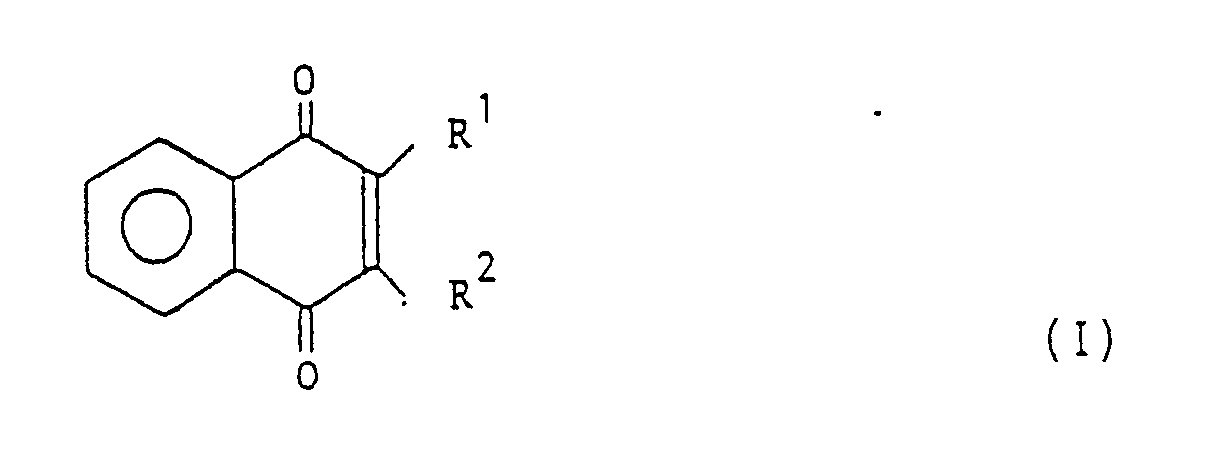
- Preferred compounds of formula (I) include those wherein the group R¹ comprises or contains a cyclohexyl moiety, particularly those wherein R¹ is a 4-substituted cyclohexyl group, especially a 4-t-butylcyclohexyl group.
- Specific compounds of formula (I) include for example:-
2-(4-t-butylcyclohexyl)-3-hydroxy-1,4-naphthoquinone,
2-(4-t-pentylcyclohexyl)-3-hydroxy-1,4-naphthoquinone,
2-(4-t-butylcyclohexylmethyl)-3-hydroxy-1,4-naphthoquinone,
2-cyclohexyl-3-hydroxy-1,4-naphthoquinone,
2-(4-phenylcyclohexyl)-3-hydroxy-1,4-naphthoquinone,
2-(8-cyclohexyloctyl)-3-hydroxy-1,4-naphthoquinone,
2-(4-cyclohexylcyclohexyl)-3-hydroxy-1,4-naphthoquinone,
2-(3-cyclohexylpropyl)-3-hydroxy-1,4-naphthoquinone,
2-(4-t-butoxycyclohexyl)-3-hydroxy-1,4-naphthoquinone,
2-n-nonyl-3-hydroxy-1,4-naphthoquinone,
2-(4,4-dimethylcyclohexyl)-3-hydroxy-1,4-naphthoquinone,
2-acetoxy-3-(4,4-dimethylcyclohexyl)-1,4-naphthoquinone,
2-acetoxy-3-cyclohexyl-1,4-naphthoquinone,
2-(3-t-butylcyclohexyl)-3-hydroxy-1,4-naphthoquinone,
2-cyclopentyl-3-hydroxy-1,4-naphthoquinone, and
2-(4-(4′-chlorophenyl)cyclohexyl)-3-hydroxy-1,4-naphthoquinone. - The pyridinols which may be employed in the combinations of the invention include those described in U.S. Patent No. 3,206,358.
- Preferred pyridinols include those of formula (II)

- Particularly preferred compounds of formula (II) include
3,5-dichloro-2,6-dimethyl-4-pyridinol;
3,5-dibromo-2,6-dimethyl-4-pyridinol;
3,5-dichloro-2,6-dipropyl-4-pyridinol and
3,5-dibromo-2,6-dipropyl-4-pyridinol. - The naphthoquinones and 4-pyridinols and alkanoic esters thereof employed in the combinations according to the invention may be prepared in conventional manner, for example, using analogous techniques to those described in the above-mentioned references.
- The two active ingredients of the combinations of the invention may be present in any convenient potentiating ratio. The actual ratio will vary depending primarily upon the inherent antiprotozoal activity of the naphthoquinone. Thus the more active the naphthoquinone the greater will be the ratio of pyridinol to naphthoquinone. However, in general, the ratio of naphthoquinone to pyridinol (w/w) will be in the range of 1:500 to 1:1. The ratio of more active naphthoquinones to pyridinol is advantageously about 1:50 to 1:500 or even greater; for less active naphthoquinones the ratio will be lower, for example in the ranges of about 1:10 to 1:100 or 1:1 to 1:25 depending upon the activity of the naphthoquinone.
- According to a further feature of the invention we provide a combination as described herein for use as a therapeutic agent, for example for use in the treatment or prophylaxis of a protozoal disease as described below.
- Examples of protozoal diseases which may be treated in accordance with the invention include coccidiosis and malarial infections, in hosts, including mammals (such as man in the case of malaria) and birds (such as poultry in the case of coccidiosis).
- The amount of naphthoquinone required for therapeutic effect is at the ultimate discretion of the physician/veterinarian carrying out the treatment and will, of course, vary not only with the nature of the infection to be treated but also with the particular naphthoquinone and pyridinol used and the ratio thereof. In general, however, a suitable daily dose for a mammal (including man) for the treatment of malaria, for example, will lie in the range of 0.1mg to 200mg/kg bodyweight, for example 1mg to 100 mg/kg such as 10mg to 40mg/kg.
- The amount of pyridinol present in the combination will be that necessary to provide the appropriate potentiating ratio of naphthoquinone to pyridinol as hereinbefore defined. Thus the amount of pyridinol will vary according to the particular naphthoquinone employed but will be apparent to someone skilled in the art.
- It will be appreciated that the amount of the combinations, according to the invention, required for use in treatment or prophylaxis will vary not only with the active compound but also with the route of administration and nature of the infection. In general a suitable dose for a mammal (including man) for treatment, for example of malaria, will lie in the range of 0.1 mg to 200 mg per kilogram bodyweight per day, with a preferred range of 1 mg to 100 mg, particularly 10 to 40 mg. For the prophylaxis or treatment of coccidiosis the compound will normally be administered ad lib in drinking water or diet and suitable levels of drug will be in the range of 1 to 500ppm, preferably 10-400ppm ideally about 200ppm.
- The combinations of the invention are preferably employed as antiprotozoal agents in the form of therapeutic (pharmaceutical or veterinary) formulations.
- According to a further feature of the present invention we provide a therapeutic formulation comprising a combination, according to the invention, together with one or more pharmaceutically acceptable carriers therefore and/or optionally one or more further therapeutic and/or prophylactic ingredients. The combination according to the invention is present in the therapeutic formulations in an effective antiprotozoal amount.
- The combinations may conveniently be presented (as therapeutic formulations) in unit dosage form. A convenient unit dose formulation contains the combination in an amount of from 10 mg to 1 g.
- Therapeutic formulations include those suitable for oral, rectal or parenteral (including intramuscular and intravenous) administration, although the oral route is preferred. The formulations may, where appropriate, be conveniently presented in discrete dosage units and may be prepared by any of the methods well known in the art of pharmacy. All methods include the step of bringing into association the active compound with liquid carriers or finely divided solid carriers of both and then, if necessary, shaping the product into the desired formulation.
- Therapeutic formulations suitable for oral administration wherein the carrier is a solid are most preferably presented as unit dose formulations such as boluses, capsules, cachets or tablets each containing a predetermined amount of the combination. A tablet may be made by compression or moulding, optionally with one or more accessory ingredients. Compressed tablets may be prepared by compressing in a suitable machine the active compound in a free-flowing form such as a powder or granules optionally mixed with a binder, lubricant, inert diluent, lubricating, surface active or dispersing agent. Moulded tablets may be made by moulding an inert liquid diluent. Tablets may be optionally coated and, if uncoated, may be optionally scored. Capsules may be prepared by filling the combination, either alone or in admixture with one or more accessory ingredients, into the capsule cases and then sealing them in the usual manner. Cachets are analogous to capsules wherein the combination together with any accessory ingredient(s) is sealed in a rice paper envelope. Therapeutic formulations suitable for oral administration wherein the carrier is a liquid may be presented as a solution or a suspension in an aqueous liquid or a non-aqueous liquid, or as an oil-in-water or water-in-oil liquid emulsion.
- Therapeutic formulations suitable for rectal administration wherein the carrier is a solid are most preferably presented as unit dose suppositories. Suitable carriers include cocoa butter and other materials commonly used in the art, and the suppositories may be conveniently formed by admixture of the combination with the softened or melted carrier(s) followed by chilling and shaping moulds.
- Therapeutic formulations suitable for parenteral administration include sterile solutions or suspensions of the combination in aqueous or oleaginous vehicles. Such preparations are conveniently presented in unit dose or multi-dose containers which are sealed after introduction of the formulation until required for use.
- It should be understood that in addition to the aforementioned carrier ingredients the pharmaceutical formulations described above may include, as appropriate, one or more additional carrier ingredients such as diluents, buffers, flavouring agents, binders, surface-active agents, thickeners, lubricants, preservatives (including anti-oxidants) and the like, and substances included for the purpose of rendering the formulation isotonic with the blood of the intended recipient.
- The therapeutic formulations for veterinary use, may conveniently be in either powder or liquid concentrate form. In accordance with the standard veterinary formulation practice, conventional water soluble excipients, such as lactose or sucrose, may be incorporated in the powders to improve their physical properties. Thus particularly suitable powders of this invention comprise 50 to 100% w/w, and preferably 60 to 80% w/w of the combination and 0 to 50% w/w and preferably 20 to 40% w/w of conventional veterinary excipients. These powders may either be added to animal feedstuffs, for example by way of an intermediate premix, or diluted in animal drinking water.
- Liquid concentrates of this invention suitably contain a water-soluble compound combination and may optionally include a veterinarily acceptable water miscible solvent, for example polyethylene glycol, propylene glycol, glycerol, glycerol formal or such a solvent mixed with up to 30% v/v of ethanol. The liquid concentrates may be administered to the drinking water of animals, particularly poultry.
- The following examples illustrate the invention:-
- The effect of combinations of 2-(4-t-butylcyclohexyl)-3-chloro-1,4-naphthoquinone and Clopidol, ie. 3,5-dichloro-2,6-dimethylpyridinol ("naphthoquinone/4-pyridinol combinations") against P-falciparum were determined and compared to the effect of each drug alone by a modification of the method of Desjardins et al (Antimicrobial Agents and Chemotherapy 16, 710-718 (1979)). Each of the two compounds to be tested were dissolved in ethanol at a concentration of 10 mg/L and serially diluted with RPMI 1640 medium and 10% (v/v) human plasma in microtitration plates. P.falciparum-parasitised and fresh blood cells were added together with ³H-adenosine or ³H-hypoxanthine in RPMI 1640 medium and 10% human plasma. The cultures were then incubated at 37oC for 43 hours, harvested and the particulate contents connected on glass fibre filter papers which were washed copiously with water using a Cooke Microtiter System (Dynatech Labs. Europe); the filter papers were dried and the radioactivity measured using a scintillation counter. Infected, untreated and uninfected cultures were included as controls. Percent inhibition was correlated with dose to provide an IC₅₀ for each drug alone.
- For subsequent combination experiments the individual drug solutions and mixtures thereof were serially diluted. The percentage inhibition of incorporation of radio-activity of the drug-treated cultures for a range of concentrations and combinations thereof were determined and are shown in Table 1.
- The IC₅₀ of each drug at a fixed concentration of the other was determined by linear regression and is shown in Table II. Plotting of these values on an isobologram demonstrated that the anti-malarial activity of the drugs in combination was greater than that of the predicted additive effect of the individual components.
Table I Concentration of Naphthoquinone in mg/ℓ 0 4. 2 1 0.5 0.25 1.25 x 10⁻¹ 6.25 x 10⁻² 3.13 x 10⁻² 1.56 x 10⁻² 7.8x10⁻³ 3.9 x 10⁻³ Concentration of 4-pyridinol in mg/ℓ 0 0 75 55 31 17 14 18 6.4 79 83 3.2 74 78 74 70 64 1.6 55 81 78 74 60 58 50 0.8 44 77 81 78 66 57 47 33 27 0.4 22 84 81 74 74 60 47 29 29 26 32 0.2 18 83 78 70 62 68 34 36 25 32 23 27 0.1 24 80 75 70 60 56 47 23 18 37 32 0.05 70 57 49 37 43 37 11 2 2.5 x10⁻² 56 47 47 41 14 3 1.25 x10⁻² 30 31 8 25 6.3 x10⁻³ 23 6 Table II Fixed concentration of clopidol (4-pyridinol) in mg/ℓ ED₅₀ for naphthoquinone in mg/ℓ Fixed concentration of naphthoquinone in mg/ℓ ED₅₀ for Clopidol (4-pyridinol) in mg/ℓ 0.000 0.851 (2.18 to 0.464) 0.0 1.18 (1.44 to 0.980) 0.00625 0.699 (none) 0.00781 1.63 (none) 0.0125 0.401 (3.03 to 0.271) 0.0156 0.128 (none) 0.0250 0.478 (1.41 to 0.271) 0.0313 2.57 (647000 to 0.721) 0.0500 0.447 (0.766 to 0.295) 0.0625 1.03 (14.2 to 0.405) 0.100 0.287 (0.510 to 0.128) 0.125 0.578 (1.52 to 0.0224) 0.200 0.198 (0.381 to 0.082) 0.250 0.074 (0.183 to 0.00955) 0.400 0.155 (1.31 to 0.000) 0.500 0.052 (0.081 to 0.289) 0.800 0.0801 (0.225 to 0.0239) 1.00 0.0092 (0.039 to 0.000013) 1.60 0.0303 (0.0780 to 0.00075) 2.00 0.00097 (none) 3.20 0.0075 (0.039 to 0.0000) 4.00 0.00012 (none) - By the method of Example 1 the effect of a number of naphthoquinone/clopidol (4-pyridinol) combinations on P.falciparum in vitro were determined. Results, expressed as % inhibition of radioactivity incorporation, are given in Table III.

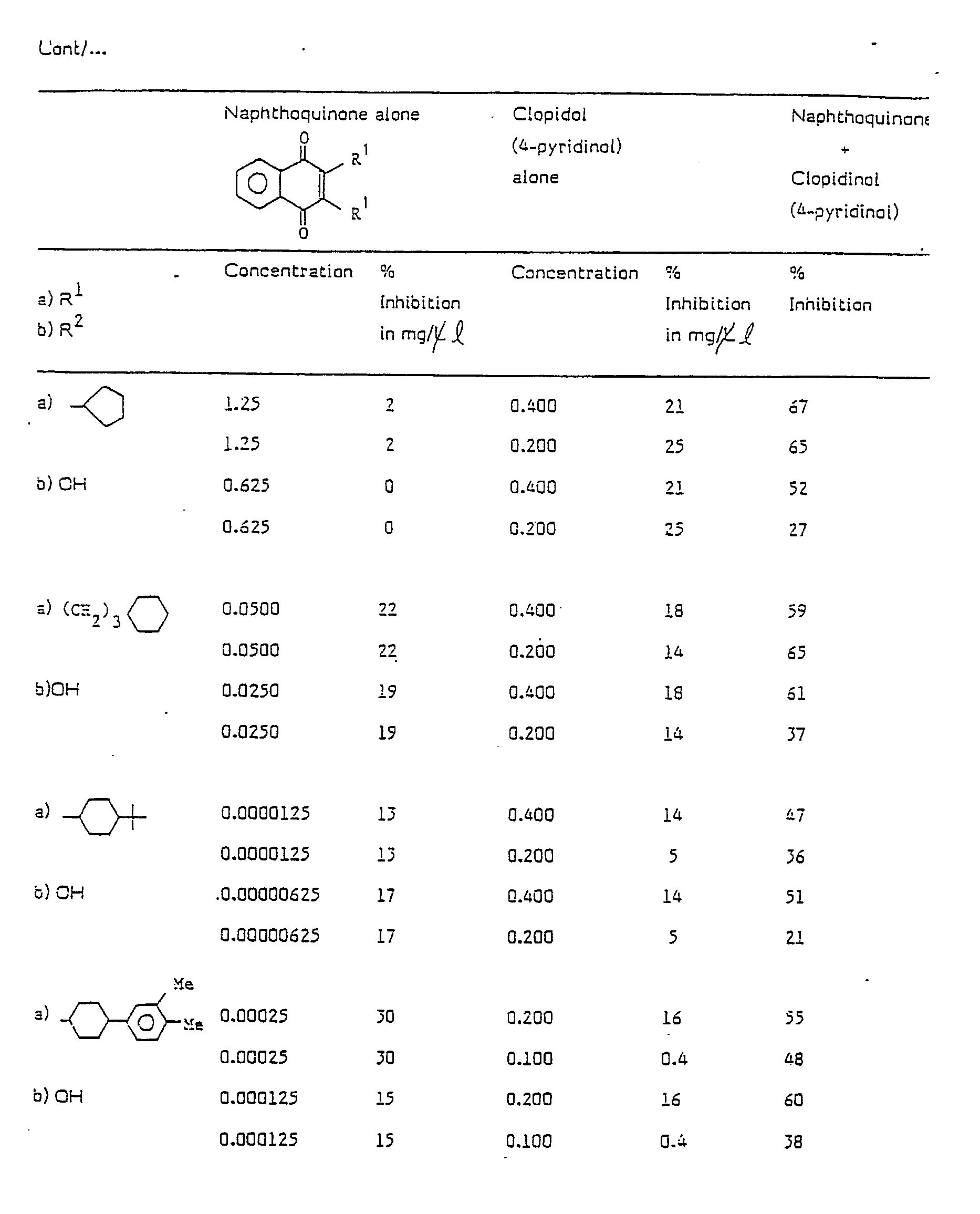

- By the method of Example 1 the effect of a number of 2-(4-t-butylcyclohexyl)-3-hydroxy-1,4-naphthoquinone/4-pyridinol analogue combinations on P.falciparum in vitro were determined. Results, expressed as % inhibition of radioactivity incorporation, are given in Table IV.

- The naphthoquinone and the pyridinol were each suspended in 025% (w/v) celacol®(hydroxypropylmethylcellulose) in water by milling for 16-24 hours at 26oC. The suspensions were subsequently serially diluted with 0.25% (w/v) celacol® in water.
- At time 0, 0.1 ml of a suspension of 10⁷ P.yoelii-parasitised red blood cells/ml of phosphate-buffered saline were injected intravenously into 15-20 g mice through a tail vein. Groups of 5 mice per treatment were dosed orally at times 6, 22, 30, 46, 54, 70 and 78 hours with 0.2ml of the drug suspension. Tail-blood smears were taken at 96 hours, stained with Giemsa and the percentage of red blood cells infected determined and compared to untreated, infected controls. Percent inhibition was correlated with dose to provide ED₅₀ values for each drug alone.
- In subsequent experiments dilutions of the two drugs, alone and in combination were used, and the percentage inhibition of parasitaemia and ED₅₀ values (of each drug at fixed concentrations of the other) were determined. The results are shown respectively in Tables V and VI.
TABLE V Concentrations of naphthoquinone Concentration of Clopidol(4-pyridinol) in mg/Kg/dose mg/Kg/dose 0.0 30 15 7.5 3.7 1.9 0.9 0.0 0 61 34 13 17 6 0.60 99 0.30 74 98 96 0.15 16 92 80 62 0.075 17 86 69 45 35 0.037 28 77 73 32 23 20 0.019 13 48 42 11 23 16 TABLE VI Fixed concentration of Clopidol (4-pyridinol) in mg/kg/dose ED₅₀ for naphthoquinone in mg/Kg/dose Fixed concentration of naphthoquinone ED₅₀ for Clopidol (4-pyridinol) in mg/Kg/dose 0.000 0.224 (0.224 to 0.208) 0.000 22.5 (27.6 to 19.4) 0.94 0.109 (0.125 to 0.0909) 0.019 13.8 (21.5 to 10.7) 1.9 0.0762 (0.0975 to 0.0599) 0.0375 5.14 (6.22 to 4.23) 3.75 0.0519 (0.0599 to 0.0450) 0.075 1.87 (2.45 to 1.30) 7.5 0.0219 (0.0274 to 0.0151) 0.15 0.522 (0.946 to 0.03 15. 0.0197 (0.0242 to 0.0121) - A number of combinations of clopidol (4-pyridinol) and naphthoquinones were assayed and compared with each drug alone for their antimalarial effect against P.yoelii in vivo by the method of Example 4. Representative results for each combination showing percentage inhibition of parasitaemia are given in Table VII below.


- The acute oral LD₅₀'s of compounds of formula (I) in rats were determined by standard techniques. The results are shown below.
Compound LD₅₀ 2-(4′-t-butylcyclohexyl)-3-hydroxy-1,4 naphthoquinone >1000 mg/kg bodyweight 2-hydroxy-3-(4-t-pentylcyclohexyl)-1,4-naphthoquinone 2000 mg/kg bodyweight - The following examples illustrate therapeutic formulations according to the invention wherein the combination is a combination herein described, specifically a combination of 2-(4-t-butylcyclohexyl)-3-hydroxy-1,4-naphthoquinone and 3,5-dichloro-2,6-dimethylpyridinol.
Tablet formulation Combination 100 mg Lactose 100 mg Maize starch 30 mg Magnesium stearate 2 mg 232 mg Oral suspension Combination 50 mg Avicel® RC 591 (Microcrystalline Cellulose) 75 mg Sucrose syrup 3.5 ml Methylhydroxybenzoate 5 mg Colour 0.01% w/v Cherry flavour 0.1 % v/v Tween® 80 (Polysorbate 80) 0.2 % v/v Water to 5 ml Injectable suspension Combination 100 mg Polyvinyl pyrrolidine (PVP) 170 mg Tween® 80 (Polysorbate 80) 0.2% v/v Methylhydroxybenzoate 0.1% w/v Water for injection to 3 ml Capsule Combination 100 mg Starch 1500 150 mg Magnesium stearate filled into a soft gelatin capsule 2.5 mg
Claims (8)

Priority Applications (1)
| Application Number | Priority Date | Filing Date | Title |
|---|---|---|---|
| AT90114375T ATE91892T1 (en) | 1983-04-14 | 1984-04-14 | ANTI-PROTOZOA AGENT. |
Applications Claiming Priority (2)
| Application Number | Priority Date | Filing Date | Title |
|---|---|---|---|
| GB838310140A GB8310140D0 (en) | 1983-04-14 | 1983-04-14 | Antiprotozoal agents |
| GB8310140 | 1983-04-14 |
Related Parent Applications (1)
| Application Number | Title | Priority Date | Filing Date |
|---|---|---|---|
| EP84104249.2 Division | 1984-04-14 |
Publications (3)
| Publication Number | Publication Date |
|---|---|
| EP0401875A2 true EP0401875A2 (en) | 1990-12-12 |
| EP0401875A3 EP0401875A3 (en) | 1990-12-27 |
| EP0401875B1 EP0401875B1 (en) | 1993-07-28 |
Family
ID=10541104
Family Applications (2)
| Application Number | Title | Priority Date | Filing Date |
|---|---|---|---|
| EP90114375A Expired - Lifetime EP0401875B1 (en) | 1983-04-14 | 1984-04-14 | Improvements in or relating to antiprotozoal agents |
| EP84104249A Expired - Lifetime EP0123239B1 (en) | 1983-04-14 | 1984-04-14 | Improvements in or relating to antiprotozoal agents |
Family Applications After (1)
| Application Number | Title | Priority Date | Filing Date |
|---|---|---|---|
| EP84104249A Expired - Lifetime EP0123239B1 (en) | 1983-04-14 | 1984-04-14 | Improvements in or relating to antiprotozoal agents |
Country Status (13)
| Country | Link |
|---|---|
| US (1) | US5053418A (en) |
| EP (2) | EP0401875B1 (en) |
| JP (1) | JPS59205316A (en) |
| AT (2) | ATE67089T1 (en) |
| AU (1) | AU574354B2 (en) |
| CY (1) | CY1862A (en) |
| DE (2) | DE3485033D1 (en) |
| GB (1) | GB8310140D0 (en) |
| HK (1) | HK129695A (en) |
| IL (1) | IL71546A (en) |
| PH (1) | PH22010A (en) |
| UY (1) | UY24036A1 (en) |
| ZA (1) | ZA842796B (en) |
Cited By (3)
| Publication number | Priority date | Publication date | Assignee | Title |
|---|---|---|---|---|
| WO1994012164A1 (en) * | 1992-11-26 | 1994-06-09 | The Wellcome Foundation Limited | Combination of atovaquone with proguanil for the treatment of protozoal infections |
| RU2122853C1 (en) * | 1993-07-02 | 1998-12-10 | Руссель Юклаф | Agent for inhibition of platelet aggregation |
| EP1779892A4 (en) * | 2004-07-30 | 2010-05-19 | Japan Health Science Found | ANTI-PROTOZOAL AGENT |
Families Citing this family (18)
| Publication number | Priority date | Publication date | Assignee | Title |
|---|---|---|---|---|
| GB8500292D0 (en) * | 1985-01-07 | 1985-02-13 | Wellcome Found | Treatment of babesiosis |
| US5206268A (en) * | 1988-08-16 | 1993-04-27 | Burroughs Wellcome Co. | Medicaments |
| GB8819477D0 (en) * | 1988-08-16 | 1988-09-21 | Wellcome Found | Medicaments |
| IE65715B1 (en) * | 1988-08-16 | 1995-11-15 | Wellcome Found | Medicaments |
| US5225184A (en) * | 1988-08-16 | 1993-07-06 | Burroughs Wellcome Co. | Medicaments |
| GB8921516D0 (en) * | 1989-09-22 | 1989-11-08 | Wellcome Found | Medicaments |
| EP0567162A1 (en) * | 1989-09-22 | 1993-10-27 | The Wellcome Foundation Limited | Medicaments for the treatment of toxoplasmosis |
| GB8923254D0 (en) * | 1989-10-16 | 1989-12-06 | Wellcome Found | Medicaments |
| US5403934A (en) * | 1990-03-12 | 1995-04-04 | Burroughs Wellcome Co. | Heterocyclic compounds |
| GB9005518D0 (en) * | 1990-03-12 | 1990-05-09 | Wellcome Found | Heterocyclic compounds |
| GB9126874D0 (en) * | 1991-12-18 | 1992-02-19 | Wellcome Found | Medicaments |
| GB9216859D0 (en) * | 1992-08-07 | 1992-09-23 | Wellcome Found | Medicaments |
| GB9226905D0 (en) | 1992-12-24 | 1993-02-17 | Wellcome Found | Pharmaceutical preparation |
| GB9410299D0 (en) * | 1994-05-20 | 1994-07-13 | British Tech Group | Naphthoquinone derivatives |
| US5684035A (en) * | 1996-07-17 | 1997-11-04 | Kapadia; Govind J. | Antimalarial agents |
| EP2246329A1 (en) | 2009-01-19 | 2010-11-03 | Glaxo Group Limited | 4(1H)-pyridinone derivatives and their use as antimalaria agents |
| WO2010081904A1 (en) | 2009-01-19 | 2010-07-22 | Glaxo Group Limited | 4 ( 1h) -pyridinone derivatives and their use as antimalaria agents |
| WO2010108177A2 (en) * | 2009-03-20 | 2010-09-23 | University Of South Florida | A method and composition using a dual specificity protein tyrosine phosphatase as an antimalarial drug target |
Family Cites Families (12)
| Publication number | Priority date | Publication date | Assignee | Title |
|---|---|---|---|---|
| US2553647A (en) * | 1946-03-20 | 1951-05-22 | Research Corp | Naphthoquinone antimalarials |
| US2553648A (en) | 1948-01-08 | 1951-05-22 | Research Corp | Naphthoquinone compounds |
| NL124395C (en) | 1963-09-25 | |||
| US3347742A (en) | 1965-05-28 | 1967-10-17 | Merck & Co Inc | 2-(4-cyclohexylcyclohexyl)-3-hydroxy-1, 4-naphthoquinone in controlling coccidiosis in poultry |
| US3367830A (en) | 1965-06-23 | 1968-02-06 | Merck & Co Inc | Controlling coccidiosis in poultry with 1,4-naphthoquinones |
| AU458235B2 (en) * | 1971-02-09 | 1975-02-20 | Shionogi & Co., Ltd | Quinone derivatives and compositions containing thesame |
| FI762480A7 (en) | 1975-09-15 | 1977-03-16 | Du Pont | |
| GB1553424A (en) | 1976-02-10 | 1979-09-26 | Wellcome Found | Method of treating protozal diseases |
| EP0002228B1 (en) | 1977-11-22 | 1984-02-29 | The Wellcome Foundation Limited | Hydroxy naphthoquinone derivatives, their preparations for treating and preventing theileriosis in cattle and sheep, processes for their synthesis; naphthoquinone derivatives |
| US4485116A (en) | 1981-10-16 | 1984-11-27 | Hudson Alan T | Antiprotozoal compounds |
| US4485117A (en) * | 1981-10-16 | 1984-11-27 | Hudson Alan T | Antiprotozoal compounds |
| GB8310141D0 (en) * | 1983-04-14 | 1983-05-18 | Wellcome Found | Naphthoquinone derivatives |
-
1983
- 1983-04-14 GB GB838310140A patent/GB8310140D0/en active Pending
-
1984
- 1984-04-13 AU AU26797/84A patent/AU574354B2/en not_active Ceased
- 1984-04-13 ZA ZA842796A patent/ZA842796B/en unknown
- 1984-04-13 PH PH30544A patent/PH22010A/en unknown
- 1984-04-13 IL IL71546A patent/IL71546A/en not_active IP Right Cessation
- 1984-04-14 JP JP59075673A patent/JPS59205316A/en active Granted
- 1984-04-14 EP EP90114375A patent/EP0401875B1/en not_active Expired - Lifetime
- 1984-04-14 EP EP84104249A patent/EP0123239B1/en not_active Expired - Lifetime
- 1984-04-14 AT AT84104249T patent/ATE67089T1/en active
- 1984-04-14 DE DE8484104249T patent/DE3485033D1/en not_active Expired - Lifetime
- 1984-04-14 AT AT90114375T patent/ATE91892T1/en active
- 1984-04-14 DE DE90114375T patent/DE3486189T2/en not_active Expired - Lifetime
-
1989
- 1989-12-11 US US07/449,485 patent/US5053418A/en not_active Expired - Lifetime
-
1995
- 1995-08-17 HK HK129695A patent/HK129695A/en not_active IP Right Cessation
- 1995-09-13 UY UY24036A patent/UY24036A1/en not_active IP Right Cessation
-
1996
- 1996-04-05 CY CY186296A patent/CY1862A/en unknown
Cited By (6)
| Publication number | Priority date | Publication date | Assignee | Title |
|---|---|---|---|---|
| WO1994012164A1 (en) * | 1992-11-26 | 1994-06-09 | The Wellcome Foundation Limited | Combination of atovaquone with proguanil for the treatment of protozoal infections |
| US5998449A (en) * | 1992-11-26 | 1999-12-07 | Glaxo Wellcome Inc. | Combination of atovaquone with proguanil for the treatment of protozoal infections |
| US6166046A (en) * | 1992-11-26 | 2000-12-26 | Glaxo Wellcome Inc. | Combination of atovaquone with proguanil for the treatment of protozoal infections |
| US6291488B1 (en) | 1992-11-26 | 2001-09-18 | Glaxo Wellcome Inc. | Preventing protozoal infections |
| RU2122853C1 (en) * | 1993-07-02 | 1998-12-10 | Руссель Юклаф | Agent for inhibition of platelet aggregation |
| EP1779892A4 (en) * | 2004-07-30 | 2010-05-19 | Japan Health Science Found | ANTI-PROTOZOAL AGENT |
Also Published As
| Publication number | Publication date |
|---|---|
| AU2679784A (en) | 1984-10-18 |
| EP0123239A2 (en) | 1984-10-31 |
| ATE91892T1 (en) | 1993-08-15 |
| DE3486189T2 (en) | 1994-03-03 |
| GB8310140D0 (en) | 1983-05-18 |
| JPS59205316A (en) | 1984-11-20 |
| IL71546A0 (en) | 1984-07-31 |
| ZA842796B (en) | 1985-11-27 |
| CY1862A (en) | 1996-04-05 |
| PH22010A (en) | 1988-05-02 |
| JPH0481568B2 (en) | 1992-12-24 |
| UY24036A1 (en) | 1995-09-18 |
| AU574354B2 (en) | 1988-07-07 |
| US5053418A (en) | 1991-10-01 |
| DE3486189D1 (en) | 1993-09-02 |
| HK129695A (en) | 1995-08-24 |
| EP0123239A3 (en) | 1987-11-25 |
| EP0401875A3 (en) | 1990-12-27 |
| DE3485033D1 (en) | 1991-10-17 |
| EP0123239B1 (en) | 1991-09-11 |
| EP0401875B1 (en) | 1993-07-28 |
| IL71546A (en) | 1987-08-31 |
| ATE67089T1 (en) | 1991-09-15 |
Similar Documents
| Publication | Publication Date | Title |
|---|---|---|
| EP0123239B1 (en) | Improvements in or relating to antiprotozoal agents | |
| Hudson et al. | Novel anti-malarial hydroxynaphthoquinones with potent broad spectrum anti-protozoal activity | |
| DK172273B1 (en) | 2-substituted-3-hydroxy-1,4-naphthoquions and process for their preparation | |
| JPH0144179B2 (en) | ||
| EP0010668B1 (en) | 3-deazaadenosine and pharmaceutical compositions containing it | |
| HU201672B (en) | Process for producing pharmaceutical compositions comprising podophyllotoxin | |
| US4560687A (en) | Substituted aromatic compounds | |
| AP517A (en) | Combination of atovaquone and proguanil and its use in treatment of protozoal infections. | |
| US6413993B1 (en) | Combination preparation for treating malaria | |
| EP0572615B1 (en) | Medicament for the Treatment of Protozoal Infections caused by Babesia | |
| US4031220A (en) | Method for the treatment of malaria | |
| EP0445141B1 (en) | Medicaments for the treatment of toxoplasmosis | |
| US5780514A (en) | Antiprotozoal medicaments | |
| EP0653936B1 (en) | Use of 2-[4-(4-chlorophenyl)cyclohexyl]-3-hydroxy-1,4-naphthoquinone for the treatment of cancer | |
| NL8101987A (en) | THE COMPOUND 4-AMINO-1-BETA-D-RIBOFURANOSYL-1H-IMIDAZO / 4.5-C / -PYRIDINE OR A PHARMACEUTICALLY ACCEPTABLE ACID ADDITION SALT; PHARMACEUTICAL PREPARATION. | |
| US4195089A (en) | Synergistic composition for malaria | |
| EP0496729B1 (en) | Medicament for the treatment of cryptosporidiosis | |
| AP315A (en) | Heterocyclic compounds. | |
| HK1004468B (en) | Combination of atovaquone with proguanil for the treatment of protozoal infections | |
| JPH04230322A (en) | Antimalarial pharmaceutical composition | |
| EP0567162A1 (en) | Medicaments for the treatment of toxoplasmosis | |
| HK1041638B (en) | Combination preparation for treating malaria | |
| BE695974A (en) |
Legal Events
| Date | Code | Title | Description |
|---|---|---|---|
| PUAI | Public reference made under article 153(3) epc to a published international application that has entered the european phase |
Free format text: ORIGINAL CODE: 0009012 |
|
| PUAL | Search report despatched |
Free format text: ORIGINAL CODE: 0009013 |
|
| AC | Divisional application: reference to earlier application |
Ref document number: 123239 Country of ref document: EP |
|
| AK | Designated contracting states |
Kind code of ref document: A2 Designated state(s): AT BE CH DE FR GB IT LI LU NL SE |
|
| AK | Designated contracting states |
Kind code of ref document: A3 Designated state(s): AT BE CH DE FR GB IT LI LU NL SE |
|
| 17P | Request for examination filed |
Effective date: 19910515 |
|
| 17Q | First examination report despatched |
Effective date: 19920207 |
|
| GRAA | (expected) grant |
Free format text: ORIGINAL CODE: 0009210 |
|
| ITF | It: translation for a ep patent filed | ||
| AC | Divisional application: reference to earlier application |
Ref document number: 123239 Country of ref document: EP |
|
| AK | Designated contracting states |
Kind code of ref document: B1 Designated state(s): AT BE CH DE FR GB IT LI LU NL SE |
|
| REF | Corresponds to: |
Ref document number: 91892 Country of ref document: AT Date of ref document: 19930815 Kind code of ref document: T |
|
| REF | Corresponds to: |
Ref document number: 3486189 Country of ref document: DE Date of ref document: 19930902 |
|
| ET | Fr: translation filed | ||
| PGFP | Annual fee paid to national office [announced via postgrant information from national office to epo] |
Ref country code: CH Payment date: 19940215 Year of fee payment: 11 |
|
| PGFP | Annual fee paid to national office [announced via postgrant information from national office to epo] |
Ref country code: SE Payment date: 19940418 Year of fee payment: 11 |
|
| PGFP | Annual fee paid to national office [announced via postgrant information from national office to epo] |
Ref country code: BE Payment date: 19940427 Year of fee payment: 11 Ref country code: AT Payment date: 19940427 Year of fee payment: 11 |
|
| ITTA | It: last paid annual fee | ||
| PGFP | Annual fee paid to national office [announced via postgrant information from national office to epo] |
Ref country code: NL Payment date: 19940430 Year of fee payment: 11 Ref country code: LU Payment date: 19940430 Year of fee payment: 11 |
|
| PLBE | No opposition filed within time limit |
Free format text: ORIGINAL CODE: 0009261 |
|
| STAA | Information on the status of an ep patent application or granted ep patent |
Free format text: STATUS: NO OPPOSITION FILED WITHIN TIME LIMIT |
|
| EPTA | Lu: last paid annual fee | ||
| 26N | No opposition filed | ||
| EAL | Se: european patent in force in sweden |
Ref document number: 90114375.0 |
|
| PG25 | Lapsed in a contracting state [announced via postgrant information from national office to epo] |
Ref country code: LU Free format text: LAPSE BECAUSE OF NON-PAYMENT OF DUE FEES Effective date: 19950414 Ref country code: AT Effective date: 19950414 |
|
| PG25 | Lapsed in a contracting state [announced via postgrant information from national office to epo] |
Ref country code: SE Effective date: 19950415 |
|
| PG25 | Lapsed in a contracting state [announced via postgrant information from national office to epo] |
Ref country code: LI Effective date: 19950430 Ref country code: CH Effective date: 19950430 Ref country code: BE Effective date: 19950430 |
|
| BERE | Be: lapsed |
Owner name: THE WELLCOME FOUNDATION LTD Effective date: 19950430 |
|
| PG25 | Lapsed in a contracting state [announced via postgrant information from national office to epo] |
Ref country code: NL Effective date: 19951101 |
|
| REG | Reference to a national code |
Ref country code: CH Ref legal event code: PL |
|
| NLV4 | Nl: lapsed or anulled due to non-payment of the annual fee |
Effective date: 19951101 |
|
| EUG | Se: european patent has lapsed |
Ref document number: 90114375.0 |
|
| REG | Reference to a national code |
Ref country code: GB Ref legal event code: IF02 |
|
| PGFP | Annual fee paid to national office [announced via postgrant information from national office to epo] |
Ref country code: GB Payment date: 20030313 Year of fee payment: 20 |
|
| PGFP | Annual fee paid to national office [announced via postgrant information from national office to epo] |
Ref country code: FR Payment date: 20030403 Year of fee payment: 20 |
|
| PGFP | Annual fee paid to national office [announced via postgrant information from national office to epo] |
Ref country code: DE Payment date: 20030430 Year of fee payment: 20 |
|
| PG25 | Lapsed in a contracting state [announced via postgrant information from national office to epo] |
Ref country code: GB Free format text: LAPSE BECAUSE OF EXPIRATION OF PROTECTION Effective date: 20040413 |
|
| REG | Reference to a national code |
Ref country code: GB Ref legal event code: PE20 |