EP0401940A2 - Méthode d'encapsulation d'un composant électrique - Google Patents
Méthode d'encapsulation d'un composant électrique Download PDFInfo
- Publication number
- EP0401940A2 EP0401940A2 EP90202087A EP90202087A EP0401940A2 EP 0401940 A2 EP0401940 A2 EP 0401940A2 EP 90202087 A EP90202087 A EP 90202087A EP 90202087 A EP90202087 A EP 90202087A EP 0401940 A2 EP0401940 A2 EP 0401940A2
- Authority
- EP
- European Patent Office
- Prior art keywords
- capacitor
- winding
- sheet
- mold
- electrode
- Prior art date
- Legal status (The legal status is an assumption and is not a legal conclusion. Google has not performed a legal analysis and makes no representation as to the accuracy of the status listed.)
- Withdrawn
Links
Images


Classifications
-
- H—ELECTRICITY
- H01—ELECTRIC ELEMENTS
- H01G—CAPACITORS; CAPACITORS, RECTIFIERS, DETECTORS, SWITCHING DEVICES, LIGHT-SENSITIVE OR TEMPERATURE-SENSITIVE DEVICES OF THE ELECTROLYTIC TYPE
- H01G2/00—Details of capacitors not covered by a single one of groups H01G4/00-H01G11/00
- H01G2/12—Protection against corrosion
-
- B—PERFORMING OPERATIONS; TRANSPORTING
- B29—WORKING OF PLASTICS; WORKING OF SUBSTANCES IN A PLASTIC STATE IN GENERAL
- B29C—SHAPING OR JOINING OF PLASTICS; SHAPING OF MATERIAL IN A PLASTIC STATE, NOT OTHERWISE PROVIDED FOR; AFTER-TREATMENT OF THE SHAPED PRODUCTS, e.g. REPAIRING
- B29C70/00—Shaping composites, i.e. plastics material comprising reinforcements, fillers or preformed parts, e.g. inserts
- B29C70/68—Shaping composites, i.e. plastics material comprising reinforcements, fillers or preformed parts, e.g. inserts by incorporating or moulding on preformed parts, e.g. inserts or layers, e.g. foam blocks
- B29C70/685—Shaping composites, i.e. plastics material comprising reinforcements, fillers or preformed parts, e.g. inserts by incorporating or moulding on preformed parts, e.g. inserts or layers, e.g. foam blocks by laminating inserts between two plastic films or plates
-
- B—PERFORMING OPERATIONS; TRANSPORTING
- B29—WORKING OF PLASTICS; WORKING OF SUBSTANCES IN A PLASTIC STATE IN GENERAL
- B29C—SHAPING OR JOINING OF PLASTICS; SHAPING OF MATERIAL IN A PLASTIC STATE, NOT OTHERWISE PROVIDED FOR; AFTER-TREATMENT OF THE SHAPED PRODUCTS, e.g. REPAIRING
- B29C70/00—Shaping composites, i.e. plastics material comprising reinforcements, fillers or preformed parts, e.g. inserts
- B29C70/68—Shaping composites, i.e. plastics material comprising reinforcements, fillers or preformed parts, e.g. inserts by incorporating or moulding on preformed parts, e.g. inserts or layers, e.g. foam blocks
- B29C70/72—Encapsulating inserts having non-encapsulated projections, e.g. extremities or terminal portions of electrical components
-
- B—PERFORMING OPERATIONS; TRANSPORTING
- B29—WORKING OF PLASTICS; WORKING OF SUBSTANCES IN A PLASTIC STATE IN GENERAL
- B29C—SHAPING OR JOINING OF PLASTICS; SHAPING OF MATERIAL IN A PLASTIC STATE, NOT OTHERWISE PROVIDED FOR; AFTER-TREATMENT OF THE SHAPED PRODUCTS, e.g. REPAIRING
- B29C43/00—Compression moulding, i.e. applying external pressure to flow the moulding material; Apparatus therefor
-
- B—PERFORMING OPERATIONS; TRANSPORTING
- B29—WORKING OF PLASTICS; WORKING OF SUBSTANCES IN A PLASTIC STATE IN GENERAL
- B29C—SHAPING OR JOINING OF PLASTICS; SHAPING OF MATERIAL IN A PLASTIC STATE, NOT OTHERWISE PROVIDED FOR; AFTER-TREATMENT OF THE SHAPED PRODUCTS, e.g. REPAIRING
- B29C43/00—Compression moulding, i.e. applying external pressure to flow the moulding material; Apparatus therefor
- B29C43/22—Compression moulding, i.e. applying external pressure to flow the moulding material; Apparatus therefor of articles of indefinite length
- B29C43/28—Compression moulding, i.e. applying external pressure to flow the moulding material; Apparatus therefor of articles of indefinite length incorporating preformed parts or layers, e.g. compression moulding around inserts or for coating articles
Definitions
- This invention relates to a method of encapsulating an electrical component such as a capacitor.
- capacitors known are those having a body formed by a winding of a layer or layers of insulation between two sheets of conductive foil.
- a wound capacitor as do other types of capacitor, provides a single functional capacitive element of a predetermined value when incorporated into an electrical circuit.
- the two conductive foils form electrode plates which are spaced by the layer or layers of insulation, forming the dielectric.
- Such a capacitor winding is shown in Fig. 1 of the drawings where the foils 15 are narrower than the insulation layers 16, and the lateral sides of the foils are inset with respect to the ends of the winding.
- This type of construction is known as "inductive" because tap insert connectors are used which contact respective foils at typically only one location in only one turn of the wound foil, usually about the middle of the length of the foil. Because of the single location of contact, inductance is greatly increased.
- FIG. 2 of the drawings Another type of prior art wound capacitor is shown in Fig. 2 of the drawings wherein the opposite lateral side of each foil 17 is extended to, and perhaps past, the corresponding edge of the insulation 18.
- the ends of the winding can be metallized to make contact with a corresponding foil. This staggering of the foils reduces inductance as the metallized end makes essentially continuous contact with the edge of the foil throughout its entire length.
- a wound capacitor formed by a winding having a pair of lateral sides and including a first, a second and a third insulative layer, extending substantially from one side of said winding to the other side of said winding; a first electrode disposed between said first and second insulative layers; a second electrode disposed between said second and third insulative layers and extending intermediate said sides of said winding and terminating short of each of said sides; a third electrode positioned on the side of said third insulative layer away from said second electrode, the first electrode extending to said one side of said winding and short of the other side of the winding, the third electrode terminating short of said one side of said winding and extending to said other side of said winding; a conductive tab electrically connected to said second electrode; conductive means at least partially covering said one side, making electrical contact with multiple turns of the first electrode and including a lead; and conductive means at least partially covering said other side making electrical contact with multiple turns of the third electrode and including a lead
- a method of encapsulating an electrical component such as a capacitor, having a body and at least two leads extending in one direction from said body, said method comprising the following steps:
- a capacitor formed using one method which is an embodiment of the invention is a multiple function integrated capacitor which consolidates the capacitive functions of three discrete capacitors into a single package, thereby greatly reducing costs and significantly reducing space required for mounting on a printed circuit board compared with accommodating several separate components. Additionally, a capacitor formed using one method which is an embodiment of the present invention greatly reduces inventory costs because only one component need be stocked instead of three separate components.
- the capacitor may also include additional electrical components such as a bleeder resistor. Other features of the capacitor are reduced inductance, reliability, long service life and its relative simplicity to manufacture, making it inexpensive.
- a multiple capacitive function capacitor which integrates the functions of at least three individual capacitors, is generally indicated by reference numeral 20 in Figure 10.
- a partially completed winding 22 or body of the capacitor is shown in Figure 3.
- the winding has a pair of lateral sides 24, 26 (hereinafter referred to as "ends') and includes a first, a second and a third insulative layer (28, 30 and 32 respectively) extending substantially from one winding end 24 to the other winding end 26.
- a first electrode 34 which is disposed between layers 28 and 30 extends to winding end 24 but not end 26.
- a second electrode 36 which is located between layers 30 and 32 terminates short of both winding ends with one lateral edge 37 of the electrode 36 in alignment with the inset edge of the electrode 34.
- the capacitor 20 includes a third electrode 38 positioned on the side of the third layer away from the second electrode 36. The electrode 38 extends to the winding end 26 and terminates short of the winding end 24, preferably in general registration with the corresponding edge 40 of the electrode 36
- first electrode 34 and the third electrode 38 Electrical contact is made with the first electrode 34 and the third electrode 38 by providing a conductive covering, i.e., metallizing, the winding ends 24 and 26.
- a conductive tab 42 contacts the second electrode 36 near the middle of its length with the tab having an insulated portion 44 located at the passage of the tab through the winding end 26 to prevent formation of a conductive path between the second electrode 36 and third electrode 38.
- the capacitor 20 integrates a trio of capacitive elements.
- the first and third electrodes 34, 38 form the plates of a first or X capacitor while the second and third electrodes 36, 38 and the first and second electrodes 34, 36 form the respective plates of a second and third capacitor (Y capacitors).
- the capacitor 20 is particularly useful in the delta capacitor circuit shown in FIG. 4 which has application in radio frequency interference (RFI) emission and susceptibility control.
- the X capacitor 46 is connected between line L1 and neutral N.
- the Y capacitors 48, 50 are connected from L1 to ground and from N to ground, respectively.
- the equivalence of a delta circuit, using three discrete capacitors, to the capacitor 20 with the electrode 36 grounded, the electrode 34 connected to L1, and the electrode 38 connected to N is illustrated schematically in FIG. 5.
- the electrode 34 functions as a plate of capacitor 48 and a plate of capacitor 46.
- the electrode 36 performs the duties of a plate of capacitor 48 and a plate of capacitor 50.
- the electrode 38 is the equivalent of respective plates of capacitors 46 and 50.
- Capacitance and dielectric strength are controlled by appropriate selection of electrode size, distance between electrodes and/or dielectric constant of the insulative material separating the electrodes. It will be readily apparent to one of skill in the art that besides the delta configuration, other configurations requiring series and/or parallel circuits can be effected using the multiple function capacitor 20.
- the capacitor 20 has a construction which provides a line to neutral (X) capacitor which has a significantly higher self-resonant frequency than prior capacitors which have only two electrodes. It will be appreciated that the larger a conventional capacitor is, the lower its self-resonant frequency. Above this frequency, a capacitor acts as an inductor. Referring to FIG. 4, when capacitor 20 is used only as a composite X capacitor, there is no need to ground the electrode 36. In fact, the capacitor 20 is not ever provided with the tab 42. The result is that the discrete "X" capacitor 46, for connection across an electrical load, is shunted by the series combination of the much smaller capacitance capacitors 48 and 50.
- X line to neutral
- the capacitor 20 offers good high frequency performance and is usable over a much broader frequency range than capacitors of conventional design.
- a sheet of plastic film 52 preferably polypropylene, metallized on its lower surface short of winding end 24, preferably forms the first insulative layer 28 and the first electrode 34.
- the deposited metal could be aluminum or zinc with a deposited metal thickness of the order of 1 x 10 ⁇ 5 cm (1,000 ⁇ ). It will be appreciated that this gives the capacitor 20 "self-healing" characteristics in that a momentary short circuit through the dielectric is eliminated, because the localized heat generated is sufficient to vaporize the thin electrode in the area of the breakdown.
- another sheet of plastic film 54 metallized on its lower surface short of winding end 26 forms the third insulative layer 32 and the third electrode 38.
- the second insulative layer 30 and the second electrode 36 are part of an insert 56 positioned between the metallized sheets 52 and 54.
- the insert includes a fourth insulative layer 58 extending fully between the winding ends 24 and 26 and disposed between the second electrode 36 and the third insulative 32.
- the second insulative layer 30 has a thickness substantially equal to the combined thicknesses of insulative layers 58 and 32.
- the insulative layers 30 and 58 are desirably plastic film, most preferably polypropylene, while the second electrode may be aluminum foil of a thickness of about .0005 inch.
- the layers 30 and 58 extend beyond the foil 36 laterally and at both longitudinally ends of the insert 56 to form an insulative periphery fully surrounding the foil.
- This feature provides the capacitor with a high dielectric voltage withstand.
- the conductive tab 42 is symmetrical with respect to the insert, extending beyond both ends 24, 26 of the winding 22 and having a pair of insulative portions 44.
- the free ends 60 of the tab 42 are curled to form terminals, as shown in FIG. 10, with the insulative portions 44 being of sufficient length to maintain the tab out of electrical contact with the outer surface 62 of the winding as the tab is first bent to run along the surface 62, and bent again so the tab ends 60 extend away from the winding, parallel to each other.
- the capacitor 20 also includes U-shaped leads 64, 66 fused to the respective metallized ends 24, 26 of the winding 22 for electrical connection to electrodes 34, 38, respectively. More specifically, each lead includes a bight portion 68 welded or soldered to a respective winding end, and a pair of parallel legs 70 extending away from the winding 22 generally parallel to tab ends 60.
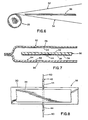
- FIG. 9 Simplified equipment for forming the capacitor winding 22 is schematically illustrated in FIG. 9.
- Spaced rolls 70, 72 of the metallized films 52, 54, respectively, are provided.
- the ends of the films 52, 54 are wound on an arbor 74 disposed downstream of the rolls, forming a V-shaped gap 76 between the films.
- the insert 56 made up of films 30 and 58 and conductive foil 36 (from rolls 73, 75 and 77, respectively), is held in the gap 76 between a vertically movable feed arm roller 78 and a feed pressure roller 80 in conjunction with a brake 82.
- the films 30 and 58 can be perforated by perforators 84 and 86, and the foil 36 can be perforated by a perforator 88.
- a pivotally mounted tab insert arm 90 can be actuated to place the tab 42 between the foil 36 and the sheet 58 with pressure holding the tab in place above a roller 92.
- Ultrasonic bonding or similar techniques can be used to bond the tab 42 to the foil 36 for specialized applications.
- the roller 92 is perferably positioned about one-half the distance between the end of the insert foil 36 in the gap 76 and the perforation at perforator 88. This centering of the ground electrical tab 42 midway between the ends of the foil 36 minimizes winding inductance and improves the line to ground high frequency performance.
- the various lengths of the sheets 30 and 58 and the foil 36 making up the insert 56 between the gap 76 and the perforators 84, 86, 88 are adjustable by means of roller assemblies 94, only the one for sheet 30 being illustrated.
- Each assembly 94 includes a pair of spaced idler rollers 96 and a take-up roller 98 movable relative with respect to the idler rollers to vary the length of the sheet (or foil) held by the roller assembly.
- the tab insert assembly made up of tab insert arm 90 and roller 92, is also movable to maintain centering of the tab 42 along the length of the insert 56.
- the lengths of the insert films 30 and 58 are preferably approximately 3.8cms longer than the length of the insert foil 36. This provides margins at the beginning and end of the insert, increasing the dielectric withstand voltage capability of the Y-type capacitive elements formed by capacitor 20. The presence of the insert dielectrics, formed by the films 30, 58 also increases this dielectric withstand voltage.
- the insert operations starts.
- the arbor speed is slowed and feed arm roller 78 moves up to close the gap 76.
- feed pressure roller 80 preferably made of a resilient material such as rubber, moves up against an idler roller 100 to apply direct pressure on the insert material between the metallized films 52 and 54.
- the insert materials 30, 36 and 58 are then pulled onto the arbor 74 by the metallized films, 52 and 54.
- the arbor speed is increased again.
- the ground tab 42 moves into the incipient winding 22 in contact with the foil 36 around the arbor 74.
- the insulated portions 44 of the tab 42 extend past the ends 24, 26 the winding 22.
- the tab 42 is held in place along the length of the foil 36 during insertion by the pressure between the foil 36 and the film 58.
- a brake 102 engages, stopping the foil movement.
- the beginning of the foil 36 is already wrapped around the arbor 74 and continues to be pulled into the winding 22. This causes the foil to separate at the perforation, caused by perforator 88, which at this time is positioned in the gap 76 between rollers 78 and 80.
- the insert films 30 and 58 continue to feed into the winding, being pulled by the arbor 74 and sliding past the foil which is being held by brake 102. This sliding continues until a margin 104, which increases the dielectric withstand voltage, is achieved. Brake 82 then energizes, stopping the film insert dielectrics. The insert dielectrics wrapped around the arbor 74 continue to be wound into the winding 22, causing the insert dielectrics to separate at the perforations, which are now correctly positioned in gap 76. The feed arm roller 78 then lowers to open the gap 76 to its original size. The arbor 74 continues to turn, finishing the final wrap operation with metallized films 52 and 54. These films 52 and 54 are then cut and the ends are glue-sealed. After the winding 22 is completed, it is removed from the arbor 74, flattened to close the arbor hole and cured using standard processes.
- ground tab 42 is then masked and the ends 24, 26 of the winding 22 are metallized using a flame or arc spray.
- Current-carrying U-shaped leads 64, 66 are then soldered or welded to the metallized ends 24, 26 of the winding 22, forming the low inductance capacitor contacts for the hot and neutral sides of the capacitor.
- the double-ended ground tab 42 provides parallel contact to the ground insert electrode 36.
- This also provides a low inductance contact to the ground. These low inductance contacts improve the high frequency performance of the capacitor.
- the finished capacitor 20 is then epoxy encapsulated and stamped.
- the epoxy encapsulating system uses a modified mold and fill process. As shown in FIG. 11, the mold 106 is open-ended, having rectangular cavities 108. Stamped clear labels 110, extending approximately 0.38mm past the ends of the mold are inserted into these cavities. The resilience of the plastic label material causes it to form itself to the sides of the mold and it forms its own natural arc against the bottom of the cavity. The top edges of the label are flush with the top of the cavity.
- Masking tape is then placed across the open ends of the mold with its adhesive forming a seal along the edges of the insert label that extend past the ends of the mold. The masking tape is held in place by contact with the adjacent sides of the mold.
- the tape seal prevents epoxy leakage when the mold is filled.
- the mold is then partially filled with epoxy, and the component is placed inside the cavity with the leads protruding out the open top of the mold.
- the epoxy is displaced by the part, bringing the epoxy level to the top of the mold.
- the epoxy is then cured using standard processes.
- the masking tape is removed and the completed part with the label adhering to the epoxy is removed from the mold by pushing it out the open end. This process eliminates mold/epoxy adhesion problems since there is no direct contact between the epoxy and the mold.
- the process advantages also include lower cost molds since part removal methods, anti-adhesion coatings, release radii, polished surfaces, expensive materials and complex cavity shapes with ends are not needed.
- a method of forming the multiple capacitive function wound capacitor 20 includes several steps:
- FIG. 12 an alternative embodiment 20A of the capacitor of the present invention is shown which integrates additional electrical functional elements.
- Components of capacitor 20A which correspond to components of the capacitor 20 are designated by the reference numeral assigned to the component of capacitor 20 with the addition of the suffix "A".
- the insert 56A is shown and includes a resistive coating or laminate 112 which forms a bleeder resistor 114 for the capacitor 20A by extending fully between winding ends 24A and 26A. This resistive coating is disposed adjacent to one longitudinal end of the insert, between dielectric layers 30A and 58A and is spaced from the end of the second electrode 36A.
- the bleeder resistor will be placed in parallel with the X capacitive element formed by electrodes 34 and 38. It will also be appreciated that other electrical elements such as additional resistors or transient suppression elements can also be integrated into the capacitor by using appropriate flexible materials and inserting them into the winding in a similar manner.
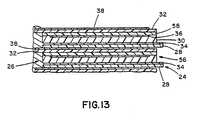
- FIG. 13 depicts various layers formed by several turns of the winding with only the winding end 26 metallized
- the first insulative layer 28 and the third insulative layer 32 do extend substantially from the one winding end 24 to the other winding end 26
- certain components are preferably slightly inset with respect to the winding ends to permit the metallization applied at the respective ends to make surface contact with their corresponding electrodes 34 and 38, as opposed to only making line contact with the ends of respective electrodes.
- the extent of inset is very small compared to the width of the winding (the distance between ends 24 and 26) which may be over 2.0cms.
- the insert 56 and the insulative layer 32 are recessed about 1 millimeter. The result is that gaps are formed between turns of insulative layer 28. As the electrode 34, formed by metallization on one surface of layer 28, extends to the winding end 24, metallization of the end 24 causes metal to fill the gaps to make surface contact, resulting in a reliable low impedance connection. Similarly at winding end 26 the insert 56 and the insulative layer 28 are recessed about 1 millimeter so that metallization at the end 26 results in surface contact with the electrode 38 which extends to the end 26.
Landscapes
- Engineering & Computer Science (AREA)
- Chemical & Material Sciences (AREA)
- Composite Materials (AREA)
- Mechanical Engineering (AREA)
- Power Engineering (AREA)
- Microelectronics & Electronic Packaging (AREA)
- Fixed Capacitors And Capacitor Manufacturing Machines (AREA)
Priority Applications (1)
| Application Number | Priority Date | Filing Date | Title |
|---|---|---|---|
| EP19900202087 EP0401940A3 (fr) | 1985-10-31 | 1986-10-27 | Méthode d'encapsulation d'un composant électrique |
Applications Claiming Priority (3)
| Application Number | Priority Date | Filing Date | Title |
|---|---|---|---|
| US06/794,245 US4633368A (en) | 1985-10-31 | 1985-10-31 | Multiple function integrated capacitor |
| US794245 | 1985-10-31 | ||
| EP19900202087 EP0401940A3 (fr) | 1985-10-31 | 1986-10-27 | Méthode d'encapsulation d'un composant électrique |
Related Parent Applications (2)
| Application Number | Title | Priority Date | Filing Date |
|---|---|---|---|
| EP86308353A Division EP0222547B1 (fr) | 1985-10-31 | 1986-10-27 | Condensateur enroulé |
| EP86308353.1 Division | 1986-10-27 |
Publications (2)
| Publication Number | Publication Date |
|---|---|
| EP0401940A2 true EP0401940A2 (fr) | 1990-12-12 |
| EP0401940A3 EP0401940A3 (fr) | 1991-06-26 |
Family
ID=26125970
Family Applications (1)
| Application Number | Title | Priority Date | Filing Date |
|---|---|---|---|
| EP19900202087 Withdrawn EP0401940A3 (fr) | 1985-10-31 | 1986-10-27 | Méthode d'encapsulation d'un composant électrique |
Country Status (1)
| Country | Link |
|---|---|
| EP (1) | EP0401940A3 (fr) |
Cited By (2)
| Publication number | Priority date | Publication date | Assignee | Title |
|---|---|---|---|---|
| WO2003050846A3 (fr) * | 2001-12-08 | 2003-12-11 | Medtronic Minimed Inc | Enrobage selectif permettant la gestion des defaillances et dispositifs electroniques comprenant cet enrobage |
| DE102024202378A1 (de) * | 2024-03-14 | 2025-09-18 | Zf Friedrichshafen Ag | Kapazitive Wicklung eines Zwischenkreiskondensators und Zwischenkreiskondensator mit einer Gleichtaktstrom Ableitungsfunktion |
Family Cites Families (3)
| Publication number | Priority date | Publication date | Assignee | Title |
|---|---|---|---|---|
| FR1050002A (fr) * | 1952-01-30 | 1954-01-05 | Safco Trevoux | Condensateur |
| FR1261150A (fr) * | 1960-06-29 | 1961-05-12 | Siemens Ag | Procédé de montage étanche à l'humidité d'éléments de construction, notammentde condensateurs électriques et condensateur monté conformément au procédé ou à un procédé similaire |
| FR2186805A1 (fr) * | 1972-05-30 | 1974-01-11 | Courdavault Yvo Ne |
-
1986
- 1986-10-27 EP EP19900202087 patent/EP0401940A3/fr not_active Withdrawn
Cited By (6)
| Publication number | Priority date | Publication date | Assignee | Title |
|---|---|---|---|---|
| US6801420B2 (en) | 2001-04-19 | 2004-10-05 | Medtronic Minimed, Inc. | Selective potting for controlled failure and electronic devices employing the same |
| US7187528B2 (en) | 2001-04-19 | 2007-03-06 | Medtronic Minimed, Inc. | Selective potting for controlled failure and electronic devices employing the same |
| US7460350B2 (en) | 2001-04-19 | 2008-12-02 | Medtronic Minimed, Inc. | Selective potting for controlled failure and electronic devices employing the same |
| US7760481B2 (en) | 2001-04-19 | 2010-07-20 | Medtronic Minimed, Inc. | Electronic device for controlled failure |
| WO2003050846A3 (fr) * | 2001-12-08 | 2003-12-11 | Medtronic Minimed Inc | Enrobage selectif permettant la gestion des defaillances et dispositifs electroniques comprenant cet enrobage |
| DE102024202378A1 (de) * | 2024-03-14 | 2025-09-18 | Zf Friedrichshafen Ag | Kapazitive Wicklung eines Zwischenkreiskondensators und Zwischenkreiskondensator mit einer Gleichtaktstrom Ableitungsfunktion |
Also Published As
| Publication number | Publication date |
|---|---|
| EP0401940A3 (fr) | 1991-06-26 |
Similar Documents
| Publication | Publication Date | Title |
|---|---|---|
| EP0222547B1 (fr) | Condensateur enroulé | |
| US4584767A (en) | In-mold process for fabrication of molded plastic printed circuit boards | |
| US6715197B2 (en) | Laminated ceramic electronic component and method for manufacturing same | |
| US4959505A (en) | Electrical component in chip structure and method for the manufacture thereof | |
| US4352145A (en) | Multiple element cylindrical metallized film capacitors and method of making the same | |
| US12293881B2 (en) | Electrolytic capacitor and method for producing same | |
| US5398155A (en) | Electric double layer capacitors | |
| US3857074A (en) | Electrical capacitors and method of making same | |
| US4984130A (en) | Passive electric component | |
| US6591494B2 (en) | Method for manufacturing a non-contact type IC card | |
| EP0401940A2 (fr) | Méthode d'encapsulation d'un composant électrique | |
| EP0434451A2 (fr) | Condensateur bobiné scellÀ© muni d'un film à bords revêtus | |
| JPH0571125B2 (fr) | ||
| US4685026A (en) | Capacitor forming and manufacturing method | |
| EP0056010B1 (fr) | Condensateur bobiné à surfaces métallisées segmentées | |
| EP3857582B1 (fr) | Condensateur film comprenant une couche diélectrique acrylique mise en oeuvre par dépôt | |
| JPH02194518A (ja) | 固体電解コンデンサの製造方法 | |
| EP0124588B1 (fr) | Condensateur pourvu d'une resistance de decharge integree et son procede de fabrication | |
| JP4291437B2 (ja) | インダクタンス部品とその製造方法 | |
| CA1241712A (fr) | Condensateur, et sa fabrication | |
| US4456945A (en) | Capacitor | |
| KR200189960Y1 (ko) | 캐패시터용 리드플레이트 | |
| US20100309608A1 (en) | Buried Capacitor Structure | |
| US5144522A (en) | Critically damped capacitor and method of making same | |
| JPH0314035Y2 (fr) |
Legal Events
| Date | Code | Title | Description |
|---|---|---|---|
| PUAI | Public reference made under article 153(3) epc to a published international application that has entered the european phase |
Free format text: ORIGINAL CODE: 0009012 |
|
| 17P | Request for examination filed |
Effective date: 19900731 |
|
| AC | Divisional application: reference to earlier application |
Ref document number: 222547 Country of ref document: EP |
|
| AK | Designated contracting states |
Kind code of ref document: A2 Designated state(s): AT BE CH DE FR GB IT LI NL SE |
|
| PUAL | Search report despatched |
Free format text: ORIGINAL CODE: 0009013 |
|
| AK | Designated contracting states |
Kind code of ref document: A3 Designated state(s): AT BE CH DE FR GB IT LI NL SE |
|
| STAA | Information on the status of an ep patent application or granted ep patent |
Free format text: STATUS: THE APPLICATION HAS BEEN WITHDRAWN |
|
| 18W | Application withdrawn |
Withdrawal date: 19911023 |