EP0403049A2 - Assemblage pour le contrôle facile d'un rotor d'une pompe à réfrigérant d'un réacteur nucléaire - Google Patents
Assemblage pour le contrôle facile d'un rotor d'une pompe à réfrigérant d'un réacteur nucléaire Download PDFInfo
- Publication number
- EP0403049A2 EP0403049A2 EP90302432A EP90302432A EP0403049A2 EP 0403049 A2 EP0403049 A2 EP 0403049A2 EP 90302432 A EP90302432 A EP 90302432A EP 90302432 A EP90302432 A EP 90302432A EP 0403049 A2 EP0403049 A2 EP 0403049A2
- Authority
- EP
- European Patent Office
- Prior art keywords
- cylindrical member
- bore
- casing
- rotor
- assembly
- Prior art date
- Legal status (The legal status is an assumption and is not a legal conclusion. Google has not performed a legal analysis and makes no representation as to the accuracy of the status listed.)
- Withdrawn
Links
Images



Classifications
-
- G—PHYSICS
- G21—NUCLEAR PHYSICS; NUCLEAR ENGINEERING
- G21D—NUCLEAR POWER PLANT
- G21D1/00—Details of nuclear power plant
- G21D1/04—Pumping arrangements
-
- F—MECHANICAL ENGINEERING; LIGHTING; HEATING; WEAPONS; BLASTING
- F04—POSITIVE - DISPLACEMENT MACHINES FOR LIQUIDS; PUMPS FOR LIQUIDS OR ELASTIC FLUIDS
- F04D—NON-POSITIVE-DISPLACEMENT PUMPS
- F04D29/00—Details, component parts, or accessories
- F04D29/60—Mounting; Assembling; Disassembling
- F04D29/62—Mounting; Assembling; Disassembling of radial or helico-centrifugal pumps
- F04D29/628—Mounting; Assembling; Disassembling of radial or helico-centrifugal pumps especially adapted for liquid pumps
-
- Y—GENERAL TAGGING OF NEW TECHNOLOGICAL DEVELOPMENTS; GENERAL TAGGING OF CROSS-SECTIONAL TECHNOLOGIES SPANNING OVER SEVERAL SECTIONS OF THE IPC; TECHNICAL SUBJECTS COVERED BY FORMER USPC CROSS-REFERENCE ART COLLECTIONS [XRACs] AND DIGESTS
- Y02—TECHNOLOGIES OR APPLICATIONS FOR MITIGATION OR ADAPTATION AGAINST CLIMATE CHANGE
- Y02E—REDUCTION OF GREENHOUSE GAS [GHG] EMISSIONS, RELATED TO ENERGY GENERATION, TRANSMISSION OR DISTRIBUTION
- Y02E30/00—Energy generation of nuclear origin
Definitions
- the present invention relates generally to nuclear reactor coolant system pumps and, more particularivelyly, is concerned with an assembly for facilitating inservice inspection of a reactor coolant pump rotor.
- One component employed by the reactor coolant system is a canned motor pump.
- Two canned motor pumps are used in each of the two coolant loops of the reactor coolant system.
- the pump casing of the canned motor pump is attached directly to the bottom of the channel head of the steam generator in the reactor coolant system. This configuration effectively combines the two components into a single structure.
- the advantages of this configuration are significant.
- the canned motor pump has a demonstrated record of high reliability and an inherently simplified auxiliary fluid system. This pump further diminishes the potential risk for small loss-of-coolant accident (LOCA) because shaft seals are not used. Further, the close coupling of the pump and the steam generator eliminates a piping leg, improves loop pressure drop, simplifies the support system, and reduces potential for core uncovery during small LOCA.
- LOCA loss-of-coolant accident
- a preventive maintenance program has been established for the canned motor pumps. This program should be performed between major inspections to verify the integrity of the pumps, prevent premature failure of the component and minimize plant down time.
- a mechanical inspection, scheduled to be performed at each refueling, consists of tests of breakaway torque (to confirm that the pump rotor spins or rotates freely and no rubs exist) and axial end play (check for excessive thrust bearing wear).
- the hermetically-sealed canned motor pump is mounted to the bottom of the steam generator channel head in an inverted position where the canned motor stator flange of the pump is located well below the reactor vessel flange. Due to this arrangement, the water level in the refueling canal during refueling operations is approximately 14 mm above the bottom of the canned motor pump, making it impossible to physically reach the pump rotor through an inspection port without draining the pump and the system.
- the present invention resides in a reactor coolant circulating pump having an outer casing and a rotor rotatably mounted in said casing, characterized by an assembly for facilitating inspection of said pump rotor comprising means defining a cylindrical bore through said casing in axial alignment with an end of said pump rotor; an extension on said rotor end and rotatable therewith, said extension including a cylindrical coupler member extending into said bore and having an outer end with an element configured to receive a tool for performance of inservice rotor inspection; a hollow cylindrical member disposed in said bore and surrounding said coupler member, said cylindrical member being slidably movable relative to said coupler member along said bore between a retracted position wherein said cylindrical member is stored for normal pump operation and an extended position wherein said cylindrical member is in sealing engagement with said casing and said extension; and a cover member sealably attached to said casing across said bore tor closing said bore and retaining said cylindrical member in its retracted position for normal pump operation, said cover member being de
- the arrangement according to the present invention permits inservice inspection of the pump rotor by measurement of rotor breakaway torque and axial end play without the necessity of first draining the pump.
- the reactor coolant system 12 includes two coolant loops, generally indicated by the numerals 14A and 14B.
- Each of the coolant loops 14A, 14B includes a single steam generator 16, a pair of high inertia canned motor pumps 18, a single hot leg pipe 20, and a pair of cold leg pipes 22.
- the pair of pumps 18 in each coolant loop 14A, 14B are hermetically sealed and mounted in inverted positions to the one steam generator 16 in the respective coolant loop.
- Each pump 18 has an outer casing 24 which is attached, such as by welding, directly to the bottom of a channel head 26 of the steam generator 16 so as to effectively combine the two components into a single structure.
- the hot leg pipes 20 extend between and interconnect the reactor vessel 10 and the respective stream generators 16 for routing high temperature reactor coolant from the vessel 10 to the steam generators 16.
- the cold leg pipes 22 extend between and interconnect the pumps 18 and the reactor vessel 10 for routing lower temperature reactor coolant from the steam generators 16 via the pumps 18 back to the reactor vessel 10.
- a pressurizer tank 28 is connected by a surge line 30 to one of the hot leg pipes 20.
- the pump 18 has a central axially extending rotor 32 rotatably mounted at its lower end by a pivot pad bearing 34 and at its upper end by a pivoted pad and thrust bearing combination 36.
- a canned motor 38 is located along the pump rotor 32 between the lower and upper bearings 34, 36.
- the motor 38 includes a rotor section 40 mounted for rotation with the pump rotor 32 and a stator 42 stationarily mounted about the rotor section 40.
- An annular cooling water jacket 44 surrounds the motor 38. Cooling coils (not shown) are also provided adjacent the upper thrust bearing 36 for cooling the same.
- an impeller 46 which rotates with the rotor 32 and draws water axially through a central inlet nozzle 48 in the upper end of the pump casing 24 from the steam generator 16 and discharges the water tangentially through an outlet nozzle 50 in the pump casing 24 to the respective one of the cold leg pipes 22.
- operation of the pumps 18 creates negative pressure at their inlet nozzles 48 which suctions or draws water from the reactor vessel 10 via the respective hot leg pipes 20 to and through the steam generators 16 and positive pressure at their outlet nozzles 50 which pumps water through the cold leg pipes 22 back to and through the reactor vessel 10.
- a mechanical inspection of the pumps 18 to verify the integrity of the pumps and prevent premature failure of their components to minimize plant down time is scheduled to be performed at each refueling.
- This inspection of each pump 18 includes a breakaway torque test to confirm that the pump rotor 32 spins freely and no rubs exist, and an axial end play test to check for excessive thrust bearing wear.
- an inservice pump rotor inspection assembly 52 is provided which permits these inspections to be performed without draining the coolant system and without disassembling the pumps 18.
- the pump 18 is hermetically sealed at its lower end by a closure member in the form of a stator cap or flange 54 attached to the pump outer casing 24 by a plurality of bolts 56.
- the construction of the pump 18 is such that its rotor 32 rotates in a central cavity 58 which contains a small head of reactor coolant water extending downward along the rotor to the stator flange 54. Because of the location of the inverted pump 18 on the bottom of the steam generator 16, the stator flange 54 is located well below the water level in the reactor vessel 10.
- the inservice inspection assembly 52 includes an inspection port in the form of a cylindrical bore 60 extending through the stator flange 54 in axial alignment with, and disposed below, a lower end 32A of the rotor 32.
- the cylindrical bore 60 has a lower open end 60A communicating with the exterior of stator flange 54 and an upper open end 60B communicating with the lower end of the central cavity 58 of the pump.
- the inspection assembly 52 further includes an extension 62 attached on the lower end 32A of the rotor 32, a hollow cylindrical member 64, an end cap 66 and a cover member 68.
- the rotor extension 62 of the inspection assembly 52 includes a cylindrical coupler member 70 extending into the bore 60 of the stator flange 54 through the upper open end 60B of the bore 60 from the lower end of the cavity 58.
- the coupler member 70 is spaced radially inward at its exterior surface 70A from a cylindrical wall surface 60C of the bore 60 so as to define an annular space 72 between the respective surfaces 70A, 60C.
- the coupler member 70 has formed therein an outer socket 74 and an inner internally threaded bore 76 merging and extending axially upwardly from the outer socket 74.
- the outer socket 74 and inner threaded bore 76 of the coupler member 70 open at the lower terminal end 70B of the coupler member 70 and face toward the lower open end 60A of the bore 60 for receiving therethrough complementarily-configured ends of respective tools 78, 80, as seen in Figs. 6 and 7, used for making breakaway rotor torque and rotor axial play measurements during the performance of the inservice rotor inspection.
- the hollow cylindrical member 64 of the inspection assembly 52 is open at its opposite upper and lower ends 64A, 64B.
- the cylindrical member 64 is disposed in the bore 60 within the annular space 72 between the coupler member exterior surface 70A and bore wall surface 60C, and is slidably movable relative to the axially stationary coupler member 70 and the stator flange 54 along the respective surfaces 70A, 60C thereof.
- the end cap 66 is releasably attached to the lower open end 64B of the cylindrical member 64 respective by a plurality of fasteners 82 (only one of which is shown in Fig. 3).
- the end cap 66 has an inner portion 66A which fits into the lower end 64B of the cylindrical member 64 and has an annular recess 84 which seats an O-ring 86 for providing a seal with the cylindrical member.
- the end cap 66 has an outer ledge 66B thereon which underlies the lower end 64B of the cylindrical member 64.
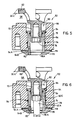
- the upper and lower limits of reciprocal sliding movement of the cylindrical member 64 within the annular space 72 and relative to the coupler member 70 and the stator flange 54 between an upper retracted position, as seen in Fig. 3, and a lower extended position, as seen in Fig. 4, is determined by first and second pairs of stop elements defined respectively at the upper and lower ends 64A, 64B of the cylindrical member 64 and at axially spaced locations on the wall surface 60C of the bore 60. More particularly, the stop elements of the first pair are in the form of the ledge 66B on the end cap 66 at the lower end 64B of the cylindrical member 64 and a radially projecting annular ledge 88 defined at the upper end 64A of the cylindrical member 64.
- the stop elements of the second pair are in the form of oppositely upward and downward facing upper and lower annular shoulders 90, 92 defined by radially offset portions of the bore wall surface 60C at axially spaced locations therealong.
- the inspection assembly 52 further includes external and internal seals 94, 96 being provided respectively at external and internal surfaces 64C, 64D of the cylindrical member 64.
- the external seal 94 at the external surface 64C of the cylindrical member 64 is composed by an O-ring seal 98 supported in an annular groove 100 formed in the bore wall surface 60C.
- the O-ring seal 98 surrounds and engages the external surface 64C of the cylindrical member 64 when the latter is at both its upper retracted position of Fig. 3 and its lower extended position of Fig. 4 and also as the cylindrical member 64 moves between its positions.
- the external seal 94 is thus continuously present between the external surface 64C of the cylindrical member 64 and the bore wall surface 60C and effective to prevent escape of coolant from the cavity 58 along the external surface 64C of the cylindrical member 64.
- the internal seal 96 at the internal surface 64D of the cylindrical member 64 is composed by an annular raised land 102 formed on the exterior surface 70A of the coupler member 70 and an O-ring seal 104 supported in an annular groove 106 in the internal surface 64D of the cylindrical member 64.
- the O-ring seal 104 surrounds and engages the annular land 102 on the exterior surface 70A of the coupler member 70 when only the cylindrical member 64 is at its lower extended position of Fig. 4.
- the internal seal 96 is not continuously present between the internal surface 64D of the cylindrical member 64 and the exterior surface 70A of the coupler member 70.
- the internal seal 96 is only present and effective to prevent escape of coolant from the cavity 58 along the internal surface 64D of the cylindrical member 64 when the latter is at its lower extended position.
- the internal seal 96 at the internal surface 64D of the cylindrical member 64 is only effective when the cylindrical member 64 is at its lower position of Fig. 4, thus when the cylindrical member 64 is at its upper position of Fig. 3 coolant is permitted to pass by the internal O-ring seal 104 from the cavity 58 to below the coupler member 70.
- the end cap 66 of the inspection assembly 52 is normally sealably attached to the lower end 64B of the cylindrical member 64.
- the end cap 66 thus closes the lower open end 64B of the cylindrical member 64 prevents escape of coolant from the bore 60 through the cylindrical member lower open end 64C when the cylindrical member is disposed at its retracted position during normal pump operation and further as cylindrical member 64 is moved from its retracted to extended position in converting the inspection assembly 52 for performance of inservice rotor inspection procedures.
- removal of the end cap 66 does result in escape of the small quantity of coolant which was occupying the interior volume of the cylindrical member 64 below coupler member 70.
- the amount of coolant lost is minimal, for instance, 0.1 liter of primary coolant, in view that the establishment of the interior seal 96 when the cylindrical member 64 has moved to its lower position which prevents any additional flow of coolant past the interior O-ring seal 104.
- the end cap 66 has to be removed once the cylindrical member 64 has reached its extended position so that access is provided for extension of measuring tools 78, 80 through the lower end 60A of the bore 60 to the socket 74 and threaded bore 76 in the coupler member 70.
- the cover member 68 of the inspection assembly 52 is normally disposed across the lower open end 60A of the bore 60 so as to close the inspection port.
- the cover member 68 in the shape of a cylindrical plate is sealably and detachably attached to the stator flange 54 by a plurality of bolts 108.
- the cover member 68 has an annular recess 110 in its upper surface 68A within which is seated an annular flexible gasket or seal 112 which provides the seal between the stator flange 54 and cover member 68.
- the cylindrical member 64 can move to its lower extended position. There is a static head of coolant water in the refueling canal of the reactor vessel 10 providing approximately 70 kg downward force over the cylindrical member 64 forcing it downward as soon as the cover member 68 is removed. Thus, the cylindrical member 64 should move downward unaided. However, should the cylindrical member 64 need assistance in moving to the lower position, an internally-threaded hole 114 is tapped in the external face of the end cap 66 for temporary attachment of a tool to pull the cylindrical member 64.
- the inspection assembly 52 further includes an annular retainer member 116 and a mounting flange 118.
- the retainer member 116 of the inspection assembly 52 is provided for mounting to the stator flange 54 about the lower open end 60A of the bore 60 after removal of the cover member 68, relocation of the cylindrical member 64 to its lower extended position, and removal of the end cap 66.
- the retainer member 116 has a central opening 116A which permits insertion of the inspection tools 78, 80 and is attached to the lower end 64B of the cylindrical member 64 by the same fasteners 82 used to attach the end cap 66.
- the purpose for using the retainer member 116 is twofold.
- the retainer member 116 serves to cover and protect from scratching the seal surface 54A on the stator flange 54 surrounding the bore 60.
- An annular gasket 119 is bonded to the retainer member 116 for this purpose.
- the retainer member 116 retains or holds the cylindrical member 64 at its lower extended position so that the latter cannot be inadvertently lifted upward causing removal of the internal seal 96 and passage of more coolant out the inspection port or bore 60 as inservice rotor inspection procedures are being performed.
- the mounting flange 118 of the inspection assembly 52 is provided for mounting to the stator flange 54 about and overlying the retainer member 116 after the latter has already been mounted to the stator flange 54.
- the mounting flange 118 is attached to the stator flange 54 by the same bolts 108 used to attach the cover member 68.
- the flange member 118 is used for two different purposes at two different times. First, as shown in Fig. 7, the mounting flange 118 is employed during performance of inservice rotor inspection procedures to mount the inspection tool 80 which is used to measure rotor end play. Second, as seen in Fig. 8, the mounting flange 118 is employed during shipment of the pump 18 to mount a screw 120 which is threaded into the inner threaded bore 76 of the coupler member 70 for sealing the pump cavity 58 and holding the rotor 32 stationary.
- the inservice inspection measurement of rotor breakaway torque is carried out by use of the tool 78 in Fig. 6 which is a torque wrench having an adapter for insertion into the hexagonal outer socket 74 in the coupler member 70.
- the expected breakaway torque for the pump 10 in the wet condition is about 1720 Nm and the extra torque generated by the friction of the internal O-ring seal 104 over the coupler member 70 which is negligible.
- Inservice inspection measurement of rotor axial end play is carried out by use of the tool 80 in Fig. 7 which is a jacking screw 122 mounted to the mounting flange 118 and having an end adapter screwed into the threaded inner bore 76 in the coupler member 70. By rotating the jacking screw 122, the axial rotor end play can be measured by the dial indicator 124.
Landscapes
- Engineering & Computer Science (AREA)
- General Engineering & Computer Science (AREA)
- Mechanical Engineering (AREA)
- Physics & Mathematics (AREA)
- Plasma & Fusion (AREA)
- High Energy & Nuclear Physics (AREA)
- Structures Of Non-Positive Displacement Pumps (AREA)
- Monitoring And Testing Of Nuclear Reactors (AREA)
Applications Claiming Priority (2)
| Application Number | Priority Date | Filing Date | Title |
|---|---|---|---|
| US07/364,953 US4955787A (en) | 1989-06-12 | 1989-06-12 | Assembly for facilitating inservice inspection of a reactor coolant pump rotor |
| US364953 | 1989-06-12 |
Publications (2)
| Publication Number | Publication Date |
|---|---|
| EP0403049A2 true EP0403049A2 (fr) | 1990-12-19 |
| EP0403049A3 EP0403049A3 (fr) | 1991-07-31 |
Family
ID=23436844
Family Applications (1)
| Application Number | Title | Priority Date | Filing Date |
|---|---|---|---|
| EP19900302432 Withdrawn EP0403049A3 (fr) | 1989-06-12 | 1990-03-07 | Assemblage pour le contrôle facile d'un rotor d'une pompe à réfrigérant d'un réacteur nucléaire |
Country Status (4)
| Country | Link |
|---|---|
| US (1) | US4955787A (fr) |
| EP (1) | EP0403049A3 (fr) |
| JP (1) | JP2875592B2 (fr) |
| KR (1) | KR100205261B1 (fr) |
Cited By (1)
| Publication number | Priority date | Publication date | Assignee | Title |
|---|---|---|---|---|
| US20110135511A1 (en) * | 2009-12-08 | 2011-06-09 | Olivier Philippart | Motor stand of a primary motor-driven pump unit of a pressurized water nuclear reactor |
Families Citing this family (5)
| Publication number | Priority date | Publication date | Assignee | Title |
|---|---|---|---|---|
| KR100454218B1 (ko) * | 2001-12-28 | 2004-10-26 | 한전기공주식회사 | 원자로 냉각재 펌프의 상부 리지드 커플링 캡 스크류제거장치 |
| KR200447611Y1 (ko) * | 2007-11-27 | 2010-02-11 | 한전케이피에스 주식회사 | 배관 보호용 어댑터 |
| US8061972B2 (en) * | 2009-03-24 | 2011-11-22 | Dresser-Rand Company | High pressure casing access cover |
| US8371178B1 (en) * | 2011-06-30 | 2013-02-12 | Florida Turbine Technologies, Inc. | Turbopump with rotor torque sensor |
| CN103899567B (zh) * | 2014-04-22 | 2016-02-03 | 攀钢集团攀枝花钢钒有限公司 | 悬臂式耐腐蚀泵检修方法 |
Family Cites Families (12)
| Publication number | Priority date | Publication date | Assignee | Title |
|---|---|---|---|---|
| US2972310A (en) * | 1958-11-12 | 1961-02-21 | E M B Elektromotorenbau A G | Electric motor |
| DE1528676A1 (de) * | 1966-05-17 | 1970-02-19 | Babcock & Wilcox Ag | Umwaelzpumpe eines integrierten Kernreaktors |
| US3491695A (en) * | 1968-02-27 | 1970-01-27 | Albert Blum | Submersible electric pump |
| SE320739B (fr) * | 1968-09-24 | 1970-02-16 | Asea Ab | |
| DE2017415B2 (de) * | 1970-04-11 | 1971-07-15 | Klein, Schanzhn & Becker AG, 6710 Fran kenthal | Verfahren und vorrichtung zur abdichtung der durchfuehrung der antriebswelle einer kuehlmittelumwaelzpumpe durch das druckgefaess eines atomkernreaktors |
| JPS5755915B2 (fr) * | 1972-12-16 | 1982-11-26 | ||
| US3989408A (en) * | 1974-05-20 | 1976-11-02 | Westinghouse Electric Corporation | Positioning device for a turbine rotor position sensor |
| US4087204A (en) * | 1974-12-19 | 1978-05-02 | Niedermeyer Karl O | Enclosed sump pump |
| US3936217A (en) * | 1975-01-31 | 1976-02-03 | Westinghouse Electric Corporation | Inspection port for turbines |
| US4406580A (en) * | 1981-07-23 | 1983-09-27 | United Technologies Corporation | Inspection hole plug for gas turbine engine |
| US4591477A (en) * | 1982-09-30 | 1986-05-27 | Rettew Robert A | Apparatus and method for servicing a nuclear reactor system |
| JPS648578A (en) * | 1987-06-30 | 1989-01-12 | Seiko Epson Corp | Magnetic disk device |
-
1989
- 1989-06-12 US US07/364,953 patent/US4955787A/en not_active Expired - Fee Related
-
1990
- 1990-03-07 EP EP19900302432 patent/EP0403049A3/fr not_active Withdrawn
- 1990-03-15 KR KR1019900003505A patent/KR100205261B1/ko not_active Expired - Fee Related
- 1990-05-30 JP JP2138637A patent/JP2875592B2/ja not_active Expired - Fee Related
Cited By (2)
| Publication number | Priority date | Publication date | Assignee | Title |
|---|---|---|---|---|
| US20110135511A1 (en) * | 2009-12-08 | 2011-06-09 | Olivier Philippart | Motor stand of a primary motor-driven pump unit of a pressurized water nuclear reactor |
| US9281084B2 (en) * | 2009-12-08 | 2016-03-08 | Areva Np | Motor stand of a primary motor-driven pump unit of a pressurized water nuclear reactor |
Also Published As
| Publication number | Publication date |
|---|---|
| EP0403049A3 (fr) | 1991-07-31 |
| KR100205261B1 (ko) | 1999-07-01 |
| US4955787A (en) | 1990-09-11 |
| JP2875592B2 (ja) | 1999-03-31 |
| JPH0325397A (ja) | 1991-02-04 |
| KR910001794A (ko) | 1991-01-31 |
Similar Documents
| Publication | Publication Date | Title |
|---|---|---|
| US12243661B2 (en) | Valve assembly with isolation valve vessel | |
| EP0403049A2 (fr) | Assemblage pour le contrôle facile d'un rotor d'une pompe à réfrigérant d'un réacteur nucléaire | |
| US4591477A (en) | Apparatus and method for servicing a nuclear reactor system | |
| US5861560A (en) | Shutdown cooling pump vortex detection system | |
| US7243959B2 (en) | Reactor water isolation devices | |
| US5426680A (en) | Method for removing control rod drive using tool to verify control rod drive uncoupling | |
| GB2175374A (en) | Check valve test method using truncated accumulator blowdown | |
| CN109273120B (zh) | 一种紧凑型小型核反应堆冷段温度测量方法 | |
| KR20110020515A (ko) | 원자로용 씨이디엠 압력하우징의 밀봉면 누설감지장치 | |
| KR102560717B1 (ko) | 원자로공동 집수조로의 노심용융물 유입차단장치 | |
| US20160351280A1 (en) | Nuclear grade air accumulating, isolating, indicating and venting device | |
| KR100212907B1 (ko) | 기다란 물체의 지지 및 안내용 수직도관의 차단장치 | |
| JPS61274295A (ja) | 原子炉水位計測装置 | |
| RU2102827C1 (ru) | Устройство защиты турбогенератора с водородным охлаждением | |
| Marguet | The Primary Circuit | |
| JP4434625B2 (ja) | インターナルポンプ用上部プラグ | |
| Shirahama | 2.3 Reactor coolant system and connected | |
| Huchard et al. | Full sized tests on a french coolant pump under two-phase flow | |
| CN121617677A (zh) | 一种一体化小型压水堆压力容器用防泄漏装置 | |
| Anderson et al. | Instrument accuracy in reactor vessel inventory tracking systems | |
| Huchard et al. | Full Sized Tests on a French Main Coolant Pump under Two-Phase Flow | |
| Scott | Annotated bibliography of safety-related occurrences in pressurized-water nuclear power plants as reported in 1976 | |
| JPH0342640B2 (fr) | ||
| JPS6050492A (ja) | インタ−ナルポンプにおける原子炉水漏洩防止装置 | |
| Kapoor et al. | Unusual occurrences in fast breeder test reactor |
Legal Events
| Date | Code | Title | Description |
|---|---|---|---|
| PUAI | Public reference made under article 153(3) epc to a published international application that has entered the european phase |
Free format text: ORIGINAL CODE: 0009012 |
|
| AK | Designated contracting states |
Kind code of ref document: A2 Designated state(s): BE DE ES FR GB IT |
|
| PUAL | Search report despatched |
Free format text: ORIGINAL CODE: 0009013 |
|
| AK | Designated contracting states |
Kind code of ref document: A3 Designated state(s): BE DE ES FR GB IT |
|
| 17P | Request for examination filed |
Effective date: 19920130 |
|
| STAA | Information on the status of an ep patent application or granted ep patent |
Free format text: STATUS: THE APPLICATION HAS BEEN WITHDRAWN |
|
| 18W | Application withdrawn |
Withdrawal date: 19931008 |