EP0403961A2 - Magnetische Protein-Konjugate, Verfahren zu ihrer Herstellung und ihre Verwendung - Google Patents
Magnetische Protein-Konjugate, Verfahren zu ihrer Herstellung und ihre Verwendung Download PDFInfo
- Publication number
- EP0403961A2 EP0403961A2 EP90111264A EP90111264A EP0403961A2 EP 0403961 A2 EP0403961 A2 EP 0403961A2 EP 90111264 A EP90111264 A EP 90111264A EP 90111264 A EP90111264 A EP 90111264A EP 0403961 A2 EP0403961 A2 EP 0403961A2
- Authority
- EP
- European Patent Office
- Prior art keywords
- protein
- cells
- amino groups
- magnetic
- bone marrow
- Prior art date
- Legal status (The legal status is an assumption and is not a legal conclusion. Google has not performed a legal analysis and makes no representation as to the accuracy of the status listed.)
- Granted
Links
Classifications
-
- C—CHEMISTRY; METALLURGY
- C07—ORGANIC CHEMISTRY
- C07K—PEPTIDES
- C07K14/00—Peptides having more than 20 amino acids; Gastrins; Somatostatins; Melanotropins; Derivatives thereof
- C07K14/435—Peptides having more than 20 amino acids; Gastrins; Somatostatins; Melanotropins; Derivatives thereof from animals; from humans
-
- A—HUMAN NECESSITIES
- A61—MEDICAL OR VETERINARY SCIENCE; HYGIENE
- A61K—PREPARATIONS FOR MEDICAL, DENTAL OR TOILETRY PURPOSES
- A61K49/00—Preparations for testing in vivo
- A61K49/06—Nuclear magnetic resonance [NMR] contrast preparations; Magnetic resonance imaging [MRI] contrast preparations
- A61K49/18—Nuclear magnetic resonance [NMR] contrast preparations; Magnetic resonance imaging [MRI] contrast preparations characterised by a special physical form, e.g. emulsions, microcapsules, liposomes
- A61K49/1818—Nuclear magnetic resonance [NMR] contrast preparations; Magnetic resonance imaging [MRI] contrast preparations characterised by a special physical form, e.g. emulsions, microcapsules, liposomes particles, e.g. uncoated or non-functionalised microparticles or nanoparticles
- A61K49/1821—Nuclear magnetic resonance [NMR] contrast preparations; Magnetic resonance imaging [MRI] contrast preparations characterised by a special physical form, e.g. emulsions, microcapsules, liposomes particles, e.g. uncoated or non-functionalised microparticles or nanoparticles coated or functionalised microparticles or nanoparticles
-
- A—HUMAN NECESSITIES
- A61—MEDICAL OR VETERINARY SCIENCE; HYGIENE
- A61K—PREPARATIONS FOR MEDICAL, DENTAL OR TOILETRY PURPOSES
- A61K47/00—Medicinal preparations characterised by the non-active ingredients used, e.g. carriers or inert additives; Targeting or modifying agents chemically bound to the active ingredient
- A61K47/50—Medicinal preparations characterised by the non-active ingredients used, e.g. carriers or inert additives; Targeting or modifying agents chemically bound to the active ingredient the non-active ingredient being chemically bound to the active ingredient, e.g. polymer-drug conjugates
- A61K47/51—Medicinal preparations characterised by the non-active ingredients used, e.g. carriers or inert additives; Targeting or modifying agents chemically bound to the active ingredient the non-active ingredient being chemically bound to the active ingredient, e.g. polymer-drug conjugates the non-active ingredient being a modifying agent
-
- A—HUMAN NECESSITIES
- A61—MEDICAL OR VETERINARY SCIENCE; HYGIENE
- A61K—PREPARATIONS FOR MEDICAL, DENTAL OR TOILETRY PURPOSES
- A61K49/00—Preparations for testing in vivo
- A61K49/06—Nuclear magnetic resonance [NMR] contrast preparations; Magnetic resonance imaging [MRI] contrast preparations
- A61K49/20—Nuclear magnetic resonance [NMR] contrast preparations; Magnetic resonance imaging [MRI] contrast preparations containing free radicals, e.g. trityl radical for overhauser
-
- A—HUMAN NECESSITIES
- A61—MEDICAL OR VETERINARY SCIENCE; HYGIENE
- A61K—PREPARATIONS FOR MEDICAL, DENTAL OR TOILETRY PURPOSES
- A61K9/00—Medicinal preparations characterised by special physical form
- A61K9/48—Preparations in capsules, e.g. of gelatin, of chocolate
- A61K9/50—Microcapsules having a gas, liquid or semi-solid filling; Solid microparticles or pellets surrounded by a distinct coating layer, e.g. coated microspheres, coated drug crystals
- A61K9/5094—Microcapsules containing magnetic carrier material, e.g. ferrite for drug targeting
-
- A—HUMAN NECESSITIES
- A61—MEDICAL OR VETERINARY SCIENCE; HYGIENE
- A61P—SPECIFIC THERAPEUTIC ACTIVITY OF CHEMICAL COMPOUNDS OR MEDICINAL PREPARATIONS
- A61P37/00—Drugs for immunological or allergic disorders
-
- G—PHYSICS
- G01—MEASURING; TESTING
- G01N—INVESTIGATING OR ANALYSING MATERIALS BY DETERMINING THEIR CHEMICAL OR PHYSICAL PROPERTIES
- G01N2446/00—Magnetic particle immunoreagent carriers
- G01N2446/80—Magnetic particle immunoreagent carriers characterised by the agent used to coat the magnetic particles, e.g. lipids
- G01N2446/90—Magnetic particle immunoreagent carriers characterised by the agent used to coat the magnetic particles, e.g. lipids characterised by small molecule linker used to couple immunoreagents to magnetic particles
Definitions
- P can be a protein in which one or more thiol groups are either present naturally or have been generated by reduction of disulfide bonds or have been introduced by chemical reaction.
- P is in particular an immunoglobulin or immunoglobulin residue, preferably a monoclonal antibody or a Fab, Fab 'or F (ab') 2 fragment, an antigen or an enzyme, hormone, lectin or growth factor residue.
- P is preferably a monoclonal antibody of the IgG or IgM class, in particular a monoclonal antibody which is directed against an antigen which is present in dissolved form in body fluids or aqueous salt solutions or a monoclonal antibody which is directed against an antigen which is expressed on cells, the cells expressing the antigen being in particular cells of the myeloid or lymphatic system, cells of the peripheral blood, in particular B lymphocytes, T lymphocytes or their progenitor cells or tumor cells, in particular tumor cells of the bone marrow. Such cells can also be erythrocytes, bacteria, mycoplasma or protozoa. Viruses are also to be understood as cells within the scope of the invention.
- M is preferably a dispersible particle with a metal oxide core and an envelope carrying an amino group, the metal oxide core being able to include a group of paramagnetic substances, preferably a particle whose diameter is between approximately 0.1 .mu.m and approximately 100 .mu.m, but preferably between approximately 0. 1 ⁇ and about 1.5 ⁇ lies.
- the invention further relates to a method for producing a magnetic protein conjugate of the general formula I and the use of a conjugate of the formula I for the specific removal of cells or soluble antigens, receptors, substrates, co-factors or carbohydrate determinants from aqueous salt solutions or body fluids as well as the use in the context of a diagnostic or as a diagnostic and in particular the Use for bone marrow depletion or for HLA typing.
- a bone marrow transplant is often the only way of therapy, among other things, in the treatment of certain forms of leukemia and panmyelopathy (bone marrow loss).
- T-lymphocytes of the donor bone marrow can be selectively eliminated before reinfusion in the patient.
- This elimination of donor T cells can e.g. B. by selective lysis of the cells to be removed in the presence of complement or by selective killing of the T cells with the aid of so-called immunotoxins or by another method, e.g. B. done by magnetic cell depletion of the bone marrow.
- Such a cell depletion of bone marrow can be carried out in a relatively simple manner by incubating the bone marrow with a mouse monoclonal antibody which, for. B. is directed specifically against the T cells of the bone marrow and consequently binds only to the T cells.
- a mouse monoclonal antibody which, for. B. is directed specifically against the T cells of the bone marrow and consequently binds only to the T cells.
- Such T-cells coated with monoclonal antibodies from the mouse can now be removed in a second step by z. B. with rabbit anti-mouse immunoglobulin which is bound to magnetic particles, whereby the T-lymphocytes are specifically coated with the magnetic material so that they can be removed with a magnet from the bone marrow (see see Vartdal et al., Transplantation (1987), 43, 366-371 and the literature cited therein).
- Magnetic particles suitable for this purpose are commercially available today in various forms, and their manufacture has been described several times in the patent literature (see, for example, Chagnon et al., EP 0125995 A2 (priority US 493991 of May 12, 1983), Advanced Magnetics, or Ughelstad et al., WO 8303920 of November 10, 1983, SINTEF).
- These magnetic particles are known to consist of a metal oxide core, in which paramagnetic substances can be enclosed, and that the core is surrounded by an envelope, which reactive groups, such as. B. aminophenyl, amino, carboxyl, hydroxy or sulfhydryl groups, which can be used for coupling proteins (Chagnon et al., EP 0125995 A2).
- particles bearing hydroxyl groups can be activated by reaction with p-toluenesulfonyl chloride, and that particles activated in this way can be reacted with amino groups of proteins (Kvalheim et al., Cancer Research (1987), 47, 846-851) .
- the object of the present invention to develop a method in which monoclonal antibodies are coupled to magnetic particles a) covalently and b) not via their amino groups.
- the object of the present invention is therefore in other words, to find a coupling method in which the antigen binding site of the antibody is not changed or the coupling of the antibody takes place away from the antigen binding site.
- This object of the invention is achieved by producing magnetic protein conjugates of the formula I. M-NH-CO- (CH2) n -SP
- magnetic particles which carry free amino groups as reactive groups can also be converted in a simple manner into magnetic particles which have iodoacetyl or bromoacetyl functions as reactive groups. Such particles are new.
- magnetic particles which carry iodoacetyl or bromoacetyl functions can be conjugated without difficulty to proteins which have thiol groups, the thiol groups in the protein either being present natively or being introduced chemically or being produced by reducing existing disulfide bonds .
- magnetic particles which carry iodoacetyl or bromoacetyl functions can be easily conjugated to monoclonal antibodies by converting the interchain disulfide bonds of the antibodies by selective reduction into free SH groups, which can be reacted with the iodoacetyl or bromoacetyl functions of the magnetic particles to form a thioether bond.
- This type of coupling of monoclonal antibodies to magnetic particles is also new.
- magnetic antibody conjugates according to the invention e.g. B. in the depletion of bone marrow, because of their high specificity prove to be particularly advantageous.
- the magnetic antibody conjugates according to the invention can also be used in the context of a diagnostic method or as a diagnostic, in particular, for. B. in HLA typing, because of their high specificity to be advantageous.
- magnetic antibody conjugates The preparation of magnetic antibody conjugates according to the invention is described below by way of example for various monoclonal antibodies which are directed against cells of the bone marrow and for a rabbit polyclonal immunoglobulin; however, the examples cited do not limit the invention. Furthermore, the use of the magnetic antibody conjugates produced by way of example for the depletion of cells of the bone marrow is also described by way of example, without restricting the use to the examples mentioned. The reductive cleavage of the disulfide bond of the spacer by incubation with dithiothreitol is also described by way of example, without thereby restricting the invention.
- physiological saline or a phosphate buffered saline, with a thiol group-bearing protein P is converted to a compound of formula I, whereupon the compound of formula I obtained from any non-covalently bound protein with the addition of a suitable detergent, such as . B. Tween, washed freely.
- a suitable detergent such as . B. Tween
- Suitable solvents for coupling a compound of formula II to magnetic particles must be such that the magnetic particles used for the coupling are not affected by the solvent used in their physical and magnetic properties, in particular in their size, dispersibility and surface properties.
- magnetic particles such as z. B. are described in EP 0125995 A2 or WO 8303920, has been used as a suitable solvent, for. B. found a mixture of water and dimethylformamide.
- the amount of protein bound to the particles was calculated from the amount of protein nitrogen per mg iron by multiplying by a factor of 6.25.
- the calculated coupling rates are summarized in Table 1.
- a suspension of a cell mixture to be depleted in a saline, preferably physiological, aqueous solution or in a body fluid is mixed with a compound of formula I at a suitable temperature between z. B. 0 ° C and 40 ° C, preferably with shaking, also preferably under sterile conditions, incubated for a suitable period of time, and then the magnetic particles are separated from the solution by a suitable magnet.
- Suitable temperatures are, for example, 0 ° C., room temperature or 37 ° C., but preferably room temperature.
- the duration of the incubation depends in each case on the incubation temperature used and on the binding reactivity of the antibody and can, for. B. from a few minutes to z. B. 2 hours. Preferably z. B. at room temperature z. B. incubated over a period of 10 to 20 minutes.
- This procedure essentially follows the procedure for depleting cells.
- Magnetic particles which have been reacted with monoclonal antibodies in the manner described are referred to below as “magnetobeads", their specificity being indicated in each case by prefixing the respective antibody name.
- the particles were then centrifuged off at 3000 ⁇ g, each washed 3 ⁇ with 10 ml PBS each and resuspended in a) 5 ml, b) 4.3 ml, c) 3.6 ml and d) 2.9 ml PBS, pH 7.2 .
- N-hydroxy succinimidyl bromoacetate (NHBrA), the NHBrA being produced analogously to the production of NHJA according to Rektor et al., ibid.
- MNZ Mononuclear cells
- 1 x 10⁶ cells before and after depletion of a specific cell population with 1 ⁇ g / ml first antibody BMA 031 (Behringwerke AG) and then with 20 ⁇ g / ml second antibody (rabbit anti-mouse immunoglobulin, F (ab) 2 fragment, FITC-labeled, Behringwerke) labeled in a manner known per se and evaluated in the cytofluorograph, a depletion efficiency of over 95% being determined.
- first antibody BMA 031 Boehringwerke AG
- 20 ⁇ g / ml second antibody rabbit anti-mouse immunoglobulin, F (ab) 2 fragment, FITC-labeled, Behringwerke
Landscapes
- Health & Medical Sciences (AREA)
- Chemical & Material Sciences (AREA)
- Engineering & Computer Science (AREA)
- Life Sciences & Earth Sciences (AREA)
- General Health & Medical Sciences (AREA)
- Veterinary Medicine (AREA)
- Public Health (AREA)
- Animal Behavior & Ethology (AREA)
- Epidemiology (AREA)
- Bioinformatics & Cheminformatics (AREA)
- Medicinal Chemistry (AREA)
- Nuclear Medicine, Radiotherapy & Molecular Imaging (AREA)
- Pharmacology & Pharmacy (AREA)
- Radiology & Medical Imaging (AREA)
- Nanotechnology (AREA)
- Organic Chemistry (AREA)
- Chemical Kinetics & Catalysis (AREA)
- Molecular Biology (AREA)
- Immunology (AREA)
- Toxicology (AREA)
- Zoology (AREA)
- Gastroenterology & Hepatology (AREA)
- Biochemistry (AREA)
- Biophysics (AREA)
- Genetics & Genomics (AREA)
- General Chemical & Material Sciences (AREA)
- Proteomics, Peptides & Aminoacids (AREA)
- Peptides Or Proteins (AREA)
- Medicines Containing Antibodies Or Antigens For Use As Internal Diagnostic Agents (AREA)
- Medicines That Contain Protein Lipid Enzymes And Other Medicines (AREA)
- Investigating Or Analysing Biological Materials (AREA)
- Enzymes And Modification Thereof (AREA)
- Preparation Of Compounds By Using Micro-Organisms (AREA)
Abstract
M-NH-CO-(CH₂)n-S-P I
mit n = 1-6, bevorzugt mit n = 1 oder 2 und besonders bevorzugt mit n = 1 , worin M ein dispergierbares, magnetisch reagierendes Material oder Partikel, welches Aminogruppen trägt, und P ein Protein ist, ein Verfahren zu ihrer Herstellung sowie ihre Verwendung zur spezifischen Entfernung von Zellen oder löslichen Antigenen, Rezeptoren, Substraten, Co-Faktoren oder Kohlenhydrat-Determinanten aus wäßrigen Salzlösungen oder Körperflüssigkeiten oder im Rahmen eines diagnostischen Verfahrens bzw. als Diagnostikum, bevorzugt zur Entfernung von Zellen, bevorzugt zur Knochenmark-Depletion oder zur HLA-Typisierung.
Description
- Die Erfindung betrifft magnetische Protein-Konjugate der Formel I,
M-NH-CO-(CH₂)n-S-P I
mit n = 1-6, bevorzugt mit n = 1 oder 2 und besonders bevorzugt mit n = 1, für welche gilt:
M ist ein dispergierbares, magnetisch reagierendes Material oder Partikel, welches Aminogruppen trägt, und P ist ein Protein. - P kann ein Protein sein, in welchem eine oder mehrere Thiolgruppen entweder in natürlicher Weise vorhanden sind oder durch Reduktion von Disulfidbindungen erzeugt oder durch chemische Reaktion eingeführt wurden.
- P ist insbesondere ein Immunglobulin oder Immunglobulin-Rest, bevorzugt ein monoklonaler Antikörper oder ein Fab-, Fab′- oder F(ab′)₂- Fragment, ein Antigen oder ein Enzym-, Hormon-, Lectin- oder Wachstumsfaktorrest.
- P ist bevorzugt ein monoklonaler Antikörper de IgG- oder IgM-Klasse, insbesondere ein monoklonaler Antikörper, welcher gegen ein Antigen gerichtet ist, welches in Körperflüssigkeiten oder wäßrigen Salzlösungen in gelöster Form vorhanden ist oder ein monoklonaler Antikörper, welcher gegen ein Antigen gerichtet ist, welches auf Zellen exprimiert ist, wobei die das Antigen exprimierenden Zellen insbesondere Zellen des myeloischen oder lymphatischen Systems, Zellen des peripheren Bluts, insbesondere B-Lymphozyten, T- Lymphozyten oder deren Vorläuferzellen oder Tumorzellen, insbesondere Tumorzellen des Knochenmarks sein können. Solche Zellen können auch Erythrozyten, Bakterien, Mykoplasmen oder Protozoen sein. Im Rahmen der Erfindung sollen aber auch Viren als Zellen verstanden werden.
- M ist bevorzugt ein dispergierbares Partikel mit Metalloxid-Core und einem Aminogruppen tragenden Hüllmantel, wobei das Metalloxid-Core eine Gruppe paramagnetischer Substanzem einschließen kann, bevorzugt ein Partikel dessen Durchmesser zwischen etwa 0,1 µ und etwa 100 µ, bevorzugt jedoch zwischen etwa 0,1 µ und etwa 1,5 µ liegt.
- Die Erfindung betrifft ferner ein Verfahren zur Herstellung eines magnetischen Protein-Konjugats der allgemeinen Formel I sowie die Verwendung eines Konjugats der Formel I zur spezifischen Entfernung von Zellen oder löslichen Antigenen, Rezeptoren, Substraten, Co-Faktoren oder Kohlenhydrat-Determinanten aus wäßrigen Salzlösungen oder Körperflüssigkeiten sowie die Verwendung im Rahmen eines Diagnostikums bzw. als Diagnostikum sowie insbesondere die Verwendung zur Knochenmarks-Depletion oder zur HLA-Typisierung.
- Eine Knochenmarkstransplantation ist unter anderem bei der Behandlung bestimmter Formen der Leukämie und der Panmyelopathie (Knochenmarksschwund) oftmals die einzige Möglichkeit der Therapie.
- Bei Leukämien und gewissen lymphoiden Neoplasien werden die Patienten bisweilen einer Ganzkörperbestrahlung mit extrem hoher Dosis und/oder einer aggressiven Chemotherapie unterworfen. Bei einer derartigen Behandlung werden die normalen Stammzellen des Knochenmarks, die Vorläufer aller Blutzellen, vollständig zerstört. Dem Patienten wird daher Knochenmark eines geeigneten Spenders reinfundiert, von dem sich Zellen in den Knochenmarkräumen des Empfängers ansiedeln und so die Neuentwicklung des Blutbildungs- und Immunsystems ermöglichen. Dieses Verfahren nennt man allogene Knochenmarkstransplantation.
- Verantwortlich für das hohe Risiko der allogenen Knochenmarkstransplantation sind unter anderem die dem Patienten im reinfundierten Knochenmark mitübertragenen T-Lymphozyten des Spenders, welche die Zellen des Empfängers als fremd erkennen und sie deshalb angreifen und zerstören. Diese für den Patienten oft lebensbedrohende Knochenmarksunverträglichkeit nennt man "graft-versus-host"-Reaktion oder "graft-versus-host"-Erkrankung (GVHD). Die Risiken dieser "graft-versus-host"-Erkrankung können zum einen dadurch vermindert werden, daß man dem Patienten nach Möglichkeit genau typisiertes Knochenmark besonders geeigneter Spender, meist aus dem Verwandtenkreis, reinfundiert. Zum anderen können sie aber auch dadurch reduziert werden, daß man unerwünschte Zellpopulationen, wie sie z. B. T-Lymphozyten des Spender-Knochenmarks darstellen können, vor der Reinfusion in den Patienten selektiv eliminiert. Diese Elimination von Spender-T-Zellen kann z. B. durch selektive Lysis der zu entfernenden Zellen in Gegenwart von Komplement oder durch selektive Abtötung der T-Zellen mit Hilfe sogenannter Immuntoxine oder durch ein anderes Verfahren, z. B. durch magnetische Zell-Depletion des Knochenmarks erfolgen.
- Eine derartige Zell-Depletion von Knochenmark kann man auf relativ einfache Weise so durchführen, daß man das Knochenmark mit einem monoklonalen Antikörper von der Maus inkubiert, welcher z. B. spezifisch gegen die T-Zellen des Knochenmarks gerichtet ist und sich infolgedessen nur an die T-Zellen bindet. Derartige, mit monoklonalen Antikörpern von der Maus belegte T-Zellen können nun in einem zweiten Schritt dadurch entfernt werden, daß man sie z. B. mit anti-Maus-Immunglobulin vom Kaninchen, welches an magnetische Partikel gebunden ist, inkubiert, wodurch die T-Lymphozyten in spezifischer Weise mit dem magnetischen Material belegt werden, so daß sie sich mit Hilfe eines Magneten aus dem Knochenmark entfernen lassen (s. hierzu Vartdal et al., Transplantation (1987), 43, 366-371 und die dort zitierte Literatur).
- In analoger Weise lassen sich aus dem Knochenmark auch andere Zellpopulationen, etwa Tumorzellen, entfernen, was für die sogenannte autologe Knochenmarkstransplantation von Bedeutung ist (s. hierzu Kvalheim et al., Cancer Research (1987), 47, 846-851 und die dort zitierte Literatur). Dabei kann, wie von Kvalheim et al., ibid., beschrieben, der die Tumorzellen erkennende monoklonale Antikörper auch direkt an die magnetischen Partikel gebunden werden, so daß der oben erwähnte Zweitantikörper (Kaninchen anti-Maus) nicht mehr benötigt wird.
- Das vorstehend beschriebene Verfahren zur Knochenmarks-Depletion mit Hilfe monoklonaler oder polyklonaler Antikörper, welche an magnetische Partikel gebunden sind, ist noch sehr jung und bedarf der weiteren Entwicklung und Erprobung. Hierfür geeignete magnetische Partikel stehen heute in verschiedenster Form käuflich zur Verfügung, und ihre Herstellung wurde mehrfach in der Patentliteratur beschrieben (s. z. B. Chagnon et al., EP 0125995 A2 (Priorität US 493991 vom 12.05.83), Advanced Magnetics, oder Ughelstad et al., WO 8303920 vom 10.11.83, SINTEF). Von diesen magnetischen Partikeln ist bekannt, daß sie aus einem Metalloxid-Core bestehen, in welchem paramagnetische Substanzen eingeschlossen sein können, und daß das Core von einem Hüllmantel umgeben ist, welcher reaktive Gruppen, wie z. B. Aminophenyl-, Amino-, Carboxyl-, Hydroxy-oder Sulfhydrylgruppen, tragen kann, welche zur Kopplung von Proteinen verwendet werden können (Chagnon et al., EP 0125995 A2).
- Bekannt ist beispielsweise, daß Carboxylgruppen tragende Partikel in Gegenwart eines Kondensationsmittels mit Aminogruppen von Proteinen zur Reaktion gebracht werden können (Chagnon et al., EP 0125995 A2).
- Bekannt ist ferner die Kopplung von Proteinen an Amino-gruppen tragende magnetische Partikel unter Verwendung von Glutaraldehyd, wobei die Kopplung jeweils über die Amino-gruppen erfolgt (Chagnon et al., EP 0125995 A2).
- Bekannt ist weiterhin, daß sich Hydroxygruppen tragende Partikel durch Reaktion mit p-Toluolsulfonylchlorid aktivieren lassen, und daß solchermaßen aktivierte Partikel mit Aminogruppen von Proteinen zur Reaktion gebracht werden können (Kvalheim et al., Cancer Research (1987), 47, 846-851).
- All diese Kopplungsverfahren haben gemeinsam, daß das Protein jeweils über seine freien Aminogruppen an die Partikel angeknüpft wird. Eine derartige Kopplung über Aminogruppen Kann jedoch bei monoklonalen Antikörpern von erheblichem Nachteil sein, weil hierbei bisweilen die Spezi fität und Reaktivität der Antikörper beeinträchtigt wird. Dies ist eine Folge der Tatsache, daß sich die Aminogruppen bei einem Antikörper sozusagen statistisch über das ganze Molekül verteilen und daher auch in der Antigen-Bindungsstelle der Fab-Fragmente lokalisiert sind, was bei einer Kopplung über diese Aminogruppen einen Spezifitätsverlust bewirkt.
- Es ist weiterhin bekannt, daß sich Antikörper auch ohne chemische Verknüpfung rein adsorptiv auf magnetische Partikel aufziehen lassen, wenn die Partikel aus einem Styrol-Divinylbenzol-Copolymerisat bestehen, welches Eisenoxid enthält, da sich Protein bekanntlich unspezifisch an Polystyrol anbindet.
- Auch bei diesem Verfahren muß jedoch mit einer Beeinträchtigung der Antikörperspezifität und -reaktivität gerechnet werden. Ein weiterer gravierender Nachteil dieses Verfahrens besteht jedoch darin, daß sich adsorptiv gebundene Antikörper bei der Knochenmarks-Depletion wieder ablösen und so dem Patienten bei der Reinfusion des depletierten Knochenmarks mit verabreicht werden können, was insbesondere bei einem vorangegangenen Therapieversuch mit monoklonalen Antikörpern zu ernsten Nebenreaktionen führen könnte. Dieses Problem ist jedoch bekannt und soll durch kovalente Anknüpfung der Antikörper an die magnetischen Partikel überkommen werden.
- Bekannt ist auch, daß magnetische Partikel auf Polystyrol-Basis den gravierenden Nachteil haben, daß sie zu Aggregation neigen und sich an Zellen auch unspezifisch anlagern.
- Ausgehend von diesem Stand der Technik ist es die Aufgabe der vorliegenden Erfindung, eine Methode zu entwickeln, bei welcher monoklonale Antikörper an magnetische Partikel a) kovalent und b) nicht über ihre Aminogruppen gekoppelt werden. Aufgabe der vorliegenden Erfindung ist es daher, mit anderen Worten, ein Kopplungsverfahren zu finden, bei welchem die Antigen-Bindungsstelle des Antikörpers nicht verändert wird bzw. die Kopplung des Antikörpers abseits der Antigen-Bindungsstelle erfolgt.
- Gelöst wird diese erfindungsgemäße Aufgabe durch Herstellung magnetischer Protein-Konjugate der Formel I
M-NH-CO-(CH₂)n-S-P
- Es wurde bereits vorgeschlagen, Aminogruppen tragende magnetische Partikel in magnetische Partikel zu überführen, welche als reaktive Gruppen Maleimido-Funktionen tragen und diese mit Proteinen zu konjugieren, welche Thiolgruppen besitzen, wobei die Thiolgruppen im Protein entweder bereits nativ vorhanden oder auf chemischem Wege eingeführt oder durch Reduktion vorhandener Disulfidbindungen erzeugt werden können.
- Es wurde nun gefunden, daß sich magnetische Partikel, welche als reaktive Gruppen freie Aminogruppen tragen, auf einfache Weise auch in magnetische Partikel überführen lassen, welche als reaktive Gruppen Jodacetyl- oder Bromacetyl-Funktionen tragen. Derartige Partikel sind neu.
- Weiterhin wurde gefunden, daß magnetische Partikel, welche Jodacetyl- oder Bromacetyl-Funktionen tragen, problemlos mit Proteinen konjugiert werden können, welche Thiolgruppen besitzen, wobei die Thiolgruppen im Protein entweder bereits nativ vorhanden oder auf chemischem Wege eingeführt oder durch Reduktion vorhandener Disulfidbindungen erzeugt werden können.
- Insbesondere wurde gefunden, daß magnetische Partikel, welche Jodacetyl- oder Bromacetyl-Funktionen tragen, problemlos mit monoklonalen Antikörpern konjugiert werden können, wenn man die Interketten-Disulfid-Bindungen der Antikörper durch selektive Reduktion in freie SH-Gruppen überführt, welche mit den Jodacetyl- oder Bromacetyl-Funktionen der magnetischen Partikel unter Ausbildung einer Thioetherbindung zur Reaktion gebracht werden können. Diese Art der kopplung monoklonaler Antikörper an magnetische Partikel ist ebenfalls neu.
- Überraschenderweise wurde gefunden, daß die Spezifität und Reaktivität der über Thioether-Bindungen an magnetische Partikel gekoppelte Antikörper voll erhalten bleibt, weil durch die Kopplung des Antikörpers über seine Hinge-Region seine Antigen-Bindungsstelle nicht verändert oder beeinträchtigt wird. Hierin liegt ein besonderer Vorteil der Erfindung gegenüber den bislang bekannten Kopplungsverfahren, bei denen die Antikörper, wie vorstehend beschrieben, entweder rein adsorptiv oder über Reaktion ihrer Aminogruppen auf magnetische Partikel aufgezogen werden, was sowohl die Spezifität als auch die Reaktivität der konjugierten Antikörper beeinträchtigen kann. Gegenüber der adsorptiven Kopplung besteht überdies bei der vorliegenden Erfindung der Vorteil, daß die Antikörper an die magnetischen Partikel chemisch gebunden sind und sich infolgedessen bei der Verwendung erfindungsgemäßer magnetischer Antikörper-Konjugate, z. B. zur Knochenmarks-Depletion, nicht von den Partikeln ablösen.
- Weiterhin wurde gefunden, daß die bisweilen erfolgende unspezifische Adsorption von Antikörpern an die magnetischen Partikel durch Zusatz eines geeigneten Detergenz verhindert oder rückgängig gemacht werden kann.
- Es wurde weiterhin gefunden, daß sich die erfindungsgemäßen magnetischen Antikörper-Konjugate, z. B. bei der Depletion von Knochenmark, wegen ihrer hohen Spezifität als besonders vorteilhaft erweisen.
- Weiterhin wurde gefunden, daß sich die erfindungsgemäßen magnetischen Antikörper-Konjugate auch im Rahmen eines diagnostischen Verfahrens bzw. als Diagnostikum, insbesondere z. B. bei der HLA-Typisierung, wegen ihrer hohen Spezifität als vorteilhaft erweisen.
- Die Herstellung erfindungsgemäßer magnetischer Antikörper-Konjugate ist nachfolgend für verschiedene monoklonale Antikörper, welche gegen Zellen des Knochenmarks gerichtet sind sowie für ein polyclonales Immunglobulin vom Kaninchen beispielhaft beschrieben; jedoch engen die genannten Beispiele die Erfindung nicht ein. Weiterhin ist die Verwendung der beispielhaft hergestellten magnetischen Antikörper-Konjugate zur Depletion von Zellen des Knochenmarks ebenfalls beispielhaft beschrieben, ohne die Verwendung auf die genannten Beispiele zu beschränken. Beispielhaft beschrieben ist auch die reduktive Spaltung der Disulfidbindung des Spacers durch Inkubation mit Dithiothreitol, ohne die Erfindung dadurch einzuschränken.
- Aminogruppen tragende magnetische Partikel M werden in einem geeigneten Lösungsmittel mit einer mit Aminogruppen reagierenden Halogenacyl-Spacer Verbindung der allgemeinen Formel II,

M-NH-CO-(CH₂)n-X III
umgesetzt, welche schließlich in einem geeigneten wäßrigen salzhaltigen Lösungsmittel, welches Proteine nicht denaturiert, wie z. B. physiologische Kochsalzlösung oder eine mit Phosphat gepufferte Kochsalzlösung, mit einem Thiolgruppen tragenden Protein P, zu einer Verbindung der Formel I umgesetzt wird, worauf man die erhaltene Verbindung der Formel I von etwaig vorhandenem nicht Kovalent gebundenem Protein unter Zusatz eines geeigneten Detergenz, wie z. B. Tween, freiwäscht. - Geeignete Lösungsmittel zur Kopplung einer Verbindung der Formel II an magnetische Partikel müssen so beschaffen sein, daß die jeweils zur Kopplung verwendeten magnetischen Partikel in ihren physikalischen und magnetischen Eigenschaften, insbesondere in ihrer Größe, Dispergierbarkeit und Oberflächenbeschaffenheit, durch das verwendete Lösungsmittel nicht beeinträchtigt werden. Für magnetische Partikel, wie sie z. B. in EP 0125995 A2 oder WO 8303920 beschrieben sind, wurde als geeignetes Lösungsmittel z. B. eine Mischung aus Wasser und Dimethylformamid aufgefunden.
- Eisen wurde durch Atomabsorption und Stickstoff nach der Kjeldahl-Methode bestimmt. Die Werte für den gekoppelten Protein-Stickstoff wurden nach der Formel

P-N: Protein-Stickstoff
Tot-N.: Gesamt-Stickstoff
Fe: Eisen - Die an die Partikel gebundene Proteinmenge (µg Protein/mg Eisen) wurde aus der Proteinstickstoffmenge je mg Eisen durch Multiplikation mit dem Faktor 6.25 errechnet. Die errechneten Kopplungsraten sind in Tabelle 1 zusammengefaßt.
- Eine Suspension eines zu depletierenden Zellgemischs in einer salzhaltigen, bevorzugt physiologischen wäßrigen Lösung oder in einer Körperflüssigkeit wird mit einer Verbindung der Formel I bei einer geeigneten Temperatur zwischen z. B. 0° C und 40° C, bevorzugt unter Schütteln, ebenfalls bevorzugt unter sterilen Bedingungen, über einen geeigneten Zeitraum inkubiert, und danach werden die magnetischen Partikel durch einen geeigneten Magneten aus der Lösung abgetrennt.
- Geeignete Temperaturen sind beispielsweise 0° C, Raumtemperatur oder 37° C, bevorzugt jedoch Raumtemperatur. Die Zeitdauer der Inkubation richtet sich jeweils nach der verwendeten Inkubationstemperatur und nach der Bindungsreaktivität des Antikörpers und kann z. B. von wenigen Minuten bis zu z. B. 2 Stunden betragen. Bevorzugterweise wird z. B. bei Raumtemperatur z. B. über einen Zeitraum von 10 bis 20 Minuten inkubiert.
- Dieses Verfahren folgt im wesentlichen dem Verfahren zur Depletion von Zellen.
- Die nachfolgenden Beispiele dienen der näheren Erläuterung der Erfindung, schränken die Erfindung jedoch nicht ein.
- Magnetische Partikel, welche in der beschriebenen Weise mit monoklonalen Antikörpern zur Reaktion gebracht wurden, werden nachfolgend als "Magnetobeads" bezeichnet, wobei ihre Spezifität jeweils durch Voranstellung der jeweiligen Antikörper-Bezeichnung wiedergegeben wird.
- 4 x 300 µl einer käuflichen Suspension der magnetischen Partikel (BioMagR, Advanced Magnetics) wurden jeweils 3 x mit je 10 ml Phosphat-gepufferter Kochsalzlösung pH 7.2 (PBS) gewaschen und jeweils in 3 ml PBS resuspendiert. Diese Suspensionen wurden jeweils mit einer frisch hergestellten Lösung von 10 mg N-Hydroxysuccinimidyl-jodacetat (NHIA; Rector et al., J. Immunol. Meth. (1978), 24, 321-336) in jeweils 2 ml trockenem Dimethylformamid versetzt und 1 h bei Raumtemperatur geschüttelt. Dann wurden die Partikel bei 3000 x g abzentrifugiert, jeweils 3 x mit je 10 ml PBS gewaschen und in a) 5 ml, b) 4,3 ml, c) 3,6 ml und d) 2,9 ml PBS, pH 7.2 resuspendiert.
- Die Konjugation erfolgte analog Beispiel 1 mit N-Hydroxy- succinimidyl-bromacetat (NHBrA), wobei die Herstellung des NHBrA in Analogie zur Herstellung von NHJA nach Rektor et al., ibid., erfolgte.
- 3 mg polyklonales Kaninchen anti-Maus-Immunglobulin in Phosphat-gepufferter Kochsalzlösung (500 µl) wurde mit 3 mg Dithiothreitol versetzt und 30 min bei Raumtemperatur inkubiert. Der reduzierte Antikörper wurde mittels Gelfiltration über Sephadex G25 in Phosphat-gepufferter Kochsalzlösung pH 7.2 in einem Elutionsvolumen von 4,2 ml isoliert und zu den gemäß Beispiel 1 hergestellten Partikelsuspensionen a-d wie folgt zugesetzt:
- a: kein Zusatz (Kontrolle)
- b: Zusatz von 0,7 ml (ca. 0,5 mg Protein)
- c: Zusatz von 1,4 ml (ca. 1,0 mg Protein)
- d: Zusatz von 2,1 ml (ca. 1,5 mg Protein)
- Die Mischungen (jeweils 5 ml) wurden jeweils 1 h unter Schütteln bei Raumtemperatur inkubiert. Dann wurden die Partikel bei 3000 x g abzentrifugiert, 3 x mit je 10 ml PBS gewaschen, in 5 ml PBS pH 7.2 resuspendiert und bei 4° C aufbewahrt. Die analytischen Daten sind in Tabelle 1 zusammengefaßt.
- Die Kopplung erfolgte analog Beispiel 3. Die analytischen Daten sind in Tabelle 1 zusammengefaßt.
- 2 mg BMA 081 in PBS (500 µl) wurden mit 1 mg Dithiothreitol versetzt und 30 min bei Raumtemperatur inkubiert. Der reduzierte Antikörper wurde mittels Gelfiltration über Sephadex G25 in Phosphat-gepufferter Kochsalzlösung pH 7.2 in einem Elutionsvolumen von 3,6 ml isoliert und zu den gemäß Beispiel 1 hergestellten Partikelsuspensionen a-d wie folgt zugesetzt:
- a: Kein Zusatz (Kontrolle)
- b: Zusatz von 0,4 ml (ca. 0,2 mg Protein)
- c: Zusatz von 1,2 ml (ca. 0,6 mg Protein)
- d: Zusatz von 2,0 ml (ca. 1,0 mg Protein)
- Die Mischungen (jeweils ca. 5 ml) wurden jeweils 1 h unter Schütteln bei Raumtemperatur inkubiert. Dann wurden die Partikel bei 3000 x g abzentrifugiert, 3 x mit je 10 ml PBS gewaschen, in 5 ml PBS pH 7.2 resuspendiert und bei 4° C aufbewahrt. Die analytischen Daten sind in Tabelle 1 zusammengefaßt.
- Die Kopplung erfolgte analog Beispiel 5. Die analytischen Daten sind in Tabelle 1 zusammengefaßt.
- Mononukleäre Zellen (MNZ) wurden in an sich bekannter Weise (Boyum, Scand. J. Immunol. (1976), Suppl. 5, 9 - 15) über einen Ficoll-Gradienten aus frisch gespendetem Humanblut isoliert.
- Für die Depletion wurden 3 x 10⁷ MNZ in 2 ml PBS mit 1 % BSA ((w/v), Seromed) in Plastik-Röhrchen (Falcon, Nr. 2051) mit 1 ml einer Suspension von 2 mg/ml Magnetobeads in PBS gemischt und 15 min bei Raumtemperatur unter dauerndem Schütteln inkubiert. Dann wurden die gemäß Beispiel 5 hergestellten Magnetobeads und die daran gebundenen Zellen mit Hilfe eines Permanentmagneten abgetrennt. Die in Suspension verbliebenen Zellen wurden bei 400 g pelletiert und in einem geeigneten Medium, z. B. PBS oder RPMI 1640, resuspendiert. Die Depletionseffizienz wurde mittels indirekter Immunfluoreszenz im Cytofluorograf (Ortho) bestimmt.
- Hierzu wurden 1 x 10⁶ Zellen vor und nach Depletion einer bestimmten Zellpopulation mit 1 µg/ml Erstantikörper BMA 031 (Behringwerke AG) und danach mit 20 µg/ml Zweitantikörper (Kaninchen-anti-Maus-Immunglobulin, F(ab)₂- Fragment, FITC-markiert, Behringwerke) in an sich bekannter Weise markiert und im Cytofluorograph ausgewertet, wobei eine Depletionseffizienzen von über 95 % bestimmt wurden.
Tabelle 1: Kopplungsgrade verschiedener hergestellter Magnetobeads Beispiel Antikörper Isotyp Kopplungsmethode Kopplungsrate Protein/Eisen (µg/mg) 3b KAM poly NHJA 74 3c KAM poly NHJA 136 3d KAM poly NHJA 171 4b KAM poly NHBrA 98 4c KAM poly NHBrA 143 4d KAM poly NHBrA 167 5b BMA 081 IgG2a NHJA 56 5c BMA 081 IgG2a NHJA 107 5d BMA 081 IgG2a NHJA 113 6b BMA 0110 IgG2b NHJA 76 6c BMA 0110 IgG2b NHJA 156 6d BMA 0110 IgG2b NHJA 183 KAM: Kaninchen anti-Maus-Immunglobulin poly: polyclonal NHJA: N-Hydroxysuccinimidyl-jodacetat NHBrA: N-Hydroxysuccinimidyl-bromacetat
Claims (18)
M-NH-CO-(CH₂)N-S-P I
dadurch gekennzeichnet, daß man Aminogruppen tragende magnetische Partikel M mit einem mit Aminogruppen reagierenden Maleimido- Spacer der allgemeinen Formel II,
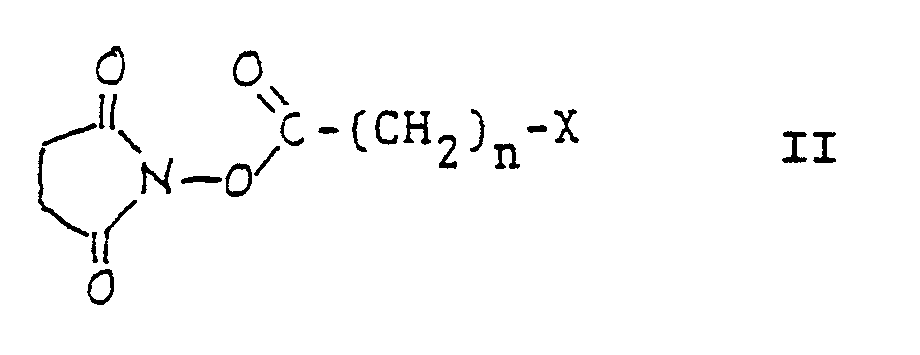
M-NH-CO-(CH₂)n-X III
umsetzt, welche schließlich mit einem Thiolgruppen tragenden Protein P zu einer Verbindung der allgemeinen Formel I umgesetzt wird, worauf man die erhaltene Verbindung der Formel I von nicht kovalent gebundenem Protein freiwäscht.
Applications Claiming Priority (2)
| Application Number | Priority Date | Filing Date | Title |
|---|---|---|---|
| DE3919873 | 1989-06-19 | ||
| DE3919873A DE3919873A1 (de) | 1989-06-19 | 1989-06-19 | Magnetische protein-konjugate, verfahren zu ihrer herstellung und ihre verwendung |
Publications (3)
| Publication Number | Publication Date |
|---|---|
| EP0403961A2 true EP0403961A2 (de) | 1990-12-27 |
| EP0403961A3 EP0403961A3 (de) | 1991-07-17 |
| EP0403961B1 EP0403961B1 (de) | 1994-03-02 |
Family
ID=6382977
Family Applications (1)
| Application Number | Title | Priority Date | Filing Date |
|---|---|---|---|
| EP90111264A Expired - Lifetime EP0403961B1 (de) | 1989-06-19 | 1990-06-14 | Magnetische Protein-Konjugate, Verfahren zu ihrer Herstellung und ihre Verwendung |
Country Status (12)
| Country | Link |
|---|---|
| US (1) | US5095097A (de) |
| EP (1) | EP0403961B1 (de) |
| JP (1) | JP2858883B2 (de) |
| KR (1) | KR0154120B1 (de) |
| AT (1) | ATE102052T1 (de) |
| AU (1) | AU639867B2 (de) |
| CA (1) | CA2019218C (de) |
| DE (2) | DE3919873A1 (de) |
| DK (1) | DK0403961T3 (de) |
| ES (1) | ES2063200T3 (de) |
| IE (1) | IE63666B1 (de) |
| PT (1) | PT94398B (de) |
Cited By (1)
| Publication number | Priority date | Publication date | Assignee | Title |
|---|---|---|---|---|
| WO1997014443A1 (en) * | 1995-10-19 | 1997-04-24 | Bracco International B.V. | Magnetically labeled chemoattractants as targeted contrast agents in the nmr imaging of living tissues |
Families Citing this family (13)
| Publication number | Priority date | Publication date | Assignee | Title |
|---|---|---|---|---|
| WO1994007138A1 (en) | 1992-09-14 | 1994-03-31 | Fodstad Oystein | Detection of specific target cells in specialized or mixed cell population and solutions containing mixed cell populations |
| NO180658C (no) * | 1994-03-10 | 1997-05-21 | Oeystein Fodstad | Fremgangsmåte og anordning for deteksjon av spesifikke målceller i spesialiserte eller blandede cellepopulasjoner og opplösninger som inneholder blandede cellepopulasjoner |
| NO180167C (no) * | 1994-09-08 | 1997-02-26 | Photocure As | Fotokjemisk fremgangsmåte til å innföre molekyler i cellers cytosol |
| US5585278A (en) * | 1994-10-27 | 1996-12-17 | Bayer Corporation | Method for coupling antibody to novel latex substrate and its use in immunoassay |
| NO961031D0 (no) | 1996-03-13 | 1996-03-13 | Det Norske Radiumshospital Tum | Fremgangsmåte til å drepe uönskede målceller |
| ES2235231T3 (es) | 1996-03-26 | 2005-07-01 | Cylex, Inc. | Metodos para la medicion de la funcion linfocitica. |
| JP3662347B2 (ja) * | 1996-06-10 | 2005-06-22 | 日鉄鉱業株式会社 | 医療用粉体 |
| US6379975B1 (en) * | 1996-11-27 | 2002-04-30 | T.A.C. Thrombosis And Coagulation Aktiebolag | Methods and reagents for determining protein S |
| US7169571B2 (en) | 1997-09-12 | 2007-01-30 | Cylex, Inc. | Methods for measurement of lymphocyte function |
| DE60031521T2 (de) * | 1999-05-04 | 2007-06-21 | Dan A. Nashville Pankowsky | Produkte und verfahren für einzelwert- und vielfachwert-phänotypisierung von zellen |
| US6828157B1 (en) * | 1999-05-04 | 2004-12-07 | Dan A. Pankowsky | Products and methods for single parameter and multiparameter phenotyping of cells |
| US6682940B2 (en) * | 1999-05-04 | 2004-01-27 | Dan A. Pankowsky | Products and methods for single parameter and multiparameter phenotyping of cells |
| US20020150952A1 (en) * | 2001-04-17 | 2002-10-17 | Peter Sottong | Methods for measuring lymphocyte activation by mitogens and antigens |
Citations (2)
| Publication number | Priority date | Publication date | Assignee | Title |
|---|---|---|---|---|
| WO1983003920A1 (en) | 1982-04-23 | 1983-11-10 | Sintef | Magnetic polymer particles and process for the preparation thereof |
| EP0125995A2 (de) | 1983-05-12 | 1984-11-21 | Advanced Magnetics, Inc. | Magnetische Teilchen zur Verwendung in Trennungen |
Family Cites Families (5)
| Publication number | Priority date | Publication date | Assignee | Title |
|---|---|---|---|---|
| FR2334106A1 (fr) * | 1975-12-02 | 1977-07-01 | Pasteur Institut | Gel magnetique convenant pour dosages immunoenzymatiques |
| US4671958A (en) * | 1982-03-09 | 1987-06-09 | Cytogen Corporation | Antibody conjugates for the delivery of compounds to target sites |
| US4698302A (en) * | 1983-05-12 | 1987-10-06 | Advanced Magnetics, Inc. | Enzymatic reactions using magnetic particles |
| US4795698A (en) * | 1985-10-04 | 1989-01-03 | Immunicon Corporation | Magnetic-polymer particles |
| US4814098A (en) * | 1986-09-06 | 1989-03-21 | Bellex Corporation | Magnetic material-physiologically active substance conjugate |
-
1989
- 1989-06-19 DE DE3919873A patent/DE3919873A1/de not_active Withdrawn
-
1990
- 1990-06-14 ES ES90111264T patent/ES2063200T3/es not_active Expired - Lifetime
- 1990-06-14 DK DK90111264.9T patent/DK0403961T3/da active
- 1990-06-14 AT AT90111264T patent/ATE102052T1/de not_active IP Right Cessation
- 1990-06-14 EP EP90111264A patent/EP0403961B1/de not_active Expired - Lifetime
- 1990-06-14 DE DE90111264T patent/DE59004731D1/de not_active Expired - Lifetime
- 1990-06-15 US US07/538,753 patent/US5095097A/en not_active Expired - Lifetime
- 1990-06-18 JP JP2157799A patent/JP2858883B2/ja not_active Expired - Lifetime
- 1990-06-18 AU AU57178/90A patent/AU639867B2/en not_active Ceased
- 1990-06-18 KR KR1019900008921A patent/KR0154120B1/ko not_active Expired - Fee Related
- 1990-06-18 CA CA002019218A patent/CA2019218C/en not_active Expired - Fee Related
- 1990-06-18 IE IE219490A patent/IE63666B1/en unknown
- 1990-06-18 PT PT94398A patent/PT94398B/pt not_active IP Right Cessation
Patent Citations (2)
| Publication number | Priority date | Publication date | Assignee | Title |
|---|---|---|---|---|
| WO1983003920A1 (en) | 1982-04-23 | 1983-11-10 | Sintef | Magnetic polymer particles and process for the preparation thereof |
| EP0125995A2 (de) | 1983-05-12 | 1984-11-21 | Advanced Magnetics, Inc. | Magnetische Teilchen zur Verwendung in Trennungen |
Non-Patent Citations (4)
| Title |
|---|
| BOYUM, SCAND. J. IMMUNOL., vol. 5, 1976, pages 9 - 15 |
| KVALHEIM ET AL., CANCER RESEARCH, vol. 47, 1987, pages 846 - 851 |
| RECTOR ET AL., J. IMMUNOL. METH., vol. 24, 1978, pages 321 - 336 |
| VARTDAL ET AL., TRANSPLANTATION, vol. 43, 1987, pages 366 - 371 |
Cited By (1)
| Publication number | Priority date | Publication date | Assignee | Title |
|---|---|---|---|---|
| WO1997014443A1 (en) * | 1995-10-19 | 1997-04-24 | Bracco International B.V. | Magnetically labeled chemoattractants as targeted contrast agents in the nmr imaging of living tissues |
Also Published As
| Publication number | Publication date |
|---|---|
| ES2063200T3 (es) | 1995-01-01 |
| AU639867B2 (en) | 1993-08-05 |
| DE3919873A1 (de) | 1990-12-20 |
| CA2019218C (en) | 2001-01-02 |
| CA2019218A1 (en) | 1990-12-19 |
| AU5717890A (en) | 1990-12-20 |
| JP2858883B2 (ja) | 1999-02-17 |
| KR0154120B1 (ko) | 1998-10-15 |
| EP0403961A3 (de) | 1991-07-17 |
| DE59004731D1 (de) | 1994-04-07 |
| JPH03184999A (ja) | 1991-08-12 |
| ATE102052T1 (de) | 1994-03-15 |
| KR910000797A (ko) | 1991-01-30 |
| IE902194A1 (en) | 1991-01-02 |
| PT94398B (pt) | 1997-01-31 |
| PT94398A (pt) | 1991-02-08 |
| EP0403961B1 (de) | 1994-03-02 |
| DK0403961T3 (da) | 1994-06-27 |
| IE902194L (en) | 1990-12-19 |
| IE63666B1 (en) | 1995-05-31 |
| US5095097A (en) | 1992-03-10 |
Similar Documents
| Publication | Publication Date | Title |
|---|---|---|
| EP0186616B1 (de) | Magnetische Partikel für die Diagnostik | |
| EP0403961B1 (de) | Magnetische Protein-Konjugate, Verfahren zu ihrer Herstellung und ihre Verwendung | |
| EP0255471B1 (de) | 1,4,7,10-Tetraazacyclododecan-Derivate | |
| DE68917736T2 (de) | System zur magnetischen affinitäts-separation von zellen aus zellkonzentraten. | |
| DE3685625T2 (de) | Antikoerperkomplexe von haptenmodifizierten diagnostischen oder therapeutischen mitteln. | |
| DE3382572T2 (de) | Antikoerper-verbindungen. | |
| DE69838953T2 (de) | Methoden zur herstellung von glykosylierten antikörpern und antikörperfragmenten mit reaktiven ketongruppen | |
| DE602004005826T2 (de) | Verfahren zur reinigung von stabilen radioiodium-konjugate | |
| DE3713842A1 (de) | Substituierte cyclische komplexbildner, komplexe und komplexsalze, verfahren zu deren herstellung und diese enthaltende pharmazeutische mittel | |
| EP0305320A2 (de) | Mehrkernige substituierte Komplexbildner, Komplexe und Komplexsalze, Verfahren zu deren Herstellung und diese enthaltende pharmazeutische Mittel | |
| EP0260610A2 (de) | Monoklonale Antikörper gegen humanen Tumonekrosefaktor (TNF) und deren Verwendung | |
| DE69434810T2 (de) | Immobilisiertes markierungsverfahren | |
| EP0332022B1 (de) | Magnetische Protein-Konjugate, Verfahren zu ihrer Herstellung und ihre Verwendung | |
| DE68922109T2 (de) | Gamma-inulin-zusammensetzungen. | |
| EP0277088A2 (de) | Polymer-Komplexe, Verfahren zu deren Herstellung und diese enthaltende pharmazeutische Mittel | |
| DE4201461A1 (de) | Mittel fuer die selektive tumortherapie auf der basis ferromagnetischer partikel - verfahren zu ihrer herstellung und verwendung | |
| DE3885733T2 (de) | Verfahren zur befreiung von zellgemischen und geweben von unerwünschten populationen. | |
| DE3710730A1 (de) | Substituierte komplexbildner, komplexe und komplexsalze, verfahren zu deren herstellung und diese enthaltende pharmazeutische mittel | |
| EP0403960A2 (de) | Magnetische Protein-Konjugate, Verfahren zu ihrer Herstellung und ihre Verwendung | |
| EP1683572A1 (de) | Magnetisch betätigtes absorptionsmittel und herstellungsverfahren dafür | |
| DE3508000A1 (de) | Ferromagnetische partikel fuer die nmr-diagnostik | |
| DE69026387T2 (de) | Reduktion der nichtzielspezifischen retention von immunokonjugaten und ihren metaboliten | |
| EP1276770A1 (de) | Proteine mit hoher immunreaktivität sowie ein verfahren zu ihrer herstellung | |
| EP0925110B1 (de) | Konjugat, geeignet zur bindung von substanzen | |
| WO2004058968A1 (de) | Reinigung rekombinanter filamentöser bakteriophagen mittels affinitätschromatografie zur erhöhung der immunogenität und wirkung von phagenimpfstoffen |
Legal Events
| Date | Code | Title | Description |
|---|---|---|---|
| PUAI | Public reference made under article 153(3) epc to a published international application that has entered the european phase |
Free format text: ORIGINAL CODE: 0009012 |
|
| AK | Designated contracting states |
Kind code of ref document: A2 Designated state(s): AT BE CH DE DK ES FR GB GR IT LI LU NL SE |
|
| 17P | Request for examination filed |
Effective date: 19901221 |
|
| PUAL | Search report despatched |
Free format text: ORIGINAL CODE: 0009013 |
|
| AK | Designated contracting states |
Kind code of ref document: A3 Designated state(s): AT BE CH DE DK ES FR GB GR IT LI LU NL SE |
|
| 17Q | First examination report despatched |
Effective date: 19920804 |
|
| GRAA | (expected) grant |
Free format text: ORIGINAL CODE: 0009210 |
|
| AK | Designated contracting states |
Kind code of ref document: B1 Designated state(s): AT BE CH DE DK ES FR GB GR IT LI LU NL SE |
|
| REF | Corresponds to: |
Ref document number: 102052 Country of ref document: AT Date of ref document: 19940315 Kind code of ref document: T |
|
| REF | Corresponds to: |
Ref document number: 59004731 Country of ref document: DE Date of ref document: 19940407 |
|
| ITF | It: translation for a ep patent filed | ||
| ET | Fr: translation filed | ||
| GBT | Gb: translation of ep patent filed (gb section 77(6)(a)/1977) |
Effective date: 19940516 |
|
| REG | Reference to a national code |
Ref country code: DK Ref legal event code: T3 |
|
| REG | Reference to a national code |
Ref country code: GR Ref legal event code: FG4A Free format text: 3011467 |
|
| EPTA | Lu: last paid annual fee | ||
| REG | Reference to a national code |
Ref country code: ES Ref legal event code: FG2A Ref document number: 2063200 Country of ref document: ES Kind code of ref document: T3 |
|
| PLBE | No opposition filed within time limit |
Free format text: ORIGINAL CODE: 0009261 |
|
| STAA | Information on the status of an ep patent application or granted ep patent |
Free format text: STATUS: NO OPPOSITION FILED WITHIN TIME LIMIT |
|
| EAL | Se: european patent in force in sweden |
Ref document number: 90111264.9 |
|
| 26N | No opposition filed | ||
| REG | Reference to a national code |
Ref country code: CH Ref legal event code: PUE Owner name: BEHRINGWERKE AKTIENGESELLSCHAFT TRANSFER- DADE BEH |
|
| NLS | Nl: assignments of ep-patents |
Owner name: BEHRING DIAGNOSTICS GMBH;HOECHST AKTIENGESELLSCHAF |
|
| NLT1 | Nl: modifications of names registered in virtue of documents presented to the patent office pursuant to art. 16 a, paragraph 1 |
Owner name: DADE BEHRING MARBURG GMBH |
|
| REG | Reference to a national code |
Ref country code: FR Ref legal event code: TP |
|
| REG | Reference to a national code |
Ref country code: ES Ref legal event code: PC2A |
|
| REG | Reference to a national code |
Ref country code: FR Ref legal event code: CD |
|
| PGFP | Annual fee paid to national office [announced via postgrant information from national office to epo] |
Ref country code: SE Payment date: 20000518 Year of fee payment: 11 |
|
| PGFP | Annual fee paid to national office [announced via postgrant information from national office to epo] |
Ref country code: AT Payment date: 20000519 Year of fee payment: 11 Ref country code: CH Payment date: 20000519 Year of fee payment: 11 Ref country code: GB Payment date: 20000519 Year of fee payment: 11 |
|
| PGFP | Annual fee paid to national office [announced via postgrant information from national office to epo] |
Ref country code: DK Payment date: 20000522 Year of fee payment: 11 |
|
| PGFP | Annual fee paid to national office [announced via postgrant information from national office to epo] |
Ref country code: NL Payment date: 20000524 Year of fee payment: 11 |
|
| PGFP | Annual fee paid to national office [announced via postgrant information from national office to epo] |
Ref country code: LU Payment date: 20000531 Year of fee payment: 11 Ref country code: BE Payment date: 20000531 Year of fee payment: 11 Ref country code: GR Payment date: 20000531 Year of fee payment: 11 |
|
| PG25 | Lapsed in a contracting state [announced via postgrant information from national office to epo] |
Ref country code: AT Free format text: LAPSE BECAUSE OF NON-PAYMENT OF DUE FEES Effective date: 20010614 Ref country code: DK Free format text: LAPSE BECAUSE OF NON-PAYMENT OF DUE FEES Effective date: 20010614 Ref country code: LU Free format text: LAPSE BECAUSE OF NON-PAYMENT OF DUE FEES Effective date: 20010614 Ref country code: GB Free format text: LAPSE BECAUSE OF NON-PAYMENT OF DUE FEES Effective date: 20010614 |
|
| PG25 | Lapsed in a contracting state [announced via postgrant information from national office to epo] |
Ref country code: SE Free format text: LAPSE BECAUSE OF NON-PAYMENT OF DUE FEES Effective date: 20010615 |
|
| PG25 | Lapsed in a contracting state [announced via postgrant information from national office to epo] |
Ref country code: GR Free format text: LAPSE BECAUSE OF NON-PAYMENT OF DUE FEES Effective date: 20010630 Ref country code: LI Free format text: LAPSE BECAUSE OF NON-PAYMENT OF DUE FEES Effective date: 20010630 Ref country code: CH Free format text: LAPSE BECAUSE OF NON-PAYMENT OF DUE FEES Effective date: 20010630 Ref country code: BE Free format text: LAPSE BECAUSE OF NON-PAYMENT OF DUE FEES Effective date: 20010630 |
|
| BERE | Be: lapsed |
Owner name: DADE BEHRING MARBURG G.M.B.H. Effective date: 20010630 |
|
| PG25 | Lapsed in a contracting state [announced via postgrant information from national office to epo] |
Ref country code: NL Free format text: LAPSE BECAUSE OF NON-PAYMENT OF DUE FEES Effective date: 20020101 |
|
| EUG | Se: european patent has lapsed |
Ref document number: 90111264.9 |
|
| GBPC | Gb: european patent ceased through non-payment of renewal fee |
Effective date: 20010614 |
|
| REG | Reference to a national code |
Ref country code: CH Ref legal event code: PL |
|
| NLV4 | Nl: lapsed or anulled due to non-payment of the annual fee |
Effective date: 20020101 |
|
| REG | Reference to a national code |
Ref country code: DK Ref legal event code: EBP |
|
| PGFP | Annual fee paid to national office [announced via postgrant information from national office to epo] |
Ref country code: FR Payment date: 20090616 Year of fee payment: 20 Ref country code: IT Payment date: 20090624 Year of fee payment: 20 |
|
| PGFP | Annual fee paid to national office [announced via postgrant information from national office to epo] |
Ref country code: ES Payment date: 20090724 Year of fee payment: 20 |
|
| REG | Reference to a national code |
Ref country code: FR Ref legal event code: CD |
|
| PGFP | Annual fee paid to national office [announced via postgrant information from national office to epo] |
Ref country code: DE Payment date: 20090821 Year of fee payment: 20 |
|
| REG | Reference to a national code |
Ref country code: ES Ref legal event code: FD2A Effective date: 20100615 |
|
| PG25 | Lapsed in a contracting state [announced via postgrant information from national office to epo] |
Ref country code: ES Free format text: LAPSE BECAUSE OF EXPIRATION OF PROTECTION Effective date: 20100615 |
|
| PG25 | Lapsed in a contracting state [announced via postgrant information from national office to epo] |
Ref country code: DE Free format text: LAPSE BECAUSE OF EXPIRATION OF PROTECTION Effective date: 20100614 |