EP0404394A2 - Bildverarbeitungssystem - Google Patents
Bildverarbeitungssystem Download PDFInfo
- Publication number
- EP0404394A2 EP0404394A2 EP90306206A EP90306206A EP0404394A2 EP 0404394 A2 EP0404394 A2 EP 0404394A2 EP 90306206 A EP90306206 A EP 90306206A EP 90306206 A EP90306206 A EP 90306206A EP 0404394 A2 EP0404394 A2 EP 0404394A2
- Authority
- EP
- European Patent Office
- Prior art keywords
- picture elements
- black
- white
- image
- destination
- Prior art date
- Legal status (The legal status is an assumption and is not a legal conclusion. Google has not performed a legal analysis and makes no representation as to the accuracy of the status listed.)
- Withdrawn
Links
Images


Classifications
-
- G—PHYSICS
- G06—COMPUTING OR CALCULATING; COUNTING
- G06T—IMAGE DATA PROCESSING OR GENERATION, IN GENERAL
- G06T3/00—Geometric image transformations in the plane of the image
- G06T3/40—Scaling of whole images or parts thereof, e.g. expanding or contracting
Definitions
- the present invention relates to an image processing system for producing reduced size grayscale images from black and white images for display within a data processing system.
- Images within data processing systems may be produced in black and white. That is, each image may be made up of multiple rows and columns of picture elements, each picture element being either black or white.
- Such systems are often utilised in data processing systems due to the facility with which an individual picture element may be characterised as black or white utilising a binary system. In such systems a binary value of one may be associated with either a black or white picture element and a binary value of zero is associated with the opposite value of a picture element.
- an image processing system for producing a destination grayscale image of reduced size comprising rows and columns of destination picture elements from a source black and white image comprising rows and columns of source picture elements, each source picture element being either black or white
- the system comprising: logic for dynamically determining groups of source picture elements which correspond to each destination picture element; logic for determining the number of black and/or white source picture elements within each group of source picture elements corresponding to each destination picture element; logic for selecting a particular grayscale value in response to the number of black and/or white source picture elements within each group of picture elements for each destination picture element and for assigning the particular grayscale value to each destination picture element.
- the invention permits the rapid and efficient reduction of black and white images to smaller grayscale images.
- the image processing apparatus comprises operator input means for receiving operator inputs specifying the size of the destination image desired by an operator.
- the operator input means may be a keyboard or a mouse used in conjunction with a user interface in a manner well known in the art.
- the image processing system comprises; means for storing a table containing a plurality of grayscale values; and wherein the logic for selecting a particular grayscale value in response to the number of black and/or white picture elements does so by accessing the table. Therefore a look-up table is employed to avoid repetitive calculations thus increasing the speed and efficiency of the image reduction process.
- the image processing system can be a data processing system which can include other components such as a display device for displaying the destination image, a keyboard, a mouse, storage devices, communications links and the like.
- the image processing system can also be an adapter card for use with a data processing system.
- the image processing system 10 is a data processing system including a keyboard 12 which is coupled to a central processing unit 14, in a manner well known in the art. Also coupled to central processing unit 14 is memory device 16, which may comprise both volatile and nonvolatile memory storage devices and which may include auxiliary memory devices such as magnetic disc or tape storage.
- Central processing unit 14 is also coupled to display driver 18 which is utilised, in a manner well known in the art, to provide a visual display by coupling appropriate control signals to display 20.
- display 20 may be provided by monitor or other display device well known in the art.
- Image processing system 10 may, of course, include other components and may be provided by a personal computer such as the IBM Model No. PS/2 manufactured by International Business Machines Corporation of Armonk, New York.
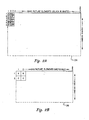
- FIG. 2A depicts a black and white image 24 which is comprised of multiple rows and columns of picture elements or pixels.
- Black and white image 24, as depicted in Figure 2A is comprised of a matrix of picture elements which is 2,040 columns by 2,640 rows.
- each picture element within the aforementioned matrix may be characterised in a binary scheme as a one or a zero, the one or zero corresponding to an indication of whether the particular picture element is to be considered "on" or white or "off” or black.
- reduced size grayscale image 26 which is created from black and white image 24 of Figure 2A.
- reduced size grayscale image 26 within Figure 2B is comprised of a matrix of picture elements which is 640 columns by 480 rows.
- each picture element within the matrix which forms reduced size grayscale image 26 is characterised by a grayscale value which is one of the permitted magnitudes of luminescence which data processing system 10 may accommodate.
- picture element A of reduced size grayscale image 26 will be comprised of all or most of picture elements A through R of black and white image 24.
- picture element A of reduced grayscale image 26 will, in a perfect conversion, be equivalent to 3.1875 picture elements in a horizontal direction within black and white image 24 and 5.5 picture elements in a vertical direction within black and white image 24.
- it is possible to create a very effective reduced grayscale image from a black and white image by rounding off the number of picture elements within black and white image 24 which will correspond to a new picture element within reduced grayscale image 26 to the nearest whole number of picture elements. This greatly simplifies the calculations involved without causing a noticeable deterioration in image quality.
- the luminescence level of picture element A of reduced grayscale image 26 is determined by examining a specified number of picture elements within black and white image 24. That specified number of picture elements is 18 picture elements which are labelled A through R respectively.
- the grayscale value for picture element A of reduced grayscale image 26 may be calculated by totaling the binary values of picture elements A through R of black and white image 24 and then dividing that total by 18. This resultant factor may then be multiplied by the total number of grayscale values which data processing system 10 may accommodate to determine the proper grayscale value for picture element A of reduced grayscale image 26. In this manner, each of the over 300,000 picture elements within reduced grayscale image 26 will require 18 additions, one division and one multiplication in order to calculate the appropriate value. It should be apparent that this process is quite expensive in terms of processor assets and a system which utilises only additions or subtractions in combination with a look-up table will necessarily be more efficient and rapid in terms of producing a reduced size grayscale image.
- grayscale value table 28 which may be utilised to create a reduced size grayscale image in accordance with the present invention.
- grayscale value table 28 includes a rightmost column 30 which lists each corresponding grayscale value which data processing system 10 (see Figure 1) will accommodate. For example, if data processing system 10 will accommodate 64 grayscale values, then grayscale value table 28 will include 64 rows, each of which will correspond to a particular grayscale value.
- Grayscale value table 28 also includes a plurality of other columns, each of which corresponds to the number of black and white picture elements or pixels, which will be included within each new picture element within reduced grayscale image 26. As may be seen, the number of black and white picture elements which will be included within each new picture element of reduced grayscale image 26 will vary in direct relation to the dimensions of the reduced grayscale image selected by the system operator.
- the number of black picture elements within each specified group of black and white picture elements is counted, utilising a bit counting scheme.
- black picture elements or white picture elements may be counted and may be utilised to generate the same result, since the union of all black picture elements and all white picture elements will equal the total number of picture elements.
- grayscale value table 28 may be accessed utilising that count number under the column which corresponds to the number of black and white picture elements within each reduced grayscale image picture element. Thereafter, the corresponding grayscale value which is listed in the rightmost row will be assigned to the new picture element within the reduced grayscale image.
- the number of grayscale values which may be generated utilising the foregoing method and apparatus will be limited to the number of black and white picture elements which correspond to each reduced grayscale image picture element. That is, if a reduction is selected which results in four black and white picture elements corresponding to each reduced grayscale picture element, then only five grayscale values will result, despite the capability of data processing system 10 to accommodate a larger number of grayscale values.
- each new picture element within the reduced grayscale image will correspond to 20 black and white picture elements, then 21 different grayscale values will be generated. This is true due to the fact that if each black and white picture element within a specified group which corresponds to a reduced grayscale image picture element is white then the reduced grayscale picture element will be white. If all of the black and white picture elements within a group which corresponds to a reduced grayscale image picture element are black, then the corresponding reduced grayscale image picture element will be black. The variations which are possible between these two conditions are limited to the number of picture elements from the black and white image which correspond to each new picture element within the reduced grayscale image.
- interpretative table 32 is dynamically created in response to the selection by an operator of the dimensions of the reduced grayscale image.
- interpretative table 32 operates upon each row in black and white image 24 (see Figure 2A) and includes an interpretative operator code which specifies how many eight bit masks must be processed in each iterative step.
- a mask code is listed for the first byte of black and white picture elements which will be processed. This mask code is a hexadecimal code which simply specifies which picture elements within an eight bit mask will be operated upon in the current iteration.
- interpretative table 32 has been selected to correspond to the reduction of a 2,040 column by 2,640 row black and white image to a 640 column by 480 row reduced grayscale image, as illustrated in Figures 2A and 2B, it will be apparent that a submatrix of three horizontal picture elements by six vertical picture elements will be operated upon to create each new picture element within the reduced grayscale image.
- a read pointer is listed within interpretative table 32 to indicate that the first eight bit mask will also be operated upon in the next iteration within interpretative table 32.
- an interpretative operator code is listed again, indicating that only one mask is to be processed and a hexadecimal code is once again listed indicating that the second three bits within the first byte of black and white picture elements will be processed during this iteration.
- interpretative table 32 An unused byte is placed within interpretative table 32 at this point to equalise the length of all instructions and a read pointer is once again utilised to indicate that the process will continue within the first byte of black and white picture elements.
- interpretative operator code is changed to indicate that during this iteration two masks of black and white picture elements will be processed.
- three columns of picture elements within black and white image 24 see Figure 2A
- two of those columns will be contained within the first byte of black and white picture elements and the third will be contained within the second byte of black and white picture elements.
- This is further illustrated by the generation of two hexadecimal masks for the first and second byte of black and white picture elements which are utilised to specify that the last two bits within the first byte and the first bit within the second byte will be processed.
- a bump read pointer is next utilised to illustrate that the process will begin during the next iteration in the next byte of black and white picture elements.
- an interpretative operator code is listed at the end of the table to indicate that an entire row has been processed and thereafter the next row will be processed by utilising the information within interpretative table 32. In this manner, the output of each row is accumulated until a sufficient number of rows has been processed to generate an output row of new picture elements for a reduced grayscale image. In the illustrated example this will occur after six rows of black and white picture elements have been processed.
- a dynamically created interpretative table is established specifying the size of the reduced grayscale image which is desired and this table includes only the non-repetitive information which is necessary to specify the number of black and white picture elements which will correspond to each new picture element within the reduced grayscale image.
- the aforementioned table is then utilised to process one row of the black and white image at a time and the row values are accumulated until a sufficient number of columns have been processed to provide an output row.
- the aspect ratio of a given image may be retained or dismissed, as desired, and may be controlled by operator inputs.
- the tables 28, 32 and the control logic in this embodiment are stored in the memory 16. There are however many other possibilities, they could, for example be stored in special purpose storage located on an adapter card.
Landscapes
- Physics & Mathematics (AREA)
- General Physics & Mathematics (AREA)
- Engineering & Computer Science (AREA)
- Theoretical Computer Science (AREA)
- Image Processing (AREA)
Applications Claiming Priority (2)
| Application Number | Priority Date | Filing Date | Title |
|---|---|---|---|
| US36846989A | 1989-06-19 | 1989-06-19 | |
| US368469 | 1989-06-19 |
Publications (2)
| Publication Number | Publication Date |
|---|---|
| EP0404394A2 true EP0404394A2 (de) | 1990-12-27 |
| EP0404394A3 EP0404394A3 (de) | 1992-03-04 |
Family
ID=23451339
Family Applications (1)
| Application Number | Title | Priority Date | Filing Date |
|---|---|---|---|
| EP19900306206 Withdrawn EP0404394A3 (de) | 1989-06-19 | 1990-06-07 | Bildverarbeitungssystem |
Country Status (3)
| Country | Link |
|---|---|
| EP (1) | EP0404394A3 (de) |
| JP (1) | JPH0330072A (de) |
| CA (1) | CA2012404A1 (de) |
Family Cites Families (5)
| Publication number | Priority date | Publication date | Assignee | Title |
|---|---|---|---|---|
| JPS57185078A (en) * | 1981-05-09 | 1982-11-15 | Tokyo Shibaura Electric Co | Picture display unit |
| JPS60163080A (ja) * | 1984-02-03 | 1985-08-24 | 富士通株式会社 | 画像縮小表示処理方式 |
| JPS6183587A (ja) * | 1984-08-18 | 1986-04-28 | 富士通株式会社 | 画像デ−タ変換方式 |
| US4783838A (en) * | 1984-12-26 | 1988-11-08 | Konishiroku Photo Industry Co., Ltd. | Image processing method and apparatus therefor |
| JPH077461B2 (ja) * | 1986-11-14 | 1995-01-30 | コニカ株式会社 | 画像推定方法 |
-
1990
- 1990-03-16 CA CA 2012404 patent/CA2012404A1/en not_active Abandoned
- 1990-06-07 EP EP19900306206 patent/EP0404394A3/de not_active Withdrawn
- 1990-06-19 JP JP2158859A patent/JPH0330072A/ja active Pending
Also Published As
| Publication number | Publication date |
|---|---|
| CA2012404A1 (en) | 1990-12-19 |
| JPH0330072A (ja) | 1991-02-08 |
| EP0404394A3 (de) | 1992-03-04 |
Similar Documents
| Publication | Publication Date | Title |
|---|---|---|
| EP0051294B1 (de) | Bildformat-Konvertierschaltung | |
| US4675833A (en) | Processor controlled photocomposition system | |
| US4536848A (en) | Method and apparatus for colored computer graphic photography | |
| US4554638A (en) | Display device including apparatus for rotating the image to be displayed | |
| EP0138324B1 (de) | Bildverarbeitungssystem | |
| US4503427A (en) | Apparatus for displaying stored picture information in association with a cursor | |
| EP0528084A1 (de) | System und Verfahren zur Verarbeitung von gespeicherte Bilder darstellenden Daten | |
| EP0096348B1 (de) | System und Verfahren zum Definieren und Anzeigen eines Bildesfür eine photographische Wiedergabe | |
| JPS6255137B2 (de) | ||
| US5010324A (en) | Sequential page unit image display device having display control memory | |
| US5731814A (en) | Method and apparatus for identifying an object selected on a computer output display | |
| JPH03120957A (ja) | デジタル画像をデイザーさせて表示する方法及び装置 | |
| US5255213A (en) | Apparatus for providing selectable fractional output signals | |
| US6611274B1 (en) | System method, and computer program product for compositing true colors and intensity-maped colors into a frame buffer | |
| EP0404397B1 (de) | Bildverarbeitungssystem | |
| US6337701B1 (en) | Apparatus for hardware support of software color cursors and method therefor | |
| JP3110041B2 (ja) | 画像情報処理装置 | |
| CA1203005A (en) | Method and apparatus for colored computer graphic photography | |
| CA2012404A1 (en) | Method and apparatus for conversion of black and white image to grayscale image | |
| JP2924528B2 (ja) | ラベリング処理方法及びラベリング処理装置 | |
| GB2181930A (en) | C.R.T display apparatus with menu control | |
| EP0156598A1 (de) | Bildverarbeitung | |
| JP2573438B2 (ja) | パターン識別方法および装置 | |
| US6985624B2 (en) | Image processing apparatus and its method | |
| JP2761249B2 (ja) | 画素密度変換パルス生成装置 |
Legal Events
| Date | Code | Title | Description |
|---|---|---|---|
| PUAI | Public reference made under article 153(3) epc to a published international application that has entered the european phase |
Free format text: ORIGINAL CODE: 0009012 |
|
| AK | Designated contracting states |
Kind code of ref document: A2 Designated state(s): DE FR GB IT |
|
| 17P | Request for examination filed |
Effective date: 19901213 |
|
| PUAL | Search report despatched |
Free format text: ORIGINAL CODE: 0009013 |
|
| AK | Designated contracting states |
Kind code of ref document: A3 Designated state(s): DE FR GB IT |
|
| 17Q | First examination report despatched |
Effective date: 19950504 |
|
| STAA | Information on the status of an ep patent application or granted ep patent |
Free format text: STATUS: THE APPLICATION IS DEEMED TO BE WITHDRAWN |
|
| 18D | Application deemed to be withdrawn |
Effective date: 19960116 |