EP0405496B1 - Méthode de manipulation d'images supérieures à une fenêtre - Google Patents
Méthode de manipulation d'images supérieures à une fenêtre Download PDFInfo
- Publication number
- EP0405496B1 EP0405496B1 EP90112244A EP90112244A EP0405496B1 EP 0405496 B1 EP0405496 B1 EP 0405496B1 EP 90112244 A EP90112244 A EP 90112244A EP 90112244 A EP90112244 A EP 90112244A EP 0405496 B1 EP0405496 B1 EP 0405496B1
- Authority
- EP
- European Patent Office
- Prior art keywords
- image
- point
- viewport
- rectangle
- bit map
- Prior art date
- Legal status (The legal status is an assumption and is not a legal conclusion. Google has not performed a legal analysis and makes no representation as to the accuracy of the status listed.)
- Expired - Lifetime
Links
Images



Classifications
-
- G—PHYSICS
- G06—COMPUTING OR CALCULATING; COUNTING
- G06T—IMAGE DATA PROCESSING OR GENERATION, IN GENERAL
- G06T11/00—Two-dimensional [2D] image generation
Definitions
- This invention relates to digital data systems adapted for viewing and manipulating graphic images on a cathode ray tube screen, particularly to systems in which the screen presents a viewport through which all or a portion of the graphic image may be viewed, and most particularly to methods of performing operations on graphic images only portions of which are visible through the viewport.
- CTR cathode ray tube
- Graphic information to be stored in a digital computer system for presentation on a CRT display has generally been stored in two ways, known as "object-based” and "pixel-based”:
- information determinative of the graphic information to be displayed, rather than a direct representation of that information is stored; for example, the coordinates of the beginning and ending points of a line, the coordinates of the corners of a rectangle, the radius and the coordinates of the center of a circle, etc.
- This method has the disadvantage that computation of the screen contents must be performed on the definitional information.
- a pixel In a pixel-based storage scheme, for each elemental portion of the CRT screen (denoted a "pixel", that term being derived from pic ture el ement), memory is organized with a storage cell corresponding to each pixel position on the screen, and information is stored in each cell connoting what is to be displayed at the corresponding pixel position.
- a single bit is stored in a cell denoting whether the corresponding screen pixel position is ON or OFF; in more complex implementations, a multi-bit binary number is stored that might denote such quantities as the color, intensity, and attributes (blinking, reverse video, etc.) of a corresponding screen pixel position.
- This method has the disadvantage that "zooming" (changing the displayed size of the elements) requires extensive manipulation of the stored data.
- the European Patent Application EP-A2-0 172 433 describes ways of panning a viewport across a display occupying a larger virtual screen.
- "zooming out” to view the entire image at once is accomplished by manipulating the bit map in such a way that bits are discarded in order to effectively "shrink” the element sizes; while subsequent “zooming in” can restore the image to the size it had before zooming out, resolution will have been irreparably degraded.
- a complication can occur when a user desires to perform a manipulation (e.g., moving, rotating, changing the fill pattern altering text size or font, etc.) on an element or an area larger than is visible on the screen at one time.
- a manipulation e.g., moving, rotating, changing the fill pattern altering text size or font, etc.
- the prior-art methods for identifying such an element or area consist in using a pointing device (e.g., a "mouse") to identify two diagonally opposite corners of a rectangle containing the element or area to be identified. It is, of course, impossible to do this when the entire perimeter of the desired rectangle cannot be seen at once; under the prior-art methods, the user would be required to zoom out in order to specify the rectangle, encountering the aformentioned loss of granularity.
- the present invention overcomes these drawbacks of the prior art by providing a method wherein the diagonally opposite corners of the rectangle required for demarking an element or area to be manipulated may be identified in separate steps, on portions of the image that need not be simultaneously visible on the screen.
- the user may pan to a portion of the graphic image where he wishes to place one corner of the rectangle, and may identify the position of that corner with his pointing device. He may then pan to a different portion where he desires to place the the diagonally opposite corner, and identify that corner with his pointing device.
- the location of the first corner is "remembered", and the rectangle is drawn; that portion of the rectangle which lies within the currently visible portion of the image is visible to the user. Should the user pan to other portions of the image, portions of the rectangle that lie therein will then be visible.
- the user may thus verify that the rectangle demarks the area he intended, and may then proceed to operate on elements within the rectangle.
- Figure 1 depicts a typical distributed computer system on which the invention might be practiced, comprising a plurality of workstations connected by means of a bus to a mainframe host computer.
- Figure 2 depicts a hypothetical graphics image accessible from a host computer which a user at a terminal or workstation might wish to manipulate.
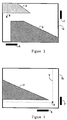
- Figure 3 depicts a portion of the graphics image, such portion being feasible for viewing at the user's terminal or workstation, and illustrates a step in demarking an area or element to be manipulated.
- Figure 4 depicts a different portion of the graphics image, and illustrates a different step in demarking an area or element to be manipulated.
- Figure 5 is a flow chart of the prior-art method of demarking elements within a graphic image.
- Figure 6 is a flow chart of the method of the present invention of demarking elements within a graphic image.
- the invention would typically be practiced in a distributed data processing system such as that shown in Figure 1, comprising a mainframe host computer to which are connected, by means of a bus or communications medium 11, a plurality of terminals or workstations 12.
- Users at the workstations might locally run free-standing applications on data files stored locally at the workstation, might put the workstation into terminal emulation mode and remotely run applications on the host computer, or might download programs or data from the host computer to be run or operated upon at the workstation in free-standing mode.
- the present invention is useful when pixel-based graphic data is downloaded to a workstation for manipulation there.
- the display screen typically provided at a workstation does not have sufficient size or resolution to display a large or complex graphic image in its entirety with good legibility.
- a user might download a graphic image from the host for inclusion in one of his own works which might be of such size or complexity.
- Figure 2 depicts a hypothetical graphic image 1, containing elements 2, 3, and 4.
- Graphic image 1 is a simple one, for illustrative purposes; typical graphic images would contain many more elements, in much closer and more complex juxtaposition.
- the conventional means for identifying element 2 as the element to be manipulated is to draw rectangle ("box") 5 around it, by indicating with a pointing device (e.g., "mouse”) the positions of two diagonally opposite corners of it.
- Figure 3 depicts a tvpical screen display on which appears a portion la of graphic image 1.
- the prior art typically employs "scroll bars" 6 and 7, which indicate a vertical and horizontal strip, respectively, of the overall graphic image, the currently visible portion occupying the area the two strips have in common. Panning to a different area may be accomplished by "dragging" the scroll bars with a mouse, well known in the prior art, or alternatively by typed commands or by the use of the arrow keys with which most terminals are provided.
- Figure 3 is seen to contain the portion of graphic image 1 in which is one of the corners of the desired rectangle 5 (shown in Figure 2), and there is a sufficient amount of detail visible to enable a user to place the corner where he wishes it.
- Figures 5 and 6 are simplified flow charts of the prior-art method of defining the rectangle 5 and the method of the present invention, respectively.
- a mouse click selecting a point for one corner of a rectangle will provide (by means well known to those skilled in the art) the screen coordinates of the point, denoted x1, y1. These will be stored relative to the current bit map-- that is, the bit map for the currently-displayed portion. In order for that action to have any efficacy, the next action from the user must be to provide a second mouse click, denoting the point for the diagonally opposite corner of the rectangle. That point's coordinates, denoted x2, y2 are provided by the mouse. They too are stored relative to the current bit map, and the rectangle thus defined may then be constructed.
- Figure 6 (describing the present invention) is seen to contrast with the prior art in that it describes a routine that must be entered separately for each of the two mouse clicks, and which stores the first coordinate pair relative to the bit map of the entire image; it thus permits the user to pan to a different portion of graphic image 1 in between the two clicks, and permits him to demark the two corners in portions of the graphic image 1 that need not be simultaneously visible to him.
- the user After exiting the routine, the user might invoke other actions, such as panning his screen display to a different portion of the graphic image 1.
- the aforementioned check would pass, leaving the decision box on the "YES" line.
- the second coordinate pair (x2, y2) are stored, and the rectangle is constructed.
- the rectangle would be described, in either the prior-art case or in the case of the present invention, by the coordinate pairs x1,y1;x2,y1;x2,y2;x1,y2;x1,y1.)
- the portion of the rectangle contained within the currently displayed portion of graphic image 1 immediately appears on the screen; should the user pan to some other portion of graphic image 1, any portion of rectangle 5 contained in that portion would then be visible.
Landscapes
- Physics & Mathematics (AREA)
- General Physics & Mathematics (AREA)
- Engineering & Computer Science (AREA)
- Theoretical Computer Science (AREA)
- Processing Or Creating Images (AREA)
Claims (4)
- Procédé pour commander la visualisation par tube TRC dans un système de traitement de données d'une image graphique d'un objet, dans lequel une représentation binaire de pixels représentant cette image est stockée dans une mémoire et dans lequel un processeur exécute une manipulation de ladite image en modifiant approximativement ladite représentation binaire de pixels, et dans lequel la fenêtre de l'image visualisée par tube TRC n'est qu'une partie de toute l'image représentée par ladite représentation binaire de pixels ;
caractérisé par les étapes suivantes de :A) visualisation dans une fenêtre d'une première extrémité de ladite partie d'image à manipuler ;B) détermination si un premier point à ladite première extrémité est stocké ;C) si ce premier point n'est pas stocké, indication dans ladite fenêtre d'un premier point (x1, y1) à ladite première extrémité de ladite partie d'image et stockage d'une représentation dudit premier point par son emplacement par rapport à la représentation binaire de pixels de ladite image entière ;D) retour à l'étape B) ;E) si ce premier point est déjà stocké, orientation de ladite fenêtre par rapport à ladite image pour visualiser une deuxième extrémité de ladite partie d'image à manipuler ;F) indication dans ladite fenêtre, qui visualise ladite deuxième extrémité, d'un deuxième point (x2, y2) à ladite deuxième extrémité et stockage d'une représentation dudit deuxième point par son emplacement par rapport à la représentation binaire de pixels de ladite image entière ; et,G) manipulation de ladite partie d'image délimitée par lesdites représentations stockées desdits premier et deuxième points. - Procédé selon la revendication 1, dans lequel sont stockées des informations qui représentent un rectangle défini par lesdites représentations de premier et deuxième points ; dans lequel le périmètre dudit rectangle, par rapport à la représentation binaire de pixels de ladite image, entoure ladite partie d'image ; et qui consiste à manipuler ladite partie d'image entourée par ledit rectangle.
- Procédé selon la revendication 1, dans lequel un dispositif de pointage dudit système permet d'indiquer un point dans ladite fenêtre, caractérisé par les étapes de :indication d'un premier point dans ladite fenêtre par ledit dispositif de pointage et stockage de premières coordonnées représentant la position dudit premier point à l'intérieur de ladite représentation binaire de pixels ;orientation de ladite fenêtre par rapport à ladite image pour visualiser une deuxième partie de ladite image ;indication d'un deuxième point dans ladite fenêtre par ledit dispositif de pointage et stockage de deuxièmes coordonnées représentant la position dudit deuxième point à l'intérieur de ladite représentation binaire de pixels ; et,construction de la représentation d'un rectangle par rapport à ladite représentation binaire de pixels par utilisation desdites premières et deuxièmes coordonnées comme angles diagonalement opposés dudit rectangle.
- Procédé selon la revendication 3, caractérisé par :après ladite étape d'indication dudit premier point, mais avant ladite étape d'indication dudit deuxième point :stockage de troisièmes coordonnées représentant la position d'un point transitoire dans ladite fenêtre correspondant à la position alors présente dudit dispositif de pointage ; et,construction dynamique de la représentation d'un rectangle par rapport à ladite représentation binaire de pixels par utilisation desdites premières et troisièmes coordonnées comme angles diagonalement opposés dudit rectangle.
Applications Claiming Priority (2)
| Application Number | Priority Date | Filing Date | Title |
|---|---|---|---|
| US374520 | 1989-06-30 | ||
| US07/374,520 US5014222A (en) | 1989-06-30 | 1989-06-30 | Method of manipulating images larger than a viewport |
Publications (3)
| Publication Number | Publication Date |
|---|---|
| EP0405496A2 EP0405496A2 (fr) | 1991-01-02 |
| EP0405496A3 EP0405496A3 (en) | 1992-10-28 |
| EP0405496B1 true EP0405496B1 (fr) | 1997-10-08 |
Family
ID=23477198
Family Applications (1)
| Application Number | Title | Priority Date | Filing Date |
|---|---|---|---|
| EP90112244A Expired - Lifetime EP0405496B1 (fr) | 1989-06-30 | 1990-06-27 | Méthode de manipulation d'images supérieures à une fenêtre |
Country Status (3)
| Country | Link |
|---|---|
| US (1) | US5014222A (fr) |
| EP (1) | EP0405496B1 (fr) |
| DE (1) | DE69031550T2 (fr) |
Families Citing this family (13)
| Publication number | Priority date | Publication date | Assignee | Title |
|---|---|---|---|---|
| US5247678A (en) * | 1989-10-12 | 1993-09-21 | Texas Instruments Incorporated | Load time linker for software used with a multiprocessor system |
| JPH0685145B2 (ja) * | 1990-11-28 | 1994-10-26 | インターナショナル・ビジネス・マシーンズ・コーポレイション | 複数の選択されたオブジェクトの位置表示方法 |
| US6121966A (en) * | 1992-11-02 | 2000-09-19 | Apple Computer, Inc. | Navigable viewing system |
| US5392388A (en) * | 1992-12-04 | 1995-02-21 | International Business Machines Corporation | Method and system for viewing graphic images in a data processing system |
| US5680629A (en) * | 1992-12-07 | 1997-10-21 | Microsoft Corporation | Method and system for previewing computer output |
| US5452413A (en) * | 1992-12-18 | 1995-09-19 | International Business Machines Corporation | Method and system for manipulating wide-angle images |
| US6035309A (en) * | 1993-02-09 | 2000-03-07 | International Business Machines Corporation | System and method for editing and viewing a very wide flat file |
| US5652901A (en) * | 1994-12-23 | 1997-07-29 | Microsoft Corporation | Method and system for previewing computer output |
| US6101289A (en) * | 1997-10-15 | 2000-08-08 | Electric Planet, Inc. | Method and apparatus for unencumbered capture of an object |
| US6473101B1 (en) * | 1999-02-01 | 2002-10-29 | Gordon F. Grigor | Single surface multi-view panning system and method for multiple displays |
| US7216291B2 (en) * | 2003-10-21 | 2007-05-08 | International Business Machines Corporation | System and method to display table data residing in columns outside the viewable area of a window |
| US7991225B2 (en) * | 2006-03-03 | 2011-08-02 | University Of Alaska | Methods and systems for dynamic color equalization |
| US20090075761A1 (en) * | 2007-09-18 | 2009-03-19 | Joseph Balardeta | Golf gps device and system |
Family Cites Families (3)
| Publication number | Priority date | Publication date | Assignee | Title |
|---|---|---|---|---|
| US4197590A (en) * | 1976-01-19 | 1980-04-08 | Nugraphics, Inc. | Method for dynamically viewing image elements stored in a random access memory array |
| EP0172433A3 (fr) * | 1984-08-02 | 1989-04-05 | Tektronix, Inc. | Méthode et dispositif d'affichage avec décalage de l'image sous commande du curseur |
| JP2662429B2 (ja) * | 1988-11-14 | 1997-10-15 | キヤノン株式会社 | 画像編集装置 |
-
1989
- 1989-06-30 US US07/374,520 patent/US5014222A/en not_active Expired - Fee Related
-
1990
- 1990-06-27 DE DE69031550T patent/DE69031550T2/de not_active Expired - Fee Related
- 1990-06-27 EP EP90112244A patent/EP0405496B1/fr not_active Expired - Lifetime
Also Published As
| Publication number | Publication date |
|---|---|
| EP0405496A3 (en) | 1992-10-28 |
| EP0405496A2 (fr) | 1991-01-02 |
| US5014222A (en) | 1991-05-07 |
| DE69031550D1 (de) | 1997-11-13 |
| DE69031550T2 (de) | 1998-05-20 |
Similar Documents
| Publication | Publication Date | Title |
|---|---|---|
| US5689717A (en) | Method and apparatus for the placement of annotations on a display without overlap | |
| JP3598303B2 (ja) | オーバーラップする複数のディスプレイオブジェクトをディスプレイ上に選択的にディスプレイしてアクティブ化する方法、および、コンピュータシステム | |
| US5504853A (en) | System and method for selecting symbols and displaying their graphics objects in a detail window | |
| EP0694878B1 (fr) | Procédé et dispositif pour augmenter le détail d'une structure en arbre | |
| EP0694829B1 (fr) | Procédé et dispositif pour visualiser des résultats de recherche de base de données | |
| JP3392870B2 (ja) | 図形エッジ・システム | |
| US5388202A (en) | Method and apparatus for generating window borders having pictorial frame elements | |
| KR100324878B1 (ko) | 가상현실환경에서정보를표시하는방법 | |
| US5487145A (en) | Method and apparatus for compositing display items which minimizes locked drawing areas | |
| US7710429B2 (en) | Stationary semantic zooming | |
| EP0447095A2 (fr) | Affichages d'espace de travail | |
| US7430723B2 (en) | System and method for implementing a three-dimensional graphic user interface | |
| US5014222A (en) | Method of manipulating images larger than a viewport | |
| US5317680A (en) | Using regular graphic shapes to identify a pointer-selected graphic object | |
| US7061498B2 (en) | Screen display processing apparatus, screen display processing method and computer program | |
| CN112200899A (zh) | 一种采用实例化渲染实现模型业务交互的方法 | |
| US6392662B1 (en) | Draw order preservation in a computer-implemented graphics system | |
| JP2642040B2 (ja) | 主ウインドウ内に表示された固定要素を見かけ上直接的に編集するための方法及びシステム | |
| CA1229439A (fr) | Systeme d'affichage de donnees | |
| Maloney | Classic Drawing | |
| Angus | Interactive graphics systems for CAE | |
| Carver et al. | Development of a stereoscopic three-dimensional drawing application | |
| Myers | Display hardware | |
| Saleme | Computer aided design and drafting on an Apple II microcomputer | |
| JPH036551B2 (fr) |
Legal Events
| Date | Code | Title | Description |
|---|---|---|---|
| PUAI | Public reference made under article 153(3) epc to a published international application that has entered the european phase |
Free format text: ORIGINAL CODE: 0009012 |
|
| AK | Designated contracting states |
Kind code of ref document: A2 Designated state(s): DE FR GB IT |
|
| PUAL | Search report despatched |
Free format text: ORIGINAL CODE: 0009013 |
|
| AK | Designated contracting states |
Kind code of ref document: A3 Designated state(s): DE FR GB IT |
|
| 17P | Request for examination filed |
Effective date: 19930309 |
|
| RAP1 | Party data changed (applicant data changed or rights of an application transferred) |
Owner name: BULL HN INFORMATION SYSTEMS INC. |
|
| RAP1 | Party data changed (applicant data changed or rights of an application transferred) |
Owner name: BULL HN INFORMATION SYSTEMS INC. |
|
| 17Q | First examination report despatched |
Effective date: 19951222 |
|
| GRAG | Despatch of communication of intention to grant |
Free format text: ORIGINAL CODE: EPIDOS AGRA |
|
| GRAH | Despatch of communication of intention to grant a patent |
Free format text: ORIGINAL CODE: EPIDOS IGRA |
|
| GRAH | Despatch of communication of intention to grant a patent |
Free format text: ORIGINAL CODE: EPIDOS IGRA |
|
| GRAA | (expected) grant |
Free format text: ORIGINAL CODE: 0009210 |
|
| AK | Designated contracting states |
Kind code of ref document: B1 Designated state(s): DE FR GB IT |
|
| REF | Corresponds to: |
Ref document number: 69031550 Country of ref document: DE Date of ref document: 19971113 |
|
| ITF | It: translation for a ep patent filed | ||
| ET | Fr: translation filed | ||
| PLBE | No opposition filed within time limit |
Free format text: ORIGINAL CODE: 0009261 |
|
| STAA | Information on the status of an ep patent application or granted ep patent |
Free format text: STATUS: NO OPPOSITION FILED WITHIN TIME LIMIT |
|
| 26N | No opposition filed | ||
| PGFP | Annual fee paid to national office [announced via postgrant information from national office to epo] |
Ref country code: GB Payment date: 20000602 Year of fee payment: 11 Ref country code: DE Payment date: 20000602 Year of fee payment: 11 |
|
| PGFP | Annual fee paid to national office [announced via postgrant information from national office to epo] |
Ref country code: FR Payment date: 20010531 Year of fee payment: 12 |
|
| PG25 | Lapsed in a contracting state [announced via postgrant information from national office to epo] |
Ref country code: GB Free format text: LAPSE BECAUSE OF NON-PAYMENT OF DUE FEES Effective date: 20010627 |
|
| GBPC | Gb: european patent ceased through non-payment of renewal fee |
Effective date: 20010627 |
|
| PG25 | Lapsed in a contracting state [announced via postgrant information from national office to epo] |
Ref country code: DE Free format text: LAPSE BECAUSE OF NON-PAYMENT OF DUE FEES Effective date: 20020403 |
|
| PG25 | Lapsed in a contracting state [announced via postgrant information from national office to epo] |
Ref country code: FR Free format text: LAPSE BECAUSE OF NON-PAYMENT OF DUE FEES Effective date: 20030228 |
|
| REG | Reference to a national code |
Ref country code: FR Ref legal event code: ST |
|
| PG25 | Lapsed in a contracting state [announced via postgrant information from national office to epo] |
Ref country code: IT Free format text: LAPSE BECAUSE OF NON-PAYMENT OF DUE FEES Effective date: 20050627 |