EP0405924A2 - Système opérationnel pour entrée analogique-numérique - Google Patents
Système opérationnel pour entrée analogique-numérique Download PDFInfo
- Publication number
- EP0405924A2 EP0405924A2 EP90306994A EP90306994A EP0405924A2 EP 0405924 A2 EP0405924 A2 EP 0405924A2 EP 90306994 A EP90306994 A EP 90306994A EP 90306994 A EP90306994 A EP 90306994A EP 0405924 A2 EP0405924 A2 EP 0405924A2
- Authority
- EP
- European Patent Office
- Prior art keywords
- fast
- channel
- slow
- analog
- schedule
- Prior art date
- Legal status (The legal status is an assumption and is not a legal conclusion. Google has not performed a legal analysis and makes no representation as to the accuracy of the status listed.)
- Withdrawn
Links
Images





Classifications
-
- G—PHYSICS
- G06—COMPUTING OR CALCULATING; COUNTING
- G06F—ELECTRIC DIGITAL DATA PROCESSING
- G06F3/00—Input arrangements for transferring data to be processed into a form capable of being handled by the computer; Output arrangements for transferring data from processing unit to output unit, e.g. interface arrangements
- G06F3/05—Digital input using the sampling of an analogue quantity at regular intervals of time, input from a/d converter or output to d/a converter
Definitions
- the present invention relates to process controllers. More specifically, the present invention is directed to an input data sampling system for a process controller.
- An object of the present invention is to provide an improved input data sampling scheduling system.
- an input data sampling scheduling system having a program for adaptively controlling an input data sampling scheduling based on the hardware configuration of a process controller requiring the data.
- the present invention has the following significant advantages over the prior art:
- the design and implementation of the present invention system was based on the need to service (sample) all of the possible analog inputs within a period that will satisfy any potential application for which the controller is intended, while utilizing hardware which is inexpensive, but inherently slow in relation to other A/D technologies currently available. Since the needs of the presently used control algorithms require certain inputs to be read as frequently as once every 1-3 seconds, it is obvious that a simple system of just cycling through all data inputs, e.g., sixteen, was not feasible. The objective, therefore, was first, to provide a system that sampled certain inputs at rates as fast as once a second while scheduling the remaining channels at a rate that is still acceptable to the control routines. Second, to provide a synchronized schedule of channel readings, such that the control routines are called with respect to a known reading frequency (thus making "rate of change” calculations reliable). Third, to provide time slots within this schedule for interspersing calibration channel readings.
- the analog to digital input operating system (ADIOS) of the present invention is composed of routines which reside in memory both in the personal computer (PC) interface and in the controller itself.
- the PC provides the user interface for configuring the inputs of the controller. From this configuration a "Channel Schedule" is constructed which describes when each of the physical channels on the controller should be sampled.
- the PC constructs the Channel Schedule based on entries in its database which are loaded as part of the control algorithm.
- the database for a given control algorithm consists of items such as: Label Data (for making the user interface "friendly"), Parameter Check Data (for doing error checking on user entries), and Description Data (which describes certain characteristics of the control algorithm and its parameters).
- the Description Data (related to the required sampling rates of the control algorithm's inputs) is used to build the Channel Schedule.
- the PC downloads this schedule into a programmable read-only memory (PROM) of the controller.
- PROM programmable read-only memory
- the ADIOS samples channels and calls tasks based on this downloaded Channel Schedule and also based on a "Task Table" which resides in the control algorithm PROM.
- This TASK Table is built by the control algorithm developers and describes the control routines and their run frequency.
- the present invention provides flexibility in the way the control algorithm is designed by allowing essentially three programmable sensor input data rates. These rates (call DIGl, FAST and SLOW) are programmable by the control algorithm developer (not the end-user) in increments of one second.
- the FAST channels can be specified in multiples of one second and the SLOW channels in multiples of the FAST channel rate.
- the DIGl rate is always a digital input samples at a one second rate, regardless of the programmed FAST rate.
- a "Digital" channel in this case, is an analog input channel configured as a digital input. The reading of this channel is handled differently for this type and is described hereinafter.
- this Channel Schedule size will have to be fixed at a suitable size since it resides in the controller's PROM, and that a given configuration will have a table size which may exceed this limit. For example, a schedule where the FAST rate was 2 seconds and the SLOW rate was 10 seconds would require roughly 50 bytes of PROM. A schedule where the FAST rate was one second the SLOW rate was fifteen seconds would require over 250 bytes. The amount of PROM allocated for this table will be based on the memory which can be spared and the "normal" schedule size, e.g., 128 bytes.
- the control algorithm must specify the FAST and SLOW rates, and the allowable tolerance for the one second Mark (described hereinafter) 0-255 msec.
- the control algorithm must designate each input variable as either DIGl, FAST or SLOW parameters. This designation is done at the time the control algorithm is developed. The scheduling of the reading of the analog input channels based on these designations is accomplished transparent to the user, done by the PC at configuration time.
- each control algorithm variable Associated with each control algorithm variable is a parameter that describes the allowable deviation between successive readings of the A/D converter.
- This "delta" essentially limits the rate of change which is considered legitimate, as opposed to the change that would be attributable to a noise disturbance only.
- This delta is specified in engineering units. Therefore, the fact that the reading was in or out of this delta is not known until after the Calculation/Filter routine is actually run. This requires every reading to be entered into the AI Queue, meaning that there will be two entries into the AI Queue for every analog input reading (see hereinafter for details of how these two readings are used in a filtering scheme).
- the memory resident ADIOS Executive program spawns a Task Scheduler (TS) at one second intervals, passing information to the TS pertaining to what kind of situation just occurred to cause the spawn.
- the Task Scheduler calls tasks that should be run every second, every two seconds, every ten seconds, etc., based on a Task Table built by the control algorithm developers. This table describes the algorithm routine name, its call rate (number of seconds between calls), and other required parameters.
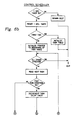
- the overall ADIOS program is composed of the following main sub-routines or functions, tables, and a Queue (refer to Fig. 1 for a block diagram representation):
- the ADIOS operation is based on the 50/60 Hz interrupt signal for all its timing. Every 50/60 Hz interrupt (20.0 or 16.67 msec, respectively) the ADIOS Executive is responsible for servicing a variety of functions, bassed on the state of the AIS Table.
- the basic functions that the ADIOS Executive routine has to perform, as shown in Fig. 1, are:
- the Calculation Filter Routine is normally responsible for reading the AIQ and converting all input channel counts in the Queue into engineering units (the exception to this is the calibration channels and the "Marks").
- the CFR reads the "Range” from the AIQ in order to use the appropriate calibration channels. This process converts the counts into a physical value.
- the CFR reads the channel number from the AIQ in order to determine which input configuration file to use to make the conversion.
- the configuration file describes the relationship between the physical input parameter (ohms, volts, mA) and the engineering units (°F, °C, psi, etc.). Also in this file is the control variable number which has been mapped to this physical input.
- the resulting engineering units will be stored in a random access memory (RAM) table corresponding to this Control Variable Number, such that the control algorithm routines that use these values need to have no knowledge of the conversion process.
- RAM random access memory
- the Channel Type describes some special functions. If the Type indicates a calibration channel, no conversion is required to engineering units. The number of counts is stored as a reference point which is mapped to a known physical value. If the Type is a "Mark", this indicates that the Task Scheduler should be spawned.
- the CFR performs filtering using a method described hereinafter. Every channel is read twice by the ADIOS, such that two readings for the same channel always appear in succession in the AIQ. The CFR converts both readings and implements the filtering scheme.
- the Task Scheduler is spawned every second by the CFR due to reading a "Mark" in the AIQ.
- Information (flag) is available to the TS as to whether or not the spawn is due to a one second Mark or a FAST Rate Mark (the Mark that occurs immediately following the completion of the FAST channels).
- the TS is responsible for calling the appropriate control algorithm routines based on the CATS Table.
- the CATS Table describes the Call rate (seconds between calls) and condition codes for each routine.
- the Condition Code byte for each routine tells whether or not a routine should be called when its Call Rate count expires.
- the AIS Table describes a schedule of events within the SLOW Rate cycle. For example, if the SLOW Rate is specified to be fifteen seconds, the AIS Table will be built to describe every event within a fifteen second period. Each table entry is described in terms of a Channel Number and an Event Type. Events are usually channel readings that are one of the normal analog inputs into the controller system or one of the possible calibration readings. The examples herein are based on scanning sixteen data inputs. However, Events can also be special types that provide synchronization (one second Mark, FAST Rate Mark, or Delay Count) or the "End of File" (EOF) type. The "one second Mark” is a Mark that replaces a "one second Mark” every "FAST Rate” seconds.
- the AIS Table For initialization on power-up (or hard reset) the AIS Table is not used. The system first cycles through all the calibration channels, then goes through all the configured input channels. Once this is completed the Control is spawned and the first channel in the AIS Table is scheduled. Calibration readings are scheduled into the table also during normal operation.
- the AIS table describes a channel event with respect to time. Each event in the table requires a given number of 50/60 Hz interrupts based on the Type. Since the "Event Type" implies how many 50/60 Hz interrupts will occur before the AIS Table is referred again, the ADIOS is required to keep track of this status. The number of interrupts which must occur for each type, and the action the ADIOS must take at each of these interrupts is hardware dependant and is not inherent to the ADIOS operation.
- Each slot in the AIS Table is a single byte.
- the upper nibble of the byte corresponds to the Type, and the lower nibble corresponds to the Channel Number.
- the other Types use the byte for a purpose specific to that type.
- Type Byte Code Interrupts Required 60 Hz 50 Hz Calibration 00-0E 13 13 Resistive 10-1F 27 25 Voltage 20-2F 13 13 Digital 30-3F 2 2 Delay 80-BF * * FAST Rate Mark FD 0 0 One second Mark FE 0 0 End of File (EOF) FF 0 0 * Depends of the Schedule built within each FAST Cycle.
- the ADIOS After reading the AIS Table, the ADIOS would immediately select the appropriate input and set the flags/bytes necessary to monitor the state of the input. Some examples of these flags/bytes are: . Active (Current) AIS Table slot number . Number of counts (interrupts) required for this event type. . Number of counts (interrupts) remaining in this event type. . “Settling Analog Input” flag. . “Converting Analog Input” flag. . “Converting Digital Input” flag, etc.
- the ADIOS When each data reading is completed, the ADIOS inserts the counts, channel number, etc. into the AIQ (see hereinafter). There will be two successive readings for each analog channel in this table.
- the CFR must convert both readings and use these values in the filtering scheme described hereinafter.
- the Byte Code In a Calibration Channel the Byte Code equals 00-OEH.
- the Byte Code for a Calibration Channel will be fixed at 00H, since the table only inserts a single slot for calibration.
- the ADIOS keeps track of which Calibration channel is to be selected each time it goes through the table.
- a Calibration Channel Like any input reading, a Calibration Channel consists of two readings. If the readings are both outside the valid range allowed for the channel, the last good reading is left unchanged and a flag is set for this channel. If the Calibration channel continues to produce bad readings (3 consecutive readings), the A/D is shut down.
- a Calibration channel requires thirteen interrupt cycles: Activity Interrupts Settle 1 First Reading 6 Second Reading 6 Total 13
- the Byte Code In a Resistive Channel the Byte Code equals 10-1FH.
- Byte Code Numbers in the AIS Table range from 10-1FH, e.g., channels on the controller numbered from 10-17H.
- a resistive channel is actually converted twice during each "Reading", since the first conversion may actually be done in the wrong range of the A/D Converter. If the readings are both outside the valid range allowed for the channel, the last good reading is left unchanged, and a flag is set for this channel. If the channel continues to produce bad readings, a Failure message corresponding to this condition may be displayed. The system is not shut down due to an "Out of Range" input.
- a Resistive channel requires the following number of interrupts:
- the Byte Code In a Voltage Channel the Byte Code equals 20-2FH.
- Byte Code Numbers in the AIS Table range from 20-2FH, e.g., channels on the controller numbered from 20-27H. Since there is only a single range in which voltage channels are read, two conversions within each reading is not necessary. However, the same filtering technique (described hereinafter) is used as with the other types of inputs.
- a Voltage channel requires the following number of interrupts: Activity Interrupts Settle 1 First Reading 6 Second Reading 6 Total 13
- the Byte Code In a Digital Channel the Byte Code equals 30-3FH.
- Byte Code Numbers in the AIS Table range from 30-3FH, e.g., channels on the controller numbered from 30-37H.
- An analog channel configured as a digital input requires no filtering and is always read at the FAST channel rate. Since the input state is integrated, the proper state will be read unless the input is in a state of transition while being read. The proper state will be read “FAST" seconds later, or only one second if this input is configured as a "DIGl” channel (see hereinafter for explanation of DIGl).
- a Digital channel requires the following number of interrupts: Activity Interrupts Settle 1 Reading 1 Total 2
- the Delay is a "planned deadtime", required since the schedule of all the channels within each FAST time period cycle will usually not fall on even FAST boundaries.
- the Delay period is a multiple of 50/60 Hz interrupts and is specified in the lowest six bits of the Byte Code byte (0-63 interrupts).
- the Byte Code equals FE. This mark is used to spawn the Task Scheduler. It may not be at exactly the one second point in each FAST cycle due to the scheduling of the channels, but it will always be within "X" msec. "X” is a parameter specified as part of the basic characteristics of the control algorithm from 0-255 msec.
- the AIS Table is constructed in the PC based on the rates programmed for FAST and SLOW and the tolerance allowed for the One Second Mark.
- the FAST rate determines the size of each "sub-cycle”
- the SLOW rate determines the number of sub-cycles necessary to complete the table.
- the One Second Mark Tolerance determines how many slots will actually be required for Delay in each FAST sub-cycle.
- a sub-cycle is first built by working backwards from the FAST Mark. Any DIGl and FAST channels are inserted immediately in front of the FAST Mark. If it happens that the One Second Mark falls within these channels in the sub-cycle, the One Second Mark is inserted where it produces the least deviation from one second within the specified tolerance. If the tolerance cannot be satisfied, a Delay slot will be inserted. The DIGl channels are then also inserted immediately in front of each One Second Mark. After all the FAST channels have been inserted, the SLOW channels are inserted.
- SLOW channels The only criteria for SLOW channels is that they all are scheduled at least once within the SLOW rate cycle.
- the amount of time available in a sub-cycle (after all the FAST and DIGl channels have been inserted), the number of sub-cycles in the table, and the number of Delay slots necessary due to the tolerance specified for One Second Marks determine whether or not the schedule, first of all, is even possible. If possible, the number of sub-cycles, and the number of slots necessary in each sub-cycle, determine if the table will eventually even fit within the controller's PROM . If both of these initial criteria are met. the SLOW channels can be inserted.
- the AIS Table in Fig. 2 contains sample entries which will be used to illustrate an example schedule, e.g., sixteen data inputs.
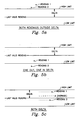
- Fig. 3 illustrates how this schedule is translated into real-time by the ADIOS.
- the configuration in this example is the following: one FAST Voltage-type (channel #1), one DIGl-type (channel #0), one SLOW Voltage-type (channel #5), and thirteen SLOW Resistive-type (channels #2-4, and 6-15) inputs.
- the first fourteen conversions are the Calibration Channels.
- the next “x" conversions depend on the number of channels configured, which in this case is all sixteen channels. The conversions proceed from the lowest physical channel number to the highest. This is the only time this will be done, since the calibration channels will be "sprinkled” into the table during normal operation, and the regular input channels will be based on the AIS Table. These time slots are to the left in Fig. 3 (earlier in time).
- the Delay slot contains the Byte Code 89H (nine delay counts). The calculation to determine this Delay value, based on the various Event Types and the counts they require in this particular sub-cycle, is shown below.
- Fig. 3 shows the nine Delay interrupts at the far left of the diagram.
- This slot indicates a Byte Code of 12H (resistive Channel #2).
- Channels 2-15 are the channels configured as SLOW. The scheduler inserts these channels into the five sub-cycles as space permits. In this first sub-cycle, SLOW channels 2-5 are scheduled (Slots 1, 2, 5 and 6). Channels 6-9 will be scheduled in sub-cycle #2, channels 10-13 in sub-cycle #3, and the last 2 SLOW channels in sub-cycle #4.
- Channel #2 is selected and the A/D routines are called to control the reading of this input.
- Fig. 3 shows this channel immediately following the Delay interrupts. The channel is first "settled” (S), then the A/D conversion is done in the next 26 interrupts. On the 27th interrupt Slot #2 is read. (Slots 2-6 are not shown in Fig. 3.)
- the DIGl channel Since the DIGl channel type requires a reading every second, the DIGl channel is scheduled immediately before the One Second Mark in Slot #4.
- the channel to be read is #0 (Byte Code 30H indicates DIGl Channel #0).
- the One Second Mark is scheduled here based on the channels located in Slots 5-8 and is placed based on the closest it can get to the 60th count back from the FAST Mark.
- the FAST Mark indicates the end of sub-cycle #1. Note that the FAST Mark does not actually take up any real time in Fig. 3. The next Slot will contain the Delay counts for sub-cycle #2.
- the remainder of the table would consist of sub-cycles #2-#5.
- the Delay counts and scheduling of channels in sub-cycles #2 thru #5 will be different from #1, since the single SLOW voltage-type channel was read in sub-cycle #1.
- the remaining 10 SLOW resistive channels must be spread between sub-cycles #2-#5, and only three will fit in each sub-cycle. The reason is because there was only 9 counts left for Delay in the first sub-cycle, the SLOW voltage channel freed-up 13 counts, and the remaining resistive channels require 27 counts each, i.e., 22 available ⁇ 27 required.
- Sub-cycle #5 will consist of the last SLOW channel, the FAST and DIGl channels and one of the 14 Calibration Channels.
- the Channel Number will be read as 00H and the ADIOS must keep track of which Calibration channel is next, since the AIS Table does not explicitly call out the channel number in this section of the table.
- This slot indicates the end of the table and that the beginning of the table should be read (Slot 0).
- This schedule required 46 slots in this example, or 92 bytes. This number was arrived at as follows: Sub-cycle # # of Slots 1 10 2 9 3 9 4 9 5 8 EOF 1 Total 46
- the analog input calculation queue is a queue of channels that have been read, but have not yet had their counts coverted to a meaningful engineering unit for use by the control algorithm routines.
- the table is composed of the following parameters: . Channel Number (1 byte) . Accumulated Counts (2 bytes) . A/D Range in which counts were accumulated (1 byte)
- An entry into the AIQ is made every time a channel is read and a valid number of counts is accumulated.
- the ADIOS spawns the CFR.
- the CFR may already be running at this point, but the operating system will not restart the CFR until it is completed.
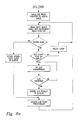
- the CFR reads the AIQ and converts the counts to engineering units based on the configuration parameters for that channel number. For every analog voltage/resistive input channel there are two readings taken. Both readings are converted and used in the filtering scheme described hereinafter.
- the Control Algorithm Task Schedule (CATS) Table describes which control-related routines are to be called by the Task Scheduler, whether or not the task is to be synchronized to a FAST channel reading, and the frequency at which it should be called.
- the Task Scheduler is capable of calling routines at 1-255 second intervals. Tasks that depend on the timely reading of an input, i.e., need to be synchronized to FAST channel reading, are insured to run after the channel has been read and its engineering units computed. This is accomplished by inserting one second and FAST Rate "Marks" into the Channel Schedule and moving these Marks into the AIQ.
- the CATS Table has the following structure: . Subroutine ID Number (Address) . Sync Flag . Initial Call Rate Count . Normal Call Rate Count . Condition Code Byte
- Subroutine ID Number (Address) Number assigned to the subroutine which allows a subroutine's status to be kept and a call to be made via a table entry.
- Sync Flag Allows a routine to be called such that it is always synchronized to a FAST channel reading it depends on.
- Initial Call Rate Count Number of seconds before the routine is called for the very first time. This number can be changed on the fly if required.
- Normal Call Rate Count Number of seconds between calls on a normal basis. This number can be changed on the fly if required.
- Condition Code Byte Byte that describes which conditions must exist (or not exist) before routine can be run, even if Call Rate count has expired.
- A/D analog-to-digital converter
Landscapes
- Engineering & Computer Science (AREA)
- Theoretical Computer Science (AREA)
- Human Computer Interaction (AREA)
- Physics & Mathematics (AREA)
- General Engineering & Computer Science (AREA)
- General Physics & Mathematics (AREA)
- Analogue/Digital Conversion (AREA)
- Control By Computers (AREA)
- Feedback Control In General (AREA)
Applications Claiming Priority (2)
| Application Number | Priority Date | Filing Date | Title |
|---|---|---|---|
| US371901 | 1982-04-26 | ||
| US37190189A | 1989-06-27 | 1989-06-27 |
Publications (2)
| Publication Number | Publication Date |
|---|---|
| EP0405924A2 true EP0405924A2 (fr) | 1991-01-02 |
| EP0405924A3 EP0405924A3 (en) | 1992-02-19 |
Family
ID=23465874
Family Applications (1)
| Application Number | Title | Priority Date | Filing Date |
|---|---|---|---|
| EP19900306994 Withdrawn EP0405924A3 (en) | 1989-06-27 | 1990-06-26 | Analog to digital input operating system |
Country Status (4)
| Country | Link |
|---|---|
| EP (1) | EP0405924A3 (fr) |
| JP (1) | JPH0337704A (fr) |
| AU (1) | AU5479890A (fr) |
| CA (1) | CA2014252A1 (fr) |
Cited By (7)
| Publication number | Priority date | Publication date | Assignee | Title |
|---|---|---|---|---|
| US5239456A (en) * | 1990-07-30 | 1993-08-24 | The Foxboro Company | Method and apparatus for process control with opimum setpoint determination |
| US5319539A (en) * | 1992-05-27 | 1994-06-07 | The Foxboro Company | Method and apparatus for generating an optimal gain of process control equipment |
| US5335165A (en) * | 1992-05-27 | 1994-08-02 | The Foxboro Company | Method and apparatus for adaptive deadtime process control |
| US5341288A (en) * | 1992-05-27 | 1994-08-23 | The Foxboro Company | Method and apparatus for analyzing process characteristics |
| US5420785A (en) * | 1993-05-26 | 1995-05-30 | The Foxboro Company | Self-tuning deadtime process controller |
| US5537388A (en) * | 1994-03-02 | 1996-07-16 | The Foxboro Company | Method and apparatus for characterizing and compensating for non-linear components |
| US5649195A (en) * | 1995-05-22 | 1997-07-15 | International Business Machines Corporation | Systems and methods for synchronizing databases in a receive-only network |
Families Citing this family (1)
| Publication number | Priority date | Publication date | Assignee | Title |
|---|---|---|---|---|
| JP3260226B2 (ja) * | 1993-11-22 | 2002-02-25 | 株式会社小糸製作所 | 車両用色替わり灯具 |
Family Cites Families (3)
| Publication number | Priority date | Publication date | Assignee | Title |
|---|---|---|---|---|
| JPS55159240A (en) * | 1979-05-31 | 1980-12-11 | Nissan Motor Co Ltd | Collection and control unit of data for automobile |
| GB2159676A (en) * | 1983-12-15 | 1985-12-04 | Caterpillar Tractor Co | Sequencing analog to digital converter |
| GB8527676D0 (en) * | 1985-11-09 | 1985-12-11 | Burr Brown Ltd | Interfacing between analog signals & system bus |
-
1990
- 1990-04-10 CA CA 2014252 patent/CA2014252A1/fr not_active Abandoned
- 1990-05-07 AU AU54798/90A patent/AU5479890A/en not_active Abandoned
- 1990-05-30 JP JP13863290A patent/JPH0337704A/ja active Pending
- 1990-06-26 EP EP19900306994 patent/EP0405924A3/en not_active Withdrawn
Cited By (7)
| Publication number | Priority date | Publication date | Assignee | Title |
|---|---|---|---|---|
| US5239456A (en) * | 1990-07-30 | 1993-08-24 | The Foxboro Company | Method and apparatus for process control with opimum setpoint determination |
| US5319539A (en) * | 1992-05-27 | 1994-06-07 | The Foxboro Company | Method and apparatus for generating an optimal gain of process control equipment |
| US5335165A (en) * | 1992-05-27 | 1994-08-02 | The Foxboro Company | Method and apparatus for adaptive deadtime process control |
| US5341288A (en) * | 1992-05-27 | 1994-08-23 | The Foxboro Company | Method and apparatus for analyzing process characteristics |
| US5420785A (en) * | 1993-05-26 | 1995-05-30 | The Foxboro Company | Self-tuning deadtime process controller |
| US5537388A (en) * | 1994-03-02 | 1996-07-16 | The Foxboro Company | Method and apparatus for characterizing and compensating for non-linear components |
| US5649195A (en) * | 1995-05-22 | 1997-07-15 | International Business Machines Corporation | Systems and methods for synchronizing databases in a receive-only network |
Also Published As
| Publication number | Publication date |
|---|---|
| EP0405924A3 (en) | 1992-02-19 |
| AU5479890A (en) | 1991-01-03 |
| JPH0337704A (ja) | 1991-02-19 |
| CA2014252A1 (fr) | 1990-12-27 |
Similar Documents
| Publication | Publication Date | Title |
|---|---|---|
| US5339425A (en) | Operating system for a process controller | |
| EP0405924A2 (fr) | Système opérationnel pour entrée analogique-numérique | |
| US4560976A (en) | Data compression | |
| EP0579354B1 (fr) | Equipement de commande avec transmission de definition de structure de commande | |
| EP0534583B1 (fr) | Compteur convertible d'énergie | |
| KR100422132B1 (ko) | 실시간 시스템의 씨피유 타스크 점유율 측정장치 | |
| US6507298B1 (en) | Method for selecting, prioritizing, and A/D conversion of analog signals, and A/D converter configuration that prioritizes and selects signals | |
| US5352875A (en) | Terminal for an IC card | |
| US20030163475A1 (en) | In-place dynamically re-sizeable persistent historical database | |
| US4562423A (en) | Data compression | |
| EP1650673B1 (fr) | Procédé et système pour créer un temporisateur étendu de bits dans une unité de traitement de temps | |
| DE4104365C1 (fr) | ||
| EP0578361A1 (fr) | Appareil numérique de traitement de signaux | |
| CN101266474B (zh) | 可编程控制器系统 | |
| Boterenbrood et al. | The development of embedded local monitor board (ELMB) | |
| AU9062898A (en) | A method and a computer system for configuring a set of objects | |
| CN1308424A (zh) | 数字无绳电信系统终端的控制单元及用于控制单元的方法 | |
| GB2109204A (en) | Data compression | |
| US7058841B2 (en) | System and method for implementing a timer facility | |
| US6531906B2 (en) | Delay systems and methods using a variable delay SINC filter | |
| DE10028064A1 (de) | Computersystem mit einer ROM-Korrektureinheit | |
| KR100730859B1 (ko) | 데이터 분배 시스템 | |
| KR100400930B1 (ko) | 필터특성이프로그램가능한디지탈필터링방법및디지탈필터 | |
| Cittolin et al. | A Remus based crate controller for the autonomous processing of multichannel data streams | |
| Williams | SCADA and CIM: towards integration |
Legal Events
| Date | Code | Title | Description |
|---|---|---|---|
| PUAI | Public reference made under article 153(3) epc to a published international application that has entered the european phase |
Free format text: ORIGINAL CODE: 0009012 |
|
| AK | Designated contracting states |
Kind code of ref document: A2 Designated state(s): CH DE FR GB IT LI NL SE |
|
| PUAL | Search report despatched |
Free format text: ORIGINAL CODE: 0009013 |
|
| AK | Designated contracting states |
Kind code of ref document: A3 Designated state(s): CH DE FR GB IT LI NL SE |
|
| STAA | Information on the status of an ep patent application or granted ep patent |
Free format text: STATUS: THE APPLICATION IS DEEMED TO BE WITHDRAWN |
|
| 18D | Application deemed to be withdrawn |
Effective date: 19920820 |