EP0406457A1 - Procédé de chiffrage et de déchiffrage de données - Google Patents
Procédé de chiffrage et de déchiffrage de données Download PDFInfo
- Publication number
- EP0406457A1 EP0406457A1 EP89112107A EP89112107A EP0406457A1 EP 0406457 A1 EP0406457 A1 EP 0406457A1 EP 89112107 A EP89112107 A EP 89112107A EP 89112107 A EP89112107 A EP 89112107A EP 0406457 A1 EP0406457 A1 EP 0406457A1
- Authority
- EP
- European Patent Office
- Prior art keywords
- data
- values
- key
- encrypted
- electronic circuit
- Prior art date
- Legal status (The legal status is an assumption and is not a legal conclusion. Google has not performed a legal analysis and makes no representation as to the accuracy of the status listed.)
- Withdrawn
Links
Images
Classifications
-
- H—ELECTRICITY
- H04—ELECTRIC COMMUNICATION TECHNIQUE
- H04L—TRANSMISSION OF DIGITAL INFORMATION, e.g. TELEGRAPHIC COMMUNICATION
- H04L9/00—Cryptographic mechanisms or cryptographic arrangements for secret or secure communications; Network security protocols
- H04L9/06—Cryptographic mechanisms or cryptographic arrangements for secret or secure communications; Network security protocols the encryption apparatus using shift registers or memories for block-wise or stream coding, e.g. DES systems or RC4; Hash functions; Pseudorandom sequence generators
- H04L9/0618—Block ciphers, i.e. encrypting groups of characters of a plain text message using fixed encryption transformation
-
- H—ELECTRICITY
- H04—ELECTRIC COMMUNICATION TECHNIQUE
- H04L—TRANSMISSION OF DIGITAL INFORMATION, e.g. TELEGRAPHIC COMMUNICATION
- H04L2209/00—Additional information or applications relating to cryptographic mechanisms or cryptographic arrangements for secret or secure communication H04L9/00
- H04L2209/12—Details relating to cryptographic hardware or logic circuitry
-
- H—ELECTRICITY
- H04—ELECTRIC COMMUNICATION TECHNIQUE
- H04L—TRANSMISSION OF DIGITAL INFORMATION, e.g. TELEGRAPHIC COMMUNICATION
- H04L2209/00—Additional information or applications relating to cryptographic mechanisms or cryptographic arrangements for secret or secure communication H04L9/00
- H04L2209/24—Key scheduling, i.e. generating round keys or sub-keys for block encryption
Definitions
- the invention relates to a method for encrypting and decrypting data according to the preamble of claim 1.
- Encrypting means that a reversible function is applied to data to be encrypted, which depends on a key value. As a result, the encrypted data can only be decrypted by using a function dependent on a key value again.
- the functions and the key values can be identical, but they can also differ.
- DES DATA ENCRYPTION STANDARD
- the data to be encrypted is divided into blocks, with each block being divided into a right and a left sub-block.
- the method runs in similar sub-steps, with in each of these sub-steps a reversible function dependent on a 48-bit sub-key being applied to the left sub-block, while the right sub-block is not encrypted in this sub-step.
- the right, unencrypted sub-block is then stored at the location of the left sub-block and the encryption result of the left sub-block is stored at the location of the right sub-block, ie the data are changed using a reversible method.
- STREAM CHIPERS a method known as "STREAM CHIPERS" is known.
- this key does not have to consist of as many values as the data to be encrypted, it can be generated, for example, by a pseudo-random generator, ie a generator that produces a pseudo-random data word in succession.
- this pseudo random generator can consist of several interlinked pseudo random generators. So that the encrypted data can be decrypted again, the same pseudo-random generator that was used for the encryption is required. It also requires that the pseudo-random generator start running in the same place.
- the pseudo-random generator for encrypting different data packets always starts at the same place, it can easily be "listened to", i.e. by encrypting known data, the values required for decrypting other data can be determined. Therefore, in Ciarcia on page 110 it is suggested to change the start value more often, that is, to introduce an initialization vector.
- the initial value used to encrypt data must be transmitted to decrypt that data with the data. This applies in particular if the start value is determined depending on the data to be encrypted, since this data is no longer available after encryption.
- Ciarcia a key generator is described on page 101, the key values of which depend on the output values of an electronic circuit.
- the key values of which depend on the output values of an electronic circuit.
- Ciarcia describes circuit arrangements with which such known methods can be carried out. In addition, he describes in particular on page 102 ff. The possibility of carrying out part of such an encryption method by means of a suitably programmed microprocessor.
- the object of the invention is to provide a method for encrypting and decrypting data, in which the key values are changed without additional auxiliary values being required.
- the invention relates to a method for encrypting and decrypting data D, D 'which takes place in sub-steps S1, S2, ... Sn and in which the key values K for the individual sub-steps S1, S2, ... Sn are dependent of the ver key data can be changed with the help of an electronic circuit EC.
- the key values K required for decryption are obtained from the data to be decrypted without additional auxiliary values.
- part A of the data which is used to generate the key value K is not encrypted and in each of the sub-steps S1, S2, ... Sn of the method, a different one is used Part of the data to be processed is used to generate the key values K.
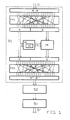
- FIG. 1 shows, in the form of a block diagram, the basic sequence of an encryption process that takes place in several sub-steps S1, S2,... Sn.
- the data D to be encrypted are encrypted in several substeps S1, S2, ... Sn and the encrypted data D 'is output. It is advisable to choose the number of steps so that the encryption process meets at least the following criteria: - Each bit of the encrypted data D 'should depend on each bit of the data to be encrypted D; - When changing a bit of the data to be encrypted D, the probability of a change in each bit of the encrypted data D 'should be 50%.
- FIG. 1 also shows a possible embodiment of a sub-step of a method according to the invention.
- the input data A ', B' of this substep are reversibly changed by a method FP1.
- a method FP1 can cause the individual bit positions to be interchanged, and can also an inversion or any other reversible function may be provided.
- the aim of this method is to encrypt each bit of the data D to be encrypted at least once during the execution of all sub-steps S1, S2,... Sn.
- the part A of the data processed according to the method FP1 serves as an input variable of a key generator KG, the key value provided at the output of this key generator KG depending on this input variable A.
- Part A of the data processed according to method FP1 is not encrypted within this sub-step S1.
- the rest of the data processed according to the method FP1, denoted by B in FIG. 1, is processed on the basis of a reversible function dependent on a key value K and forms the data part denoted by C in FIG.
- the unencrypted data part A and the data part C are reversibly changed in this exemplary embodiment by a method FP2.
- This method FP2 also only has to be reversible, like the method FP1.
- this method FP2 should not depend on a key value.
- S1, S2, ... Sn it is sufficient to use only either the method FP1 or the method FP2. It is only important that within each substep at least a portion of the data A serving as the input variable of the key generator KG in the output variable A ⁇ , B ⁇ does not have the same bit position as in the input variable A ′, B ′, so that after all sub-steps S1 have been processed , S2, ... Sn every bit of the input data D has been encrypted at least once.
- Which reversible function, if possible not dependent on a key value, on which the method FP1 or FP2 is based is otherwise in principle not important for a method according to the invention.
- the output variable A ⁇ , B ⁇ of a sub-step thus contains a part of the input variable A ′, B ′ of this sub-step, which is changed according to a resulting function FP1, FR, FP2 dependent on a key value K and a part of the input variable A ′, B ′ which is changed according to a function FP1, FP2 which is not dependent on a key value.
- a simple example of a reversible function FP1, FP2 that is not dependent on a key value is the interchanging of the bit positions, i.e. the bit positions of the input data differ from the bit positions of the output data.
- Such a function can be implemented by fixed wiring, as shown schematically in FIG. 1 and FIG. 2, but also by an appropriately programmed data processing system, for example a microprocessor.
- An example of a function dependent on a key value is the exclusive OR function.
- An implementation in the form of a method step of an electrical circuit based on such a function and also an implementation with the aid of an appropriately programmed microprocessor are known from "Ciarcia".
- a method according to the invention described above can be carried out entirely with the aid of an electrical circuit or an electronic circuit, but it can also be carried out with the aid of an appropriately programmed data processing system. It is only essential for the invention that at least one electronic circuit EC influencing the key values K of the key generator KG is present. It is not excluded that the key generator KG is partially implemented by an appropriately programmed microprocessor.
- a very simple embodiment of such a key generator KG is a programmed non-volatile memory in which the on output data A supply the address data and the corresponding memory contents are output as a function of this address data.
- the coding can be carried out by correspondingly programming the memory or by having the coding values, for example, the column addresses of the key values and the input data A determine the row addresses of the key values K.
- the coding values can be linked to the input data A of the key generator KG or the output values of a memory using an exclusive OR function.
- it is advisable to make the key generator somewhat more complicated because this increases the security of the encryption device. It is only important for the key generator KG that it outputs key values K in a clear dependency on input data A and that if the key generator KG can be coded, these key values K also depend clearly on the coding values.
- the key generator KG used is encodable and contains the coding values in an electronic circuit EC ten and if this electronic circuit EC can also be separated from the rest of the device required to carry out the method according to the invention, different users can encrypt data with the aid of the electronic circuit EC encoded for them on the same device without another user could decrypt this encrypted data again.
- Such electronic circuits EC which can be separated from the rest of the device, can be contained in chip cards, for example, or can be connected to the device via an interface.
- Encryption methods according to the invention are conceivable which influence the data for each sub-step S1, S2, ... Sn according to different functions FP1, FP2, FK. If, for example, part of the data B is processed using a reversible function FR that is dependent on a key value, and in the next sub-step another part of the output data of this sub-step is processed using a function that is dependent on a key value K in such a step, for example this is equivalent to the fact that the data have been changed once according to a predetermined method FP1. In this special case, these methods FP1, FP2 would be based on a permutation function.
- a simple but nevertheless reliable method according to the invention can be implemented in that the sequence of the individual sub-steps S1, S2, ... Sn is identical and thus only one circuit or one sequence routine is required for all sub-steps S1, S2, ... Sn .
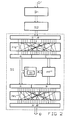
- FIG. 2 shows, in the form of a block diagram, a method for decrypting data D ′ which had previously been encrypted from data D using a method shown in FIG. 1.
- Sn substeps
- S1 are required as for encrypting this data.
- the individual steps S1, S2, ... Sn in the Ver Keying functions FR, FP1, FP2 are replaced by their inverse functions FR Um1, FP1 ⁇ 1 and FP2 ⁇ 1 for decryption and the substeps Sn ... S2, S1 are processed in reverse order.
- a key value K is generated depending on an electronic circuit EC and depending on part A of the data to be decrypted, without an additional auxiliary value, which exactly matches the key value used for encryption in this substep, but still not, as in the case of Pseudorandom generator sequences, is predictable and also not, as is the same for DES in all encryption and decryption processes for the nth substep.
- a self-inverse function that is dependent on key values is, for example, the above-mentioned exclusive OR function, and a self-inverse function that is not dependent on key values and is suitable for methods according to the invention is a symmetrical permutation function.
Landscapes
- Engineering & Computer Science (AREA)
- Computer Security & Cryptography (AREA)
- Computer Networks & Wireless Communication (AREA)
- Signal Processing (AREA)
- Storage Device Security (AREA)
Priority Applications (1)
| Application Number | Priority Date | Filing Date | Title |
|---|---|---|---|
| EP89112107A EP0406457A1 (fr) | 1989-07-03 | 1989-07-03 | Procédé de chiffrage et de déchiffrage de données |
Applications Claiming Priority (1)
| Application Number | Priority Date | Filing Date | Title |
|---|---|---|---|
| EP89112107A EP0406457A1 (fr) | 1989-07-03 | 1989-07-03 | Procédé de chiffrage et de déchiffrage de données |
Publications (1)
| Publication Number | Publication Date |
|---|---|
| EP0406457A1 true EP0406457A1 (fr) | 1991-01-09 |
Family
ID=8201581
Family Applications (1)
| Application Number | Title | Priority Date | Filing Date |
|---|---|---|---|
| EP89112107A Withdrawn EP0406457A1 (fr) | 1989-07-03 | 1989-07-03 | Procédé de chiffrage et de déchiffrage de données |
Country Status (1)
| Country | Link |
|---|---|
| EP (1) | EP0406457A1 (fr) |
Cited By (5)
| Publication number | Priority date | Publication date | Assignee | Title |
|---|---|---|---|---|
| EP0518315A3 (en) * | 1991-06-13 | 1993-07-21 | Mitsubishi Denki Kabushiki Kaisha | System and method for blockwise encryption of data |
| WO1997025799A1 (fr) * | 1996-01-11 | 1997-07-17 | Teledyne Industries, Inc. | Procede et dispositif de melange entre tours de role dans les systemes a substitution iterative de blocs |
| WO1997044935A1 (fr) * | 1996-05-20 | 1997-11-27 | Philips Electronics N.V. | Procede et appareil cryptographiques de fusion non lineaire d'un bloc de donnees et d'un code |
| EP0993143A1 (fr) * | 1998-10-07 | 2000-04-12 | Lateca Computer Inc. N.V. | Procédé de traitement et dispositif pour convertir une information d'un premier format en un second format |
| US6845159B1 (en) | 1998-10-07 | 2005-01-18 | Protego Information Ab | Processing method and apparatus for converting information from a first format into a second format |
Citations (2)
| Publication number | Priority date | Publication date | Assignee | Title |
|---|---|---|---|---|
| DE3244537A1 (de) * | 1982-12-02 | 1984-06-07 | Ant Nachrichtentech | Verfahren zur ver- und entschluesselung von datenbloecken |
| EP0202989A1 (fr) * | 1985-05-15 | 1986-11-26 | Thomson-Csf | Dispositif de chiffrement par substitutions-permutations |
-
1989
- 1989-07-03 EP EP89112107A patent/EP0406457A1/fr not_active Withdrawn
Patent Citations (2)
| Publication number | Priority date | Publication date | Assignee | Title |
|---|---|---|---|---|
| DE3244537A1 (de) * | 1982-12-02 | 1984-06-07 | Ant Nachrichtentech | Verfahren zur ver- und entschluesselung von datenbloecken |
| EP0202989A1 (fr) * | 1985-05-15 | 1986-11-26 | Thomson-Csf | Dispositif de chiffrement par substitutions-permutations |
Cited By (7)
| Publication number | Priority date | Publication date | Assignee | Title |
|---|---|---|---|---|
| EP0518315A3 (en) * | 1991-06-13 | 1993-07-21 | Mitsubishi Denki Kabushiki Kaisha | System and method for blockwise encryption of data |
| US5488661A (en) * | 1991-06-13 | 1996-01-30 | Mitsubishi Denki Kabushiki Kaisha | Data communication system and method with data scrambling |
| WO1997025799A1 (fr) * | 1996-01-11 | 1997-07-17 | Teledyne Industries, Inc. | Procede et dispositif de melange entre tours de role dans les systemes a substitution iterative de blocs |
| US5838794A (en) * | 1996-01-11 | 1998-11-17 | Teledyne Electronic Technologies | Method and apparatus for inter-round mixing in iterated block substitution systems |
| WO1997044935A1 (fr) * | 1996-05-20 | 1997-11-27 | Philips Electronics N.V. | Procede et appareil cryptographiques de fusion non lineaire d'un bloc de donnees et d'un code |
| EP0993143A1 (fr) * | 1998-10-07 | 2000-04-12 | Lateca Computer Inc. N.V. | Procédé de traitement et dispositif pour convertir une information d'un premier format en un second format |
| US6845159B1 (en) | 1998-10-07 | 2005-01-18 | Protego Information Ab | Processing method and apparatus for converting information from a first format into a second format |
Similar Documents
| Publication | Publication Date | Title |
|---|---|---|
| DE69123680T2 (de) | Verfahren und Vorrichtung zum Schutz von Mehrfachrechner-Softwarekopien gegen unberechtigte Benutzung | |
| DE69929251T2 (de) | Verschlüsselungssystem mit einem schlüssel veränderlicher länge | |
| DE3650365T2 (de) | Einrichtung zur Datenverschleierung. | |
| DE68922847T2 (de) | Übertragungsvorrichtung. | |
| DE19733829C2 (de) | Verfahren zum Verschlüsseln bzw. Entschlüsseln einer Datenfolge | |
| DE69031736T2 (de) | Verschlüsselungsmethode | |
| DE69509127T2 (de) | Verfahren zum durchführen eines kommunikationsprotokolles mit geheimschlüssel zwischen zwei verarbeitungsvorrichtungen | |
| EP0281057B1 (fr) | Circuit pour la sécurité de l'accès à un ordinateur à l'aide d'une carte à circuit intégré | |
| DE69634880T2 (de) | Verfahren und gerät zum kontrollierten zugriff zu verschlüsselten datenakten in einem computersystem | |
| DE69728465T2 (de) | Nichtparalleler Mehrzyklus-Verschlüsselungsapparat | |
| DE69222090T2 (de) | Einrichtung und Verfahren zum blockweisen Verschlüsseln von Daten | |
| EP0012974B1 (fr) | Procédé de chiffrage de blocs de données ayant une longueur prédéterminée | |
| DE2231849B2 (de) | Verschlüsselungsverfahren zur Erhöhung der Entschlüsselungsfestigkeit von blockweise zu verschlüsselnden Binärdaten und Anordnung zur Durchführung des Verfahrens | |
| WO2001054083A1 (fr) | Circuit de microprocesseurs avec codage | |
| EP0631408A2 (fr) | Procédé d'authentification entre deux dispositifs électroniques | |
| DE102008010789B4 (de) | Verfahren zur zugriffs- und kommunikationsbezogenen Zufallsver- und Entschlüsselung von Daten | |
| DE2949351A1 (de) | Verfahren und vorrichtung zur absicherung von dokumenten sowie dabei verwendetes dokument | |
| DE602004001732T2 (de) | Datenverschlüsselung in einem elektronischen Gerät mit mehreren symmetrischen Prozessoren | |
| DE60038042T2 (de) | Einserkomplement-verschlüsselungskombinator | |
| DE60004409T2 (de) | Schaltung und Verfahren zur Zufallszahlerzeugung | |
| DE60305781T2 (de) | Verschlüsselung des Inhalts eines ausserhalb eines Prozessors angeordneten Speichers | |
| EP1683029B1 (fr) | Procede pour stocker des donnees dans une memoire a acces aleatoire et dispositif de codage et de decodage | |
| DE3905667C2 (fr) | ||
| EP0386677A2 (fr) | Méthode de génération d'un nombre aléatoire pour la communication chiffrée de données, en utilisant un nombre de départ variable | |
| EP0173647B1 (fr) | Procédé de chiffrage et de déchiffrage |
Legal Events
| Date | Code | Title | Description |
|---|---|---|---|
| PUAI | Public reference made under article 153(3) epc to a published international application that has entered the european phase |
Free format text: ORIGINAL CODE: 0009012 |
|
| AK | Designated contracting states |
Kind code of ref document: A1 Designated state(s): DE FR |
|
| STAA | Information on the status of an ep patent application or granted ep patent |
Free format text: STATUS: THE APPLICATION IS DEEMED TO BE WITHDRAWN |
|
| 18D | Application deemed to be withdrawn |
Effective date: 19910710 |