EP0407314A2 - Rand oder Teil einer Einfassung zum Tiefziehen oder Tiefziehen-Streckziehen und dessen Gebrauch - Google Patents
Rand oder Teil einer Einfassung zum Tiefziehen oder Tiefziehen-Streckziehen und dessen Gebrauch Download PDFInfo
- Publication number
- EP0407314A2 EP0407314A2 EP90420313A EP90420313A EP0407314A2 EP 0407314 A2 EP0407314 A2 EP 0407314A2 EP 90420313 A EP90420313 A EP 90420313A EP 90420313 A EP90420313 A EP 90420313A EP 0407314 A2 EP0407314 A2 EP 0407314A2
- Authority
- EP
- European Patent Office
- Prior art keywords
- strip
- layer
- varnish
- thickness
- plastic
- Prior art date
- Legal status (The legal status is an assumption and is not a legal conclusion. Google has not performed a legal analysis and makes no representation as to the accuracy of the status listed.)
- Granted
Links
Images


Classifications
-
- B—PERFORMING OPERATIONS; TRANSPORTING
- B32—LAYERED PRODUCTS
- B32B—LAYERED PRODUCTS, i.e. PRODUCTS BUILT-UP OF STRATA OF FLAT OR NON-FLAT, e.g. CELLULAR OR HONEYCOMB, FORM
- B32B15/00—Layered products comprising a layer of metal
- B32B15/04—Layered products comprising a layer of metal comprising metal as the main or only constituent of a layer, which is next to another layer of the same or of a different material
- B32B15/08—Layered products comprising a layer of metal comprising metal as the main or only constituent of a layer, which is next to another layer of the same or of a different material of synthetic resin
-
- B—PERFORMING OPERATIONS; TRANSPORTING
- B05—SPRAYING OR ATOMISING IN GENERAL; APPLYING FLUENT MATERIALS TO SURFACES, IN GENERAL
- B05B—SPRAYING APPARATUS; ATOMISING APPARATUS; NOZZLES
- B05B11/00—Single-unit hand-held apparatus in which flow of contents is produced by the muscular force of the operator at the moment of use
- B05B11/0005—Components or details
- B05B11/0037—Containers
-
- B—PERFORMING OPERATIONS; TRANSPORTING
- B32—LAYERED PRODUCTS
- B32B—LAYERED PRODUCTS, i.e. PRODUCTS BUILT-UP OF STRATA OF FLAT OR NON-FLAT, e.g. CELLULAR OR HONEYCOMB, FORM
- B32B1/00—Layered products having a non-planar shape
-
- B—PERFORMING OPERATIONS; TRANSPORTING
- B32—LAYERED PRODUCTS
- B32B—LAYERED PRODUCTS, i.e. PRODUCTS BUILT-UP OF STRATA OF FLAT OR NON-FLAT, e.g. CELLULAR OR HONEYCOMB, FORM
- B32B1/00—Layered products having a non-planar shape
- B32B1/08—Tubular products
-
- B—PERFORMING OPERATIONS; TRANSPORTING
- B32—LAYERED PRODUCTS
- B32B—LAYERED PRODUCTS, i.e. PRODUCTS BUILT-UP OF STRATA OF FLAT OR NON-FLAT, e.g. CELLULAR OR HONEYCOMB, FORM
- B32B15/00—Layered products comprising a layer of metal
- B32B15/20—Layered products comprising a layer of metal comprising aluminium or copper
-
- B—PERFORMING OPERATIONS; TRANSPORTING
- B32—LAYERED PRODUCTS
- B32B—LAYERED PRODUCTS, i.e. PRODUCTS BUILT-UP OF STRATA OF FLAT OR NON-FLAT, e.g. CELLULAR OR HONEYCOMB, FORM
- B32B27/00—Layered products comprising a layer of synthetic resin
- B32B27/32—Layered products comprising a layer of synthetic resin comprising polyolefins
-
- B—PERFORMING OPERATIONS; TRANSPORTING
- B32—LAYERED PRODUCTS
- B32B—LAYERED PRODUCTS, i.e. PRODUCTS BUILT-UP OF STRATA OF FLAT OR NON-FLAT, e.g. CELLULAR OR HONEYCOMB, FORM
- B32B7/00—Layered products characterised by the relation between layers; Layered products characterised by the relative orientation of features between layers, or by the relative values of a measurable parameter between layers, i.e. products comprising layers having different physical, chemical or physicochemical properties; Layered products characterised by the interconnection of layers
- B32B7/04—Interconnection of layers
- B32B7/12—Interconnection of layers using interposed adhesives or interposed materials with bonding properties
-
- B—PERFORMING OPERATIONS; TRANSPORTING
- B65—CONVEYING; PACKING; STORING; HANDLING THIN OR FILAMENTARY MATERIAL
- B65D—CONTAINERS FOR STORAGE OR TRANSPORT OF ARTICLES OR MATERIALS, e.g. BAGS, BARRELS, BOTTLES, BOXES, CANS, CARTONS, CRATES, DRUMS, JARS, TANKS, HOPPERS, FORWARDING CONTAINERS; ACCESSORIES, CLOSURES, OR FITTINGS THEREFOR; PACKAGING ELEMENTS; PACKAGES
- B65D83/00—Containers or packages with special means for dispensing contents
- B65D83/14—Containers for dispensing liquid or semi-liquid contents by internal gaseous pressure, i.e. aerosol containers comprising propellant
- B65D83/38—Details of the container body
-
- B—PERFORMING OPERATIONS; TRANSPORTING
- B32—LAYERED PRODUCTS
- B32B—LAYERED PRODUCTS, i.e. PRODUCTS BUILT-UP OF STRATA OF FLAT OR NON-FLAT, e.g. CELLULAR OR HONEYCOMB, FORM
- B32B2305/00—Condition, form or state of the layers or laminate
- B32B2305/02—Cellular or porous
- B32B2305/024—Honeycomb
-
- B—PERFORMING OPERATIONS; TRANSPORTING
- B32—LAYERED PRODUCTS
- B32B—LAYERED PRODUCTS, i.e. PRODUCTS BUILT-UP OF STRATA OF FLAT OR NON-FLAT, e.g. CELLULAR OR HONEYCOMB, FORM
- B32B2323/00—Polyalkenes
- B32B2323/04—Polyethylene
- B32B2323/046—LDPE, i.e. low density polyethylene
-
- B—PERFORMING OPERATIONS; TRANSPORTING
- B32—LAYERED PRODUCTS
- B32B—LAYERED PRODUCTS, i.e. PRODUCTS BUILT-UP OF STRATA OF FLAT OR NON-FLAT, e.g. CELLULAR OR HONEYCOMB, FORM
- B32B2435/00—Closures, end caps, stoppers
-
- B—PERFORMING OPERATIONS; TRANSPORTING
- B32—LAYERED PRODUCTS
- B32B—LAYERED PRODUCTS, i.e. PRODUCTS BUILT-UP OF STRATA OF FLAT OR NON-FLAT, e.g. CELLULAR OR HONEYCOMB, FORM
- B32B2439/00—Containers; Receptacles
- B32B2439/40—Closed containers
- B32B2439/66—Cans, tins
-
- Y—GENERAL TAGGING OF NEW TECHNOLOGICAL DEVELOPMENTS; GENERAL TAGGING OF CROSS-SECTIONAL TECHNOLOGIES SPANNING OVER SEVERAL SECTIONS OF THE IPC; TECHNICAL SUBJECTS COVERED BY FORMER USPC CROSS-REFERENCE ART COLLECTIONS [XRACs] AND DIGESTS
- Y10—TECHNICAL SUBJECTS COVERED BY FORMER USPC
- Y10T—TECHNICAL SUBJECTS COVERED BY FORMER US CLASSIFICATION
- Y10T428/00—Stock material or miscellaneous articles
- Y10T428/13—Hollow or container type article [e.g., tube, vase, etc.]
- Y10T428/1352—Polymer or resin containing [i.e., natural or synthetic]
- Y10T428/1355—Elemental metal containing [e.g., substrate, foil, film, coating, etc.]
-
- Y—GENERAL TAGGING OF NEW TECHNOLOGICAL DEVELOPMENTS; GENERAL TAGGING OF CROSS-SECTIONAL TECHNOLOGIES SPANNING OVER SEVERAL SECTIONS OF THE IPC; TECHNICAL SUBJECTS COVERED BY FORMER USPC CROSS-REFERENCE ART COLLECTIONS [XRACs] AND DIGESTS
- Y10—TECHNICAL SUBJECTS COVERED BY FORMER USPC
- Y10T—TECHNICAL SUBJECTS COVERED BY FORMER US CLASSIFICATION
- Y10T428/00—Stock material or miscellaneous articles
- Y10T428/13—Hollow or container type article [e.g., tube, vase, etc.]
- Y10T428/1352—Polymer or resin containing [i.e., natural or synthetic]
- Y10T428/1355—Elemental metal containing [e.g., substrate, foil, film, coating, etc.]
- Y10T428/1359—Three or more layers [continuous layer]
-
- Y—GENERAL TAGGING OF NEW TECHNOLOGICAL DEVELOPMENTS; GENERAL TAGGING OF CROSS-SECTIONAL TECHNOLOGIES SPANNING OVER SEVERAL SECTIONS OF THE IPC; TECHNICAL SUBJECTS COVERED BY FORMER USPC CROSS-REFERENCE ART COLLECTIONS [XRACs] AND DIGESTS
- Y10—TECHNICAL SUBJECTS COVERED BY FORMER USPC
- Y10T—TECHNICAL SUBJECTS COVERED BY FORMER US CLASSIFICATION
- Y10T428/00—Stock material or miscellaneous articles
- Y10T428/13—Hollow or container type article [e.g., tube, vase, etc.]
- Y10T428/1352—Polymer or resin containing [i.e., natural or synthetic]
- Y10T428/1379—Contains vapor or gas barrier, polymer derived from vinyl chloride or vinylidene chloride, or polymer containing a vinyl alcohol unit
-
- Y—GENERAL TAGGING OF NEW TECHNOLOGICAL DEVELOPMENTS; GENERAL TAGGING OF CROSS-SECTIONAL TECHNOLOGIES SPANNING OVER SEVERAL SECTIONS OF THE IPC; TECHNICAL SUBJECTS COVERED BY FORMER USPC CROSS-REFERENCE ART COLLECTIONS [XRACs] AND DIGESTS
- Y10—TECHNICAL SUBJECTS COVERED BY FORMER USPC
- Y10T—TECHNICAL SUBJECTS COVERED BY FORMER US CLASSIFICATION
- Y10T428/00—Stock material or miscellaneous articles
- Y10T428/13—Hollow or container type article [e.g., tube, vase, etc.]
- Y10T428/1352—Polymer or resin containing [i.e., natural or synthetic]
- Y10T428/1379—Contains vapor or gas barrier, polymer derived from vinyl chloride or vinylidene chloride, or polymer containing a vinyl alcohol unit
- Y10T428/1383—Vapor or gas barrier, polymer derived from vinyl chloride or vinylidene chloride, or polymer containing a vinyl alcohol unit is sandwiched between layers [continuous layer]
-
- Y—GENERAL TAGGING OF NEW TECHNOLOGICAL DEVELOPMENTS; GENERAL TAGGING OF CROSS-SECTIONAL TECHNOLOGIES SPANNING OVER SEVERAL SECTIONS OF THE IPC; TECHNICAL SUBJECTS COVERED BY FORMER USPC CROSS-REFERENCE ART COLLECTIONS [XRACs] AND DIGESTS
- Y10—TECHNICAL SUBJECTS COVERED BY FORMER USPC
- Y10T—TECHNICAL SUBJECTS COVERED BY FORMER US CLASSIFICATION
- Y10T428/00—Stock material or miscellaneous articles
- Y10T428/25—Web or sheet containing structurally defined element or component and including a second component containing structurally defined particles
- Y10T428/254—Polymeric or resinous material
-
- Y—GENERAL TAGGING OF NEW TECHNOLOGICAL DEVELOPMENTS; GENERAL TAGGING OF CROSS-SECTIONAL TECHNOLOGIES SPANNING OVER SEVERAL SECTIONS OF THE IPC; TECHNICAL SUBJECTS COVERED BY FORMER USPC CROSS-REFERENCE ART COLLECTIONS [XRACs] AND DIGESTS
- Y10—TECHNICAL SUBJECTS COVERED BY FORMER USPC
- Y10T—TECHNICAL SUBJECTS COVERED BY FORMER US CLASSIFICATION
- Y10T428/00—Stock material or miscellaneous articles
- Y10T428/26—Web or sheet containing structurally defined element or component, the element or component having a specified physical dimension
- Y10T428/263—Coating layer not in excess of 5 mils thick or equivalent
- Y10T428/264—Up to 3 mils
- Y10T428/265—1 mil or less
-
- Y—GENERAL TAGGING OF NEW TECHNOLOGICAL DEVELOPMENTS; GENERAL TAGGING OF CROSS-SECTIONAL TECHNOLOGIES SPANNING OVER SEVERAL SECTIONS OF THE IPC; TECHNICAL SUBJECTS COVERED BY FORMER USPC CROSS-REFERENCE ART COLLECTIONS [XRACs] AND DIGESTS
- Y10—TECHNICAL SUBJECTS COVERED BY FORMER USPC
- Y10T—TECHNICAL SUBJECTS COVERED BY FORMER US CLASSIFICATION
- Y10T428/00—Stock material or miscellaneous articles
- Y10T428/31504—Composite [nonstructural laminate]
- Y10T428/31551—Of polyamidoester [polyurethane, polyisocyanate, polycarbamate, etc.]
- Y10T428/31605—Next to free metal
-
- Y—GENERAL TAGGING OF NEW TECHNOLOGICAL DEVELOPMENTS; GENERAL TAGGING OF CROSS-SECTIONAL TECHNOLOGIES SPANNING OVER SEVERAL SECTIONS OF THE IPC; TECHNICAL SUBJECTS COVERED BY FORMER USPC CROSS-REFERENCE ART COLLECTIONS [XRACs] AND DIGESTS
- Y10—TECHNICAL SUBJECTS COVERED BY FORMER USPC
- Y10T—TECHNICAL SUBJECTS COVERED BY FORMER US CLASSIFICATION
- Y10T428/00—Stock material or miscellaneous articles
- Y10T428/31504—Composite [nonstructural laminate]
- Y10T428/31678—Of metal
- Y10T428/31692—Next to addition polymer from unsaturated monomers
-
- Y—GENERAL TAGGING OF NEW TECHNOLOGICAL DEVELOPMENTS; GENERAL TAGGING OF CROSS-SECTIONAL TECHNOLOGIES SPANNING OVER SEVERAL SECTIONS OF THE IPC; TECHNICAL SUBJECTS COVERED BY FORMER USPC CROSS-REFERENCE ART COLLECTIONS [XRACs] AND DIGESTS
- Y10—TECHNICAL SUBJECTS COVERED BY FORMER USPC
- Y10T—TECHNICAL SUBJECTS COVERED BY FORMER US CLASSIFICATION
- Y10T428/00—Stock material or miscellaneous articles
- Y10T428/31504—Composite [nonstructural laminate]
- Y10T428/31855—Of addition polymer from unsaturated monomers
- Y10T428/31909—Next to second addition polymer from unsaturated monomers
- Y10T428/31913—Monoolefin polymer
- Y10T428/3192—Next to vinyl or vinylidene chloride polymer
Definitions
- the invention relates to aluminum-based multilayer strips for deep drawing and deep drawing, as well as stampings and containers obtained from these strips.
- English Patent No. 2,003,415 describes a drawing-drawing process of an aluminum strip having at least one side covered with plastic film and the other covered either with plastic film, or with varnish partially cooked, to make beverage cans or cans with a plastic film on the outside.
- the containers obtained given as an example have a height / diameter ratio of approximately 2.
- the Applicant has sought to obtain deep-drawn or deep-drawn hollow aluminum alloy bodies for the manufacture of aerosol cans.
- the strip or portion of strip of the invention is particularly astonishing at first by the behavior of its painted face on stamping and then on drawing: thanks to the action of the solid particles present in the varnish located on the external surface. from the stamped and more precisely thanks to the outcrop of some of these particles, this external surface is in a way "self-lubricated” and the viscous lubricant usually used can be eliminated, preferably by spraying the working surfaces with l water in the case of mass production. Water then has a triple role: cooling of the tools, evacuation of the solid particles detached during the operation, and improvement of the sliding parts / tools.
- the surface layer of plastic On the inside of the stamped side, the surface layer of plastic is perfectly adherent like the varnish to the Al alloy core thanks to the layers of anodic oxide or chemical conversion present on the faces of this core. . It remains watertight during deformation and will act as a barrier vis-à-vis the content or interior aggressive agent, so that the interior varnishing operation can be eliminated.
- this layer of plastic material prevents any metal-on-metal binding, and in combination with the exterior varnish, in which it has been observed (example 4) that the solid particles went so far as to play a "sacrificial lubricating role" during successive shaping operations, it enables particularly high "height to diameter" (H / D) ratios to be reached in stamping-stretching.
- strip Al will denote the strip or portions of strip of aluminum or aluminum alloy treated on the surface according to the invention; similarly “multilayer tape” will denote the strip Al coated according to the invention with varnish with solid lubricant on one side corresponding to the outside of the packaging and with a layer of plastic material on the other side corresponding to the inside of the packaging.
- the aluminum alloys suitable according to the invention are those usually used in the field of hollow bodies for packaging such as boxes, aerosols, boxes for the food industry, closure caps. Alloys such as those in the 3000 series, for example 3004, those in the 5000 series, for example 5052 are suitable; these alloy designations correspond to the standards of the Aluminum Association. It should be noted that the excellent drawing and stretching ability of the multi-layer strip of the invention makes it possible to include therein a strip of Al alloy which is less efficient in this regard, the problem of surface tears ( "galling") when stretched being resolved by the lubricating particles of the outer layer.
- Aluminum surface treatments including anodization and chemical conversion are known to improve the adhesion of polymers, adhesives and varnishes on the Al strip.
- the Applicant has found that, among the large number of possibilities of surface treatments, certain particular conditions made it possible to develop the adhesion necessary to carry out the invention, namely an anodic oxidation of the two faces of the strip Al, in the presence of phosphoric acid and leading to an anodic layer of thickness between 30 nm and 80 nm and preferably between 40 and 80 nm. It is also possible to carry out a phosphochromic chemical conversion treatment leading to a layer of thickness between 20 and 60 nm. The Applicant, while granting a preference to anodic oxidation, has observed that the adhesion was optimum with the layer thicknesses and the nature of the treatments as defined above.
- the face of the strip Al corresponding to the outside of the stamping is coated with a varnish containing a solid lubricant consisting of micronized particles.
- these varnishes contain from 0.1 to 10% by weight relative to the weight of the dry varnish of solid lubricant consisting of micronized particles with an average diameter of between 1 and 30 ⁇ m, and preferably between 2 and 20 ⁇ m, and preferably still between 10 and 20 ⁇ m, the mean diameter corresponding to the mean of the largest dimensions of these particles which are not necessarily spherical.
- the varnish contains from 0.5 to 5% by weight of solid lubricant.
- a solid lubricant is a micronized material, insoluble or poorly soluble in the varnish, with softening point greater than 60 ° C. consisting of particles harder than the varnishes and less hard than the conforming tool. These discrete particles provide points of contact with external tools and therefore have an anti-friction role.
- Micronized particles of plastics such as PE, PP, PTFE, non-polymerized organic material such as fatty acid amides can thus be used as solid lubricant; mixtures of particles different in size and / or chemical nature can be used.
- the particles of PE and PP did not separate during the conformations, those of PE typically have a molecular weight by weight greater than 100,000.
- solid particles have an average diameter chosen preferably in relation to the thickness of the layer of dry varnish: this average diameter must be greater than 1 and preferably between 1 and 10 times the thickness of the layer of dry varnish and preferably still between 4 and 10 times this thickness.
- the varnish may contain, in addition to the solid lubricant, other fillers such as coloring matter, for example 1 to 5% of white pigment based on titanium oxide, this limitation being less than 5% being made so as not to compromise the ductility of the varnish added with pigment.
- the same pale color obtained with this pigment on the container or pressed-drawn casing will make it possible to use as a decoration base a less dense layer and requiring heat treatment at a higher temperature. weak and / or shorter.
- the corresponding simplifications of the equipment and of the manufacture relate for example to the case of the distributors having as base of decoration a white coating.
- the baking of the layer of varnish loaded with solid lubricant is carried out under conditions of temperature and duration, generally between 120 and 250 ° for durations which can range from 15 seconds to 15 minutes, allowing the total baking and the development of the maximum adhesion.
- the surface layer of plastic material covering its face corresponding to the interior of the stamping has a thickness of between 15 and 100 ⁇ m and preferably between 30 and 60 ⁇ m, adhering to the strip and constituting an inert barrier between aluminum and the possibly aggressive content of the hollow body.
- This film preferably has an elongation rate greater than 200% in all directions (long and transverse direction).
- an adhesive is used to adhere said surface layer of plastic material to the strip Al.
- This adhesive is applied in a layer 0.5 to 10 ⁇ m thick and preferably 2 to 4 ⁇ m thick and the surface layer or plastic film is made of polyolefin such as polyethylene (PE), in particular PE-HD, polypropylene (PP), a copolymer of PE and PP, a copolymer of PE or of PP with another olefin, this film having a thickness of between 20 and 80 ⁇ m and preferably between 30 and 60 ⁇ m, and having an elongation rate greater than 200% in the long direction and in the transverse direction.
- PE polyethylene
- PP polypropylene
- PP polypropylene
- this film having a thickness of between 20 and 80 ⁇ m and preferably between 30 and 60 ⁇ m, and having an elongation rate greater than 200% in the long direction and in the transverse direction.
- Polyurethane adhesives agree.
- the application of the adhesive can be carried out by coating the strip Al preheated above 50 ° C. If the adhesive contains solvents, these are removed, after coating by any known means such as passing through an oven, and before application of the plastic film. If the adhesive does not contain solvent, it is preheated so as to have a fluidity allowing its application.
- the thickness of the adhesive is chosen so that there is no strip portion without adhesive; in fact, the use of a very long strip increases the risks of non-flatness or dimensional irregularity of the strip, in particular in thickness in the cross direction, it is therefore also according to the regularity and flatness of the strip Al that the adhesive thickness is chosen.
- the polyolefin film is applied to the strip Al coated with adhesive and preheated to a temperature above 50 ° C and capable of reaching the melting temperature of the film; in a known manner, this application can be carried out by passing between two pressure rollers, one possibly heated, the other possibly being covered with PTFE, the strip of Al coated with adhesive and the polyolefin film, the expression " strip A1 "designating either the continuous strip generally in the form of a reel, or the portion of strip or format.
- the polyolefin film can contain additives or fillers usually chosen to impart a particular appearance, such as soluble dyes or pigments whether they are mineral or organic, or to impart tribological properties, for example from 0.1 to 0.5%. by weight of ethylene bistearamide. It can also undergo a surface treatment, such as a Corona treatment reinforcing the adhesion to the adhesive-film interface, or such as a surface fluorination giving the external face of the film hydrophobicity and an oleophobic surface facilitating shaping. of the multilayer strip in deep hollow bodies and limiting the possible interactions between the inner side of the package and the contents of the package.
- the adhesive is a generally extrudable mixture of at least 50% by weight of an acid copolymer and at most 50% by weight of polyolefin, with a thickness of between 2 and 10 ⁇ m and preferably between 4 and 8 ⁇ m;
- the plastic film, bonded to the strip Al by this adhesive layer is a mixture of at least 50% by weight of polyolefin and at most 50% by weight of acid copolymer, with a thickness of between 20 and 80 ⁇ m and preferably between 30 and 60 ⁇ m.
- Extruded adhesives capable of causing a polyolefin film to adhere to a strip of Al are adhesives which are generally obtained by copolymerization of olefins, organic acids or anhydrides and optionally unsaturated esters.
- acidic copolymers that may be mentioned include those sold under the following commercial brands: PRIMACOR, HERCOPRIME, LOTADER, OREVAC.
- the Applicant has found that the multilayer strips obtained according to this second method had better behavior in severe drawing and drawing and in use than the multilayer strips comprising layers of acid copolymers and unmixed extruded polyolefins.
- the implementation of the second method of the invention is preferably carried out by coextrusion of all the layers simultaneously, rather than by extrusion layer by layer.
- the simultaneous coextrusion of the layers can be implemented directly on the strip Al, in a coil, preheated before coextrusion. It is also possible to simultaneously coextrude the layers so as to firstly obtain a multilayer film and, secondly, to make this multilayer film adhere to the strip Al by passing between two pressing rollers, possibly heated. and coated as in the first embodiment of the invention, the preheated strip Al and the multilayer film, the adhesive face of this film being on the side of the strip Al.
- Coextrusion allows the incorporation of additives or fillers, such as coloring matter and slip agents respectively in the intermediate layer and in a transparent surface layer in the case of a simultaneous coextrusion of 3 layers.
- the polyolefin film is applied, by applying pressure, to the strip Al preheated to a temperature allowing the film to melt, at least on the part of the film in contact with the strip Al, this which is produced by calendering, optionally followed by rapid cooling of the strip Al thus coated.
- the polyolefin film is subjected to a Corona treatment before application. Low density linear PE is suitable for this modality.
- the second object of the invention is the use of a strip or portion of multilayer strip obtained according to the invention for manufacturing a container by stamping alone or typically by stamping-stretching of said strip or portion of strip, its outer layer of varnish containing a solid particulate lubricant being placed outside the container.
- Deep containers can thus be obtained, the H / D ratio defined above is typically greater than 2.5 and even more typically between 3 and 5.
- Such an H / D ratio exceeds the H / D ratio of cans and commercial drink cans, this ratio generally being less than 2.
- the containers obtained are usually decorated.
- This use typically comprises a first step of stamping-stretching the multilayer strip which uses the usual industrial equipment but without requiring any external lubricant. It may be necessary to cool the tools, in particular the drawing rings, which is done according to the invention by spraying water with a small amount of surfactant so as to promote wetting of the tools and the multilayer strip at any stage of its shaping.
- surfactants can be anionic, cationic or neutral based on ethylene oxide and are used from 0.01 to 3% by weight relative to water and preferably from 0.05 to 0.5% so as to lower the surface tension water below 30 10 ⁇ 3 Nm ⁇ 1.
- Surfactants comprising fluorinated chains or groups, such as those sold by the company ATOCHEM under the registered trademark "FORAFAC" are particularly effective.
- the drawing-drawing is advantageously followed by a decoration step by printing, which can be carried out directly on the external varnish as obtained at the end of the drawing-drawing.
- the varnish although subjected directly to strong mechanical stresses by the drawing rings, continues to adhere remarkably to the metal and therefore constitutes a quality support for the application by printing or coating of the various elements of a decoration, whether it '' is white coatings, inks or overprint varnishes, followed by firing by heat treatment or possibly by irradiation (UV light or electron beams).
- strip or portion of strip of the invention is advantageously used to manufacture canned food cans or canned cans for drinks also called “drink cans". It can also be used for the manufacture of other stamped-stretched packaging elements, for example caps or overcaps.
- a particularly advantageous use of the strip or portion of strip of the invention is the manufacture of a housing of the aerosol type of H / D ratio often greater than or equal to 2.5 and typically between 3 and 5.
- a housing of the aerosol type of H / D ratio often greater than or equal to 2.5 and typically between 3 and 5.
- an aerosol dispenser or a pump dispenser from such a housing, it is preferably associated with a fixed annular dome of sealingly at the upper end of said side wall of the housing.
- This dome is made of plastic and has an annular veil of minimum thickness between 1.2 and 4 mm as well as two lower and upper annular portions allowing the fixing of this dome respectively on said side wall and to distribution means, said fixing portions extending and framing said annular web.
- This plastic dome is rigid and its thickness is chosen so that it resists both handling shocks and internal pressure when it is a body for an aerosol dispenser.
- the dome is in itself a molded piece simple to manufacture and light, its open shape at the base allows the use of a housing whose upper end is slightly constricted into an annular portion usually straight, that is to say generators of axial directions, or in a portion carrying a rolled edge.
- the thickness of the side wall of a multilayer case according to the invention may be only 0.5 times at 0 , 65 times what it should be in this case known from a one-piece dome shrunk to withstand a given pressure, which is a surprising result and of great economic advantage.
- the thickness of the wall, or at least the thickness of its upper part is in fact provided as a function of the deformation with shrinkage, and this thickness is then typically 1.5 to 1.8 times the thickness that would be required to withstand the only pressure.
- This narrowing of the upper end of the housing typically corresponds to a difference between the overall diameter of the body and the inside diameter of its narrowed upper opening, between 4 mm and 12 mm, and the thickness of the side wall of which more than 90 % is Al or alloy, corresponds as follows to the outside diameter of this wall, the thicknesses in parentheses relating to a spun tubular body of the prior art: . 0 33 mm to ⁇ 47 mm: thickness 0.15 to 0.20 mm (0.30 to 0.35 mm) . 0 47 mm to ⁇ 55 mm: thickness 0.20 to 0.25 mm (0.35 to 0.4 mm) . 0 55 mm to 80 mm: thickness 0.25 to 0.35 mm (0.4 to 0.6 mm).
- Example 4 there may be on the varnished outer surface of the housing and therefore at the level of the tight assembly of its narrowing into a straight portion and of the dome of small areas of bare metal. , giving local contacts or plastic / metal neighborhoods which are much less prone to corrosion than metal / metal contacts, these corresponding for example to the known crimping of the valve fixing capsule on an iron casing White.
- the annular dome is usually one of the materials of the group formed by: polyamides, polycarbonates, polyesters, polyacetal, polypropylene and polyethylene.
- the annular veil of the annular dome has a minimum thickness preferably between 1.5 and 3mm.
- the tubing or suction port of the pump must be fitted with a tube which plunges to the bottom of the housing and the initial full of liquid or cream in the housing must be at most 75% of the interior volume to obtain a distribution without incident.
- a strip of aluminum alloy 3004 in the H19 state and having a thickness of 500 ⁇ m was subjected on its two faces to degreasing in the presence of phosphoric acid followed by anodic phosphoric oxidation leading to an oxide layer 60 nm thick.
- varnishing of the face of the strip Al 5 intended to become the external face of a package a mixture of acrylic type varnish (varnish no. 326412 from HOLDEN) and 1.5% by weight of solid lubricant consisting of a mixture of PE / particles was applied to one of the two sides of the strip Al 5 PTFE of size or average diameter of 2.5 ⁇ m with a maximum of 9 ⁇ m (reference TF 1778 from LANGER & CO), so as to form, after the varnish is fully cured 12 min. at 180 ° C, a layer of dry varnish 6 (Fig. 2), 2 ⁇ m thick. Typically cooking is carried out between 160 and 260 ° C.
- a multilayer strip 8 according to the invention (FIG. 2).
- a 3 ⁇ m layer of polyurethane adhesive reference 3640 from HENKEL, was applied by coating, on the other face 4 of the strip Al preheated to 60 ° C.
- the PP film 7 of "cast” quality was applied, with a thickness of 50 ⁇ m and an elongation of 400 to 600% in all directions by calendering, by circulating between two rolls the strip Al thus coated. and the PP film so as to pressurize the PP film to the adhesive layer.
- One of the two rollers is heated, the other, in contact with the PP film, is coated with PTFE, not adhering to PP or even melted PE. There was thus obtained a multilayer strip intended to be shaped.
- a two-layer complex 10 + 11 consisting of: - a first layer 10 (metal side) of 8 ⁇ m composed of a weight mixture of 85% of acid copolymer based on EAA (ethylene-acrylic acid) and 15% of HD PE (high density polyethylene).
- This layer 10 is intended to ensure the connection between the anodic layer of the aluminum alloy and the second layer; a second external layer 11 of 40 ⁇ m composed of a weight mixture of 80% HDPE and 20% EAA, elongation 400 to 600% in all directions, thus obtaining a multilayer strip 12 according to the invention (FIG. 3), having for successive layers, the layer of varnish 6, the layer of Al 5, the bonding layer 10 and the surface layer of ductile plastic material 11.
- Example 2 differs from Example 2 in that, instead of extruding a multilayer complex on the strip A1, a complex multilayer film was prepared separately by annular extrusion, of the same composition and thickness as that described in example 2. This film was then applied by calendering on the varnished Al strip once preheated, in a similar manner to that which was described in Example 1.
- the shaping of the multilayer strip of example 1 is described, the hollow body to be obtained having 47 mm in diameter (D), and 160 mm in height (H), ie an H / D ratio of 3.4.
- the first step was to form the multilayer strip deep drawing followed by a second stretching phase, according to the following range: surgery D (diameter) H (height) skirt thickness H / D Stamping - cutting a circular blank 127 mm - - - - 1st pass 65 mm 45 mm 0.55mm 0.7 - 2nd pass 47.6mm 77 mm 0.55mm 1.6 Drawing - 1st ring 47.4mm 100 mm 0.40 mm 2.1 - 2nd ring 47.3mm 115 mm 0.35mm 2.4 - 3rd ring 47.0 160 mm 0.25mm 3.4 - uniform length
- This shaping could be carried out, continuously, from the multilayer strip itself or after cutting it into portions of strips or formats.
- the stretching was carried out with spraying with water added with 0.1% by weight of FORAFAC surfactant (registered trademark), so that the water wets in particular the external surface of the cup obtained after deep drawing, for the triple purpose of cooling the drawing rings, reducing the risk of damage to the internal and external surfaces of the hollow body, and eliminating any contamination or residues such as particles of solid lubricant which have been torn off during stretching.
- FORAFAC surfactant registered trademark
- the particles of solid lubricant behave like "sacrificial" lubricating particles which are gradually eliminated during drawing: the largest first, the smallest at the end of the stretch.
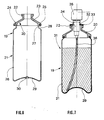
- the part (dome + housing) 19 or distributor body 19 of FIG. 6 comprises a dome 20 made of high density polyethylene (PE.HD) and a multilayer housing 21 obtained by the drawing-drawing range of example 4 followed operations to prepare its upper end.
- the dome 20 comprises at its upper end an external bulge 22 of external diameter 20 mm constituting a crimping ring of the distribution means. It further comprises below this ring 22 a veil 23 of substantially constant thickness 2.3 mm and then an enlarged lower circular portion 24, of outside diameter 45 mm and inside diameter 39 mm, having at its end an open circular groove 25 of semi-circular profile with a radius of 1.5 mm in axial section and an average diameter of 42 mm.
- the total height of the dome 20 is 18 mm.
- the housing 21 has a thickness of cylindrical body 26 of 0.25mm and a narrowed opening 27 of diameter 36.5 mm surmounted by an outer edge 28 over approximately 150 ° of external radius 1.3mm.
- the fixing of the dome 20 to the rolled edge 28 was made by surface oxidation of the circular groove 25 of the dome 20 (Corona treatment) and bonding with cyanoacrylate glue of this groove 25 fitted on the rolled edge 28 and held down for 15 seconds while the glue is drying.
- the bonding technique used results from tests; cyanoacrylate adhesives have been found to be much preferable to silicone adhesives for industrial application, the pressing and especially drying times being excessive with the latter. Polyurethane adhesives were also satisfactory.
- Other known methods for treating the surface of the plastic groove 25 can be used, for example treatment with a flame or with a shaped electrode (Corona effect).
- the box 21 is here intended for an aerosol application and its monobloc bottom 29 comprises an orifice for introducing a propellant gas under pressure and a plug 30 for sealing the plug of this orifice.
- the metal fixing cup 33 of the pump 34 which here is surmounted by a diffuser 35, is crimped with a seal 32 on the swollen upper end 22 of the dome 20.
- This pump 34 is a pump without air return, that is to say without communication between the inside and the outside of the container as known from documents EP-A-0143183 and EP-A-60251863, which allows good preservation of the product content.
- the inlet tubing of the pump 34 is provided with a dip tube 36 descending towards the bottom 29 of the housing 21, the initial filling of the product content being limited to 70% of the interior volume.
- FIG. 7 Another distributor body, identical to the body 19 of the second example, is used to obtain an aerosol product distributor according to the following modification (FIG. 7): the pump 34 is replaced by an aerosol valve fixed on the bulged end 22 of the dome 20 by crimping its fixing cup which is similar to the cup 33 of the pump.
- the distributor body 19 can thus have, as it is, two types of use.
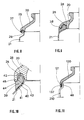
- FIG. 8 shows the fixing of a dome 20 of the same geometry as in the first three examples, on a housing identical to the housing of FIG. 6 using an annular connecting piece 37 compatible with both plastic material of the dome 2 - here of the PE.HD - and that of the housing 21, and also with the Al which can be stripped locally on the rolled edge 28 of this housing.
- This piece 37 of 0.2mm thickness is in complex containing the same polyolefin as that of the dome 20, that is to say of PE, and EAA; its outer edge is snapped onto the end of the rolled edge 28, and after the positioning of the dome 20 which is applied by its circular groove 25 to the connecting piece 37, the welding is carried out by one of the following methods : by high frequency induction, by rotation, or by ultrasound in modifying the shape of the dome for the support of the ultrasonic transducer.
- the dome 20 put in place by its circular groove 25 on the rolled edge 28 of the housing 21, has a circular groove end 25 projecting about 1 mm beyond the end of the rolled edge 28, without obstruct the interior of this rolled edge 28.
- annular injection of plastic material of the same nature as that of the dome, here PE at least partially fill the interior cavity of the rolled edge 28 by partially melting the outer skirt 38 of the dome 20 bordering the end of the circular groove 25, this skirt 25 having at this point 1 mm thick.
- a good quality sealed welded connection is obtained which extends the skirt 38.
- the end 38 of the dome 20 thus secured by molding must come in the vicinity of the end of the rolled edge, ie less than 0.5 mm before this end or a little further leaving at least 1 mm of passage towards the inside of the rolled edge 28.
- the fixing method of FIG. 10 uses an annular piece of form 39 made of plastic material of the same kind as that of the dome 20, the top of which is not shown, this piece 39 being placed on the shoulder or constricted portion. 40 of the housing before rolling its end edge.
- This part 39 here in PE like the dome 20, has a base 41 resting on this shoulder 40 of the housing 21, an upper portion 42 which will be crimped as shown by the rolling 28 of the upper end edge of the housing 21 , as well as one or more surfaces, here the two vertical 43 and horizontal 44 surfaces, coming into contact with the outer skirt 45 of the dome 20.
- the waterproof fixing is carried out by welding by rotation of the annular bearing surfaces 43 and 44 against the annular portion 45 of the dome 20.
- the fixing can also be made by welding by HF induction or by ultrasound.
- the housing 210 was obtained like the housings 21 with the multilayer strip and with the range of stamping-stretching Example 4, but its upper end 46 is here cylindrically constricted to 40 mm outside diameter.
- the plastic dome 120 has at its lower end a straight skirt 121, the inner surface of which comes to fit with a play of 0.2mm at the diameter of the end 46, the waterproof fixing then being made by gluing. It is also possible to use between the straight skirt 121 and the constricted end 46 a connection ring 137 of the same kind as the connection ring 37 of Example 7 (FIG. 8), placed around the end 137 before the fitting of the skirt 121 of the dome 120, the welding then being carried out by HF induction or by rotation.
- the internal diameter of the skirt 121 of the dome 120 and the thickness of the ring or bracelet 137 are chosen so as to slightly tighten them before welding.
Landscapes
- Engineering & Computer Science (AREA)
- Mechanical Engineering (AREA)
- Dispersion Chemistry (AREA)
- Chemical & Material Sciences (AREA)
- Laminated Bodies (AREA)
- Blow-Moulding Or Thermoforming Of Plastics Or The Like (AREA)
- Finger-Pressure Massage (AREA)
- Package Frames And Binding Bands (AREA)
- Containers Having Bodies Formed In One Piece (AREA)
- Shaping By String And By Release Of Stress In Plastics And The Like (AREA)
- Wrappers (AREA)
- Shaping Metal By Deep-Drawing, Or The Like (AREA)
- Organic Insulating Materials (AREA)
- Fixed Capacitors And Capacitor Manufacturing Machines (AREA)
- Details Of Rigid Or Semi-Rigid Containers (AREA)
- Inks, Pencil-Leads, Or Crayons (AREA)
- Pens And Brushes (AREA)
- Polishing Bodies And Polishing Tools (AREA)
Applications Claiming Priority (2)
| Application Number | Priority Date | Filing Date | Title |
|---|---|---|---|
| FR8909453A FR2649359B1 (fr) | 1989-07-06 | 1989-07-06 | Bande ou portion de bande pour emboutissage ou emboutissage-etirage, et son utilisation |
| FR8909453 | 1989-07-06 |
Publications (3)
| Publication Number | Publication Date |
|---|---|
| EP0407314A2 true EP0407314A2 (de) | 1991-01-09 |
| EP0407314A3 EP0407314A3 (en) | 1992-10-28 |
| EP0407314B1 EP0407314B1 (de) | 1996-06-12 |
Family
ID=9383759
Family Applications (1)
| Application Number | Title | Priority Date | Filing Date |
|---|---|---|---|
| EP90420313A Expired - Lifetime EP0407314B1 (de) | 1989-07-06 | 1990-07-04 | Rand oder Teil einer Einfassung zum Tiefziehen oder Tiefziehen-Streckziehen und dessen Gebrauch |
Country Status (13)
| Country | Link |
|---|---|
| US (1) | US5221576A (de) |
| EP (1) | EP0407314B1 (de) |
| JP (1) | JPH03114822A (de) |
| AT (1) | ATE139182T1 (de) |
| CA (1) | CA2020282C (de) |
| DE (1) | DE69027370T2 (de) |
| ES (1) | ES2089002T3 (de) |
| FI (1) | FI903338A7 (de) |
| FR (1) | FR2649359B1 (de) |
| IE (1) | IE76460B1 (de) |
| IS (1) | IS1679B (de) |
| NO (1) | NO903005L (de) |
| PT (1) | PT94604B (de) |
Cited By (3)
| Publication number | Priority date | Publication date | Assignee | Title |
|---|---|---|---|---|
| WO1996024487A1 (en) * | 1995-02-10 | 1996-08-15 | The Dow Chemical Company | Improved plastic/metal laminates |
| EP1669305A1 (de) * | 2004-12-10 | 2006-06-14 | L'oreal | Aufbewahrungsvorrichtung für Haarfärbemittel |
| US10005259B2 (en) | 2004-12-10 | 2018-06-26 | L'oreal | Packaging device for a hair dyeing product |
Families Citing this family (27)
| Publication number | Priority date | Publication date | Assignee | Title |
|---|---|---|---|---|
| ES2073722T5 (es) * | 1991-04-17 | 2000-11-01 | Nussbaum Und Guhl Ag | Procedimiento y dispositivo para la fabricacion de latas de aluminio con rosca. |
| US5968663A (en) * | 1991-07-24 | 1999-10-19 | Alusuisse Technology & Management Ltd. | Stretch-formable laminate |
| JPH08187818A (ja) * | 1995-01-13 | 1996-07-23 | Nippon Light Metal Co Ltd | プレス成形性および耐食性に優れたアルミニウム板 |
| EP1366777B1 (de) * | 1995-04-14 | 2005-06-15 | SmithKline Beecham Corporation | Dosierinhalator für Salmeterol |
| CA2218179A1 (en) | 1995-04-14 | 1996-10-17 | Glaxo Wellcome Inc. | Metered dose inhaler for beclomethasone dipropionate |
| MX9707862A (es) | 1995-04-14 | 1997-11-29 | Glaxo Wellcome Inc | Inhalador de dosis medida para el propionato de fluticasona. |
| DE69622166T2 (de) | 1995-04-14 | 2003-04-03 | Smithkline Beecham Corp., Philadelphia | Dosierinhalator für albuterol |
| JP3256108B2 (ja) * | 1995-08-07 | 2002-02-12 | スカイアルミニウム株式会社 | しごき加工を施して使用されるdi缶胴用アルミニウム合金圧延板 |
| US20030103906A1 (en) * | 1997-10-14 | 2003-06-05 | Smithkline Beecham Corporation | Metered dose inhaler having internal surfaces coated with fluorocarbon polymer |
| WO2001028887A1 (en) * | 1999-10-16 | 2001-04-26 | Glaxo Group Limited | Device housing for an aerosol container |
| IL150397A0 (en) * | 2000-01-14 | 2002-12-01 | Astrazeneca Ab | A method for applying a polymer coating to the internal surface of a container |
| DE10022074A1 (de) * | 2000-05-06 | 2001-11-08 | Henkel Kgaa | Elektrochemisch erzeugte Schichten zum Korrosionsschutz oder als Haftgrund |
| DE20018518U1 (de) * | 2000-10-28 | 2001-02-01 | Boehringer Ingelheim Pharma KG, 55218 Ingelheim | Zerstäuber für Nasenspray |
| GB0106046D0 (en) * | 2001-03-12 | 2001-05-02 | Glaxo Group Ltd | Canister |
| US7578921B2 (en) * | 2001-10-02 | 2009-08-25 | Henkel Kgaa | Process for anodically coating aluminum and/or titanium with ceramic oxides |
| US7820300B2 (en) * | 2001-10-02 | 2010-10-26 | Henkel Ag & Co. Kgaa | Article of manufacture and process for anodically coating an aluminum substrate with ceramic oxides prior to organic or inorganic coating |
| US7569132B2 (en) * | 2001-10-02 | 2009-08-04 | Henkel Kgaa | Process for anodically coating an aluminum substrate with ceramic oxides prior to polytetrafluoroethylene or silicone coating |
| US7452454B2 (en) * | 2001-10-02 | 2008-11-18 | Henkel Kgaa | Anodized coating over aluminum and aluminum alloy coated substrates |
| GB0301366D0 (en) * | 2003-01-21 | 2003-02-19 | Glaxo Group Ltd | A fixation device |
| US20070286814A1 (en) * | 2006-06-12 | 2007-12-13 | Medispray Laboratories Pvt. Ltd. | Stable aerosol pharmaceutical formulations |
| US8227027B2 (en) * | 2007-12-07 | 2012-07-24 | Presspart Gmbh & Co. Kg | Method for applying a polymer coating to an internal surface of a container |
| EP2165937A1 (de) | 2008-09-23 | 2010-03-24 | Nestec S.A. | Zweifarbiger Aluminiumbehälter und Verfahren zur Herstellung dieses Behälters |
| US9701177B2 (en) | 2009-04-02 | 2017-07-11 | Henkel Ag & Co. Kgaa | Ceramic coated automotive heat exchanger components |
| JP6011326B2 (ja) * | 2012-12-27 | 2016-10-19 | 東洋製罐株式会社 | 金属容器用ホットメルト組成物および金属缶 |
| US9192973B1 (en) | 2013-03-13 | 2015-11-24 | Meier Tool & Engineering, Inc. | Drawing process for titanium |
| WO2017107062A1 (en) * | 2015-12-22 | 2017-06-29 | L'oreal | Refill of a cosmetic product for a cosmetic container, and method for refilling a cosmetic container with such a refill |
| JP2018176182A (ja) * | 2017-04-05 | 2018-11-15 | ユニバーサル製缶株式会社 | キャップの製造方法およびキャップ |
Family Cites Families (10)
| Publication number | Priority date | Publication date | Assignee | Title |
|---|---|---|---|---|
| US3996115A (en) * | 1975-08-25 | 1976-12-07 | Joseph W. Aidlin | Process for forming an anodic oxide coating on metals |
| GB2003415A (en) * | 1977-09-02 | 1979-03-14 | American Can Co | Improvements relating to the manufacture of containers |
| DE2947025A1 (de) * | 1979-11-22 | 1981-06-04 | Glyco-Metall-Werke Daelen & Loos Gmbh, 6200 Wiesbaden | Zwei- oder mehrschicht-verbundwerkstoff |
| JPS58212944A (ja) * | 1982-06-07 | 1983-12-10 | 出光石油化学株式会社 | 積層体 |
| DE3335150C1 (de) * | 1983-09-28 | 1984-07-19 | Bayerische Motoren Werke AG, 8000 München | Oberflächenbeschichtung für Werkstücke |
| JPS60161146A (ja) * | 1984-01-31 | 1985-08-22 | 株式会社クラレ | 耐屈曲疲労に優れたフレキシブルな気体遮断性積層包装材よりなるバッグインボックス内容器の構成材 |
| DE3778727D1 (de) * | 1986-02-27 | 1992-06-11 | Nippon Kokan Kk | Grundbeschichtete metallplatte. |
| GB8724243D0 (en) * | 1987-10-15 | 1987-11-18 | Metal Box Plc | Laminates of polyolefin-based film |
| FR2634737B1 (fr) * | 1988-07-28 | 1991-05-10 | Cesal | Procede de fabrication de capsules de surbouchage a base de plomb et capsules obtenues |
| FR2650219B1 (fr) * | 1989-07-06 | 1991-10-04 | Pechiney Rhenalu | Procede d'obtention de materiaux multicouches aptes a etre transformes par emboutissage ou emboutissage-etirage en corps creux |
-
1989
- 1989-07-06 FR FR8909453A patent/FR2649359B1/fr not_active Expired - Fee Related
-
1990
- 1990-07-02 FI FI903338A patent/FI903338A7/fi not_active Application Discontinuation
- 1990-07-03 IS IS3600A patent/IS1679B/is unknown
- 1990-07-03 IE IE240790A patent/IE76460B1/en not_active IP Right Cessation
- 1990-07-03 US US07/547,200 patent/US5221576A/en not_active Expired - Fee Related
- 1990-07-03 CA CA002020282A patent/CA2020282C/fr not_active Expired - Fee Related
- 1990-07-04 ES ES90420313T patent/ES2089002T3/es not_active Expired - Lifetime
- 1990-07-04 EP EP90420313A patent/EP0407314B1/de not_active Expired - Lifetime
- 1990-07-04 DE DE69027370T patent/DE69027370T2/de not_active Expired - Fee Related
- 1990-07-04 AT AT90420313T patent/ATE139182T1/de active
- 1990-07-05 PT PT94604A patent/PT94604B/pt not_active IP Right Cessation
- 1990-07-05 NO NO90903005A patent/NO903005L/no unknown
- 1990-07-06 JP JP2179392A patent/JPH03114822A/ja active Pending
Cited By (4)
| Publication number | Priority date | Publication date | Assignee | Title |
|---|---|---|---|---|
| WO1996024487A1 (en) * | 1995-02-10 | 1996-08-15 | The Dow Chemical Company | Improved plastic/metal laminates |
| EP1669305A1 (de) * | 2004-12-10 | 2006-06-14 | L'oreal | Aufbewahrungsvorrichtung für Haarfärbemittel |
| FR2879170A1 (fr) * | 2004-12-10 | 2006-06-16 | Oreal | Dispositif de conditionnement d'un produit de coloration capillaire |
| US10005259B2 (en) | 2004-12-10 | 2018-06-26 | L'oreal | Packaging device for a hair dyeing product |
Also Published As
| Publication number | Publication date |
|---|---|
| CA2020282C (fr) | 1995-03-14 |
| IE76460B1 (en) | 1997-10-22 |
| US5221576A (en) | 1993-06-22 |
| JPH03114822A (ja) | 1991-05-16 |
| ATE139182T1 (de) | 1996-06-15 |
| FR2649359B1 (fr) | 1993-02-12 |
| IE902407A1 (en) | 1991-06-19 |
| CA2020282A1 (fr) | 1991-01-07 |
| PT94604A (pt) | 1992-03-31 |
| FI903338A0 (fi) | 1990-07-02 |
| FR2649359A1 (fr) | 1991-01-11 |
| NO903005D0 (no) | 1990-07-05 |
| ES2089002T3 (es) | 1996-10-01 |
| EP0407314B1 (de) | 1996-06-12 |
| DE69027370T2 (de) | 1996-11-14 |
| IS3600A7 (is) | 1991-01-07 |
| PT94604B (pt) | 1997-09-30 |
| NO903005L (no) | 1991-01-07 |
| IS1679B (is) | 1998-02-12 |
| DE69027370D1 (de) | 1996-07-18 |
| FI903338A7 (fi) | 1991-01-07 |
| EP0407314A3 (en) | 1992-10-28 |
Similar Documents
| Publication | Publication Date | Title |
|---|---|---|
| EP0407314B1 (de) | Rand oder Teil einer Einfassung zum Tiefziehen oder Tiefziehen-Streckziehen und dessen Gebrauch | |
| EP2630052B1 (de) | Mittels schweissen hergestellte und ein recycling-material oder ein material aus erneuerbaren ressourcen enthaltende fexible verpackung | |
| EP0354137B1 (de) | Verfahren zum Herstellen von Beutelspendern, entsprechende Teile und Spender | |
| EP0426580B1 (de) | Verfahren zur Herstellung eines Sprühkopfes entsprechende Sprühkopf und Spender | |
| FR2535336A1 (fr) | Colle fondant a chaud (hot-melt) | |
| EP0407313B1 (de) | Verfahren zur Herstellung von Mehrschichtkörpern für das Tiefziehen oder Streckziehen von Hohlkörpern | |
| EP2022724A1 (de) | Flexible Plastikrohre und ihr Herstellungsverfahren | |
| EP1880824A1 (de) | Vorformling zur Herstellung einer Verpackung durch Blasformen, Verfahren zum Blasformen des Vorformlings sowie hergestellte Verpackung | |
| WO1994016959A1 (fr) | Procede de fabrication d'un tube a paroi contenant plus de 60 % de matiere plastique et ayant une jupe et une tete retreinte, et tube correspondant | |
| CA2011244A1 (fr) | Corps de distributeur, distributeur comportant un tel corps et dome correspondant | |
| EP0612612B1 (de) | Tube zum Lagern und Abgeben eines wasserenthaltenden und ggf aromatisierten oder parfümierten Produktes | |
| FR2557503A1 (fr) | Substrat contenant un polyester stratifie et recipient distributeur repliable realise a partir d'un tel substrat | |
| EP1005431A1 (de) | Sprühdosenkörper mit einem metallischen oder metallplastischen innenbehälter, dieser innenbehälter und verfahren zu dessen herstellung | |
| FR2734997A1 (fr) | Ensemble applicateur de vernis a ongles, a levre | |
| EP0547982B1 (de) | Verfahren zur Herstellung eines Sprühdosenkörpers mit einem metallischen Innenbehälter sowie Sprühdosenkörper und entsprechende Sprühdose | |
| FR2923468A1 (fr) | Recipient pour produit fluide | |
| FR3072660A1 (fr) | Couvercle pour boite de conserve metallique, comprenant un anneau metallique et membrane pelable thermoscellee | |
| FR2684979A1 (fr) | Procede de surbouchage de recipients a l'aide de capsules a base de polymeres biodegradables en produits naturels, capsules de surbouchage et recipients surbouches ainsi obtenus. | |
| FR2752770A1 (fr) | Corps creux en matiere synthetique obtenu par une technique d'extrusion-soufflage | |
| EP0354857A1 (de) | Verfahren zur Herstellung von Überzugskapseln aus Blei und auf diese Weise erhaltene Überzugskapseln | |
| FR2540757A1 (fr) | Recipient metallique presentant un joint lateral circonferentiel | |
| LU86231A1 (fr) | Feuille stratifiee a base de copolymere ethylene-propylene et recipient ecrasable realise avec celle-ci | |
| FR2634466A1 (fr) | Procede de fabrication et de conditionnement d'un distributeur a poche, sous-ensembles et distributeurs correspondants | |
| BE559625A (de) |
Legal Events
| Date | Code | Title | Description |
|---|---|---|---|
| PUAI | Public reference made under article 153(3) epc to a published international application that has entered the european phase |
Free format text: ORIGINAL CODE: 0009012 |
|
| AK | Designated contracting states |
Kind code of ref document: A2 Designated state(s): AT BE CH DE DK ES FR GB GR IT LI LU NL SE |
|
| RAP1 | Party data changed (applicant data changed or rights of an application transferred) |
Owner name: CEBAL S.A. |
|
| PUAL | Search report despatched |
Free format text: ORIGINAL CODE: 0009013 |
|
| 17P | Request for examination filed |
Effective date: 19920806 |
|
| AK | Designated contracting states |
Kind code of ref document: A3 Designated state(s): AT BE CH DE DK ES FR GB GR IT LI LU NL SE |
|
| 17Q | First examination report despatched |
Effective date: 19950602 |
|
| GRAH | Despatch of communication of intention to grant a patent |
Free format text: ORIGINAL CODE: EPIDOS IGRA |
|
| GRAH | Despatch of communication of intention to grant a patent |
Free format text: ORIGINAL CODE: EPIDOS IGRA |
|
| GRAA | (expected) grant |
Free format text: ORIGINAL CODE: 0009210 |
|
| AK | Designated contracting states |
Kind code of ref document: B1 Designated state(s): AT BE CH DE DK ES FR GB GR IT LI LU NL SE |
|
| PG25 | Lapsed in a contracting state [announced via postgrant information from national office to epo] |
Ref country code: GR Free format text: LAPSE BECAUSE OF FAILURE TO SUBMIT A TRANSLATION OF THE DESCRIPTION OR TO PAY THE FEE WITHIN THE PRESCRIBED TIME-LIMIT Effective date: 19960612 Ref country code: DK Effective date: 19960612 |
|
| REF | Corresponds to: |
Ref document number: 139182 Country of ref document: AT Date of ref document: 19960615 Kind code of ref document: T |
|
| REG | Reference to a national code |
Ref country code: CH Ref legal event code: NV Representative=s name: WILLIAM BLANC & CIE CONSEILS EN PROPRIETE INDUSTRI |
|
| REF | Corresponds to: |
Ref document number: 69027370 Country of ref document: DE Date of ref document: 19960718 |
|
| PG25 | Lapsed in a contracting state [announced via postgrant information from national office to epo] |
Ref country code: LU Free format text: LAPSE BECAUSE OF NON-PAYMENT OF DUE FEES Effective date: 19960731 |
|
| GBT | Gb: translation of ep patent filed (gb section 77(6)(a)/1977) |
Effective date: 19960730 |
|
| ITF | It: translation for a ep patent filed | ||
| REG | Reference to a national code |
Ref country code: ES Ref legal event code: FG2A Ref document number: 2089002 Country of ref document: ES Kind code of ref document: T3 |
|
| REG | Reference to a national code |
Ref country code: ES Ref legal event code: FG2A Ref document number: 2089002 Country of ref document: ES Kind code of ref document: T3 |
|
| PLBE | No opposition filed within time limit |
Free format text: ORIGINAL CODE: 0009261 |
|
| STAA | Information on the status of an ep patent application or granted ep patent |
Free format text: STATUS: NO OPPOSITION FILED WITHIN TIME LIMIT |
|
| 26N | No opposition filed | ||
| PGFP | Annual fee paid to national office [announced via postgrant information from national office to epo] |
Ref country code: SE Payment date: 19970618 Year of fee payment: 8 |
|
| PGFP | Annual fee paid to national office [announced via postgrant information from national office to epo] |
Ref country code: AT Payment date: 19970619 Year of fee payment: 8 |
|
| PGFP | Annual fee paid to national office [announced via postgrant information from national office to epo] |
Ref country code: CH Payment date: 19970627 Year of fee payment: 8 |
|
| PGFP | Annual fee paid to national office [announced via postgrant information from national office to epo] |
Ref country code: NL Payment date: 19970731 Year of fee payment: 8 Ref country code: ES Payment date: 19970731 Year of fee payment: 8 |
|
| PGFP | Annual fee paid to national office [announced via postgrant information from national office to epo] |
Ref country code: BE Payment date: 19970805 Year of fee payment: 8 |
|
| PG25 | Lapsed in a contracting state [announced via postgrant information from national office to epo] |
Ref country code: AT Free format text: LAPSE BECAUSE OF NON-PAYMENT OF DUE FEES Effective date: 19980704 |
|
| PG25 | Lapsed in a contracting state [announced via postgrant information from national office to epo] |
Ref country code: SE Free format text: LAPSE BECAUSE OF NON-PAYMENT OF DUE FEES Effective date: 19980705 |
|
| PG25 | Lapsed in a contracting state [announced via postgrant information from national office to epo] |
Ref country code: ES Free format text: LAPSE BECAUSE OF THE APPLICANT RENOUNCES Effective date: 19980706 |
|
| PG25 | Lapsed in a contracting state [announced via postgrant information from national office to epo] |
Ref country code: LI Free format text: LAPSE BECAUSE OF NON-PAYMENT OF DUE FEES Effective date: 19980731 Ref country code: CH Free format text: LAPSE BECAUSE OF NON-PAYMENT OF DUE FEES Effective date: 19980731 Ref country code: BE Free format text: LAPSE BECAUSE OF NON-PAYMENT OF DUE FEES Effective date: 19980731 |
|
| BERE | Be: lapsed |
Owner name: S.A. CEBAL Effective date: 19980731 |
|
| PG25 | Lapsed in a contracting state [announced via postgrant information from national office to epo] |
Ref country code: NL Free format text: LAPSE BECAUSE OF NON-PAYMENT OF DUE FEES Effective date: 19990201 |
|
| REG | Reference to a national code |
Ref country code: CH Ref legal event code: PL |
|
| EUG | Se: european patent has lapsed |
Ref document number: 90420313.0 |
|
| NLV4 | Nl: lapsed or anulled due to non-payment of the annual fee |
Effective date: 19990201 |
|
| REG | Reference to a national code |
Ref country code: ES Ref legal event code: FD2A Effective date: 20001102 |
|
| REG | Reference to a national code |
Ref country code: GB Ref legal event code: IF02 |
|
| PGFP | Annual fee paid to national office [announced via postgrant information from national office to epo] |
Ref country code: GB Payment date: 20020617 Year of fee payment: 13 |
|
| PGFP | Annual fee paid to national office [announced via postgrant information from national office to epo] |
Ref country code: DE Payment date: 20020618 Year of fee payment: 13 |
|
| PGFP | Annual fee paid to national office [announced via postgrant information from national office to epo] |
Ref country code: FR Payment date: 20020711 Year of fee payment: 13 |
|
| PG25 | Lapsed in a contracting state [announced via postgrant information from national office to epo] |
Ref country code: GB Free format text: LAPSE BECAUSE OF NON-PAYMENT OF DUE FEES Effective date: 20030704 |
|
| PG25 | Lapsed in a contracting state [announced via postgrant information from national office to epo] |
Ref country code: DE Free format text: LAPSE BECAUSE OF NON-PAYMENT OF DUE FEES Effective date: 20040203 |
|
| GBPC | Gb: european patent ceased through non-payment of renewal fee |
Effective date: 20030704 |
|
| PG25 | Lapsed in a contracting state [announced via postgrant information from national office to epo] |
Ref country code: FR Free format text: LAPSE BECAUSE OF NON-PAYMENT OF DUE FEES Effective date: 20040331 |
|
| REG | Reference to a national code |
Ref country code: FR Ref legal event code: ST |
|
| PG25 | Lapsed in a contracting state [announced via postgrant information from national office to epo] |
Ref country code: IT Free format text: LAPSE BECAUSE OF NON-PAYMENT OF DUE FEES;WARNING: LAPSES OF ITALIAN PATENTS WITH EFFECTIVE DATE BEFORE 2007 MAY HAVE OCCURRED AT ANY TIME BEFORE 2007. THE CORRECT EFFECTIVE DATE MAY BE DIFFERENT FROM THE ONE RECORDED. Effective date: 20050704 |