EP0407790A1 - N-Vinyl-3-cyano-4-phenyl-pyrrol-Derivate - Google Patents
N-Vinyl-3-cyano-4-phenyl-pyrrol-Derivate Download PDFInfo
- Publication number
- EP0407790A1 EP0407790A1 EP90111937A EP90111937A EP0407790A1 EP 0407790 A1 EP0407790 A1 EP 0407790A1 EP 90111937 A EP90111937 A EP 90111937A EP 90111937 A EP90111937 A EP 90111937A EP 0407790 A1 EP0407790 A1 EP 0407790A1
- Authority
- EP
- European Patent Office
- Prior art keywords
- alkyl
- carbon atoms
- halogen
- chain
- straight
- Prior art date
- Legal status (The legal status is an assumption and is not a legal conclusion. Google has not performed a legal analysis and makes no representation as to the accuracy of the status listed.)
- Withdrawn
Links
- XWYQPDOOJJKHDJ-UHFFFAOYSA-N 1-ethenyl-4-phenylpyrrole-3-carbonitrile Chemical class C=CN1C=C(C#N)C(C=2C=CC=CC=2)=C1 XWYQPDOOJJKHDJ-UHFFFAOYSA-N 0.000 title claims abstract description 16
- 125000000217 alkyl group Chemical group 0.000 claims abstract description 63
- 229910052736 halogen Inorganic materials 0.000 claims abstract description 40
- 150000002367 halogens Chemical class 0.000 claims abstract description 40
- 125000001188 haloalkyl group Chemical group 0.000 claims abstract description 34
- 125000004438 haloalkoxy group Chemical group 0.000 claims abstract description 33
- 229910052739 hydrogen Inorganic materials 0.000 claims abstract description 33
- 239000001257 hydrogen Substances 0.000 claims abstract description 33
- UFHFLCQGNIYNRP-UHFFFAOYSA-N Hydrogen Chemical compound [H][H] UFHFLCQGNIYNRP-UHFFFAOYSA-N 0.000 claims abstract description 29
- 125000003545 alkoxy group Chemical group 0.000 claims abstract description 27
- 150000002431 hydrogen Chemical class 0.000 claims abstract description 22
- 125000004414 alkyl thio group Chemical group 0.000 claims abstract description 21
- 238000002360 preparation method Methods 0.000 claims abstract description 21
- 125000004995 haloalkylthio group Chemical group 0.000 claims abstract description 20
- 238000000034 method Methods 0.000 claims abstract description 15
- 229910052757 nitrogen Inorganic materials 0.000 claims abstract description 9
- 125000004433 nitrogen atom Chemical group N* 0.000 claims abstract description 9
- 229920006395 saturated elastomer Polymers 0.000 claims abstract description 9
- 241000607479 Yersinia pestis Species 0.000 claims abstract description 7
- 125000005530 alkylenedioxy group Chemical class 0.000 claims abstract description 5
- 125000004432 carbon atom Chemical group C* 0.000 claims description 55
- -1 methylenedioxy Chemical group 0.000 claims description 49
- PXGOKWXKJXAPGV-UHFFFAOYSA-N Fluorine Chemical compound FF PXGOKWXKJXAPGV-UHFFFAOYSA-N 0.000 claims description 33
- 125000001495 ethyl group Chemical group [H]C([H])([H])C([H])([H])* 0.000 claims description 29
- 125000005843 halogen group Chemical group 0.000 claims description 28
- 125000002496 methyl group Chemical group [H]C([H])([H])* 0.000 claims description 28
- 229910052731 fluorine Inorganic materials 0.000 claims description 27
- 239000011737 fluorine Substances 0.000 claims description 27
- ZAMOUSCENKQFHK-UHFFFAOYSA-N Chlorine atom Chemical compound [Cl] ZAMOUSCENKQFHK-UHFFFAOYSA-N 0.000 claims description 11
- 239000000460 chlorine Substances 0.000 claims description 11
- 229910052801 chlorine Inorganic materials 0.000 claims description 11
- 125000001309 chloro group Chemical group Cl* 0.000 claims description 8
- 125000001449 isopropyl group Chemical group [H]C([H])([H])C([H])(*)C([H])([H])[H] 0.000 claims description 8
- 125000002023 trifluoromethyl group Chemical group FC(F)(F)* 0.000 claims description 8
- 125000004108 n-butyl group Chemical group [H]C([H])([H])C([H])([H])C([H])([H])C([H])([H])* 0.000 claims description 7
- BMMCNKYHQAKJBN-UHFFFAOYSA-N 4-phenyl-1h-pyrrole-3-carbonitrile Chemical class N#CC1=CNC=C1C1=CC=CC=C1 BMMCNKYHQAKJBN-UHFFFAOYSA-N 0.000 claims description 6
- WKBOTKDWSSQWDR-UHFFFAOYSA-N Bromine atom Chemical compound [Br] WKBOTKDWSSQWDR-UHFFFAOYSA-N 0.000 claims description 6
- GDTBXPJZTBHREO-UHFFFAOYSA-N bromine Substances BrBr GDTBXPJZTBHREO-UHFFFAOYSA-N 0.000 claims description 6
- 229910052794 bromium Inorganic materials 0.000 claims description 6
- VXAWCKIQYKXJMD-UHFFFAOYSA-N ethynamine Chemical group NC#C VXAWCKIQYKXJMD-UHFFFAOYSA-N 0.000 claims description 5
- 125000004123 n-propyl group Chemical group [H]C([H])([H])C([H])([H])C([H])([H])* 0.000 claims description 5
- 239000004606 Fillers/Extenders Substances 0.000 claims description 4
- 239000003085 diluting agent Substances 0.000 claims description 3
- 125000001153 fluoro group Chemical group F* 0.000 claims description 2
- 239000004094 surface-active agent Substances 0.000 claims description 2
- 239000000575 pesticide Substances 0.000 claims 2
- UUEVFMOUBSLVJW-UHFFFAOYSA-N oxo-[[1-[2-[2-[2-[4-(oxoazaniumylmethylidene)pyridin-1-yl]ethoxy]ethoxy]ethyl]pyridin-4-ylidene]methyl]azanium;dibromide Chemical compound [Br-].[Br-].C1=CC(=C[NH+]=O)C=CN1CCOCCOCCN1C=CC(=C[NH+]=O)C=C1 UUEVFMOUBSLVJW-UHFFFAOYSA-N 0.000 claims 1
- 150000001875 compounds Chemical group 0.000 description 38
- 241000196324 Embryophyta Species 0.000 description 17
- RTZKZFJDLAIYFH-UHFFFAOYSA-N Diethyl ether Chemical compound CCOCC RTZKZFJDLAIYFH-UHFFFAOYSA-N 0.000 description 16
- ZMXDDKWLCZADIW-UHFFFAOYSA-N N,N-Dimethylformamide Chemical compound CN(C)C=O ZMXDDKWLCZADIW-UHFFFAOYSA-N 0.000 description 12
- 239000002904 solvent Substances 0.000 description 12
- 239000004480 active ingredient Substances 0.000 description 11
- 239000003995 emulsifying agent Substances 0.000 description 11
- 239000000203 mixture Substances 0.000 description 10
- YMWUJEATGCHHMB-UHFFFAOYSA-N Dichloromethane Chemical compound ClCCl YMWUJEATGCHHMB-UHFFFAOYSA-N 0.000 description 9
- 230000001681 protective effect Effects 0.000 description 8
- CSCPPACGZOOCGX-UHFFFAOYSA-N Acetone Chemical compound CC(C)=O CSCPPACGZOOCGX-UHFFFAOYSA-N 0.000 description 7
- 238000009472 formulation Methods 0.000 description 7
- YXFVVABEGXRONW-UHFFFAOYSA-N Toluene Chemical compound CC1=CC=CC=C1 YXFVVABEGXRONW-UHFFFAOYSA-N 0.000 description 6
- 239000008187 granular material Substances 0.000 description 6
- 239000000843 powder Substances 0.000 description 6
- 125000001424 substituent group Chemical group 0.000 description 6
- XLYOFNOQVPJJNP-UHFFFAOYSA-N water Substances O XLYOFNOQVPJJNP-UHFFFAOYSA-N 0.000 description 6
- 241000228453 Pyrenophora Species 0.000 description 5
- 241000520648 Pyrenophora teres Species 0.000 description 5
- 125000002877 alkyl aryl group Chemical group 0.000 description 5
- 229920000151 polyglycol Polymers 0.000 description 5
- 239000010695 polyglycol Substances 0.000 description 5
- 150000003254 radicals Chemical class 0.000 description 5
- 238000005507 spraying Methods 0.000 description 5
- 241000123650 Botrytis cinerea Species 0.000 description 4
- 241000371644 Curvularia ravenelii Species 0.000 description 4
- IAZDPXIOMUYVGZ-UHFFFAOYSA-N Dimethylsulphoxide Chemical compound CS(C)=O IAZDPXIOMUYVGZ-UHFFFAOYSA-N 0.000 description 4
- 241001330975 Magnaporthe oryzae Species 0.000 description 4
- 240000007594 Oryza sativa Species 0.000 description 4
- 241000736122 Parastagonospora nodorum Species 0.000 description 4
- 239000000969 carrier Substances 0.000 description 4
- 239000012141 concentrate Substances 0.000 description 4
- 201000010099 disease Diseases 0.000 description 4
- 208000037265 diseases, disorders, signs and symptoms Diseases 0.000 description 4
- 238000011081 inoculation Methods 0.000 description 4
- VYPSYNLAJGMNEJ-UHFFFAOYSA-N silicon dioxide Inorganic materials O=[Si]=O VYPSYNLAJGMNEJ-UHFFFAOYSA-N 0.000 description 4
- 239000007858 starting material Substances 0.000 description 4
- 239000000725 suspension Substances 0.000 description 4
- ZWEHNKRNPOVVGH-UHFFFAOYSA-N 2-Butanone Chemical compound CCC(C)=O ZWEHNKRNPOVVGH-UHFFFAOYSA-N 0.000 description 3
- UHOVQNZJYSORNB-UHFFFAOYSA-N Benzene Chemical compound C1=CC=CC=C1 UHOVQNZJYSORNB-UHFFFAOYSA-N 0.000 description 3
- 241000221787 Erysiphe Species 0.000 description 3
- 240000005979 Hordeum vulgare Species 0.000 description 3
- 235000007340 Hordeum vulgare Nutrition 0.000 description 3
- 235000007164 Oryza sativa Nutrition 0.000 description 3
- 150000002170 ethers Chemical class 0.000 description 3
- 230000000855 fungicidal effect Effects 0.000 description 3
- 239000000417 fungicide Substances 0.000 description 3
- 239000007788 liquid Substances 0.000 description 3
- VLKZOEOYAKHREP-UHFFFAOYSA-N n-Hexane Chemical compound CCCCCC VLKZOEOYAKHREP-UHFFFAOYSA-N 0.000 description 3
- 244000052769 pathogen Species 0.000 description 3
- 235000009566 rice Nutrition 0.000 description 3
- 239000011435 rock Substances 0.000 description 3
- 239000002689 soil Substances 0.000 description 3
- 239000007787 solid Substances 0.000 description 3
- 239000000126 substance Substances 0.000 description 3
- AFTOVYFNPMUYNW-UHFFFAOYSA-N 4-(3-chloro-2-fluorophenyl)-1h-pyrrole-3-carbonitrile Chemical compound FC1=C(Cl)C=CC=C1C1=CNC=C1C#N AFTOVYFNPMUYNW-UHFFFAOYSA-N 0.000 description 2
- 241001149961 Alternaria brassicae Species 0.000 description 2
- 241000190150 Bipolaris sorokiniana Species 0.000 description 2
- 241001480061 Blumeria graminis Species 0.000 description 2
- 241001465180 Botrytis Species 0.000 description 2
- CURLTUGMZLYLDI-UHFFFAOYSA-N Carbon dioxide Chemical compound O=C=O CURLTUGMZLYLDI-UHFFFAOYSA-N 0.000 description 2
- 241000906476 Cercospora canescens Species 0.000 description 2
- HEDRZPFGACZZDS-UHFFFAOYSA-N Chloroform Chemical compound ClC(Cl)Cl HEDRZPFGACZZDS-UHFFFAOYSA-N 0.000 description 2
- XDTMQSROBMDMFD-UHFFFAOYSA-N Cyclohexane Chemical compound C1CCCCC1 XDTMQSROBMDMFD-UHFFFAOYSA-N 0.000 description 2
- LYCAIKOWRPUZTN-UHFFFAOYSA-N Ethylene glycol Chemical compound OCCO LYCAIKOWRPUZTN-UHFFFAOYSA-N 0.000 description 2
- 241000223218 Fusarium Species 0.000 description 2
- 241000223194 Fusarium culmorum Species 0.000 description 2
- XEEYBQQBJWHFJM-UHFFFAOYSA-N Iron Chemical class [Fe] XEEYBQQBJWHFJM-UHFFFAOYSA-N 0.000 description 2
- UQSXHKLRYXJYBZ-UHFFFAOYSA-N Iron oxide Chemical compound [Fe]=O UQSXHKLRYXJYBZ-UHFFFAOYSA-N 0.000 description 2
- 241000228456 Leptosphaeria Species 0.000 description 2
- 241000228457 Leptosphaeria maculans Species 0.000 description 2
- LRHPLDYGYMQRHN-UHFFFAOYSA-N N-Butanol Chemical compound CCCCO LRHPLDYGYMQRHN-UHFFFAOYSA-N 0.000 description 2
- CTQNGGLPUBDAKN-UHFFFAOYSA-N O-Xylene Chemical compound CC1=CC=CC=C1C CTQNGGLPUBDAKN-UHFFFAOYSA-N 0.000 description 2
- 241001668536 Oculimacula yallundae Species 0.000 description 2
- 241000201565 Peronospora viciae f. sp. pisi Species 0.000 description 2
- 241000233622 Phytophthora infestans Species 0.000 description 2
- 241001281803 Plasmopara viticola Species 0.000 description 2
- 241000317981 Podosphaera fuliginea Species 0.000 description 2
- 241001337928 Podosphaera leucotricha Species 0.000 description 2
- 229920003171 Poly (ethylene oxide) Polymers 0.000 description 2
- ATUOYWHBWRKTHZ-UHFFFAOYSA-N Propane Chemical compound CCC ATUOYWHBWRKTHZ-UHFFFAOYSA-N 0.000 description 2
- 241001281805 Pseudoperonospora cubensis Species 0.000 description 2
- 241000342307 Pseudoperonospora humuli Species 0.000 description 2
- 241001123569 Puccinia recondita Species 0.000 description 2
- 241000228454 Pyrenophora graminea Species 0.000 description 2
- 241000231139 Pyricularia Species 0.000 description 2
- 241000918584 Pythium ultimum Species 0.000 description 2
- WYURNTSHIVDZCO-UHFFFAOYSA-N Tetrahydrofuran Chemical compound C1CCOC1 WYURNTSHIVDZCO-UHFFFAOYSA-N 0.000 description 2
- 241001617088 Thanatephorus sasakii Species 0.000 description 2
- 241000722093 Tilletia caries Species 0.000 description 2
- 241000221577 Uromyces appendiculatus Species 0.000 description 2
- 241000514371 Ustilago avenae Species 0.000 description 2
- 241000007070 Ustilago nuda Species 0.000 description 2
- 241000228452 Venturia inaequalis Species 0.000 description 2
- 150000001338 aliphatic hydrocarbons Chemical class 0.000 description 2
- AAMATCKFMHVIDO-UHFFFAOYSA-N azane;1h-pyrrole Chemical compound N.C=1C=CNC=1 AAMATCKFMHVIDO-UHFFFAOYSA-N 0.000 description 2
- MVPPADPHJFYWMZ-UHFFFAOYSA-N chlorobenzene Chemical compound ClC1=CC=CC=C1 MVPPADPHJFYWMZ-UHFFFAOYSA-N 0.000 description 2
- JHIVVAPYMSGYDF-UHFFFAOYSA-N cyclohexanone Chemical compound O=C1CCCCC1 JHIVVAPYMSGYDF-UHFFFAOYSA-N 0.000 description 2
- 239000002270 dispersing agent Substances 0.000 description 2
- 239000000975 dye Substances 0.000 description 2
- XTHFKEDIFFGKHM-UHFFFAOYSA-N ethylene glycol dimethyl ether Natural products COCCOC XTHFKEDIFFGKHM-UHFFFAOYSA-N 0.000 description 2
- 238000011156 evaluation Methods 0.000 description 2
- 150000008282 halocarbons Chemical class 0.000 description 2
- 239000003960 organic solvent Substances 0.000 description 2
- 230000001717 pathogenic effect Effects 0.000 description 2
- 239000003208 petroleum Substances 0.000 description 2
- 125000000999 tert-butyl group Chemical group [H]C([H])([H])C(*)(C([H])([H])[H])C([H])([H])[H] 0.000 description 2
- VZGDMQKNWNREIO-UHFFFAOYSA-N tetrachloromethane Chemical compound ClC(Cl)(Cl)Cl VZGDMQKNWNREIO-UHFFFAOYSA-N 0.000 description 2
- 239000008096 xylene Substances 0.000 description 2
- RYHBNJHYFVUHQT-UHFFFAOYSA-N 1,4-Dioxane Chemical compound C1COCCO1 RYHBNJHYFVUHQT-UHFFFAOYSA-N 0.000 description 1
- 125000004715 3-methylbutylthio group Chemical group CC(CCS*)C 0.000 description 1
- HVKQQHNYUJYTFB-UHFFFAOYSA-N 4-(2,3-dichlorophenyl)-1-ethenylpyrrole-3-carbonitrile Chemical compound ClC1=CC=CC(C=2C(=CN(C=C)C=2)C#N)=C1Cl HVKQQHNYUJYTFB-UHFFFAOYSA-N 0.000 description 1
- OCZRHTFVCLAJGC-UHFFFAOYSA-N 4-(3-chloro-2-fluorophenyl)-1-[1-(diethylamino)prop-1-enyl]pyrrole-3-carbonitrile Chemical compound CCN(CC)C(=CC)N1C=C(C#N)C(C=2C(=C(Cl)C=CC=2)F)=C1 OCZRHTFVCLAJGC-UHFFFAOYSA-N 0.000 description 1
- UHPMCKVQTMMPCG-UHFFFAOYSA-N 5,8-dihydroxy-2-methoxy-6-methyl-7-(2-oxopropyl)naphthalene-1,4-dione Chemical compound CC1=C(CC(C)=O)C(O)=C2C(=O)C(OC)=CC(=O)C2=C1O UHPMCKVQTMMPCG-UHFFFAOYSA-N 0.000 description 1
- 244000215068 Acacia senegal Species 0.000 description 1
- 229920001817 Agar Polymers 0.000 description 1
- RGCKGOZRHPZPFP-UHFFFAOYSA-N Alizarin Natural products C1=CC=C2C(=O)C3=C(O)C(O)=CC=C3C(=O)C2=C1 RGCKGOZRHPZPFP-UHFFFAOYSA-N 0.000 description 1
- 241000223600 Alternaria Species 0.000 description 1
- 241000235349 Ascomycota Species 0.000 description 1
- IJGRMHOSHXDMSA-UHFFFAOYSA-N Atomic nitrogen Chemical compound N#N IJGRMHOSHXDMSA-UHFFFAOYSA-N 0.000 description 1
- 241000221198 Basidiomycota Species 0.000 description 1
- 241000895523 Blumeria graminis f. sp. hordei Species 0.000 description 1
- ZOXJGFHDIHLPTG-UHFFFAOYSA-N Boron Chemical compound [B] ZOXJGFHDIHLPTG-UHFFFAOYSA-N 0.000 description 1
- 229910021532 Calcite Inorganic materials 0.000 description 1
- 229920002134 Carboxymethyl cellulose Polymers 0.000 description 1
- 241001157813 Cercospora Species 0.000 description 1
- 241000760356 Chytridiomycetes Species 0.000 description 1
- 241000228437 Cochliobolus Species 0.000 description 1
- 244000060011 Cocos nucifera Species 0.000 description 1
- 235000013162 Cocos nucifera Nutrition 0.000 description 1
- RYGMFSIKBFXOCR-UHFFFAOYSA-N Copper Chemical compound [Cu] RYGMFSIKBFXOCR-UHFFFAOYSA-N 0.000 description 1
- 241000233866 Fungi Species 0.000 description 1
- 229920000084 Gum arabic Polymers 0.000 description 1
- 206010061217 Infestation Diseases 0.000 description 1
- 239000005909 Kieselgur Substances 0.000 description 1
- 241001300479 Macroptilium Species 0.000 description 1
- NTIZESTWPVYFNL-UHFFFAOYSA-N Methyl isobutyl ketone Chemical compound CC(C)CC(C)=O NTIZESTWPVYFNL-UHFFFAOYSA-N 0.000 description 1
- UIHCLUNTQKBZGK-UHFFFAOYSA-N Methyl isobutyl ketone Natural products CCC(C)C(C)=O UIHCLUNTQKBZGK-UHFFFAOYSA-N 0.000 description 1
- ZOKXTWBITQBERF-UHFFFAOYSA-N Molybdenum Chemical compound [Mo] ZOKXTWBITQBERF-UHFFFAOYSA-N 0.000 description 1
- 208000031888 Mycoses Diseases 0.000 description 1
- FXHOOIRPVKKKFG-UHFFFAOYSA-N N,N-Dimethylacetamide Chemical compound CN(C)C(C)=O FXHOOIRPVKKKFG-UHFFFAOYSA-N 0.000 description 1
- SECXISVLQFMRJM-UHFFFAOYSA-N N-Methylpyrrolidone Chemical compound CN1CCCC1=O SECXISVLQFMRJM-UHFFFAOYSA-N 0.000 description 1
- 244000061176 Nicotiana tabacum Species 0.000 description 1
- 235000002637 Nicotiana tabacum Nutrition 0.000 description 1
- 241000233654 Oomycetes Species 0.000 description 1
- 241001223281 Peronospora Species 0.000 description 1
- 244000046052 Phaseolus vulgaris Species 0.000 description 1
- 235000010627 Phaseolus vulgaris Nutrition 0.000 description 1
- 241000233614 Phytophthora Species 0.000 description 1
- 241001503460 Plasmodiophorida Species 0.000 description 1
- 241000233626 Plasmopara Species 0.000 description 1
- 241000896242 Podosphaera Species 0.000 description 1
- 239000004372 Polyvinyl alcohol Substances 0.000 description 1
- 241000682843 Pseudocercosporella Species 0.000 description 1
- 241001281802 Pseudoperonospora Species 0.000 description 1
- 241000221300 Puccinia Species 0.000 description 1
- 241000233639 Pythium Species 0.000 description 1
- 206010037888 Rash pustular Diseases 0.000 description 1
- 239000004113 Sepiolite Substances 0.000 description 1
- 241001533598 Septoria Species 0.000 description 1
- 241000579741 Sphaerotheca <fungi> Species 0.000 description 1
- LSNNMFCWUKXFEE-UHFFFAOYSA-N Sulfurous acid Chemical compound OS(O)=O LSNNMFCWUKXFEE-UHFFFAOYSA-N 0.000 description 1
- 241000722133 Tilletia Species 0.000 description 1
- GWEVSGVZZGPLCZ-UHFFFAOYSA-N Titan oxide Chemical compound O=[Ti]=O GWEVSGVZZGPLCZ-UHFFFAOYSA-N 0.000 description 1
- 241000221576 Uromyces Species 0.000 description 1
- 241000221566 Ustilago Species 0.000 description 1
- 241000317942 Venturia <ichneumonid wasp> Species 0.000 description 1
- BZHJMEDXRYGGRV-UHFFFAOYSA-N Vinyl chloride Chemical class ClC=C BZHJMEDXRYGGRV-UHFFFAOYSA-N 0.000 description 1
- 240000008042 Zea mays Species 0.000 description 1
- 235000005824 Zea mays ssp. parviglumis Nutrition 0.000 description 1
- 235000002017 Zea mays subsp mays Nutrition 0.000 description 1
- HCHKCACWOHOZIP-UHFFFAOYSA-N Zinc Chemical compound [Zn] HCHKCACWOHOZIP-UHFFFAOYSA-N 0.000 description 1
- 239000000205 acacia gum Substances 0.000 description 1
- 235000010489 acacia gum Nutrition 0.000 description 1
- 230000000895 acaricidal effect Effects 0.000 description 1
- 239000000642 acaricide Substances 0.000 description 1
- 239000000654 additive Substances 0.000 description 1
- 239000000853 adhesive Substances 0.000 description 1
- 230000001070 adhesive effect Effects 0.000 description 1
- 239000000443 aerosol Substances 0.000 description 1
- 239000008272 agar Substances 0.000 description 1
- 150000001298 alcohols Chemical class 0.000 description 1
- 125000002723 alicyclic group Chemical group 0.000 description 1
- 125000001931 aliphatic group Chemical group 0.000 description 1
- HFVAFDPGUJEFBQ-UHFFFAOYSA-M alizarin red S Chemical compound [Na+].O=C1C2=CC=CC=C2C(=O)C2=C1C=C(S([O-])(=O)=O)C(O)=C2O HFVAFDPGUJEFBQ-UHFFFAOYSA-M 0.000 description 1
- 150000008055 alkyl aryl sulfonates Chemical class 0.000 description 1
- 150000008051 alkyl sulfates Chemical class 0.000 description 1
- 229940045714 alkyl sulfonate alkylating agent Drugs 0.000 description 1
- 150000008052 alkyl sulfonates Chemical class 0.000 description 1
- 235000012211 aluminium silicate Nutrition 0.000 description 1
- 150000001408 amides Chemical class 0.000 description 1
- 125000000129 anionic group Chemical group 0.000 description 1
- 125000003118 aryl group Chemical group 0.000 description 1
- 229960000892 attapulgite Drugs 0.000 description 1
- 229910052796 boron Inorganic materials 0.000 description 1
- 125000005998 bromoethyl group Chemical group 0.000 description 1
- 125000005997 bromomethyl group Chemical group 0.000 description 1
- 230000001680 brushing effect Effects 0.000 description 1
- 239000001273 butane Substances 0.000 description 1
- 229910002092 carbon dioxide Inorganic materials 0.000 description 1
- 239000001569 carbon dioxide Substances 0.000 description 1
- 239000001768 carboxy methyl cellulose Substances 0.000 description 1
- 235000010948 carboxy methyl cellulose Nutrition 0.000 description 1
- 239000008112 carboxymethyl-cellulose Substances 0.000 description 1
- 235000013339 cereals Nutrition 0.000 description 1
- 239000003795 chemical substances by application Substances 0.000 description 1
- 150000008422 chlorobenzenes Chemical class 0.000 description 1
- 229920005556 chlorobutyl Polymers 0.000 description 1
- 125000004775 chlorodifluoromethyl group Chemical group FC(F)(Cl)* 0.000 description 1
- 125000002603 chloroethyl group Chemical group [H]C([*])([H])C([H])([H])Cl 0.000 description 1
- 125000004218 chloromethyl group Chemical group [H]C([H])(Cl)* 0.000 description 1
- 239000008199 coating composition Substances 0.000 description 1
- 239000010941 cobalt Substances 0.000 description 1
- 229910017052 cobalt Inorganic materials 0.000 description 1
- GUTLYIVDDKVIGB-UHFFFAOYSA-N cobalt atom Chemical compound [Co] GUTLYIVDDKVIGB-UHFFFAOYSA-N 0.000 description 1
- 208000030499 combat disease Diseases 0.000 description 1
- 229910052802 copper Inorganic materials 0.000 description 1
- 239000010949 copper Substances 0.000 description 1
- 235000005822 corn Nutrition 0.000 description 1
- GUJOJGAPFQRJSV-UHFFFAOYSA-N dialuminum;dioxosilane;oxygen(2-);hydrate Chemical compound O.[O-2].[O-2].[O-2].[Al+3].[Al+3].O=[Si]=O.O=[Si]=O.O=[Si]=O.O=[Si]=O GUJOJGAPFQRJSV-UHFFFAOYSA-N 0.000 description 1
- 125000004772 dichloromethyl group Chemical group [H]C(Cl)(Cl)* 0.000 description 1
- 235000014113 dietary fatty acids Nutrition 0.000 description 1
- 125000006001 difluoroethyl group Chemical group 0.000 description 1
- 125000004786 difluoromethoxy group Chemical group [H]C(F)(F)O* 0.000 description 1
- 125000001028 difluoromethyl group Chemical group [H]C(F)(F)* 0.000 description 1
- 239000010459 dolomite Substances 0.000 description 1
- 229910000514 dolomite Inorganic materials 0.000 description 1
- 238000010410 dusting Methods 0.000 description 1
- 230000001804 emulsifying effect Effects 0.000 description 1
- 239000000839 emulsion Substances 0.000 description 1
- 238000005538 encapsulation Methods 0.000 description 1
- 150000002148 esters Chemical class 0.000 description 1
- 239000000194 fatty acid Substances 0.000 description 1
- 229930195729 fatty acid Natural products 0.000 description 1
- 239000003337 fertilizer Substances 0.000 description 1
- 235000013312 flour Nutrition 0.000 description 1
- MUJOIMFVNIBMKC-UHFFFAOYSA-N fludioxonil Chemical compound C=12OC(F)(F)OC2=CC=CC=1C1=CNC=C1C#N MUJOIMFVNIBMKC-UHFFFAOYSA-N 0.000 description 1
- 125000005817 fluorobutyl group Chemical group [H]C([H])(F)C([H])([H])C([H])([H])C([H])([H])* 0.000 description 1
- 125000003784 fluoroethyl group Chemical group [H]C([H])(F)C([H])([H])* 0.000 description 1
- 125000004785 fluoromethoxy group Chemical group [H]C([H])(F)O* 0.000 description 1
- 125000004216 fluoromethyl group Chemical group [H]C([H])(F)* 0.000 description 1
- 239000006260 foam Substances 0.000 description 1
- 238000005187 foaming Methods 0.000 description 1
- 239000004088 foaming agent Substances 0.000 description 1
- 235000012055 fruits and vegetables Nutrition 0.000 description 1
- 239000007789 gas Substances 0.000 description 1
- 239000003502 gasoline Substances 0.000 description 1
- 239000003630 growth substance Substances 0.000 description 1
- 239000004009 herbicide Substances 0.000 description 1
- GNOIPBMMFNIUFM-UHFFFAOYSA-N hexamethylphosphoric triamide Chemical compound CN(C)P(=O)(N(C)C)N(C)C GNOIPBMMFNIUFM-UHFFFAOYSA-N 0.000 description 1
- WGCNASOHLSPBMP-UHFFFAOYSA-N hydroxyacetaldehyde Natural products OCC=O WGCNASOHLSPBMP-UHFFFAOYSA-N 0.000 description 1
- 238000000338 in vitro Methods 0.000 description 1
- 238000011534 incubation Methods 0.000 description 1
- 208000015181 infectious disease Diseases 0.000 description 1
- 229910052500 inorganic mineral Inorganic materials 0.000 description 1
- 239000001023 inorganic pigment Substances 0.000 description 1
- 239000002917 insecticide Substances 0.000 description 1
- PNDPGZBMCMUPRI-UHFFFAOYSA-N iodine Chemical compound II PNDPGZBMCMUPRI-UHFFFAOYSA-N 0.000 description 1
- 229910052742 iron Inorganic materials 0.000 description 1
- 125000000959 isobutyl group Chemical group [H]C([H])([H])C([H])(C([H])([H])[H])C([H])([H])* 0.000 description 1
- 150000002576 ketones Chemical class 0.000 description 1
- 229920000126 latex Polymers 0.000 description 1
- 239000000787 lecithin Substances 0.000 description 1
- 235000010445 lecithin Nutrition 0.000 description 1
- 229920005610 lignin Polymers 0.000 description 1
- WPBNNNQJVZRUHP-UHFFFAOYSA-L manganese(2+);methyl n-[[2-(methoxycarbonylcarbamothioylamino)phenyl]carbamothioyl]carbamate;n-[2-(sulfidocarbothioylamino)ethyl]carbamodithioate Chemical class [Mn+2].[S-]C(=S)NCCNC([S-])=S.COC(=O)NC(=S)NC1=CC=CC=C1NC(=S)NC(=O)OC WPBNNNQJVZRUHP-UHFFFAOYSA-L 0.000 description 1
- 238000004519 manufacturing process Methods 0.000 description 1
- 239000004579 marble Substances 0.000 description 1
- 229910052751 metal Inorganic materials 0.000 description 1
- 239000002184 metal Substances 0.000 description 1
- 229920000609 methyl cellulose Polymers 0.000 description 1
- 239000001923 methylcellulose Substances 0.000 description 1
- 235000010981 methylcellulose Nutrition 0.000 description 1
- 239000002480 mineral oil Substances 0.000 description 1
- 239000003595 mist Substances 0.000 description 1
- 238000002156 mixing Methods 0.000 description 1
- 229910052750 molybdenum Inorganic materials 0.000 description 1
- 239000011733 molybdenum Substances 0.000 description 1
- 229910052901 montmorillonite Inorganic materials 0.000 description 1
- IJDNQMDRQITEOD-UHFFFAOYSA-N n-butane Chemical compound CCCC IJDNQMDRQITEOD-UHFFFAOYSA-N 0.000 description 1
- JIKUXBYRTXDNIY-UHFFFAOYSA-N n-methyl-n-phenylformamide Chemical compound O=CN(C)C1=CC=CC=C1 JIKUXBYRTXDNIY-UHFFFAOYSA-N 0.000 description 1
- OFBQJSOFQDEBGM-UHFFFAOYSA-N n-pentane Natural products CCCCC OFBQJSOFQDEBGM-UHFFFAOYSA-N 0.000 description 1
- 229940042880 natural phospholipid Drugs 0.000 description 1
- 229920005615 natural polymer Polymers 0.000 description 1
- JCXJVPUVTGWSNB-UHFFFAOYSA-N nitrogen dioxide Inorganic materials O=[N]=O JCXJVPUVTGWSNB-UHFFFAOYSA-N 0.000 description 1
- 235000015097 nutrients Nutrition 0.000 description 1
- 239000003921 oil Substances 0.000 description 1
- 235000019198 oils Nutrition 0.000 description 1
- 239000011368 organic material Substances 0.000 description 1
- TWNQGVIAIRXVLR-UHFFFAOYSA-N oxo(oxoalumanyloxy)alumane Chemical compound O=[Al]O[Al]=O TWNQGVIAIRXVLR-UHFFFAOYSA-N 0.000 description 1
- 229910052625 palygorskite Inorganic materials 0.000 description 1
- 239000006072 paste Substances 0.000 description 1
- 125000001997 phenyl group Chemical group [H]C1=C([H])C([H])=C(*)C([H])=C1[H] 0.000 description 1
- 150000008060 phenylpyrroles Chemical class 0.000 description 1
- 150000003904 phospholipids Chemical class 0.000 description 1
- 239000001007 phthalocyanine dye Substances 0.000 description 1
- 239000002798 polar solvent Substances 0.000 description 1
- 239000011118 polyvinyl acetate Substances 0.000 description 1
- 229920002689 polyvinyl acetate Polymers 0.000 description 1
- 229920002451 polyvinyl alcohol Polymers 0.000 description 1
- 239000001294 propane Substances 0.000 description 1
- 239000003380 propellant Substances 0.000 description 1
- 239000011814 protection agent Substances 0.000 description 1
- 239000003531 protein hydrolysate Substances 0.000 description 1
- 239000008262 pumice Substances 0.000 description 1
- 208000029561 pustule Diseases 0.000 description 1
- 239000010453 quartz Substances 0.000 description 1
- 150000003839 salts Chemical class 0.000 description 1
- 125000002914 sec-butyl group Chemical group [H]C([H])([H])C([H])([H])C([H])(*)C([H])([H])[H] 0.000 description 1
- 229910052624 sepiolite Inorganic materials 0.000 description 1
- 235000019355 sepiolite Nutrition 0.000 description 1
- 150000004760 silicates Chemical class 0.000 description 1
- 239000000377 silicon dioxide Substances 0.000 description 1
- 239000000243 solution Substances 0.000 description 1
- 241000894007 species Species 0.000 description 1
- 239000007921 spray Substances 0.000 description 1
- 150000003462 sulfoxides Chemical class 0.000 description 1
- 229920001059 synthetic polymer Polymers 0.000 description 1
- 239000000454 talc Substances 0.000 description 1
- 229910052623 talc Inorganic materials 0.000 description 1
- YLQBMQCUIZJEEH-UHFFFAOYSA-N tetrahydrofuran Natural products C=1C=COC=1 YLQBMQCUIZJEEH-UHFFFAOYSA-N 0.000 description 1
- OGIDPMRJRNCKJF-UHFFFAOYSA-N titanium oxide Inorganic materials [Ti]=O OGIDPMRJRNCKJF-UHFFFAOYSA-N 0.000 description 1
- 125000006000 trichloroethyl group Chemical group 0.000 description 1
- 125000003866 trichloromethyl group Chemical group ClC(Cl)(Cl)* 0.000 description 1
- 125000004205 trifluoroethyl group Chemical group [H]C([H])(*)C(F)(F)F 0.000 description 1
- 125000000876 trifluoromethoxy group Chemical group FC(F)(F)O* 0.000 description 1
- 235000015112 vegetable and seed oil Nutrition 0.000 description 1
- 239000008158 vegetable oil Substances 0.000 description 1
- 239000011701 zinc Substances 0.000 description 1
- 229910052725 zinc Inorganic materials 0.000 description 1
Classifications
-
- C—CHEMISTRY; METALLURGY
- C07—ORGANIC CHEMISTRY
- C07D—HETEROCYCLIC COMPOUNDS
- C07D207/00—Heterocyclic compounds containing five-membered rings not condensed with other rings, with one nitrogen atom as the only ring hetero atom
- C07D207/02—Heterocyclic compounds containing five-membered rings not condensed with other rings, with one nitrogen atom as the only ring hetero atom with only hydrogen or carbon atoms directly attached to the ring nitrogen atom
- C07D207/30—Heterocyclic compounds containing five-membered rings not condensed with other rings, with one nitrogen atom as the only ring hetero atom with only hydrogen or carbon atoms directly attached to the ring nitrogen atom having two double bonds between ring members or between ring members and non-ring members
- C07D207/32—Heterocyclic compounds containing five-membered rings not condensed with other rings, with one nitrogen atom as the only ring hetero atom with only hydrogen or carbon atoms directly attached to the ring nitrogen atom having two double bonds between ring members or between ring members and non-ring members with only hydrogen atoms, hydrocarbon or substituted hydrocarbon radicals, directly attached to ring carbon atoms
- C07D207/325—Heterocyclic compounds containing five-membered rings not condensed with other rings, with one nitrogen atom as the only ring hetero atom with only hydrogen or carbon atoms directly attached to the ring nitrogen atom having two double bonds between ring members or between ring members and non-ring members with only hydrogen atoms, hydrocarbon or substituted hydrocarbon radicals, directly attached to ring carbon atoms with substituted hydrocarbon radicals directly attached to the ring nitrogen atom
- C07D207/327—Radicals substituted by carbon atoms having three bonds to hetero atoms with at the most one bond to halogen, e.g. ester or nitrile radicals
-
- A—HUMAN NECESSITIES
- A01—AGRICULTURE; FORESTRY; ANIMAL HUSBANDRY; HUNTING; TRAPPING; FISHING
- A01N—PRESERVATION OF BODIES OF HUMANS OR ANIMALS OR PLANTS OR PARTS THEREOF; BIOCIDES, e.g. AS DISINFECTANTS, AS PESTICIDES OR AS HERBICIDES; PEST REPELLANTS OR ATTRACTANTS; PLANT GROWTH REGULATORS
- A01N43/00—Biocides, pest repellants or attractants, or plant growth regulators containing heterocyclic compounds
- A01N43/34—Biocides, pest repellants or attractants, or plant growth regulators containing heterocyclic compounds having rings with one nitrogen atom as the only ring hetero atom
- A01N43/36—Biocides, pest repellants or attractants, or plant growth regulators containing heterocyclic compounds having rings with one nitrogen atom as the only ring hetero atom five-membered rings
-
- C—CHEMISTRY; METALLURGY
- C07—ORGANIC CHEMISTRY
- C07D—HETEROCYCLIC COMPOUNDS
- C07D207/00—Heterocyclic compounds containing five-membered rings not condensed with other rings, with one nitrogen atom as the only ring hetero atom
- C07D207/02—Heterocyclic compounds containing five-membered rings not condensed with other rings, with one nitrogen atom as the only ring hetero atom with only hydrogen or carbon atoms directly attached to the ring nitrogen atom
- C07D207/30—Heterocyclic compounds containing five-membered rings not condensed with other rings, with one nitrogen atom as the only ring hetero atom with only hydrogen or carbon atoms directly attached to the ring nitrogen atom having two double bonds between ring members or between ring members and non-ring members
- C07D207/34—Heterocyclic compounds containing five-membered rings not condensed with other rings, with one nitrogen atom as the only ring hetero atom with only hydrogen or carbon atoms directly attached to the ring nitrogen atom having two double bonds between ring members or between ring members and non-ring members with hetero atoms or with carbon atoms having three bonds to hetero atoms with at the most one bond to halogen, e.g. ester or nitrile radicals, directly attached to ring carbon atoms
Definitions
- 3-cyano-4-phenyl-pyrrole derivatives which are unsubstituted or substituted on pyrrole nitrogen, e.g. have a fungicidal activity (cf. e.g. EP 130 149, EP 182 737, EP 206 999, EP 236 272, GB 2 141 709, DE 3 718 375).
- Compounds substituted on pyrrole nitrogen are described in EP 182 737, e.g. N-vinyl-3-cyano-4- (2,3-dichlorophenyl) pyrrole, which have fungicidal properties.
- Alkoxy is preferably a substituent for straight-chain or branched alkoxy having 1 to 6, particularly preferably 1 to 4, carbon atoms per alkyl radical; Examples include: methoxy, ethoxy, n- or i-propoxy, n-, i-, s- and t-butoxy.
- Haloalkyl and haloalkoxy are preferably substituents for straight-chain or branched radicals each having 1 to 4 carbon atoms, particularly preferably having 1 or 2 carbon atoms and each having 1 to 9 or 1 to 5 identical or different halogen atoms as defined under halogen; Examples include: fluoromethyl, chloromethyl, bromomethyl, fluoroethyl, chloroethyl, bromoethyl, fluoro-n-propyl, chloro-n-propyl, difluoromethyl, trifluoromethyl, dichloromethyl, trichloromethyl, difluoroethyl, trifluoroethyl, trichloroethyl, chloro-difluoromethyl, trifluoromethyl chloroethyl, chlorobutyl, fluorobutyl, fluoromethoxy, chloromethoxy, bromomethoxy, fluoroethoxy, chloroethoxy, brometh
- Haloalkylthio is preferably a substituent in the radicals for straight-chain or branched radicals each having 1 to 4 carbon atoms, particularly preferably having 1 or 2 carbon atoms and each having 1 to 9 or 1 to 5, identical or different halogen atoms as defined under halogen; the following may be mentioned by way of example: fluoromethylthio, chloromethylthio, bromomethylthio, fluoroethylthio, chloroethylthio, bromethylthio, fluoropropylthio, chloropropylthio, bromopropylthio, fluorobutylthio, chlorobutylthio, bromobutylthio, fluorine-i-propylthio, chloromethyl-dichloro-thio-dichloro-thio-dichloromethyl-dichloro-thio-dichloromethyl-dichloromethyl-trifluoromethyl Trifluoroe
- Halogen as such or in the definitions halogenoalkyl, haloalkoxy and haloalkylthio represents fluorine, chlorine, bromine and / or iodine, in particular fluorine, chlorine and / or bromine and in particular fluorine or chlorine.
- Alkylthio is preferably a substituent for straight-chain or branched alkylthio with preferably 1 to 6 carbon atoms, for example, the following groups are to be understood: methylthio, ethylthio, propylthio, butylthio, pentylthio and their isomers, such as. B. i-propylthio, i-, s- and t-butylthio, 1-methyl-butylthio, 2-methyl-butylthio and 3-methyl-butylthio.
- Preferred alkylthio radicals contain 1 to 4 carbon atoms. Methylthio, ethylthio, n-, i-, s-propylthio and n-, i-, s- and t-butylthio are particularly preferred.
- N-vinyl-3-cyano-4-phenyl-pyrrole derivatives according to the invention are generally defined by the formula (I).
- reaction sequence of the process according to the invention can be represented by the following formula:
- Formula (11) provides a general definition of the substituted 3-cyano-4-phenyl-pyrrole derivatives required as starting materials for carrying out the process according to the invention.
- R 4 , R 5 and R 6 represent those radicals which have already been mentioned for these substituents in connection with the description of the substances of the formula (I) according to the invention.
- Formula (III) provides a general definition of the 1-aminoacetylene derivatives to be used as starting materials in the process according to the invention for the preparation of compounds of the formula (I).
- R 1 , R 2 and R 3 have those meanings which have already been given above in connection with the description of the compounds of the formula (I) according to the invention for R 1 , R 2 and R.
- the 1-aminoacetylene derivatives are known compounds of organic chemistry and / or can be prepared by processes known per se (cf. Studies in Organic Chemistry, Preparative Acetylenic Chemistry Vol. 34 (2nd Edition), Elsevier 1988, p.235).
- Inert organic solvents are suitable as diluents for carrying out the process according to the invention.
- These include in particular aliphatic, alicyclic or aromatic, optionally halogenated hydrocarbons, such as, for example, gasoline, benzene, toluene, xylene, chlorobenzene, petroleum ether, hexane, cyclohexane, dichloromethane, chloroform, carbon tetrachloride, ethers, such as diethyl ether, dioxane, tetrahydrofuran or ethylene glycol dimethyl or diethyl ether, amides, such as dimethylformamide, dimethylacetamide, N-methylformanilide, N-methylpyrrolidone or hexamethylphosphoric triamide, or Sulfoxides such as dimethyl sulfoxide.
- reaction temperatures can be varied within a wide range in the process according to the invention. In general, temperatures between - 40 ° C and + 120 C, preferably at temperatures between 0 ° C and + 60 ° C.
- 1.0 to 2.0 mol, preferably 1.0 to 1.2 mol, of 1-aminoacetylene are generally employed per mol of 3-cyano-4-phenyl-pyrrole derivative of the formula (11) Derivative of the formula (111).
- reaction is carried out, worked up and isolated according to generally customary methods.
- the active compounds according to the invention have a strong action against pests and can be used practically to control unwanted harmful organisms.
- the active ingredients are suitable for use as crop protection agents, in particular as fungicides.
- Fungicidal agents in crop protection are used to control Plasmodiophoromycetes, Oomycetes, Chytridiomycetes, Zygomycetes, Ascomycetes, Basidiomycetes, Deuteromycetes.
- the active compounds according to the invention can be used with particularly good success to combat diseases in fruit and vegetable cultivation, such as, for example, against the pathogen causing gray bean mold (Botrytis cinerea) or to combat rice diseases, for example against the pathogen causing rice stain disease (Pyricularia oryzae) or against Erysiphe Use graminis and against Pyrenophora teres on barley.
- diseases in fruit and vegetable cultivation such as, for example, against the pathogen causing gray bean mold (Botrytis cinerea) or to combat rice diseases, for example against the pathogen causing rice stain disease (Pyricularia oryzae) or against Erysiphe Use graminis and against Pyrenophora teres on barley.
- some of the active compounds according to the invention have good fungicidal effects against Leptosphaeria and Fusarium on cereal crops. Furthermore, some of the active compounds according to the invention also have a good and broad in vitro action.
- the active compounds can be converted into customary formulations, such as solutions, emulsions, suspensions, powders, foams, pastes, granules, aerosols, very fine encapsulations in polymeric substances and in coating compositions for seeds, and ULV Cold and warm mist formulations.
- formulations are made in a known manner, e.g. by mixing the active ingredients with extenders, that is to say liquid solvents, pressurized liquefied gases and / or solid carriers, if appropriate using surface-active agents, that is to say emulsifiers and / or dispersants and / or foam-generating agents. If water is used as an extender, e.g. organic solvents can also be used as auxiliary solvents.
- extenders that is to say liquid solvents, pressurized liquefied gases and / or solid carriers, if appropriate using surface-active agents, that is to say emulsifiers and / or dispersants and / or foam-generating agents.
- surface-active agents that is to say emulsifiers and / or dispersants and / or foam-generating agents.
- water e.g. organic solvents can also be used as auxiliary solvents.
- aromatics such as xylene, toluene, or alkylnaphthalenes
- chlorinated aromatics or chlorinated aliphatic hydrocarbons such as chlorobenzenes, chlorethylenes or methylene chloride
- aliphatic hydrocarbons such as cyclohexane or paraffins, e.g.
- Petroleum fractions Petroleum fractions, alcohols, such as butanol or glycol, and their ethers and esters, ketones, such as acetone, methyl ethyl ketone, methyl isobutyl ketone or cyclohexanone, strongly polar solvents, such as dimethylformamide and dimethyl sulfoxide, and water;
- liquefied gaseous extenders or carriers mean liquids which are gaseous at normal temperature and pressure, e.g. Aerosol propellants, such as halogenated hydrocarbons and butane, propane, nitrogen and carbon dioxide; solid carriers are possible: e.g.
- natural rock powders such as kaolins, clays, talc, chalk, quartz, attapulgite, montmorillonite or diatomaceous earth and synthetic rock powders such as highly disperse silica, aluminum oxide and silicates; as solid carriers for granules are possible: e.g. broken and fractionated natural rocks such as calcite, marble, pumice, sepiolite, dolomite and synthetic granules from inorganic and organic flours and granules from organic material such as sawdust, coconut shells, corn cobs and tobacco stems; as emulsifying and / or foaming agents are possible: e.g.
- nonionic and anionic emulsifiers such as polyoxyethylene fatty acid esters, polyoxyethylene fatty alcohol ethers, e.g. Alkylaryl polyglycol ethers, alkyl sulfonates, alkyl sulfates, aryl sulfonates and protein hydrolyzates;
- Possible dispersants are: e.g. Lignin sulfite liquor and methyl cellulose.
- Adhesives such as carboxymethyl cellulose, natural and synthetic polymers in the form of powders, granules or latices, such as gum arabic, polyvinyl alcohol, polyvinyl acetate, and also natural phospholipids, such as cephalins and lecithins, and synthetic phospholipids can be used in the formulations.
- Other additives can be mineral and vegetable oils.
- Dyes such as inorganic pigments, e.g. Iron oxide, titanium oxide, ferrocyan blue and organic dyes such as alizarin, azo and metal phthalocyanine dyes and trace nutrients such as salts of iron, manganese, boron, copper, cobalt, molybdenum and zinc can be used.
- the formulations generally contain between 0.1 and 95 percent by weight of active compound, preferably between 0.5 and 90%.
- the active compounds according to the invention can be present in the formulations in a mixture with other known active compounds, such as fungicides, insecticides, acaricides and herbicides, and in mixtures with fertilizers and growth regulators.
- the active compound concentrations in the use forms can be varied within a substantial range. They are generally between 1 and 0.0001% by weight, preferably between 0.5 and 0.001%.
- active compound 0.001 to 50 g per kilogram of seed, preferably 0.01 to 10 g, are generally required.
- active ingredient concentrations of 0.00001 to 0.1% by weight, preferably 0.0001 to 0.02%, are required at the site of action.
- Solvent 100 parts by weight of dimethylformamide emulsifier: 0.25 parts by weight of alkylaryl polyglycol ether
- active compound 1 part by weight of active compound is mixed with the stated amounts of solvent and emulsifier and the concentrate is diluted with water to the desired concentration.
- the plants are placed in a greenhouse at a temperature of approx. 20 ° C and a relative air humidity of approx. 80% in order to promote the development of mildew pustules.
- Evaluation is carried out 7 days after the inoculation.
- Emulsifier 0.25 part by weight of alkylaryl polyglycol ether
- active compound 1 part by weight of active compound is mixed with the stated amounts of solvent and emulsifier and the concentrate is diluted with water to the desired concentration.
- the plants are placed in a greenhouse at a temperature of approx. 20 ° C and a relative humidity of approx. 80%.
- Evaluation is carried out 7 days after the inoculation.
- This test shows good effectiveness e.g. the compound of preparation example 2 at an active ingredient concentration of 0.025% by weight.
- Emulsifier 0.3 part by weight of alkylaryl polyglycol ether
- active compound 1 part by weight of active compound is mixed with the stated amount of solvent and the concentrate is diluted to the desired concentration with water and the stated amount of emulsifier.
- the disease infestation is evaluated 4 days after the inoculation.
- Botrytis test (bush beans) / protective
- Emulsifier 0.3 part by weight of alkylaryl polyglycol ether
- active compound 1 part by weight of active compound is mixed with the stated amounts of solvent and emulsifier and the concentrate is diluted with water to the desired concentration.
Landscapes
- Organic Chemistry (AREA)
- Chemical & Material Sciences (AREA)
- Life Sciences & Earth Sciences (AREA)
- Health & Medical Sciences (AREA)
- Plant Pathology (AREA)
- Engineering & Computer Science (AREA)
- Dentistry (AREA)
- General Health & Medical Sciences (AREA)
- Wood Science & Technology (AREA)
- Zoology (AREA)
- Environmental Sciences (AREA)
- Pest Control & Pesticides (AREA)
- Agronomy & Crop Science (AREA)
- Agricultural Chemicals And Associated Chemicals (AREA)
- Plural Heterocyclic Compounds (AREA)
- Pyrrole Compounds (AREA)
Abstract
Neue N-Vinyl-3-cyano-4-phenyl-pyrrol-Derivate der Formel (I)

in welcher
- R1 für Alkyl steht,
- R2 für Alkyl steht oder
- R1 und R2 gemeinsam mit dem Stickstoffatom, an welches sie gebunden sind, einen 5- bis 7-gliedrigen gesättigten, gegebenenfalls gleich oder verschieden, ein- bis mehrfach substituierten Ring bilden,
- R 3 für Alkyl steht,
- R4 für Wasserstoff, Halogen, Alkyl, Halogenalkyl, Alkoxy, Halogenalkoxy, Alkylthio oder Halogenalkylthio steht,
- R5 für Wasserstoff, Halogen, Alkyl, Halogenalkyl, Alkoxy, Halogenalkoxy, Alkylthio oder Halogenalkylthio stehen und
- R4 und R5 gemeinsam für durch Halogen substituiertes Alkylendioxy stehen und
- R6 für Wasserstoff oder Halogen steht, .
ein Verfahren zu ihrer Herstellung und ihre Verwendung zur Bekämpfung von Schädlingen.
Description
- Die Erfindung betrifft neue N-Vinyl-3-cyano-4-phenyl-pyrrol-Derivate, ein Verfahren zu ihrer Herstellung und ihre Verwendung zur Bekämpfung von Schädlingen, insbesondere pflanzenschädigende Pilze.
- Es ist bekannt, daß am Pyrrol-Stickstoff unsubstituierte oder substituierte 3-Cyano-4-phenyl-pyrrol-Derivate z.B. eine fungizide Wirksamkeit besitzen (vgl. z.B. EP 130 149, EP 182 737, EP 206 999, EP 236 272, GB 2 141 709, DE 3 718 375). So sind in der EP 182 737 am Pyrrolstickstoff substituierte Verbindungen beschrieben, z.B. N-Vinyl-3-cyano-4-(2,3-dichlorphenyl)-pyrrol, die fungizide Eigenschaften haben.
- Die Wirksamkeit dieser vorbekannten Verbindung ist jedoch insbesondere bei niedrigen Aufwandmengen und Konzentrationen nicht in allen Anwendungsgebieten völlig zufriedenstellend.
- Es wurden neue N-Vinyl-3-cyano-4-phenyl-pyrrol-Derivate der allgemeinen Formel (I),
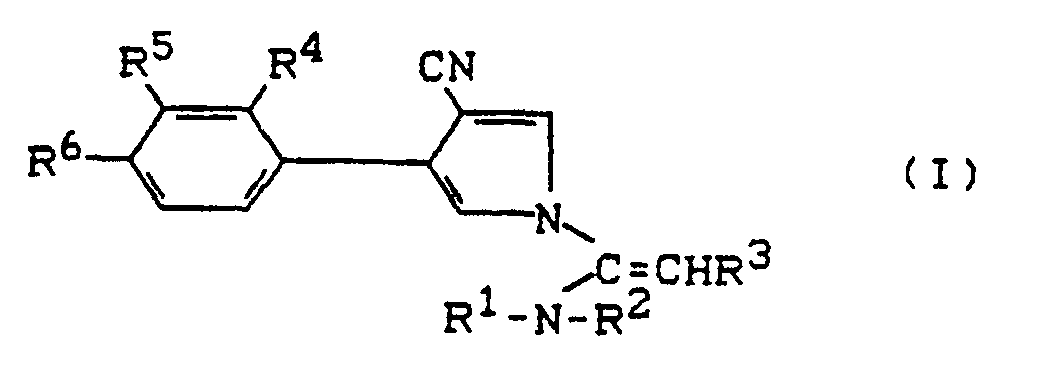
- R1 für Alkyl steht,
- R2 für Alkyl steht oder
- R1 und R2 gemeinsam mit dem Stickstoffatom, an welches sie gebunden sind, einen 5- bis 7-gliedrigen gesättigten, gegebenenfalls gleich oder verschieden, ein- bis mehrfach substituierten Ring bilden,
- R3 für Alkyl steht,
- R4 für Wasserstoff, Halogen, Alkyl, Halogenalkyl, Alkoxy, Halogenalkoxy, Alkylthio oder Halogenalkylthio steht,
- R5 für Wasserstoff, Halogen, Alkyl, Halogenalkyl, Alkoxy, Halogenalkoxy, Alkylthio oder Halogenalkylthio steht oder
- R4 und R5 gemeinsam für durch Halogen substituiertes Alkylendioxy stehen und
- R6 für Wasserstoff oder Halogen steht, gefunden.
- Weiterhin wurde gefunden, daß man die neuen N-Vinyl-3-cyano-4-phenyl-pyrrol-Derivate der allgemeinen Formel (I)

- R1 für Alkyl steht,
- R2 für Alkyl steht oder
- R1 und R2 gemeinsam mit dem Stickstoffatom, an welches sie gebunden sind, einen 5- bis 7-gliedrigen gesättigten, gegebenenfalls gleich oder verschieden, ein- bis mehrfach substituierten Ring bilden,
- R3 für Alkyl steht,
- R4 für Wasserstoff, Halogen, Alkyl, Halogenalkyl, Alkoxy, Halogenalkoxy, Alkylthio oder Halogenalkylthio steht,
- R5 für Wasserstoff, Halogen, Alkyl, Halogenalkyl, Alkoxy, Halogenalkoxy, Alkylthio oder Halogenalkylthio steht oder
- R4 und R5 gemeinsam für durch Halogen substituiertes Alkylendioxy stehen, und
- R6 für Wasserstoff oder Halogen steht, erhält, wenn man 3-Cyano-4-phenyl-pyrrol-Derivate der Formel (11)

- R4, R5 und R6 die oben angegebene Bedeutung haben, mit 1-Aminoacetylen-Derivaten der Formel (111),

- R1, R2 und R3 die oben angegebene Bedeutung haben,
gegebenenfalls in Gegenwart eines Verdünnungsmittels umsetzt. - Schließlich wurde gefunden, daß die neuen N-Vinyl-3-cyano-4-phenyl-pyrrol-Derivate der allgemeinen Formel (I) eine gute Wirkung gegen Schädlinge besitzen.
- Bevorzugte Substituenten bzw. Bereiche der in den oben und nachstehend erwähnten Formeln aufgeführten Reste werden im folgenden erläutert:
- In den allgemeinen Formeln bedeutet Alkyl vorzugsweise geradkettiges oder verzweigtes Alkyl mit 1 bis 6 Kohlenstoffatomen, bevorzugt mit 1 bis 4 und besonders bevorzugt mit 1 oder 2 Kohlenstoffatomen; beispielhaft seien genannt Methyl, Ethyl, n- und i-Propyl, n-, i-, s- und t-Butyl.
- Alkoxy steht vorzugsweise als Substituent für geradkettiges oder verzweigtes Alkoxy mit 1 bis 6, besonders bevorzugt 1 bis 4 Kohlenstoffatomen je Alkylrest; beispielhaft seien genannt: Methoxy, Ethoxy, n-oder i-Propoxy, n-, i-, s- und t-Butoxy.
- Halogenalkyl und Halogenalkoxy stehen bevorzugt als Substituenten für geradkettige oder verzweigte Reste mit je 1 bis 4 Kohlenstoffatomen, besonders bevorzugt mit 1 oder 2 Kohlenstoffatomen und jeweils 1 bis 9 bzw. 1 bis 5 gleichen oder verschiedenen Halogenatomen wie unter Halogen definiert; beispielhaft seien genannt: Fluormethyl, Chlormethyl, Brommethyl, Fluorethyl, Chlorethyl, Bromethyl, Fluor-n-propyl, Chlor-n-propyl, Difluormethyl, Trifluormethyl, Dichlormethyl, Trichlormethyl, Difluorethyl, Trifluorethyl, Trichlorethyl, Chlor-difluor-methyl, Trifluor-chlorethyl, Chlorbutyl, Fluorbutyl, Fluormethoxy, Chlormethoxy, Brommethoxy, Fluorethoxy, Chlorethoxy, Bromethoxy, Fluorpropoxy, Chlorpropoxy, Brompropoxy, Fluorbutoxy, Chlorbutoxy, Fluor-i-propoxy, Chlor-i-propoxy, Difluormethoxy, Trifluormethoxy, Dichlormethoxy, Trichlormethoxy, Difluorethoxy, Trifluorethoxy, Tetrafluorethoxy, Trichlorethoxy, Chlordifluormethoxy, Trifluorchlorethoxy, besonders hervorzuheben sind, Trifluormethyl und Trifluormethoxy.
- Halogenalkylthio steht vorzugsweise als Substituent in den Resten für geradkettige oder verzweigte Reste mit je 1 bis 4 Kohlenstoffatomen, besonders bevorzugt mit 1 oder 2 Kohlenstoffatomen und jeweils 1 bis 9 bzw. 1 bis 5, gleichen oder verschiedenen Halogenatomen wie unter Halogen definiert; beispielhaft seien genannt: Fluormethylthio, Chlormethylthio, Brommethylthio, Fluorethylthio, Chlorethylthio, Bromethylthio, Fluorpropylthio, Chlorpropylthio, Brompropylthio, Fluorbutylthio, Chlorbutylthio, Brombutylthio, Fluor-i-propylthio, Chlor-i-propylthio, Difluormethylthio, Trifluormethylthio, Dichlormethylthio, Trichlormethylthio, Difluorethylthio, Trifluorethylthio, Tetrafluorethylthio, Trichlorethylthio, Chlordifluormethylthio und Trifluorchlorethylthio.
- Halogen als solches oder in den Definitionen Halogenalkyl, Halogenalkoxy und Halogenalkylthio steht für Fluor, Chlor, Brom und/oder lod, insbesondere Fluor, Chlor und/oder Brom und besonders für Fluor oder Chlor.
- Alkylthio steht vorzugsweise als Substituent für geradkettiges oder verzweigtes Alkylthio mit vorzugsweise 1 bis 6 Kohlenstoffatomen, beispielsweise sind darunter die folgenden Gruppen zu verstehen: Methylthio-, Ethylthio-, Propylthio-, Butylthio-, Pentylthio sowie ihre Isomeren, wie z. B. i-Propylthio, i-, s-und t-Butylthio, 1-Methyl-butylthio, 2-Methyl-butylthio- und 3-Methyl-butylthio. Bevorzugte Alkylthioreste enthalten 1 bis 4 Kohlenstoffatome. Besonders bevorzugt sind Methylthio, Ethylthio, n-, i-, s-Propylthio und n-, i-, s- und t-Butylthio.
- Die erfindungsgemäßen N-Vinyl-3-cyano-4-phenyl-pyrrol-Derivate sind durch die Formel (I) allgemein definiert.
- Bevorzugt sind Verbindungen der Formel (I), bei welchen
- R1 für geradkettiges oder verzweigtes Alkyl mit 1 bis 4 Kohlenstoffatomen steht,
- R2 für geradkettiges oder verzweigtes Alkyl mit 1 bis 4 Kohlenstoffatomen steht oder
- R1 und R2 gemeinsam mit dem Stickstoffatom, an welches sie gebunden sind, einen 5- bis 7-gliedrigen gesättigten, gegebenenfalls ein- bis fünffach, gleich oder verschieden durch Halogen, Alkyl mit 1 bis 4 Kohlenstoffatomen, Alkoxy mit 1 bis 4 Kohlenstoffatomen, Halogenalkyl oder Halogenalkoxy mit je 1 bis 4 Kohlenstoffatomen und 1 bis 9 gleichen oder verschiedenen Halogenatomen substituierten Ring bilden,
- R3 für geradkettiges oder verzweigtes Alkyl mit 1 bis 4 Kohlenstoffatomen steht,
- R4 für Wasserstoff, Halogen, geradkettiges oder verzweigtes Alkyl mit 1 bis 4 Kohlenstoffatomen, geradkettiges oder verzweigtes Halogenalkyl mit 1 bis 4 Kohlenstoffatomen und 1 bis 9 gleichen oder verschiedenen Halogenatomen, geradkettiges oder verzweigtes Alkoxy mit 1 bis 4 Kohlenstoffatomen, geradkettiges oder verzweigtes Halogenalkoxy mit 1 bis 4 Kohlenstoffatomen und 1 bis 9 gleichen oder verschiedenen Halogenatomen, geradkettiges oder verzweigtes Alkylthio mit 1 bis 4 Kohlenstoffatomen, geradkettiges oder verzweigtes Halogenalkylthio mit 1 bis 4 Kohlenstoffatomen und 1 bis 9 gleichen oder verschiedenen Halogenatomen steht,
- R5 für Wasserstoff, Halogen, geradkettiges oder verzweigtes Alkyl mit 1 bis 4 Kohlenstoffatomen, geradkettiges oder verzweigtes Halogenalkyl mit 1 bis 4 Kohlenstoffatomen und 1 bis 9 gleichen oder verschiedenen Halogenatomen, geradkettiges oder verzweigtes Alkoxy mit 1 bis 4 Kohlenstoffatomen, geradkettiges oder verzweigtes Halogenalkoxy mit 1 bis 4 Kohlenstoffatomen und 1 bis 9 gleichen oder verschiedenen Halogenatomen, geradkettiges oder verzweigtes Halogenalkylthio mit 1 bis 4 Kohlenstoffatomen und 1 bis 9 gleichen oder verschiedenen Halogentomen steht,
oder - R4 und R5 gemeinsam für ein- oder zweifach durch Fluor substituiertes Methylendioxy stehen und
- R6 für Wasserstoff oder Fluor stehen.
- Besonders bevorzugt sind Verbindungen der Formel (I), bei welchen
- R1 für Methyl, Ethyl, n- oder i-Propyl oder n-Butyl, steht,
- R2 für Methyl, Ethyl, n- oder i-Propyl oder n-Butyl, steht oder
- R1 und R2 gemeinsam mit dem Stickstoffatom, an welches sie gebunden sind, einen 5- bis 7-gliedrigen gesättigten Ring bilden,
- R3 für Methyl oder Ethyl steht,
- R4 für Wasserstoff, Fluor, Chlor, Brom, Methyl, Ethyl, Halogenalkyl mit 1 oder 2 Kohlenstoffatomen und 1 bis 5 gleichen oder verschiedenen Halogenatomen, insbesondere Fluor- und/oder Chloratomen, Methoxy, Ethoxy, Halogenalkoxy mit 1 oder 2 Kohlenstoffatomen und 1 bis 5 gleichen oder verschiedenen Halogenatomen, insbesondere Fluor- und/oder Chloratomen, Methylthio, Ethylthio, Halogenalkylthio mit 1 oder 2 Kohlenstoffatomen und 1 bis 5 gleichen oder verschiedenen Halogenatomen, insbesondere Fluor- oder Chloratomen, steht,
- R5 für Wasserstoff, Fluor, Chlor, Brom, Methyl, Ethyl, Halogenalkyl mit 1 oder 2 Kohlenstoffatomen und 1 bis 5 gleichen oder verschiedenen Halogenatomen, insbesondere Fluor- und/oder Chloratomen, Methoxy, Ethoxy, Halogenalkoxy mit 1 oder 2 Kohlenstoffatomen und 1 bis 5 gleichen oder verschiedenen Halogenatomen, insbesondere Fluor- und/oder Chloratomen, Methylthio, Ethylthio, Halogenalkylthio mit 1 oder 2 Kohlenstoffatomen und 1 bis 5 gleichen oder verschiedenen Halogenatomen, insbesondere Fluor- oder Chloratomen steht,
- R4 und R5 gemeinsam für zweifach durch Fluor substituiertes Methylendioxy stehen und
- R6 für Wasserstoff oder Fluor steht.
- Ganz besonders bevorzugt sind Verbindungen der Formel (I), bei welchen
- R1 für Methyl oder Ethyl steht,
- R2 für Methyl oder Ethyl steht,
- R3 für Methyl oder Ethyl steht,
- R4 für Wasserstoff, Fluor, Chlor, Methyl, Ethyl, Trifluormethyl steht,
- R5 für Wasserstoff, Chlor, Methyl, Trifluormethyl steht und
- R6 für Wasserstoff oder Fluor steht.
- Die für die Verbindungen der Formel (I) angegebenen bevorzugten Definitionen gelten auch für die Ausgangsverbindungen der Formel (11) und der Formel (III).
- Im einzelnen seien außer den bei den Herstellungsbeispielen genannten Verbindungen die folgenden N-Vinyl-3-cyano-4-phenyl-pyrrol-Derivate der allgemeinen Formel (I) genannt:


- Verwendet man beispielsweise 3-Cyano-4-(2-fluor-3-chlorphenyl)-pyrrol und 1-Diethylaminopropin als Ausgangsstoffe, so läßt sich der Reaktionsablauf des erfindungsgemäßen Verfahrens durch das folgende Formelschema darstellen:

- Die zur Durchführung des erfindungsgemäßen Verfahrens als Ausgangsstoffe benötigten substituierten 3-Cyano-4-phenyl-pyrrol-Derivate sind durch die Formel (11) allgemein definiert. In dieser Formel (11) stehen R4, R5 und R6 für diejenigen Reste, die bereits im Zusammenhang mit der Beschreibung der erfindungsgemäßen Stoffe der Formel (I) für diese Substituenten genannt wurden.
- Die substituierten 3-Cyano-4-phenyl-pyrrol-Derivate der Formel (11) sind zum Teil bekannt oder sind Gegenstand von nicht zum Stand der Technik gehörenden Patentanmeldungen der Anmelderin. So wird die Herstellung von 3-(2,2-Difluorbenzodioxol-4-yl)-4-cyano-pyrrol beschrieben in EP 206 999, die Herstellung von im Phenylring unsubstituierter oder durch Halogen, Alkyl oder Halogenalkyl substituierter 3-Cyano-4-phenyl-pyrrole werden in US 4 778 901, EP 174 910 beschrieben, weiterhin in DE 3 718 375, DE 3 737 984 und DE 3 718 375 u.a..
- Die beim erfindungsgemäßen Verfahren zur Herstellung von Verbindungen der Formel (I) als Ausgangsstoffe zu verwendenden 1-Aminoacetylen-Derivate sind durch die Formel (III) allgemein definiert.
- In Formel (III) haben R1, R2 und R3 diejenigen Bedeutungen, die bereits oben im Zusammenhang mit der Beschreibung der erfindungsgemäßen Verbindungen der Formel (I) für R1, R2 und R angegeben wurden.
- Die 1-Aminoacetylen-Derivate sind bekannte Verbindungen der organischen Chemie und/oder können nach an sich bekannten Verfahren hergestellt werden (vgl. Studies in Organic Chemistry, Preparative Acetylenic Chemistry Vol. 34 (2nd Edition), Elsevier 1988, S.235).
- Als Verdünnungsmittel zur Durchführung des erfindungsgemäßen Verfahrens kommen inerte organische Lösungsmittel infrage. Hierzu gehören insbesondere aliphatische, alicyclische oder aromatische, gegebenenfalls halogenierte Kohlenwasserstoffe, wie beispielsweise Benzin, Benzol, Toluol, Xylol, Chlorbenzol, Petrolether, Hexan, Cyclohexan, Dichlormethan, Chloroform, Tetrachlorkohlenstoff, Ether, wie Diethylether, Dioxan, Tetrahydrofuran oder Ethylenglykoldimethyl- oder -diethylether, Amide, wie Dimethylformamid, Dimethylacetamid, N-Methylformanilid, N-Methylpyrrolidon oder Hexamethylphosphorsäuretriamid, oder Sulfoxide, wie Dimethylsulfoxid.
- Die Reaktionstemperaturen können bei dem erfindungsgemäßen Verfahren in einem größeren Bereich variiert werden. Im allgemeinen arbeitet man bei Temperaturen zwischen - 40 °C und + 120 C, vorzugsweise bei Temperaturen zwischen 0 ° C und + 60 ° C.
- Zur Durchführung des erfindungsgemäßen Verfahrens setzt man pro Mol an 3-Cyano-4-phenyl-pyrrol-Derivat der Formel (11) im allgemeinen 1,0 bis 2,0 Mol, vorzugsweise 1,0 bis 1,2 Mol an 1-Aminoacetylen-Derivat der Formel (111) ein.
- Die Reaktionsdurchführung, Aufarbeitung und Isolierung der Reaktionsprodukte erfolgt nach allgemein üblichen Methoden.
- Die erfindungsgemäßen Wirkstoffe weisen eine starke Wirkung gegen Schädlinge auf und können zur Bekämpfung von unerwünschten Schadorganismen praktisch eingesetzt werden. Die Wirkstoffe sind für den Gebrauch als Pflanzenschutzmittel, insbesondere als Fungizide geeignet.
- Fungizide Mittel im Pflanzenschutz werden eingesetzt zur Bekämpfung von Plasmodiophoromycetes, Oomycetes, Chytridiomycetes, Zygomycetes, Ascomycetes, Basidiomycetes, Deuteromycetes.
- Beispielhaft aber nicht begrenzend seien einige Erreger von pilzlichen Erkrankungen, die unter die oben aufgezählten Oberbegriffe fallen, genannt:
- Pythium-Arten, wie beispielsweise Pythium ultimum;
- Phytophthora-Arten, wie beispielsweise Phytophthora infestans;
- Pseudoperonospora-Arten, wie beispielsweise Pseudoperonospora humuli oder Pseudoperonospora cubensis;
- Plasmopara-Arten, wie beispielsweise Plasmopara viticola;
- Peronospora-Arten, wie beispielsweise Peronospora pisi oder P. brassicae;
- Erysiphe-Arten, wie beispielsweise Erysiphe graminis;
- Sphaerotheca-Arten, wie beispielsweise Sphaerotheca fuliginea;
- Podosphaera-Arten, wie beispielsweise Podosphaera leucotricha;
- Venturia-Arten, wie beispielsweise Venturia inaequalis;
- Pyrenophora-Arten, wie beispielsweise Pyrenophora teres oder P. graminea
- (Konidienform: Drechslera, Syn: Helminthosporium);
- Cochliobolus-Arten, wie beispielsweise Cochliobolus sativus
- (Konidienform: Drechslera, Syn: Helminthosporium);
- Uromyces-Arten, wie beispielsweise Uromyces appendiculatus;
- Puccinia-Arten, wie beispielsweise Puccinia recondita;
- Tilletia-Arten, wie beispielsweise Tilletia caries;
- Ustilago-Arten, wie beispielsweise Ustilago nuda oder Ustilago avenae;
- Pellicularia-Arten, wie beispielsweise Pellicularia sasakii;
- Pyricularia-Arten, wie beispielsweise Pyricularia oryzae;
- Fusarium-Arten, wie beispielsweise Fusarium culmorum;
- Botrytis-Arten, wie beispielsweise Botrytis cinerea;
- Septoria-Arten, wie beispielsweise Septoria nodorum;
- Leptosphaeria-Arten, wie beispielsweise Leptosphaeria nodorum;
- Cercospora-Arten, wie beispielsweise Cercospora canescens;
- Alternaria-Arten, wie beispielsweise Alternaria brassicae;
- Pseudocercosporella-Arten, wie beispielsweise Pseudocercosporella herpotrichoides.
- Die gute Pflanzenverträglichkeit der Wirkstoffe in den zur Bekämpfung von Pflanzenkrankheiten notwendigen Konzentrationen erlaubt eine Behandlung von oberirdischen Pflanzenteilen, von Pflanz- und Saatgut, und des Bodens.
- Dabei lassen sich die erfindungsgemäßen Wirkstoffe mit besonders gutem Erfolg zur Bekämpfung von Krankheiten im Obst- und Gemüseanbau, wie beispielsweise gegen den Erreger des Bohnengrauschimmels (Botrytis cinerea) oder zur Bekämpfung von Reiskrankheiten wie beispielsweise gegen den Erreger der Reisfleckenkrankheit (Pyricularia oryzae) oder gegen Erysiphe graminis und gegen Pyrenophora teres an Gerste einsetzen.
- Weiterhin zeigen einige der erfindungsgemäßen Wirkstoffe gute fungizide Wirkungen gegen Leptosphaeria und Fusarium an Getreidekulturen. Ferner zeigen einige der erfindungsgemäßen Wirkstoffe auch eine gute und breite in vitro-Wirkung.
- Die Wirkstoffe können in Abhängigkeit von ihren jeweiligen physikalischen und/oder chemischen Eigenschaften in übliche Formulierungen übergeführt werden, wie Lösungen, Emulsionen, Suspensionen, Pulver, Schäume, Pasten, Granulate, Aerosole, Feinstverkapselungen in polymeren Stoffen und in Hüllmassen für Saatgut, sowie ULV-Kalt-und Warmnebel-Formulierungen.
- Diese Formulierungen werden in bekannter Weise hergestellt, z.B. durch Vermischen der Wirkstoffe mit Streckmitteln, also flüssigen Lösungsmitteln, unter Druck stehenden verflüssigten Gasen und/oder festen Trägerstoffen, gegebenenfalls unter Verwendung von oberflächenaktiven Mitteln, also Emulgiermitteln und/oder Dispergiermitteln und/oder schaumerzeugenden Mitteln. Im Falle der Benutzung von Wasser als Streckmittel können z.B. auch organische Lösungsmittel als Hilfslösungsmittel verwendet werden. Als flüssige Lösungsmittel kommen im wesentlichen in Frage: Aromaten, wie Xylol, Toluol, oder Alkylnaphthaline, chlorierte Aromaten oder chlorierte aliphatische Kohlenwasserstoffe, wie Chlorbenzole, Chlorethylene oder Methylenchlorid, aliphatische Kohlenwasserstoffe, wie Cyclohexan oder Paraffine, z.B. Erdölfraktionen, Alkohole, wie Butanol oder Glycol sowie deren Ether und Ester, Ketone, wie Aceton, Methylethylketon, Methylisobutylketon oder Cyclohexanon, stark po lare Lösungsmittel, wie Dimethylformamid und Dimethylsulfoxid, sowie Wasser; mit verflüssigten gasförmigen Streckmitteln oder Trägerstoffen sind solche Flüssigkeiten gemeint, welche bei normaler Temperatur und unter Normaldruck gasförmig sind, z.B. Aerosol-Treibgase, wie Halogenkohlenwasserstoffe sowie Butan, Propan, Stickstoff und Kohlendioxid; als feste Trägerstoffe kommen in Frage: z.B. natürliche Gesteinsmehle, wie Kaoline, Tonerden, Talkum, Kreide, Quarz, Attapulgit, Montmorillonit oder Diatomeenerde und synthetische Gesteinsmehle, wie hochdisperse Kieselsäure, Aluminiumoxid und Silikate; als feste Trägerstoffe für Granulate kommen in Frage: z.B. gebrochene und fraktionierte natürliche Gesteine wie Calcit, Marmor, Bims, Sepiolith, Dolomit sowie synthetische Granulate aus anorganischen und organischen Mehlen sowie Granulate aus organischem Material wie Sägemehl, Kokosnußschalen, Maiskolben und Tabakstengel; als Emulgier- und/oder schaumerzeugende Mittel kommen in Frage: z.B. nichtionogene und anionische Emulgatoren, wie Polyoxyethylen-Fettsäure-Ester, Polyoxyethylen-Fettalkohol-Ether, z.B. Alkylarylpolyglykol-Ether, Alkylsulfonate, Alkylsulfate, Arylsulfonate sowie Eiweißhydrolysate; als Dispergiermittel kommen in Frage: z.B. Lignin-Sulfitablaugen und Methylcellulose.
- Es können in den Formulierungen Haftmittel wie Carboxymethylcellulose, natürliche und synthetische pulverige, körnige oder latexförmige Polymere verwendet werden, wie Gummiarabicum, Polyvinylalkohol, Polyvinylacetat, sowie natürliche Phospholipide, wie Kephaline und Lecithine, und synthetische Phospholipide. Weitere Additive können mineralische und vegetabile Öle sein.
- Es können Farbstoffe wie anorganische Pigmente, z.B. Eisenoxid, Titanoxid, Ferrocyanblau und organische Farbstoffe, wie Alizarin-, Azo- und Metallphthalocyaninfarbstoffe und Spurennährstoffe wie Salze von Eisen, Mangan, Bor, Kupfer, Kobalt, Molybdän und Zink verwendet werden.
- Die Formulierungen enthalten im allgemeinen zwischen 0,1 und 95 Gewichtsprozent Wirkstoff, vorzugsweise zwischen 0,5 und 90 %.
- Die erfindungsgemäßen Wirkstoffe können in den Formulierungen in Mischung mit anderen bekannten Wirkstoffen vorliegen wie Fungizide, Insektizide, Akarizide und Herbizide sowie in Mischungen mit Düngemitteln und Wachstumsregulatoren.
- Die Wirkstoffe können als solche, in Form ihrer Formulierungen oder den daraus bereiteten Anwendungsformen wie gebrauchsfertige Lösungen, Suspensionen, Spritzpulver, Pasten, lösliche Pulver, Stäubemittel und Granulate angewendet werden. Die Anwendung geschieht in üblicher Weise, z.B. durch Gießen, Verspritzen, Versprühen, Verstreuen, Verstäuben, Verschäumen, Bestreichen usw.. Es ist ferner möglich, die Wirkstoffe nach dem Ultra-Low-Volume-Verfahren auszubringen oder die Wirkstoffzubereitung oder den Wirkstoff selbst in den Boden zu injizieren. Es kann auch das Saatgut der Pflanzen behandelt werden.
- Bei der Behandlung von Pflanzenteilen können die Wirkstoffkonzentrationen in den Anwendungsformen in einem größeren Bereich variiert werden. Sie liegen im allgemeinen zwischen 1 und 0,0001 Gew.-%, vorzugsweise zwischen 0,5 und 0,001 %.
- Bei der Saatgutbehandlung werden im allgemeinen Wirkstoffmengen von 0,001 bis 50 g je Kilogramm Saatgut, vorzugsweise 0,01 bis 10 g benötigt.
- Bei Behandlung des Bodens sind Wirkstoffkonzentrationen von 0,00001 bis 0,1 Gew.-%, vorzugsweise von 0,0001 bis 0,02 % am Wirkungsort erforderlich.
-


- Analog zu Beispiel 1 bzw. dem erfindungsgemäßen Verfahren können die in der nachfolgenden Tabelle angegebenen Verbindungen der Formel (I)


- Lösungsmittel: 100 Gewichtsteile Dimethylformamid Emulgator: 0,25 Gewichtsteile Alkylarylpolyglykolether
- Zur Herstellung einer zweckmäßigen Wirkstoffzubereitung vermischt man 1 Gewichtsteil Wirkstoff mit den angegebenen Mengen Lösungsmittel und Emulgator und verdünnt das Konzentrat mit Wasser auf die gewünschte Konzentration.
- Zur Prüfung auf protektive Wirksamkeit besprüht man junge Pflanzen mit der Wirkstoffzubereitung taufeucht. Nach Antrocknen des Spritzbelages werden die Pflanzen mit Sporen von Erysiphe graminis f.sp. hordei bestäubt.
- Die Pflanzen werden in einem Gewächshaus bei einer Temperatur von ca. 20° C und einer relativen Luftfeuchtigkeit von ca. 80% aufgestellt, um die Entwicklung von Mehltaupusteln zu begünstigen.
- 7 Tage nach der Inokulation erfolgt die Auswertung.
- Eine gute Wirksamkeit von 88 % Wirkungsgrad bei einer Wirkstoffkonzentration von 0,025 Gew.-% zeigt bei diesem Test z.B. die Verbindung gemäß Herstellungsbeispiel 2.
- Lösungsmittel: 100 Gewichtsteile Dimethylformamid
- Emulgator: 0,25 Gewichtsteile Alkylarylpolyglykolether
- Zur Herstellung einer zweckmäßigen Wirkstoffzubereitung vermischt man 1 Gewichtsteil Wirkstoff mit den angegebenen Mengen Lösungsmittel und Emulgator und verdünnt das Konzentrat mit Wasser auf die gewünschte Konzentration.
- Zur Prüfung auf protektive Wirksamkeit besprüht man junge Pflanzen mit der Wirkstoffzubereitung taufeucht. Nach Abtrocknen des Spritzbelages werden die Pflanzen mit einer Konidiensuspension von Pyrenophora teres besprüht. Die Pflanzen verbleiben 48 Stunden bei 20 C und 100 % relativer Luftfeuchtigkeit in einer Inkubationskabine.
- Die Pflanzen werden in einem Gewächshaus bei einer Temperatur von ca. 20 ° C und einer relativen Luftfeuchtigkeit von ca. 80 % aufgestellt.
- 7 Tage nach der Inokulation erfolgt die Auswertung.
- Eine gute Wirksamkeit zeigt bei diesem Test z.B. die Verbindung des Herstellungsbeispiels 2 bei einer Wirkstoffkonzentration von 0,025 Gew.-%.
- Lösungsmittel: 12,5 Gewichtsteile Aceton
- Emulgator: 0,3 Gewichtsteile Alkylarylpolyglykolether
- Zur Herstellung einer zweckmäßigen Wirkstoffzubereitung vermischt man 1 Gewichtsteil Wirkstoff mit der angegebenen Menge Lösungsmittel und verdünnt das Konzentrat mit Wasser und der angegebenen Menge Emulgator auf die gewünschte Konzentration.
- Zur Prüfung auf protektive Wirksamkeit bespritzt man junge Reispflanzen mit der Wirkstoffzubereitung bis zur Tropfnässe. Nach dem Abtrocknen des Spritzbelages werden die Pflanzen mit einer wäßrigen Sporensuspension von Pyricularia oryzae inokuliert. Anschließend werden die Pflanzen in einem Gewächshaus bei 100 % rel. Luftfeuchtigkeit und 25 ° C aufgestellt.
- 4 Tage nach der Inokulation erfolgt die Auswertung des Krankheitsbefalls.
- Eine gute Wirksamkeit zeigen in diesem Test z.B. die Verbindungen gemäß den Herstellungbeispielen 1 und 2 bei einer Wirkstoffkonzentration von 0,025 Gew.-% in der Spritzbrühe.
- Lösungsmittel: 4,7 Gewichtsteile Aceton
- Emulgator: 0,3 Gewichtsteile Alkylarylpolyglykolether
- Zur Herstellung einer zweckmäßigen Wirkstoffzubereitung vermischt man 1 Gewichtsteil Wirkstoff mit den angegebenen Mengen Lösungsmittel und Emulgator und verdünnt das Konzentrat mit Wasser auf die gewünschte Konzentration.
- Zur Prüfung auf protektive Wirksamkeit bespritzt man junge Pflanzen mit der Wirkstoffzubereitung bis zur Tropfnässe. Nach Antrocknen des Spritzbelages werden auf jedes Blatt 2 kleine mit Botrytis cinerea bewachsene Agarstückchen aufgelegt. Die inokulierten Pflanzen werden in einer abgedunkelten, feuchten Kammer bei 20 ° C aufgestellt. 3 Tage nach der Inokulation wird die Größe der Befallsflecken auf den Blättern ausgewertet.
- Eine gute Wirksamkeit zeigen in diesem Test z.B. die Verbindungen gemäß Herstellungsbeispielen 1 und 2 bei einer Wirkstoffkonzentration von 100 ppm.
oder
Claims (7)
1. N-Vinyl-3-cyano-4-phenyl-pyrrol-Derivate der allgemeinen Formel (I),

in welcher
oder
R1 für Alkyl steht,
R2 für Alkyl steht oder
R1 und R2 gemeinsam mit dem Stickstoffatom, an welches sie gebunden sind, einen 5- bis 7-gliedrigen gesättigten, gegebenenfalls gleich oder verschieden, ein- bis mehrfach substituierten Ring bilden,
R3 für Alkyl steht,
R4 für Wasserstoff, Halogen, Alkyl, Halogenalkyl, Alkoxy, Halogenalkoxy, Alkylthio oder Halogenalkylthio steht,
R5 für Wasserstoff, Halogen, Alkyl, Halogenalkyl, Alkoxy, Halogenalkoxy, Alkylthio oder Halogenalkylthio steht oder
R4 und R5 gemeinsam für durch Halogen substituiertes Alkylendioxy stehen und
R6 für Wasserstoff oder Halogen steht.
2. N-Vinyl-3-cyano-4-pheny-Ipyrrol-Derivate gemäß Anspruch 1, der Formel (I), in welcher
R1 für geradkettiges oder verzweigtes Alkyl mit 1 bis 4 Kohlenstoffatomen steht,
R2 für geradkettiges oder verzweigtes Alkyl mit 1 bis 4 Kohlenstoffatomen steht oder
R1 und R2 gemeinsam mit dem Stickstoffatom, an welches sie gebunden sind, einen 5- bis 7-gliedrigen gesättigten, gegebenenfalls ein-bis fünffach, gleich oder verschieden durch Halogen, Alkyl mit 1 bis 4 Kohlenstoffatomen, Alkoxy mit 1 bis 4 Kohlenstoffatomen, Halogenalkyl oder Halogenalkoxy mit je 1 bis 4 Kohlenstoffatomen und 1 bis 9 gleichen oder verschiedenen Halogenatomen substituierten Ring bilden,
R3 für geradkettiges oder verzweigtes Alkyl mit 1 bis 4 Kohlenstoffatomen steht,
R4 für Wasserstoff, Halogen, geradkettiges oder verzweigtes Alkyl mit 1 bis 4 Kohlenstoffatomen, geradkettiges oder verzweigtes Halo genalkyl mit 1 us 4 Kohlenstoffatomen und 1 bis 9 gleichen oder verschiedenen Halogenatomen, geradkettiges oder verzweigtes Alkoxy mit 1 bis 4 Kohlenstoffatomen, geradkettiges oder verzweigtes Halogenalkoxy mit 1 bis 4 Kohlenstoffatomen und 1 bis 9 gleichen oder verschiedenen Halogenatomen, geradkettiges oder verzweigtes Alkylthio mit 1 bis 4 Kohlenstoffatomen, geradkettiges oder verzweigtes Halogenalkylthio mit 1 bis 4 Kohlenstoffatomen und 1 bis 9 gleichen oder verschiedenen Halogenatomen steht,
R5 für Wasserstoff, Halogen, geradkettiges oder verzweigtes Alkyl mit 1 bis 4 Kohlenstoffatomen, geradkettiges oder verzweigtes Halogenalkyl mit 1 bis 4 Kohlenstoffatomen und 1 bis 9 gleichen oder verschiedenen Halogenatomen, geradkettiges oder verzweigtes Alkoxy mit 1 bis 4 Kohlenstoffatomen, geradkettiges oder verzweigtes Halogenalkoxy mit 1 bis 4 Kohlenstoffatomen und 1 bis 9 gleichen oder verschiedenen Halogenatomen, geradkettiges oder verzweigtes Halogenalkylthio mit 1 bis 4 Kohlenstoffatomen und 1 bis 9 gleichen oder verschiedenen Halogentomen steht,
oder
R4 und R5 gemeinsam für ein- oder zweifach durch Fluor substituiertes Methylendioxy stehen und
R6 für Wasserstoff oder Fluor stehen.
3. N-Vinyl-3-cyano-4-phenyl-pyrrol-Derivate gemäß Anspruch 1 der Formel (I), bei welchen
oder
R1 für Methyl, Ethyl, n- oder iso-Propyl oder n-Butyl steht,
R2 für Methyl, Ethyl, n- oder iso-Propyl oder n-Butyl steht oder
R1 und R2 gemeinsam mit dem Stickstoffatom, an welches sie gebunden sind, einen 5- bis 7-gliedrigen gesättigten, unsubstituierten Ring bilden,
R3 für Methyl oder Ethyl steht,
R4 für Wasserstoff, Fluor, Chlor, Brom, Methyl, Ethyl, Halogenalkyl mit 1 oder 2 Kohlenstoffatomen und 1 bis 5 gleichen oder verschiedenen Halogenatomen, insbesondere Fluor- und/oder Chloratomen, Methoxy, Ethoxy, Halogenalkoxy mit 1 oder 2 Kohlenstoffatomen und 1 bis 5 gleichen oder verschiedenen Halogenatomen, Methylthio, Ethylthio, Halogenalkylthio mit 1 oder 2 Kohlenstoffatomen und 1 bis 5 gleichen oder verschiedenen Halogenatomen, steht,
R5 für Wasserstoff, Fluor, Chlor, Brom, Methyl, Ethyl, Halogenalkyl mit 1 oder 2 Kohlenstoffatomen und 1 bis 5 gleichen oder verschiedenen Halogenatomen, Methoxy, Ethoxy, Halogenalkoxy mit 1 oder 2 Kohlenstoffatomen und 1 bis 5 gleichen oder verschiedenen Halogenatomen, insbesondere Fluor- und/oder Chloratomen, Methylthio, Ethylthio, Halogenalkylthio mit 1 oder 2 Kohlenstoffatomen und 1 bis 5 gleichen oder verschiedenen Halogenatomen, steht,
oder
R4 und R5 gemeinsam für zweifach durch Fluor substituiertes Methylendioxy stehen und
R6 für Wasserstoff oder Fluor steht.
4. N-Vinyl-3-cyano-4-phenyl-pyrrol-Derivate gemäß Anspruch 1 der Formel (I), in welcher
R1 für Methyl oder Ethyl steht,
R2 für Methyl oder Ethyl steht,
R3 für Methyl oder Ethyl steht,
R4 für Wasserstoff, Fluor, Chlor, Methyl, Ethyl oder Trifluormethyl steht,
R5 für Wasserstoff, Chlor, Methyl oder Trifluormethyl steht und
R6 für Wasserstoff oder Fluor steht.
5. Verfahren zur Herstellung von N-Vinyl-3-cyano-4-phenyl-pyrrol-Derivaten der Formel (I)

in welcher
dadurch gekennzeichnet, daß man 3-Cyano-4-phenyl-pyrrol-Derivate der Formel (11) 
in welcher
in welcher
R1 für Alkyl steht,
R2 für Alkyl steht oder
R1 und R2 gemeinsam mit dem Stickstoffatom, an welches sie gebunden sind, einen 5- bis 7-gliedrigen gesättigten, gegebenenfalls gleich oder verschieden, ein- bis mehrfach substituierten Ring bilden,
R3 für Alkyl steht,
R4 für Wasserstoff, Halogen, Alkyl, Halogenalkyl, Alkoxy, Halogenalkoxy, Alkylthio oder Halogenalkylthio steht,
R5 für Wasserstoff, Halogen, Alkyl, Halogenalkyl, Alkoxy, Halogenalkoxy, Alkylthio oder Halogenalkylthio steht oder
R4 und R5 gemeinsam für durch Halogen substituiertes Alkylendioxy stehen, und
R6 für Wasserstoff oder Halogen steht,
dadurch gekennzeichnet, daß man 3-Cyano-4-phenyl-pyrrol-Derivate der Formel (11)
in welcher
R4, R5 und R6 die oben angegebene Bedeutung haben, mit 1-Aminoacetylen-Derivaten der Formel (111),

in welcher
gegebenenfalls in Gegenwart eines Verdünnungsmittels umsetzt.
R1, R2 und R3 die oben angegebene Bedeutung haben,
gegebenenfalls in Gegenwart eines Verdünnungsmittels umsetzt.
6. Schädlingsbekämpfungsmittel, gekennzeichnet durch einen Gehalt an mindestens einem N-Vinyl-3-cyano-4-phenyl-pyrrol-Derivat der Formel (I) nach den Ansprüchen 1 und 5.
7. Verwendung von N-Vinyl-3-cyano-4-phenyl-pyrrol-Derivaten der Formel (I) nach den Ansprüchen 1 und 5 zur Bekämpfung von Schädlingen.
8. Verfahren zur Bekämpfung von Schädlingen, dadurch gekennzeichnet, daß man N-Vinyl-3-cyano-4-phenyl-pyrrol-Derivate der Formel (I) nach den Ansprüchen 1 und 5 auf Schädlinge und/oder ihren Lebensraum einwirken läßt.
9. Verfahren zur Herstellung von Schädlingsbekämpfungsmitteln, dadurch gekennzeichnet, daß man N-Vinyl-3-cyano-4-phenyl-pyrrol-Derivate der Formel (I) nach den Ansprüchen 1 und 5 mit Streckmitteln und/oder oberflächenaktiven Mitteln vermischt.
Applications Claiming Priority (2)
| Application Number | Priority Date | Filing Date | Title |
|---|---|---|---|
| DE3922104 | 1989-07-05 | ||
| DE3922104A DE3922104A1 (de) | 1989-07-05 | 1989-07-05 | N-vinyl-3-cyano-4-phenyl-pyrrol-derivate |
Publications (1)
| Publication Number | Publication Date |
|---|---|
| EP0407790A1 true EP0407790A1 (de) | 1991-01-16 |
Family
ID=6384357
Family Applications (1)
| Application Number | Title | Priority Date | Filing Date |
|---|---|---|---|
| EP90111937A Withdrawn EP0407790A1 (de) | 1989-07-05 | 1990-06-23 | N-Vinyl-3-cyano-4-phenyl-pyrrol-Derivate |
Country Status (7)
| Country | Link |
|---|---|
| US (1) | US5061312A (de) |
| EP (1) | EP0407790A1 (de) |
| JP (1) | JPH0344368A (de) |
| KR (1) | KR910002793A (de) |
| BR (1) | BR9003189A (de) |
| DD (1) | DD297959A5 (de) |
| DE (1) | DE3922104A1 (de) |
Cited By (1)
| Publication number | Priority date | Publication date | Assignee | Title |
|---|---|---|---|---|
| EP0530515A1 (de) * | 1991-09-06 | 1993-03-10 | American Cyanamid Company | N-Alkanoylaminomethyl- und N-Aroylaminomethylpyrrole als Insektizide und Akarizide |
Citations (5)
| Publication number | Priority date | Publication date | Assignee | Title |
|---|---|---|---|---|
| EP0133247A2 (de) * | 1983-07-22 | 1985-02-20 | Ciba-Geigy Ag | N-Aminomethyl-3-phenyl-4-cyanopyrrol-Derivate, deren Herstellung und Verwendung als Mikrobizide |
| EP0182737A2 (de) * | 1984-10-16 | 1986-05-28 | Ciba-Geigy Ag | 3-Phenylpyrrolderivate, Verfahren zu ihrer Herstellung und ihre Verwendung als Schädlingsbekämpfungsmittel |
| EP0206999A2 (de) * | 1985-06-21 | 1986-12-30 | Ciba-Geigy Ag | Mikrobizide Mittel |
| EP0281731A2 (de) * | 1987-01-31 | 1988-09-14 | Bayer Ag | 1-Aminomethyl-3-aryl-4-cyano-pyrrole |
| EP0310558A2 (de) * | 1987-10-02 | 1989-04-05 | Ciba-Geigy Ag | Mikrobizide Mittel |
Family Cites Families (3)
| Publication number | Priority date | Publication date | Assignee | Title |
|---|---|---|---|---|
| PT78722A (en) * | 1983-06-17 | 1984-07-01 | Ciba Geigy Ag | Process for preparing novel n-alkylated 3-phenyl-4-cianopyrrole derivatives |
| EP0236272B1 (de) * | 1986-03-04 | 1991-06-12 | Ciba-Geigy Ag | Fungizide Verwendung eines Cyanopyrrol-Derivates |
| DE3718375A1 (de) * | 1987-06-02 | 1988-12-15 | Bayer Ag | Verfahren zur herstellung von 3-cyano-4-aryl-pyrrolen |
-
1989
- 1989-07-05 DE DE3922104A patent/DE3922104A1/de not_active Withdrawn
-
1990
- 1990-06-18 US US07/539,631 patent/US5061312A/en not_active Expired - Fee Related
- 1990-06-23 EP EP90111937A patent/EP0407790A1/de not_active Withdrawn
- 1990-06-29 JP JP2170333A patent/JPH0344368A/ja active Pending
- 1990-07-03 DD DD90342470A patent/DD297959A5/de not_active IP Right Cessation
- 1990-07-04 KR KR1019900010048A patent/KR910002793A/ko not_active Withdrawn
- 1990-07-05 BR BR909003189A patent/BR9003189A/pt unknown
Patent Citations (5)
| Publication number | Priority date | Publication date | Assignee | Title |
|---|---|---|---|---|
| EP0133247A2 (de) * | 1983-07-22 | 1985-02-20 | Ciba-Geigy Ag | N-Aminomethyl-3-phenyl-4-cyanopyrrol-Derivate, deren Herstellung und Verwendung als Mikrobizide |
| EP0182737A2 (de) * | 1984-10-16 | 1986-05-28 | Ciba-Geigy Ag | 3-Phenylpyrrolderivate, Verfahren zu ihrer Herstellung und ihre Verwendung als Schädlingsbekämpfungsmittel |
| EP0206999A2 (de) * | 1985-06-21 | 1986-12-30 | Ciba-Geigy Ag | Mikrobizide Mittel |
| EP0281731A2 (de) * | 1987-01-31 | 1988-09-14 | Bayer Ag | 1-Aminomethyl-3-aryl-4-cyano-pyrrole |
| EP0310558A2 (de) * | 1987-10-02 | 1989-04-05 | Ciba-Geigy Ag | Mikrobizide Mittel |
Cited By (1)
| Publication number | Priority date | Publication date | Assignee | Title |
|---|---|---|---|---|
| EP0530515A1 (de) * | 1991-09-06 | 1993-03-10 | American Cyanamid Company | N-Alkanoylaminomethyl- und N-Aroylaminomethylpyrrole als Insektizide und Akarizide |
Also Published As
| Publication number | Publication date |
|---|---|
| DE3922104A1 (de) | 1991-01-17 |
| DD297959A5 (de) | 1992-01-30 |
| US5061312A (en) | 1991-10-29 |
| KR910002793A (ko) | 1991-02-26 |
| BR9003189A (pt) | 1991-08-27 |
| JPH0344368A (ja) | 1991-02-26 |
Similar Documents
| Publication | Publication Date | Title |
|---|---|---|
| EP0248288A2 (de) | Trisubstituierte 1,3,5-Triazin-2,4,6-trione | |
| EP0334134A1 (de) | 3,7-Disubstituierte Benzthiazolone | |
| EP0281731A2 (de) | 1-Aminomethyl-3-aryl-4-cyano-pyrrole | |
| EP0431424A2 (de) | Pyridinylpyrimidin-Derivate | |
| EP0177740A1 (de) | Acylierte Saccharin-Derivate | |
| EP0531821B1 (de) | 1-Alkoxyhexatrien-2-carbonsäureester | |
| EP0226051A1 (de) | Fungizide Verwendung von Tetrahydrobenzothienylharnstoff-Derivaten | |
| DE3815700A1 (de) | Substituierte pyridyl(3)-alkanole, verfahren zu ihrer herstellung und ihre verwendung als schaedlingsbekaempfungsmittel | |
| EP0277537B1 (de) | 1-Aminomethyl-3-aryl-4-cyano-pyrrole | |
| EP0435043A1 (de) | Substituerte 1-Aminomethyl-3-aryl-4-cyano-pyrrole | |
| EP0557860B1 (de) | Substituierte Pyridylpyrimidine und ihre Verwendung als Schädlingsbekämpfungsmittel | |
| DE3922104A1 (de) | N-vinyl-3-cyano-4-phenyl-pyrrol-derivate | |
| EP0300312A2 (de) | Substituierte 3-Arylpyrrole | |
| EP0253259A2 (de) | Fungizide Verwendung von substituierten Thienylaminen | |
| EP0140271A2 (de) | Iodacetamide | |
| EP0283777A1 (de) | Benzaldoxim-Derivate | |
| EP0339417B1 (de) | 3-Cyano-4-phenyl-pyrrole | |
| EP0189800A2 (de) | Thiocyanatomethylthio-Gruppen enthaltende Verbindungen | |
| DE3535664A1 (de) | Fungizide mittel auf imidazolinylpyridin-derivat-basis | |
| DE3607624A1 (de) | N-thioxosubstituierte jodpropargylurethane | |
| EP0185983A1 (de) | N-(3-Chlor-1,2,4-oxadiazol-5-yl)-harnstoffe | |
| EP0208110A1 (de) | Fungizide Mittel auf Benzaldoxim-Derivat-Basis | |
| EP0529400A1 (de) | 3-(2-Chlor-3-trifluormethylphenyl)-4-cyanopyrrol, als Schädlungsbekämpfungsmittel | |
| EP0272430A1 (de) | Saccharin-Salze von substituierten Aminen | |
| DE3742970A1 (de) | Substituierte pyrimidine |
Legal Events
| Date | Code | Title | Description |
|---|---|---|---|
| PUAI | Public reference made under article 153(3) epc to a published international application that has entered the european phase |
Free format text: ORIGINAL CODE: 0009012 |
|
| 17P | Request for examination filed |
Effective date: 19900623 |
|
| AK | Designated contracting states |
Kind code of ref document: A1 Designated state(s): BE CH DE ES FR GB IT LI NL |
|
| 17Q | First examination report despatched |
Effective date: 19921217 |
|
| STAA | Information on the status of an ep patent application or granted ep patent |
Free format text: STATUS: THE APPLICATION IS DEEMED TO BE WITHDRAWN |
|
| 18D | Application deemed to be withdrawn |
Effective date: 19930629 |