EP0409032A2 - Biocapteur optique - Google Patents
Biocapteur optique Download PDFInfo
- Publication number
- EP0409032A2 EP0409032A2 EP90113059A EP90113059A EP0409032A2 EP 0409032 A2 EP0409032 A2 EP 0409032A2 EP 90113059 A EP90113059 A EP 90113059A EP 90113059 A EP90113059 A EP 90113059A EP 0409032 A2 EP0409032 A2 EP 0409032A2
- Authority
- EP
- European Patent Office
- Prior art keywords
- enzyme
- optical biosensor
- biosensor according
- indicator
- solution
- Prior art date
- Legal status (The legal status is an assumption and is not a legal conclusion. Google has not performed a legal analysis and makes no representation as to the accuracy of the status listed.)
- Withdrawn
Links
Images
Classifications
-
- C—CHEMISTRY; METALLURGY
- C12—BIOCHEMISTRY; BEER; SPIRITS; WINE; VINEGAR; MICROBIOLOGY; ENZYMOLOGY; MUTATION OR GENETIC ENGINEERING
- C12Q—MEASURING OR TESTING PROCESSES INVOLVING ENZYMES, NUCLEIC ACIDS OR MICROORGANISMS; COMPOSITIONS OR TEST PAPERS THEREFOR; PROCESSES OF PREPARING SUCH COMPOSITIONS; CONDITION-RESPONSIVE CONTROL IN MICROBIOLOGICAL OR ENZYMOLOGICAL PROCESSES
- C12Q1/00—Measuring or testing processes involving enzymes, nucleic acids or microorganisms; Compositions therefor; Processes of preparing such compositions
- C12Q1/001—Enzyme electrodes
- C12Q1/005—Enzyme electrodes involving specific analytes or enzymes
-
- C—CHEMISTRY; METALLURGY
- C12—BIOCHEMISTRY; BEER; SPIRITS; WINE; VINEGAR; MICROBIOLOGY; ENZYMOLOGY; MUTATION OR GENETIC ENGINEERING
- C12Q—MEASURING OR TESTING PROCESSES INVOLVING ENZYMES, NUCLEIC ACIDS OR MICROORGANISMS; COMPOSITIONS OR TEST PAPERS THEREFOR; PROCESSES OF PREPARING SUCH COMPOSITIONS; CONDITION-RESPONSIVE CONTROL IN MICROBIOLOGICAL OR ENZYMOLOGICAL PROCESSES
- C12Q1/00—Measuring or testing processes involving enzymes, nucleic acids or microorganisms; Compositions therefor; Processes of preparing such compositions
- C12Q1/001—Enzyme electrodes
- C12Q1/005—Enzyme electrodes involving specific analytes or enzymes
- C12Q1/006—Enzyme electrodes involving specific analytes or enzymes for glucose
Definitions
- the invention relates to an optical biosensor.
- the invention has for its object to provide a sensor for determining an analyte, which is versatile and is particularly suitable for measurements in flow chambers and directly in the solution and for determining glucose concentrations.
- optical biosensor which has an enzyme with an indicator bound to it, which reflects the change in an indicator size during a reaction in the analyte catalyzed by the enzyme.
- the enzyme serves to catalyze a reaction in the analyte.
- the detection of this reaction enables the enzyme bound, ie this marking indicator, which shows an indicator size characteristic of the reaction.
- this marking indicator which shows an indicator size characteristic of the reaction.
- the selection of the respective indicator is made so that its display enables a quantitative determination of an analyte component.
- glucose oxidase is used to determine glucose concentrations as an enzyme, to which a fluorescent dye is bound as an indicator and which shows a fluorescence dependent on the oxygen concentration.
- the mass of the fluorescence intensity of the dye-labeled enzyme enables the glucose concentration to be determined, since oxygen is consumed by the enzyme during the reaction catalyzed by it.
- the glucose oxidase used to determine glucose converts glucose and oxygen into gluconolactone and hydrogen peroxide.
- the oxygen consumption during this reaction increases, which increases the fluorescence intensity accordingly.
- a lot of oxygen leads to a low fluorescence, but little oxygen leads to a strong fluorescence.
- the biosensor according to the invention it is possible to directly determine the concentration of an analyte component in a solution.
- the labeled enzyme only needs to be added to a sample liquid.
- the fluorescence is then measured before and after the addition of an analyte solution which thus contains glucose. If, for example, a 3 mM glucose solution is added, a fluorescence increase of 60% can be determined, for example.
- the labeled enzyme is preferably immobilized on a carrier material in order to obtain a sensor surface.
- the enzyme is therefore applied to a transparent support in accordance with an advantageous embodiment of the invention.
- the transparent Carrier can be a glass plate.
- other supports can also be used, for example plastic films, or the labeled enzyme is applied directly to the end of a light guide (single fiber or fiber bundle).
- a biosensor can be used directly for measurement in a flow measuring chamber.
- the biosensor is mounted in such a way that the labeled immobilized enzyme, for example glucose oxidase, points to the sample solution, while the support is directed towards an appropriately provided fluorescence measuring arrangement, a fluorimeter.
- the fluorescence of the labeled enzyme is excited, for example by means of light with a wavelength of 405 nm, through the transparent support and the fluorescence is measured, for example, at 450 nm. Response times of around 50 to 100 seconds can be achieved.
- the maximum change in fluorescence intensity decreases to about 20% (compared to 50% when measured directly in solution). This is due to the fact that the measurement signal detected by the downstream fluorescence measurement arrangement has a higher interference signal component. This includes scattered light and background fluorescence, so that the percentage change in the overall signal is smaller as the concentration of the measured variable to be detected changes. In the case of the glucose concentration, determinations in the range of approximately 0.01 to 2 mM can be carried out.
- the sensor response time depends on the immobilization method used in each case.
- Decacycles are preferably used as the fluorescence indicator.
- any fluorescent dye that shows a change in the fluorescence intensity with the oxygen concentration can be used.
- the enzyme layer is advantageously coated with a light-absorbing substance, preferably a layer on activated carbon.
- the enzyme layer can advantageously be provided with a protective membrane which is expediently applied by immersion in a solution. This prevents undesired reactions of the enzyme with the sample liquid.
- the sensor sensitivity or the analytical range of the sensor can advantageously be set according to the thickness of the protective membrane.
- a protective membrane made of cellulose acetate (cellulose acetate solution in acetonitrile) or cuprophan is preferably used. However, other protective membrane materials can also be used.
- the light-absorbing substance is preferably applied together with the protective membrane.
- the enzyme is glucose oxidase.
- the enzyme can be, for example, one of the oxidases, oxygenases or oxidoreductases. This enables the determination of further analysts in addition to the glucose determination.
- the fluorescent dye is preferably 3-COOH, -7-OH-coumarin, which is covalently bound to the enzyme (e.g. glucose oxidase) by the carbodiimide method.
- 3-COOH-succinimidyl ester-7-OH-coumarin which can be directly covalently linked to the enzyme, is also preferably used.
- peptide bonds are formed between the carboxy groups of the dye and the amino groups of the enzyme.
- Immobilization with polyvinyl alcohol is preferably used as the immobilization technique, the labeled enzyme, for example glucose oxidase labeled with 7-hydroxycoumarin, being immobilized in a hydrogel of photo-crosslinked polyvinyl alcohol.
- the labeled enzyme for example glucose oxidase labeled with 7-hydroxycoumarin
- other immobilization techniques can also be used, for example crosslinking with glutardialdehyde is possible.
- any immobilization technique can be used in which the enzyme is bound in a type of hydrogel while maintaining the enzyme activity. For example, it is possible to introduce a labeled enzyme into a polyacrylamide gel.
- a preferred method according to the invention for producing an optical biosensor comprises the steps of producing a solution of an enzyme with an indicator bound to it, mixing the solution with polyvinyl alcohol solution, applying the solution mixture to a transparent support and drying the solution mixture and is crosslinked.
- a biosensor produced in this way can be used directly in a flow measuring chamber.
- indicator sizes can also be detected with the biosensor according to the invention.
- the change in pH can be determined.
- pH indicators must be immobilized directly on the enzyme.
- measuring arrangements other than fluorescence measuring arrangements can also be used, e.g. a reflection or absorption measurement arrangement.
- glucose biosensors are further explained below using examples with glucose biosensors.
- other analyte components can be determined with the biosensor according to the invention.
- glucose oxidase labeled with 7-hydroxycoumarin is always used as the enzyme and the fluorescence intensity is measured.
- a non-carrier biosensor i.e. the labeled enzyme is dissolved in the sample solution.
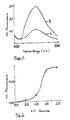
- the diagram shows two measurement curves A and B, which illustrate the relative fluorescence as a function of the wavelength.
- the measurement curve A represents the fluorescence spectrum without the addition of glucose.
- the measurement curve B was recorded after the addition of 3 mM glucose solution.
- a comparison of curves A and B shows that the relative fluorescence with the addition of glucose has increased by 60%. This type of glucose determination can be called the kinetic method.
- the calibration curve shown in FIG. 2 shows the relative fluorescence as a function of the glucose concentration for a biosensor with a labeled enzyme immobilized on a support.
- the labeled enzyme has been immobilized in a hydrogel made of photocrosslinked polyvinyl alcohol.
- the fluorescence intensity changes by 20%. This change is significantly less than in the exemplary embodiment illustrated in FIG. 1. This is due to the fact that the optical measurement signal additionally contains scattered light and background fluorescence, which are the percentage change in the overall signal belittle.
- the calibration curve illustrated in Figure 2 is non-linear. However, the glucose concentration can be determined in the range of about 0.01 to 2 mM.
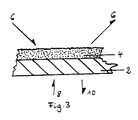
- FIG. 3 An example of the construction of a glucose biosensor is illustrated in FIG. 3.
- the sensor has a carrier 2, which is a glass plate in the illustrated embodiment.
- a labeled enzyme in the area of 1 cm2 is applied to the glass plate.
- an aliquot of 50 U / ml was taken from a solution of 400 U / ml of labeled glucose oxidase and mixed in a ratio of 1: 2 with a finished polyvinyl alcohol solution.
- the arrangement has been dried and photocrosslinked.
- the biosensor thus produced can be clamped directly in a flow measuring chamber.
- the arrows 6 illustrate the sample liquid with which the enzyme reacts catalytically.
- the arrows 8, 10 illustrate the light supplied by the carrier 2 to excite the fluorescence and the returning measurement signal. Light with a wavelength of 405 nm is used for excitation. The fluorescence is measured at 450 nm.
Landscapes
- Chemical & Material Sciences (AREA)
- Life Sciences & Earth Sciences (AREA)
- Organic Chemistry (AREA)
- Health & Medical Sciences (AREA)
- Engineering & Computer Science (AREA)
- Zoology (AREA)
- Wood Science & Technology (AREA)
- Proteomics, Peptides & Aminoacids (AREA)
- Analytical Chemistry (AREA)
- General Engineering & Computer Science (AREA)
- Immunology (AREA)
- Microbiology (AREA)
- Molecular Biology (AREA)
- Biophysics (AREA)
- Physics & Mathematics (AREA)
- Genetics & Genomics (AREA)
- Biochemistry (AREA)
- Bioinformatics & Cheminformatics (AREA)
- Biotechnology (AREA)
- General Health & Medical Sciences (AREA)
- Emergency Medicine (AREA)
- Investigating Or Analysing Materials By The Use Of Chemical Reactions (AREA)
- Investigating, Analyzing Materials By Fluorescence Or Luminescence (AREA)
Applications Claiming Priority (2)
| Application Number | Priority Date | Filing Date | Title |
|---|---|---|---|
| DE19893923921 DE3923921A1 (de) | 1989-07-19 | 1989-07-19 | Optischer biosensor |
| DE3923921 | 1989-07-19 |
Publications (2)
| Publication Number | Publication Date |
|---|---|
| EP0409032A2 true EP0409032A2 (fr) | 1991-01-23 |
| EP0409032A3 EP0409032A3 (en) | 1992-04-15 |
Family
ID=6385398
Family Applications (1)
| Application Number | Title | Priority Date | Filing Date |
|---|---|---|---|
| EP19900113059 Withdrawn EP0409032A3 (en) | 1989-07-19 | 1990-07-09 | Optical biosensor |
Country Status (2)
| Country | Link |
|---|---|
| EP (1) | EP0409032A3 (fr) |
| DE (1) | DE3923921A1 (fr) |
Cited By (10)
| Publication number | Priority date | Publication date | Assignee | Title |
|---|---|---|---|---|
| WO2000011205A1 (fr) * | 1998-08-21 | 2000-03-02 | Bayer Corporation | Detecteurs optiques a base d'enzymes oxydatives |
| CN102374982A (zh) * | 2011-09-16 | 2012-03-14 | 厦门大学 | 一种化学沉积微纳米银增强葡萄糖传感膜荧光信号的方法 |
| US10842427B2 (en) | 2005-09-30 | 2020-11-24 | Intuity Medical, Inc. | Body fluid sampling arrangements |
| US11045125B2 (en) | 2008-05-30 | 2021-06-29 | Intuity Medical, Inc. | Body fluid sampling device-sampling site interface |
| US11051734B2 (en) | 2011-08-03 | 2021-07-06 | Intuity Medical, Inc. | Devices and methods for body fluid sampling and analysis |
| US11399744B2 (en) | 2008-06-06 | 2022-08-02 | Intuity Medical, Inc. | Detection meter and mode of operation |
| US11419532B2 (en) | 2005-06-13 | 2022-08-23 | Intuity Medical, Inc. | Analyte detection devices and methods with hematocrit/volume correction and feedback control |
| US11933789B2 (en) | 2009-11-30 | 2024-03-19 | Intuity Medical, Inc. | Calibration material delivery devices and methods |
| US11986293B2 (en) | 2008-06-06 | 2024-05-21 | Intuity Medical, Inc. | Medical diagnostic devices and methods |
| US11986298B2 (en) | 2005-09-30 | 2024-05-21 | Intuity Medical, Inc. | Devices and methods for facilitating fluid transport |
Families Citing this family (2)
| Publication number | Priority date | Publication date | Assignee | Title |
|---|---|---|---|---|
| DE19731990A1 (de) * | 1997-07-25 | 1999-01-28 | Studiengesellschaft Kohle Mbh | Verfahren zur Herstellung und Identifizierung von neuen Hydrolasen mit verbesserten Eigenschaften |
| DE102007034886B4 (de) | 2007-05-28 | 2009-06-18 | Stiftung Alfred-Wegener-Institut Für Polar- Und Meeresforschung | Optisches Messverfahren zur Ermittlung des pH-Wertes eines Mediums unter Anwendung von Ageladine A als fluoreszierendem pH-Wert-Indikator |
Family Cites Families (4)
| Publication number | Priority date | Publication date | Assignee | Title |
|---|---|---|---|---|
| US4200110A (en) * | 1977-11-28 | 1980-04-29 | United States Of America | Fiber optic pH probe |
| GB8509491D0 (en) * | 1985-04-12 | 1985-05-15 | Plessey Co Plc | Optic waveguide biosensors |
| AT392539B (de) * | 1986-02-03 | 1991-04-25 | Avl Verbrennungskraft Messtech | Verfahren zur optischen bestimmung der katalytischen enzymaktivitaet einer probe, und eine anordnung zur durchfuehrung des verfahrens |
| US4981779A (en) * | 1986-06-26 | 1991-01-01 | Becton, Dickinson And Company | Apparatus for monitoring glucose |
-
1989
- 1989-07-19 DE DE19893923921 patent/DE3923921A1/de not_active Ceased
-
1990
- 1990-07-09 EP EP19900113059 patent/EP0409032A3/de not_active Withdrawn
Cited By (13)
| Publication number | Priority date | Publication date | Assignee | Title |
|---|---|---|---|---|
| US6107083A (en) * | 1998-08-21 | 2000-08-22 | Bayer Corporation | Optical oxidative enzyme-based sensors |
| WO2000011205A1 (fr) * | 1998-08-21 | 2000-03-02 | Bayer Corporation | Detecteurs optiques a base d'enzymes oxydatives |
| US11419532B2 (en) | 2005-06-13 | 2022-08-23 | Intuity Medical, Inc. | Analyte detection devices and methods with hematocrit/volume correction and feedback control |
| US11986298B2 (en) | 2005-09-30 | 2024-05-21 | Intuity Medical, Inc. | Devices and methods for facilitating fluid transport |
| US10842427B2 (en) | 2005-09-30 | 2020-11-24 | Intuity Medical, Inc. | Body fluid sampling arrangements |
| US11045125B2 (en) | 2008-05-30 | 2021-06-29 | Intuity Medical, Inc. | Body fluid sampling device-sampling site interface |
| US11986293B2 (en) | 2008-06-06 | 2024-05-21 | Intuity Medical, Inc. | Medical diagnostic devices and methods |
| US11399744B2 (en) | 2008-06-06 | 2022-08-02 | Intuity Medical, Inc. | Detection meter and mode of operation |
| US11933789B2 (en) | 2009-11-30 | 2024-03-19 | Intuity Medical, Inc. | Calibration material delivery devices and methods |
| US11382544B2 (en) | 2011-08-03 | 2022-07-12 | Intuity Medical, Inc. | Devices and methods for body fluid sampling and analysis |
| US11672452B2 (en) | 2011-08-03 | 2023-06-13 | Intuity Medical, Inc. | Devices and methods for body fluid sampling and analysis |
| US11051734B2 (en) | 2011-08-03 | 2021-07-06 | Intuity Medical, Inc. | Devices and methods for body fluid sampling and analysis |
| CN102374982A (zh) * | 2011-09-16 | 2012-03-14 | 厦门大学 | 一种化学沉积微纳米银增强葡萄糖传感膜荧光信号的方法 |
Also Published As
| Publication number | Publication date |
|---|---|
| DE3923921A1 (de) | 1991-01-24 |
| EP0409032A3 (en) | 1992-04-15 |
Similar Documents
| Publication | Publication Date | Title |
|---|---|---|
| DE69727579T2 (de) | Trockenreagenz-Teststreifen mit einem Benzindinfarbstoff-Vorläufer und einer Antipyrinverbindung | |
| DE3752230T2 (de) | Teststreifen zur Bestimmung von Glukose in einer Vollblutprobe | |
| AT403961B (de) | Optochemisches messsystem mit einem fluoreszenzsensor | |
| DE69314363T2 (de) | Verbesserter oxidativer Kupplungsfarbstoff zur spektrophotometrischen Quantitativen Analyse von Analyten | |
| DE68924026T2 (de) | Biosensor und dessen herstellung. | |
| DE3687646T2 (de) | Biosensor und dessen herstellung. | |
| DE69412137T2 (de) | Sensoreinrichtung zum sandwichtest | |
| DE3688297T2 (de) | Verfahren zur nichtsegmentierten Durchflussanalyse unter Benutzung der Wechselwirkung von Strahlung mit einem in einer Durchflusszelle angebrachten festen Material. | |
| DE69115493T2 (de) | Vorrichtung zur analyse | |
| EP0409033A2 (fr) | Dispositif capteur à fibre optique pour déterminer un analyte, en particulier du glucose | |
| DE2940165C2 (de) | Glucoseindikator und Testvorrichtung mit dem Glucoseindikator | |
| DE69322959T2 (de) | Sensor für optische prüfung | |
| EP0409032A2 (fr) | Biocapteur optique | |
| EP0516610B1 (fr) | Dispositif pour la détermination du flux de matière | |
| AT390145B (de) | Verfahren zur bestimmung der konzentration von in einer substanz enthaltenen stoffen, insbesondere von sauerstoff | |
| EP0606327B1 (fr) | MEMBRANE DETECTRICE POUR L'AFFICHAGE DU pH D'UN ECHANTILLON, SA FABRICATION ET SON UTILISATION | |
| DE19540098A1 (de) | Verfahren und Mehrkanalbiosensor zur Mehrkomponentenanalyse von Mischungen und/oder Gemischen | |
| DE3900191C2 (de) | Meßvorrichtung zur Bestimmung des Sauerstoffpartialdruckes, des Sauerstoffgehaltes und des Sauerstoff-Flusses in biologischen Systemen | |
| DE4027728A1 (de) | Immobilisierung von organischen makromolekuelen oder biopolymeren in einer polymermembran | |
| DE4332512A1 (de) | Sensormaterial zum Nachweis von Ammoniak | |
| US20020180992A1 (en) | Method for the quality control of material layers | |
| DE4216980C2 (de) | Immunosensorisches Nachweisverfahren | |
| DE2318044A1 (de) | Verfahren zur analytischen bestimmung von bestandteilen in einer materialprobe wie einer biologischen fluessigkeit | |
| EP0691408B1 (fr) | Pâte d'enzyme polymérisable par UV pour la production de capteurs biologiques et capteurs produits en utilisant cela | |
| CN116698816B (zh) | 一种负载金纳米棒-水凝胶sers传感器的制备方法及应用 |
Legal Events
| Date | Code | Title | Description |
|---|---|---|---|
| PUAI | Public reference made under article 153(3) epc to a published international application that has entered the european phase |
Free format text: ORIGINAL CODE: 0009012 |
|
| AK | Designated contracting states |
Kind code of ref document: A2 Designated state(s): BE CH DE DK FR GB IT LI NL SE |
|
| PUAL | Search report despatched |
Free format text: ORIGINAL CODE: 0009013 |
|
| AK | Designated contracting states |
Kind code of ref document: A3 Designated state(s): BE CH DE DK FR GB IT LI NL SE |
|
| STAA | Information on the status of an ep patent application or granted ep patent |
Free format text: STATUS: THE APPLICATION IS DEEMED TO BE WITHDRAWN |
|
| 18D | Application deemed to be withdrawn |
Effective date: 19921016 |