EP0409660A2 - Verbesserungen an optischen Systemen - Google Patents
Verbesserungen an optischen Systemen Download PDFInfo
- Publication number
- EP0409660A2 EP0409660A2 EP90308012A EP90308012A EP0409660A2 EP 0409660 A2 EP0409660 A2 EP 0409660A2 EP 90308012 A EP90308012 A EP 90308012A EP 90308012 A EP90308012 A EP 90308012A EP 0409660 A2 EP0409660 A2 EP 0409660A2
- Authority
- EP
- European Patent Office
- Prior art keywords
- pulses
- frequency
- light
- beams
- optical
- Prior art date
- Legal status (The legal status is an assumption and is not a legal conclusion. Google has not performed a legal analysis and makes no representation as to the accuracy of the status listed.)
- Withdrawn
Links
- 230000003287 optical effect Effects 0.000 title claims abstract description 76
- 238000004891 communication Methods 0.000 claims abstract description 18
- 230000003595 spectral effect Effects 0.000 claims abstract description 14
- 239000000463 material Substances 0.000 claims description 54
- 238000000034 method Methods 0.000 claims description 27
- 230000008859 change Effects 0.000 claims description 17
- 238000001914 filtration Methods 0.000 claims description 9
- 239000011521 glass Substances 0.000 claims description 5
- 230000000873 masking effect Effects 0.000 claims description 5
- 230000005540 biological transmission Effects 0.000 claims description 4
- 239000013307 optical fiber Substances 0.000 claims description 4
- 239000013078 crystal Substances 0.000 claims description 3
- 238000001514 detection method Methods 0.000 claims description 2
- 229920000620 organic polymer Polymers 0.000 claims description 2
- 230000008878 coupling Effects 0.000 claims 2
- 238000010168 coupling process Methods 0.000 claims 2
- 238000005859 coupling reaction Methods 0.000 claims 2
- VYPSYNLAJGMNEJ-UHFFFAOYSA-N Silicium dioxide Chemical compound O=[Si]=O VYPSYNLAJGMNEJ-UHFFFAOYSA-N 0.000 claims 1
- 239000005350 fused silica glass Substances 0.000 claims 1
- 229920000642 polymer Polymers 0.000 claims 1
- 239000002861 polymer material Substances 0.000 claims 1
- 230000002123 temporal effect Effects 0.000 abstract description 17
- 230000000694 effects Effects 0.000 abstract description 9
- 230000001419 dependent effect Effects 0.000 abstract description 2
- 239000000284 extract Substances 0.000 abstract 1
- 230000001902 propagating effect Effects 0.000 description 9
- 239000000523 sample Substances 0.000 description 8
- 230000004048 modification Effects 0.000 description 6
- 238000012986 modification Methods 0.000 description 6
- 230000008569 process Effects 0.000 description 6
- 230000010287 polarization Effects 0.000 description 5
- 230000006835 compression Effects 0.000 description 4
- 238000007906 compression Methods 0.000 description 4
- 230000007246 mechanism Effects 0.000 description 4
- 230000001360 synchronised effect Effects 0.000 description 4
- 230000001934 delay Effects 0.000 description 3
- 238000005516 engineering process Methods 0.000 description 3
- FAPWRFPIFSIZLT-UHFFFAOYSA-M Sodium chloride Chemical compound [Na+].[Cl-] FAPWRFPIFSIZLT-UHFFFAOYSA-M 0.000 description 2
- 239000004065 semiconductor Substances 0.000 description 2
- 230000003213 activating effect Effects 0.000 description 1
- UHYPYGJEEGLRJD-UHFFFAOYSA-N cadmium(2+);selenium(2-) Chemical compound [Se-2].[Cd+2] UHYPYGJEEGLRJD-UHFFFAOYSA-N 0.000 description 1
- 230000003247 decreasing effect Effects 0.000 description 1
- 238000010586 diagram Methods 0.000 description 1
- 239000006185 dispersion Substances 0.000 description 1
- 229910052839 forsterite Inorganic materials 0.000 description 1
- 239000003574 free electron Substances 0.000 description 1
- 239000007788 liquid Substances 0.000 description 1
- HCWCAKKEBCNQJP-UHFFFAOYSA-N magnesium orthosilicate Chemical compound [Mg+2].[Mg+2].[O-][Si]([O-])([O-])[O-] HCWCAKKEBCNQJP-UHFFFAOYSA-N 0.000 description 1
- 239000002245 particle Substances 0.000 description 1
- 229920000015 polydiacetylene Polymers 0.000 description 1
- 230000000644 propagated effect Effects 0.000 description 1
- 239000011780 sodium chloride Substances 0.000 description 1
- 239000000126 substance Substances 0.000 description 1
Images





Classifications
-
- G—PHYSICS
- G02—OPTICS
- G02F—OPTICAL DEVICES OR ARRANGEMENTS FOR THE CONTROL OF LIGHT BY MODIFICATION OF THE OPTICAL PROPERTIES OF THE MEDIA OF THE ELEMENTS INVOLVED THEREIN; NON-LINEAR OPTICS; FREQUENCY-CHANGING OF LIGHT; OPTICAL LOGIC ELEMENTS; OPTICAL ANALOGUE/DIGITAL CONVERTERS
- G02F1/00—Devices or arrangements for the control of the intensity, colour, phase, polarisation or direction of light arriving from an independent light source, e.g. switching, gating or modulating; Non-linear optics
- G02F1/29—Devices or arrangements for the control of the intensity, colour, phase, polarisation or direction of light arriving from an independent light source, e.g. switching, gating or modulating; Non-linear optics for the control of the position or the direction of light beams, i.e. deflection
- G02F1/293—Devices or arrangements for the control of the intensity, colour, phase, polarisation or direction of light arriving from an independent light source, e.g. switching, gating or modulating; Non-linear optics for the control of the position or the direction of light beams, i.e. deflection by another light beam, i.e. opto-optical deflection
-
- G—PHYSICS
- G02—OPTICS
- G02F—OPTICAL DEVICES OR ARRANGEMENTS FOR THE CONTROL OF LIGHT BY MODIFICATION OF THE OPTICAL PROPERTIES OF THE MEDIA OF THE ELEMENTS INVOLVED THEREIN; NON-LINEAR OPTICS; FREQUENCY-CHANGING OF LIGHT; OPTICAL LOGIC ELEMENTS; OPTICAL ANALOGUE/DIGITAL CONVERTERS
- G02F1/00—Devices or arrangements for the control of the intensity, colour, phase, polarisation or direction of light arriving from an independent light source, e.g. switching, gating or modulating; Non-linear optics
- G02F1/35—Non-linear optics
- G02F1/3515—All-optical modulation, gating, switching, e.g. control of a light beam by another light beam
-
- G—PHYSICS
- G02—OPTICS
- G02F—OPTICAL DEVICES OR ARRANGEMENTS FOR THE CONTROL OF LIGHT BY MODIFICATION OF THE OPTICAL PROPERTIES OF THE MEDIA OF THE ELEMENTS INVOLVED THEREIN; NON-LINEAR OPTICS; FREQUENCY-CHANGING OF LIGHT; OPTICAL LOGIC ELEMENTS; OPTICAL ANALOGUE/DIGITAL CONVERTERS
- G02F2/00—Demodulating light; Transferring the modulation of modulated light; Frequency-changing of light
- G02F2/004—Transferring the modulation of modulated light, i.e. transferring the information from one optical carrier of a first wavelength to a second optical carrier of a second wavelength, e.g. all-optical wavelength converter
-
- G—PHYSICS
- G02—OPTICS
- G02F—OPTICAL DEVICES OR ARRANGEMENTS FOR THE CONTROL OF LIGHT BY MODIFICATION OF THE OPTICAL PROPERTIES OF THE MEDIA OF THE ELEMENTS INVOLVED THEREIN; NON-LINEAR OPTICS; FREQUENCY-CHANGING OF LIGHT; OPTICAL LOGIC ELEMENTS; OPTICAL ANALOGUE/DIGITAL CONVERTERS
- G02F2/00—Demodulating light; Transferring the modulation of modulated light; Frequency-changing of light
- G02F2/02—Frequency-changing of light, e.g. by quantum counters
-
- G—PHYSICS
- G02—OPTICS
- G02F—OPTICAL DEVICES OR ARRANGEMENTS FOR THE CONTROL OF LIGHT BY MODIFICATION OF THE OPTICAL PROPERTIES OF THE MEDIA OF THE ELEMENTS INVOLVED THEREIN; NON-LINEAR OPTICS; FREQUENCY-CHANGING OF LIGHT; OPTICAL LOGIC ELEMENTS; OPTICAL ANALOGUE/DIGITAL CONVERTERS
- G02F3/00—Optical logic elements; Optical bistable devices
-
- G—PHYSICS
- G02—OPTICS
- G02F—OPTICAL DEVICES OR ARRANGEMENTS FOR THE CONTROL OF LIGHT BY MODIFICATION OF THE OPTICAL PROPERTIES OF THE MEDIA OF THE ELEMENTS INVOLVED THEREIN; NON-LINEAR OPTICS; FREQUENCY-CHANGING OF LIGHT; OPTICAL LOGIC ELEMENTS; OPTICAL ANALOGUE/DIGITAL CONVERTERS
- G02F1/00—Devices or arrangements for the control of the intensity, colour, phase, polarisation or direction of light arriving from an independent light source, e.g. switching, gating or modulating; Non-linear optics
- G02F1/35—Non-linear optics
- G02F1/3511—Self-focusing or self-trapping of light; Light-induced birefringence; Induced optical Kerr-effect
Definitions
- the present invention relates generally to optical systems and more particularly to optical computing, information and communication systems and logic elements for use therein which utilize the principle of cross-phase modulation (XPM).
- XPM cross-phase modulation
- an intense ultrashort light pulse propagates through a non-linear material, it temporally distorts the atomic and molecular configuration of the material.
- This distortion of the non-linear material instantaneously results in a change in the refractive index of the material.
- This change in the index of refraction is directly proportional to the intensity of the propagating intense light pulse.
- the change in the refractive index of the non-linear material causes a phase change in the propagating intense light pulse.
- the phase change causes a frequency sweep within the pulse envelope, typically resulting in a blue shift at the tail end of the pulse and a red shift at the front of the pulse.
- the effect is a spectral broadening of the pulse resulting in the generation of a supercontinuum. This spectral effect on the propagating intense light pulse is typically referred to as a self-phase modulation effect.
- an intense light pulse propagating through a non-linear material will typically undergo self-focusing, that is, a narrowing of the cross-sectional diameter of the pulse.
- Self-focusing occurs because, typically, the intensity of a pulse of light is greatest at its center and weakest at its outer edges. Since n is directly proportional to the intensity of the pulse, the center of the pulse causes a greater change in refractive index of the non-linear material than the outer edges of the pulse. Consequently, the center of the pulse travels slower than its outer edges, causing the outer edges to bend in towards the center of the pulse. This effect causes the beam to focus.
- an intense light pulse propagating through a non-linear material may also be used to induce the phase modulation of and/or the focusing of a co-propagating weak light pulse. These phenomena are typically referred to as cross-phase modulation and induced focusing, respectively.
- Cross-phase modulation may result in either frequency shifting (i.e., blue shifting or red shifting) or spectral broadening (i.e., supercontinuum generation), the particular effect depending on the relative times at which the weak pulse and the intense pulse propagate through the non-linear material. For example, if the intense pulse has a greater wavelength than the weak pulse, the intense pulse will travel faster through the non-linear material. Therefore, if the intense and weak pulses are sent propagating into the non-linear material at the same time, the weak pulse will be exposed predominately to the change in refractive index caused by the tail end of the intense pulse. (This is referred to commonly as tail walk-off). The result of tail walk-off is a blue shift of the weak pulse.
- the weak pulse will feel the effects of the refractive index change due to the front end of the intense pulse (front walk-off).
- front walk-off is a shift of the weak pulse to the red.
- the weak and intense pulses are sent propagating into the non-linear material so that the weak pulse is subjected to the changes in the refractive index caused by both the tail end and the front end of the intense pulse (e.g. symmetric walk-off or no walk-off), the weak pulse broadens spectrally to both the red and the blue.
- Spectral changes arising from cross-phase modulation may lead to changes in the temporal profile of the weak pulse when it propagates into a dispersive medium (i.e. an optical fiber) or a dispersive optical component (i.e. a grating or a prism).
- a further progagation of the weak pulse through a grating pair may slow down its re-shifted frequencies (generated by XPM at the pulse front) with respect to its blues shifted frequencies (generated by XPM at the pulse back), and consequently reduces the pulse duration of the weak pulse.
- Cross-phase modulation may also be used to change the spatial distribution of copropagating weak pulses. This effect occurs when the intense pulse generates a spatially-dependent non-linear refractive index.
- a pump pulse with a Gaussian spatial distribution of its intensity generates a higher refractive index on the propagation axis of the weak pulse.
- the outer edges of the weak pulse bend in towards the center of the pulse, and the weak pulse focuses.
- cross-phase modulation is frequently used generically to refer to both cross-phase modulation and induced focusing.
- Non-linear materials are very well known in the art. Examples of non linear materials are BK-7 glass, CdSe, liquid CS2, NaCl crystal, doped glasses, semiconductor bulk and quantum structures, microcrystalline semiconductor particles in glasses polydiacetylene organic polymer and optical fibers.
- the present invention is directed to optical computing and communication systems which rely on the phenomena of cross-phase modulation to alter and control, either or simultaneously, the spectral, temporal or/and spatial properties of ultrashort light pulses for processing of information with high speed (up to tens of terahertz regime) repetition rates.
- the present invention is also directed to a method for altering and controlling, either, or simultaneously, the spectral, temporal or/and spatial properties of ultrashort light pulses using cross phase modulation.
- One optical communication system for transmitting information which is constructed according to the teachings of the present invention and which involves frequency shifting (i.e. altering the spectral properties) comprises means for generating a first beam of laser light and a second beam of laser light, said first beam comprising a series of ultrashort pulses of a first frequency, said second beam comprising a series of ultrashort pulses of a second frequency, said pulses of said first beam being stronger in intensity than said pulses of said second beam, means for modulating said pulses in the first beam according to predetermined information, means for combining said modulated first beam and second beam to form a third beam, a non-linear material disposed along the path of said third beam for receiving said third beam and for producing a fourth beam, said fourth beam including pulses of said first frequency from said modulated first beam, pulses of said second frequency from said second beam, and pulses of a third frequency, said pulses of said third frequency resulting from XPM produced by copropagation of said first and second beams in said non-linear material
- An optical AND gate which is constructed according to the teachings of the present invention and which utilizes the principle of cross-phase modulation includes a beamsplitter for combining a pair of beams of light, a delay line for delaying one of the pair of beams so that the two beams overlap, a non-linear medium disposed along the path of the combined beam and a filter for filtering out certain frequencies in the beam passed through the non-linear medium.
- An optical invertor which is constructed according to the teachings of the present invention and which utilizes the principle of cross phase modulation includes means for generating a light beam, a beamsplitter, a delay line, a non-linear medium and a filter.
- the intense and weak beams have different polarizations rather than different frequencies.
- FIG. 1 there is illustrated a schematic view of one embodiment of an optical system for transmitting information, the optical system being constructed according to the teachings of the present invention and represented generally by reference numeral 11.
- Optical system 11 which utilizes the spectral effects of cross phase modulation, includes an optical processor 12.
- Processor 12 includes a laser system 13 which is used to produce an output beam 14-1.
- Beam 14-1 includes intense ultrashort pulses at a first frequency F1 and weaker ultrashort pulses at a second frequency F2.
- Laser system 13 may comprise a laser 13-1 and a second harmonic generating crystal 13-2.
- Laser 13-1 may be a mode locked Nd:YAG laser which is capable of emitting a beam of laser light having intense pulses at 1060 nm. Examples of other lasers which may be used are a Ti:sapphire Laser, an Alexandrite laser, a Forsterite laser, a laser diode, a dye laser or a free electron laser.
- a dichroic beamsplitter 14-2 splits beam 14-1 into a first or pump beam 15, and a second or probe beam 17.
- Beamsplitter 14-2 is designed to transmit 90% at frequency F1 and 10% at frequency F2 and reflect 90% at frequency F2 and 10% at frequency F1.
- a narrow band filter 14-3 removes all frequencies except F1 from pump beam 15 and a narrow band filter 14-4 removes all frequencies except F2 from probe beam 17.
- Processor 12 also includes means 18 disposed along the path of beam 15 for modulating beam 15 in accordance with predetermined information.
- Means 18 may comprise an optical Kerr shutter 19 which is designed to transmit the intense pulses of first beam 15 only when gating pulses, emitted from a laser 21, simultaneously arrive thereat.
- an electro-optical modulator 24-1 activated by a pulse generator 24-2 as shown in Fig. 1(a) or a photoconducting switch could be employed.
- Processor 12 further includes a beamsplitter 25 for combining beams 15 and 17 and producing a third beam 27 containing both pulses at frequency F2 from beam 17 and pulses at frequency F1 from beam 15.
- Beam 15 passes into beamsplitter 25 after it is passed through an adjustable optical delay 24 while beam 17 passes directly into beamsplitter 25.
- Mirrors 28-1 and 28-2 are used to change the direction of beam 17 while adjustable optical delay 24 is used to adjust the path length of beam 15 so that the pulses in beam 15 and the pulses in beam 17 will overlap inside non-linear material X (3) , identified by reference numeral 29.
- the length of material 29 is sufficient to produce "walk-off".
- Material 29 may be for example glass or an organic substance.
- non-linear material 29 is used to modulate the frequency of the pulses at frequency F2 in beam 27 using the modulated copropagating pulses at frequency F1.
- the output from non-linear material 29 is a fourth beam 31 containing pulses at first frequency F1, pulses at second frequency F2 and pulses at a third frequency F3, the pulses at the third frequency F3 being pulses from the second beam 17 that are frequency shifted (an amount f) as a result of propagating through non-linear material 29 with pulses from beam 15.
- a pulse in beam 17 copropagates through non-linear material 29 with a pulse from beam 15, the output will be the pulse from beam 15 and a pulse corresponding to a pulse from beam 17 frequency shifted an amount that is proportional to the peak power of the pulse from beam 15.
- the pulse from beam 17 will pass through non-linear material undistorted.
- Processor 12 also includes a filter 33, which is diposed along the path of beam 31. Filter 33, is selected to block the transmission of the pulses at frequency F1.
- System 11 further includes an optical transmission channel 34.
- a beamsplitter 35 which is also disposed along the path of beam 31 at the output side of filter 33, is used to split beam 31 into a fifth beam 37 and a sixth beam 39.
- a pair of filters 41 and 43 are disposed along the paths beams 37 and 39, respectively. Filter 41 is selected to pass only pulses at frequency F2 while filter 43 is selected to pass only pulses at frequency F3.
- a pair of photodiodes 45 and 47 are used to detect the light passed by filters 41 and 43, respectively. Photodiodes 45 and 47 are both electrically connected to a computer 49 which processes the signals received from each photodiode.
- system 11 as a means for transmitting information is hereinafter described.
- Laser 13 is activated, causing the emission of an output beam from which is derived a first beam 15 of intense pulses at frequency F1 and a second beam of weak pulses at frequency F2.
- the information to be transmitted is sent from computer 22 to laser 21 causing the emission therefrom of gating pulses.
- Those intense pulses of beam 15 that arrive at shutter 19 at the same time that the gating pulses arrive undergo a change in their polarization, permitting their transmission through shutter 19. All other intense pulses are blocked from passing through shutter 19. Consequently, when beams 15 and 17 are combined into beam 27, there will usually be more weak pulses than intense pulses.
- Beam 31 which contains pulses at frequency F1 at frequency F2 and pulses at frequency F3 is passed through filter 33. Filter 33 removes pulses at frequency F1. Beam 31 is then split into beams 37 and 39.
- Beam 37 is then passed through filter 41 which filters out the pulses at frequency F2.
- the modulated pulses are then detected by photodiode 45, and the signal is sent to computer 49.
- Beam 39 is passed through filter 43 which leaves only the non-modulated pulses to be detected by photodiode 47 and processed by computer 49.
- each signal received by photodiode 47 corresponds to a gating pulse whereas each signal received by photodiode 45 corresponds to the absence of a gating pulses. In this manner, binary information may be transmitted through system 11.
- source 13 has been represented as a single laser system which simultaneously generates pulses at different frequencies and intensities, it is to be understood that two separate lasers could easily be used if properly synchronized. Also, it is to be understood that while system 11 is designed specifically to process binary information, tertiary information or higher degrees of information could easily be transmitted by increasing the number of differing intense pulses (and the associated number of shutter mechanisms). It is also to be understood that shutter 19 could be replaced by an electro-optic shutter. Also, shutter 19 and laser 21 could be replaced by an electro-mechanical shutter. Furthermore, shutter 19 can be eliminated completely by triggering the emission of intense pulses from laser source 13 with electrical signals from computer 23.
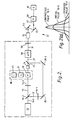
- FIG. 2 there is shown another embodiment of an optical system for transmitting information constructed according to the teachings of the present invention and represented generally by reference numeral 51.
- System 51 which utilizes the temporal effects of cross phase modulation to produce a pulse compression type switch, includes a laser system 13 for generating a beam 14-1 of ultrashort laser light pulses, beam 14-1 including intense pulses of one frequency F1 and weak pulses of another frequency F2, a dichroic beamsplitter 14-2, a pair of filters 14-3 and 14-4, a pair of deflection mirrors 28-1 and 28-2, an adjustable optical delay 24, a beamsplitter 25, modulating means 18, a nonlinear medium 30 and a filter 33, all arranged and functioning as in the Fig. 1 embodiment except that the length of non-linear medium 30 is such that there is effectively no "walk-off".
- System 51 also includes a pair of parallel grating plates 53 and 55, which receive fourth beam 31 from filter 33 and produce a fifth beam 57.
- grating plates 53 and 55 are used to temporally resolve fourth beam 31 by optically delaying the longer wavelengths of light relative to the shorter wavelengths of light.
- a photodiode 59 or other light sensitive measuring device is disposed along the path of fifth beam 57.
- a computer 61 for processing the signals emitted by photodiode 59 is electrically connected to photodiode 59.
- computer 61 is programmed so that it will only process signals having an intensity above a predetermined threshold, the threshold being for example the intensity of weak pulses that pass through non-linear medium 29 without corresponding intense pulses.
- each pulse includes frequency components from across its entire bandwidth.
- these frequency components while being spread over the spectral width of the pulse, are nonetheless homogeneously distributed over the entire temporal width of the pulse. In other words, at any point in time, the distribution of frequency components within each pulse is homogeneous.
- Laser system 13 is activated, causing the emission therefrom of laser light including intense pulses of one frequency bandwidth within beam 15 and of weak pulses of another frequency bandwidth within beam 17.
- a laser system comprising single laser
- two lasers could be employed, each emitting a separate beam.
- Information from computer 23 is then encoded into beam 15 using shutter 19 in the manner described above to eliminate certain intense pulses.
- Beams 15 and 17 are then combined using mirrors 28-1 and 28-2 and beamsplitter 25 to produce beam 27.
- Beam 27 now consists of weak pulses and intense pulses, synchronized using adjustable optical delay 24 so that they arrive simultaneously at non-linear material 30.
- Beam 27 then travels across non-linear material 30, being transformed in the process by cross-phase modulation into beam 31.
- Beam 31 includes intense pulses and two varieties of weak pulses, namely, non-modulated weak pulses and modulated weak pulses.
- the non-modulated weak pulses are those weak pulses that propagated across material 29 without a corresponding, copropagating intense pulse.
- the non-modulated weak pulses are temporally and spectrally indistinguishable from the weak pulses in beam 27.
- the modulated weak pulses are those weak pulses that co-propagated through material 30 with intense pulses.
- the modulated weak pulses have a spectrally broader bandwith than the weak pulses in beam 27.
- the modulated weak pulses are not spectrally homogeneous over time. Rather, the longer wavelength components are more concentrated towards the temporal fronts of the pulses and the shorter wavelength components are more concentrated towards the temporal tails of the pulses.
- beam 31 After emerging from non-linear material 30, beam 31 is then passed through filter 33 which filters out the intense pulses.
- the non-modulated weak pulses and the modulated weak pulses of beam 31 then arrive at grating plates 53 and 55.
- plates 53 and 55 optically delay in time the longer wavelengths of each pulse relative to the shorter wavelengths. This occurs because plate 53 disperses beam 31 into its frequency components (the longer wavelengths being deflected at a greater angle than the shorter wavelengths and, hence, traveling a greater distance to plate 55) while plate 55 receives the components and recombines them to form beam 57.
- the resultant effect of passing through grating plates 53 and 55 is as follows: For the weak non-modulated pulses, each of which is homogeneous in frequency distribution, passage through the plates results in temporal expansion. This occurs because the longer wavelengths slow down and go to the back of the pulse while the shorter wavelengths speed up and go to the front of the pulse.
- temporal expansion is that the pulse becomes less intense. This occurs because while the temporal width of the pulse has increased, its energy has not. Consequently, the same amount of energy must be spread over a greater period of time.
- Beam 57 including its compressed and expanded pulses, then arrives at photodiode 59. Both compressed signals and expanded signals trigger the emission of an electrical signal from photodiode 59 to computer 61. Because computer 61 is programmed to ignore signals of an intensity less than the modulated weak pulses in beam 27, only the compressed (i.e. modulated) pulses register. Because the compressed pulses are related to the intense pulses sent through shutter 19 which, in turn, correspond to the information to be transmitted, system 51 can so be used to transmit information.
- Fig. 2(a) shows the shapes of an initial (i.e. before passing through non-linear medium 29) a compressed pulse and expanded probe pulse, the initial pulse being identified by reference numeral, 70-0, the compressed pulse being identified by reference numeral 70-1 and the expanded pulse by reference numeral 70-2.
- system 51 may be used for intensity modulating pulses.
- system 51 may be used as a pulse compression device by removing shutter 19, laser source 21, and computer 23 or as an pulse expansion device by removing shutter 19, source 21 and computer 23 and programming computer 61 to detect only expanded pulses.
- a sequence of prisms or any optical component (or components) or material (i.e. optical fibers) which can produce by group-velocity dispersion the relative delay between short and long wavelengths may be employed.
- FIG. 3 there is shown a third embodiment of an optical system for transmitting information constructed according to the teachings of the present invention and represented generally by reference numeral 71.
- system 71 is designed to exploit the principle of induced focusing and utilizes the spatial effects of cross-phase modulation to deflect a beam of light.
- Self-focusing occurs when a Gaussian shaped beam of intense light travels through a non-linear medium because the intensity of the beam across its cross-section is much greater at its center than around its outer edges. Consequently, the increase in the refractive index of the non-linear medium is also greatest in the center of the beam and weakest around the outer edges. This causes the center of the beam to move slower than the edges which, in turn, causes the edges to bend in towards the center. As a result, the beam narrows in cross-sectional diameter (i.e. focuses). Induced focusing is identical to self-focusing except that the change in the refractive index is applied to a weak beam that is copropagating with the intense beam.
- system 71 has many of the same components as systems 11 and 51.
- System 71 includes a processor 72.
- Processor 72 includes a laser system 13 for generating a beam 14-1 of ultrafast laser light, a beamsplitter 14-2 for splitting beam 14-1 into a pair of beams 15 and 17 and a pair of filters 14-3 and 14-4 for filtering beam 15 to contain only intense pulses of at frequency F1 and beam 17 to contain only weak pulses at another frequency F2.
- System 71 also includes a deflection mirror 72 for deflecting beam 15, a beamsplitter 73 for splitting beam 15 into two beams 73-1 and 73-2, a pair of modulators 18, one for modulating beam 73-1 and the other for modulating beam 73-2, a mask 73-4 disposed along the path of beam 73-1, a mask 73-5, disposed along the path of beam 73-2, a pair of deflection mirrors 73-61 and 73-62, and a pair of beamsplitters 73-8 and 73-9 for combining beams 73-1 and 73-2 with beam 17.
- Masks 73-4 and 73-5 are designed arranged to mask off different portions of their respective beams. Beamsplitters 73-8 and 73-9 combine the portions of beams 73-1 and 73-2 passed by their respective masks along the beams 15, identified by reference numerals 74-1 and 74-2 to produce a third beam 75.
- Processor 72 further includes a non-linear material 29, which is disposed along the path of beam 75 and optical delays 72-1 and 72-2.
- non-linear material 29 receives beam 75 and produces a fourth beam 77, a fifth beam 79 and a sixth beam 80, fifth beam 79 and sixth beam 80 being angularly deflected, and by different amounts, relative to fourth beam 77.
- Filters 81, 82 and 83 are disposed along the path of beams 79 and 80, respectively to filter out the intense pulses present therein.
- System 71 further includes photodiodes 85, 86 and 87 which are disposed further along the paths of beams 77, 79, and 80 receive beams 77, 79 and 80 and output corresponding electrical signals to a computer 91 for processing.
- System 71 is operated first by activating laser 13, causing the emission therefrom of a beam of laser light having intense (i.e. pump) pulses of one frequency F1 and weak (i.e. probe) pulses of another frequency F2.
- the intense pulses are split into two beams 73-1 and 73-2 and modulated in accordance with the information from their respective modulators 18 to permit specific intense pulses to pass therethrough.
- Each beam 73-1 and 73-2 is partially masked by its respective mask 73-4 and 73-5 and then combined at beamsplitter 73-8 and 73-9, respectively with the weak pulses of beam 17 to produce a third beam 75.
- the intense pulses in beam 73-1 and 73-2 are synchronized with their corresponding weak pulses from beam 17 by using the optical delays so that they will arrive at non-linear material 29 at the proper time with the pulses of beam 17.
- Beam 77 which was not subjected to induced focusing, consists of the weak pulses of beam 75 that traveled through non-linear material 29 without copropagating with intense pulses.
- Beam 79 which is angularly deflected by an angle A relative to beam 77 as a result of induced focusing, consists of the copropagating weak and intense pulses, the intense pulses being from beam 73-1.
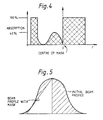
- beam 79 is angularly deflected, rather than being reduced in cross-sectional diameter (the typical result of induced focusing), is that the masking of the intense pulses leads to an asymmetrical change in the refractive index of the non-linear medium. Consequently, this asymmetry causes the intense pulses (and their copropagating weak pulses) to be deflected in the direction of the masked portion of the intense beam.
- Beam 80 is angularly deflected by an angle B, which is different from angle A, relative to beam 77.
- Beam 80 consists of copropogating weak and intense pulses, the intense pulses being from beam 73-2.
- Beams 77 and 80 are then passed through filters 81 and 82, which remove the intense light pulses therefrom.
- the pulses in paths 77, 79 and 80 are converted into electrical signals by photodiodes 85, 87 and 88 and sent to computer 89 for processing.
- FIG. 5 shows the shape of a pulse without the mask of Fig. 4 and with the mask of Fig. 4; the pulse being gaussian shaped without the mask and triangularly shaped with the mask. Catastrophic self focusing and filament generation can be eliminated if the nonlinear medium is thin enough.
- apparatus 71 can be used, if desired, as a mechanism for altering the spatial distribution of light in a weak beam; i.e. beam 17.
- the system in Fig. 3 can be easily modified to include more than two pump beams so as to be able to transmit more than two sources of information, or if desired, can be modified so as to have only one pump beam for use in transmitting information from a single source.
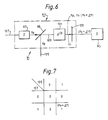
- FIG. 6 there is shown an optical computing logic device system 91 constructed according to this invention, device 91 including an AND gate 93 which operates using the principle of cross-phase modulation and a detector 95.
- AND gate 93 includes an adjustable optical delay 97, a beamsplitter 99, non-linear medium 101 and a filter 103.
- AND gate 93 is used to perform an AND function on a first beam 105 of intense pulses of one frequency f p and a second beam 107 of weak pulses of another frequency fo.
- Delay 97 delays beam 107 as necessary, so that beams 105 and 107 overlap.
- Beamsplitter 97 combines beams 105 and 107 to form a third beam 109 which is passed through non-linear medium 101.
- the output from non-linear medium 101 is a fourth beam 111 which may include pulses of frequency fp, pulses of frequency fo and pulses of a frequency (fo + ⁇ f), the pulses having a frequency (fo + f) resulting from cross-phase modulation and where f is the change in frequency resulting from cross-phase modulation.
- Filter 103 removes pulses of frequency fp and pulses of frequency fo and allows only pulses of frequency (fo + ⁇ f) to pass through.
- the light passed through filter 103 i.e. the pulses having a frequency (fo + ⁇ f) , is detected by detector 95.
- Detector 95 may be a photodiode.
- AND gate 93 operates in the following manner. If there is a pulse from beam 105 and there is no pulse in beam 107, there will be no output from filter 103. If there is no pulse in beam 105 and there is a pulse in beam 107 there will be no output from filter 103. If there is a pulse in beam 105 and a pulse in beam 107, then there will be an output from filter 103, namely a pulse having a frequency (fo + ⁇ f).
- a truth table for AND gate 93 is shown in Fig. 7
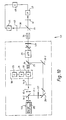
- Logic device 111 includes an INVERTER 113 which operates on the principle of cross phase modulation and a detector 115.
- INVERTER 113 includes a laser 117 for generating a weak beam 119 of ultrashort light pulses of frequency fo (i.e. probe pulses), an adjustable optical delay 118 a beamsplitter 121 for combining beam 119 with a signal or input beam 123 which is to be inverted by INVERTER 113 to form a third beam 125, input beam 123 being an intense beam of ultrashort pulses of frequency fp, (i.e.
- non-linear medium 127 disposed along the path of beam 125, the light emerging from non-linear medium 127 including pulses of frequency fo, pulses of frequency fp and pulses of frequency (fo + ⁇ f) where ⁇ f is the change i.e. shift, in frequency fo as a result of cross-phase modulation and a filter 129 for removing pulses of frequency fp and pulses of frequency (fo + ⁇ f) and allowing pulses of frequency fo to pass.
- INVERTER 113 operates as follows. Laser 117 is continuously outputting pulses fo. If there is a pump pulse fp, there will be no output from filter 129, while if there is no pump pulse fp there will be an output from filter 129, namely, a pulse having a frequency fo. Thus, INVERTER 113 only provides an output in the absence of a pump pulse. A truth table for INVERTER 113 is shown in Fig. 9.
- the pump signals in all embodiments could be generated by all-optical processors and the output signals could be used in cascade as basic units of all-optical processors.
- the optical processors may be miniaturized using diode laser technology and integrated optics.
- the pump and probe signals could have the same frequency but have different polarizations. All such variations and modifications are intended to be within the scope of the present invention as defined in the appended claims.
- System 131 which is similar to system 11 but wherein the pump and probe pulses have different polarizations rather than different frequencies.
- System 131 includes a laser system 133 having a laser 13-1 and a polarizer 135.
- the output beam from laser system 133 is split by beamsplitter 14-2 into an intense beam 15-1 and a weak beam 17-1.
- a quarter-wave plate 137 changes the polarization of weak beam 17-1 and a polarizer (analyzer) 139 removes intense beam 15-1 from the beam 31-1 emerging from non-linear medium 29.
- All embodiments of this invention can be miniaturized using diode technology and integrated optics.
- System 141 includes a pair of diode lasers 143 and 145, a computer 147 an integrated optics modulator 149, a waveguide 151, a multiplexer 153, a waveguide 154, a demultiplexer 155, a non-linear material 157, a filter 158 and a pair of detectors 159 and 161.
- System 171 includes an INVERTOR 113 and AND gate 93 an optical amplifier 177, a frequency modulator 179, an OTC 181, a filter 183, an optical amplifier 185 and a beam scanner 187.
- Beam scanner 187 includes a laser system 13, a delay 72-2, a mirror 189, a beamsplitter 191 and a non-linear medium 29.
Landscapes
- Physics & Mathematics (AREA)
- Nonlinear Science (AREA)
- General Physics & Mathematics (AREA)
- Optics & Photonics (AREA)
- Optical Communication System (AREA)
- Light Guides In General And Applications Therefor (AREA)
Applications Claiming Priority (2)
| Application Number | Priority Date | Filing Date | Title |
|---|---|---|---|
| US382752 | 1989-07-21 | ||
| US07/382,752 US5150248A (en) | 1989-07-21 | 1989-07-21 | Terahertz repetition rate optical computing systems, and communication systems and logic elements using cross-phase modulation based optical processors |
Publications (2)
| Publication Number | Publication Date |
|---|---|
| EP0409660A2 true EP0409660A2 (de) | 1991-01-23 |
| EP0409660A3 EP0409660A3 (en) | 1992-06-03 |
Family
ID=23510268
Family Applications (1)
| Application Number | Title | Priority Date | Filing Date |
|---|---|---|---|
| EP19900308012 Withdrawn EP0409660A3 (en) | 1989-07-21 | 1990-07-20 | Improvements relating to optical systems |
Country Status (3)
| Country | Link |
|---|---|
| US (3) | US5150248A (de) |
| EP (1) | EP0409660A3 (de) |
| JP (1) | JPH0773246B2 (de) |
Cited By (7)
| Publication number | Priority date | Publication date | Assignee | Title |
|---|---|---|---|---|
| EP0529763A1 (de) * | 1991-08-23 | 1993-03-03 | Robert R. Alfano | Verfahren und System zur Komprimierung und Verstärkung von ultrakurzen Laser-Impulsen |
| WO1996013104A1 (en) * | 1994-10-19 | 1996-05-02 | British Telecommunications Public Limited Company | All-optical processing in communications systems |
| AU676004B2 (en) * | 1993-03-24 | 1997-02-27 | Ems-Inventa Ag | Copolyamide for use in a barrier layer |
| EP0837357A3 (de) * | 1996-10-17 | 1999-03-17 | Ernst-August Stehr | Verfahren und Vorrichtung zum Modulieren von Licht |
| WO2001020396A1 (en) * | 1999-09-14 | 2001-03-22 | Japan Science And Technology Corporation | Ultrawide-band light pulse generator |
| EP2199846A4 (de) * | 2007-10-11 | 2014-11-05 | Fujitsu Ltd | Optischer impulsgenerator und optischer signalprozessor |
| WO2019202145A1 (fr) * | 2018-04-20 | 2019-10-24 | Ecole Polytechnique | Procede de generation d'impulsions ultracourtes |
Families Citing this family (31)
| Publication number | Priority date | Publication date | Assignee | Title |
|---|---|---|---|---|
| US5150248A (en) * | 1989-07-21 | 1992-09-22 | Alfano Robert R | Terahertz repetition rate optical computing systems, and communication systems and logic elements using cross-phase modulation based optical processors |
| US5493433A (en) * | 1994-03-02 | 1996-02-20 | Trustees Of Princeton University | Terahertz optical asymmetric demultiplexer |
| US5646764A (en) * | 1995-05-17 | 1997-07-08 | The United States Of America As Represented By The Secretary Of The Air Force | Optical beam scanner with rotating transmissive optics |
| US5659415A (en) * | 1996-02-22 | 1997-08-19 | General Electric Company | Ultrafast optical modulator |
| WO1997044929A1 (en) * | 1996-05-22 | 1997-11-27 | British Telecommunications Public Limited Company | Optical synchronisation arrangement |
| US5786929A (en) * | 1996-06-03 | 1998-07-28 | Coherent, Inc. | Optical parametric oscillator with delayed repumping |
| GB2320634A (en) * | 1996-12-19 | 1998-06-24 | Northern Telecom Ltd | Optical sampling by using an interferometer to modulate a pulse train |
| US6078417A (en) * | 1997-05-29 | 2000-06-20 | Lucent Technologies Inc. | Spectral compaction via cross-modulation wavelength conversion |
| DE19750320C1 (de) * | 1997-11-13 | 1999-04-01 | Max Planck Gesellschaft | Verfahren und Vorrichtung zur Lichtpulsverstärkung |
| FR2774832B1 (fr) * | 1998-02-12 | 2000-08-04 | Alsthom Cge Alcatel | Procede et dispositif de resynchronisation de signaux optiques |
| US6320191B1 (en) | 1998-03-27 | 2001-11-20 | Picometrix, Inc. | Dispersive precompensator for use in an electromagnetic radiation generation and detection system |
| AU2001239060A1 (en) * | 2000-03-10 | 2001-09-17 | Charles C. Romaniuk | Dynamic phase logic gate |
| JP3828111B2 (ja) * | 2001-07-02 | 2006-10-04 | 株式会社アドバンテスト | 伝搬測定装置及び伝搬測定方法 |
| JP4397567B2 (ja) * | 2002-07-05 | 2010-01-13 | 富士通株式会社 | 光andゲート及び波形整形装置 |
| JP2006516763A (ja) | 2003-01-27 | 2006-07-06 | ゼテテック インスティテュート | 干渉計測対象物による反射/散乱および透過ビームの、四半分角視野共時測定のための装置および方法。 |
| US20040165885A1 (en) * | 2003-02-26 | 2004-08-26 | Lucent Technologies Inc. | Method and apparatus for measuring the RF spectrum of an optical signal |
| US7245805B2 (en) * | 2004-03-23 | 2007-07-17 | The Research Foundation Of The City University Of New York | Method and apparatus for producing a multiple optical channel source from a supercontinuum generator for WDM communication |
| GB0427374D0 (en) * | 2004-12-15 | 2005-01-19 | Univ Aston | Optical pulse regeneration based on pulse temporal shaping |
| IL166810A0 (en) * | 2005-02-10 | 2006-01-15 | Univ Ramot | All-optical devices and methods for data processing |
| JP4861663B2 (ja) * | 2005-09-07 | 2012-01-25 | 株式会社アドバンテスト | 測定装置、方法、プログラムおよび記録媒体 |
| US20070116889A1 (en) * | 2005-11-18 | 2007-05-24 | Federal Mogul World Wide, Inc. | Laser treatment of metal |
| US7417788B2 (en) * | 2005-11-21 | 2008-08-26 | Aditya Narendra Joshi | Optical logic device |
| KR100749910B1 (ko) * | 2006-01-11 | 2007-08-21 | 한국과학기술연구원 | 연속 파형 초광대역 레이저 광원 공진기 및 이를 이용한의료용 진단기기 |
| WO2007117428A2 (en) * | 2006-04-03 | 2007-10-18 | International Rectifier Corporation | A circuit for using the sign transitions of a motor phase and a motor phase back emf currents to control pwm |
| US7474069B2 (en) * | 2006-04-03 | 2009-01-06 | International Rectifier Corporation | Circuit for using the sign transitions of a motor phase and a motor phase back EMF currents to control PWM |
| US8452179B2 (en) * | 2010-02-26 | 2013-05-28 | Cisco Technology, Inc. | Remotely settable chromatic dispersion robustness for dense wave division multiplexing interfaces |
| JP5610399B2 (ja) * | 2011-08-02 | 2014-10-22 | 独立行政法人科学技術振興機構 | ポンププローブ測定装置 |
| US9857660B1 (en) | 2015-05-15 | 2018-01-02 | Lawrence Livermore National Security, Llc | Systems and methods for enhancing optical information |
| AU2018298069B2 (en) * | 2017-07-03 | 2022-06-30 | Marsupial Holdings, Inc. | Light-based communications system |
| DE102017213729B4 (de) * | 2017-08-08 | 2020-12-24 | Robert Bosch Gmbh | Verfahren und Vorrichtung zur Bereitstellung eines Detektionssignals für zu detektierende Objekte |
| CN114562943B (zh) * | 2020-11-27 | 2024-08-06 | 深圳中科飞测科技股份有限公司 | 一种测量系统和测量方法 |
Family Cites Families (19)
| Publication number | Priority date | Publication date | Assignee | Title |
|---|---|---|---|---|
| DE1679094B1 (de) * | 1965-08-27 | 1972-03-16 | Williams Harry V | Eieraufbereitungsmaschine |
| US3448282A (en) * | 1968-01-12 | 1969-06-03 | Ibm | Optical and gate |
| US3617936A (en) * | 1969-05-26 | 1971-11-02 | Bell Telephone Labor Inc | Frequency control of a pulsed parametric oscillator by radiation injection |
| US3995311A (en) * | 1975-09-22 | 1976-11-30 | The United States Of America As Represented By The Secretary Of The Navy | Optical logic elements |
| US4382660A (en) * | 1976-06-16 | 1983-05-10 | Massachusetts Institute Of Technology | Optical transistors and logic circuits embodying the same |
| US4128300A (en) * | 1977-09-26 | 1978-12-05 | The United States Of America As Represented By The Secretary Of The Navy | Optical logic elements |
| US4178079A (en) * | 1978-05-23 | 1979-12-11 | Bell Telephone Laboratories, Incorporated | Sub-picosecond optical gating by degenerate four-wave mixing |
| US4496222A (en) * | 1981-12-21 | 1985-01-29 | Texas Instruments Incorporated | Apparatus and method for photolithography with phase conjugate optics |
| US4529273A (en) * | 1982-12-21 | 1985-07-16 | California Institute Of Technology | Passive phase conjugate mirror |
| GB2178191B (en) * | 1985-07-18 | 1989-08-09 | Stc Plc | Dynamic hologram recording |
| US4703992A (en) * | 1986-05-27 | 1987-11-03 | Rockwell International Corporation | Laser beam cleanup by photorefractive two-way mixing |
| US4778261A (en) * | 1987-10-13 | 1988-10-18 | University Of Rochester | Method and apparatus for non-frequency-shifted, phase conjugation of optical waves by brillouin-enhanced four-wave mixing |
| JPH01233429A (ja) * | 1988-03-14 | 1989-09-19 | Nippon Telegr & Teleph Corp <Ntt> | 光タッピング装置 |
| US4964131A (en) * | 1988-12-16 | 1990-10-16 | The Board Of Trustees Of The Leland Standford Junior University | Broadband optical fiber laser |
| US4973154A (en) * | 1989-04-27 | 1990-11-27 | Rockwell International Corporation | Nonlinear optical ranging imager |
| US5150248A (en) * | 1989-07-21 | 1992-09-22 | Alfano Robert R | Terahertz repetition rate optical computing systems, and communication systems and logic elements using cross-phase modulation based optical processors |
| US5015054A (en) * | 1990-02-26 | 1991-05-14 | The United States Of America As Represented By The Department Of Energy | Apparatus and method for increasing the bandwidth of a laser beam |
| US5115488A (en) * | 1991-04-02 | 1992-05-19 | At&T Bell Laboratories | Apparatus comprising an all-optical gate |
| US5111322A (en) * | 1991-04-04 | 1992-05-05 | At&T Bell Laboratories | Polarization multiplexing device with solitons and method using same |
-
1989
- 1989-07-21 US US07/382,752 patent/US5150248A/en not_active Expired - Lifetime
-
1990
- 1990-07-20 EP EP19900308012 patent/EP0409660A3/en not_active Withdrawn
- 1990-07-20 JP JP2192839A patent/JPH0773246B2/ja not_active Expired - Lifetime
-
1991
- 1991-12-12 US US07/806,170 patent/US5373381A/en not_active Expired - Fee Related
-
1994
- 1994-06-15 US US08/259,877 patent/US5463485A/en not_active Expired - Fee Related
Non-Patent Citations (5)
| Title |
|---|
| ELECTRONICS LETTERS, vol. 23, no. 20, 24th September 1987, pages 1090-1091; D. SCHADT et al.: "Generation of short pulses from CW light by influence of crossphase modulation (CPM) in optical fibers" * |
| ELECTRONICS LETTERS, vol. 23, no. 24, 19th November 1987, pages 1324-1326, Stevenage, Herts, GB; K.C. BYRON: "Kerr modulation of signals at 1.3 and 1.5mum in polarisation-maintaining fibres pumped at 1.06mum * |
| OPTICS LETTERS, vol. 13, no. 10, October 1988, pages 901-903, Optical Society of America; A.S. GOUVEIA-NETO et al.: "Subpicosecond-pulse generation through cross-phase-modulation-induced modulational instability in optical fibers" * |
| REVUE DE PHYSIQUE APPLIQUEE, vol. 22, December 1987, pages 1677-1694; P.L. BALDECK et al.: "Effects of self, induced and cross phase modulations on the generation of picosecond and femtosecond white light supercontinua" * |
| SOVIET JOURNAL OF QUANTUM ELECTRONICS, vol. 17, no. 4, April 1987, pages 517-519, American Institute of Physics, New York, US; E.M. DIANOV et al.: "Optical kerr effect in glass fiber waveguides with weak and strong birefringence" * |
Cited By (12)
| Publication number | Priority date | Publication date | Assignee | Title |
|---|---|---|---|---|
| EP0529763A1 (de) * | 1991-08-23 | 1993-03-03 | Robert R. Alfano | Verfahren und System zur Komprimierung und Verstärkung von ultrakurzen Laser-Impulsen |
| US5323260A (en) * | 1991-08-23 | 1994-06-21 | Alfano Robert R | Method and system for compressing and amplifying ultrashort laser pulses |
| AU676004B2 (en) * | 1993-03-24 | 1997-02-27 | Ems-Inventa Ag | Copolyamide for use in a barrier layer |
| WO1996013104A1 (en) * | 1994-10-19 | 1996-05-02 | British Telecommunications Public Limited Company | All-optical processing in communications systems |
| US5953138A (en) * | 1994-10-19 | 1999-09-14 | British Telecommunications Public Limited Company | All-optical processing in communications systems |
| EP0837357A3 (de) * | 1996-10-17 | 1999-03-17 | Ernst-August Stehr | Verfahren und Vorrichtung zum Modulieren von Licht |
| WO2001020396A1 (en) * | 1999-09-14 | 2001-03-22 | Japan Science And Technology Corporation | Ultrawide-band light pulse generator |
| US6700905B1 (en) | 1999-09-14 | 2004-03-02 | Japan Science And Technology Corporation | Ultrawide-band light pulse generation |
| EP2199846A4 (de) * | 2007-10-11 | 2014-11-05 | Fujitsu Ltd | Optischer impulsgenerator und optischer signalprozessor |
| WO2019202145A1 (fr) * | 2018-04-20 | 2019-10-24 | Ecole Polytechnique | Procede de generation d'impulsions ultracourtes |
| FR3080495A1 (fr) * | 2018-04-20 | 2019-10-25 | Ecole Polytechnique | Procede de generation d'impulsions ultracourtes |
| US12003071B2 (en) | 2018-04-20 | 2024-06-04 | Ecole Polytechnique | Method for generating ultrashort pulses |
Also Published As
| Publication number | Publication date |
|---|---|
| US5373381A (en) | 1994-12-13 |
| EP0409660A3 (en) | 1992-06-03 |
| JPH03165128A (ja) | 1991-07-17 |
| US5463485A (en) | 1995-10-31 |
| US5150248A (en) | 1992-09-22 |
| JPH0773246B2 (ja) | 1995-08-02 |
Similar Documents
| Publication | Publication Date | Title |
|---|---|---|
| US5463485A (en) | Terahertz repetition rate optical computing systems, and communication systems and logic elements using cross-phase modulation based optical processors | |
| US4928316A (en) | Optical systems and methods based upon temporal stretching, modulation and recompression of ultrashort pulses | |
| US5020050A (en) | Cascadable optical combinatorial logic gates | |
| JP7429997B2 (ja) | 損失媒体を通した超短パルスレーザー通信のための方法及び装置 | |
| US4655547A (en) | Shaping optical pulses by amplitude and phase masking | |
| US4746193A (en) | Apparatus for stabilization of high speed optical pulses | |
| JP2944748B2 (ja) | 光装置 | |
| KR100321073B1 (ko) | 광학적으로부호화된신호를처리하는방법및장치 | |
| US7376349B2 (en) | Analog to digital converter systems and methods | |
| US5323260A (en) | Method and system for compressing and amplifying ultrashort laser pulses | |
| US7538935B2 (en) | All-optical, continuously tunable, pulse delay generator using wavelength conversion and dispersion | |
| WO2002071653A2 (en) | Method and apparatus for generating optical signals | |
| WO1993003406A1 (en) | Sagnac loop gates | |
| GB2372830A (en) | Electro-optic gating arrangement with improved duty cycle | |
| JP2002054998A (ja) | 光サンプリングシステム | |
| US5526450A (en) | NLO waveguide "or" switch and method therefor | |
| Marembert et al. | Investigations of fiber Kerr switch: nonlinear phase shift measurements and optical time-division demultiplexing of 320 Gbit/s DPSK signals | |
| JPH08262509A (ja) | 光駆動型光制御装置 | |
| JPH07199240A (ja) | 光変調方法 | |
| US7046883B2 (en) | Phase and polarization insensitive gates and switches | |
| Sharping et al. | All-optical, continuously tunable, nanosecond pulse delay using wavelength conversion and fiber dispersion | |
| FRIBERG | Optical Solitons for Signal Processing | |
| Aitchison et al. | Multiplexing and demultiplexing using an AlGaAs nonlinear directional coupler | |
| TACHIKURA et al. | A Novel Optical Signal Splitting Method with a Hologram and Its Application to Error-Free Switching of Transmission Lines | |
| Chin et al. | Large multi Gbit/s delays generated in an all-optical tunable delay line preserving wavelength and signal bandwidth |
Legal Events
| Date | Code | Title | Description |
|---|---|---|---|
| PUAI | Public reference made under article 153(3) epc to a published international application that has entered the european phase |
Free format text: ORIGINAL CODE: 0009012 |
|
| AK | Designated contracting states |
Kind code of ref document: A2 Designated state(s): DE GB |
|
| PUAL | Search report despatched |
Free format text: ORIGINAL CODE: 0009013 |
|
| AK | Designated contracting states |
Kind code of ref document: A3 Designated state(s): DE GB |
|
| 17P | Request for examination filed |
Effective date: 19921125 |
|
| 17Q | First examination report despatched |
Effective date: 19940629 |
|
| STAA | Information on the status of an ep patent application or granted ep patent |
Free format text: STATUS: THE APPLICATION IS DEEMED TO BE WITHDRAWN |
|
| 18D | Application deemed to be withdrawn |
Effective date: 19970201 |