EP0409808A2 - Verfahren zur Sicherstellung der Abbildvollständigkeit in einem systemgesteuerten Speicher eines Rechnersystems - Google Patents
Verfahren zur Sicherstellung der Abbildvollständigkeit in einem systemgesteuerten Speicher eines Rechnersystems Download PDFInfo
- Publication number
- EP0409808A2 EP0409808A2 EP90850219A EP90850219A EP0409808A2 EP 0409808 A2 EP0409808 A2 EP 0409808A2 EP 90850219 A EP90850219 A EP 90850219A EP 90850219 A EP90850219 A EP 90850219A EP 0409808 A2 EP0409808 A2 EP 0409808A2
- Authority
- EP
- European Patent Office
- Prior art keywords
- sms
- map
- data block
- suffix
- data
- Prior art date
- Legal status (The legal status is an assumption and is not a legal conclusion. Google has not performed a legal analysis and makes no representation as to the accuracy of the status listed.)
- Withdrawn
Links
Images


Classifications
-
- G—PHYSICS
- G06—COMPUTING OR CALCULATING; COUNTING
- G06F—ELECTRIC DIGITAL DATA PROCESSING
- G06F11/00—Error detection; Error correction; Monitoring
- G06F11/07—Responding to the occurrence of a fault, e.g. fault tolerance
- G06F11/14—Error detection or correction of the data by redundancy in operations
- G06F11/1402—Saving, restoring, recovering or retrying
- G06F11/1415—Saving, restoring, recovering or retrying at system level
- G06F11/1435—Saving, restoring, recovering or retrying at system level using file system or storage system metadata
-
- G—PHYSICS
- G06—COMPUTING OR CALCULATING; COUNTING
- G06F—ELECTRIC DIGITAL DATA PROCESSING
- G06F11/00—Error detection; Error correction; Monitoring
- G06F11/07—Responding to the occurrence of a fault, e.g. fault tolerance
- G06F11/08—Error detection or correction by redundancy in data representation, e.g. by using checking codes
Definitions
- This invention relates to CPU (Central Processing Unit) system-managed storage (SMS) and, more particularly, to methods for assuring the integrity and the recoverability of objects and their access path constructs located therein.
- CPU Central Processing Unit
- SMS system-managed storage
- Modern data processing machines comprise an instruction processor coupled to a hierarchically organized and least recently used (LRU) managed staged storage system containing software and data.
- LRU least recently used
- the fastest, most rapidly accessed storage is positioned closest to the instruction processor. Also, it is placed at the top of the hierarchy.
- Progressively slower forms of storage, which have the bulk of the information written thereon, occupy the lower positions within the hierarchy.
- internal storage specifies that portion of storage randomly addressable for single read or write transfers.
- internal storage is byte addressable except for an extension (“expanded store”). Expanded store is randomly accessed on a block or page addressable (4096 bytes/block) basis. It is managed as an LRU real memory backed paging store.
- extension storage refers to that bulk portion of storage that is not randomly addressable and must be directly accessed as on DASD.
- the internal store is deemed “synchronous" when a processor is busy while referencing internal store; whereas, if the data being sought resides in external store (beyond a point called the "I/O boundary"), a referencing processor will search for another task to perform instead of waiting.
- This task or process switching is disruptive in that a retrieval path must be established to the new data and the processing state of the prior task must be saved. When the retrieval from external storage has been completed, it is again necessary to switch the CPU back to the former process or task.
- Virtual storage is the addressing of a storage space much larger than that available in the internal storage of a CPU. It relies on locality of referencing in both space and time. That is, processes tend to reference storage in non-uniform, highly localized patterns. This makes it possible for a small amount of real storage to back a much larger amount of virtual storage. If the referenced data is not available in internal storage, then it is brought in from external storage.
- each process actively references some subset of its virtual pages.
- the capacity of the system to manage pages is measured in terms of an upper bound on the number of slots or "page frames". That is, the number of page frames is related to the amount of internal store set aside to support the page frames. If the sum of the subsets of pages referenced by processes exceeds the number of page frames, then faulting will occur. "Faulting" is a synonym for the requirement to access external storage since the referenced page was not resident in the LRU-managed internal store. A system in this state is said to be "paging".
- Aiken discloses the use of "shadowing" to remedy any defects as applied to DASD-based, tree-organized data set indices.
- the index or "map” is maintained on DASD as a dual copy located at a known offset from the first DASD copy.
- the term "shadow” refers to the practice that when an updated object is first written to external store, the system does not overwrite the original object. Instead, the updated object is written elsewhere on external store and the counterpart directory is changed to point to the updated object. The old object is the "shadow" of the updated object.
- the shadow copy scheme destroys any physical clustering that may have previously existed in the data.
- mapping relating diverse levels of indirection abound might relate data identifiers provided by applications to virtual storage addresses.
- Another map might relate virtual storage addresses to addresses in either the internal or external storage, or both.
- storage map for purposes of this invention, is broadly inclusive of any directory, index, list, table, or catalog which provides a concordance among at least any two of the following factors: data object identification, attributes, storage ID, storage or processing status, validity, and storage location.
- Luiz shows the use of redundant maps permitting hosts to establish paths to data over a shared storage control unit (IBM 3880).
- Ouchi discloses the spreading of blocks from the same logical file across N-1 DASD and recording a parity block on the Nth DASD, which parity block is an XORing of the parity contents of the N-1 other blocks. Contents from any single inaccessible DASD can be recovered from an XOR of the parity blocks and blocks stored on the N-2 remaining accessible DASD.
- Fernandez uses dual mapping between pages of memory and their locations on DASD to establish current and prior consistent information states of a page.
- map integrity could be verified as part of each atomic read/write access by a comparison match between the suffix and the counterpart map entry. Map recovery would entail no more than building back from the suffixes of data blocks. Indeed, even the suffixes of deleted but not erased data blocks could be used.
- each duplicate of a map entry could either prefix or suffix its counterpart data block.
- the prefix would either be capacity limited as to the number of constituently different fields or its range to access over the entire virtual range.
- validity checking codes would have no value since they necessarily suffix a subject bit string. Consequently, the suffix became the append mode of choice for the data block.
- SMS system-managed store
- the method for ensuring map integrity and satisfying said objects comprises the steps of: (a) duplicating a portion of map information pertinent to a data block, appending the duplicated portion to said data block, and writing both into nonvolatile 5ms as an indivisible part thereof; (b) matching the portion stored with a counterpart data block and the portion resident in the map responsive to and forming an indivisible part of each read/write access; and (c) upon any comparison mismatch, reconstructing said map from the duplicated portions of the data blocks, said portions being limited to information having the same type as the map.
- Fig. 1 there is shown a typical set of map fields associated with a data block or file and which also serve as a SUFFIX appending the block. These include an identif ier, a block number, object characteristics, external storage address, block status, and validity checking fields.
- the file identifier is supplied by the application.
- the block or page number is utilized by the demand paging virtual store for LRU management purposes.
- the object characteristics preferably include file length and type.
- the external storage address is the real address on DASD.
- SMS storage address virtual or real or both
- the block status includes the number of times a block has been copied.
- the validity checking fields include, for example, special codes such as alternating patterns (i.e., 1010 0101 0101 1010), any change in which being indicative of a failure in the hardware write path to DASD.
- a file is an abstract data type. That is, a file can be created, opened, written, rewound, read, closed, and deleted.
- WRITE CREATE involves obtaining the fields constituting the map entry, duplicating them, appending the duplicated fields as a SUFFIX to the file or data block, and writing the block and the SUFFIX indivisibly to an address in external store.
- a high-level flow of the WRITE CREATE command employed with this invention consists of a CALL to SMS to obtain the SUFFIX fields constituting the file ID, block number, file or object characteristics, and address in external store.
- DASD subsystems such as the IBM 3880 Storage Control Unit and the IBM 3380 DASD provide by software means the SUFFIX fields of block status and validity checking bits.
- the command WRITES the data block to external store as part of this indivisible command.
- Fig. 3 there is shown the generic flow of a READ/WRITE VERIFY command for matching the SUFFIX append ing an accessed data block with its counterpart map entry.
- the READ/WRITE VERIFY command requires SMS to read the data block and the SUFFIX as a single operation. Again, this is to avoid asynchronism between the SUFFIXES and data blocks.
- maps are the principal storage construct used to define access paths to and from data, their integrity is given priority. Emphasis is next placed on the map recovery operation.
- mismatch provides some indication as to the source of information corruption. For instance, invalid checking codes may be indicative of error in the SMS write path either because the CPU was not notified of the fault location and did not rewrite the block, or the CPU itself was faulty. Also, a mismatch in external store addresses suggests faulty DASD control directories.
- each SMS utilizes a file or data block access method such as VSAM. A mismatch in the object or file attributes or identifiers may imply a file handler software error.
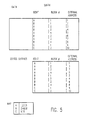
- Figs. 4 and 5 there is set out the general flow of map recovery using an illustrative example. It should be recalled that the general object is to fully recover the map information. The assumption made is that between the map and the redundant map information dispersed about DASD as SUFFIXES to data blocks, the SUFFIXES are more likely to be accurate.
- map recovery is initiated upon detection of a SUFFIX/map entry mismatch.
- all of the SUFFIXES must be acquired.
- a two-way sort is made thereon by file identity and relative block numbers. The primary sort is by the file ID, and the secondary sort is by the relative block number. Any sort package, such as IBM DFSORT Release 11, may be used.
- the sorted product of SUFFIXES represents the reconstructed map.
- Nested faults do not pose a problem. If a fault occurs during the map recovery process, the process can merely be repeated since the rebuild is a replication and sorting of SUFFIXES in which their contents are not changed.
- FIG. 5 there is illustrated three information stages of map recovery.
- the top construct depicts data blocks and their appended SUFFIXES.
- Three SUFFIX fields are shown. These are file ID, relative block number, and external store address. In this example, they are shown resident in external store arranged in consecutive addresses 1-10. Note, each of the files may have more than one entry. That is, a file is partitioned into a number of blocks. Thus, files A and B are represented by counterpart block numbers 1-4, while file C has only two blocks.
- n is the number of SUFFIX fields. More particularly, a two-way sort is shown in which the file ID is the primary index and the relative block number is the secondary index.
- the last construct is the map setting forth the file ID and the external storage address of its counterpart blocks.
- the external addresses follow a nonsequential order, i.e., 1, 3, "7", 5. This results from the fact that blocks are assigned addresses randomly, and the map is secondarily ordered by relative block number and not by external storage address.
- the rebuilt map represents the storage state of SMS as of its rebuild time. It may account for files deleted but not erased. However, the method cannot guarantee a 100 percent recovery. It relies upon the empirical high frequency of storage access and the fact that such access is close enough to fault occurrence that any consequential map corruption will be detected by SUFFIX/map mismatch.
- Map recovery is enhanced if this method is used within an application or an SMS having log-based, forward and backward error recovery. It should be remembered that the focus of log-based recovery is to return the information state of application transactions to a prior state of consistency and not on recovery of SMS map constructs. Indeed, if the maps fail, such log-based recovery fails in the absence of the method of this invention.
Landscapes
- Engineering & Computer Science (AREA)
- Theoretical Computer Science (AREA)
- Quality & Reliability (AREA)
- Physics & Mathematics (AREA)
- General Engineering & Computer Science (AREA)
- General Physics & Mathematics (AREA)
- Library & Information Science (AREA)
- Information Retrieval, Db Structures And Fs Structures Therefor (AREA)
- Techniques For Improving Reliability Of Storages (AREA)
- Memory System Of A Hierarchy Structure (AREA)
Applications Claiming Priority (2)
| Application Number | Priority Date | Filing Date | Title |
|---|---|---|---|
| US38251389A | 1989-07-19 | 1989-07-19 | |
| US382513 | 1989-07-19 |
Publications (2)
| Publication Number | Publication Date |
|---|---|
| EP0409808A2 true EP0409808A2 (de) | 1991-01-23 |
| EP0409808A3 EP0409808A3 (en) | 1991-11-27 |
Family
ID=23509286
Family Applications (1)
| Application Number | Title | Priority Date | Filing Date |
|---|---|---|---|
| EP19900850219 Withdrawn EP0409808A3 (en) | 1989-07-19 | 1990-05-29 | Method for ensuring map integrity in a system-managed store of a computer |
Country Status (3)
| Country | Link |
|---|---|
| US (1) | US5675767A (de) |
| EP (1) | EP0409808A3 (de) |
| JP (1) | JPH0358145A (de) |
Families Citing this family (13)
| Publication number | Priority date | Publication date | Assignee | Title |
|---|---|---|---|---|
| US6208999B1 (en) * | 1996-12-12 | 2001-03-27 | Network Associates, Inc. | Recoverable computer file system with a signature area containing file integrity information located in the storage blocks |
| US6182188B1 (en) * | 1997-04-06 | 2001-01-30 | Intel Corporation | Method of performing reliable updates in a symmetrically blocked nonvolatile memory having a bifurcated storage architecture |
| US6185663B1 (en) * | 1998-06-15 | 2001-02-06 | Compaq Computer Corporation | Computer method and apparatus for file system block allocation with multiple redo |
| US6694340B1 (en) * | 1998-09-24 | 2004-02-17 | International Business Machines Corporation | Technique for determining the age of the oldest reading transaction with a database object |
| US6901446B2 (en) * | 2001-02-28 | 2005-05-31 | Microsoft Corp. | System and method for describing and automatically managing resources |
| US7203871B2 (en) | 2004-06-03 | 2007-04-10 | Cisco Technology, Inc. | Arrangement in a network node for secure storage and retrieval of encoded data distributed among multiple network nodes |
| JP4943764B2 (ja) * | 2006-08-07 | 2012-05-30 | 三進金属工業株式会社 | 金属製組立棚及びワゴン |
| JP4943765B2 (ja) * | 2006-08-07 | 2012-05-30 | 三進金属工業株式会社 | 金属製組立棚及びワゴン |
| JP4733216B1 (ja) * | 2010-04-05 | 2011-07-27 | 弓子 鈴木 | 食品包装材及び包装された食品 |
| US9594635B2 (en) * | 2014-06-09 | 2017-03-14 | Oracle International Corporation | Systems and methods for sequential resilvering |
| US10671500B2 (en) | 2014-06-09 | 2020-06-02 | Oracle International Corporation | Sequential resilvering of storage devices with reduced restarts |
| CN105808378B (zh) | 2016-02-26 | 2018-10-30 | 华为技术有限公司 | 元数据修复方法及装置 |
| CN113450863B (zh) * | 2021-07-09 | 2024-09-10 | 上海交通大学 | 一种对抗阻变对称存储器硬失效错误的方法 |
Family Cites Families (11)
| Publication number | Priority date | Publication date | Assignee | Title |
|---|---|---|---|---|
| DE1250659B (de) * | 1964-04-06 | 1967-09-21 | International Business Machines Corporation, Armonk, NY (V St A) | Mikroprogrammgesteuerte Datenverarbeitungsanlage |
| US4084226A (en) * | 1976-09-24 | 1978-04-11 | Sperry Rand Corporation | Virtual address translator |
| US4092732A (en) * | 1977-05-31 | 1978-05-30 | International Business Machines Corporation | System for recovering data stored in failed memory unit |
| US4207609A (en) * | 1978-05-08 | 1980-06-10 | International Business Machines Corporation | Method and means for path independent device reservation and reconnection in a multi-CPU and shared device access system |
| US4394733A (en) * | 1980-11-14 | 1983-07-19 | Sperry Corporation | Cache/disk subsystem |
| US4419725A (en) * | 1980-11-14 | 1983-12-06 | Sperry Corporation | Cache/disk subsystem with tagalong copy |
| US4819154A (en) * | 1982-12-09 | 1989-04-04 | Sequoia Systems, Inc. | Memory back up system with one cache memory and two physically separated main memories |
| JPS59165162A (ja) * | 1983-03-11 | 1984-09-18 | インタ−ナシヨナル ビジネス マシ−ンズ コ−ポレ−シヨン | ボリューム回復方法 |
| US4751639A (en) * | 1985-06-24 | 1988-06-14 | Ncr Corporation | Virtual command rollback in a fault tolerant data processing system |
| US5027316A (en) * | 1986-09-11 | 1991-06-25 | International Business Machines Corporation | Versioning of message formats in a 24-hour operating environment |
| US5089958A (en) * | 1989-01-23 | 1992-02-18 | Vortex Systems, Inc. | Fault tolerant computer backup system |
-
1990
- 1990-05-29 EP EP19900850219 patent/EP0409808A3/en not_active Withdrawn
- 1990-07-17 JP JP2187346A patent/JPH0358145A/ja active Granted
-
1992
- 1992-11-10 US US07/973,937 patent/US5675767A/en not_active Expired - Fee Related
Also Published As
| Publication number | Publication date |
|---|---|
| US5675767A (en) | 1997-10-07 |
| EP0409808A3 (en) | 1991-11-27 |
| JPH0358145A (ja) | 1991-03-13 |
| JPH0529938B2 (de) | 1993-05-06 |
Similar Documents
| Publication | Publication Date | Title |
|---|---|---|
| US6829688B2 (en) | File system backup in a logical volume management data storage environment | |
| US6502108B1 (en) | Cache-failure-tolerant data storage system storing data objects with version code equipped metadata tokens | |
| US5089958A (en) | Fault tolerant computer backup system | |
| US7440966B2 (en) | Method and apparatus for file system snapshot persistence | |
| US8028006B2 (en) | Method and apparatus for exchanging sub-hierarchical structures within a hierarchical file system | |
| KR100211790B1 (ko) | 직접 액세스 저장 장치에서 데이터 압축을 위한 디렉토리 재 구축 방법 및 장치 | |
| US6434681B1 (en) | Snapshot copy facility for a data storage system permitting continued host read/write access | |
| US6038639A (en) | Data file storage management system for snapshot copy operations | |
| US7640412B2 (en) | Techniques for improving the reliability of file systems | |
| US5581724A (en) | Dynamically mapped data storage subsystem having multiple open destage cylinders and method of managing that subsystem | |
| US8099572B1 (en) | Efficient backup and restore of storage objects in a version set | |
| US7587564B2 (en) | System, method and computer program product for managing data versions | |
| US5504857A (en) | Highly available fault tolerant relocation of storage with atomicity | |
| US7293146B1 (en) | Method and apparatus for restoring a corrupted data volume | |
| US6912614B2 (en) | Disk array apparatus and data restoring method used therein | |
| EP0433269A2 (de) | Volumenüberprüfungsverfahren und -gerät | |
| JPH0658646B2 (ja) | デ−タ持続性が制御される仮想記憶アドレス変換機構 | |
| US6880053B2 (en) | Instant refresh of a data volume copy | |
| US5675767A (en) | Method for verification and restoration of directories in CPU system managed store | |
| US7047390B2 (en) | Method, system, and program for managing a relationship between one target volume and one source volume | |
| US7526622B1 (en) | Method and system for detecting and correcting data errors using checksums and replication | |
| CN119248197B (zh) | 一种数据处理方法、装置、设备及介质 | |
| CN111414320A (zh) | 基于日志文件系统的非易失内存构建磁盘cache的方法及系统 | |
| US7047378B2 (en) | Method, system, and program for managing information on relationships between target volumes and source volumes when performing adding, withdrawing, and disaster recovery operations for the relationships | |
| Ng et al. | Comparing disk and memory's resistance to operating system crashes |
Legal Events
| Date | Code | Title | Description |
|---|---|---|---|
| PUAI | Public reference made under article 153(3) epc to a published international application that has entered the european phase |
Free format text: ORIGINAL CODE: 0009012 |
|
| AK | Designated contracting states |
Kind code of ref document: A2 Designated state(s): DE FR GB |
|
| 17P | Request for examination filed |
Effective date: 19901213 |
|
| PUAL | Search report despatched |
Free format text: ORIGINAL CODE: 0009013 |
|
| AK | Designated contracting states |
Kind code of ref document: A3 Designated state(s): DE FR GB |
|
| 17Q | First examination report despatched |
Effective date: 19940405 |
|
| STAA | Information on the status of an ep patent application or granted ep patent |
Free format text: STATUS: THE APPLICATION HAS BEEN WITHDRAWN |
|
| 18W | Application withdrawn |
Withdrawal date: 19950621 |