EP0410461A2 - Faksimileübertragungsgerät - Google Patents
Faksimileübertragungsgerät Download PDFInfo
- Publication number
- EP0410461A2 EP0410461A2 EP90114385A EP90114385A EP0410461A2 EP 0410461 A2 EP0410461 A2 EP 0410461A2 EP 90114385 A EP90114385 A EP 90114385A EP 90114385 A EP90114385 A EP 90114385A EP 0410461 A2 EP0410461 A2 EP 0410461A2
- Authority
- EP
- European Patent Office
- Prior art keywords
- original document
- facsimile
- image data
- transmitted
- data
- Prior art date
- Legal status (The legal status is an assumption and is not a legal conclusion. Google has not performed a legal analysis and makes no representation as to the accuracy of the status listed.)
- Granted
Links
- 230000006854 communication Effects 0.000 title claims abstract description 58
- 238000004891 communication Methods 0.000 title claims abstract description 58
- 230000005540 biological transmission Effects 0.000 claims abstract description 21
- 230000000875 corresponding effect Effects 0.000 claims description 18
- 230000001276 controlling effect Effects 0.000 claims description 4
- 230000006870 function Effects 0.000 description 23
- 238000000034 method Methods 0.000 description 20
- 230000000994 depressogenic effect Effects 0.000 description 8
- 238000010586 diagram Methods 0.000 description 6
- 230000002596 correlated effect Effects 0.000 description 4
- 230000000881 depressing effect Effects 0.000 description 4
- 230000009365 direct transmission Effects 0.000 description 3
- 238000004904 shortening Methods 0.000 description 3
- 230000004044 response Effects 0.000 description 2
- 230000005856 abnormality Effects 0.000 description 1
- 239000004973 liquid crystal related substance Substances 0.000 description 1
- 230000007257 malfunction Effects 0.000 description 1
- 230000003287 optical effect Effects 0.000 description 1
- 230000000717 retained effect Effects 0.000 description 1
Images


Classifications
-
- H—ELECTRICITY
- H04—ELECTRIC COMMUNICATION TECHNIQUE
- H04N—PICTORIAL COMMUNICATION, e.g. TELEVISION
- H04N1/00—Scanning, transmission or reproduction of documents or the like, e.g. facsimile transmission; Details thereof
- H04N1/32—Circuits or arrangements for control or supervision between transmitter and receiver or between image input and image output device, e.g. between a still-image camera and its memory or between a still-image camera and a printer device
- H04N1/327—Initiating, continuing or ending a single-mode communication; Handshaking therefor
- H04N1/32765—Initiating a communication
- H04N1/32767—Initiating a communication in response to a user operation, e.g. actuating a switch
-
- H—ELECTRICITY
- H04—ELECTRIC COMMUNICATION TECHNIQUE
- H04N—PICTORIAL COMMUNICATION, e.g. TELEVISION
- H04N1/00—Scanning, transmission or reproduction of documents or the like, e.g. facsimile transmission; Details thereof
- H04N1/32—Circuits or arrangements for control or supervision between transmitter and receiver or between image input and image output device, e.g. between a still-image camera and its memory or between a still-image camera and a printer device
- H04N1/327—Initiating, continuing or ending a single-mode communication; Handshaking therefor
- H04N1/32765—Initiating a communication
-
- H—ELECTRICITY
- H04—ELECTRIC COMMUNICATION TECHNIQUE
- H04N—PICTORIAL COMMUNICATION, e.g. TELEVISION
- H04N1/00—Scanning, transmission or reproduction of documents or the like, e.g. facsimile transmission; Details thereof
- H04N1/32—Circuits or arrangements for control or supervision between transmitter and receiver or between image input and image output device, e.g. between a still-image camera and its memory or between a still-image camera and a printer device
- H04N1/327—Initiating, continuing or ending a single-mode communication; Handshaking therefor
- H04N1/32765—Initiating a communication
- H04N1/32769—Initiating a communication in response to detection of an original
-
- H—ELECTRICITY
- H04—ELECTRIC COMMUNICATION TECHNIQUE
- H04N—PICTORIAL COMMUNICATION, e.g. TELEVISION
- H04N1/00—Scanning, transmission or reproduction of documents or the like, e.g. facsimile transmission; Details thereof
- H04N1/32—Circuits or arrangements for control or supervision between transmitter and receiver or between image input and image output device, e.g. between a still-image camera and its memory or between a still-image camera and a printer device
- H04N1/327—Initiating, continuing or ending a single-mode communication; Handshaking therefor
- H04N1/32765—Initiating a communication
- H04N1/32771—Initiating a communication in response to a request, e.g. for a particular document
-
- H—ELECTRICITY
- H04—ELECTRIC COMMUNICATION TECHNIQUE
- H04N—PICTORIAL COMMUNICATION, e.g. TELEVISION
- H04N1/00—Scanning, transmission or reproduction of documents or the like, e.g. facsimile transmission; Details thereof
- H04N1/32—Circuits or arrangements for control or supervision between transmitter and receiver or between image input and image output device, e.g. between a still-image camera and its memory or between a still-image camera and a printer device
- H04N1/32496—Changing the task performed, e.g. reading and transmitting, receiving and reproducing, copying
Definitions
- the present invention relates to a facsimile communication device.
- a facsimile communication device which is used as a sort of communication devices is in wider use of transferring image data, compared with a communication device like a telephone used only for transmitting sound.
- this type of facsimile communication devices has widely employed a function named "sequential data concurrent transmission".
- the sequential data concurrent transmission is the function that, by depressing, for exampe, a sequential data concurrent transmission button, a facsimile communication device storing a plurality of facsimile numbers of other facsimile communication devices reads an original document set in the device and stores its data in an image memory to sequentially transfer contents of the image memory to the plurality of facsimile devices.
- transmission request is the function that a facsimile communication device designates one or more other facsimile communication devices and makes them read an original document set in the former and transmit image data through remote control.
- a conventional facsimile communication device having such functions as stated above comprises operating means like a sequential data transmission button, a transmission request button and the like, separately; and hence, with such devices, there arises the problem that its structure is complicated and its operability degrades.
- a facsimile control system Japanese Unexamined Patent Publication No. 160262/1982
- a facsimile control system in which simply turning on a single switch for polling enables two functions, "permission of polling-transmission” and “commencement of polling-receiving", and the "permission of polling-transmission” is automatically released when the polling-transmission is normally completed, so as to prevent malfunctions caused by the next operation, while the condition of the "permission of polling-transmission" is retained when the polling-transmission is abnormally interrupted, so as to enable the recommencement of receiving by calling a receiving station, or a remote receiver, again.
- a facsimile device capable of switching between a polling-standby mode and a polling-receiving mode (Japanese Unexamined Patent Publication No. 148464/1984) is known.
- An embodiment of the devices has an automatic receiving function capable of satisfying both of a demand for telephonic communication and a demand for facsimile communication from a transmitter (Japanese Unexamined Patent Publication Nos. 90657/1989 and 90661/1989).
- Another embodiment has an automatic receiving function capable of satisfying both of a demand for telephonic communication and a demand for facsimile communication from a transmitter and capable of satisfying a demand for facsimile communication from a manual dialing facsimile communication device (Japanese Unexamined Patent Publication No. 90658/1989).
- Still another embodiment has an automatic receiving function capable of satisfying both of a demand for telephonic communication and a demand for facsimile communication from a transmitter and capable of informing the transmitting station that the device has satisfied the demand for telephonic communication (Japanese Unexamined Patent Publication No. 90659/1989). Yet another embodiment is capable of satisfying both of a demand for telephonic communication and a demand for facsimile communication from a transmitter, and is capable of informing the operators on both transmitting and receiving parties that the device of the receiving station is in use for satisfying the demand for telephonic communication (Japanese Unexamined Patent Publication No. 90660/1989).
- the present invention provides a facsimile communication device comprising designating means for designating identifying data of another facsimile communication device to or from which image data of an original document should be transmitted; original document detecting means for detecting whether or not the original document to be transmitted has been set; and control means for reading outputs from the designating means and original document detecting means and controlling data transmission; if an original document has been set when the designating means designates identifying data, the another facsimile communication device corresponding to the identifying data and to which image data should be transmitted being called to receive the image data of the original document transmitted by the control means, and if the original document has not been set when the designating means designates the identifying data, the another facsimile communication device corresponding to the identifying data and from which the image data should be transmitted being called and required by the control means that the image data should be transmitted from it.
- the designating means designates the identifying data of other facsimile communication devices, and then the original detecting means detects the existence of the original documents in the devices, where the control means receives outputs from these means. If the detecting means detects the existence of the original document when the designating means designates the identifying data, the control means calls other facsimile communication devices to which image data should be transmitted, corresponding to the identifying data; and image data of the original document is transferred to those facsimile communication devices.
- the control means calls other facsimile devices from which image data should be transmitted, corresponding to the identifying data; and those facsimile communication devices are asked to transmit image data.
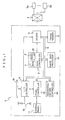
- Fig. 1 is a block diagram for explaining a system architecture of an embodiment according to the present invention.
- a facsimile communication device (shortened as “facsimile device” hereinafter) 1 of the embodiment according to the present invention is connected to a plurality of facsimile devices 3a, . .., 3b (reference numeral "3" denotes them in general) through a telephone network 2.
- the facsimile device 1 of this embodiment fulfills "sequential data concurrent transmission" which is a function of sequentially transmitting image data of an original document that the facsimile device 1 reads to the plurality of facsimile devices 3 connected to the facsimile device 1 and "transmission request" which is a function of polling the facsimile devices 3 to make the facsimile devices 3 read the original document set therein and transfer image data to the facsimile device 1.
- the facsimile device 1 includes a modem 4 for modulating/demodulating image data transferred to and from the telephone network 2 and an image memory 5 for storing image data obtained by reading an original document or received image data.
- the modem 4 and the image memory 5 are connected through a bus line 6 to a main control unit 9 which is a control means including a ROM (Read Only Memory) 7 storing a program for determining the operation of the facsimile device 1 and fixed data, a RAM (Random Access Memory) 8 temporarily storing data required for the operation of the facsimile device 1, a microprocessor and the like.
- ROM Read Only Memory
- RAM Random Access Memory
- the bus line 6 connects to an image data processing unit 10 for processing image data, a panel control unit 12 for controlling a control panel 11 provided with various keys as mentioned below, a mechanism/record control unit 30 for controlling the rotation of a platen roller and the like, an original document sensor 13 as original document detecting means provided cooperatively with an original document holding member for detecting whether or not an original document has been set in the original document holding member, and an input/output control unit 14 for inputting data of the original document.
- the original document sensor 13 may be an optical detecting means composed of mechanical switches such as limit switches, light emitting elements and light receiving elements.
- the input/output control unit 14 is connected to reading means 15 formed of a line image sensor or the like, for reading the original document.
- Fig. 2 is a plan view showing the control panel 11.
- the control panel 11 includes a display unit 16 formed, for example, of a liquid crystal display element, register keys 17 including numeral "0" to “9” keys, a "*" key, a "#” key, etc., a start key 18 for starting the operation, for example, of reading the original document and then transferring image data, and a plurality of (20 in this embodiment) keys K1 to K20 (reference numeral K denotes them in general, if necessary) as designating means for designating identifying data of other facsimile devices 3 to or from which image data should be transmitted.
- Each of the keys K1 to K20 are correlated with facsimile numbers which are identifying data with the facsimile devices 3a, ..., 3b, using the register keys 17, and the relations are stored in the RAM 8.
- the control panel 11 also includes a shortening key 19.
- a facsimile number stored beforehand corresponding to the number is read, and facsimile transmission is able to start.
- the keys K19 and K20 for example, among the keys K1 to K20 function to store a plurality of facsimile numbers.
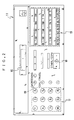
- Fig. 3 is a diagram for explaining contents stored in the RAM 8 of the facsimile device 1.
- the RAM 8 is provided with an area in which facsimile numbers and the like are stored; for example, a range of addresses 01 to 99.
- Twenty rows P1 to P20 corresponding to the addresses 01 to 20 constitute a direct area 25 which corresponds to the above direct transmission function. These rows include a facsimile number column 20, a telephone number column 21 and a column 22 of a name of a receiving station where character data and the like are stored for displaying the name of the receiving station on the display unit 16.
- a facsimile number column 23 where a facsimile number of a facsimile communication device for receiving image data instead and a column 24 of a name of a receiving station are provided.
- a shortened number area 26 corresponding to a shortened signal generating function following a direct area 25 corresponding to the above-mentioned direct transmission function, which are provided with rows P21 to P99 corresponding to the addresses 21 to 99 and with the above-mentioned facsimile number column 20, the telephone number column 21 and the column 22 of a name of a receiving station.
- facsimile numbers and the like correlated with the keys K1 to K20 are set as shown in Fig. 3, by depressing one of the keys K1 to K20, a facsimile number or a telephone number in one of the rows P1 to P20 is read, and facsimile communication or telephone communication can be established. If a facsimile device in the receiving station is in use, the line is connected to a facsimile number stored in the facsimile number column 23, and then image data is transferred. When a two-digit number is inputted using the register keys 17 after the shortening key 19 is depressed, a facsimile number or a telephone number in one of the rows P21 to P99 is read, and thus image data can be transferred or telephone communication can be established.
- Fig. 4 is a diagram showing contents of a group storage area 27 stored in the RAM 8.
- the group storage area 27 includes an identifier sector 28 used as a flag showing whether or not the key K19 or K20 is provided as a so-called group key including a plurality of facsimile numbers, and 50 shortened number data sectors A1 to A50.
- the shortened number data set in the shortened number data sectors A1 to A 50 is read, an address related to the shortened number area 26 in the RAM 8 is generated, and then image data can be transferred and telephone communication can be established.
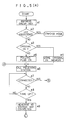
- Figs. 5(a) and 5(b) are flow charts for explaining the operation of this embodiment. The operation of this embodiment will be explained hereinafter in conjunction with Figs. 5(a) and 5(b).
- the key K20 or K19 is depressed.
- a state of the identifier sector 28 is read.
- step a4 If detected, image data of the original document is stored in the image memory 5 at step a4, and the procedure proceeds to step a5. If the answer is negative at step a3, the procedure proceeds to step a6. At step a6, a flag is set in a polling flag sector 29, and the procedure proceeds to step a5.
- step a5 one of the shortened numbers set as shown in Fig. 4 is stored in a group sector G1, the shortened number is converted into an address in the shortened number area in the RAM 8 to read a facsimile number of the address, and thus the facsimile devices 3 are called.
- step a7 it is judged whether or not the connection is established. If the answer is negative, the procedure proceeds to step a8, and it is judged whether or not a predetermined period of time has elapsed. The lapse of the predetermined period of time means that the line cannot be connected to the receiving station, and thus the procedure proceeds to step a9.
- the number of the receiving station is stored as a station which could not be connected.
- step a10 it is judged whether or not the calling operation is completed with regard to all the shortened numbers set in the group sector G1. If the answer is negative, the procedure proceeds to step all, and a shortened number in the group sector G1 which has not been called is read. Otherwise, the station which could not be connected at step a9 is chosen, the procedure proceeds to step a5. If the answer is affirmative at step a10, the procedure proceeds to step a12, and it is judged whether or not the facsimile devices 3 which were called but not connected because the line is busy has been called again. The answer is negative, the procedure proceeds to step all, and the above-mentioned procedure is carried out again. If the answer is affirmative at step a12, such a sequential concurrent transmission is completed.
- step a7 If the answer is affirmative at step a7 and the connection with the facsimile devices 3 are established, the procedure proceeds to step a13, and it is judged whether or not the facsimile devices 3 transmitted a facsimile response signal. If the answer is negative, the procedure proceeds to step a14, and it is judged whether or not a predetermined period of time has elapsed. If the answer is negative, the facsimile response signal is waited. If the answer is affirmative, the procedure proceeds to step a10.
- step a13 If the answer is affirmative at step a13, the procedure proceeds to step a15, and it is judged whether or not a polling flag in the polling flag sector 29 is set. If the answer is negative, the original document was set at step a3, and image data in the image memory 5 is read. Thus, the procedure proceeds to step a16, and image data is transmitted to the facsimile devices 3 to which the connection was established at step a7.
- step a17 a final processing of data transmission/receiving is performed, and the procedure goes back to step a10. If the answer is affirmative at step a15, the procedure proceeds to step a18, and one of the facsimile devices 3 is caused to read the original documents set therein and transmit image data to the facsimile device 1. After that, the procedure proceeds to step a17, and the above-mentioned processing is carried out again.
- the shortened numbers are set as shown in Fig. 4.
- the keys K19, K20 used as the group keys when the original document sensor 13 detects that the original document is set, the above-mentioned sequential concurrent transmission function is utilized to transfer image data to the facsimile devices 3 which correspond to the shortened number set in the key K19.
- the main control unit 9 sequentially designates the facsimile devices 3 corresponding to a shortened dial number set in the key K19 as shown in Fig. 4, and then makes one of the facsimile devices 3 read the original document set therein and transmit image data read from the original document to the facsimile device 1. In this way, the transmission request operation is sequentially performed.
- image data of the original document is transferred to a plurality of facsimile communication devices corresponding to the identifying data.
- the facsimile devices corresponding to the identifying data are sequentially asked to transmit image data.
Landscapes
- Engineering & Computer Science (AREA)
- Multimedia (AREA)
- Signal Processing (AREA)
- Facsimiles In General (AREA)
- Facsimile Transmission Control (AREA)
- Communication Control (AREA)
Applications Claiming Priority (2)
| Application Number | Priority Date | Filing Date | Title |
|---|---|---|---|
| JP197277/89 | 1989-07-28 | ||
| JP1197277A JPH0797817B2 (ja) | 1989-07-28 | 1989-07-28 | ファクシミリ通信装置 |
Publications (3)
| Publication Number | Publication Date |
|---|---|
| EP0410461A2 true EP0410461A2 (de) | 1991-01-30 |
| EP0410461A3 EP0410461A3 (en) | 1992-04-08 |
| EP0410461B1 EP0410461B1 (de) | 1995-07-19 |
Family
ID=16371788
Family Applications (1)
| Application Number | Title | Priority Date | Filing Date |
|---|---|---|---|
| EP19900114385 Expired - Lifetime EP0410461B1 (de) | 1989-07-28 | 1990-07-26 | Faksimileübertragungsgerät |
Country Status (4)
| Country | Link |
|---|---|
| EP (1) | EP0410461B1 (de) |
| JP (1) | JPH0797817B2 (de) |
| CA (1) | CA2022305C (de) |
| DE (1) | DE69020973T2 (de) |
Families Citing this family (1)
| Publication number | Priority date | Publication date | Assignee | Title |
|---|---|---|---|---|
| KR20020092153A (ko) * | 2001-06-01 | 2002-12-11 | 박진숙 | 찻잎 여과구조를 갖는 컵 |
Family Cites Families (5)
| Publication number | Priority date | Publication date | Assignee | Title |
|---|---|---|---|---|
| JPS5825761A (ja) * | 1981-08-07 | 1983-02-16 | Canon Inc | フアクシミリ装置 |
| JPH0754951B2 (ja) * | 1985-08-20 | 1995-06-07 | キヤノン株式会社 | 通信端末装置 |
| JPS62261275A (ja) * | 1986-05-08 | 1987-11-13 | Tokyo Electric Co Ltd | フアクシミリ装置 |
| JPS6427365A (en) * | 1987-07-23 | 1989-01-30 | Fuji Xerox Co Ltd | Facsimile equipment |
| CA1294078C (en) * | 1987-09-30 | 1992-01-07 | Matahira Kotani | Facsimile communication apparatus |
-
1989
- 1989-07-28 JP JP1197277A patent/JPH0797817B2/ja not_active Expired - Lifetime
-
1990
- 1990-07-25 CA CA 2022305 patent/CA2022305C/en not_active Expired - Lifetime
- 1990-07-26 DE DE1990620973 patent/DE69020973T2/de not_active Expired - Fee Related
- 1990-07-26 EP EP19900114385 patent/EP0410461B1/de not_active Expired - Lifetime
Also Published As
| Publication number | Publication date |
|---|---|
| CA2022305C (en) | 1995-01-10 |
| CA2022305A1 (en) | 1991-01-29 |
| DE69020973T2 (de) | 1996-03-21 |
| DE69020973D1 (de) | 1995-08-24 |
| EP0410461A3 (en) | 1992-04-08 |
| EP0410461B1 (de) | 1995-07-19 |
| JPH0360572A (ja) | 1991-03-15 |
| JPH0797817B2 (ja) | 1995-10-18 |
Similar Documents
| Publication | Publication Date | Title |
|---|---|---|
| US4833705A (en) | Data communication apparatus | |
| CA2092352C (en) | Radio telephone apparatus having automatic answering function for confidential messages | |
| HUT61426A (en) | Multipurpose communication equipment and an automatic telphone message device | |
| US5189527A (en) | Facsimile communication device | |
| US5706104A (en) | Image receiving apparatus | |
| KR0122445B1 (ko) | 팩시밀리의 다중식별정보 등록 및 선택송신방법 | |
| US5153912A (en) | Data communication apparatus | |
| US4864602A (en) | PABX-connected facsimile machine | |
| EP0410461B1 (de) | Faksimileübertragungsgerät | |
| US6108411A (en) | Communication device | |
| USRE40845E1 (en) | Facsimile machine with a mailbox function and remote operation mode | |
| JP2759644B2 (ja) | ダイヤルデータ書き込み方法 | |
| EP0252680A2 (de) | Automatische Nummernwähleinrichtung zum Herstellen von Verbindungen zwischen berechtigten Teilnehmern | |
| CA2013384C (en) | Facsimile apparatus | |
| KR0174605B1 (ko) | 상대방 전화번호 메모, 확인장치 및 방법 | |
| JP2547789B2 (ja) | フアクシミリ装置 | |
| JP3147362B2 (ja) | 電子電話帳付き端末装置 | |
| KR970003398B1 (ko) | 팩시밀리전송시 수신자지정제어방법 | |
| EP0604274A1 (de) | Kommunikationsgerät mit Audio-Antwortfunktion | |
| JPH04137971A (ja) | ファクシミリ装置およびその制御方法 | |
| KR100223640B1 (ko) | 팩시밀리에서 재다이얼 번호 저장방법 | |
| JPS6380680A (ja) | 通信装置 | |
| KR100214329B1 (ko) | 무선호출기를 이용한 폴링 수신 요구방법 | |
| JPH075713Y2 (ja) | ファクシミリ装置 | |
| JPS63200663A (ja) | デ−タ通信装置 |
Legal Events
| Date | Code | Title | Description |
|---|---|---|---|
| PUAI | Public reference made under article 153(3) epc to a published international application that has entered the european phase |
Free format text: ORIGINAL CODE: 0009012 |
|
| AK | Designated contracting states |
Kind code of ref document: A2 Designated state(s): DE FR GB |
|
| 17P | Request for examination filed |
Effective date: 19901227 |
|
| PUAL | Search report despatched |
Free format text: ORIGINAL CODE: 0009013 |
|
| AK | Designated contracting states |
Kind code of ref document: A3 Designated state(s): DE FR GB |
|
| 17Q | First examination report despatched |
Effective date: 19940225 |
|
| GRAA | (expected) grant |
Free format text: ORIGINAL CODE: 0009210 |
|
| AK | Designated contracting states |
Kind code of ref document: B1 Designated state(s): DE FR GB |
|
| REF | Corresponds to: |
Ref document number: 69020973 Country of ref document: DE Date of ref document: 19950824 |
|
| ET | Fr: translation filed | ||
| PLBE | No opposition filed within time limit |
Free format text: ORIGINAL CODE: 0009261 |
|
| STAA | Information on the status of an ep patent application or granted ep patent |
Free format text: STATUS: NO OPPOSITION FILED WITHIN TIME LIMIT |
|
| 26N | No opposition filed | ||
| REG | Reference to a national code |
Ref country code: GB Ref legal event code: IF02 |
|
| PGFP | Annual fee paid to national office [announced via postgrant information from national office to epo] |
Ref country code: FR Payment date: 20060719 Year of fee payment: 17 |
|
| PGFP | Annual fee paid to national office [announced via postgrant information from national office to epo] |
Ref country code: DE Payment date: 20060720 Year of fee payment: 17 |
|
| PGFP | Annual fee paid to national office [announced via postgrant information from national office to epo] |
Ref country code: GB Payment date: 20060726 Year of fee payment: 17 |
|
| GBPC | Gb: european patent ceased through non-payment of renewal fee |
Effective date: 20070726 |
|
| PG25 | Lapsed in a contracting state [announced via postgrant information from national office to epo] |
Ref country code: DE Free format text: LAPSE BECAUSE OF NON-PAYMENT OF DUE FEES Effective date: 20080201 |
|
| PG25 | Lapsed in a contracting state [announced via postgrant information from national office to epo] |
Ref country code: GB Free format text: LAPSE BECAUSE OF NON-PAYMENT OF DUE FEES Effective date: 20070726 |
|
| REG | Reference to a national code |
Ref country code: FR Ref legal event code: ST Effective date: 20080331 |
|
| PG25 | Lapsed in a contracting state [announced via postgrant information from national office to epo] |
Ref country code: FR Free format text: LAPSE BECAUSE OF NON-PAYMENT OF DUE FEES Effective date: 20070731 |